
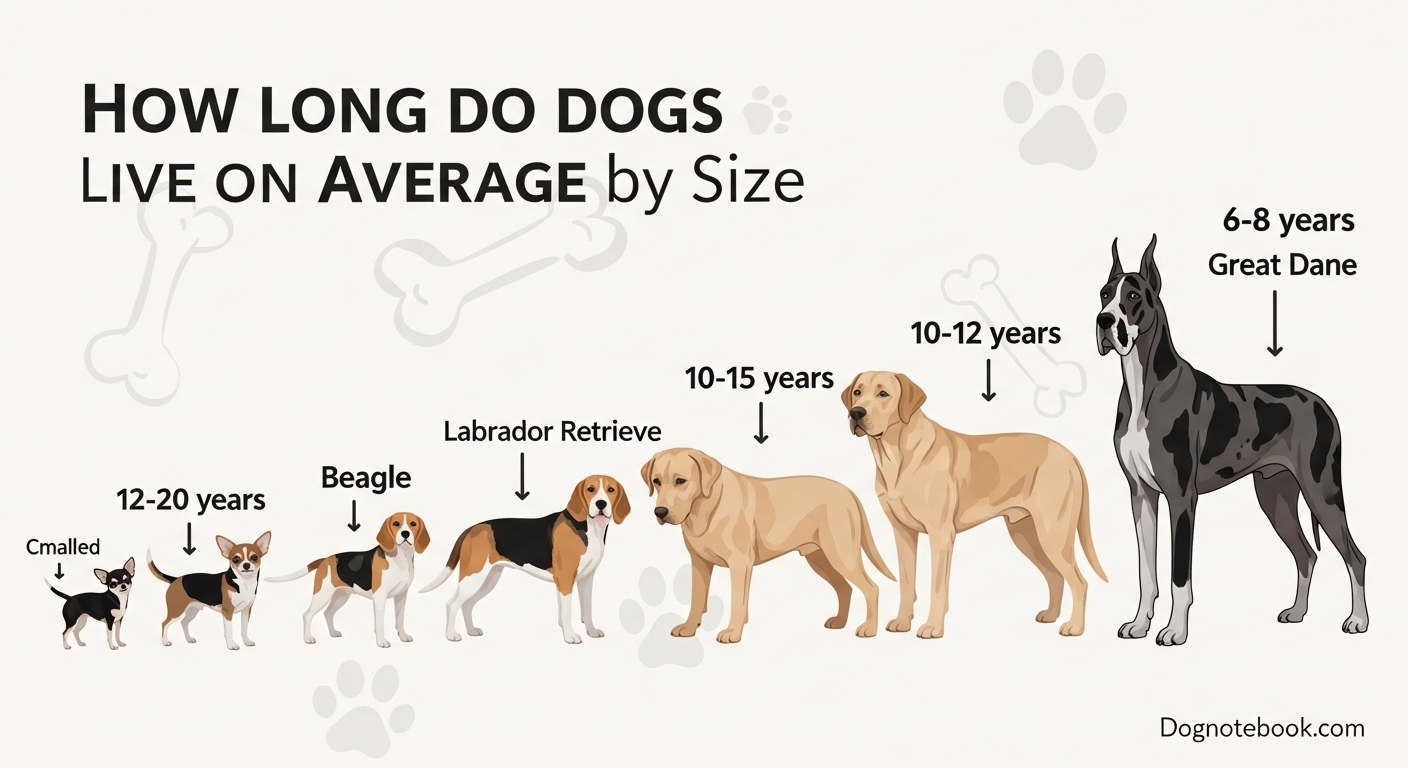
If you have ever wondered how long dogs live on average by size, you are asking one of the most important questions a dog owner can explore. The answer depends heavily on your dog’s size category, and the range is surprisingly wide. A Chihuahua might celebrate 18 birthdays, while a Great Dane might only see 8. That gap matters, not just for setting expectations but for how you plan your dog’s care, veterinary visits, and daily routine throughout their entire life.
Our team has spent weeks researching veterinary studies, breed health databases, and real owner experiences to put together a clear picture of dog life expectancy across every size category. Whether you are choosing a new puppy or trying to understand what stage of life your current dog is in, this guide breaks down exactly what to expect based on size, breed, and the science behind why smaller dogs tend to outlive larger ones.
The overall average dog lifespan falls between 10 and 13 years, but that single number hides a massive range. Size is the single biggest factor influencing how long your dog will live, and understanding that relationship helps you give your dog the best possible shot at a long, healthy life.
Table of Contents
How Long Do Dogs Live on Average by Size?
The average dog lives between 10 and 13 years, according to data from the American Veterinary Medical Association and multiple large-scale breed health studies. But that average flattens out a huge range. Some toy breeds routinely reach 15 to 18 years, while several giant breeds struggle to make it past 8. When someone asks how long dogs live on average by size, the honest answer is that size changes everything.
Here is a quick breakdown of average lifespans by size category:
- Small dogs (under 20 lbs): 10 to 15 years, with many reaching 16 to 18
- Medium dogs (20 to 50 lbs): 10 to 13 years
- Large dogs (50 to 90 lbs): 9 to 12 years
- Giant dogs (over 90 lbs): 8 to 10 years, sometimes as low as 6
Several factors influence where an individual dog falls within these ranges. Genetics, diet, exercise, veterinary care, and even whether the dog is spayed or neutered all play meaningful roles. But size remains the most consistent predictor of lifespan across thousands of breeds and millions of individual dogs studied by researchers.
It is worth distinguishing between lifespan (the actual length of a dog’s life) and life expectancy (a statistical prediction based on population averages). Both terms get used interchangeably in casual conversation, but researchers typically use life expectancy when talking about population-level data and lifespan when referring to individual animals. For this article, we use them to mean roughly the same thing.
How Long Do Small Dogs Live?
Small dogs, generally weighing under 20 pounds, have the longest average lifespan of any size category. Most small breeds live between 10 and 15 years, and many routinely reach 16 to 18 years with proper care. Some small mixed breeds have been documented living past 20 years, as we have seen in countless reports from owners in online communities and veterinary records.
Here are specific small breed lifespan examples:
- Chihuahua: 14 to 16 years
- Pomeranian: 12 to 16 years
- Dachshund: 12 to 16 years
- Toy Poodle: 14 to 18 years
- Jack Russell Terrier: 13 to 16 years
- Yorkshire Terrier: 13 to 16 years
- Shih Tzu: 10 to 16 years
- Pug: 13 to 15 years
Small dogs benefit from slower cellular aging and lower overall disease risk compared to larger breeds. However, they are not without health challenges. Dental disease is extremely common in small breeds due to crowded teeth. Patellar luxation (kneecap dislocation) affects many toy breeds, and brachycephalic breeds like Pugs and Shih Tzus face breathing difficulties that can impact quality of life.
One thing I have noticed from talking to small dog owners is that these dogs often stay mentally sharp well into their teens. Cognitive decline seems to set in later for small breeds compared to large breeds, which is a real advantage for both the dog and the person who loves them.
How Long Do Medium-Sized Dogs Live?
Medium-sized dogs, typically weighing between 20 and 50 pounds, land in the middle of the lifespan range at 10 to 13 years on average. This size category includes some of the most popular family dogs, and they tend to strike a solid balance between activity level, health, and longevity.
Here are lifespan ranges for common medium breeds:
- Beagle: 12 to 15 years
- Border Collie: 12 to 15 years
- Australian Shepherd: 12 to 15 years
- Cocker Spaniel: 12 to 15 years
- English Springer Spaniel: 12 to 14 years
- Boston Terrier: 11 to 15 years
- Whippet: 12 to 15 years
Medium dogs often enjoy the best of both worlds. They are active enough for hiking and outdoor adventures, yet they generally avoid the severe joint problems and shortened lifespans that plague many large breeds. If you are trying to choose between breeds and longevity is a priority, medium dogs offer a compelling combination of lifespan and lifestyle compatibility.
For families comparing popular breeds, the lifespan differences between retriever breeds can factor into the decision, though both Golden Retrievers and Labradors fall closer to the large dog category. The comparison is still useful for understanding how breed-specific health issues affect overall longevity within a similar size range.
How Long Do Large Dogs Live?
Large dogs, weighing between 50 and 90 pounds, typically live 9 to 12 years. This is where the lifespan drop-off becomes noticeable compared to smaller breeds. Many large breed owners on forums and in veterinary waiting rooms talk about the grief of losing their dogs at 8 to 10 years, and the data supports those experiences.
Here are lifespan ranges for popular large breeds:
- Golden Retriever: 10 to 12 years
- Labrador Retriever: 10 to 12 years
- German Shepherd: 9 to 13 years
- Rottweiler: 8 to 10 years
- Doberman Pinscher: 10 to 12 years
- Boxer: 10 to 12 years
- Siberian Husky: 12 to 14 years
- Standard Poodle: 12 to 15 years
Cancer is the leading cause of death in large breeds, particularly Golden Retrievers, where studies suggest over 60 percent will develop some form of cancer in their lifetime. Hip dysplasia and other joint conditions are also prevalent, and these issues can significantly reduce quality of life in the final years. Bone cancer specifically comes up again and again in owner discussions as a common cause of death in large breeds.
Rottweilers deserve a specific mention because they frequently come up in owner discussions about short lifespans. Real owners on Reddit consistently report their Rottweilers passing between 8 and 10 years, often from cancer or cardiac issues. This matches the veterinary data closely and is something prospective Rottweiler owners should be prepared for.
The emotional toll of a shorter lifespan is something large dog owners need to be ready for. Many owners describe it as the trade-off for having a big, loyal companion. Knowing what to expect can help you plan better veterinary care and make the most of the years you have together.
How Long Do Giant Dog Breeds Live?
Giant breeds, those weighing over 90 pounds, have the shortest lifespans of any size category. Most giant dogs live between 8 and 10 years, and some breeds average only 6 to 8 years. This is the hardest category for owners emotionally, as the time with these gentle giants always feels too short.
Here are lifespan ranges for giant breeds:
- Great Dane: 7 to 10 years
- Saint Bernard: 8 to 10 years
- Irish Wolfhound: 6 to 8 years
- English Mastiff: 6 to 10 years
- Bernese Mountain Dog: 6 to 8 years
- Newfoundland: 8 to 10 years
- Great Pyrenees: 10 to 12 years
The Irish Wolfhound and Bernese Mountain Dog are among the shortest-lived breeds in the entire world. Both routinely face diagnoses of osteosarcoma (bone cancer), which is particularly common and aggressive in giant breeds. Great Danes frequently die from cardiac conditions, especially dilated cardiomyopathy, and gastric torsion (bloat) is a constant risk for deep-chested giant breeds.
Giant dogs also age faster in visible ways. A 5-year-old Great Dane often looks and acts noticeably older than a 5-year-old Beagle. Their bodies simply wear out faster, which is why understanding the aging timeline is so important for giant breed owners. You need to start senior-level care much earlier than you might expect.
For anyone considering a giant breed, I want to be honest: the grief comes sooner. But owners almost universally say the experience is worth it. These dogs pack an enormous amount of love into fewer years, and being prepared for that timeline helps you treasure every single month.
Why Do Smaller Dogs Live Longer Than Big Dogs?
The question of why smaller dogs live longer has puzzled researchers for decades, and it actually contradicts a pattern seen across most of the animal kingdom. In general, larger mammals like elephants and whales outlive small ones like mice. But within the dog species, the reverse is true, and scientists have identified several key explanations for this.
The primary theory involves accelerated cell growth. Large dog breeds grow from a tiny puppy to a massive adult in roughly the same timeframe as small breeds, which means their cells divide at a much faster rate. This rapid cell division increases the chance of harmful mutations and cancerous growths. Research published in The American Naturalist found that faster-growing breeds have significantly higher cancer rates, which strongly supports this theory.
Metabolic rate also plays a role. Small dogs have a higher metabolic rate per unit of body mass, which some researchers believe leads to more efficient cellular repair mechanisms. Their bodies process energy differently at the cellular level, and this may protect against age-related damage over time.
Genetic factors compound the issue. Many large breeds were developed from small founder populations, leading to higher inbreeding coefficients. The American Kennel Club notes that breeds with smaller gene pools tend to accumulate more hereditary health problems over generations. German Shepherds, for example, have been heavily line-bred for specific physical traits, contributing to their high rates of hip dysplasia and degenerative myelopathy.
The Dog Aging Project, a large-scale research initiative based at the University of Washington, is actively studying why dogs of different sizes age at different rates. This project tracks tens of thousands of dogs across the United States and has already produced data suggesting that the size-lifespan relationship is more complex than previously thought, involving hundreds of genetic markers related to growth hormones and immune function. Their findings continue to shape how veterinarians understand canine aging in 2026.
Mixed-Breed vs Purebred Dog Lifespan
Mixed-breed dogs tend to live 1 to 2 years longer than purebred dogs of comparable size, according to studies from veterinary teaching hospitals. This advantage comes from what biologists call hybrid vigor, or heterosis. When a dog inherits genes from two distinct breed lines, the harmful recessive genes that cause hereditary diseases are less likely to pair up and express themselves.
In practical terms, a medium-sized mixed breed might live 12 to 15 years, while a purebred of similar size averages 10 to 13 years. The difference is most pronounced in breeds with known genetic health issues. A purebred German Shepherd has a relatively high risk of degenerative myelopathy, while a German Shepherd mix is statistically less likely to develop the condition.
That said, mixed breed status is not a guarantee of a longer life. Diet, exercise, weight management, and veterinary care all matter enormously. A well-cared-for purebred will almost certainly outlive a neglected mixed breed. But all else being equal, the genetic diversity of mixed breeds provides a measurable longevity advantage.
Small mixed breeds are the real longevity champions. Owners regularly report their small mixed breed dogs living into the late teens, and it is not unusual to hear of dogs reaching 18 to 20 years. These dogs combine the inherent longevity advantage of small size with the genetic benefits of mixed heritage, making them the longest-living group of dogs you will find anywhere.
Signs of Aging in Dogs by Size Category
One of the biggest gaps we found while researching this topic is clear guidance on when your dog becomes a “senior” based on their size. A dog’s senior status does not arrive at the same age for every breed, and recognizing the transition helps you adjust their care appropriately.
Here is when dogs typically enter their senior years by size:
- Small dogs: Senior around 10 to 12 years
- Medium dogs: Senior around 8 to 10 years
- Large dogs: Senior around 6 to 8 years
- Giant dogs: Senior around 5 to 6 years
The signs of aging are similar across all sizes, but they show up earlier in large and giant breeds. Graying around the muzzle is usually the first visible sign. You might notice your dog slowing down on walks, sleeping more during the day, or taking longer to get up from lying down.
Joint stiffness is one of the most common age-related changes, particularly in larger dogs. If your 7-year-old Labrador starts hesitating before jumping into the car, that is a normal sign of aging, but it is also worth mentioning to your veterinarian. Cognitive changes can also appear, including confusion, disorientation, and changes in sleep patterns.
I always recommend that owners of large and giant breeds start watching for these signs earlier than they might expect. Catching age-related changes early means you can adjust diet, add joint supplements, and modify exercise routines before small problems become big ones.
How to Help Your Dog Live Longer
While genetics and size set the baseline for your dog’s lifespan, the care you provide can add meaningful years to their life. Here are the most impactful things you can do to help your dog live as long as possible, regardless of their size.
Maintain a healthy weight. This is the single most important factor within your control. Studies have shown that dogs kept at an ideal weight live an average of 1.8 years longer than overweight dogs. The Purina Lifespan Study, one of the most comprehensive canine nutrition studies ever conducted, followed 48 Labrador Retrievers for 14 years and found that the feed-restricted group lived significantly longer with fewer age-related diseases.
Schedule regular veterinary checkups. Annual exams are the minimum for adult dogs, and twice-yearly visits are recommended for seniors. Blood work, dental exams, and cancer screenings become increasingly important as your dog ages. For large and giant breeds, consider starting biannual visits at age 5 or 6 rather than waiting until the traditional senior threshold.
Take dental health seriously. Dental disease affects an estimated 80 percent of dogs over age 3, and the bacteria from dental infections can spread to the heart, liver, and kidneys. Regular brushing at home and professional cleanings under anesthesia when recommended by your vet can add 1 to 3 years to your dog’s life.
Provide appropriate exercise. Exercise needs change with age and size, but every dog benefits from consistent physical activity. For young, healthy dogs, aim for 30 to 60 minutes of exercise daily. For senior dogs, shorter and gentler walks and swimming are excellent low-impact options that keep joints mobile without causing damage.
Feed quality nutrition for their life stage. Puppy food, adult food, and senior food are formulated differently for good reason. Large breed puppies, for example, should eat food specifically designed for controlled growth to reduce the risk of joint problems later in life. Senior dogs often benefit from added joint supplements like glucosamine and omega-3 fatty acids.
Keep up with mental stimulation. Cognitive enrichment is just as important as physical exercise. Puzzle toys, training sessions, nose work, and socialization all help keep your dog’s brain active and may slow cognitive decline in older dogs. Think of it as brain training that pays dividends in your dog’s later years.
Dog Years to Human Years: A Better Way to Calculate
The old rule of multiplying by 7 to convert dog years to human years is inaccurate. The American Veterinary Medical Association recommends a more nuanced approach that accounts for the fact that dogs age much faster in their first two years, with the rate of aging then slowing down and varying by size.
Under the updated method, a 1-year-old dog is roughly equivalent to a 15-year-old human, regardless of breed. By age 2, that equivalence reaches about 24 human years. After that, each calendar year adds roughly 4 to 5 human years for small dogs and 5 to 6 human years for large dogs.
This means a 10-year-old small dog is about 56 in human years, while a 10-year-old giant breed is closer to 66 to 70 in human terms. Understanding this conversion helps you contextualize where your dog is in their life journey and adjust your expectations and care routine accordingly.
FAQ
What is the 7 7 7 rule for dogs?
The 7 7 7 rule for dogs suggests that a dog needs 7 hours of sleep, 7 miles of exercise per week, and 7 minutes of training per day. While this is not a scientifically validated guideline, it serves as a helpful reminder that dogs need adequate rest, regular physical activity, and consistent mental stimulation to stay healthy throughout their lifespan.
What percentage of dogs live to 13?
Approximately 30 to 40 percent of dogs live to age 13 or beyond, though this varies significantly by size. Small and medium breeds are much more likely to reach 13 than large or giant breeds. Veterinary health data suggests that over half of small dogs reach 13 years, while fewer than 15 percent of giant breeds reach that age.
Which size dog lives the longest?
Small dogs, those weighing under 20 pounds, live the longest. Breeds like Chihuahuas, Toy Poodles, and Jack Russell Terriers routinely live 14 to 18 years, and some small mixed breeds have been documented living past 20 years. The smallest dogs in any breed category tend to have the longest lifespans within that group.
Can a dog live 30 years?
No verified case of a dog living to 30 years exists. The longest verified lifespan belongs to Bluey, an Australian Cattle Dog who lived 29 years and 5 months (1910 to 1939), recognized by Guinness World Records. A few unverified claims have approached 30 years, but no dog has been confirmed to reach that milestone. Most dogs that reach their late teens or early twenties are small breeds under 20 pounds.
Do mixed breed dogs live longer than purebreds?
Yes, on average mixed breed dogs live 1 to 2 years longer than purebred dogs of comparable size. This advantage comes from genetic diversity, which reduces the risk of inheriting two copies of harmful recessive genes that cause hereditary diseases. However, individual care, weight management, and veterinary attention have a larger impact on lifespan than breed status alone.
How long do dogs live on average by size?
Small dogs (under 20 lbs) live 10 to 15 years on average. Medium dogs (20 to 50 lbs) live 10 to 13 years. Large dogs (50 to 90 lbs) live 9 to 12 years. Giant dogs (over 90 lbs) live 8 to 10 years, with some breeds averaging only 6 to 8 years. Size is the single biggest predictor of dog lifespan.
Final Thoughts on Dog Lifespan by Size
Understanding how long dogs live on average by size gives you a realistic framework for caring for your dog at every stage of their life. Small dogs reward you with the longest companionship, often staying by your side for 14 to 18 years. Medium dogs offer a balanced 10 to 13 years of active partnership. Large and giant breeds give you fewer years but make up for it with outsized personalities and unwavering loyalty.
No matter what size dog you share your life with, the quality of care you provide makes a real difference. Weight management, regular veterinary visits, dental care, and appropriate exercise can add years to any dog’s life. The numbers we have covered are averages, not guarantees. Every dog is an individual, and the best thing you can do is give them the healthiest, happiest life possible for however long that turns out to be.
If you are choosing a new dog and lifespan is a major factor in your decision, consider a small or medium mixed breed for the best odds of a long companionship. And if you already have a large or giant breed, know that early and proactive veterinary care is your strongest tool for maximizing the years you have together.