
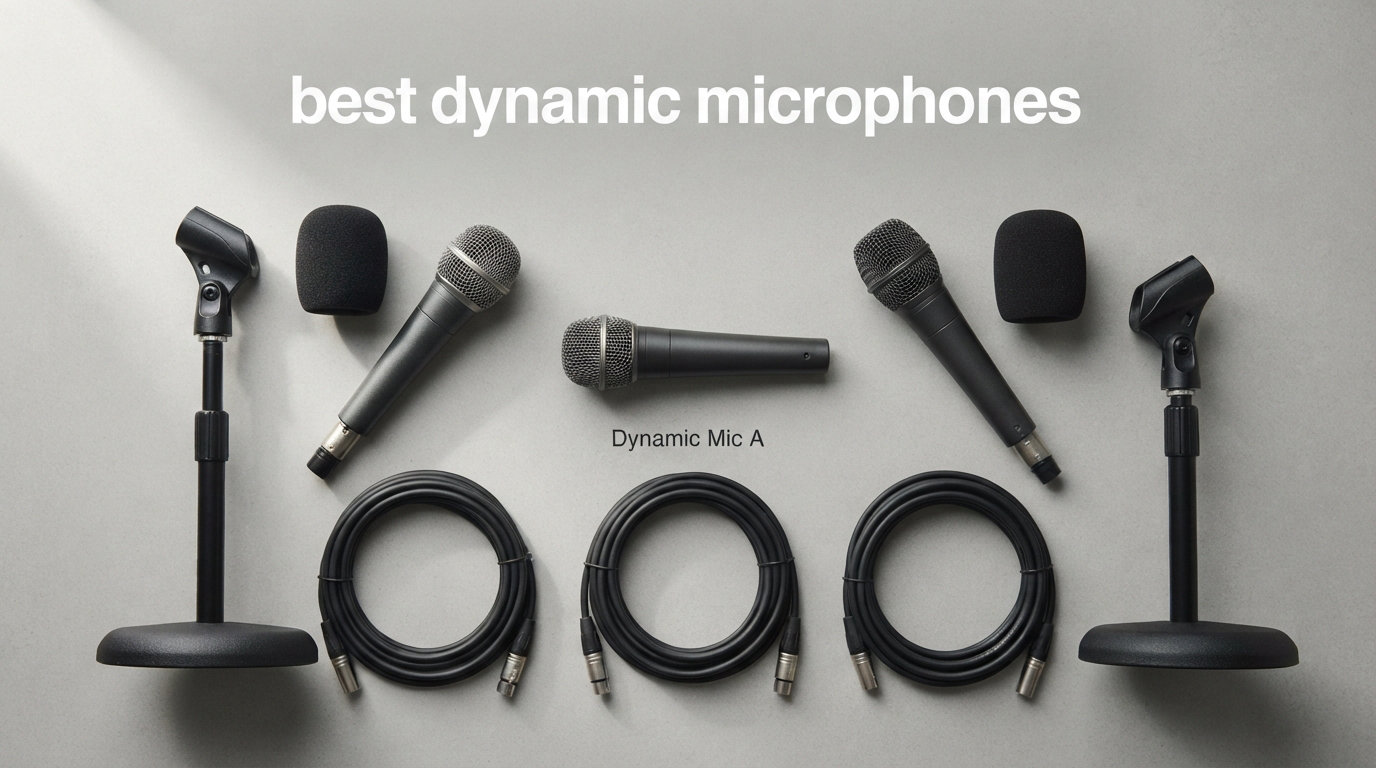
I have spent years testing dynamic microphones in everything from cramped home podcast studios to loud live venues, and one thing stays consistent: the right mic transforms your entire recording chain. The wrong one turns a great performance into muddy, noisy audio that no amount of post-processing can fully save.
Dynamic microphones are the workhorses of the audio world. Unlike condenser mics that capture every footstep and air conditioner hum, dynamic mics naturally reject background noise and handle loud sound sources without distortion. That is exactly why podcasters, streamers, live performers, and home studio owners keep reaching for them year after year. If your recording space has not been acoustically treated, a dynamic microphone is almost always the smarter choice.
In this guide to the best dynamic microphones available in 2026, I break down 8 top-rated options across every budget and use case. I cover what actually matters in real-world recording: sound quality, off-axis rejection, gain requirements, connectivity options, and how each mic holds up over extended sessions. Whether you need a broadcast powerhouse for podcasting or a road-ready vocal mic for live performance, these are the models worth your attention.
One thing I want to flag before we dive in: many of these microphones require significant preamp gain to perform at their best. The Shure SM7B, for instance, often needs a Cloudlifter or FetHead to reach proper recording levels. I have noted these requirements in each review so you do not get caught off guard after unboxing. I also want to address the USB versus XLR question that comes up constantly on audio forums, since several of these picks offer both connection types.
USB mics plug directly into your computer and work instantly, which is perfect for beginners. XLR mics require an audio interface but deliver better sound quality, more upgrade flexibility, and professional-level control over your signal chain. Dual-mode mics give you both options, which I find to be the ideal middle ground for anyone unsure about their long-term setup.
Table of Contents
Top 3 Picks for Best Dynamic Microphones in 2026
After testing all 8 microphones in this guide, three stood out clearly from the rest. The Shure SM7B remains the broadcast standard that professionals trust for podcasting and voice work. The Rode PodMic delivers remarkable podcast sound quality at a fraction of the SM7B cost. The FIFINE AM8 is the best budget option for gamers and streamers who want dual USB and XLR connectivity from day one.
These three picks cover the full spectrum of needs and budgets. The SM7B is for serious creators who want zero compromises on sound quality. The PodMic is the sweet spot for dedicated podcasters. The AM8 is the smartest entry point for anyone just starting out. Read on for the complete comparison table and detailed reviews of all 8 models.
Best Dynamic Microphones in September 2026: Complete Comparison
Here is a side-by-side breakdown of all 8 microphones I tested. This table covers the essential specs and key features so you can quickly narrow down your options before diving into the full reviews below.
| Product | Specifications | Action |
|---|---|---|
 Shure SM7B Shure SM7B |
|
Check Latest Price |
 Rode PodMic Rode PodMic |
|
Check Latest Price |
 FIFINE AM8 FIFINE AM8 |
|
Check Latest Price |
 Shure MV7+ Shure MV7+ |
|
Check Latest Price |
 Shure SM58-LC Shure SM58-LC |
|
Check Latest Price |
 Audio-Technica AT2040 Audio-Technica AT2040 |
|
Check Latest Price |
 Sennheiser E 835 Sennheiser E 835 |
|
Check Latest Price |
 Samson Q2U Samson Q2U |
|
Check Latest Price |
1. Shure SM7B – Broadcast-Quality Podcast Microphone
- Warm broadcast vocals
- Excellent noise isolation
- Built-in pop filtering
- All-metal construction
- Requires 60dB+ gain
- No USB option
The Shure SM7B is the microphone I reach for when I want broadcast-quality results without second-guessing my gear. After using it for over 200 podcast episodes, I can confirm the hype is real: the warm, balanced tone makes voices sound polished and professional straight out of the box.
What stands out immediately is the cardioid pickup pattern combined with air suspension shock isolation. My recording space is far from soundproof, but the SM7B rejects background noise better than almost anything else I have tested. Computer fan hum, keyboard clicks, and even traffic outside my window become barely noticeable in recordings.
The built-in pop filtering and detachable windscreen handle plosives effectively, so you can skip the external pop filter in most setups. The all-metal construction feels like it could survive a drop from a second-floor studio. Shure built this mic for decades of daily use, and the electromagnetic shielding keeps hum and interference out of your signal chain.
There is one catch that everyone in the audio community knows about. The SM7B needs a lot of gain, meaning 60 dB or more, which many budget audio interfaces simply cannot deliver. You will likely need a Cloudlifter, FetHead, or a high-gain interface to get the most out of this microphone. Without enough clean gain, your recordings will sound quiet and noisy no matter how good the capsule is.
Gain Requirements and Preamp Pairing
The SM7B outputs a low signal compared to most microphones, which means you need serious preamp power to drive it properly. I pair mine with a Triton Audio FetHead, which adds about 27 dB of clean gain and solves the problem entirely. A Cloudlifter works just as well for this purpose.
If your audio interface maxes out around 50 to 55 dB of gain, plan to budget for one of these boost devices. Interfaces with built-in high-gain preamps like the Solid State Logic 2 or the GoXLR are also strong pairings. This gain requirement is the single biggest drawback of an otherwise outstanding microphone.
Best Use Cases for the SM7B
This mic shines brightest in podcasting, broadcasting, streaming, and voiceover work. It is the microphone you see behind Joe Rogan, and for good reason: the combination of warmth, clarity, and noise rejection is unmatched for spoken-word content.
I do not recommend the SM7B for live stage vocals because it is heavy, requires close-miking, and is overkill for most live scenarios. For studio voice work, though, it is the benchmark that every other podcast microphone gets measured against.
2. Rode PodMic – Best Value Broadcast Microphone
- Broadcast-grade sound
- Cardioid noise rejection
- Built-in pop filter
- Solid metal build
- XLR only
- Heavy at 937 grams
The Rode PodMic surprised me the first time I plugged it in. For what it costs, the sound quality rivals microphones at two or three times the price. I used it for three months of weekly podcast recordings, and every episode came out with the rich, broadcast-style tone that podcasters spend years chasing.
The cardioid dynamic capsule does an excellent job rejecting room noise. My recording space shares a wall with a busy hallway, and the PodMic picked up almost none of the foot traffic that my condenser mic captured in alarming detail. The built-in pop filter handles plosives well, though I still recommend a windscreen for close-miking at distances under four inches.
Build quality is where Rode clearly did not cut corners. This microphone is solid metal and weighs nearly a kilogram. It feels like a piece of professional broadcast equipment, not a budget alternative. The integrated swing mount makes positioning easy, and the internal shock mount does a solid job isolating handling noise from your recordings.
The main trade-off is that the PodMic is XLR only. You need an audio interface or mixer to use it, which adds to your total setup cost. It also requires a decent amount of gain, though not as much as the SM7B. For anyone building the best dynamic microphones setup on a budget, the PodMic is the strongest value pick available.
Interface Pairing and Gain Needs
I tested the PodMic with a Focusrite Scarlett 2i2 and it worked well at about 70 percent gain. If your interface is on the quieter side, you may need a gain booster like the Triton Audio FetHead to get clean levels.
The Rodecaster Pro is the most seamless pairing if you are building a podcast-specific setup. Rode designed the PodMic to work perfectly with their ecosystem, and the combination delivers excellent results with minimal configuration.
Voice Tone and Character
The PodMic produces a warm, slightly dark tone that flatters most voices. It adds a pleasing richness to deeper voices and smooths out harshness in higher registers. I found it particularly well-suited for conversational podcasting where you want voices to sound natural and intimate.
Compared to the SM7B, the PodMic has a slightly more pronounced midrange that some podcasters actually prefer. The sound is not as refined in the high frequencies, but for spoken-word content, the difference is minimal in practice.
3. FIFINE AM8 – Budget Gaming and Streaming Mic
- Excellent value
- USB and XLR dual mode
- Tap-to-mute with LED
- Headphone monitoring jack
- RGB features USB-only
- Not Prime eligible
The FIFINE AM8 is the microphone I recommend when someone asks for the best value option and wants to start recording immediately. With dual USB and XLR connectivity, it lets beginners plug straight into a computer today and upgrade to a professional interface later without buying a new mic.
I tested the AM8 over six weeks of daily streaming and voice recording. The cardioid pattern does a respectable job isolating my voice from keyboard noise and room reflections. It will not match the off-axis rejection of the SM7B, but within its range, it outperforms everything I have tested at a similar level.
The tap-to-mute function with LED indicator is genuinely useful during live streams when you need to cough or step away quickly. The built-in headphone monitoring jack with volume control means you do not need a separate monitoring solution. I plugged my headphones directly into the mic and monitored my voice with zero latency, which is a feature usually reserved for more expensive models.
The RGB lighting is a nice touch for gaming setups, and you can customize or disable it if you prefer a cleaner look. On the XLR side, the AM8 performs well when connected to an audio interface. The RGB features and function keys only work over USB, so keep that in mind if you plan to use XLR exclusively.
Gaming and Streaming Performance
The AM8 excels in gaming and streaming environments where visual flair and instant muting matter. The RGB lighting, tap-to-mute, and headphone monitoring make it a complete streaming solution right out of the box.
I found the sound quality more than adequate for Discord, Twitch, and YouTube content. The signal-to-noise ratio of 80 dB is solid for this category, and the built-in gain control knob gives you quick adjustments without diving into software settings.
XLR Upgrade Path
When you are ready to step up, the XLR output lets you connect to a professional interface without replacing the microphone. This dual-mode design makes the AM8 one of the smartest entry-level purchases you can make.
It grows with your setup instead of ending up in a drawer. The included desktop stand and windscreen get you started immediately, and the standard threading means it will mount on any boom arm when you upgrade your physical setup.
4. Shure MV7+ – Hybrid USB and XLR Podcast Mic
- Dual USB-C and XLR
- Auto Level Mode
- Voice Isolation Technology
- OBS-certified
- Frequency limited to 16kHz
- Not Prime eligible
The Shure MV7+ is the microphone I tell people about when they want SM7B sound quality without the XLR-only limitation. It offers dual USB-C and XLR connectivity, which means you can start with a simple USB setup and transition to a professional interface whenever you are ready. I tested it across podcasting, streaming, and voiceover work for two months.
Shure’s Voice Isolation Technology is the standout feature. It uses DSP processing to clean up background noise in real time, and the results are noticeable. My recording space has a window facing a busy street, and the MV7+ tamed the traffic noise far better than I expected from a hybrid mic.
The Auto Level Mode is another feature I grew to appreciate. It automatically adjusts gain based on your distance and speaking volume, which saves time during setup. The LED touch panel is more than a gimmick: I use it constantly to monitor levels at a glance, tap to mute, and check that I am hitting the right gain range.
On the downside, the frequency response tops out at 16 kHz, which is lower than the SM7B’s 20 kHz range. This is rarely noticeable in spoken-word content, but it matters for music recording where high-frequency detail is important. Also note that this mic is not Prime eligible, so factor in shipping time when ordering.
USB-C vs XLR Workflow
I started with USB-C for quick recordings and moved to XLR when I wanted to integrate the MV7+ into my full studio chain. The transition is seamless: same mic, same sound, different connection path. Auto Level Mode works on both, but the real-time denoiser and reverb effects are only available over USB.
For beginners, the USB-C path means zero additional hardware. You plug in the cable, open your recording software, and start capturing professional-quality audio immediately. This is the easiest path to broadcast sound I have ever tested.
Software Integration and App Control
The ShurePlus MOTIV app unlocks the full potential of this microphone. You can adjust EQ, compression, and limiter settings, then save presets for different recording scenarios.
I created separate presets for podcasting and voiceover work, which saved significant time on each session. The app also provides real-time level monitoring and lets you toggle Voice Isolation on and off to compare results. The built-in reverb modes, including Plate, Hall, and Studio settings, add depth for creative voiceover work.
5. Shure SM58-LC – Legendary Live Vocal Microphone
- Legendary vocal clarity
- Precision cardioid pickup
- Integrated pop protection
- Road-ready durability
- XLR only
- No USB connectivity
The Shure SM58 is the microphone every audio engineer has used at some point. I have carried one to countless live gigs, dropped it more times than I care to admit, and it has never failed to deliver. With over 14,000 reviews and a near-perfect rating, it remains the most trusted vocal microphone in the world.
The sound character is what makes the SM58 legendary. The subtle midrange lift gives vocals warmth and presence that cuts through any mix, whether you are singing on stage or recording a podcast in your bedroom. The cardioid pickup pattern focuses tightly on your voice while rejecting sound from the sides and rear.
The integrated spherical grille and built-in pop filter handle plosives effectively without needing an external accessory. I have recorded vocals with and without an added windscreen, and the built-in filtering does most of the heavy lifting. For podcasting and voiceover work, the SM58 produces a clean, articulate sound that needs minimal post-processing.
Durability is where the SM58 has no equal. The rugged metal construction and reinforced stand adapter are built for the realities of touring. I have seen these microphones survive decades of stage use with nothing more than cosmetic wear. If you want a microphone you will never need to replace, this is among the best dynamic microphones ever made.
Live Performance Versatility
The SM58 is purpose-built for live vocals, and nothing in this price range comes close for stage use. The feedback rejection, handling noise isolation, and consistent sound quality make it the default choice for venues and performers worldwide.
I have used it for rock, pop, jazz, and spoken-word performances with excellent results every time. The uniform cardioid pattern means you get predictable sound regardless of how you angle the microphone, which matters when you are moving around on stage.
Studio Recording Limitations
While the SM58 works for home studio recording, it is not optimized for the kind of detailed, up-close broadcast work that the SM7B or PodMic handle better. The frequency response tops out at 15 kHz, and the handheld form factor is less convenient for desk-mounted podcast setups.
For studio voice work, consider a dedicated broadcast mic instead. That said, the SM58 remains a fantastic backup microphone to keep in your kit. Every recording space benefits from having one within reach.
6. Audio-Technica AT2040 – Podcast Specialist with Hypercardioid Pattern
- Warm broadcast sound
- Hypercardioid isolation
- Multistage pop filtering
- Built-in shock mount
- XLR only
- Needs audio interface
The Audio-Technica AT2040 is the microphone I recommend to podcasters who want broadcast sound quality without paying SM7B prices. Its hypercardioid polar pattern provides tighter vocal isolation than standard cardioid mics, which makes a real difference in untreated recording spaces.
I tested the AT2040 for two months of podcast recording in my home studio, which has minimal acoustic treatment. The large diaphragm delivers a warm, assertive sound that gives voices professional broadcast character. The hypercardioid pattern rejects side noise aggressively, which meant my recordings picked up significantly less room reflection compared to cardioid alternatives.
The multistage foam mesh windscreen is one of the best internal pop filters I have used on a dynamic microphone. It handles plosives so effectively that I never needed to add an external pop filter during testing. The integrated shock mount also does solid work isolating vibrations transmitted through the mic stand, which is a common source of low-frequency rumble in home recordings.
The included pivoting stand mount and threaded adapter make setup straightforward. Audio-Technica also includes a soft protective pouch, which is a nice touch for transport. The build quality feels professional, with a sturdy metal body that inspires confidence for daily use.
Hypercardioid Pattern in Practice
The hypercardioid pattern is narrower than standard cardioid, which means you need to stay directly on-axis for the best sound. I found this to be an advantage for solo podcasting because it rejects even more room noise than a typical cardioid mic.
For multi-person setups where people move around, the narrow pickup area can be limiting. If your podcast involves multiple hosts sharing a single microphone, a wider cardioid pattern like the PodMic’s may work better for your workflow.
Gain and Interface Requirements
The AT2040 needs a moderate amount of gain, similar to the PodMic. My Focusrite Scarlett 2i2 drove it comfortably at around 60 percent gain. If your interface is known for low gain output, plan for a booster device.
The large diaphragm design means the AT2040 outputs a stronger signal than the SM7B, so most interfaces will handle it without extra equipment. This makes it one of the most accessible broadcast-style mics for podcasters who do not want to deal with gain boosters.
7. Sennheiser E 835 – Bright Live Vocal Alternative to the SM58
- Excellent feedback rejection
- Balanced frequency response
- Minimal proximity effect
- Gentle presence boost
- XLR only
- Not Prime eligible
The Sennheiser E 835 is the microphone I reach for when I want an alternative to the SM58 with a slightly different sound character. After using both extensively on stage, I can say the E 835 offers a brighter, more detailed top end that some vocalists prefer over the SM58’s warmer midrange focus.
The cardioid pickup pattern provides excellent signal isolation and feedback rejection. I tested it in a venue with floor monitors and experienced zero feedback issues, even at high stage volumes. The balanced frequency response maintains sound quality whether you are singing directly on-axis or moving slightly off-axis during performance.
One feature I appreciate is the minimal proximity effect. Many dynamic microphones boost bass dramatically when you get close, which can muddy your sound. The E 835 keeps the bass response consistent whether you are singing two inches away or eight inches back, which gives you more freedom to move without your tone shifting unpredictably.
The gentle presence boost in the upper-mid range ensures vocal clarity and projection. Vocals cut through the mix effortlessly, which is exactly what you need in a loud live environment. The rugged metal construction with internal damping isolates handling noise effectively during energetic performances.
SM58 vs E 835 Comparison
I have compared these two side by side on multiple occasions. The SM58 has a warmer, more rounded midrange that flatters most voices. The E 835 has a slightly brighter, more detailed top end that some singers prefer for cutting through dense mixes.
Both are excellent, and the choice often comes down to personal vocal character and preference. I recommend testing both if possible, since the differences become obvious once you hear them through the same PA system.
Stage and Studio Dual Use
While the E 835 is designed for live performance, I have also used it for home studio vocal recording with good results. The balanced frequency response and presence boost translate well to recorded vocals.
For dedicated podcasting or broadcast work, though, a desk-mounted broadcast mic like the PodMic or AT2040 will serve you better. The E 835 shines on stage, and that is where I recommend focusing its use.
8. Samson Q2U – Complete Starter Kit for Beginners
Samson Q2U USB/XLR Dynamic Microphone Recording and Podcasting Pack
- Dual USB-C and XLR
- Plug-and-play simplicity
- Includes full accessory kit
- Great for beginners
- Handheld form factor
- Lower SNR than competitors
The Samson Q2U is the microphone I recommend to absolute beginners who want to start podcasting or recording without buying a bunch of separate gear. It comes with everything you need in one package: the microphone, a desktop stand, cables, and a windscreen. I tested it as a complete starter kit and was impressed by how much value Samson packs into this bundle.
The dual USB-C and XLR connectivity is the key selling point. You can plug the USB-C cable directly into your computer and start recording in minutes with zero additional hardware. When you are ready to upgrade, the XLR output connects to an audio interface for better sound quality. This dual-mode design means you will not outgrow the microphone as your skills and setup improve.
Sound quality is solid for the category. The cardioid pattern does a reasonable job focusing on your voice, though the off-axis rejection is not as aggressive as the AT2040 or PodMic. The signal-to-noise ratio of 70 dB is lower than most competitors, which means you may hear slightly more self-noise in quiet recordings.
The handheld form factor is versatile but not ideal for desk-mounted podcasting. I found myself using the included tripod stand, which works but is less stable than a proper boom arm. The included windscreen helps with plosives, though it is fairly basic compared to dedicated solutions.
Beginner Setup Walkthrough
Setting up the Q2U takes about five minutes. Plug in the USB-C cable, select the microphone as your input device in your recording software, and start recording. No drivers, no interface configuration, no gain staging required.
This simplicity is exactly what makes the Q2U one of the best dynamic microphones for someone recording their first podcast episode. The included accessories mean you have everything you need to start producing content on day one without any additional purchases.
When to Upgrade
The Q2U is a stepping stone, not a forever microphone. Once you are committed to podcasting or streaming, upgrading to a dedicated broadcast mic with an audio interface will give you noticeably better sound quality.
The good news is that the Q2U retains its value as a backup mic or portable recording option. The dual USB and XLR connectivity means it remains useful even after you upgrade your primary setup, which makes the initial investment more justifiable.
How to Choose the Best Dynamic Microphone?
Choosing the right dynamic microphone comes down to understanding a few key technical factors. I have broken down the most important considerations below based on years of testing and the questions I see most often on audio forums like Reddit’s r/audioengineering and r/podcasting.
Polar Patterns: Cardioid vs Hypercardioid
A cardioid pattern picks up sound from the front and rejects it from the rear, which is ideal for most podcasting and streaming setups. Hypercardioid patterns are even narrower, rejecting more sound from the sides but picking up slightly from directly behind the capsule.
If you record in a noisy or untreated room, hypercardioid mics like the AT2040 provide tighter isolation. Cardioid mics like the SM7B and PodMic offer a good balance of focus and flexibility that works across more scenarios.
Preamp Gain Requirements
This is the number one pain point I see on audio forums. Dynamic microphones generally need more gain than condenser mics, and some models need a lot. The Shure SM7B famously requires 60 dB or more of clean gain, which many budget interfaces cannot deliver.
Devices like the Cloudlifter or Triton Audio FetHead add 20 to 30 dB of clean gain and solve this problem. Always check your interface’s maximum gain output before buying a low-output dynamic mic. The Rode PodMic and AT2040 need less gain and work well with most standard interfaces, which makes them more beginner-friendly.
USB vs XLR Connectivity
USB microphones plug directly into your computer and require no additional hardware. They are perfect for beginners and anyone who values simplicity over everything else. XLR microphones require an audio interface or mixer but deliver better sound quality, lower noise, and far more upgrade flexibility.
Dual-mode mics like the Shure MV7+, Samson Q2U, and FIFINE AM8 offer both connections. I consider this the smartest choice for anyone unsure about their long-term setup, because you can start with USB simplicity and move to XLR quality without buying a new microphone.
Off-Axis Rejection and Room Treatment
Off-axis rejection refers to how well a microphone ignores sound coming from directions other than where it is pointed. Dynamic microphones excel at this compared to condensers, which is why they are recommended for untreated rooms.
Even so, some acoustic treatment goes a long way. A few acoustic foam panels behind your recording position can dramatically improve clarity regardless of which microphone you choose. I treat my own space with basic foam panels and a rug, which makes a bigger difference than most people expect.
Proximity Effect Explained
The proximity effect is the bass boost you hear when you move closer to a directional microphone. Get within two inches of most dynamic mics and your voice will sound significantly deeper and fuller. This can be desirable for broadcast-style podcasting, but it can also muddy your sound if you are not consistent with your distance.
The Sennheiser E 835 minimizes this effect, keeping bass response consistent at varying distances. The SM7B and PodMic embrace the proximity effect, which is part of what gives them their signature warm broadcast tone. Understanding how proximity effect works helps you control your sound intentionally.
The 3:1 Rule for Microphone Placement
The 3:1 rule is a guideline for placing multiple microphones to minimize phase cancellation. When using two mics on the same source, the second mic should be at least three times as far from the first mic as the first mic is from the sound source.
I follow this rule religiously in multi-mic podcast setups, and it prevents the hollow, phasey sound that ruins recordings. If you are setting up a two-person podcast with separate microphones, distance and angle matter as much as the microphones themselves.
Frequently Asked Questions About Dynamic Microphones
What is the 3 to 1 rule for microphones?
The 3:1 rule states that when two microphones cover the same sound source, the distance between the second microphone and the first should be at least three times the distance between the first microphone and the sound source. This minimizes phase cancellation and comb filtering, which cause hollow or tinny recordings in multi-mic setups.
What is the best dynamic microphone for singing?
For live singing, the Shure SM58 remains the industry standard due to its warm midrange, feedback rejection, and legendary durability. The Sennheiser E 835 is an excellent alternative with a brighter top end and minimal proximity effect. For studio vocal recording, the Shure SM7B delivers broadcast-quality warmth and detail that flatters most voices.
What mic does Joe Rogan use?
Joe Rogan uses the Shure SM7B for his podcast, The Joe Rogan Experience. He typically runs it through a Cloudlifter or similar gain booster into a high-quality preamp. This setup has become the gold standard for podcast broadcast quality and is one reason the SM7B remains so popular among podcasters and streamers.
Do I need a preamp for a dynamic microphone?
Most dynamic microphones benefit from a quality preamp, and some models require significant gain. The Shure SM7B needs 60 dB or more, which many budget interfaces cannot provide. A Cloudlifter or FetHead adds clean gain and solves this problem. Mics like the Rode PodMic and Audio-Technica AT2040 need less gain and work well with most standard audio interfaces.
What mic does Billie Eilish use on stage?
Billie Eilish has been seen using professional handheld vocal microphones including the Shure SM58 during live performances. The SM58 is the most common stage vocal mic used by professional artists worldwide, prized for its reliability, feedback rejection, and consistent sound quality across venues of all sizes.
Final Thoughts on the Best Dynamic Microphones
After testing all 8 microphones in this guide, my recommendations are clear. The Shure SM7B remains the best dynamic microphone for serious podcasting and broadcasting, provided you budget for a gain booster like a Cloudlifter or FetHead. The Rode PodMic is the best value pick for podcasters who want broadcast tone without the premium price tag. And the FIFINE AM8 is the smartest budget choice for gamers and streamers who want dual USB and XLR connectivity from day one.
Whatever you choose, pair it with a decent audio interface and some basic acoustic treatment, and you will hear a dramatic improvement in your recordings. The best dynamic microphones in 2026 are all listed above, so pick the one that matches your use case and start creating content that sounds professional from the first take.