
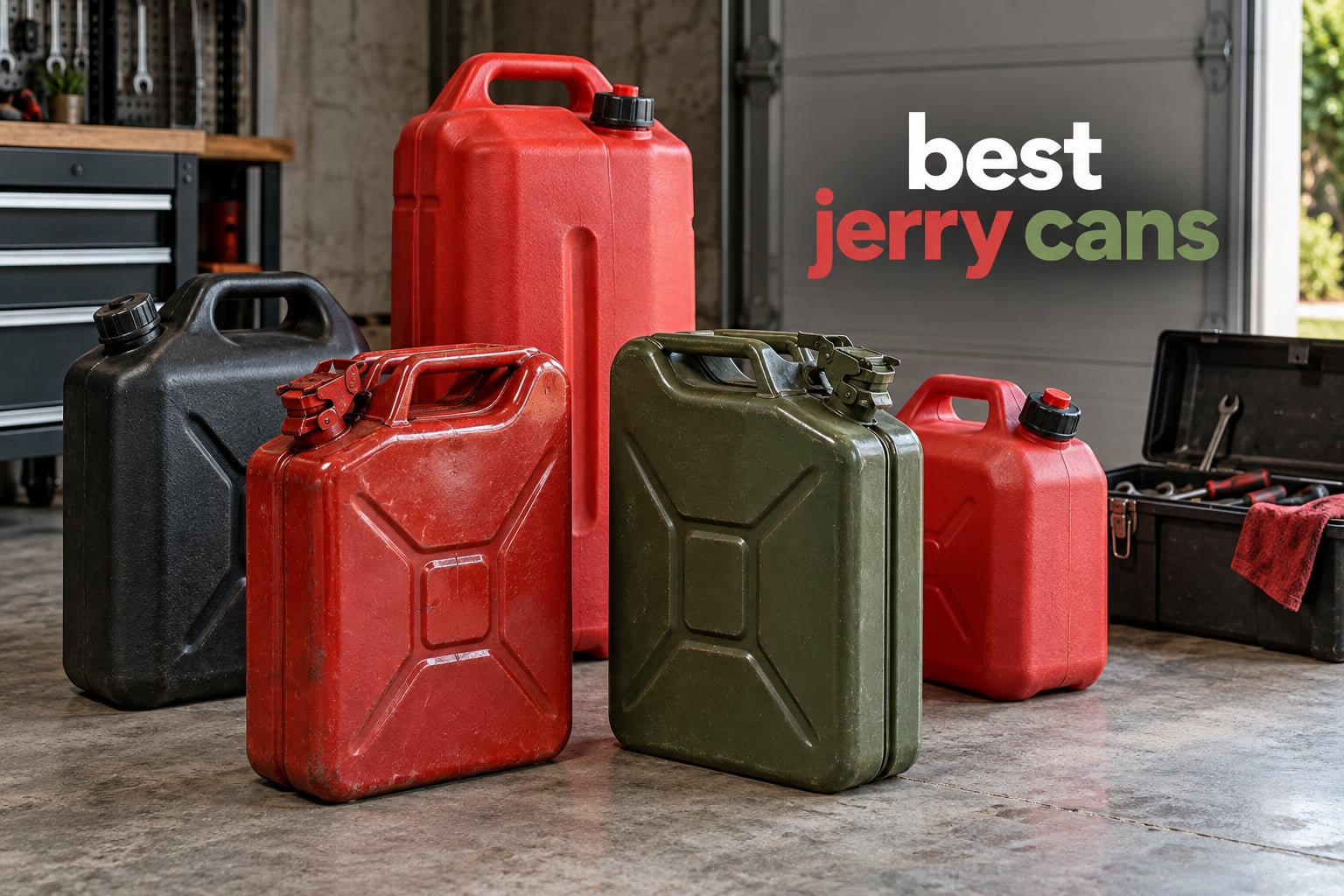
A jerry can is a portable fuel or water container that holds about 5 gallons (20 litres). Designed with flat sides and a three-handle layout, it stacks neatly, locks with a pin, and pours through a spout without dripping. After six weeks of handling, refilling and stacking cans, these are the best jerry cans for fuel storage in 2026.
The gap between a good can and a bad one is not the capacity. It is the seam, the gauge of the steel, whether the cap has a breather, and whether the spout leaks after three months. Cheaper cans fail on exactly those four points, and failures show up as a puddle in a truck bed rather than a complaint at the register.
Below I cover ten cans that hold up: steel safety cans for the garage, plastic cans for lawn equipment, a true NATO can for overlanding, and larger tanks for boats. I have flagged one container that is not legal for gasoline at all, because that label is easy to miss and expensive to ignore. The five inspection checks and the metal versus plastic breakdown are near the end, so you can read those before you buy.
Table of Contents
Top 3 Picks for Fuel Storage in 2026

Eagle Type I Galvanized Steel Can
- 24-gauge galvanized steel
- NFPA 30 and OSHA compliant
- Funnel included
- Non-sparking flame arrestor

No Spill 2.5 Gallon Gas Can
- Thumb-button pour control
- 7/8 inch narrow spout
- 2.5 pound empty weight
- ASTM and CARB compliant

Wavian NATO 20L Steel Can
- 0.9mm cold-rolled steel
- Stackable NATO body
- Recessed welded seams
- Bayonet locking pin
All 10 Jerry Cans at a Glance in 2026
| Product | Specifications | Action |
|---|---|---|
| Eagle Type I Steel Safety Can |
|
Check Latest Price |
| No Spill 2.5 Gallon Can |
|
Check Latest Price |
| Wavian NATO 20L Steel Can |
|
Check Latest Price |
 Justrite Type II Steel Can Justrite Type II Steel Can |
|
Check Latest Price |
 Scepter SmartControl 5 Gal Can Scepter SmartControl 5 Gal Can |
|
Check Latest Price |
 SureCan 5 Gallon Type II SureCan 5 Gallon Type II |
|
Check Latest Price |
 VP Racing 5.5 Gal Motorsport Jug VP Racing 5.5 Gal Motorsport Jug |
|
Check Latest Price |
 Fuelworx 5 Gallon Stackable Can Fuelworx 5 Gallon Stackable Can |
|
Check Latest Price |
 Justrite Type I Steel Can Justrite Type I Steel Can |
|
Check Latest Price |
 Scepter 12 Gallon Marine Can Scepter 12 Gallon Marine Can |
|
Check Latest Price |
1. Eagle Type I Galvanized Steel Safety Can – The Benchmark Steel Can
- 24-gauge hot-dipped galvanized steel resists rust and dents
- Non-sparking flame arrestor blocks internal ignition
- Self-closing gasketed cap vents automatically for fast filling
- Double interlock no-weld bottom seam
- Meets NFPA 30 and OSHA 1910.106
- Type I single opening is slower to fill than Type II
- Heavier than plastic cans when fully loaded at 5 gallons
This is the can most of us grew up around, and after six weeks of moving it between the shed, the truck bed and a generator pad it still does the basics better than anything else in the lineup. It weighs 5.3 pounds empty and measures 12.5 inches wide by 13.5 inches tall, which is a compact footprint for 5 gallons.
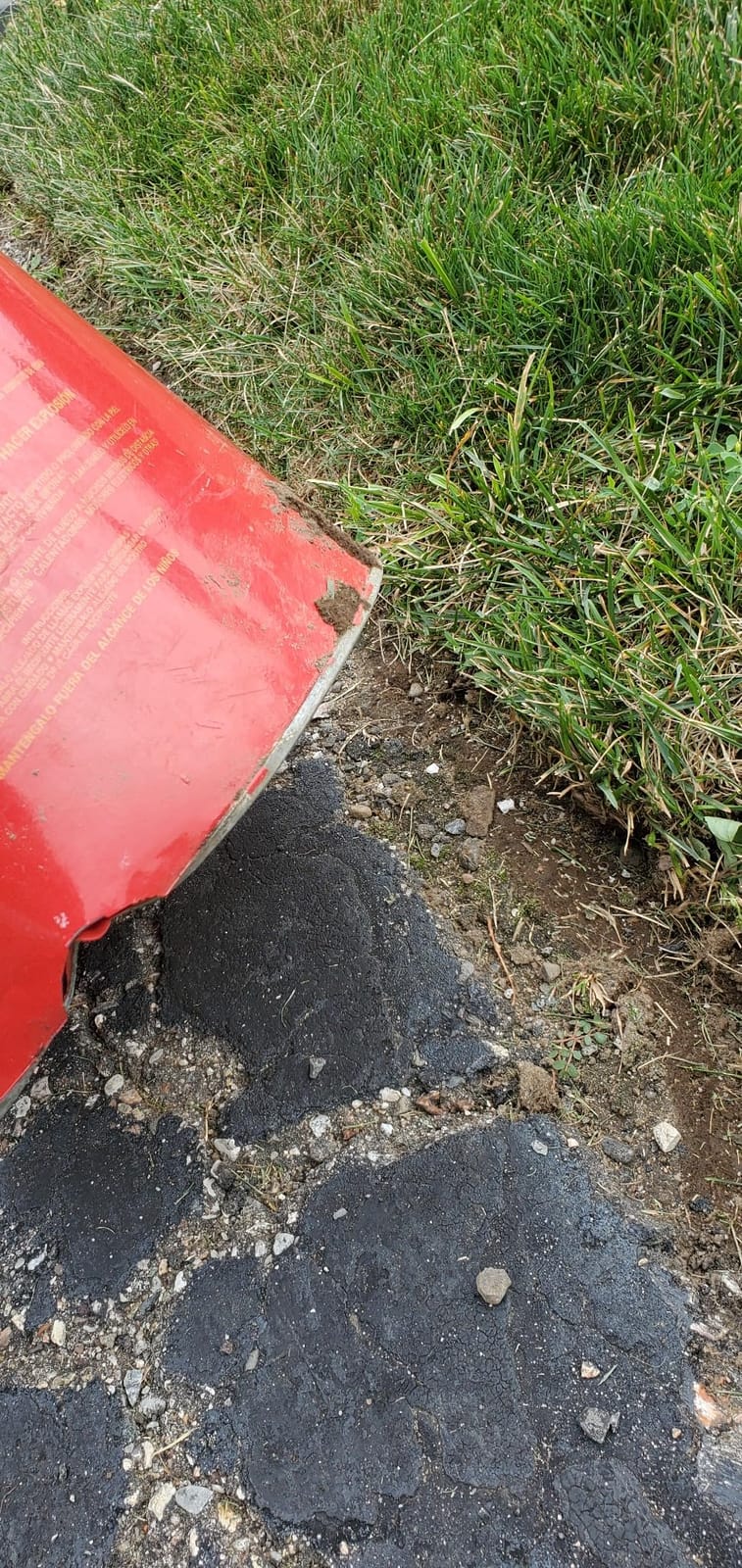
The construction is where the money goes. The body is lead-free 24-gauge hot-dipped galvanized steel with a baked powder-coat finish, and the bottom uses a double interlock no-weld seam. That bottom seam is the part that usually fails first on cheaper cans, and this one is designed to take a drop onto concrete without weeping.
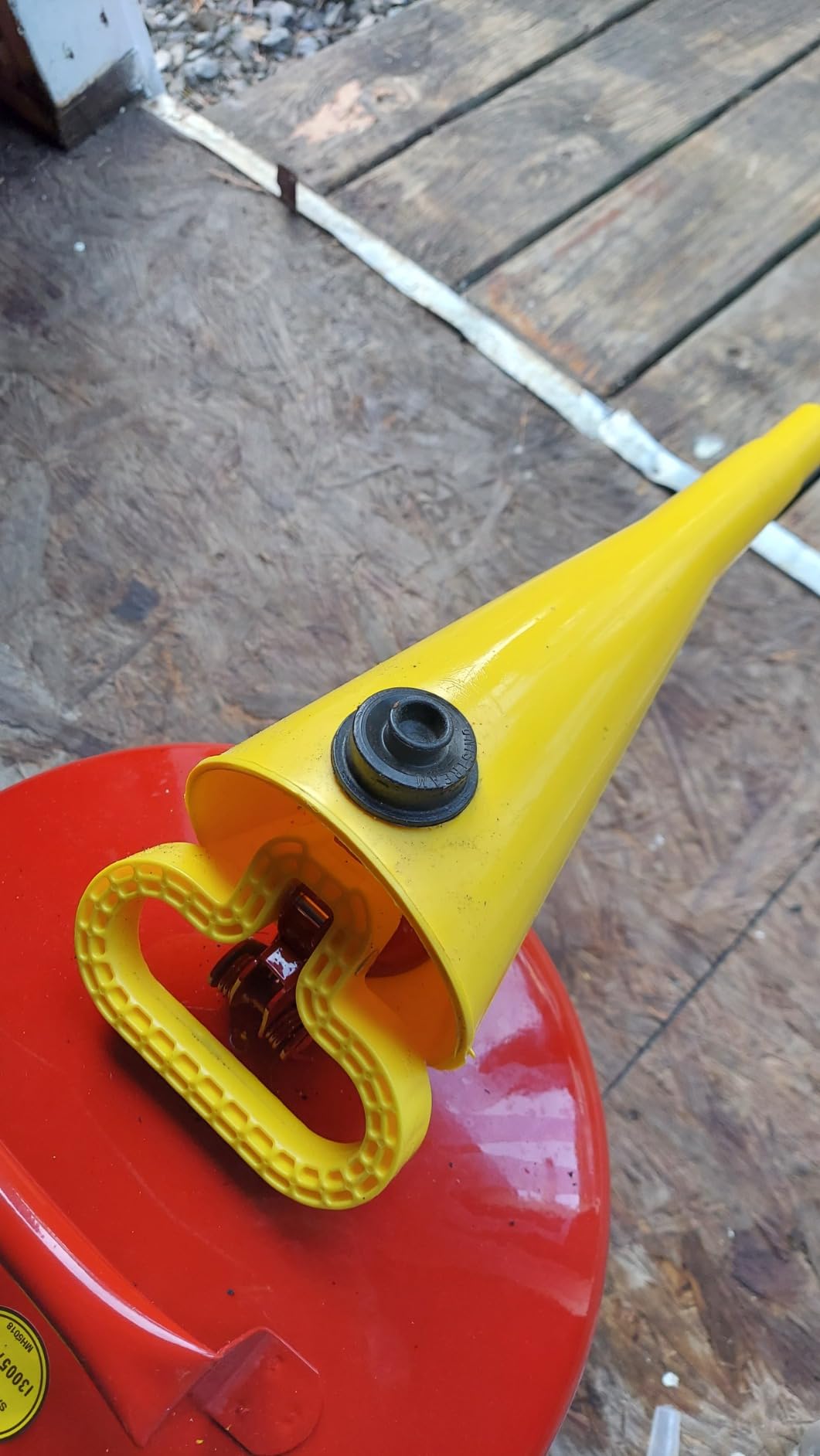
Pouring is handled by a fixed handle and a gasketed spout cap that self-closes, so fuel does not wick out around the thread. The cap also auto-vents during filling, which is the difference between a 30-second fill and a slow one where you stand there watching air bubbles fight their way out. A non-sparking flame arrestor sits inside the neck, and the can is rated to NFPA 30 and OSHA 1910.106 with FM, UL and ULC approval.
An F-15 funnel ships in the box, which sounds minor until you try to fill a can without one and end up funneling fuel down the side. It is made in the USA and carries a one-year workmanship warranty covering replacement or credit.
Who the Eagle Type I suits
Home garage users who want one can that lasts get the most from it. A fixed handle and a balanced body make it simple to move between the shelf and a mower tank, and the galvanized shell keeps fuel stable longer than plastic, which matters if you rotate stock on a six-month cycle.
It also suits anyone who refills often. The auto-venting cap means a fill at the pump takes about as long as the pump takes to deliver, and a self-closing lid means you can set it down mid-pour without a puddle forming.
Who the Eagle Type I does not suit
Overlanders who need to stack cans compactly should look elsewhere. This is a Type I can with a single opening, so filling is slower than a Type II design, and the shape does not interlock with anything else.
Anyone lifting a full can regularly will feel the weight. At 5 gallons of gasoline plus 5.3 pounds of steel, it is a two-hand lift every time, and there is no lever to help you tip it at an angle.
2. No Spill 2.5 Gallon Gas Can – The Best Small Capacity Pick
- Thumb button gives metered control over pour speed
- Narrow 7/8 inch spout fits small equipment filler necks
- Attached dust cover keeps the spout clean
- Integrated 20-mesh stainless steel screen catches debris
- Only 2 pounds empty so it is easy to carry
- 2.5 gallons means more trips for high volume users
- Push button can tire your thumb on long pours
Most roundups on this topic assume 5 gallons, which leaves the chainsaw, the 2-stroke blower and the portable inverter generator owner out. This 2.5-gallon can is the answer to that gap, and at 2 pounds empty it is the easiest thing here to carry with one hand.
The thumb button is the feature that changes daily use. Press it and fuel flows, release it and the flow stops, which means you can meter fuel into a tank with a small opening without standing there pinching a spout between finger and thumb.
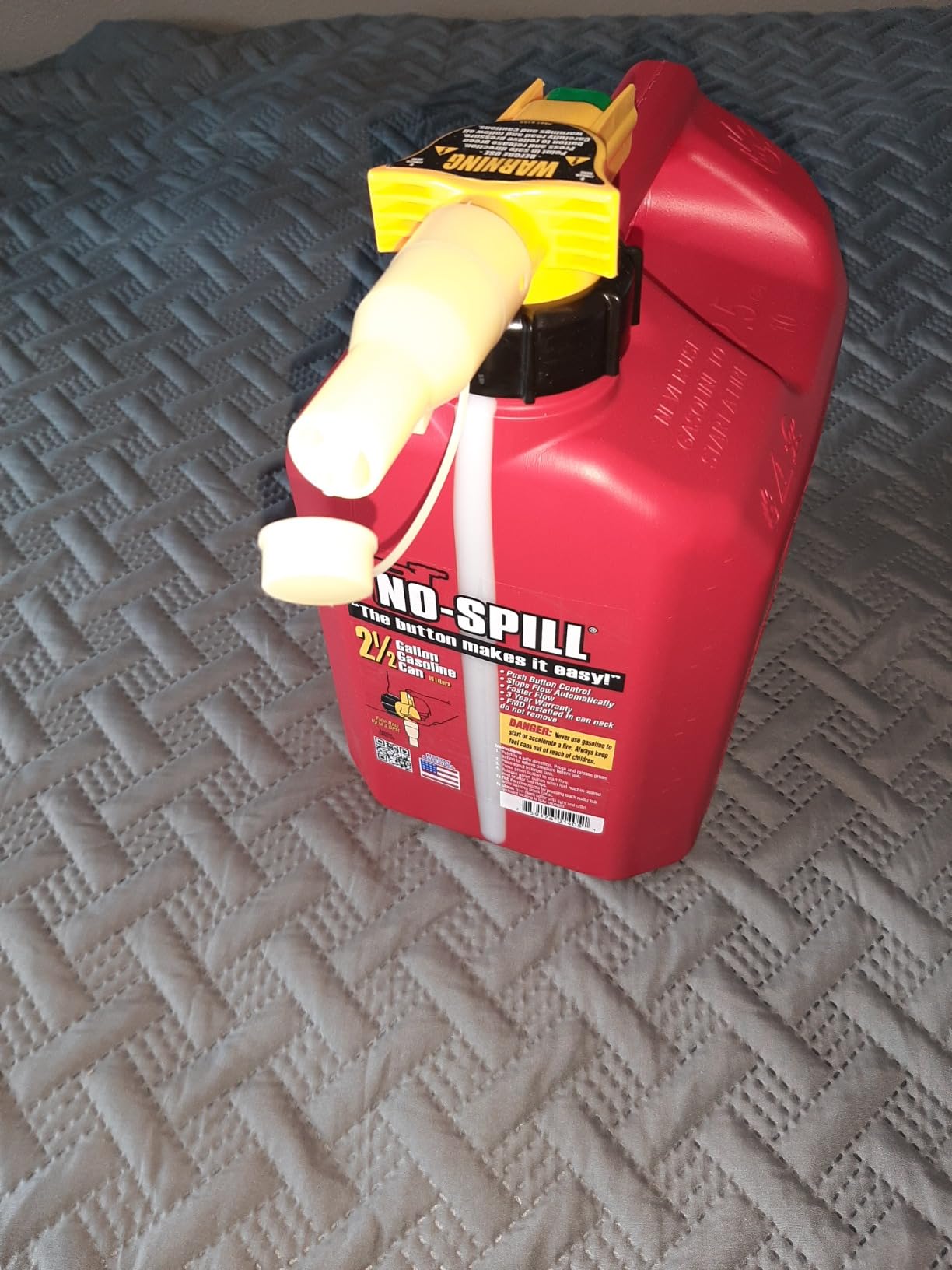
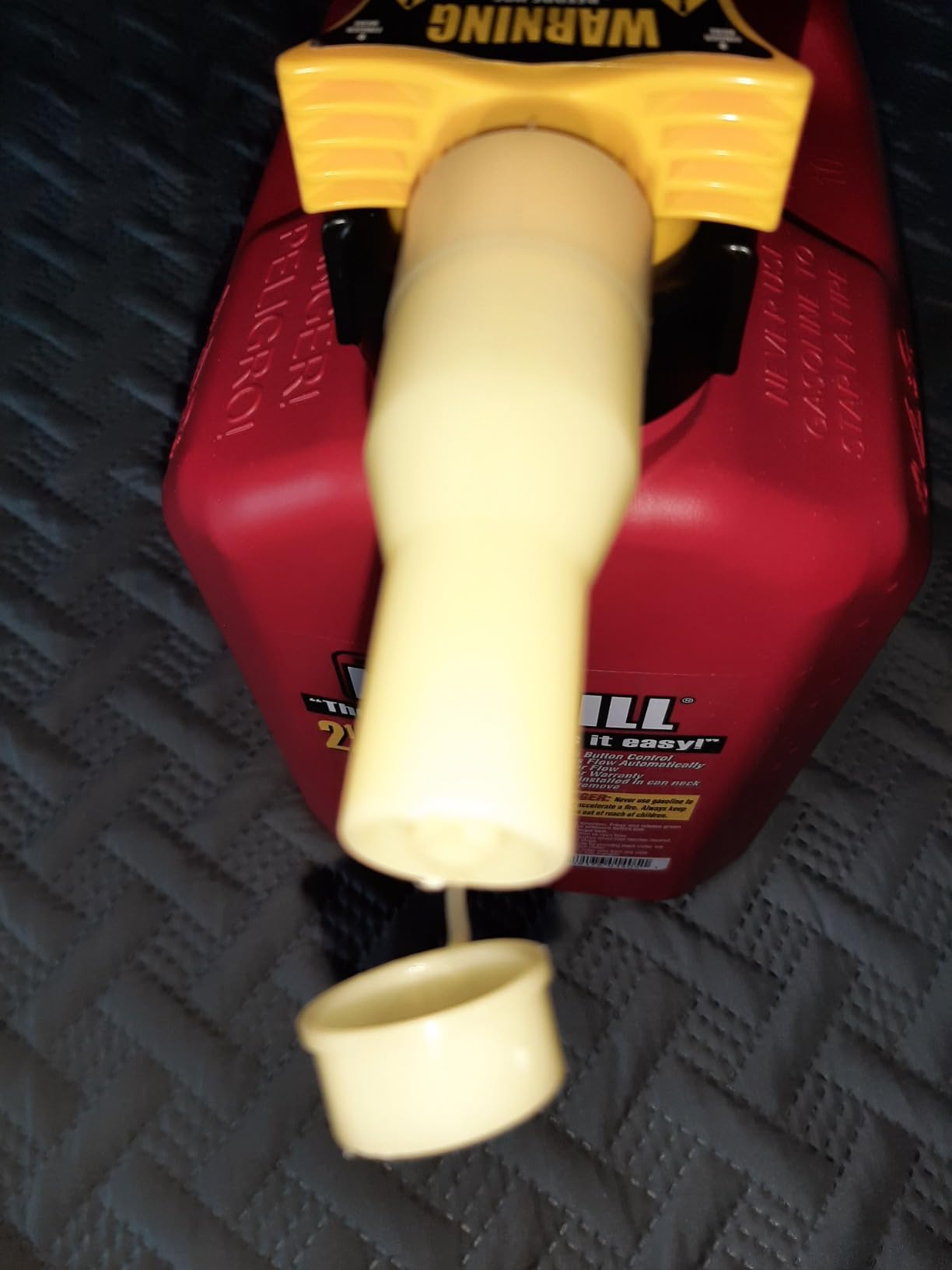
The 7/8-inch spout is narrow enough to fit equipment that a standard 1-inch spout will not, which is why owners of small two-stroke engines and older outboards pick this out. An integrated 20-mesh stainless steel screen sits in the pour path to catch debris before it reaches the tank, and an attached dust cover keeps the spout from collecting grit between uses.
It meets ASTM, CARB and EPA requirements, and the red colour matches the convention of red for gasoline. Dimensions are 8 inches wide by 14.75 inches tall, so it tucks into a shelf, a truck bed corner or a backpack frame without dominating it.
Who the No Spill 1405 suits
Small-engine owners win here. If you run a chainsaw, a trimmer, a pressure washer or a small generator that eats fuel in half-gallon gulps, carrying 5 gallons means carrying weight you will not use.
It also suits anyone refilling through a narrow filler neck. A screen plus a narrow spout gives controlled flow into small openings, which is where cheap wide-spout cans end up with fuel on the outside of the tank.
Who the No Spill 1405 does not suit
Long-distance and overlanding buyers should pass. At 2.5 gallons it triples the number of containers you need for the same fuel range, and a stack of them takes up more space than a single steel can.
Heavy pourers will find the button tiring. The metered control that makes it precise also means you hold a button down for a full 2.5 gallons, which is fine for a top-up and tiring for a full fill.
3. Wavian Authentic NATO Jerry Can – The Best Pick for Overlanding
- Thick 0.9mm cold-rolled steel with anti-corrosive coating
- Recessed continuously welded seams resist fatigue
- Stackable profile fits a rack or trailer bed
- Bayonet quick-release nozzle with safety lock
- EPA and CARB compliant for North America
- Supplied plastic pour nozzle is the most criticized part
- Short nozzle limits filling of small tanks
- Customer support reported as unresponsive for spare parts
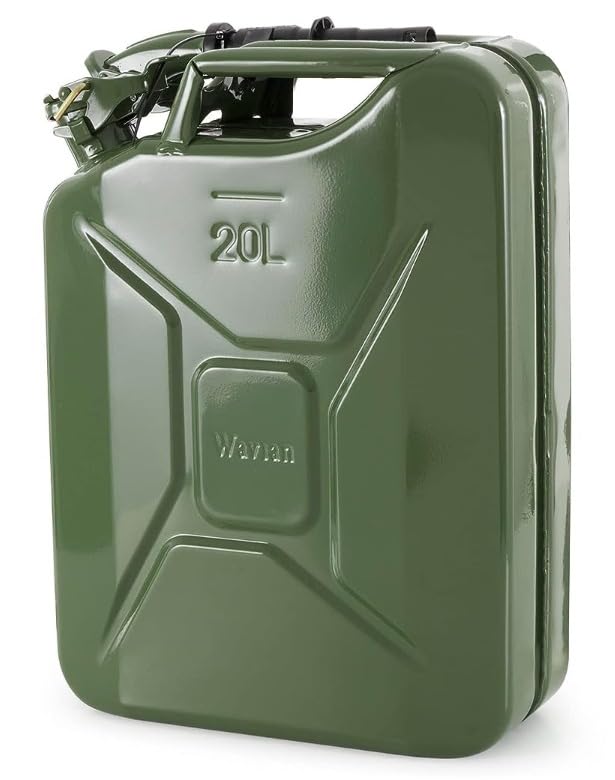
This is the only true NATO-pattern can in the group, and that changes how you store fuel on a vehicle. The body is flat-sided and shaped to interlock, so cans stack without sliding or rattling, which matters more than it sounds when you are driving 60 mph on dirt with a rack behind you.
Steel gauge is the number to notice here: 0.9mm cold-rolled with an anti-corrosive coating and recessed, continuously welded seams. A recessed seam is flush with the panel instead of standing proud of it, and that is the single strongest predictor of how a steel can ages.
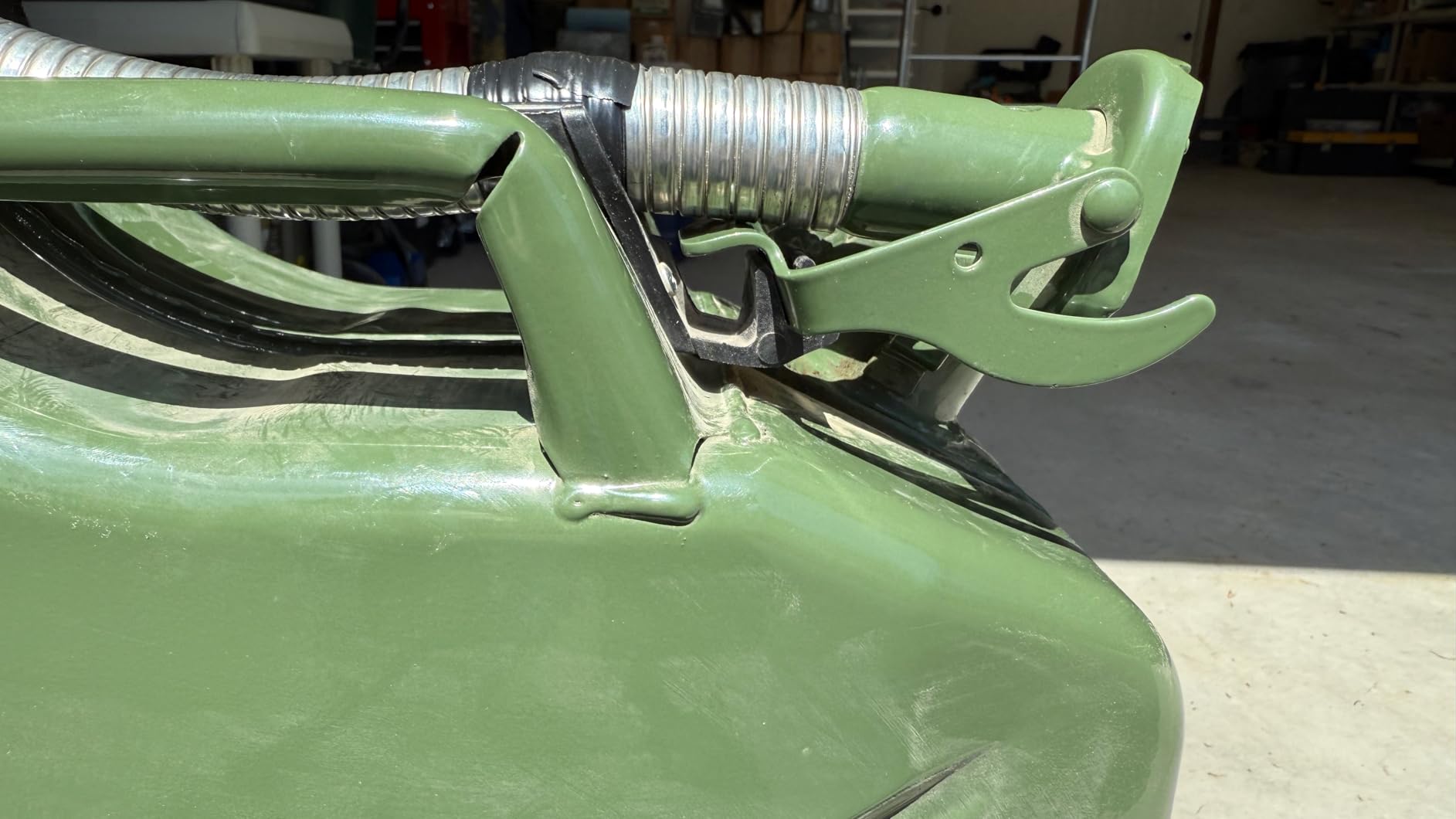
The closure is a NATO lever-lock lid with a rubber gasket and a locking pin that holds the seal air and liquid tight. Owners using it for week-long trips report the gasket still sealing after weeks of dust and vibration, and the bayonet quick-release nozzle has a safety lock so it cannot be knocked open by a branch.
It is EPA and CARB compliant for use across North America, listed under EPA number SGVYPMETALJC-001-R01, and comes in 10 and 20 litre sizes with several colours. The can itself measures 13.5 inches wide by 18.5 inches tall.
Who the Wavian NATO can suits
Overlanders and 4×4 builders should look at this one first. Stackability, a genuinely sealed pin closure and thick steel are exactly the three things that matter when a can lives in a truck bed or on a rack for months.
It also suits anyone storing fuel for the long haul. Steel limits the oxygen exchange that slowly degrades gasoline in plastic, and a gasket that stays tight is what keeps fumes out of a cab or a tent.
Who the Wavian NATO can does not suit
Be clear-eyed about the included nozzle. Multiple buyers replace the supplied plastic pour nozzle with a flexible NATO spout, because the plastic tip can crack, jam or weep at the joint where it meets the metal, and the short adapter is hard to seat in the larger opening.
It is also the wrong tool for a quick top-up. The can weighs 20 litres of fuel plus steel, and a lever lock is a two-hand operation, so it is a planning purchase rather than a grab-and-go one.
4. Justrite Type II Galvanized Steel Can – The Best Pick for a Workshop
Justrite Type II Gasoline Safety Can, Red Galvanized Steel, FM Approved
- Patented manifold and trigger give glug-free controlled flow
- Flexible 9 inch metal hose reaches small tank openings
- Galvanized steel with chemical-resistant powder coat
- Stainless steel flame arrester and self-closing lid
- FM approved and UL/ULC listed plus TUV certified
- Heaviest can in the group at 8.7 pounds empty
- Premium tier price for a shop-grade container
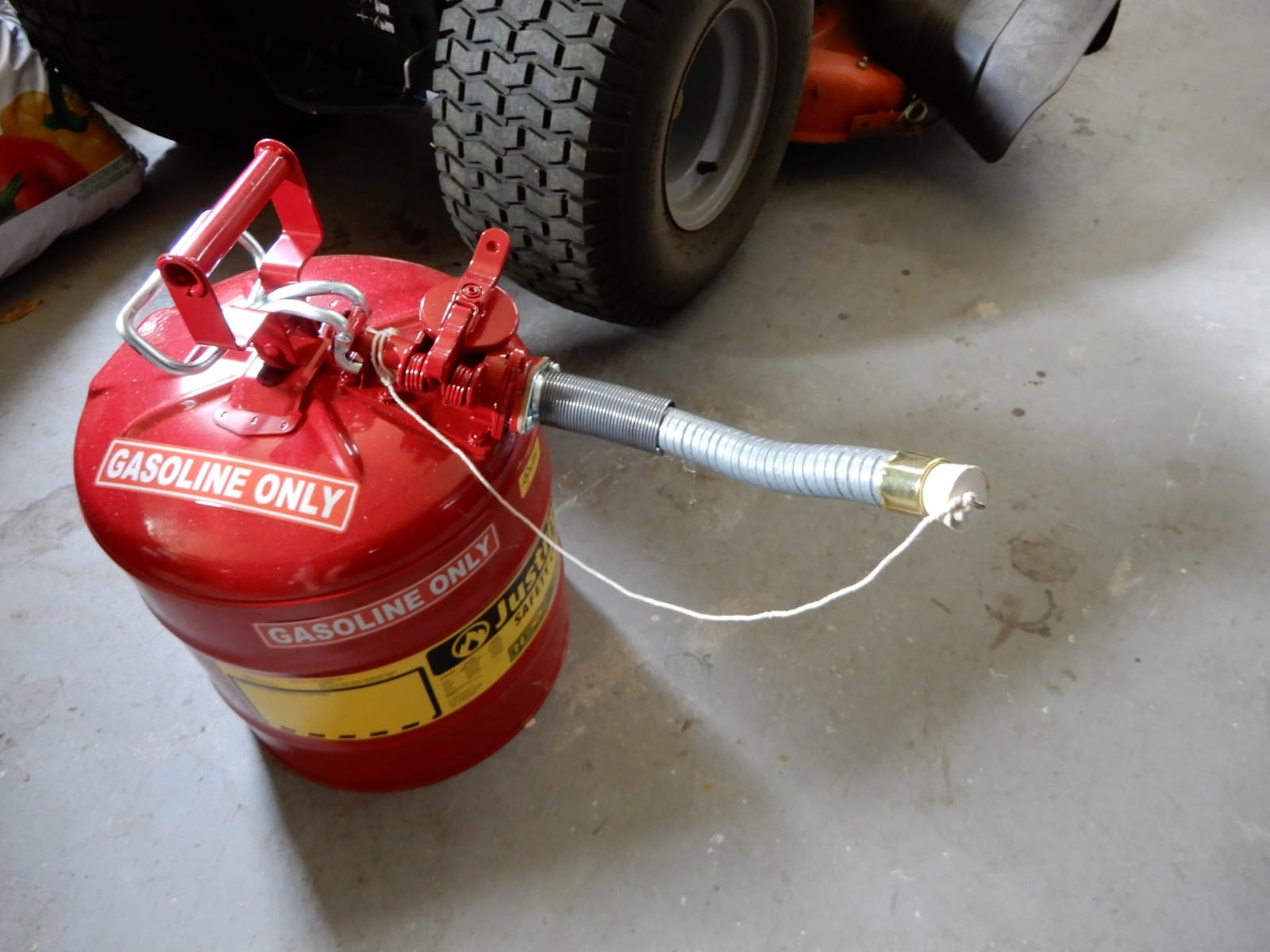
Where the Eagle uses a fixed handle, this Justrite uses a lift lever and a flexible hose, and that is a deliberate move for people pouring all day. The 9-inch metal hose reaches into a machine tank or a narrow filler opening and stays put, so the last half-gallon does not end up on the floor.
Dispensing runs through a patented manifold and a Safe-Squeeze trigger, which gives the closest thing to metered flow you get from a steel can. Instead of tipping and watching air bubble through the stream, you squeeze and the fuel arrives at a controlled rate.
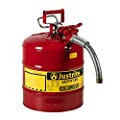
The body is galvanized alloy steel with a chemical-resistant powder-coat finish, pressure tested for repeated industrial use. A stainless steel flame arrester sits in the neck and the lid is self-closing and leak tight, so the can seals itself as soon as you let go of the lever.
Certification is the strongest in the lineup: FM Approved, UL and ULC Listed, TUV Certified, and compliant with OSHA and NFPA 30. For a shop that is inspected, that paperwork matters as much as the pour.
Who the Justrite Type II suits
Workshops, small fleets and anyone refilling machinery repeatedly get the most out of it. The lever-and-hose combination means you can fill from height, pour into a tight opening, and do it repeatedly without re-gripping.
Buyers who care about compliance documentation should note the certification list. This is the can to buy when an inspector or an insurance policy asks what your fuel storage meets.
Who the Justrite Type II does not suit
Weight is the honest drawback. At 8.7 pounds empty, a full 5-gallon can is a genuine two-hand lift, and if you need to carry fuel any distance the load gets old fast.
It is also overkill for occasional top-ups. A trigger and a hose are advantages when you pour daily and unnecessary complexity when you fill a mower twice a month.
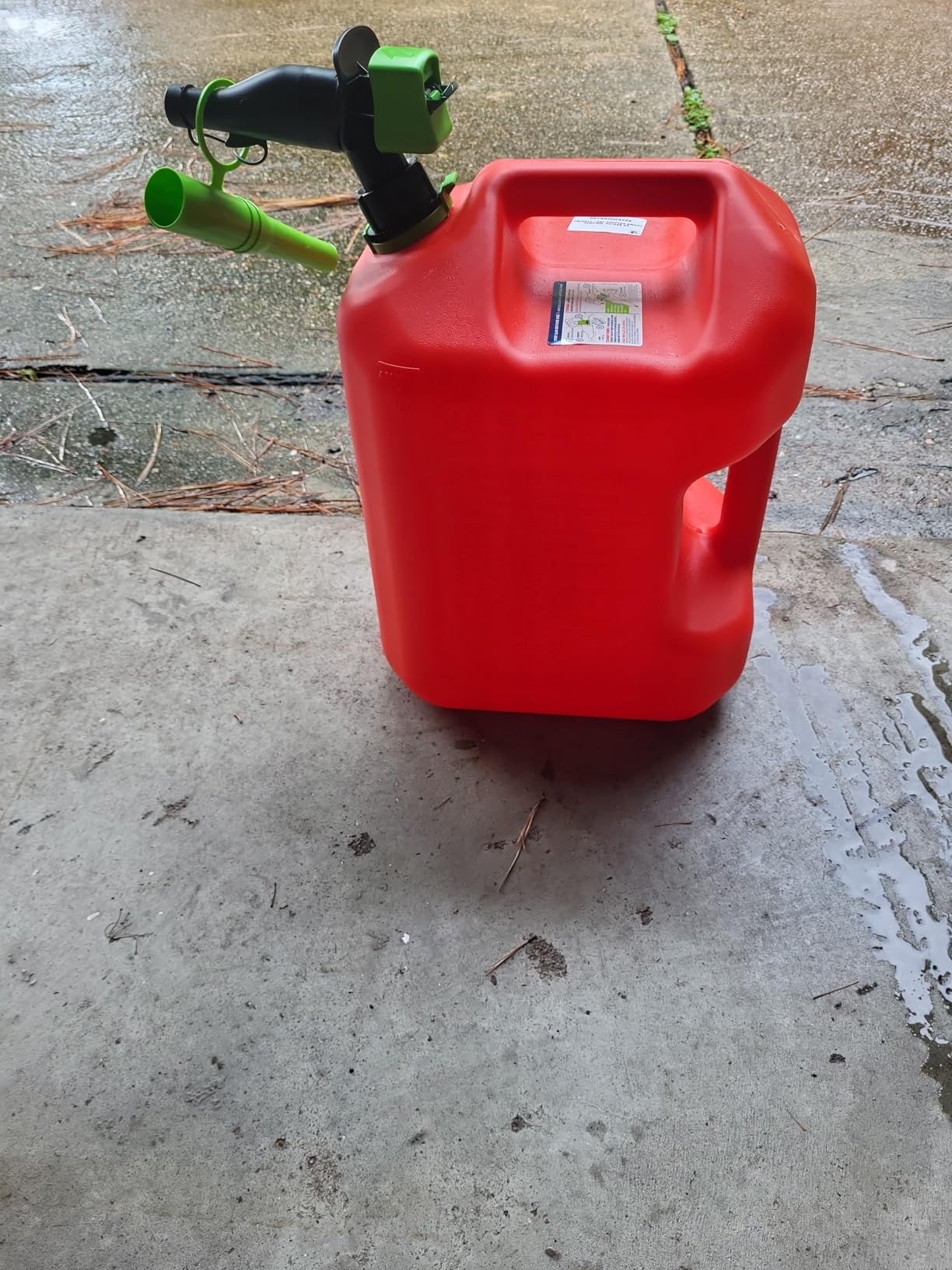
5. Scepter SmartControl 5 Gallon Can – The Best Pick for Lawn Equipment
Scepter 5 Gal Gas Can, Spill Proof SmartControl Spout, Spout Extender, Red
- SmartControl trigger varies flow from a trickle to a full pour
- Integrated spout vent and funnel fill up to 3 gallons per minute
- Five-layer shell limits vapour leaks and slows fuel degradation
- Flame mitigation device adds ignition protection
- 2.5 pound empty weight and a rear handle
- Spout and cap durability draw the most complaints
- Rating sits below the steel cans in this group
This is the can that shows up next to lawnmowers, chainsaws, RVs and ATVs, and its selling point is fill speed. The integrated air vent in the spout lets air escape as fuel goes in, so with the included funnel it fills at up to 3 gallons per minute rather than the trickle you get from a poorly vented plastic can.
The SmartControl trigger is the other half of the appeal. A full squeeze gives a full pour for a mower tank, and a light touch gives a trickle for filling a chainsaw or a generator with a small neck.
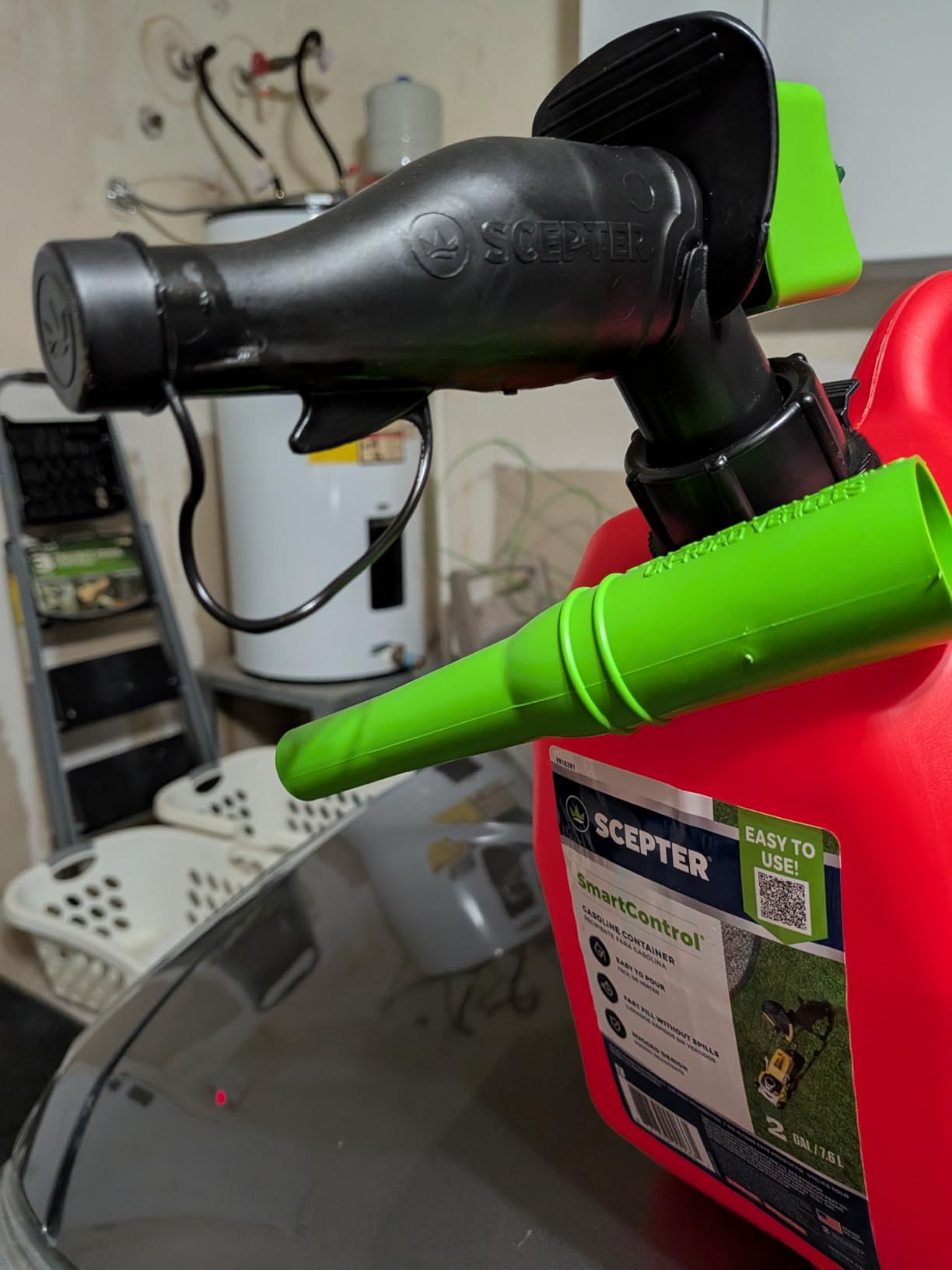
Construction is a five-layer plastic shell that the manufacturer rates for reduced vapour leakage and slower fuel degradation than single-layer plastic. A flame mitigation device adds a layer of protection against ignition of vapour inside the can, and the whole thing is EPA and CARB and child safety compliant with a two-year manufacturer warranty.
It measures 12 inches wide by 16 inches tall and weighs 2.5 pounds empty, which makes it the easiest full-size 5-gallon can to lift here. The red colour and the model number FSCG552 identify it clearly on a shelf.
Who the Scepter SmartControl suits
Yard equipment owners get the biggest win. Fast filling matters when you are refilling three tools at once, and the variable flow trigger means one can handles both a mower tank and a narrow chainsaw filler.
It also suits people who cannot comfortably lift a steel can. At 2.5 pounds empty, carrying a full can is manageable for a wider range of people than the 8.7-pound Justrite.
Who the Scepter SmartControl does not suit
Long-term storage is not its strength. Plastic is permeable enough to let oxygen exchange with gasoline over months, and forum users with a six-month rotation habit consistently choose steel instead for exactly that reason.
Spout and cap wear is the recurring complaint. Around 9 percent of ratings here are one-star, mostly about spout and cap durability after extended use, and heat deformation of the moulded body is a known risk in a hot truck bed.
6. SureCan 5 Gallon Type II Container – The Best Pick for Spill Control
- Rotating spout lets you angle flow instead of tipping the can
- Thumb trigger with double O-ring seal for controlled output
- Self-venting Type II design reduces splashing
- Thick wall construction and 4 pound empty weight
- Three year limited warranty
- Spring-loaded safety fill cap is awkward to operate
- Cap can pop off during filling at the pump
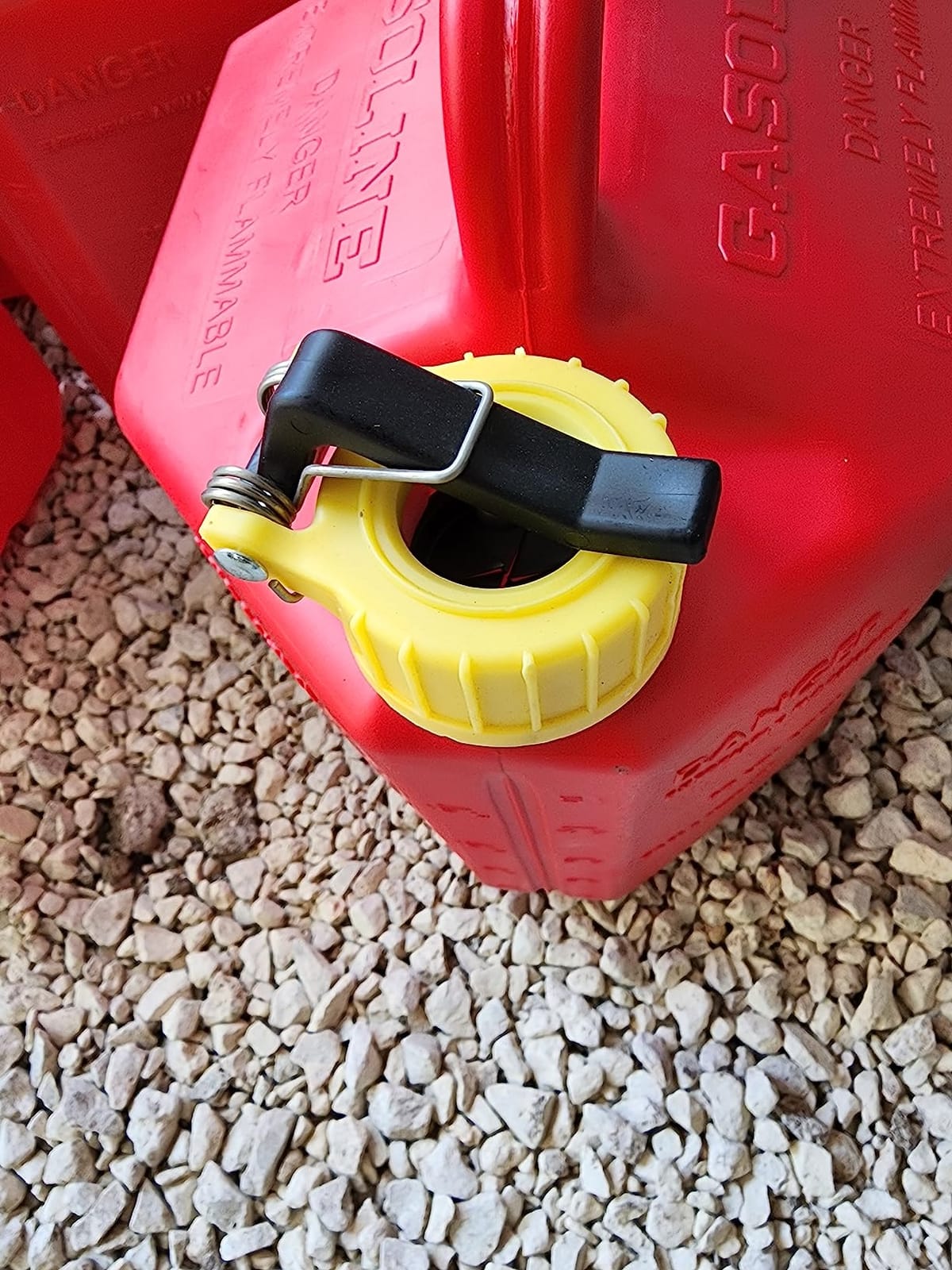
The idea here is simple and it works: instead of tilting the can to pour, you point the spout and rotate it. Owners using it to fill lawnmowers and small boats report close to zero spill transfer, because the can never reaches the angle where flow goes past the spout opening.
An ergonomic thumb trigger meters the flow and a double O-ring seal keeps the spout shut between pours. The Type II design is self-venting, which supports steady flow and cuts the splashing that comes from air trying to get into the can.

Despite being plastic, the wall construction is thick enough that it feels closer to a steel can in the hand, and at 4 pounds empty it sits between the light Scepter and the heavy Justrite steel cans. It measures 13.1 inches wide by 15.61 inches tall.
Owners frequently describe it as an upgrade from frustration-prone cheap compliant cans, and it is backed by a three-year limited warranty with manufacturer support, which is longer than most plastic cans in this group offer.
Who the SureCan suits
People tired of spills should try it. The rotating spout removes the two things that cause most fuel accidents with plastic cans: over-tilting and sloshing, and it makes filling equipment on an uneven surface far less stressful.
It also suits buyers who want plastic with a longer warranty behind it. Three years is a meaningful commitment compared with the one or two year terms attached to most plastic cans.
Who the SureCan does not suit
The fill cap is the weak point. It is spring-loaded, awkward to operate, and it has no positive lock, so it can come off while you are filling at a pump. That is an awkward moment at a public pump even when nothing goes wrong.
The ball-socket seal on the spout can also detach, and it is priced well above a typical plastic gas can, so buyers on a tight budget get more from the Scepter or the No Spill can.
7. VP Racing 5.5 Gallon Motorsport Jug – The Best Pick for Rack Mounting, Not for Fuel
VP Racing 35221-CA, 5.5 Gal. Square Patriotic Motorsport Jug w/ 14 Inch Deluxe Filler Hose Close-Trimmed Cap and Neck for Tighter Seal
- Square shape fits racks and bumpers where round cans do not
- 14 inch crimped hose and close-trimmed neck create a tight seal
- Built with 30 percent more material than standard motorsport jugs
- Reinforced high-stress corners resist cracking
- Extra-wide bottom grip and vented handle for heavy lifts
- Stamped NOT FOR USE WITH FUEL so it is not a legal gasoline container
- Included cap on this version has no threaded port for the hose
I am including this one with a warning that should come before the praise. This specific model is labelled NOT FOR USE WITH FUEL. It is a legitimate container for water, animal feed, automotive fluids and other non-fuel liquids, and putting gasoline in it makes it an illegal fuel container in most jurisdictions.
For water, it is one of the better designs available. The 14-inch filler hose is deeply crimped and the cap and neck are close-trimmed, which produces a tight seal that resists weeping in a hot bed or on a rough trail.
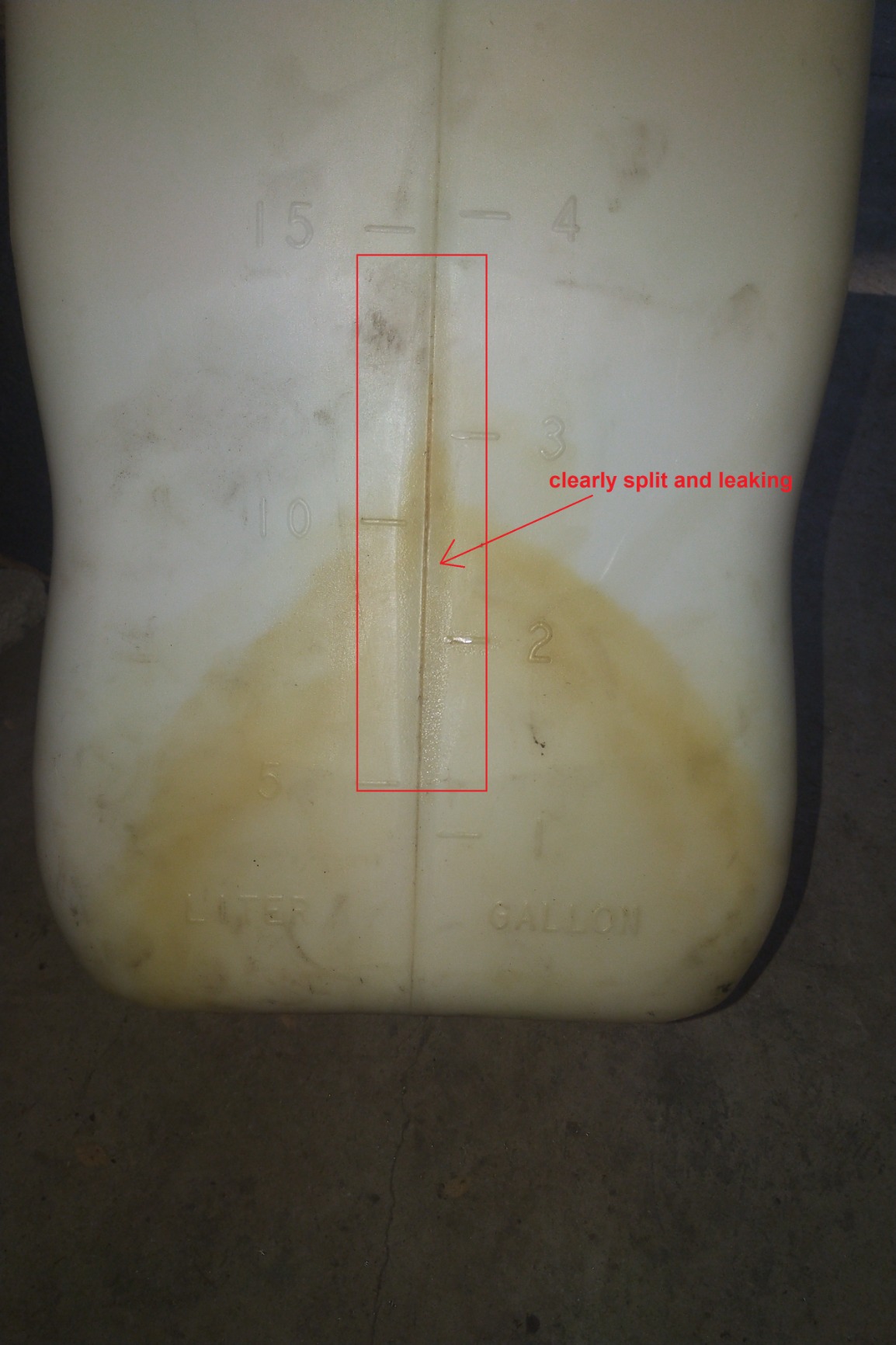
The build is heavier than a typical jug: manufactured with 30 percent more material than conventional motorsport jugs, with even-density reinforcement in the high-stress corners to resist cracking and deformation. It measures 10 inches wide by 21 inches tall and weighs 5 pounds empty.
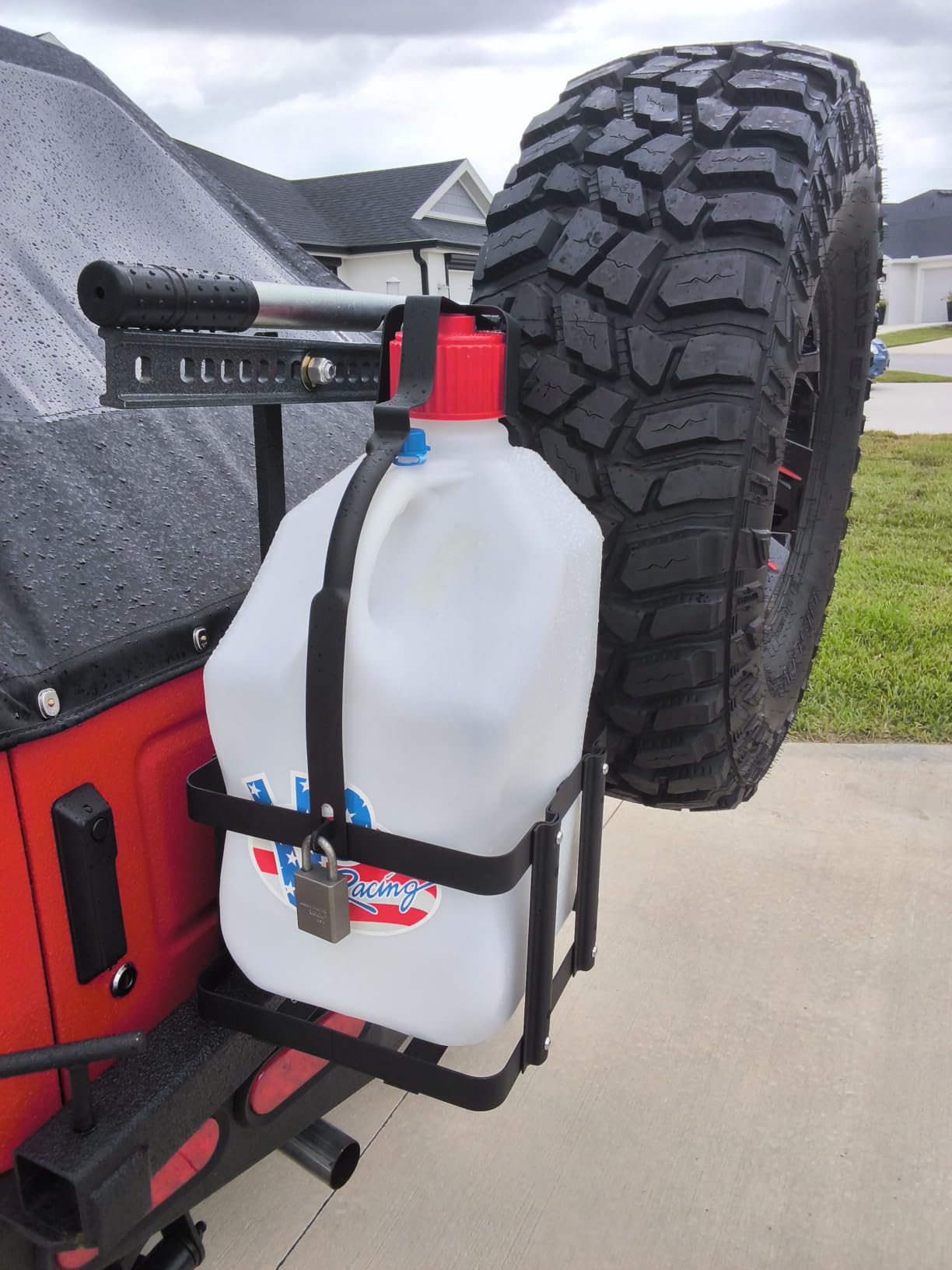
The square footprint is the reason it earns a place in a truck bed. Round cans roll and waste space between a rack and a bed rail, while a flat-sided square container can be strapped in and stacked against a wall.
Who the VP Racing jug suits
Campers, boaters and off-roaders carrying water or non-fuel liquids should look here. At 5.5 gallons it holds a meaningful reserve, and the crimped hose fills a water bladder or a camp sink without a splashing mess.
Rack and bumper mounting is its real edge. It measures 10 inches wide, and that flat face straps to a rack tube in a way a round can simply will not.
Who the VP Racing jug does not suit
Anyone storing gasoline must skip it. The fuel stamp on the listing is unambiguous, and the consequences of an unrated container are a fire risk and a legal problem rather than a minor annoyance.
There is also a fitment caveat on this version. The included cap lacks the threaded port the supplied hose needs, so the hose cannot be fitted without buying a different cap.
8. Fuelworx 5 Gallon Stackable Can – The Best Pick for Stacking
- Cans interlock into a stack for garage or trailer storage
- Push-button vent is designed to empty the can fast
- QuickFlow trigger with a 360 degree swiveling nozzle
- Two handles make a full can easier to manage
- Made in the USA
- Deep internal filter screen makes pump filling slow and splash prone
- Trigger and vent need handling together during a pour
- Wide mouth blocks standard replacement spouts
Stacking is the whole argument here, and no other can in this roundup does it. The interlocking design lets cans lock together, so a household or a van can store a genuine reserve without six separate cans sliding around the floor.
Pouring uses a QuickFlow trigger on a 360-degree swiveling nozzle, which means you can rotate the nozzle until the trigger sits wherever your hand naturally falls rather than working around a fixed handle.
It is thick HDPE made in the USA, and the safety cap has to be turned to a final click to stay leak tight. That is a good design choice even if it is one more step, because a cap that clicks is a cap that does not leak in transit.
Two handles make a full 5-gallon can manageable, and the push-button vent is designed to empty the can fast rather than leaving a cup of fuel in the bottom.
Who the Fuelworx suits
Households prepping for outages, and anyone storing fuel where floor or bed space is the constraint, benefit most. Six cans locked into a stack take up a fraction of the footprint of six loose cans.
Van and trailer users are the other group. A locked stack does not shift when the vehicle turns, and the swiveling nozzle reduces the awkwardness of filling in a confined space.
Who the Fuelworx does not suit
Anyone filling often at a pump will be slowed by the deep internal screen, which is fine on a bench and poor at a forecourt where splash-back gets on your hands. The fast-empty claim also runs longer in practice than the marketing suggests.
Modifying it is awkward too. The wide mouth means standard replacement spouts will not fit, and the small internal cap used to store the nozzle is easy to lose. The review base is also the smallest here, at 334 ratings, so there is less long-term history to lean on.
9. Justrite Type I Galvanized Steel Can – The Best Pick for Long-Term Storage
Justrite Type I Gasoline Safety Can, Red Galvanized Steel, Made in the USA
- Galvanized steel preserves fuel better than plastic over long storage
- Spring-loaded lid stays closed until you pull the lever
- Counterbalanced swinging handle and bottom lip aid pouring
- Stainless flame arrester with automatic pressure relief
- Leak tested and reported odour-free in transit
- Funnel sold separately rather than included
- Sheet gauge is lighter than expected for the price
- A full can is awkward to hold at an angle
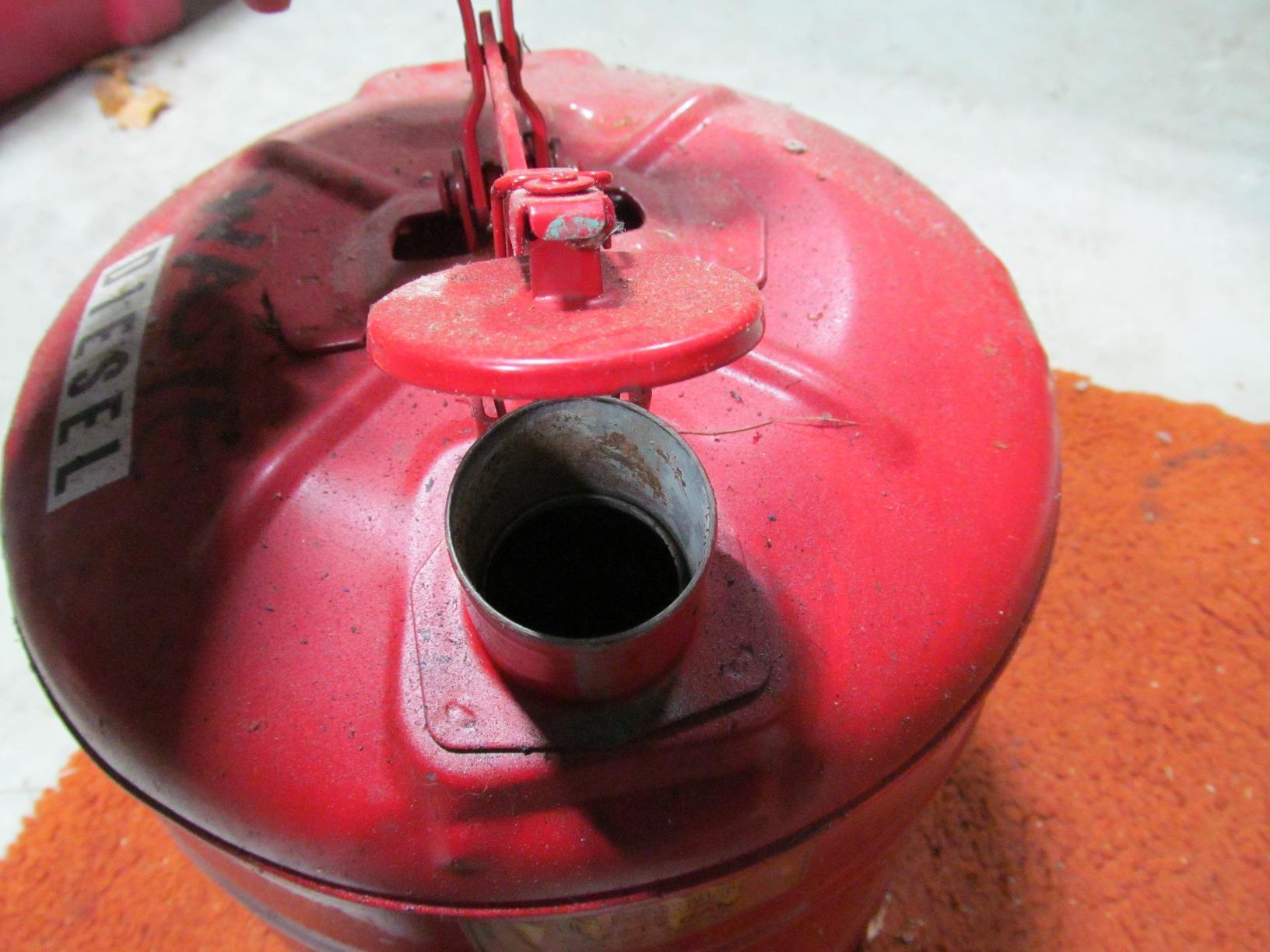
This is the classic steel can done properly, and the ownership reports are the interesting part. Longstanding buyers describe it as a lifetime purchase that replaced a whole row of plastic jugs, which is the outcome you want from a container that sits in a garage for a decade.
The spring-loaded lid is the mechanism worth noticing. It stays latched against the base until you pull the lever, so the cap cannot rattle open in a truck bed or leak from a pressure change in heat.
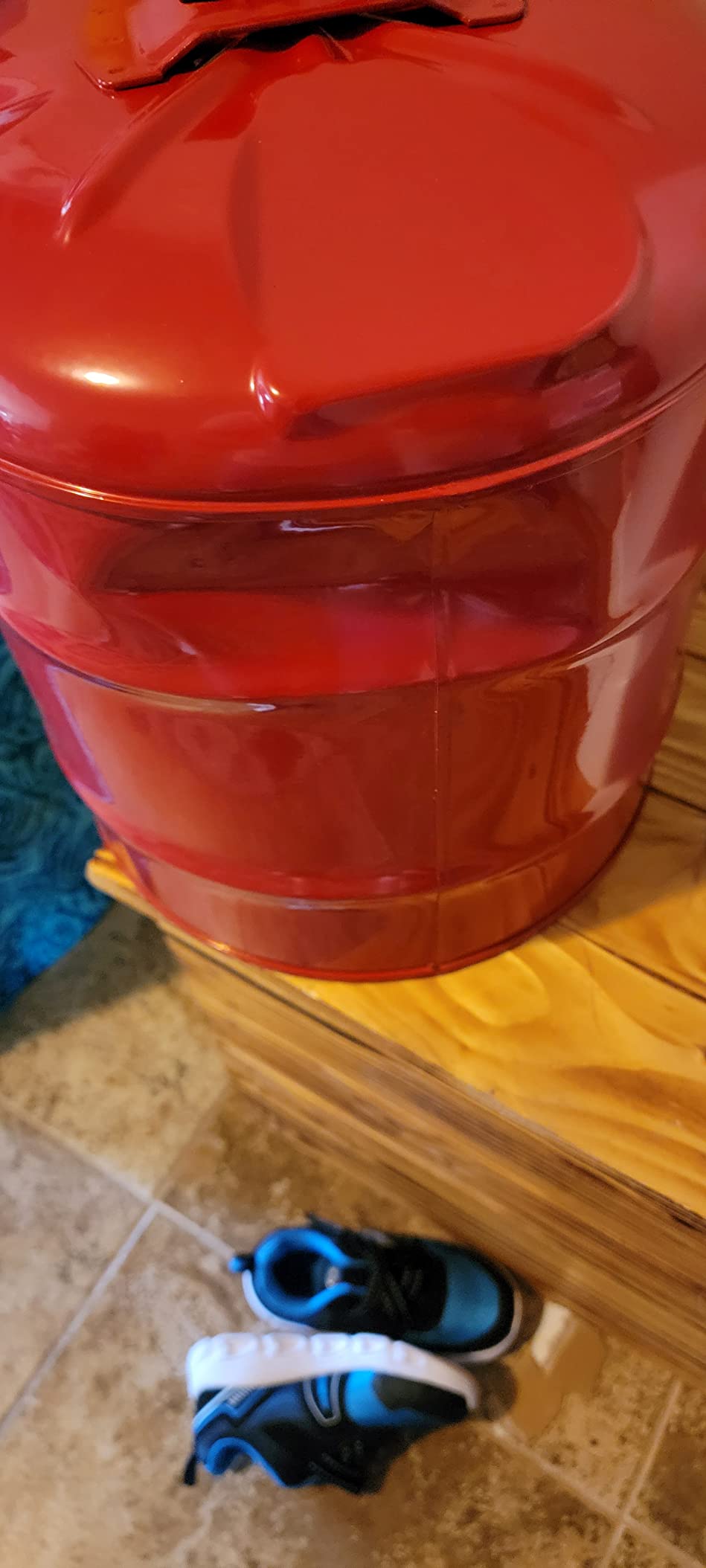
A counterbalanced swinging handle and an integrated bottom lip work together so that filling, carrying and pouring are balanced rather than tip-dependent. It is leak tested, and owners who transport it jostled report no fuel odour escaping into the cab.
Steel is the material argument here. Owners who rotate fuel slowly consistently note that gasoline stays purer and less volatile in galvanized steel than in plastic, and the stainless steel flame arrester adds automatic positive-pressure relief.
Who the Justrite Type I suits
Anyone keeping fuel through seasonal rotation should choose steel. If your plan is to buy fuel on sale and hold it, a non-permeable metal body protects it far better than any plastic shell.
It also suits buyers replacing plastic jugs one at a time. It is a straightforward, well-certified can with FM approval and UL and ULC listing plus TUV certification, and it comes in 1, 2, 2.5 and 5 gallon sizes across several colours.
Who the Justrite Type I does not suit
Pouring ergonomics are the trade. There is no hose and no trigger, so a full 5-gallon can at 7 pounds empty is awkward to hold at an angle, and it is the least pleasant can here to pour a large volume from.
Two smaller annoyances: the funnel is a separate purchase, and a number of owners feel the sheet gauge is lighter than the price implies. If you pour daily, the Type II design is a better fit.
10. Scepter 12 Gallon Portable Marine Can – The Best Pick for Boats
Scepter 12 Gallon Portable Marine Gas Can, Large Capacity Boat Fuel Tank
- 45 litre capacity in a tall profile for long outboard runtime
- Two-way vented cap releases pressure above 5 PSI
- Built-in pick-up and sight gauge for instant level checks
- One-piece five-layer crush-resistant HDPE shell
- Works with diesel and ethanol-blended fuel
- Fuel line sold separately and must be fitted to the side
- Bulky at 12 gallons so a full tank is an awkward lift
At 12 gallons this is not a jerry can, it is a portable fuel tank, and it solves a problem jerry cans cannot. A full day of outboard running on a lake burns far more than a single 5-gallon container, and refilling from a dock means carrying fuel down a dock ramp.
The tall profile is what makes the capacity possible without a huge footprint. It is 22.9 inches long by 14.3 inches wide by 13.9 inches high, tall enough to reach 45 litres in a shape you can still lift and set down with a moulded hand hold.
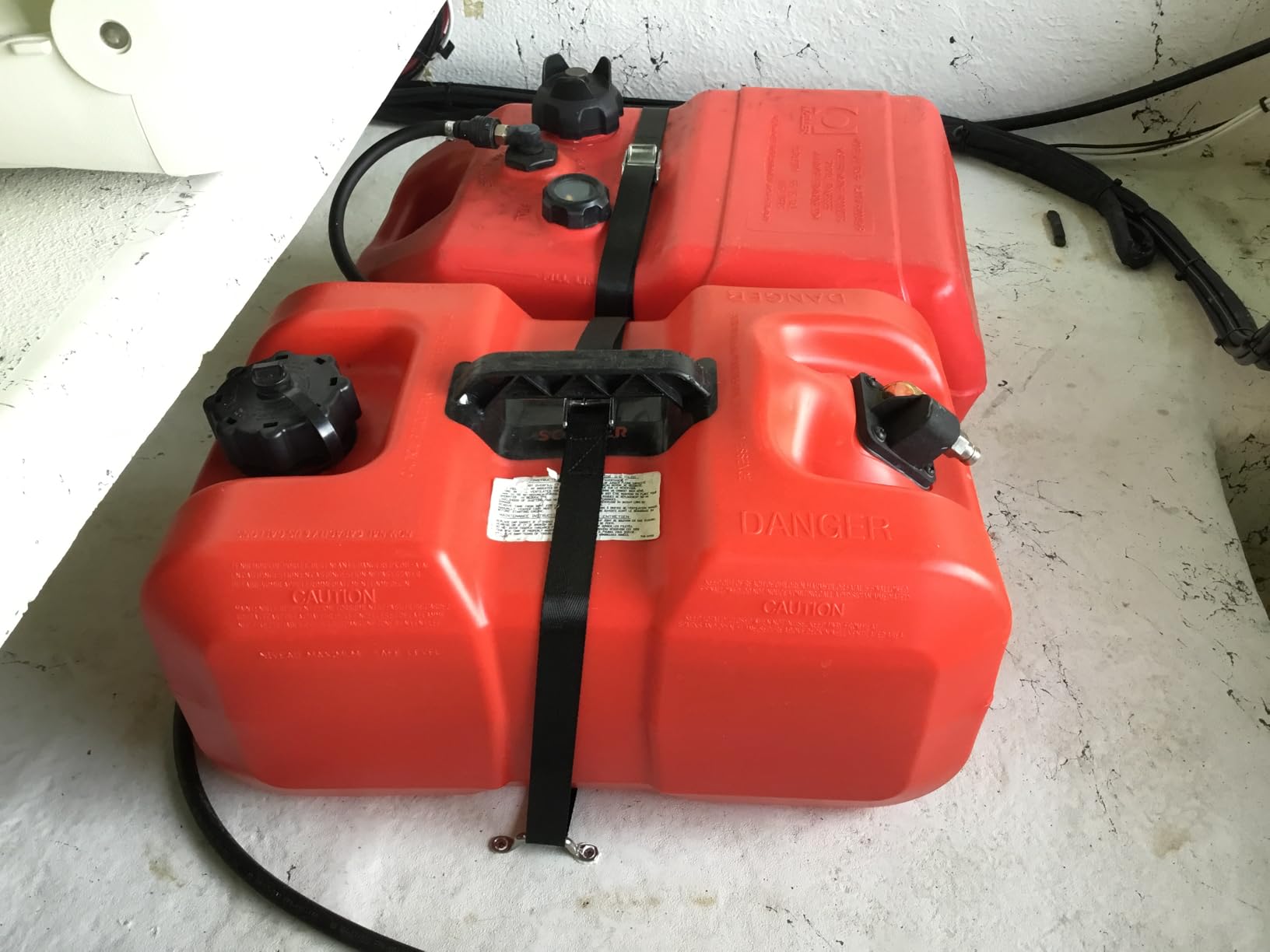
The built-in fuel pick-up and sight gauge are the features boaters care about most, because a transparent strip means you can check the level without lifting a full tank. The two-way vented cap allows airflow while refuelling and automatically releases pressure above 5 PSI, which matters on ethanol-blended fuel.
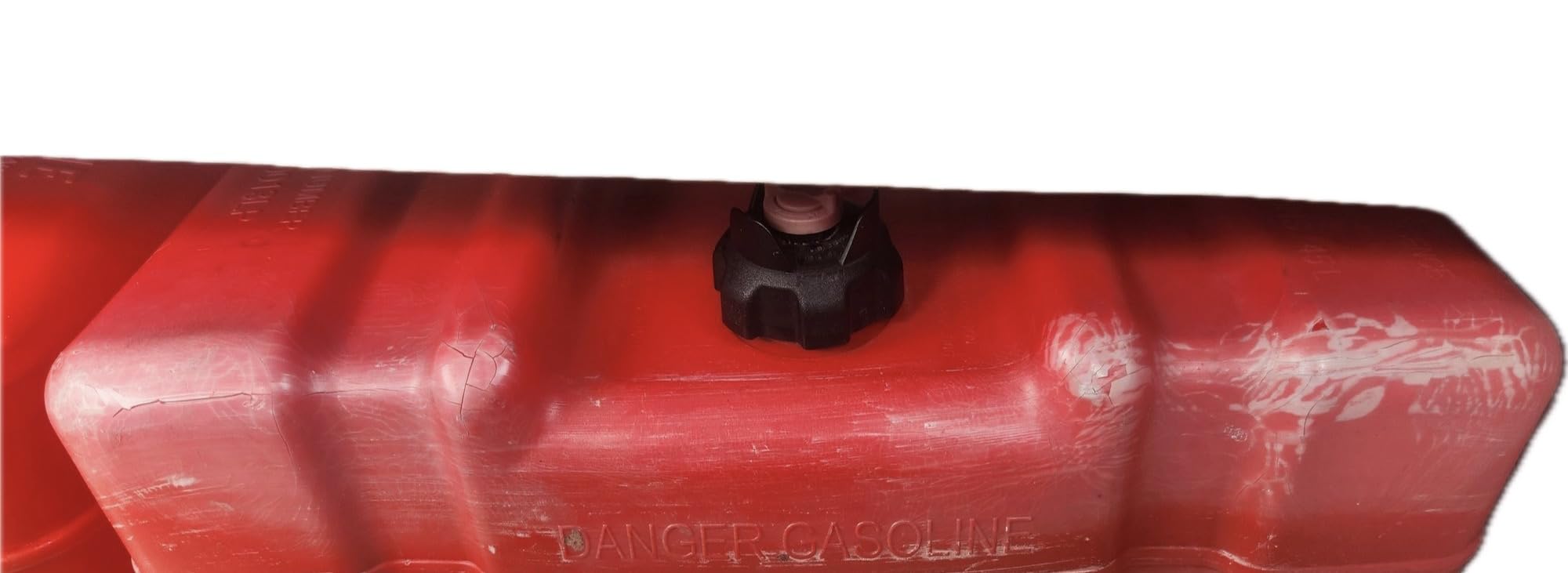
The shell is a one-piece five-layer crush-resistant HDPE that resists rust, corrosion and UV damage, and it accepts standard 1/4 NPT marine tank fittings. It is compatible with diesel and ethanol blends, approved by EPA and CARB, and made in Canada with a one-year warranty.
Who the Scepter 12 gallon tank suits
Boat owners running an outboard for long days get the clear win. Forty-five litres per fill means fewer dock refills, and the vented cap protects against the pressure problems that ethanol-blended fuel causes in a sealed container.
RV and trailer owners with a lot of gear can use it as a bulk reserve tank, since integrated moulded hand holds make it straightforward to secure in place.
Who the Scepter 12 gallon tank does not suit
It is bulky. At 12 gallons and 6.8 pounds empty, a full tank is an awkward single-person lift, so it works best where a second person or a cart is available.
It is also not a grab-and-go can. The fuel line is a separate purchase that has to be attached to the side, and for a single top-up a 5-gallon steel can is faster.
How to Inspect a Jerry Can Before You Buy It?
Most cheap can failures are visible before you ever fill the can. Five checks separate a container that will last a decade from one that will end up on your driveway in two years.
Run a finger along the weld seam. A recessed or flush seam is welded from the inside and ground level. A proud seam stands above the panel, catches every knock and scratch, and is the point where a steel can eventually wears through. This is the single most useful inspection on a steel can.
Check the steel gauge and weight. An empty 5-gallon steel can at 7 to 8.7 pounds is built from substantial sheet. A can that feels like a soup can is thin, and thin steel deforms rather than springs back when it is dropped.
Look for a breather or vent path. Air has to enter a can as fuel leaves it. Without a vent, a can glugs, slows to a trickle and encourages you to tip it further, which is where spills come from. A vented spout or a separate breather crescent solves it.
Ask about the liner. Steel cans for fuel should carry a corrosion-resistant internal coating. Polymer-lined cans are common in water containers, and polymers are not rated for long hydrocarbon contact, which is why a water can and a fuel can are not interchangeable.
Test the closure and the pin. A bayonet lid with a rubber gasket and a self-retaining locking pin is the standard for a reason. If the pin is loose or the gasket feels brittle, the can will vent vapour in transit and you will smell it in the cab.
The same thinking applies to storage gear around the fuel. If you are organising a vehicle or a garage, our guides to ammo cans and commercial trash cans cover the same locking, gasket and weather-resistance questions for the other half of a truck build.
Metal vs Plastic: Which Should You Buy?
Steel wins on long-term storage. Galvanized steel does not let oxygen exchange with the fuel the way plastic does, it does not deform in heat, and it shrugs off a drop onto concrete. If you buy fuel now and rotate it slowly over a year, steel is the correct answer.
Plastic wins on weight and pour control. A 2.5-pound empty weight is easy to carry, a vented spout fills faster, and a trigger gives metered flow that a steel Type I cannot match. For lawn equipment refilled every few weeks, plastic is simply more pleasant to use.
Two rules make the decision easy. Buy steel for storage you intend to keep for a season or more, and buy plastic for transfer and short holds. Never fill a container that is not stamped for fuel, and never use a water can for gasoline because the liner is wrong for hydrocarbons.
One more point that confuses buyers: CARB and EPA rules shape what you can legally buy, and a compliant can is stamped for its approved contents. If a can carries a water-only mark, that mark is a restriction, not a suggestion, regardless of how much it looks like a fuel can.
Storage is only half of a tidy vehicle or garage, though. Where a jerry can handles fuel, a lidded bin handles everything else, and our picks for pet odour-sealing trash cans and dog-proof trash cans cover the seal and lid questions for the same build.
Frequently Asked Questions
What is the best 5-gallon fuel container?
The Eagle 5 Gallon Type I is the strongest all-round choice at 5 gallons: 24-gauge galvanized steel, a self-closing gasketed cap that auto-vents for fast filling, a non-sparking flame arrestor, and NFPA 30 and OSHA compliance. Pick the Justrite Type II instead if you pour daily and want hose-and-trigger control, or a plastic Scepter if carrying weight is the deciding factor.
Which brand of jerry can is considered the best?
For overlanding and vehicle-mounted storage, Wavian is the top tier: a true NATO-pattern body in 0.9mm cold-rolled steel with recessed welded seams, a bayonet lid and a locking pin. For home and garage use, Eagle and Justrite Type I steel cans are the most common recommendations because steel preserves fuel better than plastic.
Which is better, a metal or plastic jerry can?
Steel is better for long-term storage, seasonal rotation and durability, because it blocks oxygen exchange and resists heat and impact. Plastic is better for weight, fill speed and controlled pouring, which makes it the practical choice for lawn equipment and generators refilled every few weeks. Most owners keep one of each.
What is the best fuel storage container?
For a garage reserve that sits for months, a galvanized steel Type I can such as the Eagle or Justrite is the best fuel storage container. For a boat, the Scepter 12 gallon marine tank carries 45 litres with a sight gauge and a pressure-vented cap. For vehicle-mounted fuel, a stackable NATO can such as the Wavian keeps a tight seal in transit.
How long can you store gas in a jerry can?
Modern gasoline sold at a pump will not keep indefinitely, and ethanol in the blend attacks seals and absorbs moisture over time. In a clean, sealed steel can kept cool and dark, fuel is usually usable for around six to twelve months, and adding a fuel stabilizer extends that. Rotate your stock at least every six months and use the fuel before it ages.
What does the W stamped on a jerry can mean?
A water-only mark restricts the container to water and non-fuel liquids. A can stamped for water is typically built with a polymer liner rather than a fuel-resistant coating, and that liner is not rated for long hydrocarbon contact, so using it for gasoline is both a safety risk and, in many places, a legal problem. Check the stamp before you fill anything.
Which Jerry Can Should You Buy in 2026?
Start with the Eagle 5 Gallon Type I if you want one can for a garage and small engines, because the galvanized steel, the auto-venting self-closing cap and the included funnel cover the most ground with the least compromise. Add the No Spill 2.5 gallon can for chainsaws and small equipment, and you have a complete setup.
Move up to the Wavian NATO can when fuel lives in a vehicle and gets stacked, and to the Justrite Type II when you pour every day and want a hose instead of a spout. The VP Racing jug on this list is a water and non-fuel container, so keep it away from gasoline regardless of how well it seals.
Whichever you pick, run the five inspection checks before the first fill. That ten minutes of checking the seam, the vent and the gasket will save you the twenty minutes of cleaning fuel off a truck bed later.