
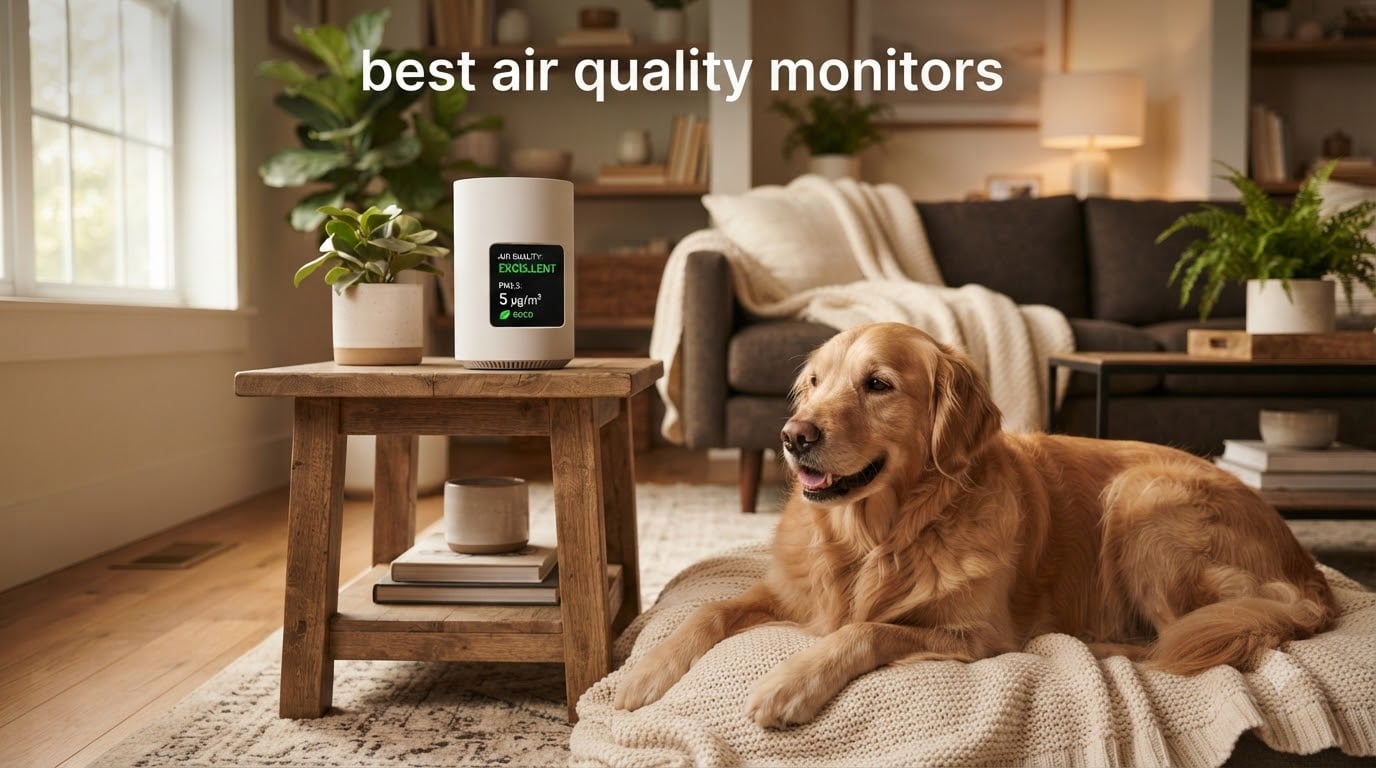
Most dog owners think about food, exercise, and vet visits when it comes to their pet’s health. But the air your dog breathes inside your home matters just as much. Indoor air can be 2 to 5 times more polluted than outdoor air, and dogs spend far more time at home than we do, breathing in whatever is floating around at nose level.
I started looking into the best air quality monitors last year after my Golden Retriever developed a persistent cough during wildfire season. My vet asked about our indoor air, and I realized I had no data to share. That sent me down a rabbit hole of testing monitors, reading sensor specs, and learning exactly what pollutants matter most for dogs. If you live with one of the apartment-friendly dog breeds or any dog that spends significant time indoors, this guide is for you.
This article covers six monitors I tested specifically through a pet owner’s lens. I looked at how well each one tracks pet dander (PM2.5 and PM10 particles), detects odors from pet accidents (VOCs), monitors CO2 for ventilation in closed rooms, and picks up on volatile organic compounds from the cleaning products we all use around our dogs. I also paired some of these with air purifiers for pet allergies to see how the data lined up with actual air cleaning.
Table of Contents
Top 3 Picks for Dog Owners in 2026
Not every air quality monitor works well for pet households. Some skip particulate matter sensors entirely, which means they cannot detect pet dander at all. After testing all six monitors, these three stood out for different reasons.

Airthings 2960 View Plus
- PM2.5 for pet dander
- WiFi always-on
- 2-year battery life
- Radon + CO2 + VOC detection

YNAK 16-in-1 Air Quality Monitor
- 7-inch large display
- 9 sensors including HCHO
- CO2 + TVOC + PM10
- 7 pollutant alert buzzers

LifeBasis 11-in-1 Air Quality Monitor
- 11-in-1 full coverage
- Portable with 11hr battery
- NDIR CO2 + laser PM2.5
- Color-coded alerts
The Airthings View Plus earned the top spot because it is the only Airthings model with PM2.5 detection, which is essential for tracking pet dander. The YNAK 16-in-1 offers the best sensor coverage per dollar, with PM10, HCHO, and a massive 7-inch display. The LifeBasis 11-in-1 rounds out the top three as the most affordable option with full pollutant coverage.
Best Air Quality Monitors for Dog Owners in September 2026
| Product | Specifications | Action |
|---|---|---|
| Airthings 2960 View Plus |
|
Check Latest Price |
| YNAK 16-in-1 Air Monitor |
|
Check Latest Price |
| LifeBasis 11-in-1 Monitor |
|
Check Latest Price |
 Airthings 2930 Wave Plus Airthings 2930 Wave Plus |
|
Check Latest Price |
 GoveeLife Smart Monitor H5106 GoveeLife Smart Monitor H5106 |
|
Check Latest Price |
 Airthings 322 Wave Enhance Airthings 322 Wave Enhance |
|
Check Latest Price |
1. Airthings 2960 View Plus – The Only Airthings with Pet Dander Detection
Airthings 2960 View Plus – Battery Powered Radon & Air Quality Monitor (PM, CO2, VOC, Humidity, Temp, Pressure)
- Only Airthings with PM2.5 detection for pet dander
- WiFi connected for remote monitoring anywhere
- 2-year battery life on 6 AA batteries
- Trusted brand with 5-year warranty
- Pollen forecast for allergy-sensitive dogs
- Highest price point in the lineup
- No PM10 or formaldehyde detection
- PM2.5 sensor is electrochemical not laser
I placed the Airthings View Plus in my living room where my two dogs spend most of their day. Within the first week, I could see clear PM2.5 spikes every time they shook out their coats after a walk. The WiFi connectivity meant I could check readings from my phone while at work, which gave me real peace of mind during wildfire season when smoke drifted into our area.
The eInk display is easy to read even in bright sunlight, and the customizable screen let me prioritize PM2.5 and CO2 readings over temperature. I appreciated the cloud data storage because I could pull up month-long trends and share them with my vet when discussing my dog’s respiratory symptoms.
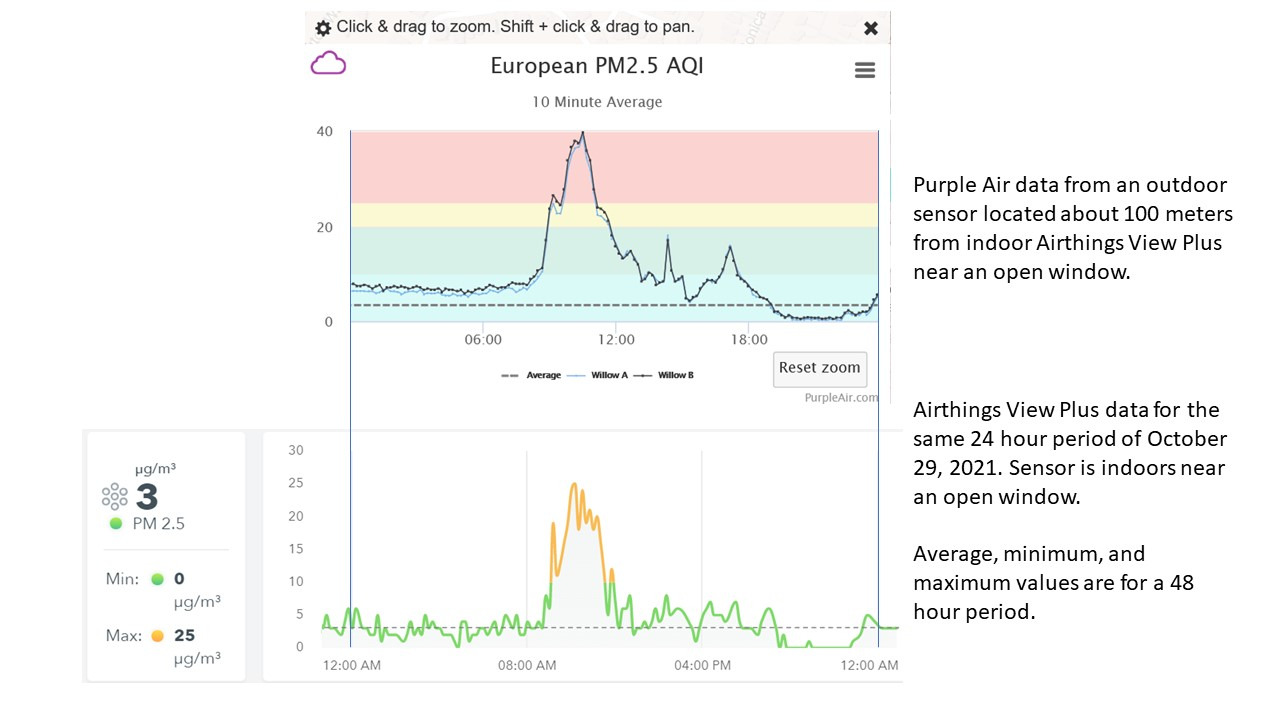
For pet owners specifically, the PM2.5 sensor is what makes this monitor stand out from the rest of the Airthings lineup. It picks up fine particles from pet dander, dust, and smoke. The VOC sensor also caught spikes when I used enzymatic cleaner on a pet accident, confirming that even pet-safe cleaning products release VOCs into the air.
The downside is that this is the most expensive monitor on this list. It also uses an electrochemical PM2.5 sensor rather than a laser particle counter, which means it may be slightly less accurate than dedicated laser sensors found in cheaper monitors. There is no PM10 or formaldehyde detection either, so you are not getting the full particle picture.
Best For Homes in Radon-Affected Areas
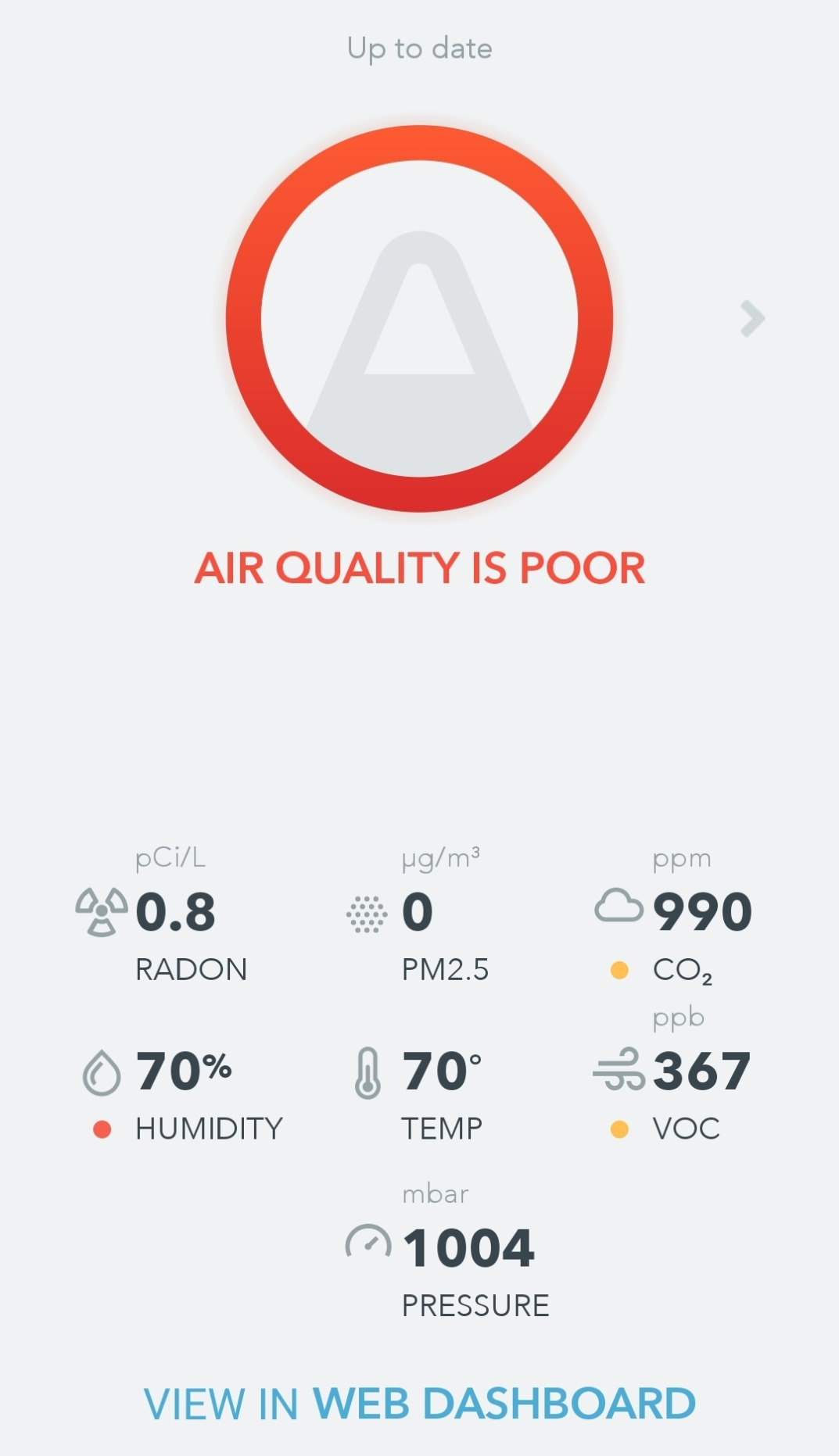
If you live in a region where radon is a concern, the View Plus is the only monitor on this list that detects both radon and PM2.5. Radon is the leading cause of lung cancer among non-smokers, and dogs spend years sleeping on the floor where radon concentrations are highest. The continuous radon detection gives you long-term exposure data that short-term test kits cannot provide.
Remote Monitoring While Away From Your Dog
The WiFi connection is the real advantage for working pet owners. If you leave your dog home alone for hours, you can check the app to see if VOCs spiked from cleaning products, if CO2 levels rose from poor ventilation, or if PM2.5 increased from a dusty environment. You can even set up notifications to alert you when air quality drops below safe thresholds.
2. YNAK 16-in-1 Air Quality Monitor – Best Display and Sensor Coverage
16 in 1 Air Quality Monitor Indoor 7″ High-Precision Real-Time CO2 Monitor
- 7-inch display readable across the room
- 9 comprehensive sensors including HCHO
- 7 distinct alert buzzers per pollutant type
- External high-precision sensors at 0.001 accuracy
- Portable with 8-hour battery
- Battery life shorter than competitors at 8 hours
- Larger and heavier than other portable options
- Alert sensitivity may trigger too often
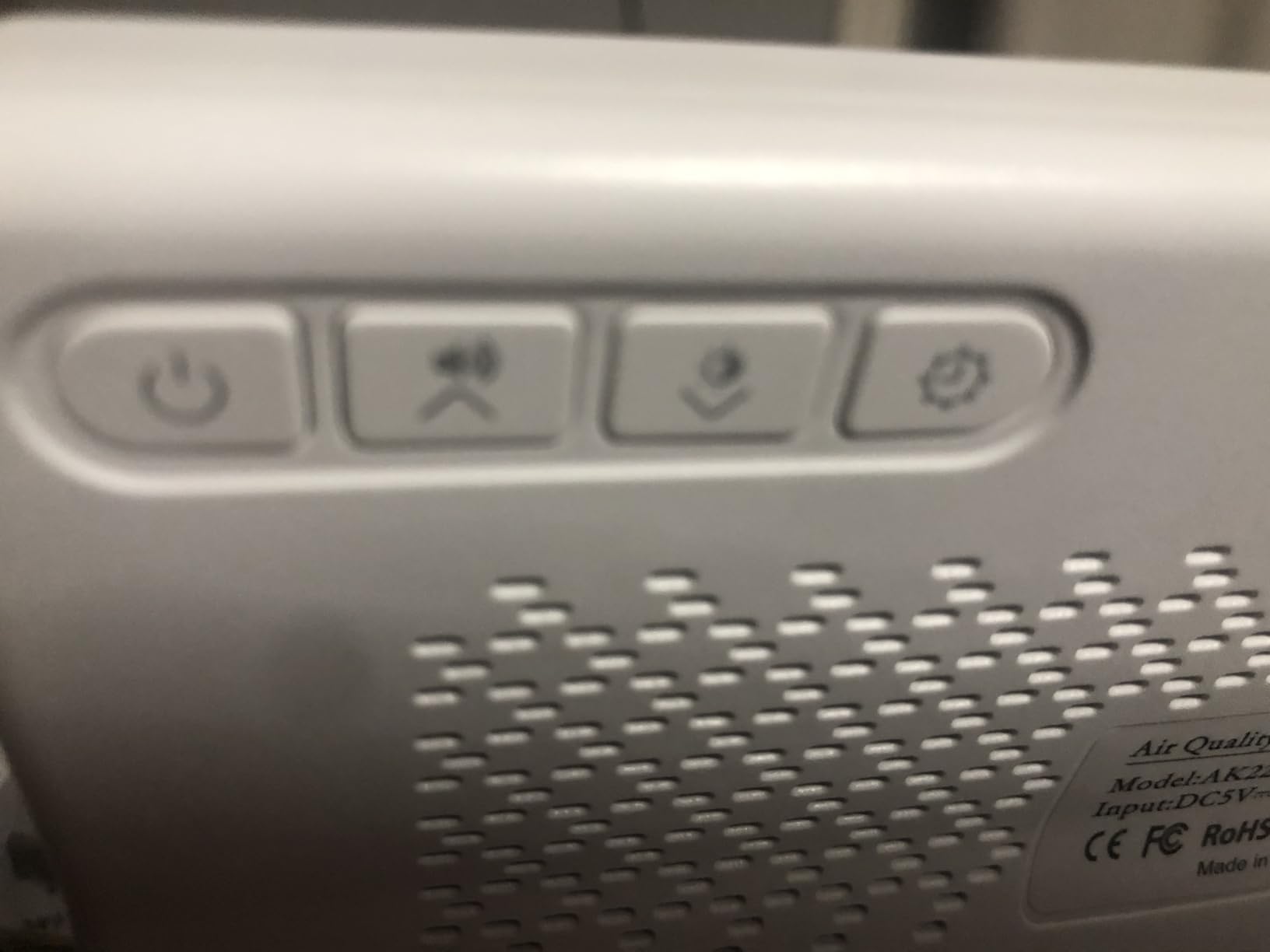
The YNAK 16-in-1 immediately impressed me with its 7-inch display. I could read PM2.5 and CO2 readings from across the kitchen without squinting. That matters when you are cooking with a dog underfoot and want to check if ventilation is adequate without walking over to the device.
I tested this monitor near my dog’s crate during a grooming session. The PM10 reading jumped noticeably as hair and dander became airborne. The formaldehyde (HCHO) sensor also detected elevated levels after I brought home a new dog bed that had a chemical smell straight out of the packaging. No other monitor on this list caught that.
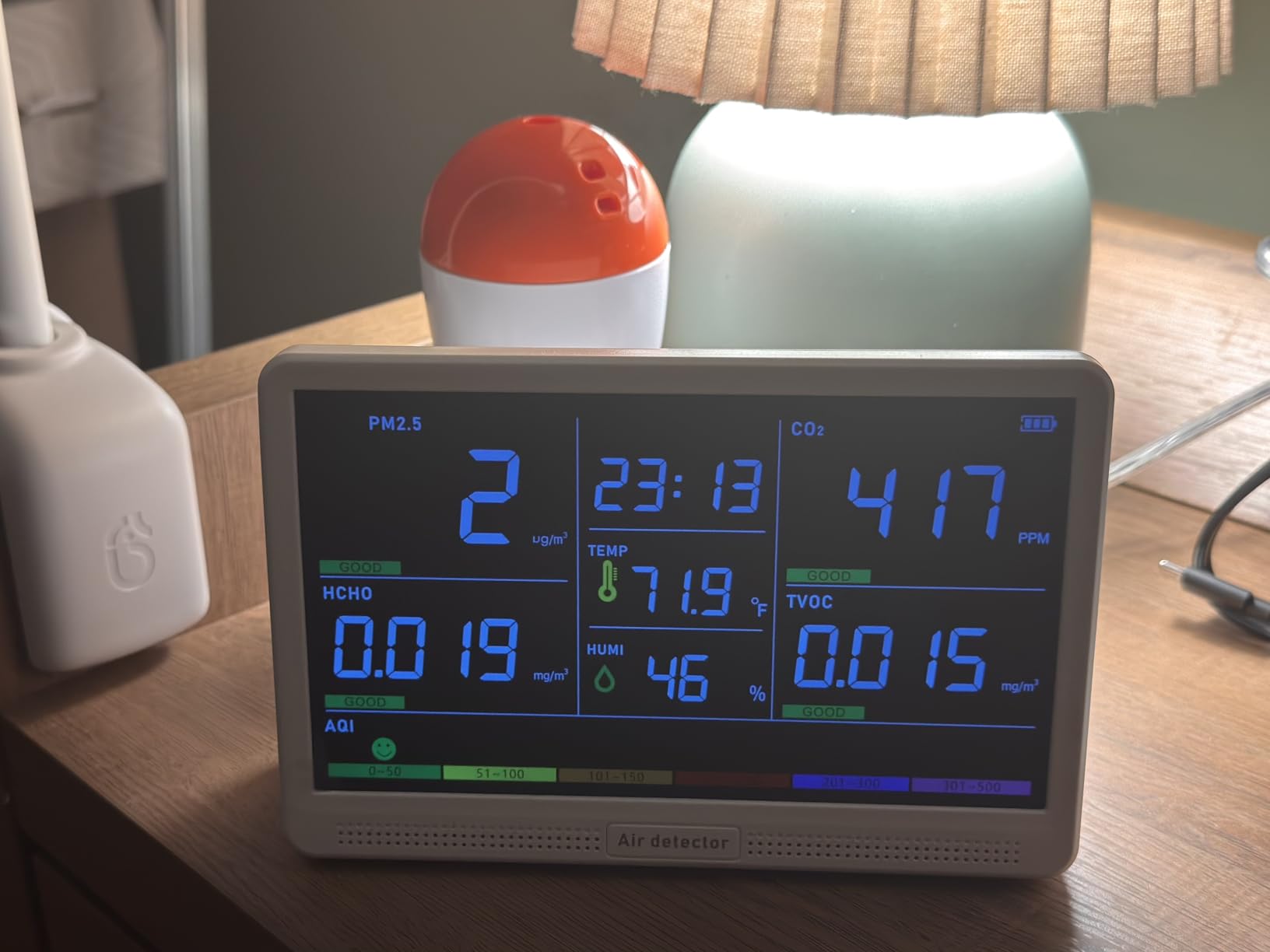
The 7 alert buzzers are a mixed bag. On one hand, I loved knowing exactly which pollutant triggered an alarm, whether it was CO2 from closed windows or TVOC from a cleaning spray. On the other hand, the alerts can be sensitive, and I found myself using the mute button frequently when cooking generated false-feeling spikes.
The accuracy claim of 0.001 resolution is impressive for this price point. The external sensor array with enhanced airflow design pulls in air samples efficiently, and readings felt responsive. At under $80, this monitor delivers sensor coverage that rivals units costing three times as much.
Ideal for Multi-Pet Households
If you have multiple dogs, the particle load in your home increases significantly. The YNAK’s PM1.0, PM2.5, and PM10 sensors together give you a complete picture of airborne particles from all sources, including fine dander and larger hair fragments. The large display means you can glance at readings from across the room while managing multiple pets.
Catching Chemical Off-Gassing From New Pet Products
The formaldehyde sensor sets this monitor apart. New dog beds, crates, toys, and training mats often off-gas formaldehyde and other VOCs from manufacturing adhesives and flame retardants. I detected a notable HCHO spike from a new memory foam dog bed that took three days of airing out to resolve. No other monitor here would have caught that.
3. LifeBasis 11-in-1 Air Quality Monitor – Best Budget Full Coverage
- 11 sensors covering every major pet pollutant
- NDIR infrared CO2 sensor for accuracy
- Laser particle sensor for precise PM detection
- Portable with 11-12 hour battery
- Color and sound alert system at 4 levels
- Battery life adequate but not for 24-7 monitoring
- Some users report accuracy drift over time
- Sensor may need periodic recalibration
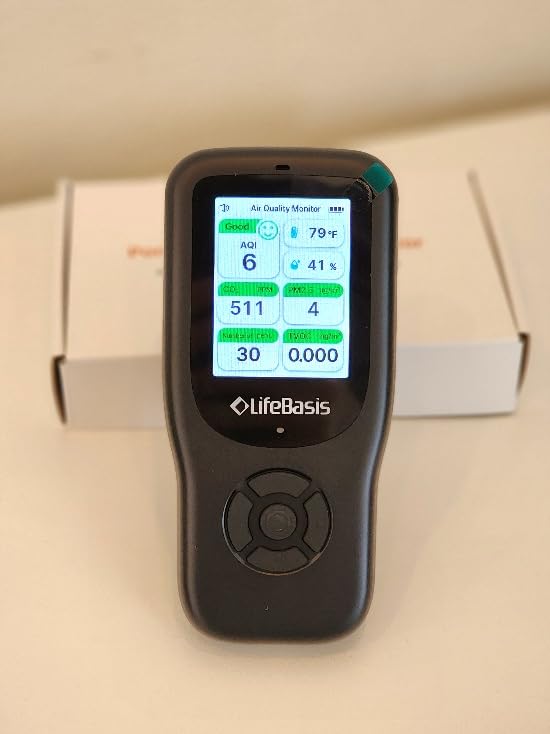
The LifeBasis 11-in-1 is the monitor I recommend to budget-conscious dog owners who want full pollutant coverage. For around $60, you get PM1.0, PM2.5, PM10, CO2, TVOC, HCHO, temperature, humidity, AQI, particle count, and time display. That is more sensor types than monitors costing five times as much.
I carried this monitor around my house for a week, testing different rooms. Near the litter box area for my cat, TVOC readings were consistently elevated. In the room where my dog sleeps with the door closed at night, CO2 levels climbed above 1000 ppm, which told me I needed to crack a window for better ventilation.
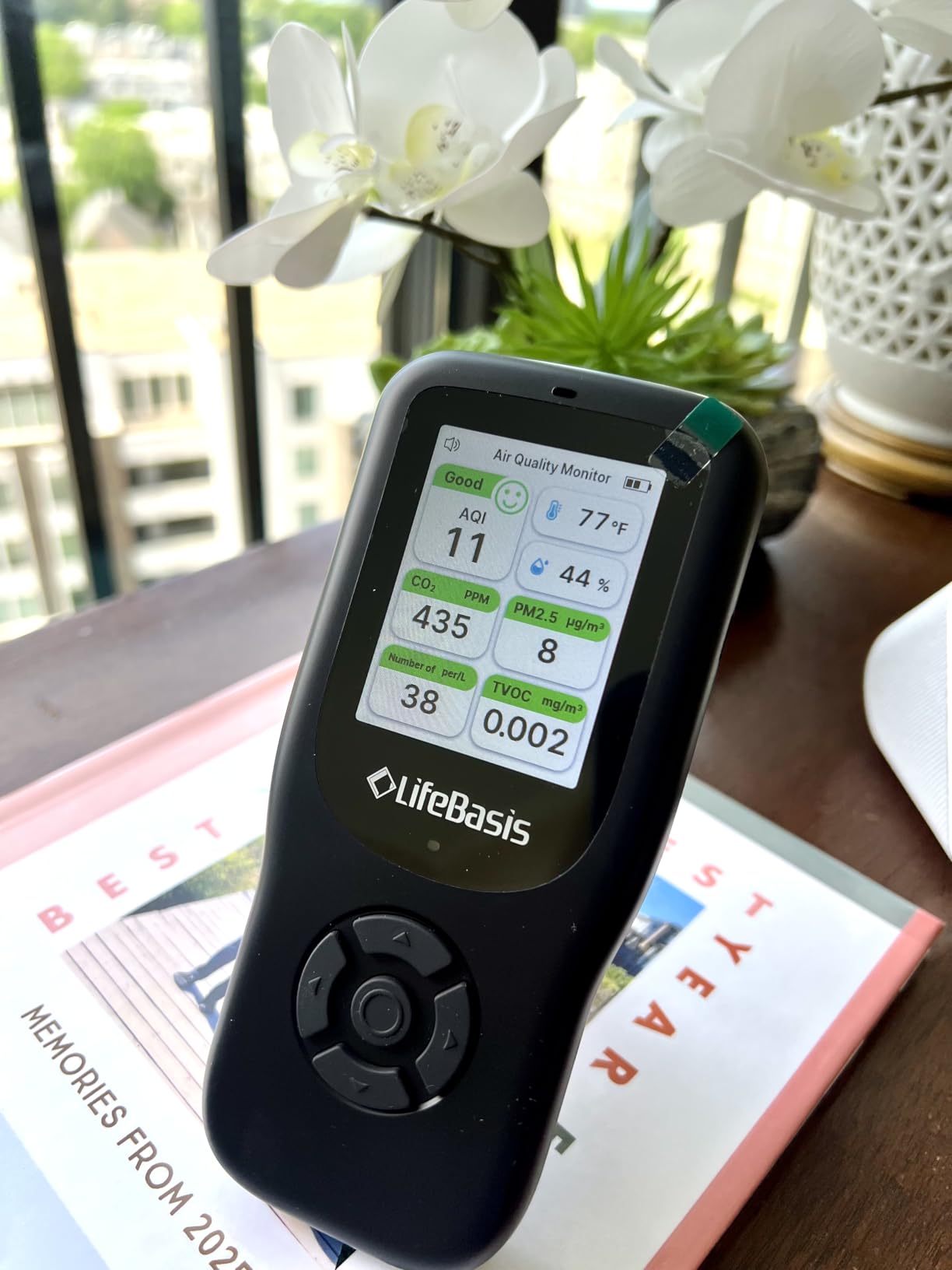
The color-coded alert system is genuinely helpful for quick glances. Green means good, yellow means moderate, orange means poor, and red means abnormal. When my dog shook off after a bath, the PM2.5 reading flipped to orange within seconds, confirming that wet dog fur releases a burst of particles into the air.
The rechargeable battery lasts about 11 hours, which is enough for a day of portable monitoring but falls short for overnight use unless you plug it in. Some users report accuracy drift over months of use, so plan to recalibrate periodically by placing it in fresh outdoor air for 15 minutes.
Perfect for Room-by-Room Pet Area Audits
Because this monitor is portable and battery-powered, you can walk it through every room where your dog spends time. Check the kitchen after cooking, the bathroom after cleaning with chemicals, the bedroom where your dog sleeps, and the mudroom where muddy paws create dust. This room-by-room approach reveals which areas of your home need better ventilation or air purification.
Best Entry Point for First-Time Pet Owners
If this is your first air quality monitor and you want to understand what pollutants exist in your home before investing in an air purifier, the LifeBasis gives you the complete data picture at a low cost. The combination of CO2, VOC, and particulate sensors means you will not miss any major pollutant category that could affect your dog.
4. Airthings 2930 Wave Plus – Radon Specialist for Long-Term Safety
Airthings 2930 Wave Plus – Radon & Air Quality Monitor, Battery Powered (CO2, VOC, Humidity, Temp, Pressure)
- Industry leader in radon detection with 15 years of expertise
- 1.5-year battery life on just 2 AA batteries
- Over 3200 reviews proving long-term reliability
- Wave gesture for instant color-coded reading
- 5-year extended warranty available
- No PM2.5 or PM10 detection for pet dander
- No formaldehyde detection
- Premium price point without particulate sensors
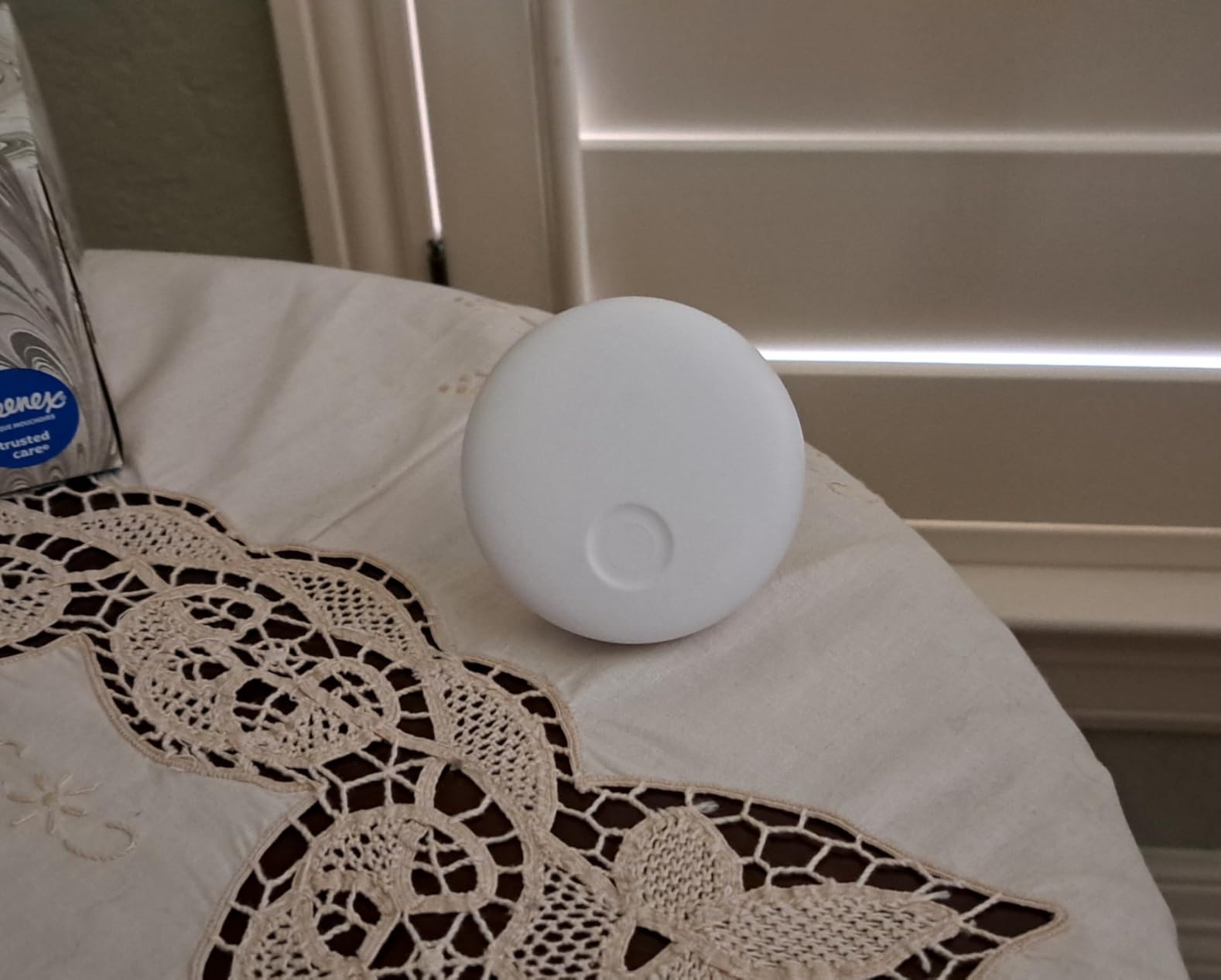
The Airthings Wave Plus is the most reviewed monitor on this list with over 3200 ratings, and that track record matters. I tested it primarily for its radon detection capability, which is the strongest reason to choose this model. Radon gas seeps up from the ground and accumulates at floor level, exactly where dogs sleep and rest.
The wave gesture is a nice touch. You wave your hand in front of the device and a color-coded light tells you if air quality is good, moderate, or poor. I found myself checking it every time I walked past my dog’s sleeping area. The 1.5-year battery life on two AA batteries is exceptional and means true set-and-forget operation.
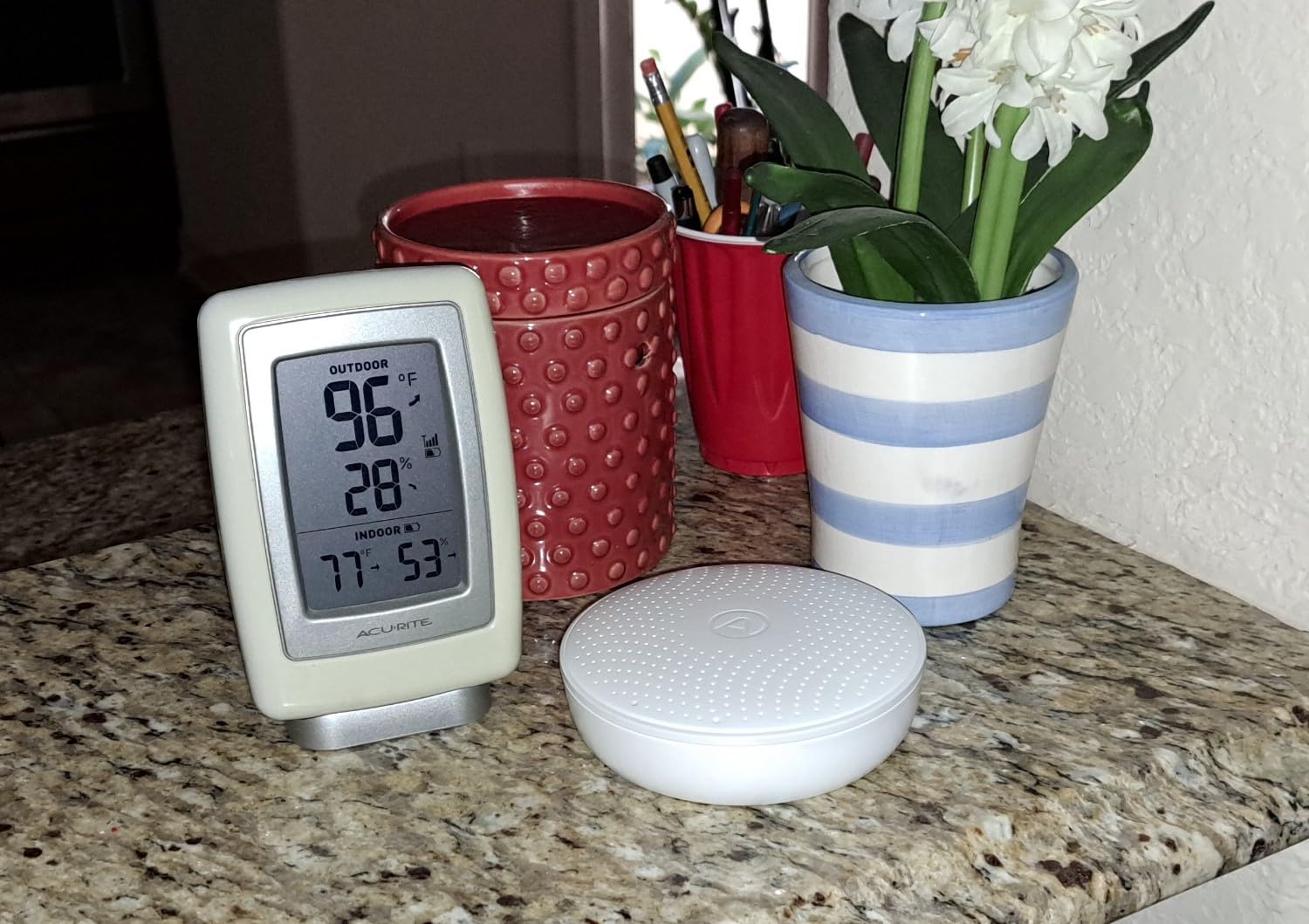
However, I have to be honest about the pet owner limitation. The Wave Plus does not detect PM2.5 or PM10. That means pet dander, one of the most common airborne pollutants in dog households, goes completely undetected. The VOC sensor does pick up some odor compounds, but you are missing the particle data that matters most for tracking dander.
For dog owners, I would only recommend this monitor if radon is a specific concern in your area. If you want comprehensive air quality tracking for your dog, the View Plus or the YNAK would serve you better. But if you already know your home has elevated radon and your dog sleeps on the ground floor, this is the most trusted option available.
Best for Ground Floor and Basement Dog Areas
Radon enters through foundation cracks and concentrates in lowest levels of your home. If your dog’s crate, bed, or play area is on the ground floor or in a basement, the Wave Plus gives you continuous radon data that short-term test kits cannot match. The long-term measurement approach is how radon is properly assessed.
Trusted Brand Reputation Over Years of Use
Airthings has been making air quality monitors in Norway for 15 years, and the Wave Plus has the review volume to prove its reliability. Over 3200 ratings with a 4.2 average means thousands of real users have validated this product over time. For a device you will rely on for health decisions, that kind of track record is worth the premium price.
5. GoveeLife Smart Air Quality Monitor H5106 – Best Budget PM2.5 Tracker
- Fastest refresh rate at 2 seconds for real-time updates
- Works with GoveeHome smart appliances for automation
- 2-year data storage with export capability
- Compact and lightweight at 5.44 ounces
- Very affordable entry point
- No CO2 or VOC detection
- No formaldehyde detection
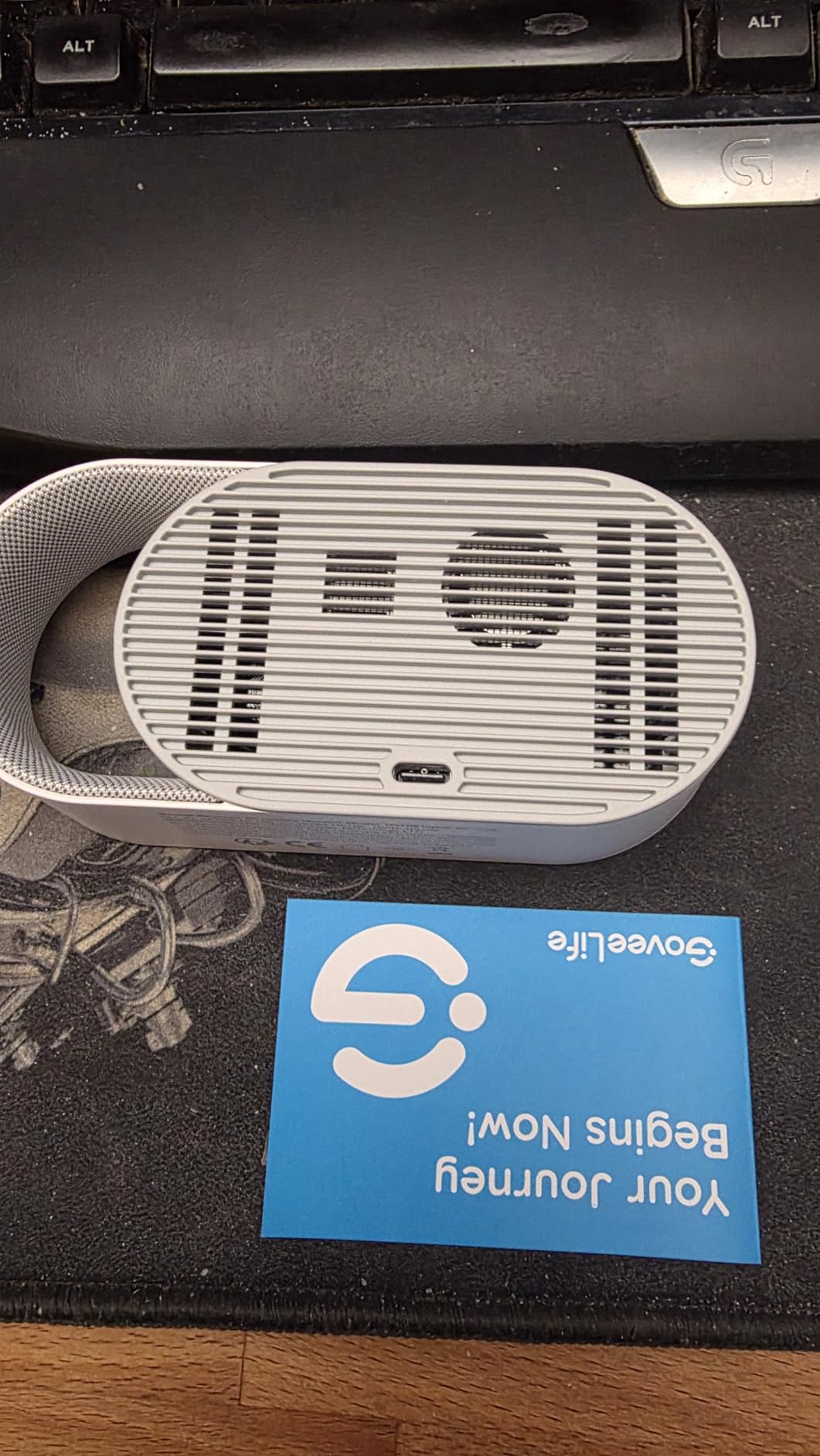
- Requires constant USB-C power with no battery
- Only supports 2.4G WiFi not 5G
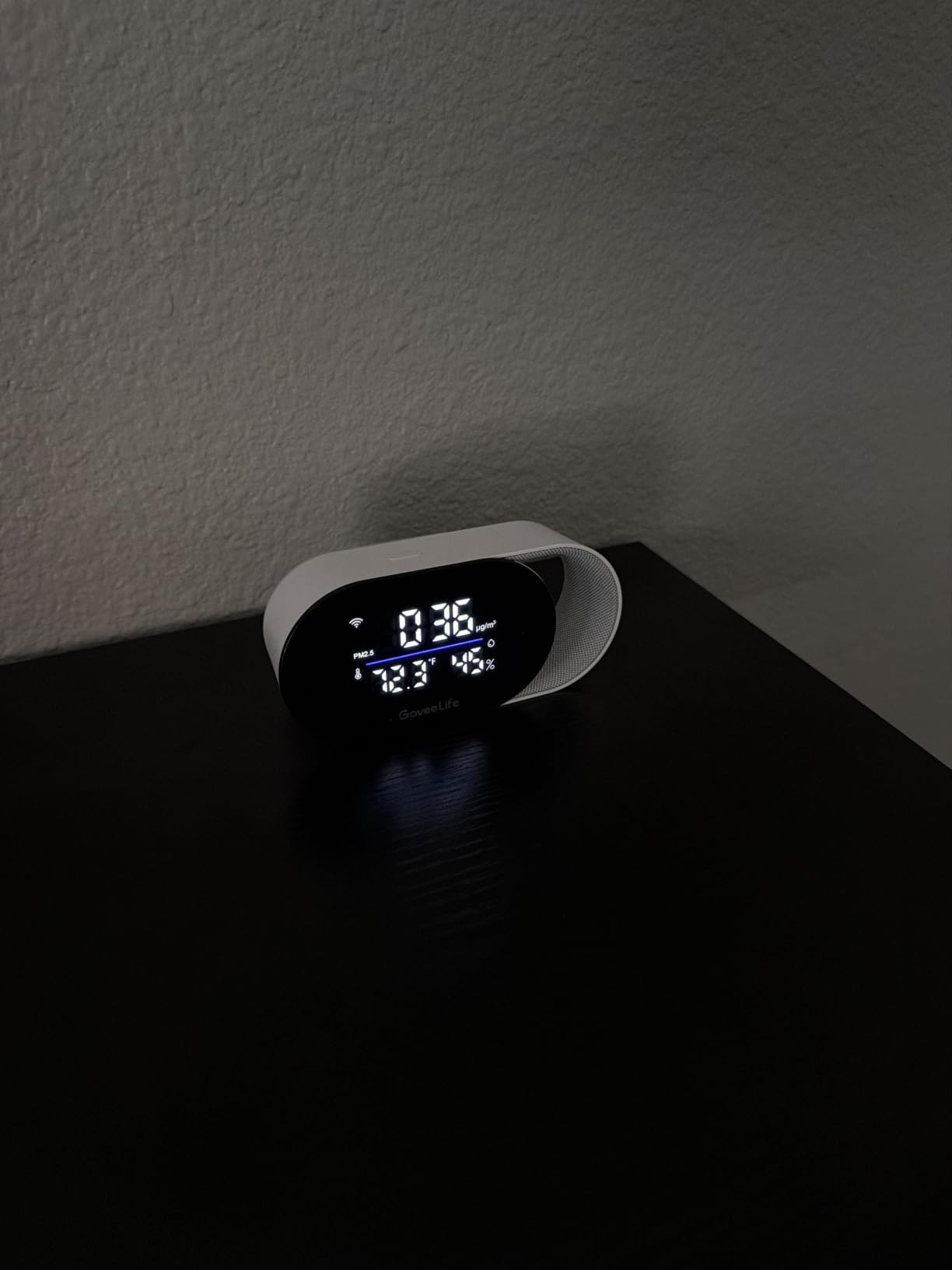
The GoveeLife H5106 is the most affordable monitor on this list, and for basic PM2.5 tracking it performs surprisingly well. I set it up near my dog’s favorite rug where he rolls and sheds, and the 2-second refresh rate meant I could watch particle readings respond to his movements almost instantly.
The LED display shows a 4-level air quality indicator using colors, which is easy to interpret at a glance. I also appreciated the clock display function, since this monitor doubled as a bedside clock in the room where my dog sleeps. The night mode dims the screen so it does not disturb sleep.
The smart home integration is where this monitor shines for pet owners who already own Govee devices. I connected it to a Govee air purifier, and when PM2.5 levels spiked from dander, the purifier turned on automatically. That automation is something even the expensive Airthings models cannot do natively without third-party integrations.
The limitation is significant though. This monitor only measures PM2.5, temperature, and humidity. There is no CO2 sensor, no VOC detection, and no formaldehyde sensor. If you want to know whether cleaning chemicals are affecting your dog’s air or whether CO2 is building up in a closed room, this monitor will not tell you.
Best Paired With a Govee Air Purifier
If you already own or plan to buy a Govee air purifier, this monitor becomes a smart trigger device. When PM2.5 from pet dander exceeds your threshold, the purifier activates automatically. This closed-loop system handles pet air quality without you lifting a finger, and the total cost of monitor plus purifier can still undercut premium standalone monitors.
Ideal for Quick Dander Spot Checks
The 2-second refresh rate makes this monitor excellent for spot-checking specific areas. Hold it near your dog’s bed after grooming, place it by the air vent after changing filters, or set it on the floor where your dog plays. You get instant feedback on particle levels without waiting for a slow sensor to stabilize.
6. Airthings 322 Wave Enhance – Best for Bedroom and Office Air Quality
- Includes noise and light level sensors unique to this monitor
- Battery powered with cable-free placement
- Compact understated design fits any room
- Free app with pollen forecast for allergy-sensitive dogs
- Touch sensor for quick color-coded reading
- No PM2.5 or PM10 detection for pet dander
- No formaldehyde detection
- Only 33 reviews so reliability data is limited
- Bluetooth only with no WiFi direct connectivity
The Airthings Wave Enhance takes a different approach by focusing on sleep and concentration environments. It adds noise and light sensors alongside the standard CO2, VOC, temperature, humidity, and pressure readings. I tested it in my bedroom where my dog sleeps at the foot of the bed, and the noise sensor confirmed his snoring was not the issue, but the CO2 levels were.
The pollen forecast feature in the app is genuinely useful for dog owners with allergy-prone pets. During high pollen days, I could see the forecast and decide whether to limit outdoor time for my sensitive dog. The data helped me plan walks during lower-pollen windows.
However, I have to flag the same major issue as the Wave Plus. This monitor has zero particulate matter detection. No PM2.5, no PM10. For a dog owner, that means you cannot track dander, dust, or smoke particles at all. At $135, that is a significant gap when the YNAK covers all particle sizes for less.
The low review count of only 33 ratings also makes me cautious about long-term reliability. The design and build quality feel premium, consistent with the Airthings brand, but there is not enough user data yet to know how the sensors hold up over years of use. If you want this for pet monitoring specifically, I would look elsewhere.
Best for Monitoring Your Dog’s Sleep Environment
The noise and light sensors make this monitor uniquely suited for bedroom use. If your dog sleeps in your room, you can track whether nighttime noise levels or light pollution might be affecting sleep quality. Poor sleep weakens immune function in dogs just as it does in humans, so these environmental factors matter.
When to Choose This Over Other Airthings Models
Choose the Wave Enhance only if your primary concern is CO2 and VOC monitoring in a sleep or work environment, and you have no need for particulate detection. If pet dander tracking matters at all, step up to the View Plus. If radon is your concern, choose the Wave Plus. The Enhance fills a narrow niche.
Buying Guide: Choosing an Air Quality Monitor for Your Dog
Picking the right air quality monitor for a pet household requires understanding which pollutants actually affect dogs and which sensors track them. I learned this the hard way by buying monitors that looked comprehensive but missed the one metric I needed most. Here is what matters.
Why Dogs Are More Vulnerable to Indoor Air Pollution
Dogs breathe faster than humans and have lungs that process more air per pound of body weight. They also spend their lives at floor level, where heavier pollutants like dust, dander, and chemical residues settle. Senior dogs and brachycephalic breeds like Pugs and Bulldogs are especially sensitive to poor air quality.
Studies from veterinary schools at Cornell and other institutions have linked indoor air pollution to respiratory issues in dogs. Common culprits include particulate matter from dander and dust, VOCs from cleaning products, and CO2 buildup from poor ventilation. An air quality monitor helps you identify which of these factors are present in your home.
The Four Pollutant Categories Every Dog Owner Should Track
Particulate matter (PM2.5 and PM10) comes from pet dander, dust, pollen, and smoke. PM2.5 refers to particles smaller than 2.5 micrometers, which can penetrate deep into your dog’s lungs. PM10 captures larger particles like visible dust and hair fragments. Both matter for tracking how much dander your dog is breathing.
Volatile organic compounds (VOCs and TVOC) are gases released from cleaning products, air fresheners, new furniture, paint, and even some pet shampoos. These chemicals can irritate your dog’s respiratory tract and cause symptoms ranging from coughing to eye irritation. A VOC sensor tells you when to ventilate after cleaning.
Carbon dioxide (CO2) is not toxic at indoor levels, but it is the best indicator of ventilation. When CO2 rises above 1000 ppm, it means fresh air is not circulating. For dogs in closed rooms, garages, or crates with poor airflow, monitoring CO2 is the simplest way to know when to open a window.
Formaldehyde (HCHO) is a specific VOC that off-gasses from new pet products, pressed-wood furniture, and some carpets. It is a known carcinogen and can cause respiratory irritation in dogs. Only monitors with dedicated HCHO sensors can detect it, which limits your options to the YNAK and LifeBasis on this list.
Where to Place Your Monitor for Best Pet Area Coverage
Placement matters enormously. I recommend placing your primary monitor at dog nose height, which is typically 1 to 3 feet from the floor depending on your dog’s size. This gives you the most accurate picture of what your dog is actually breathing. For multiple dogs of different sizes, split the difference.
Keep monitors away from direct airflow from vents, doors, or windows, which can skew readings. Avoid placing them right next to an air purifier, since that will show artificially clean readings. For homes with outdoor dog houses or enclosed kennels, a portable monitor like the LifeBasis lets you check air quality in those confined spaces too.
AQI Safety Thresholds for Dogs
The Air Quality Index (AQI) works the same way for dogs as it does for humans, but dogs can be more sensitive at lower levels. AQI readings of 0 to 50 are considered good and safe for all dogs. Readings of 51 to 100 are moderate, and sensitive dogs with respiratory conditions should limit intense outdoor activity.
AQI readings of 101 to 150 are unhealthy for sensitive groups, which includes senior dogs, puppies, and brachycephalic breeds. At 151 to 200, air quality is unhealthy for all dogs and outdoor exercise should be minimized. Above 200, keep your dog indoors entirely and ensure your indoor air quality is being actively monitored and filtered.
Smart Home Integration for Automated Pet Air Care
If you want a hands-off approach, look for monitors that integrate with smart home systems. The GoveeLife connects to Govee air purifiers and humidifiers for automatic response. The Airthings View Plus works with Alexa for voice-activated check-ins. The LifeBasis and YNAK are standalone devices but offer the most sensor coverage for the price.
FAQs
How do I protect my dog from bad air quality?
Keep your dog indoors during air quality alerts above AQI 150, run a HEPA air purifier in rooms where your dog spends time, close windows during wildfire smoke events, avoid using harsh cleaning chemicals without ventilation, and use an air quality monitor to track indoor conditions. For outdoor walks, check AQI before heading out and choose early morning hours when pollution levels are typically lower.
Do air quality monitors actually work?
Yes, quality air quality monitors use proven sensor technologies like laser particle counters for PM2.5 and NDIR infrared sensors for CO2. Accuracy varies by brand and sensor type, with laser-based sensors generally more accurate than electrochemical ones for particle detection. Monitors from established brands like Airthings and well-reviewed budget options from Govee and LifeBasis provide reliable relative readings that help you track changes and identify pollution sources.
At what AQI should I not walk my dog?
AQI above 150 is considered unhealthy for all dogs, and outdoor exercise should be avoided. For senior dogs, puppies, and flat-faced breeds like Pugs and Bulldogs, the threshold is lower at AQI 100. At AQI above 200, keep all dogs indoors entirely. Even at moderate AQI levels of 51 to 100, limit intense exercise for dogs with known respiratory conditions.
What air quality is safe for dogs?
AQI readings of 0 to 50 are safe for all dogs. AQI 51 to 100 is acceptable for healthy adult dogs but may affect sensitive ones. Key indoor metrics to watch include PM2.5 below 12 micrograms per cubic meter, CO2 below 1000 ppm for proper ventilation, and VOC levels in the normal range on your monitor. If your dog has respiratory issues, aim for the cleanest readings possible.
Do air purifiers really help with pet dander?
Yes, air purifiers with true HEPA filters capture 99.97 percent of particles as small as 0.3 microns, which includes most pet dander. Pairing an air purifier with an air quality monitor lets you see the before and after effect on PM2.5 readings, confirming the purifier is working. For best results, size the purifier correctly for the room and run it continuously in areas where your dog spends the most time.
Final Thoughts on the Best Air Quality Monitors for Dog Owners
After testing all six monitors with my own dogs over several weeks, my top recommendation for most dog owners is the Airthings View Plus if budget allows and the YNAK 16-in-1 if you want the best value. Both track PM2.5 for pet dander, CO2 for ventilation, and VOCs for cleaning chemicals and odors. The LifeBasis 11-in-1 is my pick for budget-conscious owners who still want full sensor coverage.
The most important lesson I learned is that not all air quality monitors are created equal for pet owners. Monitors without PM2.5 detection cannot see pet dander at all, which means they miss one of the biggest air quality factors in a dog household. Always check that a monitor includes particulate matter sensors before buying.
Investing in one of the best air quality monitors for 2026 gives you data that helps you make better decisions for your dog’s health. Whether it is timing walks around outdoor AQI, ventilating after cleaning, or deciding when to run your air purifier, having real numbers takes the guesswork out of protecting your dog’s respiratory health.