
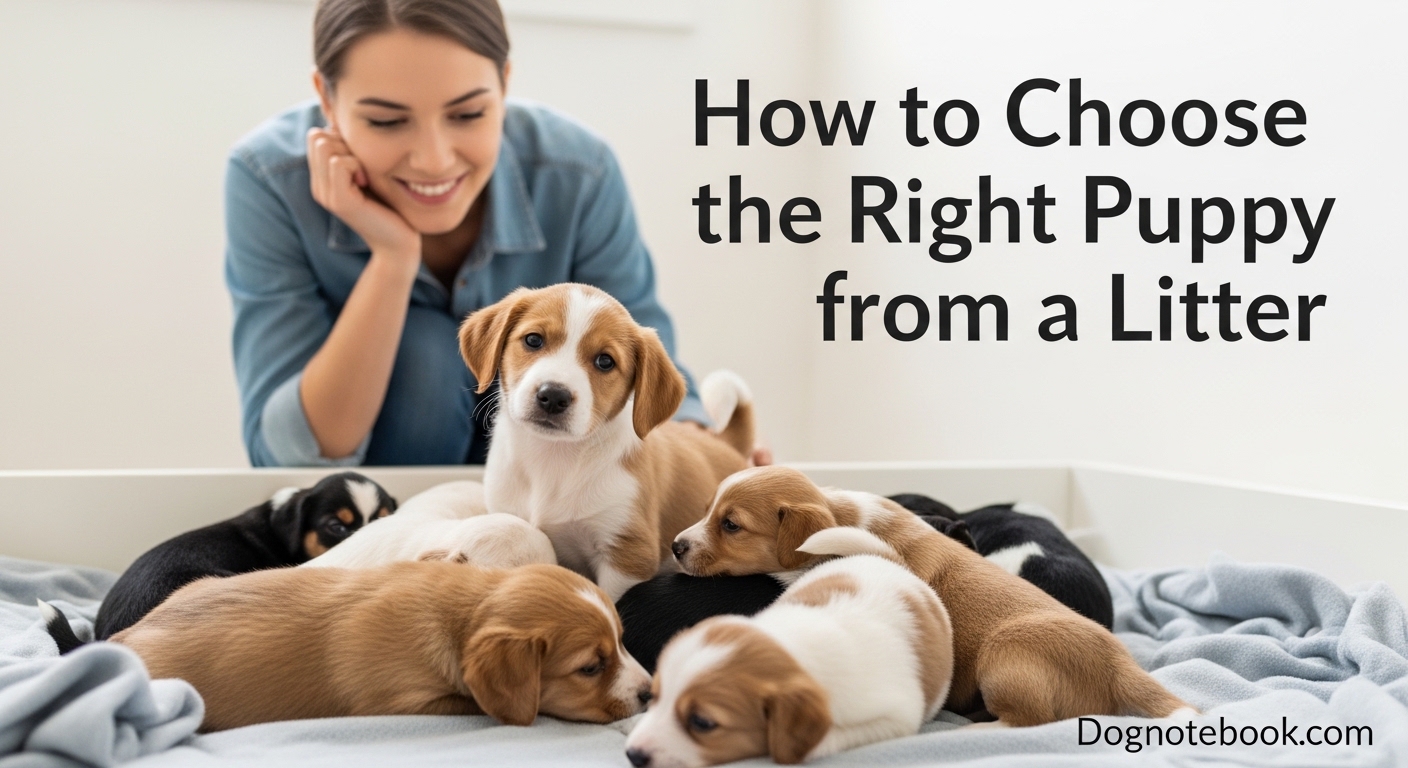
Bringing home a new puppy is one of the most exciting decisions a family can make. But walking into a litter of six or eight wagging tails and picking the first one that licks your face? That is a recipe for a mismatch that can last 10 to 15 years. Learning how to choose the right puppy from a litter takes patience, observation, and a little bit of know-how that most first-time owners simply do not have.
I have helped friends and family select puppies from litters for over a decade, and the pattern is always the same: the cutest puppy is not always the best fit, and the quietest puppy is not always the calmest adult dog. Personality matters far more than coat color, ear shape, or gender. This guide walks you through every step of the evaluation process so you can walk away with a healthy, well-tempered companion that fits your lifestyle.
Whether you are a first-time dog owner or adding a second dog to your family, this guide covers health checks, temperament testing, red flags to watch for, and the specific questions you should ask the breeder before making your decision in 2026.
Table of Contents
Before You Visit the Litter: Preparation Matters
The biggest mistake I see people make is showing up to meet a litter with zero preparation. You would not buy a car without researching the model, and selecting a puppy deserves the same level of homework.
Start by researching the breed or breed mix you are interested in. Different breeds have wildly different energy levels, grooming needs, and health predispositions. A Border Collie puppy might look adorable at 8 weeks, but that same dog will need two hours of exercise daily as an adult. Know what you are signing up for before you ever meet the litter.
Next, write down a list of questions for the breeder. I always recommend preparing at least 8 to 10 specific questions covering health testing, socialization practices, vaccination schedules, and the parents’ temperaments. Having these written down keeps you focused even when you are distracted by a pile of fluffy puppies.
One piece of advice that comes up again and again from experienced dog owners on forums like r/puppy101: do not bring young children on your first visit to the litter. Kids get excited, puppies react differently to high-energy humans, and you will not get an accurate read on any puppy’s true temperament. Visit alone first, narrow your choices, then bring the family back for a second visit to see how your top pick interacts with everyone.
If at all possible, plan to visit the litter more than once. Puppies change quickly, and a pup that seemed shy on Tuesday might be the most confident one in the group by Friday. Multiple visits give you a much clearer picture of each puppy’s emerging personality.
How to Choose the Right Puppy from a Litter: Step-by-Step
The right puppy for your family is one that matches your energy level, handles new experiences with curiosity rather than fear, and shows no signs of aggression or extreme timidity. Here is the step-by-step process I use every time I evaluate a litter.
- Watch the litter as a group before interacting. Stand back for 5 to 10 minutes and just observe. Which puppies are playing together? Which ones are exploring? Which ones are hanging back? This tells you a lot about the social dynamics before you influence them with your presence.
- Look for the middle-of-the-pack puppy. Experienced breeders and behaviorists consistently recommend the puppy that is social but not pushy, curious but not reckless. This middle-ground puppy tends to grow into a well-adjusted adult dog that adapts easily to family life.
- Perform the sit-and-wait test. Sit on the ground near the litter and stay still. Do not call them or make eye contact. See which puppies approach you on their own. A puppy that comes over to investigate you with a loose, wagging body is showing confidence and social interest.
- Try the calling test. Walk a few feet away, crouch down, and call the puppies in a happy voice with light clapping. The puppy that comes quickly and happily is showing a desire for human interaction. Puppies that ignore you completely or run away may be more independent or fearful.
- Gently handle each puppy individually. Pick up your top candidates one at a time. A well-socialized puppy should relax into your arms within a few seconds. Stiffening up, thrashing, or yelping excessively can indicate sensitivity or a lack of handling.
- Trust your gut, but verify with observation. It is okay to feel drawn to a particular puppy, as long as that puppy also passes the health and temperament checks outlined below.
Many experienced owners on Reddit recommend the “let the puppy choose you” approach, and there is real value in that. A puppy that voluntarily seeks you out is showing social confidence and a natural desire for human companionship. But always pair that emotional connection with a rational health and temperament assessment.
Experienced breeders can offer valuable guidance about which puppy suits your lifestyle. Their input is worth considering. However, veterinary behaviorist Dr. Jeff Nichol strongly advises against letting the breeder make the final decision for you. You need to perform your own observations and temperament testing to be confident in your choice.
Physical Health Checklist: How to Identify a Healthy Puppy
A healthy puppy is the foundation of everything else. No amount of training or love can fix a congenital health problem that should have been caught at selection. Here is the physical exam checklist I run through with every puppy I evaluate.
Eyes
Look for bright, clear eyes with no cloudiness, redness, or discharge. The pupils should be the same size. A puppy that squints or paws at its eyes may have an infection or congenital issue.
Slight tearing can be normal, but thick yellow or green discharge is a red flag that warrants attention.
Ears
The inside of each ear should be clean and pale pink. Redness, swelling, dark wax buildup, or a foul smell all point to ear infections or mites.
Watch whether the puppy shakes its head frequently or scratches at its ears during your visit. Persistent head shaking is not normal at any age.
Nose
A healthy puppy nose is moist and cool, though it does not need to be constantly wet. Thin clear discharge is normal.
Thick, colored, or bloody discharge is not normal. Avoid any puppy with a dry, cracked nose accompanied by lethargy.
Mouth and Gums
Lift the puppy’s lip and check the gums. They should be a healthy pink color, not pale white, bright red, or blue. The teeth should be clean for the puppy’s age.
There should be no sores or unusual growths inside the mouth. Bad breath in a puppy is unusual and can indicate dental or digestive problems.
Coat and Skin
Run your hands over the puppy’s entire body. The coat should be soft and shiny for the breed type.
Look for bald patches, scabs, redness, fleas, or ticks. Dandruff can indicate poor nutrition or skin issues. The skin should be pliable and free of lumps or swelling.
Body Condition
A healthy puppy should have a slightly rounded belly but not a bloated or distended one. A swollen, hard belly can indicate intestinal parasites, which are common but need treatment.
Feel along the belly for any soft lumps near the navel, which could indicate an umbilical hernia. Also check that both testicles have descended in male puppies. Undescended testicles, called cryptorchidism, may require surgery later.
Movement and Coordination
Watch the puppy walk and run. At 7 to 8 weeks, puppies should be coordinated enough to move without stumbling frequently.
Limping, dragging a limb, or a bunny-hopping gait in the hind legs can be early signs of joint issues. While some clumsiness is normal for young puppies, persistent gait abnormalities deserve veterinary attention.
Open Fontanelles Check
In small breed puppies, gently feel the top of the skull for soft spots called open fontanelles. Some delay in closure is normal in toy breeds.
Very large soft spots can make the puppy vulnerable to brain injury. Ask the breeder about this if you are choosing a small or toy breed puppy.
Temperament Testing: 5 Simple Tests You Can Do Yourself
Veterinary behaviorist Dr. Jeff Nichol developed a set of five temperament tests that anyone can perform during a litter visit. These tests give you a snapshot of how a puppy handles social pressure, new experiences, and physical handling. I have used these tests many times, and they are remarkably accurate at predicting adult personality traits.
Bring some colored ribbons or tape with you. As you test each puppy, label them with a ribbon so you can keep track of results across all five tests.
Test 1: The Socialization Test
Approach the puppy and gently stroke it from head to tail several times. A confident, social puppy will lean into your hand, wag its tail, and seem to enjoy the attention.
A very fearful puppy may flinch, freeze, or try to move away. An overly dominant puppy might immediately start mouthing your hands hard or climbing on you without any softness.
Test 2: The Calling Test
Place the puppy a few feet away, crouch down, and call it with a happy, encouraging voice while lightly clapping.
A quick, happy approach with a wagging tail is ideal. A slow approach or no approach at all suggests lower social drive or fearfulness. A puppy that charges at you and immediately starts biting or jumping excessively may be higher energy than you expect.
Test 3: The Restraint Test
Gently but firmly hold the puppy on its side for a few seconds. The ideal response is a brief struggle followed by relaxation.
A puppy that fights relentlessly, growls, or bites may have dominant or reactive tendencies. A puppy that freezes completely and shows signs of fear needs careful socialization work.
Test 4: The Inversion Test
Cradle the puppy on its back like a baby, supporting its head and body. The ideal response is brief resistance followed by calm acceptance.
This test reveals how the puppy handles vulnerability. Puppies that thrash aggressively or urinate submissively are showing you how they handle stress. Both responses are worth noting.
Test 5: The Startle Recovery Test
While the puppy is distracted, drop a set of keys on the floor nearby. Watch the puppy’s reaction and, more importantly, how quickly it recovers.
A confident puppy may startle briefly but then goes right back to exploring. A fearful puppy may retreat and take a long time to recover. Quick recovery from surprises is one of the best indicators of a stable temperament.
No single test tells the whole story. Look at the pattern across all five tests. The puppy that scores consistently in the confident, curious, middle range is your best bet for a balanced family companion.
Red Flags to Avoid When Choosing a Puppy
Knowing what to avoid is just as important as knowing what to look for. Here are the red flags that should make you walk away from a litter, no matter how much you love a particular puppy.
Dirty, overcrowded, or foul-smelling living conditions. A responsible breeder keeps the puppy area clean and spacious. Filthy conditions suggest neglect and increase the risk of illness and poor socialization.
The breeder refuses to let you meet the parents. If you cannot see at least the mother dog, that is a serious warning sign. The mother’s temperament is one of the strongest predictors of how her puppies will turn out. A breeder who hides the parents may be running a puppy mill.
Puppies offered before 8 weeks of age. Puppies need their mother and littermates for critical social development during the first 8 weeks. Taking a puppy home at 5 or 6 weeks can lead to bite inhibition problems, anxiety, and behavioral issues that last a lifetime.
No health records or vaccination documentation. A reputable breeder will have deworming records, vaccination dates, and health testing results for the parents readily available. If the breeder cannot provide these, walk away.
The breeder pressures you to decide immediately. A good breeder wants their puppies to go to the right homes. They welcome questions, encourage multiple visits, and do not rush you. High-pressure tactics suggest the breeder cares more about money than the welfare of the dogs.
Puppies that hide in corners, tremble, or show extreme fear. While a slightly shy puppy can blossom with proper socialization, a puppy that is terrified of people at 8 weeks will need extensive behavior modification and may never be fully comfortable in busy households.
Visible illness in any littermate. If even one puppy in the litter looks sick, the others may be incubating the same illness. Coughing, lethargy, diarrhea, or discharge from eyes or nose in any puppy should make you cautious about the entire litter.
Meeting the Parents: What to Look For
The temperament and health of the parent dogs tell you a lot about what your puppy will become. Genetics play a massive role in behavior, and the mother’s influence is especially strong because she raises the puppies during their most formative weeks.
When you meet the mother, watch how she greets you. Is she friendly and relaxed? Does she show appropriate wariness of a stranger that transitions to acceptance? A mother that is aggressive, extremely fearful, or completely disinterested in humans is a red flag. Her puppies are learning from her every day.
Ask the breeder specifically about health testing done on both parents. For larger breeds, hip and elbow evaluations are essential. Many breeds have genetic conditions that can be tested for — progressive retinal atrophy, degenerative myelopathy, and heart conditions are common examples. A responsible breeder will have documentation for all of this.
The father may not be on site, which is normal. But you should still ask about his temperament, health history, and whether you can contact his owner. If the breeder cannot tell you anything about the father, that is a gap worth thinking hard about.
Does Age Matter? What to Know at 4, 6, and 8 Weeks
One of the most common questions I get is about the right age to evaluate and pick up a puppy. The short answer is that 8 weeks is the gold standard, and here is why each stage matters.
At 4 weeks, puppies are just starting to walk steadily and interact with each other. Their personalities are barely forming. You can visit at this age to see the environment and meet the parents, but do not make any decisions based on temperament at 4 weeks. It is simply too early.
At 6 weeks, basic personality traits start emerging. You might notice which puppies are bolder or more reserved. However, puppies at this age are still in a rapid development phase, and a shy puppy at 6 weeks can become the most outgoing one by 8 weeks. Use this visit to narrow your list but not to finalize your choice.
At 8 weeks, the ideal window opens. By 8 weeks, puppies have completed their primary socialization with their mother and littermates. They have learned bite inhibition, dog communication skills, and basic confidence. Their personalities are stable enough to evaluate, and they are developmentally ready to bond with a new family.
This is also when the critical socialization window is wide open. Between 8 and 12 weeks, puppies are primed to accept new experiences, people, sounds, and environments. Picking up your puppy at 8 weeks gives you the maximum benefit of this crucial developmental period.
In many states, it is actually illegal to sell or adopt a puppy before 8 weeks of age. If a breeder offers you a puppy at 5 or 6 weeks, that is a red flag for both legal and developmental reasons.
The 3-3-3 Rule: What to Expect When You Bring Your Puppy Home
Understanding the 3-3-3 rule helps you set realistic expectations for your new puppy’s adjustment period. It also affects your selection strategy — knowing that the puppy’s true personality will not fully emerge for three months should encourage patience and careful observation.
The first 3 days are about decompression. Your puppy will likely be overwhelmed by the new environment. They may not eat well, may have accidents despite being partially house trained, and might cry at night. This is completely normal and does not mean you chose the wrong puppy.
The first 3 weeks are about settling in. Your puppy starts learning the household routine, begins to trust you, and shows more of their personality. This is when early training and socialization efforts start paying off. You will see the confident or curious traits you observed during selection start to solidify.
The first 3 months are when your puppy truly feels at home. By this point, they have bonded with your family, understand the rules of the house, and their full personality is shining through. If you chose a middle-of-the-pack, confident puppy, this is when you will be grateful for the careful evaluation you did at the litter.
Questions to Ask the Breeder Before You Choose
Forum discussions consistently highlight that most buyers do not know what to ask breeders. Here is the list I bring to every litter visit, broken into the most important categories.
Health and Genetics:
- What health testing has been done on both parents?
- Have the puppies been dewormed, and on what schedule?
- What vaccinations have been given so far?
- Have any puppies in this litter had health issues?
- Is there a health guarantee, and what does it cover?
Socialization and Rearing:
- How have the puppies been socialized so far?
- Have they been exposed to different sounds, surfaces, and people?
- Are the puppies raised indoors or in an outdoor kennel?
- What is the mother’s temperament like with visitors?
Practical Details:
- What food are the puppies currently eating?
- Can I see the parents’ health testing documentation?
- What is your return policy if things do not work out?
- Can I contact previous puppy buyers for references?
A good breeder will welcome every one of these questions. If you sense hesitation, defensiveness, or vague answers, trust that instinct and consider looking elsewhere.
FAQ
How do I pick the best puppy from a litter?
Observe the entire litter from a distance first. Look for a puppy that is social but not pushy, curious but not reckless. Use simple tests like sitting quietly to see which puppy approaches you, calling to see which comes happily, and gently handling each puppy to check for calm acceptance. Choose the middle-of-the-pack puppy with bright eyes, a shiny coat, and a confident but friendly demeanor.
What to avoid when choosing a puppy?
Avoid puppies from dirty or overcrowded conditions, breeders who will not let you meet the parents, puppies offered before 8 weeks of age, litters with no health or vaccination records, and any puppy that shows extreme fear, aggression, or visible illness. Also avoid breeders who pressure you to make a quick decision.
What is the 3-3-3 rule with puppies?
The 3-3-3 rule describes a puppy’s adjustment timeline: the first 3 days are overwhelming and the puppy may not eat or sleep well. The first 3 weeks are when the puppy starts settling into your routine. The first 3 months are when the puppy fully bonds with your family and their true personality emerges.
What is the 7 7 7 rule for puppies?
The 7-7-7 rule recommends socializing your puppy with 7 different types of people, 7 different surfaces, and 7 different environments by the time they are 12 weeks old. This builds confidence and reduces the risk of fear-based behavior problems in adulthood.
Should I let the breeder pick my puppy for me?
Experienced breeders can offer valuable guidance about which puppy suits your lifestyle, and their input is worth considering. However, veterinary behaviorists recommend that you also perform your own temperament testing and observations. The final decision should be yours, based on both the breeder’s insight and your own evaluation.
Is it better to get a male or female puppy?
Gender matters far less than individual temperament. Both male and female puppies can make excellent family pets. Focus on the puppy’s personality, energy level, and health rather than gender. If you have a strong preference, that is fine, but do not let it override the temperament and health evaluation.
Final Thoughts on Choosing Your Puppy
Learning how to choose the right puppy from a litter is not about finding the perfect dog. It is about finding the right match for your family, your home, and your lifestyle. The middle-of-the-pack puppy with bright eyes, a wagging tail, and a curious approach to new experiences is almost always the safest bet for families and first-time owners.
Take your time. Visit more than once. Run the temperament tests. Ask the breeder hard questions. And once you bring your puppy home, schedule a vet visit within the first 48 hours to confirm what your own observations told you.
The effort you put into selection will pay off every single day for the next decade or more. Your future self — and your new best friend — will thank you for it.