
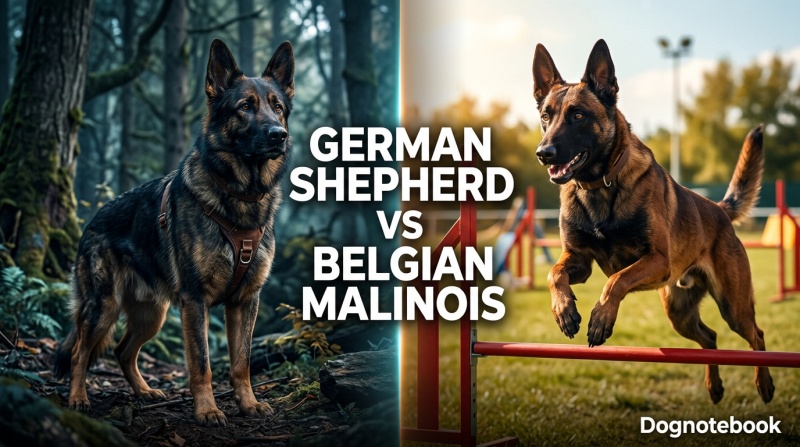
At first glance, the German Shepherd and the Belgian Malinois look nearly identical. Both are intelligent, athletic, wedge-headed dogs with erect ears and a loyal streak that runs deep. But the German Shepherd vs Belgian Malinois key differences become obvious once you spend time around each breed. Male German Shepherds typically weigh 75 to 90 pounds and stand 24 to 26 inches tall, while male Belgian Malinois are leaner at 60 to 80 pounds and 24 to 26 inches. More importantly, their temperaments, energy levels, and suitability for different owners diverge sharply.
Our team has spent years working with, training, and researching both breeds. I have personally lived with German Shepherds and trained alongside Malinois handlers, and the differences are real, practical, and often surprising. This guide breaks down every key distinction so you can make an informed choice between these two remarkable working dogs.
Table of Contents
German Shepherd vs Belgian Malinois at a Glance
Before we get into the details, here is a quick side-by-side comparison of the most important differences between these two herding breeds.
| Trait | German Shepherd | Belgian Malinois |
|---|---|---|
| Average Weight (Male) | 75 to 90 lbs | 60 to 80 lbs |
| Average Height (Male) | 24 to 26 inches | 24 to 26 inches |
| Life Expectancy | 9 to 13 years | 14 to 16 years |
| Energy Level | High | Very High |
| Coat Type | Double coat, medium to long | Double coat, short |
| Shedding Level | Heavy (year-round) | Moderate (seasonal blow) |
| Trainability | Highly trainable | Highly trainable but intense |
| Family Suitability | Great for families | Best for experienced owners |
| Best For | Active families, first-time working dog owners | Experienced handlers, police and military work |
As you can see, the breeds share similar height but differ significantly in weight, lifespan, and intensity. Those small differences in the table translate to massive lifestyle differences in practice.
Origin and History: Two Herding Breeds, Two Different Paths
Both the German Shepherd and the Belgian Malinois come from the herding group, and both were bred in Western Europe during the late 1800s. That is where the similarities in their origin stories end.
German Shepherd Origins
Captain Max von Stephanitz developed the German Shepherd Dog in Germany in 1899. His goal was to create the ideal herding and working dog. He found a dog named Hektor Linksrhein at a dog show, renamed him Horand von Grafrath, and registered him as the first German Shepherd. The breed quickly gained fame for its versatility, intelligence, and willingness to work alongside humans. By World War I, German Shepherds were serving as messenger dogs, rescue dogs, and personal guard dogs for soldiers.
Belgian Malinois Origins
The Belgian Malinois originated in the region around Malines (Mechelen), Belgium, in the late 1800s. Breeders focused on creating a hard-working, intense herding dog with a short fawn coat and black mask. The Malinois is one of four varieties of Belgian Shepherd, alongside the Tervuren, Groenendael, and Laekenois. While the German Shepherd became a popular family companion worldwide, the Malinois remained primarily a working dog, favored by European police and military forces for its speed, drive, and endurance.
How Their Histories Shaped Them
German Shepherds were bred to be all-around utility dogs, which is why they adapted so well to family life, service work, and personal protection. Belgian Malinois were bred with a sharper focus on working ability, which is why they tend to be more intense, more driven, and less forgiving of inexperience in their handlers. This historical difference is the root of almost every German Shepherd vs Belgian Malinois key difference you will encounter today.
Physical Differences: Size, Weight, and Appearance
Telling a German Shepherd from a Belgian Malinois gets easier once you know what to look for. Here are the most reliable visual differences.
Body Build and Proportions
German Shepherds have a longer body with a distinctive sloped topline from the withers to the croup. Their build is heavier and more substantial, with a broad chest and muscular hindquarters. Belgian Malinois have a square, athletic build with a level topline. They look leaner and more streamlined, built for explosive speed and agility rather than raw power.
Head and Face
Both breeds have wedge-shaped heads and upright ears, but the Malinois has a finer, more refined muzzle. German Shepherds have a broader skull and a more domed forehead. The Malinois almost always has a distinct black mask on a fawn or mahogany coat, while German Shepherds come in a wider variety of colors including black and tan, sable, solid black, and even white.
Coat Differences
German Shepherds have a denser double coat that can be medium-length or long. Belgian Malinois have a shorter, straighter double coat that lies closer to the body. If the dog in front of you has a plush, thick coat with feathering on the legs and tail, it is almost certainly a German Shepherd. If the coat is sleek, short, and tight to the body with a black mask, you are likely looking at a Malinois.
Weight Ranges at a Glance
Male German Shepherds weigh 75 to 90 pounds, and females weigh 55 to 70 pounds. Male Belgian Malinois weigh 60 to 80 pounds, and females weigh 40 to 60 pounds. The Malinois is lighter overall, which contributes to its reputation for speed and agility. The German Shepherd carries more mass, which gives it an edge in physical presence and intimidation factor.
Temperament and Personality Differences
This is where the German Shepherd vs Belgian Malinois comparison gets really interesting. Both breeds are intelligent, loyal, and protective, but the way those traits express themselves differs dramatically.
German Shepherd Temperament
German Shepherds are confident, courageous, and steady. They bond closely with their families and tend to be aloof but not aggressive toward strangers. Many GSD owners describe their dogs as goofy and playful at home, switching into serious mode when they sense a threat. They have an off switch, meaning they can relax and settle down after exercise. German Shepherds want to work with you, taking direction from their handler and thriving on structured guidance.
Belgian Malinois Temperament
Belgian Malinois are intensely focused, high-drive dogs that rarely seem to relax. Real owners on Reddit describe the breed as the “crack addict version of a German Shepherd,” and that characterization is not far off. Mals are always watching, always ready, and always looking for something to do. They form extremely tight bonds with their handlers and can be reserved or reactive toward strangers. They have less of an off switch than GSDs and need constant mental engagement to stay balanced.
One experienced handler put it this way: a German Shepherd will chase a suspect off a cliff on command, while a Malinois will bite the suspect on the way down. That intensity difference defines the breed comparison.
Family Suitability
German Shepherds generally adapt well to family life with children. They are patient, protective, and can coexist with other pets when properly socialized. Belgian Malinois can also make good family dogs, but they require an experienced handler who understands how to channel their intense drive. A Malinois without proper training and exercise can become reactive, nippy, and destructive. If you have young children, cats, or other small pets, the German Shepherd is the safer choice in most cases.
Same-Sex Aggression Warning
Both breeds can exhibit same-sex aggression, especially between males. This is something many breed comparison guides overlook, but it comes up frequently in owner forums. If you plan to have multiple dogs of the same sex, early socialization and careful introductions are essential for both breeds. Spaying or neutering can help but does not eliminate the risk entirely.
Exercise and Energy Levels
The energy difference between these two breeds is one of the most important factors in choosing between them.
German Shepherd Exercise Needs
German Shepherds need 1.5 to 2 hours of exercise daily. This can include walks, runs, fetch sessions, obedience training, and free play. They are high-energy dogs, but they can settle down in the house after a good workout. A GSD in a home with a yard and an active owner will generally be content. They also enjoy having a job, whether that is agility, tracking, or simply carrying a backpack on hikes.
Belgian Malinois Exercise Needs
Belgian Malinois need 3 to 4 hours of vigorous daily activity. Walks alone are not enough. They need running, agility work, protection sports, nose work, and structured training sessions. Many Malinois owners report spending 2 to 3 hours per day on training alone, on top of physical exercise. Without this level of engagement, Mals become destructive, anxious, and reactive. This breed is not a couch companion. They are a lifestyle commitment.
What This Means for You
If you work full time, have a family, and enjoy an active but normal lifestyle, the German Shepherd is the more realistic choice. If you are a dedicated dog sport competitor, a working dog handler, or someone who can dedicate most of your day to your dog, the Malinois may be the right match. The gap in exercise needs between these two breeds is massive and should not be underestimated.
Training and Trainability Comparison
Both breeds rank among the most intelligent dogs in the world, but they learn and work differently.
How German Shepherds Learn
German Shepherds are eager to please and respond well to positive reinforcement training. They learn commands quickly and retain them reliably. A GSD handler describes the relationship as collaborative. The dog looks to you for direction and wants to follow your lead. This makes them a strong option for first-time working dog owners who are willing to invest in basic obedience and socialization.
How Belgian Malinois Learn
Belgian Malinois learn faster than almost any other breed, but their training requires more skill and consistency. Mals work more independently than GSDs. They are constantly assessing their environment and making decisions. Forum owners describe the Malinois as the “cat version of a dog,” meaning it thinks for itself and will not blindly follow commands unless it respects the handler. This independence is an asset in police and military work but a challenge for inexperienced owners.
Training Time Commitment
Plan for 30 to 60 minutes of structured training daily with a German Shepherd. For a Belgian Malinois, expect to spend 2 to 3 hours per day on training throughout the dog’s life, not just during puppyhood. Mals do not outgrow their need for mental stimulation. If you stop training, the dog will find its own entertainment, and you probably will not like what it chooses.
Health Issues and Lifespan
Both breeds are generally healthy, but each has specific health concerns that prospective owners should know about.
German Shepherd Health Concerns
German Shepherds are prone to hip dysplasia, degenerative myelopathy (DM), elbow dysplasia, and bloat (gastric dilatation-volvulus or GDV). Hip dysplasia is the most significant concern, affecting a large percentage of the breed. Responsible breeders test breeding stock through the Orthopedic Foundation for Animals (OFA) or PennHIP. DM is a progressive neurological disease that is particularly common in GSDs and has no cure. Bloat is a life-threatening emergency that GSD owners must be educated about, since the breed’s deep chest makes them susceptible.
Belgian Malinois Health Concerns
Belgian Malinois are prone to elbow dysplasia, progressive retinal atrophy (PRA), cataracts, and pannus (chronic superficial keratitis). Pannus is an eye condition that is more common in Mals than many other breeds and requires lifelong management with eye drops. Hip dysplasia can occur in Mals but is less prevalent than in German Shepherds. Overall, the Malinois tends to be the healthier breed with fewer genetic conditions and a longer average lifespan.
Lifespan Comparison
German Shepherds typically live 9 to 13 years. Belgian Malinois generally live 14 to 16 years. That is a significant difference of 3 to 5 years, which reflects the Malinois’s leaner build and generally healthier genetic background. When choosing between these breeds, consider not just the years of commitment but the quality of those years, including potential veterinary costs for breed-specific conditions.
Grooming and Shedding Comparison
Both breeds have double coats, but their grooming needs differ in important ways.
German Shepherd Grooming
German Shepherds are heavy shedders year-round, with two intense blowout periods in spring and fall. Their thicker, denser coat requires brushing 3 to 4 times per week to manage loose hair and prevent matting. During blowout seasons, daily brushing becomes necessary. Expect to find GSD hair on every surface of your home. Many owners invest in a high-quality undercoat rake and a pet-specific vacuum.
Belgian Malinois Grooming
Belgian Malinois shed moderately throughout the year and blow their coat twice annually. Their shorter coat is easier to manage, requiring brushing once or twice a week. During seasonal blowouts, increase brushing to every other day. The Malinois coat is more self-cleaning than the GSD coat, and mud and debris tend to fall out naturally. Overall, grooming a Malinois takes less time and effort than grooming a German Shepherd.
Bath Frequency
Neither breed needs frequent baths. German Shepherds typically need a bath every 4 to 6 weeks, while Malinois can go even longer, every 2 to 3 months, unless they get into something messy. Over-bathing strips the natural oils from both breeds’ double coats and can cause skin irritation.
Which Breed Is Right for You?
After comparing these breeds across every category, the decision comes down to your experience level, lifestyle, and what you want from a dog. Here is a straightforward decision guide.
Choose a German Shepherd If You:
Are a first-time working dog owner looking for an intelligent, trainable companion. Want a family dog that is protective but gentle with children. Have 1.5 to 2 hours daily for exercise and training. Live in a home with a yard. Want a versatile dog that can do obedience, agility, or just be a loyal companion. Prefer a dog with an off switch that relaxes in the house.
Choose a Belgian Malinois If You:
Are an experienced dog handler who understands high-drive working breeds. Can commit 3 to 4 hours daily to exercise and training. Want a dog for protection sports, police work, or competitive dog sports. Live an active outdoor lifestyle that can include your dog. Are prepared for a 14 to 16 year commitment to an intense, demanding animal. Have no young children or small pets that could be at risk from a high-prey-drive dog.
Neither Breed Is Right for You If You:
Work long hours away from home and cannot provide daily exercise and engagement. Live in a small apartment without access to outdoor space. Want a low-maintenance dog that is happy with a short daily walk. Are away from home frequently and plan to leave the dog alone for extended periods. Both breeds need experienced, committed owners who understand that these are not casual pets.
German Shepherd vs Belgian Malinois Key Differences: Conclusion
The German Shepherd vs Belgian Malinois key differences come down to intensity, energy, and handler requirements. German Shepherds are versatile, family-friendly dogs that adapt to a wide range of lifestyles. Belgian Malinois are elite working dogs that demand an experienced handler and a serious daily commitment. Both breeds are extraordinary in the right hands. The right choice depends entirely on what you can offer the dog, not just what you want from it.
FAQs
Why do police use Belgian Malinois instead of German Shepherds?
Police and military units increasingly prefer Belgian Malinois because they are lighter, faster, and have more endurance than German Shepherds. Mals can work longer in hot conditions, recover faster from physical exertion, and have a higher pain tolerance. Their smaller size also makes them easier to transport and lift during operations. However, some K-9 units still use German Shepherds for their larger presence and intimidation factor.
How do I tell if I have a German Shepherd or a Belgian Malinois?
Look at the coat first. Belgian Malinois have a short, sleek coat with a distinct black mask on a fawn or mahogany background. German Shepherds have a thicker, denser coat that can be black and tan, sable, or solid black. The Malinois has a square, level-backed build, while the German Shepherd has a sloped topline. Mals are also leaner and lighter, typically weighing 15 to 20 pounds less than a comparably sized German Shepherd.
Which breed is better for first-time dog owners?
The German Shepherd is the better choice for first-time working dog owners. GSDs are eager to please, respond well to positive reinforcement, and have a more manageable energy level. Belgian Malinois require experienced handlers who can provide 3 to 4 hours of daily exercise and structured training. A Malinois in the hands of an inexperienced owner often develops behavioral problems including reactivity, destructiveness, and anxiety.
Are Belgian Malinois more aggressive than German Shepherds?
Neither breed is inherently aggressive, but Belgian Malinois have a higher prey drive and react more quickly to perceived threats. Mals are more intense and reactive by nature, which can look like aggression to people unfamiliar with working breeds. German Shepherds tend to assess situations more deliberately before reacting. Both breeds need early socialization and consistent training to prevent fear-based reactivity.
Can a Belgian Malinois live in an apartment?
It is possible but not recommended. Belgian Malinois need 3 to 4 hours of vigorous daily exercise, and apartment living makes meeting that requirement much harder. Without sufficient physical and mental stimulation, a Malinois will become destructive, vocal, and anxious. If you live in an apartment and want a working breed, a German Shepherd is a more realistic option, though even GSDs do best with access to a yard.