
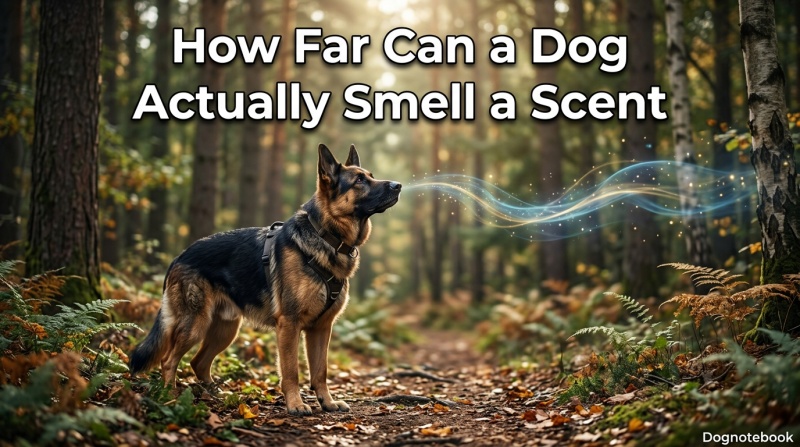
Under ideal conditions, a dog can smell a scent from up to 12 miles (20 kilometers) away. That is not a typo. Your dog’s nose is roughly 100,000 times more sensitive than yours, packed with up to 300 million olfactory receptors compared to the meager 5 to 6 million humans carry. When you see your pup stop dead in their tracks on a walk, nose twitching furiously at seemingly nothing, they are picking up an entire world of information you cannot even perceive.
The question of how far can a dog actually smell a scent does not have one simple answer. The detection range shifts dramatically based on wind direction, humidity, terrain, breed, and training. But the science behind it is fascinating, and understanding it will change how you see your dog forever.
Table of Contents
How Far Can a Dog Actually Smell a Scent?
Dogs detect scents at distances that seem almost unbelievable. The widely cited 12-mile (20 km) range applies to ideal conditions: steady wind blowing the scent directly toward the dog, moderate humidity, and an open environment. In more typical real-world scenarios, the distances are shorter but still remarkable.
Research has documented some specific detection distances that put this into perspective. Trained dogs have been recorded smelling whale feces from nearly 1.2 miles (2 km) away over open water. Conservation dogs detect wild tortoises from about 60 meters. Police dogs identify hidden substances from several hundred meters. Even an average family dog notices spoiling meat from roughly 200 meters away.
One Reddit user described their dog navigating home after being accidentally driven 11 miles away and dropped off. The dog found its way back within two days, likely following a combination of ground scent trails and airborne scent signals. While extraordinary, stories like this align with what we know about canine olfactory capabilities.
Can dogs smell their owners from miles away? Yes, under the right conditions. A dog that knows your scent intimately can pick up trace molecules carried on the wind from surprising distances. The bond between a dog and their person creates what researchers call a “scent memory,” making your particular chemical signature stand out from thousands of competing smells.
Why Dogs Smell So Much Better Than Humans
The gap between human and canine smell comes down to hardware. Dogs possess up to 300 million olfactory receptors inside their nasal cavity. Humans have roughly 5 to 6 million. That is a 50 to 60 times advantage in raw receptor count alone. But the difference goes deeper than numbers.
The part of a dog’s brain dedicated to analyzing smells is proportionally about 40 times larger than the comparable region in a human brain. Dogs do not just detect more molecules. They process scent information at a level of detail we cannot fathom. While you might smell a batch of cookies baking, your dog smells the flour, the butter, the sugar, the vanilla extract, the eggs, the pan they are baked on, and the residue of whatever was baked before.
The Two-Stream Nose: An Engineering Marvel
A dog’s nasal cavity separates incoming air into two distinct streams. One stream goes straight to the lungs for breathing. The other gets diverted into a specialized olfactory region lined with those millions of receptors. This means a dog can analyze scent continuously without interrupting normal respiration.
When a dog exhales, the air exits through slits on the sides of the nostrils. This clever design prevents the exhaled air from blowing away the scent molecules the dog is actively trying to detect. It also creates a circulation pattern that helps draw new scent molecules in. The whole system functions like a highly efficient scent amplifier.
Why Dogs Have Wet Noses
That cool, damp surface on your dog’s nose serves a critical purpose. The thin layer of mucus traps scent particles from the air, keeping them close to the olfactory receptors so they can be analyzed. Dogs also lick their noses frequently, transferring captured scent molecules directly into the mouth and then into the vomeronasal organ, also known as Jacobson’s organ.
Jacobson’s organ sits above the roof of the mouth and connects to the nasal cavity. It detects pheromones and heavy moisture-borne chemical signals that the main olfactory system misses. This secondary detection system helps dogs read information about other animals, potential mates, and territorial markers. It is essentially a dedicated chemical communication channel.
Here is a fun fact that drives the point home: dog cognition researcher Alexandra Horowitz has noted that 10 minutes of sniffing for a dog is roughly equivalent to a human sitting down and reading an entire encyclopedia volume. That walk where your dog stops every three feet is not wasted time. Their brain is processing an enormous amount of information.
5 Factors That Affect How Far a Dog Can Smell
The 12-mile maximum range gets quoted a lot, but the reality is more nuanced. Five major factors determine how far any individual dog can detect a scent at any given moment.
1. Wind and Air Currents
Wind is the single biggest factor in long-range scent detection. Scent molecules travel on air currents, forming what scientists call a “scent cone” or “scent plume” that widens as it moves away from the source. When wind blows steadily from the source toward the dog, detection range increases dramatically. When wind blows in the opposite direction, that same dog might miss a scent from just a few yards away.
Turbulence matters too. Gusty, shifting winds scatter scent molecules and break up the plume, making detection harder. Steady, laminar airflow carries scent in a more predictable path that dogs can follow.
2. Humidity and Weather
Moist air holds scent molecules better than dry air. That is why dogs often perform better at scent detection on humid days, after rain, or in the early morning when dew is present. Humidity keeps volatile organic compounds suspended in the air longer, extending the effective detection range.
Rain can be a double-edged sword. Light rain helps trap scent particles near the ground and keeps them circulating. Heavy rain can wash away ground-based scent trails entirely. Snow works similarly: fresh snowfall can preserve scent trails for days, even weeks, because the cold temperatures slow molecular evaporation. A dog can detect a track under snow that would have dissipated on warm bare ground within hours. This is why search and rescue dogs in snowy regions can find people buried under avalanches.
3. Breed and Genetics
Not all dogs are created equal when it comes to scenting ability. Breed plays a massive role in determining olfactory range and accuracy.
Bloodhounds are the undisputed champions of scent detection. They carry around 300 million olfactory receptors and have been documented following trails that are over 300 hours old. Their long, droopy ears sweep scent particles toward their nose, and the folds of skin around their face trap scent close to their nostrils. A Bloodhound’s trailing evidence is even admissible in court.
Beagles rank among the top scent dogs despite their small size. Their compact build and relentless sniffing drive made them the breed of choice for airport detection work. German Shepherds combine strong olfactory capabilities with trainability and intelligence, which is why they dominate police and military roles. Basset Hounds, with their low-slung bodies and enormous ears, work close to the ground where scent trails concentrate.
Brachycephalic breeds like Pugs, Bulldogs, and Boxers generally have a less developed sense of smell compared to long-snouted breeds. Their compressed nasal passages simply cannot house the same number of receptors or process air as efficiently.
4. Training and Experience
A trained detection dog outperforms an untrained dog with equal genetics every time. Training teaches a dog to focus on specific target scents while ignoring background odors, effectively turning up the sensitivity dial for particular smells.
Professional detection dogs train for 600 to 1,000 hours before they ever work in the field. This training rewires how the dog’s brain prioritizes scent information. A narcotics dog does not have a better nose than a pet Labrador. It simply knows to alert on specific chemical signatures that the pet dog ignores as irrelevant.
Experience also matters. Older dogs that have spent years tracking develop a library of scent memories that makes them faster and more accurate at identifying what they encounter.
5. Terrain and Environment
Open fields allow scent to travel farther because there are fewer obstacles to disrupt the scent plume. Dense forests, urban environments, and rough terrain all break up scent patterns and reduce effective detection range.
Elevation changes create thermal currents that can carry scent uphill during the day and downhill at night. Experienced handlers use this knowledge to position their dogs where air currents naturally concentrate scent. Water adds another layer of complexity: dogs can detect scents that have moved through or across water, but the detection range drops significantly compared to open air.
Ground temperature also plays a role. Warm ground creates rising thermal currents that lift scent molecules upward, extending the range for dogs positioned at higher elevations but reducing it for dogs at ground level. Cool ground keeps scent concentrated low, which benefits ground-scenting breeds.
Ground Scenting vs. Air Scenting: Two Different Skills
Dogs use two fundamentally different scenting methods, and understanding the distinction helps explain why detection distances vary so much.
Ground scenting involves detecting molecules left behind on surfaces by a person or animal that passed through earlier. These ground-level scent particles include shed skin cells, disturbed soil, crushed vegetation, and body oils deposited on contact. Dogs that track this way follow a physical path. Bloodhounds and Basset Hounds excel here because their low-slung noses stay close to the trail. Ground scenting works over shorter distances but can persist for hours or even days after the source has moved on.
Air scenting means detecting scent molecules carried on wind currents through the open air. This is how dogs detect things at those incredible mile-plus distances. A dog scanning the wind for airborne particles can cover enormous areas quickly. German Shepherds, Belgian Malinois, and other herding breeds often prefer air scenting. Search and rescue operations typically use air-scenting dogs for area searches and ground-scenting dogs for specific trail following.
Many dogs switch fluidly between both methods depending on what they need. Your dog probably air scents when catching a distant whiff of something interesting, then drops their nose to ground scent when trying to locate the exact source.
Real-World Applications of Dog Scent Detection
The incredible range of a dog’s nose has been put to work in ways that save lives every single day.
Search and rescue dogs locate missing persons in wilderness areas, disaster zones, and avalanche sites. These dogs can cover more ground in 30 minutes than a team of 20 human searchers could check in a full day. Their success rate in live-find searches significantly exceeds any technological alternative available.
Police and military dogs detect explosives, narcotics, and contraband at airports, borders, and combat zones. A single trained dog can screen hundreds of vehicles or packages in a shift, catching substances that electronic sensors miss. Their ability to discriminate between similar chemical compounds makes them irreplaceable in security work.
Medical detection dogs alert their handlers to impending health emergencies before symptoms become visible. Diabetic alert dogs sense blood sugar drops through changes in their owner’s breath chemistry. Seizure alert dogs warn of oncoming seizures minutes before they happen. Research has shown dogs can detect certain cancers, including ovarian and lung cancer, through breath and urine samples with accuracy rates exceeding 90 percent in controlled studies.
Conservation dogs track endangered species, locate invasive plants, and even detect pipeline leaks by smelling trace chemicals in the soil. Cadaver dogs assist in criminal investigations by locating human remains, sometimes decades after burial. Each of these roles leverages the same fundamental capability: a nose that processes scent information at a resolution no machine can match.
How to Let Your Dog Enjoy Their Sense of Smell
Understanding your dog’s scenting ability is not just interesting science. It is practical knowledge that can improve your dog’s daily life and deepen the bond between you.
Take sniff walks. Instead of briskly marching your dog around the block at your pace, let them set the tempo. When they stop to investigate a patch of grass for two solid minutes, let them. They are reading a detailed message left by every dog and animal that passed through recently. That mental processing is genuinely enriching and tiring for them. Ten minutes of dedicated sniffing can satisfy your dog as much as a 30-minute run.
Try nosework games at home. Hide treats in different rooms and encourage your dog to find them using only their nose. Start easy, then increase difficulty by hiding treats higher up, inside containers, or outdoors. You can also scatter kibble in the grass for a DIY sniffing challenge that turns mealtime into enrichment.
If your dog has a strong scent drive, look into organized nosework or tracking classes. Many dog training facilities offer beginner scent work courses that teach dogs to find essential oils hidden in boxes, rooms, and outdoor areas. It is a low-impact sport open to dogs of all ages and physical abilities.
Keep safety in mind. A dog following an irresistible scent trail can cover a lot of ground fast. Always use a leash or secure fencing when your dog is outdoors, especially near busy roads. Even well-trained dogs can become so focused on a scent that they tune out commands and potential hazards.
FAQs
How far away can dogs smell their owners scent?
Dogs can smell their owners from up to 12 miles (20 km) away under ideal conditions with favorable wind and moderate humidity. In everyday settings, most dogs recognize their owner’s scent from several hundred yards away. Because dogs build detailed scent memories of their people, your dog can pick your unique chemical signature out of a crowd of thousands.
What is the farthest distance a dog can smell?
The farthest confirmed detection distance for a dog is roughly 12 miles (20 km) under perfect conditions. Some sources cite up to 40 miles (65 km) in extreme cases with ideal wind and terrain, but the 12-mile figure is the widely accepted maximum based on documented evidence. Factors like breed, training, weather, and scent type all affect the actual range.
Can dogs smell 2 miles away?
Yes, dogs can absolutely smell scents from 2 miles away. In fact, trained detection dogs routinely detect target scents at this distance and beyond when wind conditions cooperate. Research has documented dogs detecting whale feces from nearly 1.2 miles over open water. Two miles is well within the realistic range for many working breeds.
What is 10 minutes of sniffing for dogs equivalent to?
According to dog cognition researcher Alexandra Horowitz, 10 minutes of dedicated sniffing for a dog is roughly equivalent to a person reading an entire chapter of a book in terms of mental stimulation. The dog’s brain processes an enormous volume of chemical information during each sniffing session, identifying individual components of complex scent mixtures and building mental maps of their environment.
How far can a dog smell underground?
Dogs can detect scents through soil and underground with surprising accuracy, though the range is significantly shorter than open-air detection. Cadaver dogs have located human remains buried several feet underground. The exact depth and distance depend on soil type, moisture levels, and how long the scent has been seeping through the ground. Wet soil conducts scent molecules better than dry, compacted earth.
Which dog breeds have the best sense of smell?
Bloodhounds are widely considered the top scenting breed with roughly 300 million olfactory receptors. Other top scent breeds include Basset Hounds, Beagles, German Shepherds, Belgian Malinois, Labrador Retrievers, and Coonhounds. Long-snouted breeds generally outperform short-nosed (brachycephalic) breeds because their larger nasal cavities house more olfactory receptors and process air more efficiently.
Conclusion
So how far can a dog actually smell a scent? Up to 12 miles under ideal conditions, and routinely across distances of hundreds of meters in everyday life. The combination of 300 million olfactory receptors, a dedicated scent-processing brain region, a two-stream nasal design, and the vomeronasal organ gives dogs a sense of smell that is roughly 100,000 times more powerful than our own.
Wind, humidity, breed, training, and terrain all shape the effective detection range on any given day. Bloodhounds push the upper limits. Short-nosed breeds land closer to the middle of the pack. But every single dog, from a champion tracking hound to a snoozing family Pug, lives in a scent-rich world you and I can barely imagine.
The next time your dog stops on a walk to investigate a seemingly blank patch of ground, give them a moment. They are reading a story written in molecules, and it is one of the most natural and enriching things they can do. Consider adding structured sniff time to your daily routine. Your dog’s nose is their window to the world. Let them look through it.