
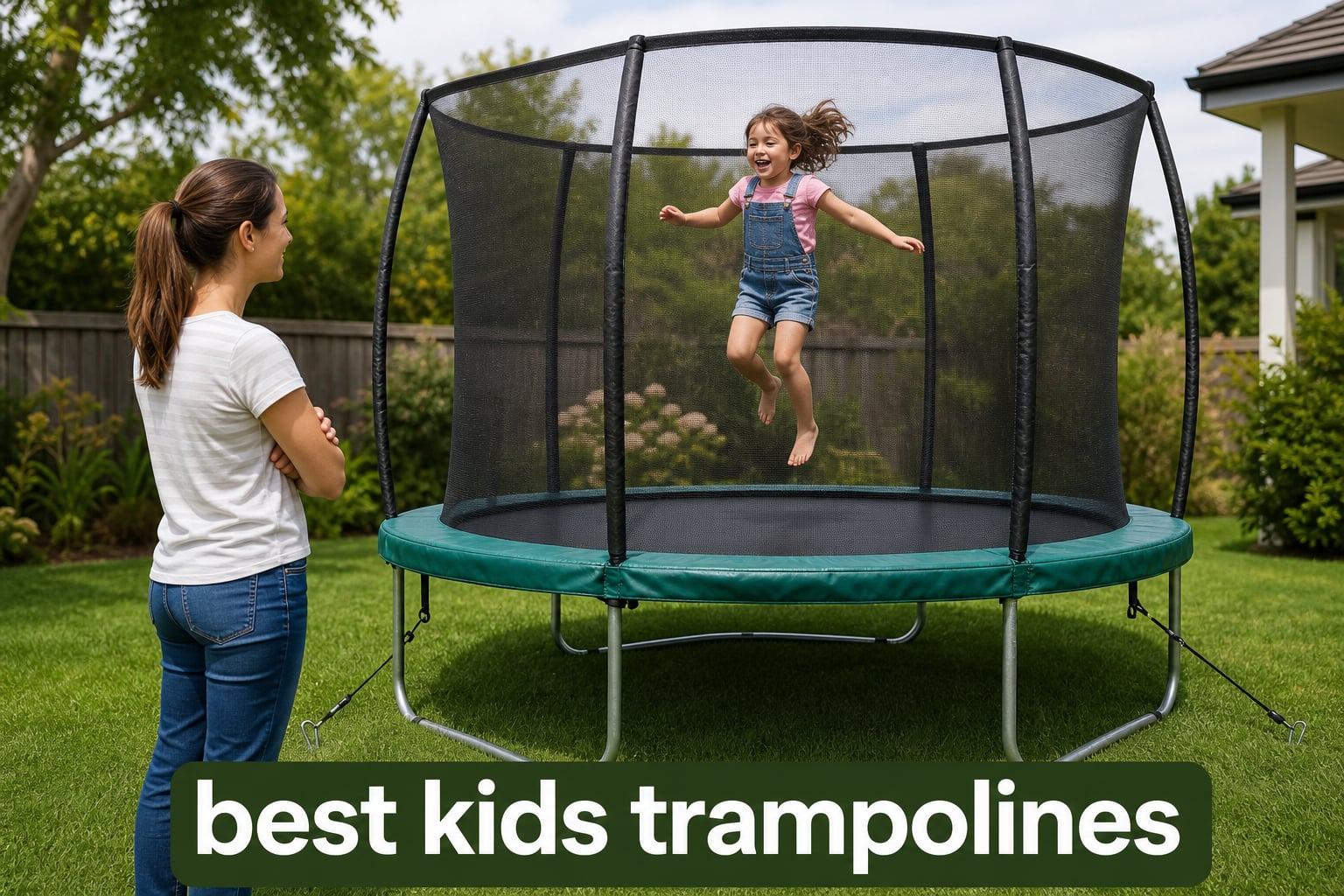
The best kids trampolines are the ones that fit a child’s stage, your available space, and a family’s willingness to supervise every jump. A compact rebounder with a handle can make sense for a small child indoors, while a full outdoor trampoline needs a secure enclosure, room around it, ground anchoring, and rules that adults actually enforce.
I approached this list by separating the small indoor models from the larger backyard options instead of treating every trampoline as interchangeable. The product details and buyer feedback point to clear differences in capacity, enclosure design, frame construction, storage, and the amount of play space a child gets.
Safety comes first. The American Academy of Pediatrics has long advised against recreational home trampoline use because injuries can happen even with padding and nets; if your family chooses one, keep a single jumper on the mat, supervise actively, block flips, check the equipment often, and keep younger children on equipment made for their size.
Table of Contents
Top 3 Picks for Best Kids Trampolines in 2026
The Yohood is my leading pick for a contained toddler play station because its listing combines an enclosure, ASTM certification, a 176-pound capacity, and several activity attachments. BCAN earns the best-value spot for its ASTM certification, no-gap mat, and unusually high stated capacity in a compact 36-inch format, while VEVOR is the practical portable pick with a 132-pound capacity and fold-flat design.
The three choices serve different homes: Yohood for varied contained play, BCAN for a compact spring model with a protected mat edge, and VEVOR for regular storage and transport. None should be used by more than one child at a time.
Best Kids Trampolines in September 2026
Use this overview to match the product to the job, not simply to select the largest stated capacity. The first five options suit a compact indoor or toddler-focused setup, while the final four are outdoor models that call for more yard planning and anchoring.
| Product | Specifications | Action |
|---|---|---|
 Yohood 55 inch 6-in-1 Yohood 55 inch 6-in-1 |
|
Check Latest Price |
 Fisher-Price WonderJump 36 inch Fisher-Price WonderJump 36 inch |
|
Check Latest Price |
 VEVOR 3FT Foldable VEVOR 3FT Foldable |
|
Check Latest Price |
 ATIVAFIT 36 inch ATIVAFIT 36 inch |
|
Check Latest Price |
 BCAN SP1 36 inch BCAN SP1 36 inch |
|
Check Latest Price |
 AOTOB 8FT Outdoor AOTOB 8FT Outdoor |
|
Check Latest Price |
 JELENS Outdoor JELENS Outdoor |
|
Check Latest Price |
 ZCMHAXJ 55 inch ZCMHAXJ 55 inch |
|
Check Latest Price |
 LANGXUN 60 inch 6-in-1 LANGXUN 60 inch 6-in-1 |
|
Check Latest Price |
 Lyromix 12FT Outdoor Lyromix 12FT Outdoor |
|
Check Latest Price |
1. Yohood 55-Inch 6-in-1: Best Enclosed Toddler Activity Center
- Six activity modes
- Enclosed jumping area
- Adjustable gymnastics bar
- Takes more floor space
- Remove accessories to jump
The Yohood is the most feature-dense compact option here. Its 55-inch round frame combines a trampoline with a basketball hoop, punching bag, rings, swing, and adjustable gymnastics bar, giving a young child several ways to move without buying separate equipment.
The listing specifies ASTM certification, a 176-pound maximum capacity, a paint-coated galvanized-steel frame, double-bolted connections, anti-slip suction cups, and a high-elasticity net. Those details place it in a different category from an open mini rebounder: this is a contained activity station intended for supervised toddler play.
The trade-off is footprint. At 55 by 55 inches and 54 inches high, it needs a dedicated clear area; the accessories also need to come off when the child wants a straightforward jumping session.
The best fit is a child who needs varied indoor movement
I would look at this model for a child who loses interest in a one-purpose toy or needs a structured outlet for active play at home. The adjustable bar is a meaningful detail because it can change with a child’s height rather than immediately becoming awkward to hold.
The space requirement is larger than a basic mini trampoline
Measure the full room, including clearance from furniture, walls, ceiling fixtures, and door swings, before ordering. The enclosure helps contain a jumper, but it does not make tight placement safe or remove the need for an adult nearby.
2. Fisher-Price WonderJump 36-Inch: Best for Fast Indoor Setup
- Tool-free setup
- Six non-slip pads
- Folds for storage
- No enclosure
- 55 lb capacity
The Fisher-Price WonderJump keeps the idea simple: a 36-inch indoor mini trampoline with a foam-grip stabilizing handle. Its major appeal is tool-free assembly and a removable, foldable format that is far easier to put away than a permanent play structure.
Six non-slip foot pads and a powder-coated steel frame are useful practical details for an indoor trampoline for kids. The 55-pound maximum capacity is the governing limit, though, so this choice is for a smaller, younger child rather than a product meant to grow with a family for years.
There is no enclosure net. That makes location, pace, and direct supervision especially important, and it makes this a poor choice for energetic children who are likely to jump near the edge.
The right user is a smaller child with a clear play corner
This is a sensible candidate when the priority is a low-profile, temporary activity in a playroom or basement. Keep the entire 36-inch circle well away from hard furniture and only permit one child at a time.
The storage advantage matters in multipurpose rooms
A foldable design changes the ownership experience if the same room also serves as a living room or guest space. Check that adults can unfold it fully, inspect each foot pad, and lock it into stable position before every use.
3. VEVOR 3FT Foldable: Best Portable Mini Trampoline
- Quick folding
- 132 lb capacity
- Steel structure
- No enclosure
- Thin spring padding
The VEVOR makes portability its strongest argument. The product description says its 3-foot frame folds in three seconds for storage under a sofa or in a vehicle, and its 12.8-pound stated item weight supports that portable role.
It uses 28 elastic bands rather than exposed traditional springs, plus a foam handle, rubber foot pads, waterproof PP mat, and an all-steel structure. Its listed 132-pound maximum capacity provides more headroom than the 55-pound mini models, but the mat still measures only 36 inches across.
Parents report liking its foldability and one-person assembly in the available review insights. I would still treat the stated 0.24-inch spring-foam padding and open sides as reasons to keep jumps controlled and supervised.
The useful feature is portability rather than a large bounce zone
Choose this for a family that genuinely needs to store the trampoline between sessions or transport it. A 3-foot surface is for one child’s basic bounce and coordination practice, not roughhouse play or multiple jumpers.
The stated capacity does not change the small-frame limits
A higher weight rating is helpful, but it does not expand the landing area or provide an enclosure. Follow the listing’s capacity limit, keep footwear and objects off the mat, and stop use if bands, stitching, pads, or feet show damage.
4. ATIVAFIT 36-Inch: Best Elastic-Band Option for Ages 2 to 6
- Elastic band suspension
- Waterproof mat
- Six-leg base
- No enclosure
- Short handle
- 55 lb capacity
The ATIVAFIT is expressly positioned for ages 2 to 6, which makes its purpose clearer than a generic mini rebounder. It combines a 36-inch frame, foam handle, elastic-band design, non-slip waterproof Oxford-cloth mat, and a six-leg base with a safety lock.
Elastic-band suspension means there are no conventional exposed coil springs around the mat, a detail some parents prefer for a toddler setup. The description also reports one-person assembly with included tools, and the unit can be used indoors or outdoors when the surface is level and dry.
Its 55-pound limit and 23.6-inch total height put a firm boundary around the intended user. It is not the right match for an older or taller child, and the open design calls for an especially clear safety zone.
The intended age range is the deciding factor
Pick this model when the child falls within the stated two-to-six range and can hold a handle safely. A handlebar supports balance; it is not a substitute for adult supervision or a cue to allow bigger jumps.
The suspension design is worth checking before purchase
Elastic bands can offer a different feel from coil springs, but buyers should still inspect the mat edge and band attachment points on a regular schedule. Outdoor use also means drying the mat after rain and taking it inside during severe weather when possible.
5. BCAN SP1 36-Inch: Best Compact Pick for a No-Gap Mat
- No-gap mat
- ASTM certified
- High stated capacity
- No enclosure
- Short 23.6 inch height
The BCAN SP1 stands out among the mini models because its listing says it is ASTM certified and uses a no-gap mat design intended to reduce the chance of a foot reaching the springs. It also lists 28 extra-thick springs tested more than 200,000 times, a foam handle, and rubber tips with stabilizing washers.
The stated 220-pound capacity is the highest among the compact products in this roundup. That number should not be read as permission for several children to jump together; the 36-inch diameter remains a one-child surface, and the open perimeter remains a fall concern.
Available review data shows a 4.6 average across more than 1.6k reviews, with 82% reported as five-star. The listing also cites video instructions, one-person assembly, US parts warehouses, and a one-year manufacturer warranty.
The safety detail is the protected mat-to-spring transition
The no-gap claim is the reason to compare this model closely with other open mini trampolines. Check that the cover is intact and seated correctly at every session because that protective boundary only works when all components are installed as directed.
The capacity should be treated as a structural limit
Capacity tells you about the maker’s stated load rating, not the safe number of children who can jump. Keep the one-at-a-time rule, have the child step on and off rather than leap from furniture, and stop jumping at the first sign of instability.
6. AOTOB 8FT Outdoor: Best Small Backyard Trampoline With a Net
- Enclosure net
- Three U-shaped legs
- Foam-padded sleeves
- Heavy frame
- Needs outdoor anchoring
The AOTOB moves the list into true backyard-trampoline territory. Its 8-foot round format includes a safety net, widened jump pad, closely fitted spring cover, foam-padded frame sleeves, zipper entrance, and a listed 400-pound maximum load capacity.
The design uses three U-shaped legs and six stated balanced contact points, with a thickened anti-rust steel structure. These features target stability, but a 60.8-pound trampoline still needs a level site and secure anchoring; frame weight alone does not protect it from strong wind.
The supplied review insights cite more than 2.5k reviews and describe parents praising safety features and durability. I would give this option extra credit for keeping the enclosure in the basic package, while still viewing the net as a fall-reduction feature rather than a guarantee against injury.
The eight-foot diameter suits a limited but dedicated yard area
Before choosing an 8-foot outdoor trampoline for kids, mark out more than the frame diameter. Leave open clearance around the enclosure, keep it away from fences, trees, playsets, concrete, and overhead branches, and choose level ground that drains well.
The enclosure needs a routine inspection
Look at the zipper, buckles, net seams, pole foam, spring cover, and frame joints before jumping. Teach children to enter through the designated opening, close it fully, and never climb or hang on the enclosure.
7. JELENS Outdoor: Best ASTM-Certified Multi-Size Backyard Choice
- Multiple size options
- Galvanized frame
- Padded pillars
- 265 lb capacity
- One-year warranty
JELENS offers sizes from 8 to 15 feet, allowing a family to match the frame to the yard rather than forcing a single size. The product listing cites ASTM F381-16 safety certification, an enclosure net supported by upright pillars, thick sponge protection around the pillars and springs, and a double-layer galvanized steel frame with an anti-rust coating.
Its listed 265-pound capacity is lower than several outdoor alternatives here, so this is better viewed as a one-jumper-at-a-time family trampoline, not a platform for a group of children. The product includes a 12-month free-parts replacement warranty and gives the main dimensions for the 8-foot model.
The 201 available reviews average 4.5 stars according to the provided data. Those figures are useful context, but they do not replace checking current assembly instructions and confirming which size is actually being purchased.
The useful choice is selecting size before selecting extras
An 8-foot model may work for a restricted yard, while 10-, 12-, 14-, and 15-foot frames ask for far more dedicated open ground. Do not use the diameter alone; include clearance around the enclosure and room for adults to inspect and access it.
The galvanized frame still needs weather care
Galvanized and coated steel are helpful for outdoor exposure, but they are not a reason to ignore corrosion, loose bolts, or torn padding. Take down or secure the unit according to its instructions before high winds and remove standing water from the mat.
8. ZCMHAXJ 55-Inch: Best Compact Option With an Arch Frame
- Arch frame
- 360 degree foam
- Quiet suction pads
- Small jumping surface
- Spring details unavailable
The ZCMHAXJ is another 55-inch compact toddler trampoline, but its stated feature set centers on an arch-frame layout with no head-bump joints. The listing also claims ASTM certification, a carbon-steel frame, triple U-base, grip-tight suction cups, and 360-degree impact foam.
A stated 440-pound capacity is striking for a compact product. In practical use, the 55-inch footprint remains the stronger limiter: it is sized for a single small child’s supervised play, not several children bouncing at once simply because the published load figure is high.
The product information calls out silent suction pads intended to reduce vibration and says assembly takes about 30 minutes. Its available review total is 152 with a 4.5 average, so I would inspect the current listing closely for complete assembly contents and support terms.
The arch layout matters if head-level tubes concern you
Frame geometry is worth examining for a toddler product because children can move unpredictably. Foam coverage and the arch design may reduce contact points, but place the trampoline away from furniture and keep a caregiver close enough to intervene immediately.
The compact size is better for one child than sibling play
This is a space-saving option for indoor or outdoor use on a dry, level surface. For two or more children wanting active group play, a full enclosure model with substantially more jumping area is the more sensible category to compare.
9. LANGXUN 60-Inch 6-in-1: Best Multi-Activity Mini Trampoline
- Multiple activities
- 360 degree foam
- Tool-free assembly
- 120 lb capacity
- Cramped for multiple jumpers
The LANGXUN gives a child a 60-inch trampoline plus a basketball hoop, dartboard, swing, rings, and adjustable horizontal bar. Its baby-fence-style frame surrounds the area with foam tubes, while the listing describes thickened steel tubing, a double-layer frame, 36 olive-shaped springs, and a waterproof polypropylene pad.
This is a good example of why parents should read both the activities and the load limit. It has a stated 120-pound maximum capacity, so the 6-in-1 label describes variety, not a large shared jumping space.
It has the biggest review count in this set at more than 3.6k reviews and a reported 4.4 average. The manufacturer description says assembly is tool-free and takes about 30 minutes, which may appeal to families who want an involved play station without a large outdoor installation.
The extra activities help extend play beyond bouncing
A child may rotate between shooting, swinging, rings, and jumping, making this type of unit useful for short active-play sessions. Remove or manage accessories exactly as the product instructions call for before the trampoline portion is used.
The capacity sets the real child-size boundary
Do not assume the 60-inch diameter is suitable for multiple children because it has several attachments. One jumper, an uncluttered mat, and a closed or properly positioned barrier are safer routines for a compact toddler unit.
10. Lyromix 12FT Outdoor: Best for a Larger Family Backyard
- Large jumping area
- Ground stakes included
- UV-tested mat
- Three-month warranty
- Mixed assembly feedback
The Lyromix is the family-scale option in this group, with the analyzed listing describing a 12-foot frame intended for four to six kids and adults, a net, basketball hoop, 72 springs, four W-shaped legs, ground stakes, sprinkler, and LED-light extras. It lists a 300-pound maximum capacity and a galvanized steel frame with rust-resistant springs.
Its 144-by-144-inch dimensions make yard planning non-negotiable. The manufacturer says the jumping mat passed a 5,000-hour American UV-standard test, but exposure, wind, and drainage at your home will still shape how long any outdoor material lasts.
This product has a 4.2 average from 745 reviews in the supplied data, the lowest rating of the ten picks, and the review insight flags mixed assembly feedback. It also has a three-month stated warranty, so families who select it should be comfortable with careful setup and routine checks.
The larger surface supports family-scale space, not group jumping
A 12-foot trampoline creates more room for a child to move, but the safest rule is still one jumper at a time. The risk of collision rises when children with different sizes or jumping patterns share the mat, even inside a net.
The included stakes do not end the wind-preparation job
Use the included ground stakes as directed and follow local weather forecasts closely. Forum discussions repeatedly flag wind damage as a parent pain point; inspect anchors after storms and follow the manual’s instructions for additional securing or disassembly in severe conditions.
The safest buying decision starts with size, supervision, and placement
Pick the type before the model. A toddler mini trampoline for kids is a compact, single-child activity with a low frame and usually a handle; an outdoor trampoline for kids is a larger installation with an enclosure, legs, weather exposure, and a much bigger safety zone.
For children under 6, the caution is especially high. The AAP’s position is that recreational trampolines carry injury risk, and the research points to younger children as a group that can be hurt more easily by falls and collisions; use age-appropriate equipment only, and consider whether another active-play option would be a better fit.
The safety checklist starts with the frame and enclosure
Look for a safety enclosure that closes securely, padding that fully covers springs or the mat edge, foam over enclosure poles, a stable leg layout, and clear stated capacity information. ASTM certification or stated compliance is a helpful product signal, but it does not make unsupervised jumping safe.
Inspect the zipper, net, pad, mat stitching, attachment points, frame joints, feet, and anchors before use. Replace damaged parts with manufacturer-approved parts where available; forum reports commonly mention rust, worn springs, and hard-to-find replacement pieces after extended use.
The correct size leaves open ground around the trampoline
Start by measuring the actual jumping frame, then add free space around the enclosure for safe access and to prevent contact with fences, trees, walls, garden edges, furniture, and play equipment. Never position it beneath branches, power lines, or other overhead hazards.
Round frames tend to be a common backyard shape, while 36- to 60-inch mini models fit a single smaller child indoors. A 12-foot outdoor frame needs a dedicated yard zone; it is not something to squeeze into an empty-looking corner.
The spring choice changes feel but not the family rules
Traditional spring models use coils around the mat and need pads that stay intact and correctly positioned. Elastic-band mini models remove conventional metal springs from the edge, while spring-free designs use other tension systems; each still requires close inspection and active adult supervision.
Bounce quality should never be assessed by how high a child can go. For a child’s first use, aim for controlled small jumps, feet near the center, no somersaults, no wrestling, no toys on the mat, and one participant at a time.
The assembly plan should include two adults for large outdoor frames
Families in forum discussions regularly report that assembly takes two to four hours with two people, often longer than expected. Set aside daylight, read the manual before opening every part, lay pieces out by step, and do not let children use the trampoline until the complete safety system is installed.
Do a final walk-around before the first jump: bolts tightened to the manual’s direction, legs level, net poles secure, entrance closed, pads attached, and anchors installed. Recheck after the first few sessions because connections can settle.
The weather plan protects the frame and the people around it
Galvanized or powder-coated steel and UV-resistant mat materials help outdoors, but rain, sun, and wind still matter. Dry the mat after rain, clear leaves and debris, watch for corrosion, and follow the maker’s weather instructions for covers, anchoring, or seasonal storage.
Wind needs a specific plan, not an assumption that a heavy frame will stay put. Anchor kits or included stakes can help when installed correctly, but severe-weather guidance in the product manual should decide whether to add securing measures or take the trampoline down.
The household rules prevent the most predictable injuries
Put the rules where children can see them: one jumper, adult supervision, no flips, no climbing the net, no jumping onto or off the frame, and no use when the mat is wet. Remove ladders or access aids when the trampoline is not supervised if that is appropriate for your household.
Ask your home insurer about its policy before installation. Coverage and requirements vary, and an insurer may have rules related to trampolines, fencing, or safety measures that are separate from a product’s stated safety features.
The daily inspection should take place before the first child jumps
Walk the perimeter and look for a wet mat, a torn net, loose stitching, a displaced pad, a bent frame tube, loose hardware, rust, damaged elastic bands, or a missing anchor. Close the entrance after the child enters, then keep play away from the net and edge padding.
Small faults are easier to fix before they become a fall or a damaged mat. Keep the product manual and replacement-part details in a known place, since parents in forum discussions often report that parts access differs widely by brand.
The supervision rule works best when every caregiver uses the same language
Explain the rules before play begins rather than after a child is already bouncing: one child, small controlled jumps, no flips, no toys, and stop when an adult says stop. Guests and older siblings should follow the same rules as the owner’s children.
Do not rely on a net to manage collisions or risky behavior. Enclosures are designed to reduce falls from the perimeter, whereas supervision and one-at-a-time jumping address the collision and stunt risks that a net cannot solve.
The maintenance schedule should match the exposure level
Indoor mini trampolines need regular checks of legs, foot pads, handles, and mat attachment points. Outdoor frames need those checks plus attention to UV wear, rainwater, surface drainage, wind anchors, corrosion, and the condition of the enclosure after storms.
Clean leaves and grit from a mat before use, because debris changes footing and can hide wear. Follow the manufacturer’s care instructions for cleaning products and for taking down, covering, or storing the trampoline in severe weather or off-season periods.
FAQs
What is the safest trampoline brand for kids?
No brand makes recreational trampoline use risk-free. For a child-focused model, prioritize a size appropriate to the child, a securely closing enclosure on outdoor products, intact edge padding or a no-gap mat, a stable frame, clear capacity guidance, and active adult supervision. ASTM certification is a useful listed feature, but family rules matter every time a child jumps.
What’s the best children’s trampoline?
The best children’s trampoline matches the child and setting. The Yohood 55-inch 6-in-1 is the strongest compact enclosed activity-center pick in this list, while the AOTOB 8FT is the better category to consider for a small backyard because it includes an enclosure. Neither choice is a substitute for one-jumper-at-a-time supervision.
Do pediatricians recommend trampolines?
The American Academy of Pediatrics advises against recreational trampoline use because injuries can occur from falls, collisions, and attempted stunts. Families who choose to use one should supervise closely, allow only one jumper at a time, prohibit flips, keep equipment maintained, and keep young children on equipment made for their stage and size.
Which is better, Springfree or Jumpflex trampoline?
The better choice depends on the specific model, yard size, suspension design, enclosure construction, warranty terms, replacement-parts access, and your ability to assemble and anchor it correctly. Spring-free and traditional-spring systems use different designs, but both still need careful setup, inspections, and the same one-jumper safety rules.
What should I look for when buying a trampoline?
Look for an age-appropriate size, a stable frame, an intact padded edge or no-gap system, a secure enclosure for outdoor models, stated capacity, weather-suitable materials, replacement-parts access, clear assembly instructions, and an anchoring plan. Then confirm that your yard or indoor room has enough clear space and that an adult can supervise each session.
Final Thoughts
For an enclosed compact activity center, choose the Yohood; for an ASTM-certified mini trampoline with a no-gap mat, the BCAN is the focused alternative; and for a contained small-backyard setup, the AOTOB is the standout category. The Lyromix has the largest analyzed outdoor format, but it requires the most yard and assembly planning.
The best kids trampolines in 2026 are not defined by their stated capacity or extras alone. Choose the right size, build it on clear level ground, inspect it often, anchor outdoor models, and keep the one-jumper rule every time.