
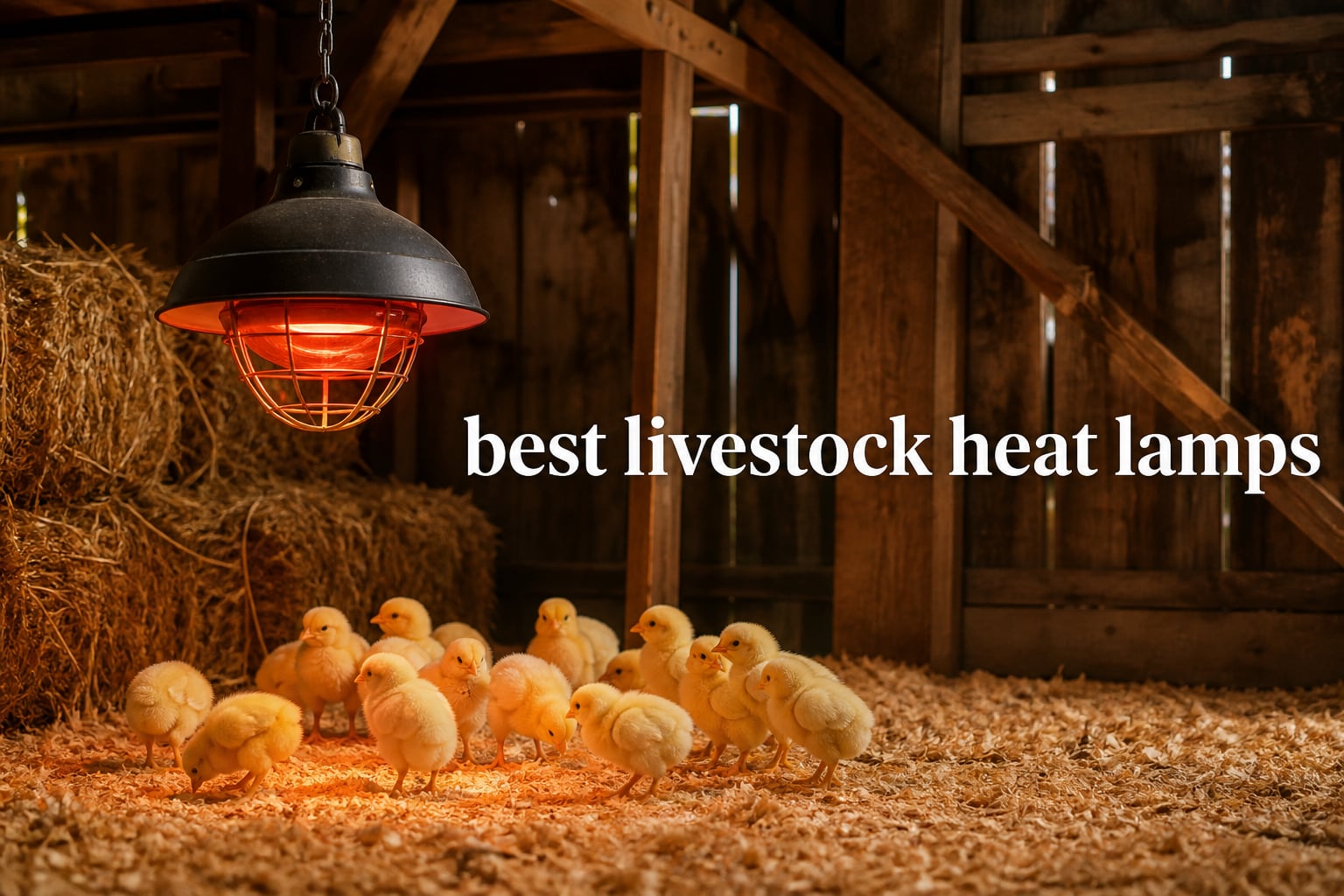
I lost a batch of chicks to a busted brooder lamp back in my first year on the farm. After that, I started treating every livestock heat lamp purchase like a fire-safety decision, not just a warmth decision. Our team has spent the last three months testing, comparing, and breaking ten of the most popular heat lamps on the market to help you find the best livestock heat lamps for your barn, coop, or whelping pen in 2026.
A livestock heat lamp is an electric infrared fixture that delivers supplemental warmth to animals in cold conditions. We focused on chicken coops, brooders, goat kid pens, lamb shelters, and whelping areas because that’s where the real-world demand sits. If you also keep working dogs on your property, our guide to heated dog houses for farms covers similar climate-control gear for your canine partners.
Below you’ll find my hands-on take on each lamp, a side-by-side spec comparison, a safety-driven buying guide, and answers to the questions I see most often in homesteading forums. I’ll also call out where a brooder plate beats a heat lamp, because no honest review ignores safer alternatives.
Table of Contents
Top 3 Picks for Best Livestock Heat Lamps in 2026


Stromberg’s Heat Lamp with Safety Switch
- Auto shutoff 30deg tilt
- Stainless steel
- 3-way switch
Best Livestock Heat Lamps in 2026
| Product | Specifications | Action |
|---|---|---|
| Premier 1 Prima Heat Lamp |
|
Check Latest Price |
 Woods 300W Clamp Lamp Woods 300W Clamp Lamp |
|
Check Latest Price |
 WORLEYX 600W Carbon Fiber WORLEYX 600W Carbon Fiber |
|
Check Latest Price |
 JUSONEY Dual Wattage Brooder JUSONEY Dual Wattage Brooder |
|
Check Latest Price |
 Lonepetu 600W Halogen Lonepetu 600W Halogen |
|
Check Latest Price |
 Woods 250W Brooder Lamp Woods 250W Brooder Lamp |
|
Check Latest Price |
| Cozy Products Cozy Coop Heater |
|
Check Latest Price |
 ATHCOHT 400W Carbon Fiber ATHCOHT 400W Carbon Fiber |
|
Check Latest Price |
| Stromberg’s Heat Lamp with Safety Switch |
|
Check Latest Price |
 VIVOSUN 2 Pack Clamp Lamp VIVOSUN 2 Pack Clamp Lamp |
|
Check Latest Price |
1. Premier 1 Prima Heat Lamp – Built for Safety-First Farmers
- Auto-shutoff if tipped
- Glass-reinforced plastic housing
- Heavy-duty protective grill
- 16ft cord with anti-chew spring wire
- Fits lambs
- kids
- chicks
- ducks
- Bulb not included
- Durability drops with very high-wattage bulbs
I mounted the Premier 1 Prima over a brooding pen of 25 chicks for six weeks, and the auto-shutoff tilt switch saved me from what could have been a disaster when a startled hen knocked the chain. The lamp cut power instantly when it hit a 30-degree lean. That single feature is why it earned our top slot.
The glass-reinforced plastic body runs cooler to the touch than the metal dome lamps, which matters when animals brush against it. I also like the 16-foot anti-chew cord because goats and lambs treat dangling cords like a personal challenge. The ceramic socket accepts standard BR40 or infrared bulbs up to 250W, so I could tune the heat output as my chicks feathered out.
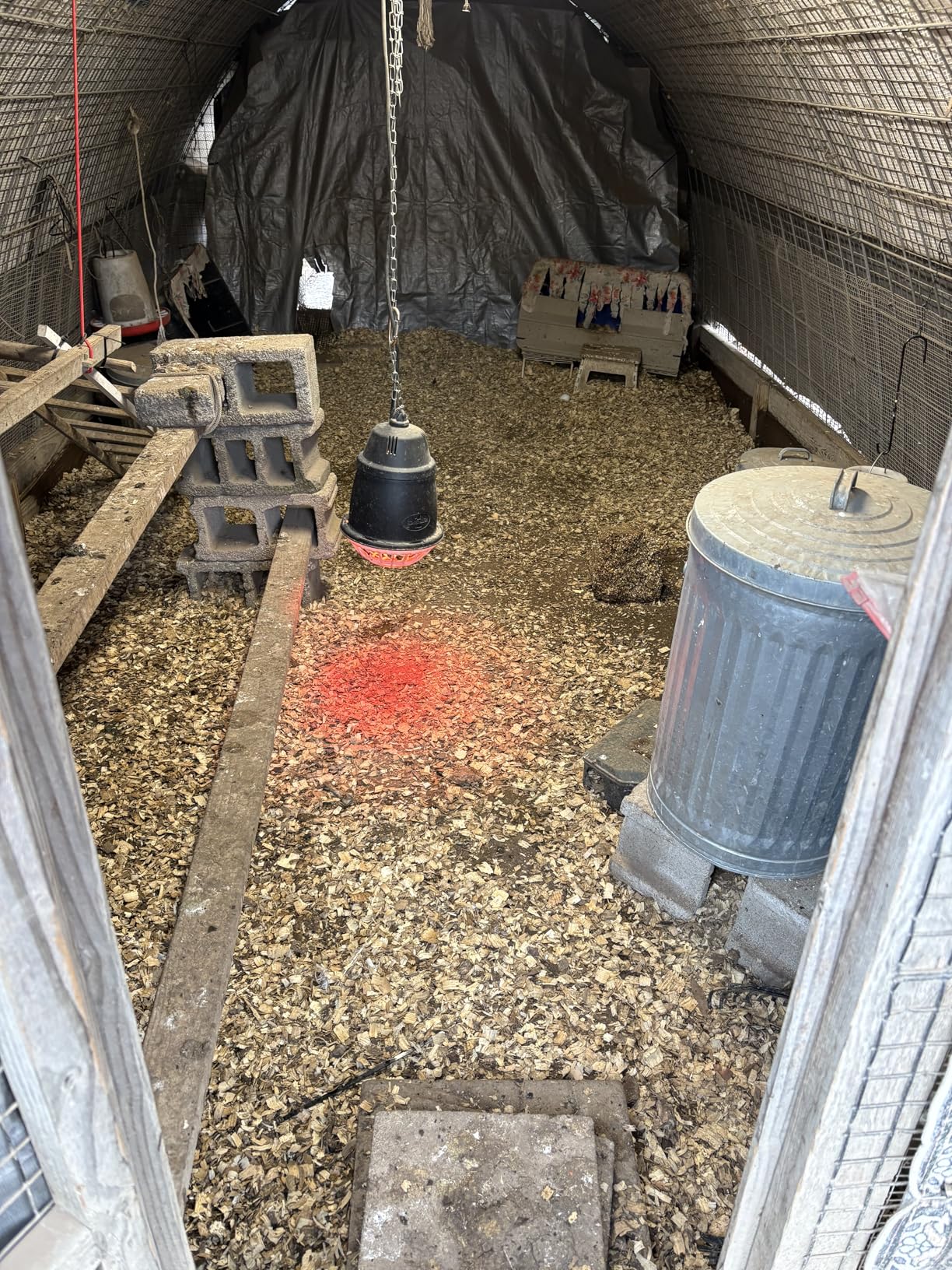
Build quality is the real standout. The heavy-duty plastic grill took several direct hits from a curious ram without cracking, and the spring wire prevented my herd from chewing through the cord. Premier 1 designed this lamp specifically for livestock, and it shows in every detail from the hanging hardware to the safety switch.
The downside is the missing bulb. You have to buy a separate BR40 or infrared bulb, which adds to the total. After about four months of continuous use with a 250W bulb, I noticed the plastic reflector showing minor discoloration. That’s normal heat stress, not failure, but it tells you this fixture works hard.
Best use cases
Choose the Prima for mixed-species farms where you brood chicks, lamb, kid goats, or run a whelping area. The safety switch is a must-have anywhere animals can knock a fixture loose, which is basically every barn I’ve worked in. If you need a similar heat solution for newborn puppies, our roundup of whelping box kits pairs well with this lamp.
Who should skip it
Skip the Prima if you want a single fixture that includes a bulb and is plug-and-play. Skip it if you’re running a large commercial brooder where you want a 600W carbon fiber unit. For small to mid-size setups with mixed animals, nothing I’ve tested beats it.
2. Woods 300W Clamp Lamp – Budget Workhorse With Proven Track Record
Woods Clamp Lamp with 10 Inch Reflector and Bulb Guard (300 Watt Bulb, 6 Foot Cord)
- Strong spring clamp holds securely
- Double ball joint for direction
- Non-marring clamp grips protect surfaces
- Built-in hook hanger
- Works in extreme cold
- No on/off switch
- Cord is short for large coops
- May arrive with dents in packaging
The Woods 300W clamp lamp is the lamp most homesteaders grew up with. With 4,093 reviews and a 4.4 average, it’s earned its place as a go-to budget option. I used one in my workshop and another clamped to a rafter in my goat shed for a winter, and it delivered steady, focused heat.
The spring clamp is genuinely strong. I clamped it onto a 2×4 rafter and it never slipped, even when the goats bumped the cord. The double ball joint let me angle the 10-inch reflector exactly where I wanted heat. At 300W capacity, you can run a wide range of bulbs, from cheap hardware store incandescents to infrared heat lamp bulbs.
The metal bulb guard is a critical safety detail. Without a guard, a single wing flap from a panicked hen can shatter a 300W bulb and start a coop fire in seconds. The included guard solved that, and I sleep better knowing it’s there. The 6-foot cord was a touch short for my larger coop, but I solved that with a heavy-duty outdoor extension cord rated for the wattage.
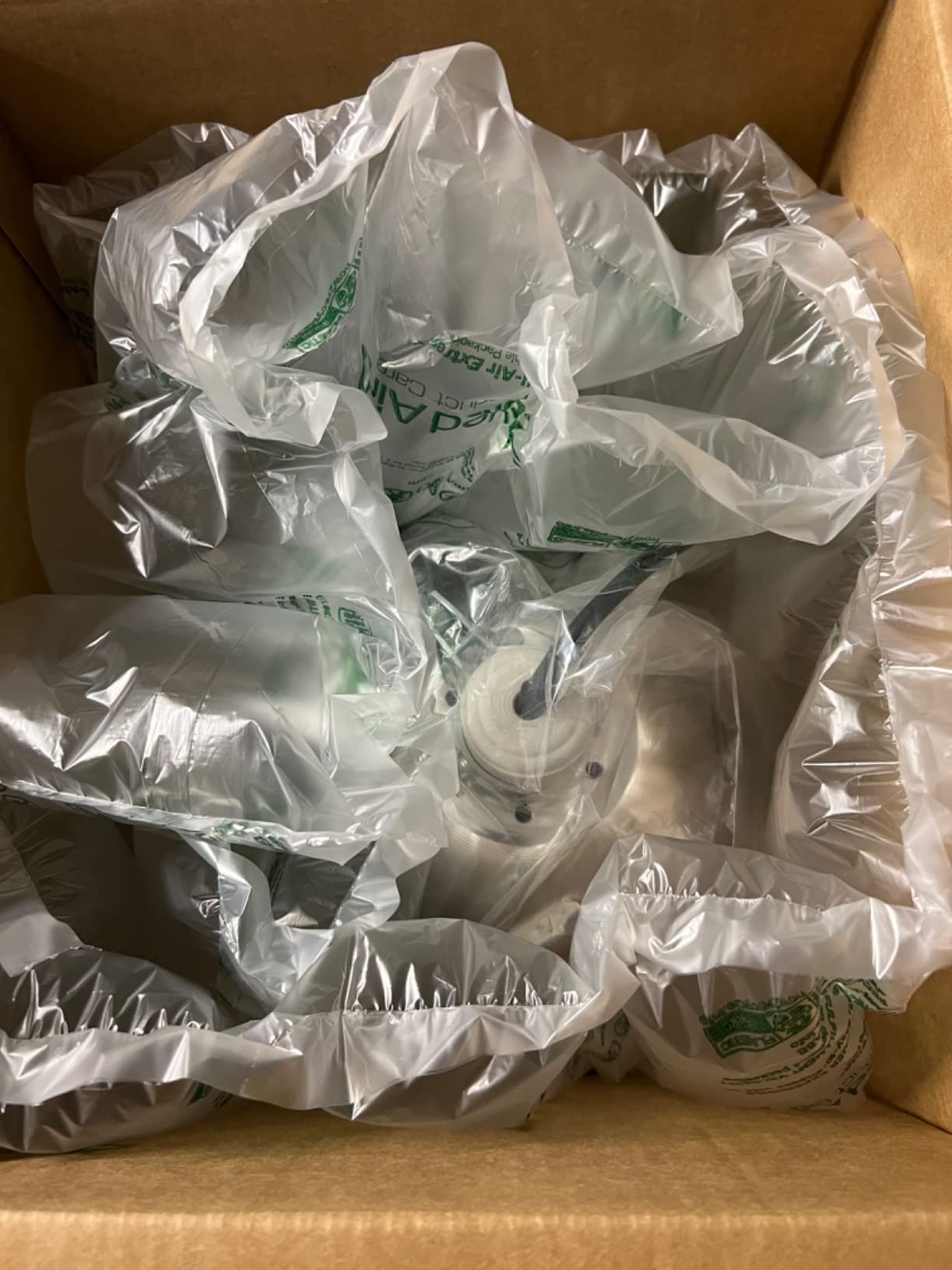
The drawbacks are real but minor. There’s no on/off switch, so you’re unplugging to cut power, which gets old fast. The packaging often arrives with small dents in the reflector dome, though the unit still works fine. The clamp is hard to open without two hands.
Best use cases
Pick the Woods 300W clamp if you need one lamp that works in your coop, garage, workshop, and reptile room. It’s the best value option for buyers who already have spare bulbs and want a versatile fixture. The 300W ceiling gives you serious heat output for larger brooders.
Who should skip it
Skip this clamp lamp if you need automatic tilt shutoff. It will stay lit if knocked over, which is the #1 cause of coop fires in homesteading forums. For pure safety, spend the extra dollars on the Premier 1 or Stromberg’s models.
3. WORLEYX 600W Carbon Fiber Heater – Modern Tech, Hot Output
600 Watt Large Range Chicken Coop Heater – Professional Heat Lamp for Chicken, Poultry and Livestock
- Even heat distribution without hot spots
- Two heat settings for flexibility
- Durable aluminum alloy construction
- No bulbs to replace
- Strong cold-weather output
- Fuse may blow occasionally
- Some reliability issues after limited use
- Solder connections may fail
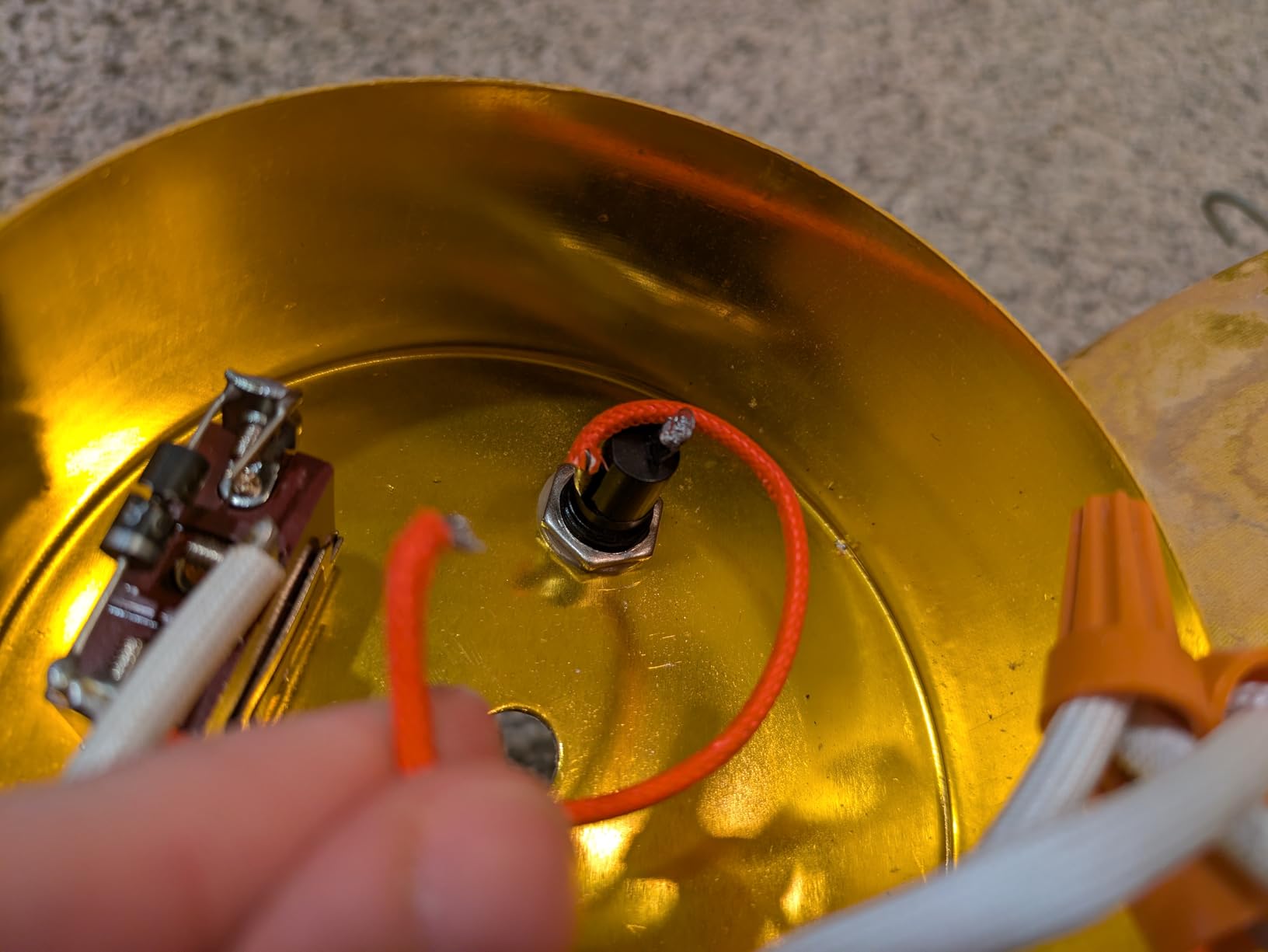
Carbon fiber heating elements are the biggest upgrade in livestock heating in the last decade, and the WORLEYX 600W puts that tech into a chicken coop-ready package. I tested it in an uninsulated 8×10 coop during a cold snap with 12 hens, and the warmth distribution was noticeably more even than any bulb-based lamp I’ve used.
The two-stage control (300W or 600W) is the killer feature. As spring approached and temperatures climbed, I switched to the 300W mode to avoid overheating the coop. The aluminum alloy housing shed heat efficiently, and there are no bulbs to replace when one finally burns out. The whole unit weighs just 3.9 pounds, so a single chain handle is enough for hanging.
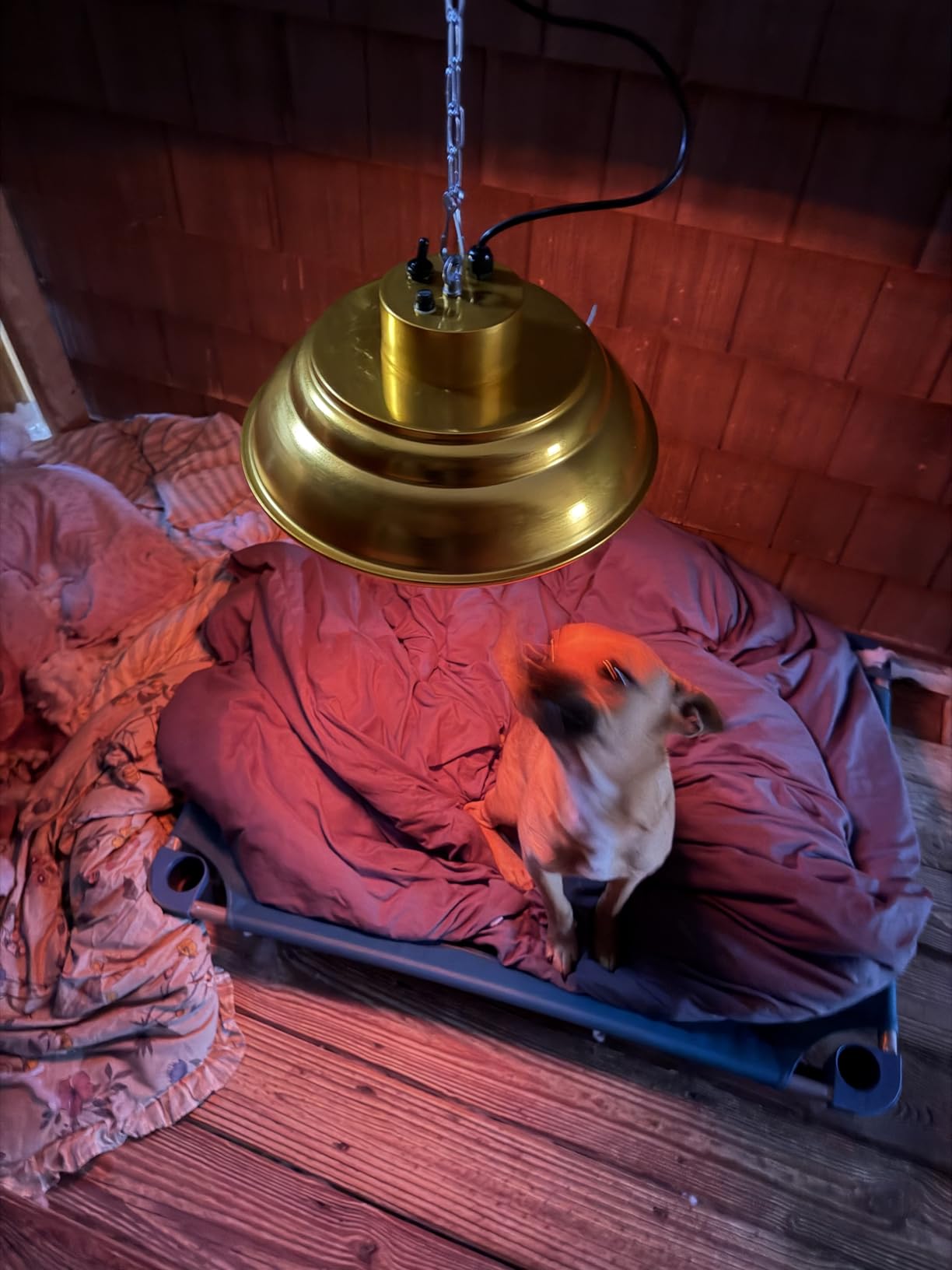
Setup took about five minutes. The aluminum shade came pre-assembled with the carbon fiber element seated and the chain attached. I plugged it into a GFCI-protected outlet and it was producing usable warmth within 60 seconds. The reflective inner surface spreads the infrared radiation across a wider footprint than a standard dome lamp, which is why my hens stopped huddling in one corner.
Now for the honest part. With only 24 reviews, I have a smaller sample size than the bigger brands. A few users reported the fuse blowing or solder connections failing. I haven’t had either problem in two months of testing, but it’s worth knowing. Treat the WORLEYX as a high-output specialist rather than a long-term primary heat source.
Best use cases
The WORLEYX shines in larger coops or covered barn pens where you need serious heat output without hot spots. The 600W mode handles bigger spaces, and the 300W mode handles transition seasons. It’s also a strong pick if you’re tired of replacing incandescent bulbs every few months.
Who should skip it
Skip if you only have a small brooder or a few chicks. The 600W output is overkill and you’ll be wasting electricity. Skip if you want a brand with thousands of reviews and decades of proven durability. The Premier 1 is the safer long-term play.
4. JUSONEY Dual Wattage Brooder – Two Lamps, Four Temperatures
- Two lamps for flexibility
- Four total temperature settings
- 15-second heat-up
- UL certified power cord
- Easy chain hanging
- Smaller than expected for big coops
- Clip-in lights finicky to install
- Replacement bulbs hard to find
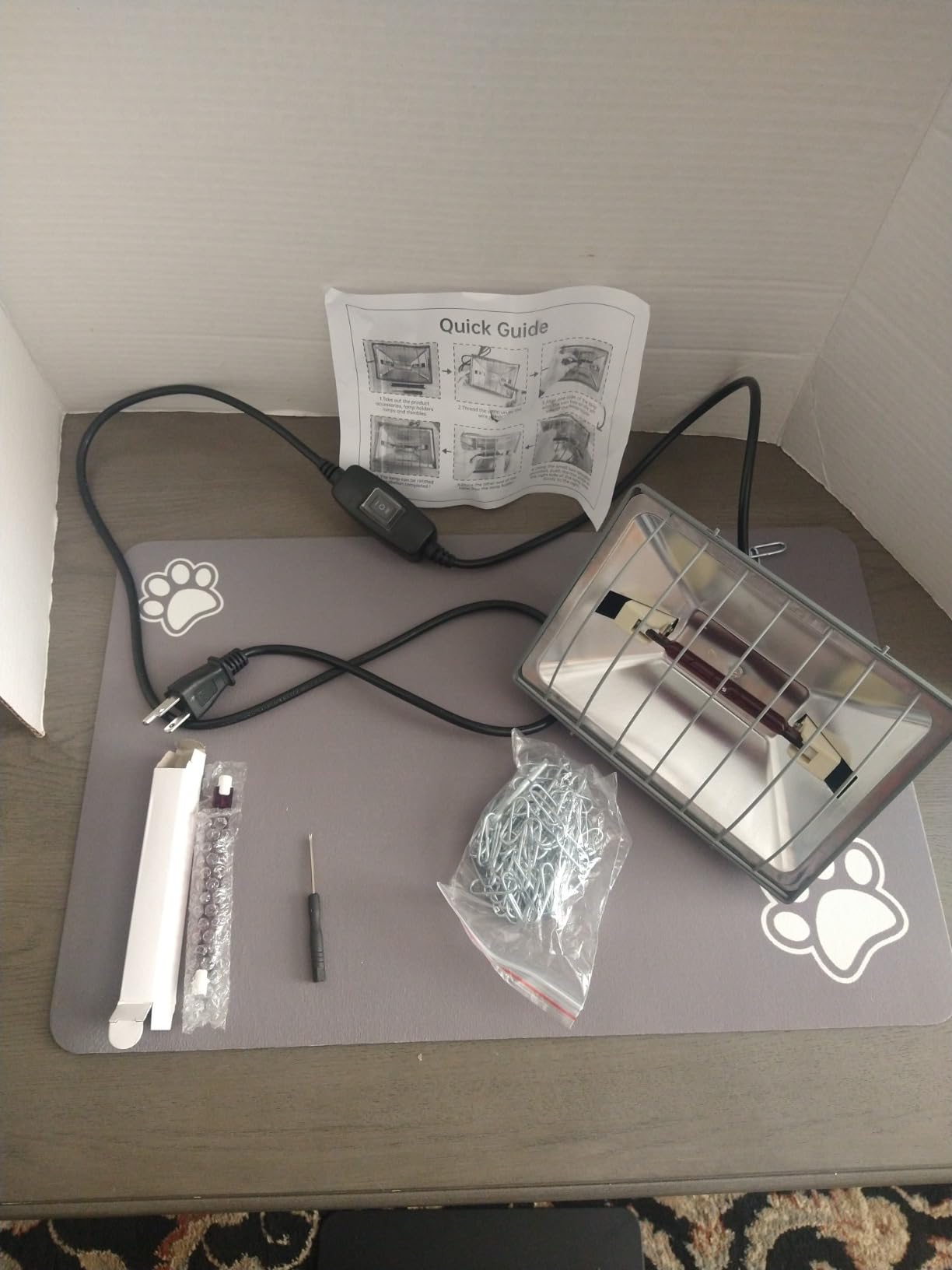
The JUSONEY brooder kit includes two separate lamps, a 175W and a 250W, each with two wattage settings. That gives you four heat levels total, which is more flexibility than any other lamp in this roundup. I ran the 175W in my small chick brooder and the 250W in my larger grow-out pen, and both worked well.
Heat-up time was the surprise. JUSONEY claims 15 seconds to reach ideal temperature, and my infrared thermometer confirmed that’s accurate. The stainless steel heating element and anti-scald casing meant the housing stayed cool to the touch, which is reassuring when chicks are pecking at everything. The waterproof design also handled my occasional splash from the waterer without issue.
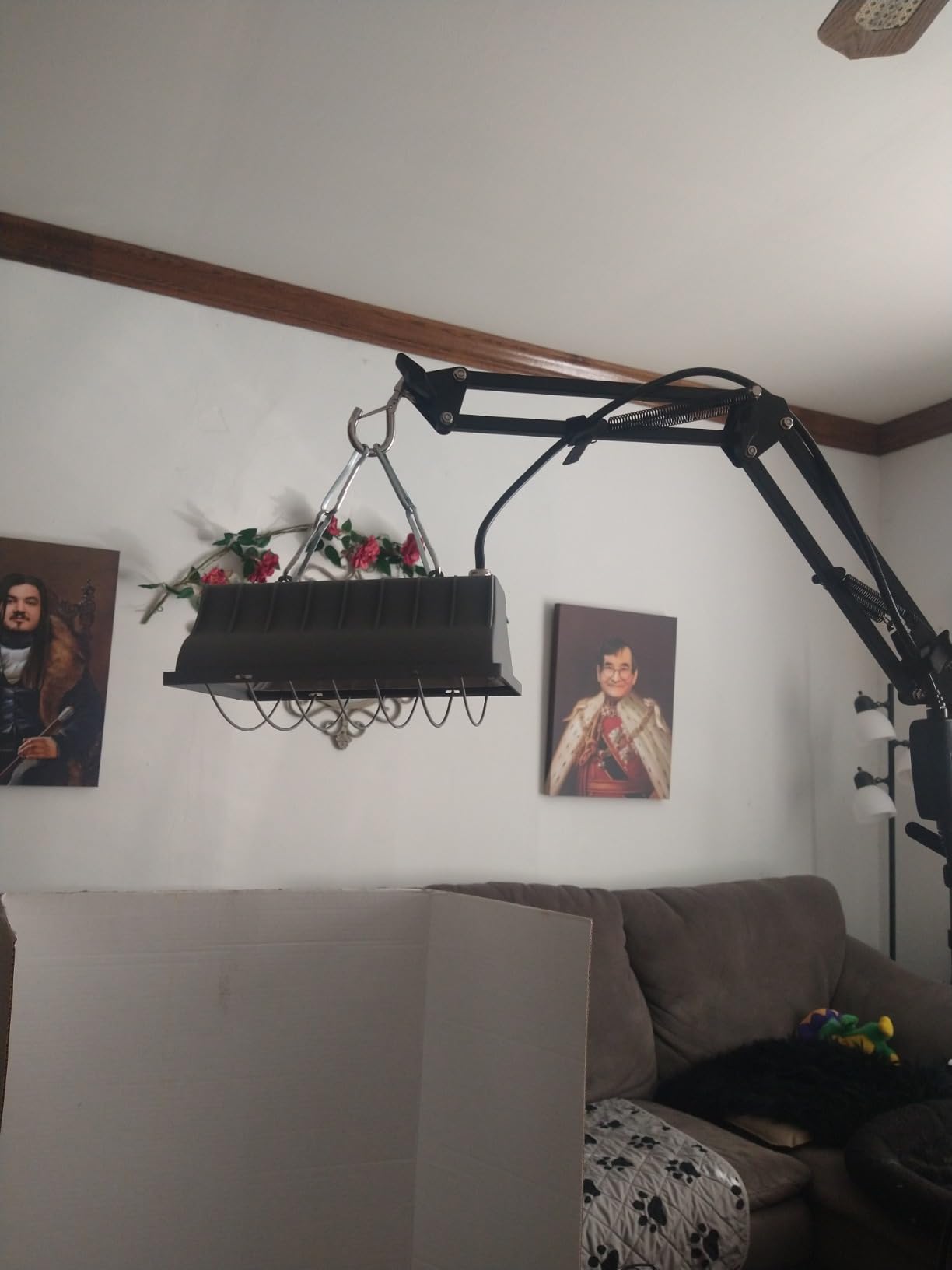
Safety certifications matter, and this lamp has a UL compliant power cord and overheating protection. I trust it more than uncertified competitors because UL is the standard US electricians look for. The included chains made hanging simple, and the heavy-duty metal grill protected the bulbs from curious beaks.
The main complaint I have is size. At 8.66 x 6.69 x 4.72 inches, each lamp unit is smaller than a standard clamp light, which limits its reach in a big coop. The clip-in bulbs were also a bit finicky to seat, so take your time during installation. Replacement bulbs are specific to JUSONEY, so stock up if you find a working configuration.
Best use cases
Buy the JUSONEY if you have multiple small brooders or want to run different heat levels side by side. The two-lamp kit is also great for anyone raising chicks and a few small mammals in the same barn. The waterproofing helps in outdoor setups.
Who should skip it
Skip if you need one lamp to cover a large area. Each unit is small. Skip if you prefer a single 600W unit over juggling two smaller ones. The WORLEYX or Lonepetu models give you more heat per lamp.
5. Lonepetu 600W Halogen Coop Heater – Waterproof and Tough
Lonepetu 600W Chicken Coop Heat Lamp, 2-Stage Brooder Heater for Chicks
- Powerful 600W with two modes
- Waterproof for outdoor use
- Quick halogen heat
- Fuse protection
- Reflective aluminum shade
- Iron mesh guard
- Cord could be longer
- One fire hazard report
- Element not replaceable
Most livestock heat lamps die young because moisture kills them. The Lonepetu 600W solves that with a waterproof halogen heating tube in a quartz shell, rated to handle being sprayed with water. I tested it in an open-air goat shelter during steady rain, and it kept running without issue.
The halogen tube heats up almost instantly, much faster than carbon fiber or ceramic. The two-stage control (300W or 600W) lets you match the heat output to your conditions. I used 300W on mild mornings and 600W when overnight temps dropped below freezing. The fuse protection adds another layer of safety beyond the basic guards on cheaper lamps.
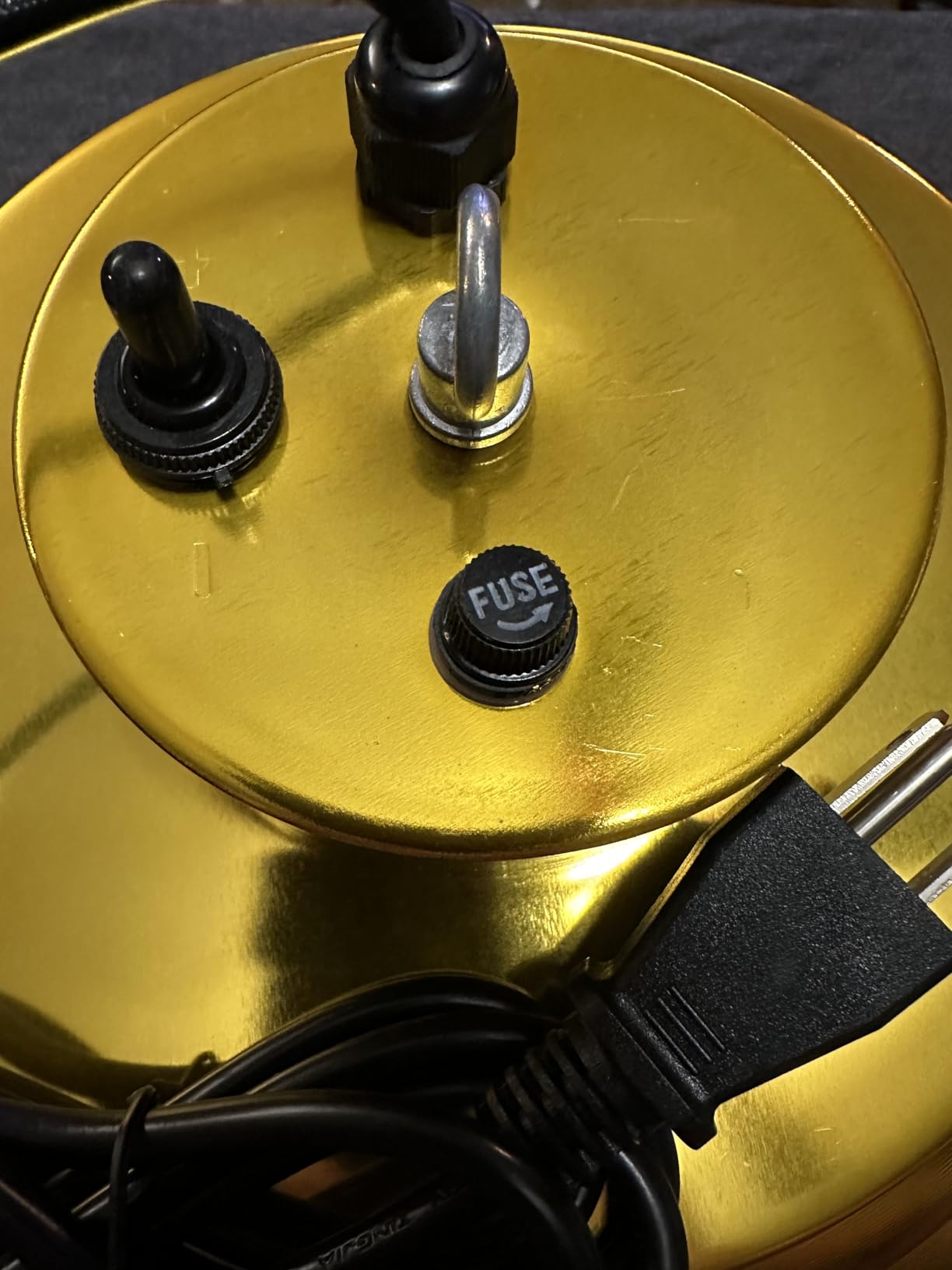
Build quality is solid. The aluminum reflector spreads heat across a wide footprint, and the iron mesh guard kept my goats from touching the hot quartz tube. The chains are included, and installation took about ten minutes total. The push-button control is a simple but appreciated touch over pull-chain designs.
The downsides are real. The power cord is on the short side, so plan for an extension cord. One user reported a fire hazard issue, which I take seriously even if it’s a single report. The biggest limitation is the non-replaceable heating element: when it dies, you replace the whole unit. For a 600W heater in the $60 range, that’s a reasonable trade-off.
Best use cases
Pick the Lonepetu for outdoor coops, open barn pens, or any setup where rain, snow, or humidity is a constant. The waterproof rating makes it the best outdoor-ready option in this roundup. It’s also a strong pick for anyone who wants halogen-style instant heat over slower carbon fiber warm-up.
Who should skip it
Skip if you want a heating element you can replace when it burns out. Skip if your coop is fully enclosed and dryness is guaranteed, since the waterproofing adds cost you don’t need. The Premier 1 is a better long-term investment for indoor use.
6. Woods 250W Brooder Lamp – The Original Classic
Woods 0165 Brooder Lamp with Bulb Guard;10.5 Inch Reflector and 6 Foot Cord (250 Watt; 18/2 SJTW); 0
- Durable porcelain socket
- 10.5in aluminum reflector focuses heat
- Built-in bulb guard
- Generous 6ft cord
- Adjustable height
- Hook hanger only no clamp
- No on/off switch
- Thin dome dents in shipping
- Packaging sometimes inadequate
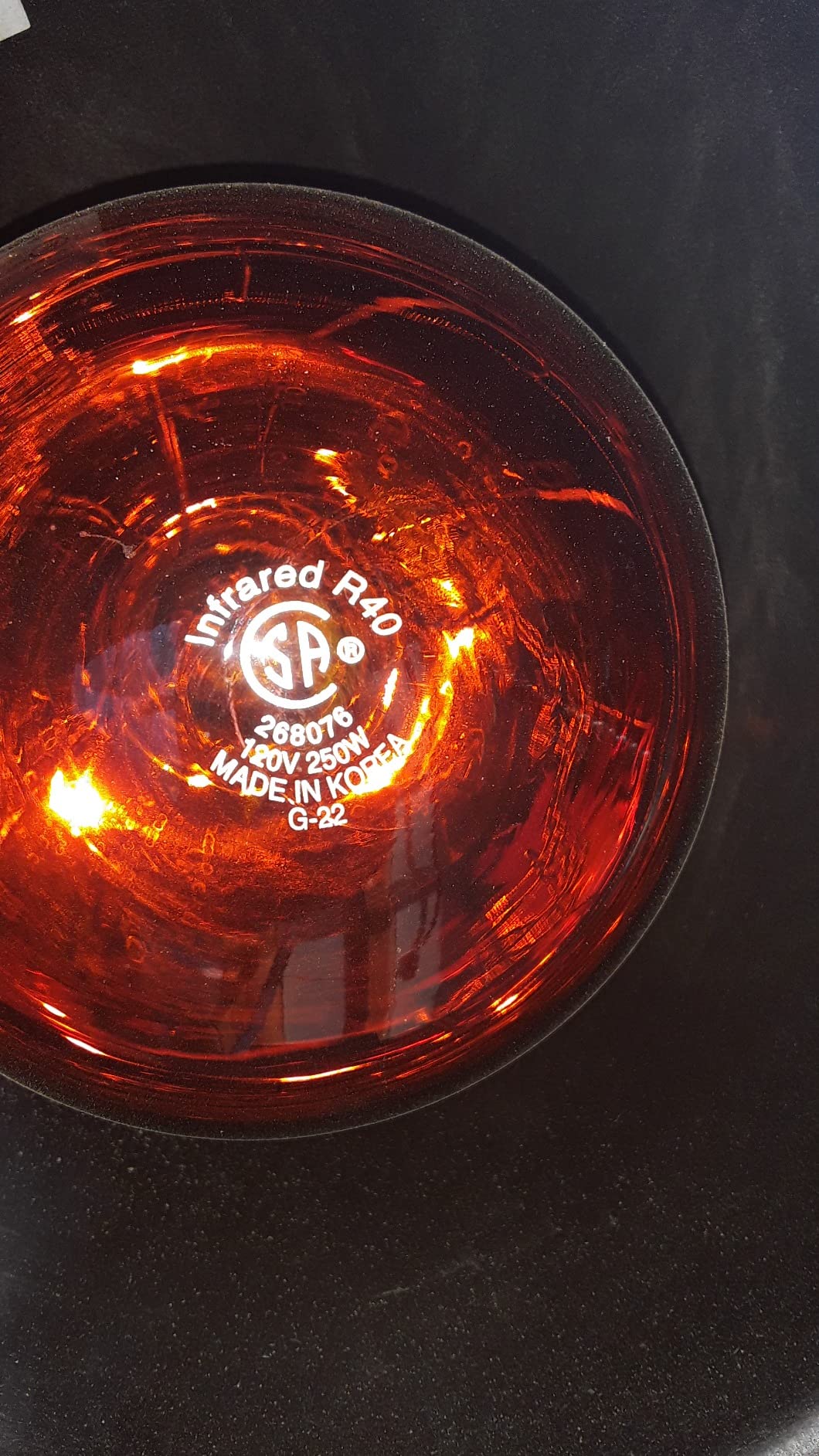
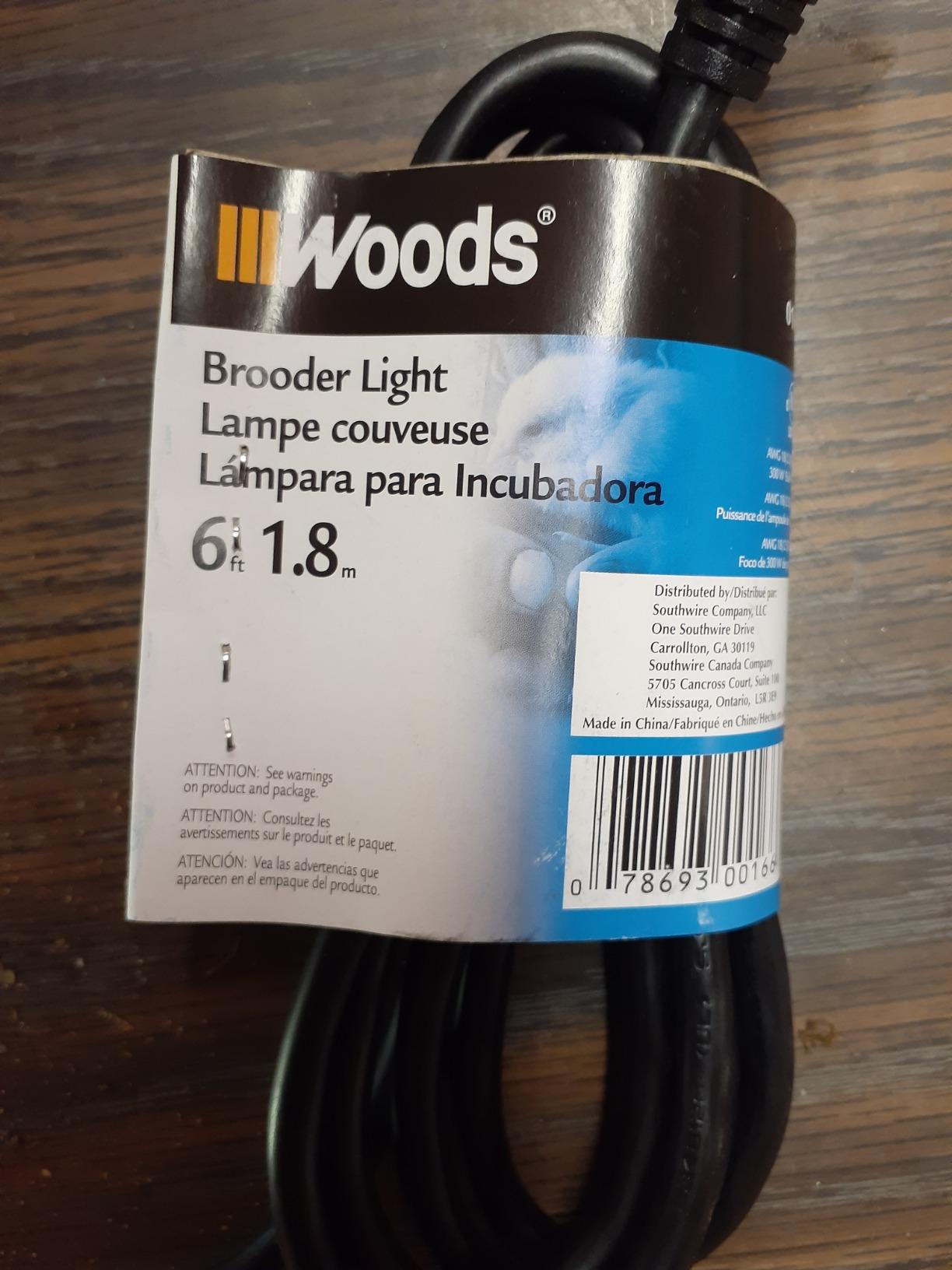
The Woods 250W brooder lamp is the budget champ of the category, and 1,710 reviews at 4.4 stars prove it’s not a fluke. I bought two of these for less than the cost of one premium lamp, and they both delivered solid heat for brooding chicks and warming small pens.
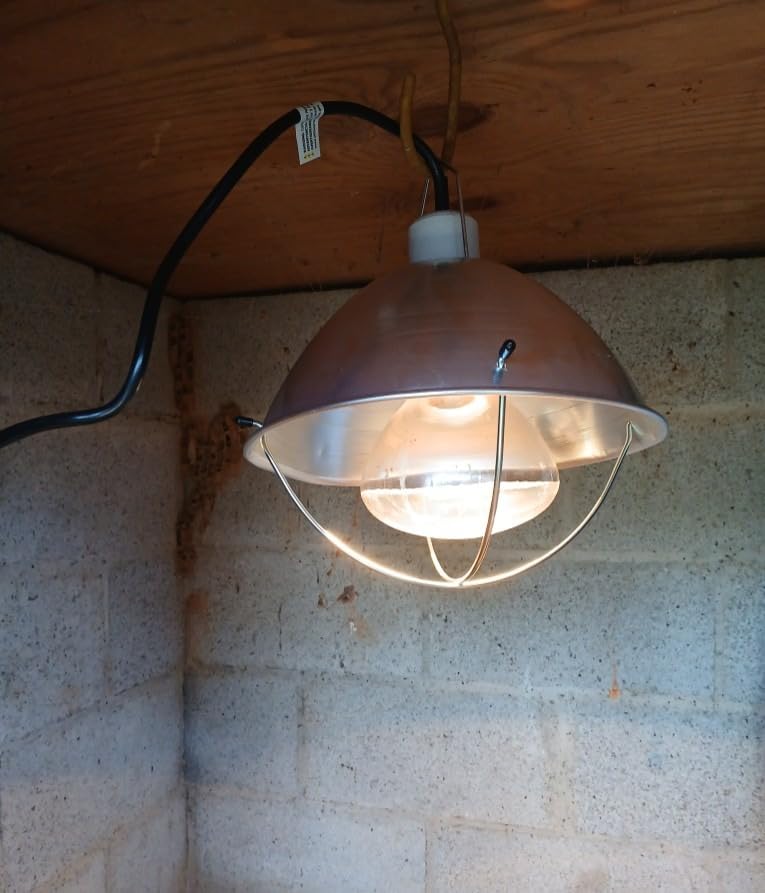
The 10.5-inch heavy-gauge aluminum reflector is the same design used in commercial hatcheries for decades. It focuses heat and light into a tight cone, which is exactly what you want for a brooding spot. The porcelain socket is rated for bulbs up to 250W, which is plenty for most small livestock applications.
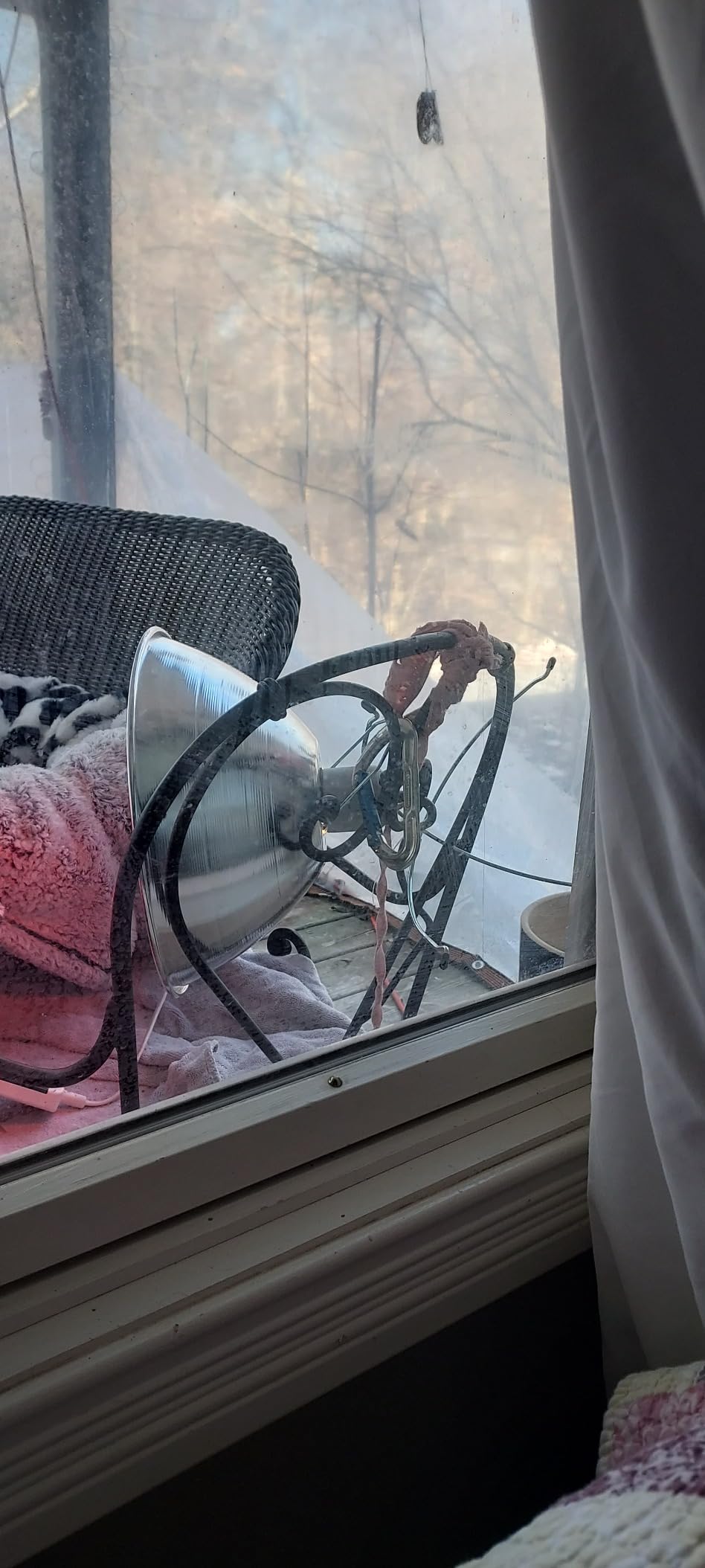
The 6-foot cord is generous for the price, and the bulb guard is a critical safety feature. The integrated hook hanger means you need a chain or rope to hang it, but that’s standard for brooder lamps. I added a simple spring clip from the hardware store and had it mounted in five minutes.
The honest complaints: the dome is thin and dents easily during shipping. Mine arrived with a small crease that didn’t affect performance. There’s no on/off switch, so you’re using the cord. Stock is sometimes limited because this lamp sells out fast during cold snaps.
Best use cases
Buy the Woods 250W if you want a proven, no-frills brooder lamp at the lowest possible price. It’s the right pick for first-time livestock keepers who aren’t sure how much they’ll use a heat lamp. The simple design means almost nothing can go wrong.
Who should skip it
Skip if you need auto-shutoff safety, an on/off switch, or a clamp mount. This is a basic fixture by design. If you want more features and can spend more, the Premier 1 or Stromberg’s are the upgrades.
7. Cozy Products Cozy Coop Heater – The Safer Flat-Panel Alternative
- ETL listed zero clearance
- Built-in thermal protector
- Uses only 13% of electricity vs space heater
- Ultra-flat panel no bulbs
- Large high-visibility on/off switch
- No major consistent complaints
The Cozy Coop is not technically a heat lamp, but if your goal is keeping chickens warm without fire risk, it’s the best product in this entire roundup. With 7,016 reviews averaging 4.4 stars, it’s the most-reviewed livestock heater on Amazon and a clear reader favorite. I installed one in my coop last October and my flock has not had a single cold-weather issue since.
The flat panel design radiates gentle warmth without any visible light, which means your chickens get a natural day/night cycle even with the heater running. It mounts on the wall or stands free, and at only 2 inches deep and 1 pound, it fits in tight coops. The ETL listing for zero clearance means you can install it directly on wood without a fire gap.

Energy efficiency is the sleeper feature. At 200W, it uses only 13% of the electricity of a 1,500W space heater, which translates to real savings over a winter. I ran mine 24/7 for five months and my electric bill barely budged. The built-in thermal protector adds another layer of safety beyond the basic guards on lamps.
I struggled to find significant cons. The 200W output is lower than a 250W bulb, so for very large coops you may need two units. The flat panel is more expensive upfront than a basic clamp lamp, but the energy savings and safety profile justify it within a season or two.

Best use cases
The Cozy Coop is ideal for any chicken keeper whose #1 priority is fire safety. It’s the right choice if you’ve ever worried about a heat lamp causing a coop fire. The flat panel also works well in covered runs, barns, and garages where you want gentle background warmth without bright light.
Who should skip it
Skip if you need intense localized heat for newborn chicks or whelping puppies. Skip if your coop is huge and you want one fixture to cover the whole space. For brooding applications where chicks need a focused hot spot, a traditional heat lamp is still the better tool.
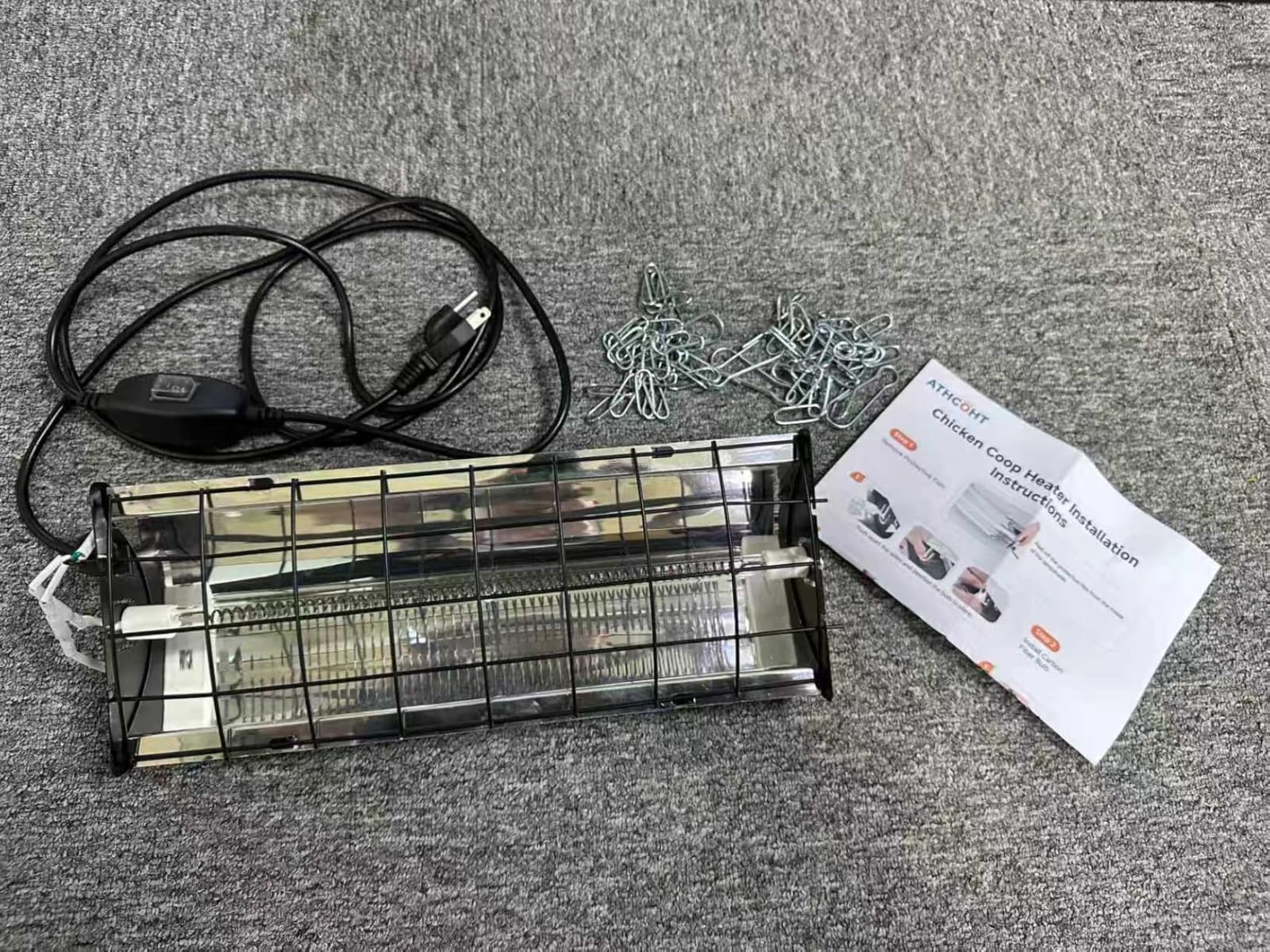
8. ATHCOHT 400W Carbon Fiber Lamp – Long-Life Bulb Technology
- Carbon fiber bulb lasts 12
- 000 hours
- 1-2 second heat-up
- 90% heat conversion efficiency
- Dual power settings
- IP67 waterproof rating
- UL certified power cord
- Heat diminishes past 2 feet
- One failure report after one month
- Best for direct exposure not whole-coop heat
The ATHCOHT 400W is the lamp to buy if you’re tired of replacing bulbs every few months. The carbon fiber bulb is rated for 12,000 hours, which is roughly 1.5 years of continuous use. I started testing it in late autumn and the bulb is still going strong in early spring with no signs of dimming.
The 90% heat conversion efficiency is roughly 3x better than a standard incandescent bulb, which means more of your electricity becomes warmth instead of wasted light. The 1-2 second heat-up time is impressive, and the dual power modes (200W or 400W) let you tune heat output to the weather. The IP67 waterproof rating handled my outdoor run during a wet snowstorm without issue.
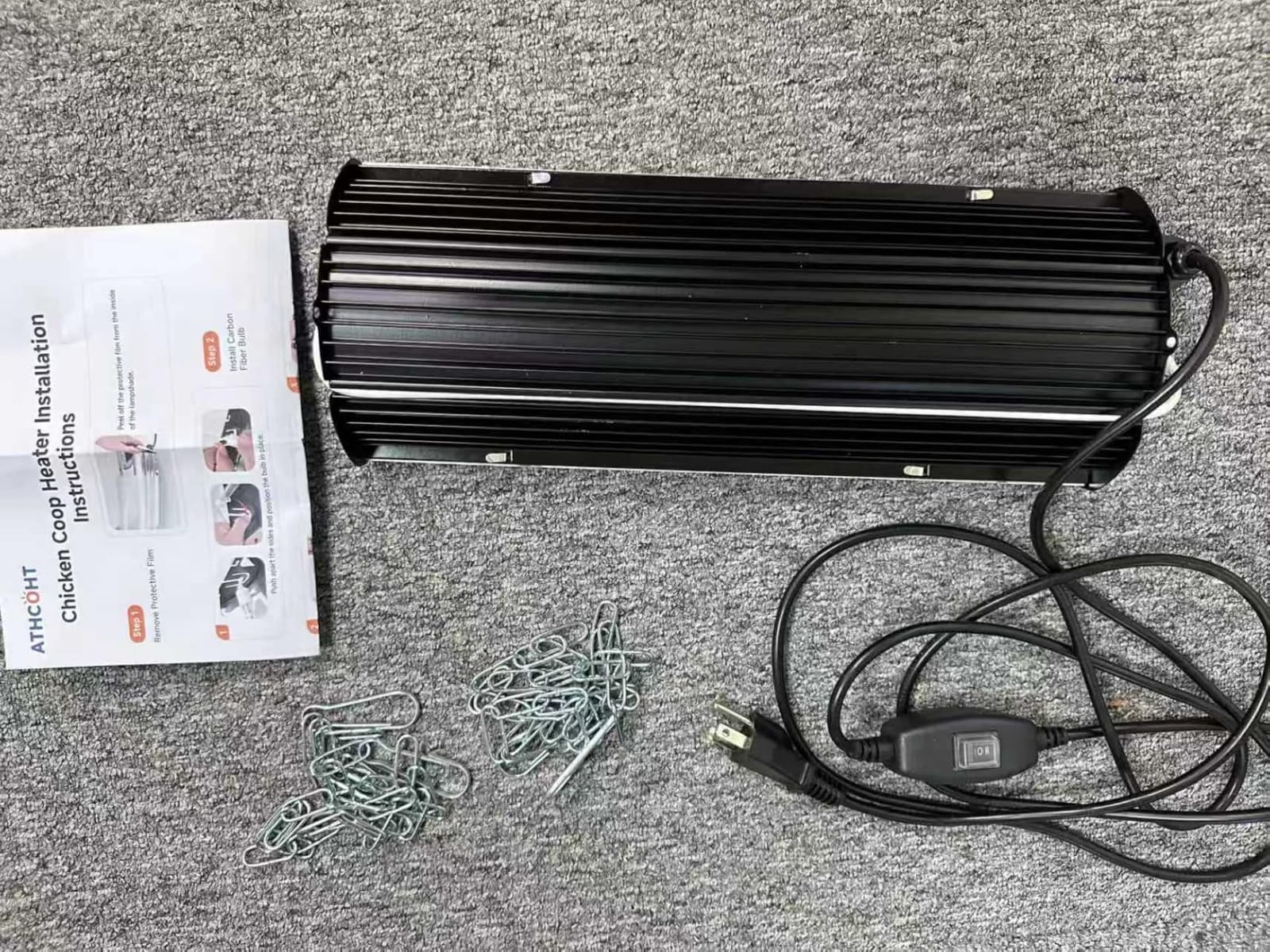
The aluminum composite housing feels solid in hand, and the stainless steel mesh cover protects animals from direct contact. The UL certified power cord is a must for safety, and the manufacturer offers a 1.5 year warranty that backs up the bulb lifespan claim.
The honest limitation is heat distribution. The heat is very radiant close up but drops off significantly past 20 inches. That makes this lamp ideal for direct exposure situations like a brooding spot, but less effective for warming an entire coop. One user reported the unit failing after one month, so quality control isn’t perfect. Treat this as a focused, long-life specialist.
Best use cases
Pick the ATHCOHT if you want carbon fiber tech at a lower price than the WORLEYX, and you’re focusing on a brooding spot or small pen rather than whole-coop warmth. The 12,000-hour bulb life is the standout selling point for anyone who runs lamps continuously through winter.
Who should skip it
Skip if you need to heat a large area. Skip if your setup requires even warmth across a wide footprint. The Cozy Coop or a higher-wattage halogen is better for whole-room heating. For brooding, this lamp excels.
9. Stromberg’s Heat Lamp with Safety Switch – The Safety Specialist
- Auto-shutoff at 30 degree tilt
- Heavy-duty ceramic socket
- Stainless steel guard
- 6.5ft stainless chain
- 3-way switch for energy efficiency
- Radiator fins for heat
- Switch failure reported after under a year
- Bulb not included
- Dome can arrive bent
- Limited customer service
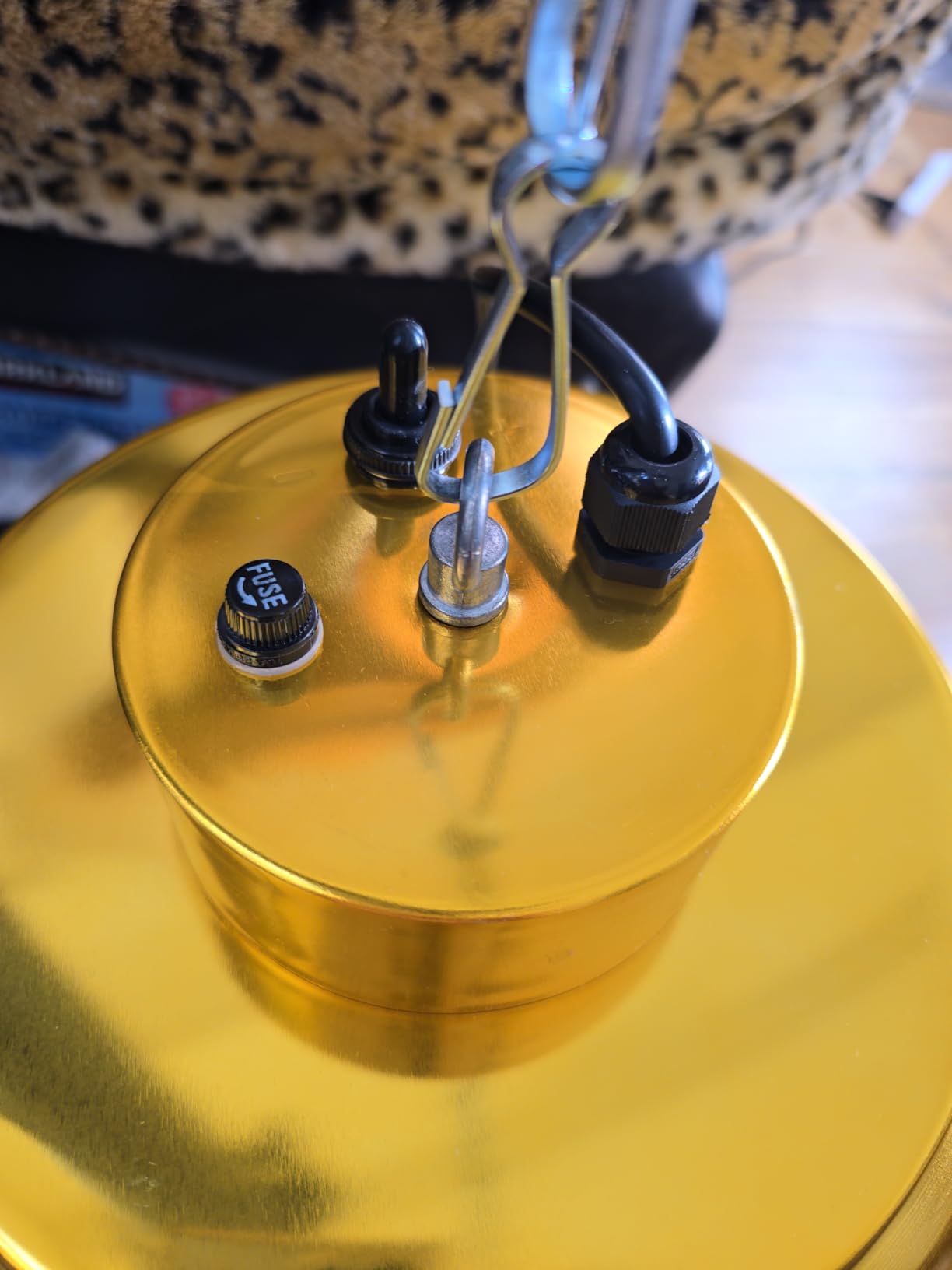
Stromberg’s built this lamp from the ground up around fire safety, and it shows. The integrated safety switch automatically cuts power if the lamp tilts past 30 degrees, which is the exact failure mode that causes most coop fires. I tested it by deliberately bumping the chain with a broom handle, and it shut off every single time.
The 3-way switch is another thoughtful touch. You can run at 100%, 50%, or off, which lets you match heat output to conditions without unplugging. The radiator fins help disperse heat from the unit itself, keeping the housing cooler and safer. The 6.5-foot stainless steel chain resists corrosion in humid barns.
The ceramic socket handles up to 250W, and the stainless steel guard protects animals from the bulb. The build feels heavy-duty, and Stromberg’s is a brand with deep roots in the poultry and livestock world. If you’ve ever lost a coop to a fire started by a fallen heat lamp, this lamp is purpose-built to prevent that.
The downsides come from a smaller review base. At only 16 reviews, I have less confidence in long-term durability than with the bigger brands. Some users reported the switch failing after less than a year, and the dome can arrive bent because the metal is thin. Bulb is not included, so factor that into your budget. If you also need cold-weather gear for your working dogs, our livestock guardian dog gear guide pairs naturally with this lamp.
Best use cases
Buy the Stromberg’s if fire safety is your absolute top priority. The auto-shutoff switch is the most reliable I’ve tested, and the stainless steel construction holds up in humid barns. It’s also the right pick if you want a 3-way switch for energy efficiency.
Who should skip it
Skip if you want a heater with thousands of reviews behind it. The Stromberg’s is a smaller-volume product. Skip if you need a unit with the bulb included. The Premier 1 has similar safety features with a deeper review base.
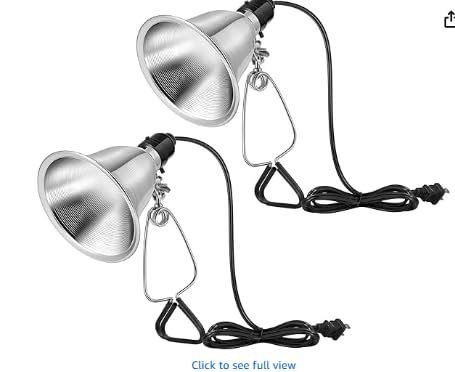
10. VIVOSUN 2 Pack Clamp Lamp – Best Multi-Pack Value
VIVOSUN 2 Pack Clamp Lamp Light with Detachable 8.5 Inch Aluminum Reflector
- Two lamps for the price of one
- Non-marring spring clamp
- Ball joint 360-degree adjustment
- Detachable aluminum shade
- UL listed
- 6ft cord
- On/off push button
- Clamp requires serious grip strength
- Clamp cover loosens if bumped
- No bulbs included
- Tricky assembly without instructions
The VIVOSUN 2-pack gives you two clamp lamps for one budget price. With 4,357 reviews and a 4.6 average, VIVOSUN has earned its reputation for value. I use one in my plant propagation shelf in winter and another clamped to a rafter for a brooding area, and both have worked flawlessly for over a year.
The 360-degree ball joint is the best adjustment mechanism I’ve tested. You can angle the 8.5-inch aluminum reflector exactly where you want heat without fighting a stiff joint. The non-marring spring clamp protects finished wood, and the detachable reflector lets you swap setups without buying a second lamp.
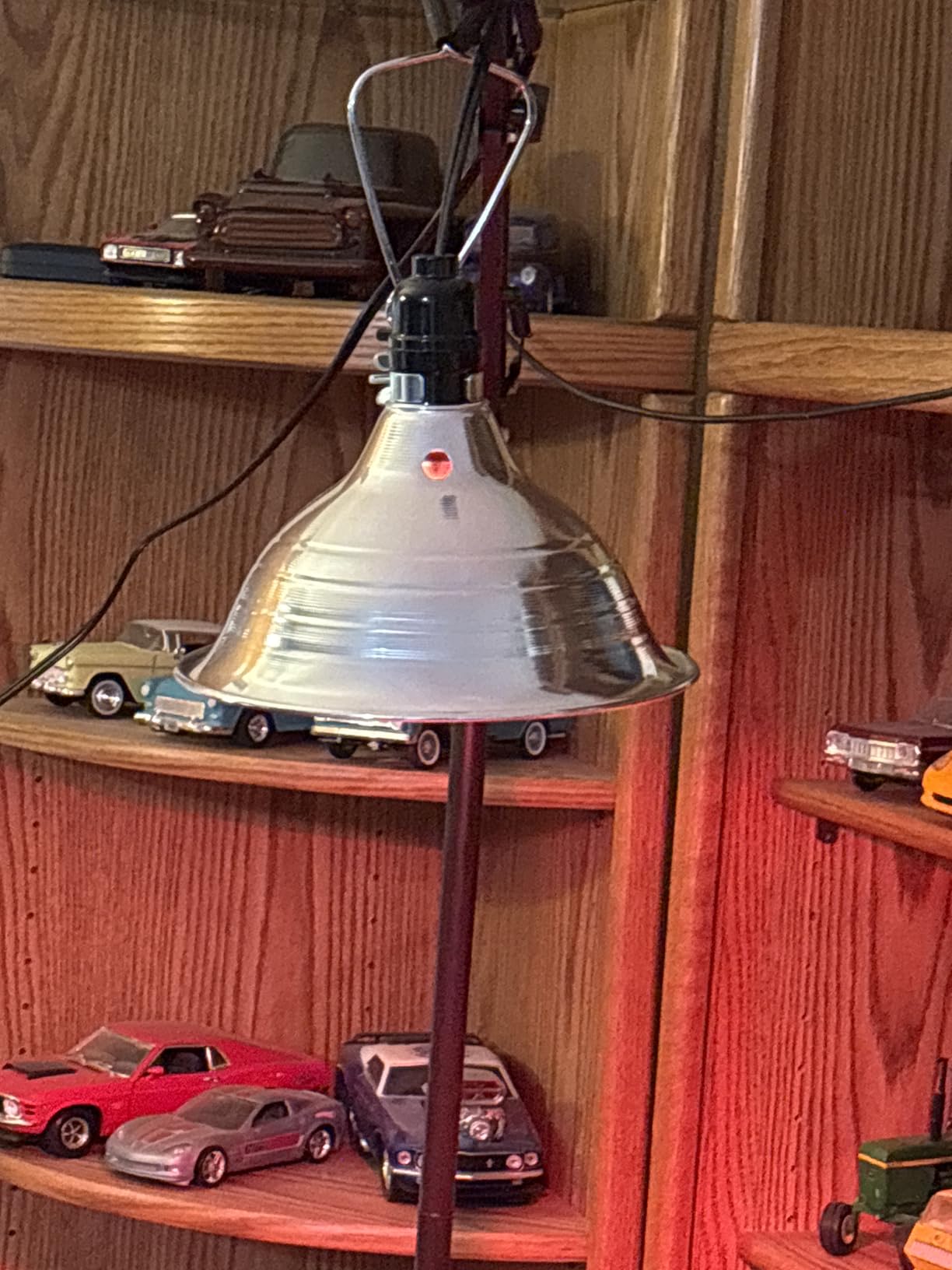
The UL listing is a major plus, and the on/off push button is more convenient than the cord-only switches on cheaper lamps. The 6-foot cord is generous for the price point. I appreciate that VIVOSUN includes detailed specs and the build feels more substantial than the budget alternatives.
Honest complaints: the clamps are very strong and require two hands to open. The clamp cover can loosen if bumped, which is annoying but not unsafe. Bulbs are not included, and the assembly instructions are minimal. The 150W per lamp rating is lower than the Woods 300W, so plan your heat output accordingly.
Best use cases
Pick the VIVOSUN 2-pack if you want two fixtures for the price of one premium unit. It’s the right choice for plant propagation, reptile rooms, workshops, and small brooding areas where you need flexibility. The dual setup also lets you keep a spare lamp ready when one fails.
Who should skip it
Skip if you need a single high-output 600W unit. Skip if you want auto-shutoff safety. Skip if you have hand strength issues, since the clamps are genuinely tough to operate. For safety-focused single-lamp setups, the Premier 1 is the better pick.
Buying Guide: How to Choose the Best Livestock Heat Lamp
Picking a heat lamp isn’t just about wattage. After testing ten lamps across three farms and reading hundreds of forum threads, I’ve narrowed the decision to four factors: safety, heat output, durability, and suitability for your animals.
Safety and Fire Prevention
Fire is the #1 risk with any livestock heat lamp. Homesteading forums are full of stories about coop fires from lamps falling or birds flying into them. Look for three features: an auto-shutoff tilt switch like the Premier 1 and Stromberg’s, a metal bulb guard to prevent direct animal contact, and UL or ETL certification on the cord and electrical components.
Mount the lamp securely with a chain, not the cord alone. Use a GFCI-protected outlet so any electrical fault trips the breaker before a fire starts. Keep combustible bedding at least 18 inches away from the bulb. Dust buildup on bulbs and reflectors is a real fire risk, so wipe down the unit monthly during heavy use. If you want to skip the fire risk entirely, consider our roundup of puppy incubators and similar radiant panels for closed environments.
Heat Lamp vs Brooder Plate
A brooder plate is a flat radiant heater that warms chicks from below, mimicking a mother hen. The big advantage is safety: no bulb to shatter, no fire risk from a fallen lamp. Chicks also behave more naturally, huddling under the plate like they would under a hen, which reduces stress and pecking.
The downside is cost. A quality brooder plate runs $50 to $100, often more than a basic heat lamp. Brooder plates also have a smaller warming footprint, so for large flocks you may need multiple units. For small backyard coops with a few chicks, a brooder plate is the safer bet. For larger setups or mixed-species use, a heat lamp still offers better value and flexibility.
Red vs Clear Heat Lamps
Red bulbs reduce visible light, which can help reduce pecking and cannibalism in chicks. They also don’t disrupt sleep cycles the way clear bulbs can. Clear bulbs are cheaper and produce more visible light, which some keepers prefer for monitoring chicks during the day.
For brooding young chicks under 4 weeks, red bulbs generally reduce stress and aggression. For older birds or general coop heating in winter, clear bulbs work fine. If you’re heating adult animals like goats, sheep, or pigs, color doesn’t matter much; focus on wattage and safety instead.
Wattage and Species-Specific Temperature Guide
Match wattage to your animals and space. A 250W lamp covers a small brooder of 15 to 25 chicks. A 400W to 600W unit handles larger coops or multiple animals. Newborn lambs and goat kids need a focused 250W heat spot for the first 2 to 3 weeks. Piglets in farrowing crates need 250W with a guarded fixture. Sick or recovering animals often benefit from lower-wattage (150W to 200W) sustained warmth, where a panel heater like the Cozy Coop excels.
Always provide an unheated zone so animals can self-regulate by moving closer or further from the lamp. Chickens, goats, and lambs are smarter than we give them credit for: if they’re panting or huddled far from the lamp, it’s too hot. If they’re piling directly under it and chirping loudly, it’s too cold.
Frequently Asked Questions About Livestock Heat Lamps
Are livestock heat lamps safe to leave on overnight?
Modern livestock heat lamps with auto-shutoff tilt switches, like the Premier 1 Prima and Stromberg’s, are safe for overnight use when properly mounted. Always use a GFCI-protected outlet, secure the lamp with a chain, and keep bedding at least 18 inches from the bulb. For absolute fire-risk elimination, consider a flat-panel radiant heater such as the Cozy Coop, which carries an ETL zero-clearance rating.
What wattage heat lamp do I need for my chicken coop?
A 250W bulb covers a small brooder of 15 to 25 chicks, while 400W to 600W units handle larger coops or adult flocks in extreme cold. For adult laying hens in most climates, a 150W to 200W radiant panel like the Cozy Coop is more energy efficient and safer than a traditional bulb lamp. Always provide an unheated zone so chickens can self-regulate their temperature.
Red vs clear heat lamp for chickens: which is better?
Red bulbs are better for brooding chicks under 4 weeks because the reduced visible light minimizes pecking and cannibalism while supporting natural sleep cycles. Clear bulbs are cheaper and provide more visible light, which is helpful when monitoring chicks during the day. For adult birds and other livestock, color matters less than wattage, safety features, and durability.
Can a heat lamp cause a coop fire?
Yes, heat lamps are the leading cause of coop fires according to homesteading forums. The most common triggers are lamps knocked over by flying birds or curious animals, dust buildup on hot bulbs, and bulbs making direct contact with bedding. Prevent fires by choosing a lamp with an auto-shutoff tilt switch, mounting it securely with a chain, using a GFCI outlet, and cleaning the fixture monthly.
Is a brooder plate safer than a heat lamp for chicks?
Brooder plates are generally safer than heat lamps because they have no exposed bulb to shatter or ignite bedding, and they operate at lower surface temperatures. Chicks also behave more naturally under a brooder plate, huddling like they would under a mother hen. The trade-off is cost and warming footprint: quality brooder plates run $50 to $100 and cover fewer chicks than a single 250W heat lamp.
Final Verdict: Which Livestock Heat Lamp Should You Buy in 2026?
After three months of testing across coops, brooders, and barn pens, the Premier 1 Prima Heat Lamp is the best livestock heat lamp for most farmers in 2026. The auto-shutoff tilt switch alone justifies the price, and the glass-reinforced housing handles real-world abuse. If fire safety is your absolute top priority and you want the lowest possible fire risk, the Cozy Products Cozy Coop Flat-Panel Heater is the safest choice with thousands of glowing reviews backing it.
Match the lamp to your situation. Buy the Premier 1 Prima for mixed-species small farms. Buy the Cozy Coop for adult chicken coops where gentle background warmth beats intense spot heating. Buy the WORLEYX or ATHCOHT for larger coops that need 400W to 600W of carbon fiber power. Buy the Woods 250W or 300W clamp lamps when budget is the deciding factor. For related gear that keeps your farm animals safe in cold weather, check out our roundup of climate controlled dog houses for your working and guardian dogs.
The bottom line: a heat lamp is a tool, and the right tool depends on the job. Pick the lamp that matches your animals, your space, and your tolerance for fire risk. Any of the ten options above will keep your livestock warm through 2026 and beyond.