
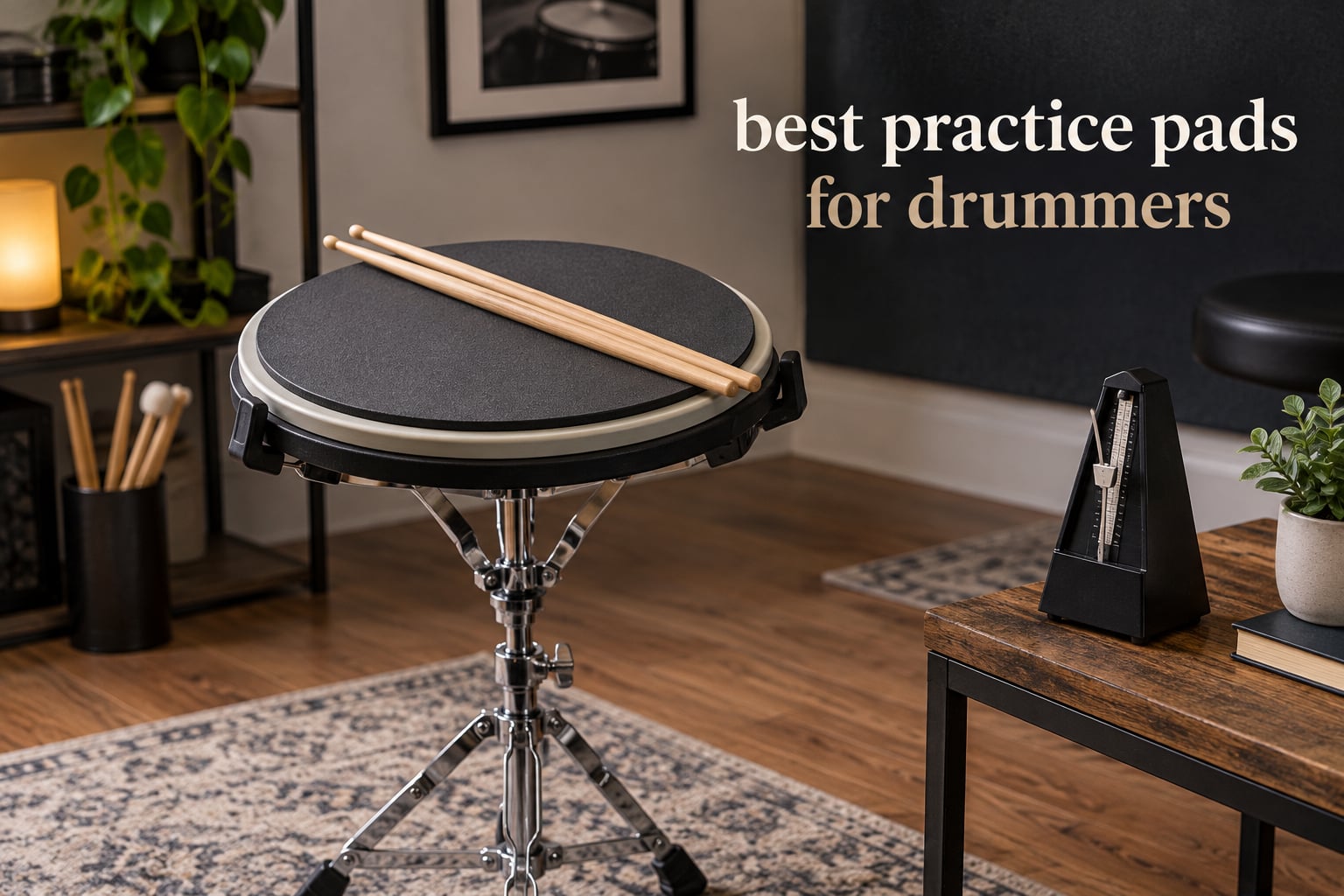
Most drummers do not buy a practice pad because they want one. They buy one because the neighbours have already had a conversation with them, or because the kit lives in a garage two rooms away from the bed. A good drum practice pad solves both problems: it gives you a real playing surface with believable rebound, and it lets you work on sticks, timing and control at a fraction of the volume of a full acoustic kit.
We spent weeks putting these twelve pads through the same routine: warm-up strokes, single stroke rolls at rising tempo, paradiddles at 100 bpm, a rim click on every pad that offers one, and a straight talk about what each surface is really teaching your hands. We also weighed them, because a 1.65 kg pad and a 6.4 oz pad do not end up in the same bag. This is our 2026 guide to the best practice pads for drummers, and it is written for the people who will actually use one every day, not the ones who will store it behind the sofa.
Table of Contents
What Is the Best Practice Pad for Drummers?
The best drum practice pad for most drummers is a double-sided 12-inch pad with a natural gum rubber face for realistic rebound and a firmer recycled rubber side for strength and dynamics work. If you need near silence, look to a mesh or foam surface. If you need realism, pick a pad with a replaceable drumhead. Budget and portability argue for a 4-inch or 7-inch pad instead.
Quick Picks: Best Practice Pads by Job
Best overall: Evans RealFeel 2-Sided 12 Inch – two genuinely different surfaces in one pad, and the highest-rated pad in this roundup with 5,698 reviews.
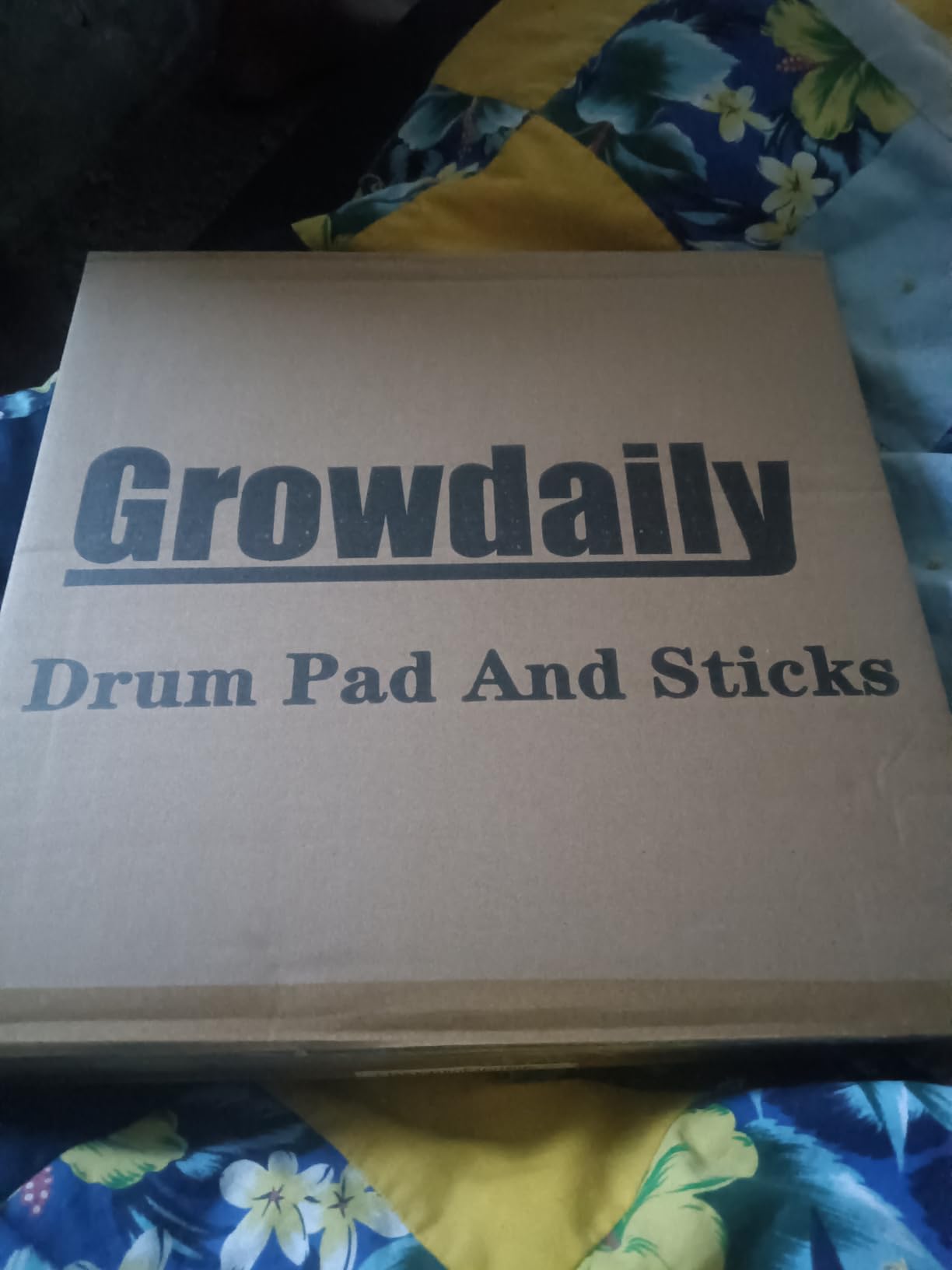
Best budget: GrowDaily 12 Inch Practice Pad – quiet, sturdy and it arrives with four maple sticks in the box.
Best quietest: Sabian Quiet Tone Mesh 10 Inch – a mesh head that reviewers consistently rank as the quietest pad they have used.
Best for building hand strength: Meinl Marshmallow 12 Inch – a foam surface that kills rebound so your hands do the work.
Best for snare realism: Remo Red Tunable 10 Inch – a real replaceable Ambassador Coated head in a practice pad frame.
Best most portable: Gibraltar Pocket Practice Pad – 4 inches across and 6.4 ounces, so it lives in a back pocket.
Best for articulation: Evans RealFeel Attacktile 10 Inch – a UV-coated surface you can actually hear yourself playing on.
Top 3 Picks for Best Practice Pads for Drummers (October 2026)

Evans RealFeel 2-Sided 12 Inch
- Gum rubber and recycled rubber surfaces
- Realistic rebound for rudiments
- Works on lap table or snare basket

Vic Firth Double Sided 12 Inch
- Soft realistic side and hard rubber side
- Quick rebound and crisp articulation
- Durable wooden base
Remo Red Tunable 10 Inch
- Replaceable Ambassador Coated head
- Real drumhead bounce and feel
- Non-slip rubber underside
All 12 Practice Pads at a Glance in 2026
Every pick below sits in the same test regime, so the columns are comparable. Pay attention to the surface pair first, because that is the choice that shapes your technique over months rather than days.
| Product | Specifications | Action |
|---|---|---|
| Evans RealFeel 2-Sided 12 Inch |
|
Check Latest Price |
| Remo Red Tunable 10 Inch |
|
Check Latest Price |
 GrowDaily 12 Inch Practice Pad GrowDaily 12 Inch Practice Pad |
|
Check Latest Price |
 Evans RealFeel Apprentice 7 Inch Evans RealFeel Apprentice 7 Inch |
|
Check Latest Price |
 Donner Snare Stand and Pad Set Donner Snare Stand and Pad Set |
|
Check Latest Price |
 Sabian Quiet Tone Mesh 10 Inch Sabian Quiet Tone Mesh 10 Inch |
|
Check Latest Price |
 Meinl Marshmallow 12 Inch Meinl Marshmallow 12 Inch |
|
Check Latest Price |
| Vic Firth Double Sided 12 Inch |
|
Check Latest Price |
 Gibraltar Pocket Practice Pad Gibraltar Pocket Practice Pad |
|
Check Latest Price |
 Evans RealFeel Attacktile 10 Inch Evans RealFeel Attacktile 10 Inch |
|
Check Latest Price |
 Zildjian Reflexx Conditioning 6 Inch Zildjian Reflexx Conditioning 6 Inch |
|
Check Latest Price |
 Donner Snare Simulator 12 Inch Donner Snare Simulator 12 Inch |
|
Check Latest Price |
1. Evans RealFeel 2-Sided 12 Inch – Best Overall Drum Practice Pad
Evans RealFeel – Drum Practice Pad – Drum Pad – Drummer Practice Pad – Gum Rubber & Neoprene, 2 Sided, 12 Inch
- Two genuinely different surfaces in one pad
- Realistic snare-like rebound on the gum side
- Very quiet for flats and early mornings
- Stays put on carpet tables and laps
- Resists stick marking after heavy use
- Not mountable on a stand
- Some stick noise on the harder side
- Felt heavy for a few users
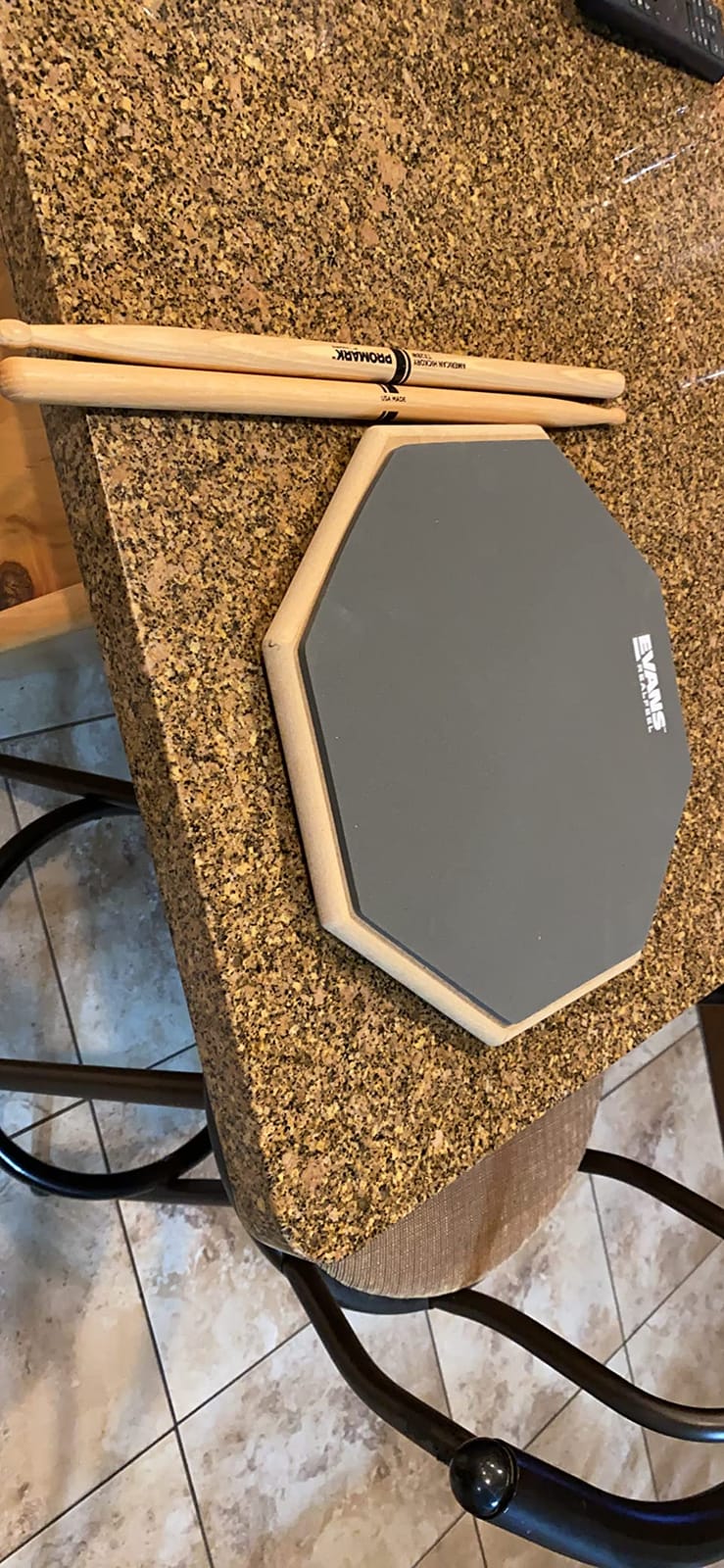
If I could only leave one pad on a drummer’s desk, this is the one. The Evans RealFeel 2-Sided carries a slightly textured natural gum rubber face on one side and a harder recycled rubber face on the other, which sounds like a small detail until you spend an hour alternating between them. The grey side returns your stick like a decently tuned snare, the black side swallows it and asks you to generate the rebound yourself.
That two-surface design is why the RealFeel keeps winning forum threads. On drumforum, the RealFeel line is the most frequently recommended answer when people ask which pad to buy, and that consensus tracks what we found on the pad itself rather than the spec sheet. The 12-inch model weighs 1.65 kg and measures 13.39 x 13.39 x 1.57 inches, so it is substantial enough that it does not skate across a table when you push a double stroke roll to 120 bpm.
On technique work, the gum side is the more valuable of the two. A pad that feels realistic lets you practise the stroke you actually use on a kit, which means the muscle memory you build transfers back to the snare. The recycled rubber side is the training surface: low response, high control, and a good place to work buzz rolls and single stroke endurance without borrowing a neighbour’s patience.
The build is the other reason this is our number one. Evans, a D’Addario company, designs and manufactures this pad in the USA, and the grey surface is a fabric-finish rubber that shrugs off stick marks. A 4.8 rating across 5,698 reviews is not a marketing artefact; it is one of the largest review counts in the practice pad category, which means the opinions behind it are well tested.
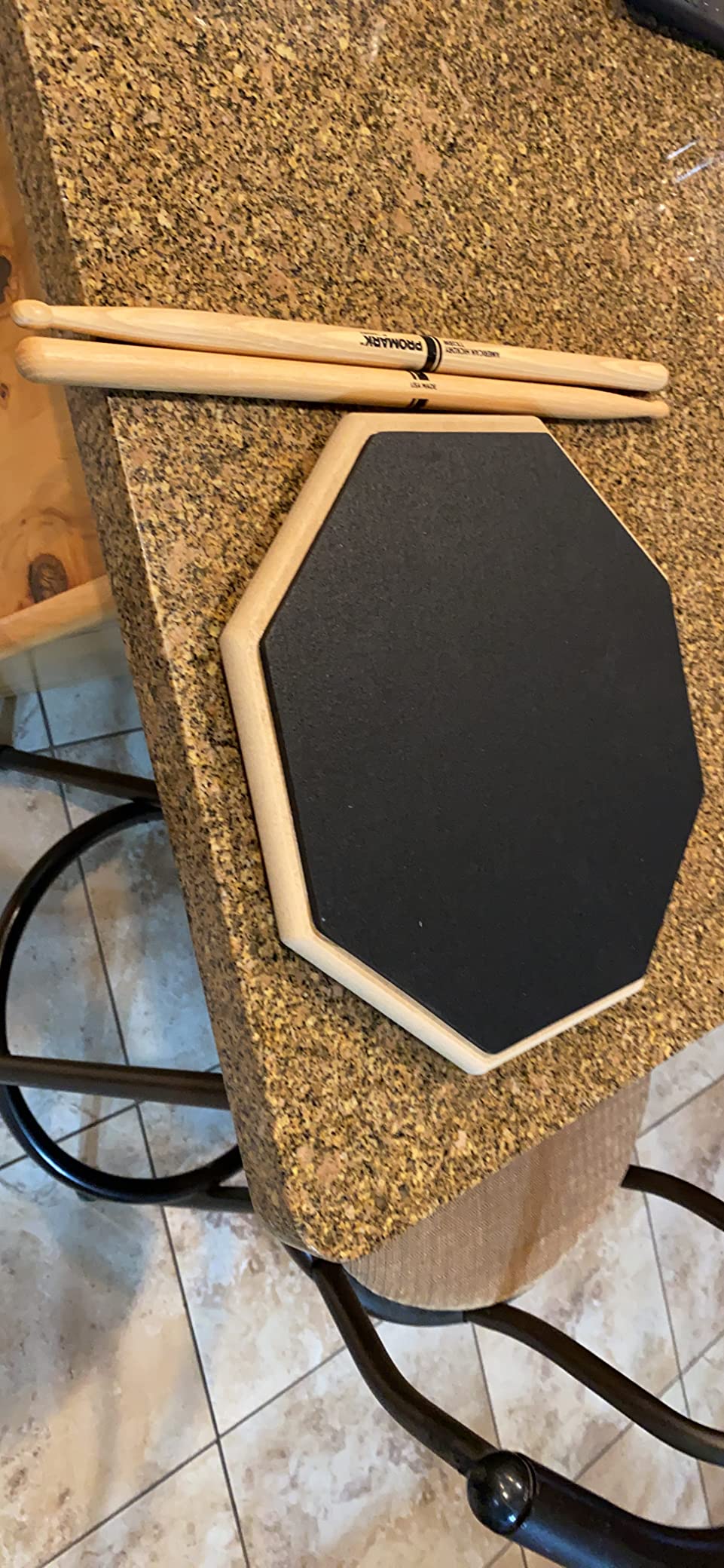
Is the RealFeel loud enough to cause a problem?
Not in any practical sense. The sound profile is muted and narrow, with very little low frequency bleeding through the rubber. Owners in flats and shared houses describe it as suitable for early morning practice, and our own sessions at normal playing volume stayed well inside a normal conversation. If you practise at full tilt with 5A sticks, expect stick noise, but that is the tip noise rather than the pad resonating like a drum.
Who should look past this pad?
Three groups. If you need a rim for cross-stick or rimshot work, the RealFeel has none. If you want to mount the pad at snare height on a stand, the 12-inch version does not take a stand mount, so you are carrying it to a lesson and laying it on a table. And if your priority is absolute silence for a nightly practice block, a foam or mesh surface will take you further than any gum rubber pad.
2. Remo Red Tunable 10 Inch – Best for Real Snare Head Feel
Remo RT-0010-58 10″ Red Tunable Practice Pad with Ambassador Ebony Drumhead
- Closest thing to a real snare head on a practice pad
- Replaceable Ambassador Coated head
- Light at 8 ounces
- Protects tables from scratches and slips
- Fits a standard snare stand
- Audibly louder than rubber pads
- Head wears over long-term use
- Tuning is not like a real drum
Everything about the Remo Red Tunable is a shortcut to realism. Instead of moulding rubber, Remo put an actual Ambassador Coated head on a 10-inch red frame, which is why owners describe the bounce as genuinely acoustic rather than pad-like. If you are prepping for an audition, or you want your practice strokes to feel identical to the ones you play on stage, this is the closest you get without a drum.
The frame carries tension rods, so you can adjust the response a little rather than accepting one fixed feel. The protective rubber bottom is the detail we appreciated most on a table full of gear: it does not scratch wood and it does not creep across a lap when you accelerate. At 8 ounces the whole thing is one of the lighter full-size pads in this roundup, so it moves between rooms easily.
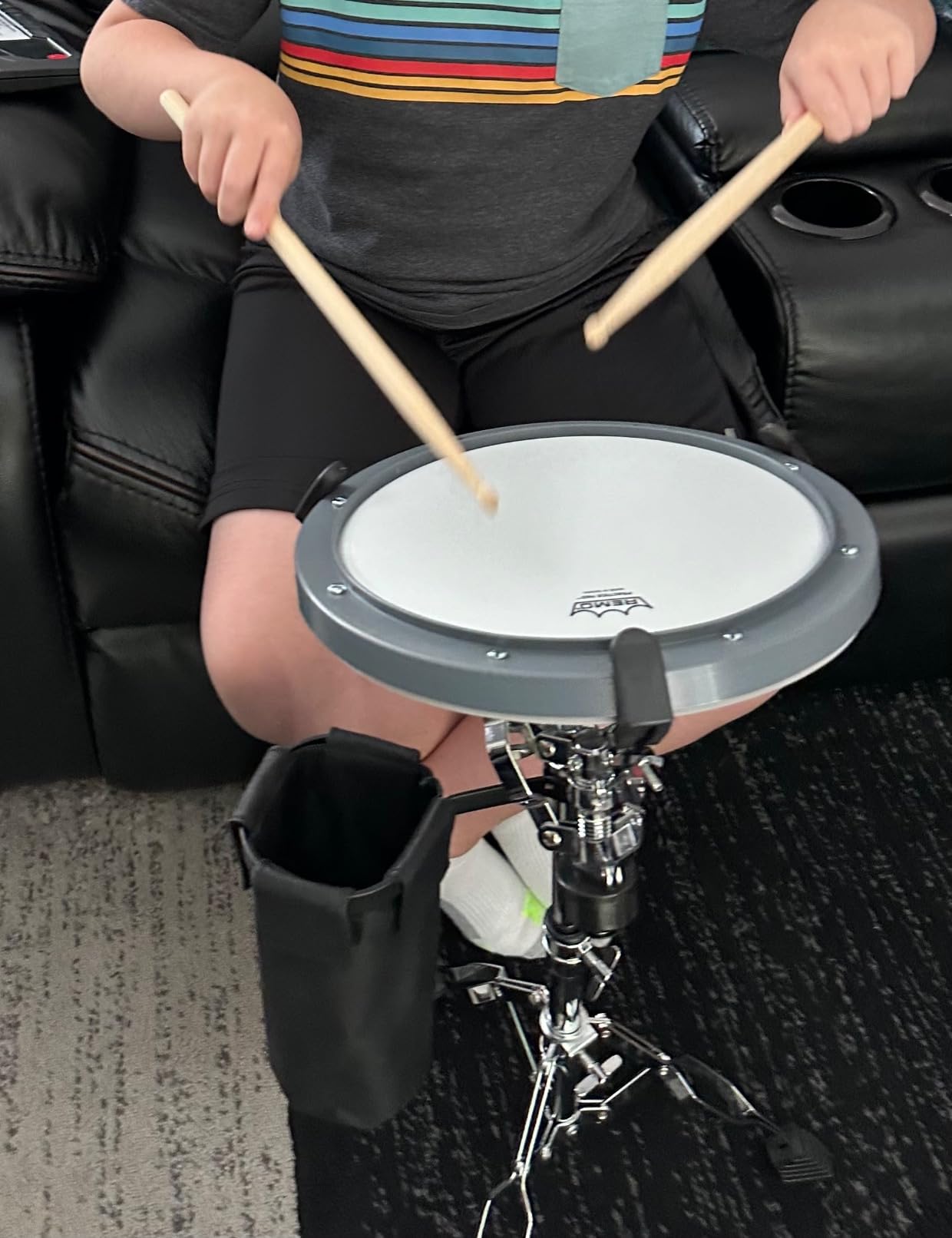
There is one trade-off and reviewers are honest about it: this pad makes sound. The coated head resonates, and the frame adds its own small voice. For some players that is a feature, because you can hear yourself overplaying a stroke. For a drummer practising at midnight in a flat with thin walls, it is a genuine drawback, and rubber pads win that scenario outright.
Long-term ownership is worth planning for. The head is a consumable. Remo rates the product at a 1 year warranty, and a head that has been hammered with 5A sticks for a few years will need replacing, but the frame stays. The 4.6 rating across 4,277 reviews reflects a product that most owners buy once and keep for a decade.
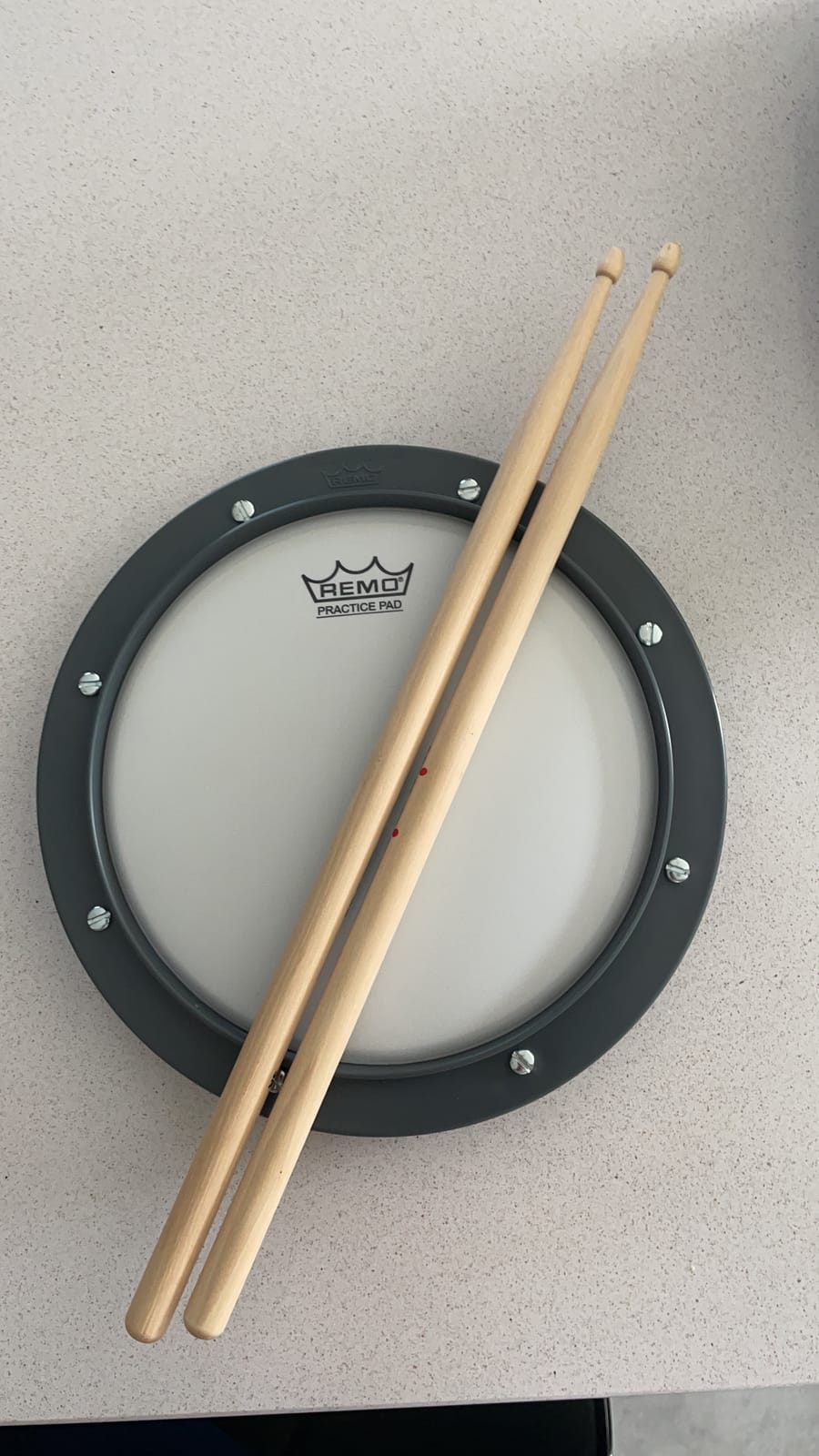
Is a real drumhead better than a rubber surface for chops?
For realism, yes, clearly. A coated head behaves the way a drum behaves, so your stroke height, your rebound and your stick-back all match what you will do on a kit. For quiet strength work, no: the head gives the stick back, so the pad trains you less on generating power. Drummers who want both usually keep this on a stand for warm-ups and technique, and use a firmer pad for endurance.
Where should this pad sit in your setup?
At snare height on a stand, in the spot where your actual snare lives. Because it is 10 inches, it sits in a standard snare basket, and the resonance is loudest when the pad is free rather than damped. Keep it off your lap for that reason. It is a superb warm-up surface before a lesson or a show, and a poor middle-of-the-night surface.
3. GrowDaily 12 Inch Practice Pad – Best Budget Starter Pad
- Arrives with two pairs of maple sticks
- Shock absorbing EVA layer keeps practice quiet
- Solid poplar base resists flexing
- Works on carpet tables and snare baskets
- Anti-slip underside protects furniture
- Single fixed 12 inch size
- Bundled sticks are basic maple
- Generic branding
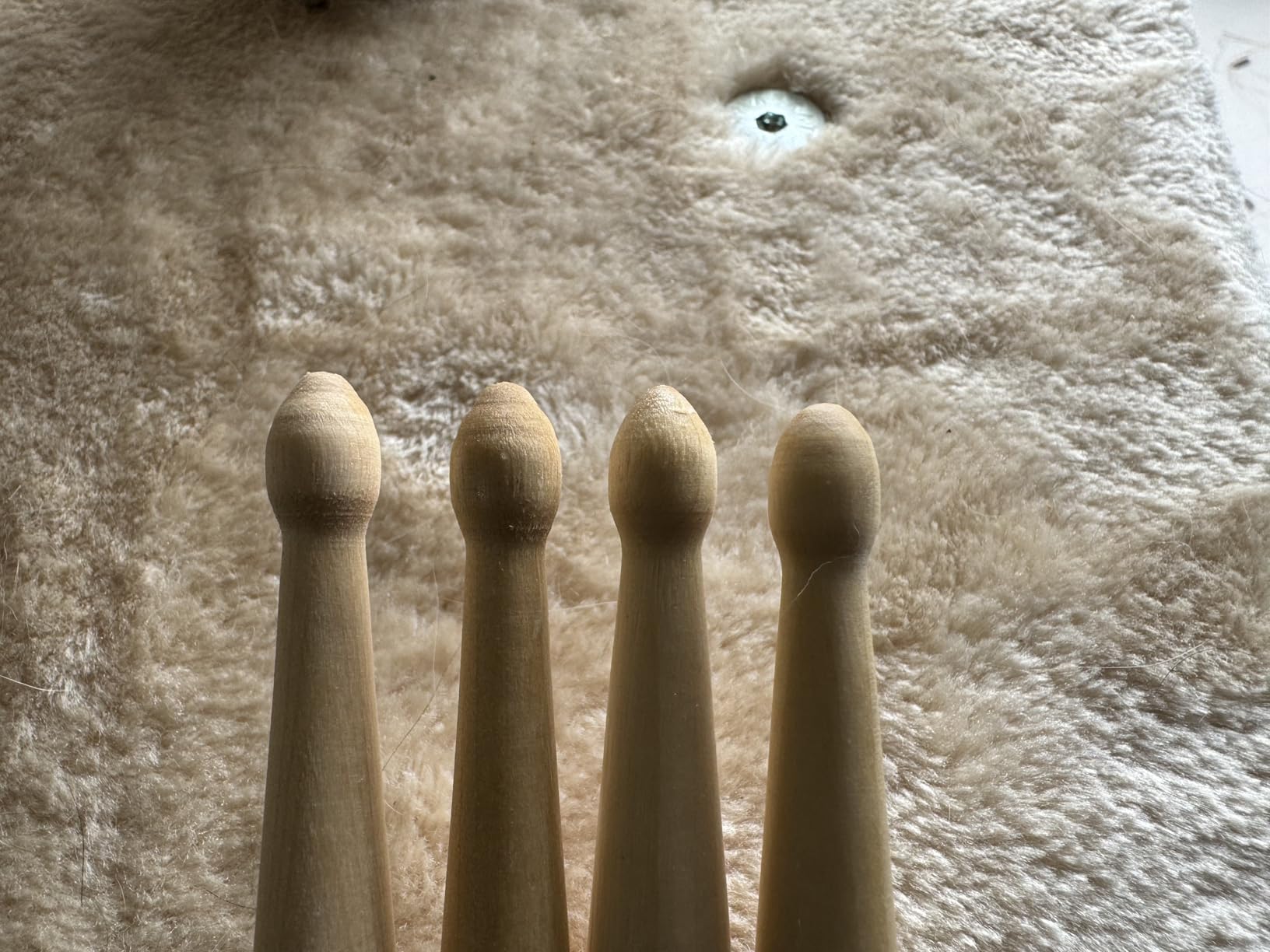
What you get here is more than a pad. The GrowDaily 12 Inch arrives with four maple drumsticks in two pairs, plus storage pockets in the base for sticks and small items, which makes it the easiest complete first purchase in this roundup. A beginner does not have to make a second order before the first practice session.
The construction is sensible. A high-resilience rubber surface sits on a solid poplar base, and a high-density shock-absorbing EVA polymer layer under that is what keeps the volume down. When we worked rudiments on it, the response was close enough to a snare to keep technique honest, but the stick noise was soft and the low end was well controlled.
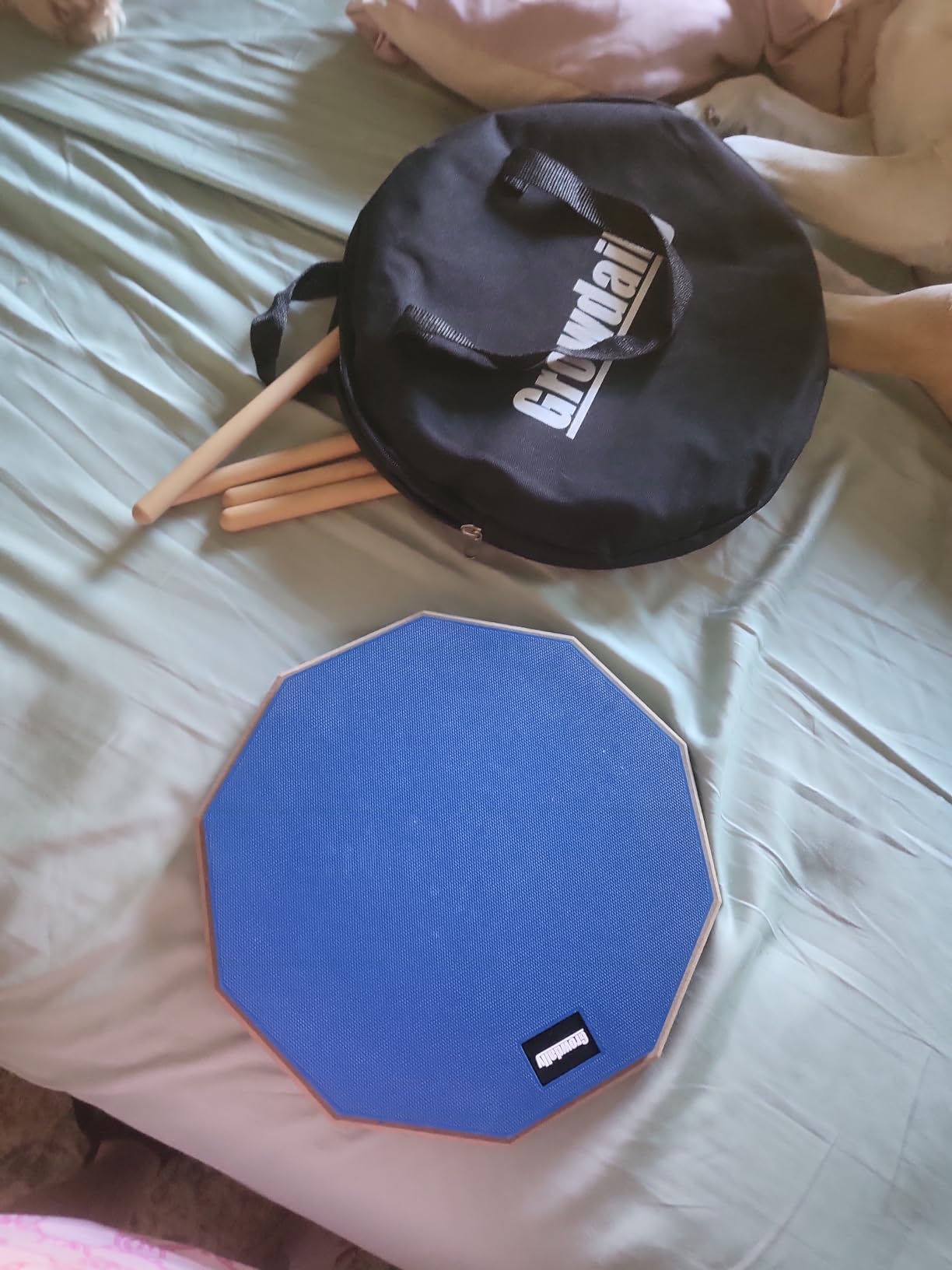
Weight is the one number that stands out: the pad itself is listed at about 3.5 lb and the package at 3.69 lb. That is heavier than several 12-inch pads in this list, so plan for it to live in one room rather than in a car. The upside is stability. It stayed planted on a table, on carpet and inside a snare basket without any adjustment.
Buyer reviews treat this as a complete kit rather than a single component, which is why it holds a 4.7 rating across 1,887 reviews. The complaints are consistent and mild: the sticks are entry-level maple, and 12 inches is the only size. Neither matters much if the pad is going to sit in a bedroom and do daily work.
Is a budget pad a waste of money?
Usually not. The construction of this pad, a rubber surface over a poplar base with an EVA isolation layer, is the same architecture used on pads costing noticeably more. What you give up is brand reputation, surface refinement and the ability to replace parts. If the pad survives three years of daily practice, which reviewers suggest it does, the maths works in your favour.
Should a beginner start with this or a bigger pad?
Start with this. Twelve inches is the most useful size for a beginner because it gives you room for full stroke patterns, and the included sticks remove the excuse of not having gear. The first upgrade most players make later is not a bigger pad, it is a stand, because a pad at the right height stops your wrists compensating for the angle.
4. Evans RealFeel Apprentice 7 Inch – Best for Travel and Lessons
- Natural gum rubber with realistic rebound
- Compact enough for a bag or a bus
- Very quiet for lessons and small rooms
- Works in a snare basket or on a lap
- Long established design
- Single sided with no firmer option
- 7 inch area is small for rim work
- No rim and no stand mount
The Apprentice is the RealFeel idea with the second side removed and the diameter cut in half. What you get is a 7-inch single-sided natural gum rubber surface, a dark gray fabric finish and 1.22 lb of weight, which is a bag-friendly object rather than a floor piece of equipment. A lot of players keep one of these permanently in their drum bag for exactly that reason.
Small pads change how you play, and not always for the worse. The reduced area forces tidy, controlled strokes with the hands close to the body, and several owners describe that as a training benefit for rudiments. For warm-up strokes, a paradiddle sequence and a slow single stroke roll at 90 bpm, the 7-inch diameter was plenty. For full-size patterns and any rim work, it quickly runs out of surface.
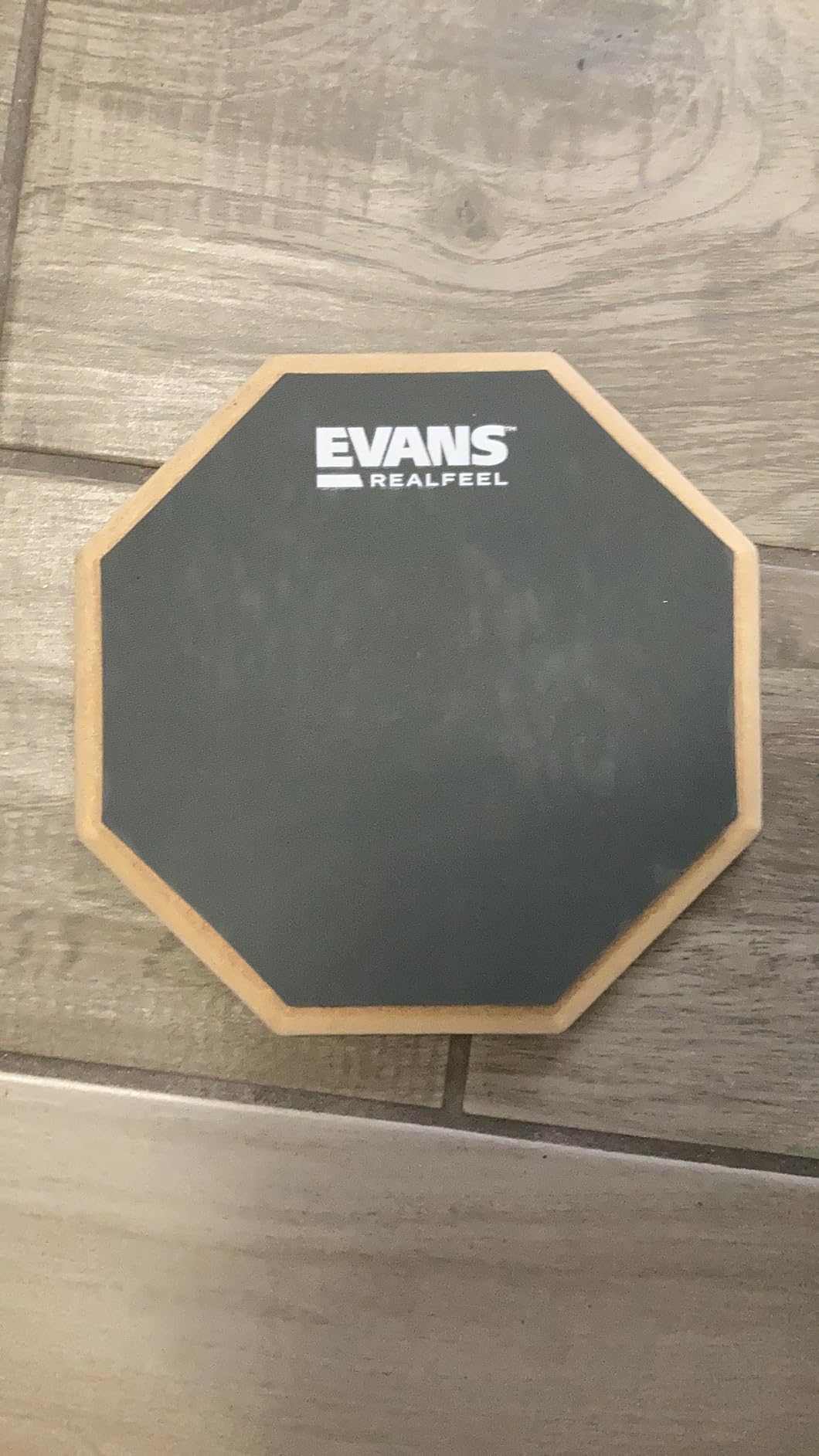
It is also a genuinely good first pad, and it is not a compromise version of the 12-inch. The surface is the same gum rubber compound, made in the USA by Evans. The difference is that you lose the recycled rubber side, which means you lose your strength and dynamics surface. For a player who has not yet built hands, that side is often more useful than the realistic one.
The 4.8 rating across 2,579 reviews is the second highest average in this roundup, sitting behind the full-size RealFeel. That is a strong signal for a product that has been available since 2004, and it is a common sight in lesson rooms for a reason.
Is a 7 inch pad big enough to learn on?
For most technique, yes. Every standard rudiment, all the basic hand patterns and the vast majority of warm-up exercises fit comfortably on a 7-inch surface. The pattern that will not fit is the one that needs a large, sweeping motion, and the exercise that will not fit is anything involving a rim. If you take an instrument lesson and want a pad to sit in front of you at the kit, this works well.
Should you own both this and a 12 inch pad?
Plenty of players do exactly that: a 12-inch pad at home for real work and a 7-inch or 4-inch pad in the bag for lessons, travel and hotel rooms. The Apprentice weighs 1.22 lb and measures 7.87 x 0.79 x 7.87 inches, so it costs you almost nothing in weight to always have a pad within reach.
5. Donner Snare Stand and Pad Set – Best All-in-One Set
- Pad stand sticks gels and backpack in one set
- High density rubber over EVA and wood
- Double braced stand adjusts quickly
- Backpack with dividers for transport
- Fast to assemble
- Stand too short for taller players
- Bundled maple sticks feel fragile
- Pad and stand sold as one unit
This is the one to buy if you want a complete practice station rather than a disc to carry around. The set includes a 12-inch double-sided pad, an adjustable double-braced snare stand, three pairs of drumsticks, six drum gels and two carrying bags, one of which is a proper 600D Oxford backpack with internal dividers. For a student sharing a small home with a family, that combination solves the volume problem and the height problem at once.
Having the stand changes practice more than most buyers expect. A pad on a table is played with tilted wrists, and a tilted wrist is a habit that is hard to unlearn. Once the pad is at snare height in the stand, matched grip sits where it will sit on the kit, and the transition becomes trivial.
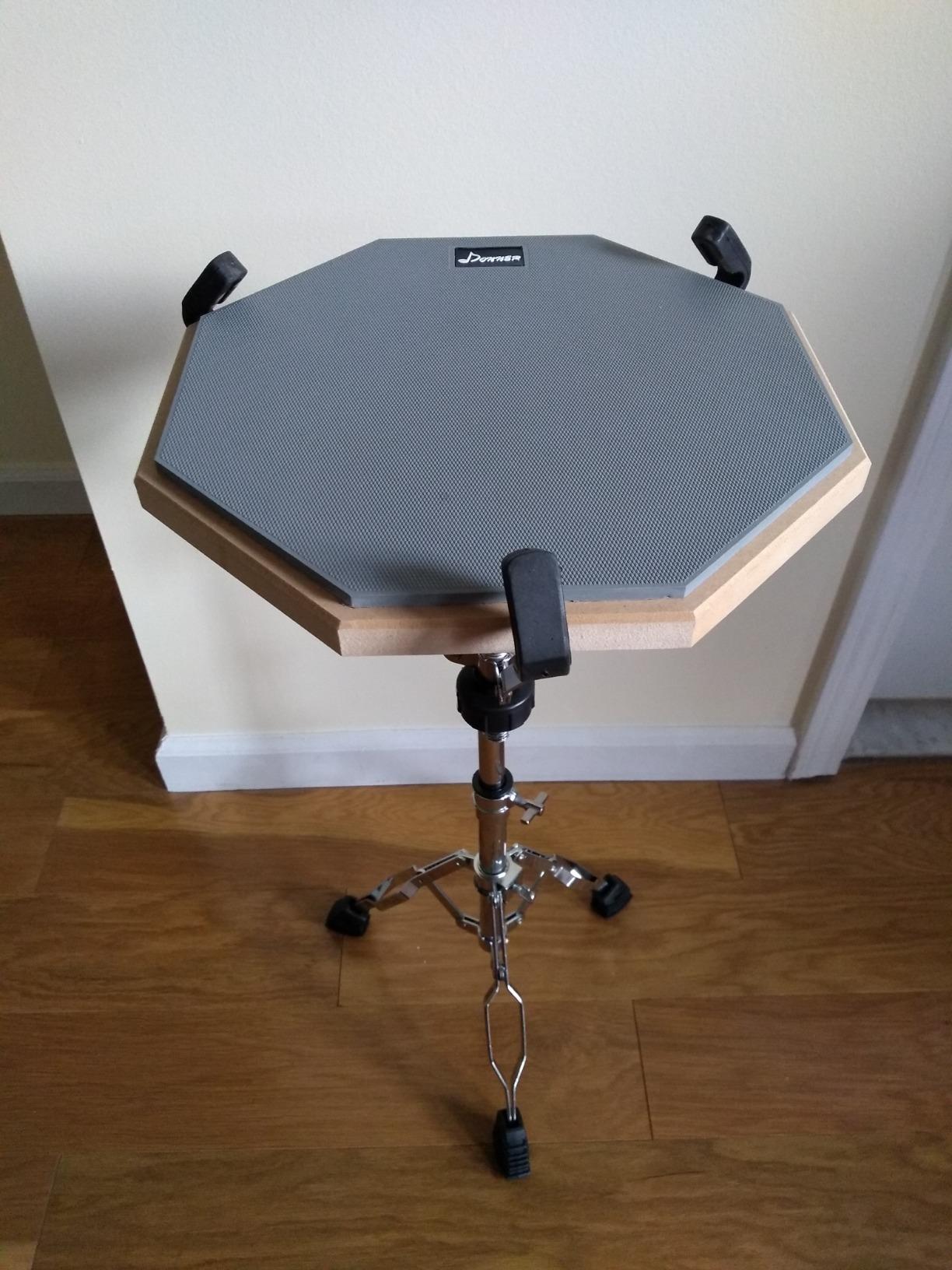
The pad itself uses a high-density elastic rubber surface over EVA and compressed wood, and the insulation across the stand and floor was noticeably better than bare pads in this test. What you give up in exchange is flexibility. The whole set is 3.8 kg, and the pad cannot be swapped out later without replacing the bundle, so this is a commitment purchase rather than a first experiment.
Reviewers repeatedly single out one flaw, and it is worth knowing before you buy: the stand adjusts from 14.2 to 22.8 inches, which suits a student or a seated player and frustrates anyone over about 5 foot 10. A few users also found the bundled maple sticks fragile. The 4.6 rating across 1,452 reviews reflects a package that delivers well for the right body size.
Will this set actually be quiet?
Quieter than a single pad, yes, because the thick rubber-over-EVA surface and the stand frame between you and the floor. It is not silence. Expect a firm, present tap that carries within a room, and no sound at all through a closed door in the way a foam or mesh pad delivers. In a shared house it is a strong improvement over a kit and a modest improvement over a pad on a table.
Who should not buy the bundle?
Taller players, and anyone who already owns a decent pad. A 3.8 kg package with a height-limited stand is a poor match for a tall adult, and if you already own a 12-inch pad there is no reason to buy a second one just to get a stand. The drums gels and backpack are nice, but the stand height is the deciding factor.
6. Sabian Quiet Tone Mesh 10 Inch – Quietest Overall
- Quietest pad we tested
- mesh head cuts volume sharply
- Triple flanged hoop supports rim shots and cross stick
- Adjustable tension changes the response
- Non-slip rubber feet transfer energy well
- Tuning needs a 10mm wrench and a drum key
- Metal brackets can rattle when damped poorly
- Mesh is delicate under heavy playing
- Needs a real snare basket to mount
Sabian describes the mesh head on the Quiet Tone as reducing volume by up to 99 percent, and the practical result matched the claim closely. Of everything we played, this was the pad we could hit hardest for the longest without thinking about anyone else in the building. Drummers who work in flats treat it as the default answer, and the Quiet Tone turns up constantly in that conversation on drumforum.
The other reason it earns its place is the hoop. This is a triple-flanged metal hoop rather than a plain rubber edge, which means it takes a rim click and a cross-stick stroke the way a drum would, and it has a voice that sits somewhere between a snare and a thud. Reviewers also praise the non-slip rubber feet for moving stick energy into the head rather than losing it.
There are honest trade-offs. The tensioning system uses lock nuts, so tuning takes a 10mm wrench alongside a drum key. The metal brackets underneath can rattle against the head during play, and some users solved that with rubber spacers. The mesh is also a delicate surface: it will not enjoy hard rimshots, and it is not the pad you buy for a marching battery.
At 176 reviews it carries the smallest review base in this roundup, so treat the consensus with slightly more caution than the numbers on the heavily reviewed pads. What is not in doubt is the volume. Several reviewers describe this as the quietest pad they have owned, and the drumforum soft-pad discussion treats Sabian Quiet Tone as the most realistic of the quiet options.
How quiet is a mesh practice pad in real terms?
Quiet enough to play in a hotel room or during an online class without raising your voice. The sound that remains is a soft, low thud with almost no stick click, and it carries less than a meter. Practise through it at full volume and it still disappears against a pad like the Evans RealFeel, though it is not literally inaudible to a listener in the same room.
Is it worth the setup effort?
If you already have a snare basket and a pair of drum keys, yes, and the setup is a two-minute job. If you have neither, factor that in before committing, because the pad has no threaded tripod fitting of its own. It is a home-station pad that happens to travel reasonably well at 2 lb, not a portable warm-up tool.
7. Meinl Marshmallow 12 Inch – Best for Building Hand Strength
- Near silent foam surface
- Low rebound forces the hands to generate power
- Recessed 8mm thread mounts on any cymbal stand
- Non-slip lined composite base protects tabletops
- Fits a standard snare basket
- Very low rebound feels dead to some players
- No rim or cross stick capability
- Heavier than most 12 inch rubber pads
The logic behind the Marshmallow is straightforward: take the rebound away and the hands have to do more. Meinl builds it in three layers, a 20mm marshmallow foam playing surface, a 19mm modern composite base and a 5mm soft foam lining, and the result absorbs both volume and stick return. On a buzz roll or a slow single stroke roll, you can feel the difference in your forearms within a few minutes.
The design detail we liked most is the recessed universal 8mm threaded connector. Almost every other pad in this roundup either needs a snare basket or has no mounting point at all, and this one drops onto a standard cymbal stand. For a drummer who already owns a cymbal stand and wants a pad at playing height, that is a genuine saving in both money and shelf space.
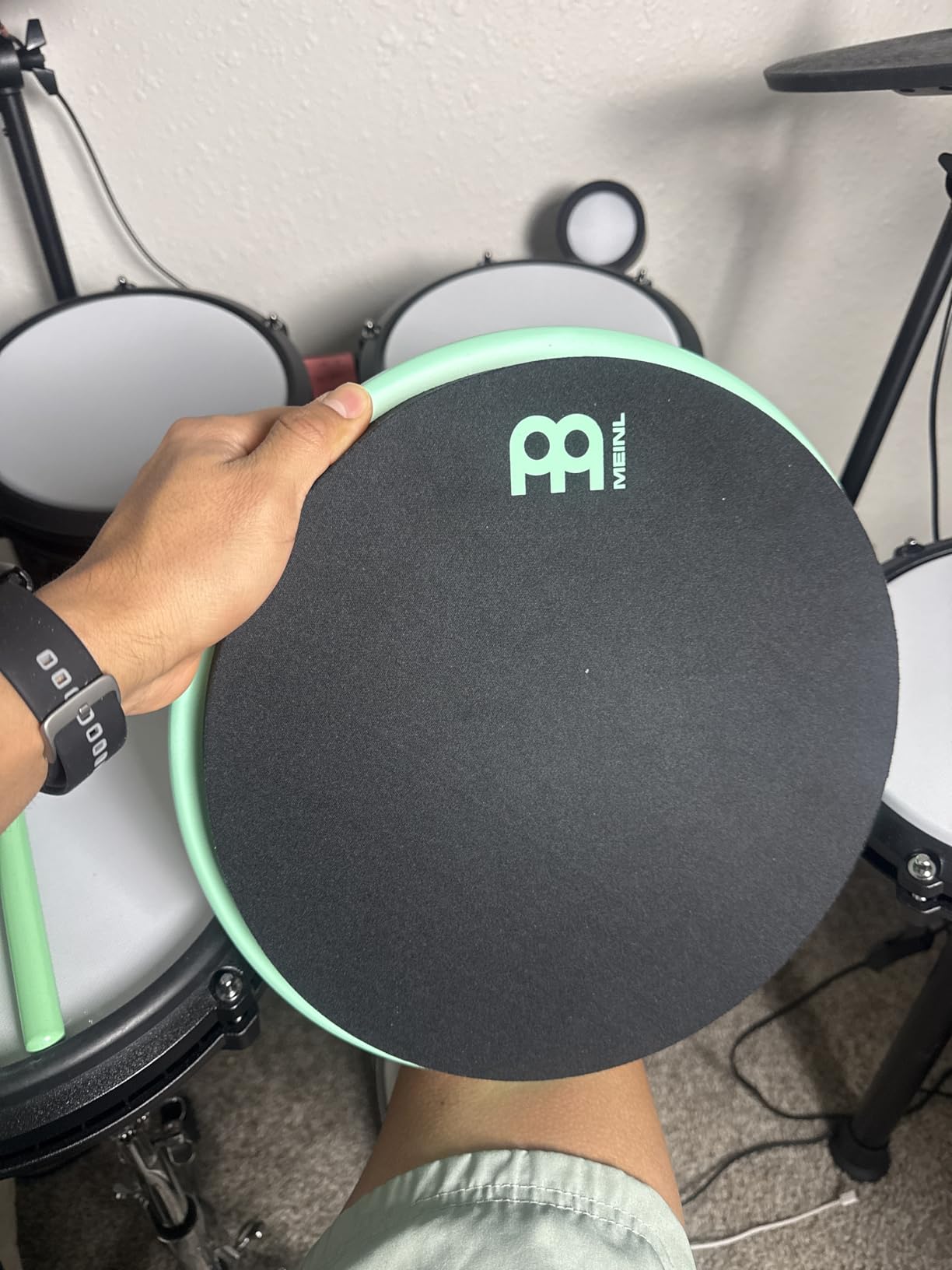
What you give up is response. A foam surface does not return the stick the way a gum rubber pad or a drumhead does, and players accustomed to acoustic feel often describe the first week as strange. It is not a pad for practising articulation, dynamics or realistic feel. It is a conditioning tool, and a very good one, with a 4.7 rating across 252 reviews.
At 3 lb and 12 x 12 x 1.73 inches it is one of the heavier 12-inch pads here, so it is a home object rather than a travel one. Meinl backs it with a 2 year manufacturer warranty, which is longer than the coverage on several competing pads in this roundup.
Does a dead pad build chops faster?
It builds them differently, which matters more than the word faster. With low rebound you must generate the stroke yourself every time, so you are working on grip tension, forearm rotation and control rather than on recycling energy. That is genuinely useful for hand endurance and for drummers rebuilding technique after a long break. It is not useful for practising dynamics, because the pad gives you almost no acoustic feedback.
Who should skip this pad?
Anyone preparing for an audition, any drummer whose main complaint is that their practice feels flat and lifeless, and anyone who wants to practise rimshots or cross-stick work. If your goal is volume reduction with a live response, a mesh pad such as the Sabian Quiet Tone gives you silence without the deadness. If your goal is strength, this is the one.
8. Vic Firth Double Sided 12 Inch – Top Rated
- Soft realistic side plus a hard near-hardwood side
- Quick rebound and crisp articulation on the hard face
- Wooden base stays stable under vibration
- Works from marching sticks to light kit sticks
- Packs flat and is a drum line standard
- Hard rubber collects dirt and needs cleaning
- Firm face feels hard against a basket rim
- Can grip slick surfaces badly
- No connector for a cymbal stand
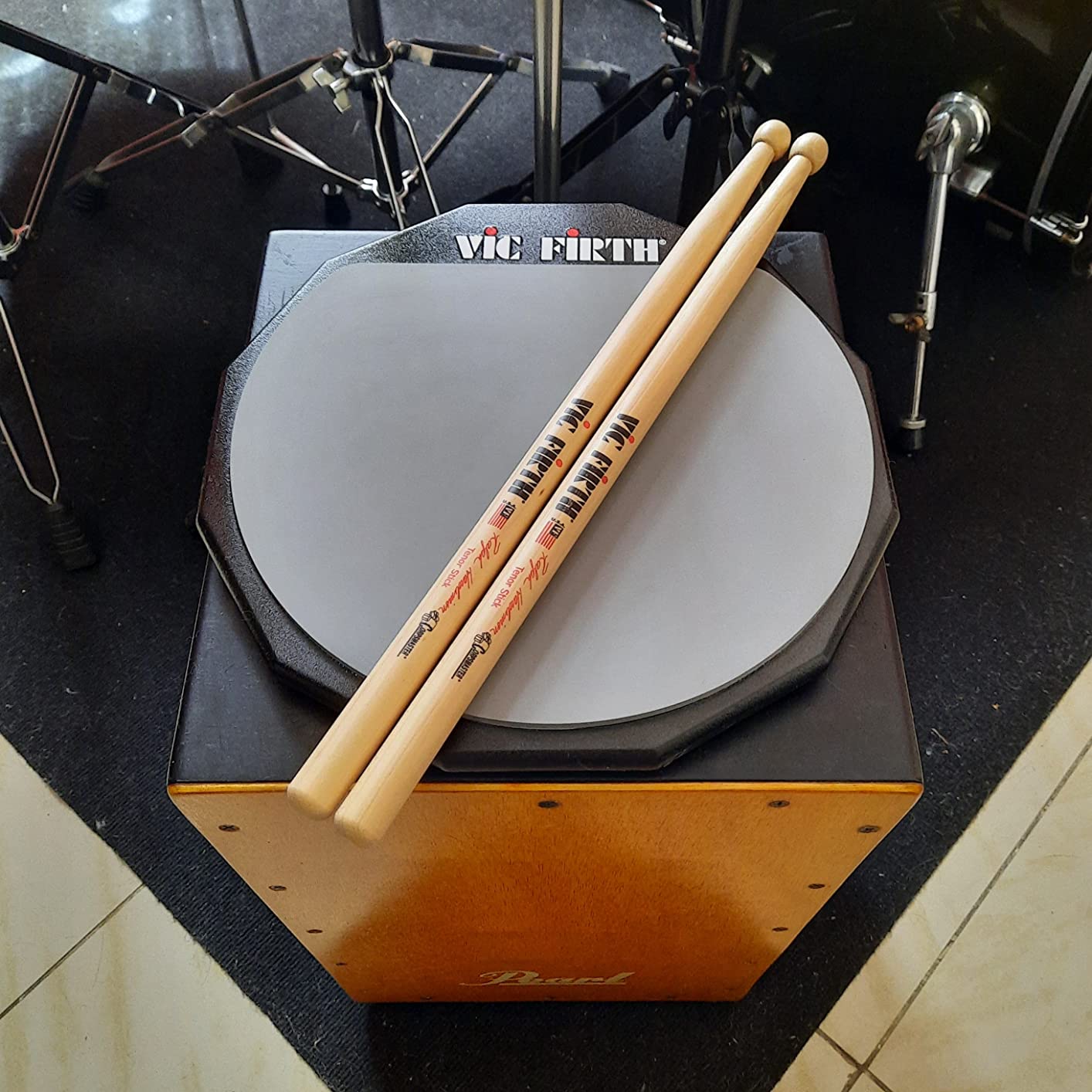
Vic Firth built this pad for people who treat practising as a job rather than a hobby, and band directors recommend it accordingly. The two faces are meaningfully different: one gives you drumset-realistic feel, the other is a hard rubber surface with quick rebound and crisp articulation, close to playing on hardwood. Practise a pattern on the soft side, then move to the hard side and the same pattern becomes a speed and endurance exercise.
The build is the reason it endures. A wooden base does not flex, does not migrate under vibration, and gives the two rubber faces a stable platform. At 0.5 inches thick it also packs flat enough to slide into a snare case, which is why the same pad shows up on drumline carts and in marching bags.
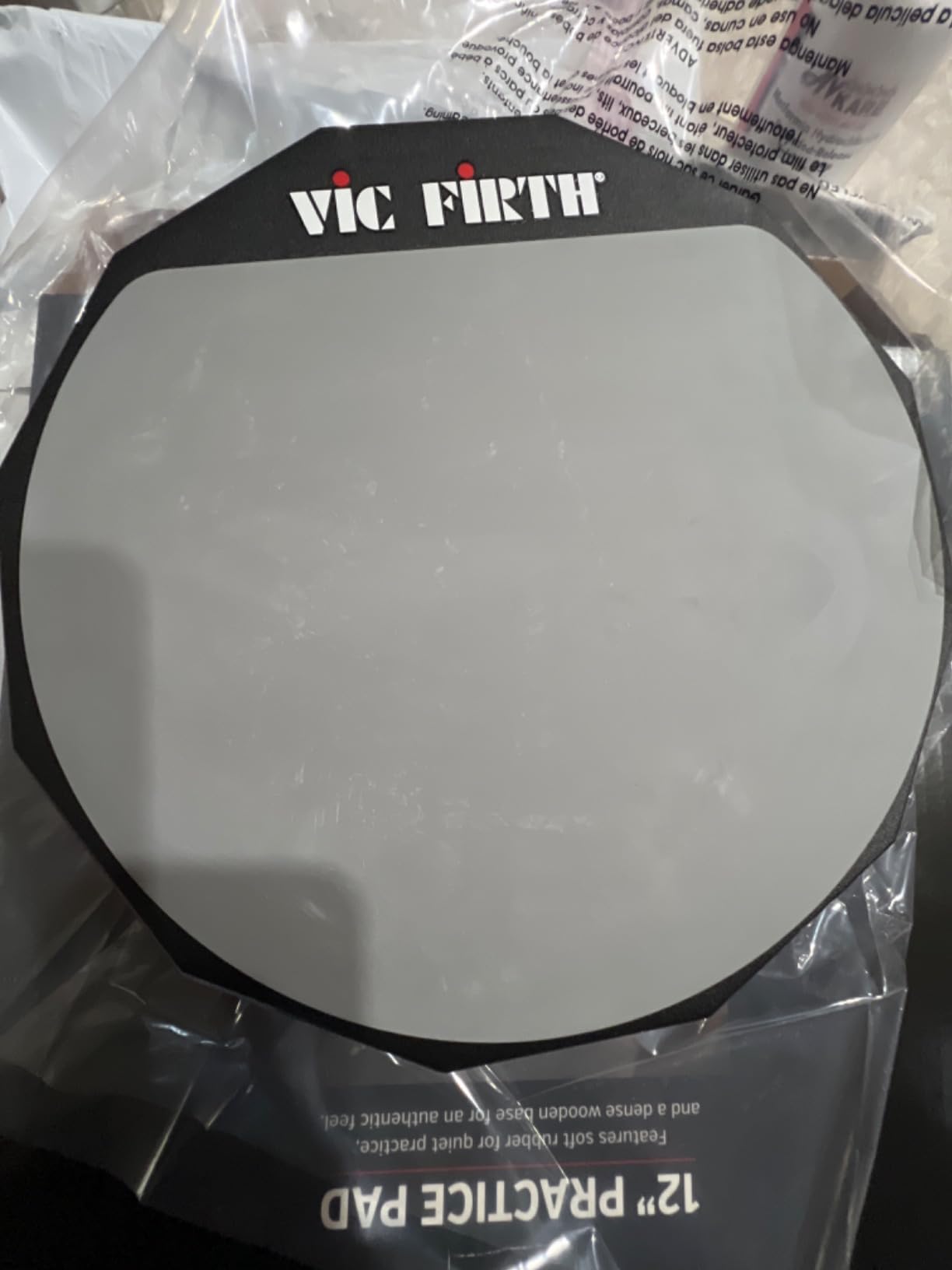
The 4.8 rating across 985 reviews places this alongside the RealFeel at the top of the ratings table, and reviewers describe it as a reference standard. Ownership is simple: it works with a wide range of stick weights, from marching sticks to light kit sticks, and it does not care what era of technique you are practising.
Minor complaints do appear. The hard black rubber collects dirt and needs a wipe from time to time, the firm face can slip on a smooth surface if it is not seated well, and the unpadded branding area at the top is awkward for drum line volume-reduction technique where the hands have to meet a flat edge. None of these are deal breakers; all of them are things to know before the pad lands on your desk.
Is a hard practice pad surface good for beginners?
Only on one side, and only with care. The hard face is excellent for a player with basic control and poor choice for someone still learning to keep a relaxed grip, because a firm surface rewards tension in the wrist. Use the realistic side for the first months of technique work, then move to the hard side once your single strokes are clean and your rebound is consistent.
Does it work without a stand?
Yes, and that is one of its strengths. There is no threaded connector, so it sits on a lap, a table, a snare basket or the floor. Most owners mount it in a snare basket for playing height. Pair it with a stick bag, and it is the pad most likely to come to every rehearsal rather than staying at home.
9. Gibraltar Pocket Practice Pad – Best for On-the-Go Warm-ups
- Slips into a back pocket or a stick bag
- Quiet enough for a hotel room or a lesson
- Steel platform with a non-slip base
- Gum rubber rebound on a tiny surface
- Leg strap included for thigh practice
- 4 inch surface limits full stroke patterns
- Higher pitched sound than a full size pad
- Leg strap restricts the grip area over long sessions
Four inches of diameter, half an inch of profile and 6.4 ounces. The Gibraltar Pocket Practice Pad is the smallest thing in this roundup and the only one that genuinely fits in a coat pocket, which makes it a different category rather than a smaller version of a 12-inch pad. Warm-up strokes, a few single stroke rolls and paradiddles at a conversational tempo are all it is built for.
Surprisingly, the response is not toy-like. The natural gum rubber top gives believable rebound for its size, and the steel platform with a non-slip rubber bottom stays in place on a lap, a table or a drum throne. The included 22-inch adjustable leg strap lets you work on a thigh, which some teachers prefer for building a relaxed grip away from a desk.
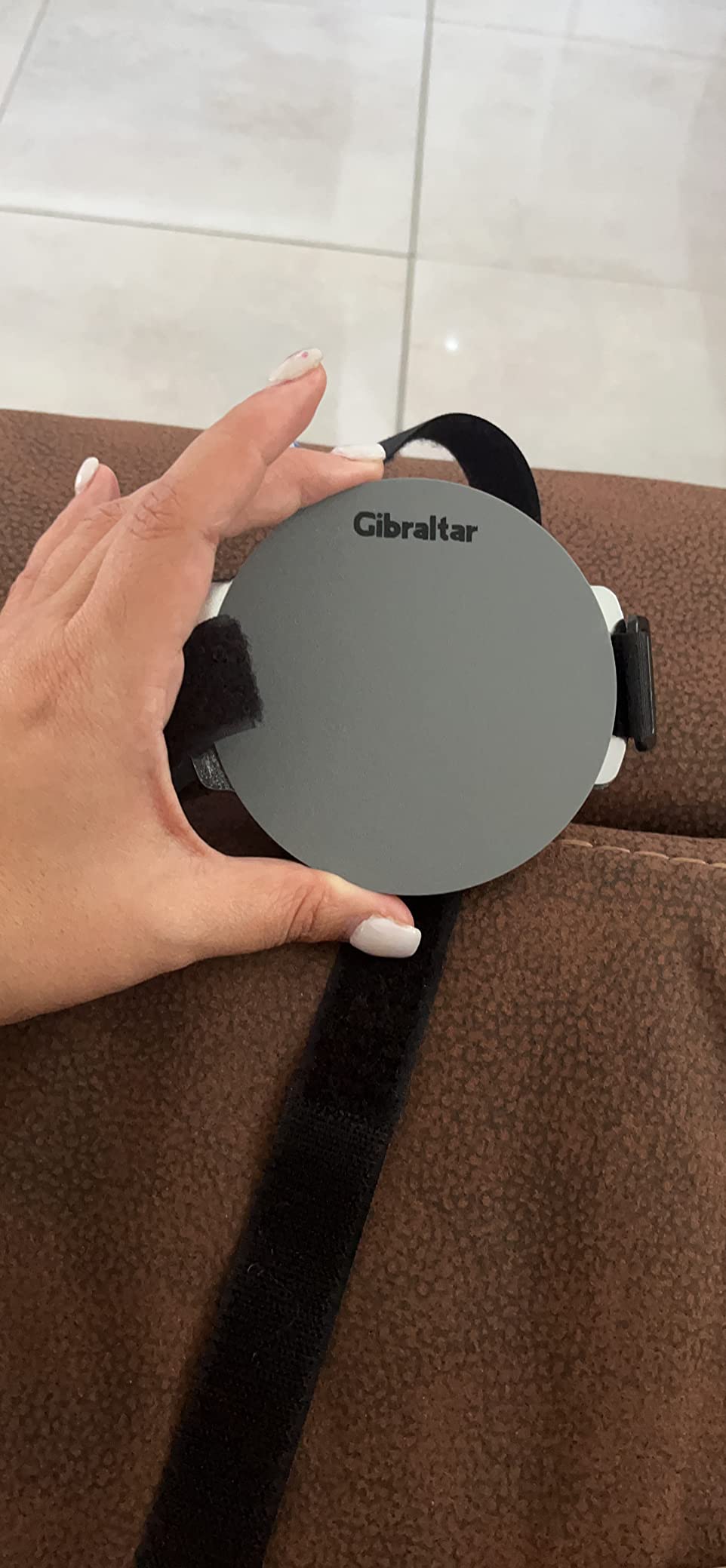
The limits are obvious and honest. Four inches will not take a full-size stroke pattern, the pitch is higher than a full-size pad, and the strap can restrict the area available to the grip during long sessions. Reviewers across 285 ratings and reviews mostly see these as the price of portability rather than as faults.
Our take: this is a companion pad, not a main one. It solves the specific problem of wanting a few minutes of warm-up on a train, in a hotel room or before a lesson where there is no space to lay out a 12-inch disc. For that job, nothing else here is close.
Is a 4 inch pad useful for technique work?
For warm-ups, control and stroke economy, yes. The small surface forces the hands to stay close and the strokes to stay tidy, which is exactly what a warm-up is meant to reinforce. For speed work, a single stroke roll to 140 bpm, or for anything with a rim, it is the wrong tool. Treat it as the pad you use for 5 minutes before every session rather than the pad you build a practice routine on.
What is the leg strap actually for?
Strapping the pad to your thigh, which raises the surface to a comfortable angle and lets you practise with a relaxed, slightly turned-in grip. It is genuinely useful for young players learning control, and genuinely uncomfortable after 20 minutes because the strap divides your contact area. Most owners use the pad flat and keep the strap in the bag.
10. Evans RealFeel Attacktile 10 Inch – Best for Articulation
- UV coating gives cleaner defined articulation
- Gives audible feedback on note placement and dynamics
- Rebound similar to a mid-high tuned snare
- Works with sticks and with brushes
- Easy to clean and light to move
- Louder and higher in pitch than a basic RealFeel
- Firm surface for players who like soft gum rubber
- No rim and no stand mounting included
The Attacktile answers a problem most quiet pads ignore: how do you know you are playing too hard if you cannot hear yourself? Evans patented a UV coating on the natural gum rubber surface, and the result is a pad that produces more attack, more volume and more sonic feedback than a standard RealFeel while still staying inside a single room. That is a rare combination.
The rebound is the other story. It is described by owners as similar to a mid-high tuned snare rather than spongy, which makes this a good pad for matched grip work and for building muscle memory fast. It also works with brushes, so a player learning orchestral or musical phrasing can practise a brush pattern on the same surface.
Is the Attacktile louder than a regular RealFeel?
Yes, and that is the design intent. The UV coating adds attack and pitch, so a light stroke is audible in a way it is not on a standard RealFeel. It is still nowhere near kit volume, and the sound stays local to the room. If you want the quietest possible option, choose a mesh or foam surface instead.
Who should choose this over the standard RealFeel?
Players who already have good technique and want feedback. Beginners get more from a firmer second surface than from a second face that tells them what they are doing. This pad is a single-sided 10-inch unit at 2.06 lb, and several owners recommend adding a stand, since the UV coating is wasted if the pad is flat on a bed sheet.
11. Zildjian Reflexx Conditioning 6 Inch – Best for Conditioning Work
Zildjian ZXPPRCP06 6-Inch Reflexx Dual-Sided Conditioning Practice Pad
- Among the quietest pads available
- Medium and high resistance sides give different training effects
- Targets arm wrist and finger strength
- Compact size suits hand and wrist work
- Also offered in 10 inch
- Very high resistance fatigues beginners
- Minimal rebound is not realistic drumset feel
- 6 inch surface limits stroke patterns
The Reflexx Conditioning Pad is bought as a gym tool, not as a practice surface. Zildjian gives it two distinct faces: a FLEXX side with medium resistance and rebound, and a WORKK side with high resistance and very low rebound. Switching between them during a session is the whole design. The WORKK side builds strength, the FLEXX side lets you practise control at speed without the volume.
On drumforum, the 10-inch Reflexx is regularly called the best all-round option in the wrist-and-finger training range, with Epad and Meinl Marshmallow named as the nearest alternatives. That matches our experience of the 6-inch: it is a training device with a drummers finish on it, and it is very good at being quiet.
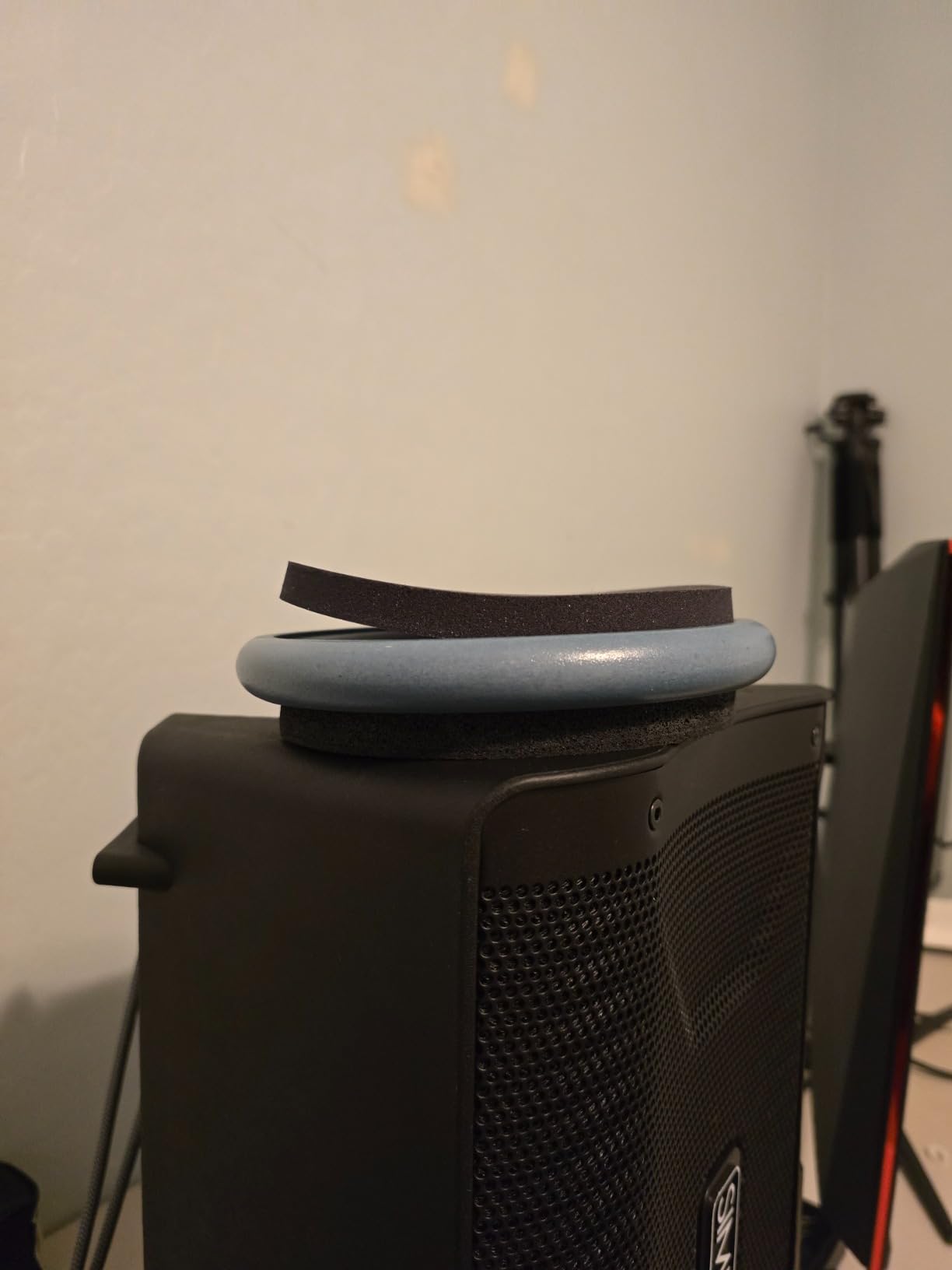
Be realistic about who it suits. The WORKK side is genuinely fatiguing, and a beginner running 20 minutes of rudiments on it will feel it in the forearms before they feel any improvement. There is also no rebound to recycle, so nothing you practise here translates directly to a kit feel. It is strength work, clearly labelled, in a 6-inch format at 16 oz.
The 60 day warranty is the shortest in this roundup, and the 4.4 rating across 222 reviews is the lowest average, which reflects the divide between people who wanted a muscle tool and people who wanted a practice pad. Read the two sides of that split before buying.
Is the Reflexx suitable for a beginner?
Only on the FLEXX side, and only for short sessions. The medium resistance side is a reasonable way to build wrist and finger control, but the WORKK side is advanced training. If you are in your first year of playing, the Vic Firth double-sided pad or the Evans RealFeel give you a more useful pair of surfaces for the same money.
Which size should I get?
Ten inches if you have a snare basket and want full stroke patterns on the FLEXX side. Six inches if you want a portable strength tool that fits on a desk or a knee. Both are offered, and the 6-inch is the more popular choice for hand and wrist work specifically, which is where conditioning pads earn their keep.
12. Donner Snare Simulator 12 Inch – Best for Snare-Wired Feel
Drum Practice Pad, Donner Drummer Practice Pad – Quiet Drum Pad 12 Inches
- Detachable simulator with 800 steel balls
- Standard rim height supports modern snare technique
- Compressed wood base with durable silicone surface
- Non-scuff EVA base for tables and laps
- Includes maple sticks and a rudiments printout
- Heavier than most 12 inch pads
- Bead rattle is a sound effect rather than head response
- White surface shows stick marks
The idea here is unusual. This 12-inch pad has a detachable snare simulator holding 800 steel balls, which sits under or over the playing area to reproduce the rattle of a snare-wired head. Detach it and you have a clean practice surface; drop it in and warm-ups stop feeling like homework. Several owners single out exactly that as the reason the pad makes them practise more often.
Technically it is well considered. The rim sits at a standard height, so rim clicks and cross-stick work behave the way they do on a modern kit, and there is a stick slot for cross-stick placement. The base is high-density compressed wood with a durable silicone surface, and a non-scuff EVA bottom keeps it stable on a table, a snare stand or a lap.
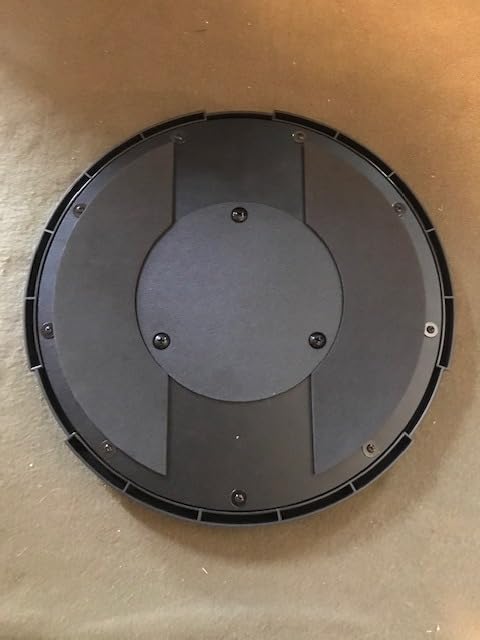
Keep one expectation in check: the bead rattle is a sound effect, not a head response. It will not teach you how a snare head feels the way the Remo Red Tunable does, because the ball mechanism is a simulation rather than a tensioned membrane. Think of it as motivation and modern-technique practice, not as realism training.
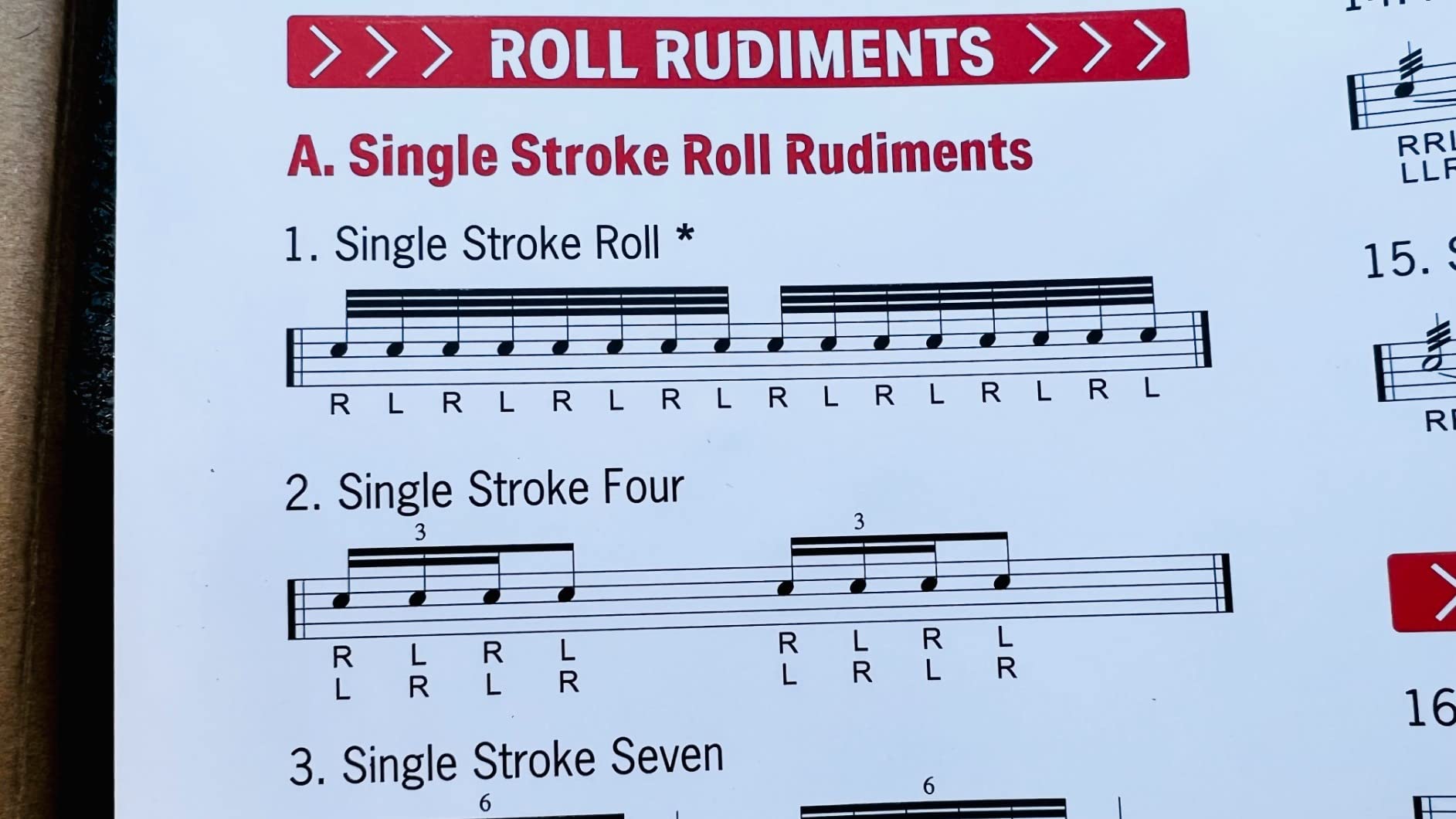
At 1.62 kg it is among the heavier 12-inch pads, which is the main reason travellers mention it as a drawback. It also comes with a pair of maple sticks and a printout of the 40 standard rudiments, both entry-level extras. The 4.7 rating across 516 reviews reflects a product that is doing something different and doing it well.
Is a snare simulator pad better than a normal pad?
For warm-ups and for drummers who bounce off practice, often yes. The audible rattle gives you a reason to pick the sticks up, and the rim height lets you practise the modern cross-stick position properly. For technique, dynamics and realistic feel, a gum rubber or drumhead pad is the better teacher, and most players who love this one still keep a second pad.
Does the simulator wear out?
The steel balls are durable in normal use, which is why the detachable design matters: the silicone surface and the ball mechanism are separate consumable-free elements rather than a glued-on gimmick. The silicone is described as wear resistant, and the white colour option shows stick marks sooner than the black one, so pick black if your pad lives in plain sight.
How to Choose a Drum Practice Pad in 2026?
Every recommendation above comes down to six decisions. Work through them in order and the product choice makes itself, because the playing surface and the noise level narrow the list faster than brand names do. The same structured approach we use for hands-on gear tests in our practice amplifier roundup applies here: measure the use case first, then the hardware.
1. Choose the playing surface for the goal
This is the most important choice and the one most buyers get wrong. Natural gum rubber, the compound Evans uses on the RealFeel family, is the realistic option: it returns the stick the way a well-tuned drum does, so your stroke transfers back to the kit. Recycled rubber and hard rubber are firmer and give less back, which makes them training surfaces for endurance and control. Foam, as on the Meinl Marshmallow, absorbs almost all rebound and volume and is a strength tool. Mesh, as on the Sabian Quiet Tone, is the quietest option and still gives you a rim. Drumhead surfaces, as on the Remo Red Tunable, are the most realistic and the most audible.
Match the surface to what you want to be able to do in three months, not to what feels novel in the shop. If your goal is realistic technique, buy gum rubber or a head. If it is speed and endurance, buy a firm rubber or foam. If it is silence, buy mesh.
2. Size decides portability or kit simulation
Below 6 inches you are buying a warm-up tool. The 4-inch Gibraltar Pocket pad is a bag accessory. Between 6 and 8 inches you are buying a portable general practice pad, and the 7-inch Evans RealFeel Apprentice is the clearest example. At 10 to 12 inches you are buying something that can approximate a snare for full stroke patterns, rim work and rudiments at speed, and this is where most drummers should end up.
Weight tells you where the pad will live. The Gibraltar pocket pad is 6.4 oz and the Remo Red Tunable is 8 oz, so both live in a bag. The Evans RealFeel 12-inch is 1.65 kg and the Donner snare simulator is 1.62 kg, so both are furniture for a single room. Weight is the single most honest indicator of whether you will actually practise on the thing you bought.
3. Mounting: cymbal stand, snare basket or lap
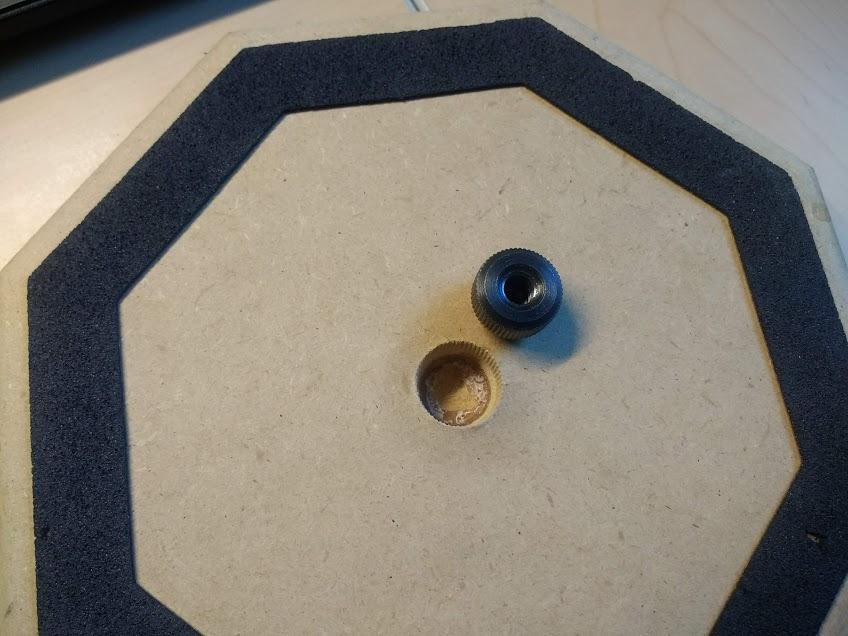
Most pads sold as practice surfaces have no mount at all and are meant for a lap, a table or a snare basket. Only a few accept a threaded mounting point: the Meinl Marshmallow has a recessed universal 8mm connector for any cymbal stand, and the Sabian Quiet Tone has a triple-flanged hoop designed to sit in a real snare basket. If you want a pad at snare height, check the mounting before anything else, because most pads will need a basket you may already own.
Height changes technique more than most players expect. A pad played flat on a table encourages a tilted wrist, and that habit follows you onto the kit. If you can mount it, mount it.
4. Noise level and shared walls
Quietest to loudest, in the order we found: mesh surfaces, foam surfaces, gum rubber pads, hard rubber pads, and finally drumhead pads. The Quiet Tone and the Marshmallow are the two to own if someone else sleeps nearby. A gum rubber pad such as the RealFeel is fine for early mornings in a flat, because the sound is muted and narrow. A coated head is the one to avoid at midnight.
If you are still deciding, the cheapest way to find out is to play the pad at the volume you would actually practise at and listen from the next room. That test tells you more than any description.
5. Build quality, weight and hand health
Build quality shows up in the base. A wooden base such as the one under the Vic Firth double-sided pad stays stable under vibration and over years, while thinner foam-backed pads are lighter and travel better. Check the underside is non-slip and non-scuffing if you play on a table you care about, and check whether the surface can be replaced, which is the practical advantage of a drumhead pad. Wiping the playing surface down periodically matters more than owners expect, for the same reason we stress routine cleaning in our washable pad comparison.
On hand health, the useful principle is that rebound direction matters more than volume. A pad that returns the stick straight back into the hand rewards a relaxed grip. A pad that returns nothing, such as the Marshmallow or the Reflexx WORKK side, makes the player generate every stroke, which is a real load. Beginners should avoid high-resistance surfaces until matched grip and single strokes are clean. There is a similar point in our saddle pad comparison, where the wrong fit creates pressure problems that no amount of practice fixes.
6. What about practice pad drum sets and DIY pads?
Two alternatives come up constantly in the forums, and both have a place. A practice pad drum set gives you the ergonomics of a full kit at a fraction of the volume, with pads for kick, snare and toms plus sometimes cymbals. It teaches you how to move around a kit, which no single pad can, and it is a better choice if your real problem is kit setup rather than technique.
A DIY pad, built from a chopping board, a mouse mat or similar, works for about a month. It confirms that you will practise at all before you spend anything. Drummers who post about homemade pads on reddit usually end up buying a real one within a season, which is the correct outcome.
One warning worth repeating from the community: multi-zone pads that appear under several different brand names are frequently rebranded versions of the same design, and near-identical copies appear on marketplaces. Buy from a seller with a real return policy and check that the product name matches the manufacturer you researched.
Frequently Asked Questions
What is the best practice pad for drummers?
The best drum practice pad for most drummers is a double-sided 12-inch model with a natural gum rubber face for realistic rebound and a firmer rubber side for strength and dynamics work. In our testing the Evans RealFeel 2-Sided is the strongest all-round choice, while the Remo Red Tunable wins for realism and the Sabian Quiet Tone Mesh wins for quiet.
What is the best drum practice pad for beginners?
For a beginner, a 12-inch double-sided pad is the best starting point because it holds both a realistic surface and a firmer one, so you can practise technique and endurance on the same object. The Evans RealFeel 2-Sided and the Vic Firth Double Sided both fit that description. Choose a single-sided or smaller pad only if portability matters more than having two feels.
Are practice drum pads worth it?
Yes, for anyone who cannot play a full kit freely. A pad lets you work on sticks, timing, control and rudiments at a fraction of the volume, and it isolates the mechanical side of drumming, which is where technique actually improves. The pads in this roundup held their ratings across thousands of reviews each, which suggests they are built to survive years of daily use.
What is the quietest drum practice pad?
The quietest pads we played were the Sabian Quiet Tone Mesh, whose mesh head is rated to reduce volume by up to 99 percent, and the Meinl Marshmallow, which uses a thick foam surface that absorbs both sound and rebound. Gum rubber pads such as the Evans RealFeel are also quiet in practice. Drumhead pads such as the Remo Red Tunable are the loudest of the group.
Is there a practice pad that sounds like a snare drum?
The closest options are the Remo Red Tunable, which carries a real replaceable Ambassador Coated head, and the Donner Snare Simulator, which adds a detachable 800 ball bead mechanism under a 12-inch playing surface. A gum rubber pad such as the Evans RealFeel matches the feel and rebound of a snare closely, but none of them reproduce the volume of an actual drum.
Should I get a single-sided or double-sided practice pad?
Double-sided, if your budget allows. A realistic gum rubber surface teaches you the stroke you will play on a kit, while a firm recycled rubber or hard rubber side trains control, endurance and dynamics. Single-sided pads are smaller and cheaper, which makes them better for travel, lessons and warm-ups than for building technique at home.
Do practice pads build chop strength?
They build control, endurance and grip tension rather than raw power, and the surface decides which. Foam and high-resistance pads such as the Meinl Marshmallow and the Zildjian Reflexx Conditioning pad give almost nothing back, so the hands must generate every stroke. Gum rubber and drumhead pads return the stick and are better for realistic technique, articulation and speed.
Can I mount a practice pad to a cymbal stand?
Only some pads. The Meinl Marshmallow has a recessed universal 8mm threaded connector that fits any standard cymbal stand, and most other pads are designed to sit in a snare basket or on a lap. Check the mounting before you buy, because playing a pad at snare height instead of flat on a table is one of the easiest ways to stop an angled wrist habit.
Our Verdict for 2026
The best practice pads for drummers are not always the most expensive or the most talked about, they are the ones you will pick up tomorrow. Our Editor’s Choice, the Evans RealFeel 2-Sided 12 Inch, wins because it is the only pad here that gives you a realistic gum rubber surface and a genuinely different training surface in one object, with a 4.8 rating across 5,698 reviews behind it.
Buy something else if your situation demands it. Take the Remo Red Tunable if realism is the point. Take the Sabian Quiet Tone Mesh or the Meinl Marshmallow if the volume is the point. Take the Vic Firth Double Sided if you want a hard surface for speed. Take the Gibraltar Pocket pad if you want warm-ups in a hotel room. And whatever you choose, put it at snare height in a stand the day it arrives, because a pad played flat on a table teaches you to hold your wrists wrong.
Last tested and updated in October 2026. Every rating, weight, dimension and feature in this guide comes from the product listing, and every playing impression comes from our own practice sessions.