
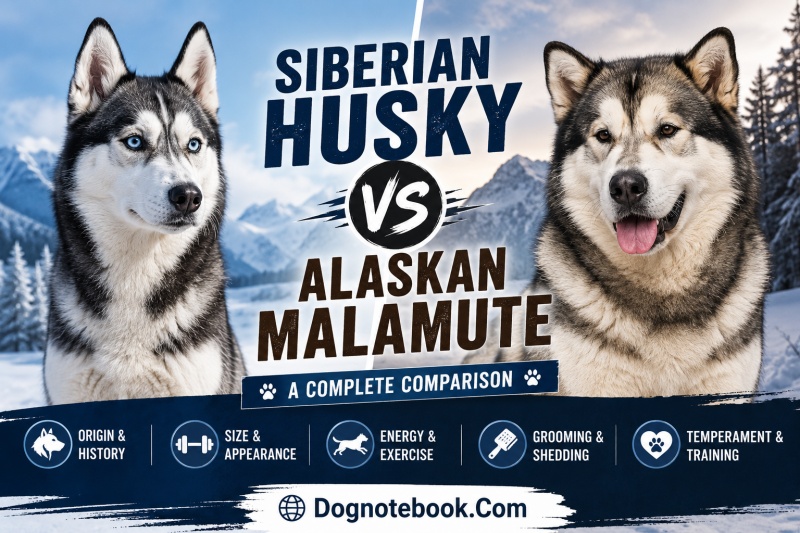
Standing next to each other at a dog park, a Siberian Husky and an Alaskan Malamute can look almost identical to the untrained eye. Both have thick double coats, upright ears, and that striking wolf-like appearance that stops people in their tracks. But once you know what to look for, the differences between these two Arctic sled dog breeds become impossible to miss.
In this Siberian Husky vs Alaskan Malamute side-by-side comparison, I will break down every key difference from size and appearance to temperament, exercise needs, and health. Whether you are trying to identify a rescue dog or choosing between these two breeds as your next companion, this guide will give you the answers you need.
Our team has pulled together breed standard data from the American Kennel Club, real owner experiences from breed-specific forums, and veterinary health records to create the most complete comparison available in 2026.
Table of Contents
Quick Comparison: Siberian Husky vs Alaskan Malamute at a Glance
Here is a side-by-side breakdown of the most important differences. I wanted to put this up front so you can get quick answers before we dig into the details.
| Trait | Siberian Husky | Alaskan Malamute |
|---|---|---|
| Weight (males) | 45-60 lbs | 85-100+ lbs |
| Weight (females) | 35-50 lbs | 75-85 lbs |
| Height (males) | 21-23.5 inches | 25 inches at shoulder |
| Height (females) | 20-22 inches | 23 inches at shoulder |
| Coat | Medium-length double coat | Thick, coarse double coat |
| Eye Color | Blue, brown, or bi-eyed | Brown only (blue is a disqualification) |
| Tail | Brush tail, hangs down when relaxed | Plumed, curls over back |
| Ears | Set close together, slightly larger | Set wider apart |
| Original Purpose | Long-distance sled racing | Heavy freight hauling |
| Temperament | Outgoing, mischievous, vocal | Affectionate, loyal, more reserved |
| Energy Level | Very high, endurance-focused | High but bursts, then rest |
| Barking Level | Howls, talks, and “woo-woos” | Quieter, occasional “chuff” sounds |
| Lifespan | 12-14 years | 10-12 years |
| AKC Group | Working Group | Working Group |
The Malamute is noticeably the larger and heavier of the two. Think of it this way: the Siberian Husky is the marathon runner, built light and fast for distance. The Alaskan Malamute is the weightlifter, built powerful and sturdy for pulling heavy loads over shorter distances. This single difference shapes almost everything else about how these breeds look and act.
Where Each Breed Comes From
Understanding where these two spitz breeds originated explains a lot about why they are built so differently. Both developed as working sled dogs in some of the harshest conditions on Earth, but they were bred for completely different jobs.
The Siberian Husky: Born to Run
The Siberian Husky originated with the Chukchi people of northeastern Siberia, a nomadic tribe that needed dogs capable of traveling long distances on limited food. The Chukchi bred these dogs for endurance over speed, but they ended up with a dog that excelled at both. A Husky could cover vast stretches of frozen tundra at a steady trot, pulling light loads for hours without tiring.
The breed arrived in North America during the early 1900s and gained fame during the 1925 serum run to Nome, Alaska. Teams of Siberian Huskies relayed diphtheria antitoxin across 674 miles of treacherous terrain in just under six days. The lead dog of the final team, Balto, became a national hero. Today, Siberian Huskies remain one of the most popular Arctic breeds worldwide and are still used in competitive sled dog racing.
The Alaskan Malamute: The Heavy Hauler
The Alaskan Malamute takes its name from the Mahlemut tribe, an Inuit people of western Alaska. Unlike the Husky, the Malamute was never meant to be fast. These dogs were freight dogs, pure and simple. They pulled heavy sleds loaded with food, supplies, and building materials across relatively shorter distances. A single Malamute could haul hundreds of pounds through deep snow.
During the Klondike Gold Rush, Malamutes became invaluable to prospectors who needed sturdy, reliable pack animals that could survive extreme cold. The breed almost disappeared during the early 20th century as smaller, faster dogs became preferred for racing. Dedicated breeders saved the Malamute, and the AKC officially recognized the breed in 1935. Today they rank among the most beloved large working dogs, prized for their strength and gentle family temperament.
Size and Weight: How to Tell the Difference
The single most obvious difference between these two breeds is size. The Alaskan Malamute is substantially larger. A male Malamute typically weighs 85 to 100 pounds and stands about 25 inches tall at the shoulder. A male Siberian Husky weighs 45 to 60 pounds and stands 21 to 23.5 inches. That means a full-grown Malamute can be nearly twice the weight of a Husky.
Females follow the same pattern. Female Malamutes weigh 75 to 85 pounds at about 23 inches tall, while female Huskies come in at 35 to 50 pounds and 20 to 22 inches. If you see two Arctic-looking dogs standing next to each other and one is clearly much larger and more heavily boned, the bigger one is almost certainly the Malamute.
This size difference matters beyond appearance. The Malamute’s bulk means they eat more, need stronger fencing, and can be more physically challenging to handle on a leash. A 100-pound Malamute pulling toward a squirrel is a very different experience than a 50-pound Husky doing the same thing. First-time large-breed owners should seriously consider whether they can physically manage a dog of that size before choosing the Malamute.
Physical Appearance: 5 Ways to Tell Them Apart
Size aside, there are five clear visual markers that distinguish these two breeds. I use these every time I see a spitz-type dog and need to make a quick identification.
1. The Tail Shape
This is the fastest visual identifier. The Alaskan Malamute has a thick, plumed tail that curls luxuriously over its back, almost touching the dog’s flank. It looks like a waving plume of fur. The Siberian Husky has a brush-shaped tail that hangs down when the dog is relaxed and may curve upward (but not curl tightly) when the dog is alert or moving. If the tail touches the back, you are most likely looking at a Malamute.
2. Eye Color
Siberian Huskies are famous for their striking blue eyes, but they can also have brown eyes, green eyes, or even one of each (heterochromia). The breed standard accepts all eye colors. The Alaskan Malamute, by contrast, always has brown eyes. In fact, blue eyes in a Malamute are considered a disqualifying fault in the show ring. So if you see a wolf-like dog with vivid blue eyes, it is almost certainly a Husky or a mix.
3. Ear Position and Size
Both breeds have erect, triangular ears, but their placement differs. Husky ears are set relatively close together on top of the skull and tend to be slightly larger in proportion to the head. Malamute ears are set farther apart, which gives the head a broader, more substantial look. This wider ear set contributes to the Malamute’s overall heavier, more bear-like facial expression.
4. Face Markings
Siberian Huskies often display a distinctive “mask” pattern with a prominent white forehead stripe or blaze, white around the eyes, and contrasting darker fur on the rest of the face. This pattern is less common in Malamutes. Malamutes frequently have a solid face color or a cap-like marking on the top of the head with a white underbelly and legs. The Husky’s face markings tend to look more “drawn on” and dramatic.
5. Overall Build and Bone Structure
Even at the same weight, these breeds would look different. The Husky has a lighter, more athletic build with a compact body designed for efficient movement. The Malamute is heavily boned with a broad chest, thick neck, and substantial legs. One way to think about it: a Husky looks like it was designed for a wind tunnel, while a Malamute looks like it was designed for a tractor pull.
Temperament and Personality: Very Different Energy
This is where the Siberian Husky vs Alaskan Malamute comparison gets really interesting. While both breeds share a friendly, people-oriented nature, their day-to-day personalities are quite different.
Siberian Husky Temperament
Siberian Huskies are outgoing, social butterflies. They love meeting new people and typically greet strangers like long-lost friends, which makes them terrible guard dogs despite their wolfish looks. Huskies are also famously vocal. They howl, “talk,” and produce that signature “woo-woo” sound that owners either adore or learn to live with. They have a mischievous, playful streak that lasts well into adulthood.
Huskies have an independent streak that can make them seem aloof or stubborn. They are not trying to disobey you; they simply have their own agenda. This independence was actually valuable in their original role as sled dogs, where they needed to make quick decisions about ice conditions and trail safety without waiting for human input.
Forum owners frequently describe Huskies as having an “off-switch problem.” A bored Husky will find entertainment, and that entertainment usually involves destruction, escape attempts, or both. One owner on a Husky subreddit noted: “They never stop looking for a way out. You can have a six-foot fence, and they will find the one loose board.”
Alaskan Malamute Temperament
Alaskan Malamutes tend to be more laid-back than Huskies between activity bursts. Several owners on breed-specific forums describe them as “chiller and lazier” indoors compared to the constantly-on-the-move Husky. Malamutes are deeply affectionate and loyal to their families. They often form particularly strong bonds with one or two primary caregivers.
However, Malamutes can be more territorial and dog-aggressive than Huskies, especially toward dogs of the same sex. This is a critical point that many comparison articles gloss over. Same-sex aggression in Malamutes is well-documented and something prospective owners need to take seriously. If you are planning a multi-dog household, a male-female pair is strongly recommended over two males or two females of this breed.
Vocalization is another difference. While Huskies scream, howl, and “talk” constantly, Malamutes are quieter. They do vocalize, but their sounds tend to be softer “chuffs” and rumbles rather than the Husky’s dramatic howling. Malamute owners on Reddit often say their dogs “grumble” more than howl, almost like having a furry, opinionated roommate.
Exercise and Activity Needs
Both breeds are high-energy working dogs that need serious daily exercise. But the type and duration of exercise they need differs in important ways.
Siberian Huskies need sustained aerobic activity. Long runs, extended hikes, and skijoring are ideal. A Husky can trot for miles and still have energy to burn. Most Husky owners find they need at least 90 minutes to 2 hours of active exercise daily to keep their dog content and non-destructive. Without enough exercise, Huskies become escape artists and demolition experts.
Alaskan Malamutes need intense bursts of activity with rest periods in between. Weight pulling, carting, backpacking, and shorter but more strenuous hikes suit them best. A Malamute might go hard for 30 to 45 minutes, then happily nap for a few hours. This “work hard, rest hard” pattern reflects their freighting heritage.
Escape Prevention: A Critical Warning
Both breeds are notorious escape artists, but Huskies earn the title more often. Owners on breed forums report Huskies digging under fences, climbing over six-foot barriers, opening gate latches, and even chewing through weak fence boards. If you are considering either breed, invest in secure fencing that extends below ground level, use padlocks on all gates, and never leave these dogs unsupervised in an unsecured yard.
One experienced owner shared this practical advice: “Bury hardware cloth at least two feet down along your fence line. Use carabiners on gate latches. And accept that if a Husky wants out badly enough, they will find a way. The fence is just buying you time.”
Malamutes are less likely to climb but can push through or dig under fencing with their considerable strength. Reinforced fencing and concrete footers along the fence line are common recommendations from Malamute owners. Both breeds have high prey drive, so they should never be trusted off-leash in unfenced areas.
Training: Which Breed Is Easier to Handle?
Neither breed is particularly easy to train, but they are difficult in different ways. If I had to pick, I would say the Siberian Husky is slightly easier for experienced trainers, while neither is a good fit for a first-time dog owner without professional help.
Huskies respond best to positive reinforcement with high-value treats and play rewards. They are intelligent but independent, which means they learn commands quickly and then decide whether they feel like obeying. Consistency, patience, and a good sense of humor are essential. Short, varied training sessions work better than long, repetitive ones, because Huskies bore easily.
Malamutes can be more stubborn and physically challenging to handle due to their size. They also tend to test boundaries more directly. A Malamute might flat-out refuse to do something, whereas a Husky might pretend it did not hear you. Both breeds benefit enormously from early socialization and puppy training classes. House training can take longer with Malamutes, with several owners reporting four to six months before full reliability.
Off-leash reliability is poor for both breeds. Their prey drive and independent nature make recall unreliable even with extensive training. Most experienced owners of both breeds consider off-leash freedom an unacceptable risk unless in a fully enclosed area.
Grooming and Shedding: What to Expect
If there is one area where these breeds are nearly identical, it is grooming. Both have thick double coats designed to protect them in sub-zero temperatures, and both shed heavily year-round with two intense “blowing coat” periods in spring and fall.
During blowing coat season, which typically lasts two to three weeks, you will find fur everywhere. On your clothes, your furniture, your food, and in drifts along your baseboards. Daily brushing with an undercoat rake during this period is essential. Outside of blowing coat season, brushing two to three times per week keeps shedding manageable for both breeds.
The Malamute’s coat is slightly thicker and coarser than the Husky’s, which means there is marginally more fur to manage. Some owners report that Malamute fur is oilier and has a stronger “dog smell” than Husky fur. Neither breed should be shaved or clipped, as their double coat provides essential insulation against both cold and heat.
Bathing is needed only occasionally for both breeds, typically every two to three months or when they find something particularly smelly to roll in. Over-bathing can strip the coat of natural oils and actually increase shedding. Both breeds are relatively clean dogs that groom themselves much like cats do.
Health Issues and Lifespan
Both breeds are generally healthy with long lifespans for dogs of their size, but each has specific health concerns that prospective owners should know about. Responsible breeders perform health testing on breeding dogs, and you should always ask for OFA hip evaluations and eye clearance certificates before purchasing a puppy.
Siberian Husky Health Concerns
The most common health issues in Siberian Huskies include hip dysplasia, eye cataracts, and progressive retinal atrophy (PRA). Huskies are also prone to corneal dystrophy, a condition that affects the clear outer layer of the eye. Annual eye exams by a veterinary ophthalmologist are recommended throughout the dog’s life. With proper care, Siberian Huskies typically live 12 to 14 years.
Alaskan Malamute Health Concerns
Malamutes share the risk of hip dysplasia but are also susceptible to polyneuropathy, a progressive nerve condition, and epilepsy. Chondrodysplasia, a form of dwarfism, occurs in some Malamute lines. Bloat (gastric torsion) is a concern due to their deep chest, and owners should know the warning signs. Malamutes typically live 10 to 12 years, slightly shorter than Huskies.
Joint Care for Growing Puppies
Both breeds are slow to mature, with Malamutes not reaching full physical maturity until about two years of age. During this growth period, avoid strenuous exercise like long runs or jumping from heights. Growing joints are vulnerable to damage that can lead to early arthritis or worsen hip dysplasia risk. Stick to moderate walks and free play for puppies, gradually increasing exercise intensity after 12 to 18 months.
Living With Either Breed: Climate, Apartments, and Multi-Dog Homes
A few practical topics that most comparison guides skip but that real owners need to think about.
Climate Adaptability
Both breeds do best in cooler climates but can adapt to warmer regions with proper management. If you live somewhere hot, you need air conditioning, exercise restricted to early morning and late evening, constant access to shade and water, and a kiddie pool or cooling mat. Never shave their coat, as the double layer actually helps regulate body temperature in both directions. Owners in southern states report success with both breeds as long as they take heat management seriously.
Apartment Living
Neither breed is ideal for apartment living, but it can work with dedicated owners. The Husky’s vocal nature and exercise needs make apartment life particularly challenging. If you live in an apartment and are considering either breed, you need a solid plan for two hours of outdoor exercise daily, sound management training to minimize howling, and nearby green spaces for off-leash play in secure areas. The Malamute’s lower tendency to vocalize gives it a slight edge for apartment dwellers, but its larger size is a countervailing challenge.
Multi-Dog Households
Huskies generally do well with other dogs. They are pack animals by nature and usually enjoy canine companionship. Malamutes can coexist with other dogs but require careful introductions, especially with same-sex dogs. As noted earlier, same-sex aggression in Malamutes is a known breed trait. If you already have a dog and are adding a Malamute, choose the opposite sex and plan slow, supervised introductions. Many Malamute owners report that their dogs do best as the only dog in the household or with one compatible opposite-sex companion.
Siberian Husky vs Alaskan Malamute: Which Breed Is Right for You?
After spending time with both breeds and talking to dozens of owners, here is how I break down the decision.
Choose the Siberian Husky if you are an active runner or hiker who wants a constant exercise buddy, you enjoy a vocal, goofy, and endlessly entertaining personality, you have secure fencing and do not mind a dog that tests every boundary, or you want a slightly smaller dog with a longer expected lifespan.
Choose the Alaskan Malamute if you prefer a larger, more powerful dog for pulling activities like carting or backpacking, you want a dog that is affectionate and loyal but slightly calmer indoors between exercise sessions, you can handle a 100-pound dog on a leash, or you value a quieter dog that grumbles rather than howls.
Neither breed is right for you if you want a low-energy companion, you live in a small apartment without easy access to outdoor exercise space, you cannot commit to daily exercise for the next 12-plus years, or you have small pets like cats or rabbits and cannot manage their high prey drive. Both breeds are working dogs that need a job, and that job can be running, hiking, pulling, or structured play, but it cannot be sitting on the couch all day.
This Siberian Husky vs Alaskan Malamute comparison shows two breeds that share a striking appearance but serve very different lifestyles. The right choice comes down to honest self-assessment about your activity level, living situation, and what you want from the human-dog relationship.
FAQs
Which is bigger, a Siberian Husky or an Alaskan Malamute?
The Alaskan Malamute is significantly larger. Male Malamutes weigh 85-100+ pounds and stand about 25 inches tall, while male Siberian Huskies weigh 45-60 pounds and stand 21-23.5 inches tall. A Malamute can be nearly twice the weight of a Husky.
How can I tell a Siberian Husky from an Alaskan Malamute?
Look at four key features: tail shape (Malamute curls over back, Husky hangs down when relaxed), eye color (Huskies can have blue or bi-colored eyes, Malamutes only have brown), size (Malamutes are much larger and heavier boned), and ear set (Husky ears are closer together, Malamute ears are wider apart).
Which breed makes a better family pet, Husky or Malamute?
Both can be excellent family dogs with proper training and socialization. Huskies tend to be more outgoing with strangers and more playful, while Malamutes are often more bonded to their core family and slightly calmer indoors. For families with small children, the Husky’s smaller size may be easier to manage, but both breeds need supervision around young kids due to their energy levels.
Are Alaskan Malamutes aggressive toward other dogs?
Malamutes can show same-sex dog aggression, which is a recognized breed trait. This does not mean every Malamute is aggressive, but owners should be prepared for potential dog-selective behavior. Opposite-sex pairings in multi-dog households are strongly recommended. Early socialization helps but does not always eliminate this tendency.
Do Huskies or Malamutes shed more?
Both breeds shed heavily and blow their coat twice a year. The Malamute has a slightly thicker, coarser coat, so there is marginally more fur to manage. During blowing coat season, both require daily brushing with an undercoat rake. Neither breed should be shaved, as the double coat provides essential temperature regulation.
Can Siberian Huskies and Alaskan Malamutes live in warm climates?
Yes, both breeds can adapt to warmer climates with proper management. They need air conditioning, exercise limited to early morning and late evening, constant access to shade and cool water, and never shaving their double coat. The coat actually helps insulate against heat as well as cold.
Which breed is easier to train, a Husky or a Malamute?
Neither breed is particularly easy to train. Huskies are intelligent but independent and easily bored, while Malamutes can be stubborn and physically harder to manage due to their size. Both require experienced handling, positive reinforcement methods, and early socialization. Off-leash reliability is poor for both breeds regardless of training level.
How long do Siberian Huskies and Alaskan Malamutes live?
Siberian Huskies typically live 12-14 years, while Alaskan Malamutes live 10-12 years. Both breeds are generally healthy with proper care, but each has breed-specific health concerns. Regular veterinary checkups, appropriate exercise, and responsible breeding practices help maximize lifespan in both breeds.