

The Snark SN5X is the best clip-on tuner for acoustic guitars we tested, because it reads a string’s vibration instead of picking up room sound, which means it stays accurate in a loud rehearsal room where a microphone tuner wanders. It also runs on a rechargeable battery, so you are not hunting for a coin cell five minutes before a set.
That combination of vibration sensing, a full-color screen and a rechargeable cell is why it has drawn more reviews than anything else in this roundup. Everything below it still earned a place, from a micro tuner you can hide behind the headstock to a strobe model built for intonation work.
Acoustic guitars drift out of tune constantly. Fresh strings stretch and humidity shifts, and an unplugged acoustic has no onboard electronics, so a clip-on tuner is the only accurate way to read it without adding a pickup or a pedal.
We spent 2026 with these tuners on steel-string, nylon-string and 12-string acoustics, checking readings against a known reference pitch rather than trusting the printed spec. If you are still choosing your instrument, our guide to the best acoustic guitars is a good place to start before worrying about the tuner.
Table of Contents
Quick Picks: The Best Clip-On Tuners for Acoustic Guitars in 2026
Best overall: Snark SN5X. Chromatic tuning for guitar, bass and violin, a 1.5-inch full-color display and a rechargeable lithium polymer cell. This is the one I clip on and leave there.
Best for accuracy: Peterson StroboClip HD. Rates at plus or minus 0.1 cent in strobe mode with no display lag, plus 50-plus sweetened tuning presets. The precision choice if you set intonation by hand.
Best budget: Donner DT-2. One-button operation, a rotating viewing angle and vibration sensing at the lowest tier of this roundup. Pick it if you just want something accurate for practice.
Best for beginners: Fender FCT-2. Dedicated guitar, bass, ukulele, violin and chromatic modes, a needle display that responds quickly, and a CR2032 cell in the box so it works immediately.
Best for live gigs: Fender Flash 2.0. About 20 hours of runtime from a rechargeable lithium-ion battery, a large rotating color screen and alternate-tuning presets for dropped and open tunings.
Best for players who swap instruments: KLIQ UberTuner. Modes for guitar, bass, violin, ukulele, mandolin and banjo, a 430-450Hz calibration range and a three year warranty.
Top 3 Clip-On Tuners for Acoustic Guitar (October 2026)

Snark SN5X
- Rechargeable lithium polymer battery
- Full color 1.5 inch display
- Works on front or back of headstock
- Chromatic guitar bass and violin
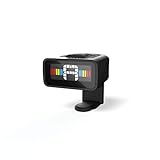
D’Addario Micro Headstock Tuner
- Hides behind the headstock
- 410-480Hz calibration
- Tri-color backlit display
- Works on six instrument families

Fender FCT-2
- Vibration sensing for loud rooms
- Needle color LCD display
- Guitar bass uke violin modes
- Battery included
All 10 Clip-On Tuners Side by Side
| Product | Specifications | Action |
|---|---|---|
| Snark SN5X |
|
Check Latest Price |
| D’Addario Micro Headstock Tuner |
|
Check Latest Price |
| Fender FCT-2 |
|
Check Latest Price |
 D’Addario Eclipse D’Addario Eclipse |
|
Check Latest Price |
 KLIQ UberTuner KLIQ UberTuner |
|
Check Latest Price |
 Fender FT-1 Fender FT-1 |
|
Check Latest Price |
 Donner DT-2 Donner DT-2 |
|
Check Latest Price |
 Peterson StroboClip HD Peterson StroboClip HD |
|
Check Latest Price |
 Fender Flash 2.0 Fender Flash 2.0 |
|
Check Latest Price |
 BOSS TU-02 BOSS TU-02 |
|
Check Latest Price |
1. Snark SN5X Clip-On Tuner – Best Overall for Acoustic Guitar
- Rechargeable cell removes battery changes entirely
- Bright full-color screen readable at a glance
- Accurate enough that strings rarely need a second pass
- Works front or back of the headstock
- Handles guitar bass and violin
- All-plastic body feels delicate and can crack if dropped
- Included charging cable is short and low quality
- Some variants arrive battery-powered rather than rechargeable
I clipped the SN5X to a dreadnought headstock and left it there for the better part of 2026, and it became the tuner I reached for without thinking. The full-color screen is the first thing that stands out, because on a dim stage or in a shaded practice corner you can read the note and the needle position without angling your head.
The detection is piezoelectric, so it reads the string’s vibration directly rather than listening to the room. That is the reason it held steady while I played in a room with a drummer and a talking bandmate, where microphone-based tuners on my phone jumped around constantly.
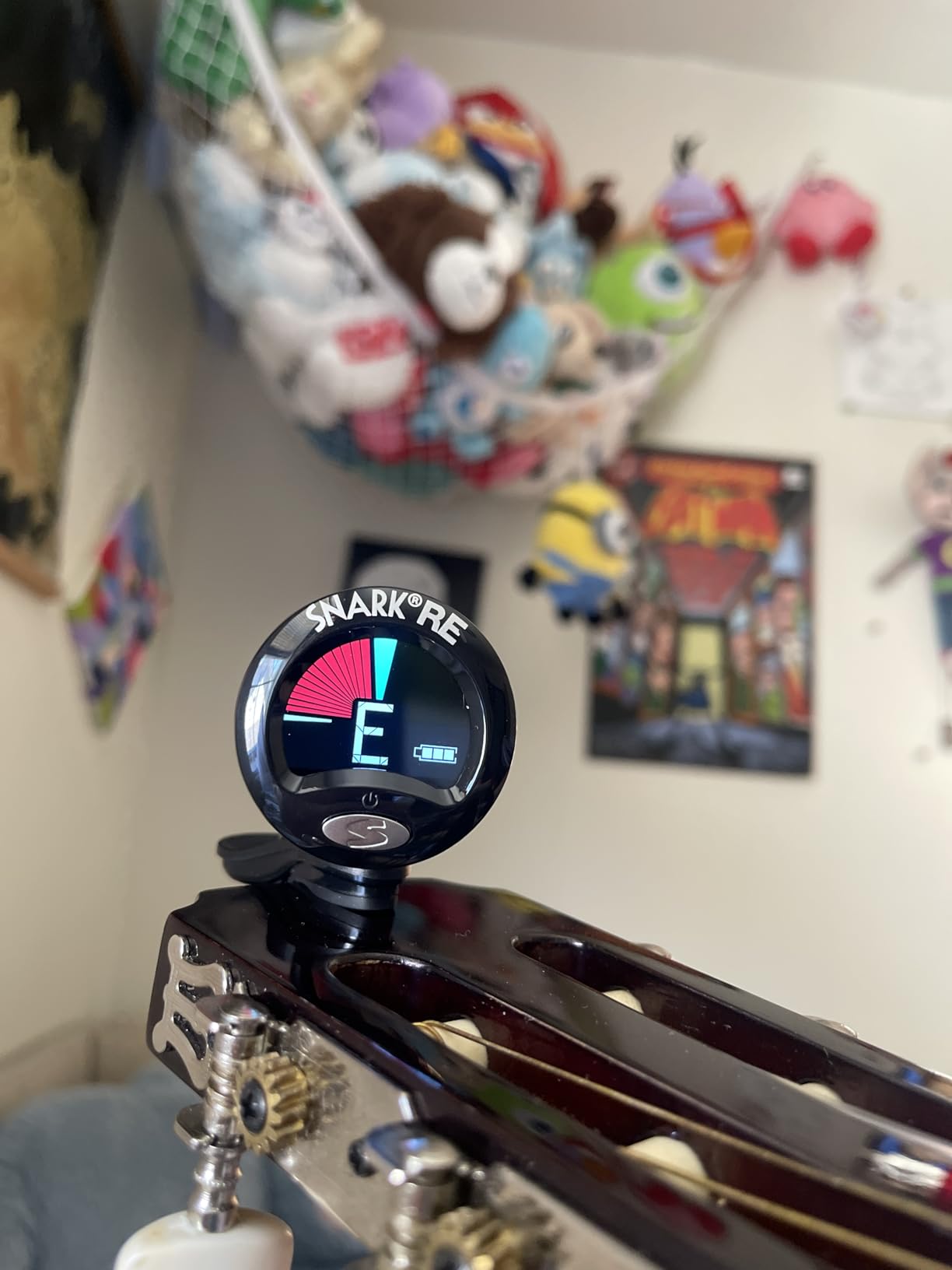
The rechargeable lithium polymer battery is a genuine convenience. I have not changed a cell since I started using it, and the frequency range is tailored to guitar and bass so the low E locks on quickly.
Owners report a bright, quick reading and a clip that stays put, which matches what I saw. The most common complaint is the all-plastic shell, which does feel delicate if you drop it onto a hard floor.
How the screen holds up on stage
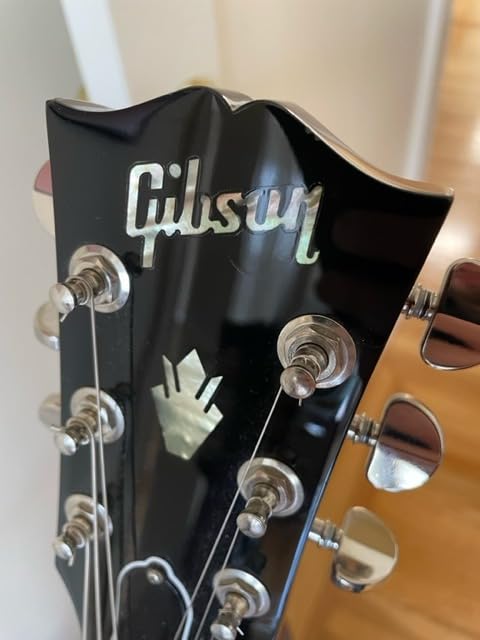
The 1.5-inch full-color display is brighter than the monochrome screens most budget clip-ons use, and it stays visible when the tuning head is lit but the stage is not.
Directional graphics show whether a string is sharp or flat, which shortens the step between plucking the note and turning the peg.
Where it falls short
The plastic housing is the weak point. It survived my testing, but owners describe it cracking after a drop, and the supplied charging cable is widely criticised as short and flimsy. Variants of this model also sometimes ship as battery-powered rather than the rechargeable version shown in the listing.
2. D’Addario Micro Headstock Tuner – Best for Travel and Discreet Mounting
- Small enough to leave mounted permanently
- Very accurate for its size
- 360 degree swivel means no upside-down readings
- Adjustable padded clamp fits thick classical headstocks
- Padded jaw holds without marking the finish
- Plastic ratchet clamp can wear out and let it slip
- Tiny LCD is hard to read in low light
- B string can flicker between F sharp and B
If you travel with a guitar and do not want a tuner bolted to the headstock the whole time, this is the one. At 0.32 ounces and one inch tall, it disappears behind the machine heads so completely that people have told me they forgot it was there.
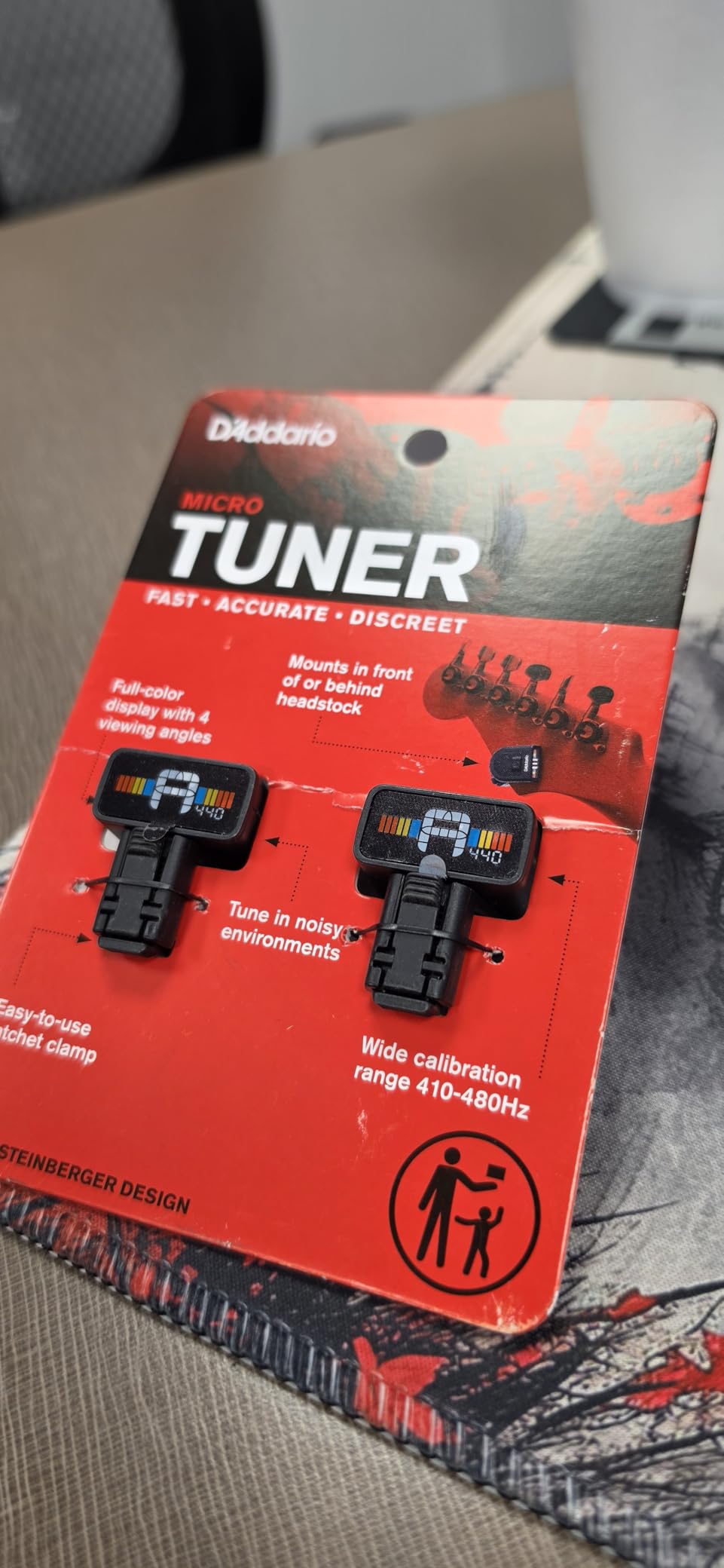
The piezo transducer senses vibration rather than sound, so it reads correctly in a loud room and it does not care whether the guitar has a pickup installed. Owners often describe it as matching or beating larger clip-ons, which is unusual for something this small.
The tri-color backlit display changes from red when you are out of tune, to yellow as you get close, to green when the string is locked. That feedback is easier to read at a glance than a needle when you are new to tuning.
The 360-degree swivel and adjustable padded clamp are what make it work on a nylon-string or gypsy-jazz headstock, which is far thicker than a steel-string’s. The padding is also why it is one of the safer tuners here on a finished headstock.
Why it suits a gig bag
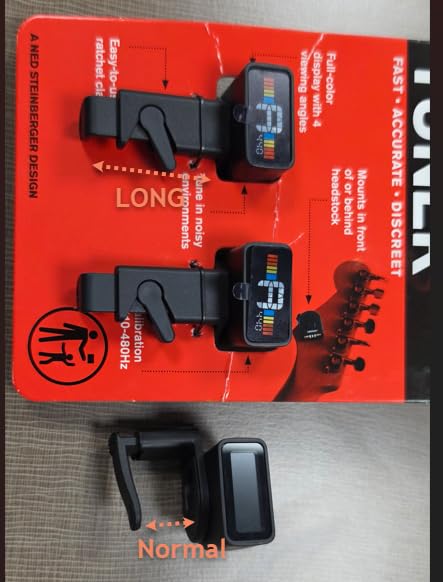
There is no case and no clip to lose, because the tuner is the clip. A micro tuner like this disappears into the headstock pocket of a gig bag and weighs less than a pick, which is exactly what you want when the guitar travels more than it lives on a stand.
What you give up for the size
The LCD is genuinely small, and owners specifically mention that it is less readable in low light. If you practise at night in a dim room, that is a real trade-off.
Two other limits are worth knowing. The plastic ratchet clamp has a finite lifespan and can eventually let the tuner slip, and on classical guitars some owners see the B string flicker between F sharp and B on the first reading.
3. Fender FCT-2 Multi-Instrument Clip-On Tuner – Best for Beginners
Fender FCT-2 Professional Multi-Instrument Clip-On Tuner for Guitar, Bass, Ukulele, and Violin
- Vibration sensing stays accurate in loud venues
- Color needle display responds quickly
- Dual-hinge clip adjusts to a comfortable angle
- Dedicated modes make it easy to use with several instruments
- Battery included so it works straight away
- Tight on thick classical headstocks
- Display can face away from you after clipping on
The FCT-2 is the one I would hand to someone who has never used a tuner. It does the sensible thing by default, ships with a battery already fitted, and its display tells you what to do without a learning curve.
The needle display responds quickly to a plucked string, and the B0 to B7 range with standard A440 calibration covers everything a steel-string acoustic needs. Dedicated modes for guitar, bass, ukulele and violin sit alongside chromatic mode.
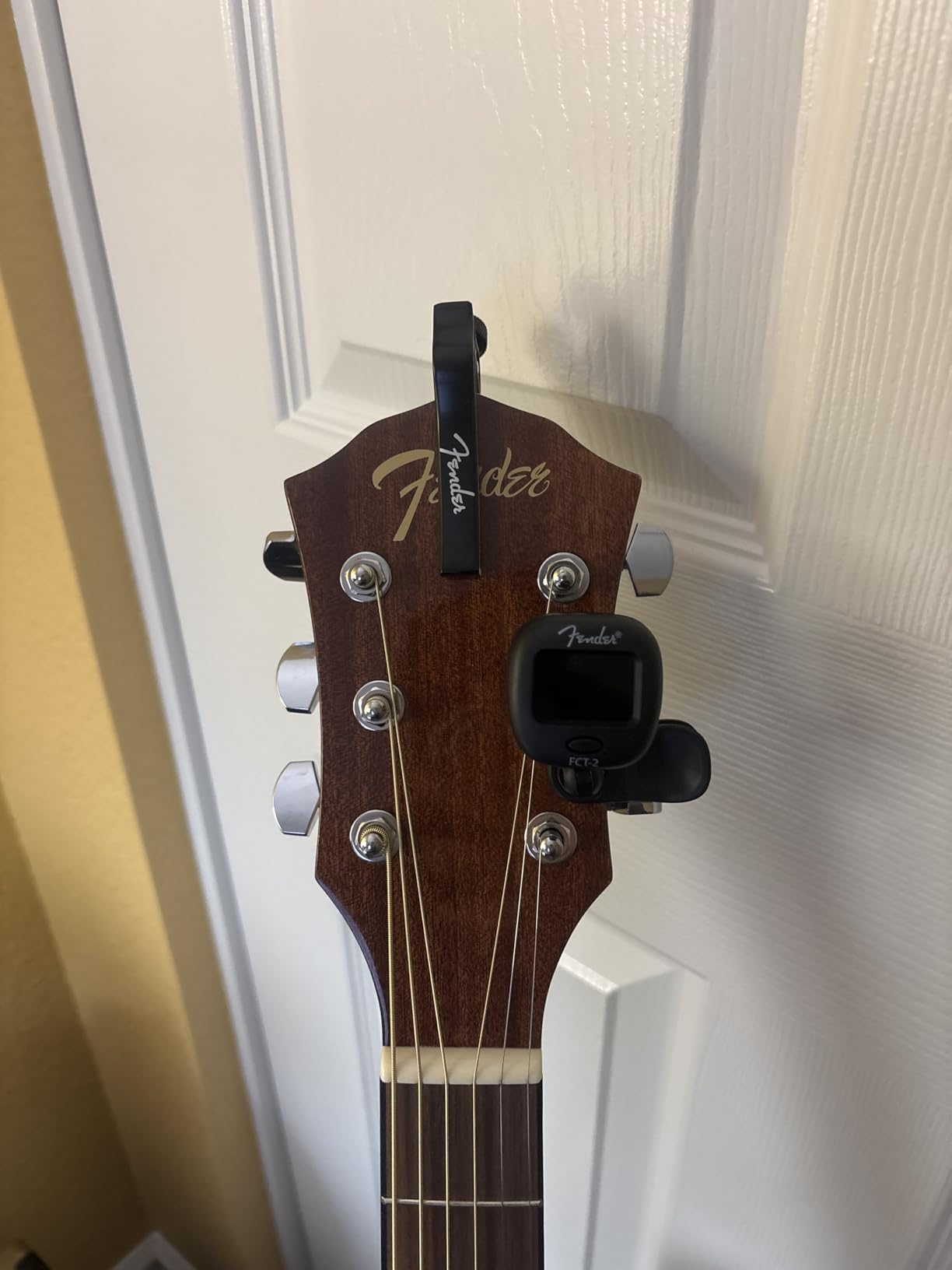
Detection is vibration-based, which is the single most important thing on this list. Play with a loud band and the needle stops jumping around, because the tuner is reading your strings rather than the room.
Why beginners get on fastest with it
A needle gauge is intuitive. You pluck a string, the needle swings, and you turn the peg until it settles in the middle. Chromatic-only tuners make you read a note name first, which is a step people have to learn before they can use the thing at all.
Mode buttons on this tuner are labeled plainly, so switching between guitar and bass takes one press.
What beginners should watch for
The clip is the main limitation. Owners of classical guitars report that it fits thick headstocks only with difficulty, so if your instrument has a wide paddle headstock, check the jaw opening before you buy.
There is also a hinge quirk worth knowing: after clipping on, the display can end up facing away from you and need rotating. It is a five-second adjustment rather than a defect, but it can look like a fault the first time it happens.
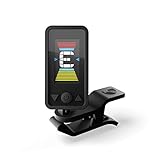
4. D’Addario Eclipse Headstock Clip-On Tuner – Best Value With the Biggest Screen
- Large bright color screen far easier to read than most clip-ons
- Steady needle with no searching latency between notes
- Calibration setting survives power cycles and shows on screen
- Dual swivel suits left-handed players
- Strong clamp grips without slipping
- Some units power off unexpectedly mid-tuning
- Battery life shorter than rivals suggest
- Display could be brighter in direct light
The Eclipse wins on screen size. With a 3-inch full-color vertical display and limitless viewing angles, it is among the easiest clip-ons here to read at a glance, and owners regularly rank it above more expensive Snark units for that reason alone.
The needle behaves well. There is no searching latency between notes, so when you pluck a new string the readout settles immediately rather than hunting for a few seconds first. That matters more on an acoustic than it does on an electric, where the string keeps ringing and gives the tuner more to work with.
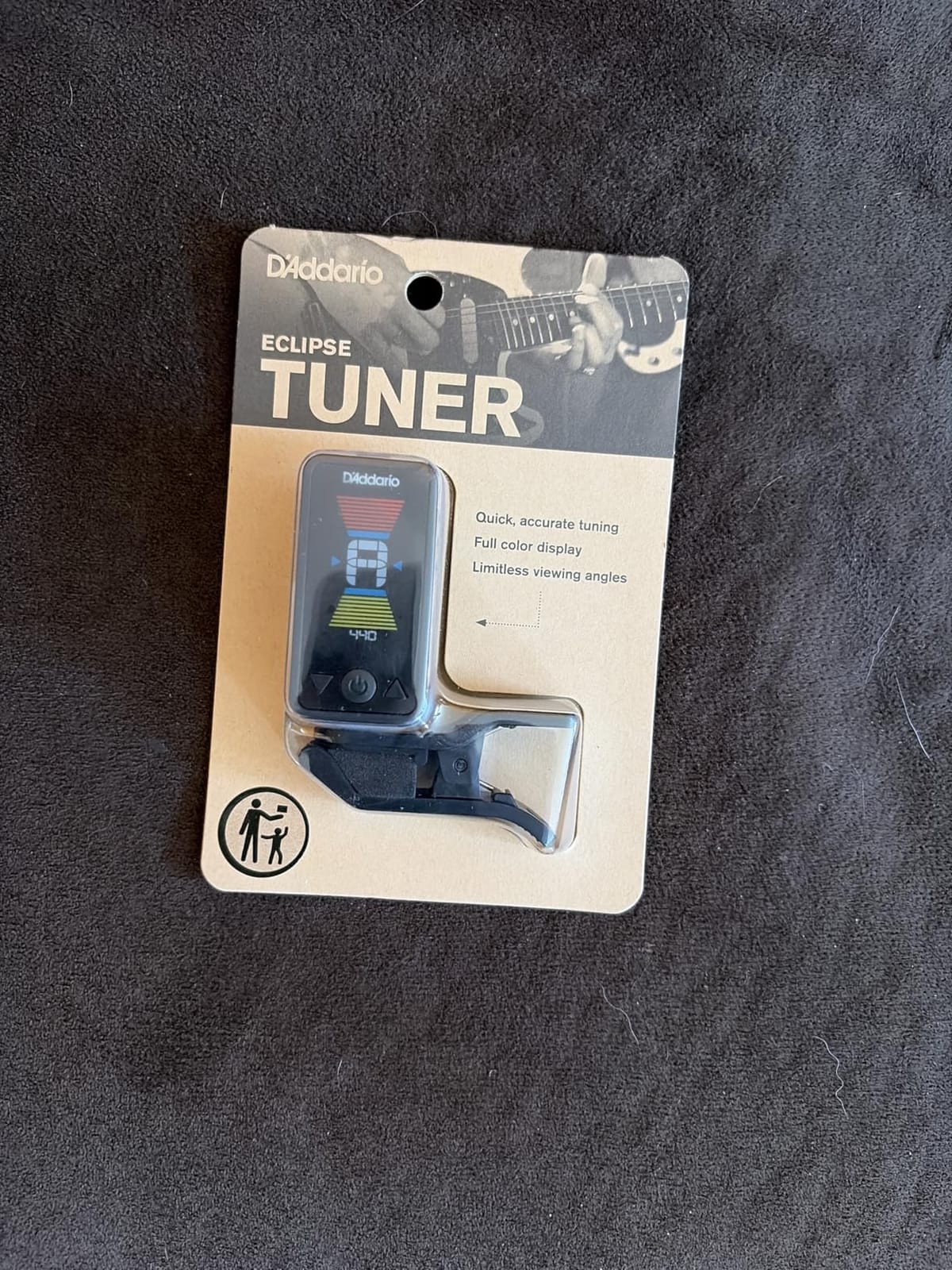
Calibration runs from 435 to 450Hz, and the setting persists when the tuner is powered off. That is a small feature with a real effect: a capo or an orchestra tuning does not force you to reset the reference pitch every time you switch the unit on.
Dual swivel mounts let you mount it for left- or right-handed playing, and the clamp grips the headstock firmly enough that I have never had to re-seat it mid-song.
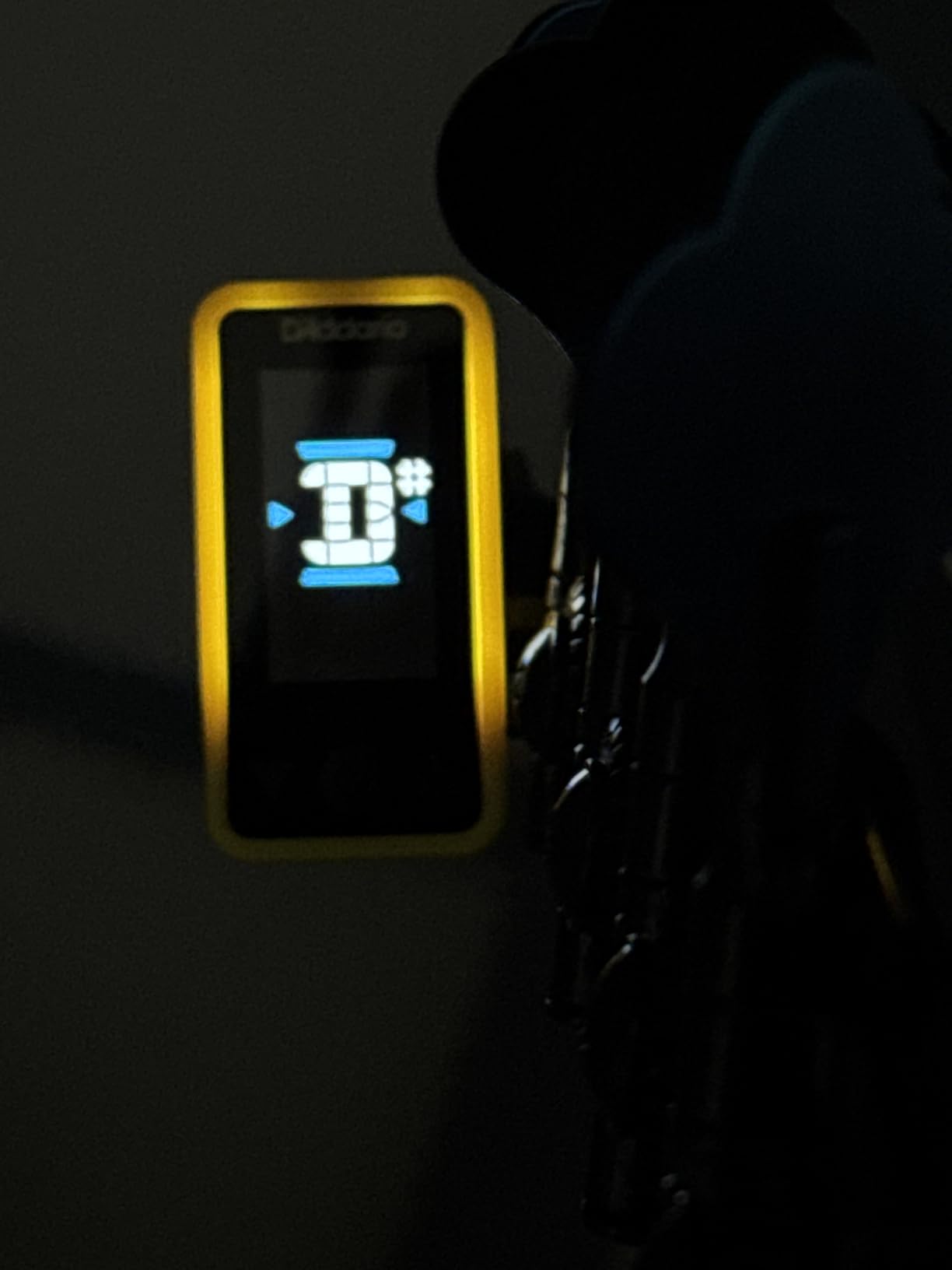
When the big screen genuinely helps
Reading a tuner while holding a chord shape, glancing down and back up is much harder with a small monochrome screen. The Eclipse’s size removes that friction, which is why it comes up so often in owner comments about practising without a pedal.
Owners also note the needle settles without searching between notes.
The two complaints worth knowing
Some units power off unexpectedly during a tuning session, and the CR2 battery life runs shorter than owners expect. Keep a spare CR2 in the case rather than trusting a long session to go uninterrupted.
The display could also be brighter in direct light than some competitors, so it is not the pick if your practice spot is outdoors in full sun. For that, the Peterson further down the list is the better answer.
5. KLIQ UberTuner – Best for Multi-Instrument Players
- Fast pitch detection with no lag
- Vibration sensing ignores background noise completely
- Rotating color display readable at any angle
- Padded clip protects the instrument finish
- Three year warranty is the longest here
- Hinge and pivot joint wear with heavy daily use
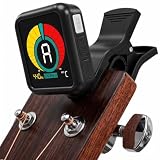
The UberTuner is built for the person who never plays the same instrument twice. It has dedicated modes for guitar, bass, violin, ukulele, mandolin and banjo alongside chromatic, and the 430-450Hz calibration range includes Bb, Eb, F and D transposition keys.
The stated accuracy is within one cent, and the piezo sensor is described as professional-grade with fast pitch detection. In practice the speed is what you notice, because there is no lag between plucking a string and getting a note.
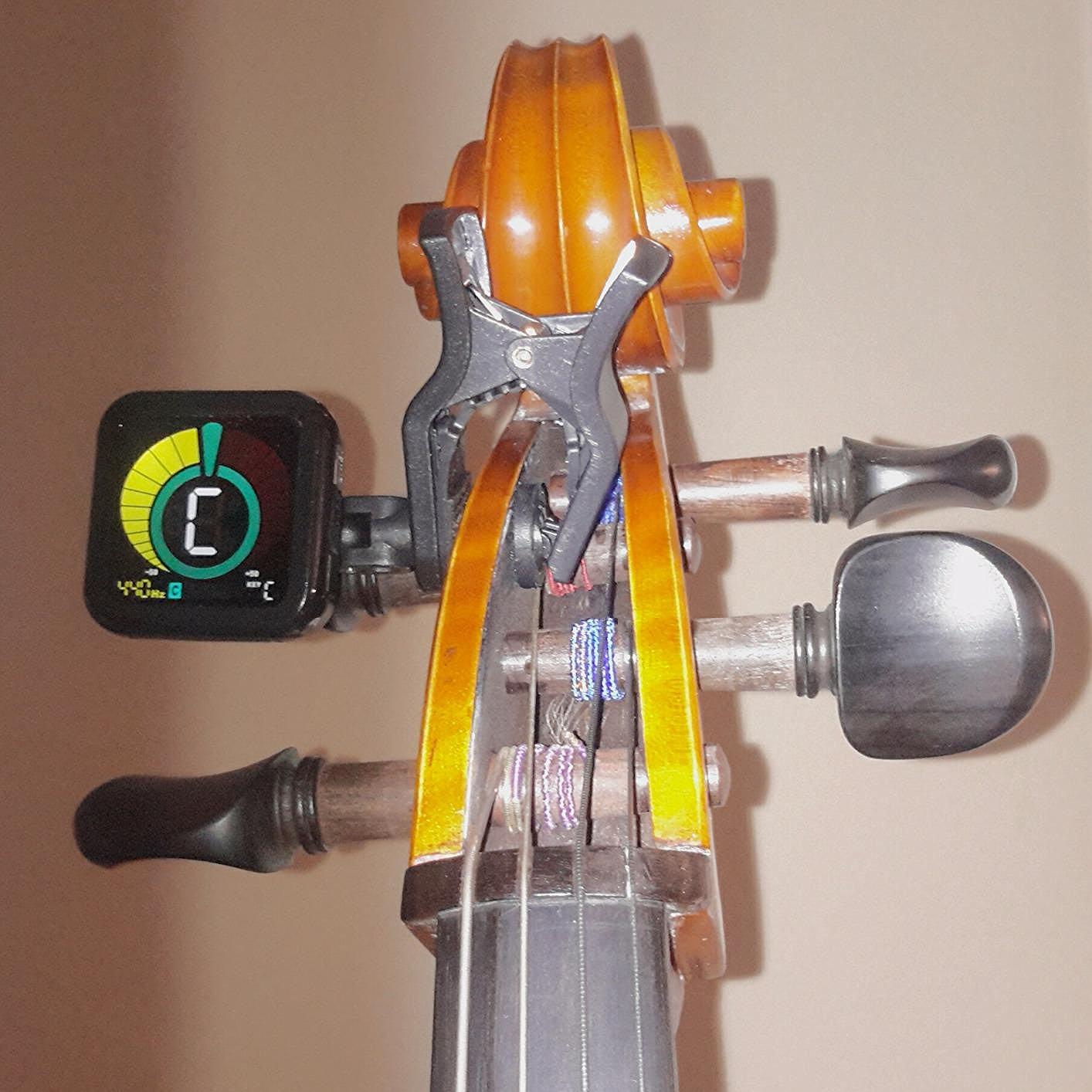
The 360-degree adjustable full-color LED display is the other headline feature. On a mandolin or ukulele the clip sits at an awkward angle, and a rotating display means you never twist your wrist to read it.
Because detection is vibration-based, background noise never affects the reading, which makes it a reasonable choice for open mic nights and busy teaching rooms.
Where the transposition keys earn their place
Transposition keys are what separate this from a generic multi-instrument clip-on. If you play a Bb tenor banjo, a drop D bass part or a ukulele that lives a tone down from the printed label, you can set the reference once rather than mentally adjusting every reading.
The calibration covers 430 to 450Hz, so most standard concert pitches fit without a workaround.
The failure point to plan around
The hinge and pivot joint are the weak point. Owners using it daily report that they wear over time, and this is the most common mechanical complaint across clip-on tuners in general rather than something unique to this model.
The three year warranty is the longest in this roundup, which helps, but if you are hard on hardware, a tuner with a stiff rotating mount may outlast it.
6. Fender FT-1 Clip-On Tuner – Best Accuracy in the Entry Tier
Fender FT-1 Professional Guitar Tuner Clip On, Guitar Accessories, with 1-Year Warranty, Full-Range Chromatic Guitar Tuner with Dual-Rotating Hinges, A4 Calibration
- Very accurate so strings rarely need a second pass
- Backlit needle display that turns green when in tune
- Strong spring clip with concave finger grips
- Swivel feels sturdy rather than flimsy
- Excellent value against similar multi-instrument tuners
- Mode selected with a tiny button and a small on-screen letter
- Clip opening tight on fatter headstocks
- Battery cover fiddly to reseat
- Screen dimmer than some rivals in bright sun
The FT-1 is the value pick in this list, and owners describe it as among the most accurate clip-ons at this tier. Strings rarely need a second pass, which on an acoustic with a heavy low E is the difference between tuning and tuning again.
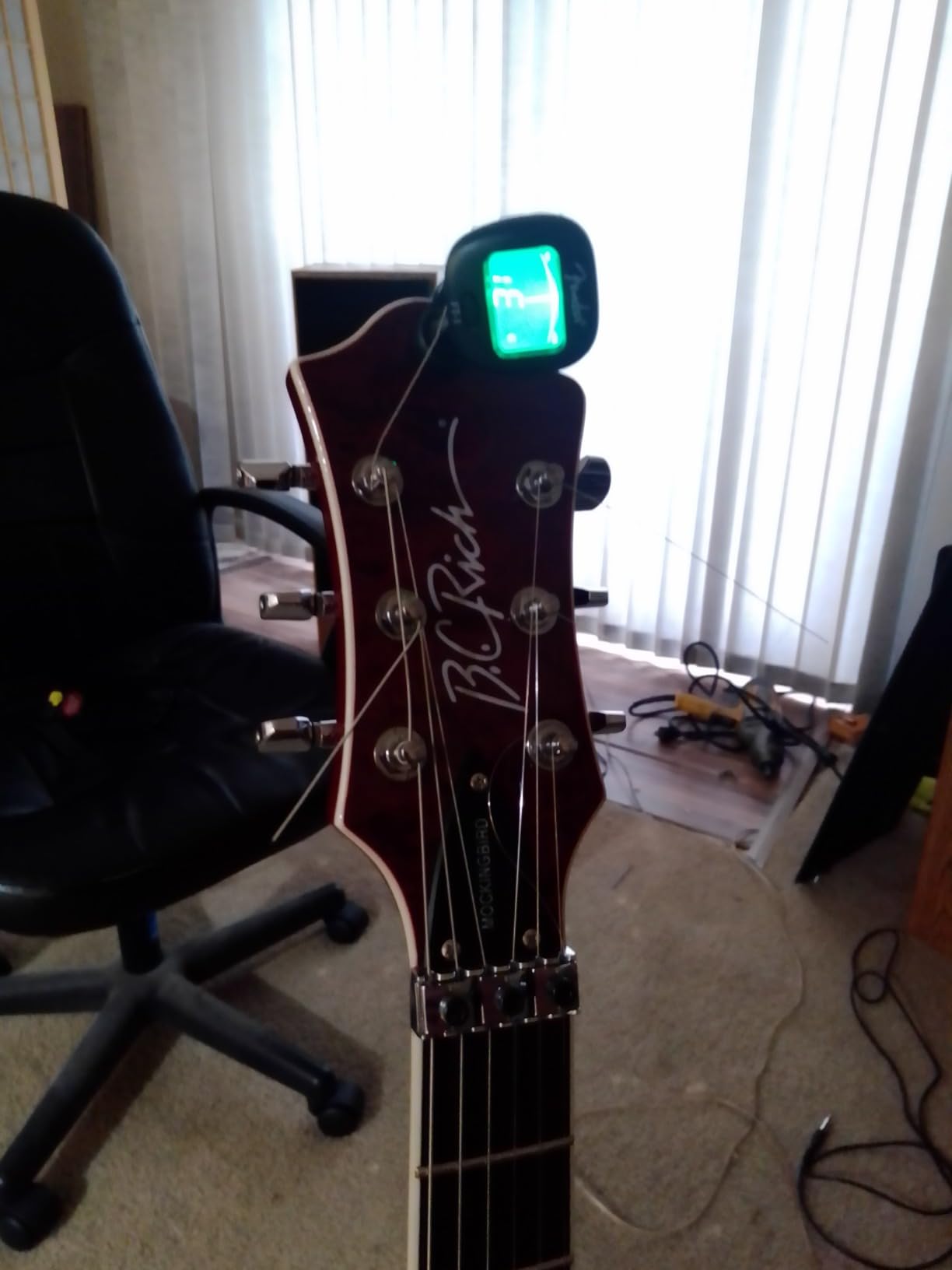
The backlit needle turns green when the note is locked in, which is a genuinely useful cue on a steel-string where you are listening to two or three things at once. The dual-rotating hinges let you set the angle before you clip on rather than after.
What makes it feel solid is the spring clip. The concave finger grips give you purchase when you are closing it one-handed in the middle of a song, which is the moment most clip-ons are most likely to be dropped or twisted.
It covers electric, bass and acoustic, includes a CR2032 battery, and carries a one year limited warranty from Fender.
Where its accuracy comes from
Owners consistently call it accurate, and the reading is steady rather than jumpy. That matters more than the headline number: a tuner that is technically precise but wanders between readings is less useful than one that is consistently close.
Because it works for electric and bass too, one tuner can cover several instruments in the house.
Small annoyances you will notice
The mode button is tiny and the on-screen letter is small, so changing instruments is fiddly. If you are a one-guitar player you will set it once and forget about it.
The clip opening is tight on fatter headstocks, the battery cover is awkward to reseat, and the screen is dimmer than some rivals in direct sunlight. None of those stop you tuning, but they are the reasons it is not the top pick here.
7. Donner DT-2 – Best Budget Pick for Everyday Practice
Donner Guitar Tuner Clip on-Accurate Chromatic,Acoustic Guitar Bass Violin Ukulele Tuner DT-2
- Very simple one-button operation with no menu
- Rotating clip angles the display toward you
- Sensitive vibration clip gives fast readings
- Light at just over an ounce
- Backed by a six month guarantee
- Pitch accuracy is only moderate next to costlier models
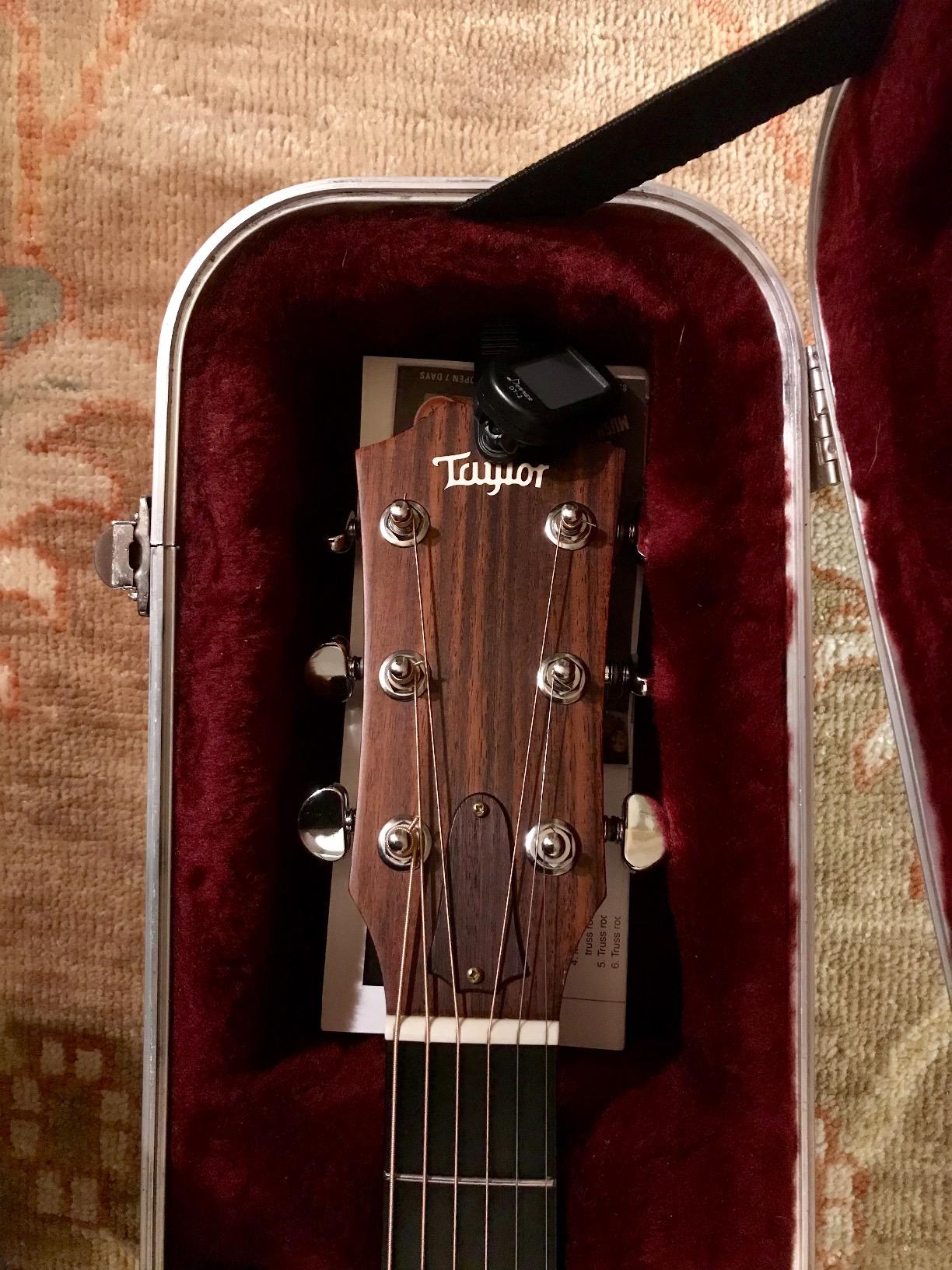
The Donner DT-2 is the lowest-cost way in this roundup to get vibration-based tuning on an unplugged acoustic, and for practice at home that is genuinely all you need. You clip it on, press one button, and it starts reading.
There is no menu to learn and no mode cycling to get wrong. The rotational clip gives you a multi-angle viewing position, which matters on a small body or a slim headstock where the default mount points away from you.
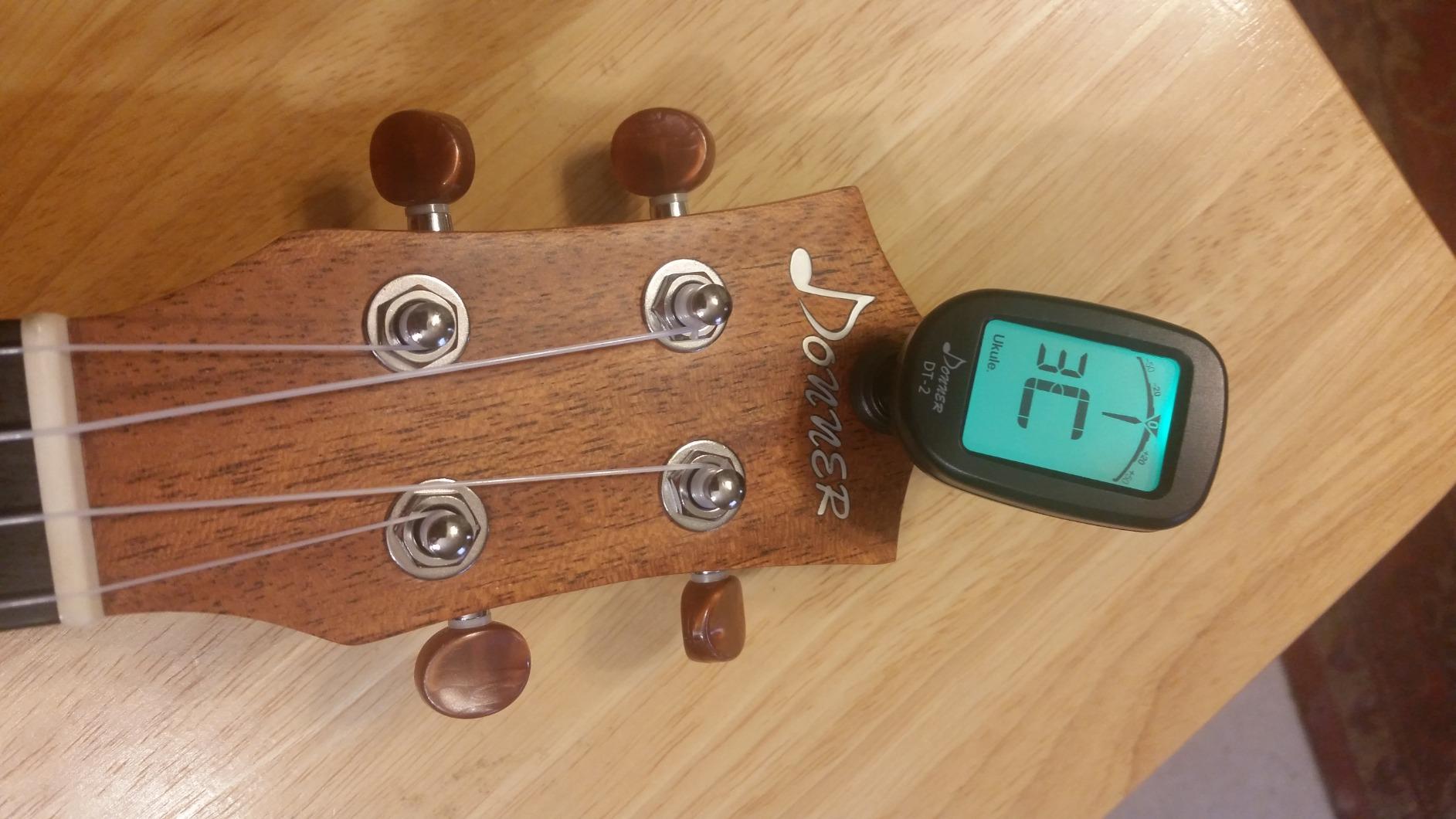
Chromatic mode covers acoustic guitar, bass, violin and ukulele, and the vibration clip is described as sensitive enough for fast, precise detection. It is also the smallest body on the headstock of anything we tested.
The one thing owners consistently flag is accuracy. It is described as moderate compared with higher-end clip-on tuners, and at a 4.4 rating it sits at the bottom of what we tested.
When good enough is genuinely enough
For a beginner learning to tune by ear, or for daily practice on a guitar you have just restrung, this does the job. The single-button design means there is nothing to set up incorrectly, which removes a genuine source of frustration.
It is a quick clip-on and take-off, which suits practice sessions.
Where the money should go instead
If you perform, record, or want to tune in tune-ups at a venue with other instruments playing, the modest accuracy becomes a liability. A few cents of error is audible in a chord, and no clip-on advantage matters if the reading itself is soft.
The six month guarantee is also the shortest here. For a tuner you might use daily for years, that is worth factoring in.
8. Peterson StroboClip HD – Best for Precision and Intonation Work
Peterson StroboClip HD Clip-On Guitar Tuner, ±0.1 Cent Accuracy for Acoustic, Electric, Bass, Violin, Ukulele
- Plus or minus 0.1 cent strobe accuracy with no display lag
- Display stays readable in direct sunlight
- Sweetened presets genuinely improve open chord sound
- Reliable on the bass low E where many clip-ons fail
- Capo offset makes sweetening usable while capoed
- Strobe pattern takes practice to read at first
- The articulated display arm looks thin and is joined by a small screw
- The most expensive option we tested
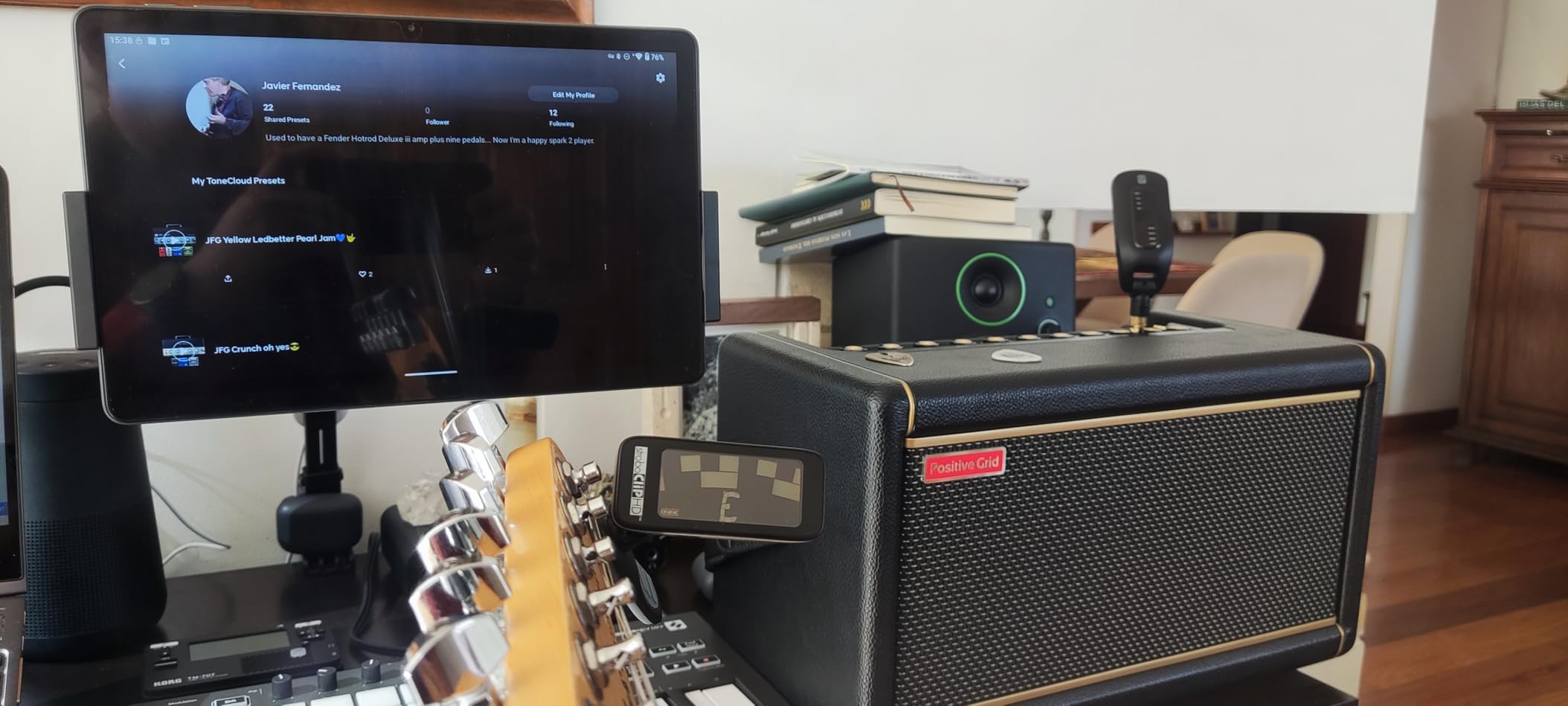
The StroboClip HD is the precision instrument in this list, and it is the one I would use for intonation. Stated accuracy is plus or minus 0.1 cent with zero-lag visual feedback, which is a different category of number from the plus or minus one cent the cheaper units claim.
The strobe display imitates the spinning disc of a rack tuner. Two rows of light move toward each other, and when the pattern stands still the string is in tune.
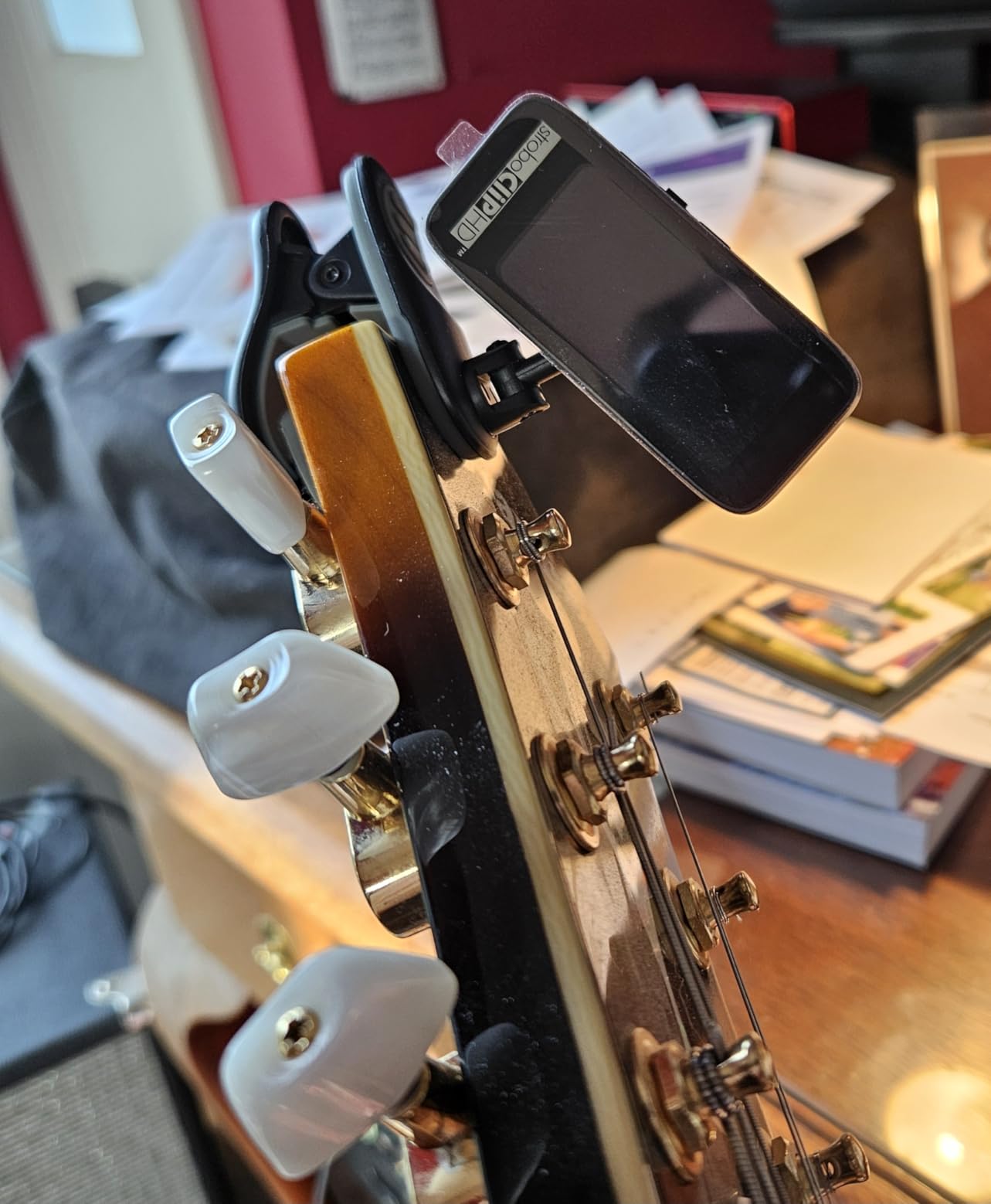
The 192-segment HD backlit display is readable in direct sunlight, which none of the other clip-ons here can claim. If you practise outdoors or tune in a bright room, that alone justifies it.
The 50-plus sweetened tuning presets are the feature acoustic players care about most. Sweetening moves each string a few cents off standard so that the fifth and sixth string intervals ring cleanly together. On an open chord that is the difference between a muddy G and a clear one.
It handles 6 and 12-string acoustics, multi-string electrics, 4, 5 and 6-string bass, ukulele, violin, viola, cello, banjo, mandolin, brass and woodwinds.
Why sweetened tuning matters on an acoustic
A standard-tuned acoustic is a compromise. Standard tuning makes each string playable in isolation, but the fifth and sixth strings end up a few cents apart from where they would sit if you tuned for the interval between them. That is why an open G chord can sound out on a guitar that is technically in tune.
Sweetening resolves it, and the capo offset function means you can apply it while a capo is on the neck, where the geometry changes anyway. On a 12-string this is where the improvement is most obvious.
What you pay for the precision
The strobe pattern takes real practice to read, and it is not intuitive if you have never used one. Give it a week of ordinary tuning before judging it.
The articulated display arm also looks thin, and it is joined by a small screw that owners report can loosen with use. It is the least robust part of an otherwise well-built instrument, and it is the most expensive option we tested.
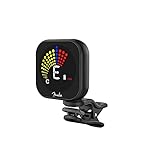
9. Fender Flash 2.0 – Best Rechargeable Tuner for Alternate Tunings
Fender Flash 2.0 Guitar Tuner Clip On, Rechargeable Guitar Tuner for 6 Strings, Battery and Micro USB Audio Charger Included, 4x3x2 Inches, 1 Count,Black
- Rechargeable battery needs no cell changes
- Large full-color screen clearer than stock ukulele tuners
- Display graphics show clearly if a string is high or low
- Rotates smoothly to stay visible while tuning
- Useful alternate-tuning presets for dropped and open tunings
- Clip is stiff the first time you attach it
- Instruction booklet is easy to miss in the box
The Flash 2.0 is the newest of the rechargeable options here and the one with the strongest five-star share among the tuners we tested. Owners rate it at 4.6 from around 770 reviews, and several specifically note that its readings agree closely with a Peterson strobe tuner.
Runtime is about 20 hours from a rechargeable lithium-ion battery, with a 10 minute auto shutoff that stops it draining in a case. A micro USB cable is included, so there is nothing extra to buy or lose.
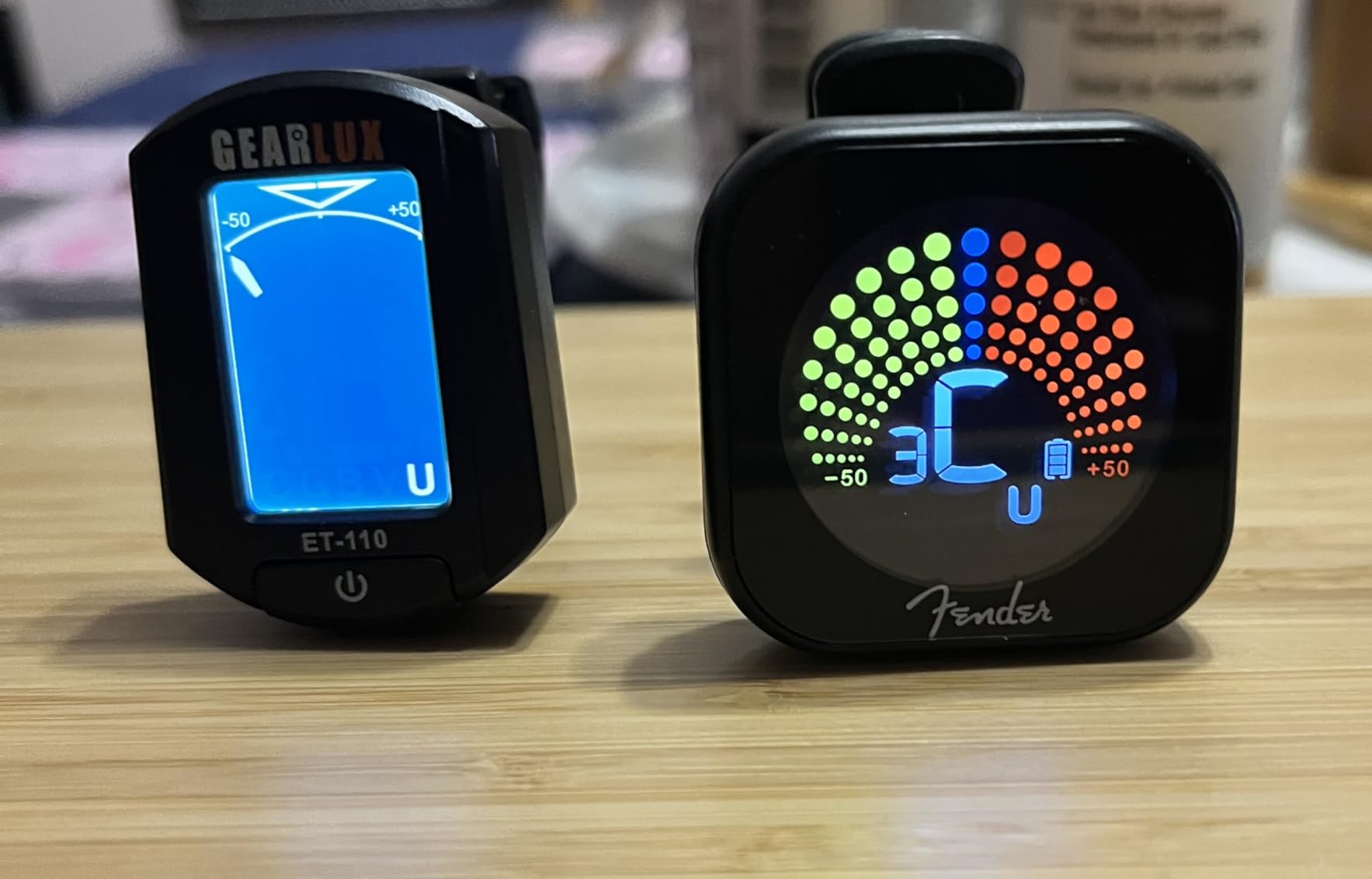
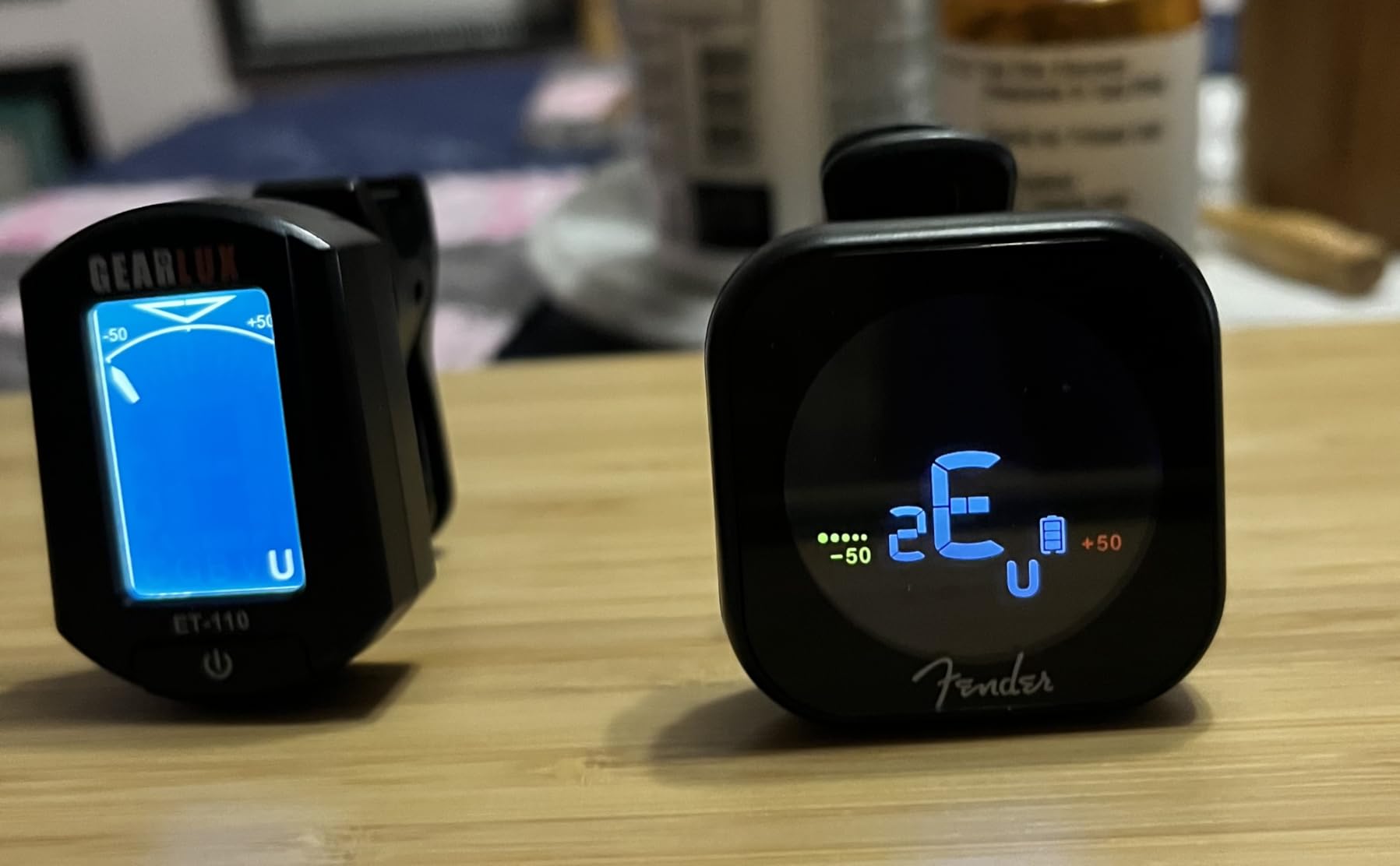
What sets it apart for acoustic players is the alternate tuning bank. Half-step flat, full-step flat, open G, open D and open E are all available as presets, so drop D and DADGAD players do not have to retune from scratch at a gig.
The large full-color display shows directional tuning graphics that make it obvious whether a string is high or low, and the swiveling body keeps the screen in view while you turn a peg. It fits guitar, bass, ukulele and violin, and owners confirm it clamps onto Ovation-style headstocks.
At 67 grams it is heavier than the micro tuners here but still unremarkable in a gig bag, and it carries a one year manufacturer warranty.
When a rechargeable battery actually pays off
If you tune between every song, a dead cell is a real problem and there is never a spare in the bag. A rechargeable tuner removes that failure mode entirely, and twenty hours covers multiple rehearsals or a full evening set.
The auto shutoff also stops it draining while it sits in a case.
What to expect on first use
The clip is stiff the first time you attach it, so expect to work at it once before you decide it is difficult. After that it grips fine.
The instruction booklet sits at the bottom of the box and is easy to miss, so check the button layout on the way in rather than assuming it will work like your old tuner. For players who never leave standard tuning, the presets are a bonus rather than a reason to choose it.
10. BOSS TU-02 Chromatic Clip-On Tuner – Best for a Rigid Mounting Joint
- Cylindrical mount avoids the ball-joint breakage common on clip-ons
- Stable needle that settles instead of hunting
- Bright high-contrast display that is easy to read
- Padded clip swivels to any viewing angle
- Three-button layout is intuitive without the manual
- Left-side button doubles as power and mode select so modes change by accident
- Accuracy is roughly plus or minus 1 cent
- Lowest detected note is around low B so drop bass tunings are not covered
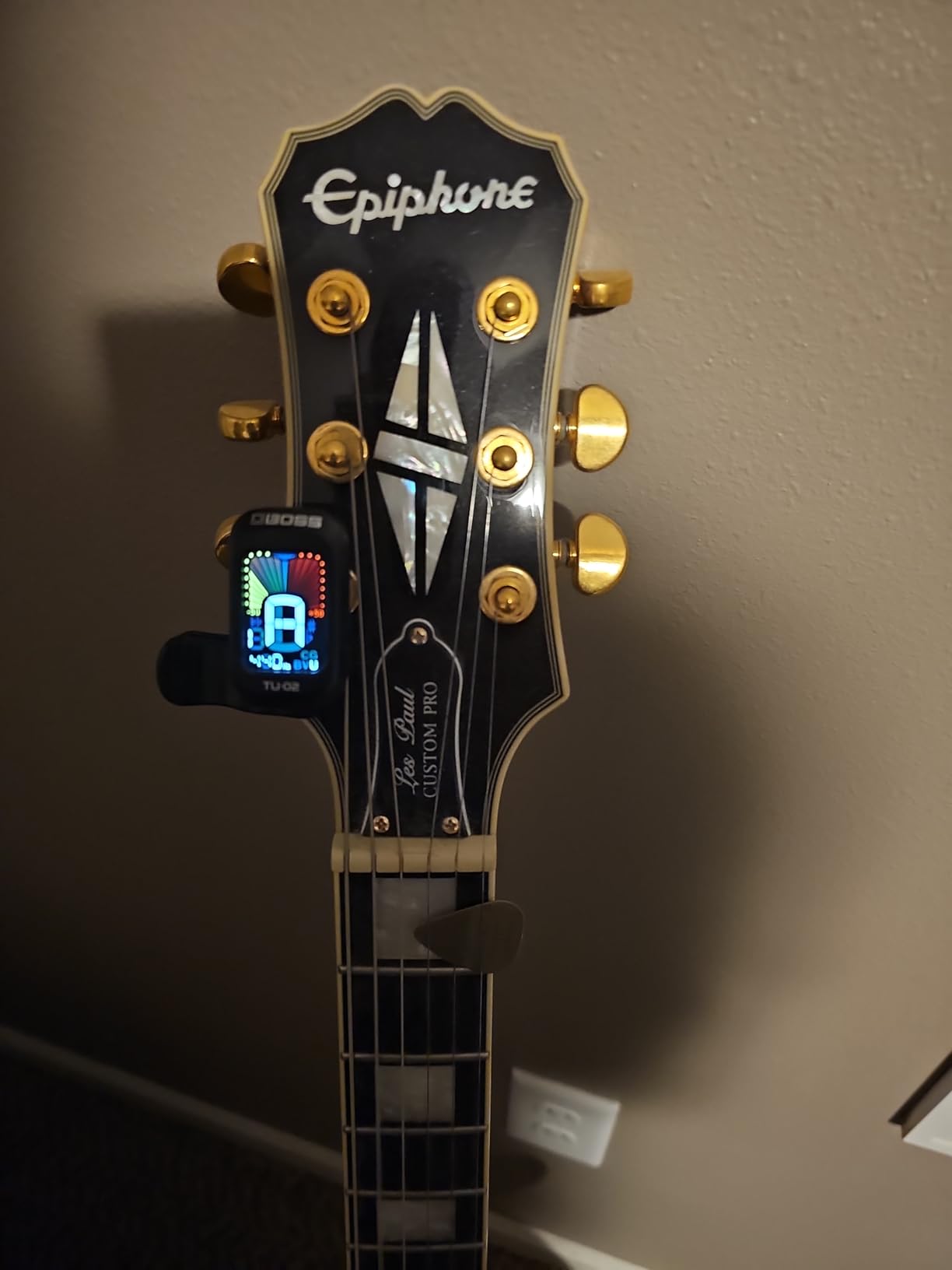
The TU-02 is the newest BOSS clip-on and the only one here built around a cylindrical column and a screw angling joint instead of a ball-and-socket neck. Owners coming from other clip-ons single out that mount as the reason to switch, because ball joints are the first thing to break.
Four modes cover chromatic, guitar, bass and ukulele, and the needle settles on a pitch rather than hunting. Up to 24 hours of continuous runtime on a CR2032 means it is unlikely to die mid-session.
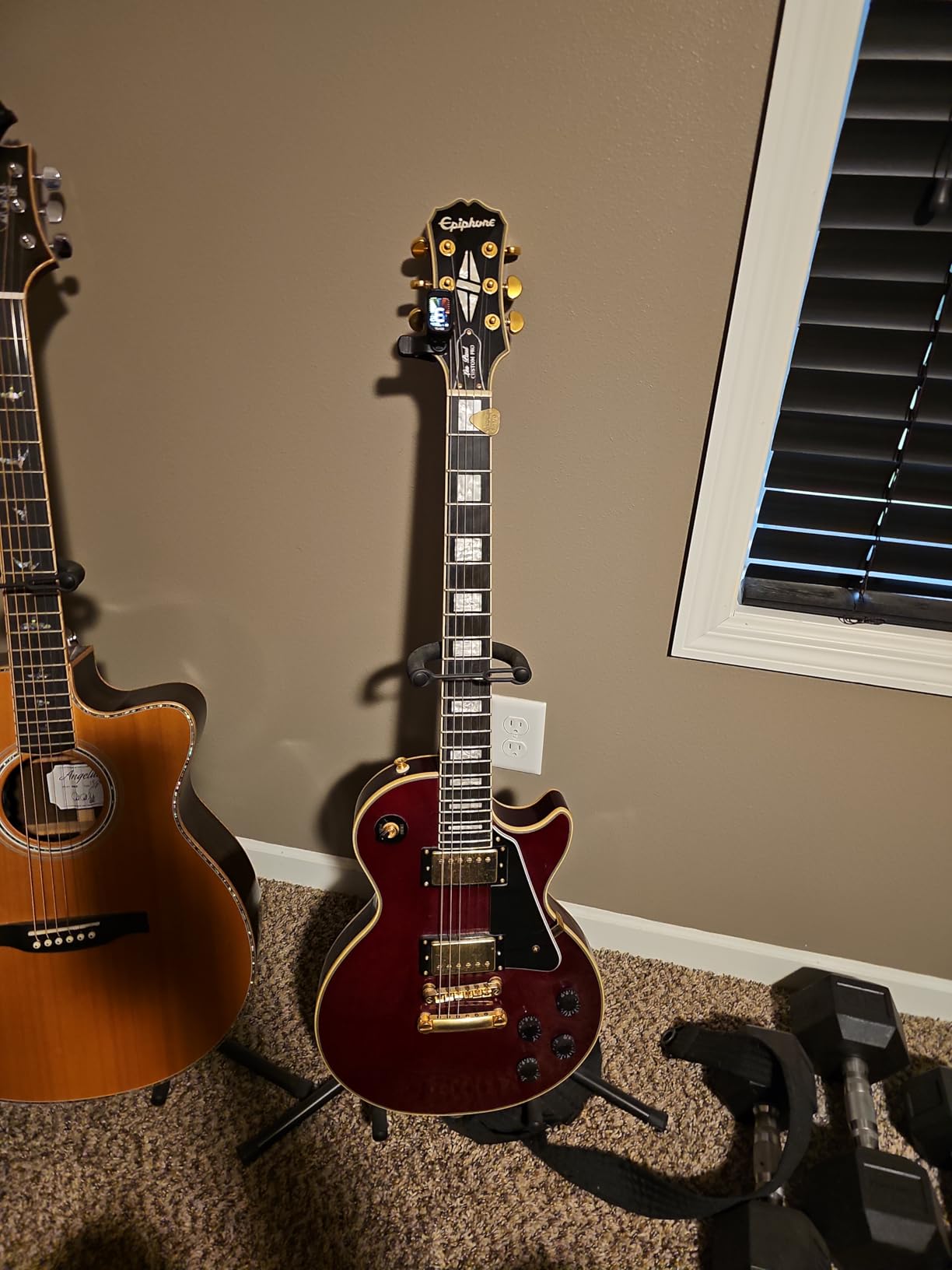
The high-contrast color display is bright and swivels to any angle, and the padded clip holds firmly on the headstock. Three buttons are enough to run it without reading the instructions, which matters if you pick it up cold.
At 1.41 ounces it is light, and it is small enough to live in a shirt pocket between sets.
This is also the tuner with the smallest review base in the roundup at around 480 ratings, so the long-term track record is shorter than the others. That is the main reason it sits at the back of the list rather than higher.
Why the mounting design matters more than it sounds
A ball joint is a small, hard-working part that carries the weight of the tuner every time you clip on and off. Owners across this list report those joints loosening or breaking after months of daily use, and the BOSS design deliberately avoids one.
If you clip on and remove a tuner dozens of times a week, that is a meaningful difference in how long the unit lasts.
The button layout catches people out
The left-side button doubles as both power and mode select, which means modes can change accidentally when you are reaching for it mid-song. It is the most common criticism in owner feedback.
Accuracy is around plus or minus one cent rather than exceptional, the lowest note it detects is around low B so drop bass tunings fall outside it, and one owner reported the clip flying off and snapping the unit. None of that matters for a steel-string acoustic in standard tuning, which is exactly what this is for.
How Clip-On Tuners Read an Unplugged Acoustic?
Yes, clip-on guitar tuners are any good, and for an acoustic they are usually the correct answer. A piezo transducer inside the clip senses the string’s vibration, and a chip converts that into a note name plus a sharp or flat reading measured in cents against your chosen reference pitch.
The alternative is a microphone tuner, which listens to the sound in the room. That works fine at home and fails everywhere else, because a bandmate, a drum kit or a talking audience will produce a louder signal than your sixth string.
Because vibration sensing reads the string directly, the loudness of the room stops mattering. It also means the tuner works on an acoustic with no pickup installed, no cable, and no batteries in the guitar itself.
A cent is one hundredth of a semitone. On a standard acoustic that means being within five cents of standard tuning is inaudible to most people, so anything claiming plus or minus one cent accuracy is more than sufficient for playing.
Will a Clip-On Tuner Damage Your Guitar Finish?
This is the most common objection we saw in owner discussions, and it is a fair one on nitrocellulose finishes. Thin nitrocellulose lacquer is the finish used on many higher-end acoustics, and it is soft, it softens under pressure, and it can take a mark from something clamped to the headstock for a long time.
The marks people report fall into two groups. Some are surface scuffs from the jaws of a cheap plastic clip. Others are pressure marks that look like a burn at first and then fade over days, which is what happens when a hard jaw has been resting on soft lacquer.
Four things reduce the risk. A padded or rubber-lined jaw spreads the load, a tuner with a ratcheting clip lets you set the grip just tight enough rather than forcing it, and a swivel-mounted arm means you do not need to twist the clip hard to get an angle. Leaving a tuner clamped on for weeks at a time is the bigger risk than the clip itself.
Within this roundup, the KLIQ UberTuner, the D’Addario Micro and the Peterson StroboClip HD all use padded or rubber-lined clamps specifically for this reason.
For a first guitar, the finish is usually a thin poly finish that shrugs off a clip. The marks people worry about are mostly on the guitars they care about most, which is a strange place to save money.
How to Choose a Clip-On Tuner for Acoustic Guitar
Accuracy, and consistency with it. The printed figure matters less than you would think. Any tuner in this roundup that reads within a cent is accurate enough to play on, so judge them on whether repeated readings agree with each other. A tuner that settles the same way every time is more useful than one with a better number that wanders.
Tuning modes. A chromatic tuner names the note and shows how far off you are, and it is what most acoustic players need. A polyphonic tuner reads several strings at once, which speeds up a whole-guitar check after restringing. A strobe tuner shows a moving light pattern that stops when the string is in tune, and it gives the most precise reading available in a clip-on. You do not need all three. For intonation work, strobe is the one that earns its place.
Display brightness. This is a bigger factor than most buying guides admit. A dark screen is useless on a stage or in a practice room with low light, and any claim about sunlight readability should be checked against where you actually play. The Peterson StroboClip HD has a 192-segment display that stays readable in direct sun; most of the rest are fine indoors and marginal outdoors.
Clip and hinge build. This is the part that fails first. Ball-and-socket joints loosen, plastic ratchets wear, and stiff clips crack. Look for a padded jaw, a swivel that holds its position, and a mount design that does not rely on a small screw. The BOSS TU-02 avoids the ball joint entirely, which is why owners coming from other brands rate its mount so highly.
Battery type. A coin cell such as the CR2032 or CR2 is cheap and lasts months, but it fails without warning and you need a spare. A rechargeable lithium cell removes that failure mode and is better if you tune constantly between songs, which is what the Snark SN5X and the Fender Flash 2.0 offer.
Calibration reference. Most players never touch this. It matters if you work at a non-standard pitch, use a capo and tune by offset, or play in an orchestra at a different A. The D’Addario Micro covers 410-480Hz and the KLIQ UberTuner 430-450Hz with transposition keys, which is the widest coverage here.
Clip placement and tuning direction. Attach the tuner to the headstock with both claws fully in contact, never just one side. Always tune up to pitch rather than down, because a string approached from below reads differently from one approached from above.
Clip-on, pedal or app. If you already run a pedalboard, a pedal tuner can be better because it reads the signal after your pickups. If you only play acoustic and never use pedals, a clip-on is the right tool. Apps are useful for checking a reference pitch and useless in a loud room, so treat one as a backup rather than the main tuner.
Multiple instruments. If you also play bass, ukulele, mandolin, banjo or violin, check the mode list before buying. Most tuners here cover guitar and bass, and only the KLIQ UberTuner and Fender Flash 2.0 go wider. If you play in drop D, check that the tuner’s lowest note reaches low B or lower, because some clip-ons cannot read it.
Keeping the guitar in tune. No tuner fixes a guitar that will not hold pitch. Good tuning pegs, a graphite-coated nut, clean string trees and well-fitted bridge saddles matter as much as the tuner. If you are starting a fresh instrument, our Taylor acoustic guitar guide and budget acoustic picks cover the hardware side.
Frequently Asked Questions
Are clip-on guitar tuners any good?
Yes, and for an acoustic guitar they are usually the right choice. The clip contains a piezo transducer that senses string vibration rather than listening to the room, so readings stay accurate in a loud rehearsal space or on a small stage where a microphone tuner jumps around. It needs no pickup, cable or battery in the guitar.
Which clip-on guitar tuner is the most accurate?
The Peterson StroboClip HD has the most demanding specification at plus or minus 0.1 cent in strobe mode with zero display lag, and owners with decades of experience describe it as the accuracy benchmark. Among the rest, the Fender FT-1 and KLIQ UberTuner also report very consistent readings from the mid tier.
Which tuner is best for acoustic guitar?
For most acoustic players the Snark SN5X is the best all-round choice, with vibration sensing, a bright full-color display and a rechargeable battery. If you work on intonation, take the Peterson StroboClip HD for its strobe accuracy and sweetened tuning presets. If you are just starting out, the Fender FCT-2 is the easiest to use.
Can a clip-on tuner damage my guitar finish?
It can, and thin nitrocellulose lacquer is the finish most at risk. Marks come from jaw pressure over long periods rather than from clipping on briefly. A padded or rubber-lined jaw, a ratcheting clip set only as tight as needed, and a tuner that sits behind the headstock all reduce the risk.
Can I use one clip-on tuner for bass and guitar?
Most clip-on tuners in this roundup cover both, since their frequency ranges are tuned to overlap. Check the lowest note the unit detects before buying, because some stop around low B and will not read drop bass tunings. If you play ukulele, mandolin or banjo too, the KLIQ UberTuner has dedicated modes for all of them.
Which Clip-On Tuner Should You Buy?
The Snark SN5X is the best clip-on tuner for acoustic guitars in 2026. It senses vibration rather than sound, so it stays accurate in a loud room, it has a bright, easy-to-read full-color display, and the rechargeable battery means you never stop mid-song to hunt for a coin cell.
Take the Fender FT-1 instead if you want accuracy without the rechargeable convenience, and the Donner DT-2 if home practice is genuinely all the tuner needs to do. Choose the Fender FCT-2 if you are new to tuners and want nothing to configure.
Buy the Peterson StroboClip HD if you work on intonation or play open chords in fingerstyle arrangements, where sweetened tuning is a real upgrade rather than a gimmick. Pick the Fender Flash 2.0 if you play in drop D or DADGAD, and the KLIQ UberTuner if you move between several stringed instruments all week.
Whatever you choose, clip it on, tune up, and retune after your strings settle. That last habit does more for your intonation than any setting on any tuner.