
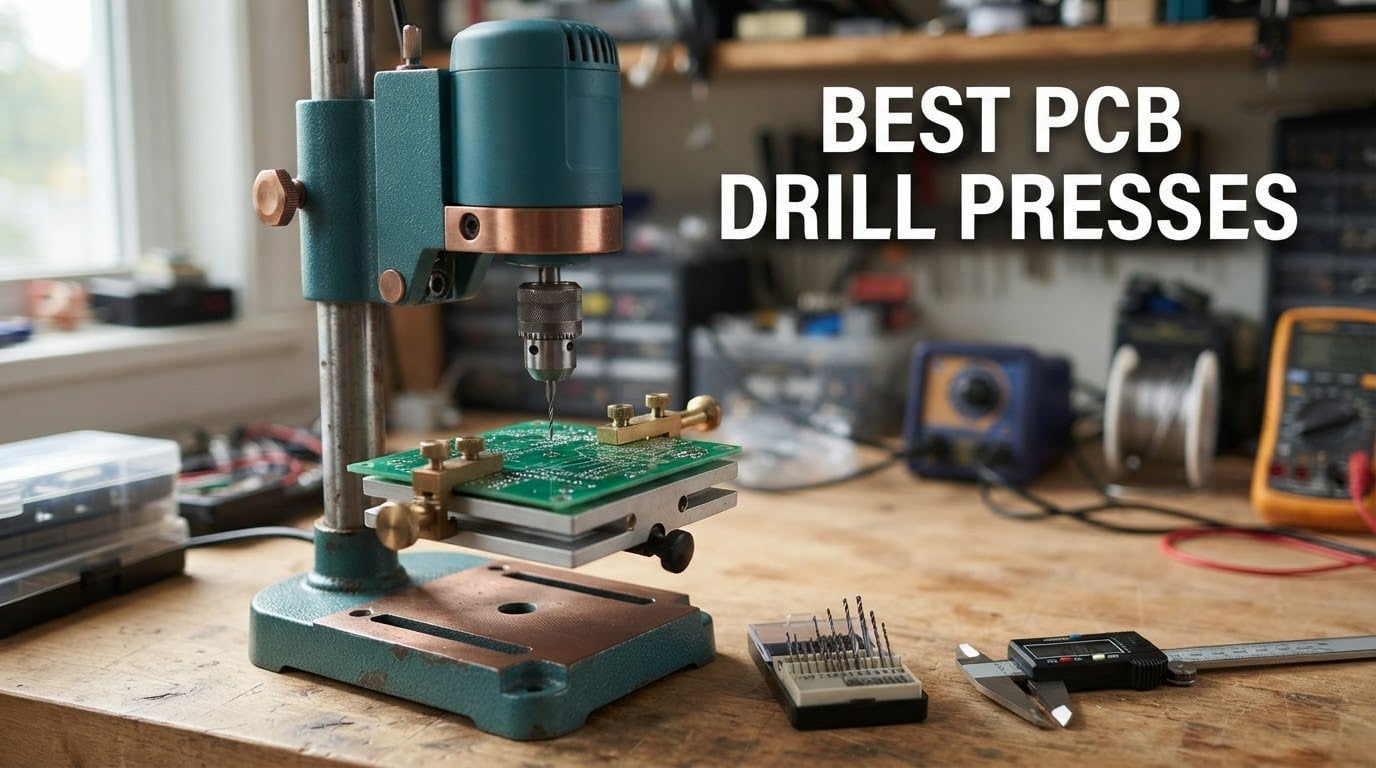
Drilling a printed circuit board by hand is the fastest way to a cracked board, a hole that walked off the pad and a lot of swearing. A PCB drill press fixes all three problems in one afternoon, and the difference between a cheap stand and a proper precision machine shows up in the first ten holes you drill. After working through twelve bench and desktop presses on a busy electronics bench, here is our guide to the best PCB drill press options for 2026, ranked by the things that actually matter on a fibreglass board.
Our lineup covers the full range of what is available today: rotary tool stands that turn a Dremel into a press, compact metal machines with 795 motors, and a laboratory-grade German bench press with collets that hold 0.3mm bits. Every machine below was assessed on runout, depth control, chuck or collet range, and how it behaves with a 0.8mm bit in FR-4.
We also leaned on what makers actually say. On the DIY pedal-building forums the recurring question is always the same, and it is never about the top speed of a motor. It is about whether the frame flexes, whether the base is heavy enough not to walk across the bench, and whether you can repeat the same hole on the next board. If you want a wider bench comparison first, our picks for the best benchtop drill presses and best drill presses overall cover the full-size class in detail.
Table of Contents
What Is a PCB Drill Press?
A PCB drill press is a small, high-precision bench machine that holds a micro drill bit straight down and feeds it to a controlled depth, so you can drill clean, consistently positioned through-holes in a bare printed circuit board without breaking it. The rigid column and flat table are what a hand-held rotary tool cannot give you.
PCBs are drilled with ordinary 0.5-1.2mm carbide or HSS bits, so you do not need a specialist machine. What you need is something that keeps the bit vertical, holds the board flat against a sacrificial backing board, and stops at a repeatable depth. A press with a chuck reaching at least 0.5mm covers the overwhelming majority of hobby board work.
Beyond drilling, the same machine handles enclosure work, model making and jewellery work. If you already own a set of PCB prototyping tools, a press is usually the one addition that changes your results most.
Top 3 Picks for PCB Drilling in 2026

Dremel 220-01 Workstation
- 2 inch depth capacity
- 15-degree angle increments
- Telescopic flex shaft stand

PROXXON TBM 115
- Micro holes down to 0.5mm
- Three spindle speeds to 8500 RPM
- Six precision collets included

All 12 Best PCB Drill Presses Compared in 2026
| Product | Specifications | Action |
|---|---|---|
| Dremel 220-01 Workstation Stand |
|
Check Latest Price |
 Milescraft 1097 Variable Speed Stand Milescraft 1097 Variable Speed Stand |
|
Check Latest Price |
| NovelLife B10 Precision Mini Press |
|
Check Latest Price |
 BACHIN MINIQ 710W Bench Stand BACHIN MINIQ 710W Bench Stand |
|
Check Latest Price |
| PROXXON TBM 115 |
|
Check Latest Price |
 EWANYO Mini Benchtop Press EWANYO Mini Benchtop Press |
|
Check Latest Price |
 Bonvoisin 1200W Benchtop Press Bonvoisin 1200W Benchtop Press |
|
Check Latest Price |
 bellaDimora Mini Benchtop Press bellaDimora Mini Benchtop Press |
|
Check Latest Price |
 MXBAOHENG CLA-218 Mini Press MXBAOHENG CLA-218 Mini Press |
|
Check Latest Price |
 IOENC Portable Jewelry Drill Press IOENC Portable Jewelry Drill Press |
|
Check Latest Price |
 SEANESZTI 340W 3-Speed Press SEANESZTI 340W 3-Speed Press |
|
Check Latest Price |
 Hoteche Variable Speed Mini Press Hoteche Variable Speed Mini Press |
|
Check Latest Price |
1. Dremel 220-01 Drill Press Workstation – Best Overall for PCB Drilling
- Turns a rotary tool into an accurate press with repeatable 90-degree hole placement
- Fluid lever movement and smooth vertical action
- Crowsnest bit storage makes bit changes fast
- Rotates to horizontal for sanding grinding and polishing
- Clamps to a bench for stability
- Lightweight base can tip if not clamped down
- Tool holder collar screw may not fit non-Dremel rotary tools
- No fence on the baseplate for registering workpieces
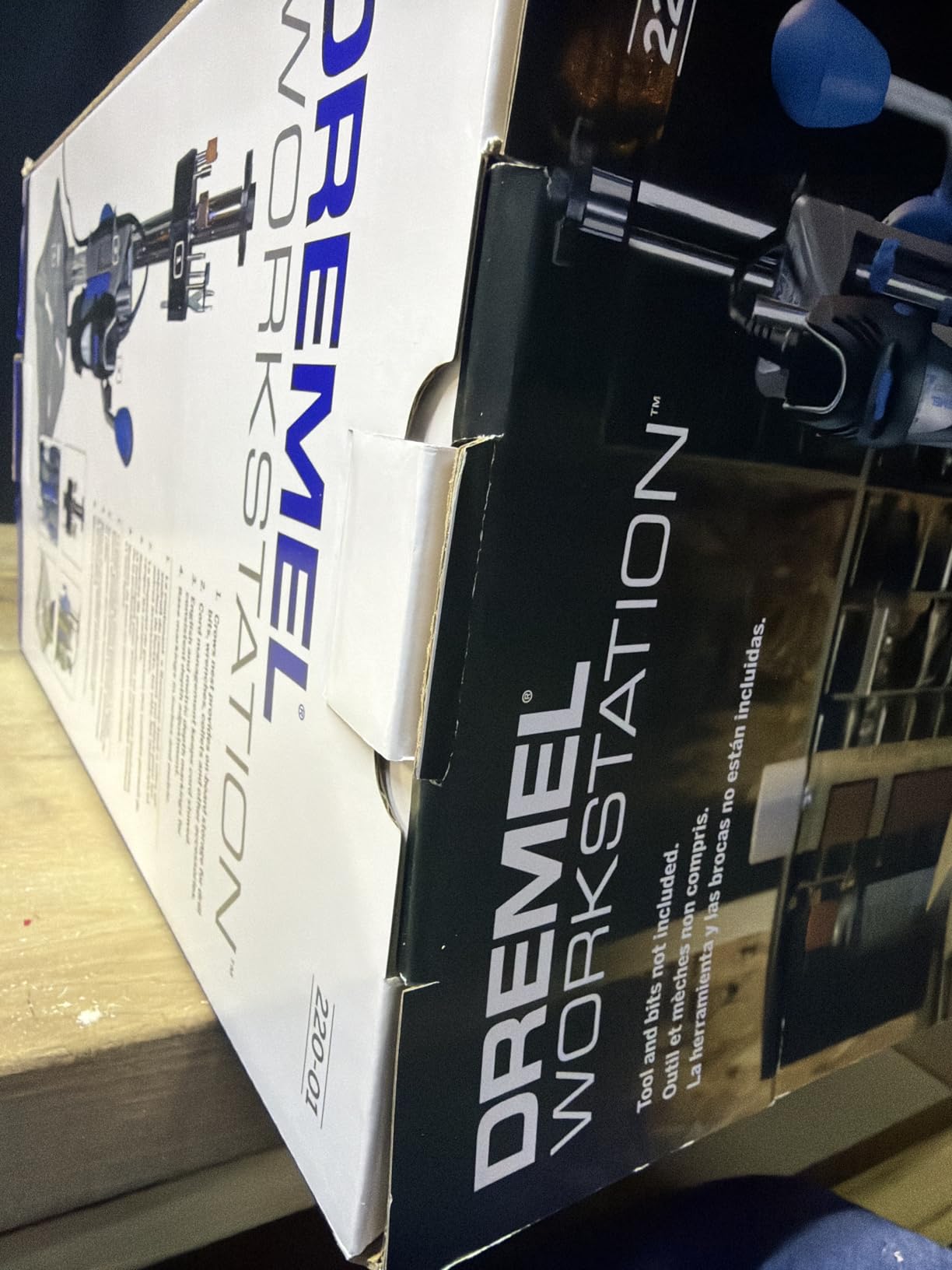
With more than seven thousand reviews behind it, the Dremel 220-01 is the most proven way to turn a rotary tool into a repeatable press. Owners consistently report thousands of precise holes drilled in hobbies from model building to jewellery and PCB work, which is the track record we look for in an entry machine. It handles angled holes in 15-degree increments all the way to 90 degrees horizontal, which matters more for enclosure work than for board drilling but keeps it useful in a pedal-building workflow.
For PCB work specifically, the 2 inch depth capacity and the scaled depth stop are the parts you will use every time. The telescopic flex shaft stand adjusts from 16 to 29 inches, so the same machine works at a sitting bench and standing at a workbench. The crowsnest bit storage on the base is a small detail that saves real time when you are swapping between 0.5mm and 0.8mm bits.
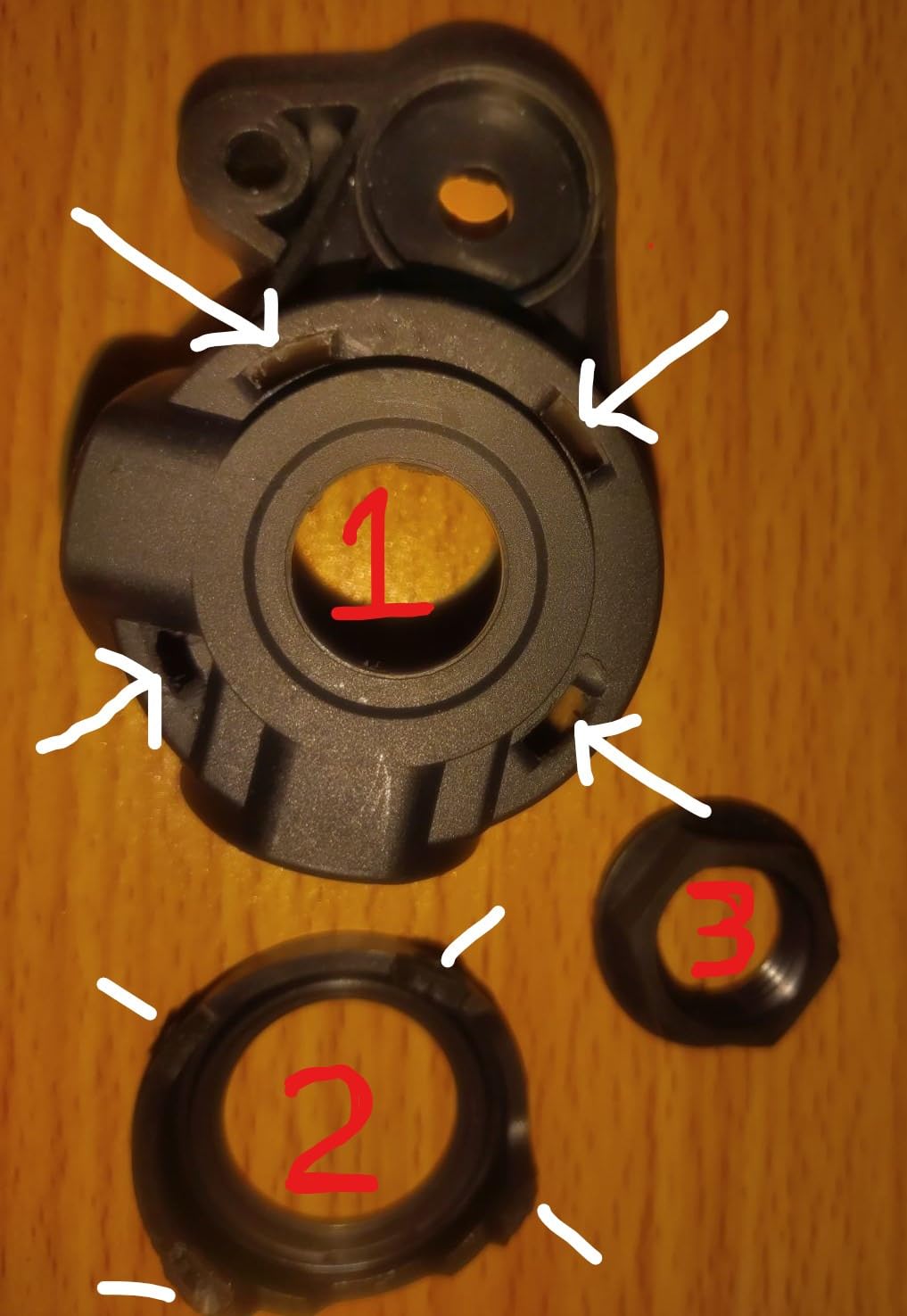
The build is metal and plastic and weighs 4.9 pounds, with a 5.98 by 5.98 inch base and a limited 1 year manufacturer warranty. Assembly relies on drawings that some buyers find confusing, so budget an evening for the first setup rather than an afternoon. Once assembled it clamps to a bench, and that step is not optional.
One of the more useful things about it is that the head rotates to horizontal, so the same flex shaft handles sanding, grinding and polishing as a third hand. For a maker with one rotary tool and no dedicated press, that versatility is the reason this machine has stayed on the bestseller list for years.
When this is the right pick for you
If you already own a Dremel-style rotary tool, this is the cheapest path to a straight, depth-controlled press. It suits anyone drilling prototype boards in short bursts, and the angle increments make it a genuinely good companion for drilling enclosure faces and drilling pilot holes in a box panel.
The depth stop markings come in both inch and metric, which avoids mental conversion when you are following a board layout. There is a depth stop in the stand, so a batch of identical holes in a row is achievable once you dial it in.
When it is the wrong pick for you
The base is light enough to tip if you lean on the lever hard with the head extended, so clamp it down or bolt it to the bench. The tool holder collar screw is sized for Dremel tools, which can be a problem if you run a different rotary tool brand.
There is no fence on the baseplate for registering a workpiece, so registering the same position on consecutive boards is manual work. And if you need a rigid machine for 0.3mm bits in a repeat-production run, the light frame of a flex shaft stand is not the answer.
2. Milescraft 1097 Variable Speed Drill Press Stand – Best for a Tight Budget Setup
Milescraft 1097 ToolStand – Variable Speed Drill Press Stand (compatible with Dremel). Rotary Tool Not Included, Black
- Rack and pinion gearing gives smooth controlled feed
- Steel base plate provides a level work surface
- Depth stop scale improves repeatability
- Compact footprint suits small benches
- Rotary tool must be purchased separately
- Plastic base collar can crack if overtightened
- Adjustment rings and depth stop can loosen during use
Milescraft 1097 is the simplest route to a rack and pinion feed, which is the gearing style that gives a rotary tool stand its smooth, controlled downward motion. Buyers see it as a solid budget drill press stand for hobby rotary tools, and they consistently name the metal head, the gearing and the depth control as the reasons.
The steel base plate is planed rather than stamped, so the surface is genuinely level for a board to sit flat against. The depth stop carries a scale, which is what makes a repeated hole at the same depth possible. A 13.5 inch steel column holds it steady, and the tool locks in a horizontal position for hands-free work.
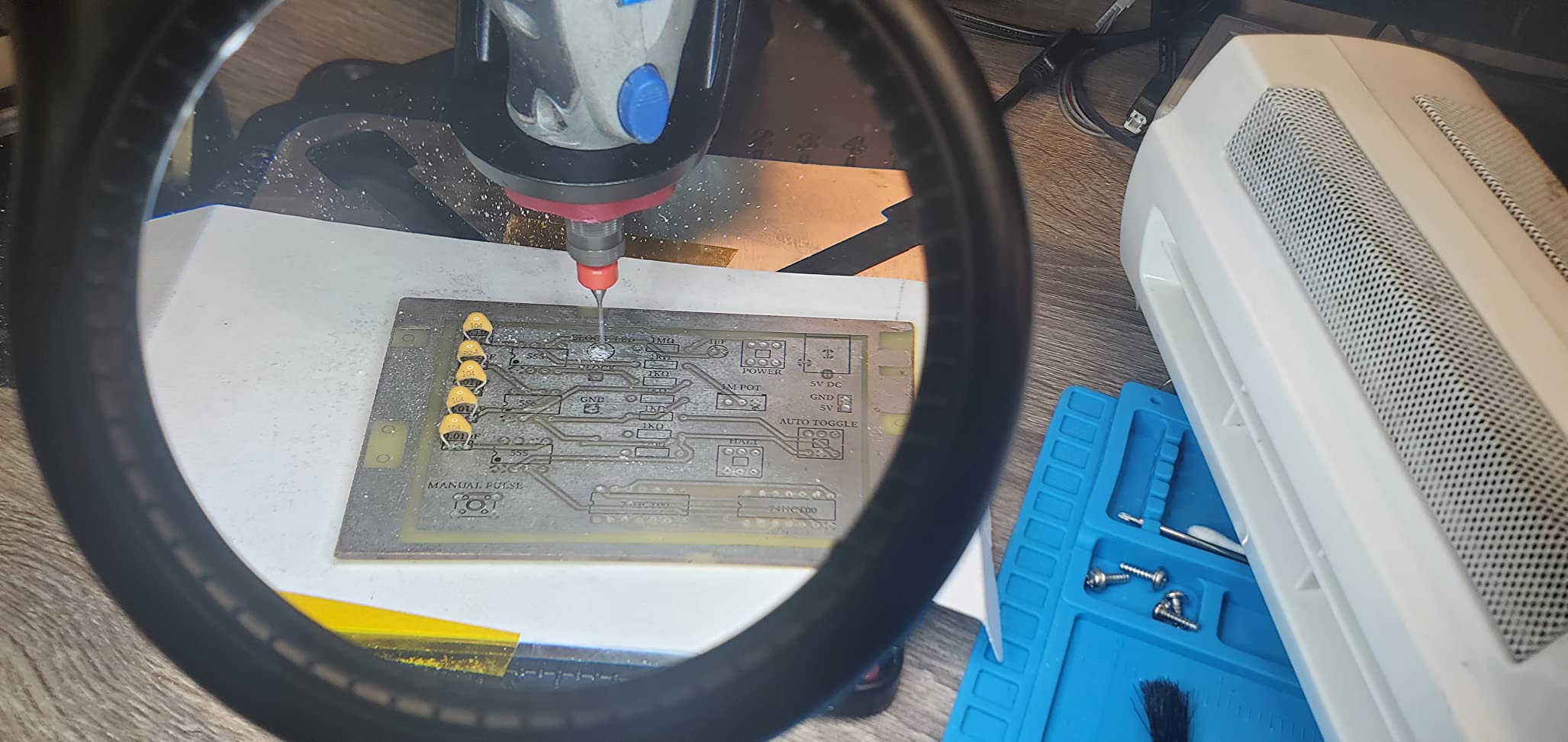
The tool is not included, so this is a stand for someone who already has one. The head fits most Dremel-style rotary tools, which is a wider net than the Dremel-branded stand above. At 16 ounces with a 7.5 by 5.3 by 13.3 inch footprint, it is the smallest machine in this group by a wide margin.
It is worth pairing with a PCB holder so the board registers the same way each time, because the stand itself offers no workpiece fence.
When this is the right pick for you
Choose this if bench space is the constraint. The footprint is small enough to sit in a corner of a desk and still leave room for a soldering iron. The rack and pinion feed makes it a step up in control from a hand-held rotary tool even at a modest budget.
It is a good companion for drilling small enclosures where a full bench press is overkill. The steel base gives you a stable surface to push against, which is the main complaint levied at cheap plastic stands.
When it is the wrong pick for you
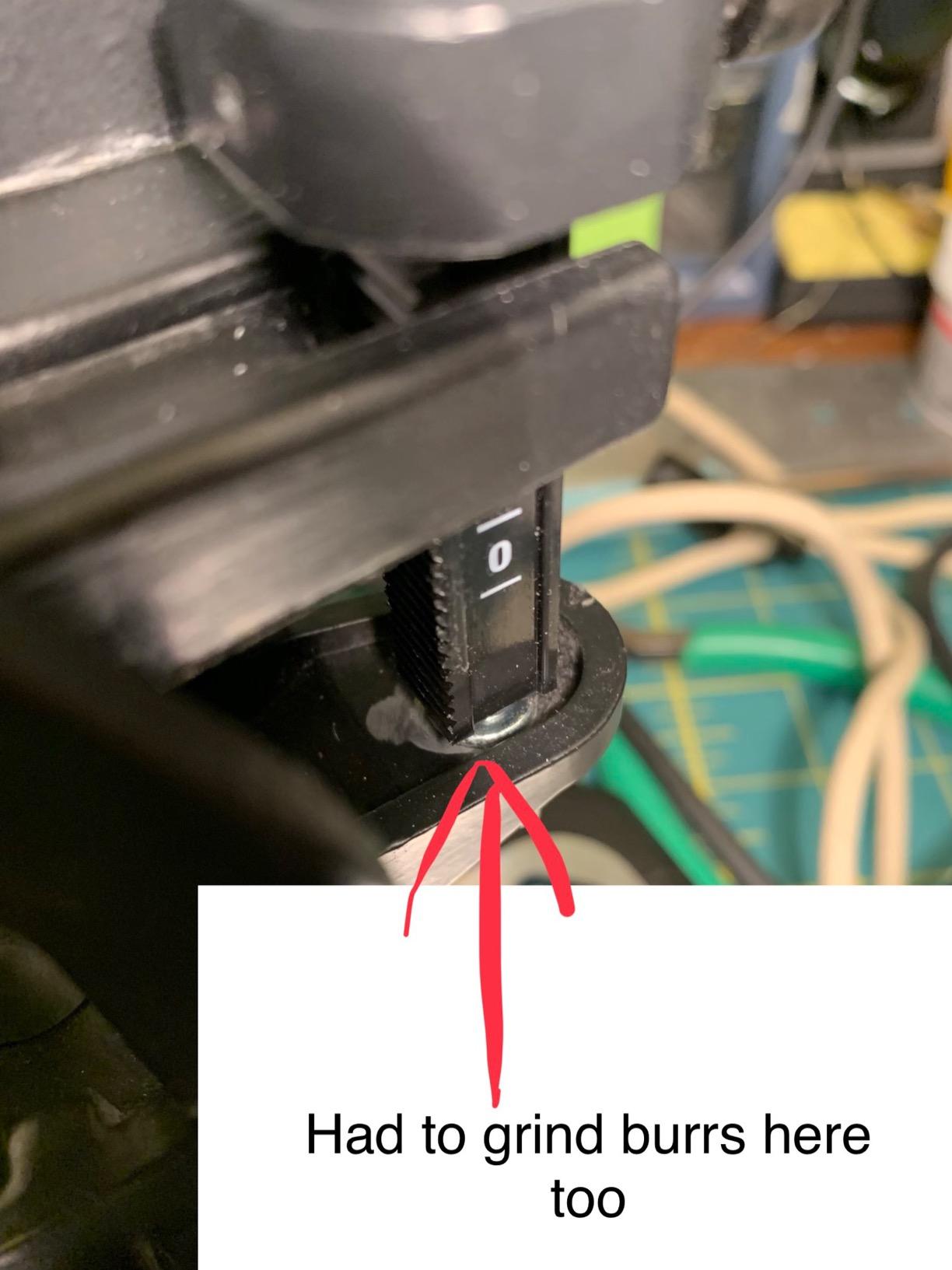
The plastic base collar can crack if you overtighten it with the included wrench, and the adjustment rings plus depth stop can loosen during use. Both are easy fixes with a dab of thread lock, but they are recurring maintenance items.
Feedback on long-term stability and ease of tool insertion is mixed, so expect to check the fittings before a batch of holes rather than trusting a setup from last month. If you need a machine with a powered spindle, this is the wrong category entirely.
3. NovelLife B10 Precision Mini Drill Press – Best Value Powered Press
NovelLife Precision Mini Drill Press Benchtop Driller Machine B10 Upgraded
- Very low runout achieving 0.01-0.02mm precision in plastic
- Compact 5.9 x 4.7 x 8.7 inch footprint saves bench space
- Stable during operation with no wobble
- Quiet operation suitable for home use
- Handles tiny bits without snapping them
- Included flat vise is weak for serious work
- Limited to soft materials not steel or thick aluminum
- Sparse written instructions
The NovelLife B10 is the strongest powered value in this roundup and the machine we reach for when a project needs more than a stand can offer. Reviewers report runout of 0.01-0.02mm in plastic, which is tight enough that a 0.5mm bit lands where you put it on the first pass. Reviewers also report it stays stable during operation with no wobble.
The frame is a solid metal structure with three metal axes and two linear bearings, which is the reason the head does not chatter. A 795 DC motor runs up to 7000 RPM from the included 24V adjustable power supply, and the 40mm stroke is more than a 1.6mm FR-4 board needs.
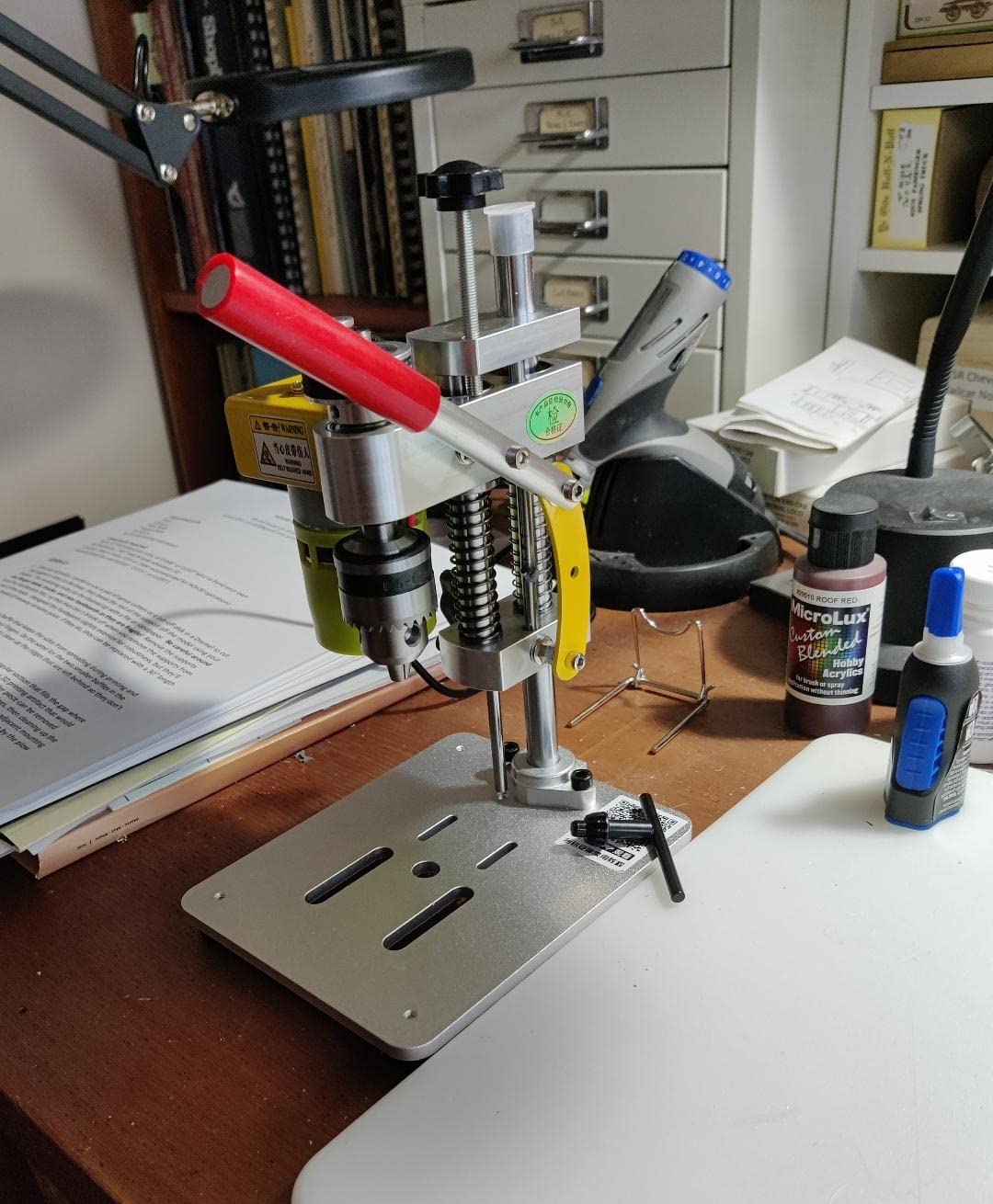
Two base slots accept either the supplied flat vise or a CNC sliding table, so this machine is a genuine stepping stone if you later want semi-automated drilling. In the box you get the press, a metal flat vise, the 24V adjustable supply, an HSS bit and an Allen wrench set. It weighs 2.2 kg and runs quietly enough for a shared room.
When this is the right pick for you
This is the one to buy if your boards have fine pitch footprints and via fields where a 0.5mm hole landing half a millimetre off centre is a scrapped board. Tight runout and linear bearings are the whole point of the design, and reviewers specifically call out that it handles tiny bits without snapping them.
It is also a good multi-material stop because the chuck takes 0.6-6mm HSS bits for wood, plastic, resin and soft aluminium. If you build resin enclosures alongside electronics, that covers both jobs on one machine.
When it is the wrong pick for you
The included flat vise is the weak point. Owners doing serious clamping work replace it early, and if you routinely cut boards to shape, budget for a better vise. It is also limited to soft materials, so steel and thick aluminium bar are out.
Written instructions are sparse and delivered as a photo, and the hex key for the height stop is slightly undersized enough to strip the screw if you force it. Expect to spend an hour on the first alignment.
4. BACHIN MINIQ 710W Bench Drill Stand – Best Multi-Material Bench Stand
- Geared motor holds speed with no RPM drop under load
- No chuck play delivering accurate repeatable holes
- Head rotates 180 degrees to drill horizontally
- Spare carbon brushes included
- Listed 0-2800 RPM range is optimistic with the low end closer to 450 RPM
- Heavy spring loaded handle takes effort to operate
- Can bog down if the bit is pushed hard on hardwood
The BACHIN MINIQ is a genuinely powered bench stand rather than a rotary tool fixture, and at 11.4 pounds it is portable enough to store under a bench between jobs. Users find it rivals larger 10 inch bench presses for accuracy at a fraction of the weight, with no chuck wobble and steady speed under load.
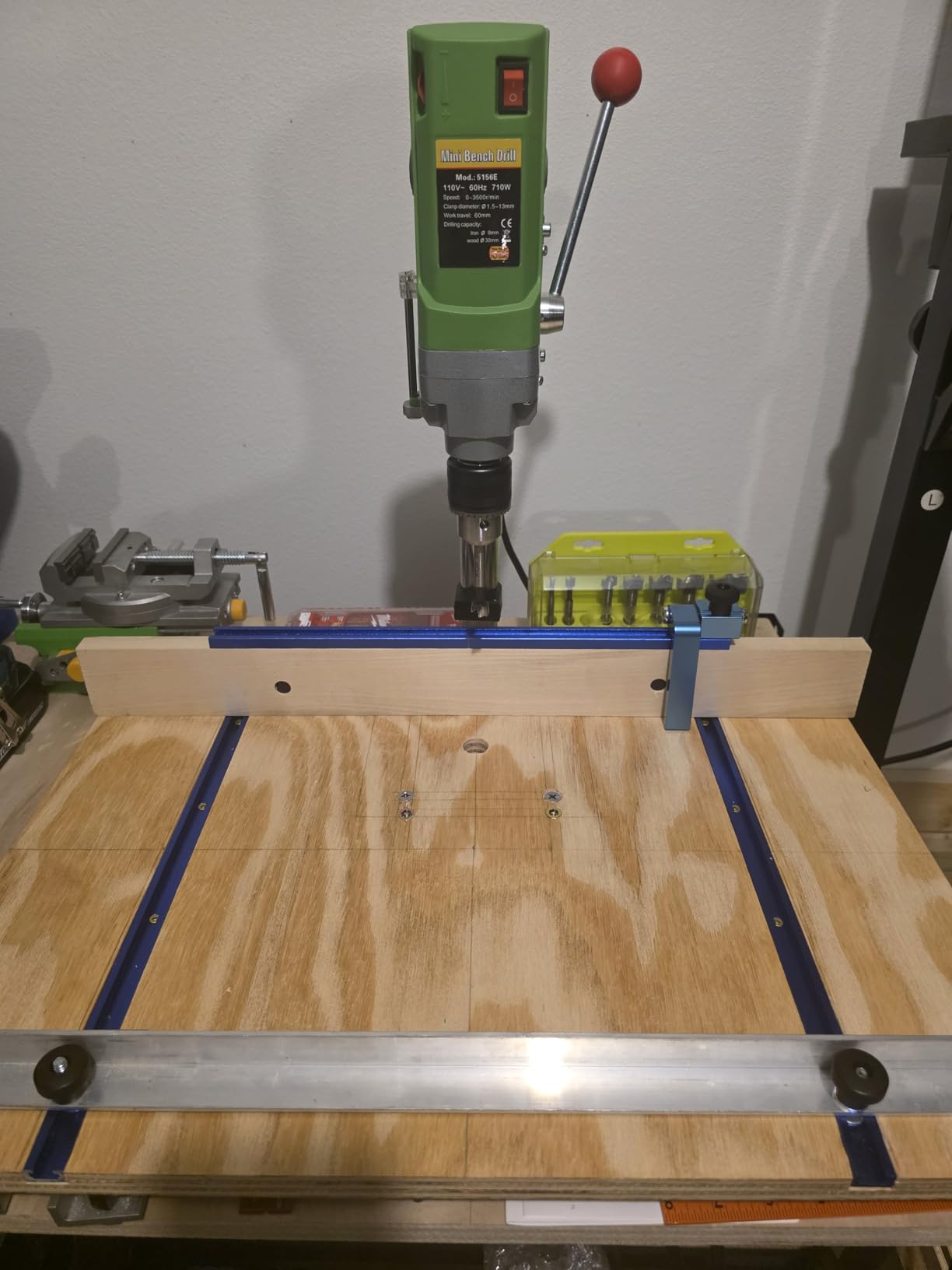
The 710W motor is geared with direct drive and no belts, which is why it holds RPM where belt-driven machines sag. The 1.5-13mm keyless chuck is a marked step up from a 3mm chuck for general bench work, and the head rotates 180 degrees so it drills horizontally as well as vertically.
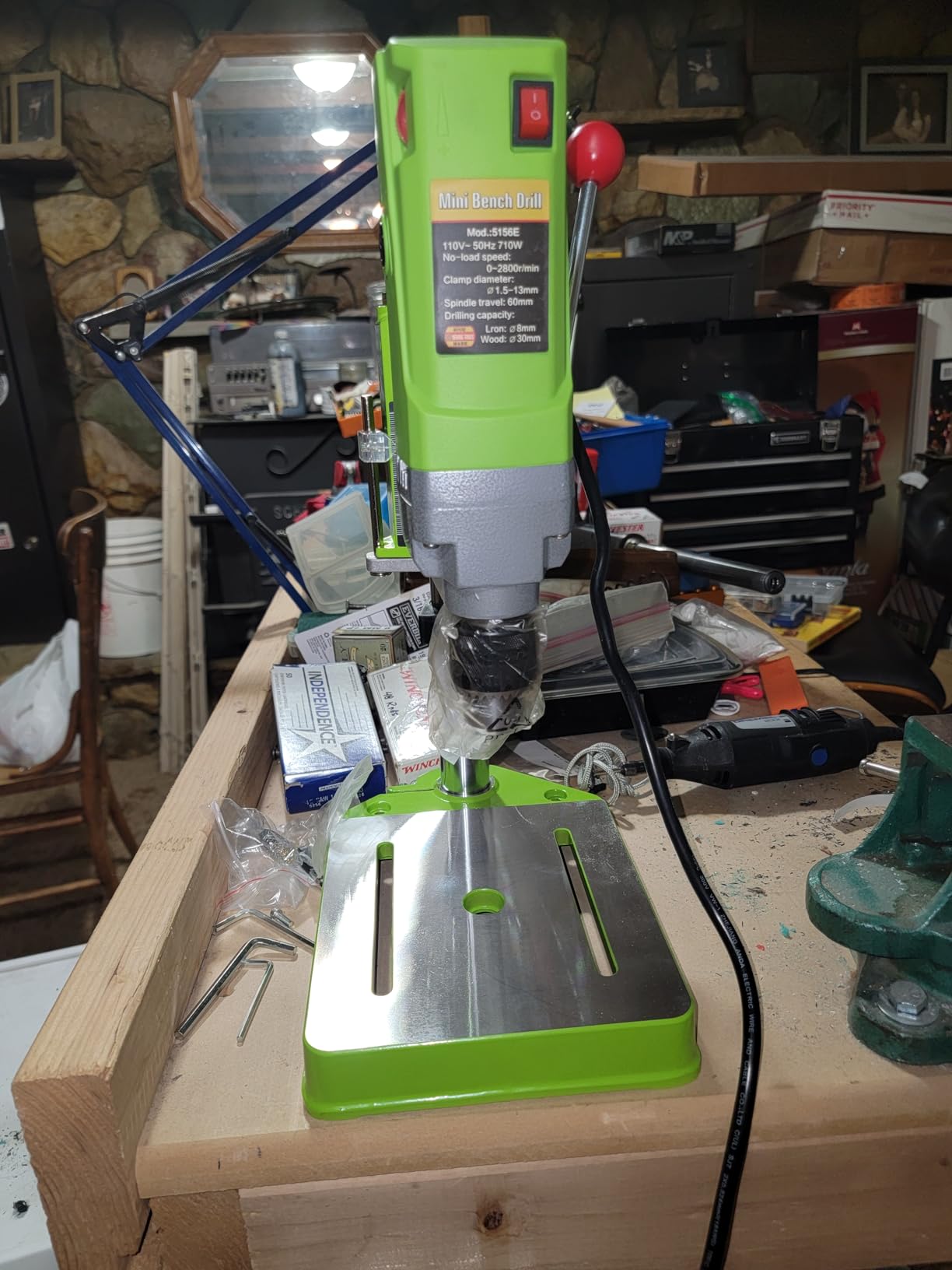
It runs on 110V AC drawing 3.23A, and spare carbon brushes are included, which matters for a machine with a brushed motor at this duty level. Note that the listed dimensions in the source data are unreliable, so measure your bench space before ordering.
When this is the right pick for you
This suits a maker who needs a proper powered press for board work and also drills wood and soft metal, without giving up a bench to a full-size column drill. The 180 degree rotating head means the same machine handles a face drilling job in an enclosure panel.
No chuck play is the headline for PCB work here. Reviewers describe accurate, repeatable holes, which is what you want when you are cloning a board and the second copy must match the first.
When it is the wrong pick for you
The published 0-2800 RPM range is optimistic, with the real low end closer to 450 RPM. That is fine for wood and plastic, but a 0.5mm bit in FR-4 is happier at a lower speed, so this is not the machine for delicate micro drilling.
The spring-loaded handle needs effort to operate, and the motor can bog down if you push a bit hard into hardwood. Support and spare parts are harder to source than they are for a mainstream bench brand, which matters if you plan to run it heavily.
5. PROXXON TBM 115 – Premium Pick for Sub-Millimetre Precision
- Undetectable runout once the quill is cleared and collets used
- Collets and spindle run true enough for 0.3mm PCB holes
- Quiet smooth operation with accurate depth control
- Includes 6 precision collets
- Vise and universal chuck are sold separately
- Limited quill travel restricts maximum hole depth
- Fiddly to position workpieces without a holding aid
The TBM 115 is the only machine in this group built explicitly for micro holes, and that changes what you can drill. It takes bits down to 0.5mm with its collet system, with three spindle speeds up to 8500 RPM from an 85W motor producing roughly 1.5 ft-lb of torque. Watchmakers, jewellers and PCB builders single it out for sub-millimetre accuracy and near-zero runout.
Reviewers report that once you work the quill fully clear and use the collets rather than an optional chuck, runout is effectively undetectable. That is the reason a 0.3mm PCB hole can be drilled without breaking the bit, which no flex shaft stand in this list can promise.
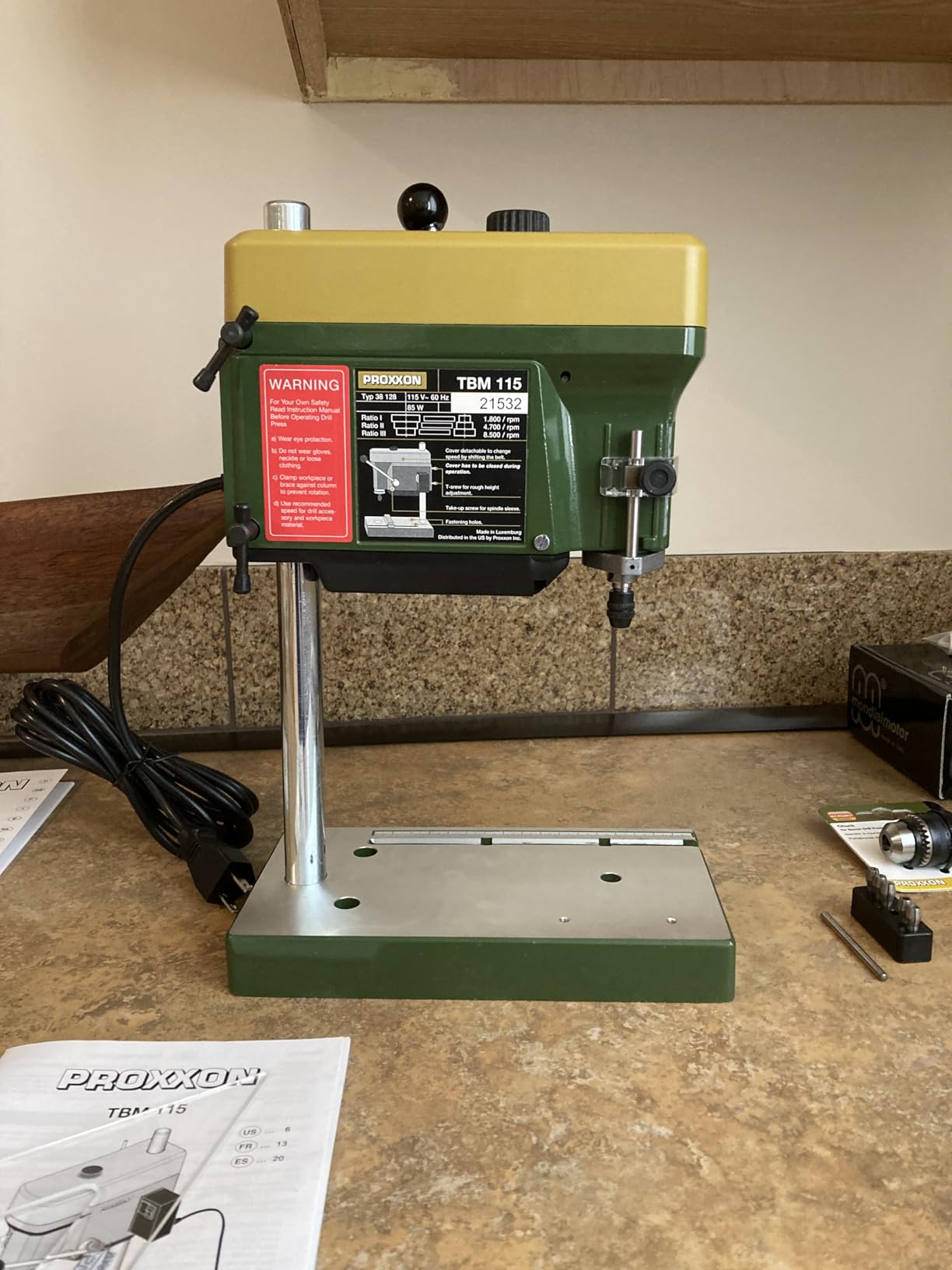
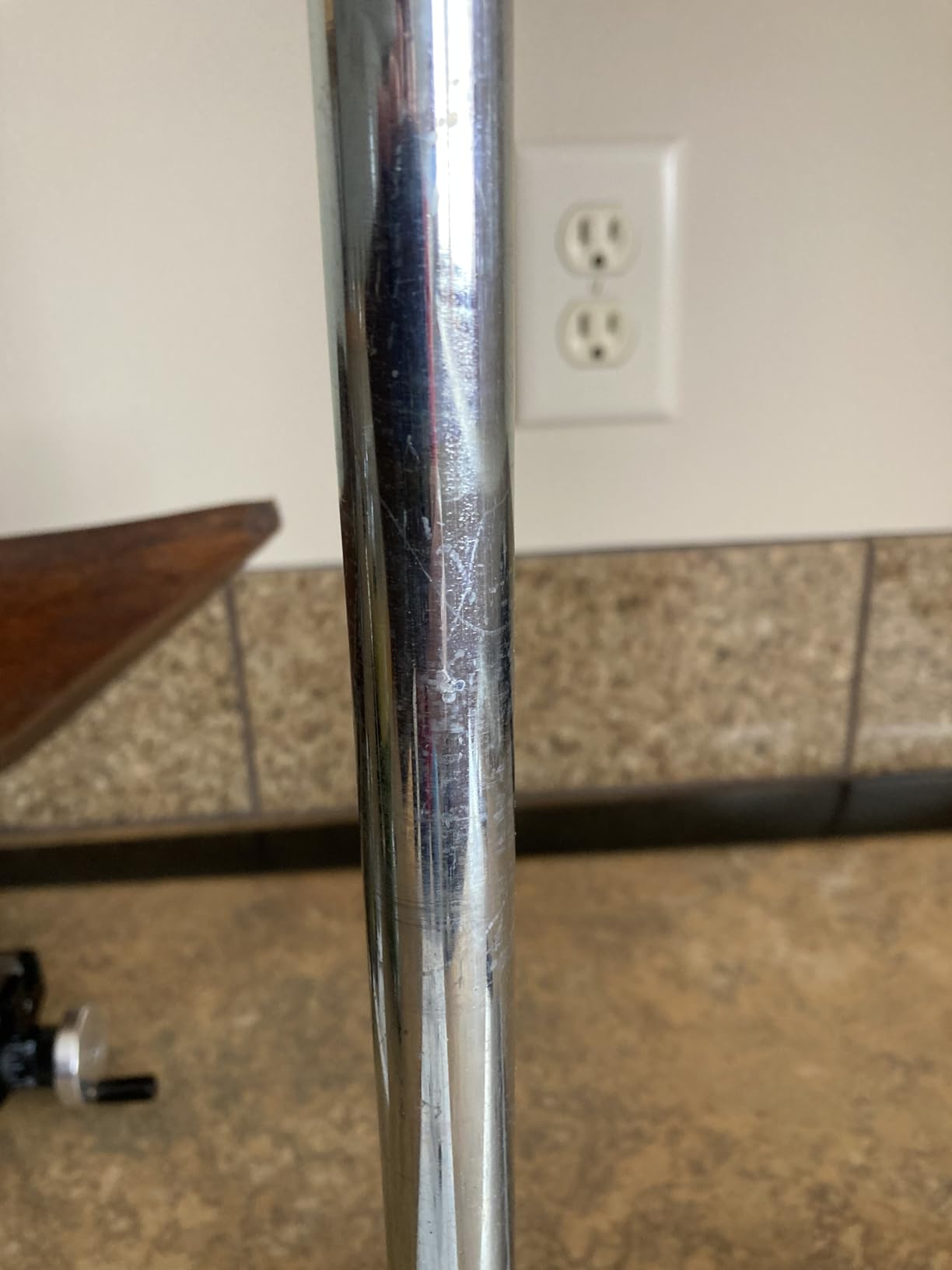
The build is a ribbed die-cast aluminium table on a hard-chromed steel column, with an adjustable parallel fence that carries a scale and a depth gauge. Six precision collets ship in the box and the machine runs on 120V. It weighs 8.3 pounds, so it is a genuinely portable precision machine rather than a shop installation.
When this is the right pick for you
If you work with fine pitch ICs, dense via fields or watch-scale electronics, this is the machine that removes the guesswork. Quiet, smooth running with accurate depth control matters when a board sits on the bench for days as you hand-assemble it.
It also does double duty for anyone who cuts watch parts, drills pearls or works on instruments, so the collet precision is not a luxury specific to PCBs. Compared to far costlier shop machines, owners find the performance hard to argue with.
When it is the wrong pick for you
The vise and universal chuck are sold separately, so add those to your budget before ordering. Limited quill travel caps the maximum hole depth, which is a real constraint on a thick stack of boards.
It is fiddly to position workpieces without a holding aid, and it is not sized for large bits, sanding drums or half inch holes. If your work is mostly 0.8mm holes in single-sided FR-4, you can spend less and lose very little.
6. EWANYO Mini Benchtop Press – Best for Tiny Desks
- Very small footprint suits cramped hobby desks
- CNC machined aluminum parts feel well made
- Thick base dampens noise and vibration
- Continuous speed adjustment over a useful range
- Clean precise holes in wood plastic and soft metal
- Small capacity limits it to thin and soft materials
- Needs a separate 12V 5A power supply for best results
- 30W motor has limited headroom on hard materials
The EWANYO is the smallest powered machine here, and for a cramped hobby desk that is the entire selling point. It is 3.94 by 3.15 by 7.09 inches and weighs 1050 g, so it can live next to a laptop rather than claiming a corner of a workbench.
Speed is continuously variable from 400 to 4500 RPM, which is a wider and smoother range than the stepped selectors on the bigger machines in this list. Owners highlight the build quality, quiet operation and suitability for jewellery, resin and model work in tight spaces. The 0.3-4mm capacity in wood and plastic covers the entire PCB bit range you will realistically use.
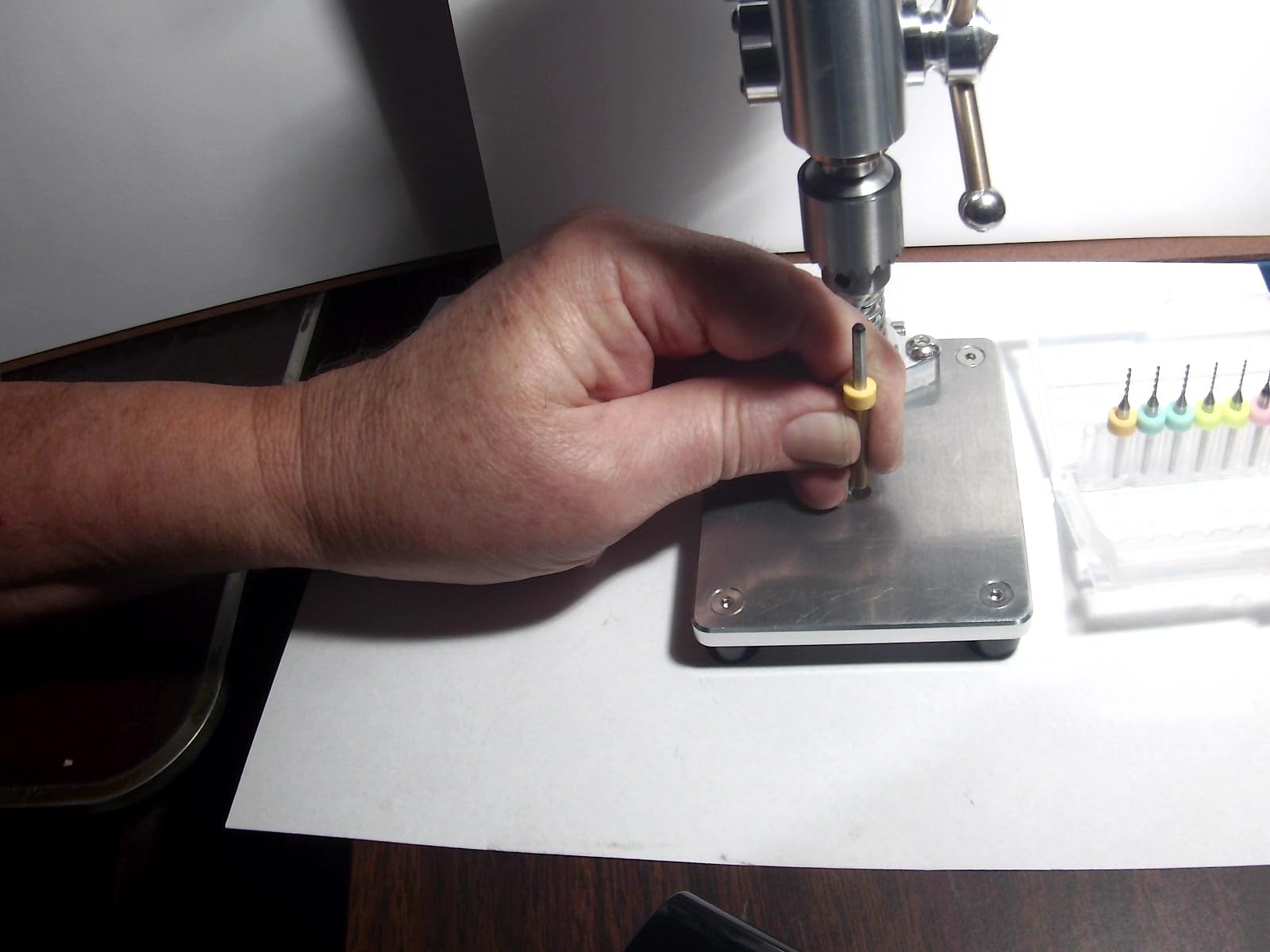
The body is CNC-machined aluminium alloy, and the thickened solid base is the part that reduces noise, vibration and skidding. A JT0 chuck with 360 degree rotation keeps the tool accessible at awkward angles. It runs on 12V and performs best with a 12V 5A supply, which is not included.
When this is the right pick for you
This is the machine for someone working at a desk with limited room and a small volume of boards. Continuous speed control from 400 RPM upward is genuinely useful on FR-4, where you want a slower bite than a 2800 RPM fixed-speed press gives you.
The JT0 chuck is a collet-style holder, so runout is better than a keyed chuck of the same size class. For resin, thin wood and plastic it produces clean, precise holes consistently.
When it is the wrong pick for you
The 30W motor has limited headroom and the capacity is small, so this is not a machine for hard materials or thick stock. If you also drill metal regularly, you will outgrow it quickly.
You need to source a 12V 5A power supply separately for the best results, and the review volume is low, which means less long-term feedback to draw on. A 3.15 inch wide table is also small for a full size board, so plan your workholding around that.
7. Bonvoisin 1200W Benchtop Press – Best All-Round Craft Machine
Bonvoisin Mini Benchtop Drill Press, 6 Variable Speed Drilling Machine for Craft and Home Improvement, 1200W Electric Drill Press 2800RPM Max Speed
- Strong 1200W motor with a wide speed range
- Rotating head allows both drilling and grinding with one machine
- Three handles give good leverage for larger workpieces
- Adjustable head height suits varied material sizes
- 18.8 pounds makes it heavy to move around a bench
- Speed range is narrow at the low end for delicate work
- Adjustment screws can loosen during drilling
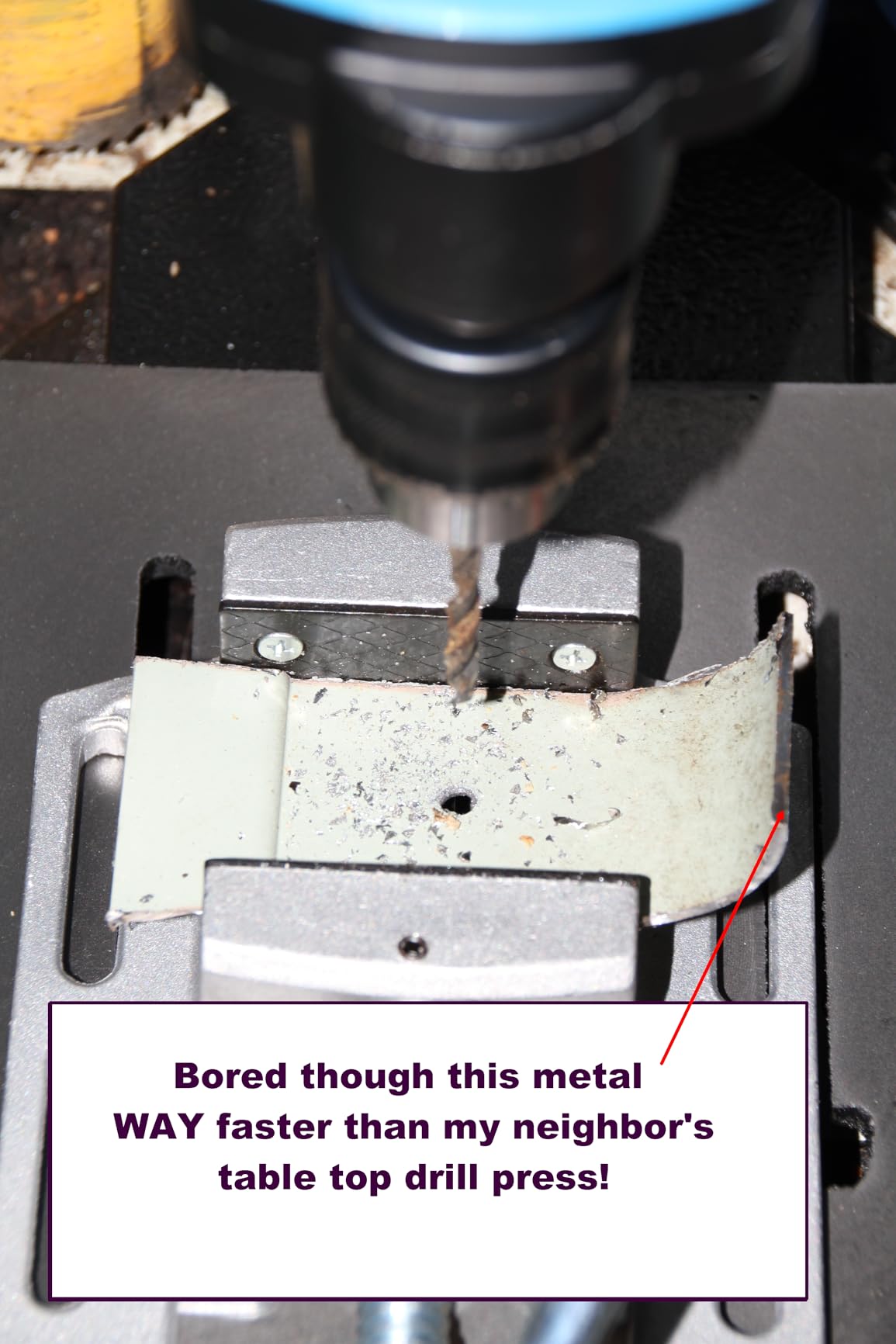
The Bonvoisin is a 1200W benchtop press built for craft and home improvement rather than electronics specifically, and that is exactly the trade you make here. In exchange for a machine twice the weight of most others in this list, you get enough power for wood and soft metal and a head that rotates 90 degrees for grinding work.
Three extended cranks give real leverage on thicker workpieces, and screw-adjusted head height handles varying material sizes without a separate tool. It draws from 110V and uses a 1-15mm chuck, so bit availability is never a problem.
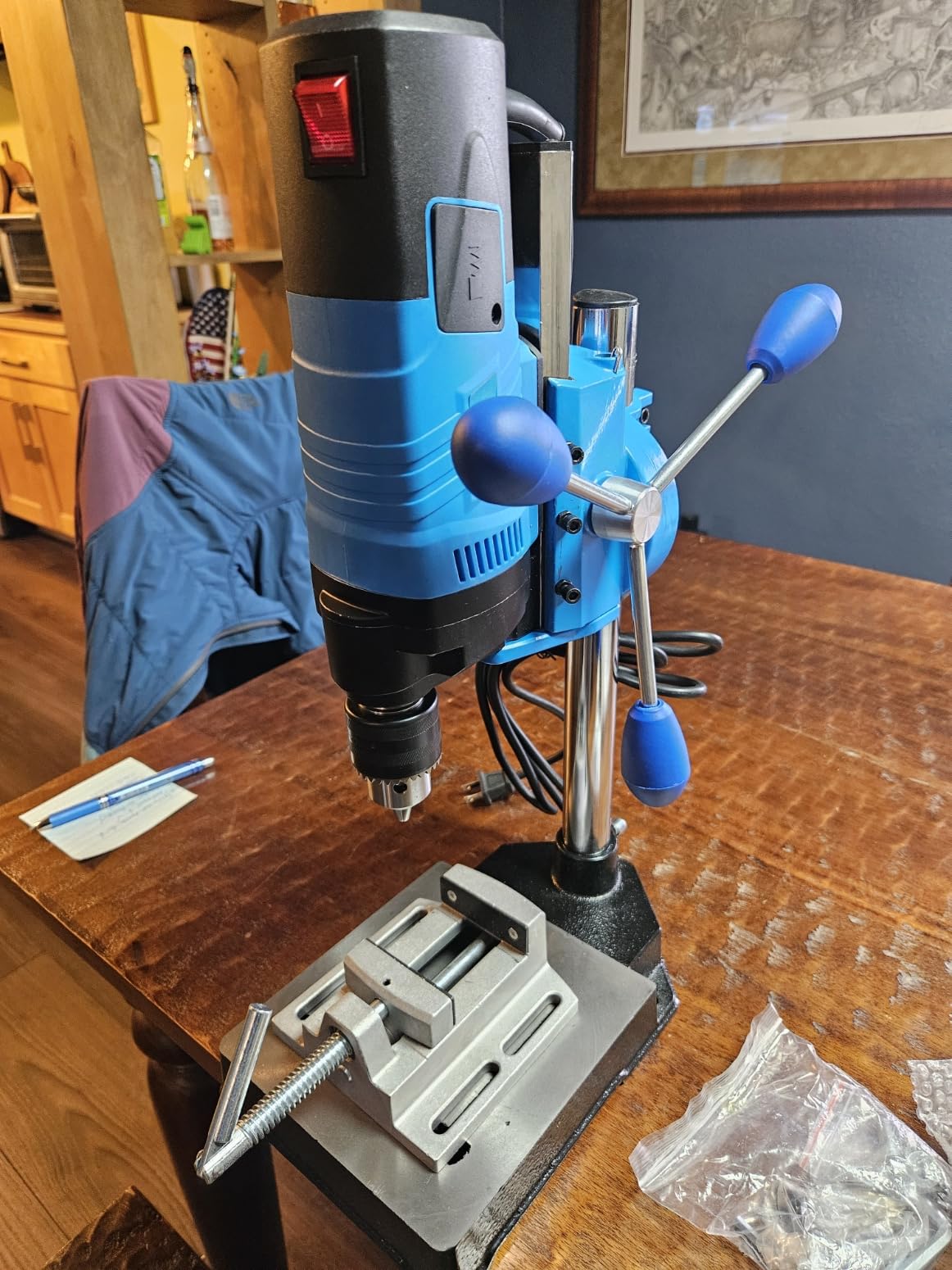
At 18.8 pounds and 11.85 by 8 by 17.7 inches, it stays on the bench once you position it. Feedback is mixed, with a notable share of 2-star ratings citing looseness during operation and the sheer weight of the machine.
When this is the right pick for you
Pick this if electronics is one part of a wider making workload, so a single machine covers board drilling, wooden enclosures and grinding cleanup. The rotating head and the three-handle layout make larger, thicker work comfortable.
Six speeds give you enough control for a range of bits without the fiddliness of a manual belt change. For drill-and-grind workflows it removes the need for a second tool.
When it is the wrong pick for you
The speed range is narrow at the low end for delicate work, and a 1-15mm chuck is a wide opening for a 0.5mm bit, so fine pitch PCB work is not the strength here. If precision on small holes is your main priority, look at a collet machine instead.
The weight is the bigger issue. Eighteen pounds is a commitment on a small bench, and the grinding wheel is not included. Adjustment screws can loosen during drilling, so check them between jobs.
8. bellaDimora Mini Benchtop Press – Best for the Accessory Bundle
- Powers through wood metal and concrete with a 1200W motor
- Comes with a 16-piece multi-material bit kit
- Three-handle design keeps the head stable
- Quick slide and lock height adjustment
- Vise and wrenches included in the box
- Lowest speed of 800 RPM is not slow enough for some delicate work
- 18 pound weight limits portability
- Grinding wheel sold separately
The bellaDimora arrives with more in the box than anything else in this roundup: a 16-piece bit kit covering metal, concrete and wood, plus a vise, four wrenches, spare carbon brushes, a shaft collar and three handles. Buyers appreciate the power-to-size ratio and the generous bundle, with the three handles helping stability on thicker stock.
Mechanically it is a 1200W machine with six speeds from 800 to 2800 RPM and a 1.5-13mm chuck covering bits from 1/16 to 1/2 inch. The head rotates 90 degrees to switch between drilling and grinding, and the slide-and-lock height adjustment is faster than a screw collar.
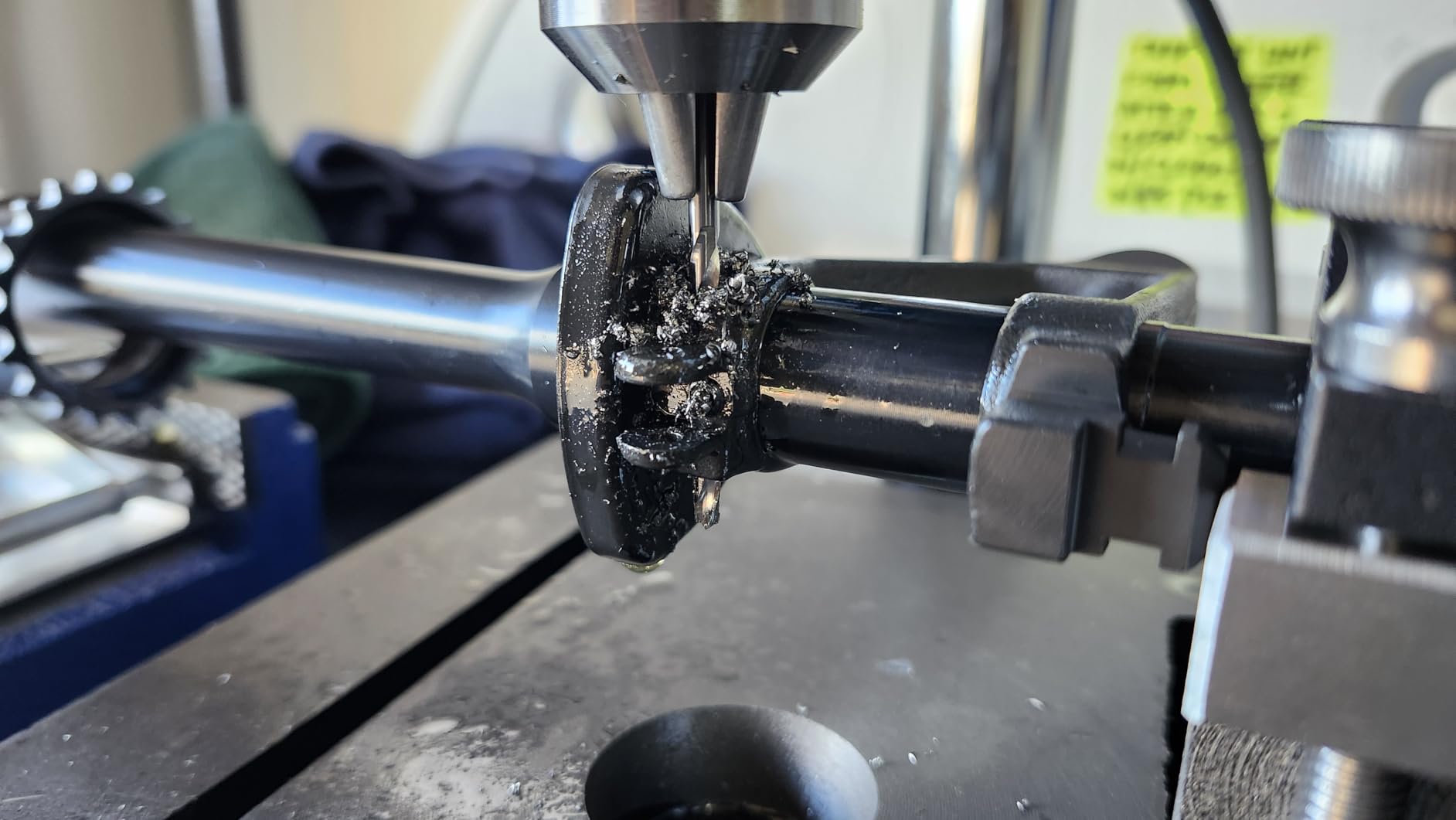
It is 18 pounds, which is the same portability trade as the Bonvoisin. Criticism centres on the speed floor for delicate drilling and the bulk of the machine rather than on build quality.
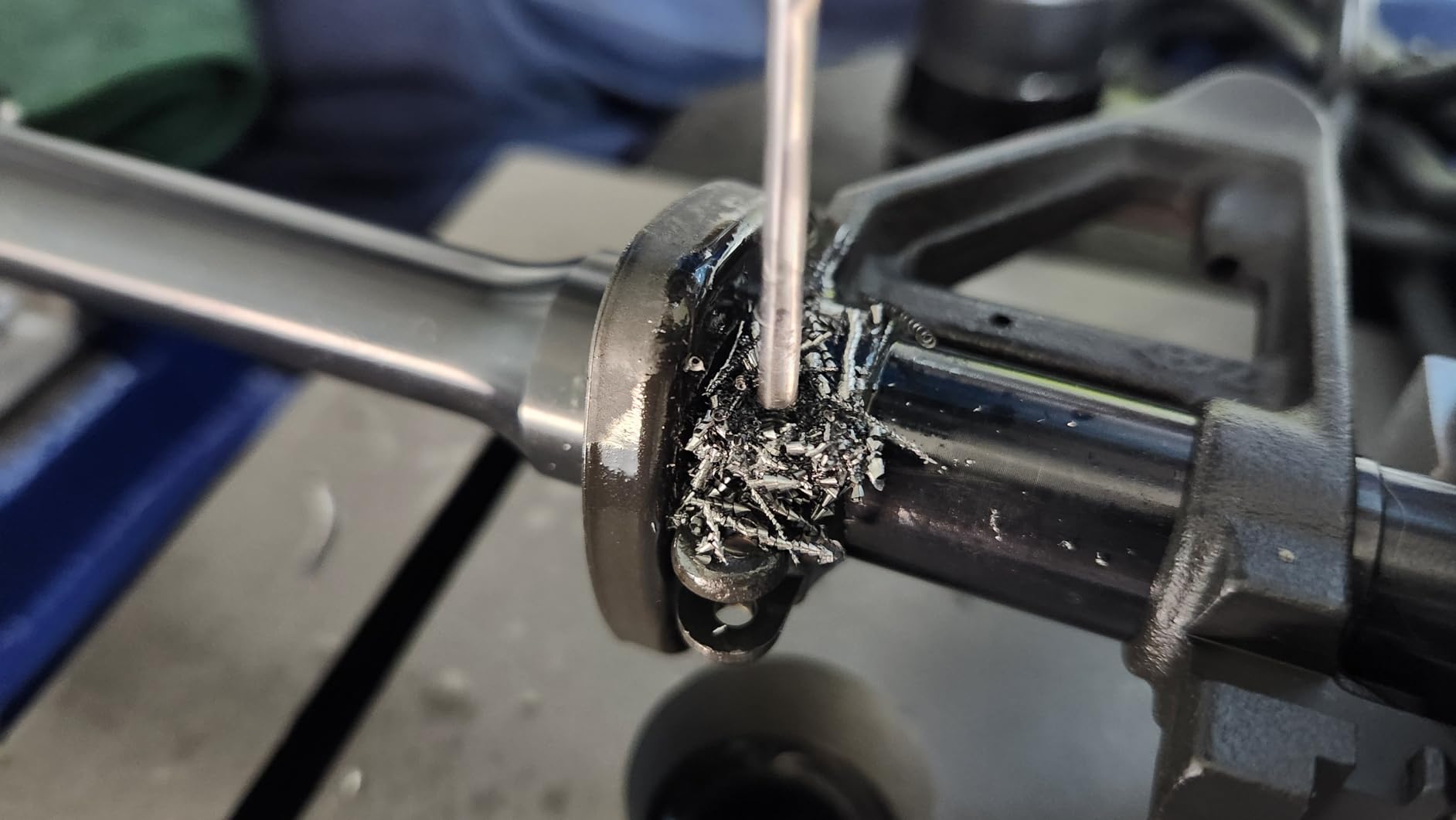
When this is the right pick for you
Buy this if you are setting up a new bench and want a usable set of bits on day one. Sixteen bits spanning three material families saves a separate shopping trip and covers everything from a PCB to a masonry anchor.
Slide-and-lock height adjustment makes switching between a thin board and a thicker block quick, and the included vise means you can start drilling immediately.
When it is the wrong pick for you
That 800 RPM floor is the deal-breaker for fine PCB work. There is no way to slow a 0.5mm bit down on FR-4, so if micro drilling is your primary task, this is the wrong class of machine.
Eighteen pounds limits portability, and the grinding wheel is a separate purchase if you need it. The 32-review sample is also thin, so long-term durability is not well documented.
9. MXBAOHENG CLA-218 Mini Press – Best for Repeatable Batch Drilling
Mini Benchtop Drill Press with Work Light, Rear-Mounted 795 Motor Design
- Rear mounted 795 motor keeps the work area clear and reduces interference
- Tool free handle makes height adjustments quick
- Red scaled stroke column plus locking depth ring improves batch consistency
- Included metal bench vise handles irregular workpieces
- Built in work light helps read the depth scale
- Limited drilling stroke of about 1.3 inch
- B10 chuck accepts only bits up to 6mm
- Rated for non-rigid and soft materials
The CLA-218 is designed around a problem you hit within an hour of drilling boards: the motor in the way. Its rear-mounted 795 motor layout keeps the cutting area clear, and buyers specifically highlight the clear work area, the tool-free height adjustment, the depth scale with work light, and the included vise. Together these make it well suited to PCB, resin, balsa and light craft drilling.
For batch work the red-scaled 5 cm stroke column and the locking depth ring are the features that matter most. You set a depth once, lock the ring, and repeat it across a board of identical footprints. The work light above the spring column lets you read that scale rather than guessing at it.
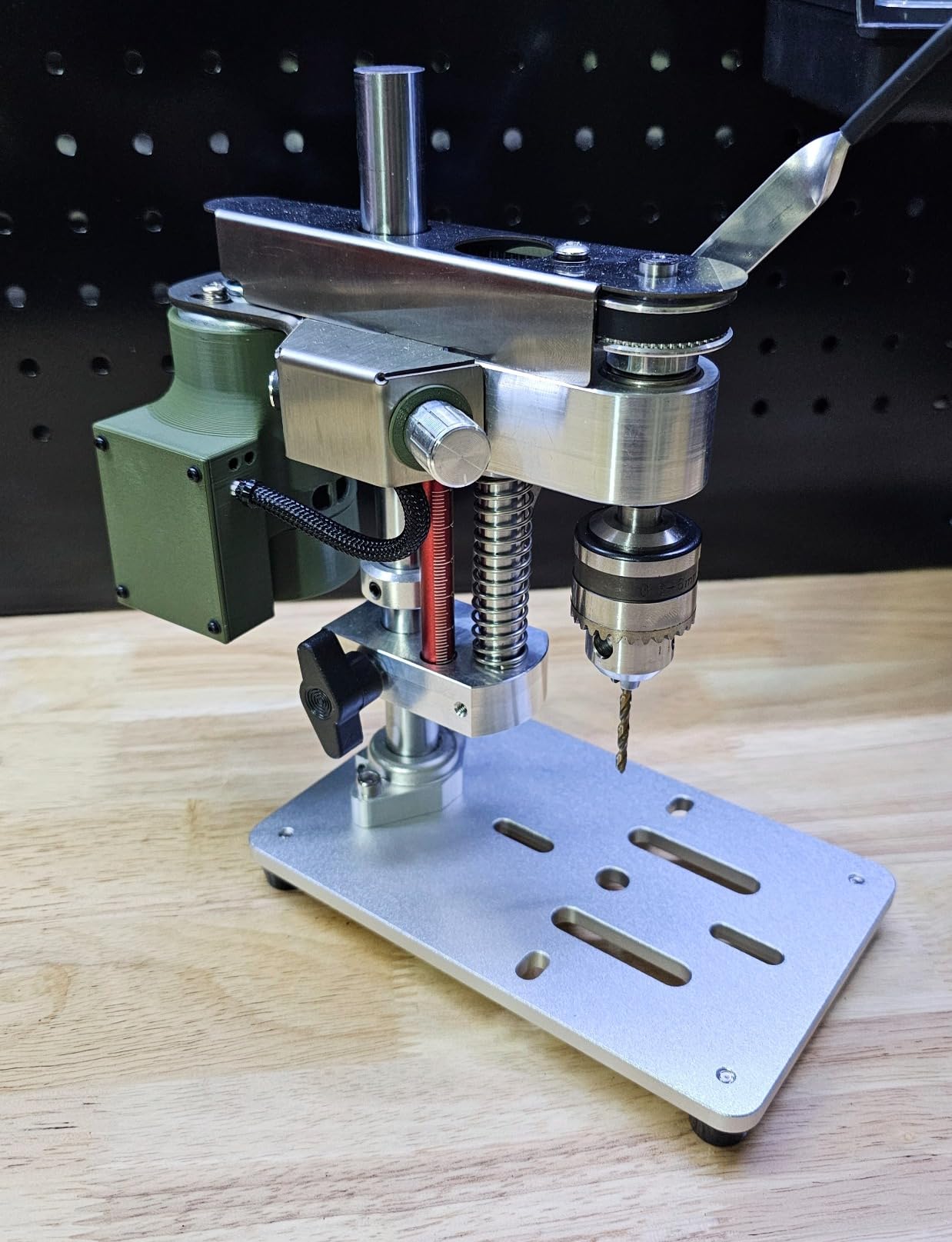
Ratings run strongly positive, with about two thirds of reviews at five stars. The included metal bench vise has a 1-55mm clamping range, which handles irregularly shaped workpieces, and the belt guard adds a layer of safety during operation. Seven-speed regulation gives 1500 rpm at 12V and 3000 rpm at 24V on a 120W motor.
When this is the right pick for you
This is the pick if you drill the same board layout more than once. The locking depth ring plus the readable scale is the cheapest reliable route to repeatability on a machine in this price bracket.
It is also a strong choice for resin casting work and light craft material, where the 1-6mm B10 chuck range is the right size. The tool-free adjustment handle means you spend your time on the board, not on setup.
When it is the wrong pick for you
The drilling stroke of about 1.3 inch is short, so deep holes or stacked workpieces are out. The 1-6mm chuck will not take the larger bits some craft work needs, and the 120W motor is rated for non-rigid and soft materials rather than thick metal.
It runs on a 12-24V supply, so check what is in the box and what is on your bench before you start. The work light is a genuine aid, but at this speed range a hard board still needs more than 120W behind it.
10. IOENC Portable Jewelry Drill Press – Best for High-Speed Craft Work
Portable Jewelry Drill Press,with Wrench – High340W,Adjustable Speed (0-16,000 RPM),Bench Top Drill Press Variable Speed,for Metal Wooden Jewelry DIY and Crafts Projects
- Highest speed range in the group at up to 16000 RPM
- Compact 6.69 inch square footprint saves bench space
- Cast iron and steel body resists impact and scratching
- Includes collet key hex wrenches spare carbon brushes and belt ring
- Extended 4.43 ft cord allows flexible positioning
- Maximum drilling depth of 0.98 inch is shallow
- Metal capacity limited to about 0.24 inch
- Collet rather than keyed chuck gives lighter bit grip
The IOENC is the speed specialist in this group, reaching 16000 rpm across three speed levels from a 340W motor. Buyers point to the high speed ceiling, the compact cast iron and steel construction, and the generous accessory kit as the main strengths. The review distribution is 69% five stars and 23% four stars with no one-star ratings.
Speed is not the deciding factor for PCB work. What matters here is the collet clamping range of 0.04-0.39 inch, which comfortably holds a 0.5mm to 1.2mm bit, and a compact 6.69 inch square footprint at 11.7 pounds. Maximum drilling depth is 0.98 inch, more than enough for a standard FR-4 board.
The accessory kit is thorough: a belt ring, a collet key, a pair of carbon brushes, an English manual and two hex wrenches, plus a 4.43 ft cord that reaches most sockets without an extension. The manufacturer warranty listed is three months, which is the shortest in this roundup.
When this is the right pick for you
For jewellery, bead work and fine craft drilling, the 16000 rpm ceiling is exactly what you want, since small bits in hard material need speed. The ergonomic ball handle and one-button switch make short bursts comfortable.
Cast iron and steel construction resists impact and scratching, which matters in a shared workshop. This is also a credible low-cost companion press for light PCB drilling alongside another machine.
When it is the wrong pick for you
It uses a collet rather than a keyed chuck, so bit grip is lighter for heavy work, and metal capacity is limited to about 0.24 inch. A 0.98 inch maximum depth rules out thicker stacked material.
The three-month listed warranty is the weakest cover in this roundup, and drill bits are not included. If you plan to lean on it for daily board production, the accessory cost and warranty length are worth weighing.
11. SEANESZTI 340W 3-Speed Press – Best for Low-Gear Torque
Mini Electric Bench Drill Stand, 3-Speed Benchtop Drill Press, 110V Low Noise Benchtop Variable Speed Drill Press Electric Bench Drilling Machine for DIY
- Drilled through 3/4 inch solid hard oak with a standard carbide bit in under 30 seconds
- Quiet operation reported on the low gear
- Lowest gear provides high torque
- Compact desktop structure
- Includes spare carbon brushes belt collet key and wrenches
- No vertical height adjustment gear making height changes clunky
- Achieving precise hole depth is difficult
- Drive belt described by one owner as essentially a rubber band
The SEANESZTI packs more capability than its size suggests. One owner reports drilling through 3/4 inch solid hard oak with a standard quarter inch carbide bit in under thirty seconds, and another calls the lowest gear a deal maker because of the torque. The full copper wire motor and cast iron base are built for durability and low bit breakage.
Three speeds are set by a manual rotary dial with a three-position belt setting for torque and power selection, topping out at 14100 rpm. Rated capacity reaches 1 inch in both wood and metal with 3.5 N m of maximum torque, which puts it well beyond board work.
The main friction points are mechanical rather than electrical. There is no vertical height adjustment gear, so height changes are clunky, and buyers report difficulty achieving precise hole depth, improvising with guide boards. One owner describes the drive belt as essentially a rubber band, and there are isolated reports of a pre-returned unit arriving and a machine failing on a 1/8 inch hole in aluminium.
When this is the right pick for you
This suits a maker whose board drilling is a small part of a general workshop load. The low gear torque and quiet running on that gear make it pleasant for repeated small work, and the compact desktop structure is genuinely small for what it does.
If you are drilling enclosures, wooden boxes and light metal alongside electronics, the 1 inch rated capacity means one machine covers all of it.
When it is the wrong pick for you
Without height adjustment, setting up for a fresh batch of boards is the most irritating part of the workflow. Difficult depth precision also means guide boards, which adds a step exactly where a PCB press should save you one.
The thin belt and the isolated quality control reports make this a riskier buy for daily use. It is a weekend workshop machine rather than something we would put on a production bench.
12. Hoteche Variable Speed Mini Press – Best for Small PCB Jobs
- Owners call it an effective little PCB drilling machine for the money
- Low gear provides strong controllable torque
- Compact size suits small projects
- Good alignment and quiet running on low gear
- Spindle travel options of 23mm and 50mm
- No chuck guard included despite the listing showing one
- No belt tension lever requiring a separate tool
- Motor runs hot within a minute of no-load start up
- Very small size restricts it to light craft work
Hoteche is the most divisive machine here, with the lowest average rating in the roundup at 4.0 across 31 reviews. Buyers who pair it with PCB, model and craft work find it accurate, quiet on low gear and effective for the money, which is why several reviewers describe it as a capable little PCB drilling machine.
On paper the specification is sensible: three variable speed settings at 2200, 3300 and 5000 rpm, a quarter inch keyed chuck covering 0.6-6.5mm, a 170 by 170 mm work table and 23mm of spindle travel, with a 50mm variant available. The listing explicitly names PCB among its materials alongside wood up to 10mm and steel up to 5mm, and it carries laser-guided accuracy alignment.
The negative reviews cluster around build and design: a missing chuck guard despite the listing showing one, dents on the belt cover and motor case on arrival, no belt tension lever, a motor that runs hot within a minute of a no-load start and smells of burning rubber, and a chuck that does not lock to the spindle column with no explanation in the instructions. The height clamp is also awkward to operate even with a glove.
When this is the right pick for you
If you drill small boards occasionally and want a compact machine, this works. Low gear torque is controllable, alignment is reported as good, and the 0.6mm lower chuck limit still covers the whole standard PCB bit range.
Choose the 23mm travel version for a standard single-sided board and the 50mm option if you ever need deeper access. It suits polymer clay and arts-and-crafts drilling as much as electronics.
When it is the wrong pick for you
Buy the belt tension lever before you need it, because the machine ships without one and a loose belt changes both speed and accuracy. The chuck not locking to the column is a design gap, not a user error, and the instructions do not cover it.
The motor heating within a minute of no-load running is a reliability concern we would want resolved before trusting a long batch. Very small size also restricts it to small shank bits and light craft work, and the awkward height clamp will frustrate you on every setup change.
How to Choose a PCB Drill Press?
There is a lot of crossover between these machines, so the fastest way to choose is to check six things in order. Work down the list and the right press picks itself.
1. Chuck and collet capacity against the bit range
PCB work lives in the 0.3-1.2mm range. A keyed chuck with a stated range of 0.6-6.5mm covers the practical majority, and a collet chuck is better again because it grips closer to the flutes. Anything whose minimum opening is above 0.5mm will not take the fine bits used in via fields.
Check the lower limit, not the headline number. A chuck advertised as 6mm often bottoms out at 1mm, which rules out most of a dense board.
2. Variable speed, and how low it actually goes
FR-4 glass fibre cuts best at a moderate speed with a light feed, and a machine that only offers stepped speeds from 2800 rpm upward will not give you that. Continuous variable control between roughly 400 and 4500 rpm is the ideal range, as on the EWANYO.
Several machines publish an optimistic low end. The BACHIN lists 0-2800 rpm but reviewers put the real minimum closer to 450 rpm, and the bellaDimora bottoms out at 800 rpm. Treat the lowest published step as an upper bound on comfort.
3. Runout and depth repeatability
Runout is how far the bit wanders off true while spinning. Below about 0.01mm, a 0.5mm bit lands where you aimed; above that, holes drift and bits break. Collets outperform keyed chucks, and linear bearings in the head outperform a rack and pinion on a stand.
A depth stop with a readable scale matters as much as runout. The MXBAOHENG’s locking depth ring and the Milescraft’s scaled stop are the two cheapest repeatability features in this roundup, and both are worth more than a higher top speed.
4. Frame rigidity and base mass
Base weight is the cheapest indicator of whether a machine will walk. The BACHIN at 11.4 pounds and the IOENC at 11.7 pounds are solid; anything under 3 pounds will creep unless you clamp it. The Dremel stand specifically needs clamping because its 4.9 pound base can tip under pressure.
5. Workholding for the actual job
A board needs to sit flat and register. Presses that ship with a vise save a step, while the Proxxon sells its vise separately. A parallel fence with a scale is a genuine advantage when you are duplicating a layout, and a PCB holder covers the cases where the machine has neither.
6. Whether you will outgrow it
If you are already making hundreds of holes a month, a manual press is a bridge, not a destination. A CNC-based drilling machine or a pick and place workflow handles volume. For a hobbyist, a manual press is the right stopping point. Before you commit, it is worth reading how makers weigh the full-size bench class in our magnetic drill press guide too, since that format suits fixed-position drilling on a metal chassis rather than thin boards.
How to Drill a PCB Without Cracking It
Exit-side burrs and cracked laminate come from three mistakes, and all three are avoidable. Here is the sequence that works on every press in this roundup.
First, clamp a sacrificial backing board under the workpiece. MDF or a scrap of the same laminate absorbs the breakthrough and removes the burr entirely. Second, support the board at both ends so it never bows downward around the drill point.
Third, start the bit above the surface and bring it down to the material before applying feed. Once the bit bites, use a fast, steady feed and do not stop and start on a single-sided board, because each pause lets the glass fibre pull the bit sideways.
On a double-sided board, peck drilling is the way: drill partway through, back the bit out fully, then drill again. That clears chips and stops heat building in the flute. Finally, back the bit out before it fully clears the board so the bit cannot grab and lift the last of the laminate as it exits.
Use a 0.8mm bit, which is about 1/32 inch, as your default. It handles almost all component leads, and that size is consistently the recommendation from makers on electronics forums.
Drill Bit Sizes and Pad Clearance for PCB Work
Drill to the smaller side of the pad, typically 0.2-0.3mm smaller than the pad diameter, so a consistent annular ring of copper stays around the hole. Go larger and you cut into the pad ring; go much smaller and the lead does not fit.
For sizing, 0.8mm covers nearly everything, 0.5-0.7mm suits fine pitch parts, 1.0-1.2mm handles large pads, and 0.3-0.4mm is for via fields. Carbide bits resist the abrasive glass fibre better than HSS and last far longer, so they are worth the small step up in cost.
Drill bits do not come with these presses in most cases, so buy a small set of PCB-specific bits rather than a general purpose twist drill set. The NovelLife and MXBAOHENG are the two exceptions that include a bit with the machine.
Safety Notes for Fibreglass and Carbon Fibre PCBs
Glass fibre dust and carbon fibre dust are both serious inhalation risks, and no press solves that for you. Drill on a bench with extraction or a mask, and never blow dust off the board with compressed air, which puts the fibres into the air you are breathing.
Wear eye protection. A 0.5mm bit at speed is a projectile if the collet lets go, and the belt-driven machines in this roundup deserve particular respect before the first spin-up.
Secure loose hair, sleeves and jewellery before drilling, and keep the workpiece clamped or held flat rather than balancing it by hand. Ventilate the room after a session, and treat the swarf from a carbon fibre board as hazardous waste rather than scrap.
Frequently Asked Questions
What size drill bit do I need for a PCB?
Use 0.8mm (about 1/32 inch) as your default size because it handles almost all component leads. Drop to 0.5-0.7mm for fine pitch parts, go up to 1.0-1.2mm for large pads, and use 0.3-0.4mm for via fields. Drill to the smaller side of the pad, usually 0.2-0.3mm under the pad diameter.
How do I drill holes in a PCB?
Clamp a sacrificial backing board under the workpiece, support the board at both ends, start the bit above the surface, then apply a fast steady feed once it bites. On double-sided boards, peck by backing the bit out fully partway through to clear chips. Back the bit out before it fully clears the board so it cannot grab and lift the laminate.
Can you drill holes in a PCB?
Yes. PCBs are drilled with standard 0.5-1.2mm carbide or HSS bits in any drill press, rotary tool or purpose-built micro press. The board needs a backing board to prevent exit burrs, and a press with a depth stop is what makes hole placement repeatable rather than hand-determined.
Do I need a drill press to make PCBs?
You can hand-drill with a rotary tool, but a press with a rigid column, a stable base and a depth stop is what keeps the bit vertical and the hole on target. Hand-drilling pushes the bit sideways, which walks the hole off pad and causes exit-side burrs and cracked fibreglass.
What is the recommended hole-to-hole clearance for PCBs?
Drill to the smaller side of the pad, typically 0.2-0.3mm smaller than the pad diameter, which leaves a consistent annular ring of copper around the finished hole. A 0.8mm bit is the standard general-purpose PCB drill size.
What company makes the best drill press?
For PCB work, Proxxon leads on sub-millimetre precision, Innocraftsman and MYLXON deliver the best precision per dollar, and Bauer covers the entry tier. For an all-round bench press, Jet and WEN lead the full-size class, though those machines are far larger than a PCB job needs.
The Verdict by Maker Profile
So, the best PCB drill press depends almost entirely on what you already own and how much bench you have. If you have a rotary tool already, the Dremel 220-01 is the pick, and it earns our Editor’s Choice for a reason: more than seven thousand reviews describe accurate, repeatable hole placement across exactly the hobby mix most of us work in.
Buy the NovelLife B10 if you want a powered machine with tight runout and small dimensions, the Proxxon TBM 115 if you work below 0.5mm or drill watch-scale parts, and the MXBAOHENG CLA-218 if you repeat the same layout across several boards. Whatever you choose, clamp a backing board, start the bit above the surface, and drill a 0.8mm hole first to set the depth. That is where the best pcb drill press becomes obvious, because a machine that repeats your first hole exactly is the one you will keep using in 2026.