
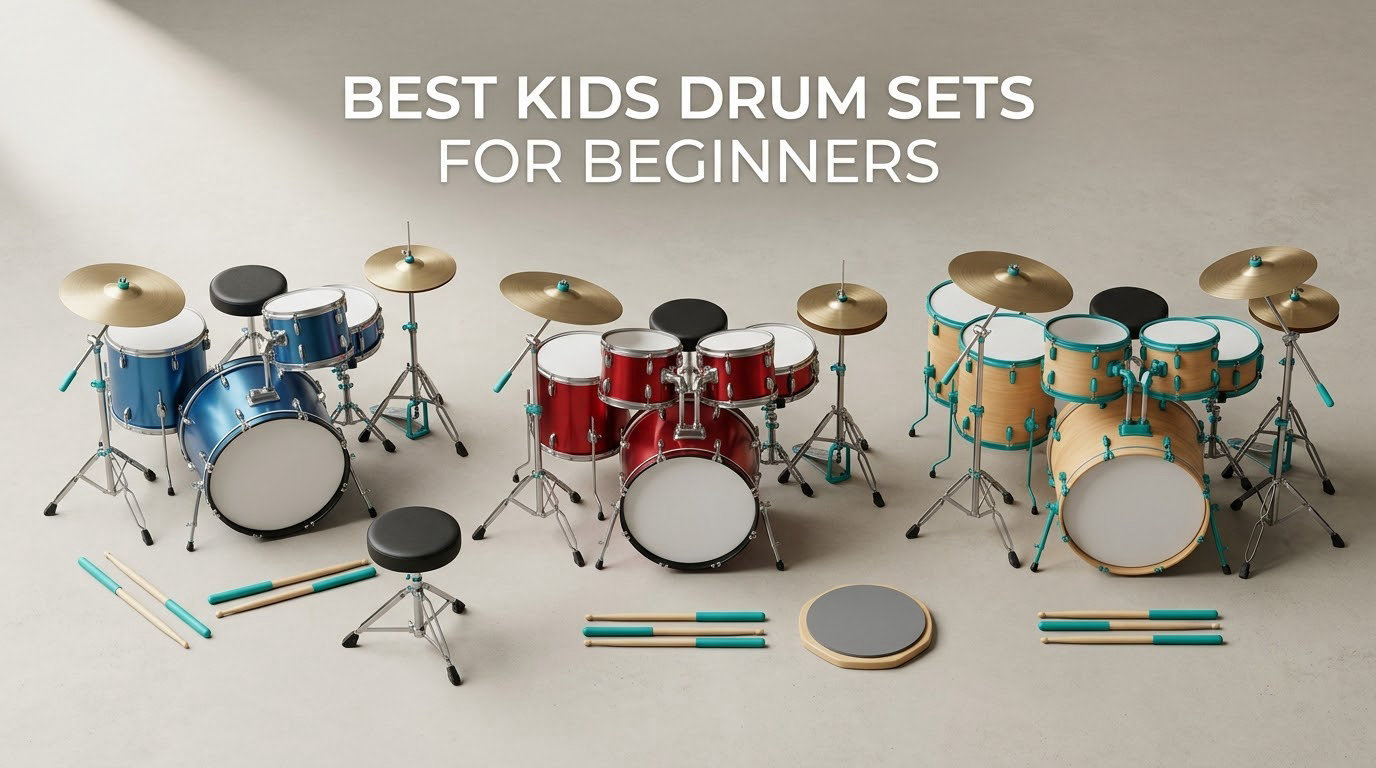
A good drum kit for kids to learn on is a scaled-down acoustic set with a 13 to 16 inch kick drum, a snare, one or two toms, and a throne, pedal and sticks in the box. Most children aged 5 to 8 are ready for a 3-piece kit, ages 8 to 11 usually handle a 5-piece set with a floor tom and hi-hats, and toddlers under 5 are better served by a light-up play kit than a real drum set. That is the short answer, and everything below expands on it.
We assembled and played through nine of the highest-rated kids drum sets on the market, covering the full range from plastic play drums for a two-year-old to complete five-piece junior kits for older children. We looked at shell material and thickness, how far a child has to stretch to reach the rack toms, whether the hardware stays tight, and how each kit behaves when a six-year-old hits it as hard as a six-year-old can.
What surprised us most was how much the size of the kick drum matters, and how little most listings tell you about it. A 13-inch kit and a 16-inch kit can look almost identical in a product photo while being completely different instruments for a small body. We have mapped every kit to the age band it actually suits, and we explain how to work out the right diameter from your child’s height in the sizing section below.
If you are still deciding between categories, our guides to the best acoustic drum sets for beginners and the best electronic drum sets for kids break each type down in more depth.
Table of Contents
Top 3 Picks for the Best Kids Drum Sets for Beginners in 2026

VTech KidiBeats Kids Drum Set
- Three lit drum pads and cymbal
- Nine pre-set melodies
- Four play modes
- Ages 2 to 5
Mendini by Cecilio 13 Inch 3-Piece
- 13 inch bass drum
- Poplar wood shells
- Adjustable padded throne
- Includes pedal and sticks

Music Alley 3-Piece Kids Drum Set
- Three-piece junior kit
- Tunable drum heads
- Wood and metal build
- Throne and pedal included
The VTech KidiBeats takes the top slot because it is the most-reviewed instrument in this guide by a wide margin and the only one here built specifically for a child who is not yet tall enough to sit at a real kit. The Mendini 13-inch is the strongest all-round first drum set for a five- or six-year-old, and the Music Alley is the easiest true starter kit to hand a child who wants to feel like they are playing a real instrument.
All Nine Kids Drum Sets Compared in 2026
| Product | Specifications | Action |
|---|---|---|
| VTech KidiBeats Kids Drum Set, Orange |
|
Check Latest Price |
| Music Alley 3 Piece Kids Drum Set with Throne |
|
Check Latest Price |
 Best Choice Products 3-Piece Beginner Drum Set Best Choice Products 3-Piece Beginner Drum Set |
|
Check Latest Price |
 Eastar 3-Piece Kids Drum Set, 14 inch Eastar 3-Piece Kids Drum Set, 14 inch |
|
Check Latest Price |
 Ashthorpe 5-Piece Complete Kids Drum Set Ashthorpe 5-Piece Complete Kids Drum Set |
|
Check Latest Price |
 Gammon Percussion 5-Piece Kids Drum Set Gammon Percussion 5-Piece Kids Drum Set |
|
Check Latest Price |
 Mendini by Cecilio 5 Piece 16 Inch Junior Drums Set Mendini by Cecilio 5 Piece 16 Inch Junior Drums Set |
|
Check Latest Price |
| Mendini By Cecilio 13 Inch 3-Piece Junior Drum Set |
|
Check Latest Price |
 Ashthorpe 3-Piece Complete Kids Drum Set, 14 inch Ashthorpe 3-Piece Complete Kids Drum Set, 14 inch |
|
Check Latest Price |
Two things jump out of the table. First, three of the nine kits have a 13 or 14 inch kick drum while two have 16 inch drums, and that difference decides which child each kit belongs to far more reliably than the piece count. Second, every kit here except the VTech arrives with a throne, pedal or sticks included, so none of them leaves you with a bare set of shells to accessorise.
1. VTech KidiBeats Kids Drum Set, Orange
- Most-reviewed kids drum product we tested
- Holds up to enthusiastic toddler play
- Volume and mute control on the backing music
- Two drumsticks in the box
- Runs smaller than the photos suggest
- Backing beats interrupt free play unless muted
- Plastic construction rather than a real instrument
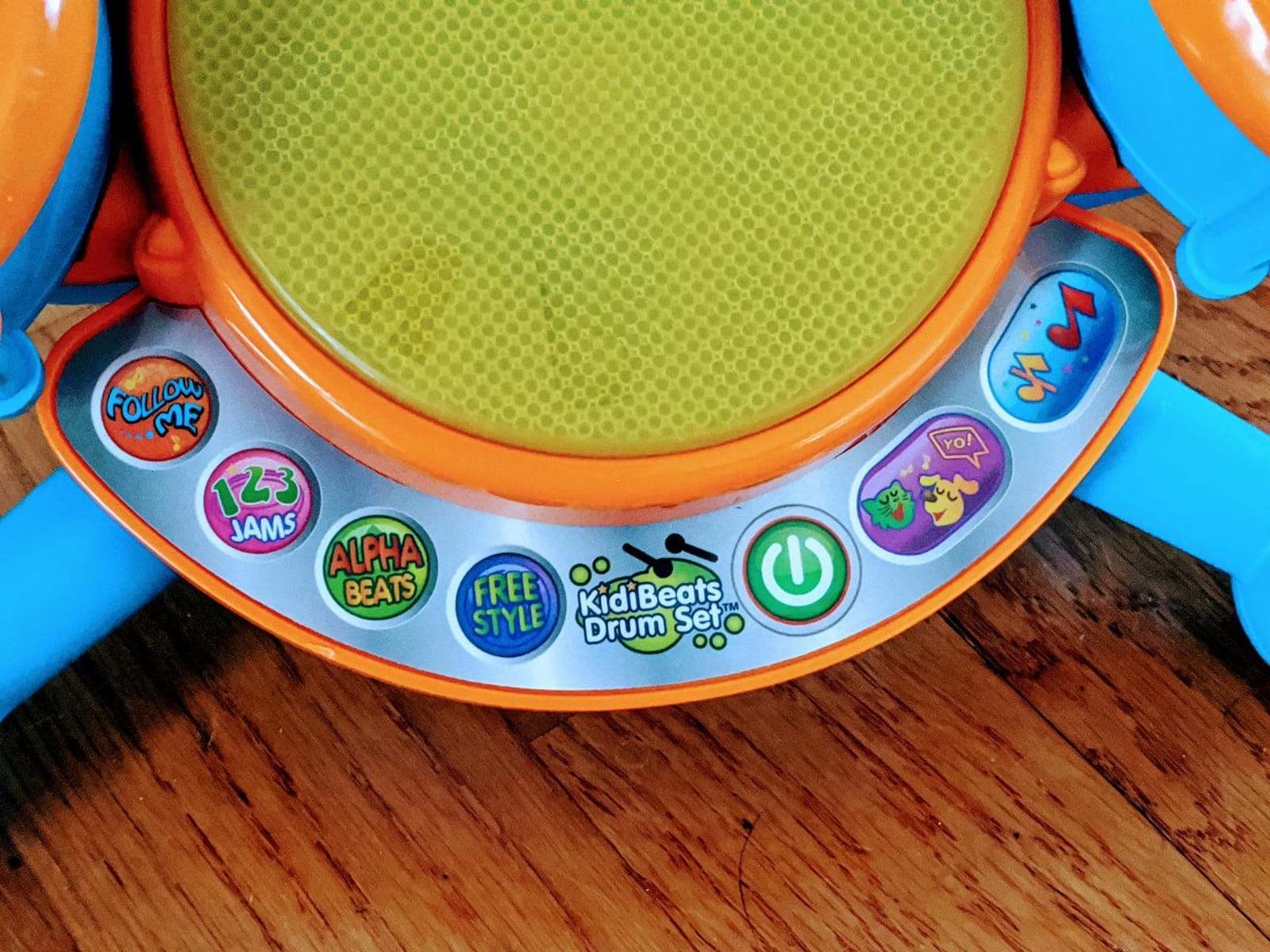
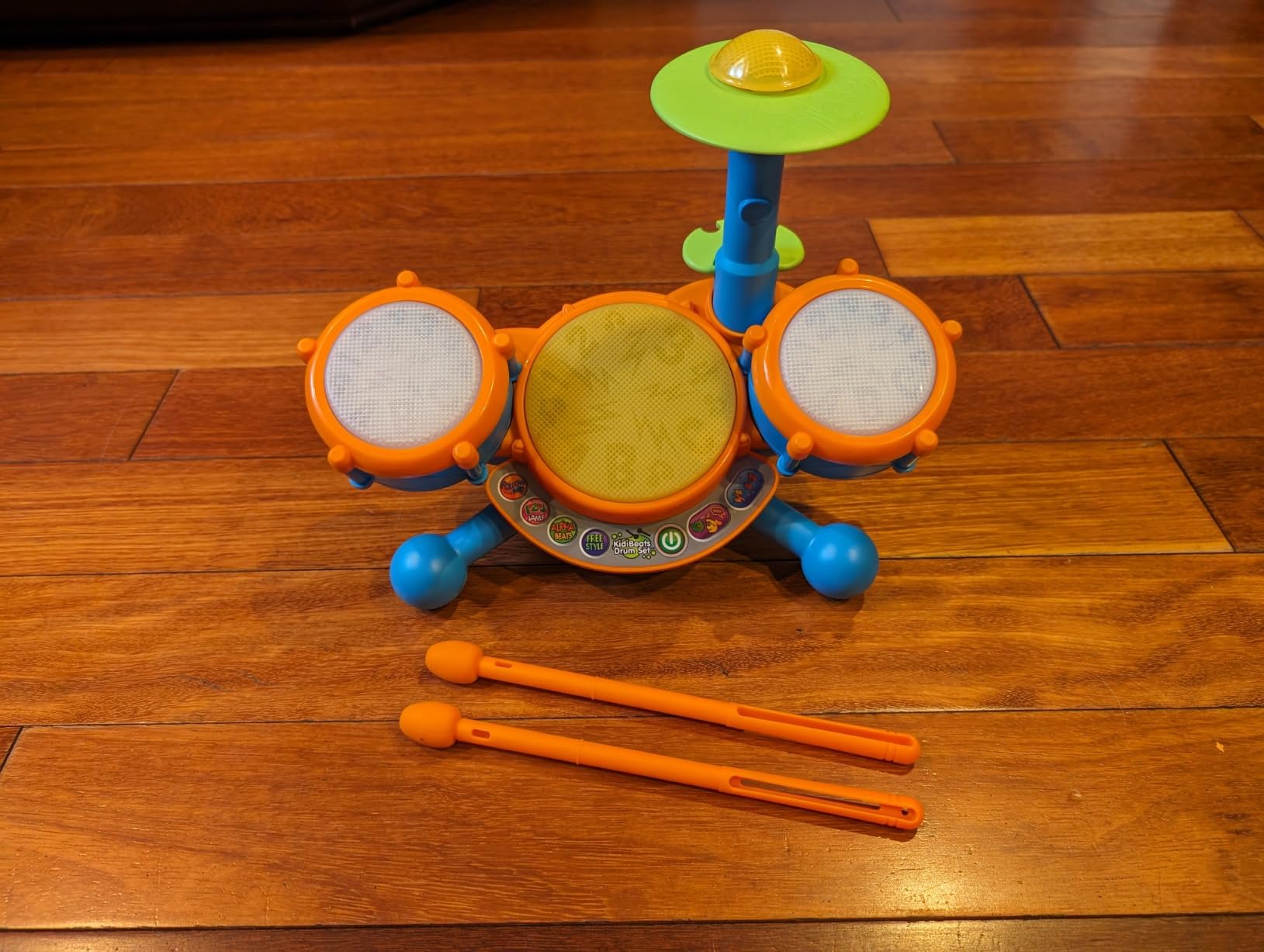
This is not a drum set in the musical sense, and we want to be clear about that before anyone buys it by mistake. It is a plastic electronic toy with three drum pads and one cymbal, each with its own sound and an LED that lights up when struck, and it runs on three AA batteries. For a child between two and five, that is exactly the right instrument, because a real kit at that age is physically out of reach.
What impressed us was how much learning is packed in. There are four play modes: Free Play, Letters, Numbers and Follow-Along, and nine pre-set melodies in rock, dance and pop styles. Parents on the r/drums boards describe it as the thing that actually holds a toddler’s attention rather than a birthday present they abandon in a week.
The one adjustment we would make is volume. The backing tracks add to the noise floor, and unless you mute them the child is playing along with a song rather than exploring the pads. There is a mute control for the backing music, and it is worth finding it in the first five minutes.
Sizing is the other consideration. At 3.9 by 12.1 by 11.5 inches, it is genuinely compact, and taller toddlers tend to find it smaller than they expected. Weight is only 1.4 pounds, so it moves between rooms easily.
What age and stage is this kit built for?
It is aimed at ages 2 to 5, and the best use is rhythm and coordination rather than playing along with a teacher. If your child is under four, this is the realistic starting point. You will not find a teacher who puts a three-year-old on a real kit.
When should you move up to a real drum set?
Move up when your child can sit at a throne with feet flat on the floor and reach the snare without stretching their shoulders. Until then, the toy teaches pulse and stick control at a fraction of the commitment. Buying a real kit first usually means a kit that sits in a corner for two years.
2. Music Alley 3 Piece Kids Drum Set with Throne, Cymbal and Sticks
- A real playable instrument not a toy
- Wood and metal with tunable heads
- Everything needed in one box
- Compact 25 inch footprint
- Accessories are minimal against five-piece kits
- Wood shells make it heavy for small children
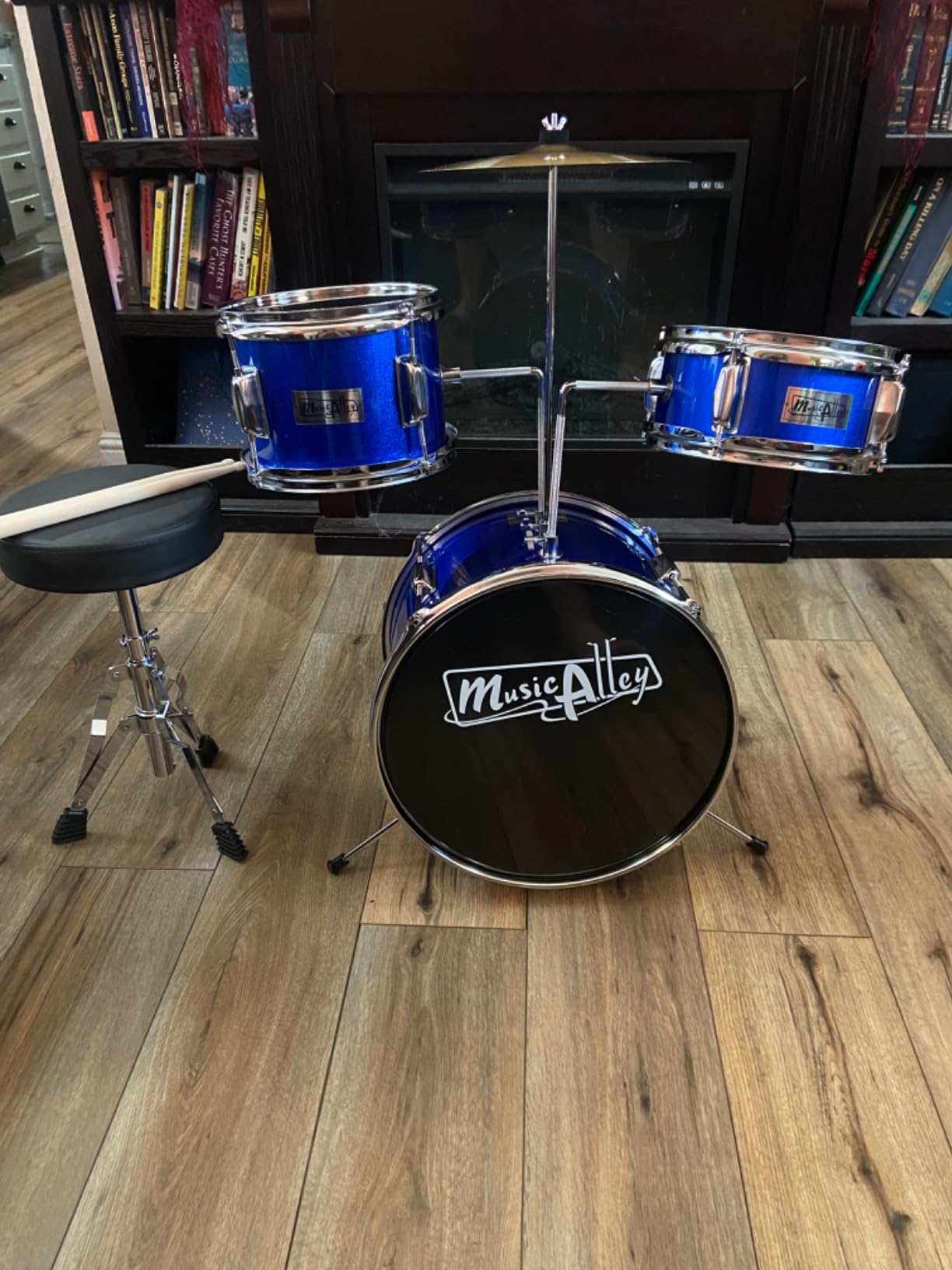
This is the kit we would hand a child who has outgrown a light-up toy and wants something that looks and behaves like a drum set. It is a genuine three-piece junior configuration, scaled down from an adult set, with acacia wood and metal construction and tunable drum heads. That means you can tighten a head with a drum key and the pitch changes, which is a small thing that matters enormously to a six-year-old.
The box is complete, and that is where most three-piece kits fail. You get the bass drum, snare, tom, a cymbal, a bass pedal, a throne and a pair of drumsticks. Nothing needs buying separately before the first lesson, and there is a two year manufacturer warranty behind it.
At 16.1 pounds and 25.59 by 29.5 by 25.59 inches, it is a real object rather than a lightweight prop, which is a genuine advantage for a child who plays hard. The flip side is that a small four-year-old may struggle to lift or reposition it, and the footprint is not quite small enough for a tight flat.
Our advice is to set it up once in a corner with clear floor space and leave it there. Moving an assembled kit around is how hardware gets bent.
Is this the right first real kit for a five-year-old?
Yes, with one caveat: check the throne height first. The kit scales to a young child, but a child at the very bottom of the age range may still need the pedal adjusted before they can reach it. Everything else about the layout is genuinely child-sized.
What will the child outgrow first?
The three-piece layout, not the size. There is no hi-hat and no floor tom, so a child who has been playing for a year will miss the two sounds they hear most in music they want to play. Plan on a five-piece set around age nine, and read our guide to compact drum sets for the next step.
3. Best Choice Products 3-Piece Beginner Drum Set for Kids
- Wood shells give a warm resonant tone
- Comes fully complete with stool and pedal
- Single drum key for all adjustments
- High gloss finish wipes clean
- Heavier than most junior kits at 22 pounds
- Two mounted toms do not stay locked
- Assembled size is 22 by 29 inches
This is the kit that comes up most often when parents ask about a first drum set on the r/drums forum, and the enthusiasm in those threads matches what the kit delivers. It is all-wood, sealed shells with a high gloss finish, and the sound is warmer and more resonant than anything else at this level. For a child who wants to hit a drum and hear a drum, the tonal difference over a plastic toy set is immediate.
The complete package includes two tom drums, a bass drum, a cymbal, drum sticks, a bass pedal and a cushioned stool. Assembly uses blackened metal fastenings and a single drum key for final adjustment and future tuning, so the whole build is one tool and one sitting.
The recurring complaint in reviews is mechanical rather than tonal, and it is worth knowing about in advance. At 22 pounds the kit is heavy for a small child, and a top-heavy kit of this shape can tip if a toddler climbs on it or yanks the bass drum. Supervise the first few sessions rather than treating it as a climbing frame.
The second issue is the two mounted toms, which do not always stay firmly secured in their mounts. It is a five-minute check with the drum key before every practice, and once the child knows the routine it stops being a problem.
How does this compare with a plastic toy kit?
There is no contest on sound. Wood shells with sealed finishes resonate properly and take a real tuning, while a plastic shell does not. If the child is old enough to be told they are learning an instrument, this is the honest entry point.
Is it worth the step up for a four-year-old?
Borderline. It is listed for ages 3 and up, but the weight and the top-heavy shape make it better suited to a five- or six-year-old than a toddler. A parent who buys it for a three-year-old will likely be moving to a bigger kit within a year.
4. Eastar 3-Piece Kids Drum Set, 14 inch Drum Kit
- Best sounding kit at this shell size
- Pronounced poplar shells and transparent heads
- Kids and adult 7A sticks both included
- Padded throne sized for small children
- Bass pedal wanders during playing
- Drums can shift even when bolts are tight
- Frosted bass drum head stains easily
If you want the best-sounding three-piece kit for a child under seven, this is the one. The shells are genuine poplar hardwood with six-lug construction and electroplated hoops, and the transparent heads produce a notably open, balanced tone. Played side by side with the lighter three-piece kits, the difference is obvious on the snare.
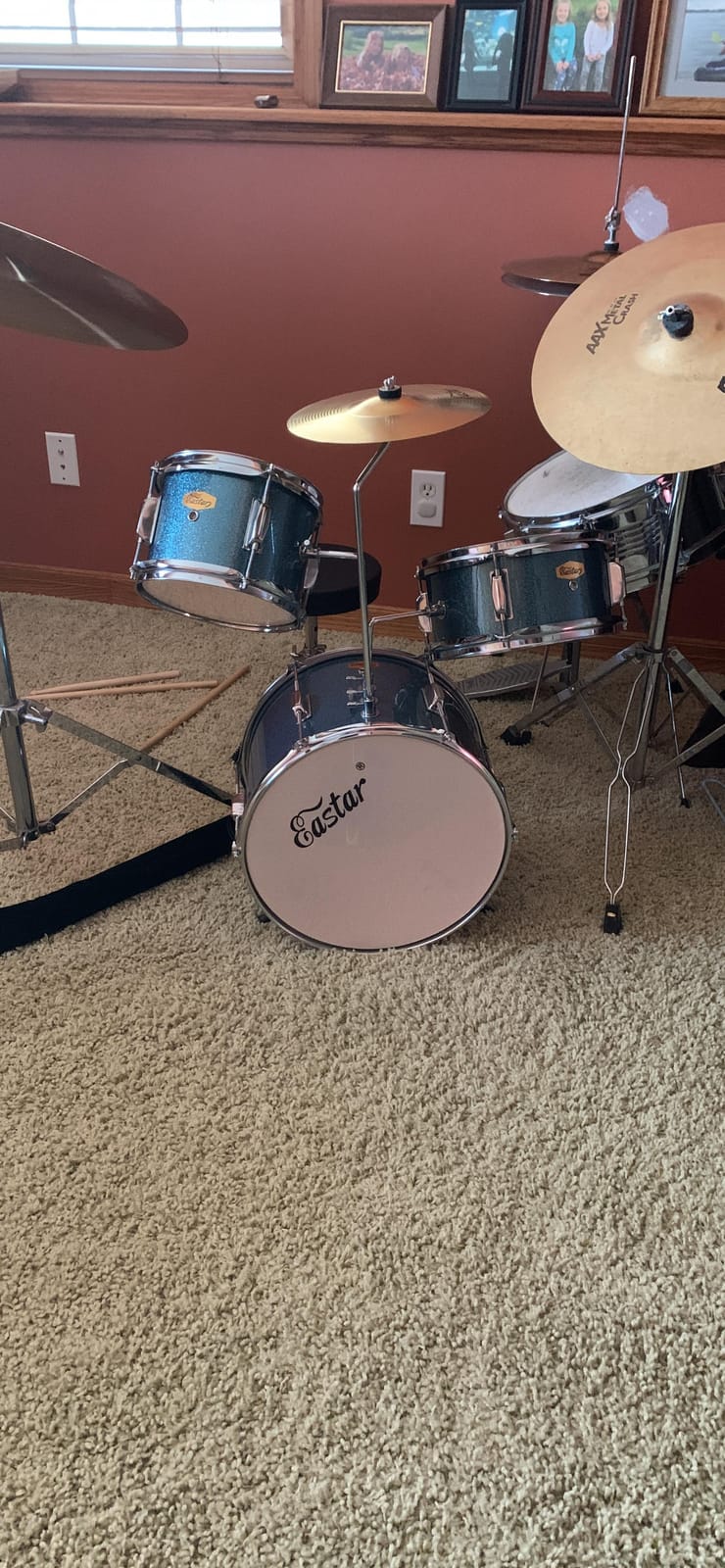
The specification is worth reading properly. You get a 14 by 10 inch bass drum, an 8 by 6 inch mounted tom, a 10 by 5 inch mounted snare with an internal adjustable soundbelt, and a 10 inch cymbal on a cymbal arm. The snare has an internal adjustment knob, which lets a child change the snare response without tools.
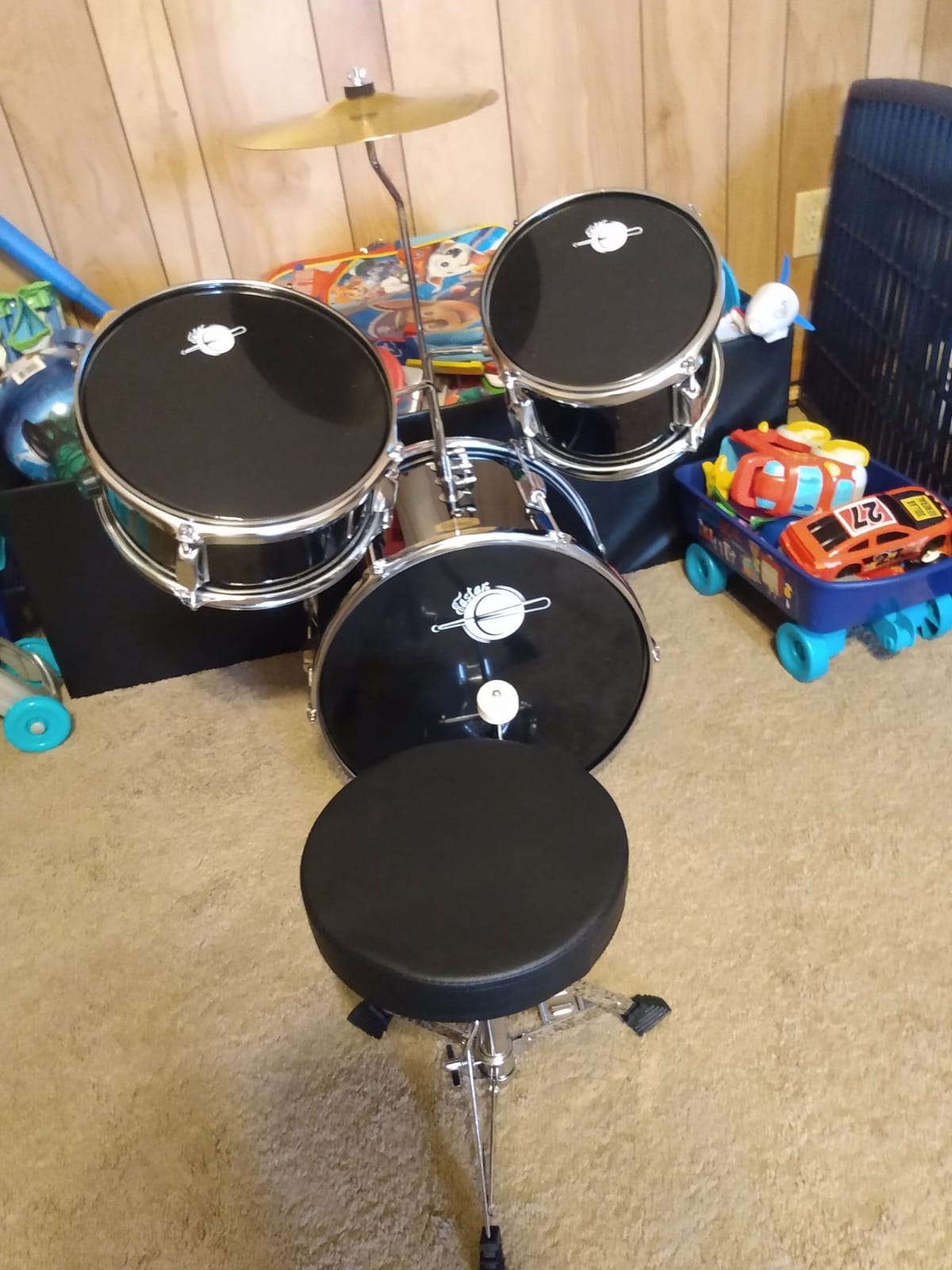
Accessories are unusually generous for this category: a plated bass drum pedal, a round padded adjustable throne, a pair of kids wooden sticks and a full-size adult 7A pair. Having both sizes of sticks means a parent can demonstrate properly without passing on a stick that is the wrong length for the child.
The one weakness that keeps coming up is stability. Owners report the bass pedal drifting during play and drums shifting slightly even with bolts fully tightened, so this is a kit that benefits from being set up once against a wall or in a rug area rather than moved around.
How long does assembly take for a first-time builder?
Around twenty minutes if you follow the included instructions or assembly video, and it arrives unassembled to avoid transit damage. The video matters more than usual here, because the cymbal arm and the snare mount are the two parts people get wrong.
Is a 14 inch bass drum right for a six-year-old?
It is the sweet spot for that age and height. A 16 inch kick is harder to pedal and harder to reach across, and a 13 inch one leaves a growing child with nothing to hit. Fourteen inches gives a child room to grow roughly two more years.
5. Ashthorpe 5-Piece Complete Kids Drum Set, 16 inch Bass
- Full five-piece layout with floor tom
- Genuine brass cymbals included
- Easy to tune with the included key
- Children grow into it for years
- Snare stand is flat and cannot tilt
- Occasional dented or faulty parts on arrival
- Smaller footprint than a pre-teen expects
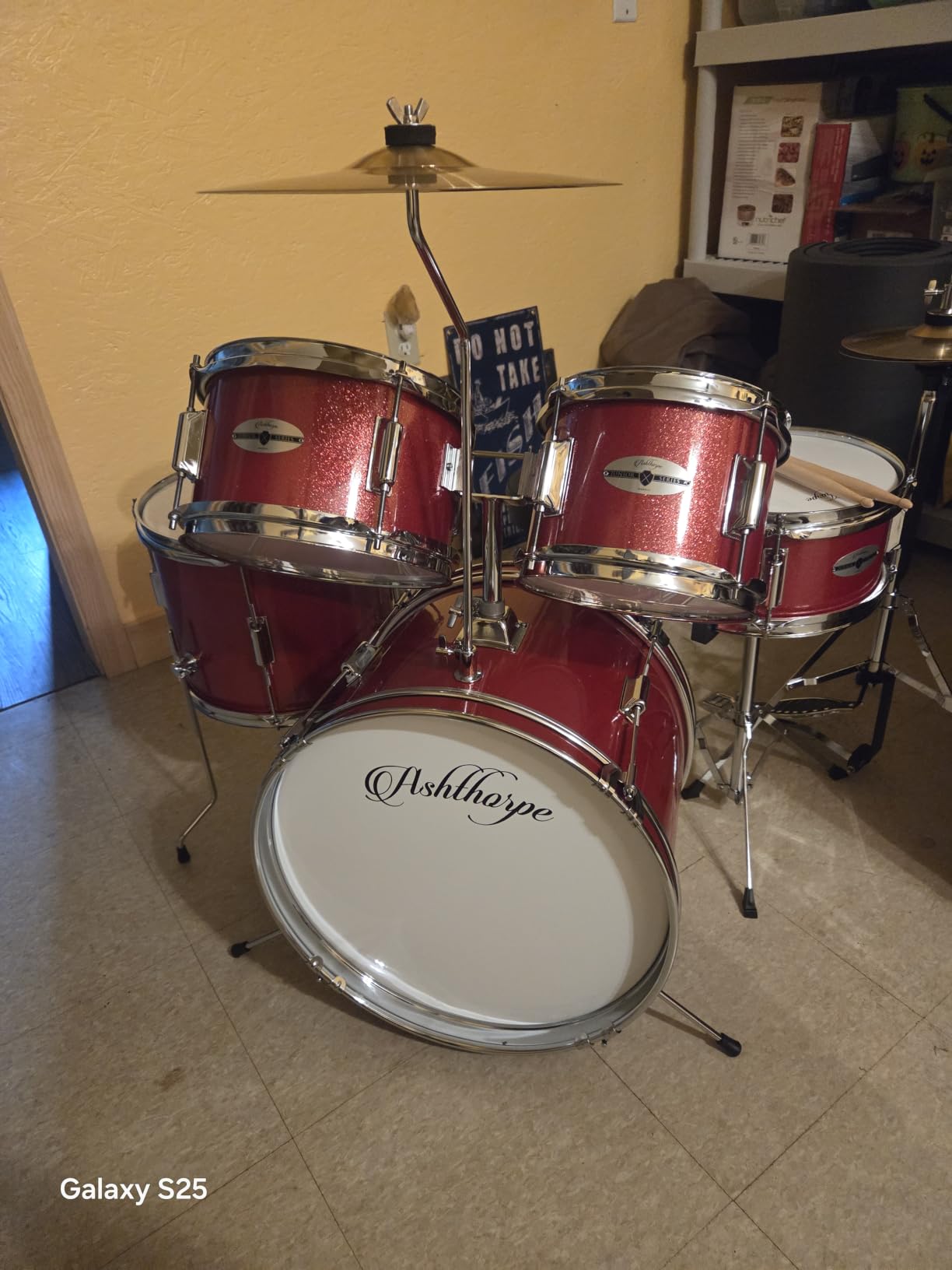
This is the first kit on our list that matches the layout a child will see on stage or in a video game, which matters more than parents expect. A 16 by 11 inch bass drum, a 12 by 10 inch floor tom, 10 by 6 and 8 by 6 inch mounted toms, a 10 by 5 inch snare, 8 inch hi-hats and a 10 inch crash and ride cymbal. Nothing is missing from the arrangement, so lessons and songs translate directly.
Build quality is a clear step up. The shells are genuine poplar hardwood with triple flanged hoops, the cymbals are brass rather than thin plated steel, and all the stands, throne, pedals, drumsticks and a drum adjustment key are in the box. The finish options run across several colours.
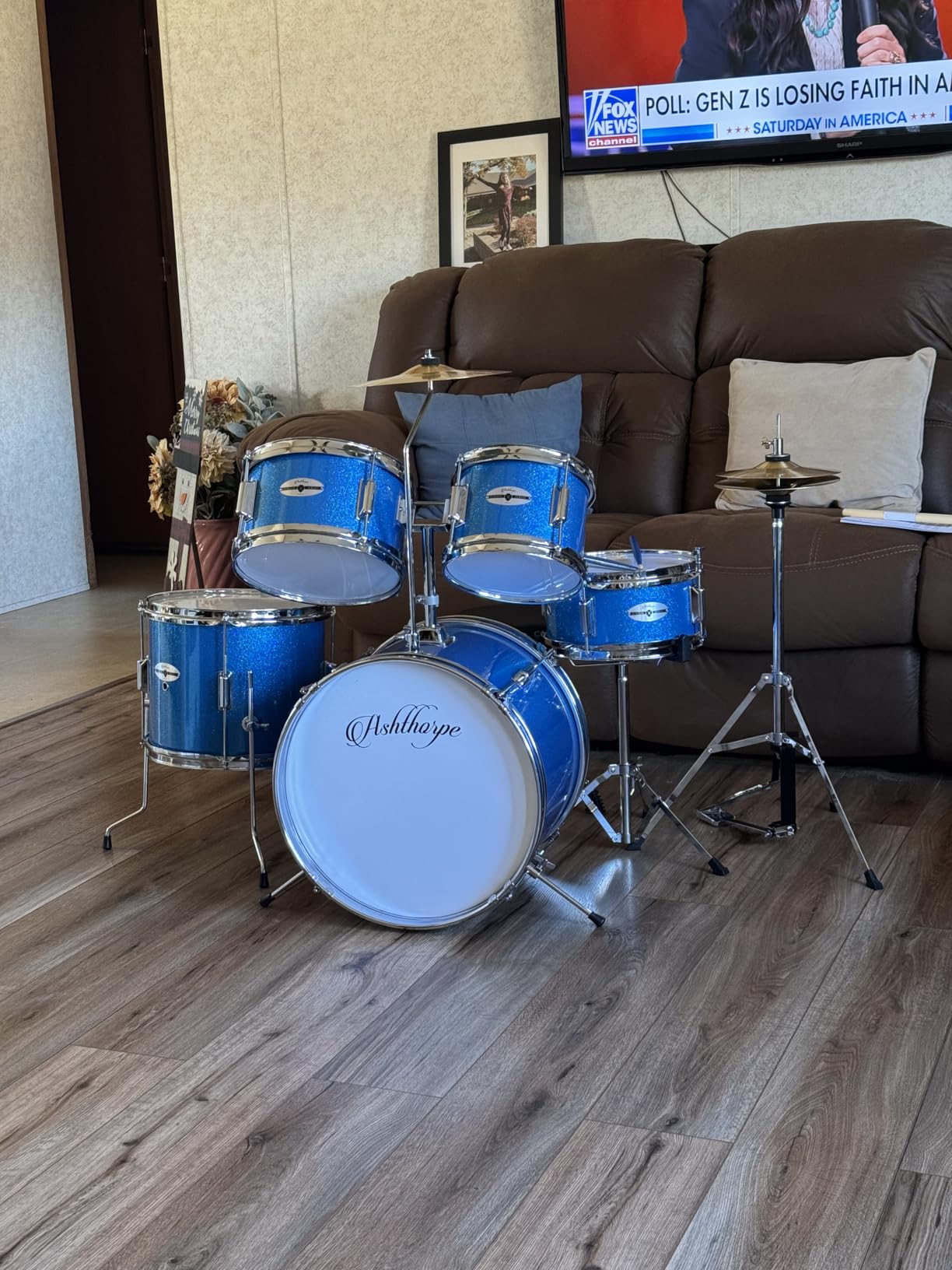
Our main criticism is the supplied hardware. The snare stand is flat and cannot be tilted to angle the drum toward the player, which flattens the snare sound until a better stand is added. At 44 pounds it is also a genuinely heavy object for a small room, and a ten-year-old will find the footprint smaller than the photos imply.
Check every cymbal and stand on unpacking day. Owners occasionally report parts arriving dented or not working, and a 90 day limited manufacturer warranty is the window for reporting it.
How long can a child use this kit before outgrowing it?
Comfortably from about age eight to eleven or twelve, which is a longer useful window than any three-piece kit. After that they are ready for a full-size kit, not a bigger junior one, so treat it as a deliberate bridge rather than a forever instrument.
What should you add or fix first?
A tilting snare stand and a fresh set of drum heads are the two upgrades worth making. Check all tension rods after the first month, because a five-piece kit has many more of them than a three-piece one and beginners routinely leave them uneven.
6. Gammon Percussion 5-Piece Kids Drum Set
Gammon Percussion 5-Piece Kids Drum Set, Complete Junior Drum Kit with Cymbals, Hardware, Sticks, & Throne – Black
- Genuine scaled-down kit with real floor tom
- Handles hard playing without damage
- Clear loud sound with a good snare snap
- Compact enough for a small room
- Cymbals bend and warp easily
- Pedal spring can fail within weeks
- Only one pair of drumsticks included
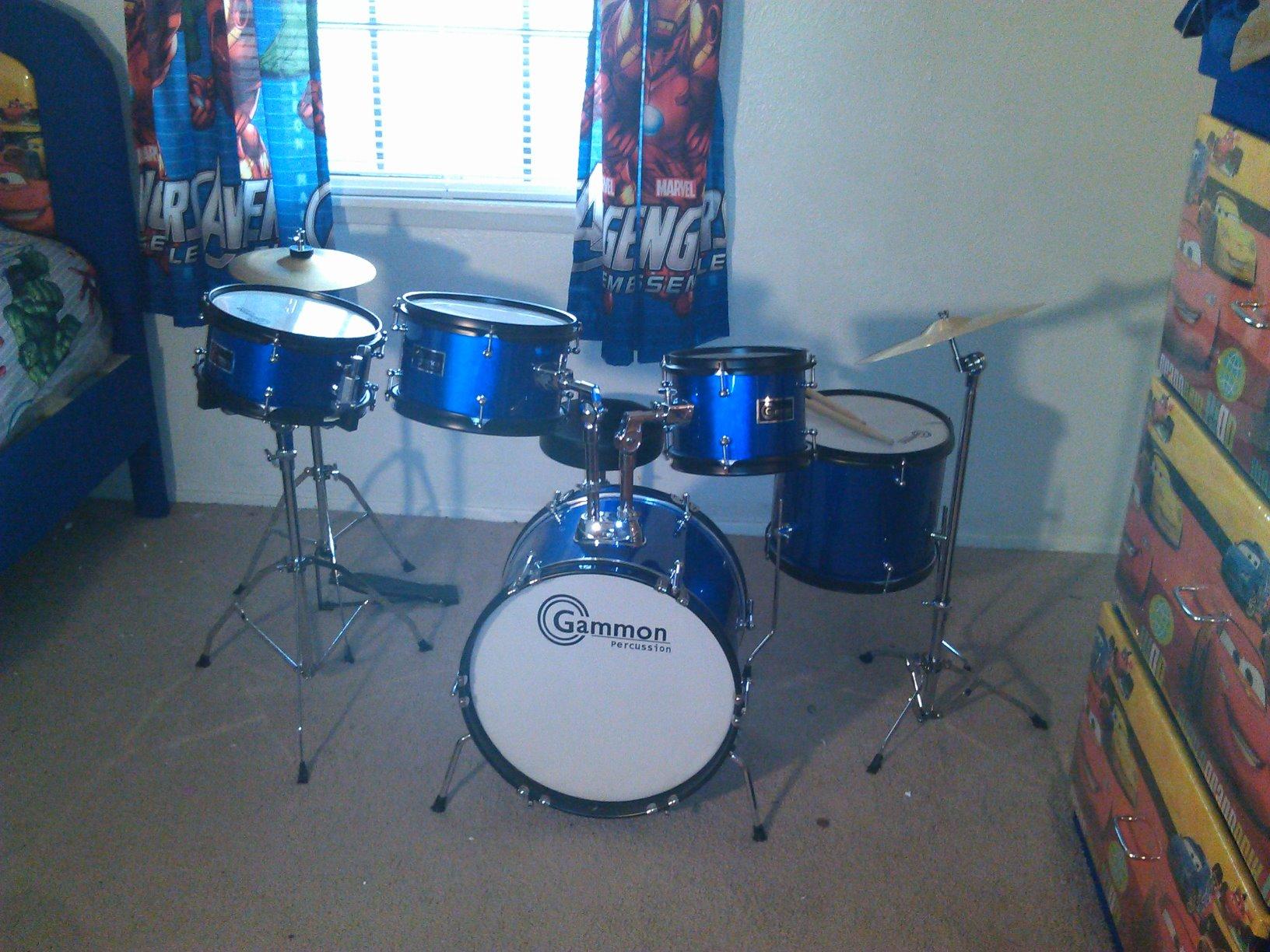
Among the five-piece kits here, this one earns the highest rating from buyers, and the reason is consistency. The drums are the same solid wood shells with a high gloss finish, black rims and chrome details, and the tone is described as clean, clear and loud with punchy toms and a proper snare snap. Every component is easy to reach for a junior player.
The box is genuinely complete: a 16 inch bass drum, snare, two mounted toms, floor tom, hi-hat cymbals with stand, a crash cymbal, snare stand, drum pedal, padded throne, drumsticks, all hardware, instructions and a drum key. That is the shortest route from an unopened box to a playable kit of anything in this guide.
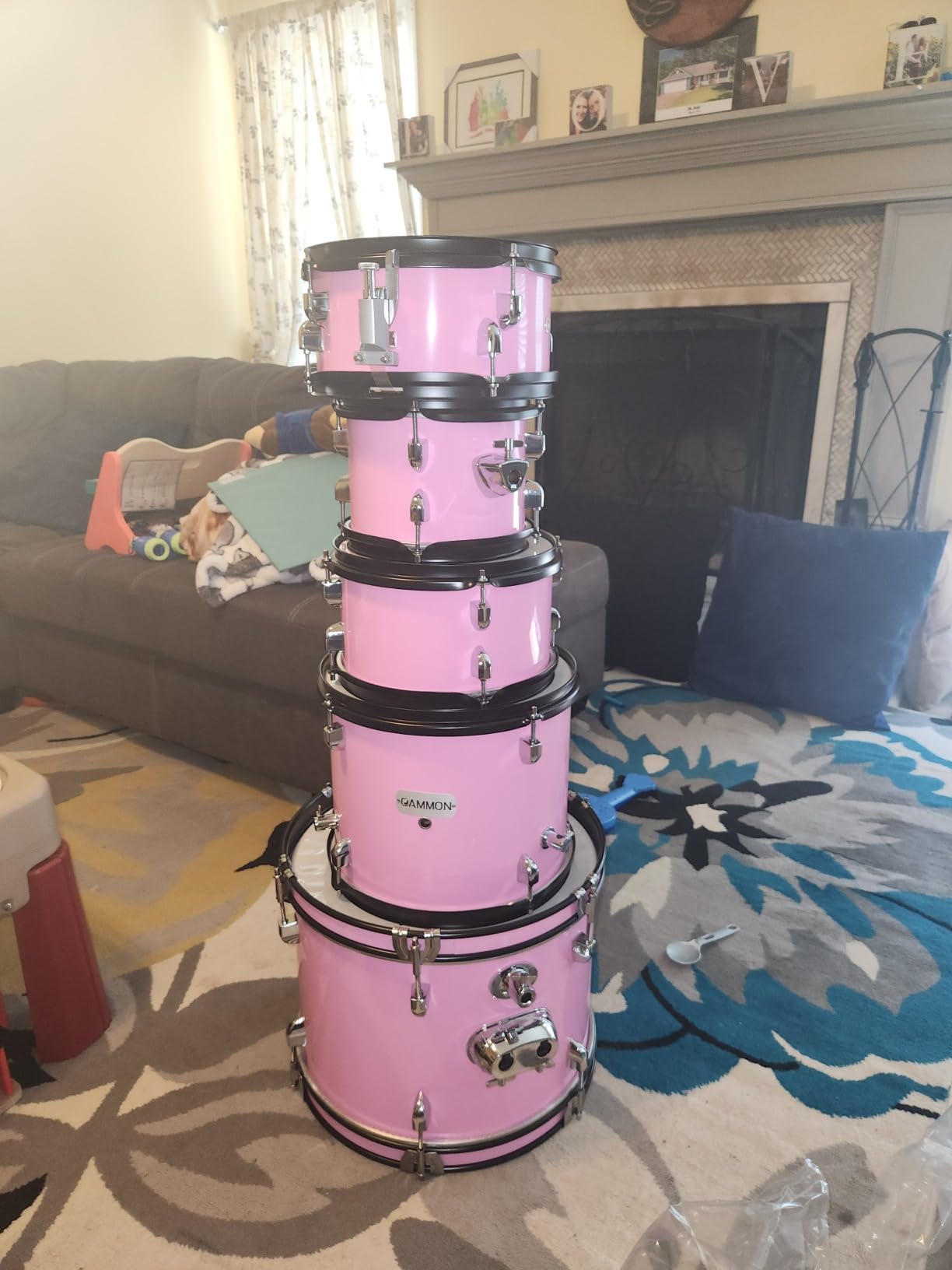
Two components fall short of the rest. The cymbals are the weakest part and bend or warp with enthusiastic striking, and the chain-driven bass pedal spring has a reputation for failing within weeks of hard use. Owners of this kit tend to recommend ear protection and buying a spare set of sticks early.
Because it ships as a five-piece set with a real floor tom, it doubles as a bridge kit for a child moving up from a three-piece. If a family already owns cymbals, this is the one to buy and add to later.
Is it quiet enough for a bedroom?
No, and neither is any acoustic kit here. A full five-piece with hi-hats is the loudest thing on this list, and in a flat with shared walls it is the arrangement most likely to cause friction. Our electronic kit guide covers the alternatives properly.
How does it hold up against hard playing?
The shells and hardware handle it well, which is the single thing that separates a five-piece kit from a toy. Budget for replacement cymbals and a second pair of sticks, and check the pedal spring periodically.
7. Mendini by Cecilio 5 Piece 16 Inch Junior Drums Set
- Complete all-in-one five-piece package
- Poplar shells look far better than toy kits
- Stable triangular base with grippy feet
- Customer service replaces faulty parts
- Assembly instructions confuse first-time builders
- Six on ten units have misaligned hardware
- Cymbals are thin and heads can crack
- Throne sits low for a seven-year-old
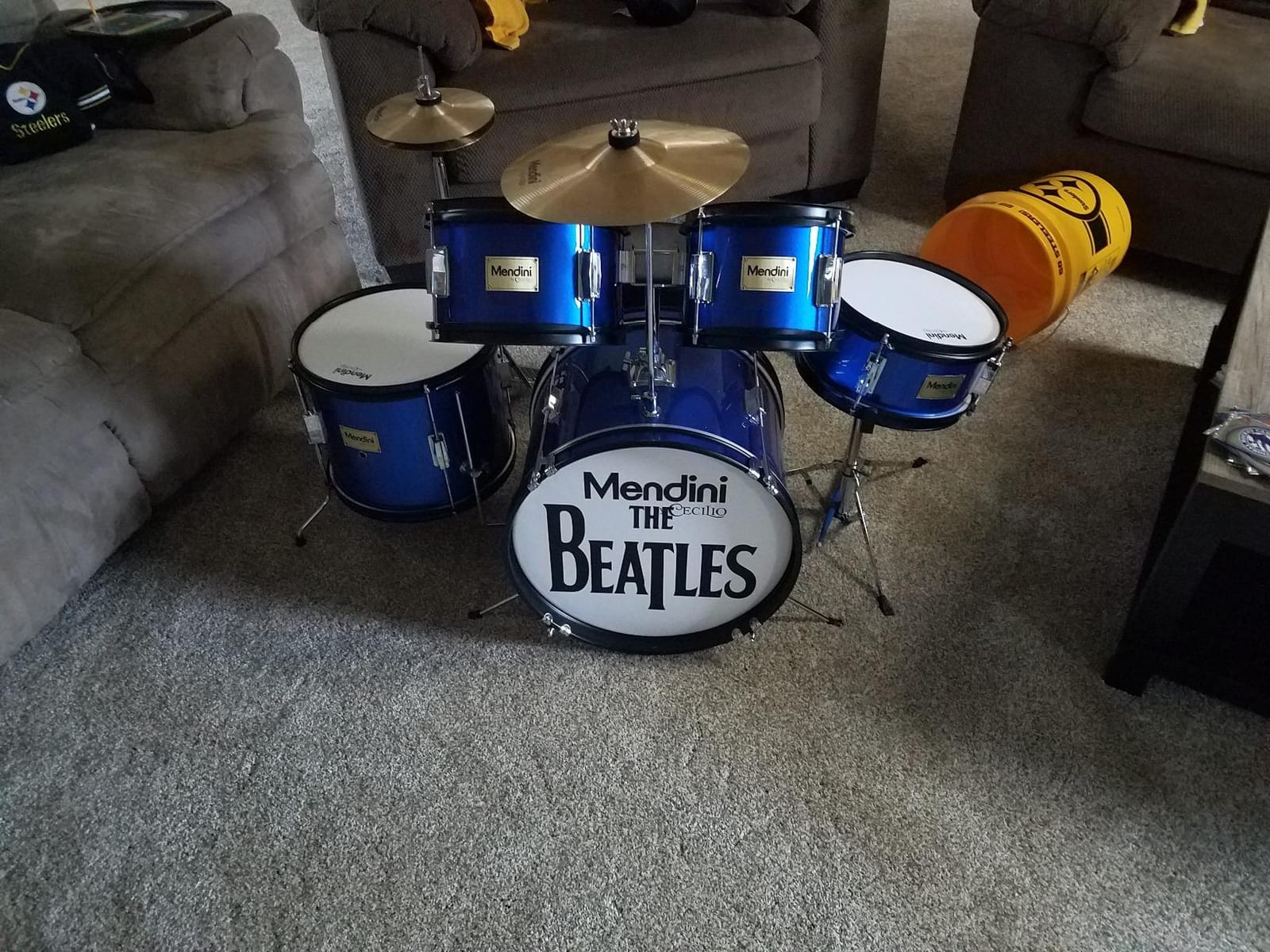
This is the most refined-looking kit on the list, and experienced drummers consistently single it out as a genuine instrument rather than a scaled-down toy. The horizontally grained poplar shells in a metallic blue finish, the triangular fixation structure with anti-slip rubber feet and the brushed chrome hardware look like a proper junior instrument rather than a flat-pack toy.
Spec-wise it covers the full five-piece layout: a 16 by 11 inch four-lug bass drum with foot pedal, 8 by 6 and 10 by 5 inch mounted toms, a 10 by 6 inch mounted snare, an 8 inch hi-hat with stand, a 12 by 10 inch floor tom and a 10 inch cymbal with arm. An adjustable padded drum seat and wooden drumsticks are included.
Set your expectations on assembly. It arrives unassembled with an installation video, and that video is not optional for a first-time builder. Experienced drummers consistently note that the instructions assume a familiarity with drum hardware that most parents do not have.
Owners also warn that some kits arrive with misaligned or incorrect hardware, commonly a hi-hat screw or mismatched floor tom leg holes. Check the whole kit against the parts list on day one, because the seller will replace missing or faulty parts on request.
How durable is a junior kit like this really?
Drummers who know this category put a junior kit at roughly a fifth of the durability of a full-size one, and that is fair. Shells and metal hardware are solid, but the cymbals are thin and the heads are less forgiving, so over-tuning can crack a head. Treat it as a teaching instrument, not a forever one.
Is the throne height right for a seven-year-old?
It is adjustable, but reviewers flag that it can sit short, which puts the bass pedal out of reach for a smaller child. Check the seat position before the first lesson and raise it until the child’s feet sit flat on the pedal board.
8. Mendini by Cecilio 13 Inch 3-Piece Junior Drum Set
- Real wood and metal build at an entry-level cost
- Good heads and hardware survive a toddler
- Compact 13 inch footprint for small rooms
- Low throne lets children reach the pedal unaided
- Snare and tom sit loosely in their mounts
- Un-damped drums are loud for the size
- Instructions reference a different pedal style
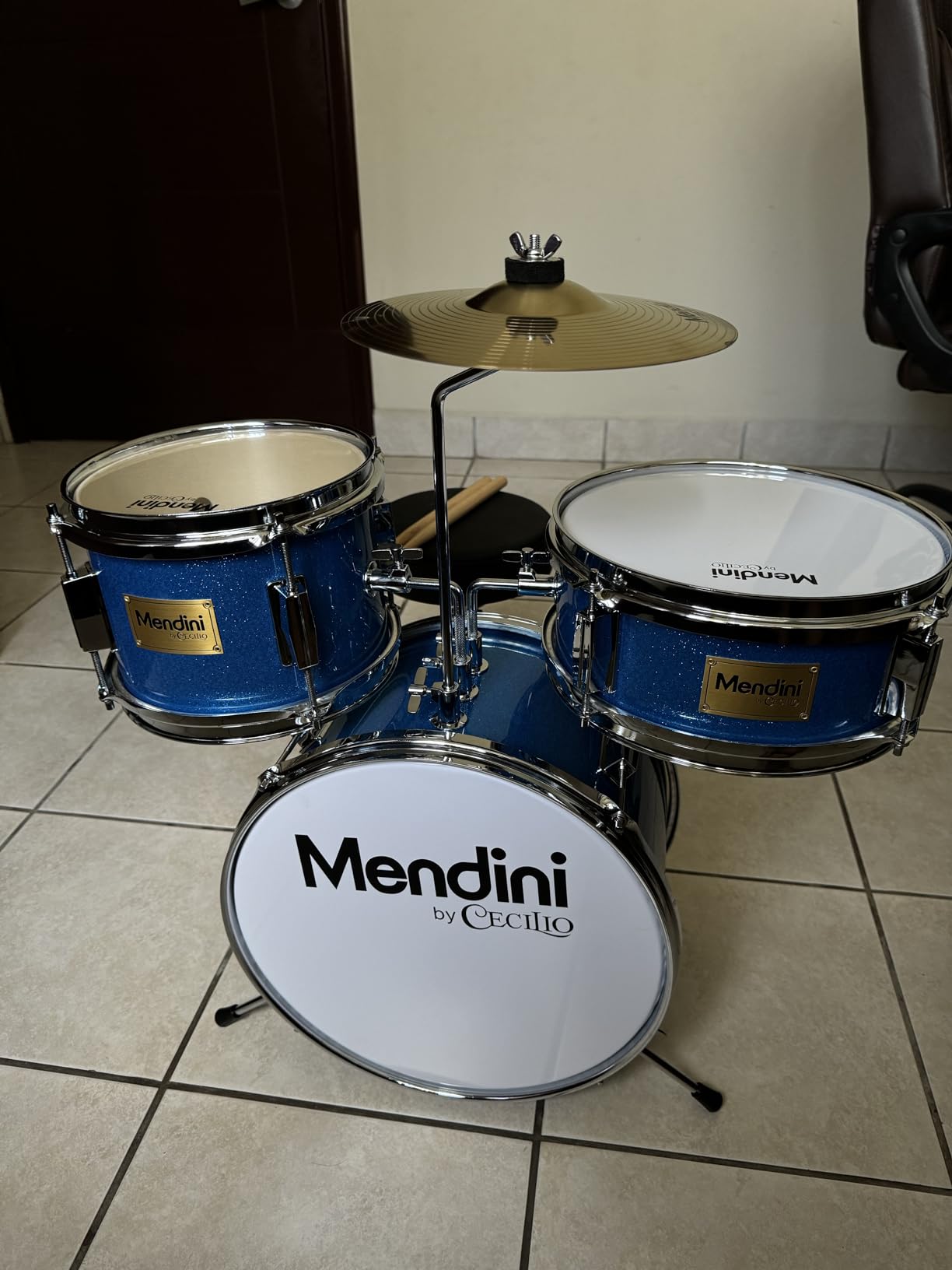
Among the most-reviewed acoustic kits in this guide, and the one we recommend most often for a first real drum set. Parents are consistently surprised that a kit in this bracket is built from poplar wood and metal rather than plastic, and that it survives a toddler who hits it as a toy. It is a real instrument at a size that fits a five- or six-year-old.
The layout is a 13 by 8 inch four-lug bass drum with foot pedal, an 8 by 6 inch mounted tom, a 10 by 4 inch mounted snare and an 8 inch cymbal on an arm. The triangular base with anti-slip rubber feet is genuinely stable, and the low adjustable padded seat is the detail that matters most, because it lets a small child reach the pedal without an adult lifting their foot.
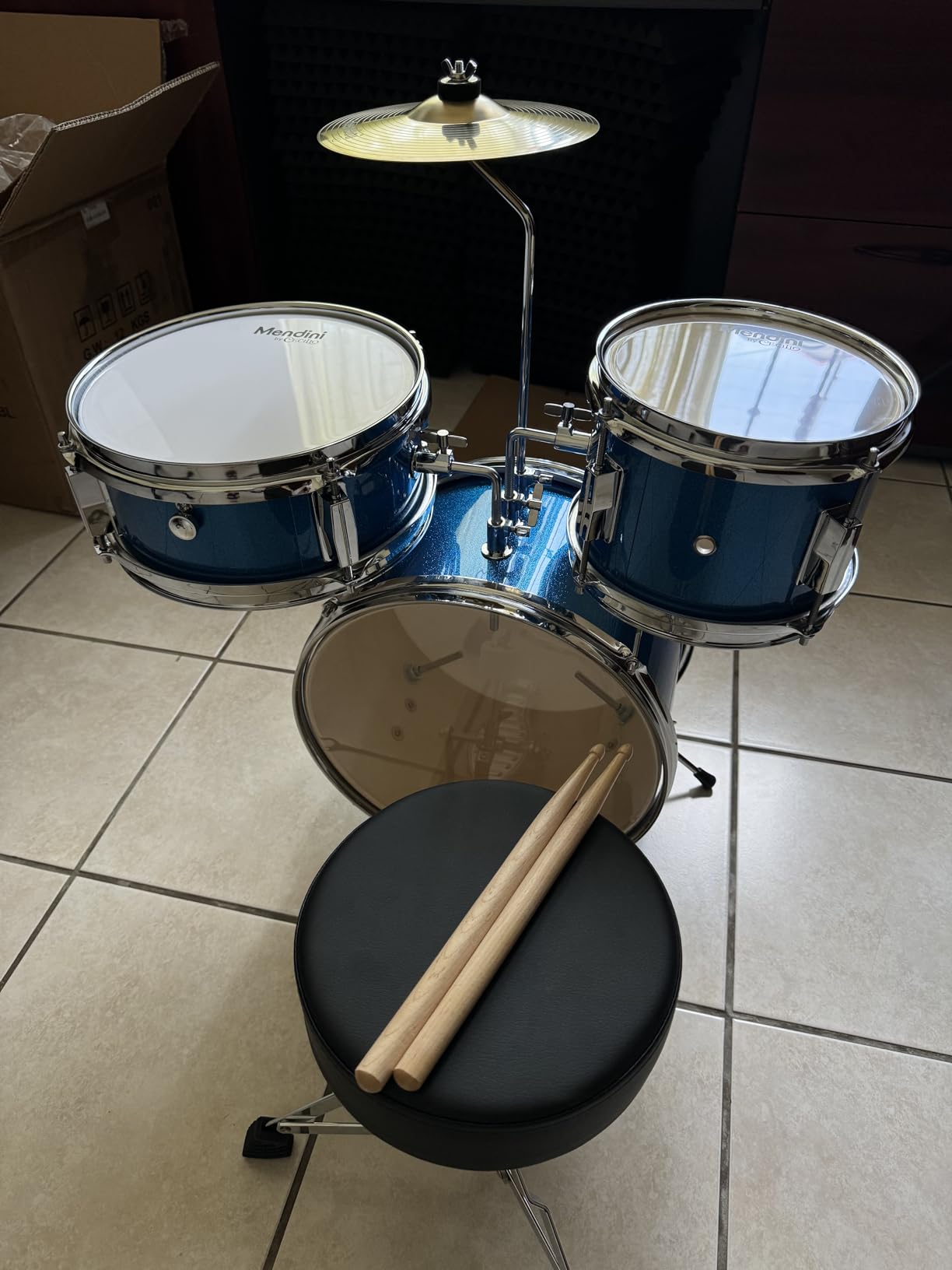
Volume is the practical complaint. The shells are undamped, so a 13 inch kit in a small room is louder than its size suggests, and drum mutes or felt strips on the rims help more than parents expect. The snare and tom can also sit loosely in their mounts and need a check with the drum key every few weeks.
It arrives unassembled with an installation video. Owners note the instructions can reference a different kick pedal style, so check which pedal your unit has before following them literally.
Is thirteen inches too small for a child?
It is the right size for a child who can sit with feet flat and reach across the snare, which in practice means most six-year-olds and younger seven-year-olds. A thirteen inch kick is also the easiest for small legs to pedal, which matters more than the diameter suggests.
What extras will the family need to buy?
Modest. A mute pack and a spare pair of sticks are the two things most owners buy, and both are inexpensive. Everything needed for the first six months of practice is in the box apart from those.
9. Ashthorpe 3-Piece Complete Kids Drum Set, 14 inch Bass
- Compact footprint fits a bedroom corner
- Poplar shells give a real resonant sound
- Snare tension knob makes tuning child-friendly
- Padded throne and pedal in the box
- Seven finish options
- Better for children under about ten
- Single crash cymbal with no hi-hat
- Requires assembly before play
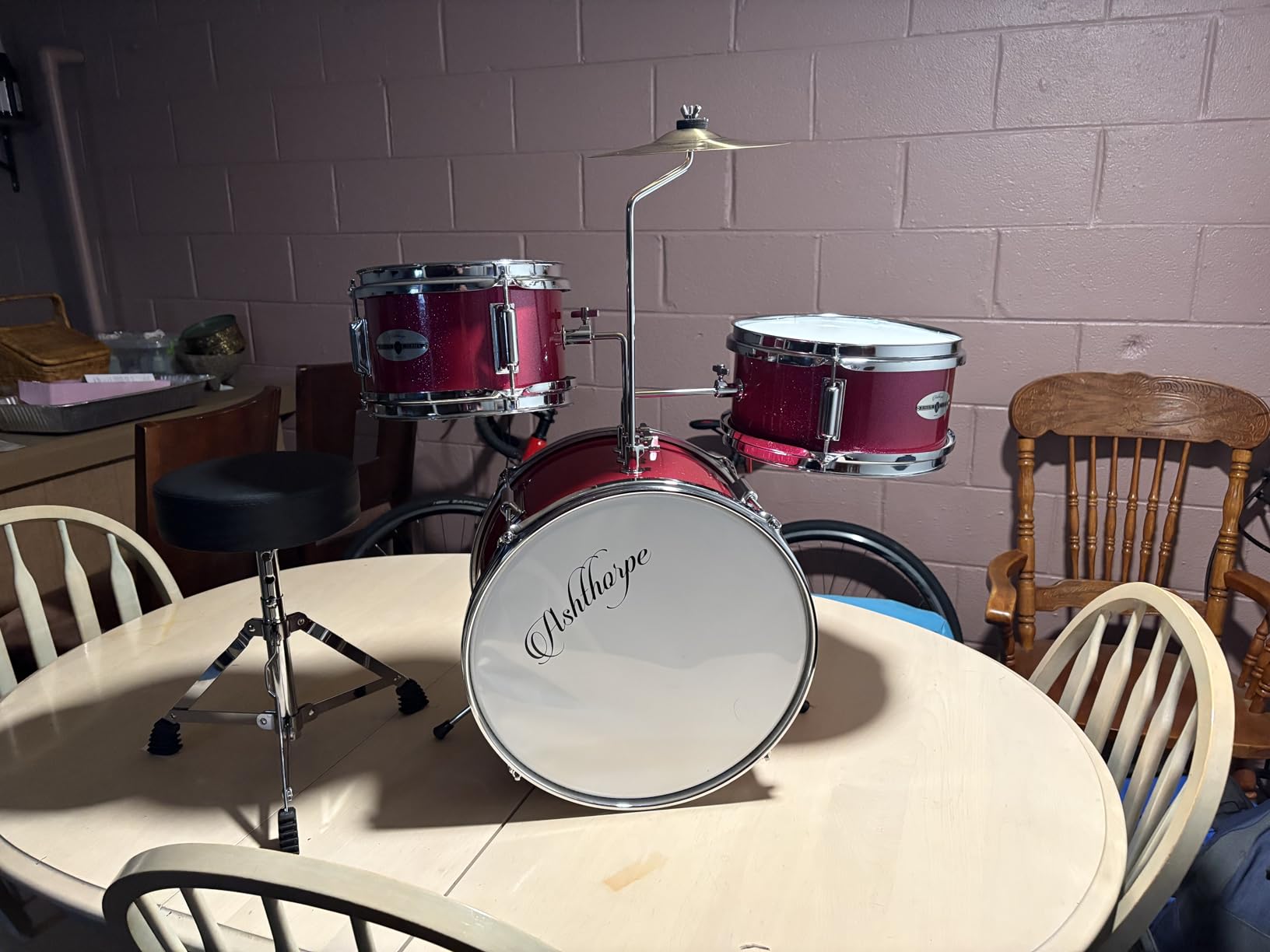
A well-built three-piece kit aimed squarely at a child between six and nine, and the compactness is the point. At 15 by 15 by 14 inches it fits in a corner of a bedroom or playroom without taking over the space, which makes it far more likely to still be set up and played after six months than a full five-piece kit.
The build matches the other Ashthorpe kit here: genuine poplar hardwood shells, triple flanged hoops and all-chrome hardware. The specification is a 14 by 9 inch bass drum, a 10 by 5 inch mounted tom and an 8 by 5 inch mounted snare with internal wires and an adjustable tension knob, plus an 8 inch stainless steel crash cymbal.
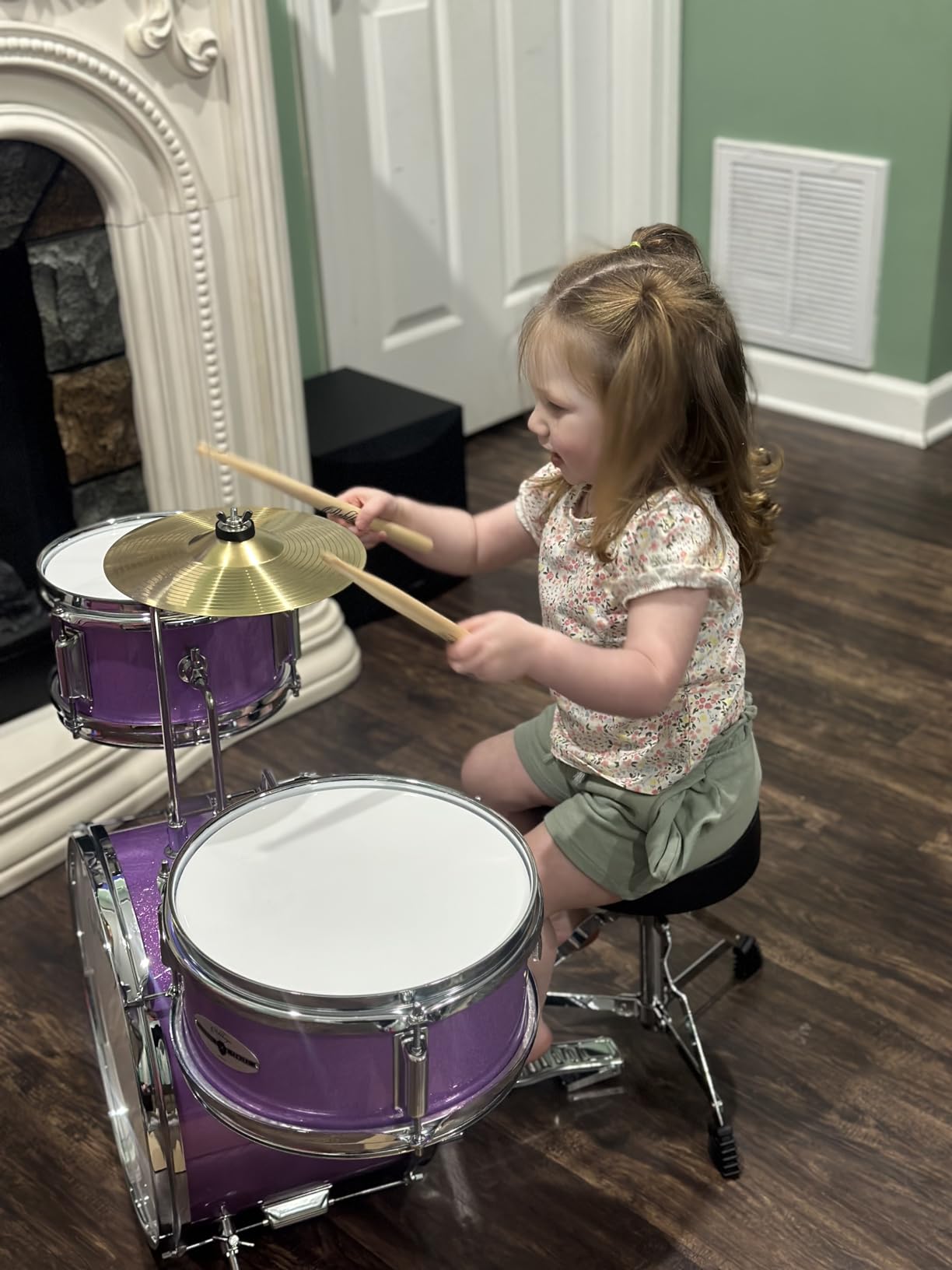
That snare tension knob is the detail we like most. A child can adjust the snare response themselves without a drum key, which turns tuning from an adult chore into part of playing. The throne is padded and adjustable, and the pedal, drumsticks, hardware and drum key are all included.
The limitation is the ceiling. With a single crash and no hi-hat, it is a limited kit for a pre-teen, and the footprint works better for children under about ten than for taller kids. Some assembly is required before play.
Is this a good birthday or holiday gift?
It is one of the safer gifts in this guide because it arrives complete, is small enough to fit in most homes, and has a colourway for almost any taste. Just check that the child can already reach a snare unaided, or the novelty will outrun the ability to play it.
When should a child move from this to a five-piece kit?
Around age nine or ten, when they start asking for hi-hats and a floor tom, or when they join a school band that expects a full kit. That is the natural upgrade point, and a five-piece junior kit like the Ashthorpe on our list is the destination.
What Size Drum Set Does Your Child Need? Age and Height Guide
The most useful number on any drum kit listing is the kick drum diameter, and almost nobody mentions it. Here is the rule we use: measure or estimate your child’s height, then match it to a kick diameter. A toddler under about 45 inches tall needs a 12 to 13 inch kick. A child between 45 and 52 inches, roughly ages 6 to 8, is comfortable with a 14 inch kick. From 52 inches upward, which is most 9 to 12 year olds, a 16 inch kit works and keeps them going for years.
Piece count follows height rather than age. Three pieces, meaning bass, snare and one tom, is correct up to about 52 inches. Add a second tom and a floor tom at 52 inches and above, and only then is a five-piece kit the right call. Age bands are a rough proxy for height, and tall six-year-olds routinely need the 14 inch kit while small nine-year-olds manage on 13 inches.
For anything under five, height is the wrong measure entirely because a real kit is out of reach regardless. That is the stage at which a light-up play kit or a practice pad arrangement is the realistic instrument, and it is where most parents start.
Acoustic vs Electronic Drum Sets: Which Should a Child Start With?
The decision rule is short. If you live in a flat, a terrace with shared walls, or anywhere noise is a recurring household argument, start electronic. If the child has a dedicated room, a garage, or a house with neighbours who already know what a drum kit sounds like, start acoustic. Everything else is preference, and acoustic wins on feel, tone and the fact that the child is learning a skill that transfers directly to a real kit.
Electronic kits replace shells and cymbals with rubber or mesh pads wired to a sound module, and that module is the whole argument. Volume drops to a level you can control, headphones give the child a silent practice option in a shared room, and built-in metronomes and play-along songs make a huge difference in the first three months. What you give up is acoustic projection, the feel of a real head, and any expectation that the technique transfers unchanged.
Our honest take is that acoustic teaches better and electronic keeps more families practising. If noise is a real constraint rather than a worry, the electronic option wins on the only metric that matters, which is whether the kit is still being played a year from now.
How to Choose a Kids Drum Set: 8 Buying Considerations
1. Kick drum diameter beats piece count
Two kits with five pieces can suit completely different children. Match the kick drum to the child’s height first, then look at the rest of the configuration. Piece count tells you about layout, not about whether the kit is playable.
2. Complete kit or shell pack
A shell pack is drums only, and you then need stands, a throne, a pedal, cymbals, sticks and a rug. For a beginner, always buy a complete kit. A shell pack only makes sense for a child who is already playing and simply outgrowing a smaller set.
3. Shell material
Poplar is the standard for junior kits and is a good choice: light, cheap and stable. Multi-ply or birch shells sound better and take more punishment, and they appear as you move up the price range. Plastic shells are the line below where a drum stops being an instrument.
4. Hardware quality and bracing
Look for chrome hardware, drum key adjustability and a throne that clamps rather than rests. This is the part that fails first, and a kit with a flat snare stand or a wandering bass pedal will frustrate a beginner every single session.
5. Cymbals included or not
Three-piece kits typically ship with one 8 or 10 inch cymbal on an arm, which is enough to start. Five-piece kits should include hi-hats and a crash. If a kit lists cymbals as a separate accessory, budget for buying them before the first lesson rather than after.
6. Noise and shared walls
An acoustic kit with a 16 inch kick produces far more low end than a 13 inch kit. Practice late in the day, use rug or carpet, and consider felt strips or a mute pack. If none of that works, an electronic kit is the answer, not a quieter acoustic one.
7. Safety for younger children
Under about five, keep an eye on small hardware: the pedal cam, tension rods and wing nuts are the real choking risks rather than the cymbals. Cymbal edges are sharp when a child is holding the wrong end, and it is worth teaching them which side faces down before the first session.
8. Resale and hand-down value
Brands with an established name and real wood shells hold value and can be handed to a sibling or sold. Unbranded plastic kits rarely sell at all. A five-piece kit that costs more now usually recovers more of that later, and it can be split up when the child moves on to a full-size set.
What to Avoid When Buying a First Kids Drum Kit
Avoid anything described as an eleven-piece or thirteen-piece set at a very low price point. Those listings count sticks, mounts and spare washers as pieces, and the drums themselves are usually plastic with heads that fail within weeks. The low three-star listings on retail carousels cluster almost entirely in that category.
Avoid unbranded budget kits and the brands that drum communities warn about repeatedly on r/drums, where the recurring advice is that cheap generic kits waste the money and the child loses interest. Brands with real drum-making heritage get recommended for a reason: the shells tune, the hardware holds and the parts can be replaced individually.
Also avoid a kit that is clearly too large. A kit a child cannot reach across or cannot pedal is a decoration, and it is the single most common way a first drum set ends up unused. Buy for the height the child has now, not the height you expect them to reach in two years.
Frequently Asked Questions
What is a good drum kit for kids to learn?
A good drum kit for kids is a scaled-down acoustic set with a 13 to 16 inch kick drum, a snare, one or two toms, and a throne, pedal and drumsticks in the box. Children aged 5 to 8 suit a 3-piece kit with a 13 or 14 inch kick, while ages 8 to 12 handle a 5-piece set with a floor tom and hi-hats. Under age five, a light-up play kit or a practice pad setup is the realistic starting instrument.
What age should kids start drums?
Most children are ready to start real drum playing between five and six, once they can sit at a throne with their feet flat on the floor and reach the snare without stretching their shoulders. Between two and five, play drums are a better introduction than any real kit, because they teach pulse and stick control without requiring a body the child does not have yet. Teachers for private lessons commonly work with children from about six upward.
What size drum set for a 7 year old?
A 7 year old usually needs a 14 inch kick drum, which matches most children in that age group and roughly 45 to 52 inches of height. A 3-piece kit with a 14 inch bass drum, one tom and a snare is the right starting configuration, and it is worth checking that the child can reach the pedal and the snare unaided. A 16 inch kit tends to be too large before about age nine.
Is a 3 piece drum set enough for a child?
Yes. A 3-piece kit containing a bass drum, snare and one tom teaches the same core technique as a larger kit, and parents widely recommend it as a solid starting point for a six-year-old. The limitation is layout rather than function: there is no hi-hat and no floor tom, so most children move to a 5-piece set between ages eight and eleven.
Should I buy acoustic or electronic drums for my child?
Buy electronic if you live in a flat, have shared walls, or have already had noise complaints. The sound module and headphones make practice possible in a small or shared space. Buy acoustic if the child has a dedicated room and the household can absorb the volume, because acoustic kits teach technique that transfers straight to a full-size kit and are far better value over a longer period.
How loud is a kids drum set?
A 3-piece kit with a 13 inch kick is noticeably quieter than a 5-piece kit with a 16 inch bass drum, and the difference is mostly low end. All acoustic kits are loud enough to be heard through a single interior wall at moderate playing force. Rug or carpet, practice outside peak hours, and felt strips on the drum rims all reduce the level noticeably. Electronic kits reduce it to whatever volume you set.
Final Verdict: Which Kids Drum Set Should You Buy?
For a child under five, the VTech KidiBeats is our pick and our overall recommendation across this roundup: it holds a 4.7 rating across more than fifteen thousand reviews, it is light enough for a toddler to move, and it teaches rhythm before anyone asks them to sit at a throne. From five to seven, choose the Mendini by Cecilio 13-inch or the Eastar 14-inch depending on whether the child can already pedal, and from eight to eleven the Ashthorpe or Gammon five-piece kits are the strongest long-term buys.
Whatever you choose, match the kick drum to your child’s height, check that the throne and pedal are included, and set the kit up in one corner where it can stay. A kids drum set that is ready to play beats an expensive one still in a box every single time.