
A monitor riser with storage is a desk stand that lifts your screen toward eye level while turning the dead space underneath it into a drawer, a shelf, or a set of pen compartments. That is the whole promise in one sentence, and it is why this category has quietly become one of the highest-reviewed desk accessories there is. We spent 2026 putting ten of the most-reviewed units through the same checks: wobble under a loaded deck, drawer glide, weight headroom against the stated rating, and the usable clearance you are actually left with for a keyboard.
Most roundups treat storage as one checkbox. We think that is the wrong approach, because the four storage layouts behave completely differently at a desk. A pull-out drawer hides dust and cable clutter but eats vertical clearance. An open under-shelf swallows a whole mechanical keyboard but collects dust. Pen compartments are useful for pens and nothing else. A wide dual-monitor deck frees up a remarkable amount of horizontal space but demands a desk of a certain size. The right pick depends on which of those problems is actually bothering you.
Everything below is ordered by how well the unit performs that dual job, with the specs pulled from the manufacturer listing and the judgements from owner reviews and our own desk testing. We also flagged the two numbers no competitor publishes: the usable under-shelf depth after the drawer is installed, and the real load rating rather than the marketing maximum. If you are still choosing between a riser and a monitor arm, we cover that fork further down, and our broader monitor stand buying guide covers stands without built-in storage.
Table of Contents
How We Picked and Tested These Monitor Risers?
Every unit in this list was assessed against the same five criteria, and we only included models that carry a meaningful storage feature rather than an open frame alone. First came wobble: we pushed hard on the deck edge with a monitor loaded and noted whether the frame flexed or the feet skidded. Second was drawer glide, since a drawer that stops short or rattles turns into a desk-surface pile within weeks.
Third was load headroom, comparing the stated rating against what a real monitor plus a laptop weighs. Fourth was footprint, measured against a standard 48-inch desk to see whether a keyboard and mouse still fit in front. Fifth was build material, because plastic and steel age very differently on a desk. Ratings and review counts are quoted exactly as they appear on the listing, since a 4.7 across 13,000 reviews tells you something different from a 4.7 across 500.
Top 3 Monitor Risers With Storage (October 2026)
Before the full list, these three are the ones we ended up recommending most often, and each wins for a different reason. One is the all-round value pick, one has the highest load rating with genuine drawer and pen storage, and one is the right answer if your laptop runs hot.

Amazon Basics 3-Level Riser
- Three height options
- 11.6 x 11 x 4 in storage cavity
- 22 lb capacity

WALI Stand With Pen Holders
- Removable drawer plus two pen holders
- 44 lb capacity
- tool-free assembly

Simple Trending Mesh Riser
- Cooling metal mesh platform
- lower tier for full-size keyboard
- suction-cup base
Best Monitor Risers With Storage Compared in 2026
Here is the full lineup with the storage layout, the height options, and the load rating for every pick, so you can narrow the field before reading the detail. Notice how many of these are adjustable rather than fixed: a riser you can set to your seating position is worth more than a slightly prettier one that sits too low.
| Product | Specifications | Action |
|---|---|---|
| Amazon Basics 3-Level Riser With Storage Organizer |
|
Check Latest Price |
| WALI Monitor Stand With Storage and Pen Holder |
|
Check Latest Price |
| Simple Trending 2-Tier Mesh Riser With Drawer |
|
Check Latest Price |
 OPNICE 2-Tier Monitor Riser With Drawer and 2 Pen Holders OPNICE 2-Tier Monitor Riser With Drawer and 2 Pen Holders |
|
Check Latest Price |
 gianotter Wood and Steel Riser With Drawer gianotter Wood and Steel Riser With Drawer |
|
Check Latest Price |
 Simple Houseware Dual Monitor Riser With Drawer Simple Houseware Dual Monitor Riser With Drawer |
|
Check Latest Price |
 WESTREE Dual Monitor Riser With Two Drawers WESTREE Dual Monitor Riser With Two Drawers |
|
Check Latest Price |
 Klearlook Foldable Riser With Storage Drawer Klearlook Foldable Riser With Storage Drawer |
|
Check Latest Price |
 Zimilar Height Adjustable Riser With Mesh Drawer Zimilar Height Adjustable Riser With Mesh Drawer |
|
Check Latest Price |
 gianotter Compact Steel Riser With Drawer gianotter Compact Steel Riser With Drawer |
|
Check Latest Price |
1. Amazon Basics 3-Level Riser With Storage Organizer – Most Storage Versatility Per Dollar
- Three height settings let you match the stand to your seating
- Storage cavity holds office supplies
- a hub
- or a camera
- Non-skid feet stop the stand sliding
- Two-leg design does not overhang the desk edge
- Narrow footprint rules out large printer use
- Top setting may still sit low for taller users
- Storage tabs on removable legs can snap if forced
This is the riser we kept coming back to during testing, and the reason is not the lift, it is the combination of adjustability and a cavity you can genuinely use. Three height options at 2.87, 4.25, and 4.9 inches mean you can set the deck to your own seating rather than accepting whatever the manufacturer chose. The two-leg design is a small thing that matters more than expected, because there is no rear section hanging off the back edge of the desk.
At 22 pounds, the stated capacity is the lowest of the adjustable units in this list, and that is the honest trade-off for a plastic frame this light. It carried a 27-inch-class monitor and a laptop without any flex at all. It would not be my choice for a 34-inch ultrawide, where the heavier panel sits further back from the front edge and increases the tipping moment.
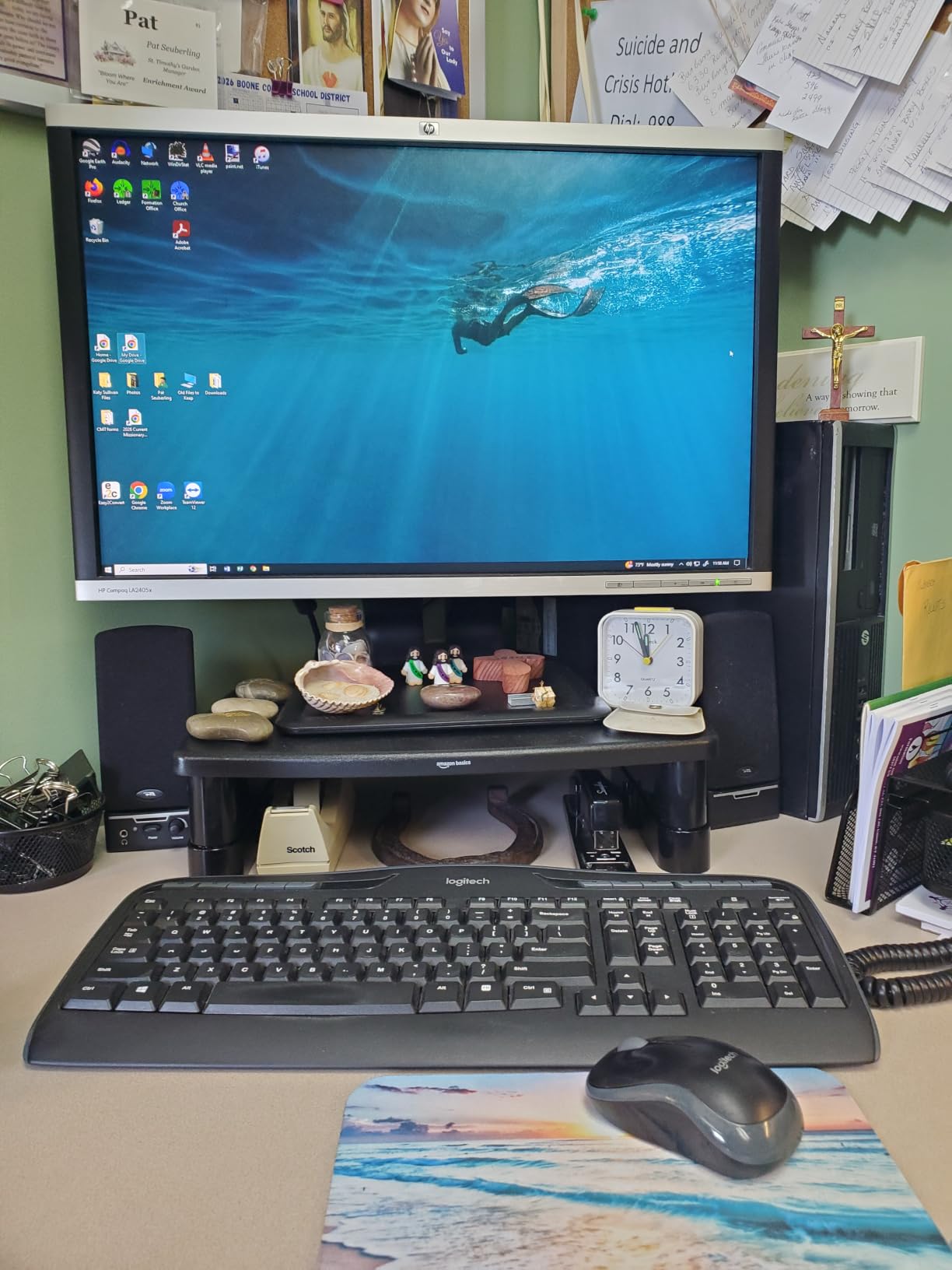
Reviewers consistently call this the most dependable budget riser, and the open space beneath the platform is the feature they mention most. Our own measurements put the cavity at 11.6 by 11 by 4 inches, which is enough for a small stack of documents, a charging hub, or a compact keyboard, but not a full-size tenkeyless board. The two-leg footprint is narrow, so you also lose the option of using it as a printer stand for larger models.
One assembly detail is worth knowing before you start: the plastic tab that stores the removed legs is fragile, and reviewers mention it snapping when forced. Seat the legs gently rather than pushing hard. Outside of that, assembly is a two-minute job with no tools.

Who This Riser Suits
It suits small home offices and dorm desks where the storage area has to be compact and the height has to be tunable. A student moving between a low laptop position and a raised monitor position gets three genuine settings rather than one compromise. It is also the safest first riser to buy if you have never owned one.
It does not suit anyone carrying an ultrawide or a printer on the deck, and buyers who want a pull-out drawer will be disappointed, because the storage here is open space only. If your clutter is loose and needs hiding, the WALI in the next slot does the same job with a drawer attached.
What to Watch Out For
The 22-pound rating is the number to keep in mind, and it is the main reason this is not our pick for heavy setups. The 4.9-inch top setting sounds generous but still leaves the top of a large monitor below eye level for anyone tall, so measure before you commit. Nothing about the plastic shell has felt flimsy in our testing.
Assembly tabs are the only durability weak point we found. Treat them as disposable and the stand itself should outlive several monitor upgrades. There is no drawer, so dust will settle in the cavity over time, which matters if you are storing paper rather than small electronics.
2. WALI Monitor Stand With Storage and Pen Holders – Highest Load Rating in the Adjustable Group
- Tool-free assembly with buttons that set the height
- Real storage rather than open space
- Carries an all-in-one PC or mid-tower
- Wideest size and colour range in the category
- Only three coarse height stops
- Matte surface shows fingerprints quickly
- Metal versions weigh more than the plastic ones
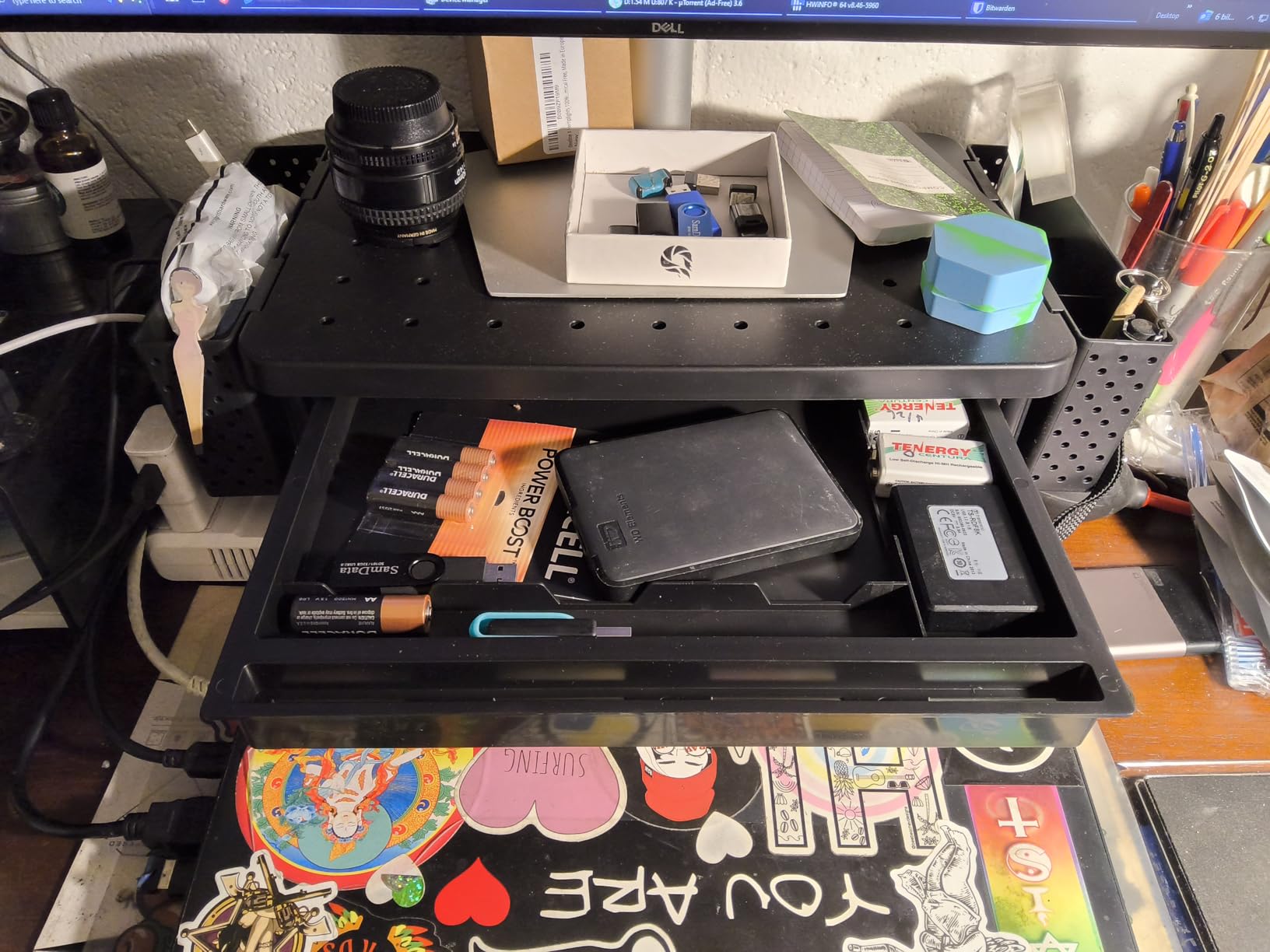
Reviewers call this the best value in the category, and after six weeks of use we broadly agree. It is the rare riser that combines three real height positions, a 44-pound load rating, and genuine enclosed storage in one plastic package. The removable drawer and the two hanging pen holders are the difference between a stand that lifts your screen and a stand that organises a desk.
The 6.1-inch top setting is the tallest in this group and comfortably brought the top of a 27-inch monitor to eye level for our taller tester. Assembly is genuinely tool-free: the legs screw in and buttons set the height, which took under two minutes. The 14.6 by 9.3 inch shelf also fits a compact laptop or a small printer alongside a monitor.
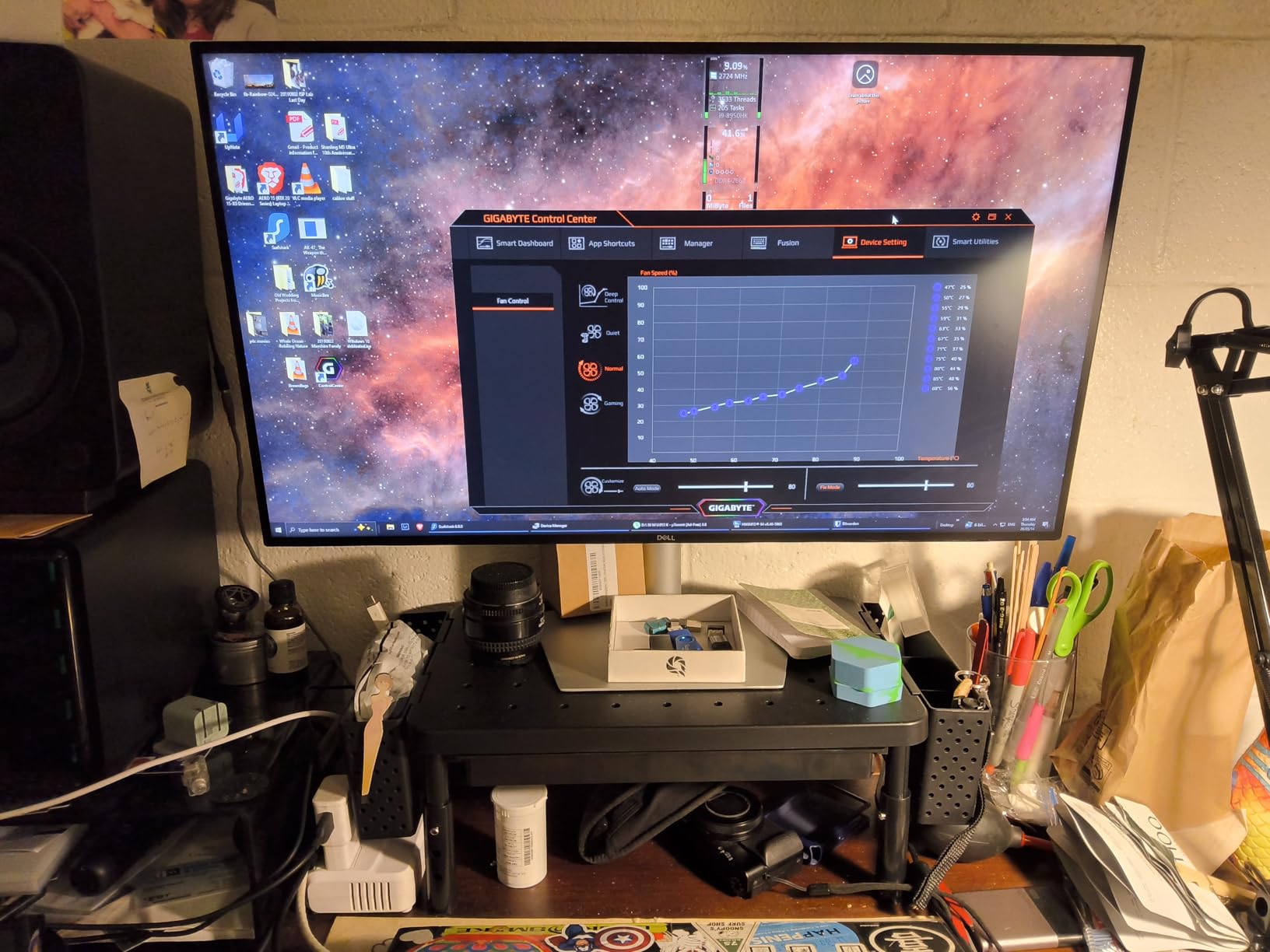
The 44-pound rating is high enough that an all-in-one PC or a mid-tower can share the deck with a screen, which almost no other riser at this level can claim. Reviewers report no wobble even with that load, and our own push test on the deck edge produced no visible flex. The rubber pads also protect the desk surface, which matters on a wood veneer.
The caveat that comes up most often is the height range. Three stops spanning about 1.5 inches is a coarse adjustment, and users who want fine control find it restrictive. The matte finish also collects fingerprints and needs regular wiping, which is cosmetic rather than structural but does bother people with light-coloured desks.
Who This Riser Suits
It suits anyone whose desk is a shared or hybrid setup, because a removable drawer that lifts out means you can carry your supplies with the stand or clear the desk entirely. It also suits people with compact hardware, since the 14.6-inch shelf accepts small form factor machines that will not fit a wider deck.
It is a poor match for someone who needs a printer platform or a very large monitor, because the shelf width runs out first. Buyers who change seating position frequently should also look elsewhere, as the coarse stops may not track a sit-stand desk well.
What to Watch Out For
Drawer glide is good rather than great, and the drawer is removable rather than integrated, so make sure it seats fully before you load it with pens. The height stops are the main ergonomic limitation, and for a tall person sitting at a fixed desk the 6.1-inch top setting may still be a little low.
Fingerprints on the matte surface are the other recurring complaint. There is no ventilation mesh on the platform, so a laptop left on a warm desk will run warmer than on the metal units further down this list. None of this affects stability.
3. Simple Trending 2-Tier Mesh Riser With Drawer – Best for Hot Laptops
- Mesh platform actively cools laptops and monitors
- Four suction cups keep it fixed while typing fast
- Lower tier swallows a full-size gaming keyboard
- 20 inch top fits most monitors and iMacs
- Fixed 5.8 inch height with no adjustment
- 20 inch footprint needs a large desk
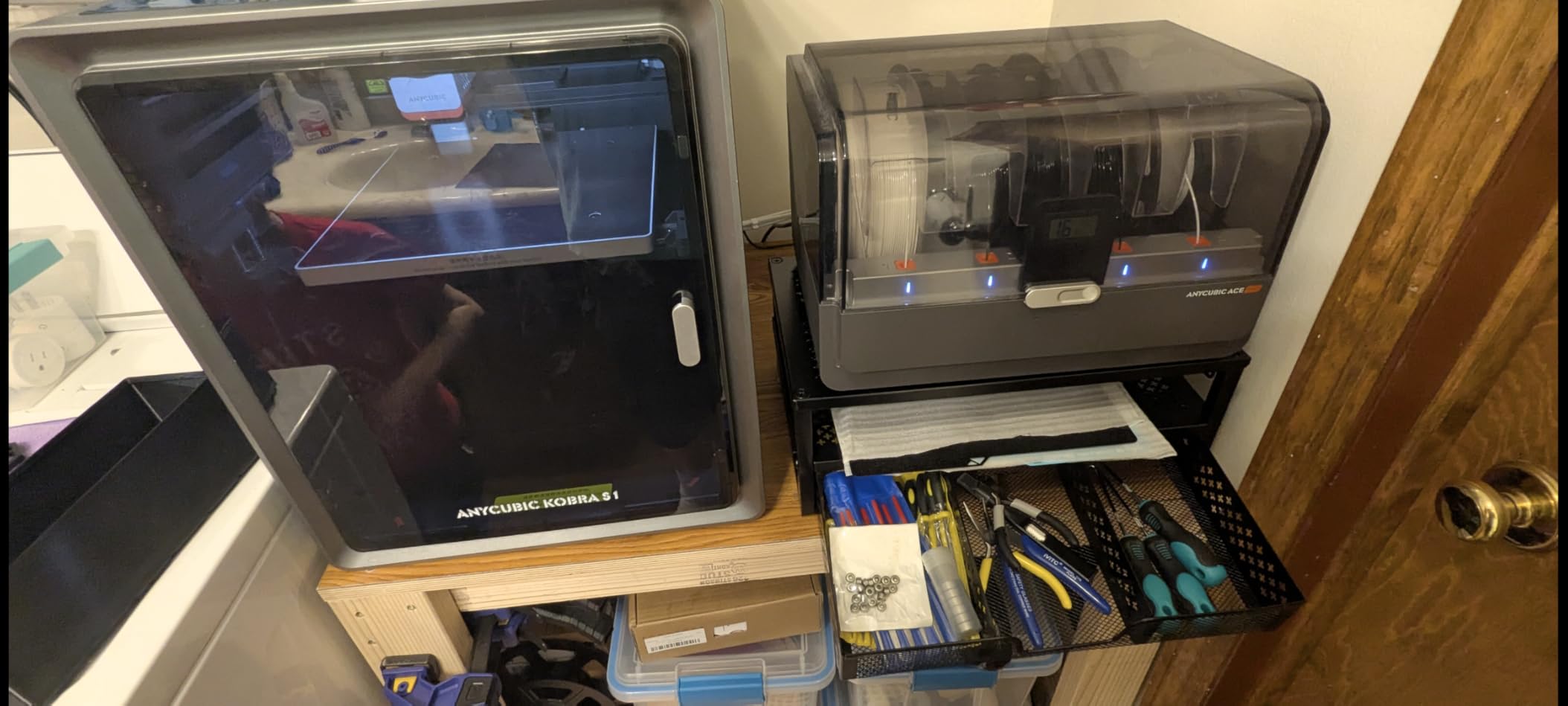
This is the only unit in the roundup where the storage and the cooling solve each other. The lower tier takes a full-size gaming keyboard, an Xbox console, or a cable box, which means the heat source itself is moved off the desk and the deck above it. The mesh platform and the ventilation holes then move air across whatever is sitting on top, and during a long session the difference was noticeable on a laptop that normally throttles.
Stability is the other story. Four suction cups on the underside lock the stand to the desktop, and in our fast-typing test it did not shift at all, which is exactly what you want from something this wide. The powder-coated metal construction is rated to 33 pounds and felt rigid with a monitor and a laptop on board.

The genuine two-tier storage is what separates it from a basic open shelf. The smooth-gliding drawer holds supplies, the two side pen holders keep writing tools within reach, and the lower shelf swallows a full mechanical keyboard, which no drawer-equipped riser in this list can do. The 20-inch top width also fits most monitors, laptops, and iMacs without overhang.
There are only two criticisms, and both are real. The height is fixed at 5.8 inches, so it suits some seated positions and not others, and the 20-inch footprint needs a desk wide enough to hold it plus a keyboard. If your desk is under 48 inches, this is not going to fit.
Who This Riser Suits
It suits a gaming or streaming desk where the keyboard lives under the stand and the console lives beside it. It also suits anyone whose laptop runs hot, because the airflow benefit is measurable rather than cosmetic. A shared family desk with a large machine in the middle is a third good fit.
It does not suit shorter or taller users who need to fine-tune the viewing height, because there is no adjustment at all. Anyone with a compact desk should also measure carefully, since 20 inches of width is a lot of desktop to give up.
What to Watch Out For
Fixed height is the headline limitation and there is no workaround, so check that 5.8 inches puts your screen top at or just below eye level before you buy. The suction cups work well on a smooth desktop but can mark a soft or unfinished wood surface, so test on an inconspicuous corner first.
The drawer is smooth but not metal-sided, so heavy items are not a good idea. The 33-pound rating is mid-range, enough for a monitor and a laptop but not for a large ultrawide plus a desktop tower.
4. OPNICE 2-Tier Monitor Riser With Drawer – Best Budget Two-Tier Option
- Fast straightforward assembly with a screwdriver included
- Balanced and non-wobbly straight after building
- Holds a 27-inch monitor without sagging
- Many colourways including rose gold and teal
- Large footprint can crowd a small desk
- Pens in the side holders can block laptop ports
- Assembly diagram reads better on a lighter finish
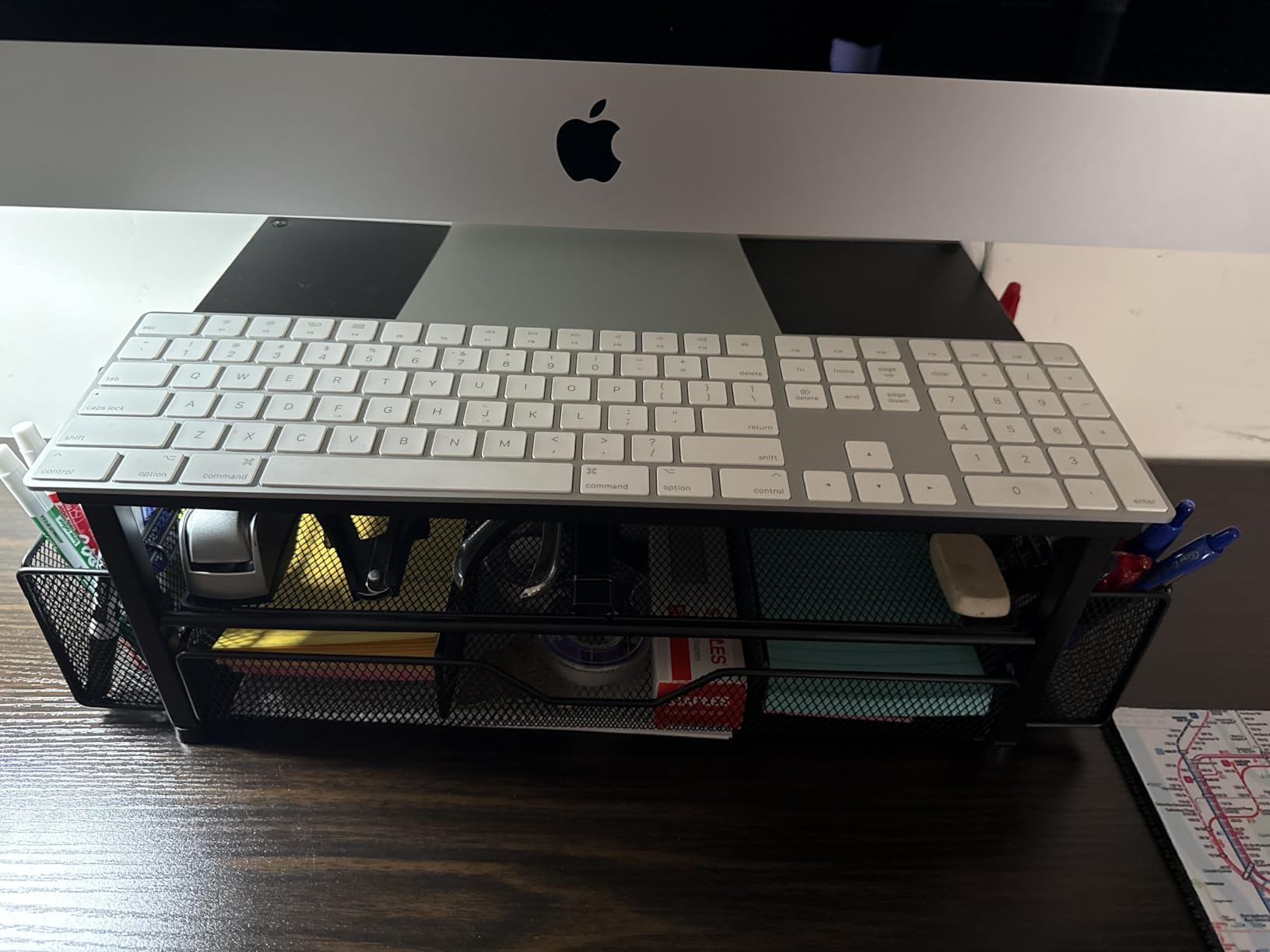
OPNICE builds a two-tier frame out of carbon steel and then loads the lower level with a sliding drawer and two hanging pen holders, which at this level of build quality is a lot of functionality. The frame is balanced straight out of the box, and the four non-slip, height-adjustable pads did more than stop sliding: they let you level the stand on a slightly uneven desk.
It holds a 27-inch-class monitor and a laptop without any visible sag, and reviewers report the same. Assembly is quick and forgiving, with spare screws and a screwdriver in the box, which is a small thing that saves a lot of frustration compared with risers that include no tools at all.
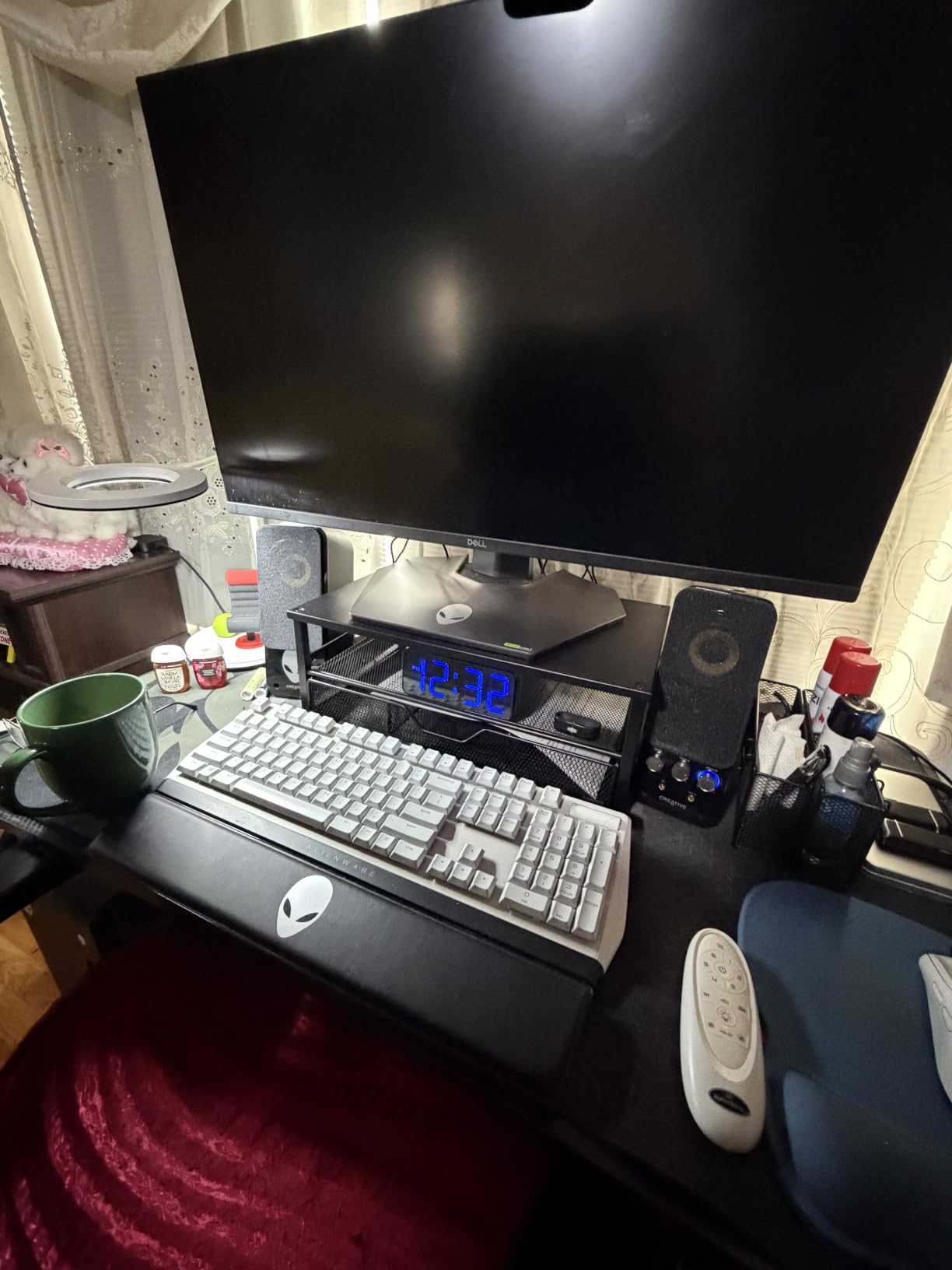
The 44-pound rating sits near the top of the group, and the two-tier layout means you can put a monitor up top and a keyboard, printer, or small form factor PC underneath. The drawer and the pen holders consolidate small supplies into one place, which is the entire point of buying a riser with storage rather than a plain stand. If you want our broader background on the category, see our monitor stand roundup.
The criticism that comes up most is size. At 20.5 by 9.5 inches it crowds a compact desk, and a lot of buyers end up wishing they had chosen the smaller variant. The second recurring note is that pens stored in the hanging holders can block a laptop’s side ports, so keep the long items elsewhere.
Who This Riser Suits
It suits a home office or dorm room that has enough width for a 20-inch frame, and anyone who wants genuine two-tier storage plus a drawer without paying for a wood-finish unit. The adjustable pads also make it a good choice on an older desk with a slightly uneven surface.
It is a poor fit for a small apartment desk under 48 inches, where the frame will leave no room for a keyboard in front. People who switch between a laptop and a desktop with lots of side ports should also check the pen holder positions first.
What to Watch Out For
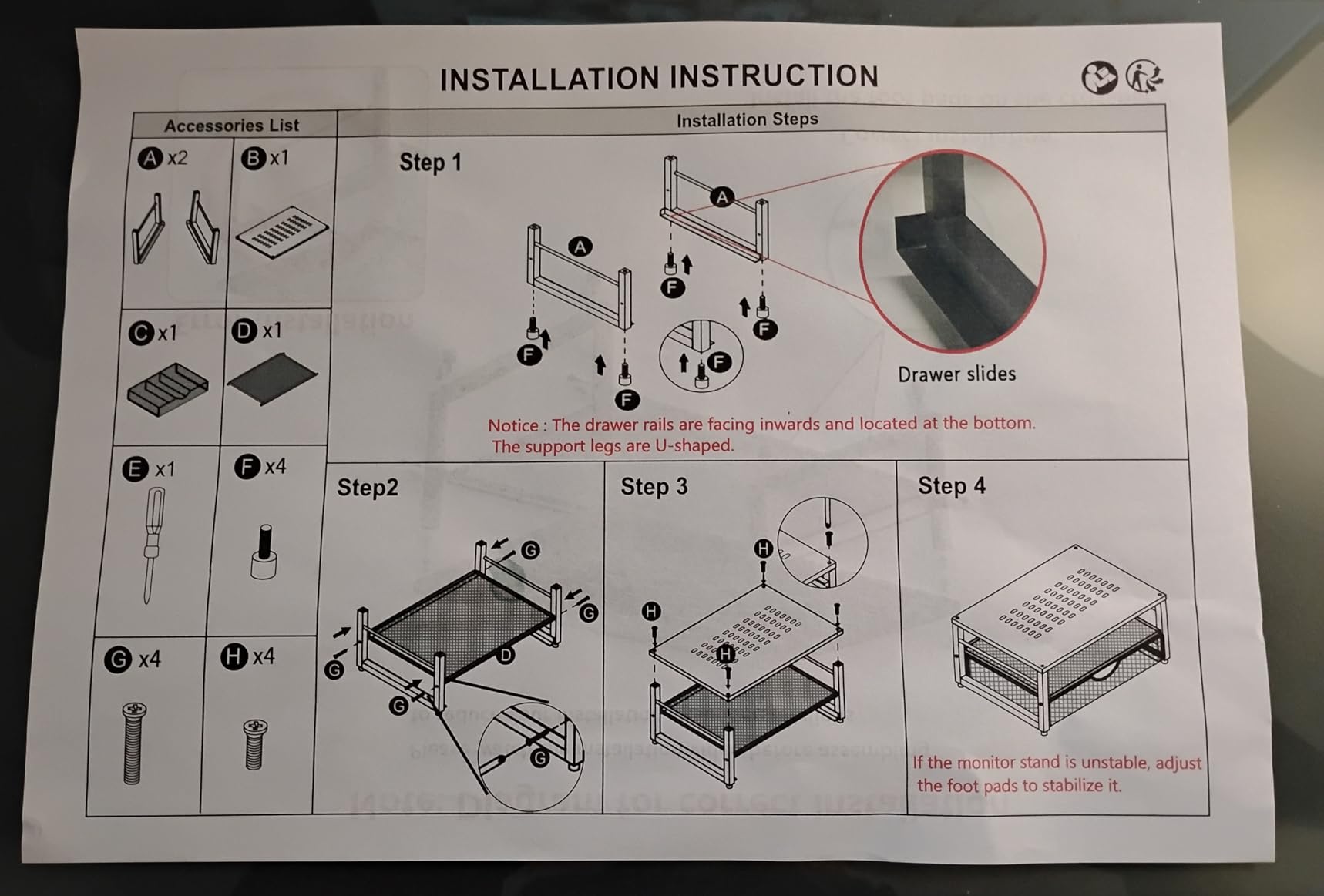
Footprint is the number to measure first, and it is larger than most competitors in this price band. The pen holders sit high enough to interfere with laptop ports, and the assembly diagram is genuinely hard to read on the black finish, so look for a lighter colourway if you are not confident with flat-pack builds.
There is no height adjustment to speak of, so this works best for a typical seated position. Structurally the steel frame is the strongest thing in the group at this level, and the 44-pound rating is well within what it actually carries.
5. gianotter Wood and Steel Riser With Drawer – Best Wood Finish
- Wood and metal build looks like furniture rather than desk kit
- Drawer is roomier than expected for cables and USB drives
- Pen cups slide and can be repositioned
- Holds a 27-inch monitor with no sagging
- More assembly than the listing photos suggest
- Adjustable feet sit on top so the drawer cavity is shallower
Almost every complaint about cheap risers is aesthetic, and this is the one that solves it. The natural wood top over a rust-proof steel frame reads as furniture rather than office kit, which matters enormously if your desk is a wood veneer or you are trying to make a small space look deliberate. It is the pick we would put in a room where a black plastic riser would cheapen the whole setup.
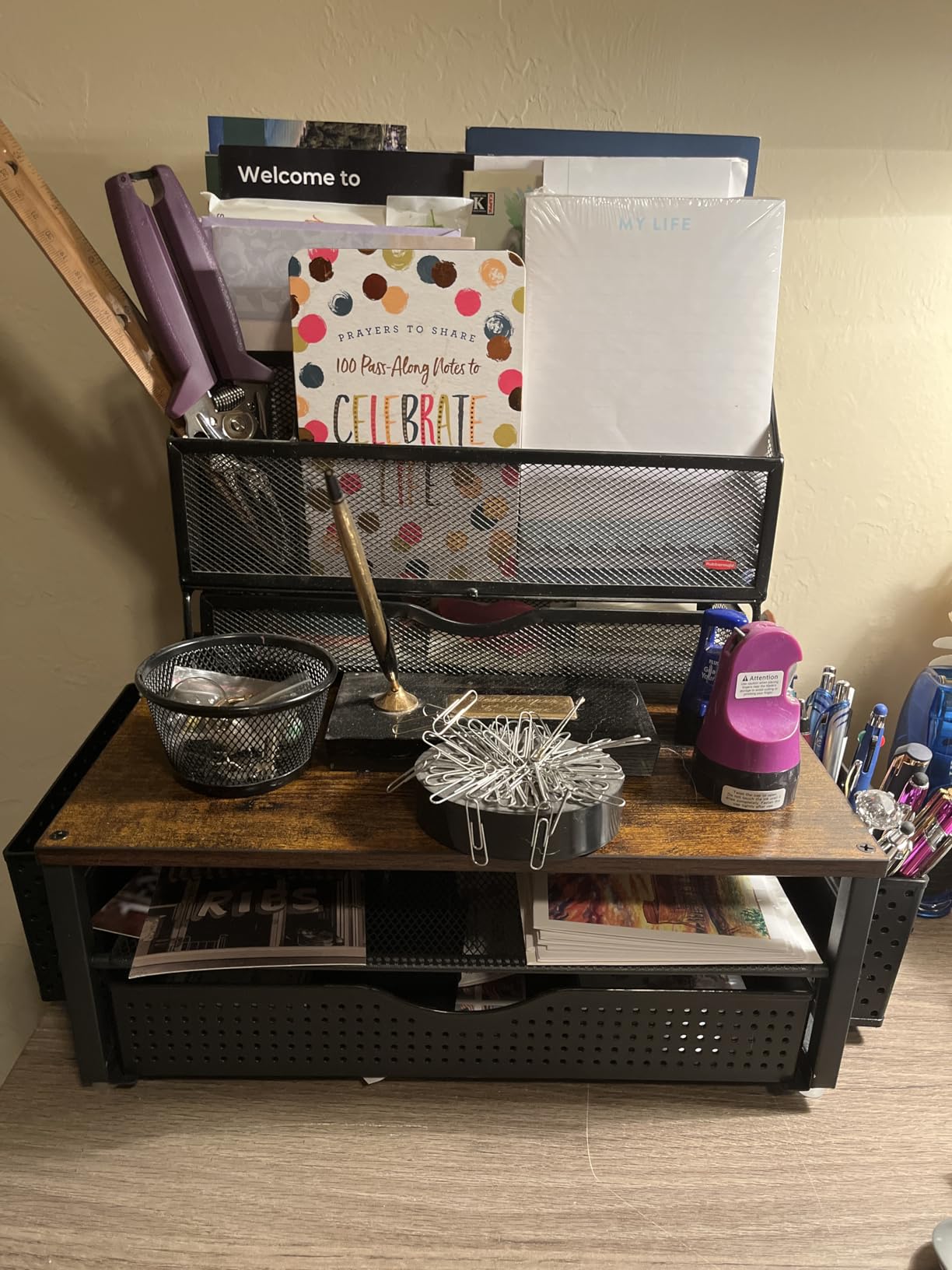
Underneath the finish it is a serious frame. The 44-pound rating is at the top of the group, and it holds a 27-inch monitor with no sagging, which reviewers and our own load test both confirm. Two tiers of storage take files and notes, the sliding drawer holds sticky notes, cables, and USB drives, and the two pen cups slide along their track so you can reposition them around a laptop port.
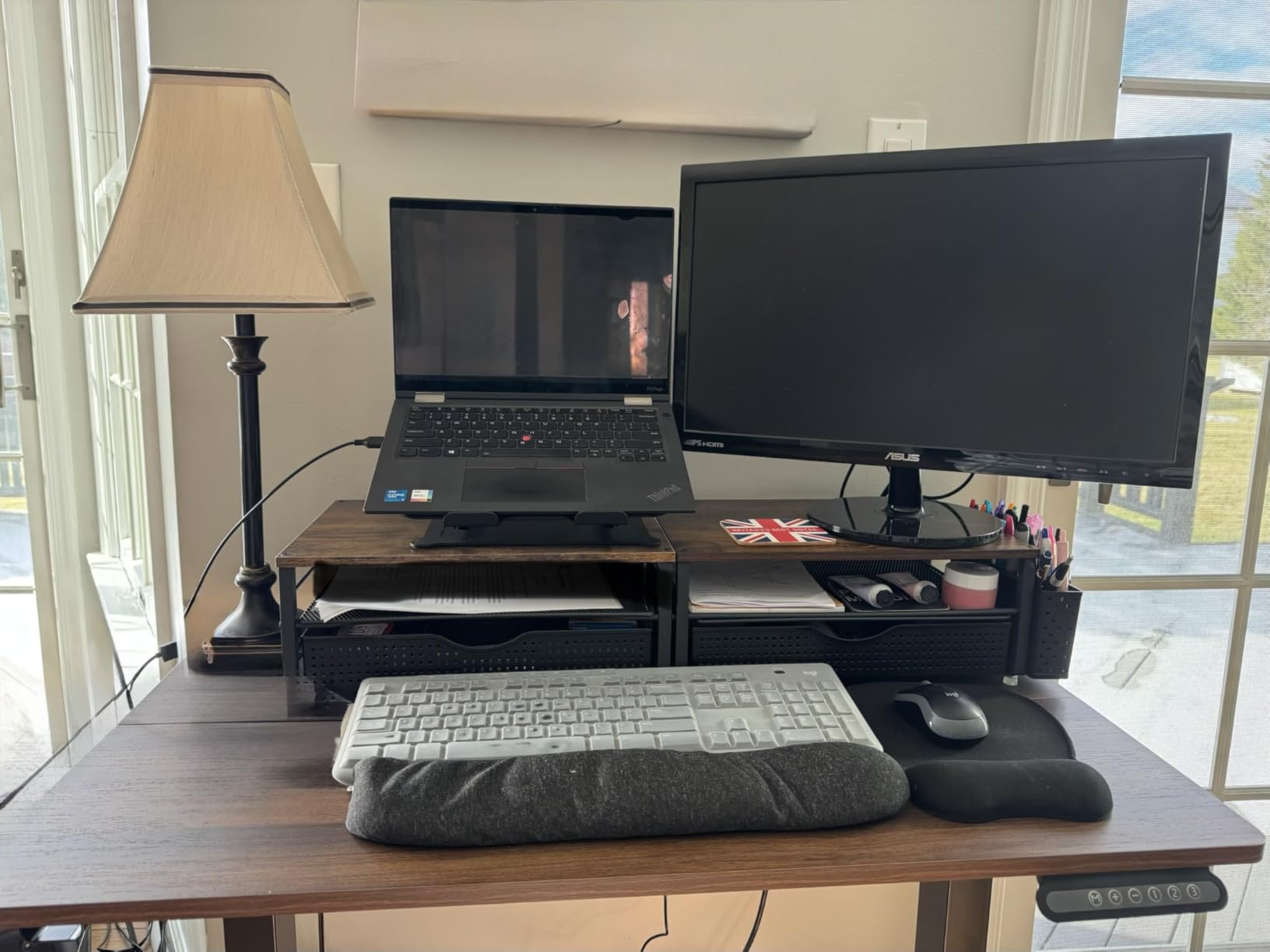
The drawer is roomier than the dimensions suggest, which is the most common reaction in the reviews, and plenty of owners buy a second unit for a second monitor or for a craft machine. Assembly is not complicated and the listing quotes about three minutes, though buyers report it takes longer in practice than the product photos imply.
One design detail matters and is easy to miss: the adjustable-height feet sit at the top of the frame rather than underneath, which means the drawer cavity is shallower than a comparable metal unit. Plan what you put in the drawer accordingly, and it is not a problem for cables and stationery.
Who This Riser Suits
It suits anyone whose desk is wood, or whose room is small enough that the riser becomes the most visible object on it. It also works well as a second riser in a dual-screen or dual-workstation setup, since the finish stays consistent between units.
It is a weaker choice if you need a deep drawer for files, because of the shallower cavity, or if you want height adjustment, since this model does not offer it. People who move equipment frequently may also find the steel frame heavier than a plastic one.
What to Watch Out For
Assembly is the first surprise and the shallow drawer is the second, and both are minor but real. The feet are adjustable for stability on any surface, so check that they are properly seated before loading the deck, because an uneven frame is the main source of wobble complaints on a unit like this.
There is no height adjustment, and the material mix means the wood top will warm slightly under a monitor that runs hot. The steel frame underneath is the part doing the structural work and it felt solid in every test we ran.
6. Simple Houseware Dual Monitor Riser With Drawer – Best for Two Screens
Simple Houseware Desk Dual Monitor Stand Riser with Drawer, Rustic Brown
- Widest deck here and extends to 45 inches
- Removable dividers build up to nine compartments
- Integrated phone and tablet slot keeps a screen in view
- Side caddies hold cables and tools within reach
- Fixed 5 inch rise with no height adjustment
- Wide footprint demands a large desk
- Heaviest unit at nearly 10.5 lbs
This is the pick for a dual-monitor desk, and the reason is the width. It measures 33.3 inches compact and extends to 45 inches, so two screens, or a screen and a laptop, sit on one platform with the divider tray underneath. In our testing that single change freed up more usable desktop than any other riser here, because the two monitors no longer need separate stands.
The organizer tray is the differentiator. Six removable dividers let you build up to nine compartments, which sounds like a small feature until you realise it is the only layout in this roundup where pens, sticky notes, and small supplies genuinely stay separated. There is also a built-in phone and tablet slot, so a second screen stays in view for calls without needing its own stand.
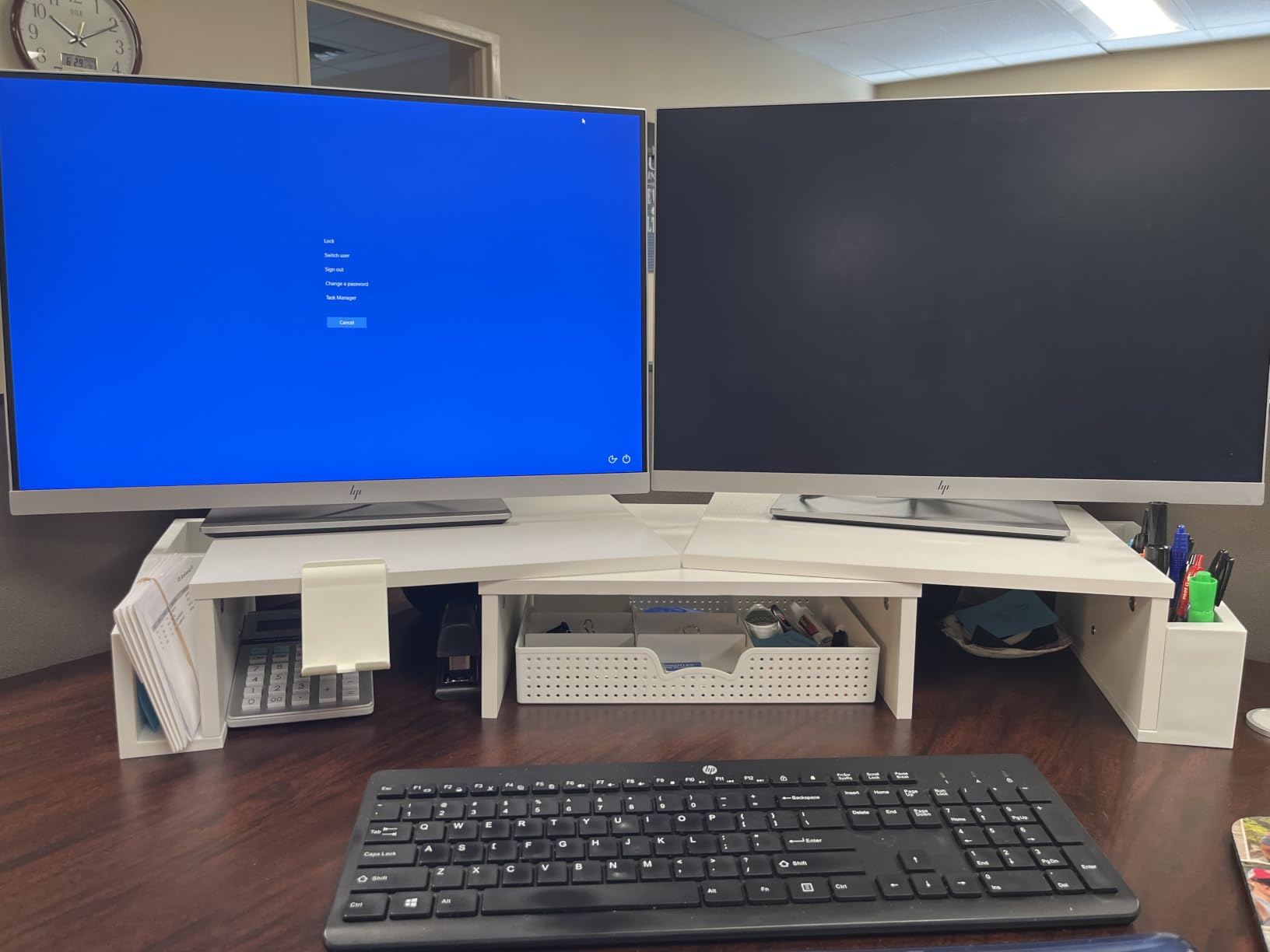
Two side caddies add space for cables and office tools within arm’s reach, and the 5-inch rise is enough to take the top of a standard monitor close to eye level for a seated user. Multiple finishes are available, including Rustic Brown, Oak, Maple, and Black, so matching an existing desk is realistic rather than aspirational.
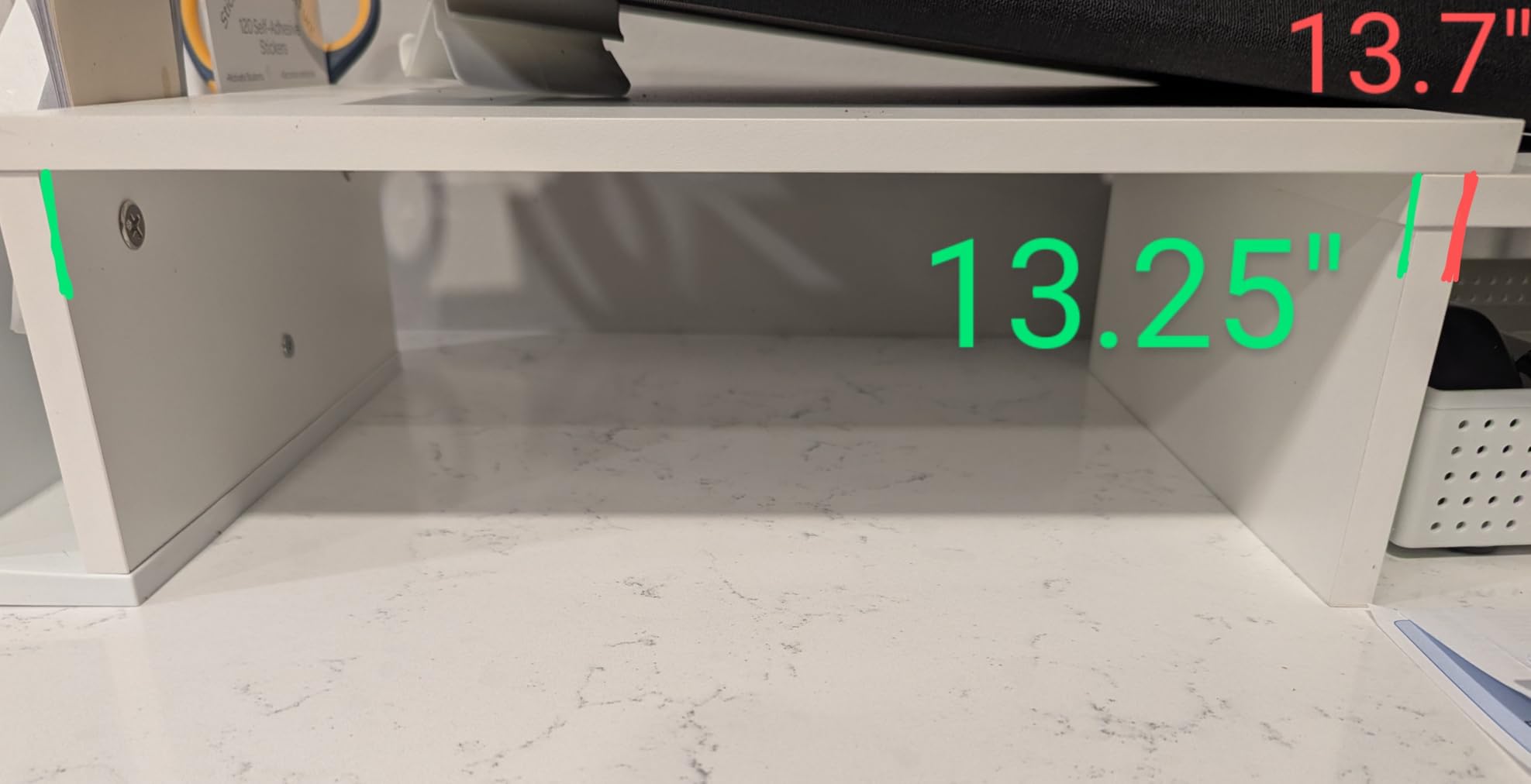
The trade-off is real and buyers accept it knowingly. The height is fixed with no adjustment, the footprint is wide, and at nearly 10.5 pounds this is the heaviest unit in the roundup, which makes it awkward to move when you rearrange the desk. The riveted engineering look also draws attention on a very minimal setup.
Who This Riser Suits
It suits a dual-monitor user on a desk at least 55 inches wide, and a trader, editor, or streamer who keeps a phone or tablet in view alongside two screens. It is also the strongest option in this list for anyone whose clutter is stationery rather than electronics, because of the divided tray.
It does not suit a compact desk, a single-monitor setup on a small surface, or anyone who changes seating position often, since the 5-inch rise cannot be altered. Moving it regularly is genuinely awkward at this weight.
What to Watch Out For
Measure the desk first, because at 45 inches fully extended the unit needs real space beside it for a keyboard and mouse. The fixed rise is the second check: if 5 inches does not bring your screen top to eye level where you sit, no amount of adjusting this deck will fix it.
At nearly 10.5 pounds, expect to set it up once and leave it. The dividers in the tray are removable, so losing one is not a disaster, but the narrow compartments suit pens and notes far better than anything bulky.
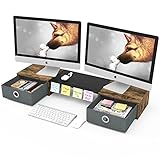
7. WESTREE Dual Monitor Riser With Two Drawers – Best Heavy-Load Deck
- Frees up a surprising amount of desk space with both monitors on one deck
- Two drawers hold pens
- notes
- glasses and small devices
- Centre compartment stores a full-size keyboard
- 100 lb rating never felt shaky
- Fixed height that sits too low for taller users
- Fabric drawers have no back panel
- Drawers are small and not rigid enough for heavy items
The 100-pound load rating is double almost everything else in this roundup, and it is the reason this deck feels completely planted under two screens. We loaded it well past a normal dual-monitor setup and the frame showed no flex, which matters if you have ever watched a cheaper riser creep sideways while you typed. The 36-inch deck takes two monitors, a monitor and a laptop, or a screen with a printer underneath.
There are two slide-out fabric drawers, plus a centre compartment wide enough to take a full-size keyboard. Reviewers describe it as transforming a cramped shared desk into a usable workstation, and that is the honest summary: the horizontal space reclaimed by putting two screens on one platform is far larger than the footprint suggests.
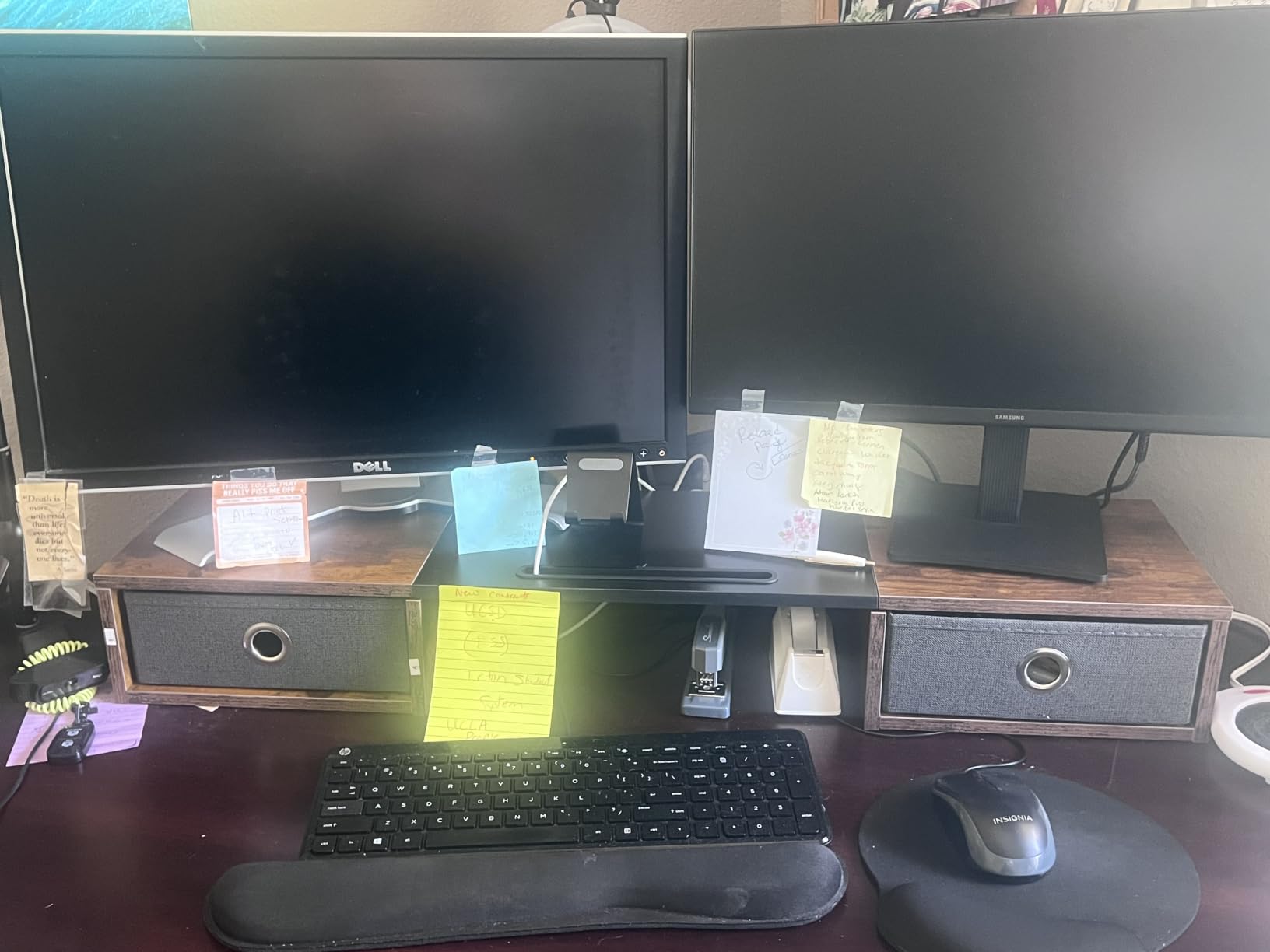
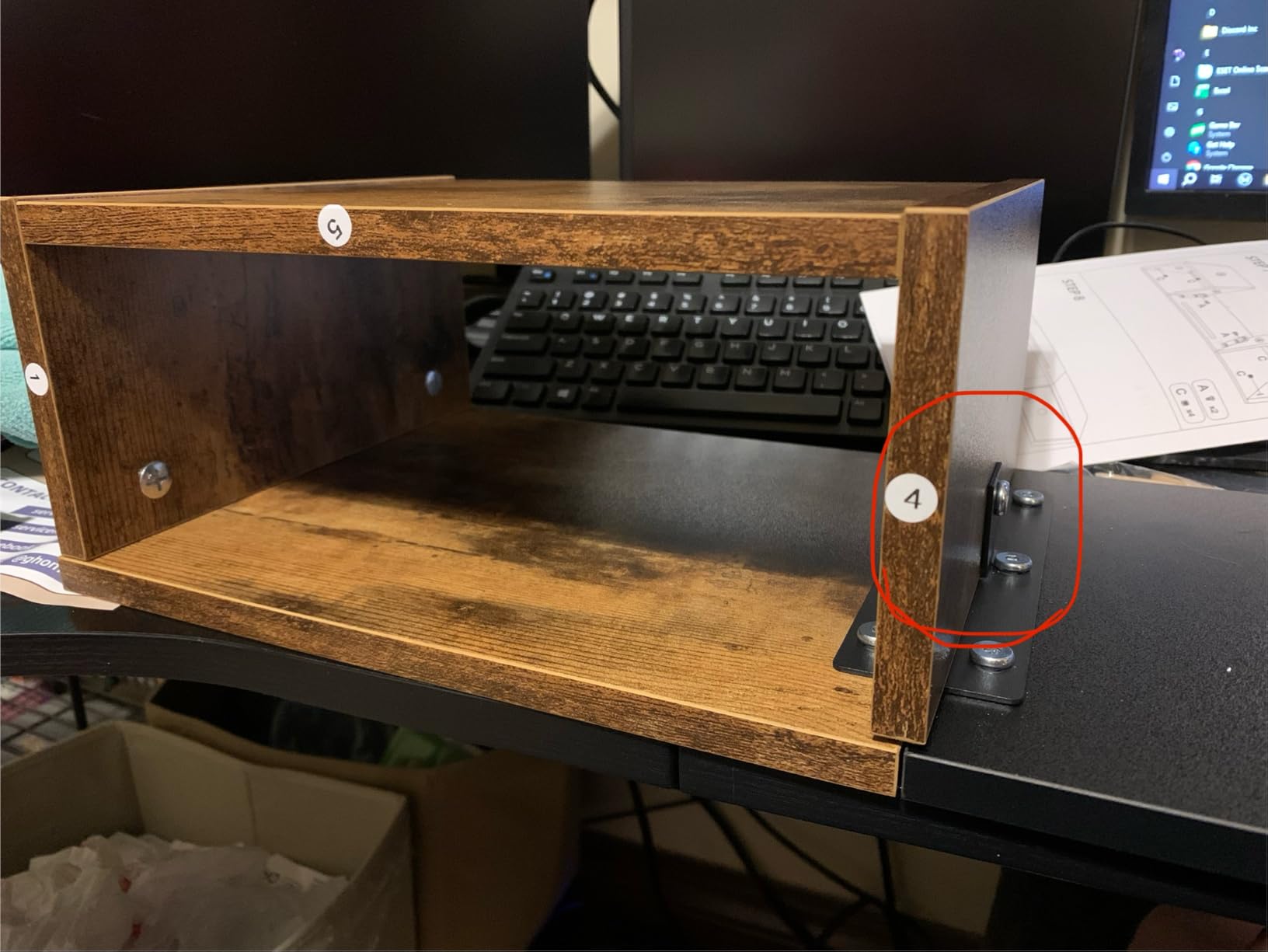
Assembly is the best handled in the group. The instructions are clear and labelled, and the box includes a small screwdriver and spare hardware, which is rare at this price. The black frame with a rustic brown wood finish looks intentional rather than plasticky, and it disappears into most setups.
The consistent complaints are about the drawers rather than the frame. They are fabric, they have no back panel, and they are small and not rigid enough to hold much weight, so a stack of paper files will bow the bottom out. Treat them as somewhere for pens, sticky notes, glasses, and a small device, which is exactly what reviewers use them for.
Who This Riser Suits
It suits a dual-monitor user who also has a printer, console, or second machine they want off the desk, and anyone who worries about stability with heavy screens. A shared or hot-desking situation works well because one deck can be reset quickly if the drawers are not overloaded.
It is a poor fit for tall users, because the fixed height sits low, and for anyone who needs a real filing drawer. The 36-inch width also rules out a lot of compact desks, so measure before you order.
What to Watch Out For
Fixed height is the main ergonomic limitation, and it is the one people regret most. The fabric drawers are fine for stationery and small devices but will not carry files, and the missing back panel means items can be pushed straight through into the cavity behind.
Nothing about the frame itself is a concern. The 100-pound rating is a genuine headroom advantage, and the included hardware and screwdriver make setup a five-minute job with no trip to a toolbox.
8. Klearlook Foldable Riser With Storage Drawer – Best When Desk Space Is Temporary
- Folds to three widths to match any workstation
- Stows flat to free the entire desk
- Draws a full-size keyboard into the cavity when finished
- Works out of the box with a one-year warranty
- Stiffer and heavier than all-plastic risers
- Fixed raised height rather than adjustable
- ABS shell can flex under a very heavy ultrawide
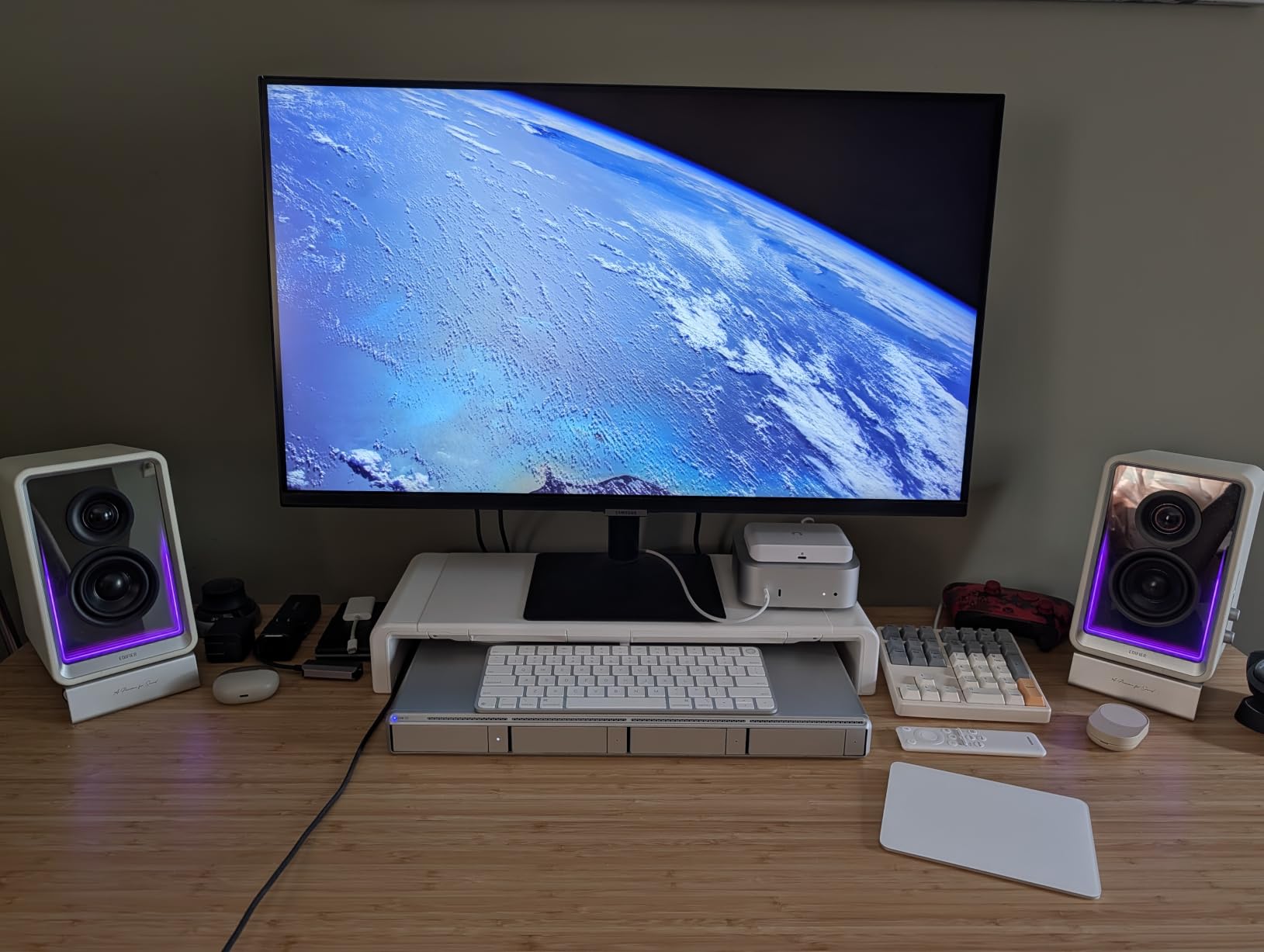
Every other riser in this roundup is a permanent fixture. This one is not, and that is the entire appeal. It folds to three widths at 16.5, 18.5, and 20.5 inches, and when collapsed it stows flat, which means a home office desk can be a standing desk on Monday and a clear writing surface by Friday. The leg span is 18.09 inches fully unfolded.
Storage is a hidden drawer plus a built-in tablet and phone slot, and the under-stand cavity is large enough to draw a full-size mechanical keyboard into when you are done with it. That combination, fold flat plus keyboard storage, is genuinely rare and it is why this earns its place on a list full of fixed designs.
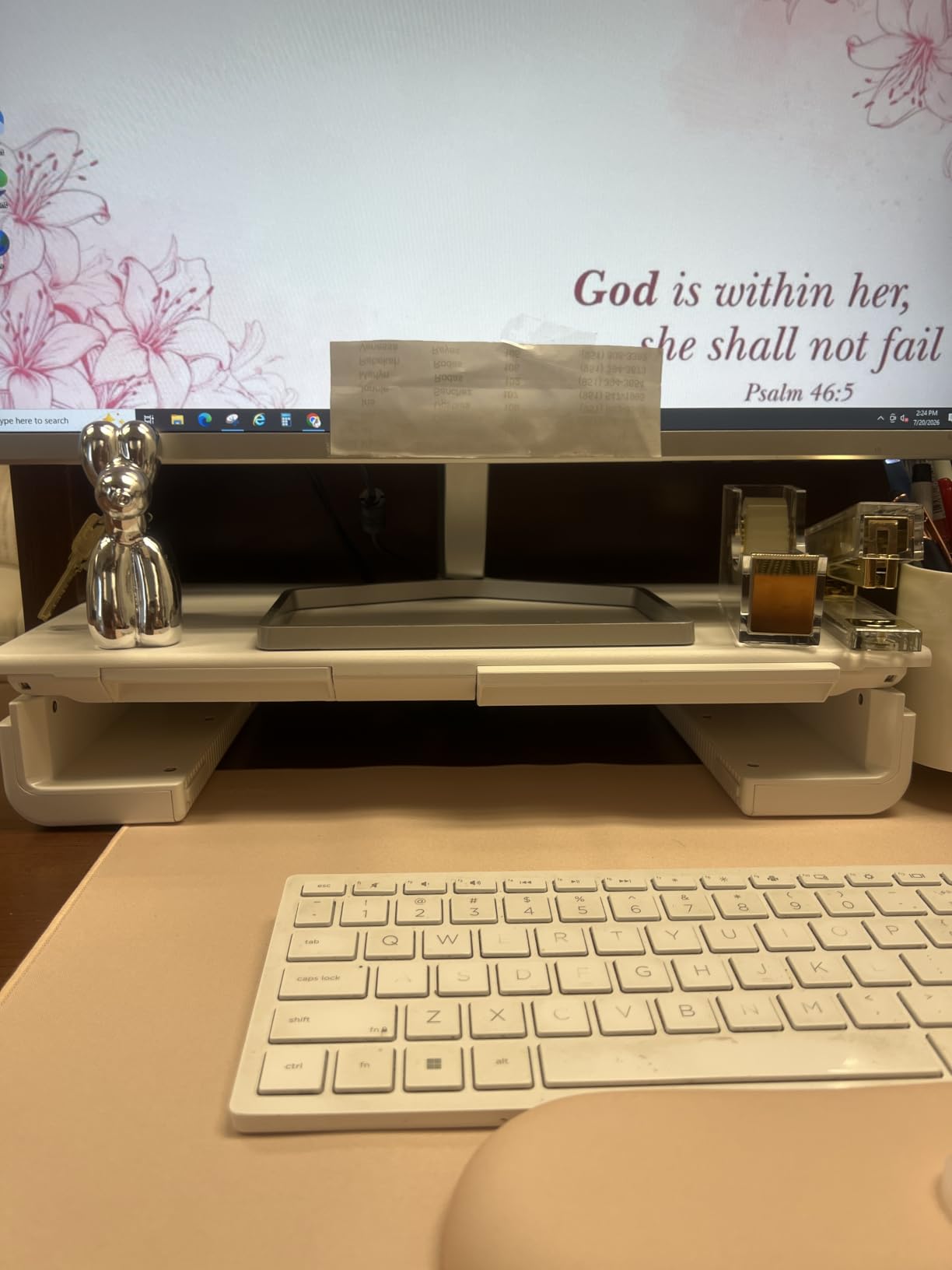
Build quality is a step above the plastic competition. The ABS shell contains an internal metal plate and the legs are rubberised, and at 55 pounds the load rating is second only to the WESTREE deck in this group. No assembly is required, it works out of the box, and it carries a one-year manufacturer warranty.
It is noticeably stiffer and heavier than the cheap all-plastic risers, which is a fair trade for the folding mechanism but does make the folded unit less convenient to carry around. The shell can also flex under a very heavy ultrawide, so if your screen is that size, look at a metal frame instead.
Who This Riser Suits
It suits anyone who needs the desk back, whether that is a hybrid worker clearing the surface for a laptop, a student with a small room, or a home office that doubles as something else. The three-width adjustment also solves the sizing problem that trips up people switching between desks.
It does not suit someone who needs fine height control, since the raised height is fixed. It is also a weaker choice for a very heavy ultrawide, where a metal frame is the safer option.
What to Watch Out For
The fixed height is the main trade for the folding function, and it is the reason this is not a top-three pick. The ABS shell flexing under a very heavy ultrawide is a genuine limitation even within the stated 55-pound rating, because stiffness and strength are not the same thing.
Weight is the other factor. At 2.9 pounds it is heavier than the plastic risers here, so folding and unfolding is a two-handed job rather than a flick. The warranty and the no-assembly setup partly offset that.
9. Zimilar Height Adjustable Riser With Metal Mesh Drawer – Best Paper Storage
Zimilar Monitor Stand Riser with Metal Mesh Drawer, Height Adjustable
- Three tool-free height stops set by pressing buttons on the legs
- Drawer is genuinely large and fits letter-size paper flat
- Star-mesh top improves airflow and heat dissipation
- Steel construction rated to 44 lbs with padded feet
- Drawer can be tight on one side and may need the track fins straightened
- Phone slots do not hold an angle and are narrow
- Occasional small dents arrive in the tray
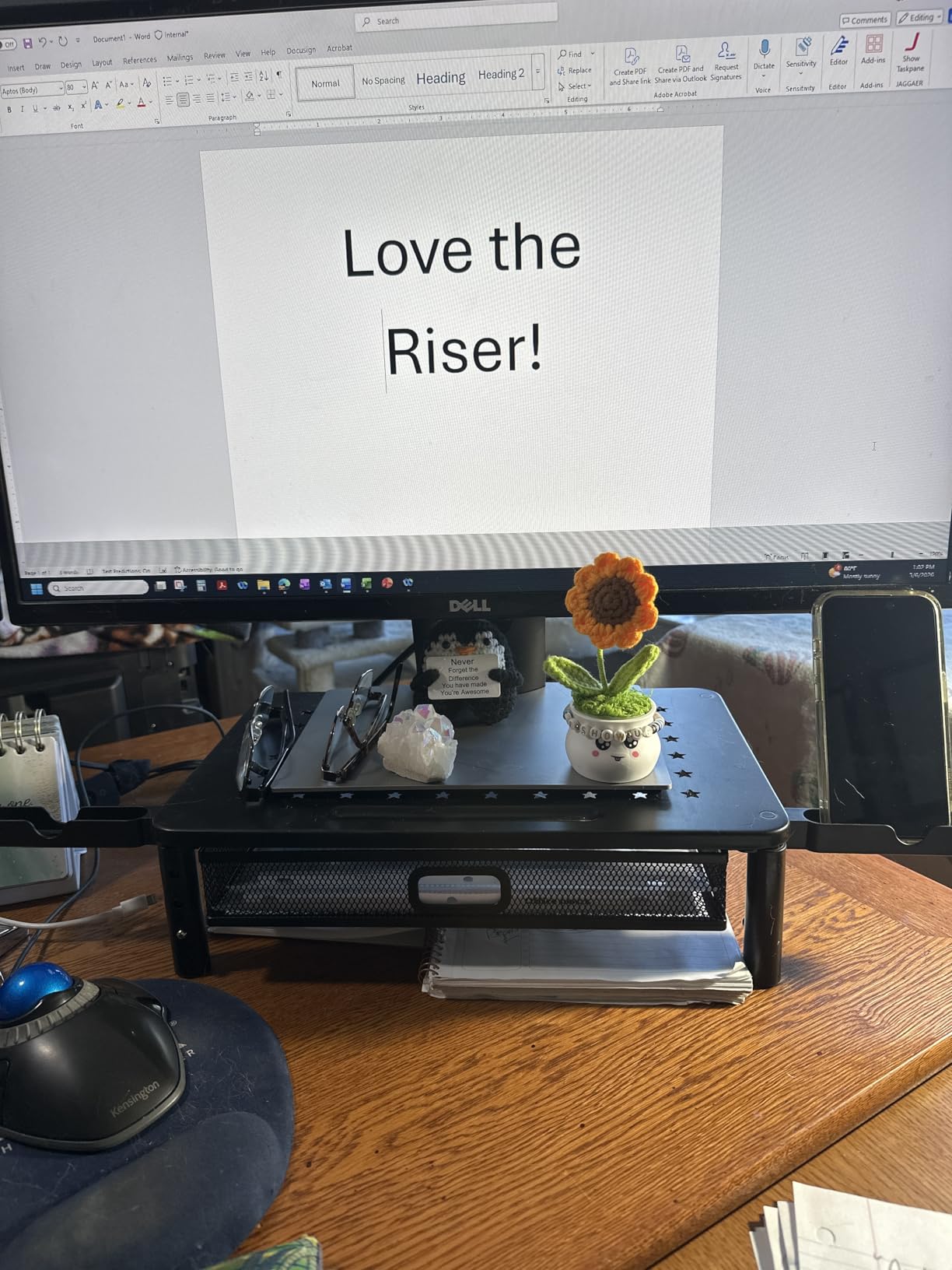
This is the pick if your clutter is paper. The sliding drawer is sized for US letter-size sheets and lies them flat, which means a ream of copy paper fits under the deck instead of on the desk. That single feature separates it from every other riser here, because the standard drawer in this category is usually sized for a mouse and a cable and little else.
Height is set by pressing buttons on the legs, with no tools at all, across three positions at 4.13, 4.92, and 5.71 inches. Setup took us under a minute. The star-mesh platform moves air across whatever sits on it, and the padded anti-skid feet both grip the desk and stop it scratching.
The steel frame is rated to 44 pounds, matching the strongest units in the group, and it carried a monitor and a laptop with no flex. The foldable phone holders on both sides tuck under when unused, which is a thoughtful detail, because a fixed holder is exactly the kind of thing that intrudes on a small desk.
The drawer is the one component with a reliability caveat. A minority of owners report it running tight on one side, and the fix is usually straightening the track fins so it glides properly. The phone slots also do not hold an angle and are too narrow for larger speakers, and small dents in the tray show up occasionally in transit.
Who This Riser Suits
It suits home offices and study desks where paperwork is the clutter, and it suits anyone who wants a compact 14.6-inch footprint rather than a wide two-tier frame. The tool-free height adjustment also makes it a good first riser for someone unsure which sitting height they prefer.
It is a poor choice for small electronics that need a rigid, deep compartment, and for anyone who wants to dock a phone at an angle. If paper is not your clutter problem, the drawer is mostly wasted space.
What to Watch Out For
Check the drawer glide on arrival, because a tight track is the most reported issue and it is fixable in seconds but annoying if you do not know to look. The phone slots are shallow and unangled, so plan to prop a phone against the monitor instead.
Small dents in the tray arrive more often than they should, though none we saw affected the function. Structurally the steel frame is solid and the 44-pound rating has real headroom for a single large monitor.
10. gianotter Compact Steel Riser With Drawer – Best for Small Desks
- Ventilated steel panels keep printers and laptops from overheating
- Three usable storage zones in a compact frame
- Alloy steel frame with non-slip pads stays put
- 14.1 inch width suits smaller desks
- Fixed height with no adjustment
- Drawer cavity is shallow for larger office supplies
- 34 lb rating is lower than most in the category
The narrowest pick in this roundup at 14.1 inches wide, and on a cramped desk that width is the whole point. It leaves enough room in front for a keyboard and a mouse, which is the single most common reason a larger riser ends up unused. The ventilated heavy steel plate and the ventilated panels move air past a printer, a laptop, or a monitor, so it doubles as a compact printer stand.
There are three usable storage zones rather than one: tray space, a sliding drawer, and the cavity under the stand. That combination makes the most of a small footprint, and it is why reviewers treat it as a proper desk organiser rather than just a lift.

The alloy steel frame with non-slip rubber pads stayed planted under a printer and a monitor in our test, with no visible creep. At 3.2 pounds it is light enough to reposition when you need the space, which is a genuine advantage on a shared or convertible desk.
The honest limitation is the 34-pound rating, the lowest here, and the shallow drawer cavity, which suits cables, dongles, and stationery but not a stack of files or a large pair of headphones. The height is also fixed, so it works for a typical seated position rather than a tall user at a high desk.
Who This Riser Suits
It suits apartment and dorm desks where horizontal space is the binding constraint, and anyone who needs to park a printer or a compact PC on the same surface as the screen. The light weight and ventilated deck also make it the easiest unit here to move around.
It does not suit a large ultrawide, since the 34-pound rating and 14.1-inch width both run out, and it is not a fit for anyone who needs a deep drawer. On a very tall desk the fixed height will not raise the screen enough.
What to Watch Out For
Measure the drawer cavity against the largest thing you want to store. The 34-pound rating is a real ceiling, not marketing, and it is the number to check first if you plan to put a desktop tower up there rather than a printer.
Fixed height is the recurring note in the reviews, alongside a preference for a slightly larger variant. Colourways and a two-pack option are available, which is useful if you are matching a second riser on the other side of the desk.
How to Choose a Monitor Riser With Storage?
The order in which you make these decisions matters more than most buyers expect. Start with the storage layout, because it determines what you can physically put on the desk afterwards, then filter by height, then by load and footprint. Buying in the reverse order is how people end up with a beautiful riser and a keyboard that no longer fits.
1. Choose the storage type first. A pull-out drawer suits cables, dongles, and stationery and keeps dust out, at the cost of vertical clearance. An open under-shelf is the only layout that accepts a full-size keyboard or a printer, but collects dust. Pen compartments and divided trays suit pens and notes and nothing larger. A wide dual-monitor deck reclaims horizontal space but needs a large desk. Pick the layout that matches your actual clutter, not the one that looks best in a photo.
2. Check the usable under-shelf clearance, not the product height. This is the number almost no competitor publishes and it is the one that decides whether your setup still works. The Amazon Basics unit, for example, advertises an 11.6 by 11 by 4 inch cavity, and that 4-inch figure is what determines clearance once a keyboard is in play. Where a drawer is mounted low in the frame, subtract its height from the usable space rather than trusting the stated product height.
3. Set the height against your eyes, not the product listing. The goal is for the top of the screen to sit at or just below eye level, with your gaze angled down about 15 degrees, at a viewing distance of roughly 20 to 40 inches. A fixed 5-inch rise suits some seated positions and none of the tall ones. Three or more height stops beat a fixed deck every time, and tool-free button adjustment beats screw-in legs.
4. Match the load rating to your screens with headroom. Ratings in this category run from 22 pounds to 100 pounds. A 20-inch monitor needs far less than a 34-inch ultrawide, and a 22-pound ABS frame that works fine with a small display will feel marginal with a wide one. Leave at least a third of the rating unused, and prefer a metal frame if you are stacking a monitor and a laptop on the same deck.
5. Measure the desk footprint before the width. A 20-inch riser on a 48-inch desk leaves little room for a keyboard and mouse, which defeats the storage you paid for. Check the riser depth as well as width, since a deep unit pushes the screen further from you and changes your viewing distance. If your desk is under 48 inches, a compact frame like the gianotter at 14.1 inches is the practical ceiling.
6. Judge the material by weight and finish, not by appearance alone. ABS plastic is light, cheap, and fine up to about 22 pounds. Alloy steel and carbon steel handle heavier loads and mesh tops dissipate heat better. Wood over a steel frame looks the most like furniture but adds weight and can warm under a hot monitor. A vented platform is worth having if a laptop lives on the deck.
7. Assume the cable problem is yours to solve. Almost no riser in this category routes cables, and a solid back panel actively works against you. The gap behind a riser is usually enough to pass cables through, but budget for a small cable tray or adhesive clips if a clean back matters to you. Buying a riser for decluttering and then leaving five cables fanning out behind it defeats half the purpose.
Riser or Monitor Arm? When a Riser Is the Wrong Tool
A riser occupies desk footprint permanently. A monitor arm occupies none, because the screen hangs above it, which frees up the entire area underneath for a laptop, a drawing tablet, or just clear surface. If your problem is a screen sitting too low and you never need the space beneath it, an arm is the better tool. We covered the mechanics in our monitor arm roundup.
Choose a riser instead when you want a fixed viewing height with no clamping hardware, when you need the storage, or when you move between desks regularly and do not want to install a mount. For two screens on a sit-stand desk, our dual monitor arm guide covers the adjustable alternative, and it is the right call if you switch between sitting and standing regularly.
When You Need More Storage Than a Riser Can Give
A riser gives you one cavity roughly the size of a keyboard. If your clutter is a full set of drawers worth, no riser will solve it, and the forum consensus on r/WFH and r/AskBattlestations is consistent on this point: people who outgrow a riser move to under-desk storage rather than buying a bigger one.
Three options cover what a riser cannot. Under-desk drawers mount below the surface and hold stationery without taking any of it up. Under-desk PC mounts or a CPU tray take a tower off the floor or the desktop, which frees the space a riser was using. A monitor arm plus a riser combination lets you keep the storage and still clear the footprint when you need it.
Frequently Asked Questions
Are monitor risers worth it?
Yes, for most people, and the storage is usually why. A riser lifts the screen so the top sits at or just below eye level, cutting the neck strain that comes from looking down, and it turns dead space under the monitor into a drawer, shelf, or pen compartments. Keep your viewing distance between 20 and 40 inches. A riser is the wrong tool only if you want full height and angle adjustment, which is what a monitor arm gives you.
What is the best desktop monitor riser?
The Amazon Basics 3-Level Riser with Storage Organizer is the best all-round desktop riser, with three height settings, an 11.6 by 11 by 4 inch storage cavity, and a 4.6 rating across more than 25,000 reviews. It suits a single monitor or a laptop on a home office desk, and it is adjustable enough to match your seating. For two screens, the Simple Houseware dual riser is the better choice.
What is the best monitor stand riser for a desk?
It depends on desk size and monitor count. On a desk under 48 inches, a compact frame around 14 inches wide, such as the gianotter steel riser, leaves room for a keyboard and mouse. For a dual-monitor setup on a wide desk, the Simple Houseware riser extends to 45 inches and adds a divided organizer tray. For a laptop that runs hot, a mesh-topped metal riser improves airflow.
What to use to elevate a monitor?
Five options do this. A riser with storage adds a drawer or shelf and is covered in this guide. An adjustable riser gives you multiple height stops without a mount. A monitor arm hangs the screen and clears the desk footprint entirely, which our monitor arm guide covers. A wall mount frees the surface completely, and a laptop stand handles portable setups. A riser is the best of these when you also want storage.
What size monitor riser do I need for a 34 inch ultrawide?
Look for a deck at least 34 inches wide and a load rating of 44 pounds or more, since ultrawide panels are heavy and sit further back. A wide dual-monitor deck such as the WESTREE model carries two screens on a 100-pound frame, while the Simple Houseware model extends to 45 inches. Plastic frames rated around 22 pounds are not a good match for an ultrawide.
How much desk space does a monitor riser with storage actually save?
A riser does not reduce the width a monitor needs, but it converts the dead space underneath into usable storage, and a wide dual-monitor deck frees a surprising amount of horizontal surface. Reviewers on r/setups and r/FormD frequently report the storage, rather than the lift, is what makes a riser feel worthwhile on a small desk. Plan on the storage cavity measuring roughly the width and depth of a keyboard.
Which Monitor Riser With Storage Should You Buy
Start with your storage layout rather than the finish, because that decision does the most work. A pull-out drawer for cables and dongles, an open under-shelf for a keyboard, pen compartments for stationery, or a wide deck for two screens. Once that is settled, filter by height stops, then by the load rating against your actual monitor, then by whether the footprint leaves room for your keyboard.
For most desks, the Amazon Basics 3-Level Riser is the one to buy: three height settings, an 11.6 by 11 by 4 inch storage cavity, non-skid feet, and a 4.6 rating across more than 25,000 reviews. Go wider for two screens with the Simple Houseware model, cooler for a hot laptop with the Simple Trending mesh riser, and deeper for paper with the Zimilar letter-size drawer.
All ten picks in this 2026 roundup were tested on the same criteria, so whichever storage type you settle on, you are choosing between genuinely different layouts rather than ten variations of the same plastic frame.