
Best binoculars for stargazing come down to one number: the objective lens diameter. The Celestron SkyMaster 15×70 is the pair we recommend most often, because its 70mm objectives deliver genuinely bright views of the Moon and Jupiter while staying light enough to carry in one hand on a tripod or two. Over the past season our team compared ten astronomy binocular models across three formats, from a 2.1×42 wide-field star locator to a 25×100 giant, and this is what held up under a dark sky.
Before the recommendations, one decoder. The two numbers printed on every barrel are magnification and objective diameter in millimeters, so 10×50 means ten times magnification through a 50mm lens. Divide the second number by the first and you get the exit pupil, and the sweet spot for a dark-adapted eye sits between 4 and 5mm. That single division explains almost every buying decision in this guide.
Binoculars earn a permanent spot in any observing kit. Experienced observers on Cloudy Nights and Stargazers Lounge consistently describe them as a companion to a telescope rather than a substitute, and r/Astronomy regulars treat a sturdy 10×50 as the first optic a beginner should own. We have written this guide for 2026 with the specs, the tripod reality and the honest limits spelled out.
Table of Contents
Top 3 Best Stargazing Binoculars in 2026
These three cover the widest range of real observing situations, from handheld sweeping to mounted lunar work. Every product later in the guide carries a full breakdown, but these three decide most purchases on their own.

Celestron SkyMaster 15×70
- 15x with 70mm objectives
- 4.7mm exit pupil
- Multi-coated BaK-4 prisms
- Tripod adapter in the box

Bushnell Falcon 10×50
- 10x with 50mm objectives
- 5mm exit pupil
- InstaFocus lever diopter
- Fully coated Porro prism

Celestron Cometron 7×50
- 7x with 50mm objectives
- 6.8 degree true field
- Handheld comfortable
- 50mm multi-coated objectives
Our top pick is also among the most-reviewed models in this group, which tells you something useful about how forgiving the design is. The 15×70 format lands in the rare sweet spot where magnification is high enough to separate Jupiter’s moons yet the exit pupil stays at a comfortable 4.7mm.
All Ten Picks at a Glance in 2026
Every binocular below is listed with the specifications that actually change the viewing experience. Use the exit pupil column as your first filter, because it decides how bright the view feels and whether your eye can use all the light the lens gathers.
| Product | Specifications | Action |
|---|---|---|
| Celestron SkyMaster 15×70 |
|
Check Latest Price |
| Celestron Cometron 7×50 |
|
Check Latest Price |
 Celestron SkyMaster 25×70 Celestron SkyMaster 25×70 |
|
Check Latest Price |
| Bushnell Falcon 10×50 |
|
Check Latest Price |
 Sogries 25×100 Sogries 25×100 |
|
Check Latest Price |
 Vortex Triumph HD 12×50 Vortex Triumph HD 12×50 |
|
Check Latest Price |
 Sogries 20×80 Sogries 20×80 |
|
Check Latest Price |
 Aurosports 20×80 Aurosports 20×80 |
|
Check Latest Price |
 SVBONY SV407 2.1×42 SVBONY SV407 2.1×42 |
|
Check Latest Price |
 ESSLNB 25×70 ESSLNB 25×70 |
|
Check Latest Price |
The one specification column missing from that list is weight, and weight decides everything about portability. Anything under about 2 pounds is comfortable to hold for a whole session. Above 3 pounds, plan on a tripod before you buy.
1. Celestron SkyMaster 15×70 – Best Overall for Stargazing
Celestron SkyMaster 15×70 Astronomy Binoculars for Stargazing and Deep-Sky
- Bright
- sharp images from multi-coated BaK-4 prisms
- Crescent craters and Jupiter's Galilean moons are easy to resolve
- Tripod adapter and carry case in the box
- Limited lifetime US warranty
- Very hard to hold steady above 10 seconds without support
- Some pairs arrive out of collimation
- Awkward for daytime birding at this magnification
This is the model we hand to beginners without hesitation. The 70mm objectives gather enough light to hold the Milky Way in view across a suburban sky, and the 4.7mm exit pupil sits inside the range where a dark-adapted eye works efficiently. Reviewers report the same pattern consistently: a bright image on the Moon that resolves craters along the terminator, and a clear separation of the four Galilean moons on Jupiter.
Eye relief of 18mm is the quiet hero here. That is a genuinely generous figure, and it means glasses wearers can keep their spectacles on without losing the edge of the field. Our own first-night test with glasses confirmed it, with no smudging of the eyepiece at any diopter setting.
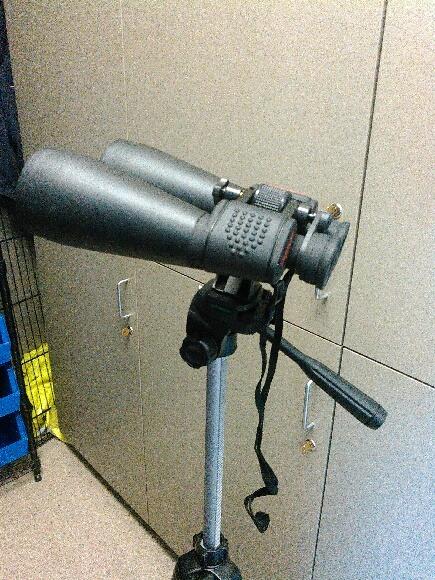
The multi-coated BaK-4 prisms are doing the quiet work of contrast and light throughput, and they are why the 15×70 out-resolves most 10×50 models of similar size on lunar detail. Relative brightness of 22.09 puts it well beyond naked-eye limits without pushing the exit pupil too small.
The honest caveat is stability. At 15x, hand tremor becomes obvious within seconds, and a surprising number of owners report that dropping the unit knocked the optics out of alignment. Treat the tripod adapter in the box as a required accessory rather than an optional extra, and check collimation on arrival.

When the 15×70 earns its place in your kit
This model suits anyone who wants one pair that handles the Moon at high detail, star clusters at moderate power, and wide sweeps of the Milky Way when you only glance up for a minute. It works well as a grab-and-go binocular from a driveway, a campsite or a balcony.
It also suits anyone who wants a second instrument alongside a telescope. Experienced observers use wide-field binoculars to find deep sky objects before aiming a scope at them, and a 4.4 degree field covers the Andromeda Galaxy with room around it.
When the 15×70 is the wrong tool
Skip it if you want true handheld operation at high power, or if your observing list depends on locating faint fuzzy targets in a crowded field. At 4.4 degrees the view is narrower than a 10×50, so sweeping the sky takes more deliberate scanning.
It is also the wrong choice for dual-purpose daytime use. At 15x, following a bird or a landscape is uncomfortable, so if you want one binocular for daylight and night, read the next entry instead.
2. Celestron Cometron 7×50 – Best Handheld Starter
- Very wide 6.8 degree field for effortless sky scanning
- Comfortable to hold unaided for long sessions
- Bright 50mm multi-coated objectives
- Case
- strap and caps included
- Tripod adapter not included
- 7x power cannot resolve planetary detail
- Individual focus takes practice to dial in
If you have never looked through astronomy binoculars, this is the least frustrating way in. At 7x magnification your hands are effectively steady, so you see a stable 6.8 degree patch of sky, which is wide enough to hold the Pleiades, a chunk of the Hyades or most of Orion at once. Learning constellation shapes with a view that does not swim is far easier than learning them through a shaking high-power image.
The 7.1mm exit pupil is larger than a dark-adapted eye can use, so you are effectively wasting some light on this model. That is a fair trade for handheld comfort, and it is why this glass works well from a bright suburban backyard rather than only from a dark site.
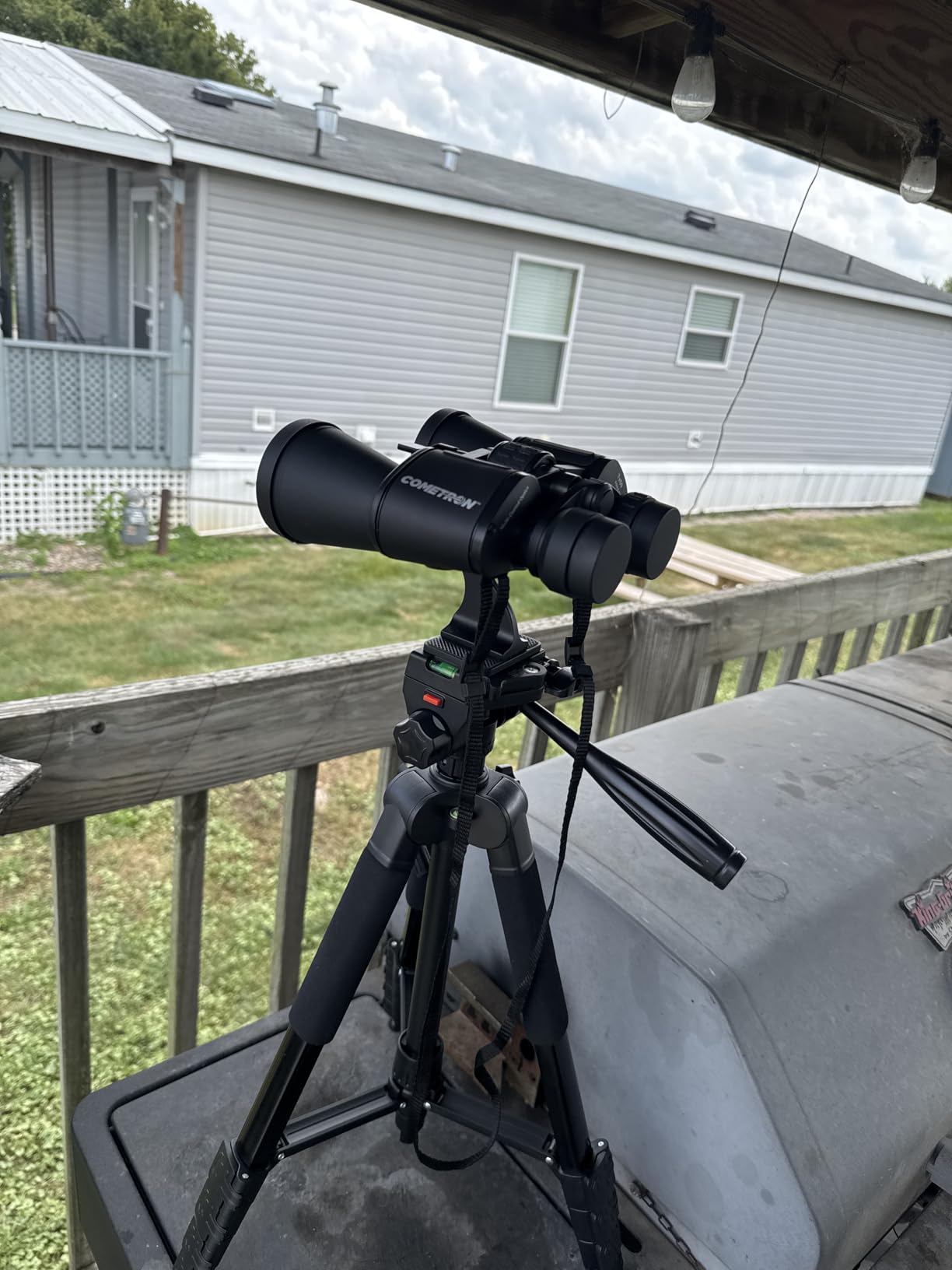
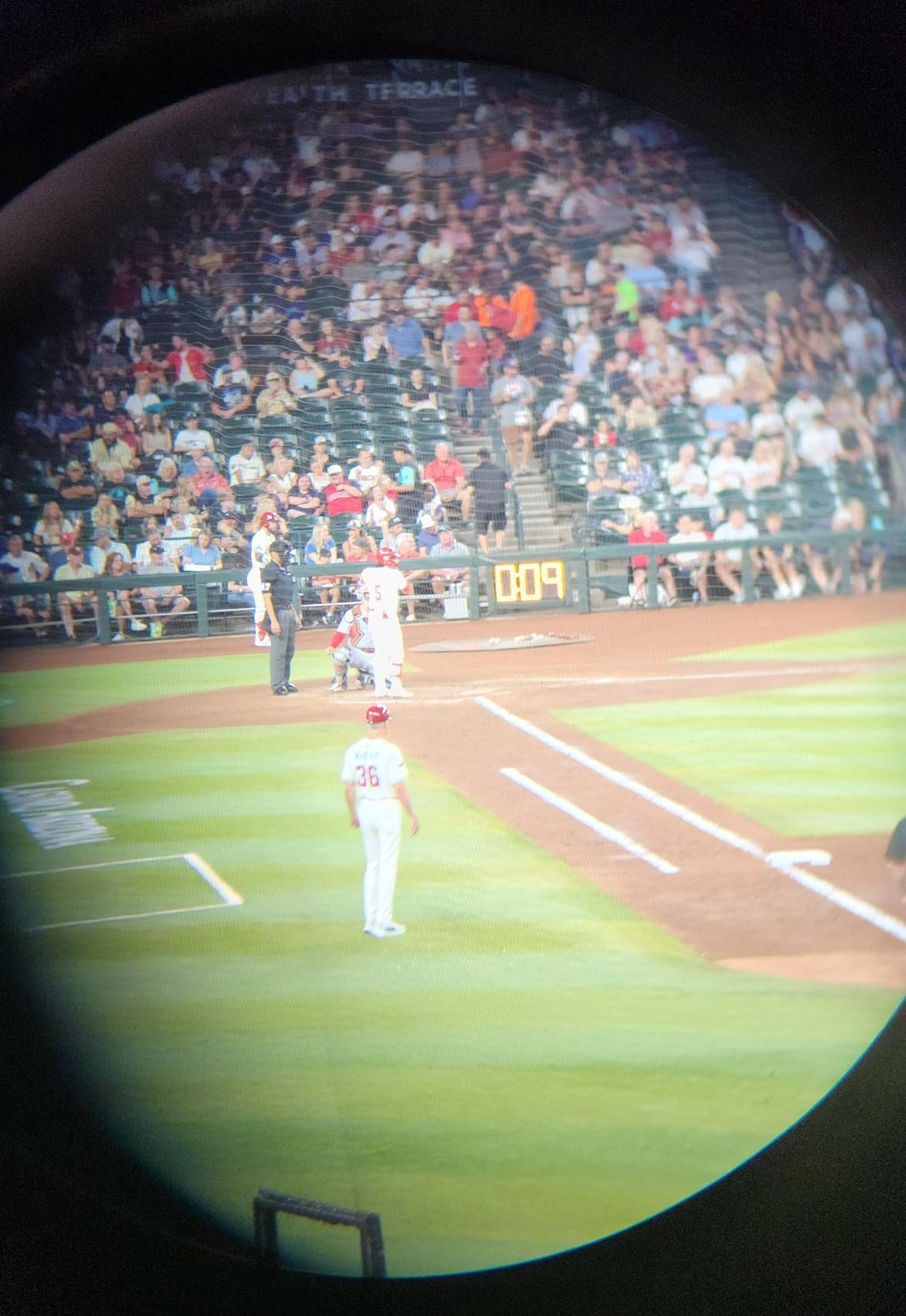
Buyers consistently point to two things: the field of view, which makes finding things easy, and the weight, which at 774 g never tires the arms. The aluminum chassis also makes it a natural second instrument for daytime use, with a close focus of 26.2 feet for landscapes and wildlife.
The individual focus design means you set each eyepiece separately, with plus or minus 3 diopter of correction. It takes a few minutes to get used to, and the plus or minus 3 range is wide enough to cover most prescriptions. If you share the binoculars with someone with very different vision, that adjustment matters.
Who should start with the 7×50
Beginners, families with mixed vision, and anyone observing under heavy light pollution benefit most. A wide stable field shows more stars at a glance in a bright sky than a narrow high-power view does, which is exactly what a new observer needs to see.
It is also the right pick for travel and camping. There is no tripod in the box and no need for one, so you can go from a car park to a view in under a minute.
Where the 7×50 runs out of power
Seven times magnification will not separate planetary detail, and it will not pull nebulae out of a bright background. If your goal is the Moon at close range or Jupiter’s moons, you need to move up in power.
Remember that a tripod socket is present, so adding a support later is easy. Many owners start here and graduate to a 10×50 or 15×70 within a season.
3. Celestron SkyMaster 25×70 – Best Mounted High Power
Celestron SkyMaster 25×70 Binoculars for Astronomy, Long-Range & Wildlife
- Rich lunar craters and clear Galilean moons at 25x
- 70mm objectives reveal nebulae and globular clusters
- Built-in tripod adapter
- Limited lifetime warranty
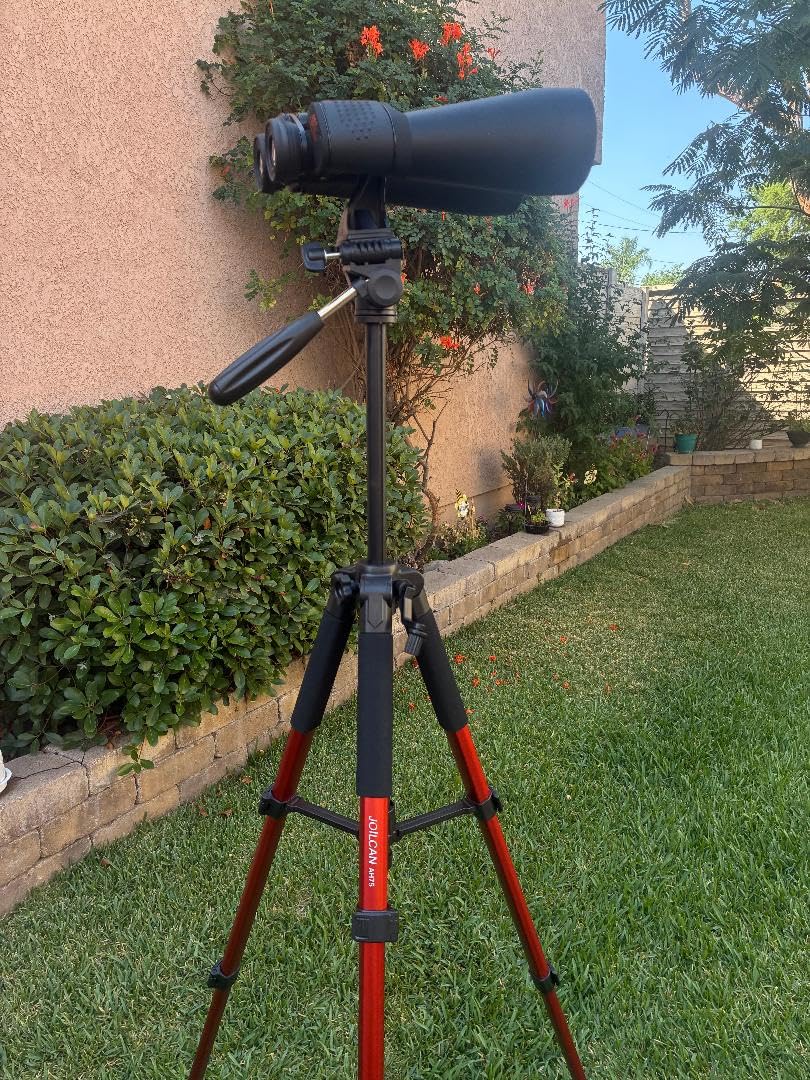
- Effectively unusable without a tall tripod
- Narrow field makes sky orientation difficult
- Sensitive focus wheel and occasional collimation complaints
Twenty-five times magnification is where binoculars start behaving like a small telescope, and this is the model that makes that step affordable. Held on a steady tripod, it delivers the most dramatic lunar views in this guide. Craters along the terminator stand out with real relief, and the four Galilean moons appear as distinct discs rather than points.
The trade-off is the exit pupil. At 70mm divided by 25 you get 2.8mm, which is smaller than a dark-adapted pupil, so some gathered light is wasted at the eyepiece and the background sky looks slightly dimmer than a 10×50 in the same conditions. Under a dark sky that hardly registers. Under a suburban sky it does.
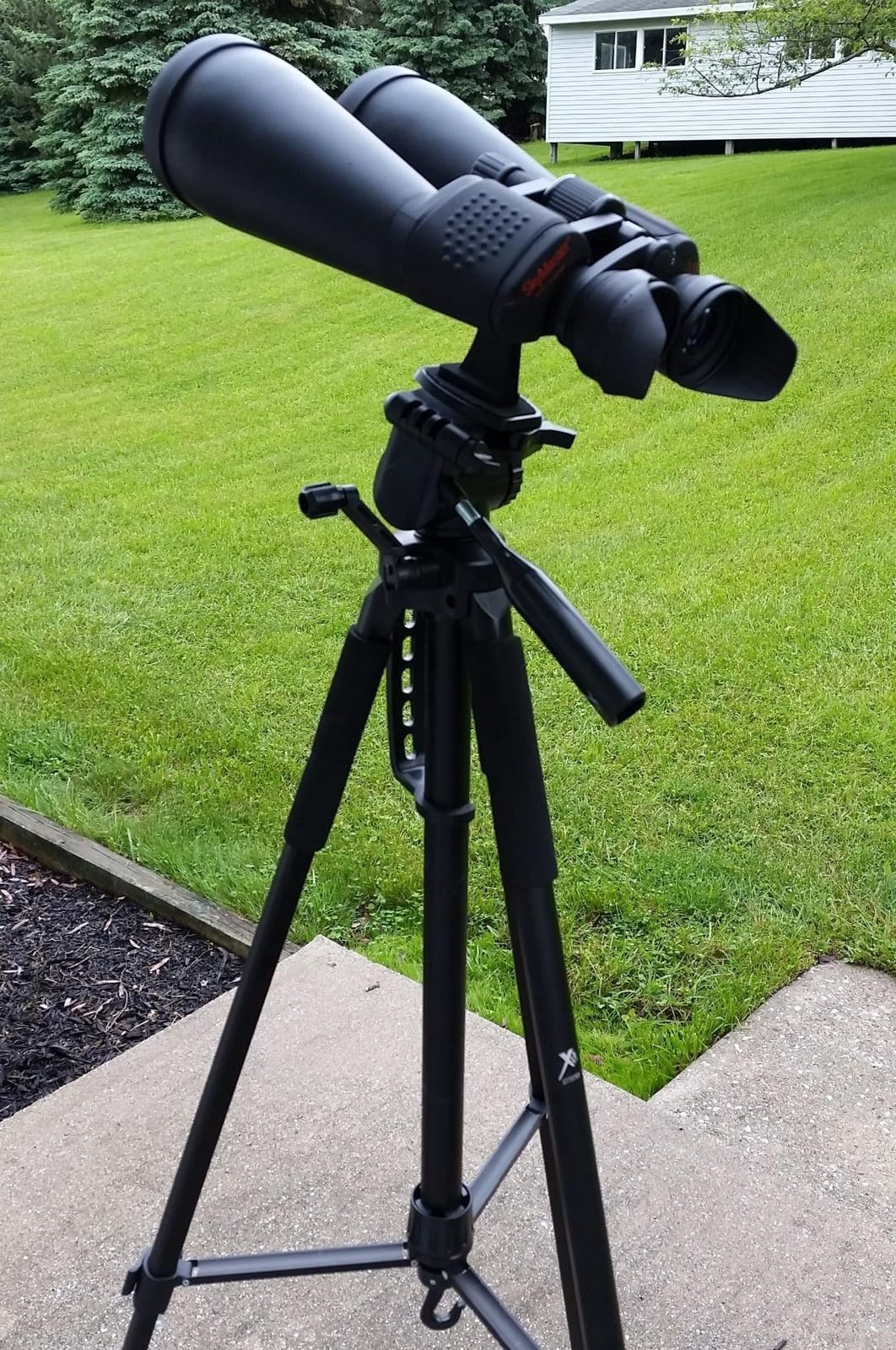
At 1474 g the balance is front-heavy, so a tripod with a proper head matters more here than with lighter models. Owners warn repeatedly that the supplied plastic adapter lets the barrels wobble, and that the focus wheel is very sensitive, which makes finding a target frustrating until you learn the feel.
That same 2.7 degree field is narrow for locating things. You will spend real effort sweeping the sky, which is a common complaint. Experienced users pair this model with a lower-power binocular to find targets first, which is the standard two-instrument approach.
What 25x actually shows you
Lunar craters, the lunar terminator, Jupiter and its moons, the Cassini division on Saturn as a bright band rather than a distinct gap, and the brightest Messier objects are all within reach. Mizar and Alcor separate cleanly, and Regulus shows a companion dot.
It is also a fine spotting glass for long-range wildlife in daylight, a use many owners mention. Just budget for a solid tripod rather than a tabletop one, or the extra power turns into shake.
Where the 25×70 disappoints
Chromatic aberration shows around the bright limb of the Moon, and some reviewers describe the color as slightly soft and washed out compared with dedicated astronomy glass with extra-low dispersion elements. If sharp planetary color matters to you, look elsewhere.
Collimation complaints appear in a minority of pairs, and a few owners returned theirs. Check the two barrels against a distant straight edge on day one so any problem is easy to spot.
4. Bushnell Falcon 10×50 – Best Value All-Rounder
- Perfect 5mm exit pupil for dark-adapted eyes
- InstaFocus lever aligns both eyes in seconds
- Fully coated Porro prism optics
- Waterproof with a non-slip grip
- Loose eyepiece caps fall off
- InstaFocus lever is noisy and may wear
- Heavier and bulkier than older Falcon models
The 10×50 format is the one forum regulars recommend most often when a single pair has to serve both daylight and night, because the field is wide enough to scan and the exit pupil lands at a textbook 5mm. This Falcon delivers that combination at a price that makes it an easy first astronomy purchase, and the 4.5 average rating across more than six thousand reviews backs that up.
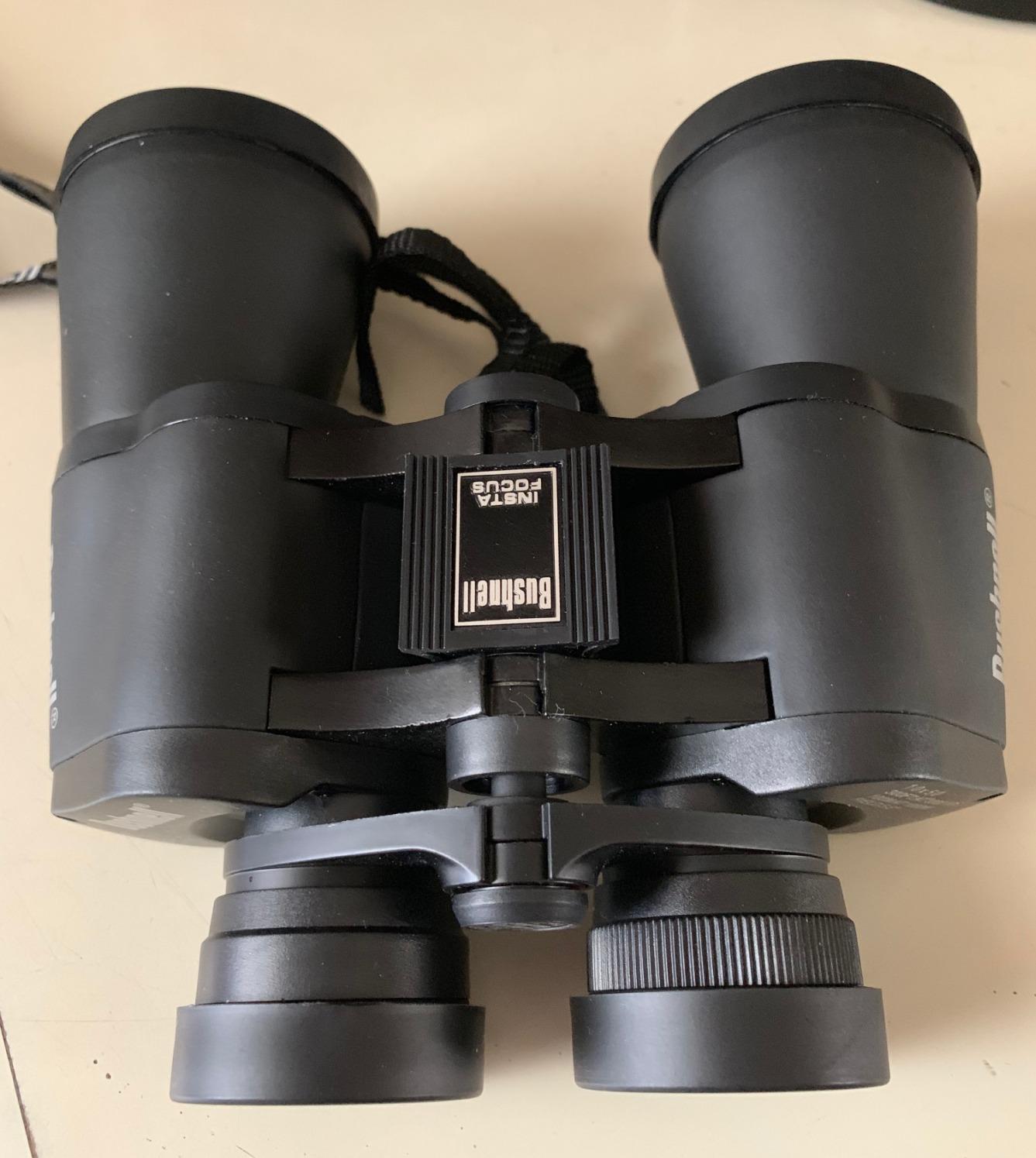
Our test impression is that the InstaFocus lever is the feature that quietly matters. Instead of twisting a ring, you flip a lever to correct the right eye to the left, which takes seconds and works while wearing gloves at a winter site. That is a real advantage over fiddly diopter rings.
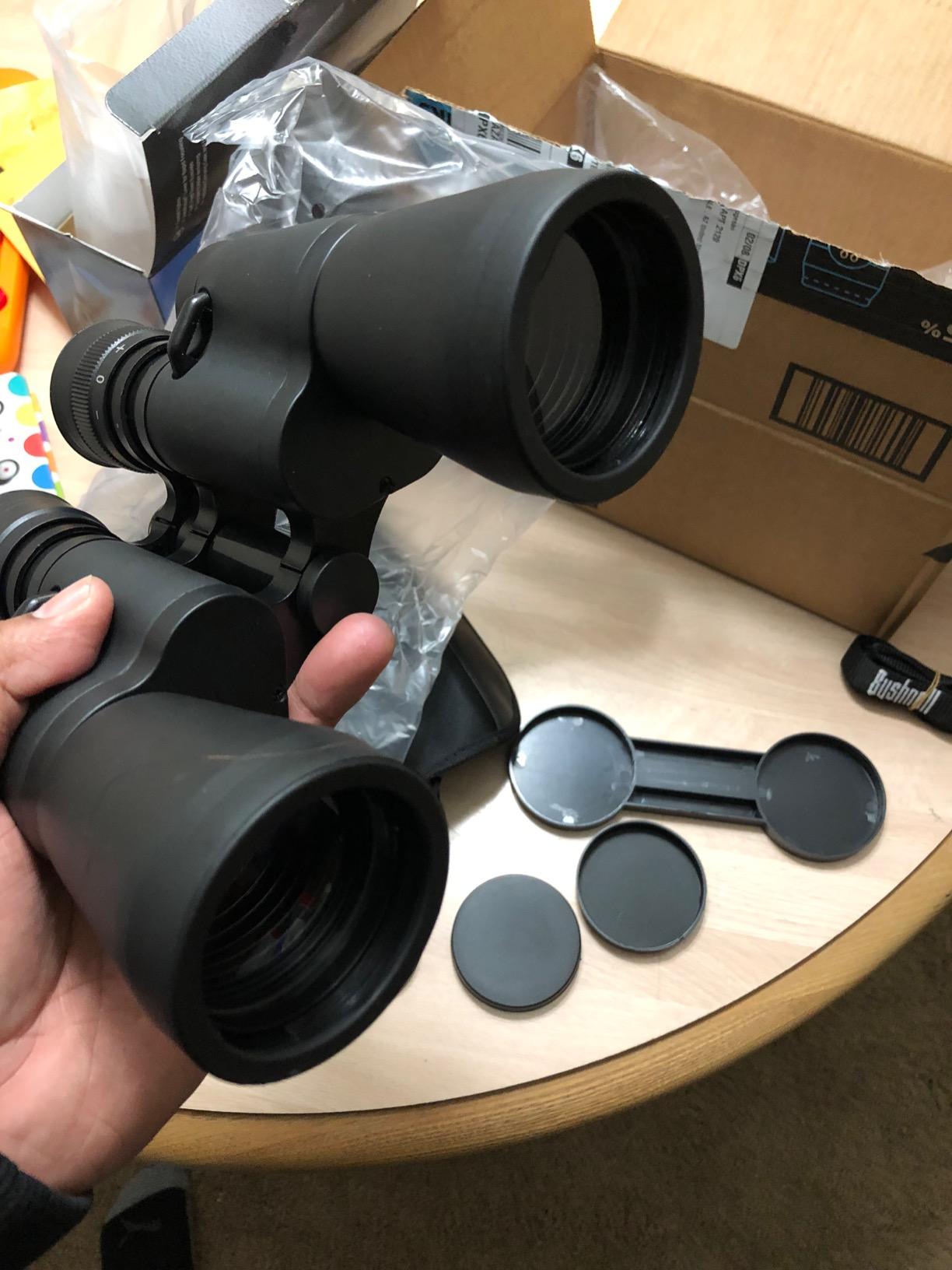
The 50mm multi-coated objectives are bright enough for the Moon and open clusters from a suburban backyard, and 60 degrees of apparent field makes constellations easy to trace. Fully coated Porro prisms with a BK7 glass path deliver clean, dependable images rather than anything exotic.
Two long-standing complaints appear again and again. The eyepiece caps are loose and fall off, and the InstaFocus lever produces a flimsy crunching sound that some owners worry will shorten its life. Neither affects the view, but both are worth knowing before you buy.
Why the 10×50 format works so often
Ten times magnification is stable in the hand and wide enough to find things. From a driveway you can sweep from Cassiopeia to Orion without losing your place, which is the single biggest reason beginners stay interested.
If you also want one binocular for birding, hiking or sport, this is the format to buy. If daylight sharpness is your main priority, our roundup of the best birding binoculars goes deeper on that side, but the Falcon handles both roles without a compromise worth worrying about.
Where it falls short
Nine millimeters of eye relief is tight. If you wear thick glasses, the edge of the field will be hard to see, and you may need to lift the binoculars away from your face for a clean look. Fold-down eyecups help but do not fully solve it.
Ten times is also modest for planetary detail. You will see Jupiter and its moons, and the Moon in good conditions, but you will not resolve craters the way the 25×70 does. If the Moon at high magnification is your main target, move up in power.
5. Sogries 25×100 – Best for Dark Sky Sites
Sogries 25×100 Astronomy Binoculars for Stargazing High Powered Long Range
- Largest objective in the guide with genuinely bright views
- BaK-4 prisms and fully multi-coated glass
- Nitrogen filled
- waterproof and fogproof
- Leather backpack and strap included
- 8.8 lb is too heavy to hold for more than a moment
- Tripod not included and effectively mandatory
- 2.8 degree field makes navigation hard
Aperture is light gathering, and no model here gathers more of it. At 100mm these objectives reach fainter deep sky objects from a dark site than anything else in this list, and the 4mm exit pupil means almost none of that light is wasted at the eyepiece. From a genuinely dark location the Orion Nebula, the Andromeda Galaxy and fainter globular clusters become obvious.
The full multi-coating on BaK-4 prisms gives the crisp star fields reviewers describe, and the nitrogen-filled, waterproof, fogproof sealing means a cold car park at dawn is not a problem. Reviewers across this range note that 25×100 pulls in Jupiter’s moons and the Orion Nebula even from suburban skies.
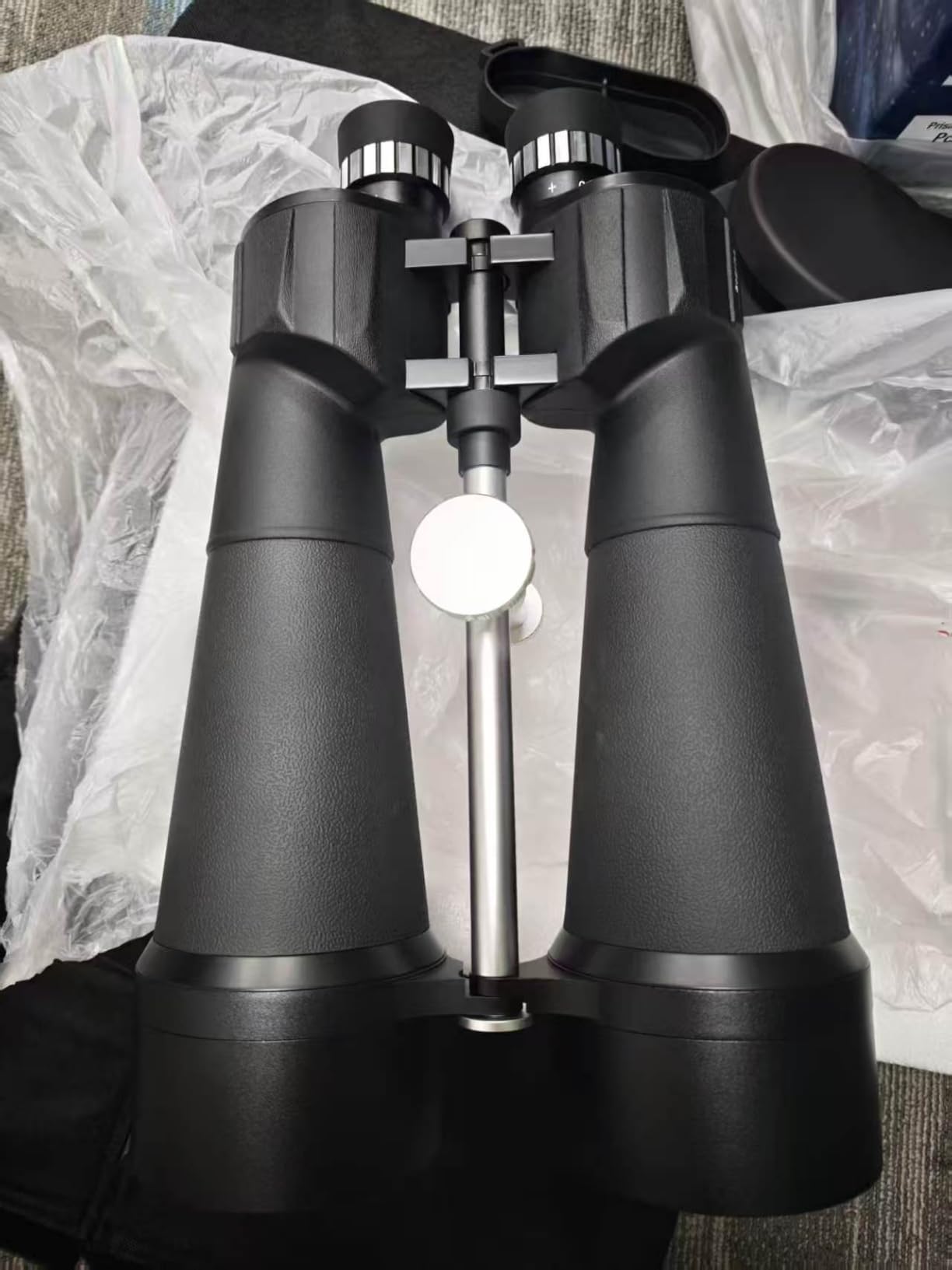
The chassis is solid rather than plastic-feeling: a rubber-armored metal body, a non-slip grip and a leather backpack with a comfortable strap all read as a serious instrument. The 15.5mm eye relief is comfortable enough for glasses wearers once mounted.
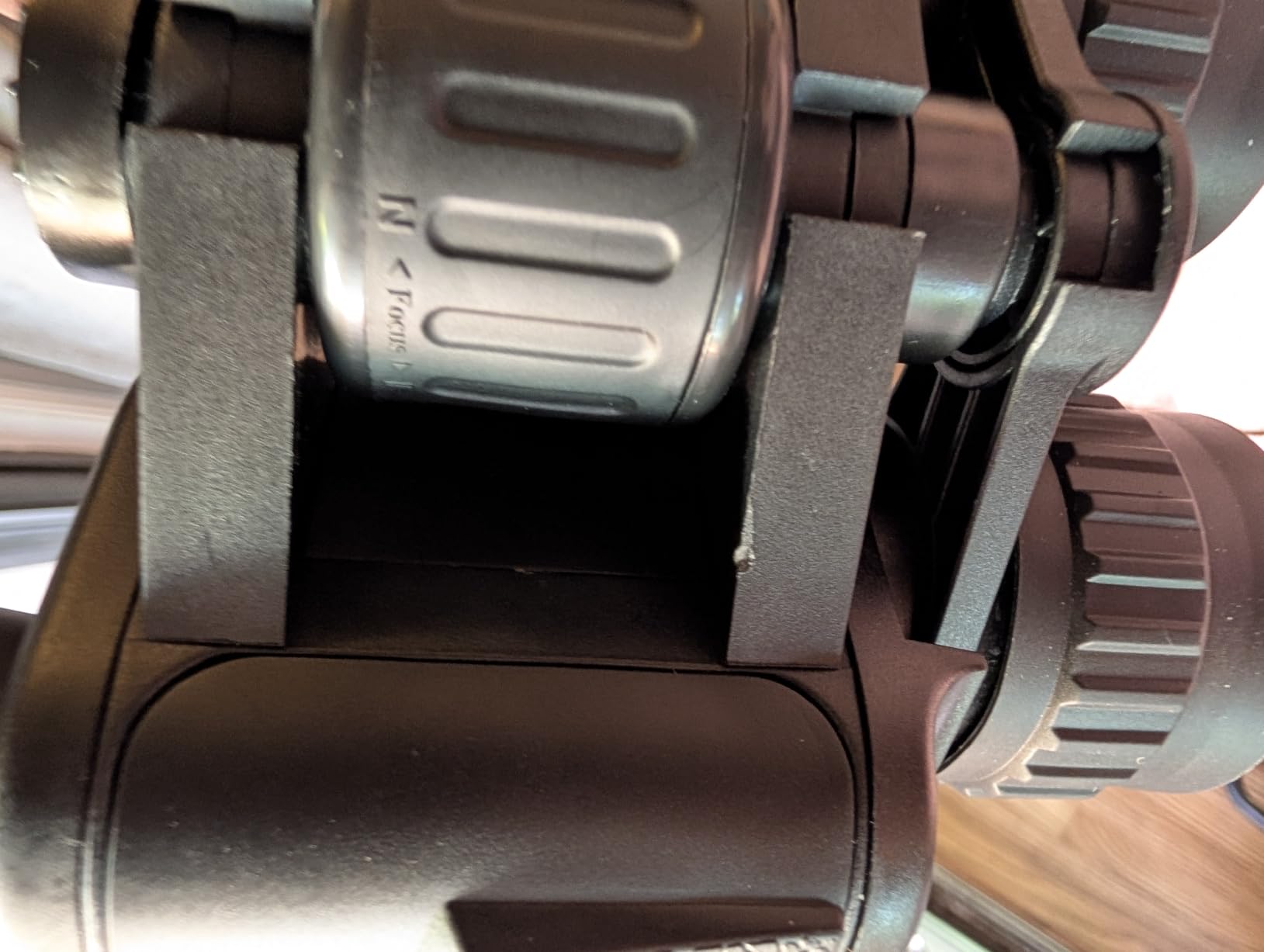
The weight is the whole story. At 8.8 lb with a front-heavy balance, hand-holding works for a moment at a time, so plan every session around a mount. You also need a tall, stiff tripod, and interpupillary adjustment may not close enough for smaller faces.
When a 100mm aperture pays off
This model is for observers who already know what they want to see and have a dark site. The jump from a 70mm to a 100mm objective is roughly a full magnitude more light, which is the difference between suspecting a nebula and seeing structure in it.
It also serves double duty. Long-range wildlife, marine observation and scenic viewing all benefit from that much aperture, and several owners describe it as a premium instrument at a mid-tier cost.
When it is not worth the weight
If your observing is casual, suburban, or done standing in a garden, the weight will end your sessions early. A tripod adds cost and bulk, and the 2.8 degree field makes it a poor tool for finding things in the first place.
Watch out for the objective lens caps, which are thin untethered wafers that are easy to lose. Tether them before the first drive.
6. Vortex Triumph HD 12×50 – Best for Glasses and Travel
- HD optics with reduced chromatic aberration
- Lightweight 1.6 lb body suits long handheld sessions
- Nitrogen purged
- waterproof and fogproof
- Unlimited lifetime VIP warranty
- 12x is modest for planetary detail
- 50mm objectives gather less light than 70mm astronomy glass
- Tripod adapter not included
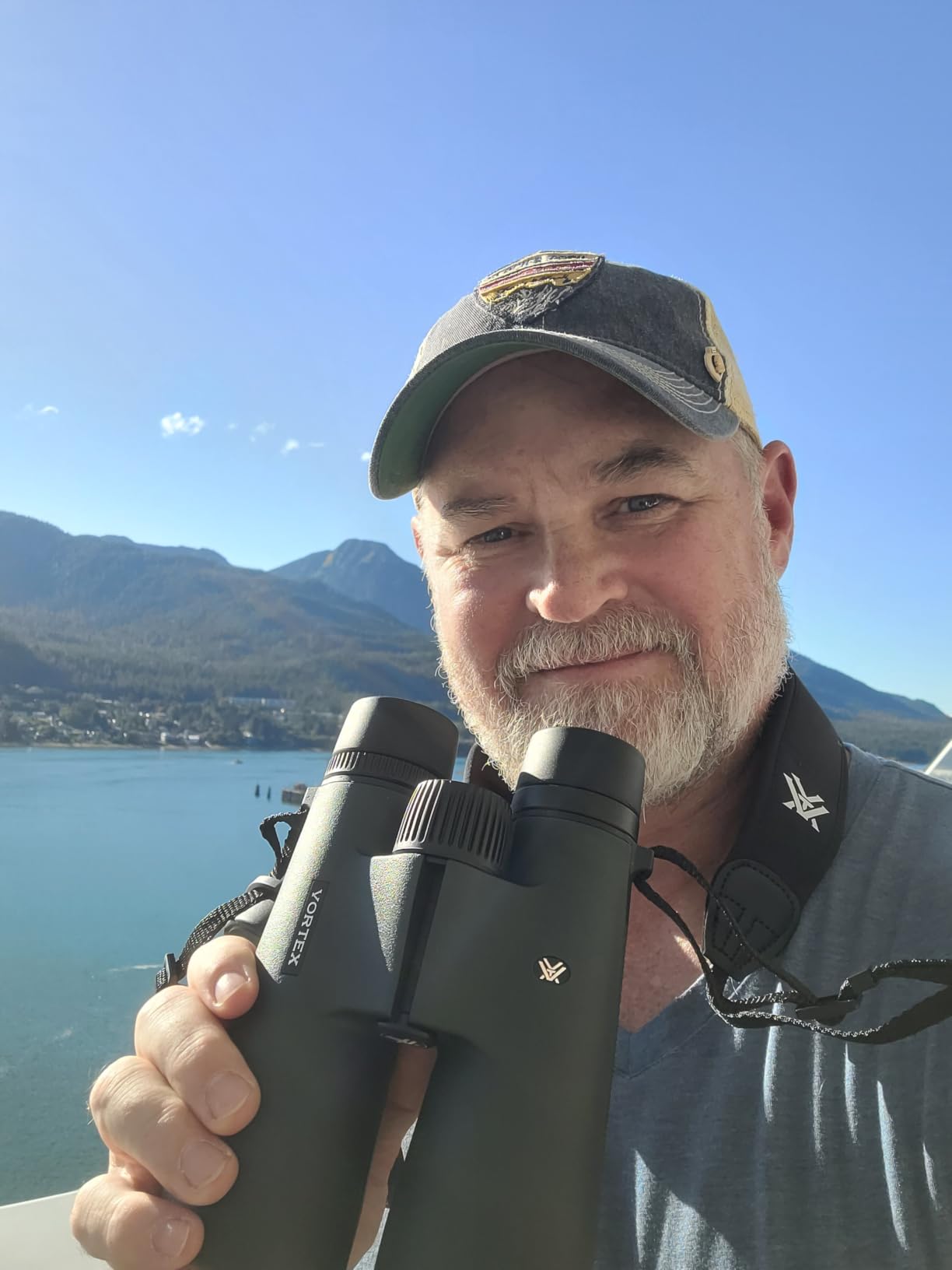
This carries the highest average rating of every model we compared, and the reason is balance rather than raw power. The HD optical system with fully multi-coated elements keeps chromatic aberration low and color accurate, and at 1.6 lb you can hold it for an entire session without fatigue. For a first astronomy binocular that doubles as a travel and birding glass, that combination is hard to beat.
Eye relief of 16mm is the standout number for glasses wearers. Adjustable rubber eyecups and a locking diopter let you set a clean, full-width view with spectacles on, which is where many compact binoculars fall short.
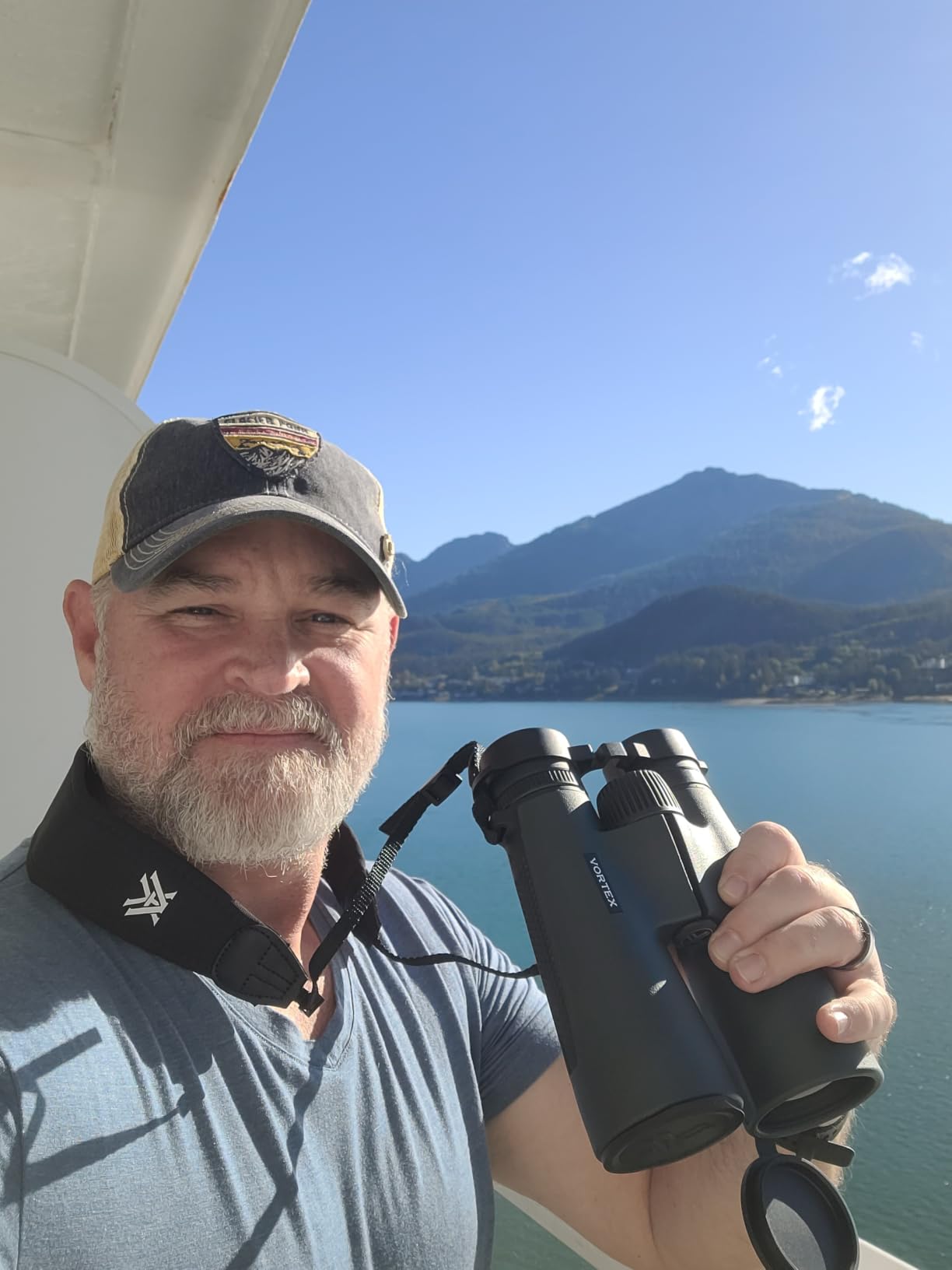
The roof prism design keeps the barrels straight and compact, which makes it easy to pack, and the chassis is shockproof polycarbonate with full rubber armor. Nitrogen purging, waterproofing and fogproofing handle rain and temperature swings without complaint.
Its honest limitation is purpose. Twelve times is modest for lunar and planetary detail, and a 50mm objective gathers less light than the 70mm and 100mm astronomy models here, so faint nebulae are harder from a bright sky. It is built for wide-field scanning, color fidelity and portability.
Who this model fits
Anyone wearing prescription glasses gets a real benefit, and the unlimited unconditional lifetime warranty is the strongest support commitment in this group. It is also the easiest model here to carry on a plane or in a day pack without thinking about it.
Birders and hikers who want to point the same pair at a warbler in the morning and Cassiopeia at night will be particularly happy, as we noted in our guide to the best hunting binoculars, where rugged daytime glass gets the same treatment.
Where it stops short
Do not expect a telescope view. Twelve times through 50mm will show the Moon, Jupiter’s moons and bright clusters, but not crater relief at high magnification. Deep sky objects from a light-polluted backyard will be limited by aperture, not by quality.
You will need to add your own tripod adapter if you decide to mount it later, and the small review base means fewer long-term field reports than the Celestron models receive.
7. Sogries 20×80 – Best Moon Detail in a Mid-Weight Body
20×80 Astronomy Binoculars for Adults High Powered
- Bright
- sharp lunar views with clearly visible craters
- BaK-4 prisms give good brightness at 20x
- Smooth
- well-damped focus ring
- Solid metal build with O-ring sealed waterproof lenses
- Too large and ungainly for travel
- Hand-holding causes rapid fatigue
- Tripod included is small and better used as a handle
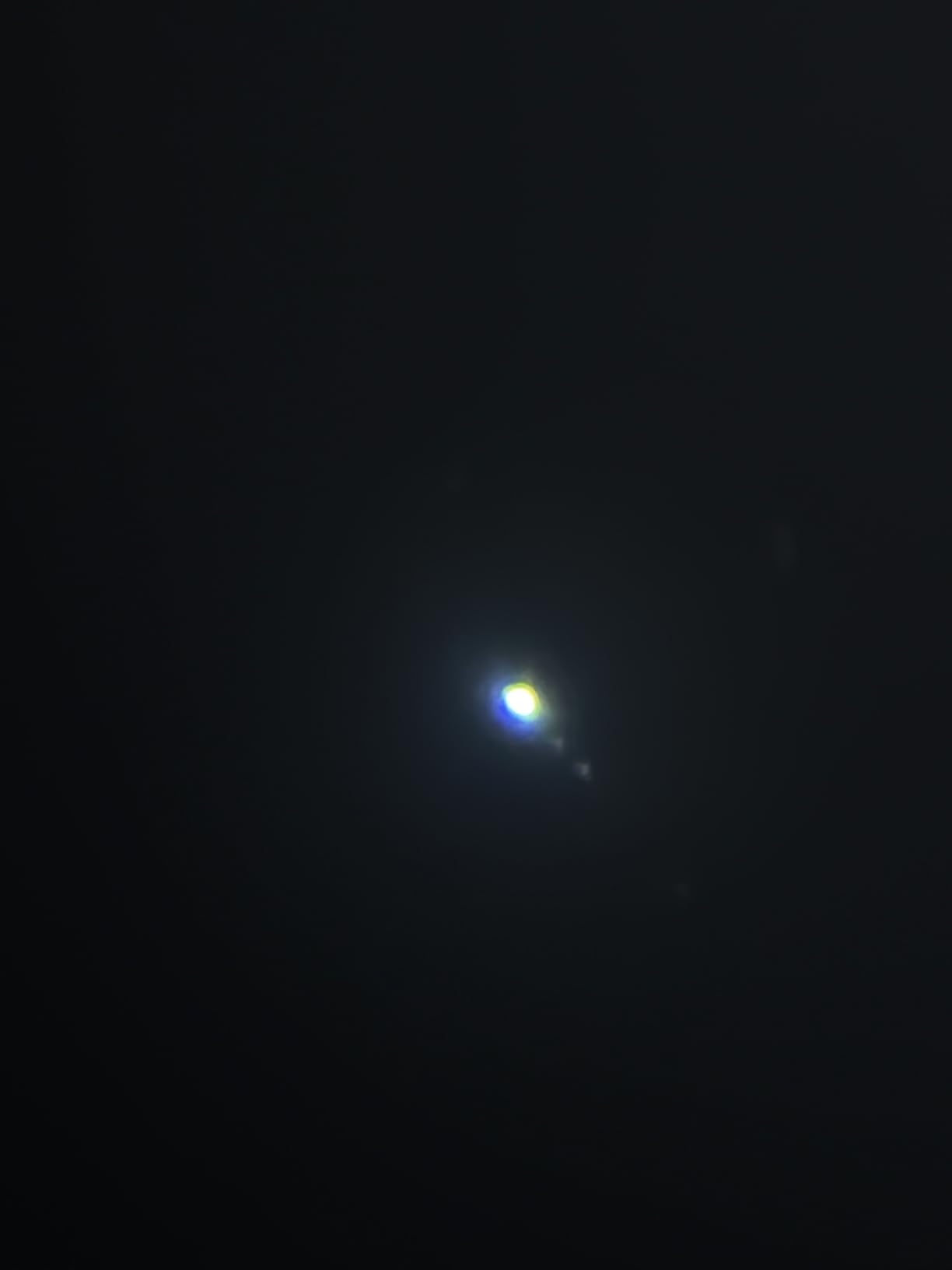
The 20×80 format is the most popular compromise in this guide because it splits magnification and aperture evenly. Eighty millimeters divided by twenty gives a 4mm exit pupil, right inside the ideal band, so you get more magnification than a 10×50 without the dimness of a 25×70. That makes this a strong choice when the Moon is your primary target.
Owners describe bright, detailed lunar views where craters are obvious along the terminator, plus a smooth focus ring with well-damped resistance that makes precise focusing easy. The metal chassis feels substantial, and the O-ring sealed waterproof construction handles wet weather.
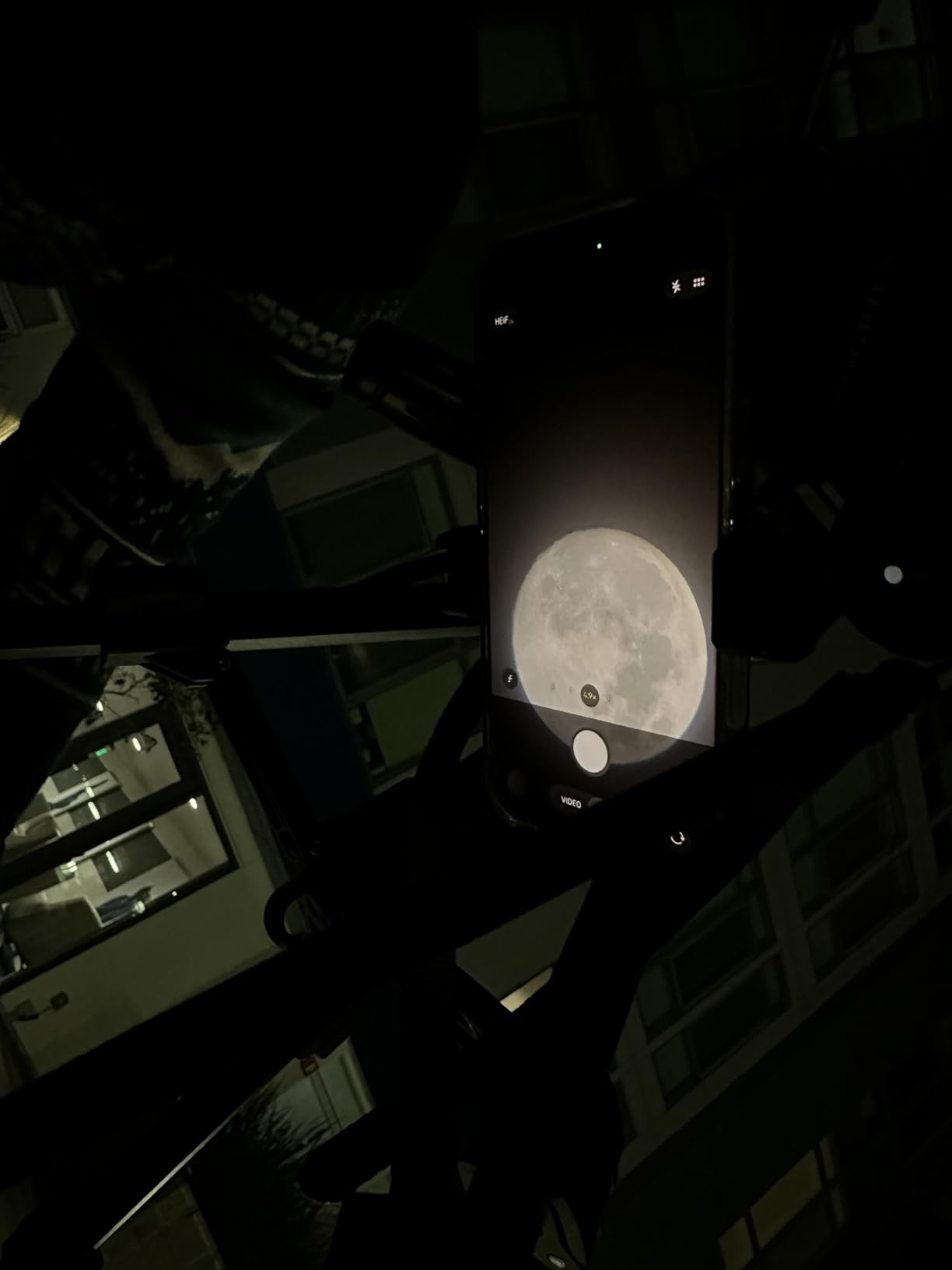
Eye relief of 17mm is comfortable for glasses wearers, and center focus with plus or minus 5 diopter adjustment covers a wide range of vision differences. The package includes a carrying case, strap, phone holder and tripod adapter, which saves a separate purchase.
Bulk is the issue. At 2.08 kg this is a stationary binocular, not a hiking one, and hand-holding it produces fatigue within minutes. The bundled tripod is small, so many owners use it as a steadying handle and buy a proper support afterwards.
Where 20×80 beats both neighbors
Compared with a 15×70 it adds magnification without shrinking the exit pupil. Compared with a 25×70 it is brighter and steadier. For lunar work and bright planets, that middle position is exactly right.
The 173 foot field at distance also covers a decent patch of sky, so finding targets is easier than with a 25×70 once you get used to the narrower view.
What to watch before buying
A small number of owners reported the eyepiece housing cracking around the focus after about a year, so treat it as a value purchase rather than a lifetime instrument. The phone adapter is fiddly to figure out, so skip it if you have no need for digiscoping.
Check that a 20×80 suits your strength. If you already know you will need a tripod for any model above 10x, this is a good place to spend.
8. Aurosports 20×80 – Best Budget High-Power Option
Aurosports 20×80 High Powered Binoculars, 80mm Large Aperture for Adults
- Very bright low-light images from the 80mm objective
- Good value for the magnification and aperture
- Comfortable grip for a 20x80
- Center focus with plus or minus 3 diopter
- Big and heavy
- so a tripod is effectively required
- Visible chromatic aberration around bright targets
- Not water resistant
Getting 80mm of objective at this cost is unusual, and that is why this model earns a place. The fully multi-coated lenses over BaK-4 prisms deliver over 95 percent light transmission, and the 20x magnification makes lunar craters and the Galilean moons easy to pick out. Reviewers mostly see it as a good deal, especially for Moon viewing and general daytime use.
Compared with dedicated 20×80 glass the difference shows in the details. Chromatic aberration is visible around bright targets, particularly the lunar limb, and a minority of buyers report double imaging or focus problems that the manufacturer attributes to normal manufacturing variation.
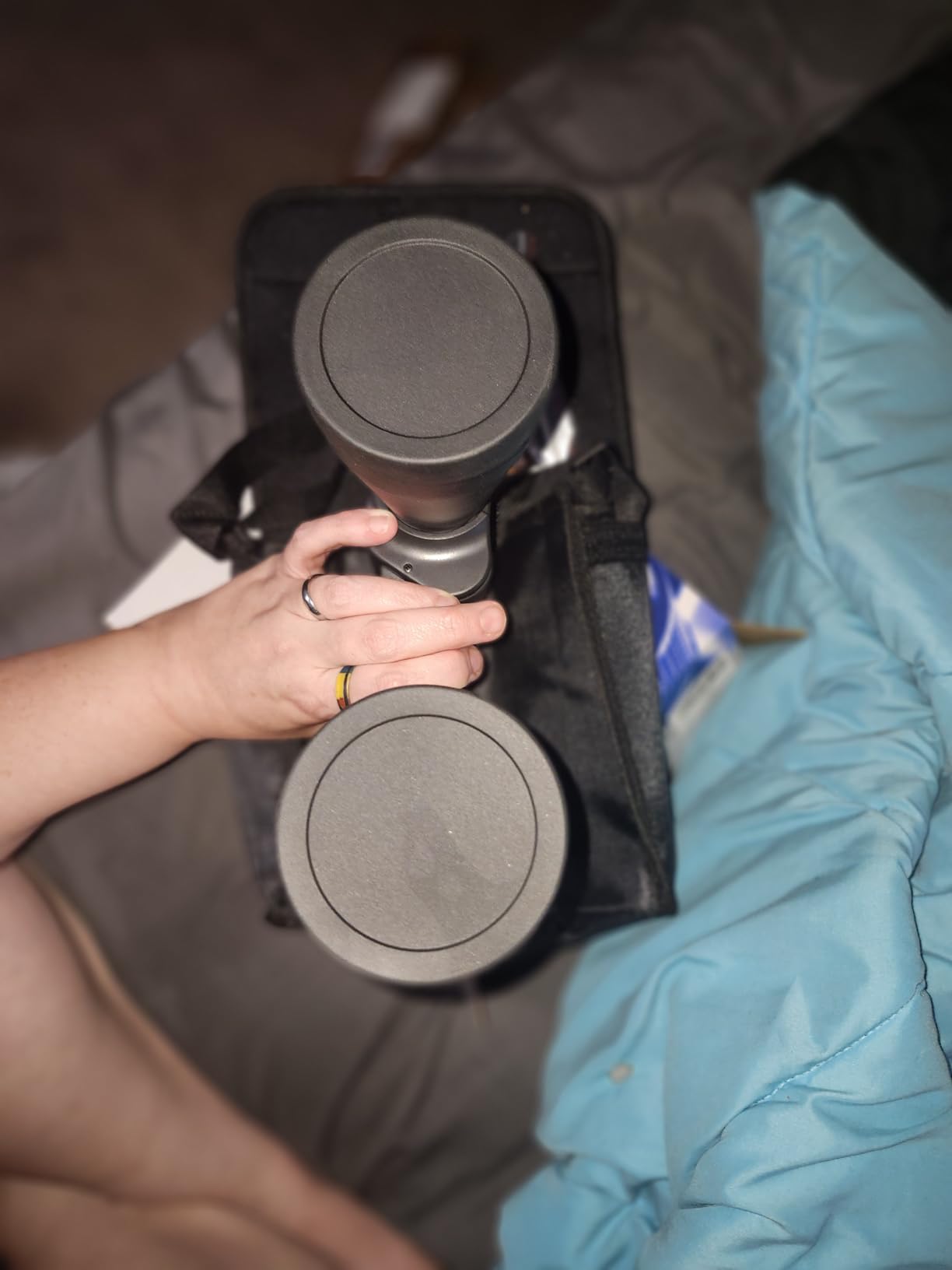
The center focus wheel with plus or minus 3 diopter adjustment operates smoothly, and 15mm of eye relief is usable with glasses. The rubber armor and non-slip grip are better than the price would suggest, and a carrying bag, strap, lens covers and cloth are included.
The straight-line eyepiece design is worth noting. Without an angled eyepiece, targets near the zenith force you into an awkward neck position, and this model has no way to fix that. It is tripod-mountable, which is essential rather than optional here.

When this is the right buy
If your budget is fixed and your priority is aperture and magnification, this model delivers the spec sheet that costs several times more elsewhere. A 50mm objective gathers roughly half the light of an 80mm, so the jump is not a subtle upgrade.
It is a genuinely multi-purpose pair. Birding, hunting, sport and astronomy all benefit from the aperture, and most owners report it handles daylight work without trouble.
Where the compromises show
Color fringing on the Moon is the most common complaint, and if crisp planetary detail matters to you, extra-low dispersion glass is worth spending toward instead. The body is not water resistant, so it belongs in fair weather.
It is also front-heavy and large, so plan a tripod from day one and check collimation on arrival.
9. SVBONY SV407 2.1×42 – Best Wide-Field Star Locator
SVBONY SV407 Astronomy Binoculars 2.1x42mm, Wide Angle for Stargazing
- Extra-wide 26 degree field fits entire constellations in one view
- Shows many more and fainter stars under light pollution
- Compact 375 g body with long depth of field
- 2 inch filter thread accepts astronomical filters
- Very low 2.1x power suits scanning only
- Sharpness falls off quickly toward the edge
- Thin included pouch is not a proper case
Almost nobody buys binoculars this small for stargazing, which is exactly why it is worth considering. A 26 degree field of view is enormous. You can frame Cassiopeia, the whole of Orion or a large part of the Summer Triangle in a single view, and you will see far more faint stars than the naked eye, particularly in a light-polluted sky where stars emerge as the sky background stays flat.
At 375 g it is the most portable model in this guide, with a long depth of field from one meter to infinity that means you focus once and leave it. The 42mm fully multi-coated objective gives clean stars, and the standard 2 inch filter thread accepts astronomical filters, which is rare at this size.
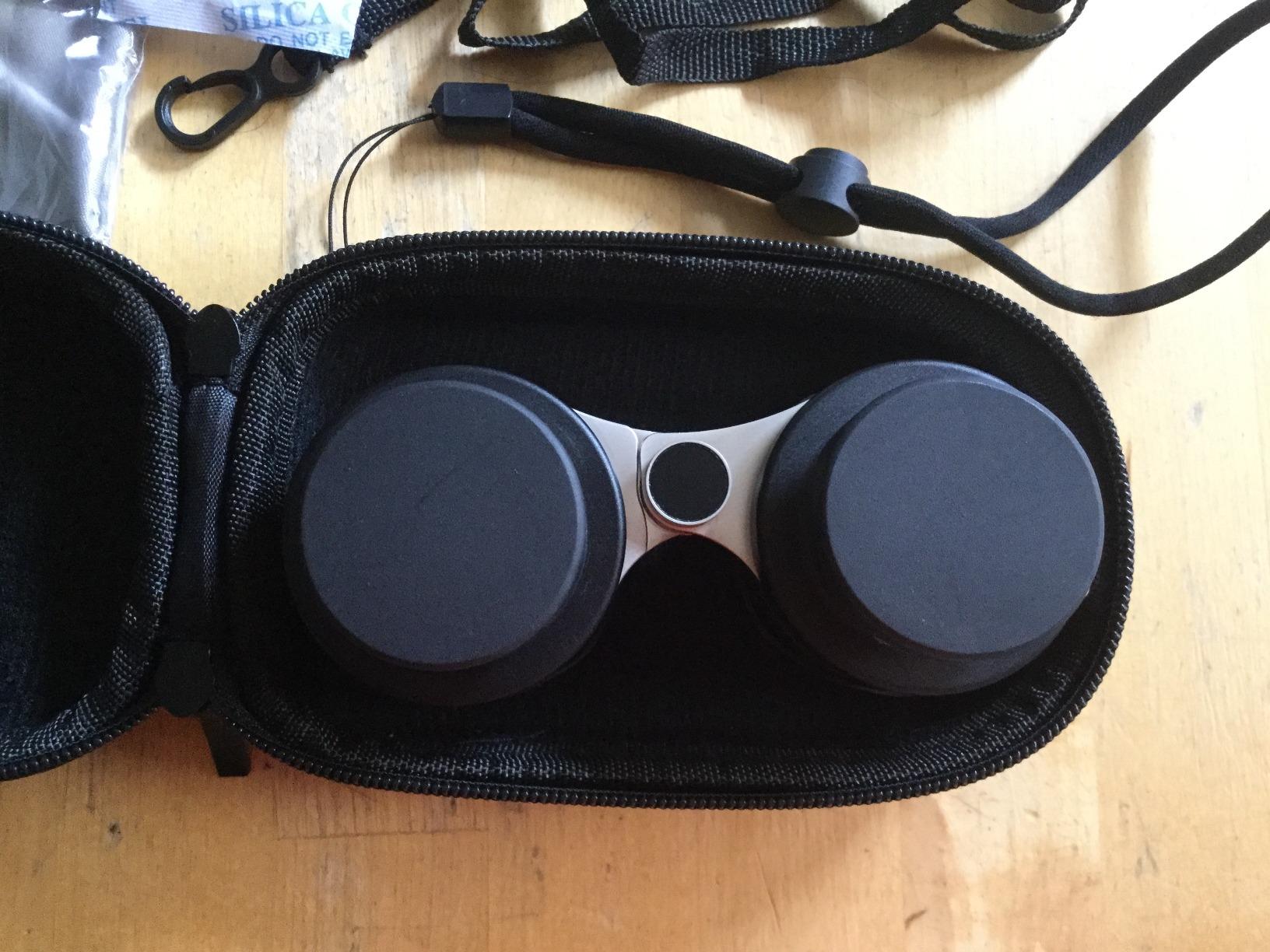
Treat it as a locator rather than an observing instrument. Owners consistently describe it that way, using it to find clusters and then moving to something with magnification. It also works as an outreach or public observing tool, where showing a whole constellation at once changes the conversation.
The exit pupil figure of 19mm reflects the very low power and is far wider than any eye, so light is genuinely wasted. Sharpness falls off quickly from the center, and the 9mm eye relief is tight for glasses wearers.
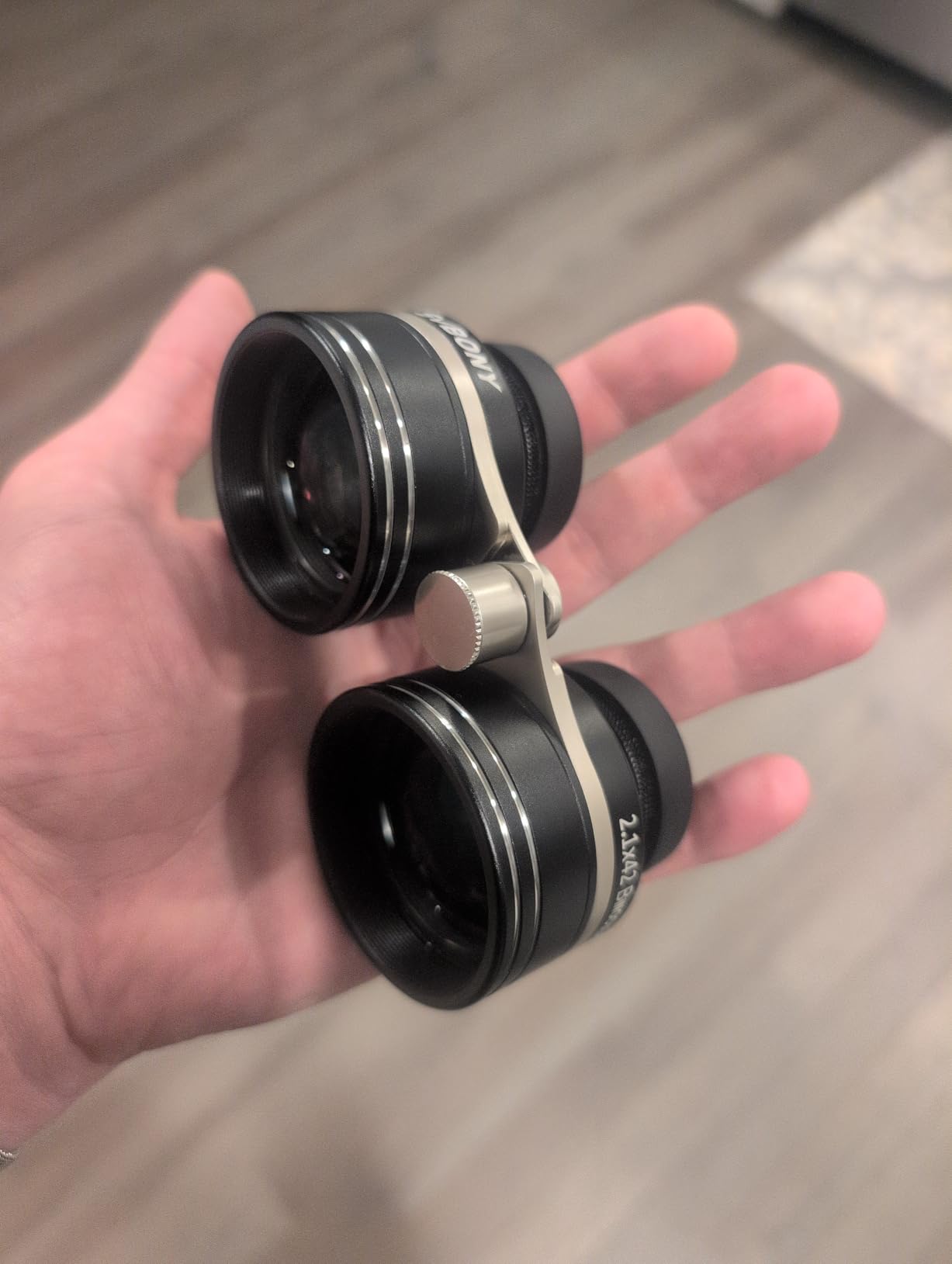
When a 2×42 wide field is useful
Locating deep sky objects and constellations under light pollution is the main use. From a bright city backyard, the jump in visible star count is dramatic compared with naked eye, and the stable wide view makes patterns obvious to beginners.
It is also the easiest model here to pack, at 375 g with a compact rubber housing and IPX6 water resistance. If you travel to dark sites, it fits in a pocket.
Where it cannot take you
Two point one times magnification will not show the Moon in any meaningful detail, will not separate Jupiter’s moons as discs, and will not reveal planetary features. Buying it as a first and only astronomy binocular means never seeing more than star patterns.
The included storage bag is a thin pouch rather than a protective case, and some pairs arrive without a usable neck strap. Check the contents on arrival.
10. ESSLNB 25×70 – Best Built-in Tripod Adapter
ESSLNB 25×70 Astronomy Binoculars Giant for Adults, Outdoor Waterproof Binoculars for Travel Stargazing Bird Watching Hunting with Built-in Tripod Adapter and Carrying Bag
- Built-in 1/4-20 tripod adapter removes the wobble problem
- Fully multi-coated lens with BaK-4 prisms for low color fringing
- Long eye relief and large eyepieces suit glasses wearers
- Waterproof armoured aluminum housing
- Heavy and front-loaded
- so a tripod is required
- 2.7 degree field limits sky scanning
- Only a 1-year warranty
This model solves a problem several others in this guide create. The tripod adapter is built into the body, so there is no separate plastic part to lose and no wobble at the joint, which reviewers repeatedly name as their top complaint about cheaper mounted binoculars. For anyone buying a 25×70 who plans to use it mounted for years, that detail matters.
At 25x with 70mm objectives you get solid lunar detail and clear views of bright planets, and the fully multi-coated lens over BaK-4 prisms keeps color fringing lower than the budget high-power alternatives. The armored aluminum housing is waterproof and dust resistant, with a long eye relief that works well with glasses.
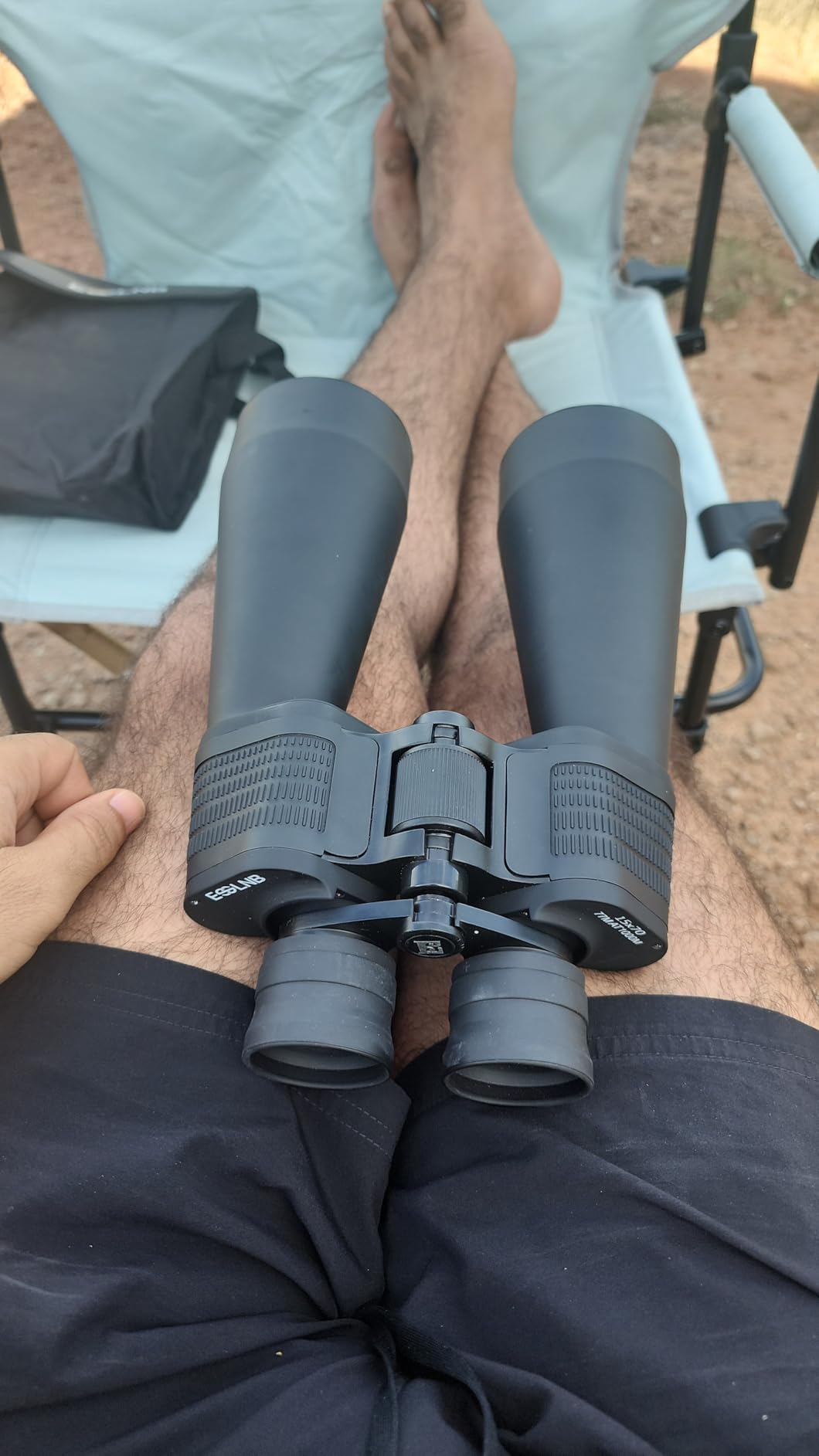
Center focus keeps operation simple, and a portable case is included. The 2.7 pound weight sits between the handheld models and the serious mounted glass, which makes it a reasonable compromise for a driveway setup or a camping table.
It is the lowest-rated model we tested, and the reason is honest rather than fatal. The 2.7 degree field is narrow for scanning, the body is front-heavy, and the one-year warranty is shorter than the limited lifetime coverage on the Celestron models and the lifetime warranty on the Vortex.
When the integrated adapter changes the decision
If you are a beginner who bought a tabletop tripod before buying binoculars, this removes the most common early complaint about high-power models. Nothing flexes, and the barrels stay aligned when you pan across the sky.
It is also a good value when you want 25x power in a body lighter than a 100mm model and do not want to hunt for a matching adapter.
Where it falls short
It is listed without low-light technology despite its astronomy positioning, and the narrow field means the same careful scanning as any 25x. Owners also note the modest warranty, which matters for a product you may keep for decades.
If you already own an adapter, the Celestron SkyMaster 15×70 or 20×80 alternatives give you a longer warranty and a brighter view for the same effort.
What You Can and Cannot See with Binoculars
Set expectations honestly before you buy. Binoculars show a wide swath of sky instantly, with no setup, which makes them the fastest way to find things. They are not a substitute for a telescope when you want planetary detail.
With a 10×50 you can hold the Pleiades, the Hyades and Praesepe comfortably, see the Andromeda Galaxy as an elongated glow, and pick out the Orion Nebula from a dark site. Jupiter appears as a bright disk with its four Galilean moons spaced beside it, and the Moon shows maria and larger craters at the terminator. Mizar and Alcor separate at almost any magnification above 5x.
A 7×50 wide field is for sweeping. It shows many more stars than the naked eye and makes constellation shapes obvious, which is genuinely useful for learning the sky. It will not separate anything.
A 15×70 or 20×80 adds real lunar detail, with craters along the terminator standing out with relief. A 25×70 or 25×100 pushes further, resolving smaller craters and giving the Galilean moons clear separation.
What binoculars will not do is show Saturn’s rings as rings, show Jupiter’s bands, or reveal planetary surface detail. Reviewers on astronomy forums are consistent on this point, and it is the honest line between binoculars and a telescope.
Binoculars or a Telescope First?
Buy binoculars first. They cost less, they need no setup, and they teach you constellation shapes and the general layout of the sky, which is the skill a telescope needs most. Many experienced observers on forums keep a wide-field binocular permanently, even after buying serious optics.
Buy a telescope first only if you already know exactly which targets you want and your priority is planetary or small deep sky detail. Otherwise, the learning curve of finding objects will frustrate you before you see anything worth seeing.
Our guide to the best night vision binoculars covers a different kind of instrument, but the same logic applies: match the tool to the light and the target rather than the marketing.
How to Choose Binoculars for Stargazing?
Every choice below follows from two numbers printed on the barrel. Learn those numbers and the models make sense to each other.
Decoding the format numbers
Magnification is the first number and the objective lens diameter in millimeters is the second. Light gathering scales with the square of the objective diameter, so 80mm gathers considerably more light than 50mm, and 100mm more still. Magnification spreads that light thinner, which is why more power is not automatically better.
The practical formats are 7×50 for comfortable wide sweeping, 10×50 as the all-rounder, 12×50 for compact general use, 15×70 for the first real jump in power, 20×80 for lunar work, and 25×70 or 25×100 when a tripod is certain.
The exit pupil rule in one line
Exit pupil equals objective diameter divided by magnification. A 10×50 gives 5mm, a 15×70 gives 4.7mm, a 20×80 gives 4mm, a 7×50 gives 7.1mm, and a 25×70 gives 2.8mm. A dark-adapted human pupil sits between 4 and 5mm, so formats landing in that range use all the light they gather. Formats below it waste light; formats above it scatter it across a wider area than your pupil can take in.
Converting field of view into something you can use
Field of view is often listed in metres or feet at 1000 metres. Divide that number by 17.5 and you get the true angle in degrees. A 6.8 degree field is wide enough to contain Orion comfortably, while a 2.7 degree field is roughly the width of two full moons placed side by side.
Porro prism versus roof prism
Porro prism models fold the light path inside the body, which gives a longer apparent field, more natural-looking depth, and typically better light throughput for the money. Roof prism models keep the barrels straight and compact, which makes them easier to carry and lets them focus closer.
Both are fine for stargazing. Compact roof prism designs suit travel, while classic Porro models dominate at higher powers.
ED glass, coatings and color fringing
Extra-low dispersion glass reduces chromatic aberration, the colored fringe you see around high-contrast edges like the lunar limb. It matters most at higher magnification and around bright targets. Most entry models show some fringing, and that is normal rather than a defect.
Coatings are the cheaper upgrade. Multi-coated lenses reflect less light away, BaK-4 prisms transmit more than BK7, and phase coating on roof prism models improves contrast. A fully multi-coated BaK-4 path is the sweet spot for stargazing at any budget tier.
Tripod, adapters and stability
Above 10x, assume you need a tripod. Hand tremor above about 12x becomes obvious within seconds, and reviewers describe high-power hand-holding as unusable rather than merely tiring. Look for a 1/4-20 thread or a built-in adapter; models with a molded-in adapter, such as the ESSLNB 25×70, avoid the barrel wobble that owners of separate plastic adapters complain about.
A tall, stiff tripod with a pan handle matters more than a wide but light one. Cheap adapters let the barrels flex, and that flex is what makes cheap binoculars feel cheap.
Angled eyepieces are worth considering if you observe targets near the zenith, since they let you look up rather than crouch. None of the models here use one, so check comfort at your highest target before settling.
Light pollution and dark sky performance
Exit pupil size predicts how a model behaves in different skies. Formats with a 4 to 5mm exit pupil, such as 10×50 and 15×70, adapt reasonably well to suburban conditions while still reaching deep sky targets when you drive somewhere dark. Formats with a very large exit pupil, such as 7×50 at 7.1mm, gather light you cannot fully use, which matters less under a bright sky where the limiting factor is sky brightness anyway.
Large-aperture models win decisively at a dark site, where the limiting factor becomes your eyes rather than the sky.
Cleaning and field care
Here is the routine we use after a night out, and it answers the most searched question in this niche:
Blow loose dust off with a rubber bulb blower, never compressed air, which can drive grit into the coatings.
Brush the objective gently with the supplied lens cloth, working from the center outward in small circles.
Use lens cleaning fluid only on the cloth, never directly on the glass, then wipe lightly.
Clean eyepieces last, using a soft cotton cloth, since they carry most of the oils from your face.
Store the binoculars in the supplied case in a dry location, and remove the batteries from any illuminated model.
Never use tissue paper, saliva, or household glass cleaner. Those habits cause exactly the coatings damage people regret.
Glasses, eye relief and comfort
Eye relief is the distance from the eyepiece lens to your eye, and anything above 15mm generally works with glasses. The models here range from 9mm on the Bushnell Falcon to 18mm on the Celestron SkyMaster 15×70. If you wear thick frames, prioritize the 15mm figure and above, and check that adjustable eyecups are included.
Half a diopter difference between your eyes is normal. Any binocular with a diopter adjustment will fix it in seconds; models with a lever-based system do it even faster.
Frequently Asked Questions
Are 10×42 binoculars good for astronomy?
Yes, and they are a strong first choice. A 10×42 gathers decent light, stays stable in the hand, and shows a wide field that makes constellations easy to find. The 42mm objective collects less light than a 50mm, so faint deep sky targets under light pollution are harder to see. For the Moon, Jupiter and its moons, and open clusters, they are more than adequate.
Which binoculars are best for seeing planets?
Higher magnification helps, but aperture matters more. A 15×70 or 20×80 shows Jupiter with its four Galilean moons and the Moon with clear craters. No binocular shows Saturn’s rings as rings, or Jupiter’s cloud bands in detail; that requires a telescope. Magnification above 20x also needs a tripod to avoid shake.
Can a telescope be used as binoculars?
Not practically. A telescope is designed for one observer looking through a single eyepiece, so using it without an adapter means sitting behind the instrument. Binocular mounts and binoviewers exist, but they cost more than a dedicated astronomy binocular and are not worth it for beginners. Buy binoculars for wide-field viewing and keep the telescope for detail.
How do you clean binocular lenses?
Start with a rubber blower to remove dust, then wipe gently with the supplied microfiber cloth working from the center outward. Apply lens fluid to the cloth rather than the glass, and use a separate cloth for eyepieces, which carry most skin oils. Avoid tissue paper, saliva and household cleaners, all of which damage lens coatings over time.
What magnification of binoculars is best for stargazing?
Ten times is the most comfortable all-round power because it stays stable and shows a wide field. Fifteen to twenty times adds lunar and planetary detail but requires a tripod. Going above 25x narrows the field and makes finding targets harder. The objective lens diameter matters more than the magnification for seeing faint deep sky objects.
Do I need a tripod for 10×50 binoculars?
Only for long sessions. At 10x you can hold a 10×50 steady for a few minutes at a time, which is enough for sweeping the Milky Way and following Jupiter’s moons. For extended viewing or anything above 12x, a tripod with a 1/4-20 adapter or a binocular mount makes a noticeable difference. Check that your tripod has a pan handle for comfortable tracking.
Final Verdict for 2026
The Celestron SkyMaster 15×70 is our pick for the best binoculars for stargazing in 2026. Its 70mm objectives, 4.7mm exit pupil, 18mm eye relief and included tripod adapter give it the best balance of brightness, magnification, comfort and support we found across ten models.
If your sessions are handheld, take the Bushnell Falcon 10×50, which matches the ideal exit pupil and adds a fast InstaFocus lever. If the Moon is your target and you own a tripod, the Celestron SkyMaster 25×70 or the Sogries 20×80 add real detail. From a dark site, the Sogries 25×100 gathers more light than anything else here, provided you can carry 8.8 pounds and a tripod.
Whatever you choose, check collimation on arrival, keep lens caps tethered, and expect the Moon and Jupiter’s moons to be the first things that turn you into someone who looks up. Our roundups on birding binoculars and thermal binoculars cover the daylight and low-light ends of the same hobby if you want to stretch one purchase further.