
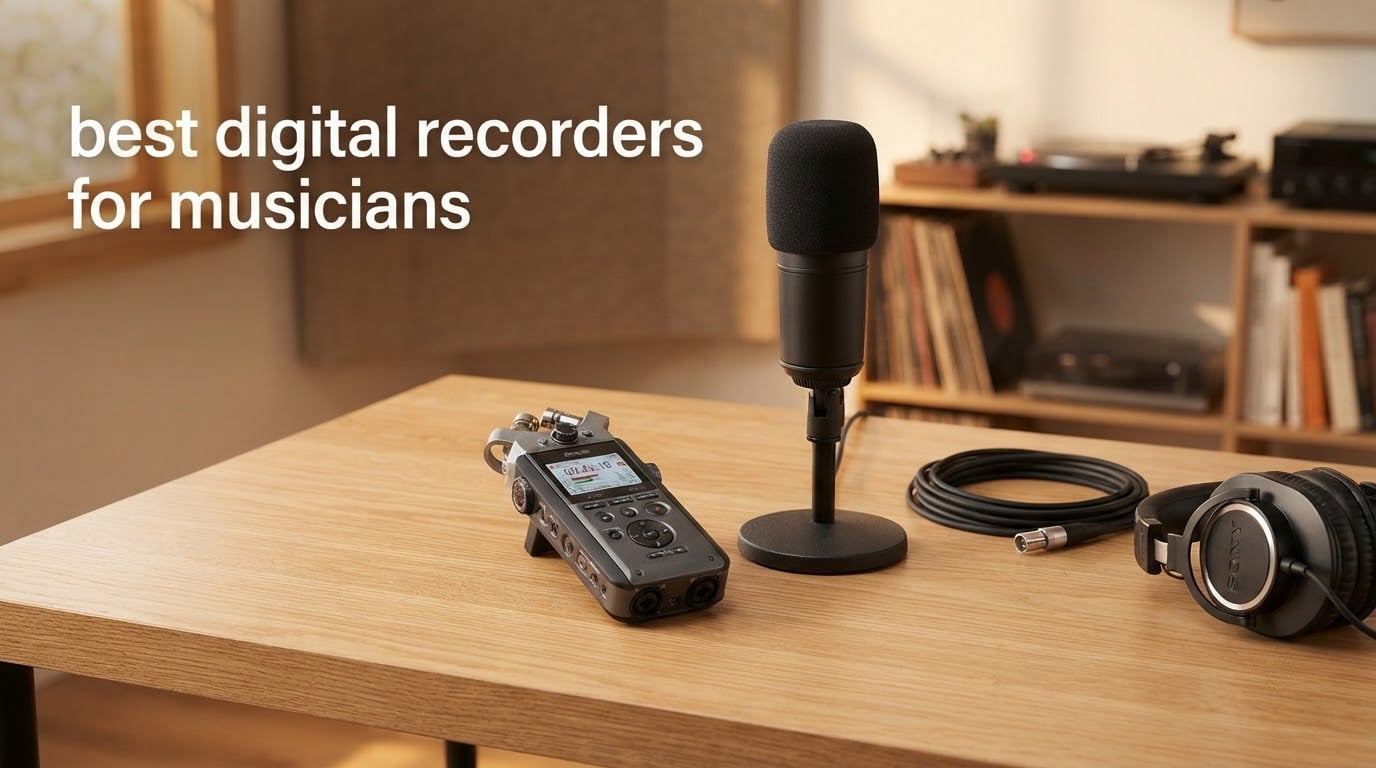
Every riff, vocal melody and drum fill you have ever had disappears the moment the room goes quiet. A digital recorder is the cheapest way to stop losing them, and the best digital recorders for musicians in 2026 are the difference between a song that lives in your head and a song you can send to someone else by Friday.
I have spent the last few months living with these seven recorders the way a musician would: writing on them, tracking rough demos on them, and dragging the files into a DAW afterward to see what actually survived. What follows is what the hardware is really good at, and just as importantly, where it will let you down.
We ranked them by the things that matter once the honeymoon is over: how quiet the preamps are during quiet acoustic takes, how many real inputs you get, whether the files land on your computer without a fight, and whether the thing keeps working after a two-hour rehearsal. If you want the short version, the Zoom H5 wins overall, the Zoom H1 Essential wins on portability, and the Tascam Portacapture X8 wins when you need to track a room full of sources at once.
Table of Contents
Top 3 Picks for Musicians in 2026
Zoom H5
- Four-track simultaneous recording
- Two XLR/TRS combo inputs
- Interchangeable mic capsules


All 7 Recorders Side by Side in 2026
| Product | Specifications | Action |
|---|---|---|
| Zoom H5 |
|
Check Latest Price |
| Zoom H1 Essential |
|
Check Latest Price |
 Roland BR-80 Roland BR-80 |
|
Check Latest Price |
| Tascam Portacapture X8 |
|
Check Latest Price |
 Tascam DR-05XP Tascam DR-05XP |
|
Check Latest Price |
 Zoom R20 Zoom R20 |
|
Check Latest Price |
 Tascam FR-AV2 Tascam FR-AV2 |
|
Check Latest Price |
1. Zoom H5 – The All-Round Pick for Bands and Songwriters
- Interchangeable capsules work like a lens system for upgrades
- Four-track simultaneous capture with two XLR/TRS combo inputs
- Shock-mounted X/Y capsule keeps handling noise down
- Selectable phantom power and -20 dB pad
- Works as a USB audio interface with loop back
- SD/SDHC recording capped at 32 GB card capacity
- No 32-bit float capture on this generation
- Runs on AA batteries rather than rechargeable cells
The H5 is the recorder I keep reaching for first, and it has earned that spot with a long, well-established owner base. It records four tracks at once, which means a whole rehearsal room can be captured in a single pass with nothing more sophisticated than a pair of dynamic mics on stands.
That capability matters because 32-bit float is not on this model, so gain staging is your job. Set the preamp so a loud chorus sits near the top of the meter without pinning, and check the file before everyone packs up. Get it right once and you never think about it again.
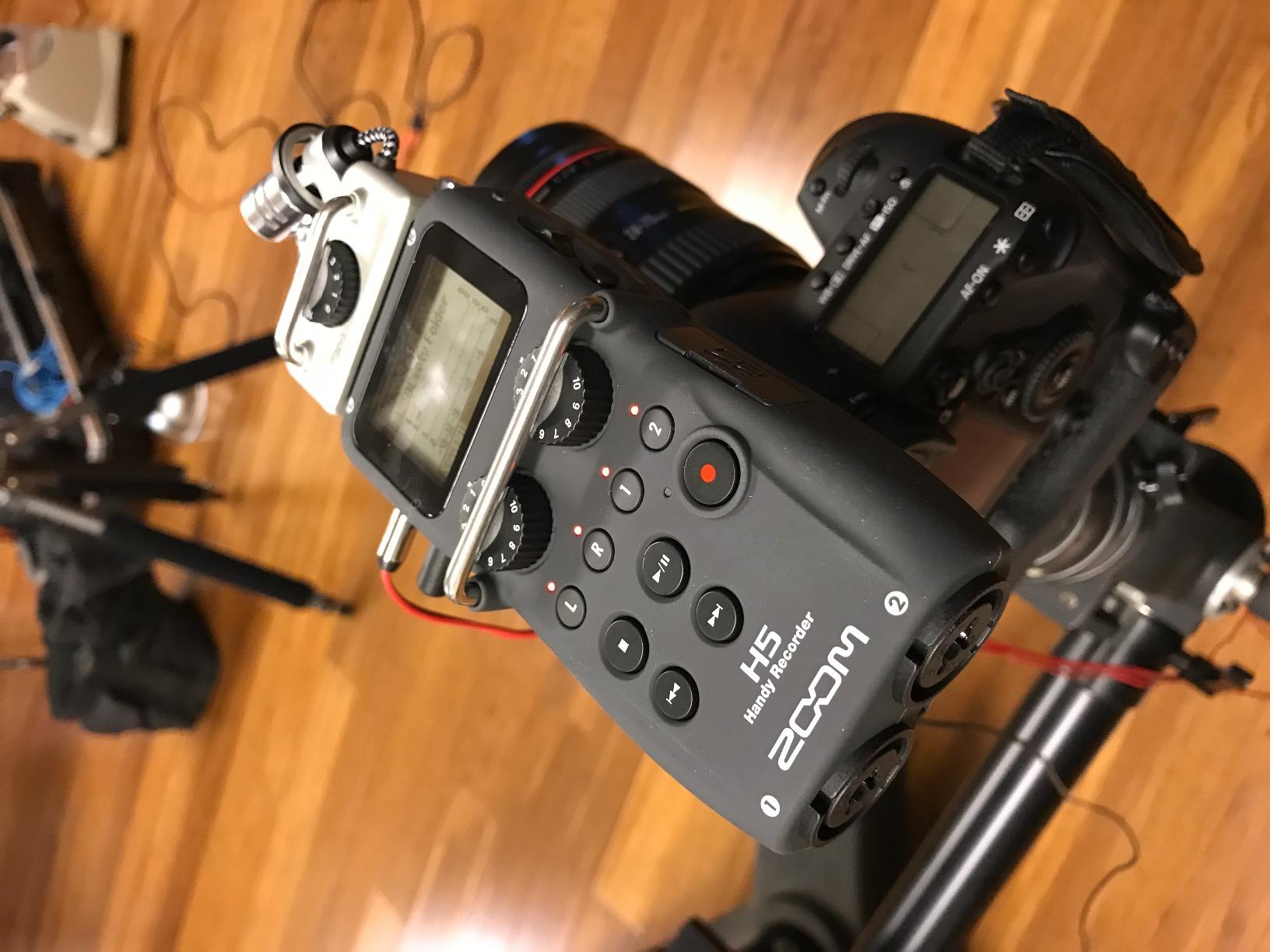
The capsule system is the part I did not expect to care about as much as I do. The X/Y capsule that ships with it is shock mounted, and swapping in a capsule with a pair of XLR inputs later feels like changing lenses on a camera rather than buying new hardware.
For a musician, that also means the recorder follows you as your setup grows. Voice memo on the couch this week, two-mic session in a spare room next month, and four-track rehearsal capture once the band starts giging again.
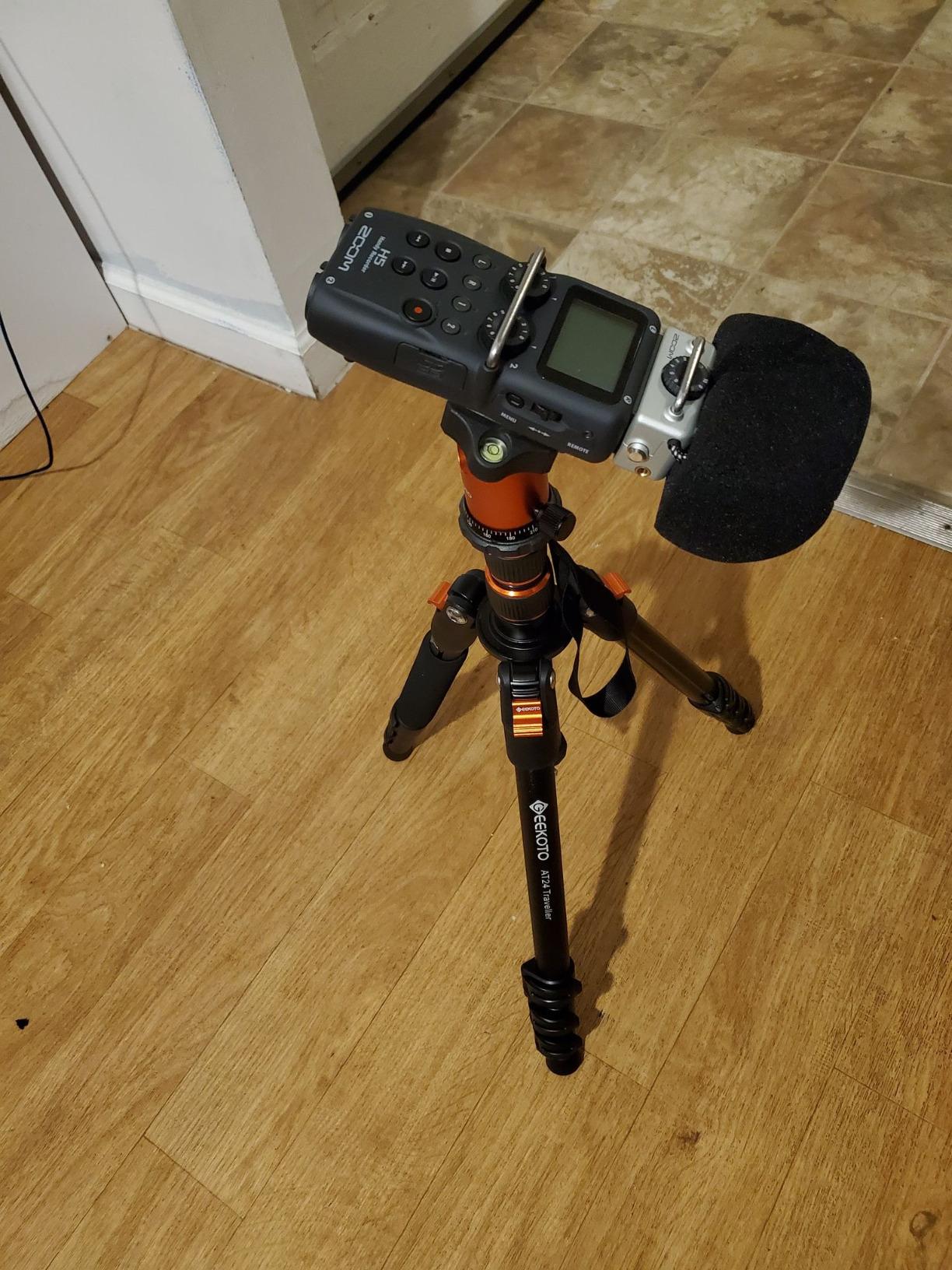
What the H5 does well for working musicians
The independent gain knobs with a proper -20 dB pad make it forgiving of loud sources, and the two XLR/TRS combo inputs are real balanced mic inputs rather than consumer-level 3.5 mm sockets. Plug a condenser mic straight in and the selectable phantom power handles the rest.
It also pulls double duty as a multichannel and stereo USB audio interface for PC, Mac or iPad with loop back, which is a genuinely useful bridge when you want to record into a DAW without a second interface. See our notes on digital mixers for the sort of downstream gear people pair with a recorder like this.
Where the H5 will disappoint you
Storage is the hard limit. Recording to SD/SDHC caps out at 32 GB, which on a multitrack session is a short afternoon before you are swapping files. The 32 GB ceiling also means a long rehearsal is a planning problem, not just a battery problem.
Second, there is no 32-bit float capture, so a blown take is a blown take. If clipping anxiety is the thing you most want gone from your workflow, look at the Portacapture X8 or the FR-AV2 instead.
Third, it runs on AA batteries. That is a fair trade for a device you can grab off a shelf, but you are managing cells rather than a rechargeable pack.
2. Zoom H1 Essential – The Smallest 32-Bit Float Recorder Worth Carrying
- Compact enough to live in a jacket pocket
- 32-bit float removes gain-guessing on idea captures
- Clear detailed stereo for songwriting demos
- Up to 96 kHz capture options
- Built-in text-to-speech accessibility features
- Tiny buttons and a small screen are awkward for large hands
- USB cannot carry data and power at the same time
- SD card and batteries are not included
The H1 Essential is the recorder I put in my bag without thinking. At 92 g it is about the weight of a small paperback, which means the idea you have while walking to a rehearsal is something you can actually capture rather than hum and hope you remember.
It records in 32-bit float, so a quiet verse followed by a loud chorus in the same take is no longer a gamble. That single feature is why this tiny unit is the modern entry point that musicians on forums now recommend over the older fixed-gain pocket recorders.
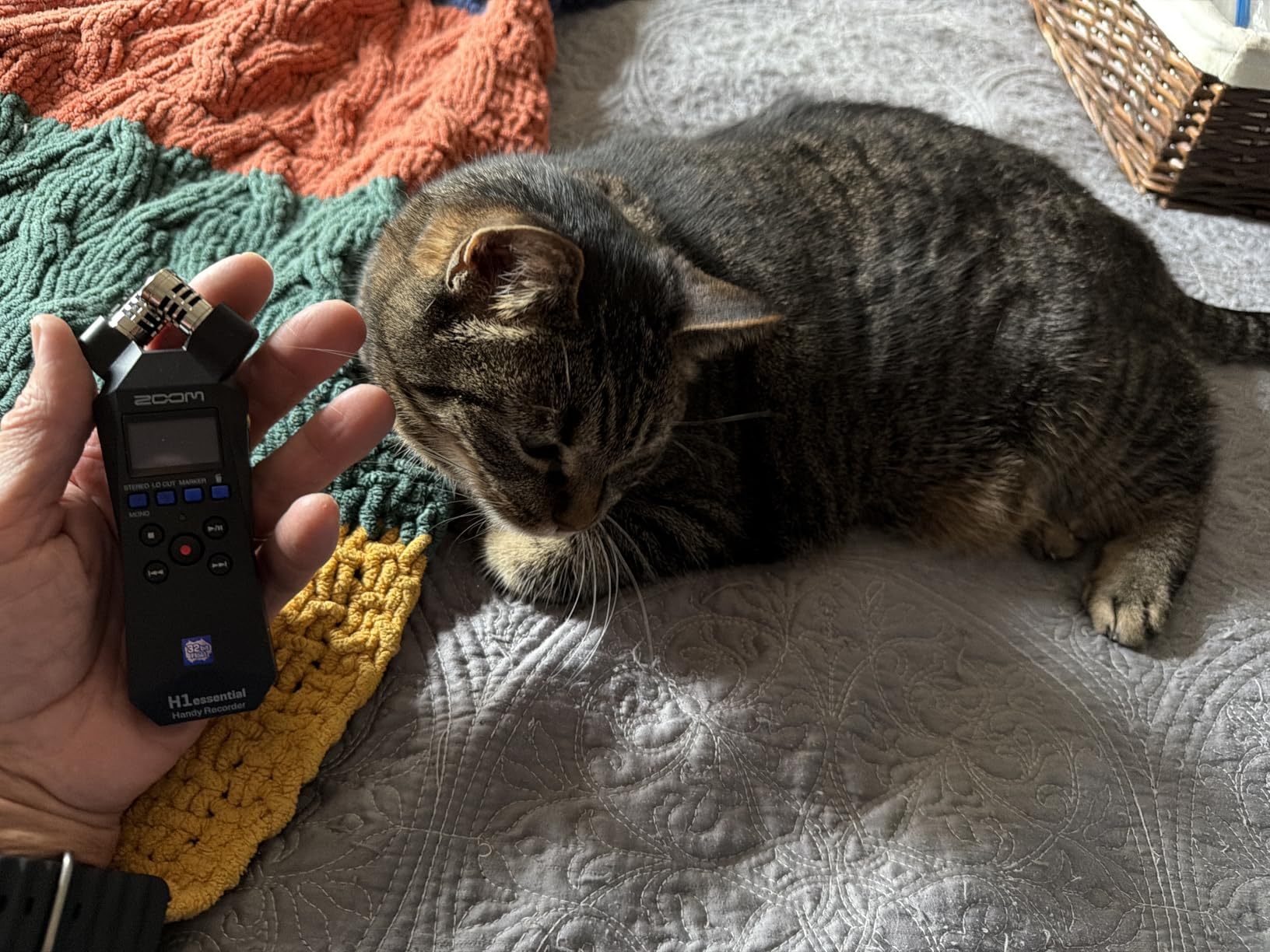
Sample rate options of 44.1 kHz, 48 kHz and 96 kHz cover everything a songwriter actually needs, and the built-in X/Y stereo microphones produce a clear, detailed pair of tracks that hold up far better than phone audio when you pull them into a project later.
It also doubles as a USB microphone for streaming, calls and video, which quietly makes it the most flexible device in this guide if your music lives next to your content.
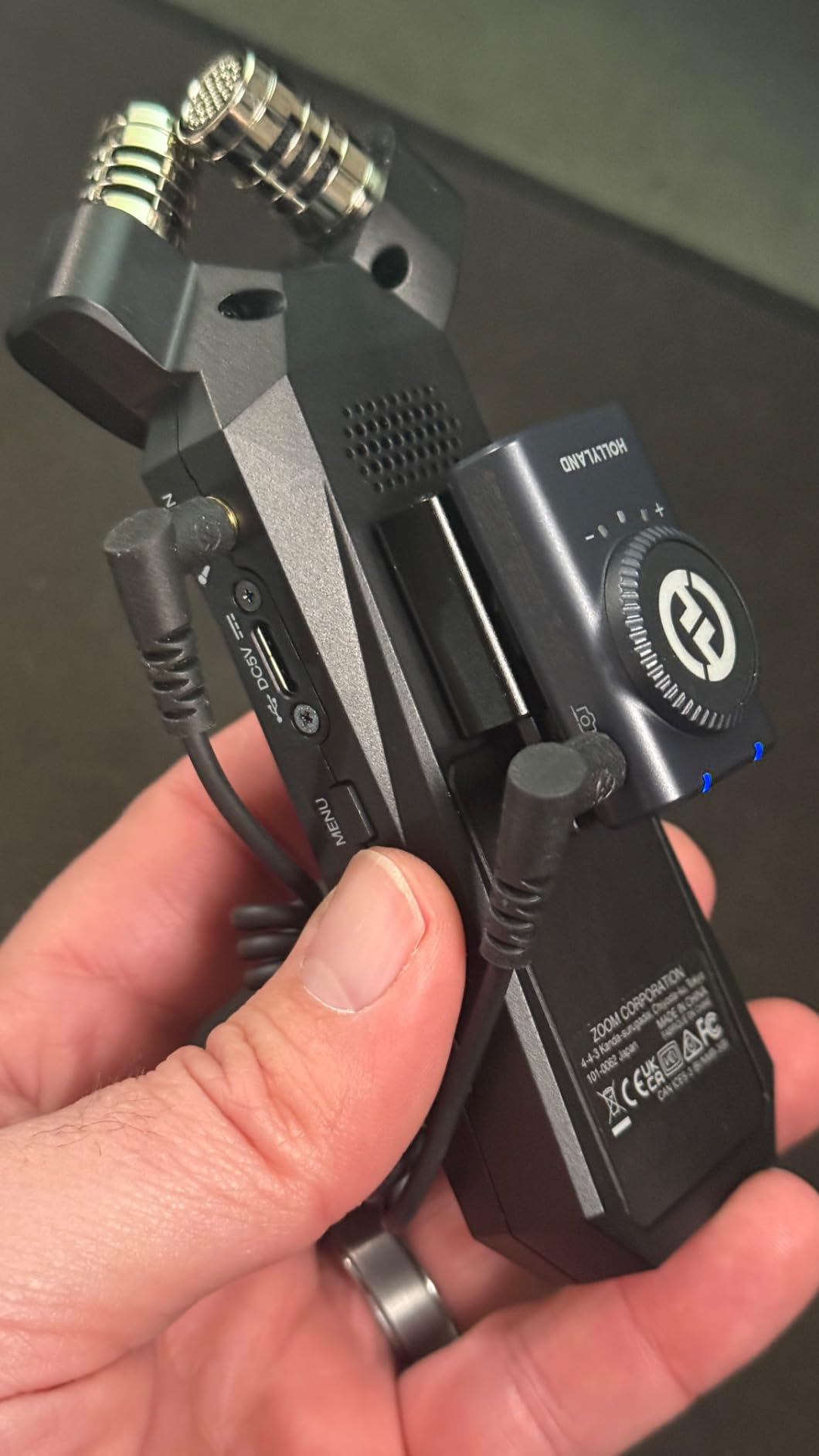
Where the H1 Essential shines
Songwriting and idea capture is the use case it wins outright. No gain control, no clipping, no second-guessing, and a file you can text to yourself before the melody fades.
For practice, it records your playing, plays it back, and stays out of the way. If you play keyboards or piano, our digital pianos guide covers the gear that pairs naturally with a portable capture device like this.
What you give up for the size
There are no external inputs, which is the big one. You are limited to the built-in microphones, so recording a guitar through a pickup or a band with separate mics is not happening on this unit.
The transfer speed of roughly 2 MB/s is slow for anything beyond a quick idea, and USB cannot carry data and power at once, so you will swap cables. Reviewers also report that the low-cut filter cannot be disabled, which matters if you are capturing low-frequency material on purpose.
The small screen and tiny buttons are awkward with larger hands, and the voice-guided startup prompts get repetitive unless you change them. SD card and batteries are not included, so budget for both before your first session.
3. Roland BR-80 – A Practice Partner, Looper and Recorder in One
- Multitrack recorder plus practice trainer and looper in one unit
- Built-in stereo condenser mic for instant capture
- COSM amp and effect models work without a computer
- Functions as a USB audio interface
- About 12 hours of recording time on batteries
- SD/SDHC card support limited to 32 GB
- Older design without 32-bit float capture
- Warranty period listed at only 90 days
The BR-80 is the odd one out in this roundup, and that is exactly why it is here. It is not trying to be the best-sounding capture device in the room. It is trying to be the thing that lets a guitarist work out a solo for forty minutes without a computer anywhere in sight.
It runs three separate modes. MTR handles multitrack recording, Live Recorder captures straightforward takes, and eBand is the practice mode that slows a passage down so you can hear what your hands are actually doing.
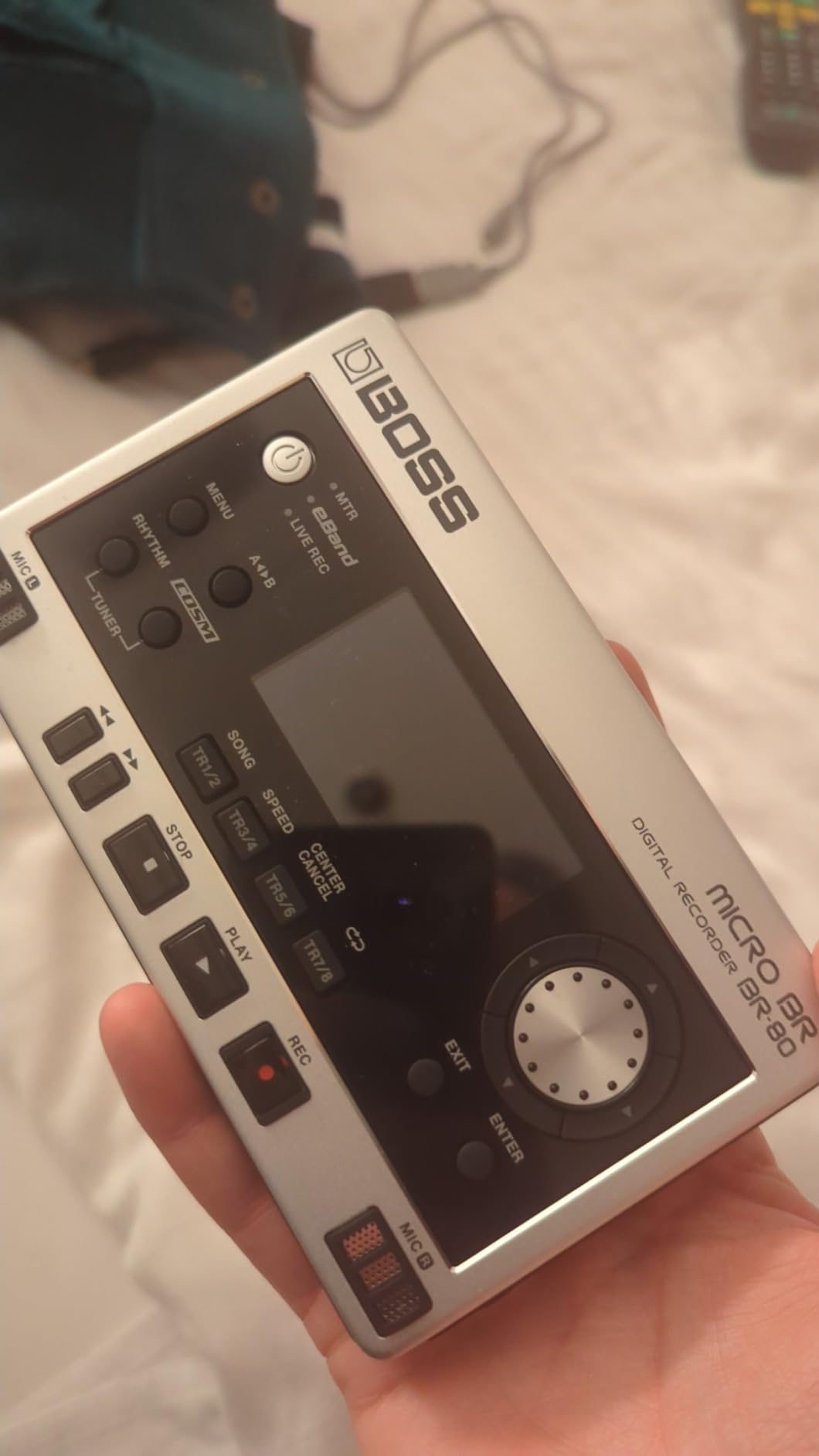
Sixty-four virtual tracks and eight simultaneous playback tracks give you real room to layer ideas, and the built-in library of backing and rhythm patterns means a single guitar part can become a full arrangement before you close the lid.
The COSM amp and effect models are the part guitarists care about most. A practice room amp, a delay and a plate reverb are all on board, which is what makes this usable without a computer for quick demos, a theme that comes up constantly on music forums.
Who should buy the BR-80
Students and self-taught players who practise daily will get more out of it than anyone recording a single take. Music teachers can hand it to a student without a lesson on file management, and anyone working on a part in a small room benefits from the eBand loop-back practice tools. It suits just as well to anyone rehearsing a digital accordion part alone, where tracking and slow-down practice are the whole point.
It also works as a USB audio interface with the built-in effects applied, so the practice sound is the sound you capture later.
Where the BR-80 falls behind
This is an older design, and that shows. There is no 32-bit float capture, so you are back to setting gain yourself, and there is no modern touchscreen workflow to speak of. The navigation is closer to a menu system than an interface.
Card support is limited to 32 GB of SD/SDHC, and the listed warranty is only 90 days, which is shorter than anything else I tested. If you are buying new and your priority is headroom rather than practice features, a modern 32-bit float unit is the better long-term purchase.
4. Tascam Portacapture X8 – Best Multitrack Headroom for Bands
- 32-bit float handles loud events without clipping
- Quiet sensitive preamps compared with Zoom units
- Large responsive 3.5-inch color touchscreen
- Four XLR/TRS inputs with per-input phantom power
- Onboard reverb and EQ plus music and field recording apps
- Only six simultaneous input channels despite the name
- Detachable plastic mic capsules feel fragile
- No Hi-Z input so passive guitars need a DI box
If you are recording a band, the X8 is a strong choice here and the one I would hand to someone tracking drums, bass, guitar and vocals in one go. Four XLR/TRS locking combo inputs, six simultaneous channels, and 32-bit float capture up to 192 kHz give you room to make real decisions instead of constant ones.
The HDDA preamps are noticeably quiet and sensitive, which is what you want when the kick drum and the vocal are in the same file. The higher resolution also means you have detail to work with later, rather than a ceiling you hit in the first minute.
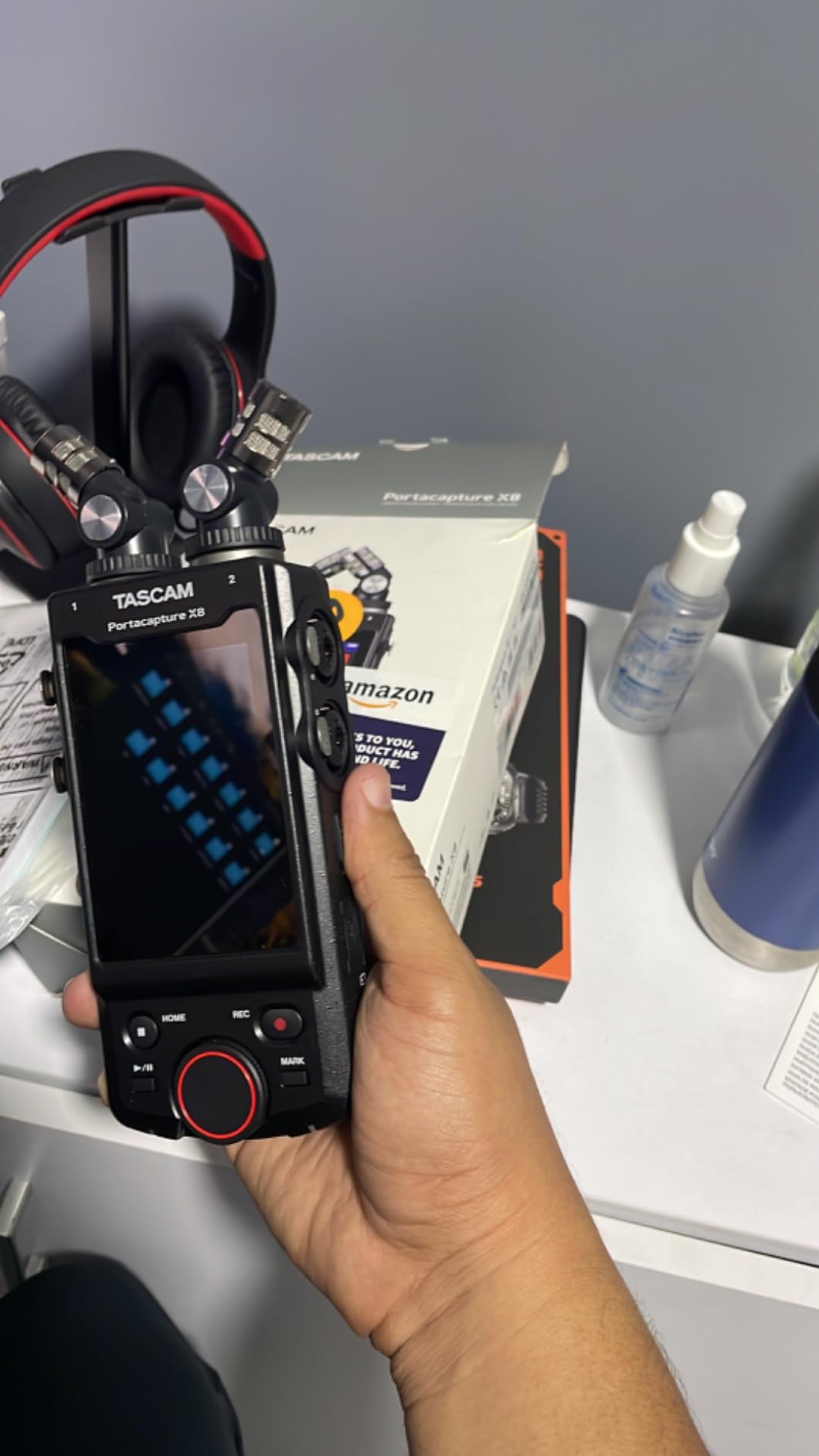
The 3.5-inch color touchscreen is a genuine upgrade in usability. It runs a launcher system that puts the recording apps you need, whether that is basic multitrack, podcasting, music, voice, field recording or ASMR, one tap away instead of buried in a menu tree.
Per-input phantom power at 24V or 48V means you can mix condenser and dynamic mics in the same session, and it will run from a USB power bank for long sessions. For a musician building a home recording setup, those are the two details that remove real friction.
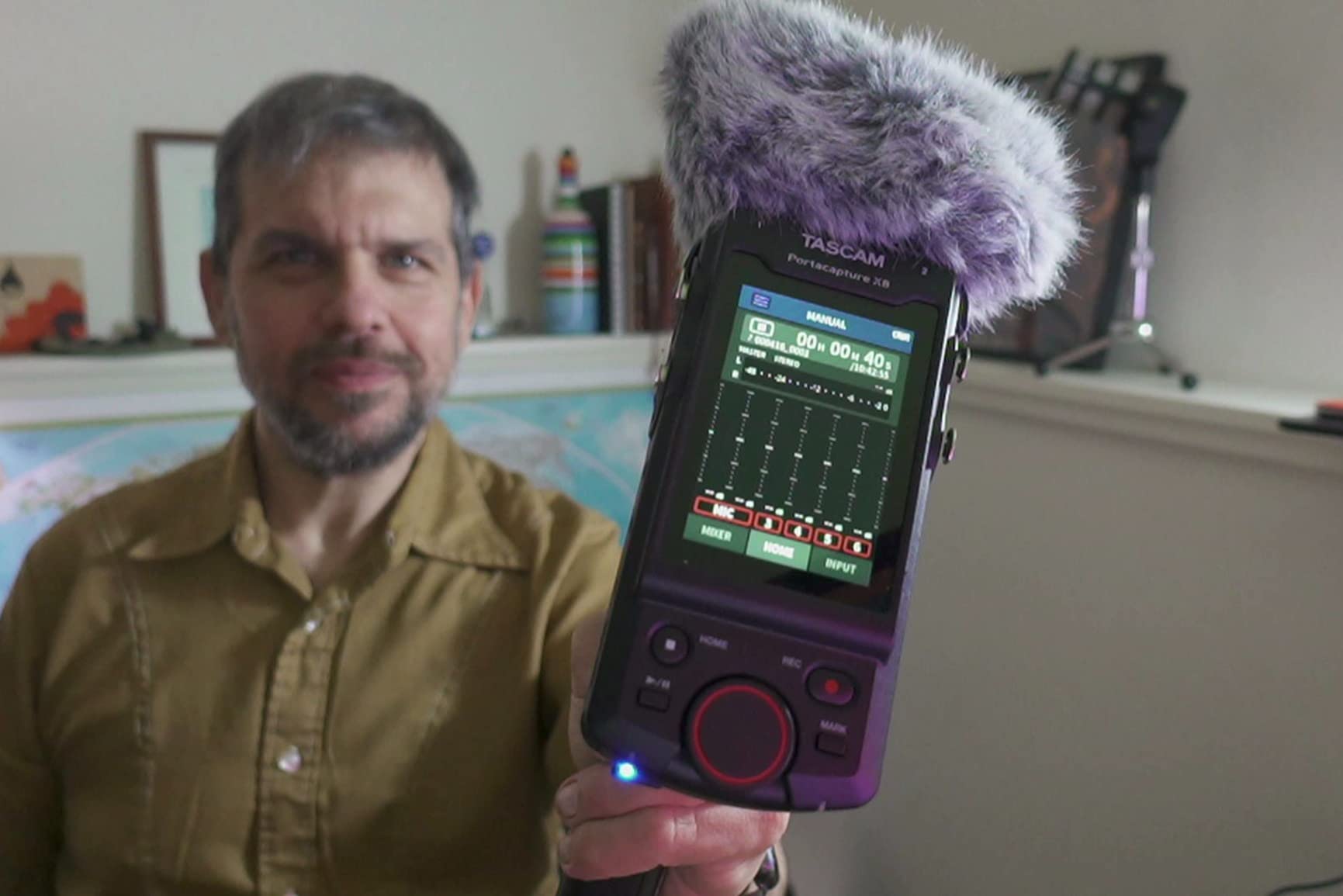
Why bands like the X8
Four real mic inputs with locking connectors means you can leave a full session rigged up on stands. The locking connectors are a small thing that stops you losing an afternoon to a cable working loose mid-take.
Onboard reverb and EQ let you rough out a mix in the room, and recording apps for music sit alongside the field and voice apps, so the same box handles a song, a podcast and a room tone sample.
What the X8 cannot do
The name promises more than the channel count delivers. Despite the X8 label, you get only six simultaneous input channels, so a full band plus a stereo pair is the practical limit.
There is no Hi-Z input, so a passive guitar or bass needs a DI box before it enters the recorder. The included detachable 14.6 mm condenser capsules can be repositioned between A-B and X-Y, but they feel fragile and cheap, which is a strange place to economise. Bluetooth remote control needs the separate AK-BT1 adapter, and the unit is not compatible with the AK-BT2.
A few owners also report track arming resetting after a power cycle, which leaves you recording empty channels, and occasional freezing or card write failures. The SD card and USB-C cable are not included either.
5. Tascam DR-05XP – A Low-Cost Door Into 32-Bit Float Recording
- 32-bit float at multiple bit depths and sample rates
- Omnidirectional condensers handle sources up to 125 dB SPL
- Up to 17 hours of battery life
- USB-C 2-in/2-out audio interface
- Pocket sized and light at under 5 ounces
- No XLR or mic-level inputs
- SD card and batteries are not included
- MP3 mode offered alongside WAV with no 192 kHz option
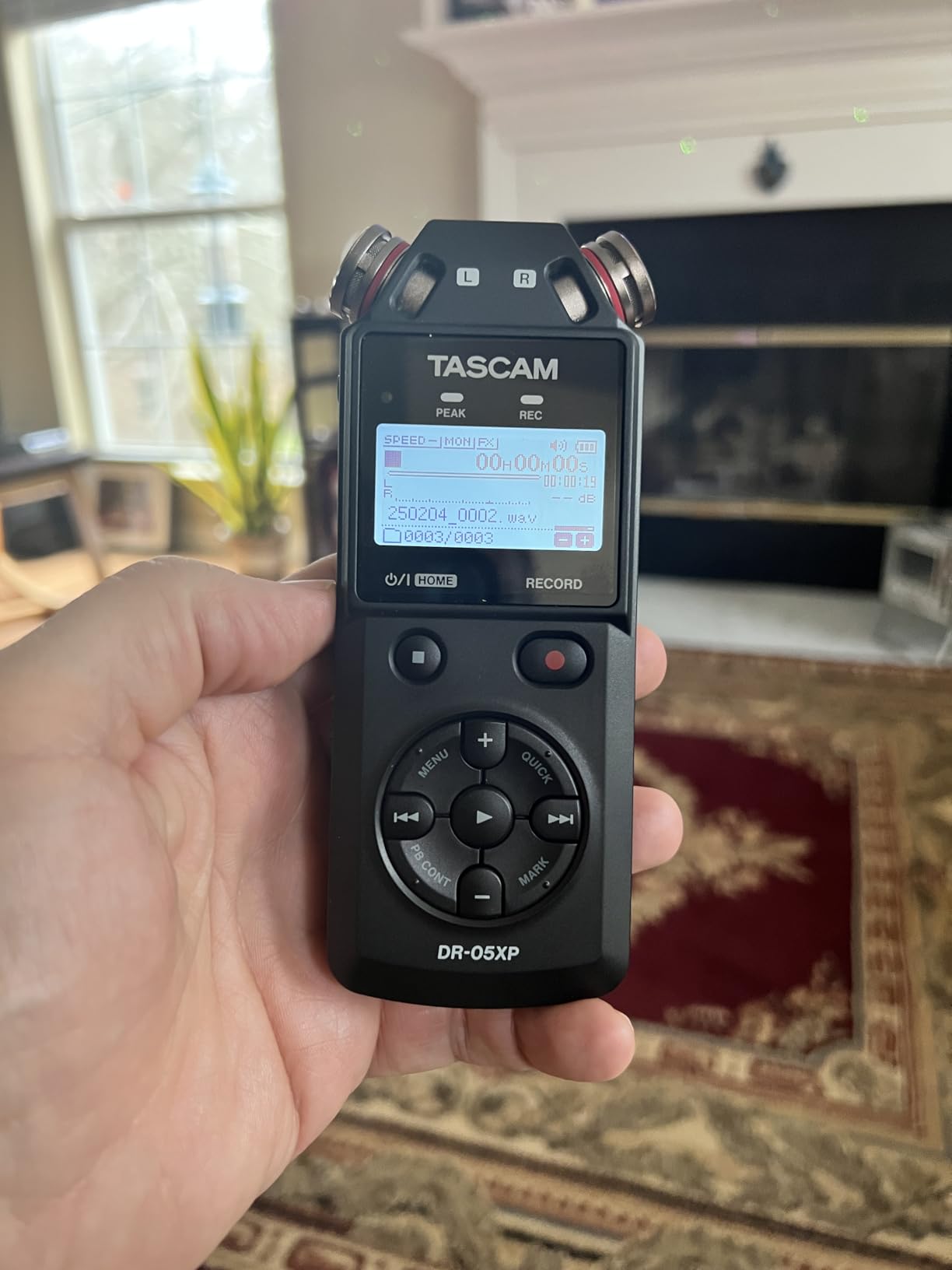
The DR-05XP is what I hand to a friend who says they will never record anything. It is a straightforward way to get modern 32-bit float capture, and for song ideas, room tone, and recording your own playing from across a rehearsal room, it does the job properly.
The omnidirectional condenser microphones are rated to handle sources up to 125 dB SPL, so a loud acoustic guitar or an amp in a small room is within range rather than clipping on contact. You also get 32-bit float, 24-bit and 16-bit modes to choose from.
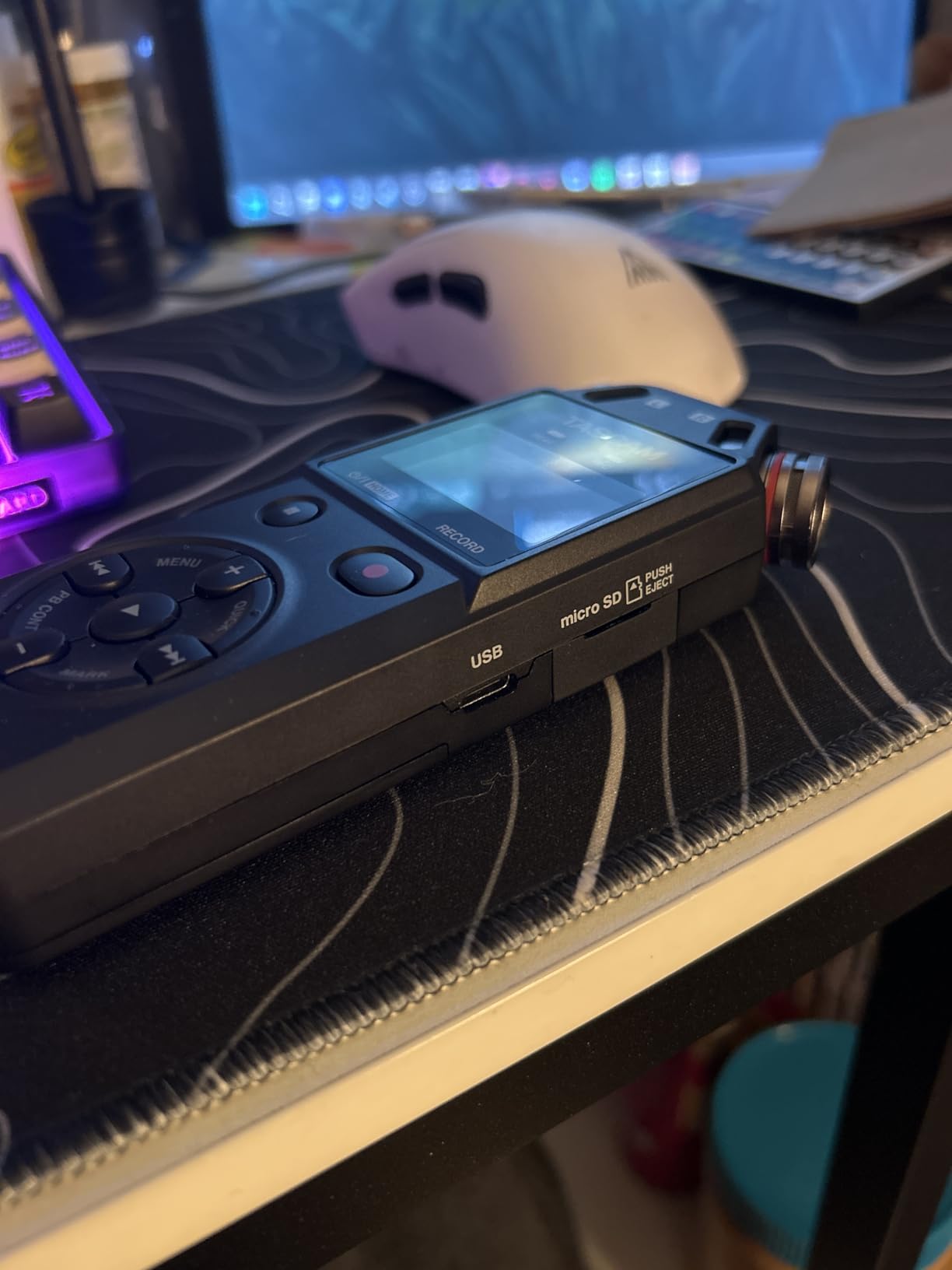
Battery life is the standout practical number here. Up to 17 hours of operation on two AA batteries means a full day of rehearsals without thinking about a charger, and at under 5 ounces it is the one I would actually forget I was carrying.
The 2-in/2-out USB-C audio interface also means it can record straight to a computer when you are ready to move beyond a sketch.
Where the DR-05XP makes sense
It is the right choice for students who need something durable for coursework and field work, for songwriters capturing ideas anywhere, and for anyone who wants a USB microphone and a field recorder in one body.
If you record spoken word, rehearsals or ambient material rather than a layered multitrack production, the absence of external inputs simply does not come up.
Where the DR-05XP stops short
No XLR or mic-level inputs. Every take comes from the built-in array, so recording a band with separate mics, or plugging in a guitar interface, is not an option on this unit.
Sample rates stop at 96 kHz, there is no 192 kHz mode, and an MP3 mode sits alongside the WAV formats if you want smaller files at the cost of quality. The SD card and batteries are not included.
6. Zoom R20 – The Most Complete Demo Machine Without a Computer
Zoom R20 Tabletop Recorder for Musicians with 16 Tracks & 6 XLR Inputs
- Full multitrack demos without a computer
- Large multi-color touchscreen with color-coded faders and gain knobs
- Built-in effects drum loops and synth help finish songs
- Works as a USB interface and control surface for a DAW
- Good quality preamps
- No internal battery so it needs a proprietary AC adapter
- No punch-in recording so layering requires moving cables
- Maximum sample rate of 44.1 kHz and no 32-bit float
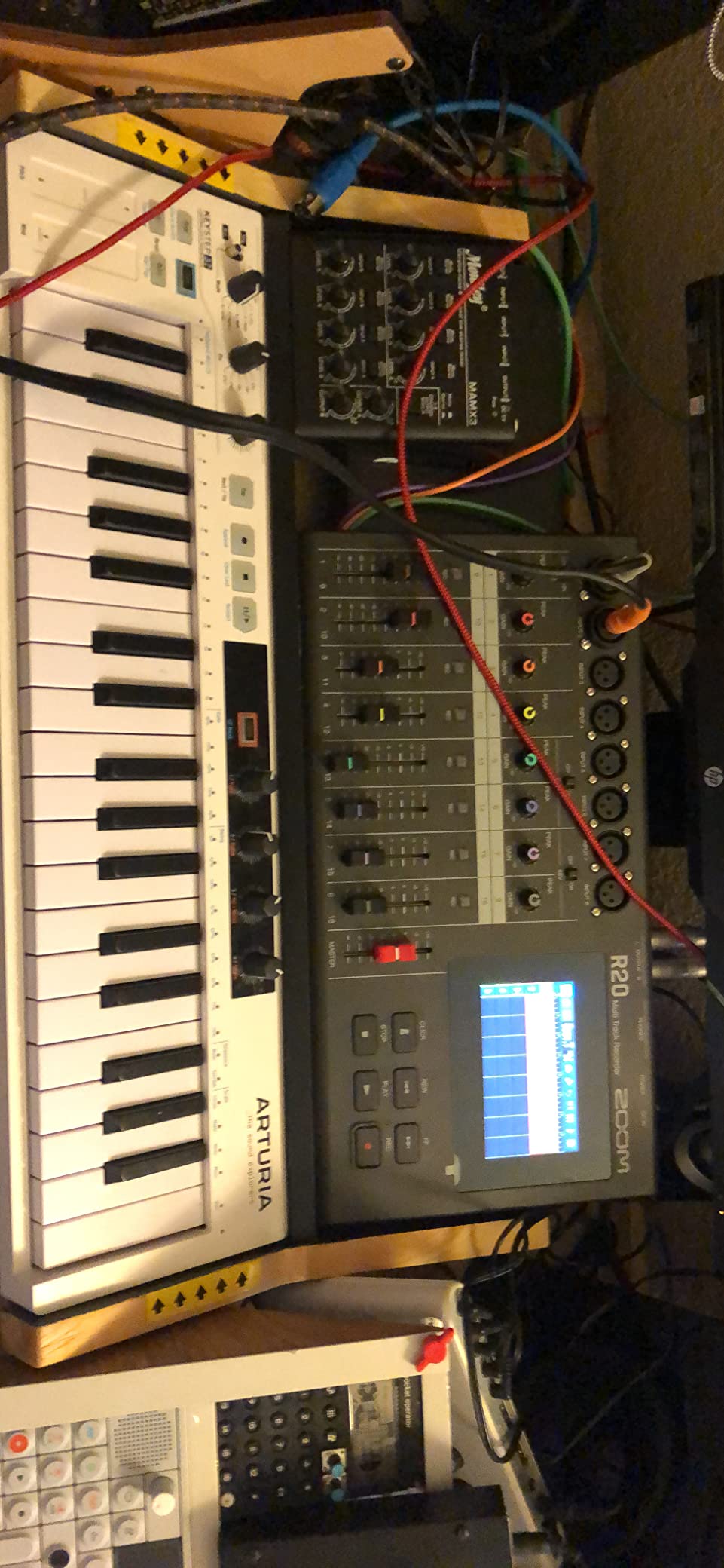
The R20 is built around a single goal: taking a song from one guitar part to something you would send to a bandmate entirely on the unit. Up to 16 tracks with 8 recorded simultaneously, edited and mixed on a large multi-color touchscreen with color-coded faders and gain knobs.
There are 150 rhythm patterns and an onboard synth with 18 sounds, plus EQ, compression and other effects. For a songwriter who wants to hear how a full arrangement feels before committing to a studio day, that is a lot of capability in one box.
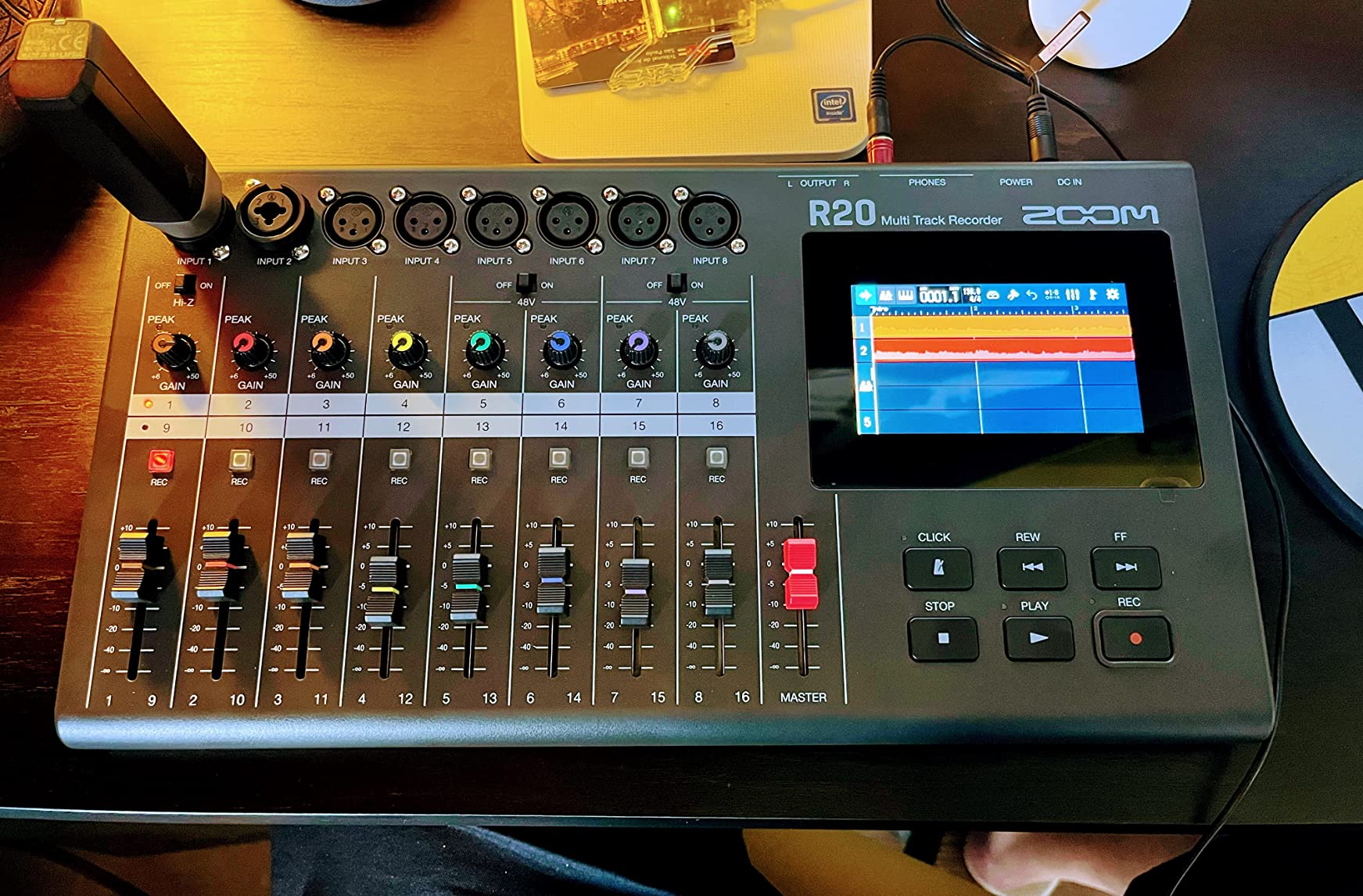
You can drag, drop, swipe and pinch to arrange audio without any external software, and it will also work as a USB interface and control surface for a DAW such as Cubase or REAPER when you outgrow the touchscreen.
Editing works best when you plan takes in order. The touchscreen is responsive enough for arranging, though it can be slow and choppy while saving to an SD card.
Who benefits most from the R20
Songwriters working in a fixed room, producers laying out reference demos, and anyone who wants to be able to send a client a full arrangement the same night. The drum loops and synth are the secret weapon for turning a bare melody into something with a pulse.
It also rewards musicians who have an interest in what happens after capture, since the editing workflow is closer to a DAW than to a field recorder.
What limits the R20
There is no internal battery. It needs a proprietary AC adapter, which means it shuts down and moves awkwardly, and it takes you out of the portable workflow that made this category interesting in the first place.
There is also no punch-in recording, so layering different parts means physically moving cables between inputs instead of arming another track. Maximum sample rate is 44.1 kHz and there is no 32-bit float capture.
The build is lightweight plastic rather than metal, some inputs have very tight jacks that are awkward to plug into, and the review consensus is that the preamp noise floor is high enough to limit quiet recording work.
7. Tascam FR-AV2 – Best When Your Music Lives Next to Video
TASCAM FR-AV2 Compact 32-Bit Float Field Recorder and Timecode Generator with Dual XLR/TRS Inputs and No-Clip Audio Recording for Videographers
- 32-bit float with dual ADCs for fast worry-free capture
- Built-in timecode generation removes the need for an external box
- Two XLR/TRS combo inputs with Ultra HDDA preamps
- Records at 48k 96k and 192kHz
- Compact and light at 9.5 ounces
- Designed primarily for videographers rather than music-only recording
- Bluetooth monitoring requires the separate AK-BT2 adapter
- Fewer capture channels than the four-input recorders here
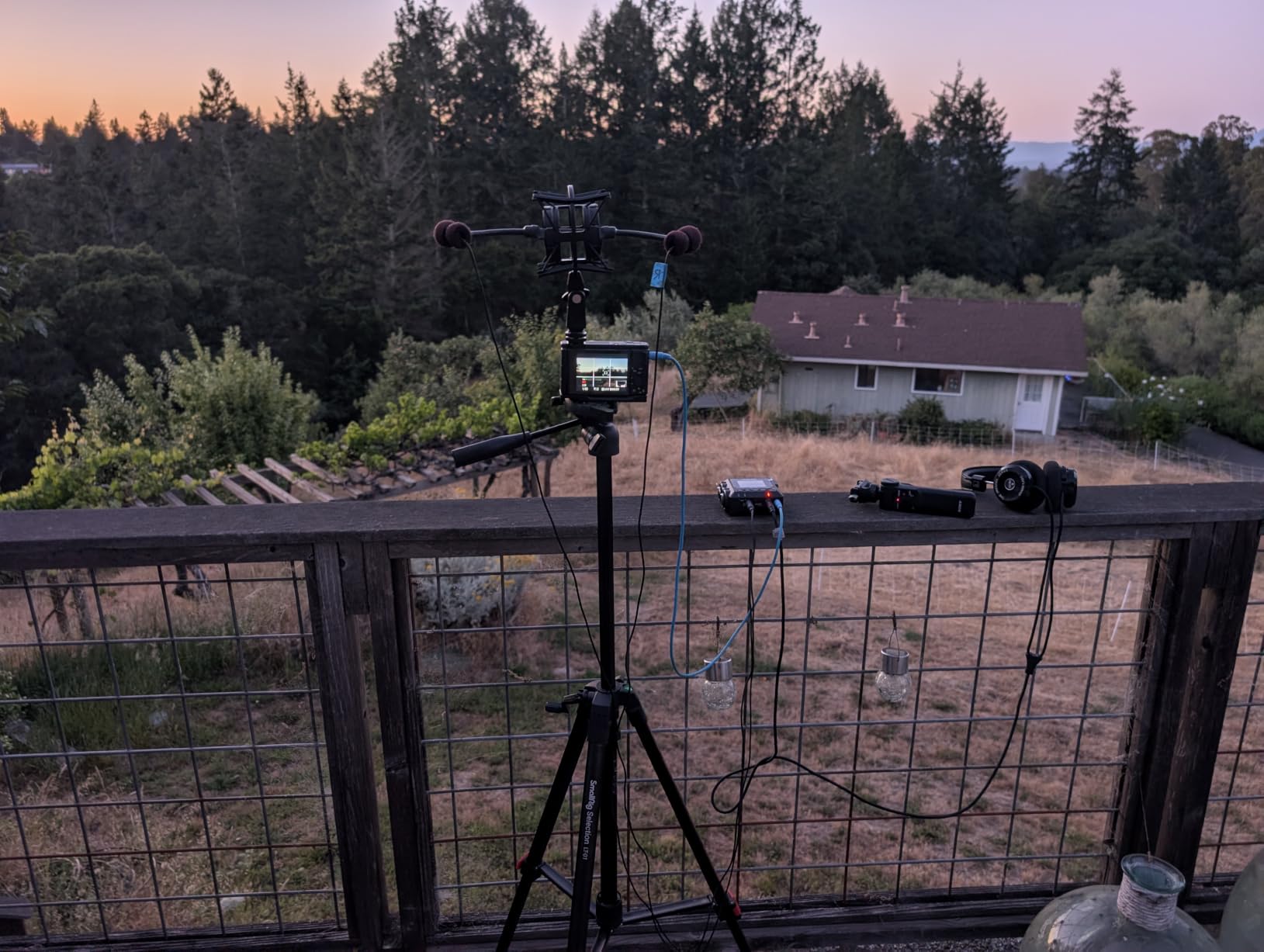
The FR-AV2 is aimed at people recording music for pictures rather than music on its own, and if that describes you it is excellent. The built-in timecode generation and sync function with a high accuracy TCXO means you do not need an external timecode device to align audio with a separate video recorder.
Dual ADCs with 32-bit float recording give you fast setup and worry-free capture, and the two XLR/TRS combo inputs use Ultra HDDA preamps with an additional 3.5 mm input for moveable mics.
Recording formats run 48k, 96k and 192kHz, so this is a recorder that will not hold you back if you are producing stem tracks for a video edit or scoring a short film.
At 9.5 ounces it stays out of the way on a location shoot, and the internal timecode generator is the feature that removes the most friction from syncing separate audio and video recorders.
Why a musician would choose it
If you are a composer scoring video, or a band member who records rehearsal clips for release, syncing is the whole job and the FR-AV2 does it internally. 32-bit float also means a loud location without a fade-out from clipping.
For a songwriter recording live performance footage, having a dedicated audio recorder with timecode removes a step that would otherwise need a second piece of equipment and a careful alignment pass.
Where it is the wrong tool
This is a videographer-focused design, and you can feel it if music is the goal. It has fewer capture channels than the four-input recorders in this roundup, which is the real limit for tracking a band.
Wireless monitoring needs the separate AK-BT2 adapter, and the model is only compatible with AK-BT2 rather than the AK-BT1 used by the Portacapture X8. If you are not syncing to picture, the Portacapture X8 is the more flexible box for the same family of tasks.
How to Choose a Recorder for Your Music?
The right recorder is the one that matches the recording you actually do. Somebody writing songs alone on a couch has different needs from somebody tracking a four-piece band, and buying for the wrong one is the most common mistake I see in these threads.
Start with your persona, not the spec sheet
Solo songwriter: prioritize a built-in microphone array and 32-bit float so you can capture an idea with zero setup. The Zoom H1 Essential and the Tascam DR-05XP both do this at the entry level, and both disappear into a bag.
Band or rehearsal recording: count inputs before anything else. Four XLR/TRS combo inputs is the practical floor for a small band, which is where the Tascam Portacapture X8 earns its place. The Zoom H5 gets you two inputs and four simultaneous tracks, which is plenty for rehearsals and light tracking.
Songwriter who wants finished demos: look for a DAW-style interface, onboard drum loops and enough simultaneous tracks to layer. The Zoom R20 is the unit built around that workflow, though it stays plugged in rather than going in your bag.
Practising instrumentalist: loop-back and slow-down practice features matter more than preamp quality. The Roland BR-80 is designed around exactly this, with eBand phrase training and 64 virtual tracks.
Musician making video or scoring: timecode generation is the deciding spec. The Tascam FR-AV2 generates it internally, removing the need for a separate box.
Understand what 32-bit float actually changes for you
On a 24-bit recorder, a take that clips is gone. You set the gain, you watch the meter, and you accept a lower level or hope the loudest moment does not arrive. That single anxiety is why many musicians upgraded in the first place.
32-bit float recording captures a much wider range in one pass, so a whisper followed by a shout in the same take is recoverable in post. The practical difference for a musician is that a band rehearsal no longer has a safe volume limit, and a first take with a surprise loud chorus is not a lost afternoon. It is also why the newer Essential-series models have become the recommended modern entry point.
Check the inputs you will actually use
XLR/TRS combo inputs are the standard you want, and phantom power at 24V or 48V is required if you plan to use condenser microphones. Built-in cardioid condenser mics that handle loud sources will cover guitars and rehearsal rooms, but you are capped at stereo if that is all the unit offers.
Watch for the absence of a Hi-Z input. A passive guitar or bass plugged straight into a line-level input will sound thin and quiet, and a DI box is the fix. The Portacapture X8 is the example here: excellent preamps, but passive instruments need a box.
Then check the unglamorous things
Card capacity, battery type, and transfer speed cause more frustration than sound quality. Several recorders here cap out at 32 GB of SD or SDHC, which changes how you plan a long session. Two of them need AA batteries, one needs a proprietary adapter and no internal battery, and transfer speeds around 2 MB/s turn a two-hour file into a coffee break.
For RF interference, a metal body shields better than plastic when you are recording near phones, WiFi routers and fluorescent lighting. A cheap windscreen matters too, since handling noise and air movement are more audible on a quiet acoustic take than most buyers expect.
Once files are captured, the transfer step is simple if the unit doubles as a USB audio interface or card reader, which is why the Portacapture X8 and the DR-05XP are convenient choices for moving audio into a DAW without a card reader middleman.
Frequently Asked Questions
What is the best audio recorder for musicians?
The Zoom H5 is the best all-round choice for most musicians in 2026, because it records four tracks simultaneously, has two XLR/TRS combo inputs with selectable phantom power, and its interchangeable mic capsule system lets you upgrade the microphones later without buying a new recorder. It is not the highest resolution option, but it covers rehearsals, songwriting and video audio better than anything cheaper.
Which audio recorder has the best sound quality?
Sound quality comes down to preamp noise and resolution, and the Tascam Portacapture X8 is a strong answer here with HDDA preamps, 32-bit float capture and up to 192 kHz recording. For quiet acoustic and ambient work, low self-noise matters more than sample rate, and the X8 is the model here that reviewers describe as noticeably quiet and sensitive.
What is the best device to record live music?
For a band, the Tascam Portacapture X8 is the strongest option here, with four XLR/TRS combo inputs, six simultaneous channels and 32-bit float capture that tolerates loud sources without clipping. For rehearsals rather than a full session, the Zoom H5 records four tracks at once from two inputs and is far easier to carry and run on batteries.
What is the best portable recording device for musicians?
The Zoom H1 Essential is built for this. It weighs 92 g, records in 32-bit float so you never set gain, and captures idea after idea without a cable or an interface. It has no external inputs, so if you need to record a band with separate microphones you should step up to a model with XLR or combo jacks.
Can a Zoom H6 record 32-bit float?
The original H6 does not record 32-bit float. That capability arrived with the newer Essential series recorders, which is why the current generation of handheld models replaced the earlier fixed-gain designs. If clipping-free capture is a requirement, look for a recorder that lists 32-bit float explicitly rather than assuming a model name implies it.
Is the Zoom H4n good for music recording?
It remains one of the most recommended all-round recorders for studio musicians and location work, which is why it appears so often in musician forums as a capable option with solid XLR preamps. Its main limitation for new buyers is that it predates 32-bit float, so you set gain manually and a clipped take is not recoverable.
What audio recorder do YouTubers and streamers use?
Most creators pick a recorder that can also work as a USB microphone, so they capture a clean scratch track on the device and then use it as the computer input. The Zoom H1 Essential and the Tascam DR-05XP both support USB microphone mode, and the Tascam FR-AV2 adds internal timecode for anyone syncing separate audio and video recorders.
What has replaced tape recorders?
Standalone digital recorders replaced the reel-to-reel and cassette tape machine for most musicians. Instead of a fixed analogue level, a digital recorder writes WAV files to an SD card at a chosen sample rate and bit depth, with modern units using 32-bit float so a take can survive a wide range of volume. Overdubbing and multitrack layering replace the physical process of bouncing tape.
The Verdict for 2026
The best digital recorders for musicians are not one machine. They are the Zoom H5 if you want the most flexible all-rounder with four-track capture and swappable capsules, the Zoom H1 Essential if you want a recorder small enough to always be with you, and the Tascam Portacapture X8 if you need four real mic inputs and clipping-free headroom for a full band.
The Roland BR-80 serves practising players better than any recorder here, the Zoom R20 can finish a whole demo without a computer, and the Tascam DR-05XP is a low-cost honest way to start recording in 32-bit float. The Tascam FR-AV2 earns its place whenever your music is locked to a video edit.
Whichever one you pick, buy the memory card and the batteries on the same day. Everything in this roundup works, but none of them work well without them, and that is the one piece of advice we give every musician who asks.