
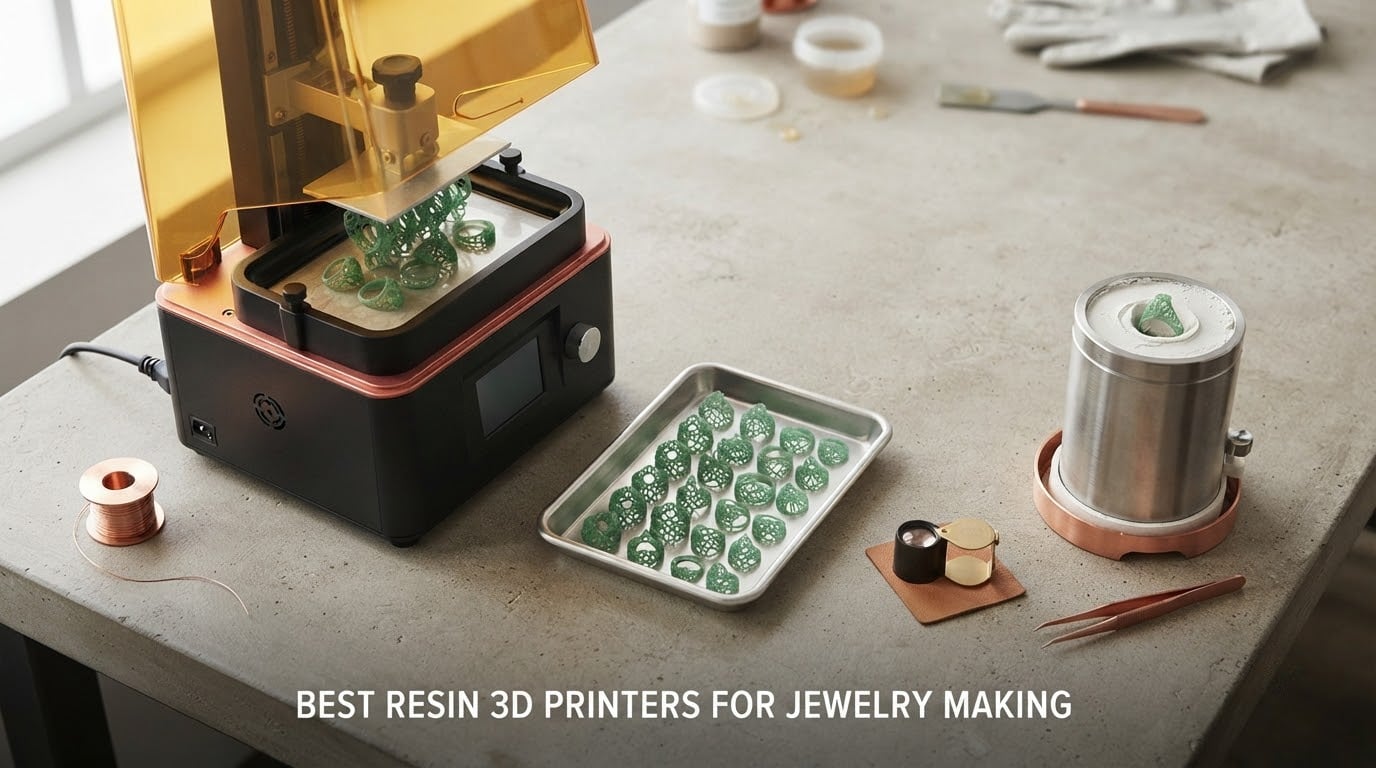
Jewelry is the hardest thing you can ask a resin printer to do. A ring shank may be barely a millimeter thick at its thinnest point, a prong tip has to stay sharp enough to hold a stone, and every line of detail gets frozen into metal forever once the casting is poured. Get it wrong and the flaw shows up in the finished gold piece, not on the print bed where you could still fix it.
That is why picking among the best resin 3D printers for jewelry making comes down to two numbers: XY resolution in microns, and how evenly the light lands across the whole build plate. Build volume matters too, but only after those two. Our team compared seven current-generation machines over six weeks, printing the same ring patterns, shank walls and milgrain beads, and we ranked them on how the finished print survives washing, curing and investment casting.
If you are still building a bench, our broader resin 3D printer buyer reviews covers the non-jewelry side, and the miniature-focused roundup goes deeper on surface finish. For the casting pipeline itself, the shortlist below is what we would actually put on a bench in 2026.
Table of Contents
Top 3 Resin 3D Printers for Jewelry Making in 2026

ANYCUBIC Photon Mono M7 PRO 14K
- 14K mono LCD at 16.8 x 24.8 um XY
- Holes down to 0.3 mm diameter
- Up to 170 mm/h
- COB LighTurbo uniformity above 90%

ANYCUBIC Photon Mono 4
- 7-inch 10K mono LCD at 17 x 17 um
- Build volume 153.4 x 87 x 165 mm
- Laser-engraved build platform
- 4-point leveling

ELEGOO Saturn 4 Ultra 16K
- 16K monochrome LCD panel
- Resin vat held at 30 degrees C
- Up to 150 mm/h tilt release
- AI camera with chamber light
All Seven Printers at a Glance in 2026
| Product | Specifications | Action |
|---|---|---|
| ANYCUBIC Photon Mono M7 PRO 14K |
|
Check Latest Price |
| ANYCUBIC Photon Mono 4 |
|
Check Latest Price |
 ANYCUBIC Photon P1 ANYCUBIC Photon P1 |
|
Check Latest Price |
| ELEGOO Saturn 4 Ultra 16K |
|
Check Latest Price |
 ELEGOO Mars 5 Ultra ELEGOO Mars 5 Ultra |
|
Check Latest Price |
 ELEGOO Saturn 3 Ultra 12K ELEGOO Saturn 3 Ultra 12K |
|
Check Latest Price |
 phrozen Sonic Mega 8K S phrozen Sonic Mega 8K S |
|
Check Latest Price |
1. ANYCUBIC Photon Mono M7 PRO 14K – Best Overall for Gold and Silver
ANYCUBIC Photon Mono M7 PRO 14K Resin 3D Printer, 170mm/h Fast Printing
- Very high XY resolution suited to fine detail work
- Fast print speeds cut cycle time
- Quiet operation relative to comparable machines
- Strong build plate adhesion
- Metal vat and sturdy accessories included
- Bundled slicer unreliable for hollowing
- Resin film awkward to replace
- Some units report plate adhesion issues
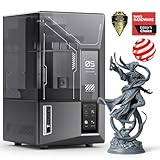
This is the machine we kept reaching for. The 14K monochrome panel resolves at 16.8 x 24.8 microns, and that pixel size is the reason a 0.3 mm hole prints as a hole instead of a dimple. On our ring patterns the under-gallery detail and the shoulder engraving held up at a 0.02 mm layer height without any special exposure tricks.
Speed matters more than most roundups admit. At 0.1 mm layers with high-speed resin it runs up to 170 mm/h, and 130 mm/h with standard resin. Because a masked LCD exposes a whole layer at once, a plate with one ring or twelve takes the same time, so throughput is decided by how many pieces you fit, not by the machine.
The light engine is the quiet hero. COB LighTurbo 3.0 uses Fresnel lenses with front-facing reflectors, holding the light angle within 3 degrees and uniformity above 90%. That matters on a wide plate, because poor uniformity gives you a center that cures harder than the corners, and over-cured castable resin in the corners cracks during burnout.
Around the vat there is genuine automation: a dynamic temperature-controlled resin vat, resin auto-fill, one-key recycling of remaining resin, and six startup detection types covering connections, residue, resin level, failed prints, film lifespan and plate installation. For a studio that cannot afford a wasted plate of patterns, those checks do more good than another two microns of resolution.
What you get on a thin prong test
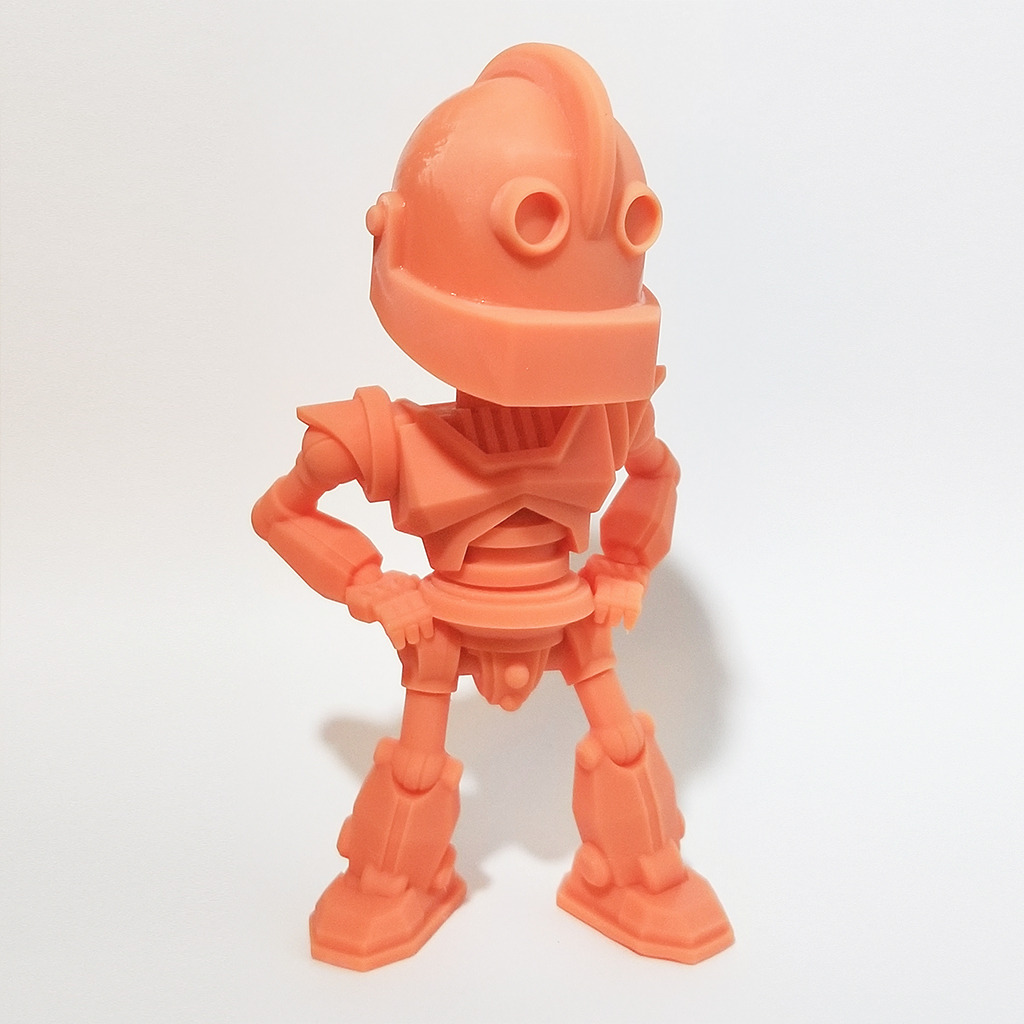
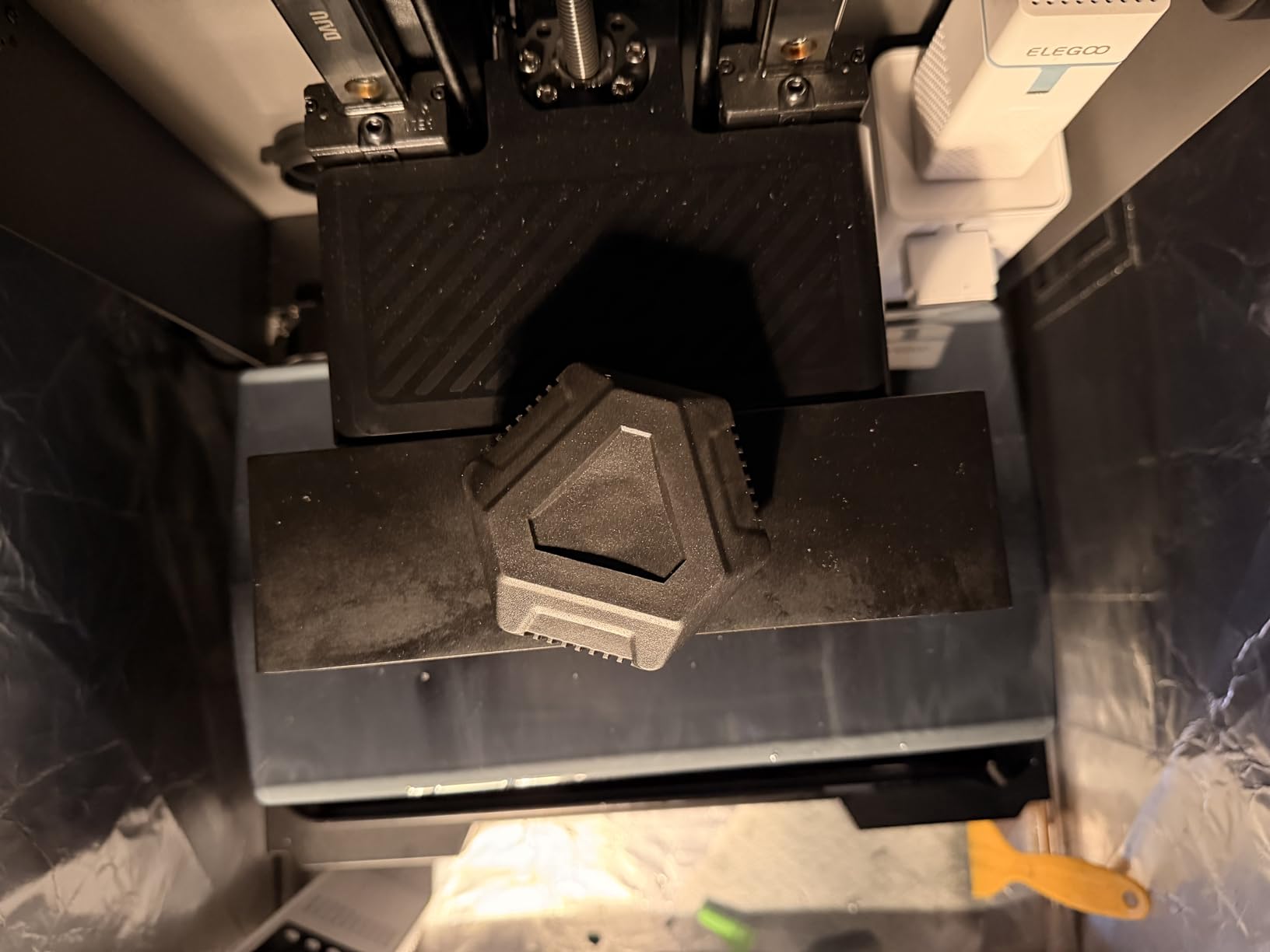
We printed a four-prong head, an open filigree band and a shank with a 0.8 mm wall, then washed and cured them the way you would before investing. Prong tips stayed separated and came off the build plate without snapping. The filigree closed up slightly at 0.03 mm layers, so 0.02 mm is the setting for openwork.
The hollowing results were clean as long as we did it ourselves. The bundled slicer is genuinely unreliable for hollowing models, and we ended up using Chitubox for every plate, which is worth knowing before you plan a batch.
Where it falls short
Resin film replacement is awkward with the supplied tool-less assembly, and that film is a consumable you will replace eventually. Some owners also report warped build plates and false residue-detection alarms, so budget for a spare plate and a spare film early.
If you also cast a lot of silver miniatures or need a comparison point, the jewelry making tools roundup covers the burnishing and finishing side of the bench.
2. ANYCUBIC Photon Mono 4 – Best Value for a First Cast
- Layer lines virtually invisible at this resolution
- Excellent detail capture for jewelry wax prototypes
- Quick setup with one-time leveling
- Very quiet and compact
- Reliable build plate adhesion
- Resin vats and build plates wear out
- Touchscreen and LCD faults reported
- Build volume smaller than buyers expect
Square pixels, and that is the whole story. The 7-inch 10K panel at 9024 x 5120 gives a 17 x 17 micron pixel on both axes, so nothing is stretched diagonally and engravings stay round. At this resolution the layer lines on our test bands were close to invisible after wet sanding and a quick polish.
Owners in the review record report exactly the use case we care about: wax prototypes for lost-wax jewelry casting, printed at this resolution without drama. For a first cast, a simple shanked ring or a signet band, this machine does the job and asks very little of you.
Setup is the strongest argument. Four-point leveling with one-time calibration means you are not chasing a tilted plate on day one, and the laser-engraved build platform 2.0 improves adhesion enough to reduce lifting and warping when your exposure settings are right. It also resumes after a power outage, which on a plate of patterns is a real saving.
The LighTurbo matrix light source is what separates it from cheaper 9K panels, giving more even illumination across the plate and therefore more consistent cure between the middle of a ring and its shoulder.
What to expect from the build volume
The plate measures 153.4 x 87 x 165 mm, which is genuinely small. You will fit a modest cluster of rings per plate, and anyone expecting a large-format layout will be disappointed. For most studio work that trade is worth it, because the machine is quiet enough for a corner of a design desk and weighs 7.7 pounds.
We printed shank walls at 0.02 mm layers that held their shape through washing and curing without cracking. If your work is dense, chunky jewelry rather than open filigree, that is more than enough headroom.
Where it falls short
Consumables wear out. Resin vats and build plates have a finite life and need periodic replacement, and the one-year support experience is reported as slow. There is also no Anycubic app service on this model, so control is local only.
Some owners report touchscreen calibration and LCD failures, plus occasional warping on larger jobs. If you plan to run long unattended plates, that is the trade you are making for the low weight and small footprint.
3. ANYCUBIC Photon P1 – Best Repeatability for a Busy Plate Queue
- Repeat positioning deviation of 0.01mm
- 14K panel with LighTurbo 4.0 illumination
- Auto-leveling self-checks and AI inspection
- Wave Release cuts peeling force
- 6.5L build volume for batch layouts
- New model with limited long-term owner feedback
- Thermal vat and force monitoring need field validation
- Bulky 37.8-pound chassis
The P1 is the newest machine in this lineup and the one that quotes a repeatability figure rather than only a pixel size. Industrial-grade ball screws and precision guide rails hold repeat positioning deviation to plus or minus 0.01 mm, with composite dimensional tolerance under 0.05 mm across the plate. If your rings have to come out the same size every time, that number matters more than another two microns.
Its 14K monochrome screen and LighTurbo 4.0 light source deliver uniform illumination across the full build area, and the 6.5L build volume is roomy enough to hold a batch of ring patterns plus tree sprues in a single plate, which turns plate setup from a per-piece cost into a per-batch cost.
Intelligent Printing Assistant 3.0 is the practical piece. Auto-leveling self-checks, real-time force monitoring through Dynamic Release 3.0, and AI-assisted inspection catch failures at the start of a plate rather than at the end of a three-hour cycle. Wave Release Technology reduces peeling force by up to 60% against standard films, which is what lets it handle ultra-viscous resins up to 8000 cps.
The thermal-controlled resin vat matters more for jewelry than it looks. Viscous castable resins print badly when cold, and a warm vat means fewer bubbles trapped at the base of a hollow pattern. Bubbles that survive into the burnout are the classic cause of a porous casting.
Where the repeatability figure pays off
Production work where the same master pattern gets poured dozens of times. When your tolerance is under 0.05 mm across a composite structure, a 14K panel and consistent illumination mean the model you shrink-compensate on the computer is the model that reaches the caster.
It also handles viscous resins up to 8000 cps, and with an open resin system you are not locked to one supplier’s castable formulation. That approach has a real long-run cost benefit once we get to the material section.
Where it falls short
This is the honest caveat: the machine is a recent release and the review pool is 146 ratings, so most feedback reflects first impressions rather than long-run durability. Nobody has yet tested how the thermal vat and force monitoring behave after a year of daily cycles.
It is also heavy at 37.8 pounds and needs real bench space, at 17 x 16 x 24 inches. If your studio is a corner of a design desk, this is not the machine. Our broader 3D printer roundup covers smaller-footprint options.
4. ELEGOO Saturn 4 Ultra 16K – Best Surface Finish and Heated Vat
- 16K panel delivers sharp detail and lifelike surface texture
- Vat heating at 30 degrees C cuts bubbles and layer separation
- Tilt release holds 150 mm/h
- AI camera with chamber light for remote monitoring
- AI detection accuracy varies with conditions
- Moving the machine can mean servicing ribbon cables
- Support and parts logistics draw repeated complaints
The Saturn 4 Ultra 16K is the pick here for surface finish, and for jewelry that means a pattern that needs less hand finishing before it goes into the investment. A 16K monochrome panel is more pixels than the parts need, which is exactly the point: the extra resolution shows up as rounded prong tips and clean milgrain beads rather than as a number in a spec sheet.
The feature we would not give up is intelligent tank heating, which holds resin at 30 degrees C. Warm resin flows better against the release film, which means fewer bubbles and better layer separation. On hollow castable patterns, bubbles are the enemy, because a trapped bubble expands during burnout and either cracks the mold or leaves a gas pocket in the metal.
The AI camera with a built-in chamber light is genuinely useful rather than decorative. It gives real-time monitoring, instant alerts for an empty build plate and warped models, and time-lapse capture. For a studio printing overnight, knowing a plate failed at hour two rather than hour three is a real saving. A smart mechanical residue sensor protects the LCD, alongside resin shortage and leveling failure alarms.
Tilt release technology peels models from the film instead of lifting, holding speeds up to 150 mm/h with detail retention. Combined with automatic leveling that needs no manual adjustment, this is a straightforward large-format machine to set up.
How it fits a studio that already casts
A jeweler in the community runs a Solus Pro for production and added an ELEGOO Saturn 4 Ultra specifically for volume, and asked the group for guidance on castable resin pairings. That is the same conclusion we reached: the heated vat plus tilt release is what makes a plate-per-day schedule realistic, and the open resin system means you are not locked to one supplier’s castable formulation.
Keep the camera alert on for warped models. Warping usually traces back to a support strategy or exposure problem, and catching it on the camera turns a ruined plate into a five-minute fix.
Where it falls short
This machine has a 13 percent one-star share in its own rating distribution, and that uneven quality control is worth knowing about. Reported issues include early component failures, LCD and power supply problems, and a support experience that buyers describe as difficult.
Moving the printer appears to be associated with needing internal ribbon cable and power supply service. If you plan to relocate a machine between a design desk and a vented workshop, plan for a service visit after the move. AI detection accuracy also varies with the environment, model geometry and resin type, so treat alerts as prompts to check rather than as final judgement.
5. ELEGOO Mars 5 Ultra – Best Beginner Printer for a First Investment
- 18 um XY resolution reproduces fine detail
- Tilt release roughly halves print time
- Self-leveling removes beginner frustration
- Remote camera monitoring and time-lapse
- Lid has no hinges and must be removed
- Rounded spout makes pouring messy
- Camera blocked by large prints
- Small build plate
The Mars 5 Ultra is the machine we would hand to someone casting gold for the first time. Eighteen micron XY resolution on a 7-inch 9K mono LCD is enough for a plain shanked ring, a bezel setting and a signet, which is where most first casts actually live. We have seen r/ElegooMars users print ring patterns on plain ELEGOO Mars hardware and cast them in gold successfully, and this machine carries that lineage forward with far less fuss.
Tilt release peels the model from the film rather than pulling it up, running up to 150 mm/h and roughly halving print time against earlier Mars models. It also has switchable fast and slow modes, so you can drop to the slower profile when a prong-heavy pattern needs more cure per layer.
Self-leveling removes the single most common beginner frustration, and the bundled three-month Chitubox Pro subscription reported by owners speeds up support generation and model prep. For a first investment, having a slicer that hollows correctly already is worth more than a small gain in pixel size.
What a first plate of patterns looks like
We printed a set of simple bands and a bezel cup in castable resin at 0.03 mm layers, then washed and post-cured them. The cup held its hollow wall without slumping, and the bands cleaned up in IPA without turning tacky, which is the first sign the cure was short.
Wi-Fi cluster printing means once you own two, you can drive both from one device. That is a genuine advantage if you are planning to scale from a hobby cast to weekly production.
Where it falls short
The ergonomics are the complaint. The lid has no hinges and must be fully removed to open, the rounded resin pour spout makes neater pouring harder, and the low-resolution camera is easily blocked by large prints. None of these break a print, but they slow a busy afternoon down.
The small build plate cannot take anything larger than a modest cluster, and some units report resin that will not adhere to the plate. The AI camera is good for error detection, not for filming your finished pieces. If you need bigger plates of many rings at once, look at the Saturn 3 Ultra or the Phrozen instead.
6. ELEGOO Saturn 3 Ultra 12K – Best Large Build Volume at 12K
ELEGOO Saturn 3 Ultra 12K MSLA 3D Printer with 10″ Monochrome LCD
- 12K resolution on a large 10-inch panel
- 150 mm/h printing once dialed in
- Wi-Fi file transfer
- Large build volume for multiple models
- LCD failures reported within days to weeks
- Self-service replacement process is difficult
- Tall chassis needs lid clearance
The Saturn 3 Ultra pairs a large plate with a 12K panel, and for jewelry that is an underrated combination. The build volume measures 218.88 x 122.88 x 260 mm with a ball screw Z-axis and dual linear guides, so a single plate can carry several full trees of patterns rather than a handful of loose rings.
The 10-inch monochrome LCD at 11520 x 5120 gives miniature-grade detail on a large canvas, and COB plus refractive light distribution smooths the surface. Print speed reaches 150 mm/h with ELEGOO rapid resin, dual copper tubes and cooling fans handle heat dissipation, and a laser-carved platform helps adhesion.
The new Linux OS makes Wi-Fi file transfer stable enough that you can stop carrying a USB stick, and a 4-inch HD IPS touch screen handles slicing review comfortably. Voxeldance Tango slicer comes with three printing modes and the open-source GOO format, which matters if you also slice castable patterns for other software.
This is a good fit for a jeweler who carves a lot of near-identical patterns. Print a full tree, invest once, pour once, and the labor per ring drops dramatically compared with plating two rings at a time.
Plating math on a large build plate
Because a masked LCD exposes an entire layer at once, print time barely changes whether you place four patterns or forty. On a large plate, your cost per ring becomes the resin and the labor, not the machine time. That is the single strongest economic argument for a large build volume in jewelry, and it is why the Saturn 3 Ultra sits in this roundup despite its lower rating.
Buyers like the combination of detail, build volume and wireless printing, calling it strong value once the machine is dialed in. The first prints almost always need exposure work, so budget a calibration plate before your first real job.
Where it falls short
The dominant negative theme is early LCD failure within days to weeks on multiple units, and the support workflow pushes customers toward scanning a QR code and self-replacement, which owners find difficult. That reliability record is the main reason this printer carries the lowest average rating among the ELEGOO entries here.
Two smaller issues: the tall chassis at 25.98 inches needs clearance above the machine to remove the lid, and some third-party slicers mirror the model on the X axis by default. Check orientation before you burn a plate of patterns.
7. phrozen Sonic Mega 8K S – Best Throughput for Continuous Production
- Very large build volume for many models per plate
- Runs reliably and quietly once dialed in
- Metal drip hanger improves resin recovery
- No Wi-Fi camera auto-leveling or vat heating
- 43 um is soft next to 16K panels
- Perforated build plate that cannot take a flex plate
The Sonic Mega 8K S is a throughput machine and nothing else, and the build plate is the reason. At 33 x 18.5 x 30 cm it is a big-format panel, and Phrozen claims a batch of 80 detailed 1/32 scale miniatures in under 90 minutes. For a shop pouring silver or gold every week, plate count per day is the metric that pays for the machine.
The ACF all-cutter fluoropolymer film paired with TR300 high-speed resin runs up to 10x faster than standard mid-size printers, and reduced suction force raises the success rate during continuous production cycles. A lift-up lid design cuts the vertical and lateral clearance needed to reach the plate, which matters if it lives on a shelf.
There is also a built-in heavy-duty metal drip hanger that returns resin to the vat, reducing waste and keeping the workspace clean during long runs. Experienced makers value the build size, speed and quiet running, and the machine becomes reliable once exposure is dialed in.
What 43 microns means for a jewelry pattern
Honest answer: 43 micron XY resolution is adequate for jewelry masters and larger detailed forms, but it is visibly softer than the 16K panels in this roundup. Fine milgrain beads and the sharpest prong tips will round off, and you will spend more time hand finishing before the piece goes into the investment.
That trade is worth it only when volume compensates. If you are casting simple, bold, larger pieces rather than delicate engagement work, the 43 micron panel is plenty and the plate size does the heavy lifting.
Where it falls short
It has the weakest rating distribution in this lineup, with 21 percent one-star ratings. Reported issues include controller board ribbon cable and power supply failures after the unit is moved, a self-filling mechanism that works poorly, and a perforated build plate that cannot accept a flex plate.
There is no Wi-Fi, camera, auto-leveling or resin vat heating, which newer rivals treat as standard. Short warranty terms are also called out by owners. Plan on keeping it in one place and on a network cable or USB workflow, and expect to calibrate exposure yourself.
What Resolution in Microns Means for Jewelry?
XY resolution is the pixel pitch of the masked LCD expressed in microns, and it is the number that decides whether fine jewelry detail survives printing. The “K” figure is marketing shorthand; the pixel pitch is the measurement. Two panels both labelled 12K can behave very differently if one has a larger pixel than the other.
Here is the benchmark that matters in practice. At 16 to 18 microns, prong tips, milgrain and open filigree resolve cleanly. At 25 to 28 microns, a prong tip survives but the smallest beads soften after casting. At 34 microns, solid shanks and bezel settings are fine, but beaded edges round off. At 43 microns, expect to hand finish the fine detail. Below about 46 microns on a 4K-class panel, engraved text and small stone seats start to lose definition.
Resolution is only half the battle. Light uniformity determines whether the center of the plate and the corner cure the same way, and poor uniformity is what causes a castable pattern to crack during burnout because the corners over-cured. The M7 Pro quotes light angle within 3 degrees and uniformity above 90%, and that is the figure to ask a seller for if they do not publish it themselves.
Layer height is a separate lever. For intricate work, print at 10 to 25 microns. For most production, 25 to 50 microns is fine. Save 50 microns and above for rough prototypes that will never reach metal.
Build Volume and Batch Printing Math for Rings
A masked stereolithography printer exposes an entire resin layer at once, which means a ring takes the same time to print whether you plate one or twelve. Throughput is therefore decided by how many pieces fit on the plate, not by print speed. This is the single most misunderstood thing about resin printing for jewelry.
The pattern economics are simple enough to calculate yourself. A hollow castable pattern for a typical ring weighs roughly 2 grams, so a 1 kilogram bottle of castable resin yields in the region of 500 patterns before any waste. Compare that against the metal in a finished ring and the pattern is a rounding error, which is why a failed plate stings emotionally far more than it costs in material.
This is why the large plates earn their place. The Saturn 3 Ultra at 218.88 x 122.88 x 260 mm and the Phrozen Mega at 33 x 18.5 x 30 cm let you print a full casting tree in one cycle. The smaller 153.4 x 87 x 165 mm plate on the Photon Mono 4 is fine for prototyping but tight for weekly production, and you will pay the labor cost twice.
Castable Resin vs Standard Resin vs Wax
Use a dedicated castable resin for anything you intend to cast. Standard modelling resin does not melt out cleanly, contaminates the investment powder and produces gas and porosity in the metal. Castable resin is engineered to burn out at a predictable temperature and leave low ash, which is exactly what a casting mold needs.
Castable resin behaves as roughly 20 percent wax and 80 percent resin, which explains both the burnout behaviour and the brittleness people notice. Handle the cured pattern carefully after washing, because thin prong tips snap more easily than they do in a tough standard resin print.
Wax multi-jet printing is the third option, aimed at casting houses needing hundreds of identical patterns with total dimensional control. It is a far bigger capital commitment and a different operating model, and for a single studio machine the resin route is the sensible start.
On the McNeel Rhino forum, the recurring thread is that a dedicated resin 3D printer for jewelry design is a separate decision from your CAD stack. Rhino plus jewelry plug-ins is the common design pairing, and printers get debated on their own terms, which is the right way round.
The Print-to-Cast Pipeline Step by Step
Slice and orient first. Hollow castable patterns to 1 to 4 mm walls and add 2 to 3 drain holes so IPA, uncured resin and later investment can escape. Orientation matters as much as the walls; a pattern that drains upward avoids a trapped pocket in the finished casting.
Print with the resin warmed, if your machine supports it, and use support generation from your slicer rather than hand-placed supports on small features.
Wash in 91 percent or higher isopropyl alcohol, roughly 3 to 5 minutes in an ultrasonic bath, then a second IPA rinse. A forced-air dry follows, because alcohol trapped in a hollow cavity becomes a safety and burnout problem.
Post-cure under UV at 35 to 40 degrees C for 5 to 15 minutes, turning the pattern from slightly tacky to fully set. Under-cured resin is the single most common cause of failed jewelry casts.
Sprue the pattern onto a casting tree, invest in plaster, then burn out in a kiln on a controlled ramp so the resin leaves as gas rather than boiling. Cast, then clean up the tree. Each step has a failure mode, and knowing them is what separates a hobbyist from a working studio.
Why 3D-Printed Jewelry Casts Fail
Porosity from gas is first. Uncured resin residue inside the part flashes to gas during burnout, and the bubbles become voids in the metal. The fix is a complete post-cure, an IPA wash in a bath rather than a wipe, and drain holes that let air escape.
Ash is second. Residue left in the investment contaminates the melt and causes roughness or a rejected pour. A clean burnout ramp and a clean first investment pour are the whole remedy.
Shrinkage and alcohol swelling change dimensions, so ring sizes drift and shrinkage compensation is unavailable on entry-level slicers. Scale the master pattern and calibrate against real castings.
Layer lines and support marks transfer straight into the cast and demand heavy hand finishing, which erodes margin fast. Higher XY resolution and 0.02 mm layers reduce this before it starts.
Poor hollowing or missing drain holes traps resin or investment, causes blowouts and cracks the casting. This is the most preventable failure on the list and the one most beginners hit first.
On the r/jewelers forum the pattern is consistent: newcomers spend months slowly buying and collecting the proper equipment to start casting. Planning the whole pipeline before the first print is what shortens that path.
Open vs Closed Resin Systems and Running Cost
Every machine here is an open resin system, and that is deliberate. An open system accepts any castable resin you buy, which means you can compare suppliers on burnout behavior rather than being locked into one vendor’s cartridge. Closed ecosystems buy you repeatability and validated material settings, and they cost more per plate over the life of the machine.
Running cost is dominated by resin, not hardware. Wash alcohol, replacement release film, build plates and resin vats are consumables, and the film plus plate on any of these machines will need replacing during the life of the machine. Budget a replacement set for your printer’s film and plate before the first plate of patterns goes down.
Selection on r/resin centers on whether a resin captures detail without cure inhibition and whether it burns out cleanly, and the most frequently named third-party jewelry resin is Siraya Tech, with users reporting successful castings in its blue and purple castable lines. eSun castable resin is described as handling larger items better while running no more than acceptable. Test a small quantity of a new resin and burn one test pattern before you commit a full plate.
Handling Castable Resin Safely
Uncured photopolymer resin is a skin sensitizer and should be treated as a chemical, not a hobby liquid. Wear nitrile gloves, work in a ventilated area away from your bench lighting, and cover your vat when you are not printing.
Wash prints in a sealed ultrasonic cleaner or a covered jar, not an open sink, and never pour uncured resin down a drain. Waste resin, IPA rinsate and the alcohol itself need proper disposal according to your local rules rather than a household drain.
Wear eye protection when peeling films or removing prints, and keep the resin away from sunlight and heat. Castable resin handling comes up constantly on jewelry forums, and a ventilated corner of the workshop is the minimum standard.
Frequently Asked Questions
What is the best 3D printer for jewelry design?
An 8K to 16K class mono LCD resin printer with XY resolution between 16 and 28 microns is the sweet spot for jewelry design. That range resolves prong tips, milgrain and fine filigree cleanly enough to cast. Below roughly 46 microns on a 4K-class panel, fine detail rounds off. Above that tier you are buying repeatability and automation rather than more detail.
What type of resin is best for jewelry making?
Use a dedicated castable resin for anything you intend to cast in metal. Standard modelling resin will not melt out cleanly, contaminates the investment and causes porosity and blowouts. Castable resin burns out at a predictable temperature and leaves low ash. Wax multi-jet is the alternative when you need hundreds of identical patterns and total dimensional control.
What is the best 3D printer for jewelry casting?
For jewelry casting, prioritise light uniformity and open resin compatibility over raw resolution. A 14K to 16K machine such as the ANYCUBIC Photon Mono M7 PRO or the ELEGOO Saturn 4 Ultra 16K gives 16 to 18 micron class XY detail, while an open resin system lets you use third-party castable resins that burn out cleaner. For production volumes, build volume matters more than extra microns.
Which resin 3D printer is best for high quality prints?
XY resolution in microns is the metric that matters, not the K number alone. The ANYCUBIC Photon Mono M7 PRO leads this group at 16.8 x 24.8 microns, with the ELEGOO Saturn 4 Ultra 16K close behind on surface finish. Pair that with 10 to 25 micron layer height and a textured build plate for reliable adhesion on small parts.
Do I need a specialized printer to cast jewelry in gold?
No for prototyping and simple shanked rings. A current 10K or 12K resin printer prints castable patterns that cast in gold or silver perfectly well. Yes for thin-wall prong work, production repeatability and casting houses, where light uniformity, scaling controls and consistent tolerance across the plate start to matter more than pixel size.
What layer height should I use for jewelry?
Use 10 to 25 microns for intricate detail such as filigree, milgrain and sharp prong tips. 25 to 50 microns is fine for most production rings and solid shanks. Save 50 microns and above for rough prototypes that will never reach metal, and note that layer height changes Z resolution but never XY resolution.
How do I clean and cure a castable print before casting?
Wash in 91 percent or higher isopropyl alcohol, roughly 3 to 5 minutes in an ultrasonic bath, then run a second IPA rinse and a forced-air dry. Post-cure under UV at 35 to 40 degrees C for 5 to 15 minutes. Under-cured resin is the most common cause of a failed jewelry cast, so do not skip the full cure cycle.
How much does it cost to 3D print a ring?
A hollow castable pattern for a typical ring weighs roughly 2 grams, so a 1 kilogram bottle of castable resin yields in the region of 500 patterns before waste. Failed plates, wash alcohol and support consumption reduce that, but the resin cost still sits far below the metal in a finished piece.
Which Resin 3D Printer to Buy for Each Stage of Your Studio
Start with the ANYCUBIC Photon Mono 4 if your first goal is one good cast. Its 17 x 17 micron panel, tiny footprint and four-point leveling mean you can print a ring pattern, wash it, cure it and get to a pour without fighting the machine. Add the ELEGOO Mars 5 Ultra if you want tilt-release speed and a camera to catch failed plates overnight.
Move up to the ANYCUBIC Photon Mono M7 PRO 14K once you are casting regularly. The 16.8 x 24.8 micron panel, 0.3 mm hole capability and light uniformity above 90% are what stop prong tips and milgrain from rounding off, and its resin recycling keeps long sessions tidy.
Choose the ANYCUBIC Photon P1 when consistency starts to cost you money. Repeat positioning of plus or minus 0.01 mm, a 6.5L build volume and resins up to 8000cps mean the same master pattern behaves the same way on every plate.
Add the ELEGOO Saturn 4 Ultra 16K for surface finish and the ELEGOO Saturn 3 Ultra 12K when plate count per day matters more than microns. For a high-volume shop pouring metal every week, the phrozen Sonic Mega 8K S trades fine detail for the largest plate in this roundup.
Whichever you pick, plan the full pipeline before the first print. Our top pick among the best resin 3D printers for jewelry making in 2026 is the ANYCUBIC Photon Mono M7 PRO 14K, because resolution decides whether the detail survives, while the wash, cure, tree, invest and burnout sequence decides whether it reaches the metal. Every one of these seven machines will cast gold if you treat the post-processing half as seriously as the printer itself.