
If you’ve ever looked at your dog or cat and thought something’s off, but I can’t put my finger on it, trust that gut feeling. Pets are wired to hide pain and illness, and by the time symptoms become obvious, they’ve usually been unwell for a while. The faster you catch the warning signs, the better their odds of a full recovery.
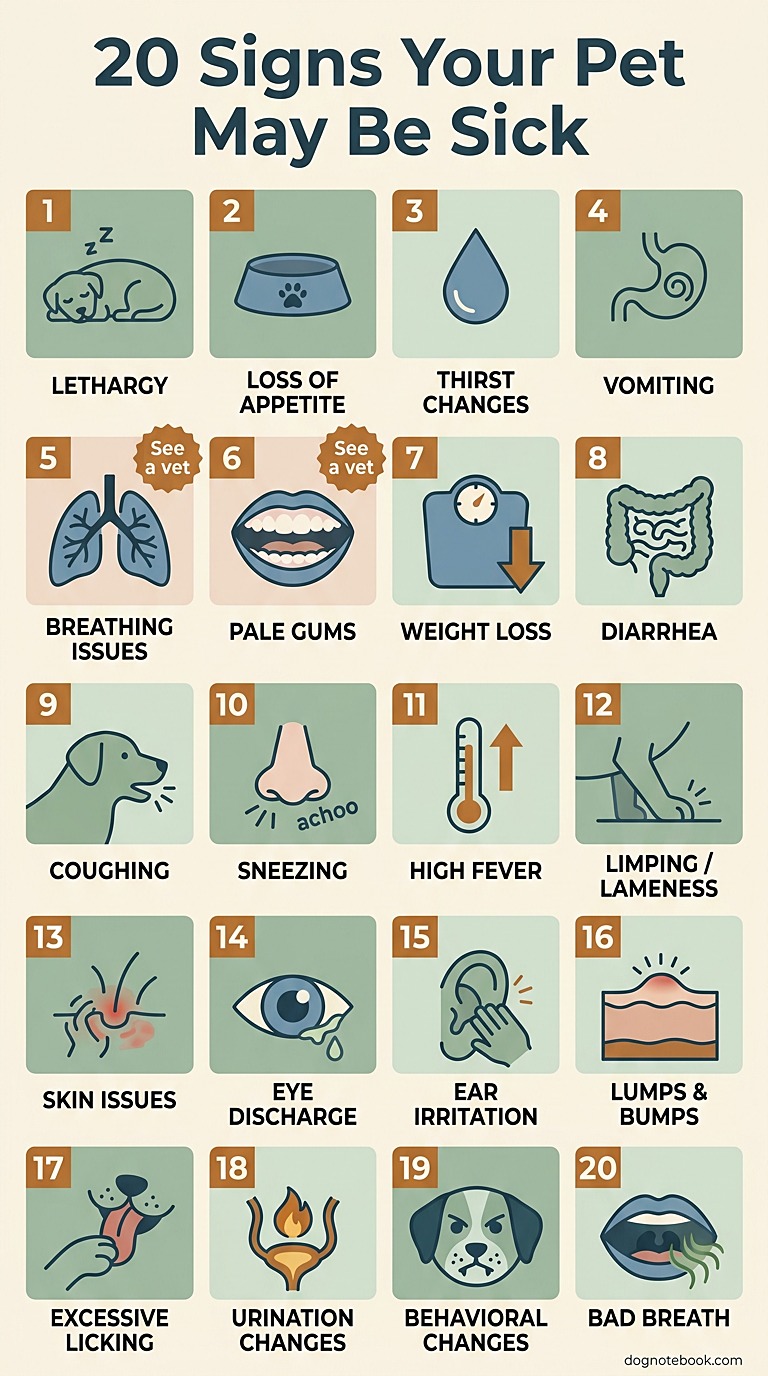
Quick answer: The top symptoms your pet is sick include sudden lethargy, loss of appetite, vomiting, diarrhea, excessive thirst, labored breathing, pale or blue gums, unexplained weight loss, hiding, limping, seizures, bloated belly, changes in urination, and bad breath. Some signs (single episode of vomiting, slight dullness) can be watched for 24 hours; others, like seizures, difficulty breathing, or a distended abdomen, are medical emergencies that need a vet immediately.
In this guide, I’ll walk you through 20 signs your pet needs help, grouped by what they mean, how urgent each one is, and the exact tests (gum color, skin tent, capillary refill) you can run at home in under a minute. I’ve cross-checked every symptom against sources like the American Veterinary Medical Association, VCA Animal Hospitals, and veterinary emergency hospitals so you’re not guessing.
Table of Contents
Quick-Glance Symptom Summary
| # | Symptom | Urgency |
|---|---|---|
| 1 | Sudden lethargy or weakness | Vet within 24 hrs (ER if collapsed) |
| 2 | Loss of appetite > 24 hrs | Vet within 24–48 hrs |
| 3 | Drinking too much or too little | Vet soon |
| 4 | Vomiting (repeated) | ER if 2+ episodes in 24 hrs |
| 5 | Diarrhea (especially bloody) | ER if bloody or severe |
| 6 | Labored or open-mouth breathing | ER immediately |
| 7 | Persistent coughing or gagging | Vet soon; ER if choking |
| 8 | Unexplained weight change | Vet within a week |
| 9 | Pale, blue, yellow, or white gums | ER immediately |
| 10 | Excessive panting at rest | Vet soon; ER if distress |
| 11 | Hiding, withdrawal, aggression | Vet within 24–48 hrs |
| 12 | Limping or stiffness | Vet within 24 hrs |
| 13 | Seizures or staggering | ER immediately |
| 14 | Bloated or swollen belly | ER immediately |
| 15 | Straining to urinate | ER immediately (esp. males) |
| 16 | Bad breath, drooling, bleeding gums | Vet within a week |
| 17 | Lumps, sores, hair loss, itching | Vet within a week |
| 18 | Eye/nose discharge | Vet within 24–48 hrs |
| 19 | Ear odor, head-shaking, discharge | Vet within a week |
| 20 | Fever, hypothermia, or collapse | ER immediately |
Why Pets Hide Illness (and Why Early Detection Matters)
In the wild, any animal showing weakness becomes a target, so dogs and cats evolved to mask pain and sickness as a survival instinct. That instinct is still baked in — which is why the American Humane Society warns that even well-meaning owners often miss subtle symptoms until the condition is advanced. The takeaway: you are your pet’s first line of defense, and small changes matter.
Daily observation — how much they ate, how they moved, whether they greeted you the way they usually do — is the single most valuable habit a pet parent can build. Knowing your pet’s normal baseline (energy, appetite, bathroom routine, even how they respond during play or training like the kind of skills you’d teach in fun enrichment routines) makes “off” easy to spot.
Behavioral Symptoms Your Pet Is Sick
1. Sudden Lethargy, Weakness, or Sleeping More Than Usual
A tired pet after a long walk is normal. A pet who skips their favorite activity, refuses to come greet you at the door, or sleeps through meals is not. Veterinarians consistently list lethargy as one of the earliest and most reliable warning signs of illness in both dogs and cats. Underlying causes range from mild infections to anemia, heart disease, pain, and organ issues.
What to do: If lethargy lasts more than 24 hours or comes with any other symptom on this list, schedule a vet visit. Sudden collapse or inability to stand is an emergency.
2. Hiding, Withdrawal, or Unusual Aggression
A normally social cat disappearing under the bed for a full day. A cheerful dog snapping when you reach toward their side. These personality shifts are classic pain signals. Cats especially tend to hide when sick — it’s a hardwired instinct to find a safe, quiet place when vulnerable.
Watch for: sudden clinginess, new fear responses, growling when touched in a specific area (often a pain clue pointing to that body part), or stopping self-grooming.
3. Restlessness, Pacing, or Difficulty Getting Comfortable
A pet who can’t settle, shifts positions constantly, stares at their belly, or assumes a “prayer position” (chest down, rear up) is often trying to relieve abdominal pain. Bloat (gastric dilatation-volvulus) in large, deep-chested dogs can present exactly this way and is a true emergency.
Eating, Drinking, and Digestion
4. Loss of Appetite (Anorexia)
A skipped meal isn’t always alarming, but any pet that refuses food for more than 24 hours needs veterinary attention. For cats, the window is even tighter — cats that go off food for 24+ hours can develop hepatic lipidosis (fatty liver disease), a serious and sometimes fatal condition. If appetite loss comes with vomiting, weight loss, or lethargy, don’t wait.
5. Increased or Decreased Thirst
Both extremes matter. Excessive drinking (polydipsia) can point to diabetes, kidney disease, Cushing’s disease, or certain medications. Drinking far less than normal often accompanies nausea, mouth pain, or more serious illness and quickly leads to dehydration.
At-home test — the skin tent: Gently lift the skin between your pet’s shoulder blades and let go. Hydrated skin snaps back instantly. If it stays “tented” for 2+ seconds, your pet is dehydrated and needs a vet. If it doesn’t return to normal at all, dehydration is severe and life-threatening.
6. Vomiting
Occasional vomiting from a dietary indiscretion is rarely serious, but certain patterns are red flags. The AVMA considers severe vomiting or diarrhea — more than two episodes in 24 hours, or either combined with other illness — an emergency. Blood in vomit (fresh red or coffee-ground appearance), repeated unproductive retching, or vomiting accompanied by a swollen belly all mean drop everything and call the emergency vet.
7. Diarrhea
Like vomiting, diarrhea can be mild or catastrophic. Watch for:
- Bloody or black, tarry stool (digested blood)
- Diarrhea that lasts more than 24 hours
- Diarrhea plus lethargy, vomiting, or fever
- Puppies or kittens with diarrhea (they dehydrate fast and parvovirus is a real threat)
Severe diarrhea leads to dehydration within hours, especially in small breeds.
8. Unexplained Weight Loss or Weight Gain
Weight that drops without a diet change — even in a pet that’s still eating — is a sign something metabolic is off. Diabetes, hyperthyroidism (especially in older cats), intestinal parasites, kidney disease, and cancer can all cause weight loss. In cats, chronic illness often shows up as slow, subtle loss you only notice when you run your hands over the ribs and spine. Sudden weight gain or a visibly swollen abdomen can also point to fluid retention, hypothyroidism, or serious organ issues.
Breathing and Oxygen Red Flags
9. Labored or Open-Mouth Breathing
Normal breathing in a resting dog or cat is quiet and effortless. Open-mouth breathing in a cat is never normal — cats don’t pant the way dogs do, so it almost always signals serious respiratory or heart disease. In dogs, labored breathing, abdominal heaving, stretched-out neck posture, or sitting with elbows out to help air in are all emergencies. Causes range from heart failure and fluid in the lungs to allergic reactions, heatstroke, and foreign body obstruction.
Test at home: Count the breaths per minute while your pet is resting (not sleeping-dreaming). For most dogs and cats, resting respiratory rate should be under 30 breaths per minute. Consistently higher counts, especially with effort, warrant a same-day vet visit.
10. Persistent Coughing, Wheezing, or Gagging
An occasional throat-clear is fine. Repeated coughing, honking sounds (think goose), wheezing, or gagging can mean kennel cough, heart disease, collapsing trachea, asthma (common in cats), heartworm, or pneumonia. A pet who is pawing at their mouth, drooling, and making choking sounds may have something lodged in the airway — that’s a race-to-the-ER situation.
11. Excessive Panting When Not Hot or Exercising
Panting is how dogs cool down. Panting while lying quietly in a cool room, especially with restlessness or a hunched posture, can signal pain, fever, heart problems, or heatstroke. In brachycephalic (flat-faced) breeds like Pugs, Bulldogs, and Persians, heavy panting escalates to a breathing emergency quickly.
Physical Appearance and Skin
12. Pale, Blue, Yellow, or Bright-Red Gums
This is one of the single most useful at-home vital checks you can do, and most owners have never tried it. Healthy gums are bubble-gum pink and moist. Here’s what other colors usually mean:
| Gum Color | What It Can Indicate |
|---|---|
| Pink, moist | Normal |
| Pale / white | Anemia, shock, internal bleeding — emergency |
| Blue or grey | Low oxygen, respiratory failure — emergency |
| Yellow | Liver disease, jaundice — urgent |
| Bright red / brick | Heatstroke, toxicity, sepsis — emergency |
| Sticky / tacky | Dehydration |
Capillary refill time (CRT): Press your finger firmly on the gum above the upper canine tooth until it blanches white. Remove. Color should return in 1–2 seconds. Longer than 2 seconds points to dehydration, shock, or poor circulation — call the vet. (For pets with naturally black-pigmented gums, check the inner eyelid tissue instead.)
13. Lumps, Bumps, or Skin Sores
Run your hands over your pet once a week. Any new lump, wound that won’t heal, scab that keeps coming back, or patch of missing hair deserves a vet exam. Not every lump is cancer — many are harmless fatty growths (lipomas) or cysts — but early detection of malignant masses is one of the most important things you can do for a pet’s long-term outcome.
14. Excessive Scratching, Licking, or Hot Spots
Constant scratching, chewing at paws, rolling to rub their back, or open “hot spots” usually point to allergies (food or environmental), parasites (fleas, mites, ringworm), or skin infections. Left untreated, these cause secondary infections and misery. In sensitive or short-coated breeds, irritation can also come from environmental factors like salted sidewalks or cold — which is also why knowing whether your dog needs seasonal protection like a coat can matter. If you’re unsure, this guide on whether dogs need coats breaks it down by breed and temperature.
Mobility and Neurological Symptoms
15. Limping, Stiffness, or Reluctance to Jump
Sudden limping, difficulty rising, dragging a limb, reluctance to climb stairs, or yelping when picked up all point to pain. Possible causes: soft tissue injury, arthritis, cruciate ligament tears, intervertebral disc disease (a huge concern in Dachshunds, Corgis, and other long-backed breeds), tick-borne disease, or fractures. A limping pet who can’t bear any weight, especially paired with a swollen joint or visible deformity, needs same-day care.
16. Seizures, Tremors, or Staggering
Seizures are always an emergency. They can involve full-body convulsions, drooling, loss of consciousness, and loss of bladder/bowel control, or look subtler — fly-biting, staring, or facial twitching. Any pet that has a seizure lasting more than 5 minutes, two or more seizures in 24 hours, or their very first seizure ever needs emergency care. Staggering, circling, head tilt, or sudden blindness can signal vestibular disease, stroke, or toxicity.
During a seizure: Don’t put your hands near your pet’s mouth (they can bite involuntarily and cannot swallow their tongue, despite the myth). Move furniture away, time the episode, and call your vet as soon as it ends.
Urinary, Abdominal, and Emergency Signs
17. Straining to Urinate or Defecate, or Blood in Urine
A pet squatting repeatedly and producing little or no urine — especially a male cat or dog — is a true emergency. Urinary blockages can rupture the bladder and cause cardiac arrest within hours. Other urgent signs: blood in urine, crying out while urinating, licking the genital area excessively, or not urinating at all for 24 hours. Inability to pass stool, especially with straining and a painful belly, also warrants immediate care.
18. Bloated, Distended, or Painful Abdomen
A sudden pot-bellied appearance — especially in large, deep-chested dogs like Great Danes, German Shepherds, Weimaraners, and Standard Poodles — combined with unproductive retching, restlessness, and drooling is a classic presentation of bloat / gastric dilatation-volvulus (GDV), where the stomach twists. Without surgery, it’s fatal within hours. Any sudden swelling of the belly warrants an emergency call, no matter the breed.
19. Fever, Hypothermia, or Collapse
Normal body temperature for dogs and cats is roughly 101–102.5°F (38.3–39.2°C). Over 103°F or under 99°F is abnormal. Heatstroke (common after car confinement or hot-weather exercise, especially in flat-faced breeds) presents with heavy panting, brick-red gums, vomiting, collapse, and seizures — it’s fatal fast. Hypothermia appears as shivering, weakness, slow breathing, and cold extremities. Any sudden collapse or loss of consciousness is an emergency.
20. Discharge From Eyes, Nose, Ears, or Mouth (and Bad Breath)
A little sleep crust is fine. What isn’t fine:
- Thick yellow, green, or white discharge from eyes or nose
- Squinting, redness, or sudden cloudiness in the eye (corneal ulcers can progress to vision loss within days)
- Elevated third eyelid (common early sign in sick cats)
- Head shaking plus ear odor or dark discharge (ear infection or mites)
- Unusually bad breath, drooling, or bleeding from the mouth (dental disease, oral tumors, kidney failure)
Oral health is more than cosmetic — advanced dental disease can seed infection into the heart and kidneys.
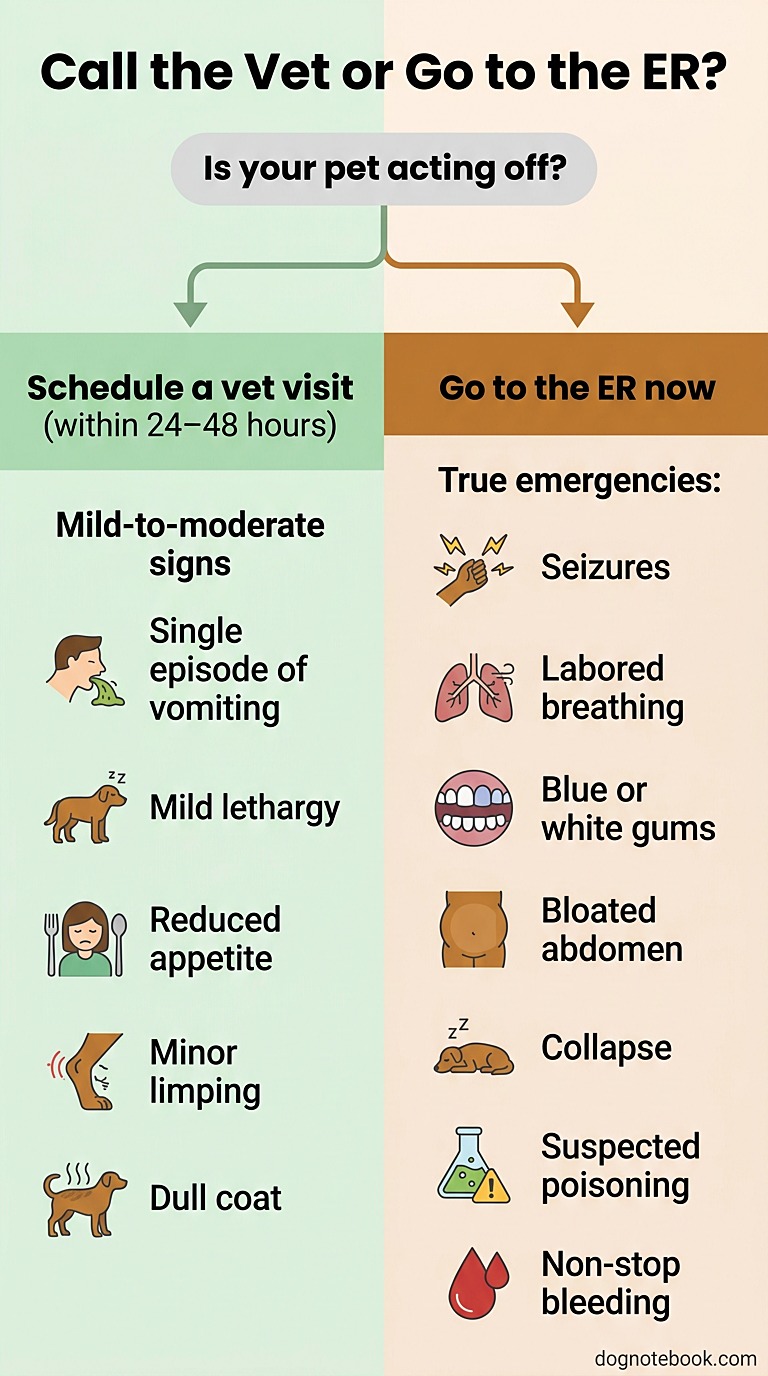
When to Call the Vet vs. When It’s an Emergency
Not every symptom needs a 2 a.m. ER run. This rule of thumb helps:
Call the regular vet within 24–48 hours
- Single episode of vomiting or diarrhea and otherwise normal
- Mild limp that improves with rest
- One skipped meal with normal energy
- Small new lump
- Mild ear odor or occasional scratching
- Dull coat or slight weight change over weeks
Go to the emergency vet now (AVMA-listed emergencies)
The AVMA maintains a list of 13 animal emergencies that require immediate veterinary care, including severe bleeding, choking or difficulty breathing, inability to urinate, suspected poisoning, seizures, fractures, heat stress, repeated vomiting or diarrhea, refusal to drink for 24 hours, and unconsciousness. Trust your gut — if you think it’s an emergency, it is.
Poisoning suspected? Call the ASPCA Animal Poison Control Center at 1-888-426-4435 or the Pet Poison Helpline at 1-855-764-7661, then get to a vet. A consultation fee may apply.
What to Do Before You Get to the Vet
- Stay calm. Your pet reads your stress. Take one breath before you act.
- Call ahead. Most ERs triage better when they know you’re coming and what’s happening.
- Don’t give human meds. Tylenol is deadly to cats. Ibuprofen is toxic to dogs. Pepto and aspirin can interact dangerously.
- Take notes. When did symptoms start? How many episodes? What did the vomit/stool look like? Any access to trash, plants, chemicals, medication?
- Bring samples. If you can safely collect vomit or stool in a sealed bag, bring it. Take photos of the incident.
- Transport safely. Use a secure carrier or blanket sling. Support the spine of any injured pet.
Common Mistakes Pet Owners Make With a Sick Pet
- Waiting “one more day” to see if it passes. Most conditions worsen, not improve, while you watch.
- Relying on a dry or warm nose as a fever check. It isn’t reliable — a pet’s nose fluctuates based on humidity and whether they just licked it.
- Googling instead of calling. Use a reputable symptom tracker, but don’t let it replace the vet.
- Assuming old age explains everything. Arthritis, slowing down, and weight loss in senior pets almost always have a treatable underlying cause.
- Skipping annual exams. Wellness visits catch issues months before symptoms appear, which is why the American Animal Hospital Association recommends at least yearly exams for adult pets and twice-yearly for seniors.
Pro Tips From the Exam Room
- Photograph normal. Snap a clear photo of your pet’s pink gums on a healthy day and save it. You’ll have a reference the next time you need to check.
- Know your pet’s resting breathing rate. Count breaths once a month while they’re resting and jot it down. A 20% jump is an early sign of heart trouble.
- Weigh small pets monthly. A five-pound cat losing half a pound is 10% of their body weight — significant.
- Watch the litter box and yard. Changes in urine volume, stool shape, frequency, or color are often the first cue something is wrong.
- Build a pet first-aid kit. Include a digital thermometer, gauze, non-stick bandages, blunt-tipped scissors, hydrogen peroxide (only for induced vomiting if your vet tells you to), and a copy of your vet’s and the poison helpline’s phone numbers.
Frequently Asked Questions
How can I tell if my pet is seriously sick and not just having a bad day?
Look for multiple symptoms stacking up, persistence beyond 24 hours, or any single red-flag sign — difficulty breathing, seizures, pale or blue gums, bloated belly, repeated vomiting, inability to urinate, collapse. One mild symptom with otherwise normal behavior can often be watched overnight. Two or more symptoms together, or one emergency sign, mean you call the vet now.
Is occasional vomiting normal in dogs and cats?
Occasional vomiting — once every few weeks with no other signs — can happen, especially in dogs that scavenge or cats that cough up hairballs. What is not normal: repeated vomiting in a single day, vomiting with blood or bile, vomiting plus lethargy or diarrhea, or any vomiting in a very young or senior pet. The AVMA flags more than two vomiting episodes in a 24-hour period as an emergency.
How long can a pet go without eating before I should worry?
For dogs: 24 hours of complete food refusal without any other symptoms warrants a vet call; longer than 48 hours is concerning regardless. For cats: 24 hours is the outside limit. Cats that stop eating are at risk of hepatic lipidosis, a life-threatening liver condition that can develop within days of appetite loss.
How do I check my pet’s hydration at home?
Two quick tests. First, gums — lift the lip; they should be moist and pink. Sticky, tacky, or dry gums suggest dehydration. Second, skin tent — pinch the skin between the shoulder blades and release. It should snap back instantly. If it stays tented, your pet is dehydrated and needs a vet. Severe dehydration (5–10%+ fluid loss) is life-threatening.
What is capillary refill time and why does it matter?
Capillary refill time (CRT) measures how quickly blood returns to the gums after pressure. Press a finger on your pet’s gum until it blanches white, then release. Color should come back in under 2 seconds. Slower than that — or gums that don’t blanch at all — suggests dehydration, shock, heart trouble, or circulatory failure, all of which need immediate veterinary care.
Can pets get the flu or colds from humans?
Dogs and cats don’t catch the common human cold the same way people do, but there are species-specific respiratory viruses (canine influenza, cat flu / feline herpesvirus) that cause similar symptoms. Sneezing, nasal discharge, coughing, and low energy in a pet deserve a vet visit rather than self-treatment with human cold medicine — many of which (including decongestants with pseudoephedrine and pain relievers) are toxic to pets.
My pet seems fine now — should I still go to the vet after a scare?
Yes, especially after a seizure, a suspected toxin exposure, a fall or car accident, a collapse, or a bloated belly episode. Pets can appear to rebound while internal injuries or toxins are still active. Shock can mask pain. A post-event exam, even if it turns out to be nothing, buys peace of mind and catches hidden problems.
How much does a vet emergency visit usually cost?
Costs vary widely by region and severity, but exam and diagnostic bills at emergency clinics commonly run from a few hundred to several thousand dollars once bloodwork, imaging, and overnight care are factored in. Pet insurance or a dedicated emergency fund (~$1,500 as a baseline) can prevent tough cost-vs-care decisions in the moment.
Are there signs that are different between dogs and cats?
Yes. Cats are masters at hiding illness and tend to show it as withdrawal, hiding, stopping grooming, and subtle weight loss — while dogs more often show external signs like vomiting, limping, or behavior shifts. Open-mouth breathing is normal for a hot or exercised dog but is a red-flag emergency in a cat. Cats also develop an elevated third eyelid (a whitish membrane in the inner corner of the eye) when unwell, a sign dogs don’t typically show.
What should always be in a pet first-aid kit?
Digital thermometer, self-adhering bandage wrap, sterile gauze pads, blunt-tip scissors, saline eye wash, disposable gloves, a muzzle (even calm pets can bite when in pain), a copy of your pet’s medical records, your vet’s number, and the 24/7 poison hotlines (ASPCA: 1-888-426-4435, Pet Poison Helpline: 1-855-764-7661). Check expiry dates twice a year.
Final Takeaway
You know your pet better than anyone. If something feels off — the eyes look duller, the bark sounds different, the usual happy hello never happens — don’t talk yourself out of calling. Veterinarians will always rather see a healthy pet for a false alarm than a critically ill one who waited. The 20 symptoms above are the ones I’d want every pet parent to have mentally bookmarked, because catching them early is the single biggest thing you can do to protect the life of a creature who can’t tell you what hurts.
Save this page — it’s the kind of reference you hope you never need, but you’ll be glad it’s bookmarked when you do.