
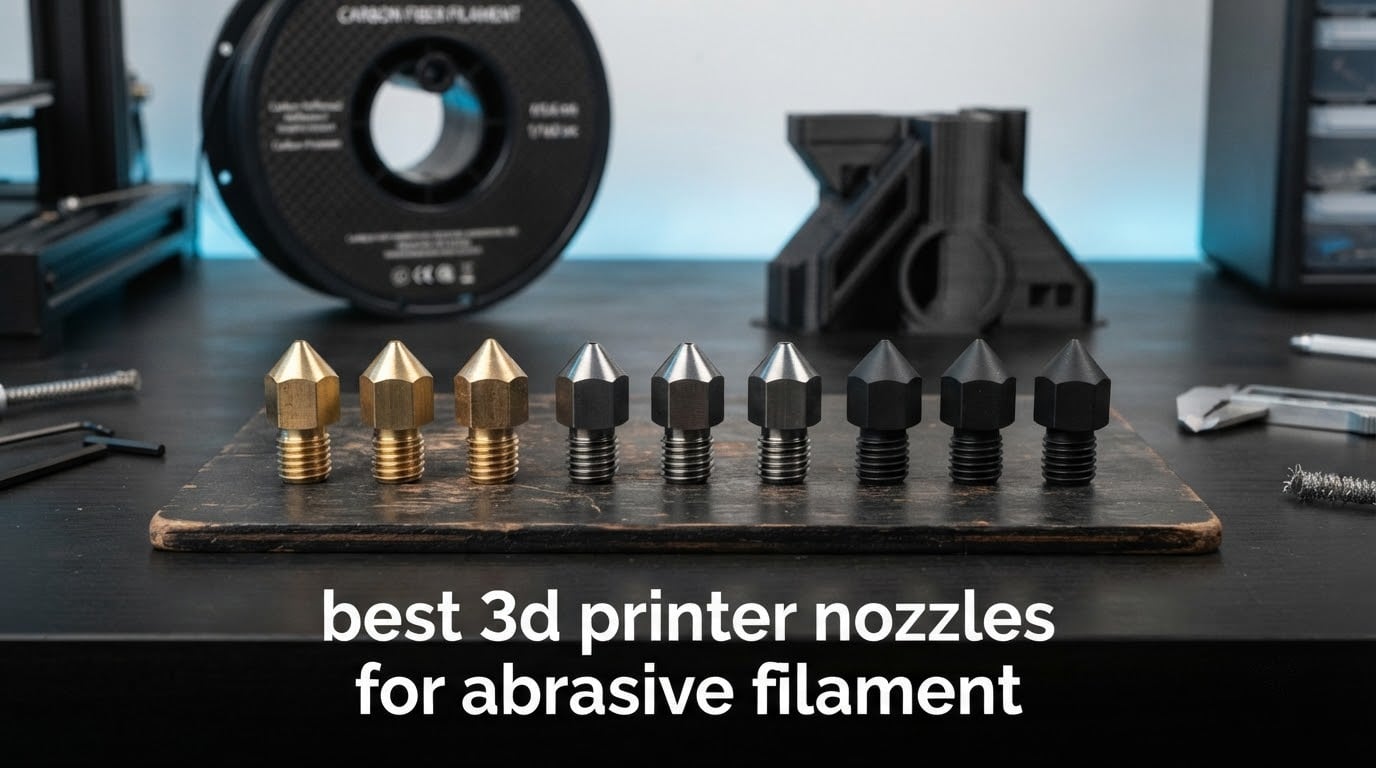
Carbon fiber, glass fiber, glow-in-the-dark and wood-fill filament will chew through a brass nozzle in a single spool, and most people do not notice until the print starts under-extruding. The best 3d printer nozzles for abrasive filament are not exotic – they are simply made from something harder than brass and machined to a bore that stays round under load.
We compared ten of the most-watched abrasive nozzles on the market, reading the wear reports, bore accuracy claims and failure modes in thousands of owner reviews across carbon PLA, PETG-CF, nylon composites and glow filament. What follows is the roundup: what each material costs you in wear, which thread your printer needs before you order anything, and a verdict on who should buy and who should skip.
If you are still choosing a machine rather than a spare part, our 3D printer buying guide covers the enclosed, all-metal builds that handle composite filament properly in the first place.
Table of Contents
What Is the Best Nozzle for Carbon Fiber Filament?
Hardened steel is the minimum for carbon fiber filament; tungsten carbide for heavy or continuous use; brass will ovalise within a single 1 kg roll. For most people printing a few spools a month, a hardened steel nozzle in the correct thread for your hotend is the whole answer. If you are running carbon fiber nylon daily or pushing PEEK-class composites, step up to a tungsten carbide tip, which is far less brittle than ruby and moves heat much better.
Brass is not a bad material – it has the best thermal conductivity of the group and melts filament fast. It is simply softer than the glass and carbon particles you are pushing through it, so the orifice wears oval before it ever clogs.
Check Your Hotend Thread Before You Order
Buying a durable nozzle for the wrong thread is the most common wasted purchase in this category, and it is the framing that dominates forum threads about wear-resistant nozzles. Work out which heat break your printer uses before you choose anything else, because the same 0.4 mm carbide nozzle exists in several incompatible bodies.
V6 is a 6 mm threaded heat break used across Ender, CR-10, Prusa i3, Anycubic and Reprap clones. MK8 is a larger thread used on Ender 2/3/5 and CR-10 all-metal hotends. Volcano and Super Volcano use a different, larger bore again. Prusa Nextruder, Bambu Lab, QIDI X-series, Elegoo Neptune 4 and Flashforge AD5X each use their own integrated mount that a generic V6 or MK8 part will not fit.
Most of the mistakes come down to a V6-versus-MK8 mix-up, and the fix takes thirty seconds: look at the printed model name on the front of your printer, or the hotend assembly page in your printer’s documentation, and match it against the compatibility line in the listing.
Top 3 Picks for Abrasive Filament in 2026
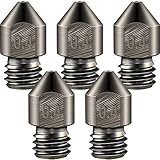
Mudder Hardened Steel MK8 0.4mm
- 5 pack hardened tool steel
- 0.4mm bore within 0.02mm
- MK8 heat break fit
- For 1.75mm filament

Micro-Swiss MK8 TwinClad XT
- TwinClad XT wear plating
- Five orifice sizes
- Plated brass MK8 body
- Made in USA

Creality Hardened MK8 Multi-Size
- 0.2 to 1.0mm range
- Hardness beyond HRC60
- 450C rated
- CNC concentric bores
Best 3D Printer Nozzles for Abrasive Filament at a Glance (October 2026)
| Product | Specifications | Action |
|---|---|---|
| Mudder 5 Pack Hardened Steel MK8 0.4mm |
|
Check Latest Price |
| Micro-Swiss MK8 TwinClad XT Plated |
|
Check Latest Price |
 POLISI3D 4 Pack Hardened Steel V6 0.4mm POLISI3D 4 Pack Hardened Steel V6 0.4mm |
|
Check Latest Price |
 Creality 8 Pack Hardened Steel MK8 Kit Creality 8 Pack Hardened Steel MK8 Kit |
|
Check Latest Price |
 ELEGOO Hardened Steel Kit for Neptune 4 ELEGOO Hardened Steel Kit for Neptune 4 |
|
Check Latest Price |
 Dawnblade Tungsten Carbide MK8 0.4mm Dawnblade Tungsten Carbide MK8 0.4mm |
|
Check Latest Price |
 DUROZZLE Ruby 0.8mm for QIDI X Series DUROZZLE Ruby 0.8mm for QIDI X Series |
|
Check Latest Price |
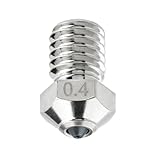 DUROZZLE Tungsten Carbide V6 0.4mm DUROZZLE Tungsten Carbide V6 0.4mm |
|
Check Latest Price |
| Creality 8 Pack Hardened MK8 Multi-Size |
|
Check Latest Price |
 DUROZZLE Tungsten Carbide for Flashforge AD5X DUROZZLE Tungsten Carbide for Flashforge AD5X |
|
Check Latest Price |
1. Mudder 5 Pack Hardened Steel MK8 0.4mm – Best Overall
- Survived 1.5kg of high-temp carbon PLA with no visible wear
- Bore verified round under magnification
- No clogs across many hours of composite printing
- Direct replacement for the factory Ender nozzle
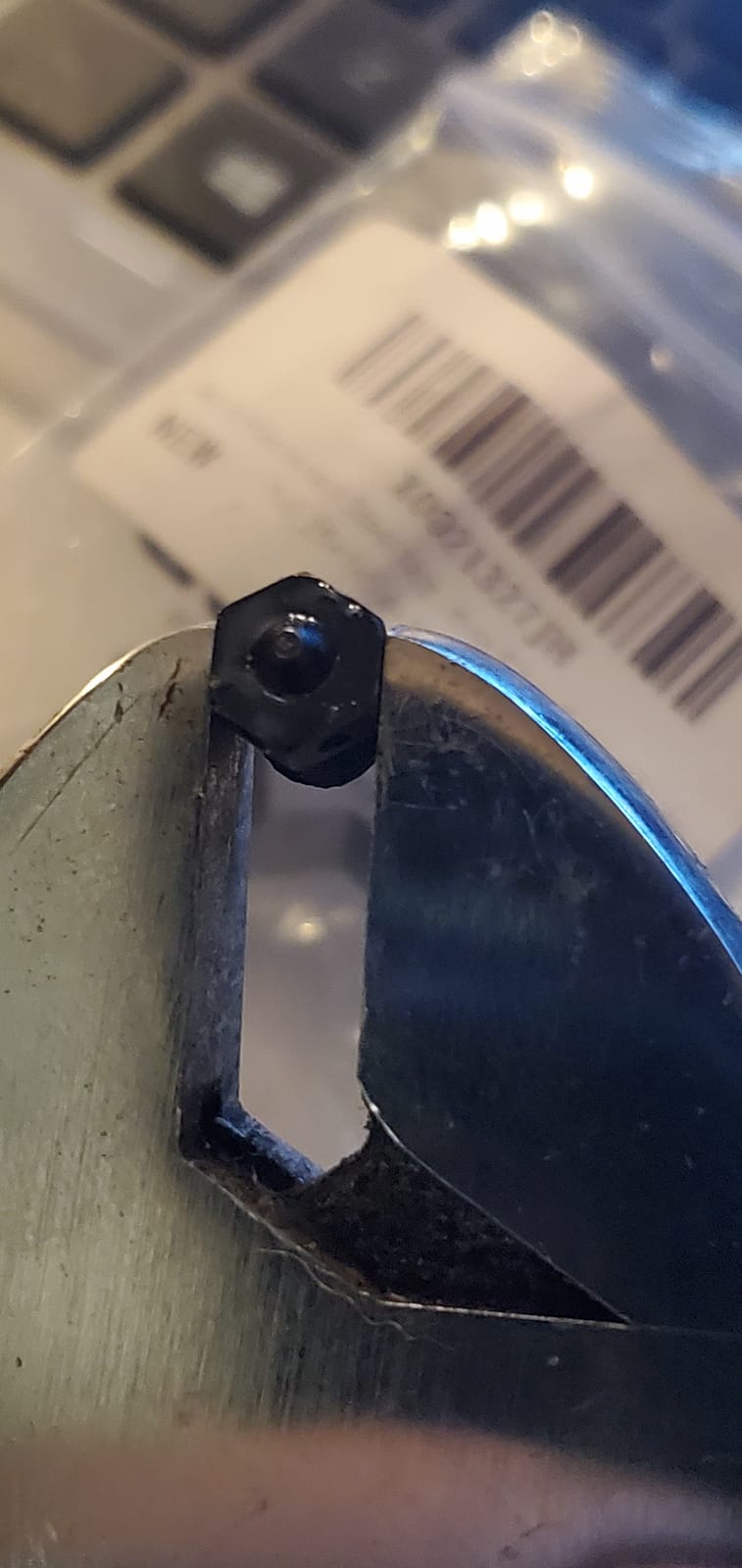
- Only two flats so a socket wrench will not fit
- Mixed reports of extrusion issues on some pieces
- One report of filament leaking around the nozzle sides
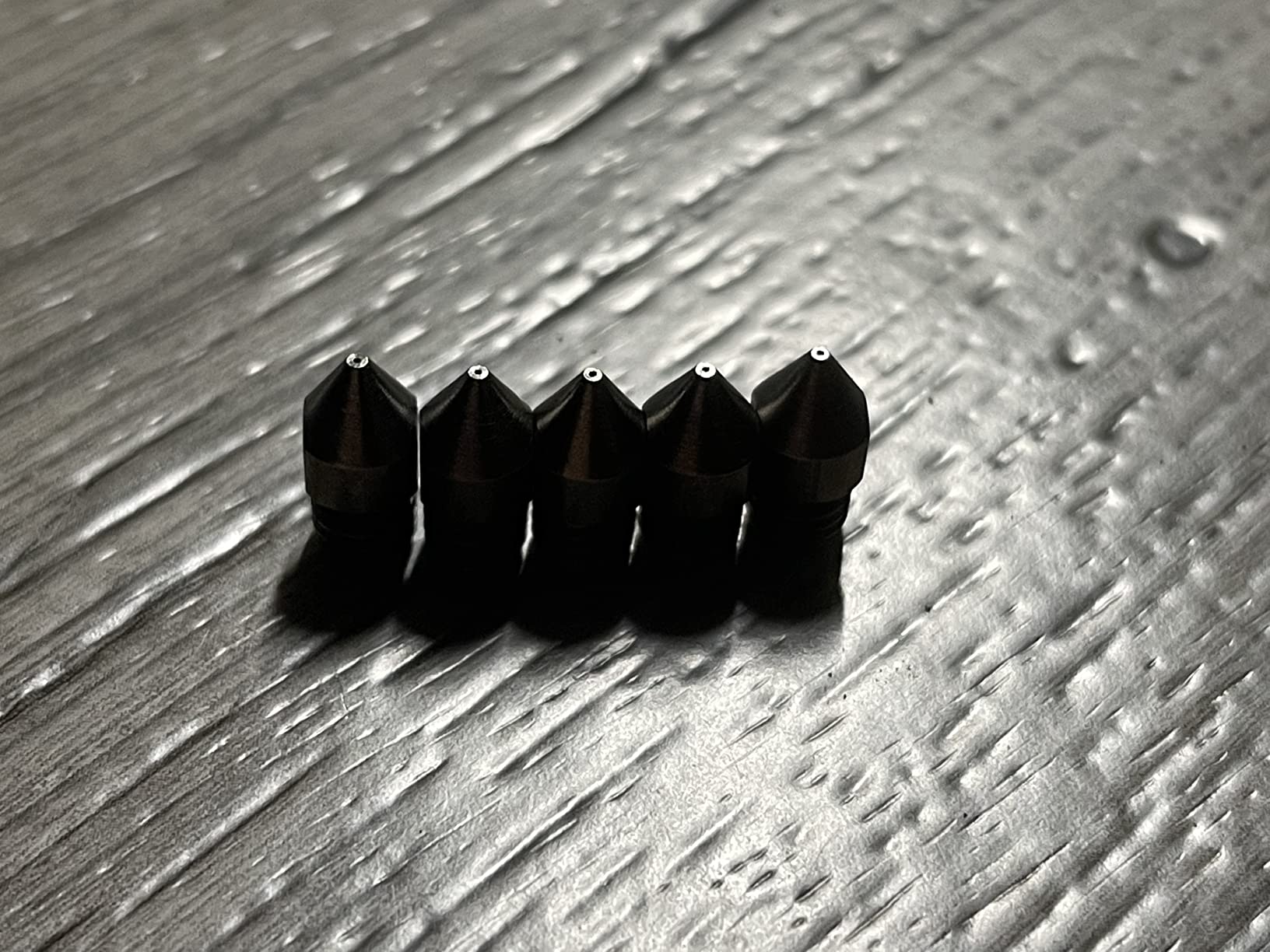
Five hardened tool steel nozzles in a 0.4 mm MK8 body, and the review history on this listing is by far the deepest in the roundup. The wear data is the standout: one owner reported printing roughly 1.5 kg of a high-temperature carbon PLA blend followed by several kilograms of standard PLA and finding the nozzle still looking new at the end.
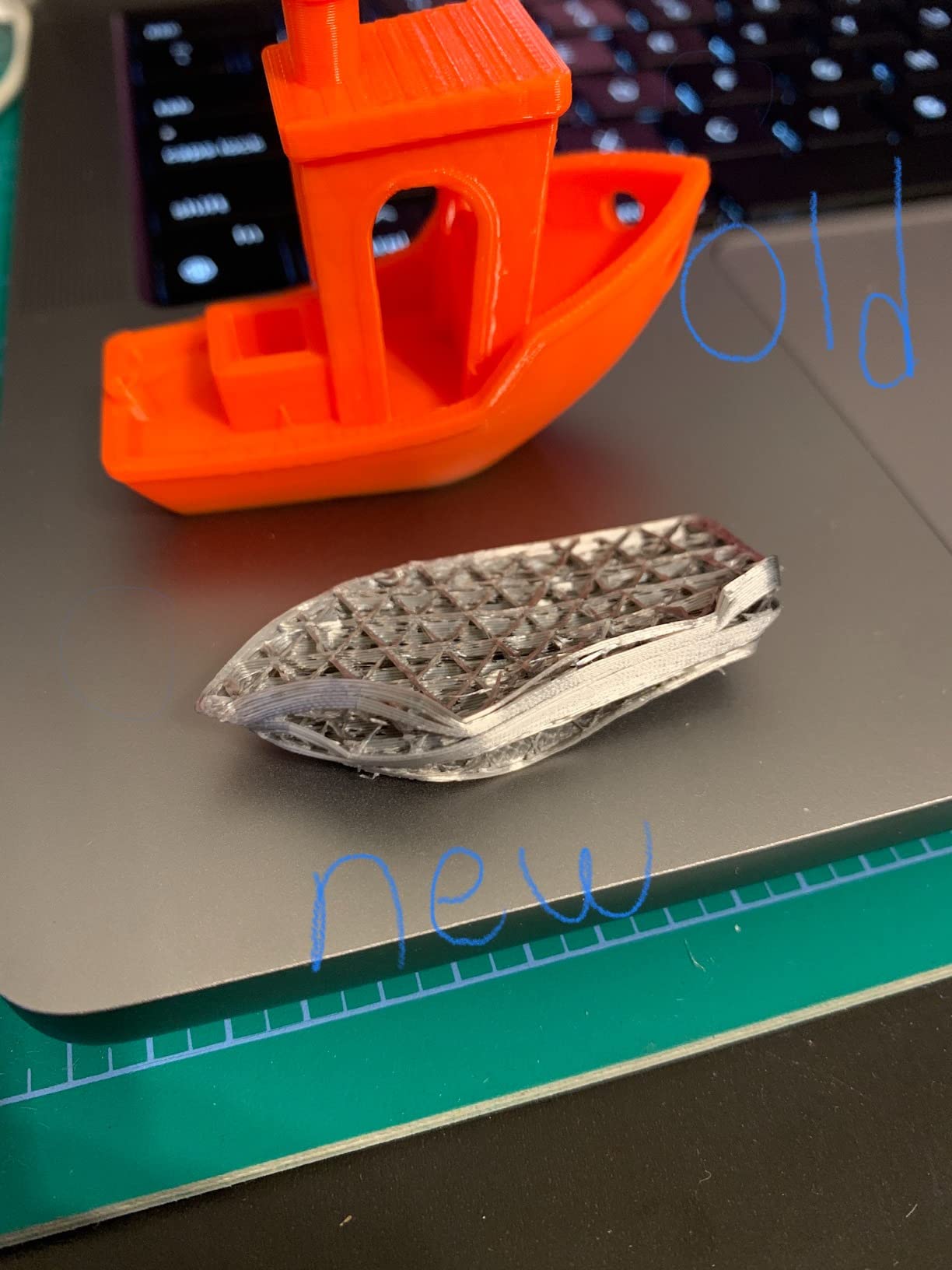
Bore quality matters more than material for short prints, and this one checks out. Owners verified the 0.4 mm bore under magnification and with a gauge, finding diameter error inside 0.02 mm with a smooth, burr-free inner wall. That is the number to look for on any abrasive nozzle, and it is why this set holds line width steady on glow-in-the-dark PLA, one of the worst offenders for sticking.
The two-flat body is a genuine annoyance. A socket wrench will not seat on it, so you need pliers, and care is needed not to mark the flats. It is a small cost for a nozzle you can leave installed for months.
Who should buy the Mudder five pack
Buy it if you own an Ender 2, 3, 3 Pro or 5, a CR-10 all-metal, a Prusa i3 or an Anet A8 and you print abrasive filament at least occasionally. Five nozzles at a low cost per piece means one can stay installed while another sits in the drawer.
It is also the sensible first upgrade for a beginner. No new temperature profile and no new slicer setup to justify it, and a drop-in fit means no Z-offset drama on most machines.
Who should skip it
Skip it if you need 0.6 or 0.8 mm. This set is 0.4 mm only, and forcing fiber bundles through a 0.4 mm bore is the fastest route to a clog you will spend an evening clearing.
Skip it if you run nylon composites daily. Hardened steel will outlast brass by a wide margin, but it is still the wrong tier for continuous PA-CF work.
2. Micro-Swiss MK8 TwinClad XT Plated Nozzle – Best Value
- Plating shows no wear after heavy carbon and glass fiber printing
- Tighter tolerances and sharper detail than generic nozzles
- Coating stops PLA building up on the nozzle exterior
- Handles nozzle changes without chipping
- Plating is easily damaged by 000-grade steel wool
- Does little to stop PETG sticking to the coating
- You may not need every size in the value pack
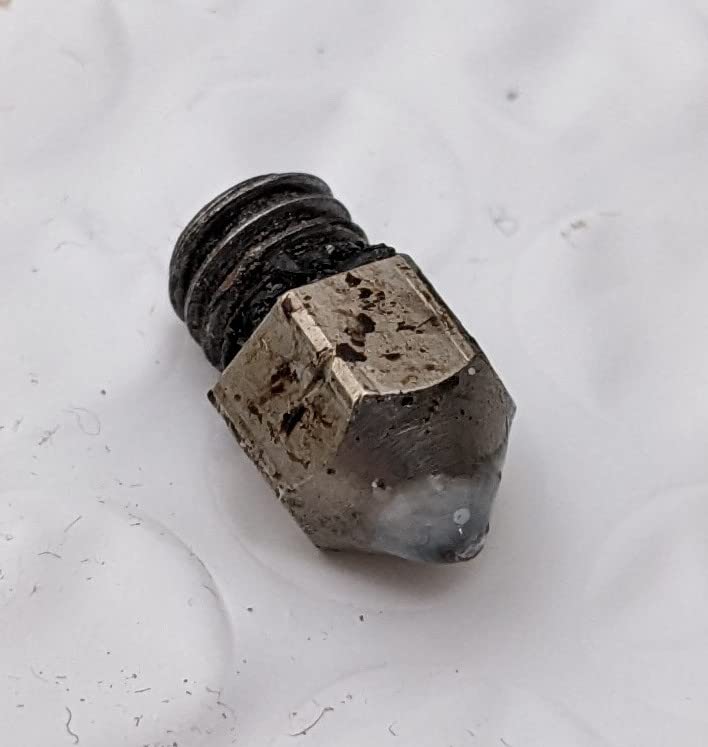
The core here is still brass, which sounds wrong on a list of abrasive nozzles until you understand what the coating does. TwinClad XT is a high-lubricity plating that gives the surface a slip layer, so carbon and glass particles ride along the wall instead of grinding into it. Owners report no measurable wear after heavy glass- and carbon-fiber-reinforced ABS and PETG printing, and noticeably tighter tolerances than off-brand nozzles.
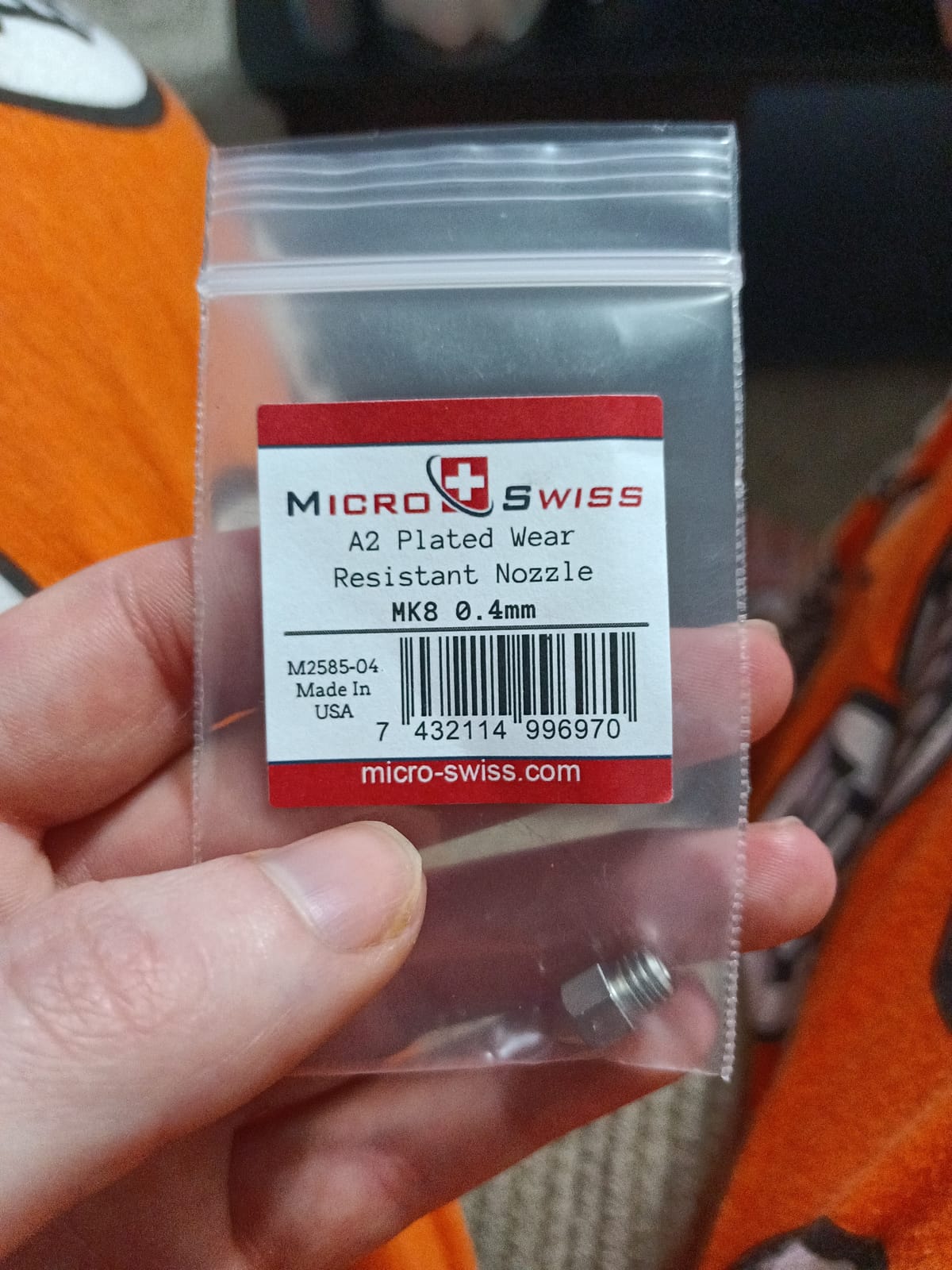
What sold us was the size coverage. The value pack includes 0.2, 0.3, 0.4, 0.6 and 0.8 mm orifices in one shipment, so the same order covers a fine detail part and a fast structural print. The 0.6 mm piece is the one to reach for with carbon fiber, and having it in the box removes the most common reason people clog a composite filament.
The plating is the weak point. One owner reported inconsistent extrusion after cleaning with 000-grade steel wool, which strips the coating back to bare brass and undoes the benefit. Treat the outside with a brass wire brush, never abrasive wool, and this nozzle behaves very differently.
Who should buy the Micro-Swiss plated nozzle
Buy it if you print a mix of standard and abrasive filament and want one order to cover every orifice size you will need. It suits CR-10, Ender, Tornado, MakerBot and CraftBot hotends, and it is made in the USA, which matters if you buy from a domestic retailer.
It is also the right call for anyone who wants wear resistance without giving up brass melt flow. The plated bore melts filament faster than solid hardened steel, so you keep print speed while resisting abrasion.
Who should skip it
Skip it if you run continuous PA-CF or PEEK-class composites. Plating extends brass life; it does not turn it into carbide, and a year of daily nylon will still wear the bore.
Also skip it if your cleaning habit involves steel wool. No coating survives it, and once the plating is gone the part is an expensive brass nozzle.
3. POLISI3D 4 Pack Hardened Steel V6 0.4mm – Most Versatile
- Dimensions match genuine E3D V6 brass nozzles
- Smooth extrusion including with carbon-filled nylon
- Much better abrasion life than the factory brass
- Lowest cost per nozzle in the roundup
- One reviewer found internal rust and questioned the hardness
- Slightly shorter body can need a Z-offset change
- Size is shown by dots rather than a stamped number
The cheapest route into hardened steel on a V6 hotend. Four CNC-machined nozzles at the lowest per-piece cost we found, sized close enough to genuine E3D V6 brass dimensions that owners report drop-in fit on Prusa i3 MK3 and MK3S, Prusa MINI and Anycubic Mega without modification.
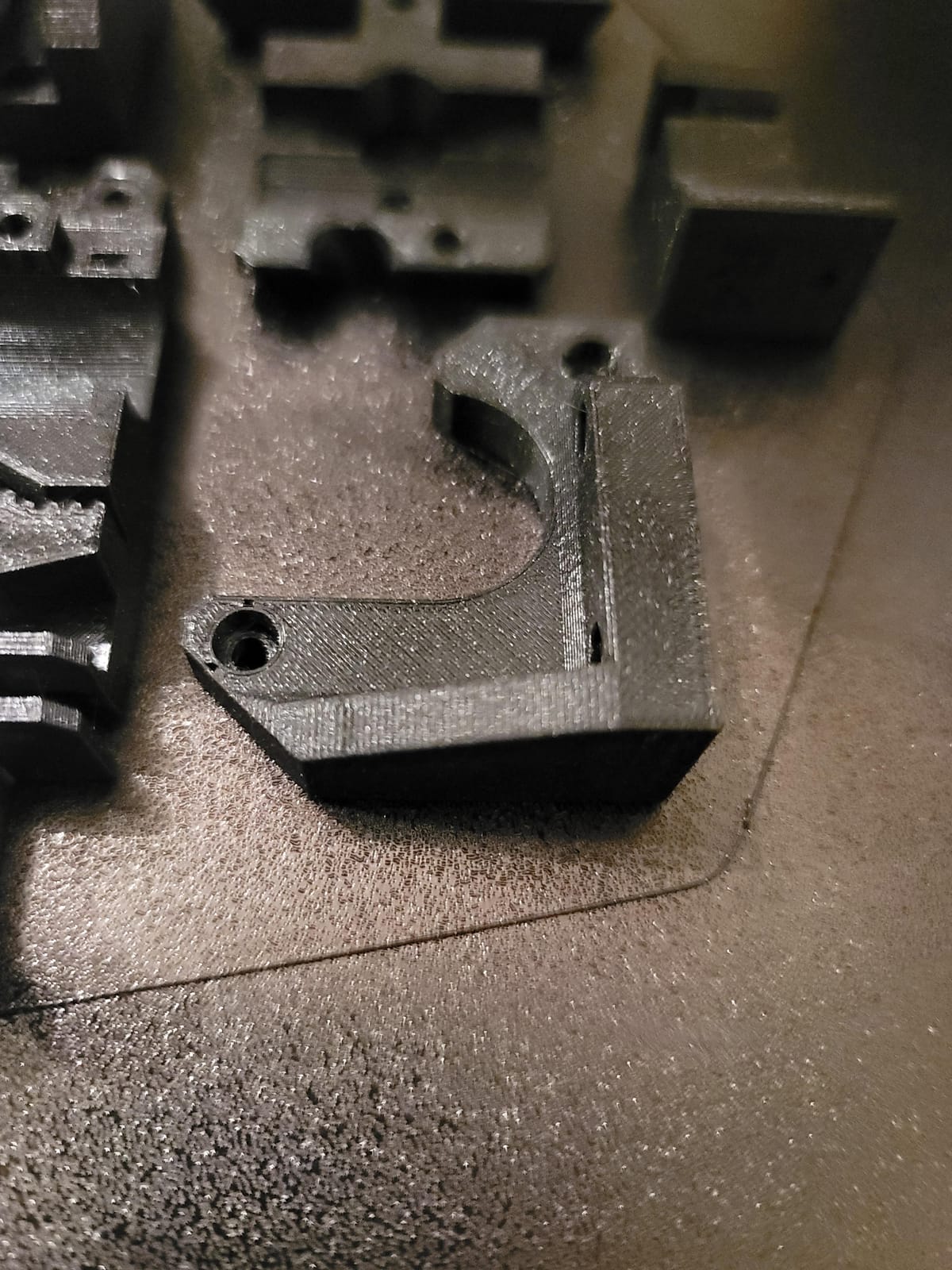
Extrusion quality was consistently smooth in the reviews, including on carbon-fiber-filled nylon, and owners regularly compare its durability favourably against the factory brass it replaces. CNC machining is the reason: concentric bores mean the melt front stays round instead of sagging to one side.
Two things catch people out. The body is slightly shorter than a factory nozzle on some machines, which needs a small Z-offset adjustment, and the size is marked with three dots rather than a stamped number, which is easy to misread under time pressure. Check the dots before installing one.
Who should buy the POLISI3D V6 pack
Buy it if you run a V6 hotend and you are printing PETG-CF, carbon PLA or glow filament on a budget. It covers the most common thread in the hobby at the lowest cost per nozzle, so you can keep several on hand for different filament types.
The four-piece format is practical. One stays installed, one is a working spare, and the others cover you while the installed one is being cleaned.
Who should skip it
Skip it if a single owner report makes you uneasy. One reviewer found rust forming inside a nozzle and questioned whether the steel was genuinely hardened – a minority report, but internal corrosion in a hot nozzle is worth checking for on arrival by looking down the bore in good light.
Skip it if you run above 300C. This is an abrasive-filament budget option, not a high-temperature one.
4. Creality 8 Pack Hardened Steel MK8 Kit – Best for High-Temperature Filaments
Official Creality High-end Hardened Steel MK8 Nozzles 8PCS, High-Temperature Wear Resistant Compatible with Ender 3/Ender 3 V2/Ender 3 Pro/Ender 3 Max/Ender 5 Series and CR 10 Series
- Handles carbon and glass fiber to 300C in real use
- Rounded chamfer lowers corner resistance and blocking
- Size engraved on each nozzle for fast identification
- Owners call them the most durable nozzles they have used
- Two nozzles in one pack were the wrong size and caused under-extrusion
- One nozzle arrived with hardened plastic residue on it
- Repeated clogs reported on brand-new pieces
- Needs temperatures about 10C higher than brass
This is the kit to buy if you print PEEK, PEI or any composite that lives above 300C. The hardened steel and copper alloy construction holds a 450C maximum, which is a real ceiling rather than a marketing number, and the copper component helps recover temperature quickly between short layers.
The rounded chamfer at the inlet is a small design choice that matters. Instead of a sharp corner where the filament changes direction, the bore opens gradually, so there is less of a shelf for softened composite to catch on and carbonise. Owners running glass fiber and engineered filaments report exactly that behaviour, and several describe these as the most durable nozzles they have used.
Quality control is the weak spot. The reviews include two mis-sized 0.4 mm nozzles in a single pack that caused serious under-extrusion, plus one which arrived crusted with residue from previous use. The engraved size marking helps, but check each nozzle with a pin gauge on installation rather than trusting the label.
Who should buy the Creality high-temperature kit
Buy it if your filament spec sheet says 300C or above, or if you run high-temperature engineering blends in a heated chamber. Fit covers Ender 2, 3, 3 V2, 3 Pro, 3 Max, 4, 5, 5 Pro, 5 Plus and 6, plus the CR-10 and CR-20 families – effectively the whole Creality line with an MK8 hotend.
Eight nozzles also lets you dedicate one bore to abrasive filament and keep a separate piece for standard PLA, which stops cross-contamination of surface finish.
Who should skip it
Skip it if you only print PLA and PETG. You would be paying for high-temperature capability you never reach, and the conductivity penalty is real – owners report needing about 10C more than with brass, along with some poorer layer adhesion and more stringing.
Also inspect the pack on arrival. At this temperature class, a single mis-sized nozzle that goes unnoticed will ruin an expensive print.
5. ELEGOO Hardened Steel Kit for Neptune 4 – Best for Neptune 4 Owners
ELEGOO 5pcs 0.4/0.6/0.8mm Harden Steel Nozzles for Neptune 4 Plus/4 Max
- Direct fit for Neptune 4 Plus and 4 Max with accurate temperatures
- Handles ASA and ABS and wood and PA-CF
- Three diameters plus cleaning needles in one box
- Several owners report it outlasted brass
- Needs 10 to 20C more nozzle temperature than brass
- One owner found the tips were not magnetic and reported rapid wear
- Poor layer adhesion and infill quality reported on some pieces
Made for the Neptune 4 Plus and 4 Max specifically, and the box is genuinely useful: three 0.4 mm nozzles, one 0.6 mm, one 0.8 mm, plus two cleaning needles and a wrench. The 0.6 mm is the one that matters for fiber, and having it alongside a 0.4 mm for finishing passes removes the most common clog cause.
Fit and temperature accuracy are the strengths here. Owners report the set drops straight into the Neptune hotend and temperature readings stay accurate, with a smooth inner wall and diameter tolerance under 0.02 mm reducing the chance of a plug forming in the first place.
The recurring theme in the reviews is temperature. Steel conducts heat less well than brass, so these nozzles want roughly 5 to 10C hotter than you are used to, and some owners returned to brass because of it. One reviewer also found the tips were not magnetic, which suggests they are not hardened steel, and reported rapid wear as a result – check yours with a magnet before committing a long composite job.
Who should buy the ELEGOO Neptune 4 kit
Buy it if you own a Neptune 4 Plus or 4 Max and you are tired of brass wearing out on ASA, ABS, wood-fill or PA-CF. The included cleaning needles and wrench make routine nozzle changes easier.
The three-diameter mix also suits a machine used for both cosmetic and structural work, where switching filament is common.
Who should skip it
Skip it if you run any other Neptune model or any other brand. This set fits the Neptune 4 Plus and 4 Max only, and the mount is not a generic V6 or MK8 thread.
Skip it if you hate tuning temperatures. Owners report needing 10 to 20C more, and some saw worse layer adhesion plus more warping and stringing – budget a few test prints to re-tune the profile.
6. Dawnblade Solid Tungsten Carbide MK8 0.4mm – Best for Continuous Abrasive Work
Tungsten Carbide MK8 Nozzle 0.4mm/1.75mm, Wear Resistant for 3D Printer
- Hardness matches ruby and far exceeds hardened steel
- About 3x ruby and 5x hardened steel conductivity
- Low thermal expansion resists deformation on long hot prints
- Handles up to 550C on MK8 Ender and CR-10 hotends
- Comes as a single nozzle at a high cost per piece
- Highest one-star share of the group at 10 percent
- No customer review text was available to detail drawbacks
This is the nozzle that answers the hardest objection to carbide, which is heat transfer. People assume a harder nozzle melts filament more slowly. At 130 W/m k this body conducts heat roughly three times better than ruby and about five times better than hardened steel, so the melt front keeps up with a fast composite print instead of lagging behind it.
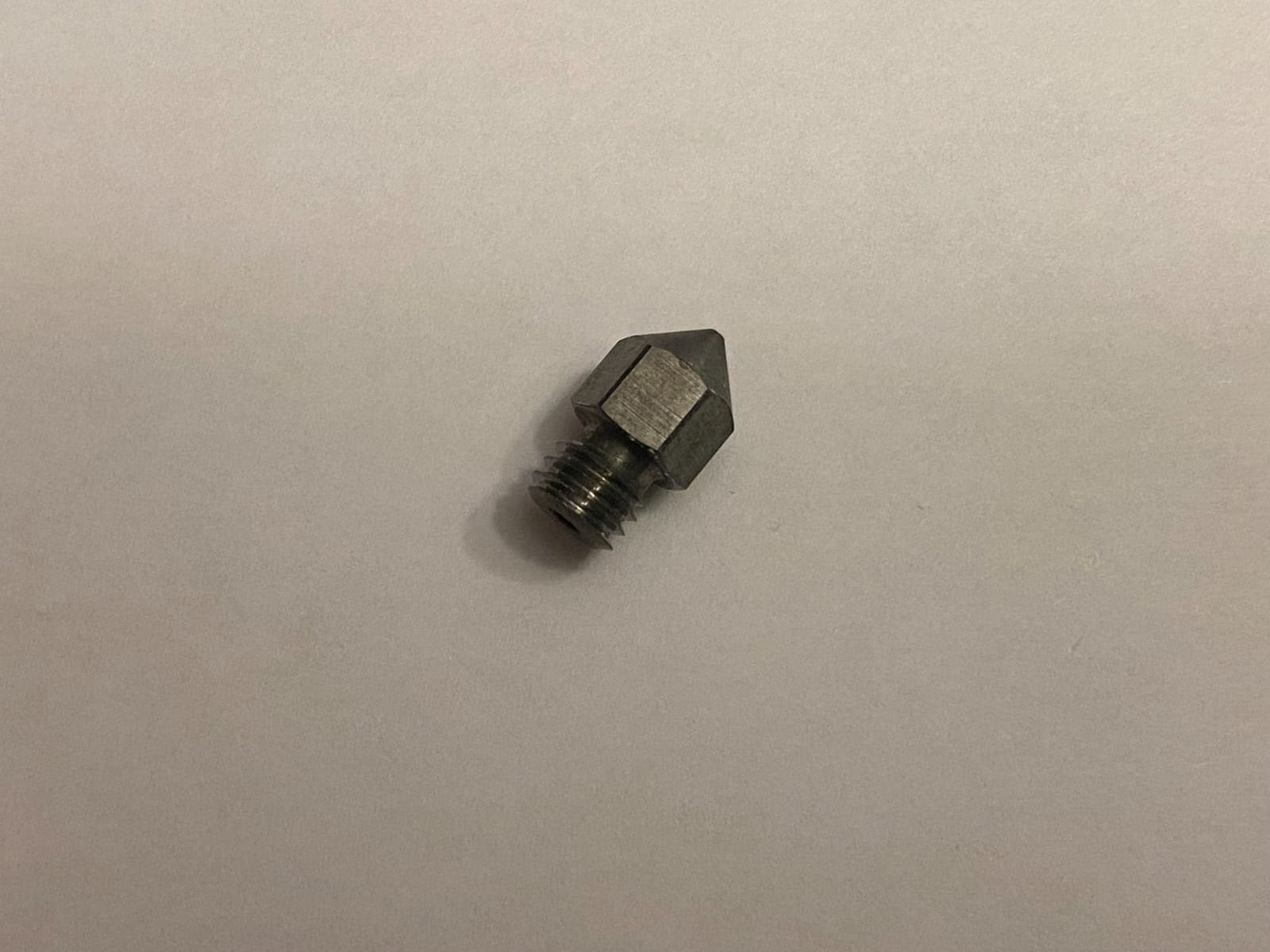
The hardness figure is the other half. At 9 on the Mohs scale it sits alongside ruby and far above hardened steel, which decides how long the orifice stays circular under carbon fiber. Thermal expansion of 4.5 um/m/C also means the bore does not grow measurably during a twelve-hour hot print.
The rating is the weakest in this roundup at 4.3, with a 10 percent one-star share, and it ships as a single nozzle rather than a pack. That is a meaningful cost per piece, and it is why this sits at six rather than at the top.
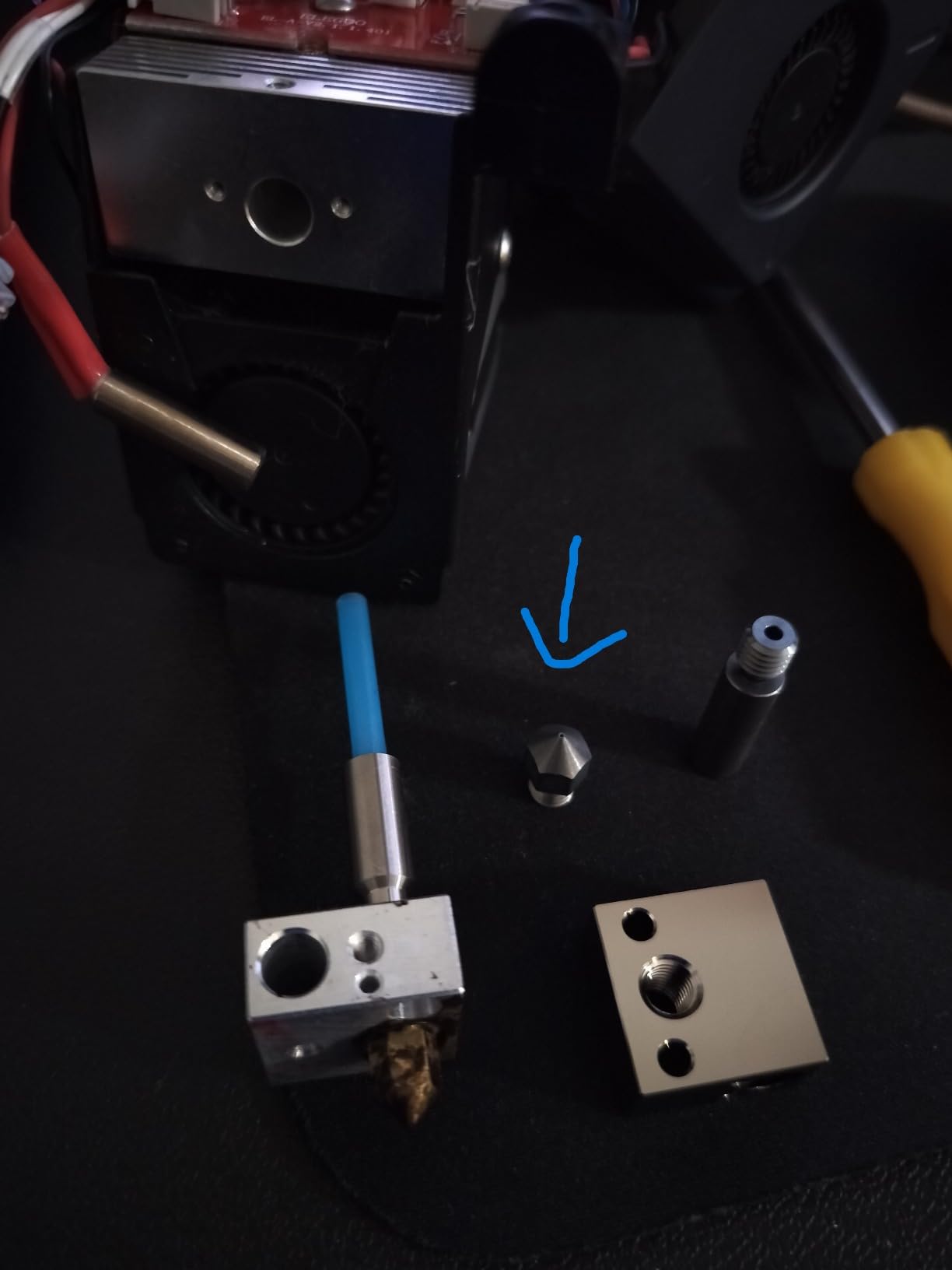
Who should buy the Dawnblade carbide nozzle
Buy it if you run carbon fiber nylon, PEEK or PEI on an MK8 hotend and you print in long sessions. The conductivity figure means you do not have to give up print speed to gain wear life, which is the usual trade-off with ceramic tips.
It is also the safest of the premium tips to handle. Carbide is less brittle than ruby, so a dropped nozzle or an over-tightened heat break is far less likely to end in a snapped tip.
Who should skip it
Skip it if you print abrasive filament once or twice a year. The cost per nozzle assumes hundreds of hours of use, and occasional prints never amortise it.
Skip it if you are on a V6 hotend. This is a single-nozzle MK8 part and it will not thread into a V6 assembly.
7. DUROZZLE Ruby 0.8mm for QIDI X Series – Best for QIDI Printers
DUROZZLE Ruby Nozzle 0.8mm for QIDI Q1-Pro/X-Max3 / X-Smart3 / X-Plus3 3D Printer, Hardened & Abrasion Resistant, Nickel Plated Copper
- Ruby tip resists carbon and glass and metal-filled filament
- Copper alloy body moves heat efficiently
- Nickel coating resists debris sticking and oxidation
- Funnel-shaped bore avoids dead corners
- Fits only QIDI Q1-Pro and X-series printers
- Ruby is more brittle than tungsten carbide and needs care
- No customer review text was returned for this listing
A genuine ruby tip seated in a nickel-plated copper alloy body, cut for the QIDI Q1-Pro, X-Max3, X-Smart3 and X-Plus3. Ruby sits at the top of the Mohs hardness scale, so for pure abrasion resistance this is among the most durable nozzles available for filled filament.
The 0.8 mm bore is the quiet advantage. Fiber bundles that bridge and jam a 0.4 mm opening pass through 0.8 mm without packing, and the wide bore also raises volumetric flow so a heavy composite print moves faster than the same geometry at 0.4 mm. The polished funnel-shaped cut reduces the accumulation points where carbonised material normally forms.
Two cautions. Ruby is brittle compared with carbide and needs careful handling during swaps, and the fit is narrow. Note also that community enthusiasm for ruby on carbon fiber outruns the technical record: the same hard tip that resists abrasion can bridge and clog on PETG-CF in a tight bore, which is why we would reach for carbide first at 0.4 mm.
Who should buy the QIDI ruby nozzle
Buy it if you own a QIDI X-series or Q1-Pro and print large structural parts in filled filament. A 0.8 mm bore plus a ruby tip is the combination that keeps a big composite job moving without stopping to clear the nozzle.
It also suits anyone who wants maximum surface hardness on top faces that will be handled, sanded or abraded after printing.
Who should skip it
Skip it if you print PETG-CF at 0.4 mm for detail. A tight bore with a hard tip is a clog risk on that specific filament, and carbide is the safer recommendation.
Skip it if you drop nozzles regularly, or if you need a part that fits something other than the QIDI X mount. There is no V6 or MK8 version of this body.
8. DUROZZLE Tungsten Carbide V6 0.4mm – Best for V6 Hotends
- Carbide is less brittle than ruby with near-ruby abrasion resistance
- About 3x ruby conductivity so melt flow stays near brass
- Nickel coating resists sticking and copper oxidation
- Funnel-shaped polished bore cuts carbonisation risk
- No customer review text was returned for this listing
- Highest cost among the 0.4mm options here
- Compatibility is limited to V6-style hotends
The carbide option for V6 hotends, built as a tungsten carbide tip on a nickel-plated copper alloy body. That pairing is deliberate: copper carries heat away from the melt zone, nickel gives a hard non-stick outer surface, and the carbide tip is the only part the filament ever touches.
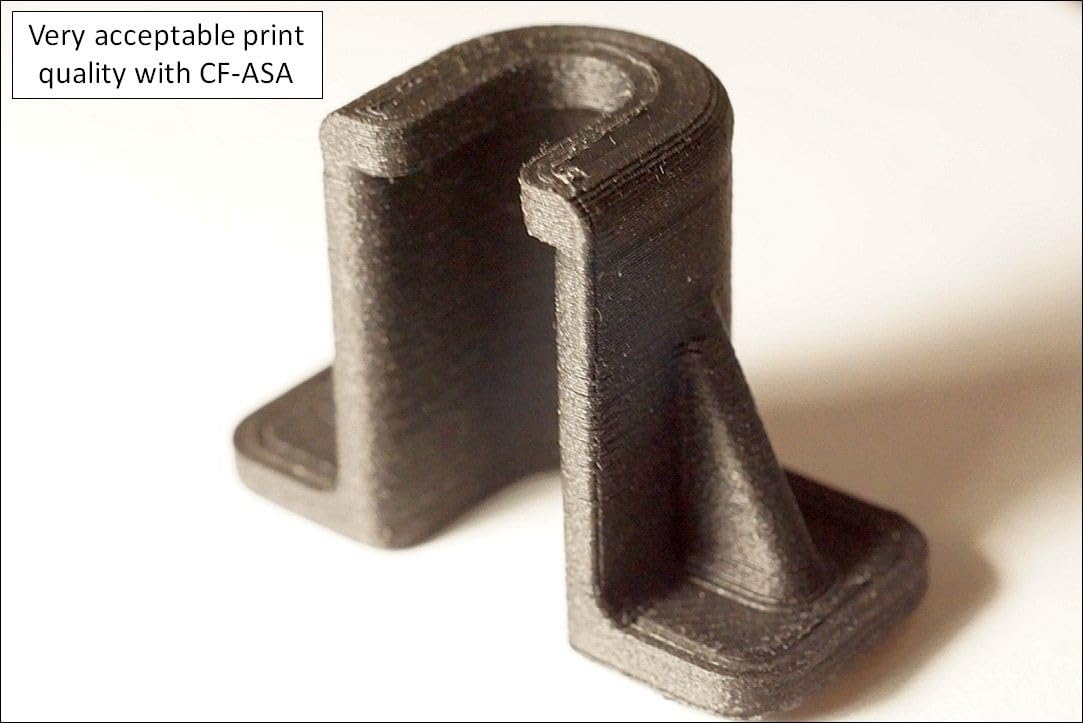
The funnel-shaped polished bore is worth noting because dead corners are where composite plugs form. A smooth transition from inlet to outlet means softened material slides through rather than sitting on a ledge and carbonising, which is the most common cause of a clog that returns right after you clear it.
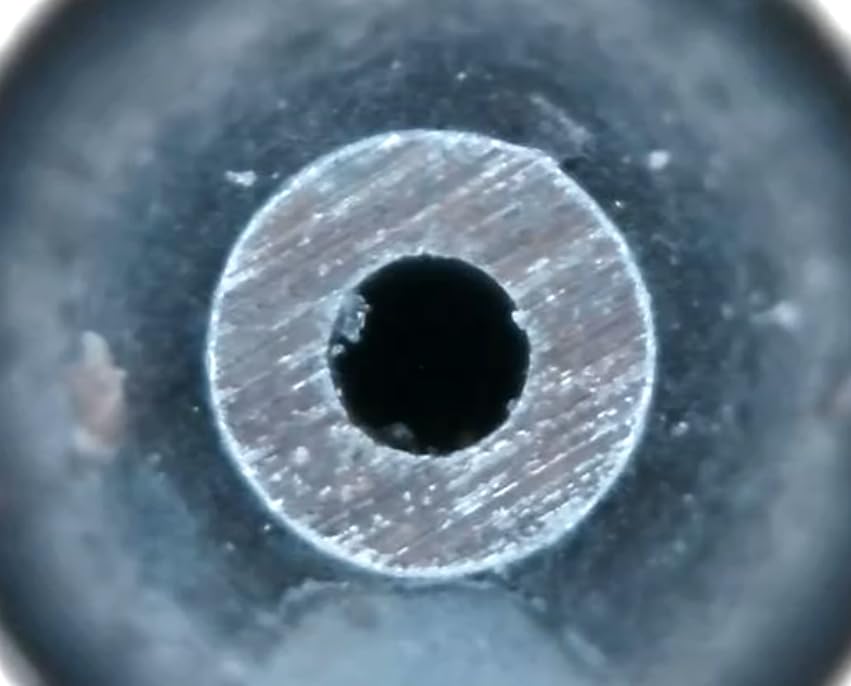
Compatibility is wide for a V6 part – Prusa i3 MK2 through MK3S, MINI, and Anycubic i3 Mega, Mega X, Mega S, Kobra and Kobra Neo are all listed. The rating is 4.4 from 40 ratings and no individual review text was returned for this listing, so treat the specification as the guide and check the fit before your first long job.
Who should buy the DUROZZLE carbide V6 nozzle
Buy it if your machine is V6-based and you are moving from occasional carbon fiber to regular composite work. Carbide is the sensible step up from hardened steel once you notice yourself replacing nozzles every few weeks.
It is also the right pick for anyone who has damaged a ruby nozzle. Carbide tolerates the same handling and the same over-tightening without chipping.
Who should skip it
Skip it if you print abrasive filament occasionally. A single-nozzle carbide part above the hardened options only pays back if you use it hard.
Skip it if you need a wider bore. This is 0.4 mm only, and while the funnel shape helps it does not replace the clearance a 0.6 mm bore gives you on fiber.
9. Creality 8 Pack Hardened MK8 Multi-Size Set – Best Size Coverage
- Widest size range covering 0.2 to 1.0mm
- Hardness beyond HRC60 cuts bore abrasion versus brass
- Rated to 450C for carbon fiber and PEEK
- CNC forming keeps input and output holes concentric
- Multi-size pack is harder to track once a nozzle wears
- No customer review text was returned for this listing
- Bore sizes need labelling by hand to stay organised
Eight hardened steel MK8 nozzles spanning 0.2, 0.4, 0.6, 0.8 and 1.0 mm, with a tool storage box and two cleaning needles in the box. Nothing else in this roundup covers that range, and it maps neatly onto how most people print: fine detail on standard filament, 0.6 mm for anything fiber-filled.
Hardness beyond HRC60 is the relevant figure for wear, and 450C covers the high-temperature composites. The CNC one-time forming is the detail that separates this from a cheap pack: keeping the input and output holes concentric produces a smooth, burr-free bore, which is exactly where clogs start.
It fits almost anything with an MK8 heat block, including Ender 3 and 5, CR-10, MakerBot, Reprap and Prusa i3 builds. The genuine weakness is bookkeeping – once a 0.4 mm wears, you need to know which of the eight pieces is which, and they are not individually labelled.
Who should buy the Creality multi-size set
Buy it if you switch between filament types, or between detail and speed work. One purchase covers a 0.2 mm nozzle for miniatures, a 0.6 mm for carbon fiber and a 1.0 mm for fast structural walls, all machined to the same standard.
It is also the best value per nozzle in a pack this size, which makes it the one we would put in a shared workshop drawer rather than on a single machine.
Who should skip it
Skip it if you print one material on one machine. You will end up with five spare diameters you never install, and an unlabelled box is hard to manage once the first nozzle wears.
Skip it if you need PEEK-class endurance. Hardened steel at 450C handles the temperature; it does not handle the abrasive load the way carbide does.
10. DUROZZLE Tungsten Carbide for Flashforge AD5X – Best for the AD5X
DUROZZLE Tungsten Carbide Nozzle 0.4mm for Flashforge AD5X 3D Printer, High Thermal Conductivity Abrasion Resistance for Precision Additive Manufacturing
- One owner logged 350 hours of fiber-infused filaments with no wear
- Matches the factory nozzle dimensions so no Z-offset change
- Heats fast and reduces filament sticking versus the factory tip
- Ships with an extra branded silicone boot
- AD5X profiles are tuned for hardened steel so recalibration is needed
- Heat transfer differs from brass so flow may need reducing
- Dedicated to the Flashforge AD5X only
The carbide upgrade for the Flashforge AD5X, and the strongest endurance claim in the roundup: one owner reported 350 hours across assorted fiber-infused abrasive filaments with the nozzle still going strong. The tip is tungsten carbide on a nickel-plated body, the same material pairing we recommend for continuous composite work.
Fit is the quiet hero. The dimensions match the factory Flashforge nozzle closely enough that it seats in the AD5X quick-swap mount with no Z-offset change, removing the most tedious part of a nozzle upgrade. Owners also report fast heat-up, good heat transfer and noticeably less filament sticking than the factory tip, plus a silicone boot in the box for insulation.
One thing to plan for: the AD5X factory profiles are calibrated for hardened steel, so expect to recalibrate. One tester saw extra stringing until the profile was adjusted. Treat the first print as a tuning print rather than a production print.
Who should buy the AD5X carbide nozzle
Buy it if you run a Flashforge AD5X and print glow-in-the-dark or fiber-filled filament regularly. Glow filament in particular is hard on non-hardened tips, and this is the tier that shrugs it off.
It is also the cleanest upgrade path on this machine, because there is no Z-offset work. If you are going to change the nozzle at all on an AD5X, changing to something harder costs the same labour.
Who should skip it
Skip it if you print only PLA and PETG. The factory hardened nozzle already handles that, and you would be adding a recalibration for no benefit.
Skip it if you have no appetite for slicer tuning, or if you own any machine other than the AD5X. This part does not fit anything else.
How to Tell a Worn Nozzle From a Bad Print?
A worn nozzle degrades quality silently rather than clogging, which is why most people keep printing with one far too long. Five symptoms cover nearly every case, and all of them are things you can check without opening the printer.
First, look at the extrusion line shape. A new 0.4 mm nozzle lays a consistent line; a worn one lays a line with flat spots or a subtle oval, most obvious in a single-wall test print viewed from above. Second, check a calibration cube – once the bore is no longer round, holes come out undersized and outer walls bow outward.
Third, under-extrusion that gets worse as the print continues even though the slicer is unchanged. Fourth, a jump in stringing between layers, which happens when melt flow is inconsistent. Fifth, and the most reliable: pull the nozzle and look down the bore in good light, or check it with a 0.4 mm pin gauge – if the pin catches, the bore has deformed.
Our own habit is simple. Every time we change filament we pull the nozzle at temperature and run a pin gauge through it. Thirty seconds of checking has saved more long composite jobs than any amount of slicer tuning. If you want a repeatable dimensional baseline to compare against, a structured light 3D scanner makes before-and-after bore and part measurements far easier to trust.
Buying Guide: Diameter, Filament Severity, and First Print
For abrasive filament, 0.6 mm beats 0.4 mm. The wider bore clears fiber particles that would bridge in a narrow opening, gives roughly 40 percent faster print time, and produces stronger layer bonding, at the cost of surface detail. If you need fine detail with a composite, print the visible surfaces in standard filament and use fiber-filled material for functional shells and load-bearing sections.
Plain 1.75 mm filament is the standard input and a 0.4 mm nozzle is the standard exit. The two numbers refer to different points in the extrusion path, so 1.75 mm filament through a 0.4 mm nozzle is the normal combination, not a mismatch.
On filament severity, glass fiber nylon and PA-CF are the harshest on a nozzle, followed by PETG-CF, then glow-in-the-dark PLA, wood-fill and metal-fill. Standard PLA, PETG and ABS are not abrasive at all. That ranking tells you where carbide earns its cost: glow and wood-fill are fine on hardened steel, while daily nylon composites are the break-even point for carbide or diamond.
Nozzle material properties from the picks in this roundup, in plain terms:
Hardened tool steel – hardness beyond HRC60, 26 W/m k thermal conductivity, 450C maximum, offered in both MK8 and V6 bodies.
Solid tungsten carbide – 9 Mohs hardness, 130 W/m k thermal conductivity, 550C maximum, offered in an MK8 body.
Carbide on nickel-plated copper – near-ruby abrasion resistance with roughly 3 times ruby’s conductivity, in V6 and AD5X bodies.
Plated brass – brass core with a high-lubricity wear coating, brass-level melt flow, MK8 body.
Genuine ruby tip – top of the Mohs scale, 45 W/m k thermal conductivity, offered in a 0.8 mm QIDI X-series body.
That conductivity column is the trade-off most people miss. Hardened steel moves heat about five times worse than tungsten carbide, which is why steel nozzles want noticeably higher temperatures and can cost you layer adhesion. Carbide gets hardness without the melt-flow penalty; ruby gets hardness with a penalty.
Once the nozzle is fitted, the sequence matters. Hot-tighten it: heat the hotend to roughly 20C above your normal print temperature, tighten the heat break while everything is expanded, and torque it into the 1.5 to 2.5 Nm range so the seal compresses rather than cracks. Add a silicone sock if your machine accepts one, and it buys you time between heat creep events.
Then recalibrate the slicer, because a change of nozzle material or diameter invalidates the profile. Re-run a flow or extrusion multiplier test, reset line width and extrusion width to match the new bore, and update your maximum layer height. A 0.6 mm nozzle on a profile still set for 0.4 mm is the most common reason people think a new nozzle prints worse than the old one.
Finally, dry your filament before you blame the nozzle. PETG-CF dried at 70 to 80C for four to six hours flows far more predictably, and moisture in a composite is the most common cause of the plugs that send people shopping for a harder nozzle they do not need. If you are scanning parts to reverse-engineer a design, a 3D scanner keeps the geometry honest while you swap materials.
Frequently Asked Questions
What is the best nozzle for carbon fiber filament?
Hardened steel is the minimum for carbon fiber filament, tungsten carbide for heavy or continuous use, and brass will ovalise within a single 1 kg roll. In practice, buy hardened steel in the correct thread for a few spools a month, and step up to tungsten carbide when you print PA-CF or PEEK-class composites daily.
Is a 0.6 mm or 0.4 mm nozzle better for abrasive filament?
For abrasive filament, 0.6 mm wins. The wider bore clears fiber particles that bridge in a 0.4 mm opening, prints roughly 40 percent faster, and bonds layers more strongly. The cost is surface detail, so keep 0.4 mm for cosmetic work and 0.6 mm for anything filled.
What is the most abrasive filament?
Glass fiber nylon and PA-CF are the most abrasive, then PETG-CF, then glow-in-the-dark PLA, wood-fill and metal-fill. Standard PLA, PETG and ABS are not abrasive at all. The harsher the filament, the more the replacement interval shortens on a hardened steel nozzle.
How long does a brass nozzle last with carbon fiber filament?
Not long. A 0.4 mm brass nozzle has been documented expanding to 0.8 mm after a single 1 kg roll of PETG-CF, and glass fiber nylon can ruin brass in a fraction of that. Hardened steel typically lasts tens of kilograms, and tungsten carbide lasts far longer still.
What causes nozzle clogs with carbon fiber filament?
Usually undried filament or charring of the binder in the melt zone, not the nozzle itself. Dry PETG-CF at 70 to 80C for four to six hours, keep the hotend clean, and print a purge line after a change. A too-narrow bore is the second cause, which is why 0.6 mm is the standard abrasive diameter.
Are ruby nozzles worth it for carbon fiber?
Ruby is exceptionally hard and resists abrasion, but it is more brittle than tungsten carbide and can bridge and clog with PETG-CF in a tight bore rather than outlasting hardened steel. Carbide gives similar hardness with better thermal conductivity and less handling risk, so it is usually the safer recommendation.
Our Verdict
Our pick for the best 3d printer nozzles for abrasive filament is the Mudder five-pack of hardened tool steel MK8 nozzles: the deepest review history in the group, a verified round bore, and wear reports of a carbon PLA survivor after more than a kilogram of filled filament. Add the Creality multi-size set if you need 0.6 and 0.8 mm coverage in one box, and step up to tungsten carbide only when hardened steel starts leaving you mid-project.
Whichever you choose, match the thread before the material, budget for a 0.6 mm bore on any filled filament, and dry your spools before you blame the nozzle. Use the buttons above to check the current listing for each model, and treat this 2026 guide as current as of this writing.