
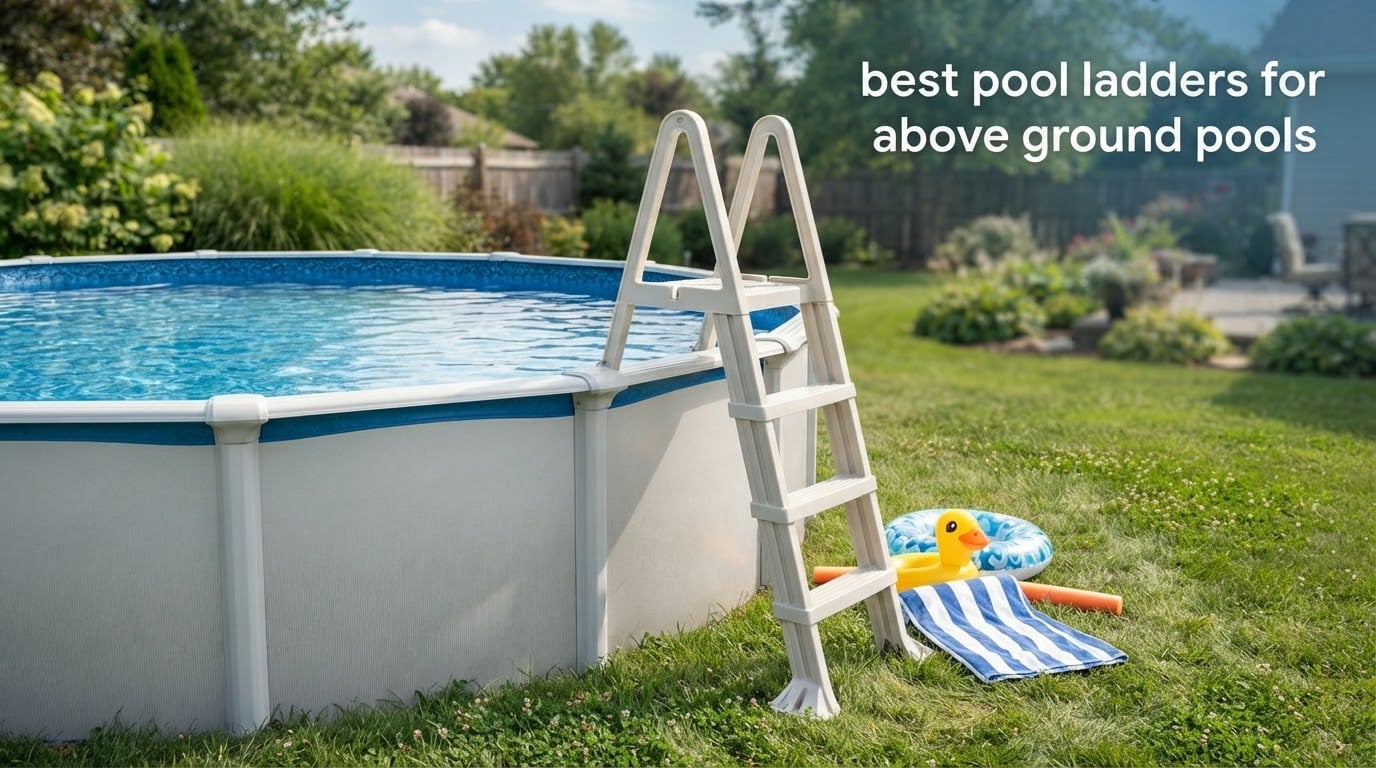
The best pool ladder for above ground pools is one that matches your wall height, carries more weight than you need, and stays put when a child grabs the rail. Our top pick is the Confer 7200 Roll Guard, a resin A-frame with a lockable barrier that fits 48 to 56 inch walls. For a deck-mounted pool, the Confer 6000X is the sturdier in-pool option.
Most above ground ladders are an afterthought, the flimsy unit folded into the box with the pool. Owners on r/AboveGroundPools talk about replacing that factory-supplied ladder constantly, and the complaints are always the same three: it drifts away from the wall, it leans when someone climbs it, and its steps flex under a 200 pound adult. Those are fixable problems, but only with a heavier, better-anchored unit.
We compared ten of the most widely reviewed pool ladders for above ground pools, covering free-standing A-frames, deck-mounted in-pool models and gated stairs. Below you get the full spec breakdown, honest pros and cons, and the safety details that matter most when small kids are around. If you are still choosing the pool itself, start with our guide to the best above ground pools so the wall height matches your ladder choice.
Table of Contents
Top 3 Pool Ladder Picks for 2026

Confer 7200 Roll Guard A-Frame
- Fits 48-56 inch walls
- Lockable roll-guard barrier
- 5 x 18 inch steps
- 300 lb capacity

Confer 6000X Heavy Duty In-Pool
- Deck mount for 46-56 inch heights
- Anti-entrapment barrier
- Flat treads
- 300 lb capacity

Confer 635-52X In-Pool Ladder
- Deck mount for 46-56 inch heights
- Three flat steps
- Rust-free plastic
- 250 lb capacity
Our editor’s choice goes to the model with the strongest combination of rating and review volume on the list, plus the barrier hardware that no other free-standing option in this group matches. The two Confer deck ladders fill the in-pool and value roles because they are the only picks here with anti-entrapment step design and a full 46 to 56 inch adjustment range.
All 10 Pool Ladders Side by Side in 2026
| Product | Specifications | Action |
|---|---|---|
| Confer Plastics 7200 Roll Guard A-Frame |
|
Check Latest Price |
 Bestway Flowclear 52 in Pool Ladder Bestway Flowclear 52 in Pool Ladder |
|
Check Latest Price |
| Confer 6000X Heavy Duty In-Pool Ladder |
|
Check Latest Price |
 Intex 28067E Steel Frame 52 inch Step Ladder Intex 28067E Steel Frame 52 inch Step Ladder |
|
Check Latest Price |
| Confer 635-52X In-Pool Ladder |
|
Check Latest Price |
 Bestway 48 inch A-Frame with Metal Frame Bestway 48 inch A-Frame with Metal Frame |
|
Check Latest Price |
 Blue Wave Premium Stainless Steel In-Pool Ladder Blue Wave Premium Stainless Steel In-Pool Ladder |
|
Check Latest Price |
 Funsicle 52 inch SureStep Pool Ladder Funsicle 52 inch SureStep Pool Ladder |
|
Check Latest Price |
 Vinyl Works AF Adjustable 24 Inch Ladder Vinyl Works AF Adjustable 24 Inch Ladder |
|
Check Latest Price |
 Intex 28077E Heavy Duty Deluxe Ladder Intex 28077E Heavy Duty Deluxe Ladder |
|
Check Latest Price |
Pool Ladder Safety: What To Check Before Anyone Climbs
Above ground ladders fail in predictable ways, and almost every failure traces back to three things: a frame that is not heavy enough, a fit that is not tight, and a way for a small child to get past the barrier. Fix those and most ladders are fine. Ignore them and you have a tipping hazard on your hands.
An anti-entrapment barrier is a physical obstruction between the ladder’s steps and the pool wall, so a child cannot slip underneath and become wedged in the gap where the ladder meets the liner. Only two picks here, the Confer 6000X and the Vinyl Works AF, list entrapment-designed step geometry as a feature. The Vinyl Works model adds an outward-opening gate that is self-closing, self-latching and lockable, and the Confer 6000X is built to current ISPSC barrier codes.
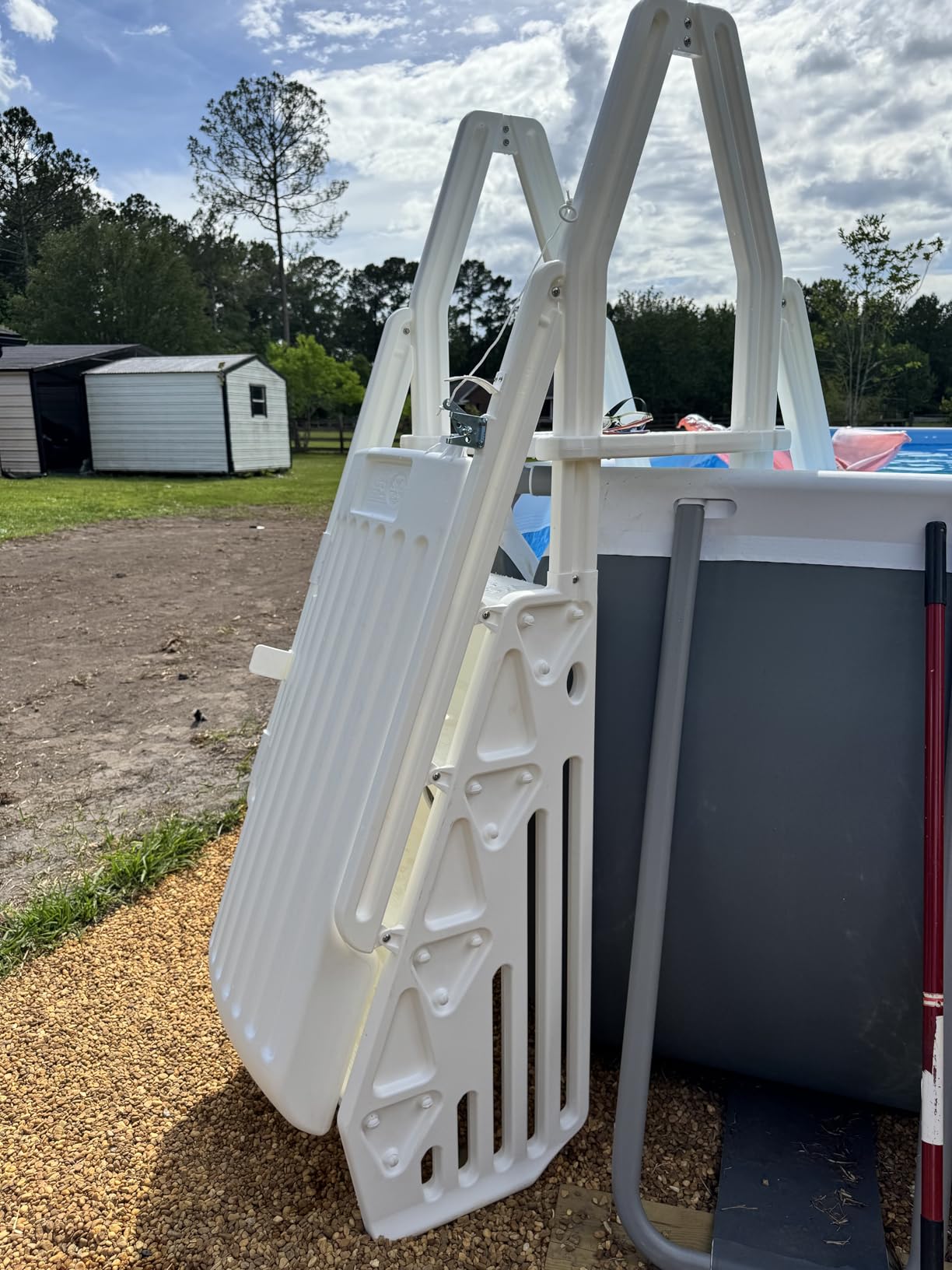
On a free-standing A-frame, the barrier works differently. The ladder hangs over the pool wall, and the opening beneath the top platform is the risk. The Confer 7200 answers it with a roll-guard barrier that swings up and locks, plus inner side rails with integrated side barriers that block the gap between ladder and wall.
Removable steps are the safest option of all, because a pool with no steps attached has no way in at all. The Intex 28077E takes this approach. It is the least convenient choice in this roundup, since you pull the steps out every time the family finishes swimming, and several owners note the reinstall adds friction to pool time. Safety-wise it is hard to argue with.
Stability is the other half. A ladder that leans when a child pulls on the top rail can fold into the water. Ballast first, anchoring second, and treat any ladder whose side rails bow under a sideways push as finished. Members on r/AboveGroundPools describe bent rails and collapsing frames as the moment they decided to replace their ladder, and that is exactly the failure a heavier resin or stainless unit prevents.
1. Confer 7200 Roll Guard A-Frame Ladder – Best Overall for Above Ground Pools
- Lockable barrier with integrated inner side rails
- Extra-large top platform and wide steps
- Fits toprails up to 14 inches wide
- Side rails ballast with water so no sand needed
- Made in the USA with a 4.4 rating from 5140 reviews
- Must be bolted to the pool frame
- Not for soft-sided or inflatable pools
- Converting to in-pool needs a separate CK7200 kit
This is the ladder I would put on a pool with no deck and children in the yard. The build is the point: 5 by 18 inch steps, curved side rails and an extra-large top platform, which together make the climb far less wobbly than a narrow-budget A-frame. Seventy percent of its 5140 reviews are five-star, and the praise clusters on exactly those two features, the steps and the barrier.
Unlike most resin A-frames, it does not need sand. The side rails fill with water, which is a real advantage if you have a vinyl liner and no clean sand on hand. The lock for the roll guard is included, so you are not hunting for a padlock on installation day. Owners who upgraded from a factory-supplied ladder report a noticeable jump in stability, and r/AboveGroundPools members cite the roll guard as the single most common upgrade they have made.
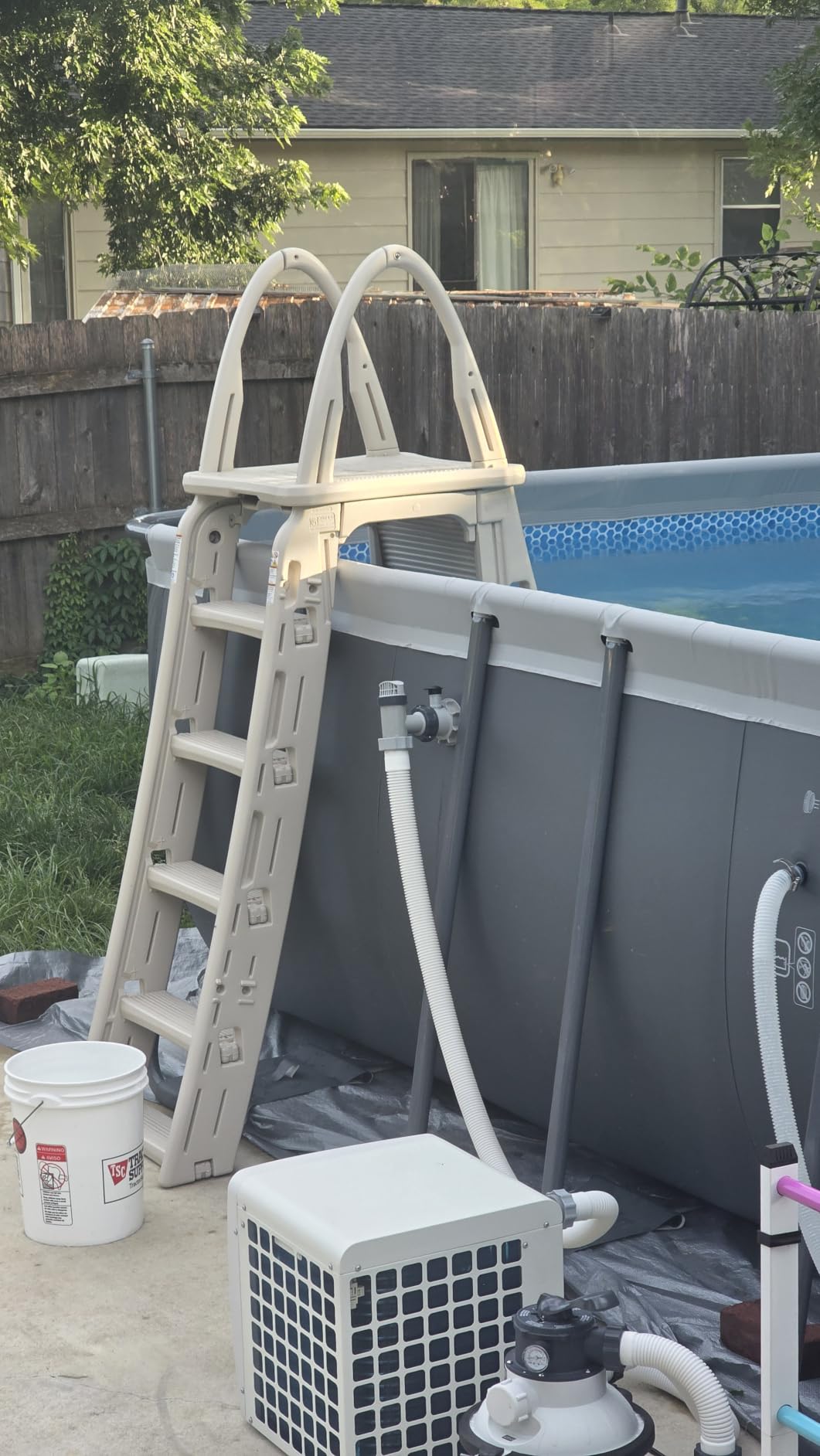
Fit is the one thing you cannot fudge. It handles 48 to 56 inch walls and toprails up to 14 inches wide, which covers most steel-frame and inflatable-frame pools, but it must be attached to the pool frame. That attachment is non-negotiable: the unit is meant to hang from the top rail, and owners who skip it are the ones posting about wobble. It also will not work on soft-sided pools at all.
At 56 pounds, it is among the heaviest ladders in this roundup, and assembly is not a one-person afternoon job. If you also want it as an in-pool ladder, the CK7200 conversion kit is a separate purchase. Both are fair trade-offs for the barrier hardware, and neither applies to you if you only ever need a deckless A-frame.
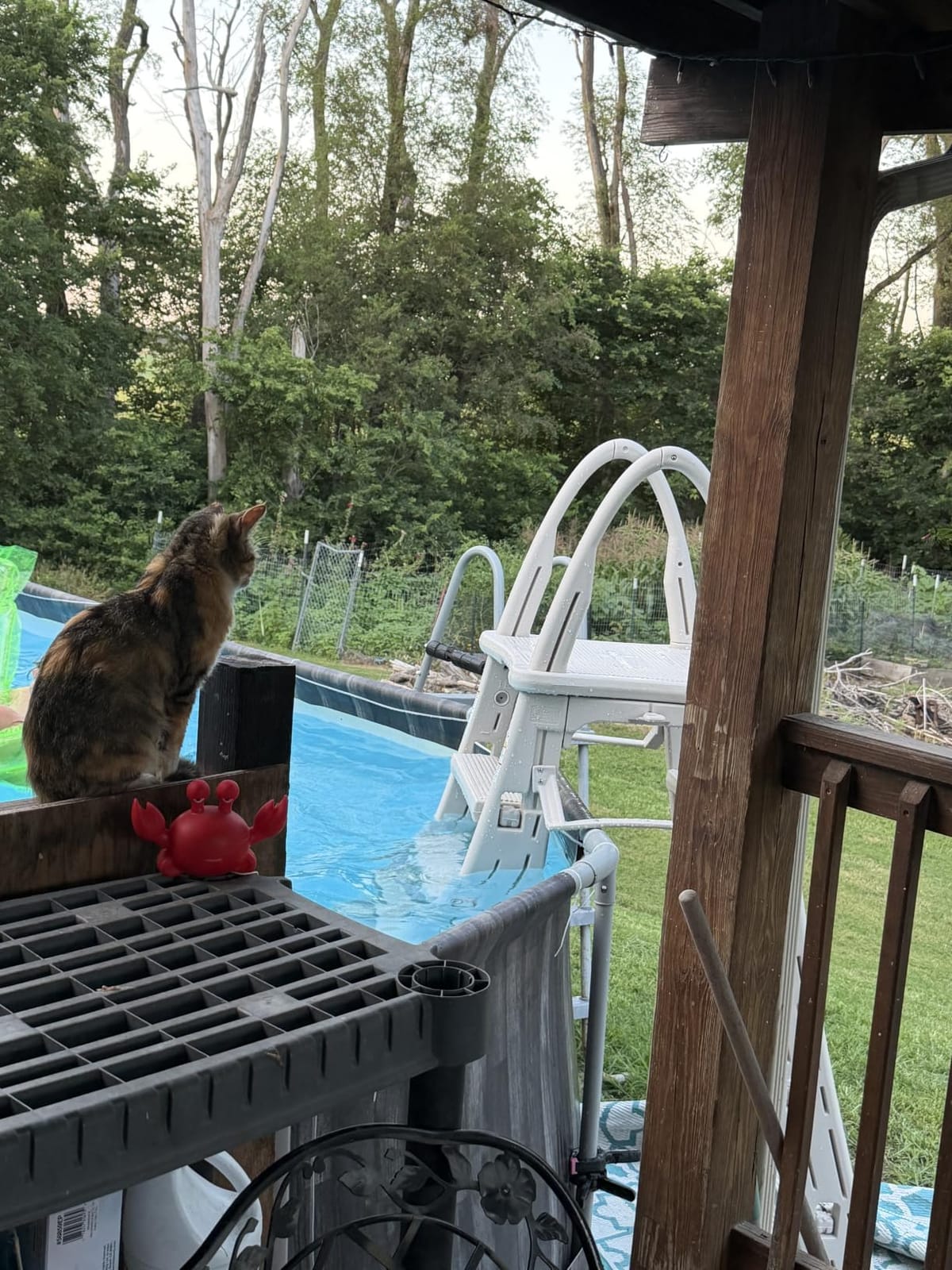
When this ladder is the right call
Choose it when your pool has no deck, your wall falls between 48 and 56 inches, and young kids or heavy swimmers are part of the picture. The lockable barrier is the deciding factor for most families, and the wide steps help older adults who find narrow rungs awkward. It is the safest free-standing option among the picks in this group.
Measure your top rail width before you commit. Anything wider than 14 inches is out, and that rules out a handful of oversized pools. If your top rail is comfortably inside the range, this is the pick I would buy without hesitating.
When to choose something else
Skip it for inflatable and soft-sided pools, since there is no frame to bolt to. Choose a different model if you have a deck, since this ladder sits outside the pool and the deck-mounted options are steadier there. Budget buyers should also weigh whether the barrier hardware matters enough to justify the price gap over a plain steel A-frame.
Owners do report the unit is rigid once mounted but noticeably heavy to reposition. Plan to install it once at season start rather than dragging it in and out of the water. Treat the permanent mounting as a feature, not a limitation, and the drift problem disappears.
2. Bestway Flowclear 52 inch Pool Ladder – Most Versatile
- Covers most 48 and 52 inch pool walls
- Simple assembly with no barrier hardware
- Light at 25.3 pounds so it is easy to reposition
- Available in 48 and 52 inch variants
- No top platform to stand on
- Frame flex reported when climbing
- No gate or anti-entrapment barrier
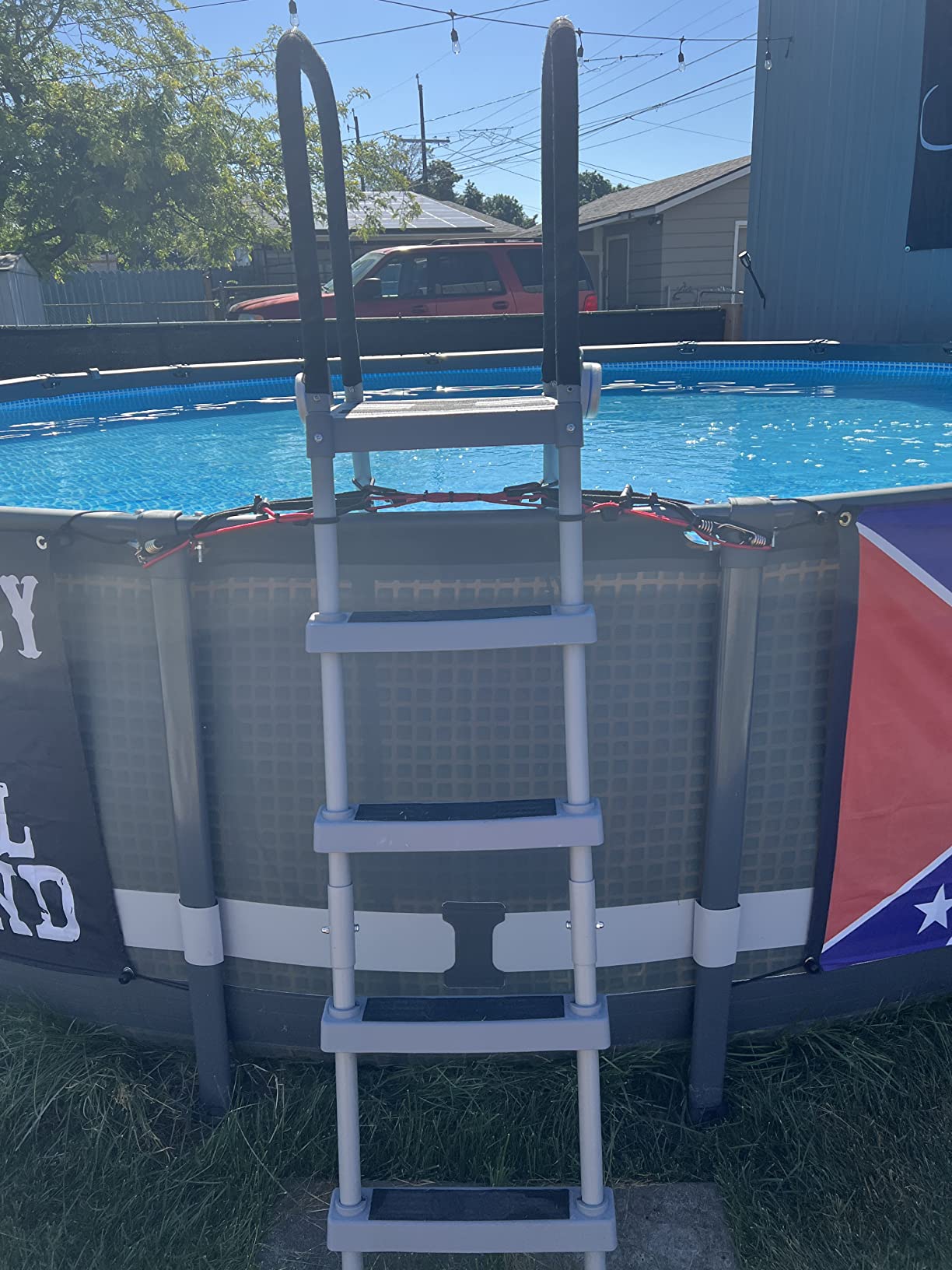
Most above ground pools ship with a ladder in this class, and the Flowclear is the same idea done slightly better. It is a four-step, corrosion-resistant metal ladder sized for pools up to 52 inches, and it assembles without any tools that matter. At 25.3 pounds it moves easily, which matters for anyone repositioning it at the start of each season.
Buyers treat it as a dependable no-frills option. The 66 percent five-star share reflects an honest expectation set: this ladder fits a standard wall, holds up outdoors, and does not try to solve problems it was not designed for. If your pool is a straightforward 48 or 52 inch wall and your swimmers are adults, it does the job without ceremony.
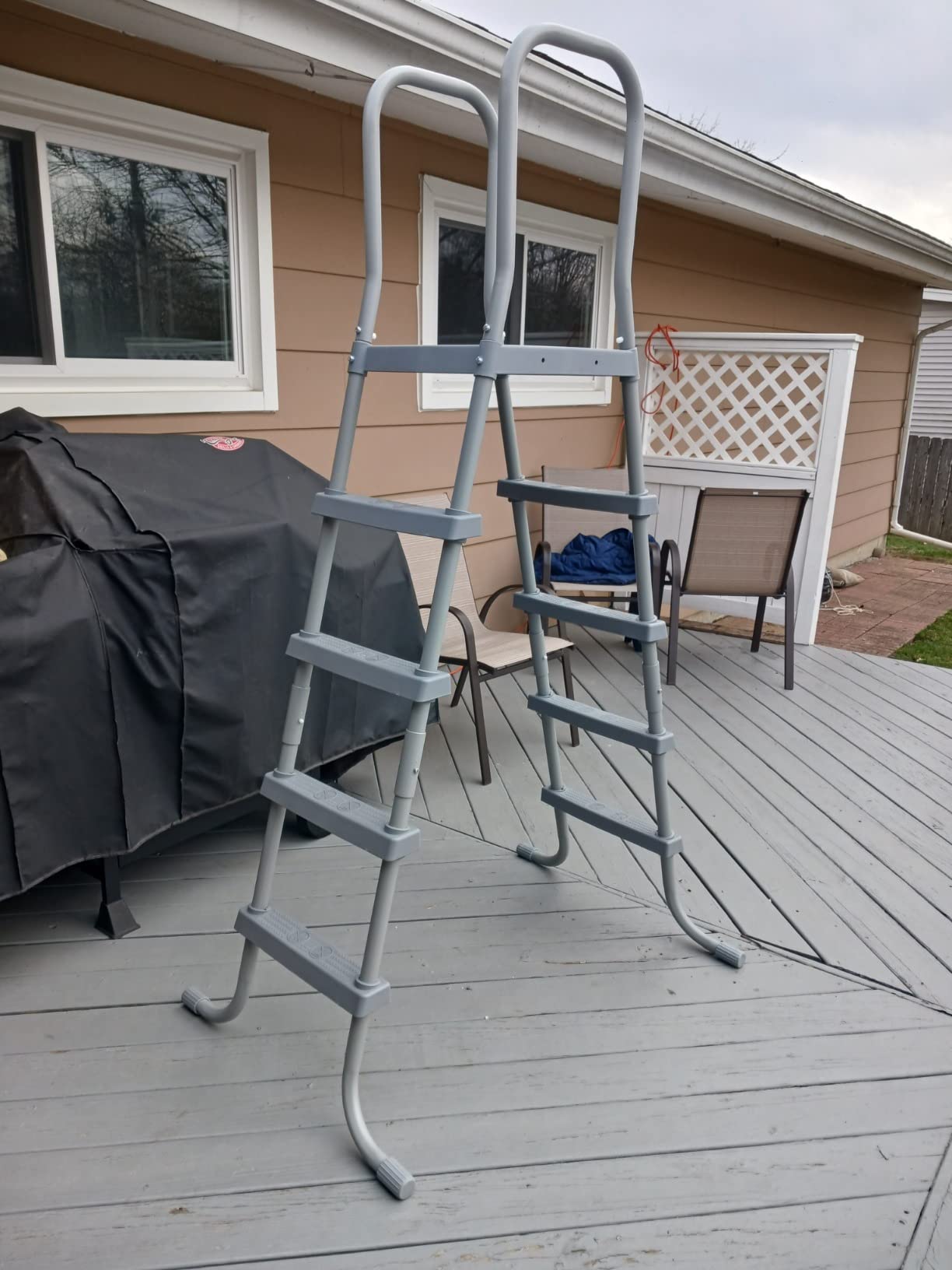
The complaints are consistent and worth stating plainly. A nine percent one-star group cites frame flex and wobble on entry, and there is no top platform, so you are climbing straight off the last step rather than stepping up to stand. That is a real issue for anyone helping a child in or out of the water.
There is also no barrier of any kind, so this is not a ladder for a yard where a toddler wanders unsupervised. Salt water is another watch point: the frame is described as corrosion-resistant, but owners near the coast report surface wear over multiple seasons. Inland and freshwater pools see far fewer complaints.
When this ladder is the right call
Pick it when you want a simple, no-frills option for a 48 or 52 inch wall, the pool has no young children, and nobody needs a top platform. It is also the easiest to move, so it suits seasonal setups where the ladder comes in with the water. Owners replacing a missing or broken factory ladder will find it familiar to assemble.
If your swimmers are adults under 300 pounds and you are on a tight budget, this is the sensible buy. You give up the barrier, the platform and the rigidity, and you get a ladder that fits and lasts.
When to choose something else
Move up if flex bothers you under load, if you need a place to stand while entering, or if children use the pool. There is no halfway fix for the first two problems, since neither a strap nor a bracket changes the frame itself. Coastal owners should consider a resin or stainless model instead.
It is also the wrong shape for a deck-mounted pool, because it sits entirely outside the wall. If your pool is built into a deck, you need an in-pool unit with flanges. That choice is worth making before you buy anything from this list.
3. Confer 6000X Heavy Duty In-Pool Ladder – Best Premium In-Pool Pick
- Holds steady against strong pump current once ballasted
- Anti-entrapment barrier and flat treads
- Ten pounds of sand needed for walls over 48 inches
- Five-year manufacturer warranty
- Made in the USA
- Two-person assembly realistically required
- Plastic rungs are hard on bare feet
- Barrier pieces can pop loose without added weight
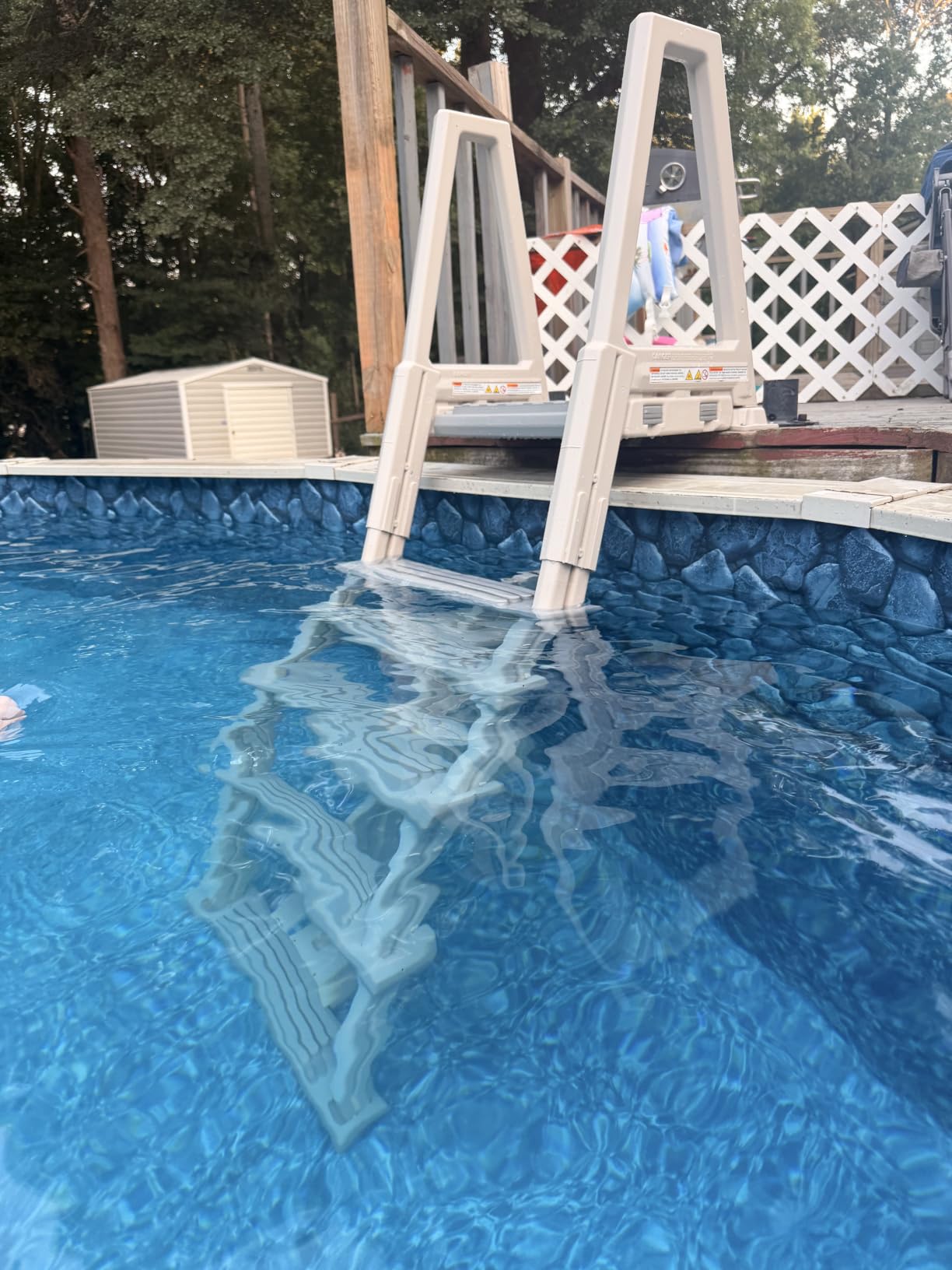
This is the in-pool ladder to beat for a pool set into a deck. It adjusts from 46 to 56 inches of deck height, carries 300 pounds, and its anti-entrapment barrier is designed to current ISPSC codes, which is a level of detail almost nobody in this category bothers with. All mounting hardware and the deck platform ship in the box.
Stability is the headline. Owners with aggressive pump setups report it does not sway or float up even with heavy circulation, and 72 percent of the 2928 reviews are five-star. Reviewers also note no rust after a full season, which is expected from resin and is the main reason to choose plastic over steel for an in-pool unit.
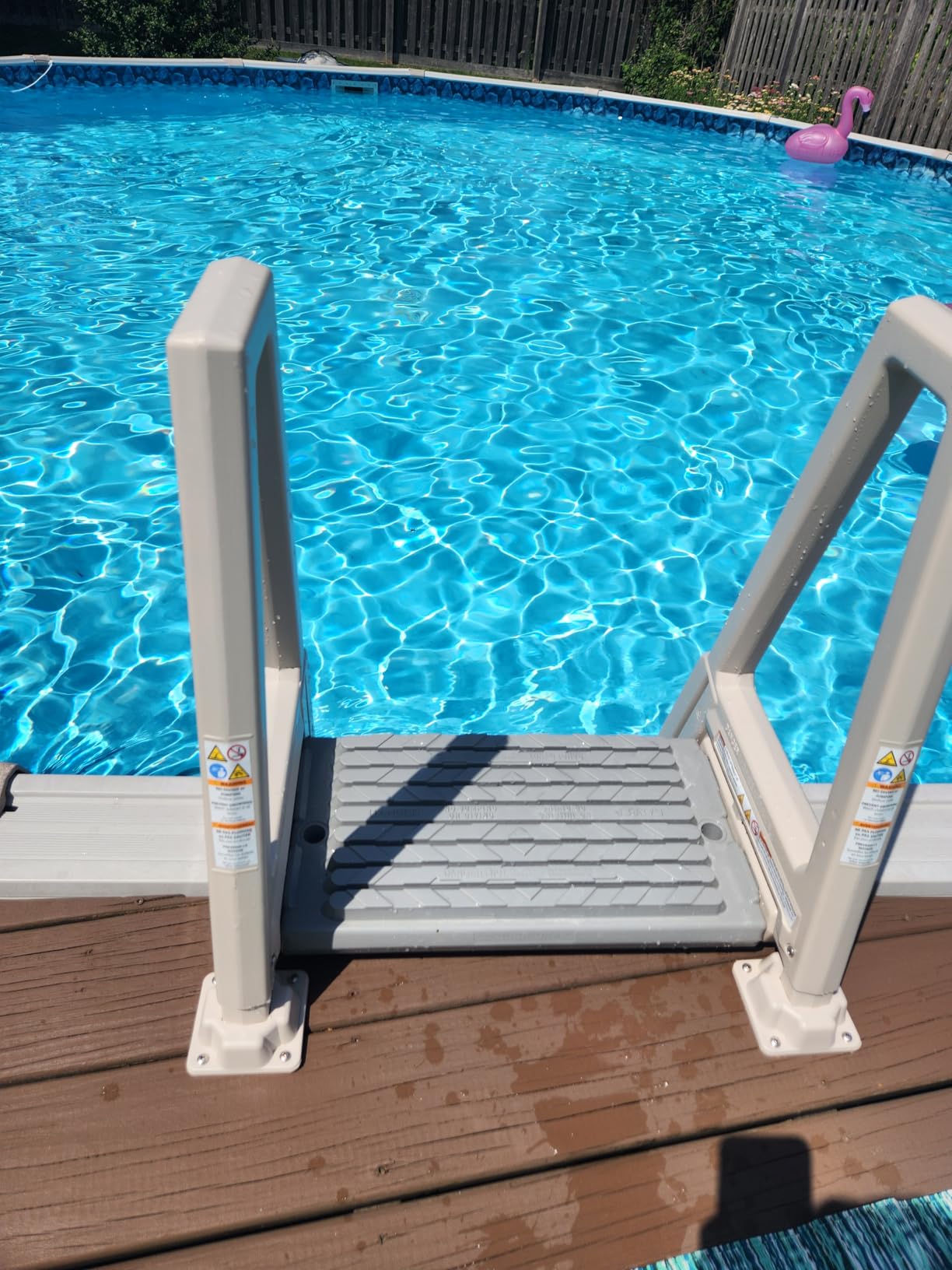
Ballast is the part people skip. If your deck is taller than 48 inches, the ladder needs 10 pounds of sand, and sand is not included. Skip that and the barrier pieces can pop loose, which several reviewers report as their main assembly complaint. Fill the barrier sections with sand or water and the problem disappears.
Assembly is genuinely a two-person job, and the accompanying instructions are unhelpful, though an instruction video is included. The plastic rungs are comfortable enough for adults in footwear but a number of owners call them hard on bare feet. Dogs, interestingly, are cited as climbing them without complaint.
When this ladder is the right call
Choose it when your pool is built into a deck between 46 and 56 inches high and you want barrier-compliant access rather than a basic ladder. It suits families with young children, and the 300 pound rating covers heavier adults. Owners replacing a tired resin ladder value the five-year warranty.
Plan for the sand ballast as part of the purchase, not an afterthought. Once it is filled and mounted, the stability complaints that plague cheaper in-pool ladders largely go away. That is the reason this one earns its place in the top three.
When to choose something else
Skip it if your deck is shorter than 46 inches or if you have no deck at all, since this unit bolts to decking and does not stand alone. If your deck is taller than 56 inches, the optional 6000X-EXT extension kit takes it to roughly 68 inches, which is an extra part to plan for.
Bare-foot comfort is the other soft spot. If your family will climb without shoes and someone has sensitive feet, a stainless ladder with textured treads is the better texture. The plastic is also not perfectly rigid, so anyone who hates any movement at all should look at the steel alternative.
4. Intex 28067E Steel Frame Pool Ladder – Best For Intex Pools
Intex 28067E Steel Frame 52″ Pool Entry Step Ladder with Secure Non-Slip Steps for Above Ground Outdoor Swimming Pools, Silver
- Top platform gives kids a place to stand
- Assembles in minutes
- Coated corrosion-resistant frame
- Well regarded as a replacement for an aging Intex ladder
- Considerable step flex while climbing
- Coated hardware can rust in salt water
- Usable capacity feels well under the stated 300 pounds
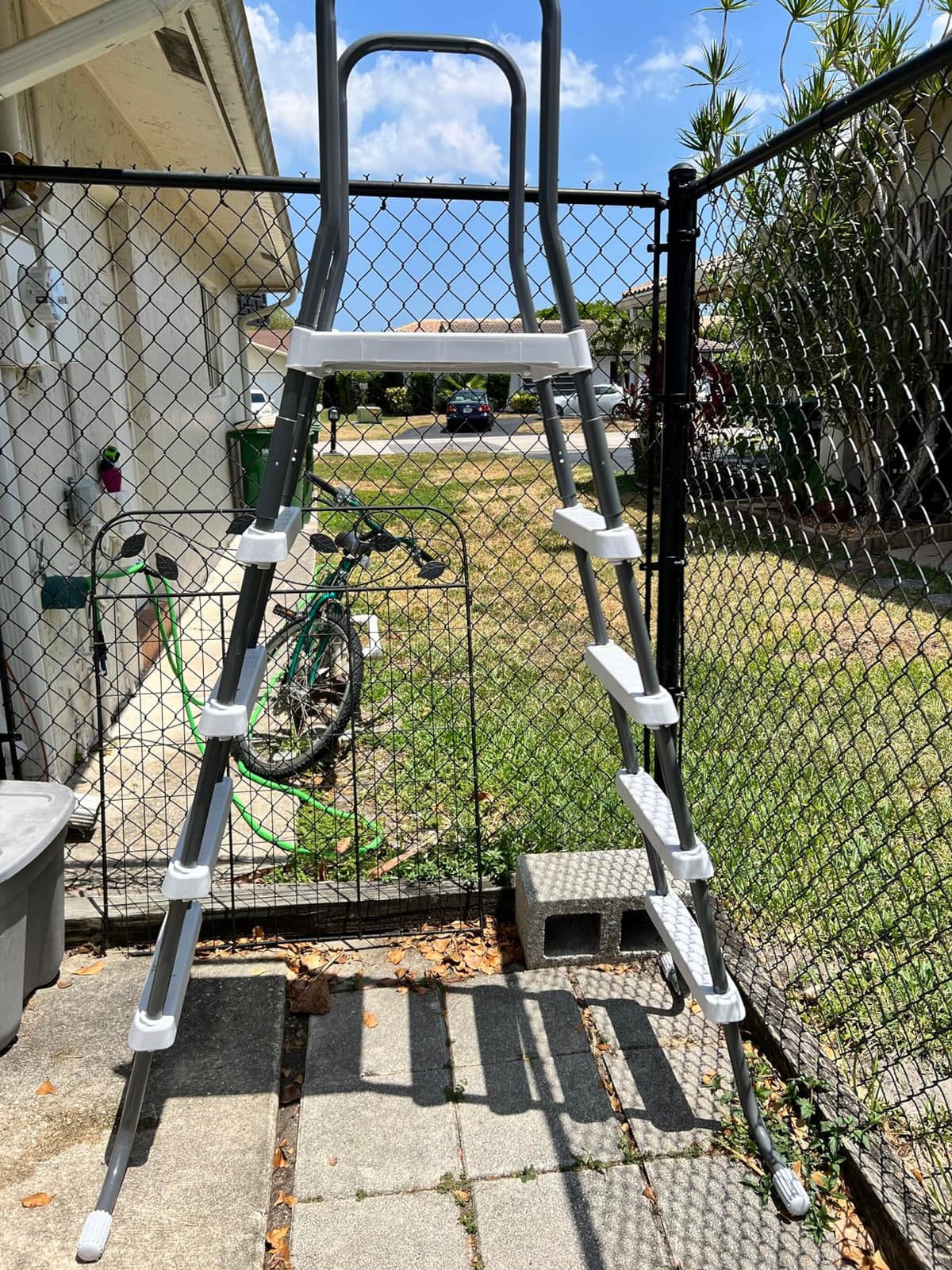
Built for 52 inch Intex walls specifically, with four high-impact slip-resistant steps on a coated steel frame and a 300 pound rating. The top platform is what separates it from most ladders at this level, since it gives a child somewhere to stand before dropping into the water. It is also the easiest assembly in this roundup.
Owners overwhelmingly use it as a replacement part. Reviewers describe replacing a rusted or degraded original Intex ladder with this one as a quick afternoon fix that instantly improves the setup. Seventy percent of its 1955 reviews are five-star, with the praise focused on the platform and the speed of assembly.
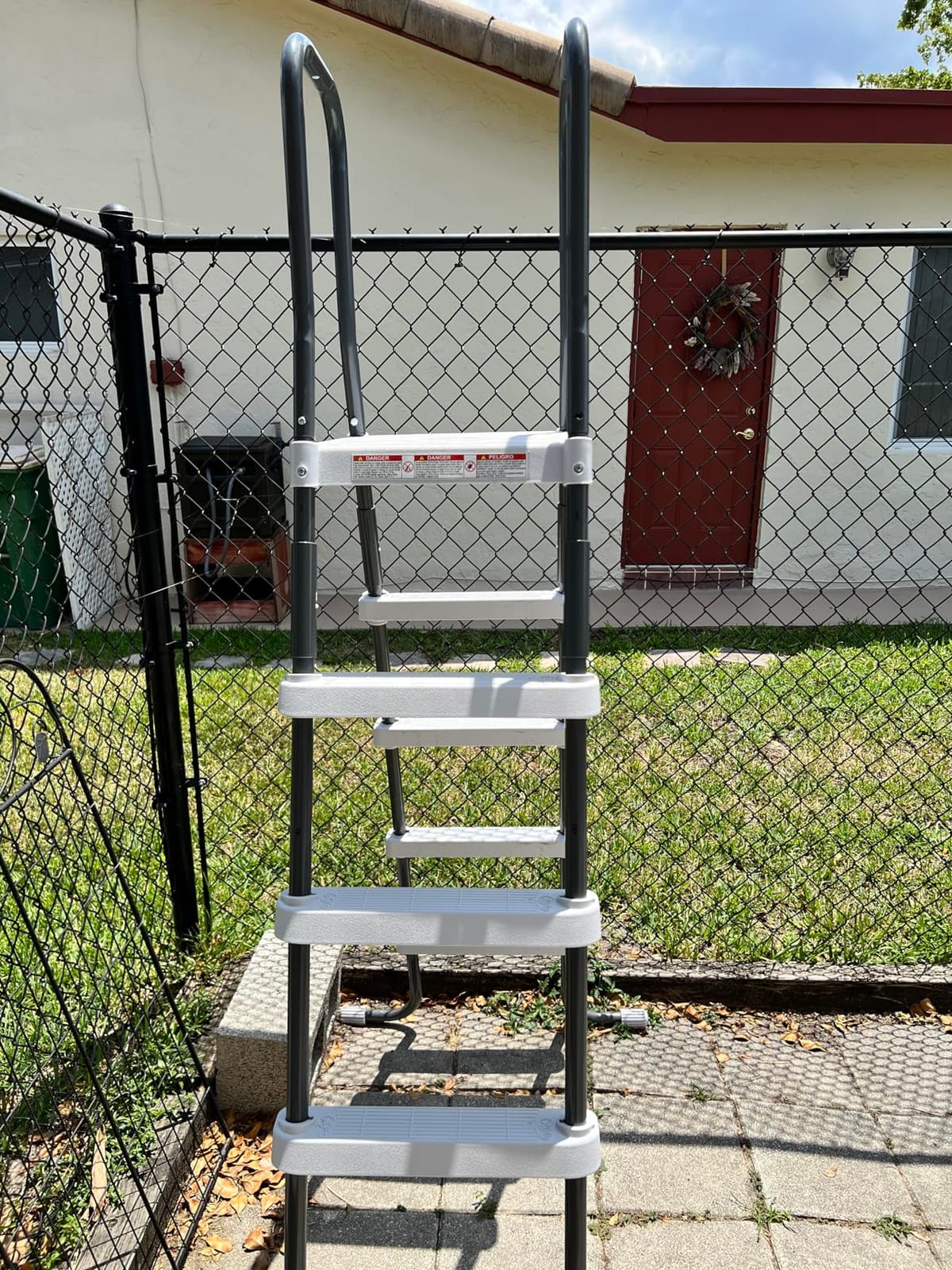
The consistent criticism is flex. Owners report noticeable wobble in the steps under load, and several say the real usable capacity is well below the stated 300 pounds, which lines up with the ladder feeling springy rather than rigid. If you are 250 pounds or more, know that going in. Some users strap or brace it to the deck for extra rigidity, which helps.
Coastal and saltwater installations are the second warning. The coating handles freshwater well but hardware does pit and rust in salt air over a few seasons. Inland owners rarely raise this. The step width is also narrower than product photos suggest, so a wet-foot grip test before you commit is worthwhile.
When this ladder is the right call
Choose it when you own an Intex steel-frame pool with a 52 inch wall and the priority is replacing a failing factory ladder cheaply. The top platform is genuinely useful for small children getting in and out. It is also a strong pick for anyone who wants a ladder today without waiting on a complicated assembly.
It suits moderate swimmers and family pools. Buyers in the 200 to 245 pound range report it holds up well, so it is a fair choice for most adults and teenagers.
When to choose something else
Choose something stiffer if you are a heavy swimmer or if wobbly steps would bother you daily. There is no barrier, so it also needs another layer of protection in a yard with toddlers. Anyone near salt water should pick resin or stainless instead of coated steel.
It also fits a narrow use case, since it is designed around a 52 inch Intex wall. If your pool is 48 inches, a different size or an adjustable model is the safer purchase. Measure first, always.
5. Confer 635-52X In-Pool Ladder – Best Value Deck Pick
- Stops swaying once filled with sand and water
- Plastic never rusts in chlorine or salt water
- Lightweight and easy to install
- Top platform included
- Compact footprint
- Ridged rungs are uncomfortable on bare feet
- 250 pound limit is lower than most rivals
- Height must be measured carefully before ordering
A straightforward three-step deck ladder for pools with 46 to 56 inch deck heights, made in the USA from plastic that will not rust in chlorine or salt water. All mounting hardware and the deck platform are included, and risers are available if you later need more height. For most residential pools this is the value pick in the whole roundup.
Owners highlight the same thing repeatedly: it stops swaying once ballasted with sand and water. That is the entire difference between a disappointing in-pool ladder and a good one, and this model gets there reliably. Seventy-two percent of its 1155 reviews are five-star, with praise split between the rust-free build and the easy installation.
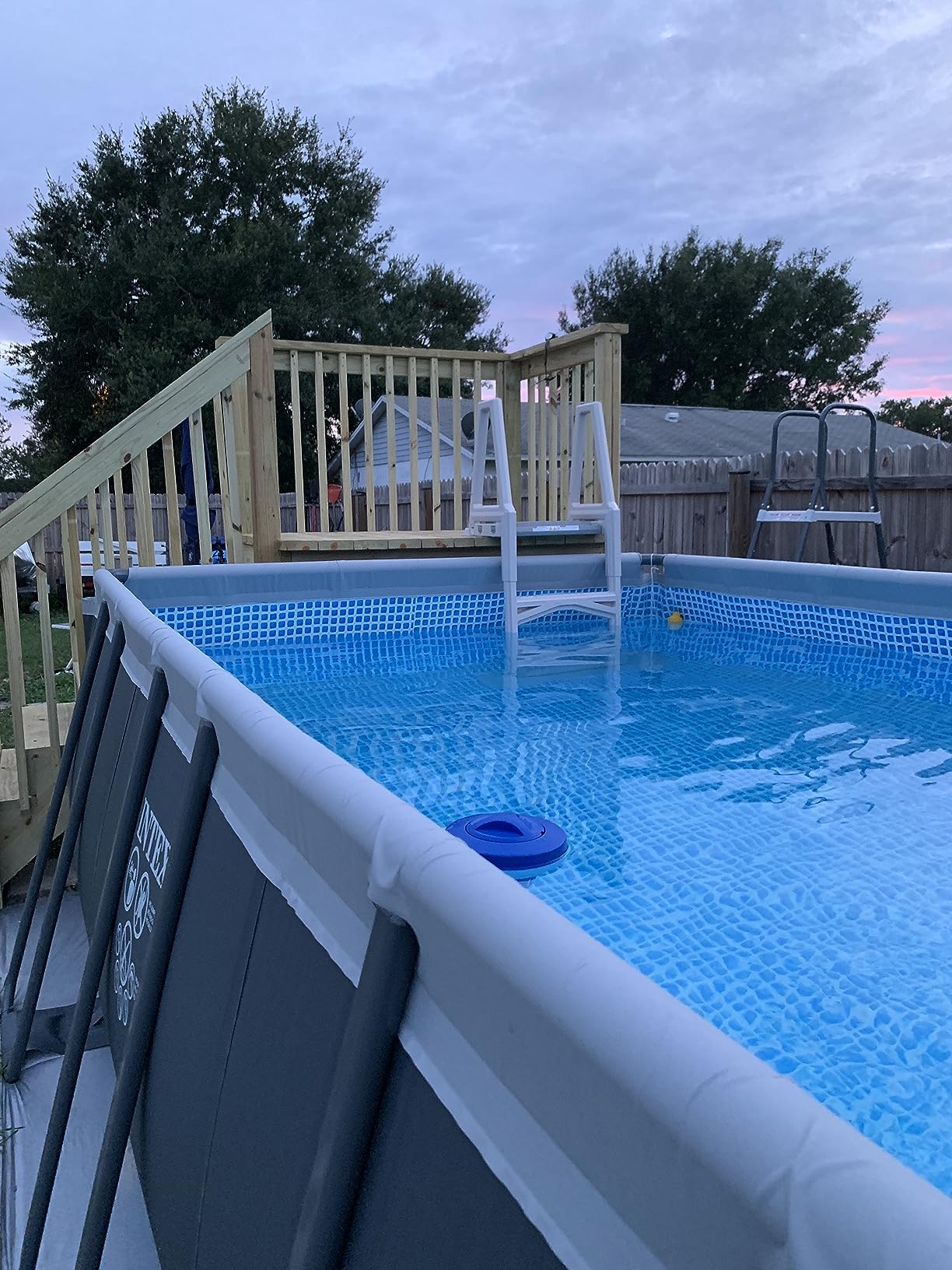
Two things to plan around. First, 10 pounds of sand is required and not included, so factor that into your setup. Second, the ridged rungs are the most repeated complaint in the reviews, described as painful on bare feet, and some owners add pool noodles or wear water shoes to take the edge off.
The 250 pound rating is lower than most of the resin competition, which usually claim 300 pounds. That caps who it suits. Also, the height adjustment is real, so measure carefully; a miscalculated pool height leaves you with a ladder that does not reach. The optional EB100X riser kit can correct it, with a limit of two risers.
When this ladder is the right call
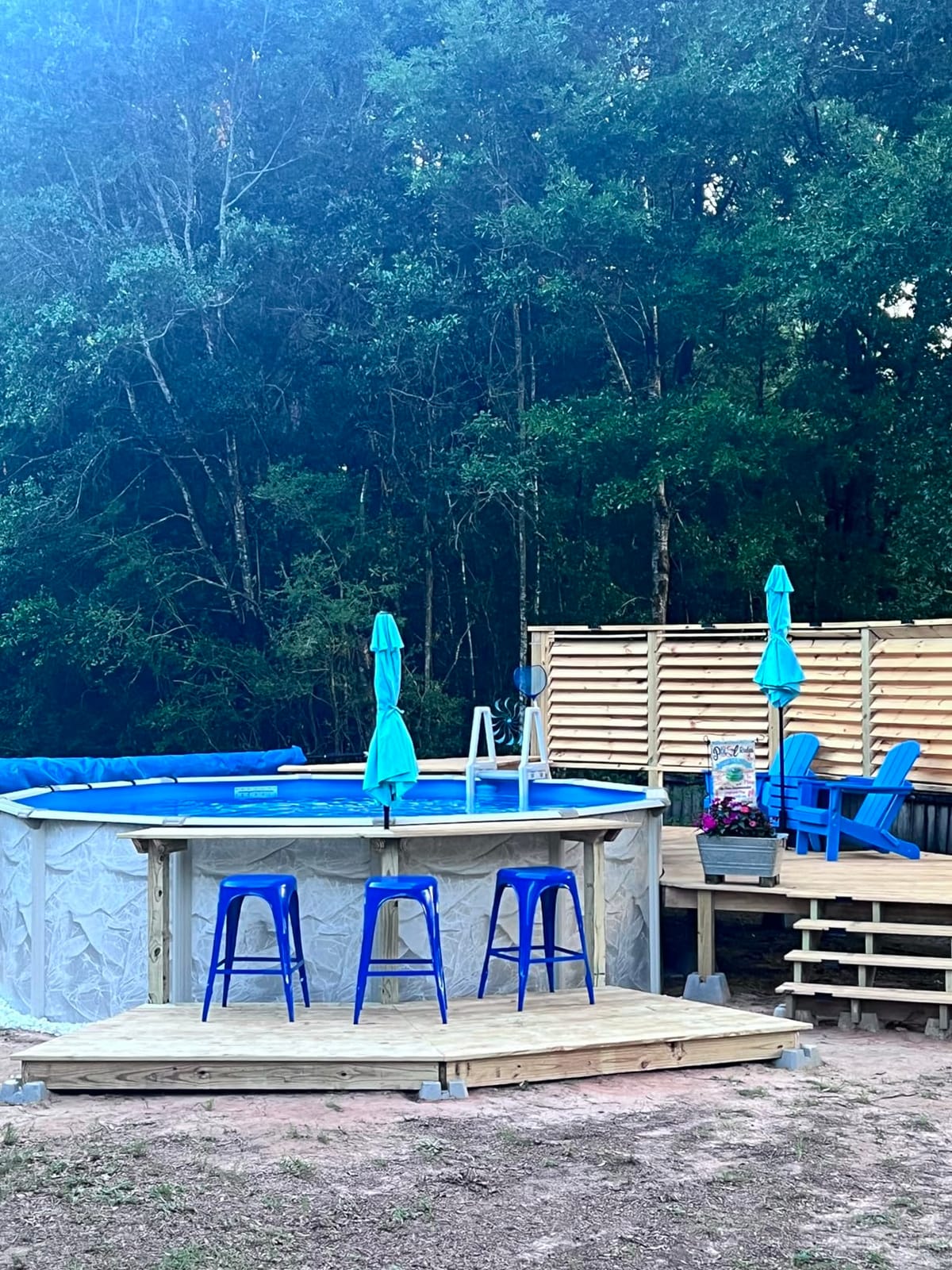
Choose it when you have a deck-mounted pool in the 46 to 56 inch range, moderate swimmer weights, and you want the cheapest corrosion-proof in-pool option. It is a good fit for chlorine pools and for coastal properties where steel is a poor long-term bet. Installation is straightforward enough for a first-time deck project.
The compact, light design also suits smaller decks where a bulkier unit crowds the coping. Owners using it with a top platform or seat report it works well as a support point.
When to choose something else
Move up to the 6000X if you need a 300 pound rating, formal anti-entrapment barrier geometry, or flat treads rather than ridged ones. Heavy swimmers should not push this one past its limit. Anyone who spends time on the ladder barefoot will find the texture frustrating.
It is also not a free-standing option, so it is wrong for a deckless pool. And if your deck is above 56 inches, plan on risers or a different model. Getting the measurement right is the single easiest way to avoid a return.
6. Bestway 48 inch A-Frame Ladder – Best For Shorter Pool Walls
Bestway 48″ Above Ground Pool Ladder with Heavy-Duty Metal Frame & Steps
- Double-sided design lets two people enter at once
- Fits both 42 and 48 inch pool walls
- Setup kit and manual make assembly quick
- Well regarded for stability relative to comparable entry ladders
- 220 pound capacity is the lowest here
- No top platform for standing
- Metal steps can get slippery when wet
Most A-frames in this roundup are single-sided, and that is where this one separates. Two people can enter and exit at the same time, which matters in a busy household with more than one kid in the water. It fits 42 inch and 48 inch walls, so it covers the shorter pool classes that the 52 inch models miss.
The 4.5 rating sits near the top of the group, with 74 percent five-star reviews. Owners single out the double-sided convenience, the corrosion-resistant frame and the quick assembly with the included setup kit. It is regarded as more stable than comparable entry ladders in its class, which is a meaningful step up from a basic factory ladder.
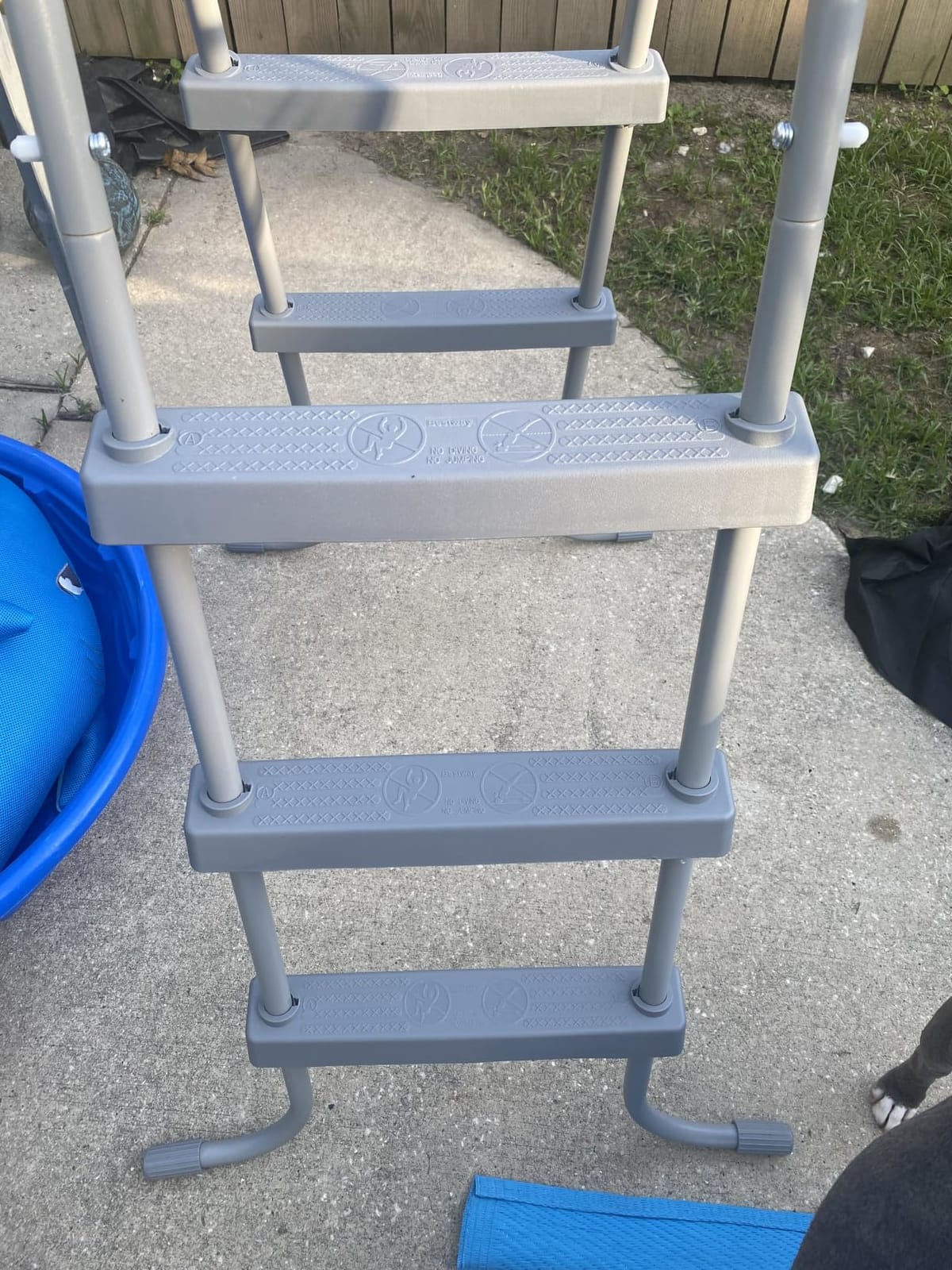
The 220 pound capacity is the lowest rating in this roundup, and it is the first thing to check against your household. That number is not a formality. Two people under that limit is the realistic use case, and a heavy adult should look at a 300 pound resin or stainless model instead.
There is no top platform, so climbers step straight into the water rather than standing to submerge. Owners also note the metal steps can get slick when wet, so grip is something to think about if small children use the ladder. The included manual keeps assembly to a short job.
When this ladder is the right call
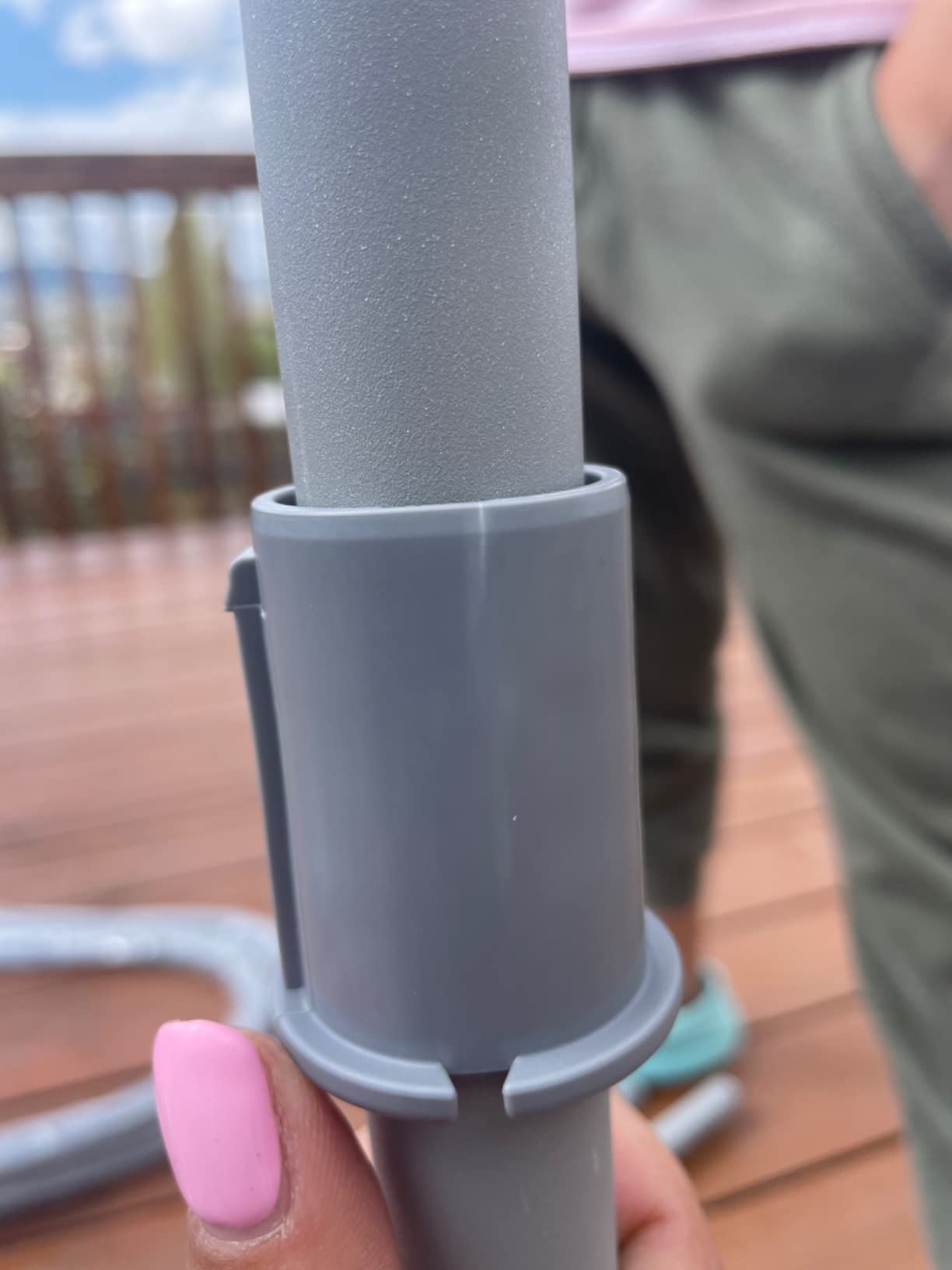
Choose it for 42 and 48 inch walls, which is where most mid-size and inflatable-frame pools sit. The double-sided layout is a genuine advantage for families or anyone hosting with a busy pool. It is also a good budget upgrade over a flimsy factory ladder without a big jump in cost.
If your household tops out well under 220 pounds, the capacity limit will never come up. In that case this is an easy recommendation on stability and ease of assembly alone.
When to choose something else
Skip it if any regular swimmer is over 220 pounds, since flex and failure risk rise sharply past the rating. Choose something with a top platform if children need help getting in and out, and choose resin or stainless if you are near salt water or want treads that stay grippy when wet.
It also tops out at 48 inch walls, so anyone with a 52 inch pool needs a taller model. Confirm the wall height before you order, and double check the top rail shape matches the hook.
7. Blue Wave Premium Stainless Steel In-Pool Ladder – Best Stainless Steel Option
Blue Wave Premium Stainless Steel in-Pool Ladder for Above Ground Pools
- Non-flexing stainless frame that does not sway
- 18 inch wide textured treads for confident footing
- Pivoting base protects the liner on sloped floors
- Deck flanges included
- One owner reports eight seasons of service
- 225 lb rating is low for the build
- Not rated for saltwater pools
- Deck flanges can wear over seasons
- Handrail sits low when pulling out
This is the ladder for anyone who finds resin flex under load unacceptable. The stainless frame does not sway or float up once the bottom tread reaches the pool floor, and owners upgrading from plastic describe it as noticeably more solid. Four extra-wide treads measure 18 inches across by 3 inches deep with a textured non-skid surface.
The pivoting 24 inch resin base tread is the clever part. It tilts to match a sloped pool floor or a cove-shaped wall, and it cushions the contact point so the vinyl liner does not scuff. Owners with older liner report this as the feature that saved their pool, and one reviewer is still running the same unit after eight seasons.
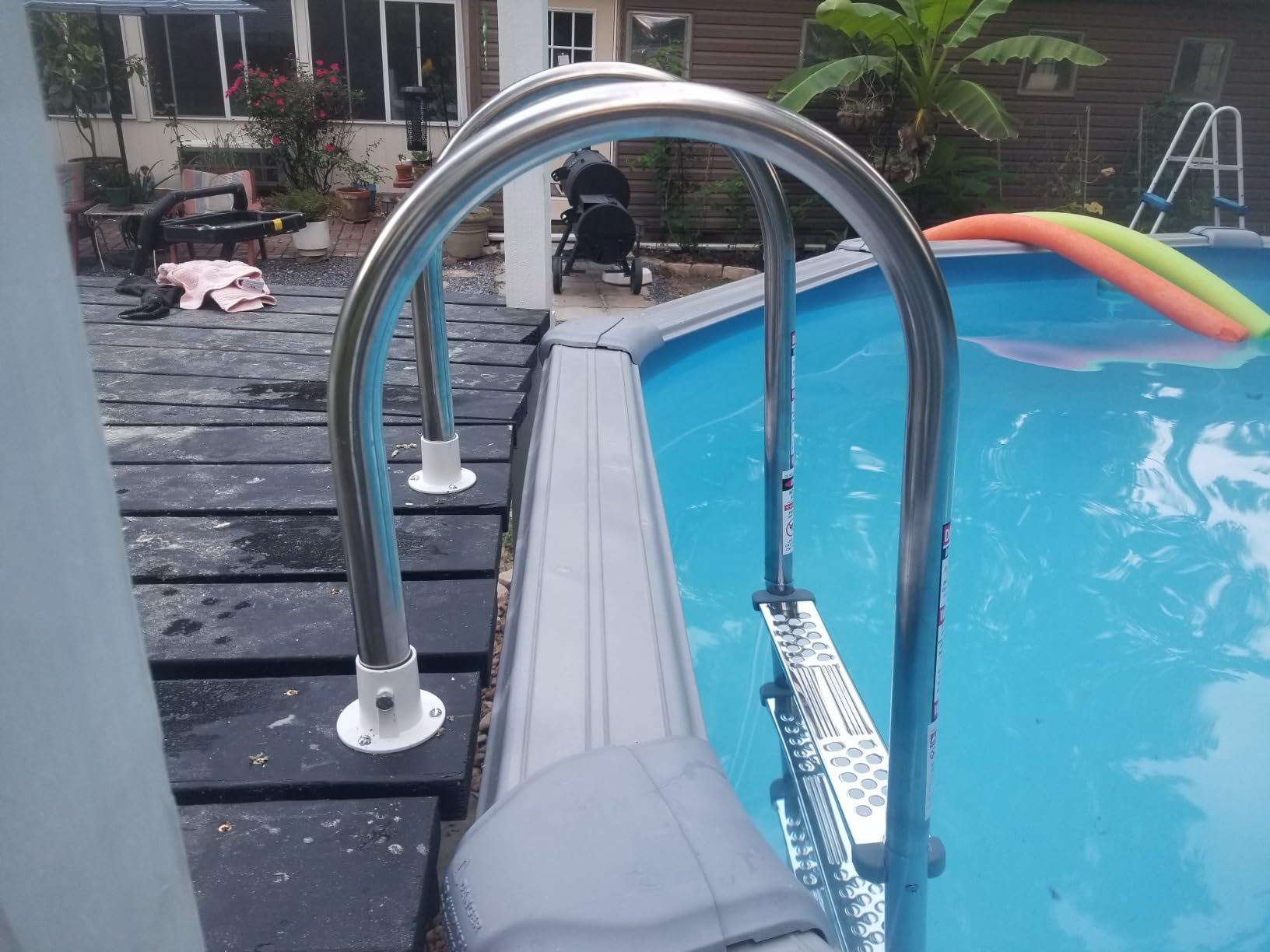
Two limits to know before buying. It is not rated for saltwater pools, so if you are coastal, choose resin or aluminium instead. And the stated 225 pound capacity is lower than what owners expect at this build quality, which is a common frustration even though the frame itself feels substantial.
Longer term, the deck flanges wear and may need replacing after several seasons, and deeper deck heights can require cutting the ladder to fit. The handrails also sit a little low, so you lean forward when pulling yourself out. Manufacturer customer service did replace a defective unit for at least one buyer, and the warranty is one year.
When this ladder is the right call
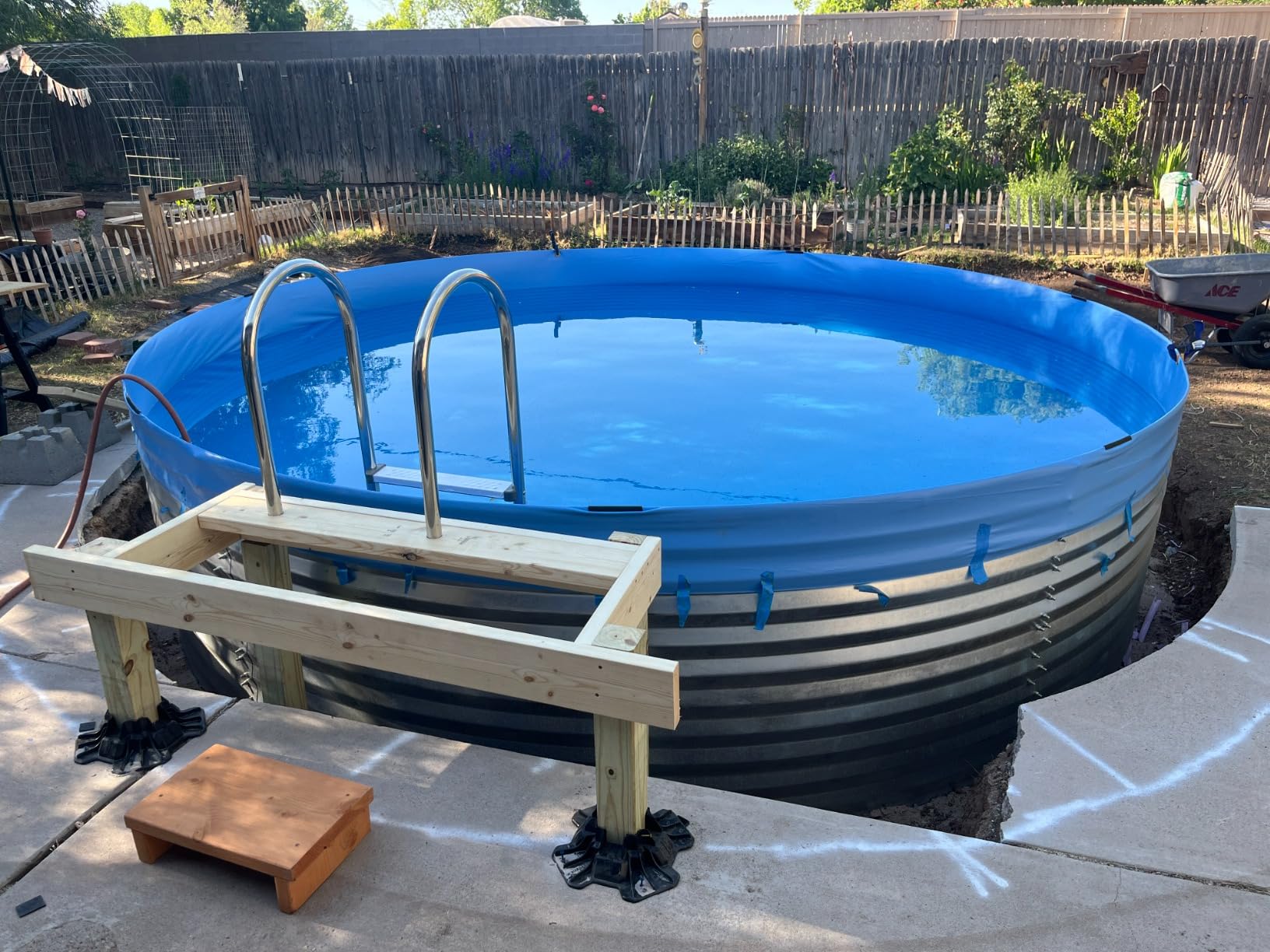
Choose it when rigidity is your top concern, you have a freshwater pool up to 54 inches deep, and you value a wide, textured step. The pivoting base is a genuine advantage on sloped floors and cove walls, and older liner owners will appreciate the liner protection. It suits adults who want a solid, unmoving ladder.
Deck flanges are included in the box, which removes the most common excuse for delaying the install. It also pairs well with a deck where a bolted connection is already established and maintained.
When to choose something else
Do not use it in a saltwater pool. If you need a rating above 225 pounds, the resin 6000X is the better fit at 300 pounds. Anyone with a deck deeper than 54 inches may end up cutting metal, which is a job most people would rather avoid.
The low handrails are the other consideration. If you have mobility limits or a history of shoulder trouble, a platform-and-stairs design is a better long-term choice. Otherwise this is a durable pick that will outlast several cheaper ladders.
8. Funsicle 52 inch SureStep Pool Ladder – Best For Easy Seasonal Storage
Funsicle 52″ SureStep Pool Ladder, for Above Ground Swimming Pools, Blue & White
- Highest average rating in the roundup at 4.7
- Steel frame resists floating and bending
- Disassembles by removing four screws for storage
- Textured steps with solid grip
- Lightweight enough to move in and out of the pool
- No top platform for small children
- Bolts can loosen over time
- Surface rust on concealed steel areas
- Box is heavy and awkward to bring indoors
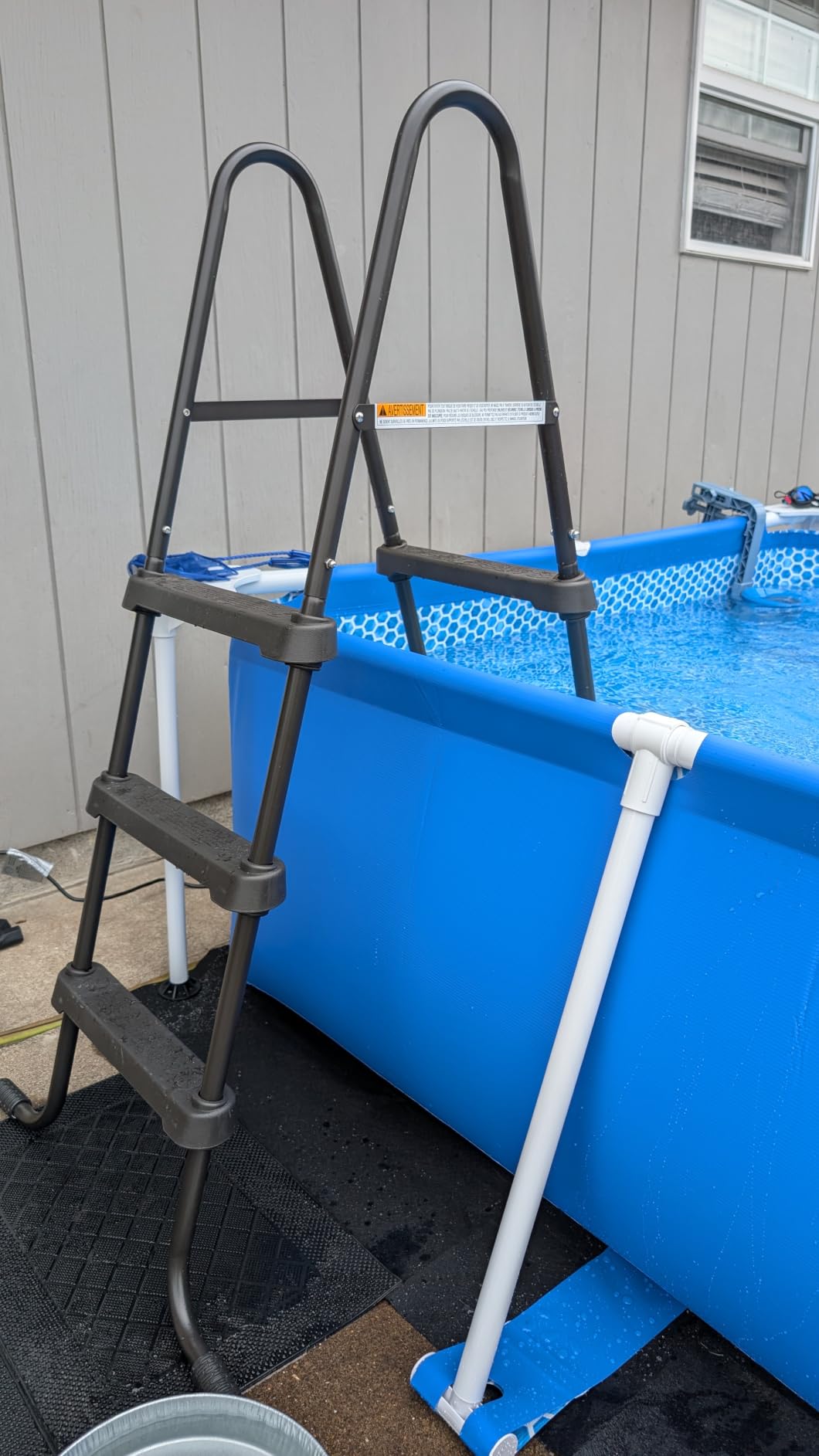
At 4.7 stars with 83 percent five-star reviews, this is the best-rated ladder in the group, and the reasons are practical. The steel construction is stiff enough that owners report it does not wobble or bend easily, and it will not drift off the wall. That solves the complaint we hear most often about factory-supplied pool ladders.
The seasonal story is what sets it apart. It disassembles by removing four screws, which owners describe as a genuinely easy off-season storage job compared to resin ladders that need draining and rinsing. Buyers with a pool that comes down in the fall particularly like being able to move the whole unit indoors. Grip texture on each step reduces slipping on wet feet.
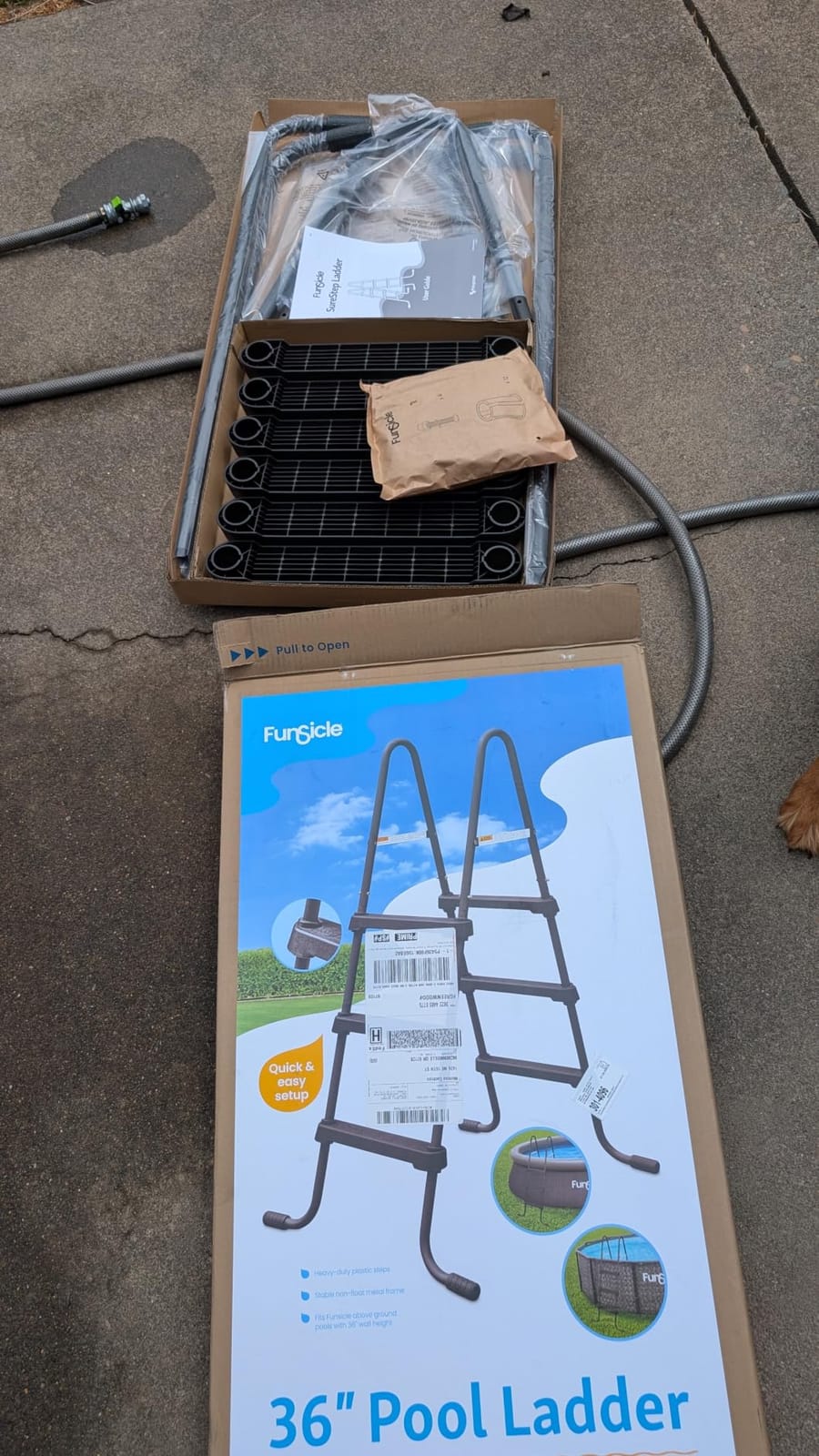
The limitations are honest ones. There is no top platform, which some parents wish existed for small children, and no barrier, so a young toddler needs a separate layer of protection. The bolts can loosen over time, so a periodic tightening is worth it before a season starts.
Surface rust does appear on concealed steel areas after a season of use, particularly where the frame sits against the pool wall. That is normal for coated or plated steel, and it does not stop most owners recommending it, but it is a fair warning for anyone expecting a permanent finish. The shipped box is also heavy and awkward to bring inside.
When this ladder is the right call
Choose it when rating and stiffness matter most and your pool wall is 52 inches or less. It is available in 36, 42, 48 and 52 inch variants, so it covers most standard sizes in one product line. Seasonal owners who store the ladder indoors will find the four-screw disassembly worth more than any other feature here.
It is also a sensible first replacement for a factory-supplied ladder, since the improvement in stability is immediate. The 4.7 rating comes from a large share of owners who had no complaints worth filing.
When to choose something else
Move up to a gated or roll-guard model if children use the pool, since there is no barrier here. Anyone who cannot tolerate any surface rust over multiple seasons should choose resin or stainless instead. Heavy swimmers are fine on stiffness grounds, but check the step width in person if grip is a concern.
There is also no top platform, so climbing in feels less controlled than on ladder models that have one. If that matters for your family, the Intex 28067E or the Confer 7200 are the better fits.
9. Vinyl Works AF Adjustable 24 Inch Ladder – Best For Kids And Safety
Vinyl Works AF Adjustable 24 Inch Ladder for Above Ground Swimming Pools with Secure Gate Closure and 2 Deck Mount Flanges, White
- Self-closing self-latching and lockable gate blocks toddler access
- Stairs rather than a ladder so easier for limited mobility
- Adjustable platform covers a wide wall height range
- Rounded base protects the vinyl liner
- Sharp edges can cut a liner unless sanded
- Gate arms can flex enough for a determined child
- Confusing instructions and a long assembly
- Steps and rails flex slightly under load
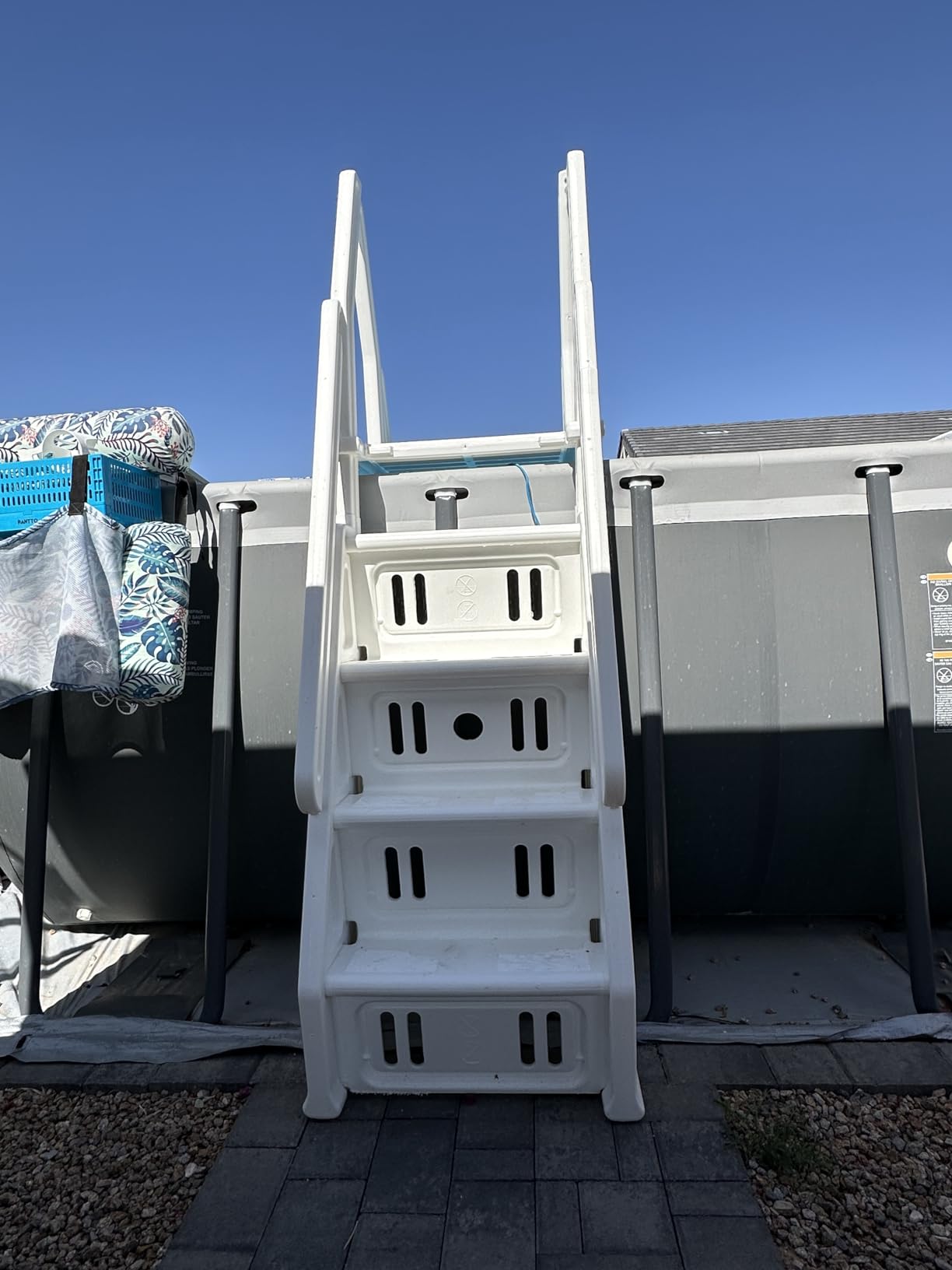
If a child can get into your pool without you, this is the ladder built to stop it. The outward-opening gate is self-closing, self-latching and lockable, and the anti-entrapment step design allows good water circulation behind the stairs so nothing gets wedged between the ladder and the wall. Grandparents rate it highly for exactly that reason.
It is also the only true stairs unit here, with 7.5 inch deep non-slip treads and 20.25 inches of clearance between the handrails. Owners recovering from joint surgery or anyone with limited mobility say stairs are far easier than a ladder. The adjustable top platform covers 47.5 to 56.25 inches of wall height, and the 22 inch in-pool footprint keeps it compact.
There are real compromises here. Sharp edges on the steps and base can cut a vinyl liner unless you sand them down, and that is a step people skip with bad results. Assembly takes several hours even with two people, driven mostly by poor instructions, which explains a 12 percent one-star share.
Be honest about the gate: the arms can be flexible enough for a determined child to unlatch, and a lock is not included. The steps and rails also give slightly under use, and the slim stairs are difficult for some larger users despite the 300 pound rating. The plastic also feels less substantial than the price suggests.
When this ladder is the right call
Choose it for households with toddlers or grandchildren who spend time at the pool, and for adults who cannot manage a vertical ladder. The lockable gate is the closest thing to true pool access control in this roundup. It also suits smaller pools where 22 inches of in-pool footprint matters.
Buyers who plan ahead get a good result. Sand the edges, budget several hours for assembly with a second pair of hands, and add your own padlock. With those steps done, the safety payoff is the best in this list.
When to choose something else
Choose something simpler if assembly time is a real constraint, or if sharp edges near a new liner make you uneasy. Anyone over 300 pounds will find the narrow stairs uncomfortable regardless of the stated capacity. It is also the most expensive ladder in this roundup, so budget-conscious buyers get far more for the money elsewhere.
It occupies space inside the pool, so it is wrong for a very small pool where swimmers need every inch. Check the 47.5 to 56.25 inch adjustment range against your actual wall height before ordering, since that range is narrower than it first looks.
10. Intex 28077E Heavy Duty Deluxe Ladder With Removable Steps – Best For Removable Step Safety
Intex 28077E Heavy Duty Deluxe Pool Ladder with Removable Steps for 52 Inch Depth Above Ground Pools
- Steps lift out when the pool is not in use
- Snapped steps lock into the base
- Stable and correctly sized for 52 inch walls
- Improved support base design
- Inexpensive next to gated alternatives
- Composite steps feel flexy under load
- Steps must be removed and replaced each season
- No top platform
- Coated steel frame not for salt water
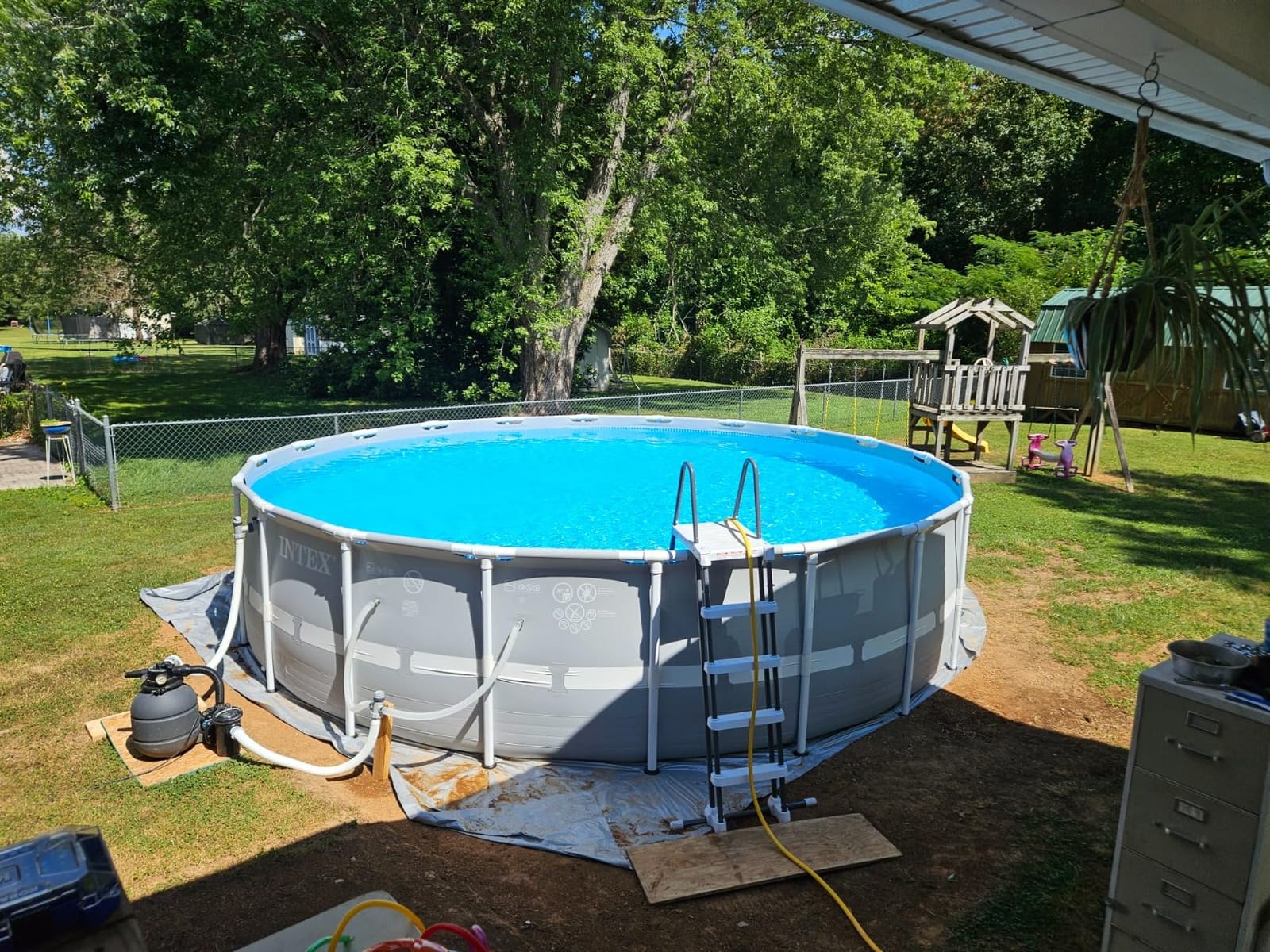
Removable steps are the safest design in this entire roundup, because a pool with no steps attached has no way in. The 28077E delivers that for 52 inch walls at a fraction of the cost of a gated ladder, and owners rate the safety benefit as the reason they keep it. The steps set into the base and snap or lock into place, then lift straight out.
Stability is a genuine plus. Owners report it as sturdy in the water, and the improved support base design is a real upgrade over the older original Intex ladder it replaces. At 20 pounds it stays manageable, and it pairs with an Intex 52 inch wall without any fitting work. Two-thirds of its 331 reviews are five-star.
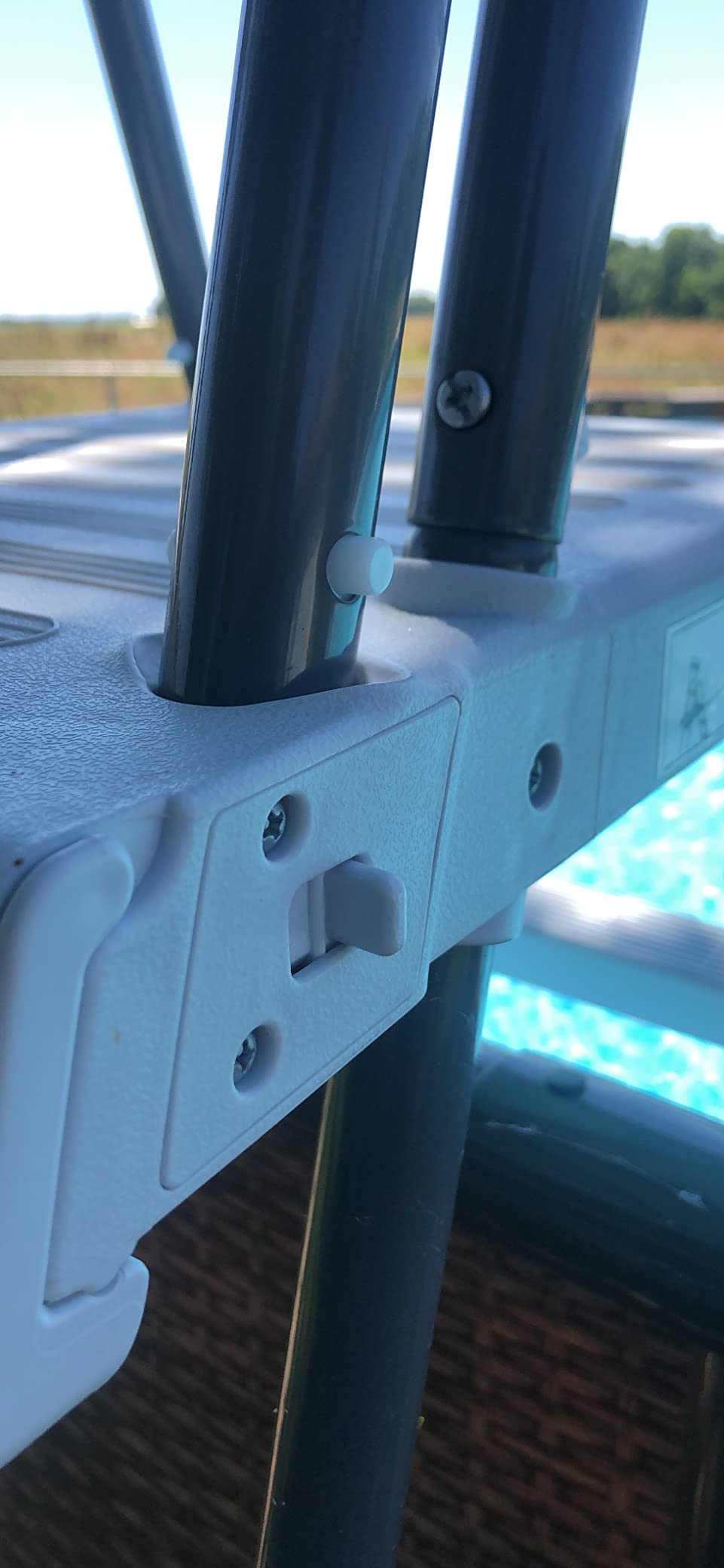
The trade-off is convenience, and owners say so plainly. Removing and reinstalling the steps takes time, and doing it every session wears on people who want the pool ready to go. The composite steps also feel flexy under load, which is the same complaint that shows up on budget steel ladders, though the frame itself is solid.
There is no top platform, so climbers step directly into the water. The coated steel frame is not intended for salt water, so coastal owners should look elsewhere. Like the other Intex models here, it is built around a 52 inch wall and nothing else.
When this ladder is the right call
Choose it when your pool has a 52 inch wall, you want the strongest entry control available in this roundup, and you are disciplined enough to pull the steps out whenever the pool is unsupervised. It is the cheapest route to a pool that a child cannot climb into without help. It also works as a direct replacement for an aging Intex ladder.
Buyers who remove the steps only when the pool is idle, rather than after every swim, get the best of both worlds. Treat it like putting the pool cover on and the habit sticks.
When to choose something else
Pick a gated model if you want continuous access control without the daily chore, since the Vinyl Works AF locks instead. Choose a ladder with a top platform if children need help getting in and out, and choose resin or stainless if you are near salt water or plan to keep the ladder outside year round.
It is also the wrong fit for a 48 inch wall. Check your wall height first, and if you plan to use a mat under the ladder, buy it at the same time so the base sits correctly.
A-Frame vs In-Pool vs Stairs: Which Style Do You Need?
Start with one question: is your pool surrounded by a deck? If yes, an in-pool ladder or stairs. If no, a free-standing A-frame. This is the single decision that eliminates half the wrong purchases, because deck-mounted units bolt to a frame that a deckless pool simply does not have.
A-frame ladders stand free on the pool floor, hook over the top rail and reach down into the water on the inside leg. They are the easiest style to install, work with no deck at all, and suit 42 to 56 inch walls. Their weakness is stability, which is why ballast and a barrier matter so much. The Confer 7200, Bestway 48 inch and Funsicle SureStep are all in this group.
In-pool ladders are bolted to a deck, and the water pressure on the inside leg holds them against the wall. They are the steadiest option because the structure itself resists movement, which is why the Confer 6000X and 635-52X and the Blue Wave stainless unit top out the stability ratings in reviews. Their weakness is fixed height, so measurement is critical.
Stairs and platform ladders are the answer for anyone who cannot climb vertical rungs comfortably, and for older swimmers. The Vinyl Works AF is the only gated option here, and it doubles as the strongest child-access control in the roundup. If you are choosing on behalf of a grandparent, this is the style to buy.
How To Choose A Pool Ladder: Wall Height, Capacity And Material
Measure the wall height before anything else, and measure it at the deepest point of the pool rather than the highest. Inflatable and soft-sided pools settle when full, so a wall that measures 52 inches empty may measure less with water in it. Give yourself an inch of margin, and check the maximum height the ladder is rated for rather than assuming flexible adjustment covers everything.
Then check the top rail. Some ladders fit standard top rails up to 14 inches wide and some do not, and the ones that do not will sit loose. Rail width and shape are the most common reason a correctly-sized ladder still has to be returned. Weight capacity is the next filter, and it is not a formality: a 220 pound rating fails for a 250 pound swimmer regardless of how the steps feel.
Material is the next axis. Resin will not rust, which makes it the easy choice for chlorine and salt water pools, but it flexes slightly. Alloy steel is stiff and affordable but pits in salt air, and the coastal feedback in reviews is consistent about that. Stainless steel is stiff and resists corrosion, though the Blue Wave model here is not rated for saltwater, so read the restriction rather than assuming from the material name.
Finally, think about what happens between uses. A ladder you can leave attached is convenient. A ladder that can be locked, gated or stripped of its steps is the safest. Weight capacity, barrier type and ballast method are all cheaper to think about now than to fix after a season of drifting and leaning. Our guide to above ground pools on a budget covers which wall heights come in which size classes.
How To Keep Your Ladder From Drifting Or Leaning
Use ballast first, because it solves two problems at once: buoyancy and wobble. Sand is the accepted answer, and most resin ladders specify a weight, commonly 10 pounds for walls above 48 inches. Water filling is the no-sand alternative, and the Confer 7200 fills its own side rails with water for that reason. Neither method damages a vinyl liner as long as the ladder base is not dragged across it.
Anchor second. Cam-lock brackets that grip the top rail and the pool wall remove the sideways motion that makes a ladder lean, and they matter most on free-standing A-frames where the only other force is the swimmer. A pool liner mat under the ladder base also stops the legs from shifting and protects the liner from scuffing, which is the failure several resin ladder owners report.
Check the frame twice a season. If a side rail bows when you push sideways, or a step cracks, replace the ladder rather than tightening bolts. Bent rails and collapsing frames are the failures owners on r/AboveGroundPools describe as the moment they stopped trusting their original ladder.
Winterise last. Steel ladders should be dried and stored indoors if you can, since trapped moisture drives the surface rust owners notice after a season. Resin ladders tolerate a wet garage far better. Ladders that bolt to the deck stay put, while free-standing units should be pulled out so the pool floor is not loaded through winter. If you are matching a pool and heater setup in one project, our pool heater guide covers the other half of that build.
Frequently Asked Questions
What is the best pool ladder for an above ground pool?
For a deckless pool, the best overall choice is a resin A-frame with a lockable barrier that fits your wall height, such as the Confer 7200 Roll Guard for 48 to 56 inch walls. For a pool built into a deck, a bolted in-pool ladder is steadier and handles 46 to 56 inch deck heights. Match the wall height first, then the weight capacity, then the safety feature.
What are the common problems with pool ladders?
The most reported problems are a ladder that drifts away from the pool wall, a frame that leans or flexes under load, side rails that bend after a child jumps or pulls on them, and steps that feel springy. The usual causes are missing ballast, a fit that is loose at the top rail, and coated steel hardware corroding in salt water. All four are fixable with ballast, cam-lock anchoring and a heavier frame.
What to use instead of a pool ladder?
If a ladder is genuinely not viable, a pool ladder bridge or platform that crosses the pool wall works for pools with a deck, and a solid top platform on an A-frame gives a stable place to stand. For anything else, a properly ballasted resin ladder is more reliable than a makeshift fix. Do not use improvised steps, and do not climb on the pool wall itself.
What ladder brands are most reliable?
Confer Plastics and Vinyl Works appear most often in the highest-volume reviews, and Blue Wave is consistently praised for rigidity in deck-mounted stainless models. Bestway and Intex lead on the replacement end because they match the walls on their own pools. Reliability in this category tracks the frame material and the barrier hardware more than the brand name.
Which above ground pool brand offers the highest quality?
Pool quality and ladder quality are separate questions. Intex and Bestway dominate the replacement ladder market because their ladders are sized for their own wall heights, so they are often the easiest match. For ladder construction specifically, resin models from Confer Plastics carry the strongest review volumes in this roundup. Match the ladder to the pool brand only as a starting point, then confirm the wall height.
What can I use to hold down my pool ladder?
Sand is the standard answer, and most resin ladders specify a weight, commonly 10 pounds for walls above 48 inches. Water filling through the ladder or into its barrier sections is the no-sand alternative. For sideways movement, cam-lock brackets that grip the top rail and the pool wall help, and a liner mat under the base stops the legs shifting on the pool floor.
How high should a pool ladder be for a 52 inch pool?
A 52 inch wall needs a ladder rated to at least 52 inches of wall height, and adjustable models that cover 46 to 56 inches are the safest choice since pools settle when full. Measure the wall at its lowest filled point, check the top rail width, and confirm the ladder’s maximum height rating covers what you measured. Oversizing is fine on an A-frame; undersizing leaves the ladder short of the deck.
The Best Pool Ladder For Your Above Ground Pool in 2026
Our pick for the best pool ladder for above ground pools is the Confer 7200 Roll Guard, because it combines the strongest barrier hardware in this group with a 48 to 56 inch fit and a 4.4 rating across more than 5000 reviews. If your pool sits in a deck, take the Confer 6000X instead and add the required sand ballast. For a small pool on a tighter budget, the Funsicle SureStep is the best-rated option we tested.
Whatever you choose, measure the wall, check the top rail, and confirm the weight rating covers the heaviest person who will use it. Then ballast it and anchor it properly, because most of the complaints we read about above ground ladders come down to a ladder that was never secured in the first place. Check the price on any of these before you buy, and replace the factory ladder sooner rather than later.