
If your dog has been diagnosed with heartworm disease, or you are worried about symptoms you are noticing, you are in the right place. Understanding heartworm symptoms in dogs by stage of infection can mean the difference between catching this disease early when treatment is most effective, and facing a far more difficult road. I have spent years researching canine health topics, and heartworm disease is one of those conditions where knowledge truly saves lives.
Heartworm disease is caused by a parasite called Dirofilaria immitis, and it spreads through mosquito bites. The tricky part is that most dogs show zero symptoms in the early stages. By the time you notice something is wrong, the infection may have already progressed significantly. That is exactly why understanding each stage matters so much.
In this guide, our team walks you through all four stages of heartworm infection, what symptoms to watch for at each phase, when to rush to the vet, and how to protect your dog going forward. We pulled insights from veterinary sources, research from the American Heartworm Society, and real experiences shared by dog owners in community forums to give you the most complete picture possible.
Table of Contents
What Is Heartworm Disease in Dogs?
Heartworm disease is a serious and potentially fatal condition caused by parasitic worms that live in the heart, lungs, and associated blood vessels of infected dogs. The scientific name for this parasite is Dirofilaria immitis, a blood-borne parasitic nematode that can grow up to 12 inches long as an adult.
These worms do not just sit harmlessly in the body. As they grow and multiply, they cause inflammation and damage to the pulmonary arteries, the right side of the heart, and the surrounding lung tissue. Over time, the worms obstruct blood flow and force the heart to work harder, which leads to congestive heart failure if left untreated.
Here is something many dog owners do not realize: heartworm disease has been diagnosed in all 50 states. Indoor dogs are not safe either. A single mosquito finding its way inside your home is all it takes. The American Heartworm Society considers dogs to be the natural host for heartworms, which means the parasite thrives and completes its full life cycle inside a dog’s body.
The disease is not contagious from dog to dog. It requires a mosquito as an intermediate host to transmit the infective larvae. But in areas where mosquitoes are common, and that is most places during warmer months, the risk is real and persistent.
How Heartworm Develops: The Life Cycle
Understanding the heartworm life cycle helps explain why symptoms take so long to appear. When an infected mosquito bites a dog, it deposits tiny heartworm larvae called microfilariae under the skin. These larvae are microscopic at this stage, completely invisible to the naked eye.
Over the next 10 to 14 days, the larvae migrate through the dog’s tissue, gradually making their way toward the bloodstream. They molt and grow as they travel. After about two months, they enter the circulatory system and begin their journey toward the heart and pulmonary arteries.
It takes approximately 6 to 7 months from the initial mosquito bite for the larvae to mature into adult heartworms. During this entire developmental period, your dog will likely show no symptoms at all. The worms are too small and too few to cause noticeable problems yet.
Once mature, adult heartworms can live for 5 to 7 years inside a dog. A single dog can harbor dozens or even hundreds of worms. Female adult worms release new microfilariae into the dog’s bloodstream, which mosquitoes then pick up when they bite, continuing the cycle.
This long incubation period is one reason heartworm is so dangerous. A dog can be infected in spring, show no signs until fall or winter, and by then the worms have already established themselves in the heart and lungs. Regular annual testing is the only reliable way to catch infections during this silent window.
Stage 1 Heartworm Symptoms: Early and Silent
Stage 1 heartworm infection is the most deceptive phase because most dogs show absolutely no symptoms. This is what makes heartworm disease so dangerous in its early days. The worm burden is still low, and your dog’s body is compensating without any visible signs of illness.
In some cases, you might notice a very mild, occasional cough. It is the kind of cough that is easy to dismiss, maybe your dog swallowed something wrong or breathed in some dust. It comes and goes, and most owners would not think twice about it. But in a dog with heartworm disease, that occasional cough can be the first whisper of a problem.
Veterinarians often describe Stage 1 as the asymptomatic phase. Blood work and physical exams may come back completely normal. The antigen test might even come back negative if the infection is very recent, because female worms need to be at least 7 months old to produce detectable antigens.
On community forums, dog owners frequently share stories of their dogs testing positive during routine annual checks with zero prior symptoms. One owner on a Reddit thread put it plainly: “My dog showed zero signs. The vet caught it on a routine test. If I had waited until symptoms appeared, it would have been so much worse.”
This is exactly why the American Heartworm Society recommends annual testing for all dogs, even those on preventive medication. Catching heartworm symptoms in dogs by stage of infection at Stage 1 means treatment is simpler, less expensive, and has a higher success rate compared to later stages.
Stage 2 Heartworm Symptoms: Moderate Signs Appear
When heartworm disease reaches Stage 2, the worm burden has increased enough that your dog starts showing moderate symptoms. This is typically where most owners first realize something is not quite right with their dog. The symptoms at this stage are noticeable but still manageable enough that some owners delay a vet visit.
The most common sign at Stage 2 is a persistent dry cough. Unlike the occasional cough in Stage 1, this cough sticks around. You might notice it more after exercise or when your dog gets excited. The cough happens because the adult worms in the pulmonary arteries are causing inflammation and irritation in the lungs.
Exercise intolerance is another hallmark of Stage 2. Your dog might tire out faster on walks, seem reluctant to play fetch, or pant heavily after minimal exertion. Dogs that used to bound up stairs may start taking them slowly or avoid them altogether. This lethargy and fatigue after mild activity is your dog’s body telling you it is struggling to keep up.
You may also notice a subtle decrease in appetite or mild weight loss. Some dogs simply seem less enthusiastic about food. Their energy levels drop, and they may spend more time sleeping or resting than usual. These changes are gradual, which makes them easy to attribute to aging or weather.
At Stage 2, a veterinarian can usually detect heartworm through a standard antigen blood test. X-rays may show slight enlargement of the pulmonary arteries. Treatment at this stage has a good prognosis, typically involving a series of injections with an adulticide medication called melarsomine, along with antibiotics and rest. Most dogs recover fully when treated at Stage 2.
Stage 3 Heartworm Symptoms: Severe and Alarming
Stage 3 is where heartworm disease becomes genuinely frightening for dog owners. The symptoms are severe, unmistakable, and significantly impact your dog’s quality of life. By this point, the worm burden in the heart and pulmonary arteries is substantial enough to cause visible physical changes.
The cough at Stage 3 becomes chronic and persistent. Some dogs may even cough up blood or blood-tinged sputum. This happens because the worms are causing significant damage to the blood vessels in the lungs, leading to bleeding and inflammation. If you see your dog coughing up anything that looks bloody, this warrants an immediate veterinary visit.
Exercise intolerance becomes severe. Even short walks can leave your dog gasping. You might notice rapid, labored breathing even when your dog is resting. The damaged lungs and obstructed blood vessels cannot deliver enough oxygen to meet your dog’s basic needs, let alone handle physical exertion.
Weight loss becomes more pronounced at this stage. Your dog’s appetite drops noticeably, and you may see visible ribs or hip bones that were not visible before. The body is working overtime to fight the infection, burning calories and depleting reserves.
A swollen abdomen, caused by fluid accumulation known as ascites, is another sign of Stage 3. When the right side of the heart struggles to pump blood effectively, fluid backs up into the abdomen. Your dog’s belly may look distended or feel firm to the touch.
Fainting episodes or syncope can occur at this stage too. Your dog might collapse briefly during exercise or excitement, then recover moments later. These fainting spells happen because the heart cannot maintain adequate blood flow to the brain during periods of increased demand. If your dog faints, even briefly, treat it as an emergency.
Treatment at Stage 3 is more complex and carries higher risks than earlier stages. Your veterinarian will need to perform more extensive diagnostics, including chest X-rays, blood work, and possibly echocardiography to assess heart function before starting treatment. The recovery period is longer, and activity restriction becomes even more critical.
Stage 4 Heartworm Symptoms: Critical and Life-Threatening
Stage 4 heartworm disease is the most severe form of the infection and represents a true medical emergency. At this stage, the worm burden is so heavy that blood flow through the heart is severely obstructed. Without immediate intervention, Stage 4 heartworm disease is fatal.
The most dangerous complication at this stage is caval syndrome, also known as vena cava syndrome. This occurs when such a large number of worms are present that they physically block the flow of blood through the heart’s right ventricle and the vena cava. The worms form a tangled mass that creates a mechanical obstruction.
Dogs with caval syndrome show dramatic and alarming symptoms. Their gums may turn pale or develop a bluish tint, called cyanosis, due to poor oxygen circulation. They become extremely weak and may be unable to stand. Breathing is labored even at complete rest, and you may see visible effort with each breath.
Another distinctive sign is dark, coffee-colored urine. This occurs because the worms are destroying red blood cells as they obstruct blood flow, leading to a condition called hemoglobinuria. If you notice your dog’s urine is abnormally dark, this is an emergency sign that should not be ignored.
At Stage 4, the only option is often emergency surgery to physically remove the worms from the heart. This procedure, called surgical extraction, is performed through the jugular vein using specialized instruments. It is risky and not available at every veterinary clinic, but without it, most dogs at this stage will not survive.
Right-sided congestive heart failure is the expected outcome at Stage 4 without treatment. The heart simply cannot pump effectively against the obstruction created by the mass of worms. Fluid accumulates in the abdomen, around the lungs, and in the tissues. The dog’s body begins to shut down.
From forum discussions, one owner described their experience: “By the time we realized what was happening, she could barely walk across the room. Her belly was swollen, and she was breathing with her mouth open even just lying down. The vet said we were at Stage 4. I wish I had known the signs earlier.”
Heartworm Symptoms by Stage: Quick Comparison
Here is a straightforward breakdown of what to expect at each stage of heartworm infection. This quick reference is designed to help you identify where your dog might be and how urgently you need to act.
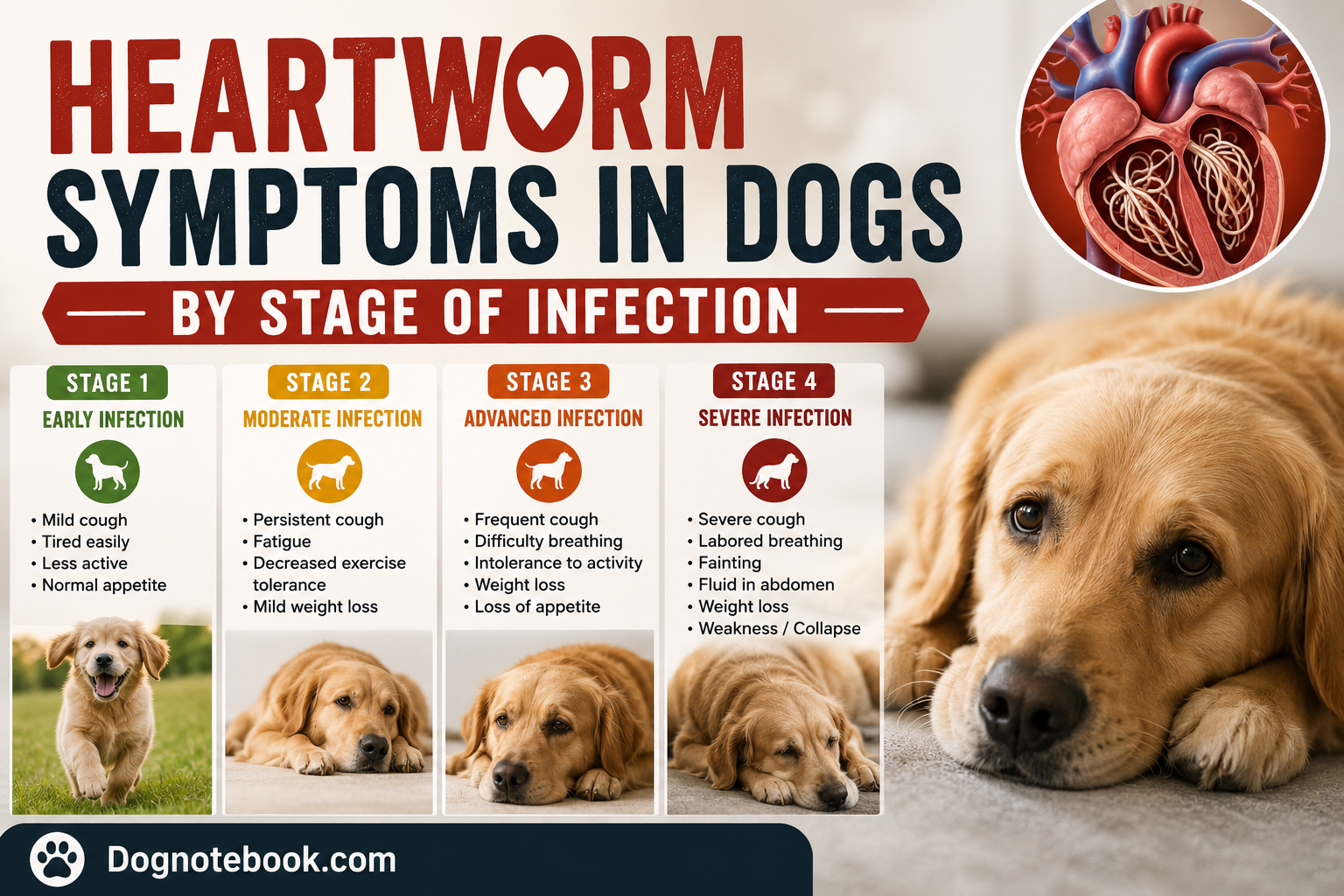
Stage 1 (Mild/Asymptomatic): No visible symptoms in most dogs. Occasional mild cough possible. Normal energy levels and appetite. Detectable only through blood testing.
Stage 2 (Moderate): Persistent dry cough. Noticeable fatigue after mild exercise. Mild lethargy. Slight decrease in appetite. Possible minor weight loss.
Stage 3 (Severe): Chronic cough, potentially with blood. Severe exercise intolerance. Labored and rapid breathing. Significant weight loss. Swollen abdomen from fluid. Fainting episodes.
Stage 4 (Critical/Emergency): Caval syndrome. Pale or blue gums. Dark, coffee-colored urine. Collapse and inability to stand. Labored breathing at rest. Right-sided heart failure.
If your dog is showing symptoms at Stage 3 or Stage 4, do not wait for an appointment. Contact an emergency veterinarian immediately. Early stage heartworm symptoms are subtle by nature, which is why annual testing remains the single best way to protect your dog.
When to Seek Emergency Veterinary Care
Some symptoms demand immediate veterinary attention, regardless of whether your dog has been diagnosed with heartworm disease. Knowing these emergency signs can save your dog’s life.
If your dog collapses, faints, or seems unable to stand, go to the nearest emergency veterinary clinic right away. Collapse can indicate that the heart is failing to pump blood effectively, which is a hallmark of advanced heartworm disease and caval syndrome.
Pale or blue-tinted gums are another emergency indicator. Healthy gums should be pink. When they turn white, pale, or blue, it means your dog is not getting enough oxygen. This can happen when heartworms obstruct blood flow through the heart and lungs.
Labored breathing that continues even when your dog is resting quietly is a red flag. Panting after exercise is normal. Struggling to breathe while lying down is not. If you see your dog breathing with visible effort, flaring nostrils, or an open mouth at rest, seek care immediately.
A swollen or distended abdomen that appears suddenly should be evaluated right away. Fluid buildup in the abdomen can signal right-sided heart failure, which is a direct consequence of advanced heartworm disease.
Dark, coffee-colored urine is an emergency sign specific to caval syndrome. If you notice this, call your vet or an emergency clinic and tell them you suspect advanced heartworm disease. Time is critical at this stage.
One thing that forum discussions emphasize repeatedly: do not wait to see if symptoms improve on their own. Heartworm disease does not resolve without treatment. Every day you delay at advanced stages reduces your dog’s chances of survival. If something feels wrong, trust your instincts and get your dog seen.
How Veterinarians Diagnose Heartworm Disease
If you suspect your dog might have heartworm disease, your veterinarian has several tools to confirm the diagnosis and determine the stage of infection. Understanding these tests helps you know what to expect during the appointment.
The most common test is the antigen blood test. This detects specific proteins produced by adult female heartworms. It is highly accurate for detecting infections where adult female worms are present, which typically means the infection has been present for at least 7 months. Your vet can run this test in the clinic and have results in about 10 minutes.
If the antigen test is positive, your veterinarian may also order a microfilariae concentration test. This examines a blood sample under a microscope to look for baby heartworms circulating in the bloodstream. Finding microfilariae confirms that adult worms are reproducing inside your dog.
Chest X-rays are important for staging the disease. They allow your vet to see the size and shape of the heart and pulmonary arteries. Enlarged pulmonary arteries, changes in the lung tissue, and heart enlargement all indicate how far the disease has progressed. X-rays are especially useful for distinguishing between Stage 2, Stage 3, and Stage 4 infections.
Echocardiography, or cardiac ultrasound, may be recommended for dogs with suspected advanced disease. This gives your veterinarian a real-time view of the heart chambers and allows them to actually see the worms if the burden is heavy enough. It also shows how well the heart muscle is functioning, which directly impacts treatment decisions and prognosis.
Additional blood work checks for elevated liver enzymes, kidney values, and signs of anemia, all of which can indicate the severity of the disease. Your vet will use the combined results from all these tests to determine the stage and build an appropriate treatment plan.
The American Heartworm Society recommends annual testing for all dogs over 7 months of age, even those on year-round preventive medication. No preventive is 100 percent effective, and missing even a single dose can leave your dog vulnerable, as several dog owners on community forums have unfortunately discovered.
Heartworm Prevention: Your Dog’s Best Defense
Preventing heartworm disease is far simpler, safer, and less expensive than treating it. That statement might sound obvious, but you would be surprised how many dogs contract heartworm because their owners skipped a dose of preventive medication or did not realize their dog needed it year-round.
Monthly heartworm preventives work by killing heartworm larvae before they can mature into adults. These medications come in chewable tablets, topical treatments, and injectable options that your veterinarian can administer. Common active ingredients include ivermectin, milbemycin oxime, and moxidectin.
Year-round prevention is recommended by the American Heartworm Society, even in states with cold winters. Mosquito seasons are unpredictable, and it only takes one warm day for mosquitoes to emerge. Many preventives also protect against other parasites like roundworms, hookworms, and whipworms, so the benefits extend beyond heartworm alone.
One of the most important things to understand is that heartworm preventives work retroactively. They kill larvae your dog may have been infected with in the past 30 days. This means giving the preventive on time every month is essential. If you miss a dose by even a few weeks, larvae could mature past the point where the preventive is effective.
In forum discussions, the regret is palpable from owners who missed just one dose. One owner shared: “I missed one monthly dose during a move, and now she is heartworm positive. I had no idea one missed dose could do this. Please, keep your dog on prevention without fail.”
Geographic risk varies, but no region is completely heartworm-free. The Mississippi Delta and southeastern United States have the highest rates of infection, but cases are reported nationwide. If you travel with your dog to different regions, their exposure risk changes as well. Talk to your veterinarian about the right preventive protocol for your location and lifestyle.
What to Expect During Heartworm Treatment
If your dog tests positive for heartworm, treatment is a multi-step process that requires patience, commitment, and strict adherence to your veterinarian’s instructions. The standard treatment protocol has been refined over decades and, when followed correctly, has a high success rate for dogs in Stages 1 through 3.
Treatment usually begins with a month of doxycycline, an antibiotic that weakens the heartworms by targeting the Wolbachia pipiens bacteria that live symbiotically inside them. This makes the worms more vulnerable to the adulticide treatment that follows. It is worth noting that doxycycline can cause gastrointestinal upset, and many owners on forums report that this first month is when their dog seems to feel the worst.
During this initial phase, your veterinarian will also start your dog on a heartworm preventive to begin eliminating microfilariae from the bloodstream. A macrocyclic lactone preventive is used for this purpose, gradually reducing the population of baby worms.
The main treatment involves a series of injections with melarsomine dihydrochloride, an arsenical compound that kills adult heartworms. The standard protocol is three injections: one initial injection, followed by two injections 24 hours apart, about one month later. Each injection is delivered deep into the muscles of the lower back.
The most critical part of treatment is activity restriction. When the adult worms die, they break apart and can cause blockages in the pulmonary arteries. This is called pulmonary thromboembolism, and it can be fatal if your dog is physically active. Your dog must be kept on strict cage rest with only leash walks for bathroom breaks for 6 to 8 weeks after the final injection.
Recovery timeline varies by stage. Dogs treated at Stage 1 or 2 generally recover within 2 to 3 months and return to normal activity. Stage 3 dogs may need 4 to 6 months of restricted activity and monitoring. Stage 4 dogs that survive surgical worm extraction face a longer recovery period with ongoing cardiac monitoring.
Throughout treatment, your veterinarian will schedule follow-up appointments to monitor your dog’s progress. These visits typically include blood tests, repeat X-rays, and physical exams to track how well the treatment is working and catch any complications early.
Frequently Asked Questions About Heartworm Symptoms in Dogs
How do I know what stage my dog has heartworms?
Only a veterinarian can determine the stage of heartworm infection through diagnostic testing. They use a combination of antigen blood tests, chest X-rays to check for heart and pulmonary artery enlargement, echocardiography to visualize the heart chambers, and general blood work to assess organ function. Stage 1 typically shows no symptoms, Stage 2 involves moderate symptoms like coughing and fatigue, Stage 3 includes severe symptoms like weight loss and labored breathing, and Stage 4 is a medical emergency with collapse and heart failure signs.
What are the symptoms of end stage heartworms in dogs?
End stage or Stage 4 heartworm symptoms include caval syndrome, where a mass of worms blocks blood flow through the heart. Dogs may show pale or blue gums, extreme weakness, inability to stand, labored breathing even at rest, dark coffee-colored urine, a severely swollen abdomen from fluid buildup, and episodes of collapse. This stage is fatal without emergency surgical intervention to remove the worms from the heart.
How long after an infection does heartworm show up?
Heartworm infection takes approximately 6 to 7 months to produce detectable adult worms after the initial mosquito bite. During this time, the larvae are migrating through the dog’s tissues and maturing. Antigen blood tests can typically detect infection starting around 6 to 7 months post-infection. Symptoms usually do not appear until the worm burden is significant enough to cause physical damage, which can take even longer in early stages.
What is Stage 2 heartworms in dogs?
Stage 2 heartworm disease is the moderate phase where symptoms become noticeable. Dogs typically develop a persistent dry cough, show exercise intolerance and fatigue after mild activity, experience lethargy, and may have a decreased appetite or mild weight loss. At this stage, the worm burden is significant enough to cause inflammation in the pulmonary arteries but not yet severe enough to cause heart failure. Treatment at Stage 2 has a good prognosis with the standard melarsomine protocol.
Can a dog survive heartworm disease?
Yes, most dogs can survive heartworm disease when it is diagnosed and treated properly. Dogs treated at Stage 1, 2, or 3 have a high survival rate with the standard three-injection melarsomine protocol. Success rates exceed 95 percent for early to moderate cases when owners follow activity restriction guidelines. Stage 4 dogs require emergency surgical extraction and face a more guarded prognosis, but survival is possible with prompt intervention.
How long can a dog live with heartworms untreated?
Untreated heartworm disease is eventually fatal, but the timeline varies depending on the worm burden, the dog’s size, and overall health. Some dogs may live 1 to 3 years with a low worm burden before showing severe symptoms, while others with heavy infections can decline within months. Small dogs often develop symptoms faster because their hearts and blood vessels are smaller and more easily obstructed. Without treatment, heartworm disease causes progressive damage to the heart, lungs, liver, and kidneys, leading to congestive heart failure.
Protecting Your Dog From Heartworm Disease
Heartworm disease is one of the most preventable yet dangerous conditions your dog can face. The symptoms progress silently from a barely noticeable occasional cough in Stage 1, to persistent coughing and fatigue in Stage 2, to severe breathing difficulty and weight loss in Stage 3, and ultimately to life-threatening caval syndrome in Stage 4. Each stage demands a different level of urgency and care.
The single most important takeaway from this guide is this: do not wait for symptoms to appear. Heartworm symptoms in dogs by stage of infection are unreliable as an early warning system because Stage 1 is almost always invisible. Annual testing and year-round prevention are the only reliable ways to protect your dog from this disease.
If your dog is showing any of the symptoms described in this article, call your veterinarian today. A simple blood test can tell you whether heartworm is the cause, and early detection makes an enormous difference in treatment outcomes. Your dog depends on you to notice the signs and act on them. Schedule that appointment, keep up with monthly prevention, and give your dog the best chance at a long, healthy life.