
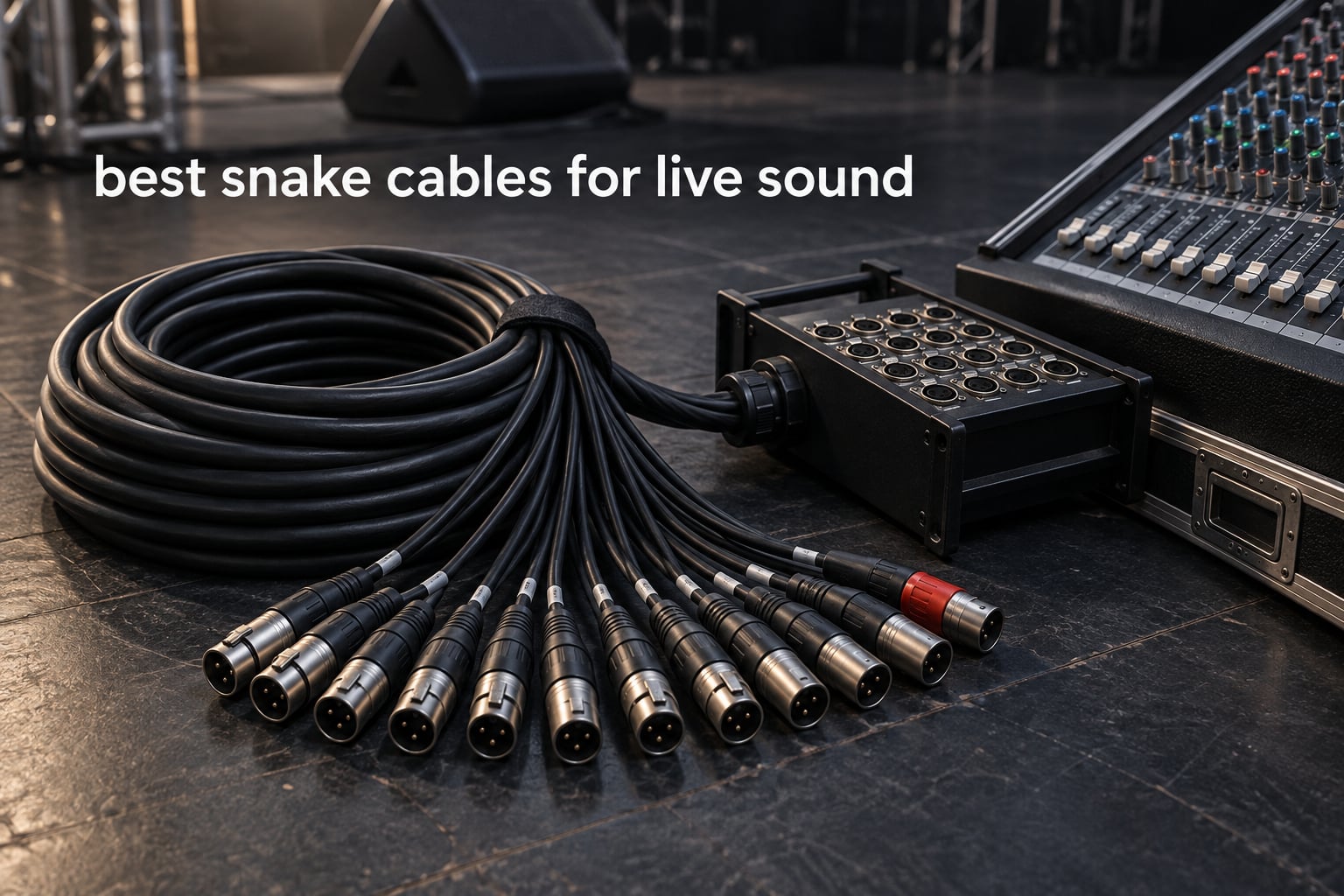
A snake cable is a multicore cable assembly that bundles many balanced audio channels into a single run from stage to console, usually terminating in a stage box. If you are searching for the best snake cables for live sound, the honest answer is that almost any correctly built balanced snake will sound the same, so what actually separates the options is shielding, connector quality, channel count, return count and how the thing survives being coiled and thrown in a van.
Our team has been rigging, testing and living with multicore snakes for years, and we compared the ten models below across load-in, patching, run length and channel count. The list covers the whole range, from a four-channel budget box that suits a rehearsal room up to a 24-channel 100-foot run built for a large stage, plus a TRS loom for IEM and line returns and a couple of lighter circuit-board designs.
We also settled the argument that dominates every cable forum: no, spending more does not buy a different tone. We explain why further down, then get into the practical questions that actually change your purchase, which are how many channels you need, how many returns, and whether a digital stage box makes more sense for your rig.
Read on for the top three picks, a full comparison of all ten, a sizing guide with worked examples, and a troubleshooting flow for finding a dead or noisy channel before the doors open.
Table of Contents
Do Better Snake Cables Actually Sound Better?
The short answer is no. A correctly built, correctly terminated balanced snake is transparent, and paying more for a brand name does not change the tone coming out of the console. What the extra money actually buys you is better shielding, solid connectors, proper strain relief and the ability to repair a broken end instead of throwing the whole cable away.
That verdict is not ours alone. On Gearspace, veteran engineers argue that no controlled study has ever shown properly designed cable brands sounding different, and that premium pricing buys durability and resale value instead of tone. Users on TheGearPage reach the same conclusion independently, describing a good snake as something that cleans up your stage rather than something that improves your mix.
Cheap cables can absolutely sound bad, but for reasons that have nothing to do with copper purity. Hum from weak shielding, crosstalk between channels, crackle from a bad fan-out termination and noise from a ground loop will all show up in your mix. Poorly made cables hurt because they are poorly made, not because a 22 AWG conductor is inherently inferior to a heavier one.
One fair caveat: in very large systems with dozens or hundreds of runs, some engineers argue small losses accumulate in ways you can hear. For a live rig of the size covered here, that effect is not something you will hear at a show, so buy for build quality and channel count instead.
It is worth adding that experienced users consistently praise Switchcraft, Neutrik, Canare and Mogami components for the same reason, durability rather than tone. Redco is regularly recommended as a parts source for building a custom snake, and one Gearspace user costed a 24-channel 30-foot Canare and Neutrik build at roughly 410 dollars DIY against about 500 dollars retail, which is the kind of math that makes brand tier easier to reason about.
Top 3 Snake Cables for Live Sound in 2026

Monoprice 4-Channel XLR Snake
- Four XLR channels in one jacket
- Color-coded channel wires
- Silver metal housings
- Lifetime warranty

Seismic Audio 24-Channel 100 Ft Snake
- 24 XLR sends and 8 XLR returns
- Low-profile stage box
- Individually shielded pairs
- 100 ft length

EBXYA 4-Channel XLR Snake
- Oxygen-free copper
- Hybrid shielding
- Zinc alloy locking shells
- 6 ft length
All 10 Best Snake Cables Compared in 2026
| Product | Specifications | Action |
|---|---|---|
| Monoprice 4-Channel XLR Snake 10 Ft |
|
Check Latest Price |
| Seismic Audio SACB-24x8x100 24-Channel 100 Ft |
|
Check Latest Price |
 Monoprice 8-Channel TRS Snake 20 Ft Monoprice 8-Channel TRS Snake 20 Ft |
|
Check Latest Price |
 Hosa SH 8X0 8-Channel XLR Snake 25 Ft Hosa SH 8X0 8-Channel XLR Snake 25 Ft |
|
Check Latest Price |
| EBXYA 4-Channel XLR Snake 6 Ft |
|
Check Latest Price |
 Seismic Audio SAEM-12x4x100 12-Channel 100 Ft Seismic Audio SAEM-12x4x100 12-Channel 100 Ft |
|
Check Latest Price |
 Seismic Audio SAXQ-12x4x50 12-Channel 50 Ft Seismic Audio SAXQ-12x4x50 12-Channel 50 Ft |
|
Check Latest Price |
 Fat Toad 8-Channel XLR Snake 10 Ft Fat Toad 8-Channel XLR Snake 10 Ft |
|
Check Latest Price |
 Hosa SH 6X2 6-Channel Snake 20 Ft Hosa SH 6X2 6-Channel Snake 20 Ft |
|
Check Latest Price |
 PRORECK 8-Channel XLR Snake 25 Ft PRORECK 8-Channel XLR Snake 25 Ft |
|
Check Latest Price |
1. Monoprice 4-Channel XLR Snake – Best Overall for Live Sound
- Metal connector housings
- Color-coded channels speed up patching
- One jacket instead of four loose runs
- Lifetime warranty
- Only 4 channels so it will not cover a larger stage
- Fixed molded jacket means channels cannot be replaced without cutting
This is the snake we keep coming back to. It is four male-to-female XLR runs folded into one soft jacket, weighs 1.2 pounds and carries a lifetime warranty, and it has held a 4.7 rating across more than 2800 reviews. That kind of review volume is unusual in a category where most listings sit under 600, and it tells us the failure rate is low.
The silver metal connector housings are the part that impressed us most. Most budget snakes use plastic shells that crack after a season of being kicked under a wedge monitor, and these do not. The plastic and rubber strain-relief boots take the bend at the connector rather than the conductor, which is exactly where cheaper builds fail.
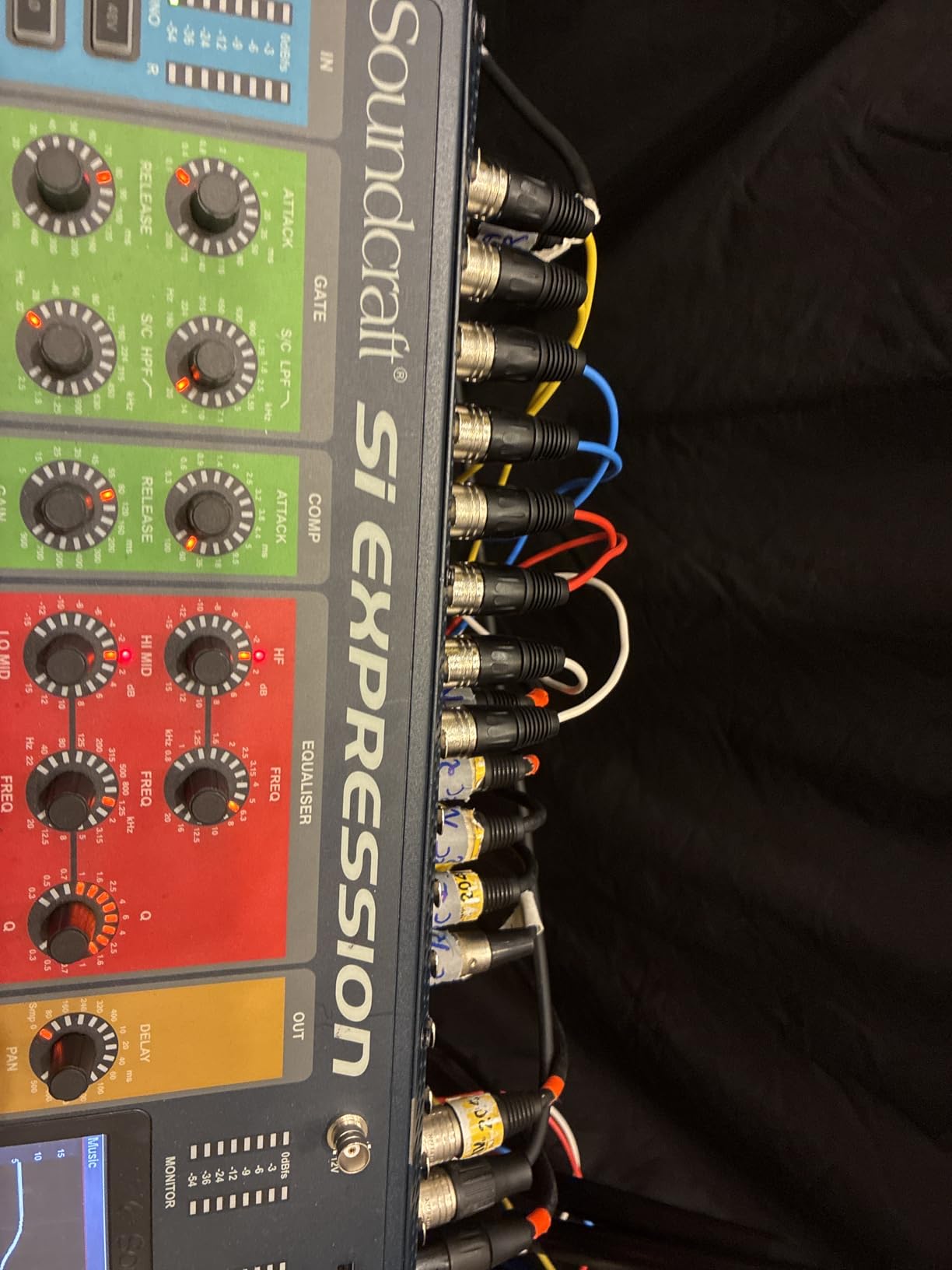
The color-coded channel wires are a genuinely useful detail rather than a gimmick. Red, blue, white and yellow means you can trace a channel end to end in seconds, even in a dark club with a torch in your teeth, instead of following a bundle of identical black wires.
It is also offered in 3, 15 and 20 foot versions and is rated for indoor and outdoor use, so a drummer running to an amp in a park is covered. If your band needs four lines and two returns, you can pair it with a Y-split or simply run the returns on a second short loom.
Why this one works for most bands
Four channels covers a very common rig: four vocals, or a two-piece band where guitars run through the amp and only the mics need to come off stage. At 1.2 pounds it disappears into a backpack, which matters more than people expect when you are the one carrying it up a flight of stairs.
The lifetime warranty also removes the main argument against a budget snake. If a channel fails, you are not stuck with dead weight, and that is worth more than a slightly heavier jacket would be.
Where it falls short
Four channels is genuinely the limit. A full band with a drum overhead pair, four wedges, keys and stereo playback will run out of inputs almost immediately, and there is no way to add channels without a second snake.
The jacket is molded in one piece, so an individual channel cannot be replaced if an internal connection fails. That is the trade for the low weight and the flexible jacket, and it is the main reason we would not put this one in a touring case that gets thrown in and out of a van every night.
2. Seismic Audio SACB-24x8x100 – Best for Large Stages
Seismic Audio SACB-24x8x100 24-Channel XLR Low Profile Circuit Board 100-Feet Snake Cable
- 24 XLR sends plus 8 returns in one run
- Low-profile stage box keeps footprint small
- Individually shielded pairs
- 4.7 across 1633 reviews
- Heavy at 36 lbs
- One-year warranty is the short end
- Large bundle to coil and store
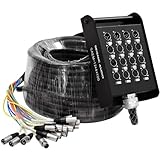
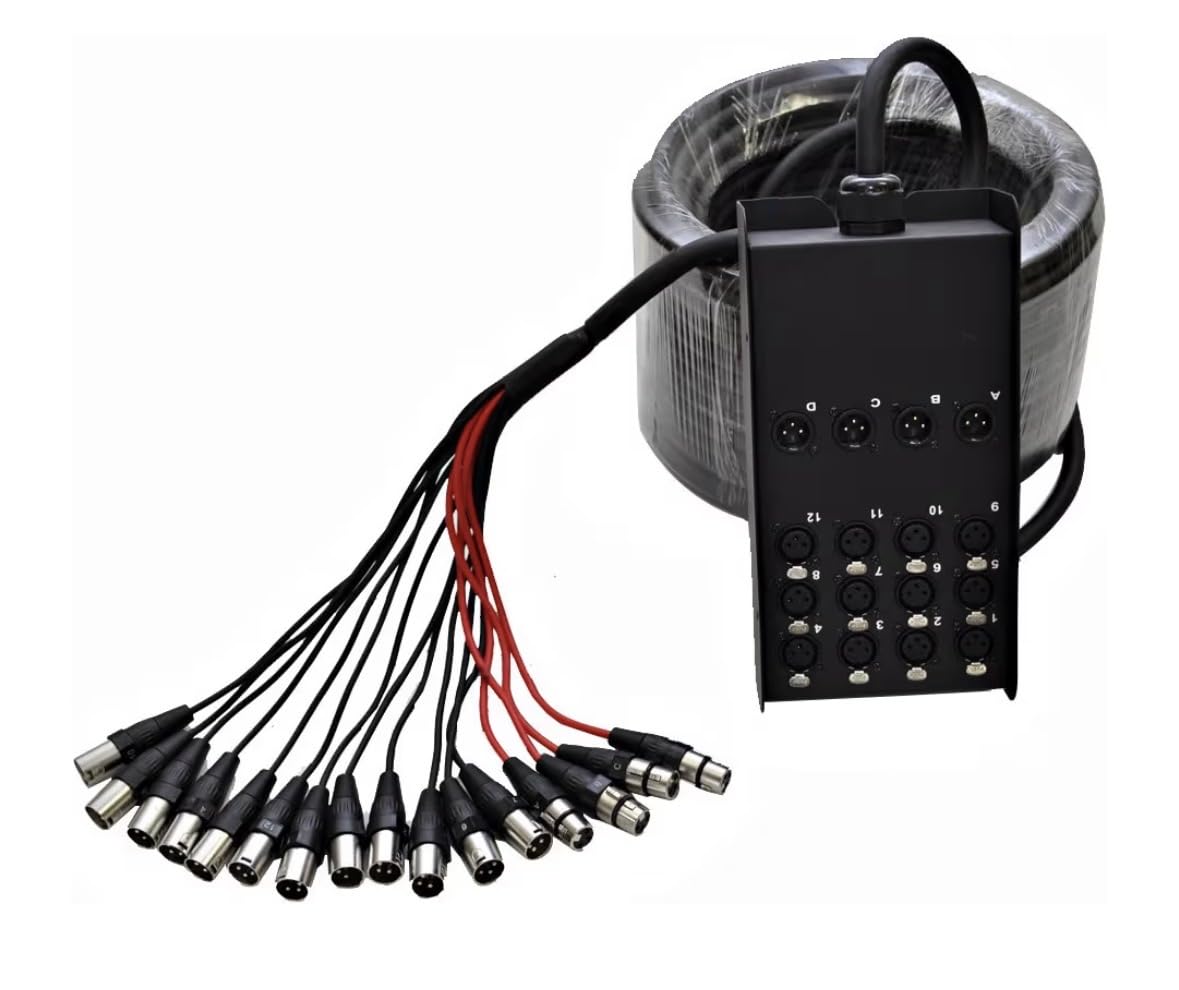
When a stage is big enough that individual XLR runs are becoming a safety problem, this is the shape of snake that solves it. Twenty-four XLR male sends and eight XLR female returns in a single 100-foot run, and the stage box uses a low-profile circuit board design that keeps the box flat enough to sit under a riser or tape down to the deck.
It weighs 36 pounds, and we want to be straight about that. This is not a cable you sling over your shoulder. It goes in a rolling case or gets carried by two people, and it belongs to a crew that has a proper load-in plan rather than a bar band playing three dates a month.
The circuit board technology with individually shielded pairs is the part that matters for a run this long. Each pair has its own screen, which is what keeps a channel in position 24 from picking up anything from the twenty-three ahead of it. Owners on r/livesound regularly single out Seismic Audio as a reasonable budget option for exactly this class of build.
At 4.7 across 1633 reviews it is one of the best-evidenced products in the whole list, and it is ranked in the top tier of the Recording Snakes category, which tells you how much of the professional community runs this thing.
Why this one works for large stages
Twenty-four sends and eight returns covers a large band, a drum riser with overheads, a stereo DI split and a talkback channel in one cable. That removes a dozen loose runs from the stage, which is where the real value of a snake has always been.
The individually shielded pairs also mean you can add channels later without worrying that the new one will be the noisy one. At 100 feet you are well inside the range where balanced analog lines behave, and you are nowhere near the point where you would want a digital stage box.
Where it falls short
Thirty-six pounds is the headline problem. Budget for a road case with wheels, because a 100-foot multicore at this weight is genuinely awkward to handle alone, and a dropped snake can damage the fan-out end.
The warranty is one year for parts and labor, which is shorter than the Monoprice lifetime cover in this list. If you buy at the pro end you are buying capacity and shielding, not long-term peace of mind.
3. Monoprice 8-Channel TRS Snake – Best for IEM and Line Returns
Monoprice 8-Channel 1/4-Inch TRS Male to 1/4-Inch TRS Male Snake Cable – 20 Feet, 26AWG, 8 Balanced Mono and Unbalanced Stereo Lines
- Color-coded routing without a patch bay
- 26AWG conductors with foil shielding
- Sleeve strips back into eight patch cables
- Handles balanced mono and unbalanced stereo
- Molded jacks are not repairable
- A minority of reviews report dropouts
- TRS suits line level better than mic runs
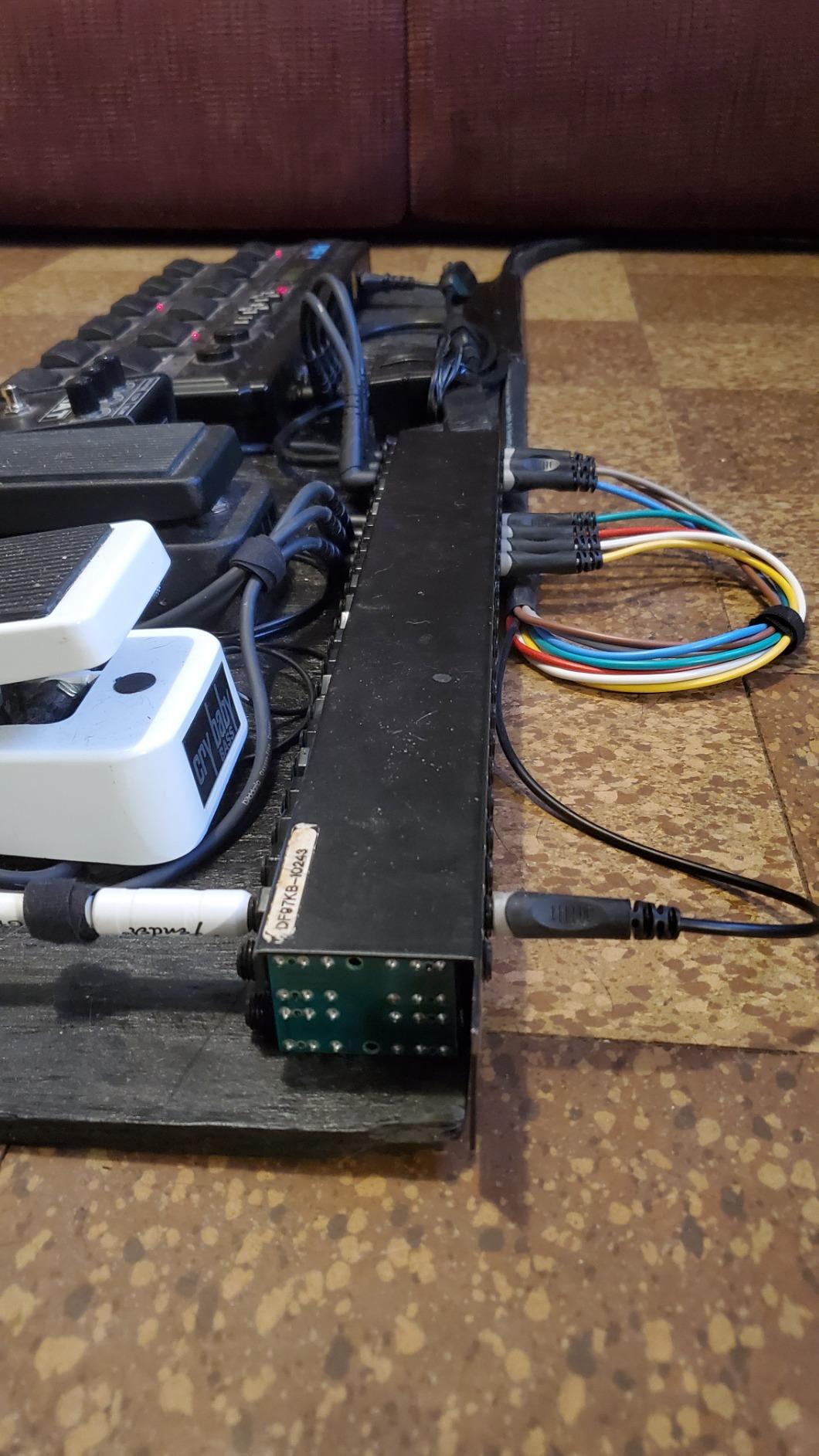
Almost every snake in this list terminates in XLR, which is right for mics and wrong for in-ear monitor returns. This one is eight 1/4 inch TRS channels running the length of one jacket, and if your IEM system wants TRS you will save yourself a row of adapters and a bundle of separate cables.
The conductors are 26 AWG with aluminum foil shielding, carrying either eight balanced mono lines or four unbalanced stereo pairs. The 20-foot length is also offered at 3 feet for rack work, and the whole thing weighs 4 pounds, so it is a genuine option for moving eight return paths out of a rehearsal room or a small studio.
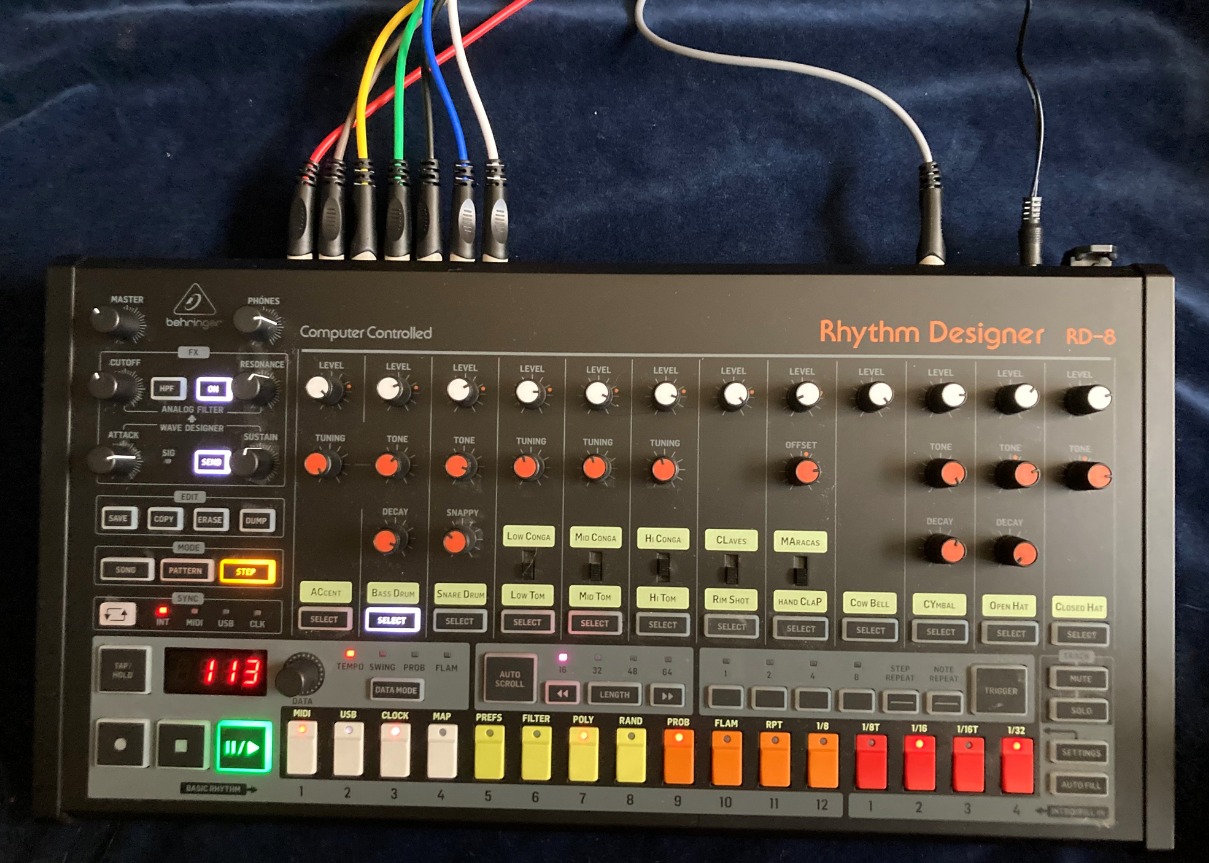
The trick owners mention most is the outer sleeve. Strip it back and you are holding eight individual 1/4 inch patch cables inside a common jacket, which is genuinely useful for a temporary rig or a studio where you re-patch constantly.
At 4.7 from 1012 reviews with 82 percent five-star, the satisfaction is consistent, and it ranks high in the Stereo Jack Cables category. We have seen the same r/homestudios threads asking for a 4 to 6 channel snake with a box and dual TRS or XLR inputs, and this is the closest budget answer to that request.
Why this one works for returns and IEM
Monitor returns are line level, and TRS is the natural connector for them. Running them as XLR just to match the mic snake means carrying an adapter at both ends, and adapters are exactly where intermittent faults come from.
It also doubles as an eight-channel send loom if your mixer outputs TRS, since the channels are reversible in practice. For a rehearsal room where you want eight lines from the control position to the stage and nothing else, this is a clean, low-cost answer.
Where it falls short
The molded TRS plugs are not repairable. If a jack fails internally you are looking at a new loom, and r/livesound regulars specifically warn that Neutrik commercial-grade TRS plugs are poor choices for anyone tempted to build their own return snake from bulk cable.
A minority of reviews report dropouts over time and call the jacket light duty, so treat it as a rehearsal and studio cable rather than a touring one. And because it is TRS rather than XLR, it is not a drop-in mic snake, it is a line-level snake.
4. Hosa SH 8X0 8-Channel XLR Snake – Best for Fixed Installations
- Compact box keeps an 8-channel run manageable at 4.3 lbs
- ProConex construction from a long-running cable maker
- Limited lifetime warranty
- Console to stage XLR sends
- Send only with no returns on the box
- 25 ft can be short on larger stages
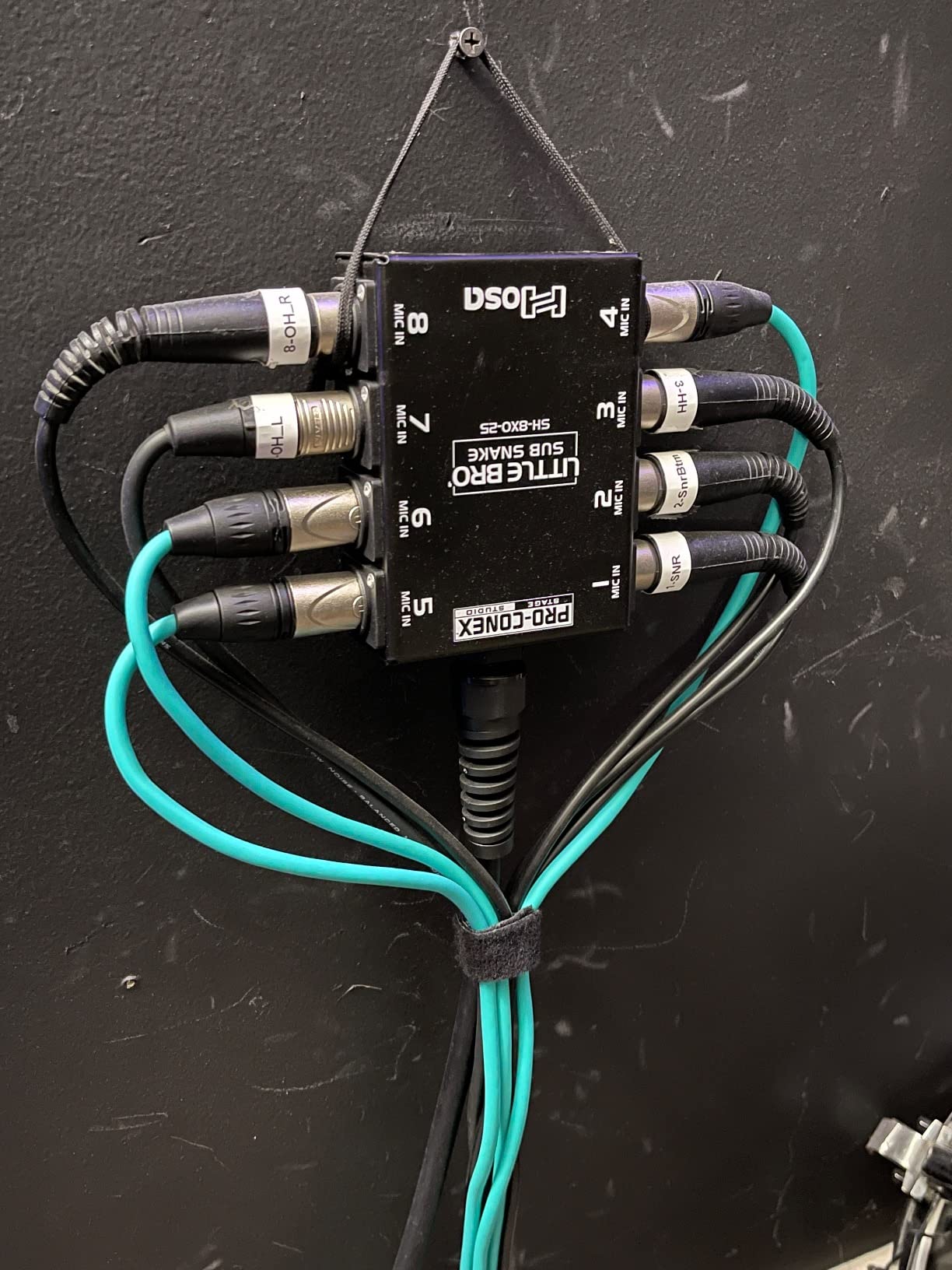
This is the snake you bolt to a wall in a church sanctuary or a rehearsal room and stop thinking about. Hosa is a long-running cable maker, the ProConex junction box is compact enough to sit behind a lectern, and the limited lifetime warranty means it can stay there for a decade.
Eight XLR male to female channels across 25 feet at 4.3 pounds is a sensible ratio. It is light enough to reposition when you move the room around, and the run length covers most sanctuary and small theater stages without needing an extension.
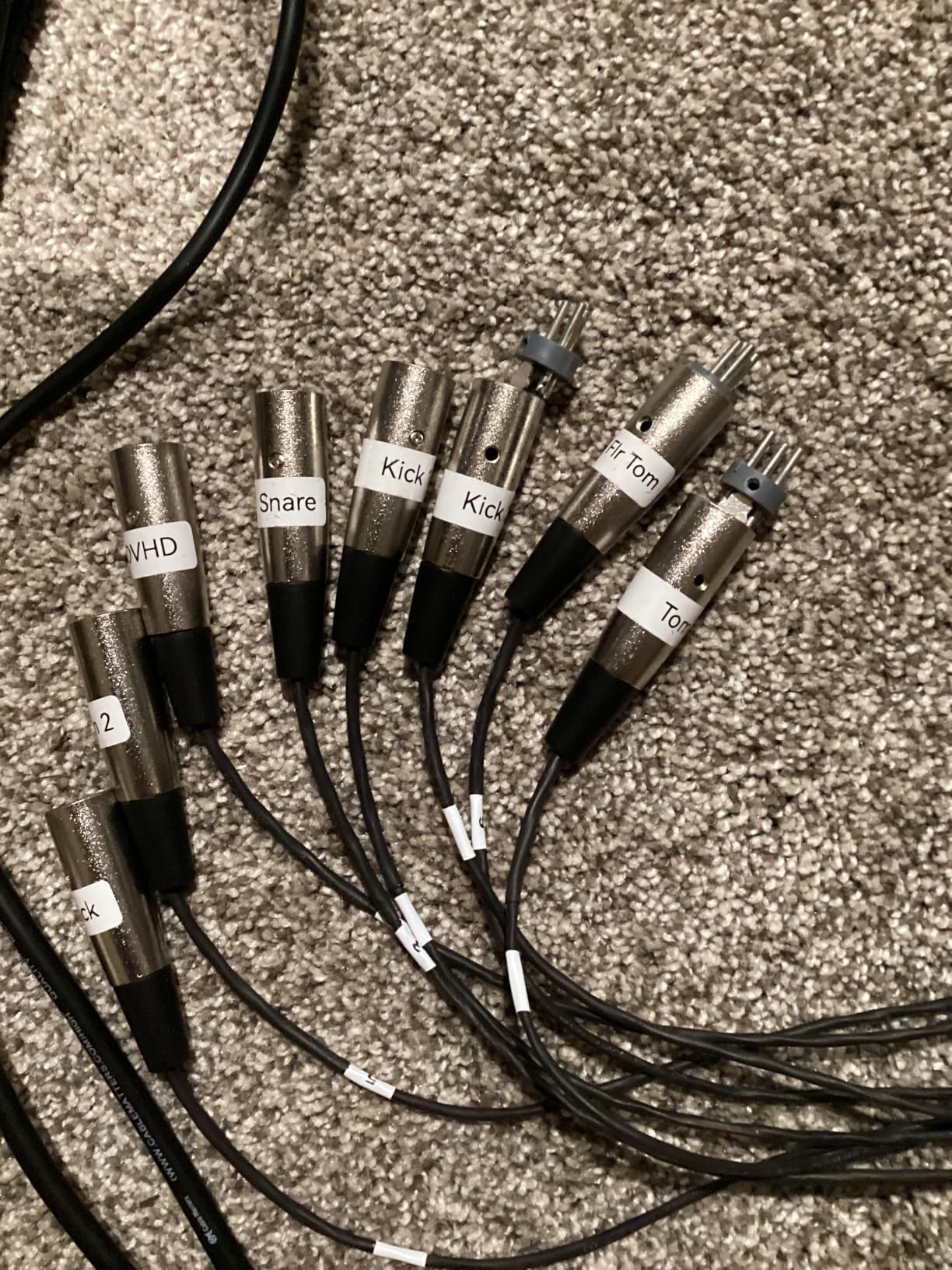
The 50-foot version exists as well if you need more reach, and because the box is a simple junction rather than an active device, there is nothing in the signal path to fail. For an installed room, a passive box with a lifetime warranty is exactly what you want.
It holds 4.7 across 544 reviews with 83 percent five-star and ranks in the top tier of the Recording Snakes category, which is a strong signal for a product that has been in service for years.
Why this one works for permanent rigs
Nothing about it moves once it is placed, so the usual touring failure modes simply do not apply. No van throws, no coil tension, no accidental yanks from a monitor tech hauling a wedge past the cable.
Eight channels covers the common installed case nicely, including a lapel and handheld lectern mic, a couple of instrumental mics and a stereo playback pair if you run one channel as a pair of returns.
Where it falls short
It is send only. There are no dedicated returns on the box, so if your system needs monitor feeds coming back you will need a second cable, which is a real limitation for anyone running IEM rather than wedges.
Twenty-five feet is short for a larger stage or a FOH position at the back of a deep room. The console end is a 25-foot problem, not a stage problem, so plan the distance before you order.
5. EBXYA 4-Channel XLR Snake – Best Value Pick
- 4.8 rating from 528 reviews
- Color-coded channels simplify patching
- Self-locking zinc alloy shells
- Saves rack space versus four cables
- Jacket is stiff near the connectors
- One reviewer reported intermittent no signal
- Not built for heavy road abuse
This carries the highest average rating in the group at 4.8 from 528 reviews, and it currently sits at the top of the Recording Snakes best-seller list. For a short snake going into a rack, a karaoke room or a home setup, it is very difficult to argue with that.
The build is better than the price suggests. Oxygen-free copper conductors, aluminum foil plus braided shielding and self-locking zinc alloy shells with nickel-plated pins are specifications you normally see higher up the list, and the 24 AWG gauge is a sensible middle ground between the light 26 AWG looms and the heavy 22 AWG touring cables.
Six feet is the standard length here, and it is also made in 3, 5, 10, 15, 20, 30 and 50 foot versions in one and two-packs. The channels are color coded red, yellow, green and blue, and the same shell also works as a 1, 2 or 3-channel snake if you only need a couple of lines.
Why this one works for small spaces
At 1.3 pounds and 6 feet it fits behind a mixer where a stage box would never go. It also saves rack and case space compared with four individual XLR cables, which matters in a small case or a tight flight case.
The self-locking connectors are the feature that wins me over at this price. A connector that stays put when someone brushes past it is worth more than a slightly better conductor, because the interruption you notice at a show is always mechanical.
Where it falls short
The jacket between the conduit and the connectors is stiff, and that junction is a strain point. If you coil this cable tightly at that spot repeatedly, you are testing exactly where it is weakest.
One reviewer reported a finicky locking clip that caused intermittent no-signal, and a few reviews mention hum or feedback. It is not built for heavy road abuse, so keep it in a case rather than living in a cable bin.
6. Seismic Audio SAEM-12x4x100 – Best Touring Snake with 12 Sends
Seismic Audio – SAEM-12x4x100 – 12 Channel XLR Sends and 4 Channel XLR Returns Snake Cable – 100 Feet
- Steel box tolerates road abuse
- No measurable crosstalk on balanced runs
- Color coding and numbering speed patching
- Printed channel numbers sit next to the wrong connectors
- Release latches are low quality
- 34 lbs wants a rolling case
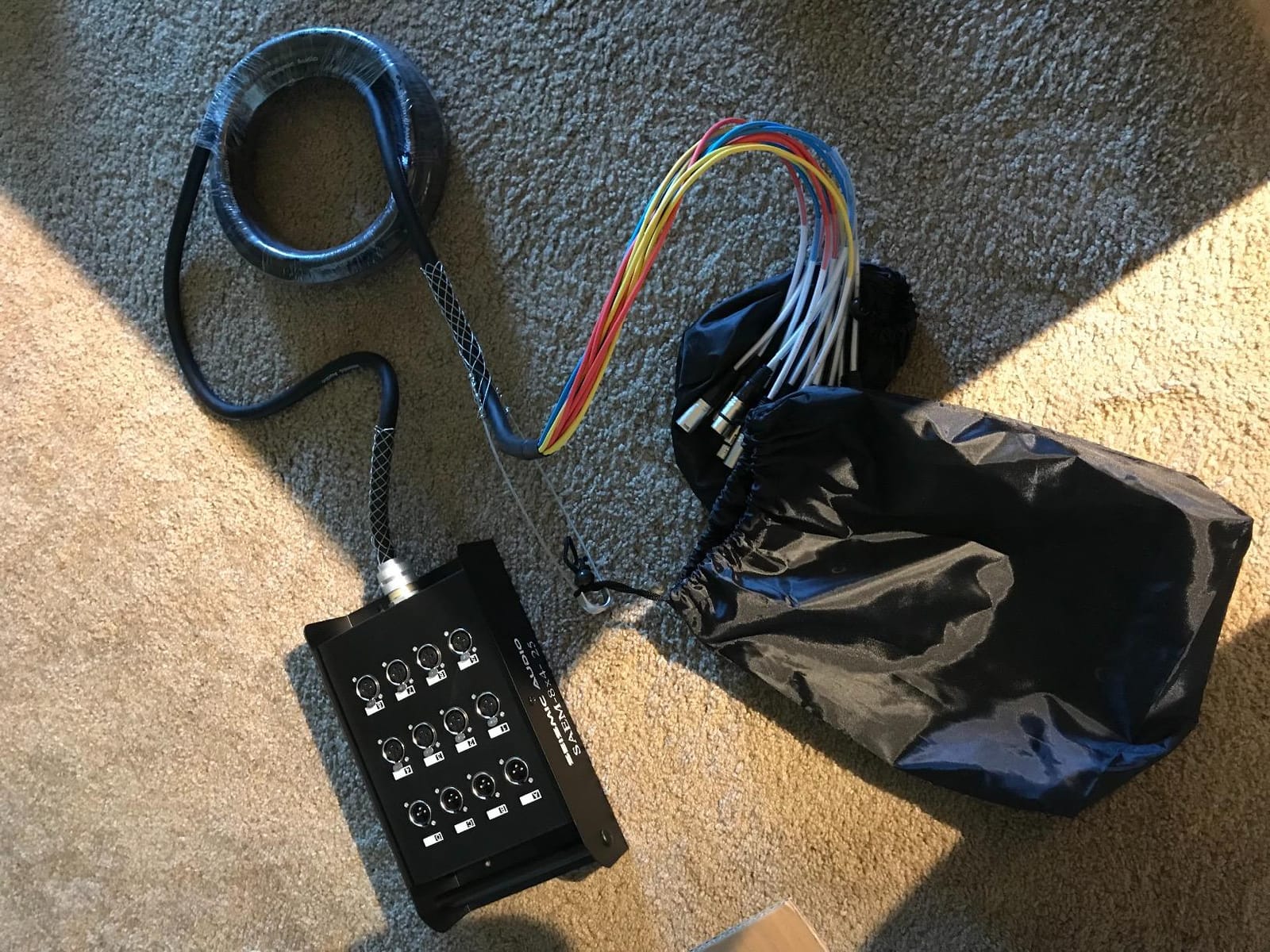
Twelve XLR male sends and four XLR female returns across 100 feet, with 22 AWG individually shielded pairs, is the configuration most working bands end up wanting. Four returns is the standard here for a reason we explain in the sizing guide below, and having them built into the box saves a second cable.
The steel stage box is the differentiator. It has a carry handle and heavy-duty strain relief on both ends, and owners report it holds up well in service with strong build quality for the price tier. At 4.6 from 520 reviews with 82 percent five-star, long-term owners describe it as dependable rather than exciting.
One owner reports no measurable crosstalk on analog balanced runs, and reviewers single out low attenuation. Both of those are the quietest possible compliments for a multicore, and they are the ones that matter for a live show.
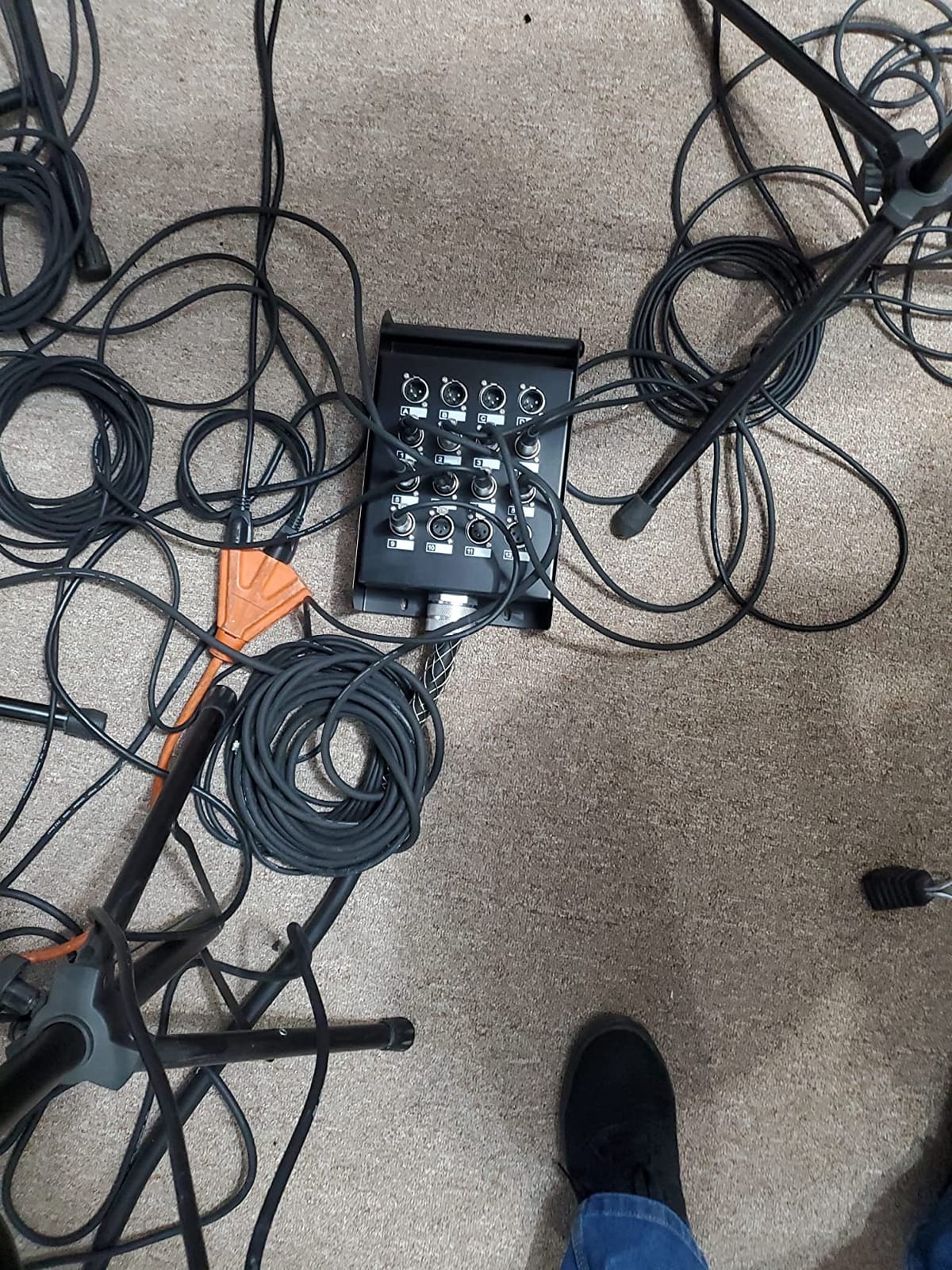
The fantail and stage box are color coded and numerically labelled, which sounds like a small thing until you are patching a 12-channel rig in the dark. The stage box surface is self-labeling white, so you can write your own channel names on it with a marker if the band always uses the same layout.
Why this one works for touring
A steel box and heavy-duty strain relief are what survive a van, a loading dock and a monitor tech stepping on something at 1am. The 22 AWG gauge gives you solid low signal resistance without the stiffness that makes a snake un-coilable.
Twelve sends and four returns is the sweet spot for a full band with four wedges and a stereo playback pair, without the weight and cost of a 24-channel run. Most working bands do not need more than this.
Where it falls short
The printed channel numbers on the box are offset from the actual connectors, which is the single most repeated complaint in the reviews and a genuine trap for anyone patching quickly. Mark your own box and check it against the fantail before the first show.
The push-release buttons are low quality and can stick or fail over time, and one owner reported loose inputs after about two and a half years of service. At 34 pounds, budget for a rolling case rather than carrying it from the van yourself.
7. Seismic Audio SAXQ-12x4x50 – Best for 50-Foot Stage Runs
Seismic Audio – SAXQ-12x4x50 – 12 Channel 50′ XLR Snake Cable with XLR and 1/4″ Returns on the Box
- XLR and 1/4 in TRS returns paralleled on the box
- Dust bags included for box and ends
- One owner reports 10 years of service
- Heavy at 22 lbs
- No 1/4 in sends at the fan end
- Dust bags are thin and tear
Fifty feet is the sweet spot for a lot of venues, because it reaches a standard FOH position in a small club or a shallow room without the excess coil of a 100-foot run. This one gives you 12 XLR sends and four returns, with the returns paralleled to 1/4 inch TRS on the box end.
That parallel return detail is the reason to buy this version instead of a straight 12-by-4. The same four return channels are available as XLR and as TRS on the box, so you can feed both a monitor system and a wedge snake from one connector position without adapters.
It uses 22 AWG individually shielded construction with a braided tangle-free jacket, and it is rated at 4.6 from 247 reviews. The standout theme in the reviews is reliability under heavy use, including one owner reporting ten years of service.
Why this one works at 50 feet
A braided tangle-free jacket is a real advantage for a multicore you coil after every set. It resists the kinking that turns a flat multicore into a frustrating coil, and at 50 feet you are carrying a much lighter bundle than a 100-foot run.
Phantom power passes cleanly and the connectors are reported as looking like Neutrik quality, which is a good sign for both build and contact quality. Drawstring dust bags for the box and both cable ends are included, which matters more than it sounds if the snake lives in a dusty van.
Where it falls short
At 22 pounds it is still heavy, and it is better suited to a stationary or wheeled setup than to a back-carry. The weight is a function of the channel count and length, and there is no way to reduce it without dropping channels.
There are no 1/4 inch sends at the fan end, so a mixer with TRS outputs needs adapters. The channel labels also sit next to the wrong connector, which is the same labelling complaint that appears on the 100-foot model, and the included dust bags are thin.
8. Fat Toad 8-Channel XLR Snake – Best for Rack and Studio Patch
Fat Toad 8-Channel XLR Snake Cable 10FT (ShieldedPRO X Series) – Balanced Audio Patch Cord for Studio, Live Sound, Mic Interface, DJ Mixer & Amplifier Gear
- Inexpensive way to move 8 balanced channels
- Low capacitance signal
- Channels coded at both ends
- Flexible jacket routes into tight spaces
- Only 10 ft
- Send only with no stage box returns
- Ratings cluster below the top picks here
Ten feet and eight balanced channels is a short, useful combination. It is long enough to reach from a rack to a desk or from a small control position to the back of a room, and short enough to stay tidy, which is why it works well for studio, DJ and small live setups.
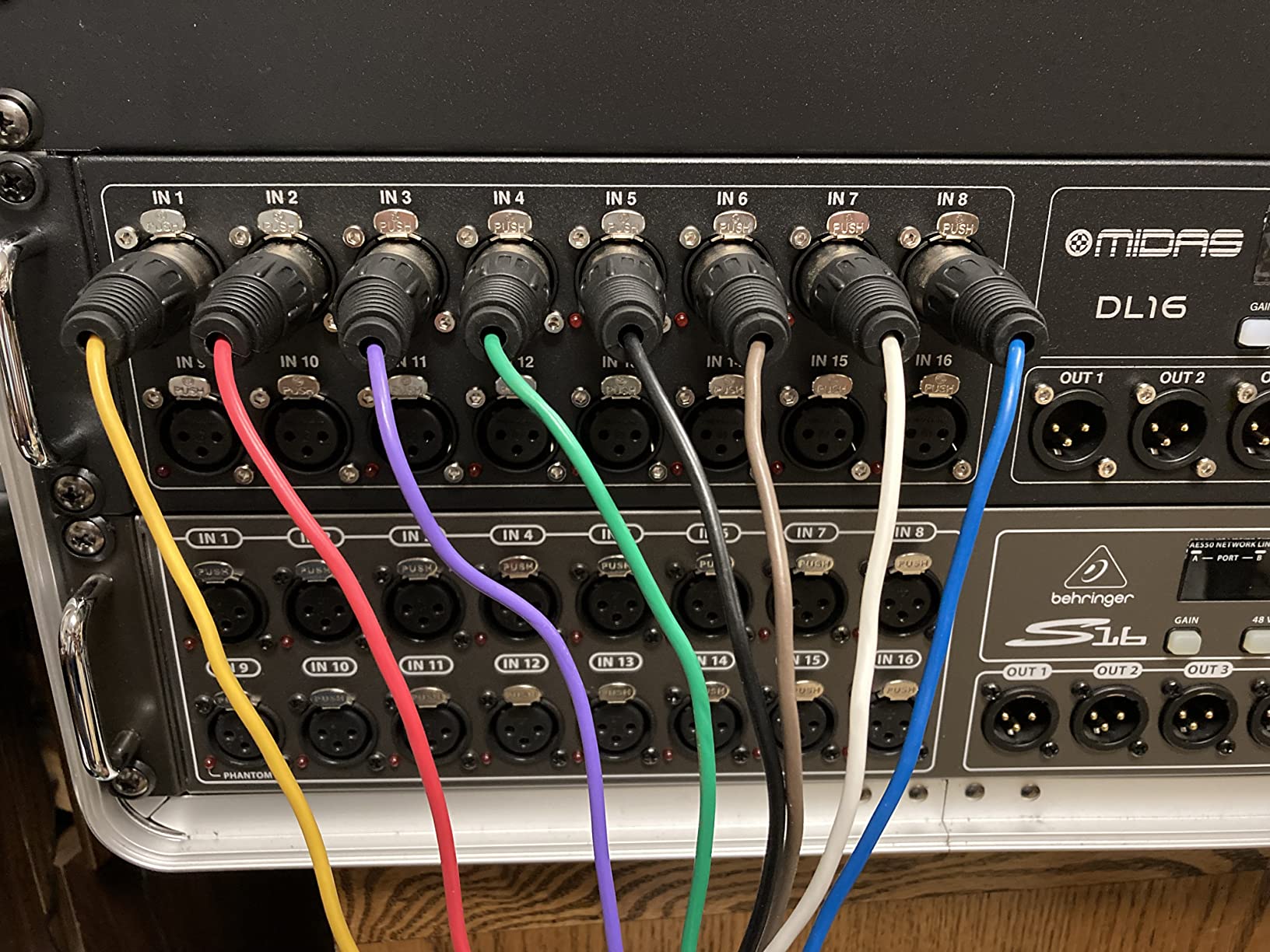
The construction is more serious than the price. Twenty-two gauge copper conductors with heavy-duty insulation, a low-capacitance design for low signal resistance, and channel coding at both ends so you can trace a line without a manual.
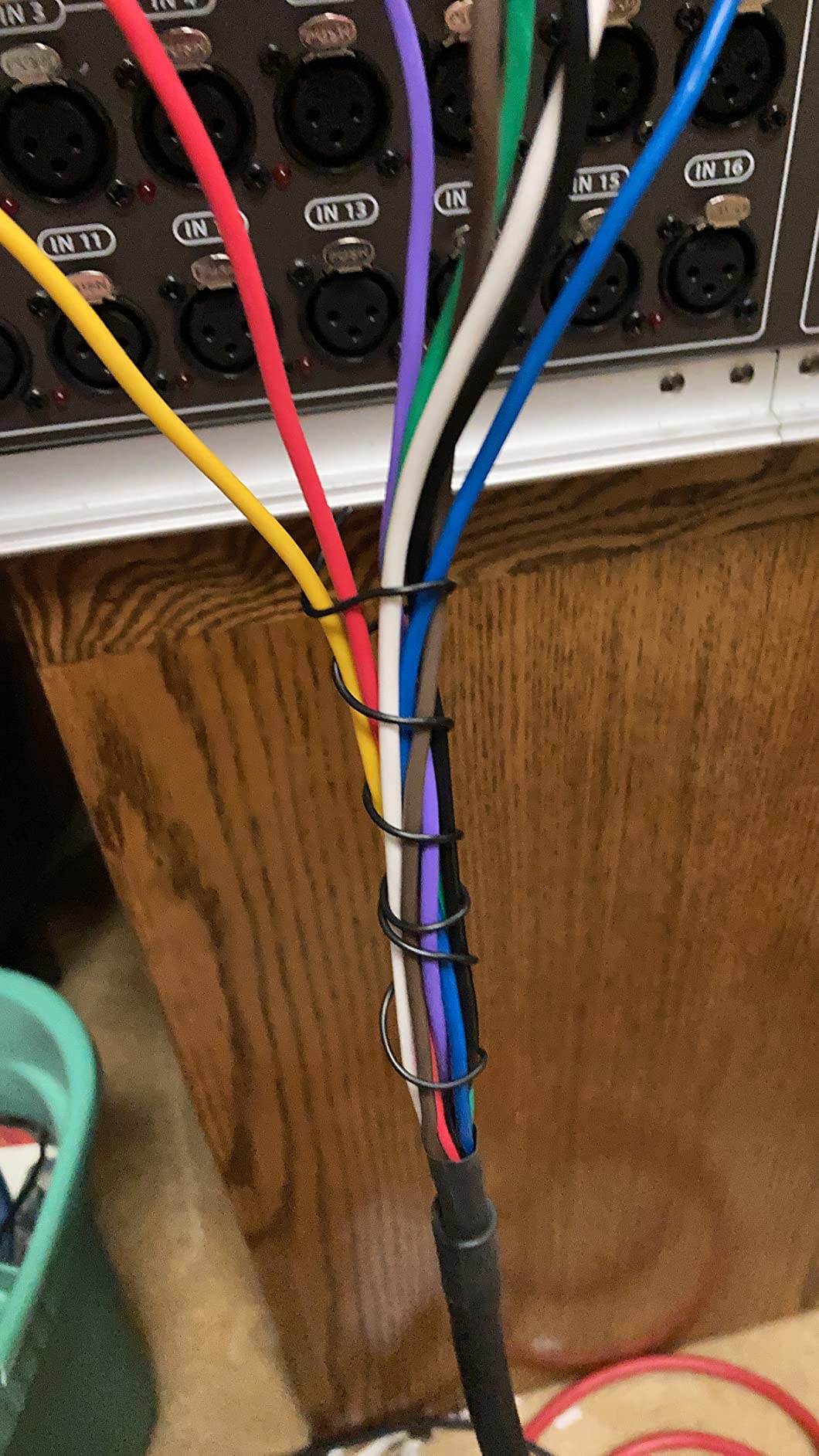
It holds 4.6 from 160 reviews with 77 percent five-star. Those ratings sit slightly below the top picks in this list, with a 7 percent three-star share, and that gap tells you where it sits: a capable budget multicore rather than a reference one.
It is also offered as a two-pack, which solves the return problem in a practical way. Run one from the console to the stage for sends and keep the second for balanced returns, and you have a working eight-channel out and eight-channel back setup for a rehearsal room or a small club.
Why this one works in a rack or studio
A flexible jacket matters more than people expect in a rack. The cable has to bend tightly to get into a cable manager or behind a mixer, and a stiff loom puts stress on the terminations at exactly that point.
Low capacitance is a genuine advantage for short studio runs because it keeps the signal clean with very little signal resistance, and the coded ends make re-patching a session fast without a patch bay.
Where it falls short
Ten feet is the whole product. It suits rack and small-stage patch use rather than a real stage run, and there is no longer version in the range to grow into.
It is send only, with no returns on the box, and the warranty is a one-year replacement rather than a lifetime cover. For a permanent installation we would pick the Hosa above instead.
9. Hosa SH 6X2 6-Channel Snake – Best for Small Stages
- 4.8 rating with only 3 percent three-star
- 6 mic sends plus 2 balanced TRS returns
- Channels work in either direction
- Light at 3.7 lbs
- Only 2 returns
- 20 ft is short on large stages
Six XLR female to XLR male mic sends plus two balanced 1/4 inch returns in a compact Little Bro junction box, at 20 feet and 3.7 pounds. For a four-piece band playing a bar, that is usually more capacity than you will ever fill.
What stands out is the consistency of the ratings. It holds 4.8 from 167 reviews with 82 percent five-star and only 3 percent three-star, which makes it the most uniformly liked product in this list despite a modest review count.
The channels are usable in either direction for balanced audio, so the return lines can double as extra sends if a night needs it. That flexibility is the reason we like it more than a send-only snake of the same size.
Why this one works for a small stage
Two returns is enough for a compact monitor rig or a stereo wedge pair, and the TRS returns mean your monitor system connects directly with no adapters. For most bar bands running four wedges, two stereo sends cover it.
At 3.7 pounds it is one of the lightest stage box snakes here, and the compact box means it can sit at the back of a small riser or on a low table without tripping anyone.
Where it falls short
Two returns will not cover a full six-channel return run, and that is the single most common forum complaint in this category, with users on r/livesound asking specifically for more returns and ending up with gender changers and Y-splitters to compensate.
Twenty feet is on the short side for anything bigger than a small room. The warranty is one year, which is the shorter end for a Hosa product, so check the current terms before you commit.
10. PRORECK 8-Channel Circuit Board Snake – Best as a Sub-Snake
PRORECK 8-Channel Low Profile XLR Send Circuit Board Snake Cables, XLR Splitter Cable for Live, Recording, Stage, Studio, 25 Feet Long
- Very light for an 8-channel snake
- Circuit board connectors reduce external noise
- Push-lock inputs hold firmly
- Numeric labeling on box and fantail
- Plastic housing is not road tough
- Channels share a common ground
- Thin drawstring bags
- Isolated reports of dropouts
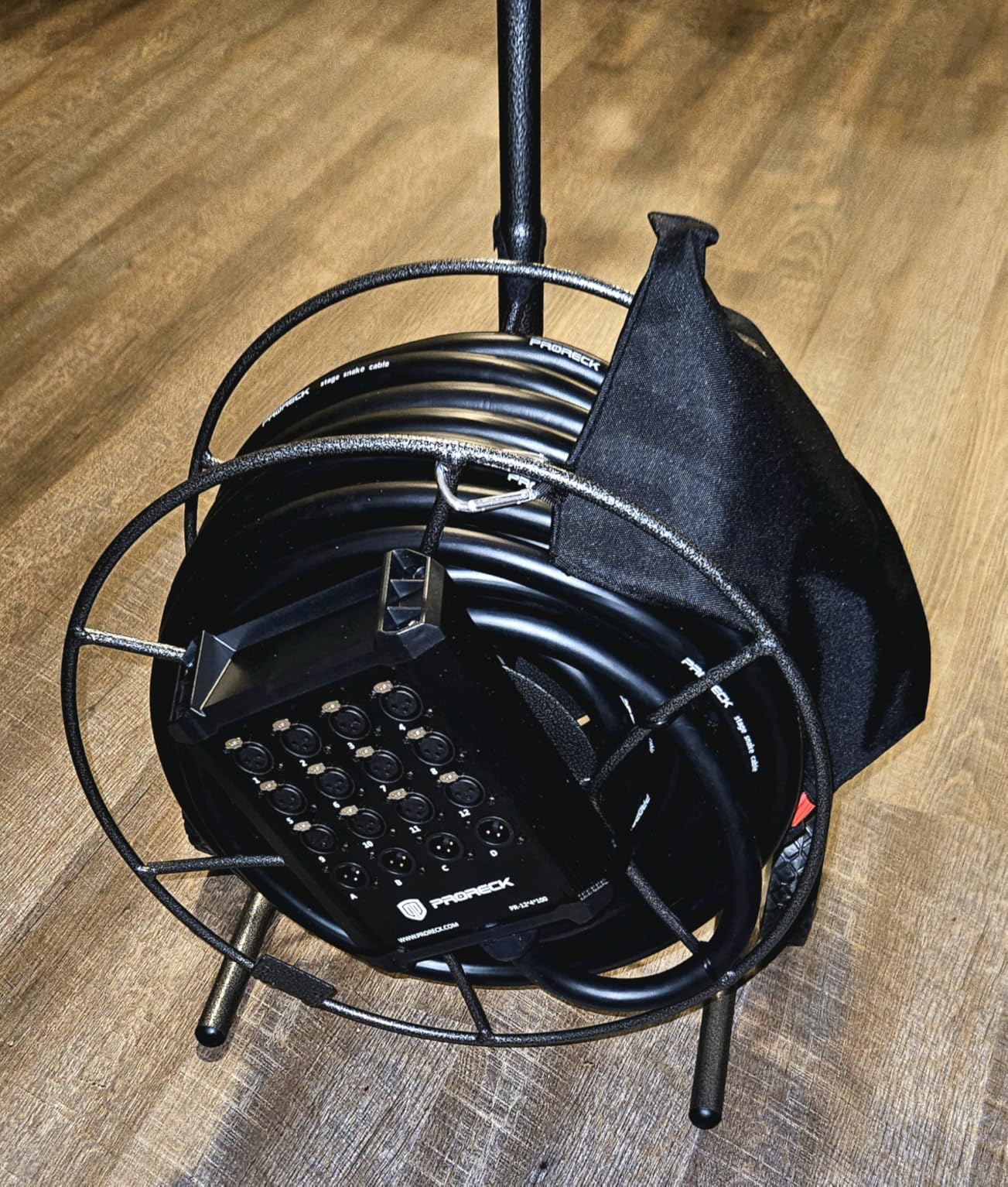
This is the one to buy when you need more inputs than your main snake has, rather than a primary stage snake. Eight male XLR on the fantail and four female XLR on a low-profile circuit board stage box, across 25 feet, and users specifically describe it as useful for extending inputs and returns without a network stage box.
Circuit board connectors are the point of the design. Keeping the connections on a board inside the box rather than on a panel reduces the amount of exposed metal, and owners report a clean, noise-free signal with phantom power passing without trouble.
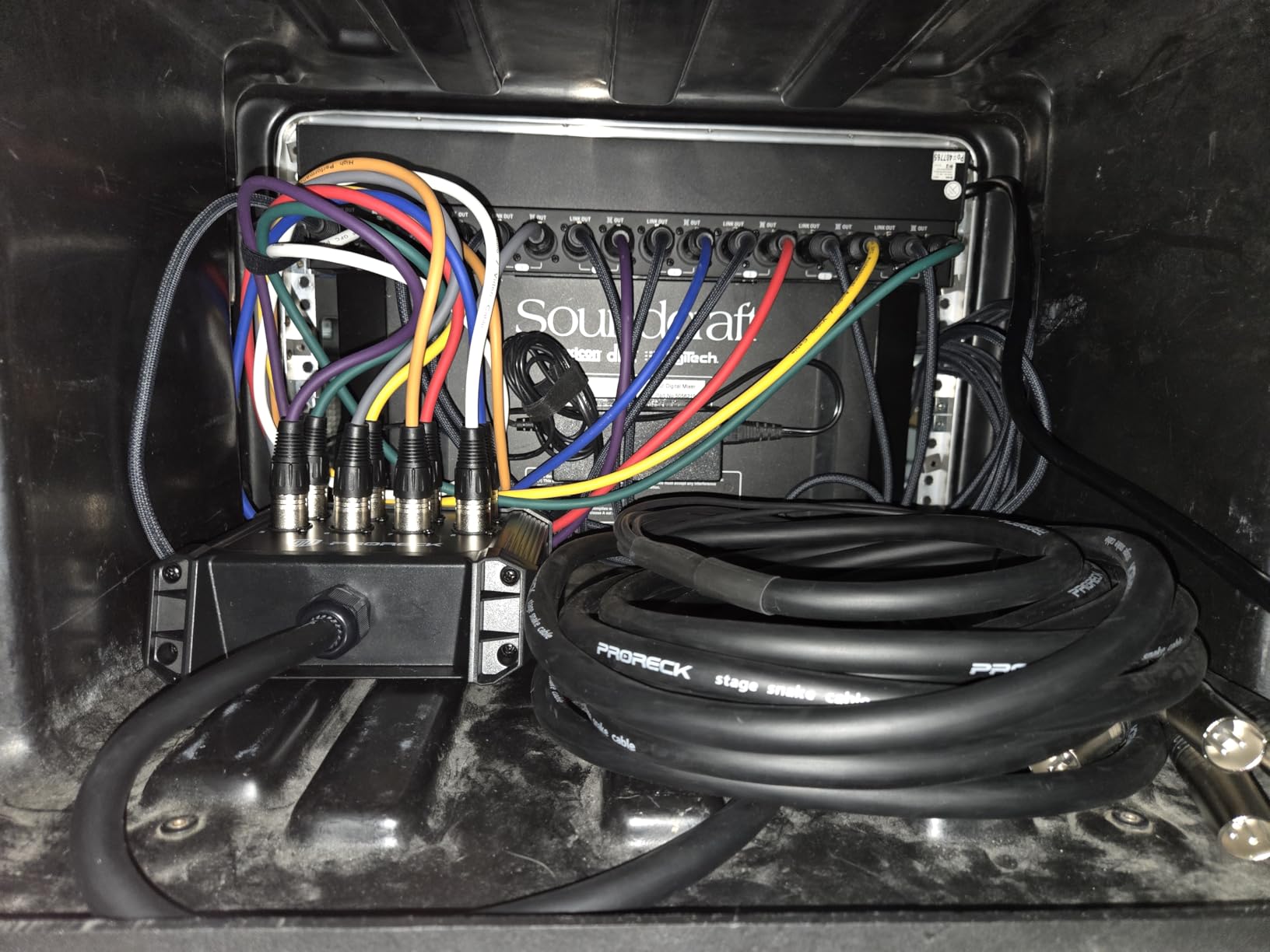
It is very light for an eight-channel snake, which is why it suits a drum riser or a side-of-stage position where you are already carrying cables. Push-lock XLR inputs hold firmly in the box, and both the box and the fantail are numerically marked for channel identification.
It holds 4.6 from 127 reviews with 80 percent five-star, but the 10 percent three-star share is the highest in this group. That spread tells you it performs well in the conditions it suits and struggles outside them.
Why this one works as a sub-snake
A sub-snake is the standard trick for extending a rig without replacing the main cable. Put this at the drum riser to bring eight mics across, and you have spare inputs without a second full-length run taking up space.
It also handles a 25-foot run comfortably, and the numeric labeling on both ends makes it a clean match with a main snake, especially if you label both to the same scheme.
Where it falls short
The plastic housing and inexpensive connectors are not built for road abuse, so this is an installed or semi-permanent snake. Touring users should choose a steel-boxed model such as the 12-channel Seismic instead.
Channels share a common ground, which can matter in setups where devices are trying to isolate ground, and there are isolated reports of channels dropping out after several months. The included cover bags also have thin, cheap drawstrings that will not survive a lot of use.
How to Size a Snake Cable for Your Band and Room?
Most wrong purchases in this category come from counting inputs only. A snake is two things at once, sends going from stage to console and returns coming back, and the return count is where people get caught.
Start with a physical count. Every mic on stage needs a send, so count vocal mics, instrument mics, drum overheads and any talkback or stereo playback feed. Then add headroom, because the band will add a keyboard or a second snare at some point and you do not want to buy the cable again.
Next, count your returns honestly. Each wedge or in-ear mix that comes from the console back to the stage needs a return, and a stereo wedge feed uses two. Four returns is the common standard on 16 and 24-channel snakes because a typical wedge mix is a stereo pair per pair of mixes, so two mixes fill four returns.
That is also why so many owners end up short. One r/livesound thread about needing more returns than the snake provided drew strong interest, and the honest answer is that the band needed a second return cable or a proper split rather than a different brand of snake.
Finally, measure the distance. Run from the stage position to the console position and add a foot at each end for the service loop. Snakes are sold in fixed lengths, and a 50-foot run for a 45-foot stage is a far better purchase than a 100-foot run you have to coil and carry.
As a worked example, a four-piece band in a 200-capacity club with four vocal mics, a guitar mic and stereo playback needs six sends and two returns for a pair of wedges. An eight-channel send snake plus a short TRS return loom covers it, and the Hosa SH 6X2 does both jobs in one box.
Scale that up to a full band with a drum riser, four wedges and a stereo playback pair, and you land on roughly twelve sends and four returns. That is the configuration the 12-channel snakes in this roundup are built for, and it is the most common touring setup we see.
For a larger stage with an orchestra or a worship band that uses more than twenty lines, go to 24 sends and 8 returns. Just budget for the weight, because a 100-foot run in that class is in the mid-thirties in pounds and needs a rolling case.
If you are still unsure, the [mixing consoles for live sound](/best-mixing-consoles-for-live-sound/) comparison covers the input and output counts you will be matching your snake to, and it is the input side of the console that decides your channel count.
Connector Types, Cable Gauge and Shielding Explained
Connector choice is mostly about what plugs into the ends. XLR male sends go into console inputs, and XLR female returns come back out of the console outputs. That is the standard for mic lines, and nine of the ten snakes here use it.
TRS is the alternative, and it exists for line-level signals rather than mics. A balanced TRS return is the natural home for monitor feeds, which is why the Monoprice 8-channel TRS loom in this list is a natural companion to a send snake rather than a replacement for one.
Multipin connectors compress many channels into one round connector at each end, usually to a wall-mounted box. They patch faster and have fewer individual connections to fail, but they are fixed installations rather than portable cables, and you cannot re-route channels once they are built.
RJ45 and EtherCON snakes carry digital audio over network cable, usually running Dante. They solve length and channel-count problems completely, but they need switches, configuration and a network knowledge you may not want for a small rig. If you are pairing cables with [powered subwoofers for live sound](/best-powered-subwoofers-for-live-sound/) or [PA speakers for live sound](/best-pa-speakers-for-live-sound/), those typically need their own dedicated runs anyway.
Gauge is the number buyers overthink. Twenty-two to twenty-four AWG is the practical range for stage snakes, and twenty-six AWG works for short fixed runs like the eight-channel TRS loom. Heavier gauges get stiff, get heavy and get hard to coil, and inside a reasonable run length you gain nothing audible.
Length matters more than gauge. A practical rule from the live sound community is to keep unbalanced runs under about twenty feet, because an unbalanced line picks up interference quickly and no amount of shielding fixes it completely. For balanced mic lines, treat roughly 300 feet as the practical ceiling before you move to a stage box or digital transport.
Shielding comes in three forms. Foil is cheap, flexible and good at high-frequency interference, but it is fragile and hard to terminate. Braid is tougher and better at low-frequency magnetic fields, but it is heavier and less complete in coverage. Hybrid foil plus braid gives you both, and it is the sensible choice in any venue with LED walls, Wi-Fi and lighting rigs nearby.
Individual shielding per pair is the next step up and is where the professional snakes in this list sit. Every channel has its own screen, so a channel in position 24 is not sitting next to twenty-three others picking up whatever they pick up. That is the difference you actually feel in a large multicore, and it is the reason circuit board designs exist at all.
Common Snake Cable Problems and How to Fix Them
Connector and pin failure is the most common problem by a wide margin. XLR pins bend, oxidize or get pushed sideways by a dropped connector, and the fix is a replacement plug, a contact cleaner, or in the worst case a new termination at that end.
Conductor fatigue at the fan-out is the second most common. A snake that crackles or drops out only when you move it almost always has a broken strand where the conductors leave the shell, because that is where the cable flexes most. Bending the fan-out through a full range and listening is how you confirm it.
Jacket and strain-relief damage is third. A multicore that has been kinked at the same point every time it is coiled will eventually crack the outer jacket, and once moisture gets in you get both noise and intermittent faults. Coiling in a figure of eight rather than an oval helps.
Crosstalk shows up as one channel bleeding into another, and it gets worse as channel count rises. It is a shielding and separation problem, so the answer is individually shielded pairs, keeping the snake away from power and lighting cable, and avoiding a run that shares a duct with mains.
Hum and ground loops are the most misdiagnosed fault. If the hum is constant it is almost always a ground loop, caused by one piece of equipment being powered from a different circuit or a signal ground bridging two paths. Moving everything to one power strip fixes most of it, and a hum isolator on inputs handles the rest.
Network faults only apply to RJ45 and EtherCON snakes, but they are worth knowing. Digital dropouts are rarely the cable, and are usually unmanaged switches, wrong QoS settings, or ports on a switch that does not support what you need.
When a channel fails under show conditions, work through this flow in order. First, move the mic to a different input and see if the fault follows the mic or the cable, which tells you instantly which half you are chasing.
Second, wiggle-test the fault while the channel is live, testing the length in small sections, because a fault that appears and disappears with movement is mechanical. Third, inspect the connector and the fan-out under a light for bent pins, corrosion or a shell that has separated slightly from the cable.
Fourth, check the strain relief and the coil, since a sharp bend at the point where the cable leaves the shell is where a fatigued conductor will break. Finally, test the channel with a cable tester before you start changing connectors, because it is much faster than swapping parts at random and guessing.
Test every channel before load-in, not during soundcheck. A full channel-by-channel check on a quiet system catches a dead channel in seconds, and doing it at load-in turns a five-minute job into a thirty-minute one under time pressure.
When a Digital Stage Box Beats a Snake Cable
A digital stage box wins in two specific situations, and loses in one. It wins when you need more than about 24 channels from a long distance, because analog balanced lines hit practical limits around 300 feet while a network run does not degrade in the same way.
It also wins when you need to re-route or re-split freely. An analog snake has a fixed channel path, and a forum thread about building snakes captures the frustration well, because changing the routing means physically re-patching. A digital box routes in software.
It loses when you are a small act moving a handful of channels, or when you want a system that works the moment you plug it in. A digital stage box needs switches, network configuration and a laptop, and if the switch is not configured correctly you get silence and no obvious reason why.
For a rental house or an installed venue that changes rooms, the weight argument matters too. A 24-channel analog snake in the mid-thirties in pounds is a two-person carry, while a stage box plus a coil of network cable is a fraction of that.
As a rough rule, stay analog below 24 channels and short runs, and go digital for large stages, long FOH distances or anywhere you need flexible routing. Many working engineers do both, keeping an analog snake for backup.
Frequently Asked Questions
Do XLR cables make a difference in sound quality?
No. A correctly built, correctly terminated balanced snake is transparent, and the brand tier does not change tone. What more money actually buys is better shielding, solid connectors, proper strain relief and repairability. Poorly made cables do sound bad, but because of hum, crosstalk and bad terminations rather than conductor purity.
What are common problems with snake cables?
The six most common failures are connector and pin damage, conductor fatigue at the fan-out, jacket and strain-relief damage, crosstalk between channels, hum and ground loops, and network faults on digital RJ45 snakes. To isolate a fault fast, move the mic to another input, wiggle-test the channel while live, inspect the connector and fan-out, check the coil, and confirm with a cable tester.
What cable gives the best sound quality?
A properly shielded, correctly terminated balanced cable with solid connectors. Ranked by what matters: balanced twisted pairs first, then per-pair or overall shielding, then connectors and strain relief, then consistent gauge, then jacket durability. There is no magic brand, and conductor material matters far less than how the cable is built and terminated.
What is the ideal gauge for a snake cable?
22 to 24 AWG is the practical range for stage snakes, with 26 AWG workable for short fixed runs. Heavier gauges get stiff and hard to coil without audible benefit inside a reasonable run length. Pair gauge with sensible lengths: keep unbalanced runs under about 20 feet and treat roughly 300 feet as a practical ceiling for balanced mic lines.
How do I choose the right channel count for a stage snake?
Count every send you need, including vocals, instrument mics and overheads, then add headroom. Count returns separately, remembering a stereo wedge feed uses two channels. Four returns is standard on 16 and 24-channel snakes because a typical stereo monitor mix uses two. Then measure the stage to console distance and add a service loop at each end.
Final Verdict: The Best Snake Cables for Live Sound in 2026
The Monoprice 4-channel XLR snake takes the top spot for the best snake cables for live sound because it does the one job most bands need, moving four balanced lines cleanly for years, with metal housings, color-coded channels, a lifetime warranty and the largest review base in the category at 2832 reviews.
If you need a real stage, the Seismic Audio 12-channel model with 12 sends, 4 returns and a steel box is the working choice, and the 24-channel 100-foot version is there when a stage genuinely needs that much capacity and you have a rolling case. For line-level returns, the Monoprice 8-channel TRS loom removes a stack of adapters.
Whatever you choose, count your returns before you count anything else, keep unbalanced runs short, and test every channel before load-in. That preparation does more for your show than any cable brand ever will.