
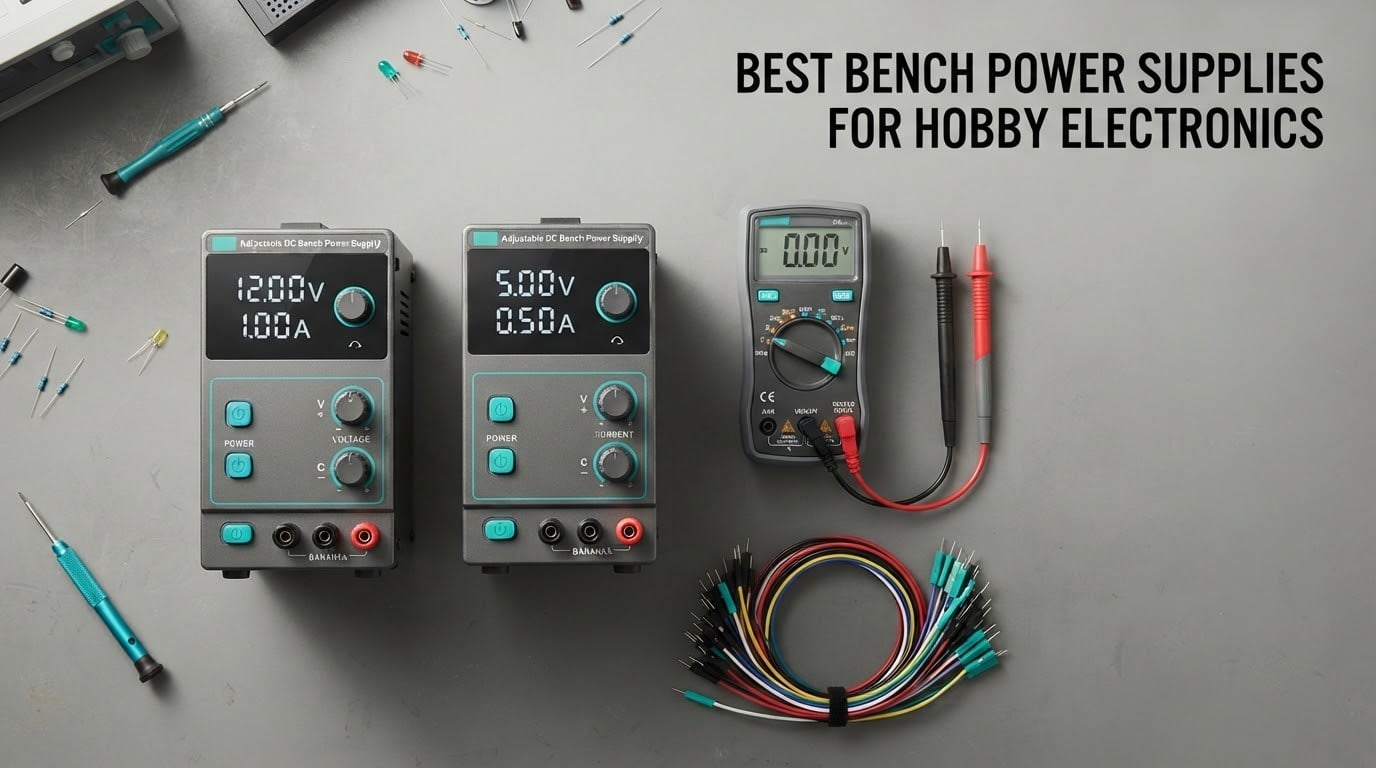
A bench power supply is a regulated, adjustable DC source that sits on your workbench and lets you dial in an exact voltage, set a current limit, and watch what your circuit actually draws. A wall adapter does none of that. It hands you a fixed voltage, hides the current draw, and will quietly cook a board if you get the polarity or the voltage wrong.
For anyone building or repairing hobby electronics, that difference matters more than the spec sheet suggests. Whether you are breadboarding an Arduino, recovering a dead cordless tool battery, debugging a game console, or bench-testing an audio amplifier, the supply is the one piece of kit that controls how much current your circuit can ever see. Set the limit low and a dead short becomes an event you can watch. Set it at 10 amps and the same short becomes a melted trace.
This guide covers the best bench power supplies for hobby electronics we could justify on published data, user review history and feature logic, not just marketing copy. We looked at 30V/10A switching units, compact 150W boxes, and true linear lab supplies, and we mapped each one to the kind of work it actually suits.
One note on honesty: none of the supplies below publish verified ripple figures we can print, so we are not going to invent them. Instead we lean on the numbers that are checkable — rating, review count, weight, dimensions, input range, protection circuits and named user-measured results such as the HYELEC owner who matched a Fluke within 5mV at 20V. If you are still building out a bench, our hobby workbench picks cover the desk side of things.
Table of Contents
Top 3 Best Bench Power Supplies for Hobby Electronics in 2026

Kungber SPS3010B 30V 10A
- 30V 10A 300W output
- 18W USB port
- Intelligent charging mode
- OCP short-circuit alarm

Jesverty SPS-3010 30V 10A
- 0.01V / 0.001A resolution
- 5V 2A USB port
- Automatic CV/CC switching
- Compact 2.4 lb body
Siglent SPD3303X-E Triple Output
- Three isolated outputs
- Series and parallel modes
- 32V 3.2A plus logic channel
- Timing and trending graphs
All 12 Bench Power Supplies Compared Side by Side
Every pick below runs 0-30V unless noted, and every one offers constant-voltage to constant-current crossover. The table gives you the raw range and the practical reason to buy it.
| Product | Specifications | Action |
|---|---|---|
| Kungber SPS3010B 30V 10A |
|
Check Latest Price |
| Jesverty SPS-3010 30V 10A |
|
Check Latest Price |
 NICE-POWER SPS-C3010 30V 10A NICE-POWER SPS-C3010 30V 10A |
|
Check Latest Price |
 WANPTEK DPS3010U 30V 10A WANPTEK DPS3010U 30V 10A |
|
Check Latest Price |
| Siglent SPD3303X-E Triple Output |
|
Check Latest Price |
 Korad KD3005D 30V 5A Korad KD3005D 30V 5A |
|
Check Latest Price |
 NICE-POWER SPS-E305 30V 5A NICE-POWER SPS-E305 30V 5A |
|
Check Latest Price |
 WANPTEK TPS-C3010H 30V 10A WANPTEK TPS-C3010H 30V 10A |
|
Check Latest Price |
 HYELEC HY3005S 30V 5A HYELEC HY3005S 30V 5A |
|
Check Latest Price |
 HANMATEK HM305M 30V 5A HANMATEK HM305M 30V 5A |
|
Check Latest Price |
 NANKADF 30V 10A NANKADF 30V 10A |
|
Check Latest Price |
 HANGELL HPS3010 30V 10A HANGELL HPS3010 30V 10A |
|
Check Latest Price |
1. Kungber SPS3010B 30V 10A: Best Overall 30V 10A Supply
- Largest review base in the group at 2775 ratings
- Intelligent charging mode with Ah readout and auto cutoff
- OCP alarm halts output on a short
- 18W USB fast-charge port on the front panel
- Only 2.3 lb so it moves between benches easily
- Encoder knob takes practice for precise setting
- Fan becomes audible near the 300W ceiling
This is the supply we keep coming back to. Out of the twelve we examined, it has the deepest review history at 2775 ratings averaging 4.5 out of 5, with 74% of those ratings at the full five stars. That volume matters, because it means the quirks below are known rather than surprising.
The core specification is unremarkable in the best way: 0-30V, 0-10A, 300 watts, regulated, with a 4-digit LED showing voltage, current and power live. It is a plastic-enclosure benchtop box weighing 2.3 lb, and at 7.59 x 3.35 x 6.1 inches it takes up very little desk. The 115V input rating is the one spec worth checking against your own mains before you commit.
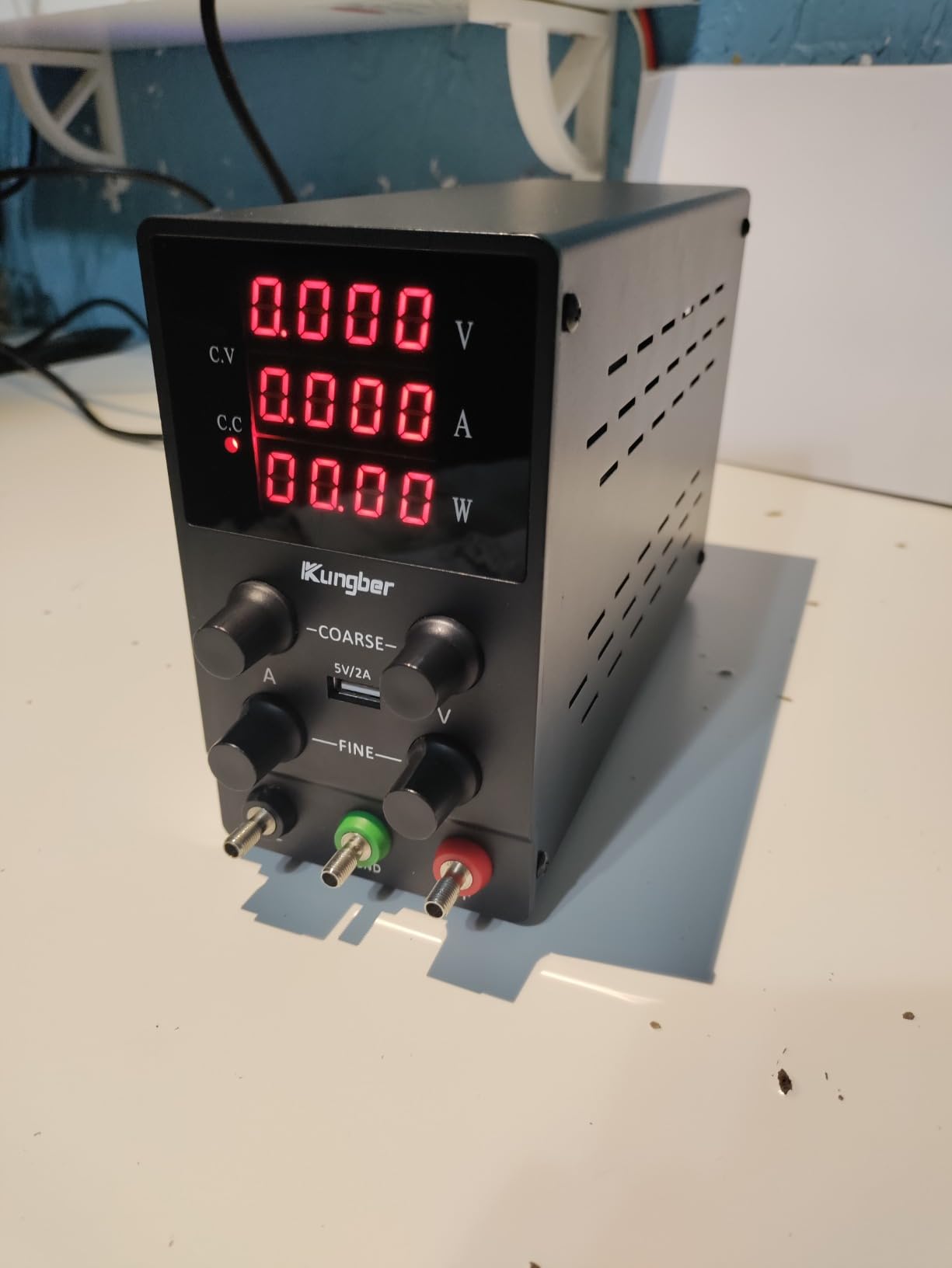
What separates it from the other 30V/10A boxes in this price bracket is the charging mode. It tracks amp-hours in real time and stops on its own when the pack reaches full charge, which turns a bench supply into a rough but usable battery charger. For cell testing or pack recovery that is a genuinely useful behaviour rather than a marketing line.
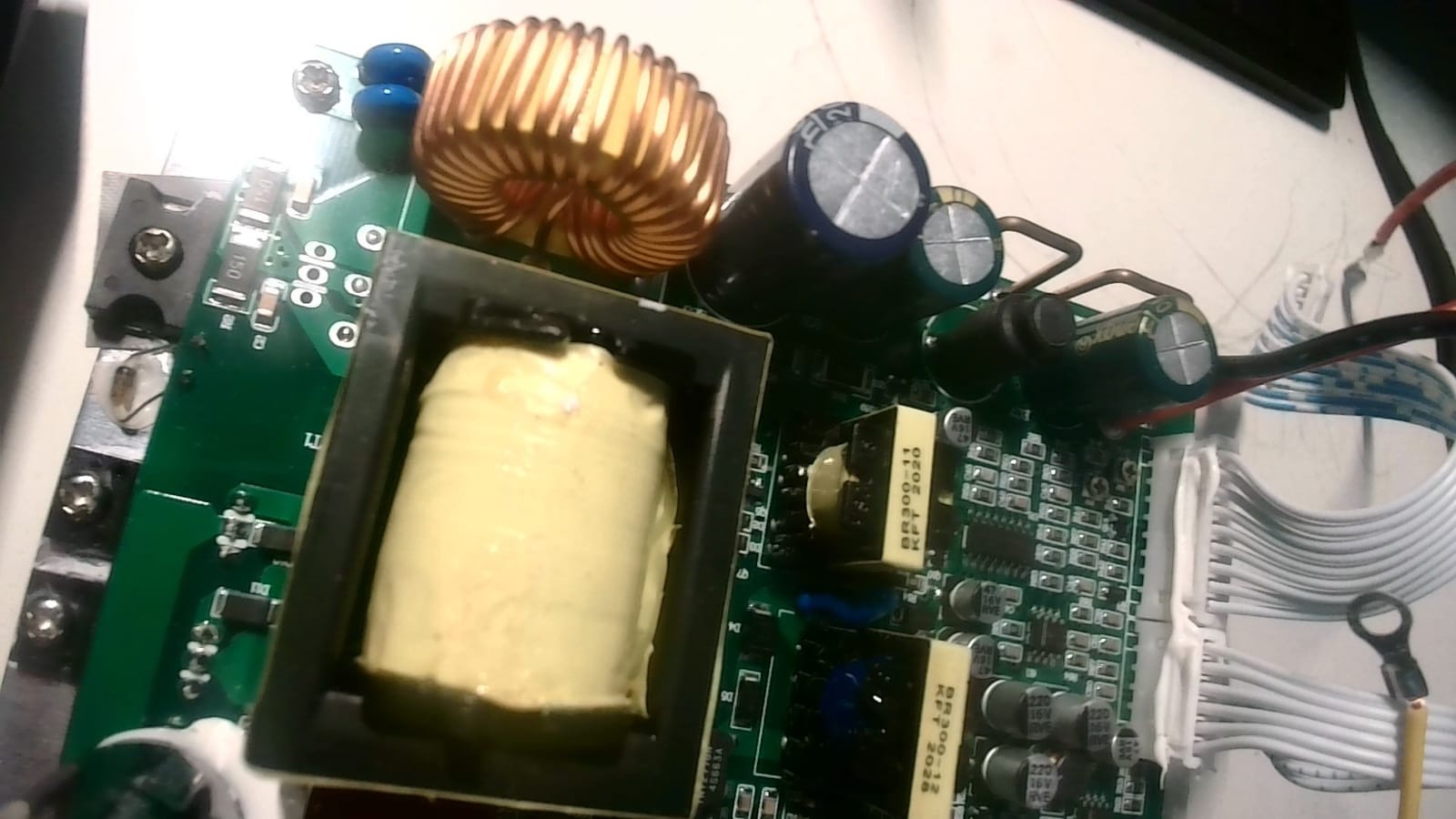
Protection is also unusually well covered: overcurrent detection with an alarm that halts output on a short circuit, plus thermal, leakage, grounding, voltage overload and power overload circuits. In practice that means a dead board trips a visible, audible event instead of quietly cooking.
What you should know before you buy
The interface is encoder-driven, which is fast once learned and frustrating for the first hour. Reviewers consistently describe the learning curve as the main drawback, so budget an evening with it before you need it for real work. The alternative on our list with a similar output range and a more traditional feel is the WANPTEK TPS-C3010H, which adds memory presets and a physical output switch.
Loaded near 10 amps continuously, the cooling fan becomes audible in a quiet room. That is normal for a 300W switching supply and not a defect, but it does mean this is a poor choice as the only supply on an audio listening bench.
Where it earns its place
For LED strip testing, motor and fan running, general prototyping and any job where you want visible overcurrent protection and a charging mode, this is the pick. It is the strongest combination of rating depth and feature set in the group, which is why it takes the top spot. Our bench power supply roundup covers the alternatives in more depth if you want to compare across brands.
2. Jesverty SPS-3010 30V 10A: Best Value for First Builds
- Very high 4.5 rating across 1664 reviews
- Sits at number one in both Lab Power Supplies and Life Science Supplies
- Bright 4-digit display with live V A and W
- Automatic constant voltage and constant current crossover
- Compact 3.35 x 6.1 x 7.09 in body
- Included test leads described by the maker as give-away grade
- AC input setting and power cord vary by destination
Where the Kungber leads on charging, the Jesverty leads on display quality and category ranking. It holds the number one position in both Lab Power Supplies and Life Science Supplies on Amazon, and 1664 reviews averaging 4.5 out of 5 is a lot of history for a hobby device.
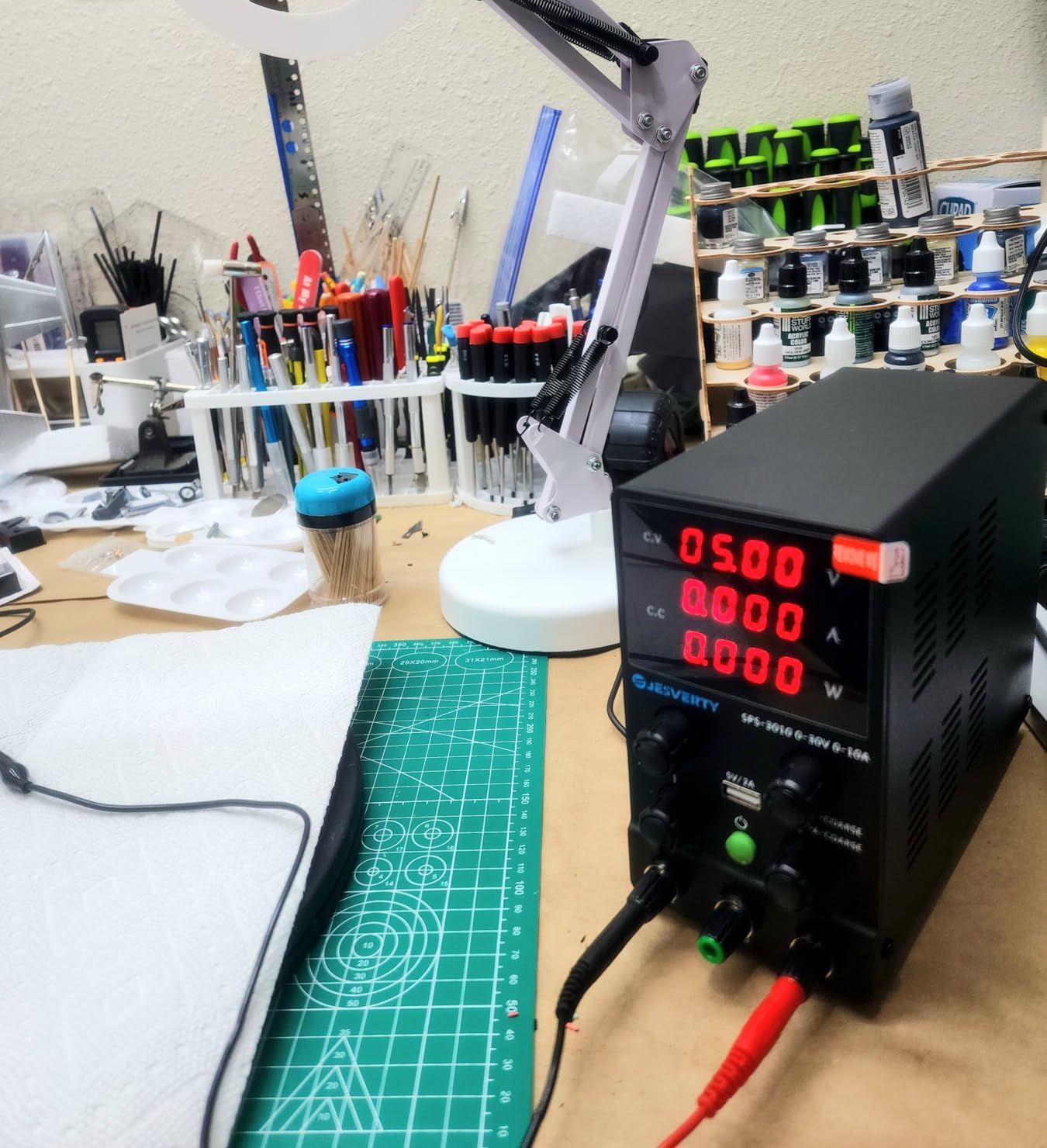
Set-point resolution is 0.01V and 0.001A on a 4-digit LED, which is the practical floor for microcontroller work where you care about a 3.3V rail landing within a few tens of millivolts. The 300W switching output, polycarbonate tower enclosure and 2.4 lb weight keep it in line with the class leaders on size.
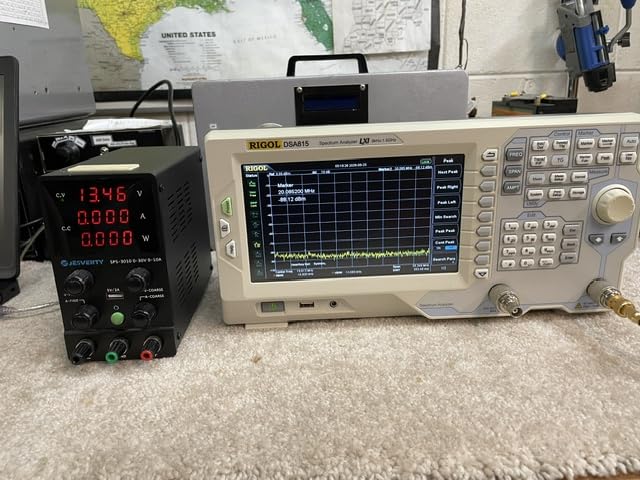
Constant-voltage and constant-current crossover happens automatically as the load changes, so you set both numbers and the supply decides the mode. That is the behaviour you want when a motor stalls or a coil saturates, and it is the single most important safety behaviour in any bench supply.
Protection covers short circuit, overload, grounding and thermal events, and the fan is temperature-regulated rather than running constantly. There is also a 5V/2A USB charging port on the front panel, which is genuinely handy for a phone or a small module while you work on something else.
Watch for the accessories, not the supply
The recurring note in reviews is the bundled test leads. The manufacturer describes them as give-away grade, and that is consistent with the pattern across this whole budget class. If you plan to pull sustained multi-amp current, buy your own leads with proper banana plugs and thicker conductor. Everything else about the package is unremarkable, which at this level is fine.
The input voltage setting and power cord also vary by destination, so check the label against your own mains before first power-up. The rear selector on supplies like this has caused more bench problems than any other single feature in this roundup.
Who should buy this one
This is the unit to recommend to a friend who is building their first bench. It has a particularly clear display, more reviews than any pick except our top two, and a category ranking that means support questions have answers. If your work is 5V and 12V digital rather than high current, the smaller 150W boxes later in this list cost you nothing you will miss.
3. NICE-POWER SPS-C3010 30V 10A: Best for Setting Values Safely
- OUTPUT key lets you set voltage and current with no power on the load
- Automatic constant voltage and constant current conversion
- Coarse and fine knobs plus a front power switch
- Accurate and stable under sustained 4-6A loads
- Deep protection list including leakage and over-power
- Fine adjustment range is narrow so you can run out of travel
- 110V input only on this model
- One report of a failure after about a week of continuous 4-6A duty
The single most useful thing on this supply is the dedicated OUTPUT key. With it pressed, the output is off while you dial in values, so you can read your set voltage and current on the display and confirm them before anything reaches the load. On a supply without it, you either unplug the load every time or accept a live output while you adjust.
Underneath, the specification is a standard 30V/10A 300W switching box with a 4-digit backlit display at 0.01V and 0.001A resolution, showing voltage, current and wattage. Coarse and fine potentiometer knobs sit alongside the digital entry, which some people find faster than a single encoder. At 2.6 lb and 3.3 x 8.4 x 5.5 inches it stands vertically on the bench.
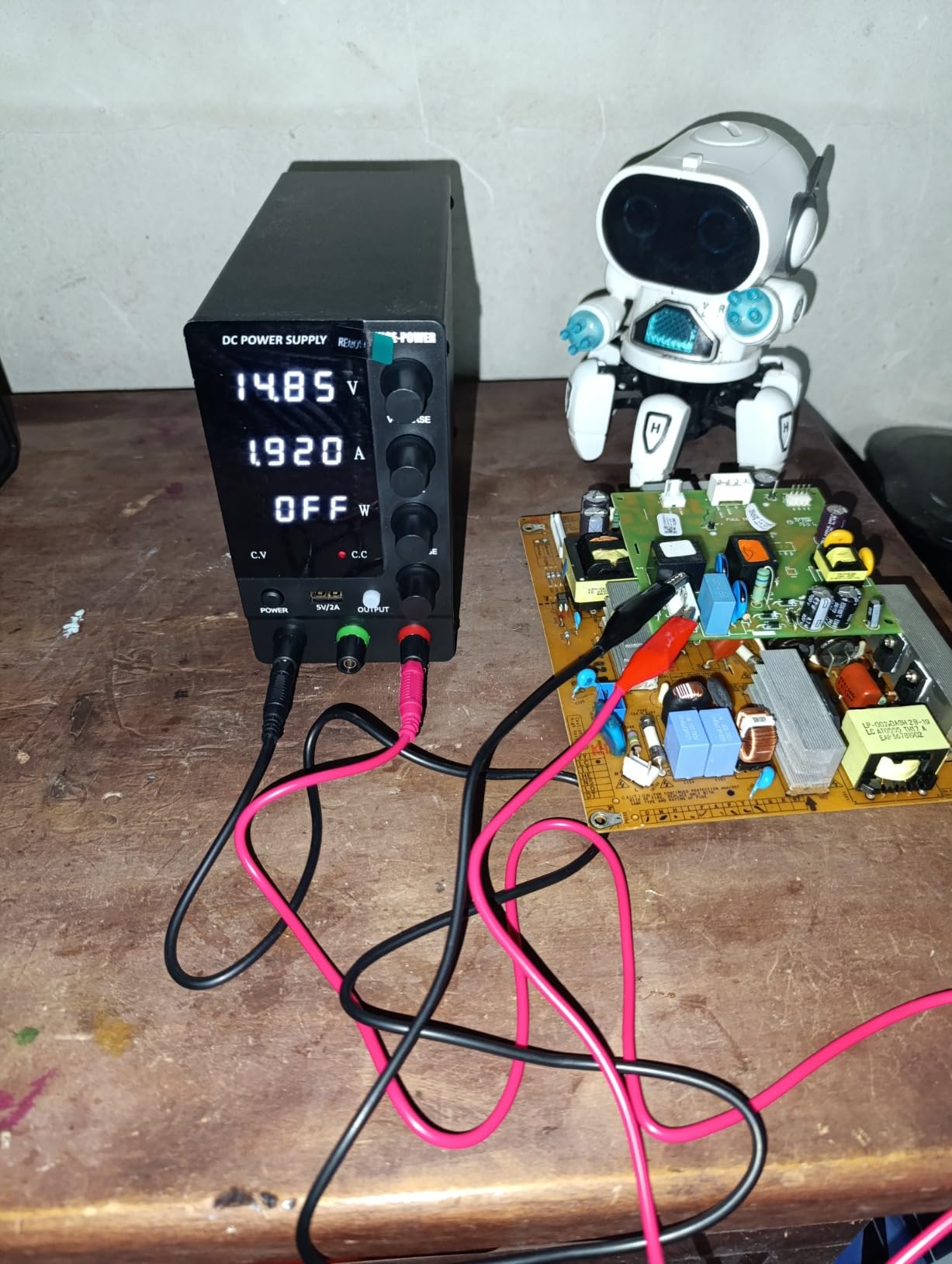
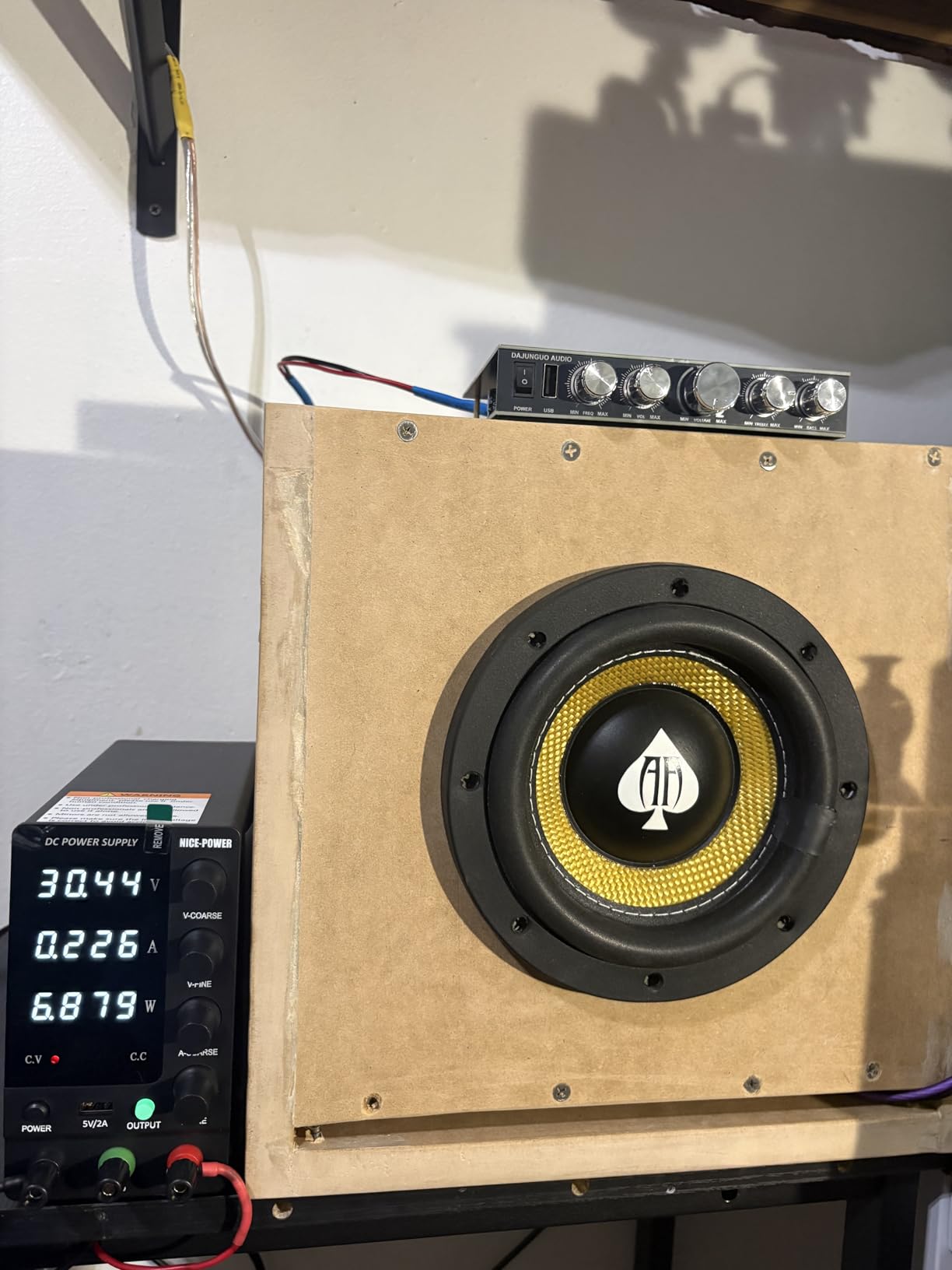
Reviewers report the voltage stays accurate and stable under sustained 4-6A loads, and one owner used it to balance and charge Prius C-type battery modules unattended. Automatic constant-voltage to constant-current conversion is what makes that unattended charging safe rather than reckless.
Protection is comprehensive on paper: leakage, grounding, over-voltage, over-current, over-power, over-load, over-temperature and short circuit. A 5V/2A USB port and a temperature-controlled fan round out the panel. The rating is 4.5 out of 5 from 604 reviews, with 77% at five stars.
Where the controls frustrate people
The fine adjustment band is narrow enough that you can run out of travel and have to go back and redo the other setting. It is a real workflow interruption rather than a defect, and it is the most common complaint in the reviews alongside the narrow band itself.
One owner reported a supply failing after roughly a week of continuous 4-6A duty. A single report out of 604 reviews is not a pattern, but if you plan sustained heavy loads as your normal mode of operation, the WANPTEK DPS3010U and NANKADF models later in this list have longer run histories at the same 300W class.
When to pick it instead
Choose this supply if you work on boards you care about and you want the output physically under your control during setup. The OUTPUT key converts a risky habit — adjusting a live supply near a fragile circuit — into a safe one. Note that this model is 110V input only, which matters if your bench is on 230V.
4. WANPTEK DPS3010U 30V 10A: Best for USB-C and Phone Charging
- 4.6 rating across 609 reviews with 83% at five stars
- Coarse and fine encoder sets pre-decimal and decimal digits separately
- USB and USB-C fast-charge ports with USB-C at 5V 3.6A
- Automatic mains detection removes the rear selector switch
- Several owners held the full 300W in constant current in hot conditions
- No dedicated output enable switch so leads must be removed to change settings safely
- Key beep is loud on every adjustment until you learn the hold-to-mute gesture
- Supplied alligator clips are cheap
The WANPTEK is rated 4.6 out of 5 from 609 reviews, 83% of them at five stars, and its technical headline is the USB-C port rated at 5V/3.6A alongside a standard USB port. That makes it the pick if you routinely put phones and small modules on the bench.
The encoder is the interesting control scheme: turning it sets the pre-decimal value, and a separate fine mode sets the decimal. Owners who like it describe it as the fastest way to hit an exact figure on this class of supply. The 4-digit LED and temperature-controlled fan with a heat sink handle the display and cooling side.
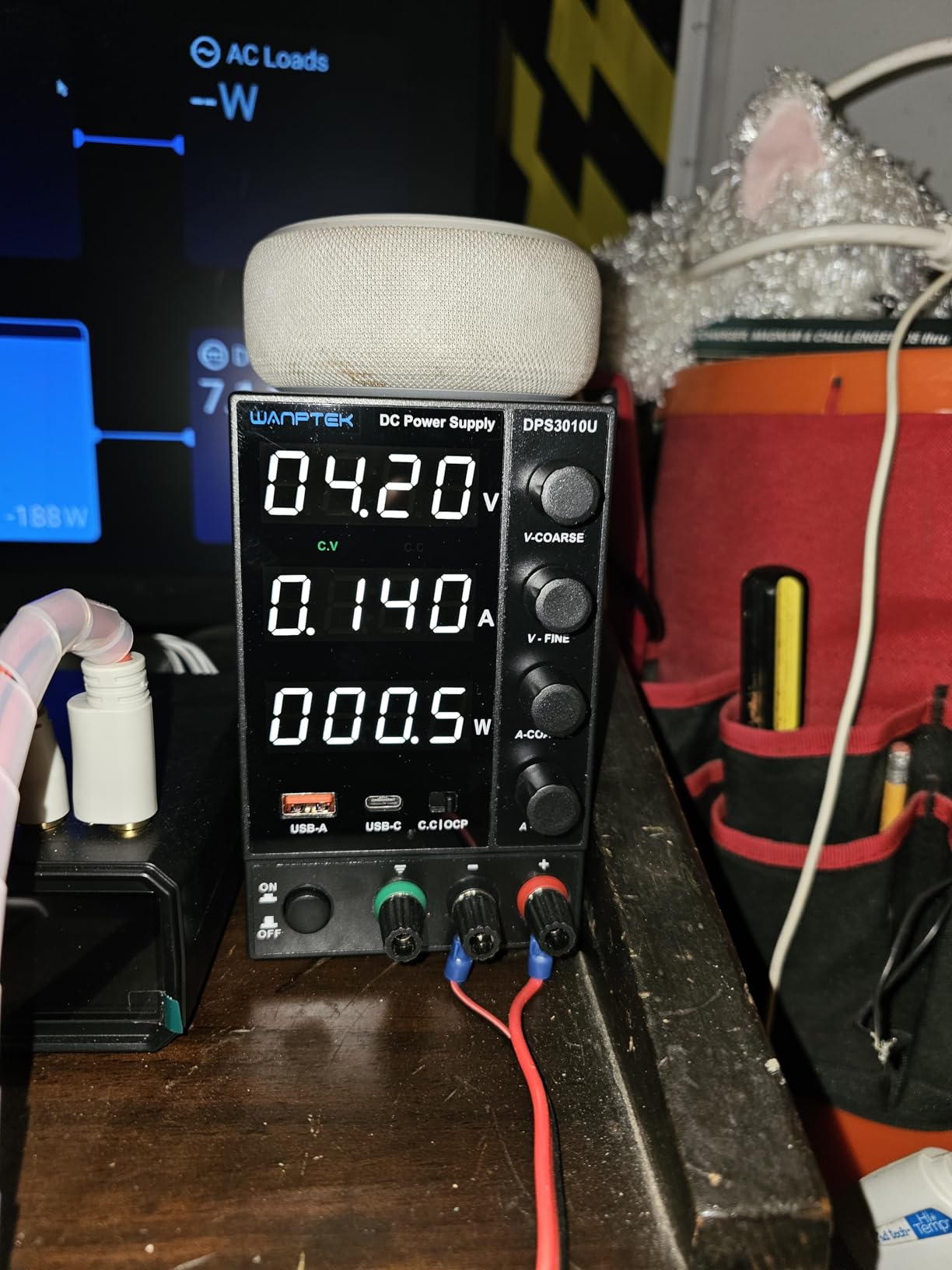
Automatic mains voltage detection is a quiet but important detail. There is no rear 110V/220V selector to set wrong, which removes the single most common cause of a bench supply failing to reach its rated voltage. Several owners report pushing the full 300 watts in constant-current mode for long stretches in hot, humid conditions without trouble, and others verified the output against bench meters.
On the protection side you get an OCP short-circuit alarm that halts output and buzzes, plus grounding, leakage, over-temperature, voltage overload and power overload circuits.
The missing output switch is a real gap
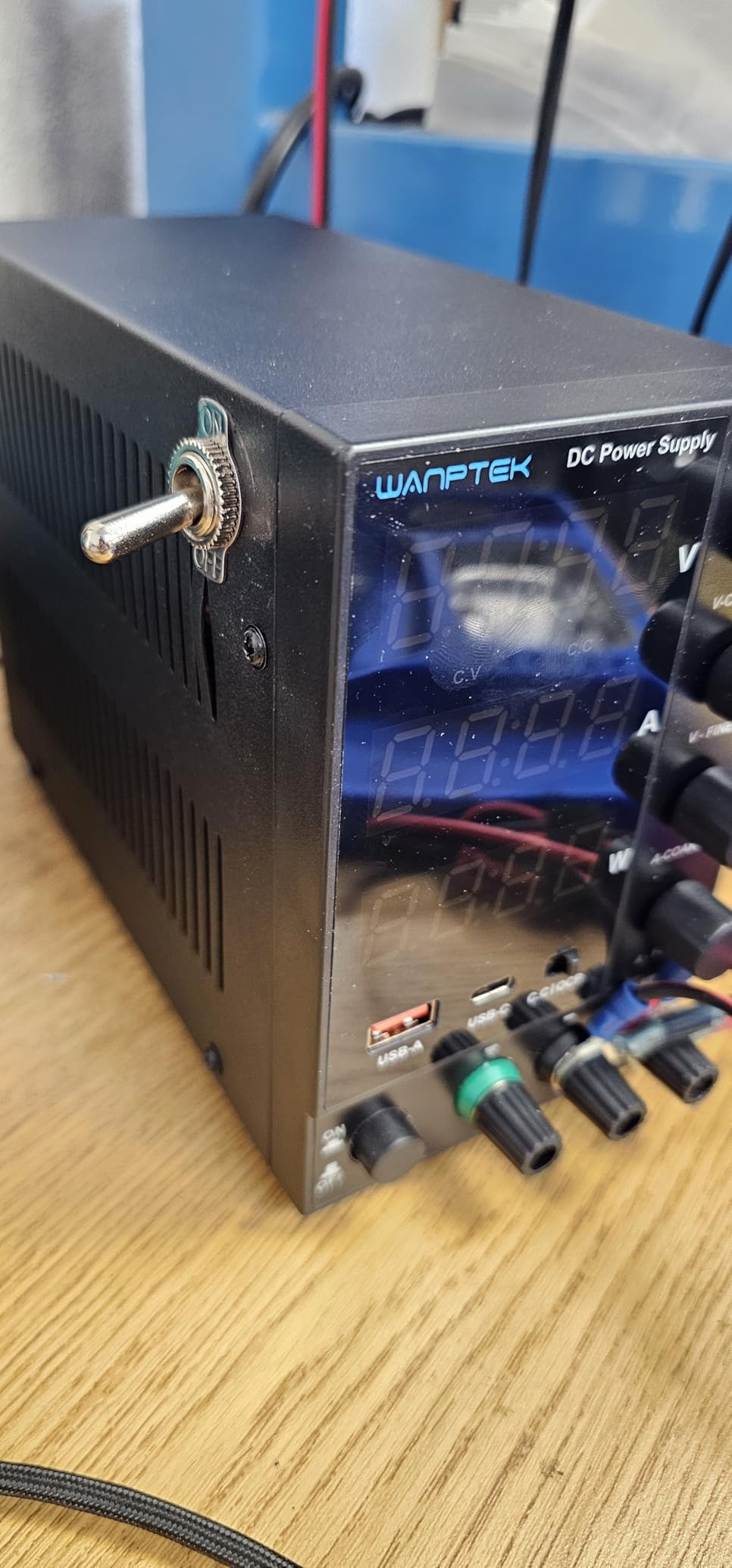
There is no dedicated output enable, so changing a setting with a load attached means the value changes live. For a fresh board that is exactly the risk the NICE-POWER unit two sections above solves. You can mute the key beep by holding the voltage knob, but that same gesture is not documented on the box.
The included alligator clips are cheap and awkward to open with the rubber sleeves fitted. If you connect to terminal blocks or binding posts regularly, buy proper leads. The front USB ports are independent of the main DC output, and the USB-C is PD and QC only — it is not a general-purpose USB data port.
Where it fits the bench
This is the supply to buy if your work involves mobile hardware, battery packs or anything where you want to top up a phone while testing. The combination of USB-C charging, no mains selector to set wrong, and 4.6 stars across 609 reviews makes it a well-rounded 300W unit. A user on r/AskElectronics specifically reported a WANPTEK DPS3010U small linear supply with no complaints, and the family’s repeat endorsement is consistent.
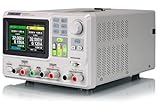
5. Siglent SPD3303X-E: Premium Three-Output Lab Supply
- Three independent controlled and fully isolated outputs
- Two 32V 3.2A channels plus a selectable 2.5V / 3.3V / 5V logic channel
- Independent series and parallel output modes
- Timing output function and trending graphs for sequenced tests
- Linear design suited to sensitive analog work
- Bulky 17.6 lb and 16 x 14 x 11 inch desktop footprint
- Costs far more than a 30V 10A switching box for basic bench work
Everything in this roundup is a single-output box until this one. The SPD3303X-E gives you three independent, controlled and isolated outputs: two channels at 32V/3.2A and one that steps through 2.5V, 3.3V and 5V at up to 3.2A, totalling 220 watts. That third channel alone answers the most common question on hobby forums, which is how to supply 3.3V and 5V logic rails at the same time. Outputs can also run in series or in parallel, and series tracking is what you need when a circuit wants a 12V rail and a minus 12V rail at once, while parallel mode gives you more current from a pair of channels than either offers alone.
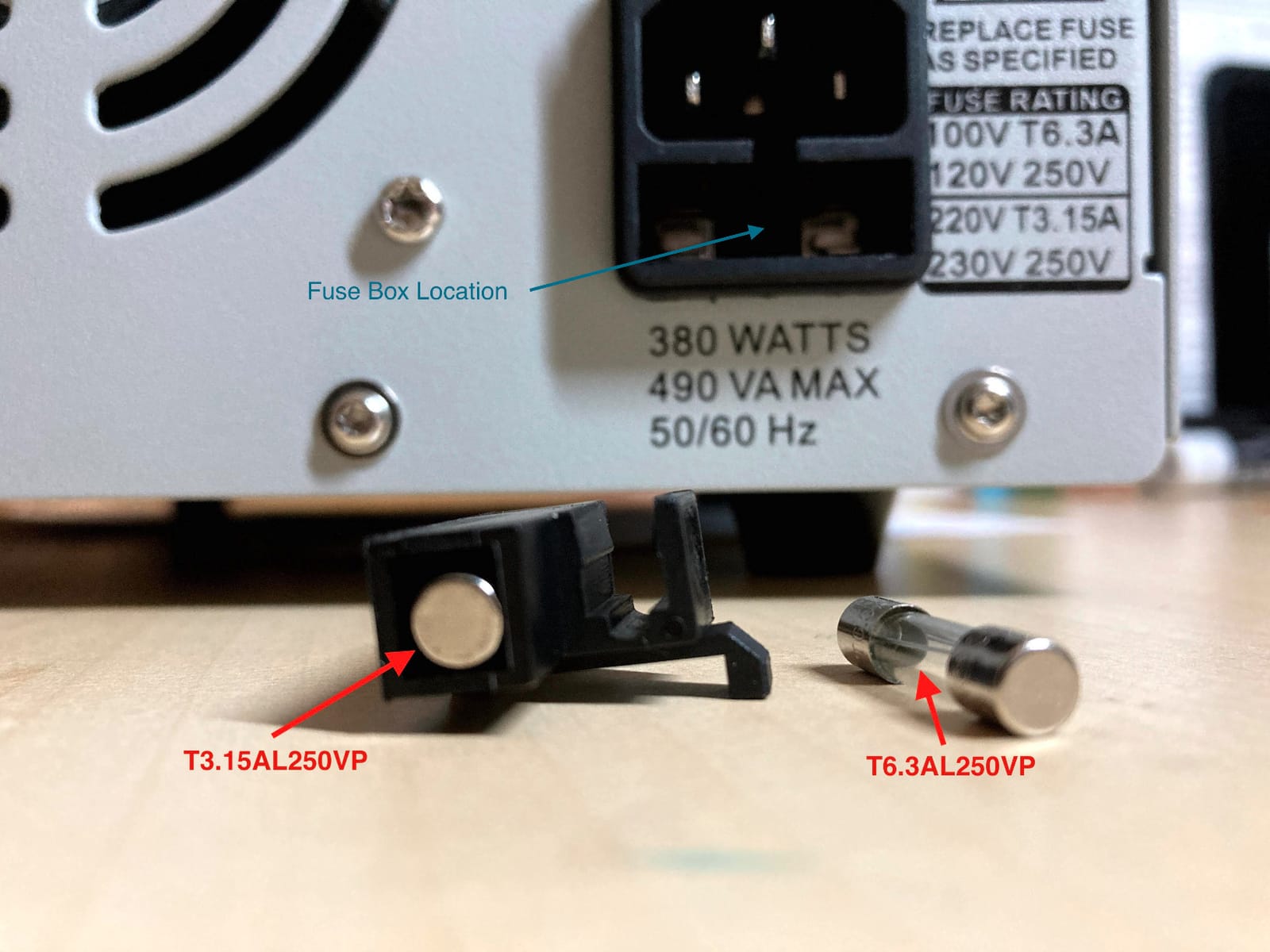
The timing output function sequences channels on and off, and the trending graphs let you watch a current draw over time. Those are not features a hobbyist needs on day one, but they are exactly what you want when characterising a battery or hunting an intermittent fault. Rating is 4.6 out of 5 from 381 reviews with 80% at five stars, backed by a three-year warranty.
It is a linear design, which is the right architecture for sensitive analog and mixed-signal work where switching converter noise shows up in the measurement.
When three outputs are worth the bulk
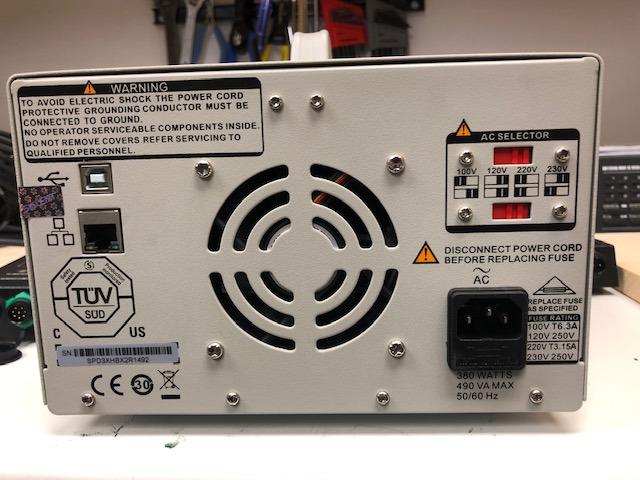
The compromise is physical and financial. At 17.6 lb and 16 x 14 x 11 inches it is a desktop instrument, not a bench accessory, and the 220W total is less raw power than a single 300W switching channel. You are buying isolation, channel count and the logic rail, not grunt.
If your projects are single-rail digital work, this is overkill and one of the 30V/10A boxes would serve you better for far less. If you build audio amplifiers, multi-rail analog circuits, or anything needing a 3.3V and a 5V rail simultaneously, nothing else here replaces it. We have written up the computer-side of this in our programmable DC supply guide.
What reviewers consistently say
Owners value the three isolated channels and the ability to series or parallel them more than any other feature, with the timing and trending functions as the secondary draw. The repeated downside is size and cost relative to a single-output switching supply. Siglent is one of the brand names that comes up repeatedly in r/AskElectronics and on the eevblog.com testgear forum when hobbyists ask which brands are reliable, and this model is why.
6. Korad KD3005D 30V 5A: Best Low-Noise Linear Supply
KORAD KD3005D – Precision Variable Adjustable 30V, 5A DC Linear Power Supply Digital Regulated Lab Grade…
- Linear regulation suits sensitive analog and low-noise measurement
- Metal enclosure handles durability and heat better than plastic cases
- Dual 4-digit displays show voltage and current simultaneously
- Automatic mA and A display switching for low-current set-ups
- Overload short-circuit and over-temperature protection
- Bulky 9 lb and 14 x 10 x 10 inch footprint for only 30V 5A
- No memory presets
- USB port or output enable button like the newer switching boxes
The Korad KD3005D is the one here that behaves like a traditional lab instrument. It is a regulated 30V/5A linear supply in a metal enclosure, and linear regulation is precisely what you want on a bench doing audio amplifier or low-level analog work, where switching converter ripple can land straight in your measurement.
Two 4-digit LED displays show voltage and current at the same time, so you can watch both numbers as a load changes. The display automatically switches between mA and A, which is a small detail that makes low-current work far more readable than counting zeros.
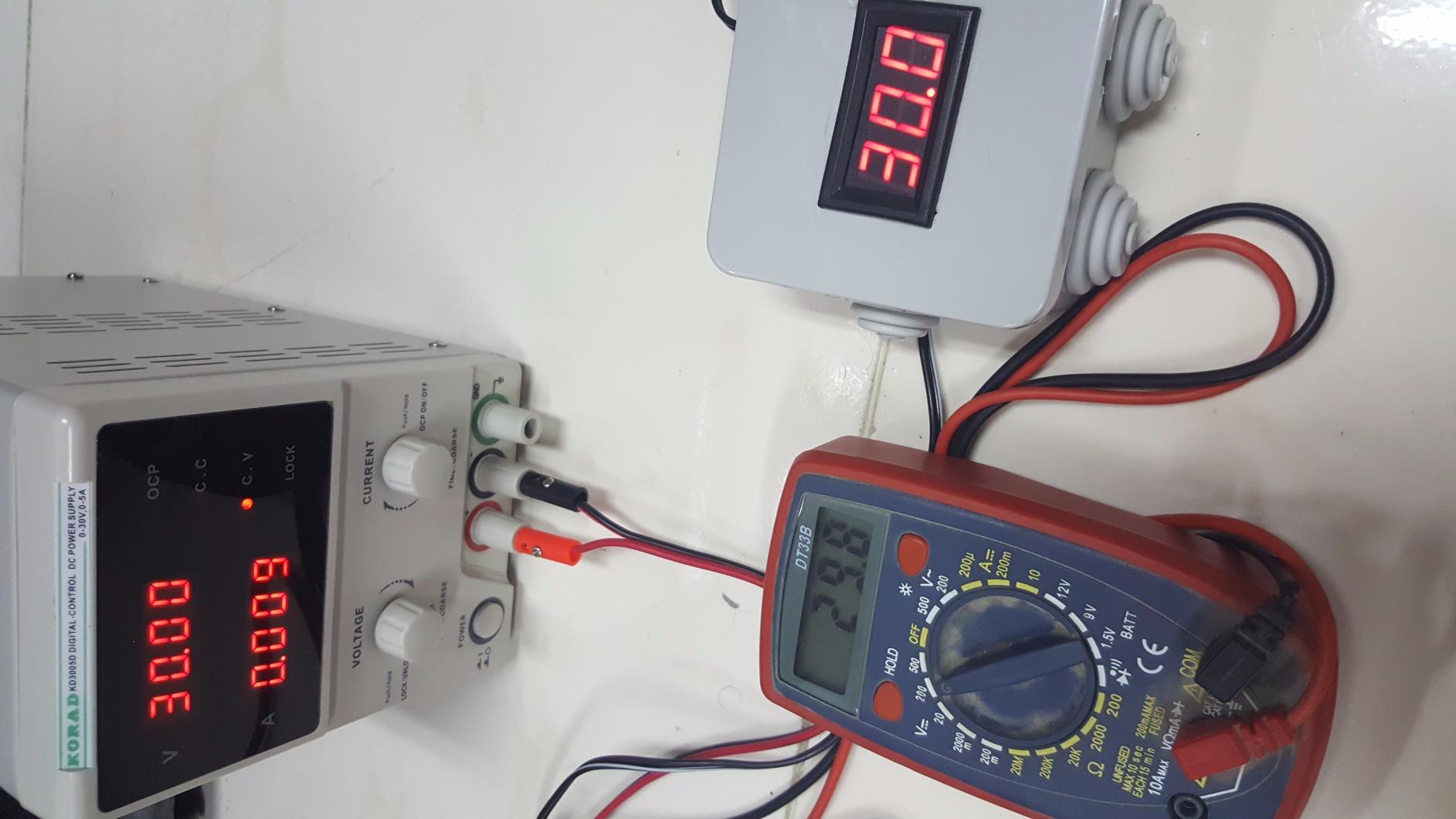
Protection covers overload, short circuit and over-temperature, and the input is switchable between 110V and 220V. The box includes 5A test leads. At 9 lb and 14 x 10 x 10 inches, it takes real bench space.
The rating is 4.5 out of 5 from 367 reviews with 73% at five stars. Owners treat it as a dependable, no-frills unit rather than a feature contest, and that framing is fair — there is no encoder, no USB port, no presets.
Why linear beats switching here
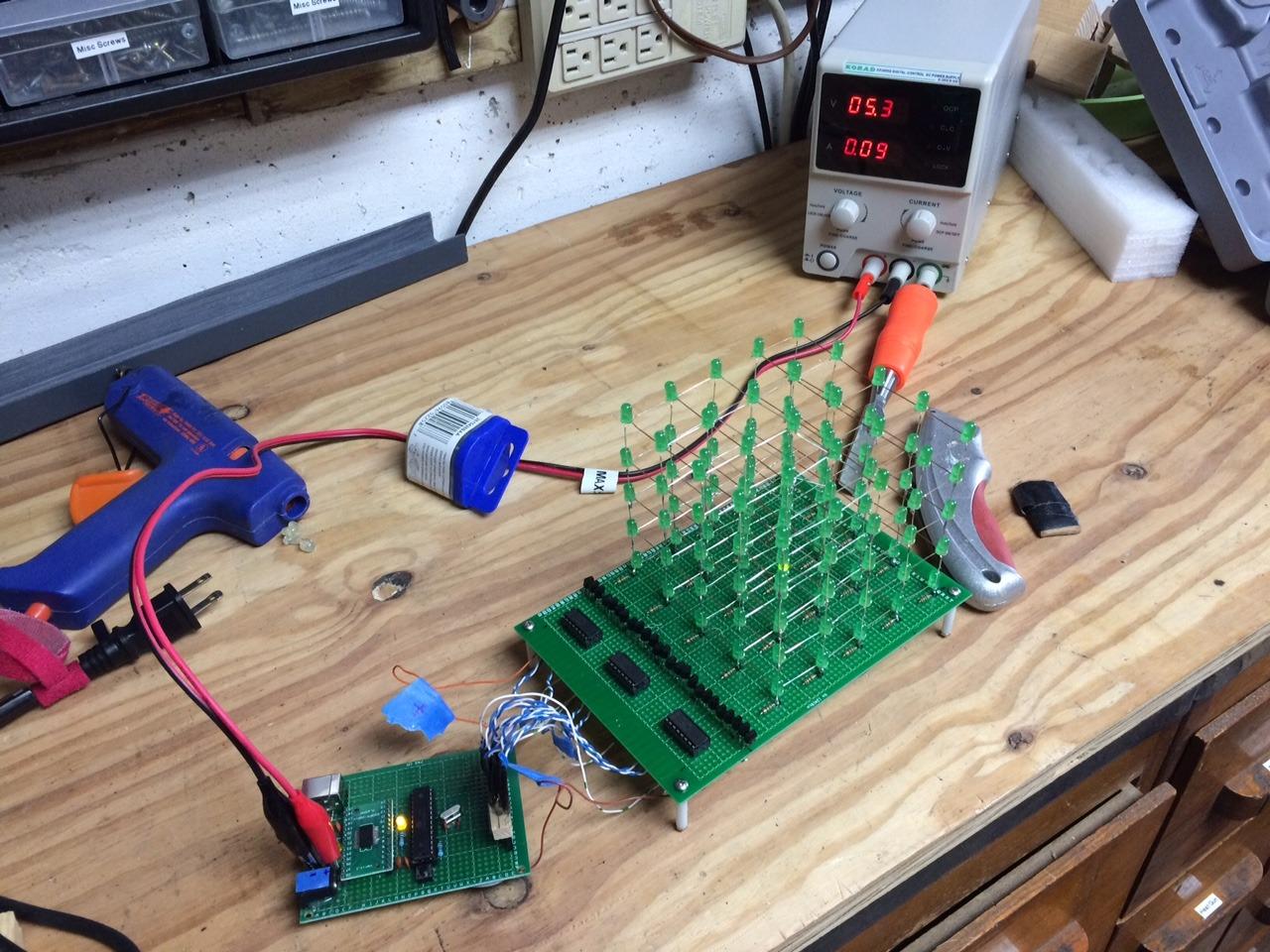
Use a linear supply when the load is small enough that the extra heat is manageable and noise matters. At 5A and, say, 12V in, a linear regulator is burning roughly 90W of excess power as heat, which is why the chassis is a 9 lb metal box. That heat budget is exactly why linear boxes in this class top out at 3-5A while switching boxes reach 10A in a 2.3 lb plastic case.
You give up current headroom to get quiet output. For an amplifier idle bias test, a preamp signal path, or a reference voltage for measurement work, that trade is worth making. For powering motors, LED strips or a bench full of development boards, it is not.
Who should skip it
If you need more than about 5A, or you want presets and a USB port, look at the WANPTEK TPS-C3010H or the HYELEC HY3005S instead. Korad is named repeatedly on r/AskElectronics and the eevblog testgear forum as a brand hobbyists trust for reliability, and the KD3005D is the model most of those recommendations point at for analog work.
7. NICE-POWER SPS-E305 30V 5A: Best for a Crowded Bench
- Very small at 6.5 x 4 x 3.2 inches and 1.54 lb
- Delivers the full rated 150W with the case staying cool through an hour-long full-load test
- Encoder knob with press-to-select digit entry
- 100-240V universal input works on 110V and 230V
- FCC and CE certified with full over-voltage over-current over-power over-temperature and short-circuit protection
- Output below roughly 0.9V is not stable enough for calibration work
- Accuracy drifts by 1-2% in the 0.7V to 3.3V range
- Cooling fan runs continuously and is loud under load
At 1.54 lb and 6.5 x 4 x 3.2 inches, the SPS-E305 takes up a fraction of the desk space of every 30V/10A box in this roundup. It is a genuine secondary supply — a low-voltage rail, a 5V logic source, or a portable box for a class or a club night where you carry your own gear.
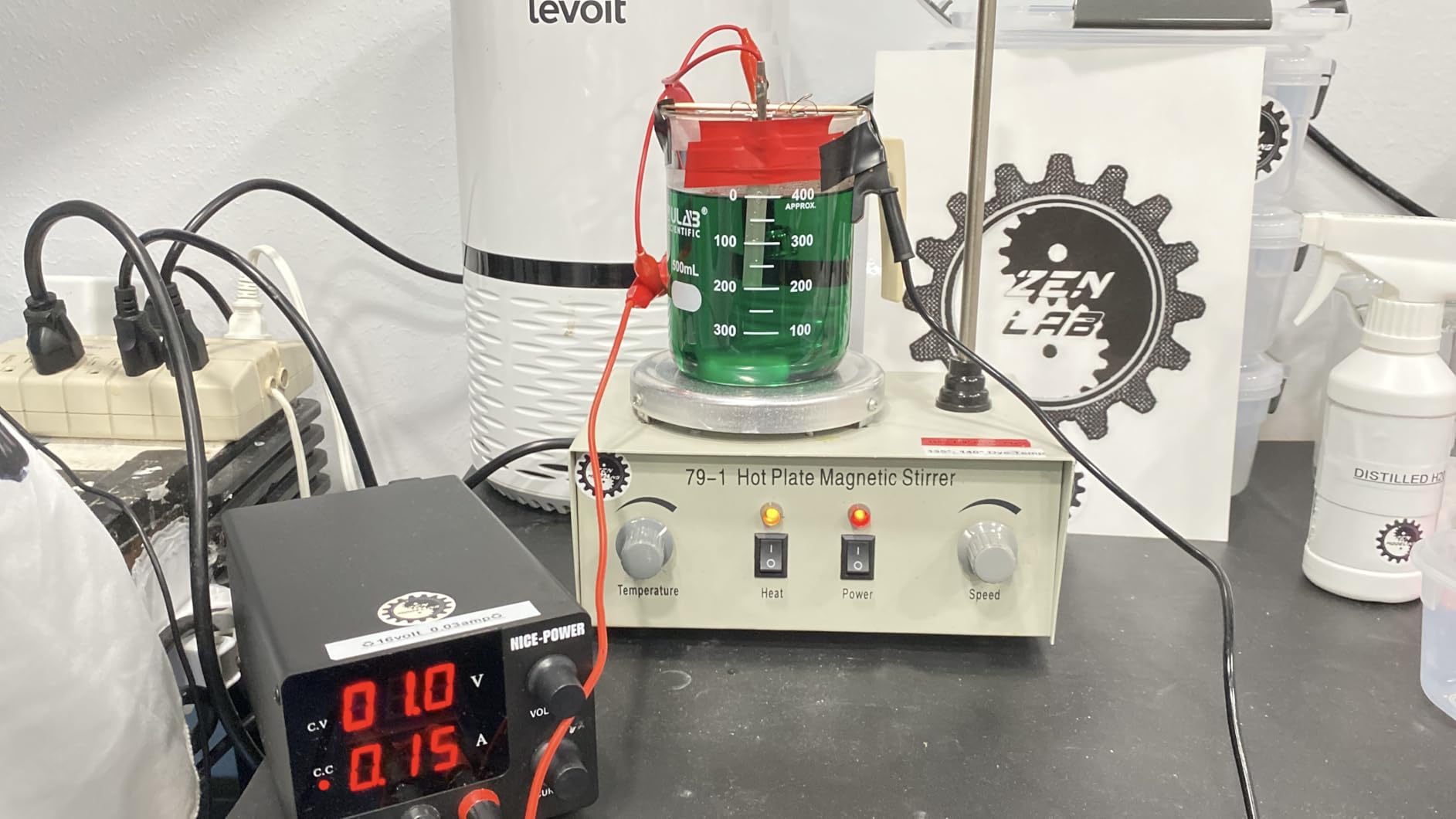
The rating is 4.6 out of 5 across 343 reviews, with 81% at five stars. Owners report the case staying cool through an hour of full load, and one measured the unit drawing about 175W while delivering its rated 150W output, which is normal switching-conductor behaviour.
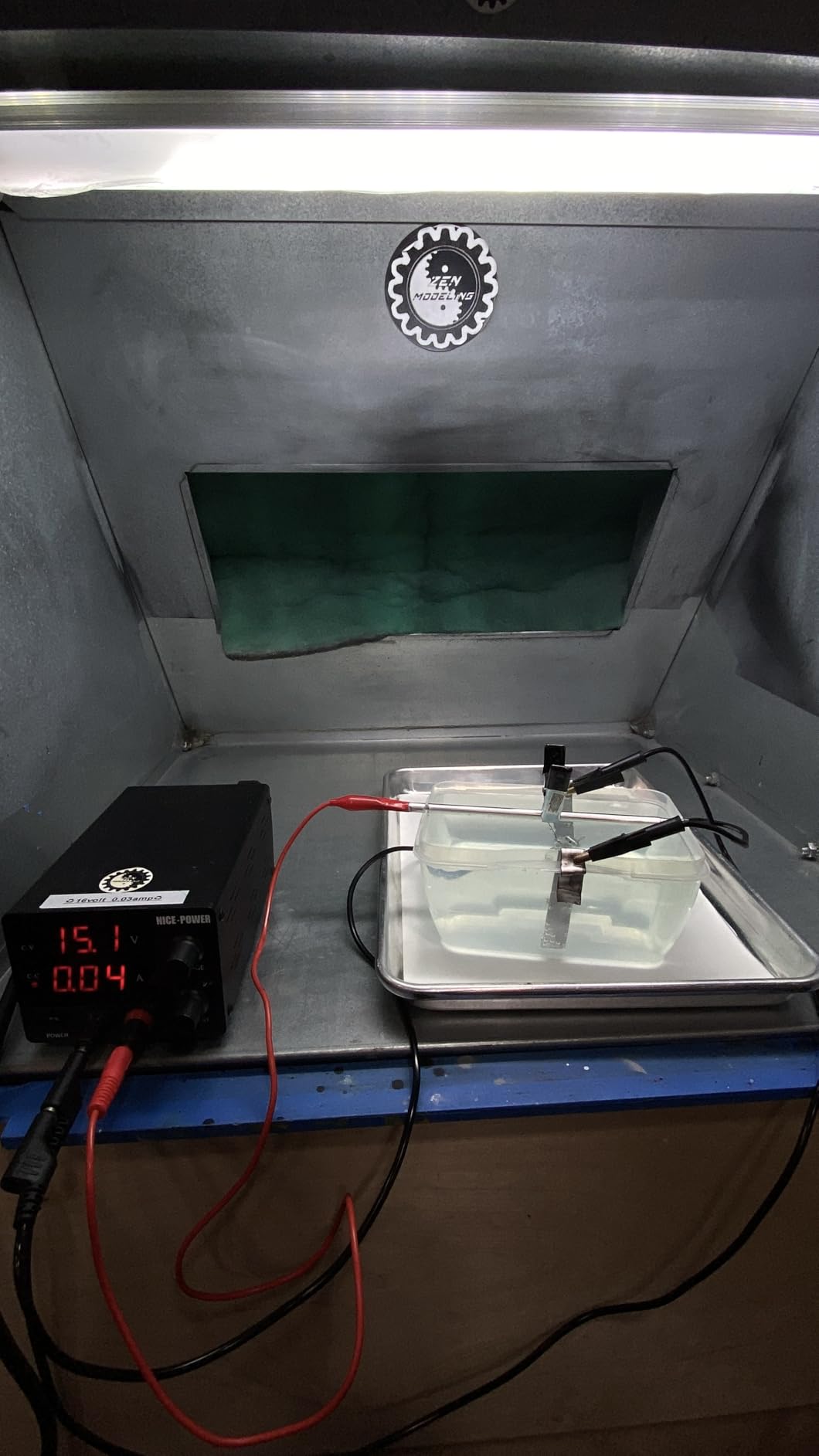
Control is an encoder with press-to-select digit entry, and the display is a 3-digit backlit LED at 0.1V and 0.01A resolution. The 100-240V universal input means it works on both 110V and 230V mains, which is unusual at this size. A 12-month repair policy backs it.
Protection is comprehensive: over-voltage, over-current, over-power, over-temperature and short circuit, with FCC and CE certification.
The low-voltage gap to know about
Below roughly 0.9V the output is not stable enough for calibration work, and accuracy drifts by 1-2% in the 0.7V to 3.3V range. That rules it out as a reference for low-level analog measurement, which is the one job you would have bought a linear supply for anyway. For a 3.3V microcontroller rail it is entirely adequate.
The display shows three digits while the interface exposes four, so one digit is hidden from view and you have to learn where it is. The cooling fan also runs continuously and is noticeably loud under load, so it is not the supply to sit next to a microphone.
Best used as a second supply
Forum regulars describe the common bench pattern as a triple-output supply plus a separate single 3A channel and a function generator. This is that secondary channel in a small footprint. Pair it with one of the 30V/10A units and you have both a high-current rail and a compact low-voltage source without doubling your desk space.
8. WANPTEK TPS-C3010H 30V 10A: Best for Repair Bench Workflows
- Three memory presets store recurring voltage and current settings
- Output on and off switch prevents sparking when rewiring a load
- OCP shuts off on a short and auto-resumes once cleared
- Encoder returns to tenths-of-a-volt resolution after idle
- Compact horizontal footprint that fits a crowded repair bench
- Power-on beep cannot be disabled with the other beeps
- Supplied leads are ring terminals rather than banana plugs
- Rear mains selector must be set correctly or the supply will not hold higher voltages
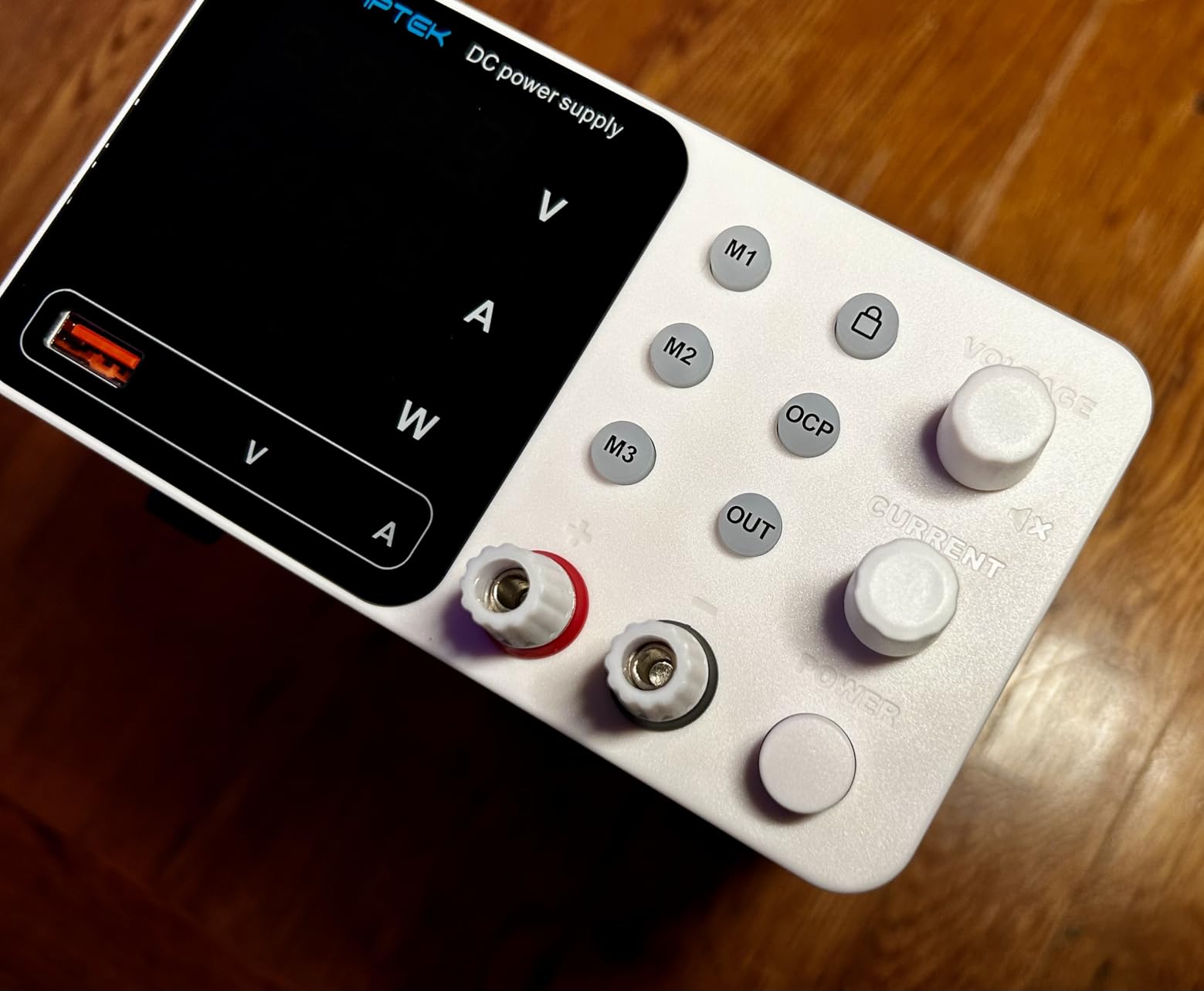
Repair work is repetitive, and this supply is built around that. Three M1/M2/M3 memory presets store your voltage and current so a console, a phone or a lamp test is one recall rather than a re-dial. The rating is 4.5 out of 5 from 273 reviews with 79% at five stars.
The output on/off switch is the safety feature that matters most on a repair bench. Rewiring a load while a supply is delivering live output causes sparking and, worse, a transient at the connector. Pressing the switch first removes that from the workflow entirely.
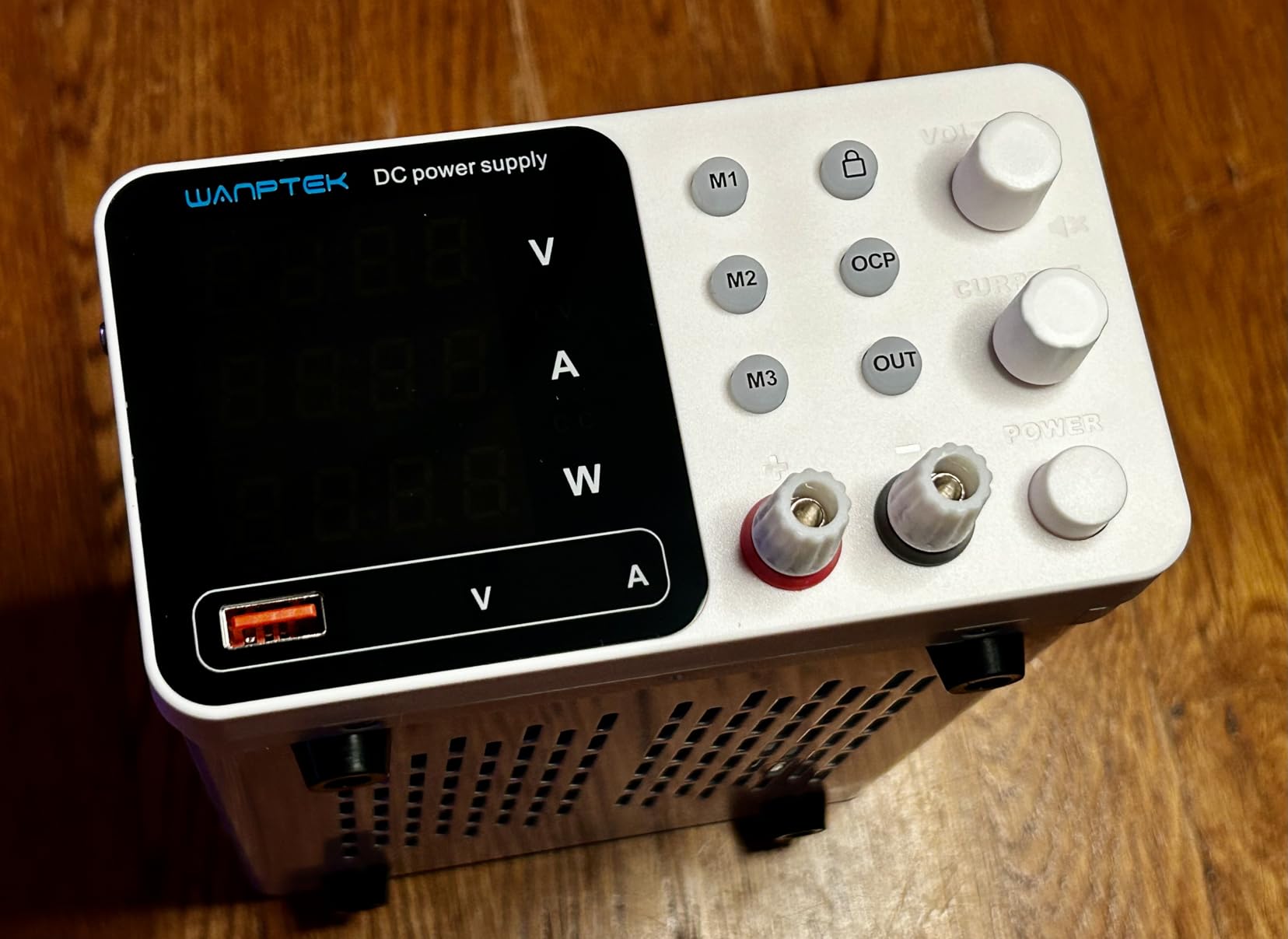
Overcurrent protection shuts off on a short and then auto-resumes once the fault clears, which is convenient when you are hunting an intermittent and do not want to reset the supply every time. There is also a one-key lock to stop accidental changes, a 4-digit LED and a front USB fast-charge port.
At 1.2 kg and 8.27 x 5.71 x 3.15 inches, the horizontal layout is deliberately shaped to fit beside a scope or a soldering station where a tall tower would not.
Small annoyances worth knowing
The power-on beep cannot be turned off along with the other beeps, so it announces itself every single time. Supplied leads are ring terminals rather than banana plugs, which is awkward if your setup is built around banana jacks, and the cord is short. All three are fixable in a minute with a different lead set.
The rear mains selector must be set to 115V before use in the US. Get this wrong and the supply will not hold higher voltages — a confusing symptom that forum users report more than any real fault with the unit.
Best for diagnostics
If your work is fault-finding rather than building, the presets plus the output switch plus OCP auto-recovery is the combination that saves the most time across a long session. One of the recurring requests in the r/AskElectronics buying threads is exactly this: an output on/off button rather than a rear switch. This supply answers it.
9. HYELEC HY3005S 30V 5A: Best for 3.3V and 5V Logic Rails
- Highest average rating in this group at 4.7 out of 5 from 181 reviews
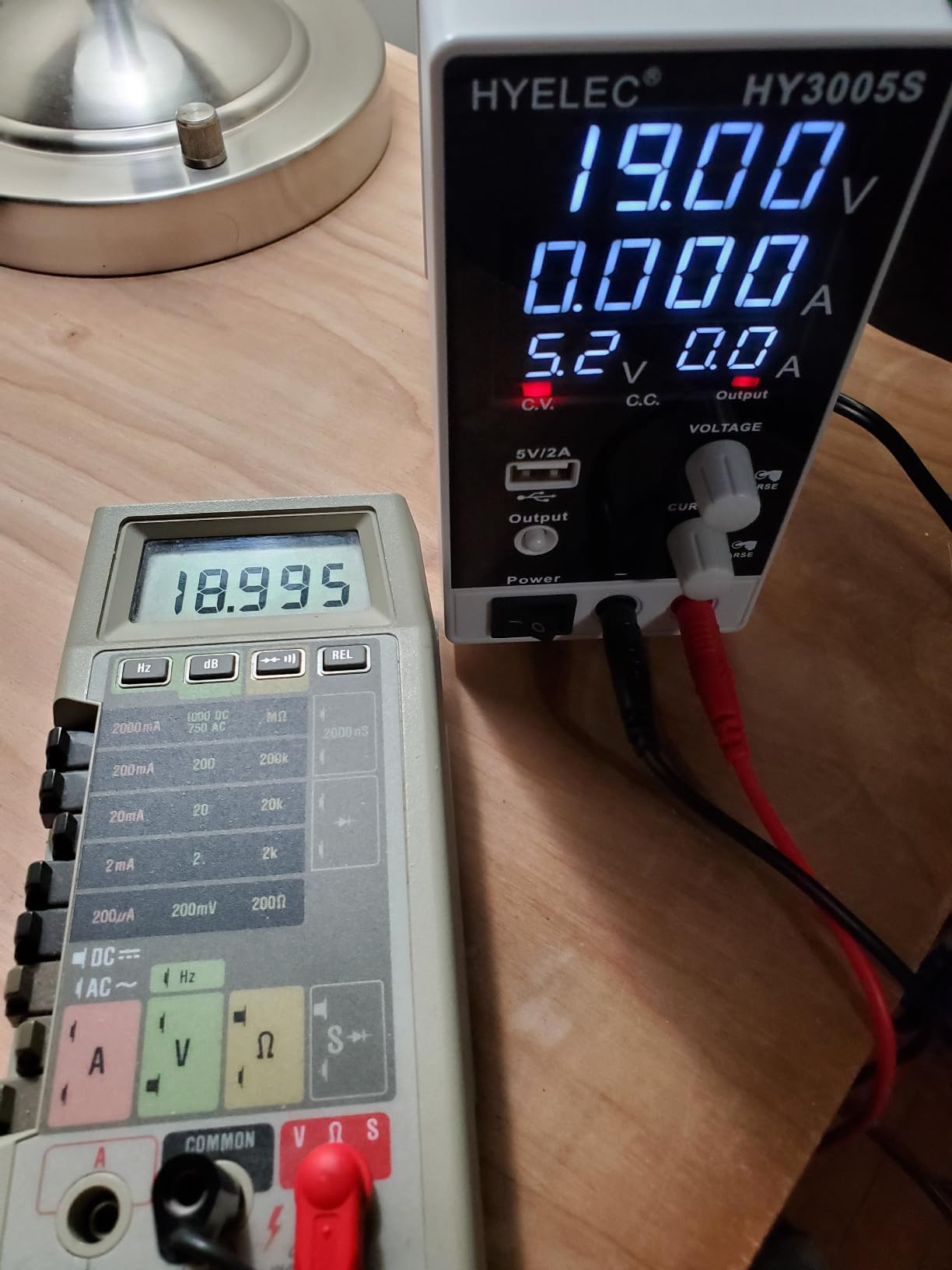
- Measured output matched a Fluke meter to within 5mV at 20V
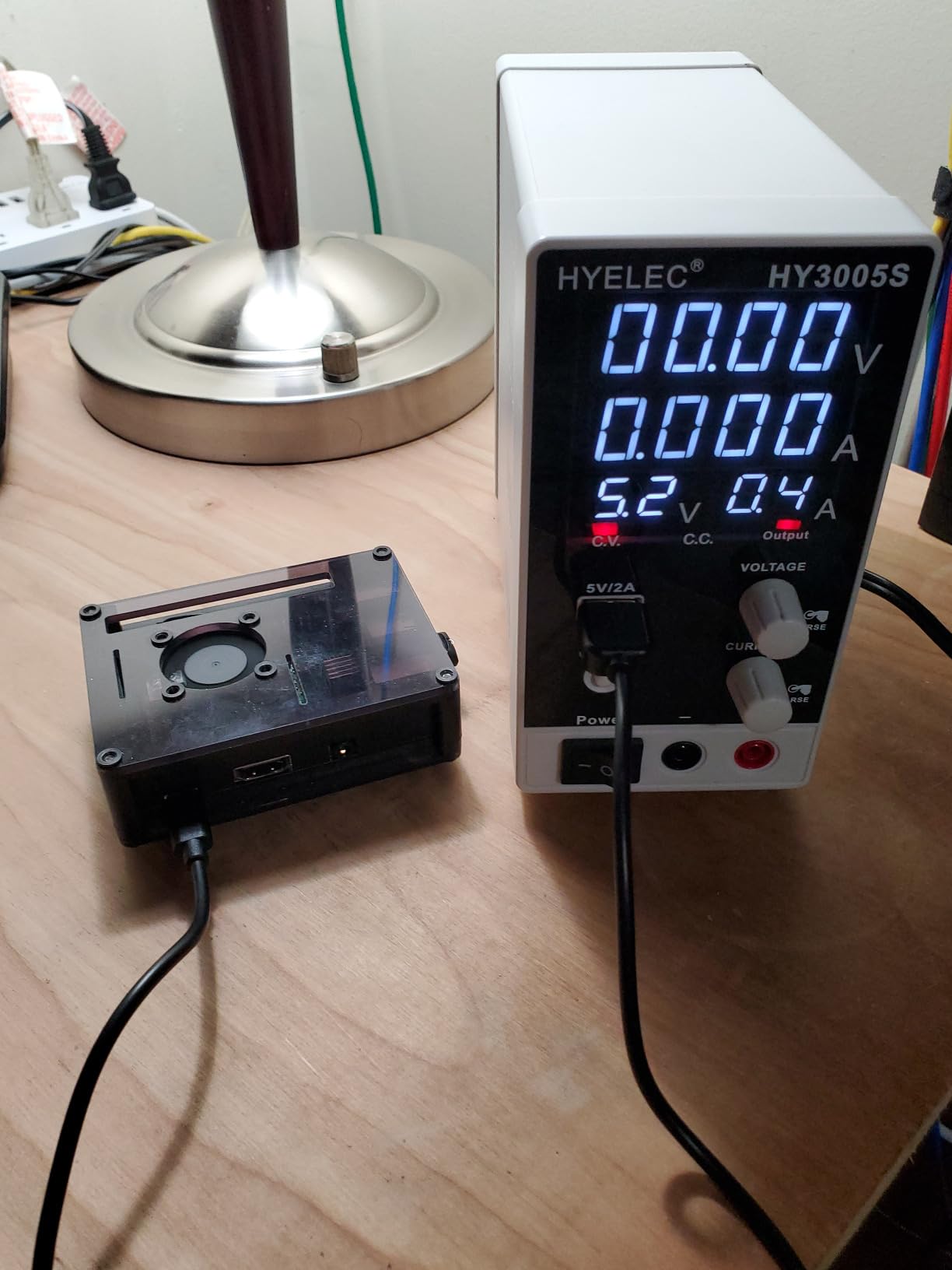
- 5V 2A USB output measured 5.2V and powered a Raspberry Pi 3B+ at 0.4A
- Dedicated OUTPUT button for setting and verifying values before power reaches the load
- Later batches use 5-way binding posts that suit breadboard prototyping
- Very light chassis so it can slide when you press buttons
- 110V input only
- Listed wattage figures for this model are inconsistent in the product data
This is the highest-rated supply in the roundup at 4.7 out of 5, with 85% of its 181 reviews at five stars. The encoder offers 0.01V and 0.001A resolution, and one owner measured the output against a Fluke to within 5mV at 20V. That is user-published accuracy, not a datasheet claim, which is why we weight it heavily.
A dedicated OUTPUT button lets you set and verify values before power reaches the load, the same workflow win as the NICE-POWER SPS-C3010. The 4-digit LED is described in reviews as stable and non-jumping, which matters more than it sounds when you are reading a value off a scope trace.
The separate 5V/2A USB output was measured at 5.2V and used to power a Raspberry Pi 3B+ drawing 0.4A, so it is a real second rail rather than a decoration. Later production batches moved to 5-way binding posts, which are far easier than clips when you are feeding a breadboard rail.
Protection includes short circuit, over-temperature and overload handling with a temperature-controlled fan, plus an output anti-shock button. At 1.65 lb and 7.5 x 3.15 x 5.9 inches it stays portable.
Check the batch before you rely on the posts
The binding posts are a later-batch change, so if 5-way posts matter to your setup, confirm what is in the box. This is 110V input only, so a 230V bench needs a different supply, and the listed wattage figures for this model are inconsistent in the product data — judge it on the 30V/5A rating instead.
The chassis is unusually light, which some owners prefer for portability and others find means it slides across the bench when you press buttons. That is a fair trade for 1.65 lb.
Where it earns its badge
For 3.3V and 5V logic work, verified accuracy and a real secondary 5V rail, this is the sharpest option at 5A. If you need 10A of headroom for motors or LED strips, step up to the Kungber or WANPTEK 300W models. If your bench is analog, the Korad linear supply is the correct direction.
10. HANMATEK HM305M 30V 5A: Budget Metal-Chassis Unit
HANMATEK DC Power Supply (0-30 V 0-5 A) HM305M Mini Variable Switching Digital Bench Power Supply
- Fully metal chassis that feels far more substantial than plastic boxes in this price range
- Encoder knobs step cleanly and one reviewer verified 13.80V setpoints against a meter
- Output power-on state can be configured to default on or off
- Working OCP that one reviewer drove a thin steel wire to trip
- Measured around 100mV peak-to-peak ripple on a basic oscilloscope test
- Twelve-month warranty
- Bleeds RF and can disturb sensitive readings
- Not suitable for advanced circuitry or amplifier work
- Display flashes while values are being changed
- Interface takes practice and the manual is brief
The HM305M is a 0-30V, 0-5A box in a fully metal case, and that chassis is the reason it feels different in the hand from plastic-bodied supplies at the same level. The rating is 4.3 out of 5 from 146 reviews with a 13% three-star share, the lowest average in this group, so it is not the pick for everyone.
Output is DC 0-32V at up to 5.1A, 150 watts, with a three-digit display at 0.1V for voltage and 0.01A for current. Encoder knobs handle press-to-select digit entry, and you can configure whether the output powers on or defaults to off. OVP, OCP and OPP protection are all present, backed by a 12-month warranty.
One reviewer measured around 100mV peak-to-peak ripple on a basic oscilloscope test, and another drove a thin steel wire to confirm the OCP actually trips. At 1 kg and 3.15 x 5.91 x 9.06 inches, the vertical metal layout keeps the footprint narrow.
Those are the reasons to like it: it is a real machine with working protection rather than a listing that says short-circuit protection.
Where it falls short
One owner reported the supply bleeding RF and transmitting spurious signals that disturbed sensitive readings, and directly concluded it is not suitable for advanced circuitry or amplifier work. That is a specific, credible complaint and it lines up with the 100mV ripple figure. For audio or measurement work, choose the Korad linear supply instead.
The display flashes while you are changing values, which makes it hard to read off the knobs, and the interface takes practice with only a brief manual to help. If precise readouts matter to you, the 4-digit displays on the Jesverty, NANKADF or HANGELL are a step up.
When it makes sense
Buy this one for general purpose 5V to 30V work on a student bench, a club night, or a first setup where budget matters more than measurement precision. The metal chassis, working OCP and configurable power-on state are all real advantages over cheaper plastic alternatives.
11. NANKADF 30V 10A: Best for Long Unattended Runs
- 1166 reviews averaging 4.5 out of 5 with 81% at five stars
- Measured accuracy dead-on below 15V and within 0.005V at higher voltages
- Output enable button shows the set voltage before it is applied
- OCP shuts off and alarms without losing the programmed settings
- One owner ran it continuously for ten days powering an electroplating cell
- After a timeout the encoder defaults back to the third digit instead of staying on the last one selected
- Voltage ramps down slowly when lowering the setting or powering off
- Display refresh/poll rate is slower than ideal
With 1166 reviews at 4.5 out of 5 and 81% at five stars, this sits behind only the top pick and the Jesverty for review volume, and it has the longest documented continuous run in the group. One owner powered an electroplating cell with it for ten days straight without issue, which is exactly the sort of evidence you cannot get from a datasheet.
Accuracy figures come from user measurement: dead-on below 15V and within 0.005V at higher voltages. The 4-digit display is specified at 0.01V and 0.001A with adjustable brightness, and the 300W output is standard for the class.
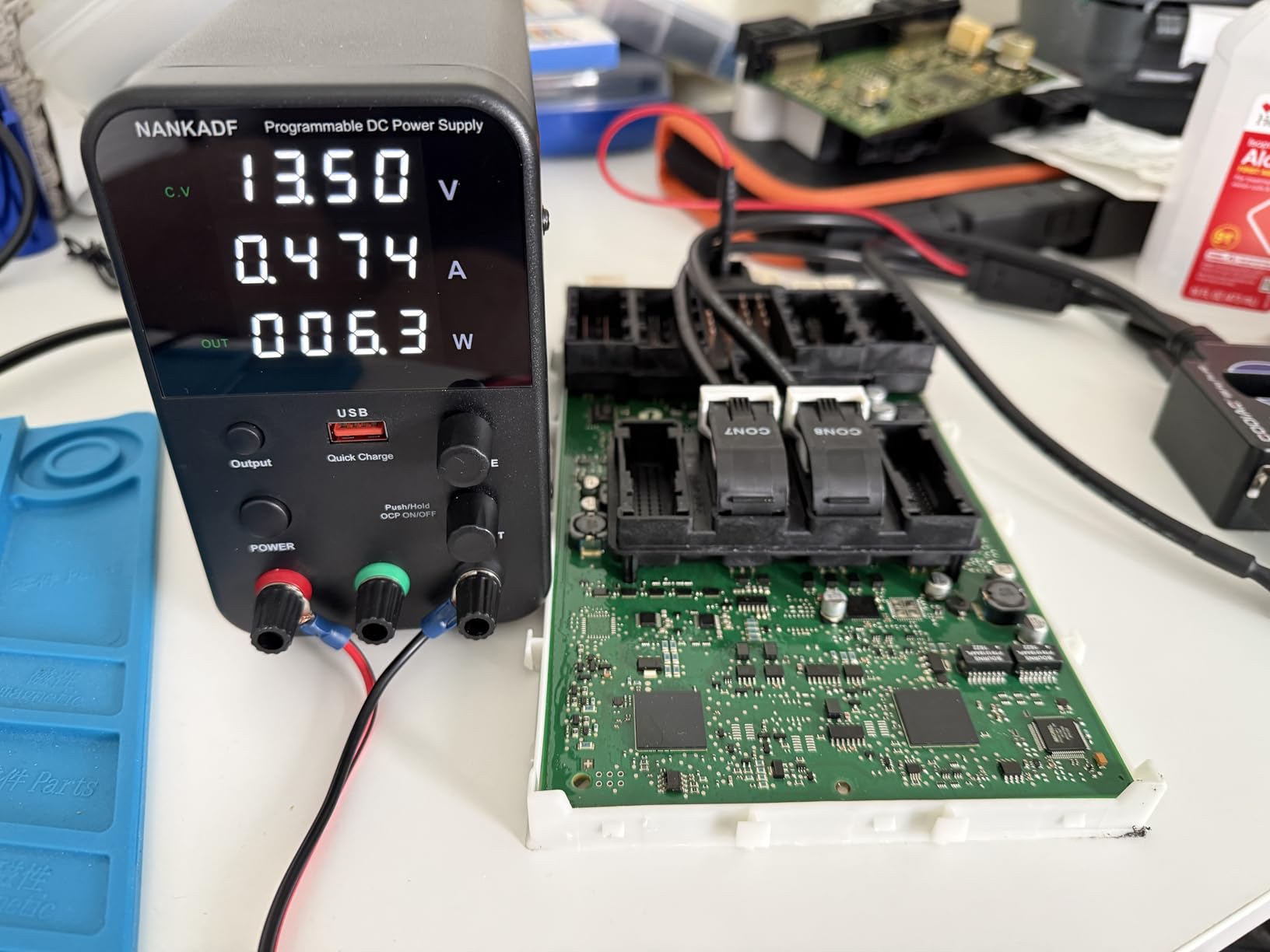
The output enable and disable button is the workflow feature here. It shows the set voltage before it is applied to the load, so you can confirm your numbers with the circuit disconnected and then energise it. Overcurrent protection shuts off and alarms without losing the programmed settings, which is a small detail that matters a lot when you are testing a board that faults intermittently.
Constant-voltage and constant-current modes switch automatically with a status indicator, and there is an 18W USB fast-charging port on the front.
The interface quirks are the trade
After a timeout the encoder defaults back to the third digit instead of staying on the digit you last selected, which slows down anyone setting values repeatedly. Voltage also ramps down slowly when you lower the setting or power off, and the display refresh rate is slower than ideal.
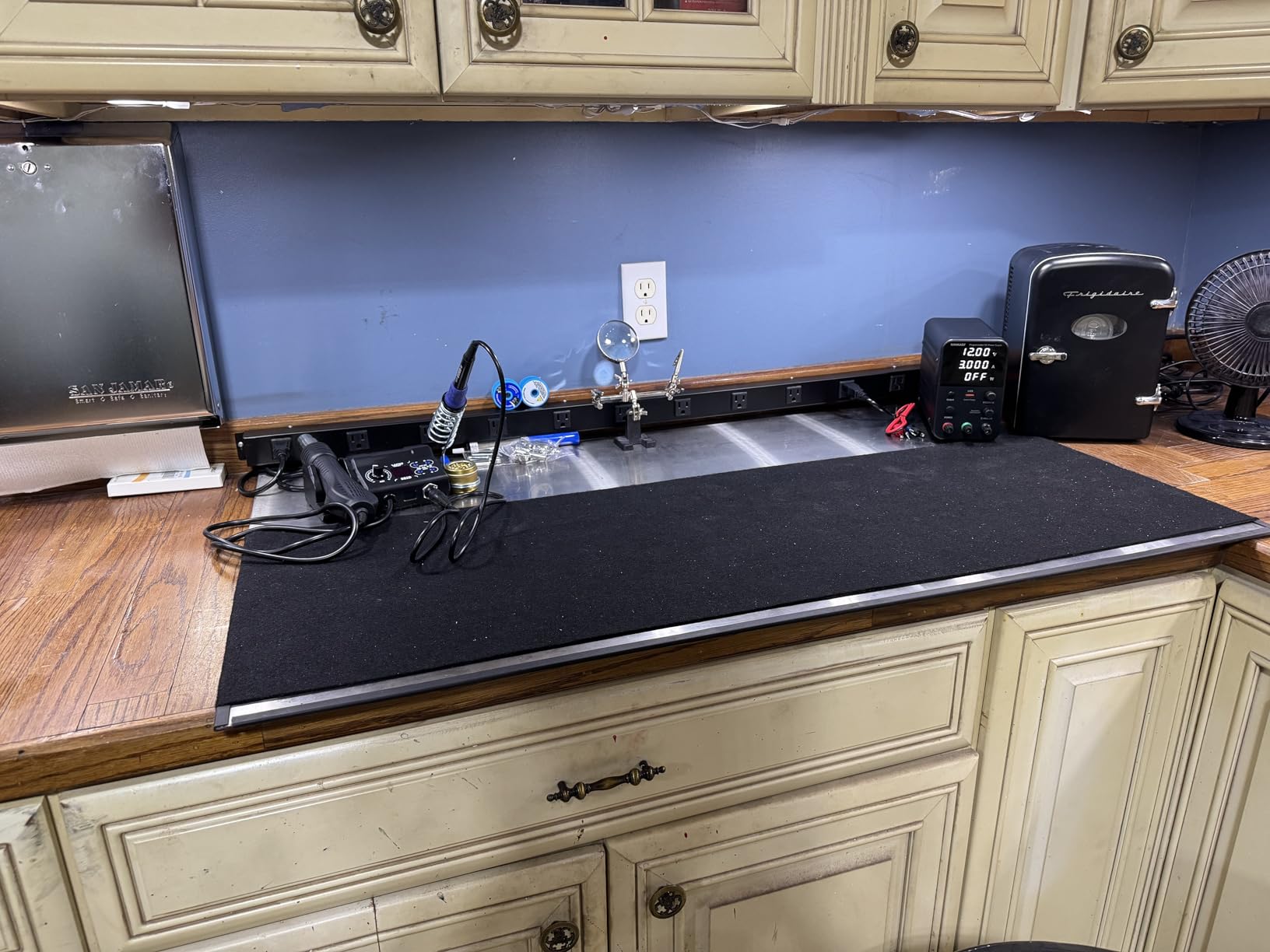
There is no integrated storage or hanger for the test leads, so leads trail across the bench. Adding a small clip or a lead holder solves it in a minute. Note also that the dimensions listed in the product data for this model are inconsistent, so judge it by the 30V/10A rating and the 1.48 kg weight.
Best for long jobs
Long unattended runs, electroplating, battery charging over hours, and any task where you set a voltage and walk away. The auto-recovering protection and the ten-day owner report are what make it a reassuring choice for work that has to keep going. For measured precision at 20V, the HYELEC is the alternative with published accuracy data.
12. HANGELL HPS3010 30V 10A: Best for Cordless Battery Recovery
- Only supply in this roundup backed by a five-year warranty
- Used by owners to bring dead cordless tool batteries back to life
- Output switch button lets you set values with the output off
- OCP short-circuit alarm stops output and buzzes on fault
- Heavy-duty case with plenty of ventilation and a large cooling fan
- 4-digit LED at 0.01V and 0.001A with automatic CV and CC switching
- Regulates into over-current mode on startup if the limit is set below about 100mA
- Knob labels are hidden by the knobs and the menus are unintuitive
- Supplied alligator-clip leads feel cheap
- One engineer reported the rear mains selector de-soldering under high-power use
The HPS3010 is rated 4.6 out of 5 from 335 reviews with 80% at five stars, and it is the only supply here with a five-year warranty. That is a meaningful signal on reliability, and it sits alongside a strong practical use case: owners report bringing dead Ryobi, Milwaukee and DeWalt tool battery packs back to life with it.
Recovering a cordless pack means charging a multi-cell lithium pack with a controlled current and watching what happens. Automatic constant-voltage and constant-current switching with a status indicator is exactly the behaviour that makes that safe, and the 18W USB and Type-C quick-charge ports cover small devices alongside the main output.
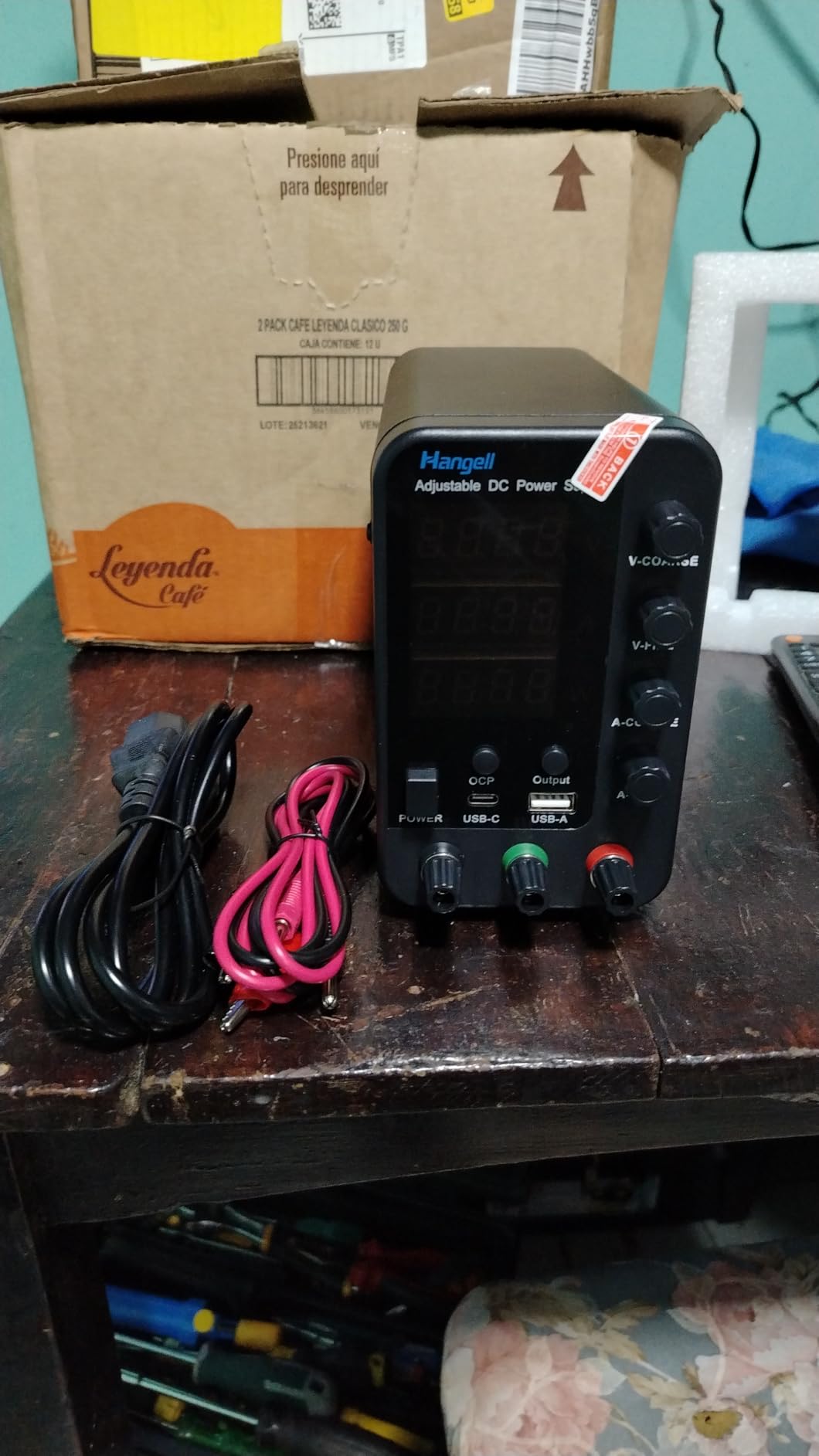
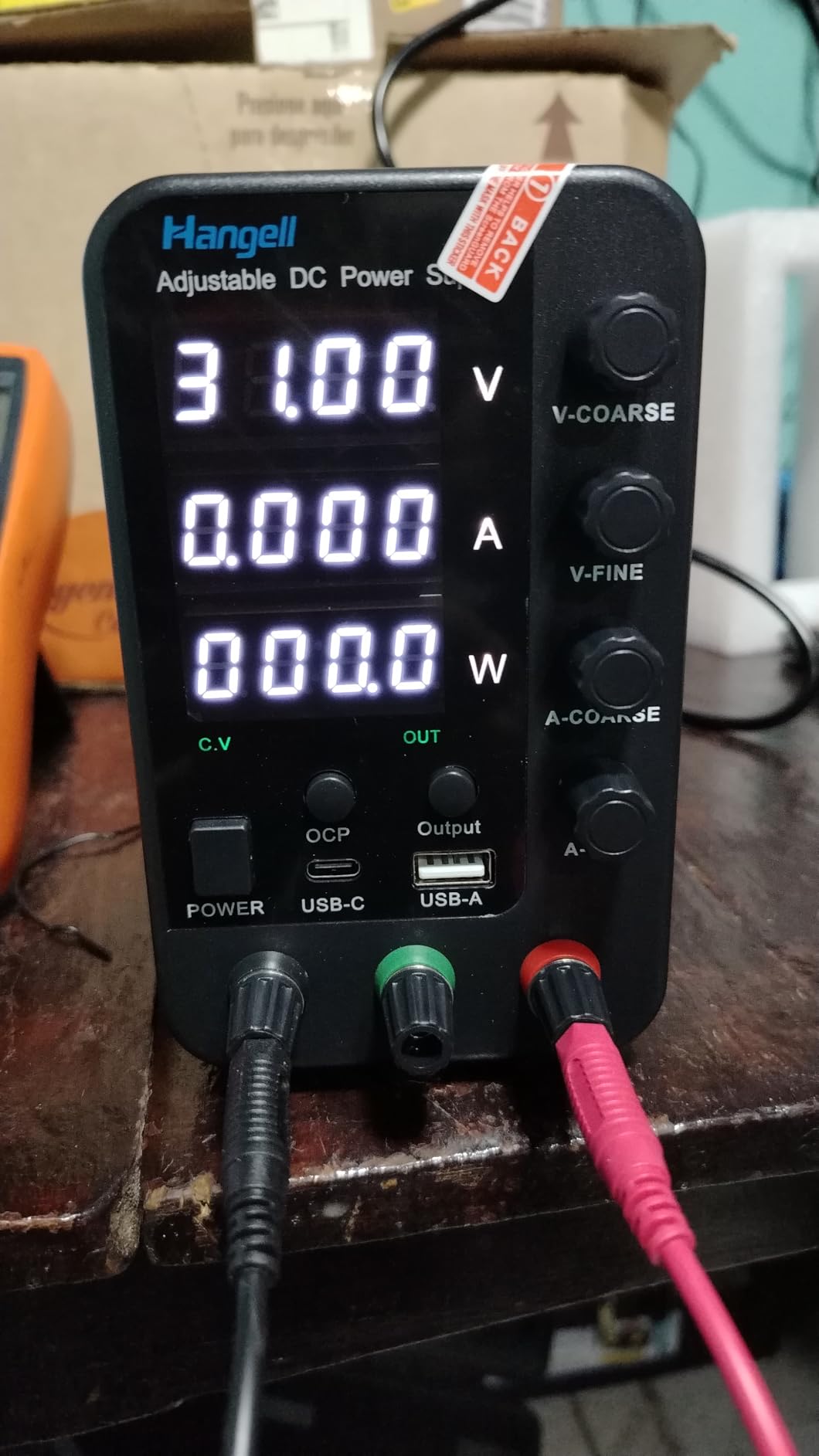
Build quality is the talking point in reviews: a heavy-duty case with plenty of ventilation, a large cooling fan and buttons that feel solid. The output switch button carries an indicator light so you always know whether the output is live, and the 4-digit display runs at 0.01V and 0.001A. Input is 100V to 220V AC, so it covers both mains standards without a manual switchover.
Protection covers over-voltage, over-current, over-temperature and overload.
Watch the startup behaviour
If the current limit is set below roughly 100mA, the supply regulates into over-current mode on startup. That surprises people who set a low limit before connecting a board, and it is the most important thing to know about this supply. Set your limit, confirm the mode indicator shows constant voltage, then connect the load.
Knob labels are obscured by the knobs themselves and the settings menus are unintuitive, so expect an evening of learning. The supplied alligator clips feel cheap. One engineer also reported a chain of failures traced to the rear mains voltage selector switch de-soldering under high-power use, with output measured limiting to roughly 145W in that report — a single detailed account, but worth knowing if you run near the ceiling continuously.
Who it suits
Battery recovery, pack balancing and any sustained high-power work where a five-year warranty is worth more than the extra features on a cheaper box. If you mostly do 5V logic and breadboard work, the HYELEC does the job more simply.
How to Choose a Bench Power Supply in 2026?
Choose by matching the output range to your work, adding current headroom, and only then paying for features you will use. Most hobby mistakes come from buying for voltage and underestimating current, or from buying a single-output box and then fighting it to make 3.3V and 5V rails.
Voltage range. Almost every hobbyist-facing box runs 0-30V. That covers 1.5V cells through to 24V motors and 12V automotive work. Below about 30V you have covered almost every first project.
Current, with headroom. Buy roughly twice the current your load actually draws. A supply forced to sit at its ceiling generates heat, runs its fan constantly and can hold voltage less accurately. For microcontroller and LED work 3-5A is plenty; for motors and LED strips you want 10A.
Topology: linear or switching. Use a linear supply for low-current analog, audio and measurement work where ripple shows up in the result. Use a switching supply for anything digital, motors, LEDs or anything drawing more than a couple of amps. Linear boxes are quiet but limited to roughly 3-5A by the heat they produce.
Number of outputs. One channel covers most projects. Two or three channels only matter if you need several rails at once, such as 3.3V logic plus 12V, or a positive and a negative rail for an op-amp circuit. Check whether a second channel is a full 0-30V channel or a fixed logic rail.
Constant current and current limit. Every supply on this list does CC/CV crossover. That is non-negotiable, because it is what turns a short circuit into a bounded event rather than a dead board.
Protection circuits. Look for overcurrent, over-voltage, over-temperature and short-circuit handling. Treat a listing whose only claim is short circuit protection, with no supporting detail, as unverified.
Output enable control. A button or switch that disables the output while you keep your settings is worth a lot on a repair bench, because it removes the live-output-while-adjusting habit. Five of the picks here have one.
Mains input. Check whether the unit is 110V only, 230V only, switchable, or auto-detecting. The rear selector being set wrong is one of the most common reasons a new supply will not reach its rated voltage.
Programmability. Only needed if you are scripting voltage sweeps or running automated test sequences. Otherwise it is money better spent on current headroom.
Which brands are worth trusting?
Rigol, Siglent, Korad, Keysight, Tektronix and B&K are the names that come up repeatedly when hobbyists ask about reliability on r/AskElectronics and the eevblog testgear forum. The pattern is consistent: brand recognition plus a published datasheet plus real protection circuits is what people mean by reliable.
On the other side, the recurring complaint about brandless marketplace boxes is a lack of any verifiable data. No datasheet, no published ripple figure, and protection circuits of unknown behaviour. Members on eevblog ask directly whether generic supplies are reliable, and the general answer is that you are buying an unmeasured power source for your bench. A no-brand supply is fine for a 5V phone charger. It is a poor choice for the source everything else on your bench depends on.
How to Read a Bench Power Supply Datasheet?
The number one organic result for this topic is a practitioner thread asking how to interpret a bench power supply spec sheet. That tells you the specs are opaque, and they are — but only six lines on a datasheet actually matter for hobby work.
Output range and total power. 0-30V and 0-10A sounds like 300W, and usually is. The number that catches people is that a 10A rating only applies at low voltages, because the wattage ceiling is the real limit.
Constant current range. Check the minimum current the CC mode holds. Some cheap boxes will not regulate below 100-300mA, which is a real limit for low-current analog work.
Ripple and noise. Usually stated as millivolts peak-to-peak, and often at full load. If a listing publishes no figure at all, that is information in itself. One user-measured example from this roundup is around 100mV peak-to-peak on the HANMATEK.
Load regulation. The percentage of change in output voltage between no load and full load. Under 1% is fine for hobby work; below 0.5% is what you want for reference work.
Resolution versus accuracy. Resolution is how finely you can set a value. Accuracy is how close it lands. A 0.01V resolution display with unverified accuracy is marketing; a display with a user-published measurement against a known meter is evidence. The HYELEC owner who matched a Fluke within 5mV at 20V is the model.
Protection and sense terminals. Confirm overcurrent, over-voltage and over-temperature handling, and check whether remote sense terminals exist. Sense terminals let the supply correct for voltage drop in long leads, which is the difference between 11.9V and 12.0V at a distant load. None of the twelve models here publish sense terminals, and that is a fair reason to look at a professional supply when accuracy matters.
Using Current Limit to Find a Short or Bad Component
Set the current limit before you power a board and the supply becomes a diagnostic instrument rather than just a source. The procedure is the same whether you are debugging your own design or a dead game console bought second-hand, and no competitor page we reviewed covers it.
Set the voltage to the circuit’s nominal supply, slightly below if you are unsure.
Set the current limit to roughly twice the expected normal draw. For a small microcontroller board that may be 100-200mA; for a motor circuit, look at the stall current.
Connect with the output disabled where the supply allows it, then enable the output.
Read the current. If it sits at your limit instead of dropping to something small, the circuit is drawing more than it should — you have found a fault, not a dead supply.
Work backwards through the circuit, disconnecting sections until the current draw drops. The last section you disconnected contains the short.
For a suspected bad component, freeze or heat it gently while watching the current. A capacitor that goes short often shows up as a reading that climbs as it warms.
The same technique protects you during a first power-up. Start at a low current limit, confirm the draw looks sane, then raise it. If the current slams into the limit immediately, you have found your problem before any component sees a sustained fault current.
One caution: discharging capacitors after the test. A bulk capacitor on a 12V rail holds a charge that can hurt you, and the supply being switched off does not change that.
Frequently Asked Questions
What is a good brand of bench power supply?
Siglent, Korad, Rigol, Keysight, Tektronix and Bu0026amp;K are the names hobbyists name most often on electronics forums when they ask about reliability. Among smaller units, Rigol and Korad come up repeatedly as the dependable picks. The test that matters is not the badge but whether the maker publishes a datasheet with a ripple figure, lists real overcurrent and overvoltage protection, and stands behind the unit.
How do I choose a bench power supply?
Match the voltage range to your work, which for most hobby projects means 0-30V. Buy about twice the current your load draws so the supply is not running at its ceiling. Then check constant current limiting, protection circuits, an output enable switch or button, and whether the mains input matches your own supply voltage. Pay for extra features only if your work needs them.
What is the most reliable power supply brand?
Among hobbyist and lab supplies, Korad, Rigol and Siglent are the most frequently recommended for reliability, followed by Keysight, Tektronix and Bu0026amp;K at the professional end. Reliability in practice means a published datasheet, working overcurrent protection, accurate readouts and distributor support. Every pick in this roundup publishes some part of that, but the Siglent, Korad and WANPTEK models carry the longest brand-level track record on hobby forums.
What is the best 12V power supply for bench testing?
For 12V testing, any 0-30V unit in this roundup covers it comfortably. For automotive and motor work where current spikes hard, choose a 30V 10A 300W model such as the Kungber SPS3010B, the WANPTEK DPS3010U or the HANGELL HPS3010. For 12V audio amplifier work specifically, the Korad KD3005D is linear and therefore quieter.
What is the best benchtop power supply?
The Kungber SPS3010B is our overall pick at 30V and 10A, with the deepest review history in the group at 2775 ratings averaging 4.5 out of 5, an intelligent charging mode and overcurrent alarming. The Jesverty SPS-3010 is the best value pick for a first build, and the Siglent SPD3303X-E is the right choice when you need three isolated outputs including a 3.3V and 5V logic rail.
Which power supply brands should I avoid?
The units to be careful with are brandless marketplace listings with no datasheet, no published ripple or regulation figures, and a short-circuit protection claim with no supporting detail. Forum members on eevblog regularly ask whether generic units are reliable, and the recurring answer is that you cannot verify what you are buying. A no-brand supply is fine as a spare; it is a poor choice for the source everything else on your bench depends on.
Do bench power supplies limit current?
Yes, and that is the defining safety feature. Every quality bench supply holds constant voltage until the load draws the current you set, then switches to constant current mode and holds that figure instead. The result is that a short circuit becomes a bounded event at your chosen limit rather than an unbounded fault. Set the limit before you power a board and it doubles as a way to find a short.
The Best Bench Power Supplies for Hobby Electronics in 2026
The best bench power supplies for hobby electronics come down to one question: what are you powering. If the answer is motors, LED strips, battery packs or general prototyping, the Kungber SPS3010B is the pick — 30V, 10A, 300W, the deepest review base in the group and a charging mode that earns its keep.
For a first bench on a tighter budget, the Jesverty SPS-3010 gives you the sharpest display at 0.01V and 0.001A resolution with automatic constant voltage to constant current switching. For analog, audio and measurement work, the Korad KD3005D is linear and quiet where every switching box here would add noise to the reading.
When you need 3.3V and 5V rails at the same time, or an isolated second channel, the Siglent SPD3303X-E is the only pick on this list built around three isolated outputs. Whatever you choose, set the current limit before you power anything, and check the mains input selector on the day you unbox it.