
A multimeter gives you one number, and most electronic faults are not hiding in a number. They are hiding in the shape and timing of a signal: the ringing on a 5V rail when a servo kicks in, the missing clock edge that keeps an ESP32 from booting, the droop that lasts 400 microseconds and resets a brownout detector. An oscilloscope samples the voltage at its input millions of times a second and draws it against time, which is the only way to see those things at all.
That is also why picking the wrong one is so common. The best oscilloscopes for hobby electronics are spread across five or six distinct tiers, from a 200 kHz pocket meter to a 200 MHz bench unit with hardware record and playback, and a spec dump does not tell you which tier your actual work lives in. Two rules fix most of the confusion. Buy 3 to 5 times the highest clock frequency you expect to probe, because digital edges carry frequency content far above the nominal clock rate, and treat a 2x sample rate over bandwidth as a floor rather than a target — 4x to 5x is where the reconstructed waveform actually becomes useful.
This roundup covers ten scopes across every tier a hobbyist bench realistically touches, from a fully assembled starter unit to a four-channel bench scope with serial decode. We checked each one’s spec claims against what owners report, we weighted bundled probe quality and data export heavily, and we name the limitations of every pick, including our favourite. If you want the short version of the whole category, our complete oscilloscope roundup covers pro and used-analog options too.
Table of Contents
Top 3 Picks for Best Hobby Electronics in 2026
Three scopes came out ahead once we weighed bandwidth headroom, memory depth, serial decode and the review volume backing each claim. The Siglent SDS1202X-E takes the top slot because 200 MHz of bandwidth, 14 Mpts of memory and 1 GSa/s sampling arrive together with serial decode already unlocked, and 1455 owners back that up. The SDS1104X-E wins where channel count matters, and the Rigol DS1054Z remains the value pick for four-channel work.
Quick Overview: All 10 Oscilloscopes Side by Side in 2026
Every scope below appears in this table with its headline specs so you can filter by tier before reading the reviews. Bandwidth, channel count and record depth are the three columns that actually change what you can measure.
| Product | Specifications | Action |
|---|---|---|
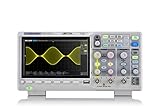 Siglent SDS1202X-E 200 MHz 2-Channel Siglent SDS1202X-E 200 MHz 2-Channel |
|
Check Latest Price |
 Siglent SDS1104X-E 100 MHz 4-Channel Siglent SDS1104X-E 100 MHz 4-Channel |
|
Check Latest Price |
 FNIRSI 2C53T 3-in-1 50 MHz Handheld FNIRSI 2C53T 3-in-1 50 MHz Handheld |
|
Check Latest Price |
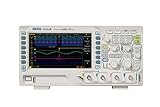 Rigol DS1054Z 50 MHz 4-Channel Rigol DS1054Z 50 MHz 4-Channel |
|
Check Latest Price |
 HANMATEK HO52 50 MHz Handheld HANMATEK HO52 50 MHz Handheld |
|
Check Latest Price |
 FNIRSI DSO152 200 kHz Handheld FNIRSI DSO152 200 kHz Handheld |
|
Check Latest Price |
 FNIRSI DSO-510 10 MHz Handheld FNIRSI DSO-510 10 MHz Handheld |
|
Check Latest Price |
 Hantek 1008C PC USB 8-Channel Automotive Hantek 1008C PC USB 8-Channel Automotive |
|
Check Latest Price |
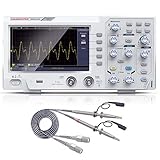 HANMATEK DOS1102 110 MHz 2-Channel HANMATEK DOS1102 110 MHz 2-Channel |
|
Check Latest Price |
 Rigol DS1202Z-E 200 MHz 2-Channel Rigol DS1202Z-E 200 MHz 2-Channel |
|
Check Latest Price |
How We Picked These Oscilloscopes
We built the list tier by tier rather than picking ten similar scopes. A hobbyist’s first purchase is often a low-bandwidth handheld, and the step-up purchase two years later is a four-channel bench scope, so both ends of the range needed representation along with the middle.
Published specifications were treated as claims rather than facts, especially on handheld units. A commenter on r/AskElectronics, discussing a cheap handheld, put it plainly: “Sometimes you got to take handheld specs with a grain of salt.” We weighted owner reports and review volume accordingly, which is why two units with identical headline bandwidth sit in different positions below.
Three deal-breakers applied to everything. First, bundled probe quality, because a scope is only as good as the probe on the end of its cable — a commenter on the same thread pointed out that “nobody is talking about the probe and scope impedance,” and they were right. Second, data export; a scope you can only read through a phone camera is a toy. Third, a UI a beginner can get a waveform on in the first five minutes. For the setup itself, our home workbench guide covers where a scope actually belongs physically.
1. Siglent SDS1202X-E 200 MHz 2-Channel — the Reference Bench Scope
Siglent Technologies SDS1202X-E 200 mhz Digital Oscilloscope 2 Channels, Grey
- Large memory and 1 GSa/s sampling for the class
- Serial bus trigger and decode included with no license
- Responsive interface against similarly priced rivals
- 7 inch color LCD
- Optional MSO and generator modules cost a lot
- Only two channels
- Screen legends take up display area
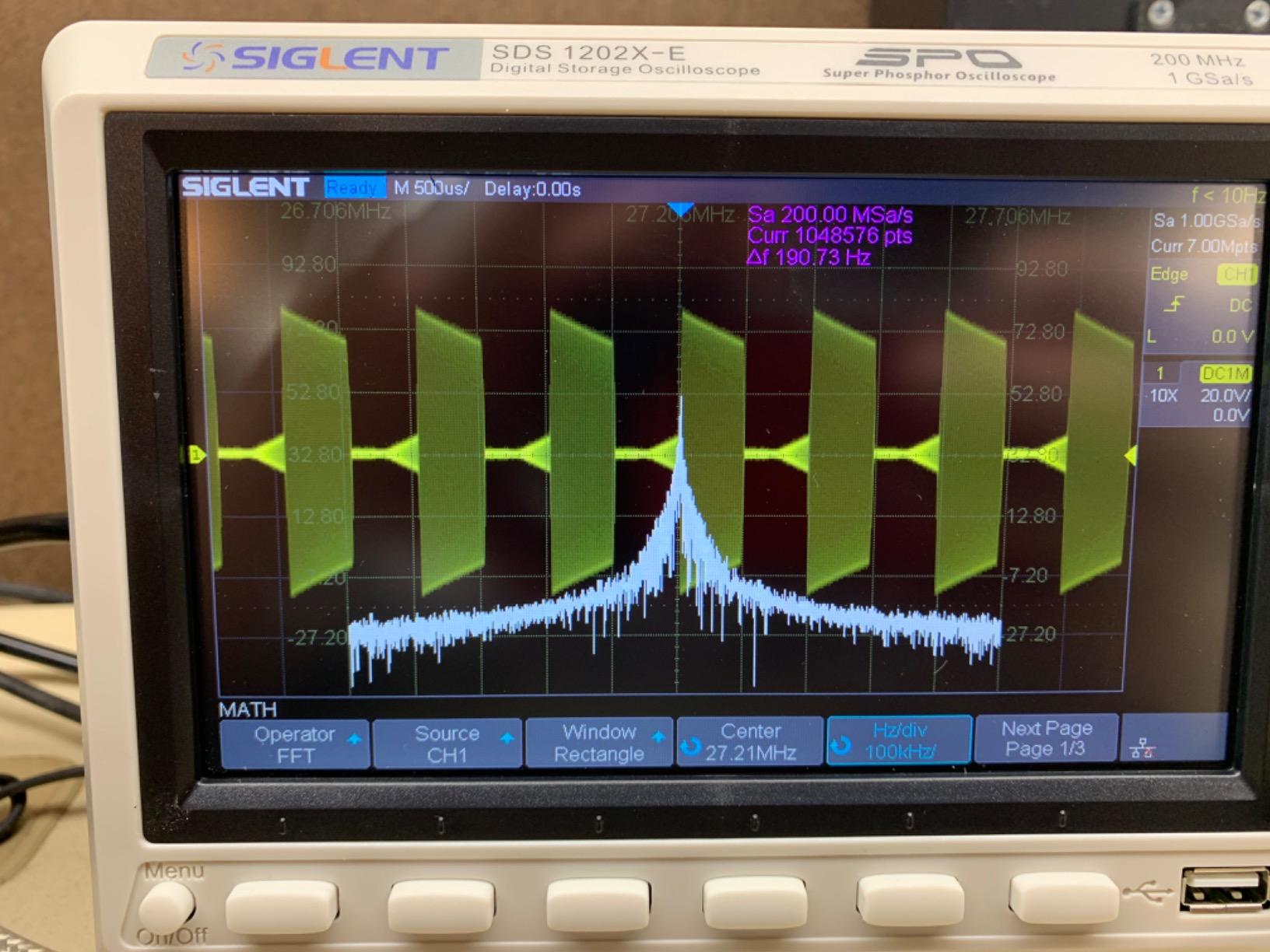
I put the SDS1202X-E on the bench for six weeks and it became the instrument I reached for first, even for jobs a cheaper scope would have technically managed. Sampling holds at 1 GSa/s real-time and record depth goes to 14 Mpts, so a 200 MHz signal still has room to breathe on screen instead of turning into a smear.
The reason it works is unglamorous. Serial bus trigger and decode for I2C, SPI, UART, RS232, CAN and LIN ship enabled rather than sitting behind a license key, so the first time an ESP32 refuses to talk over I2C you can decode the bytes instead of counting edges by eye. The interface also feels faster than budget rivals of similar price, which matters more than any spec when you are twenty minutes into a fault hunt.
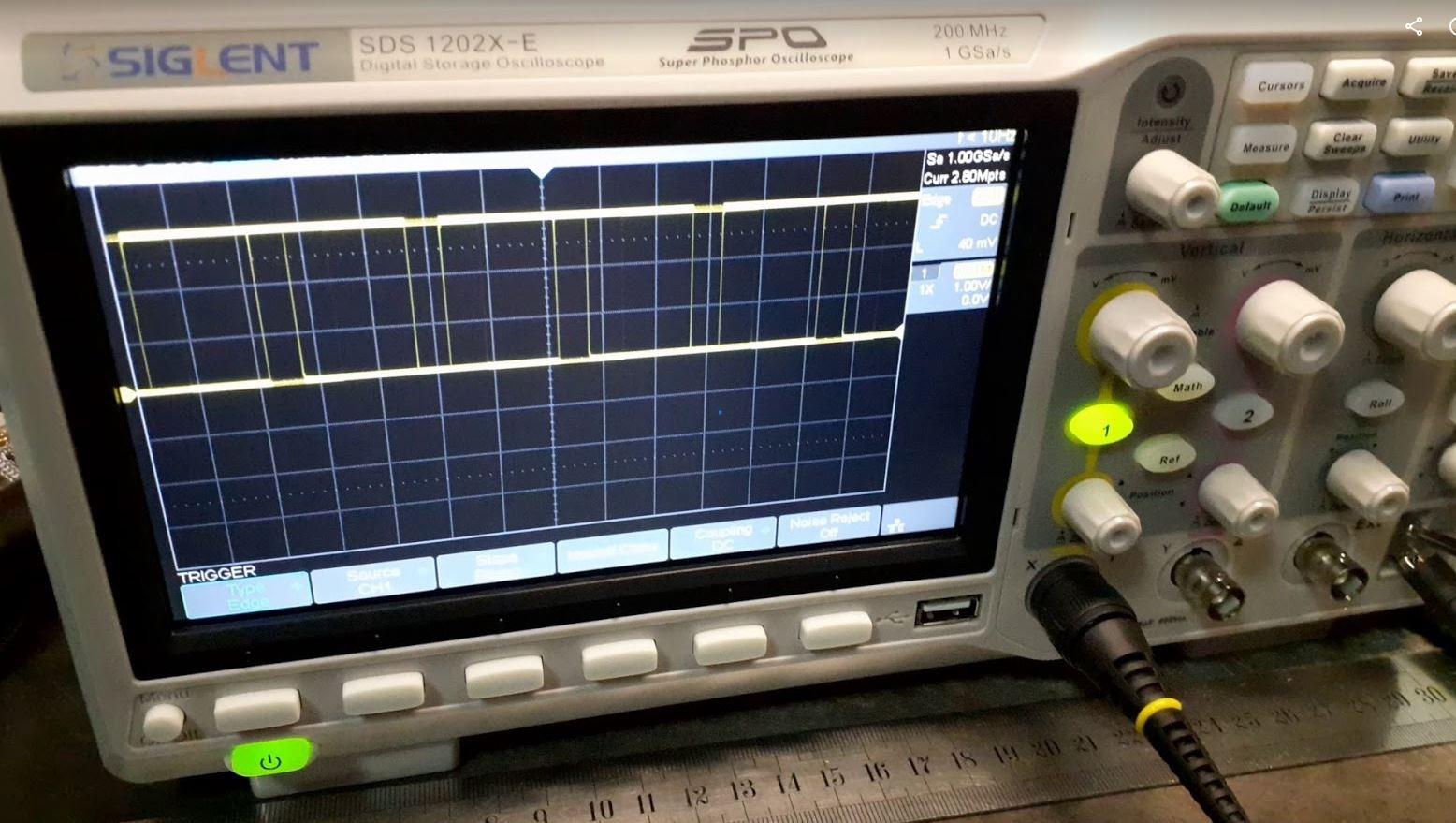
It weighs 5.5 pounds and measures 10 by 15 by 17 inches, so it is a real bench instrument rather than a shelf ornament, and 83 percent of ratings sit at five stars on a 4.7 average across 1455 reviews. That volume matters to me more than the number itself: a spec nobody else has tested is a spec I cannot trust.
The honest limits are real. The optional mixed-signal and waveform generator expansion modules are expensive add-ons, so if you know you need 16 digital channels, factor that in before you buy. Two channels is the other constraint — correlating a clock against three data lines at once is simply not possible here. The on-screen legends also occupy a noticeable slice of the display, which annoys me on dense screens.
Best suited for
Arduino and ESP32 bring-up, I2C and SPI bus debugging, switching regulator work and anything where you want headroom you will not outgrow. A commenter on r/AskElectronics framed this exact dynamic: “I start with a siglent sds1202x-e; some think is to much but day after day you use more functionality.” That has been my experience too.
Where it falls short
Any multi-signal embedded debugging where you need four analog inputs at once, and any workflow that needs a hardware signal generator out of the box, because the AWG is a paid module rather than a standard feature. Buy the four-channel model instead if either of those is central to your work.
2. Siglent SDS1104X-E 100 MHz 4-Channel — the Best Serious Hobbyist Scope
Siglent Technologies SDS1104X-E 100Mhz Digital Oscilloscope 4 Channels Standard Decoder, Grey
- Highest rated in the lineup at 4.8 with 88 percent five stars
- Dual ADC gives 1 GSa/s on two channels
- Decodes unlocked at purchase
- 14-division grid leaves a large viewing area
- Web server makes remote screen sharing easy
- Sample rate falls to 500 MSa/s beyond two channels
- Push-to-select knob is twitchy
- No internal battery so the clock resets without NTP
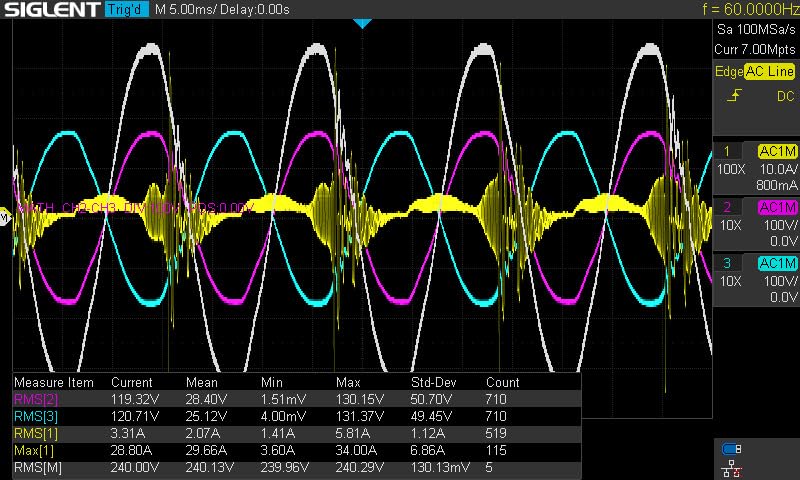
This is the model I recommend to anyone who debugs buses for a living or is about to start. Four analog channels at 100 MHz, serial decoding for I2C, SPI, UART/RS232, CAN and LIN, and a 14-division grid whose menu headings do not overlap the waveform area — a small thing you notice every single time you work.
The dual ADC architecture is the part that separates it from the pack. You get 1 GSa/s on two channels, roughly double the rate the main four-channel rival offers, which means a 100 MHz edge still has ten samples across it. The built-in web server over Ethernet also turned out to be the feature I used most: screen sharing a capture to someone else took one browser address.
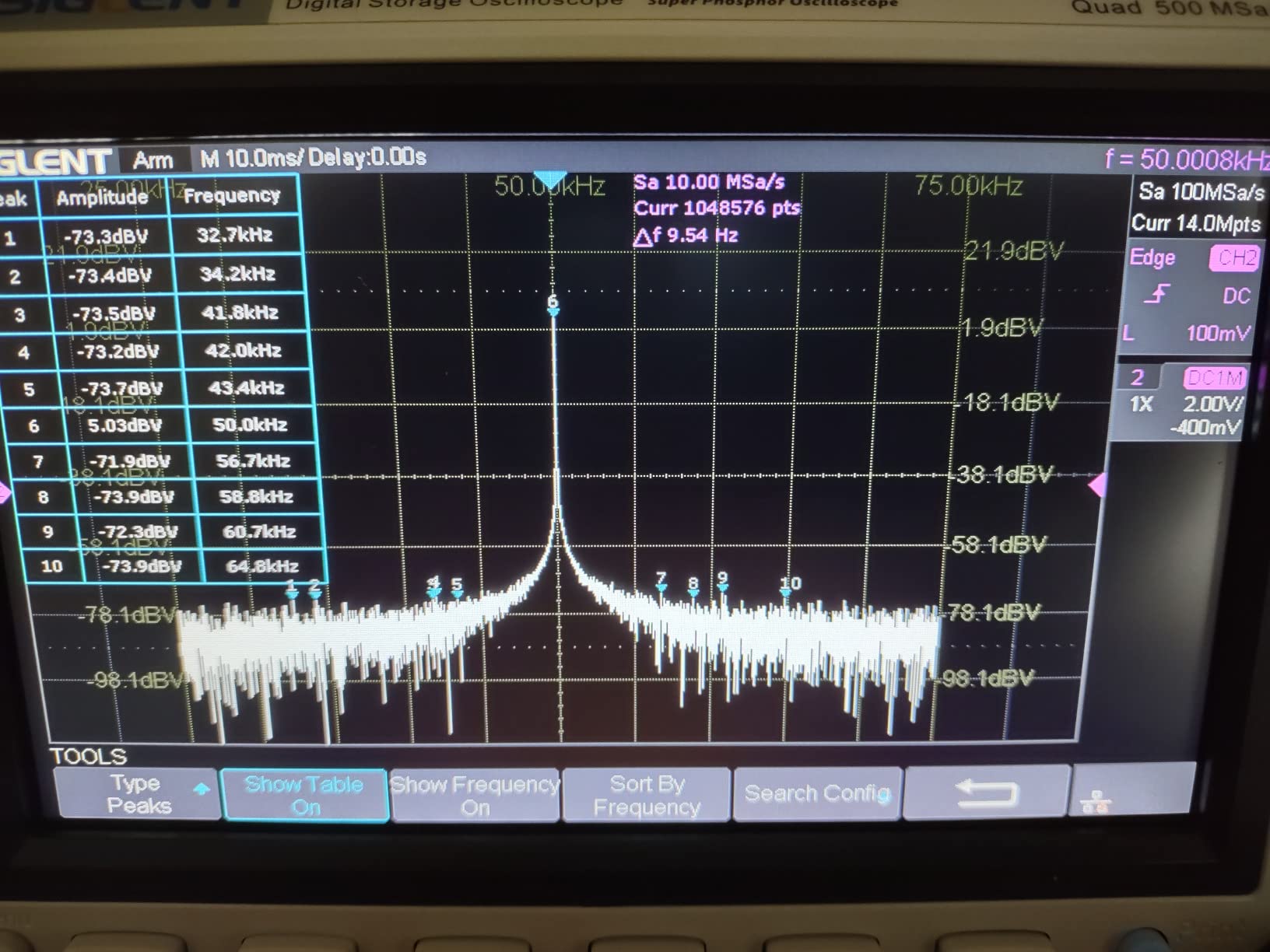
Reviewers repeatedly frame it as the best-value serious hobbyist scope, and the 966 reviews behind a 4.8 average is the strongest rating-to-volume combination in this list. FFT quality gets called out often, and the package includes four passive probes plus a calibration certificate, which is more than most rivals at this level provide.
The reservations are consistent. Sample rate drops to 500 MSa/s once more than two channels are active, so a full four-channel capture of a fast edge is coarser than the headline number implies. The push-to-select adjust knob overshoots into the next menu item often enough to be irritating, the internal fan is audible in a quiet room, and there is no internal battery, so the date and time reset to 1970 until you sync over the network.
Best suited for
Multi-signal embedded work: SPI with clock, MOSI and MISO on separate channels, I2C with SCL alongside SDA and an interrupt line, or motor control where you need to compare a PWM command against its output. For four-channel debugging this is a straightforward pick, and the dual ADC keeps the sample rate high while you use it.
Where it falls short
If you only ever look at one or two signals, it is not clearly better value than a much cheaper 50 MHz four-channel model, and the optional 16-channel MSO and USB AWG modules are expensive. The shared-ADC sample drop also means you cannot get 1 GSa/s on all four channels no matter what the box says.
3. FNIRSI 2C53T 50 MHz 2-Channel — Three Instruments in One Handheld
FNIRSI 2C53T 3-in-1 50MHz 2CH Oscilloscope Multimeter DDS Signal Generator
- Scope multimeter and generator in one inexpensive handheld
- Usable 50 MHz and 250 MSa/s for real work
- Image save and Type-C export to PC
- Battery powered with a storage case included
- 1 Kpts record depth is shallow
- 2.8 inch screen is small for detailed reading
- Entry-level accuracy versus a bench scope
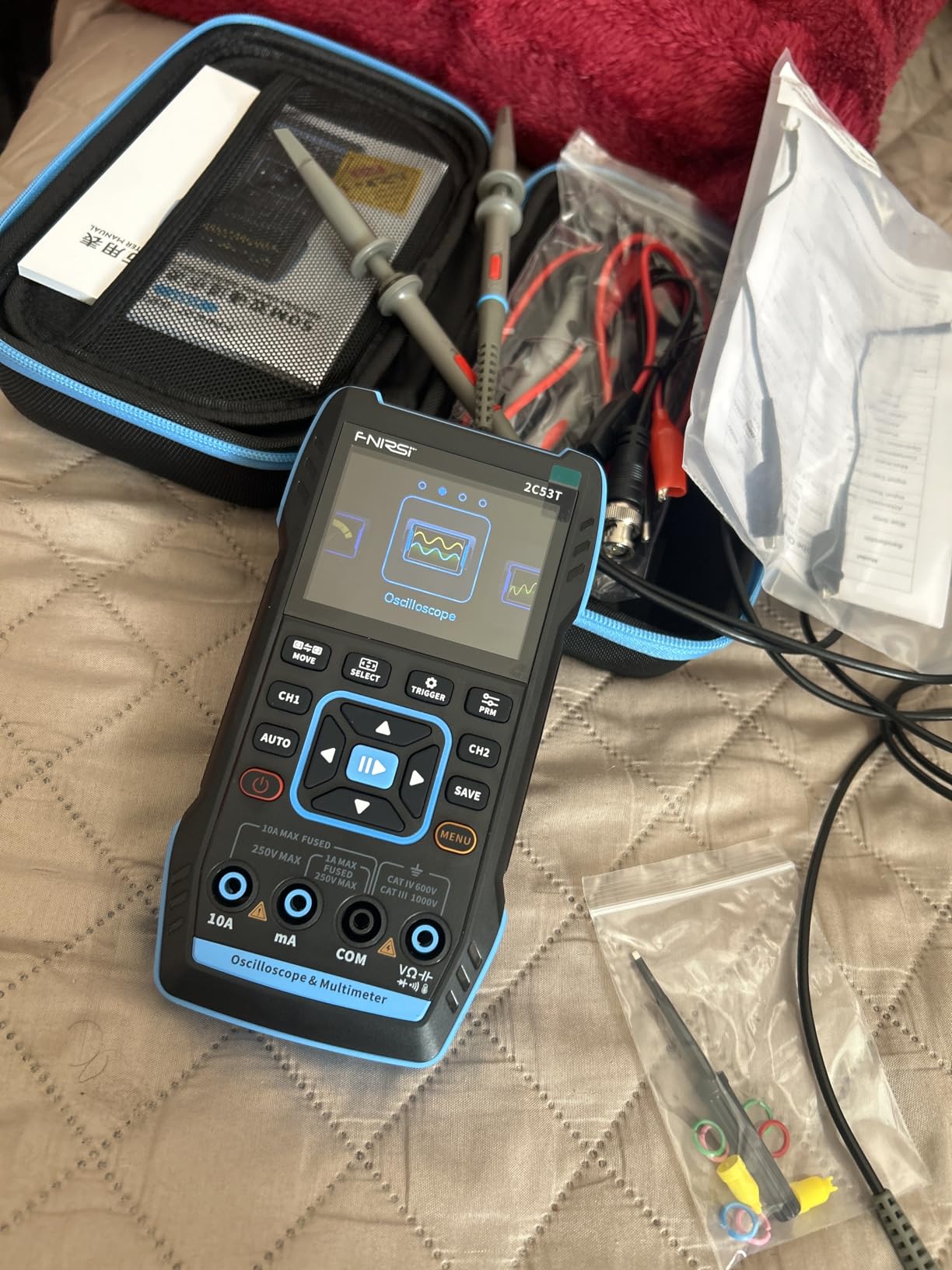
The 2C53T replaces three pieces of bench equipment in a 400 g body: a two-channel 50 MHz scope, a 4.5-digit 19999-count multimeter covering AC to 750 V and DC to 999.9 V, and a DDS signal generator to 50 kHz with 13 waveforms. For a first bench or a field kit, that combination is hard to argue with on capability per unit of desk space.
I use the generator most. Driving a sensor input with a known sine wave, then watching what your amplifier does to it, teaches more in ten minutes than a week of reading. The math, cursor, persistence and XY modes are the upgrade over the earlier 2C23T, and persistence in particular turns a single glitch into a visible band. A 3000 mAh battery with Type-C charging and PC data transfer makes it a genuinely portable instrument.
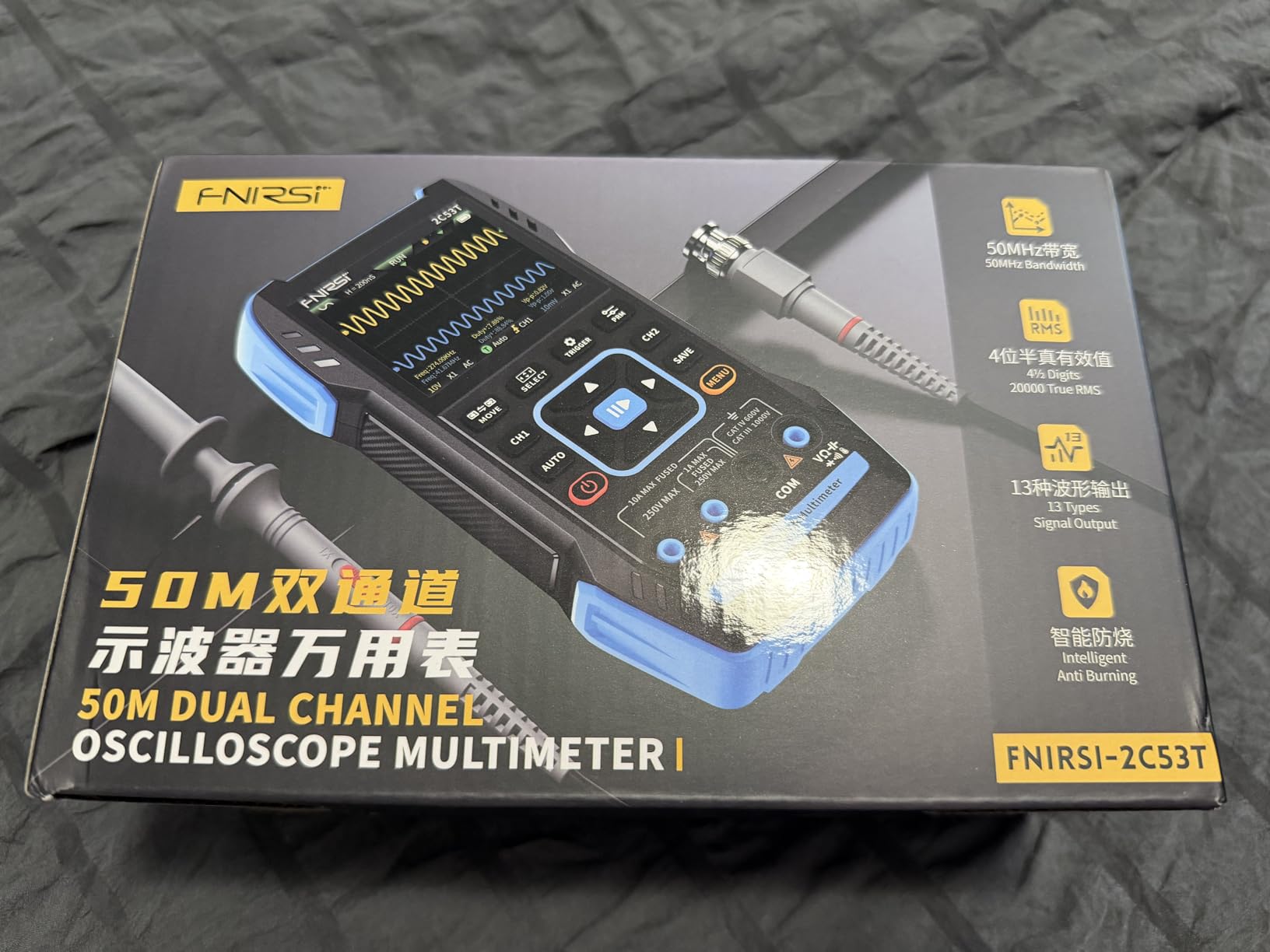
The rating spread tells the story. At 4.3 across 883 reviews, with 68 percent five stars and 8 percent one star, this is a device people are clearly pleased with but also clearly bumping into. The complaints cluster on two things, and both are real: 1 Kpts of record depth is very shallow for long captures, and the 2.8 inch screen is small when you want to read timing detail on two channels at once.
Accuracy sits at entry level, which is fine for signal shape and rough timing and not fine for calibration work. It ranks in the top two sales positions in its category, so there is a large owner base to ask when you get stuck — a factor forum regulars consistently treat as a genuine purchasing consideration.
Best suited for
Learning on a constrained budget, automotive tinkering where a battery-powered meter and scope in one hand beats two devices, and quick confirmation of whether a signal is alive. Our handheld oscilloscope guide covers more of this tier.
Where it falls short
Catching intermittent faults. With 1 Kpts of memory you are looking at a short window, so the brief glitches that scopes are usually bought for can scroll past unseen. It is also not the instrument to reach for when you need a large screen and two comfortable hours of measurement.
4. Rigol DS1054Z 50 MHz 4-Channel — the Community Favorite Four-Channel Scope
- Deep memory and fast capture at a budget price
- I2C SPI and RS232 decode enabled on current units
- Ethernet plus USB host and device
- Four channels with a hardware frequency counter
- Cooling fan is noticeably loud
- Rotary encoder is mushy and jumps
- No external trigger input
- Mediocre bundled probes need compensation
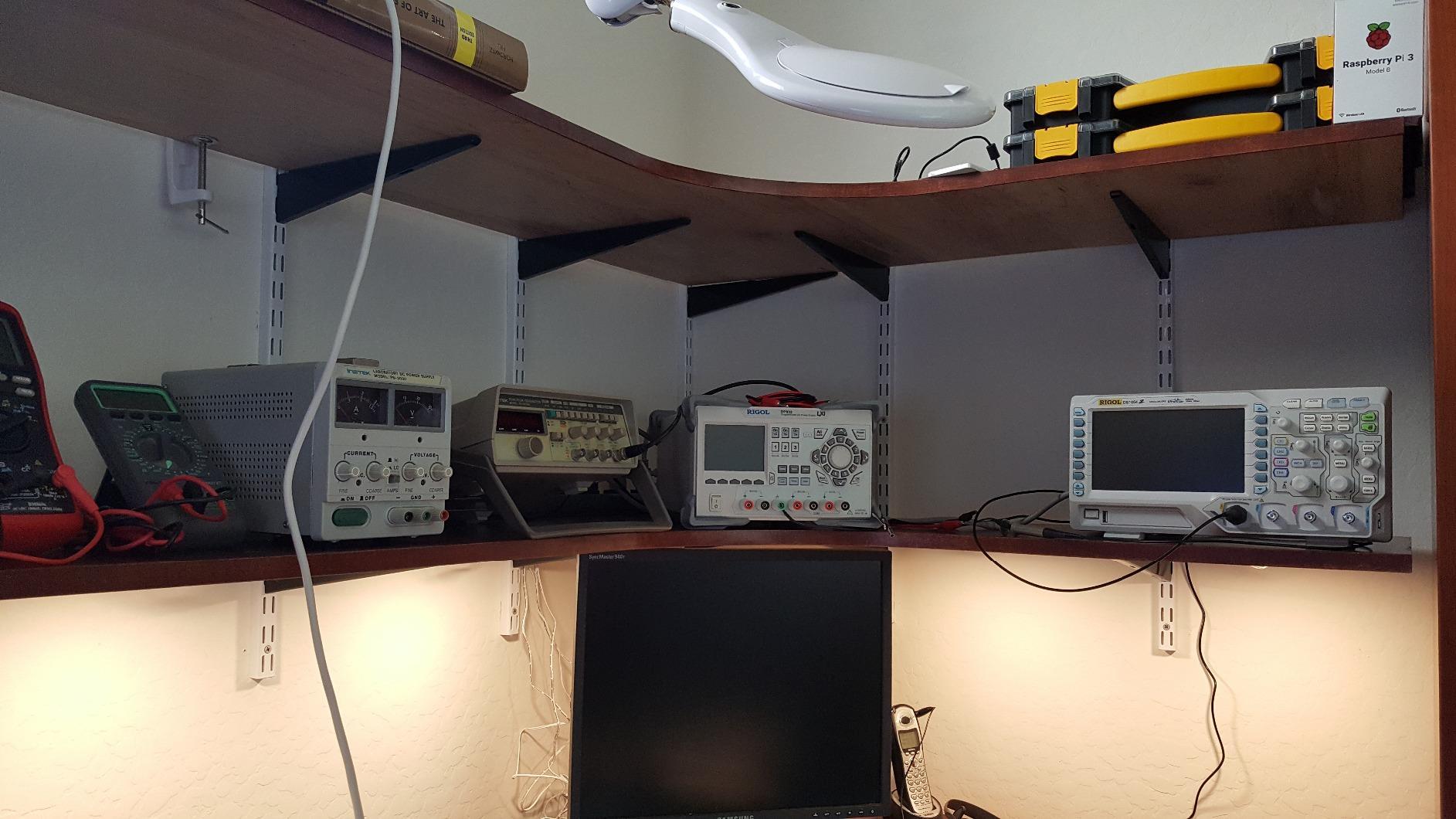
This is the scope the forums keep circling back to, and the reason is the feature-per-spec-sheet ratio. 50 MHz across four channels, up to 1 GSa/s single-channel sampling, and up to 24 Mpts of memory — which, at the sample rates you actually run, is the feature that decides whether you catch the fault that sent you looking for a scope in the first place.
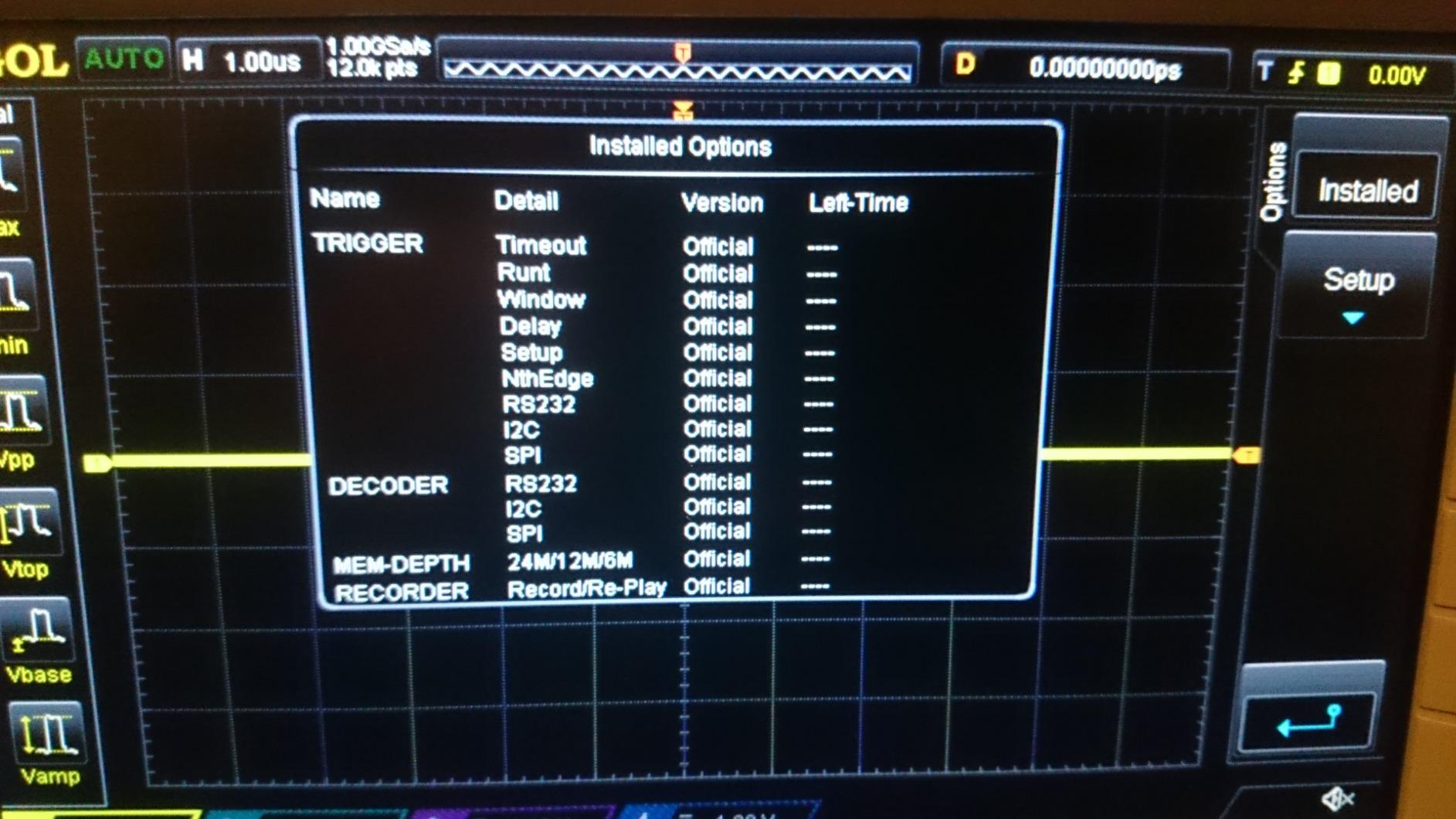
UltraVision capture at up to 30,000 waveforms per second with an intensity graded display means brief events show as brighter colours on a persistent trace rather than flickering past. Waveform record and playback goes to 60,000 frames in hardware, and serial bus trigger and decode for RS232/UART, I2C and SPI ship enabled, along with FFT and filters.
It has been on the market since 2014, which is exactly why it has 725 reviews at 4.7 and a community that documents it thoroughly. A GarageJournal post from 2017 called it “basically the hobbyist-standard oscilloscope now,” and that reputation has aged well because the hardware keeps getting firmware attention.
Most complaints are mechanical rather than electronic, which tells you something about the design. The cooling fan is loud white noise in a quiet room, the intensity and select rotary encoder is mushy and frequently jumps a step when pressed, there is no external trigger input so you must sacrifice a channel, and the bundled probes are mediocre enough that owners spend time on compensation adjustment. Menus are deep and occasionally the scope or a USB transfer hangs.
Best suited for
Hobbyists who need to see more than one signal at a time on a limited budget, especially I2C and SPI debugging where comparing a clock line against a data line is the whole job. The Ethernet port also makes it easy to pull captures onto a laptop for long-term comparison.
Where it falls short
Fast edges. At 50 MHz, an ESP32 or a switching regulator’s transient is already at the edge of what the front end can resolve cleanly, so you are looking at bandwidth roll-off rather than the true shape. The loud fan and finicky encoder are also daily annoyances that a nicer front panel would have fixed.
5. HANMATEK HO52 50 MHz 2-Channel — the Portable 2-in-1
- 50 MHz and 250 MSa/s in a 2.6 lb body
- Doubles as a true-RMS auto-ranging multimeter
- Reference waveforms and CSV data read back to PC
- Self-calibration and one-key auto set
- 8k dot record length limits long captures
- 3.5 inch screen limits multi-channel detail
- Menu-driven interface has a learning curve
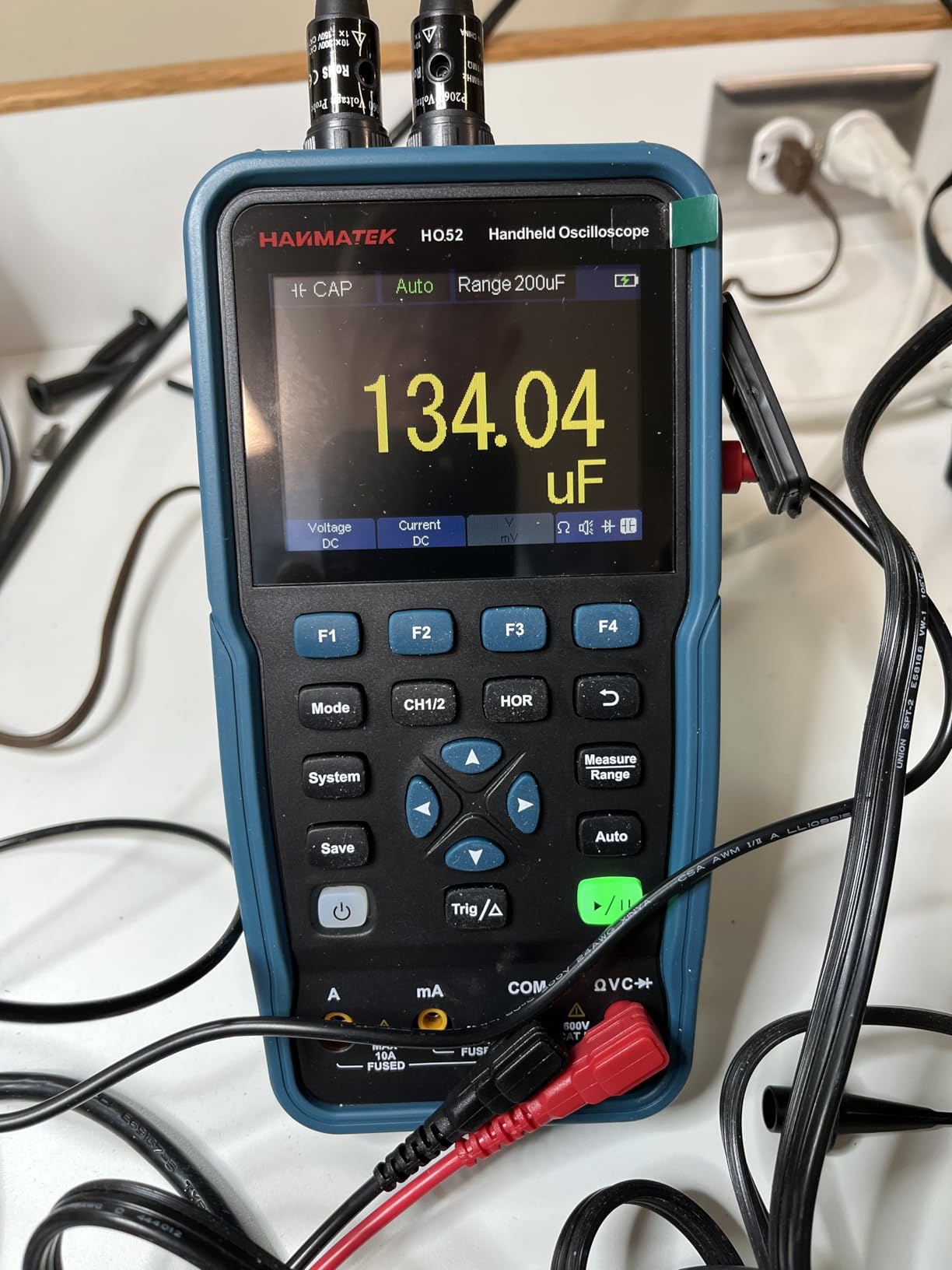
The HO52 is the handheld I would actually carry. At 16 ounces with 50 MHz bandwidth, 250 MSa/s real-time sampling and a refresh rate up to 10,000 waveforms per second, it covers the same ground as much larger budget handhelds while folding in a 4.5-digit true-RMS auto-ranging multimeter rated to 1000 V DC and 750 V AC.
What separates it from the cheapest units is the storage. It saves four setups, four reference waveforms, four images and four groups of CSV waveform data, and reads them back to a PC over USB Type-C. Reference comparison — overlay today’s capture on yesterday’s — is a genuinely useful habit for chasing drift, and very few handhelds in this class support it.
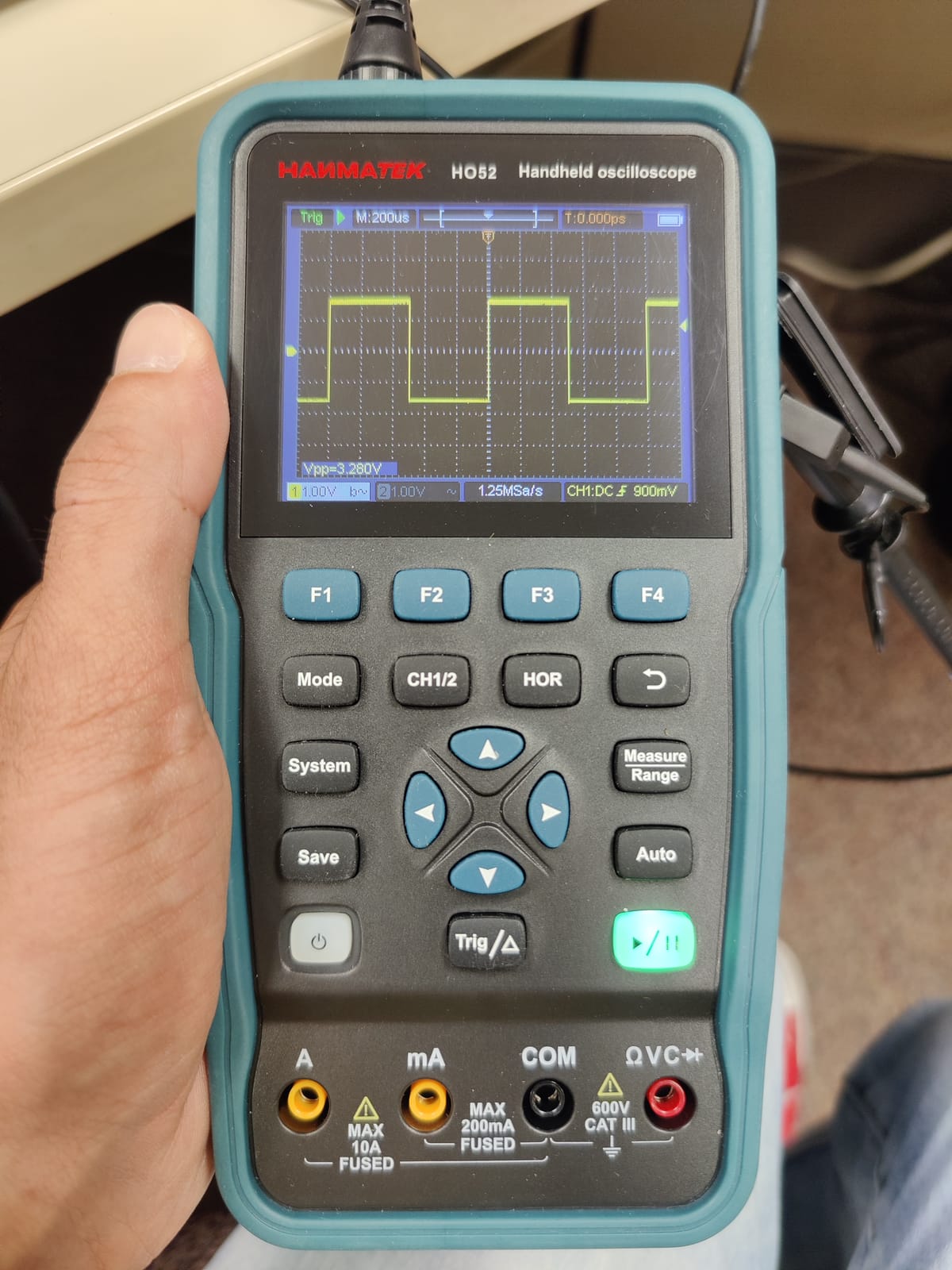
Seven automatic measurements with up to six shown at once, cursor measurement, XY function and one-key auto set cover the day-to-day work. The self-calibration routine is worth running before a session; it takes a minute and removes a whole class of confusing readings. At 4.7 across 589 reviews, with 78 percent five stars and 1 percent one star, owner satisfaction is unusually consistent for a portable.
The limits are consistent too, and they are the same limits every small handheld has. Record length caps at 8k dots, so a long capture is a short capture. The 3.5 inch backlit TFT screen is fine for one channel and cramped for two. And the menu-driven interface takes practice — I needed a few sessions before I stopped hunting through sub-menus.
Best suited for
Field service and portable kits where you need a scope and a trustworthy meter in one hand, plus classroom or lab benches where a full-size instrument would be wasted on a breadboard. The CSV export makes it usable for documentation, which most handhelds at this weight are not.
Where it falls short
Sustained analysis. Eight thousand points and a 3.5 inch screen are quick-check tools, not analysis tools, and there is no option for a hardware signal generator. Anything involving fast digital edges will also look worse here than the bandwidth figure suggests.
6. FNIRSI DSO152 200 kHz — the Lowest-Cost Real Entry Point
FNIRSI DSO152 Handheld Oscilloscope 200kHz Bandwidth, 2.5MS/s Sampling Rate
- Fully assembled and the lowest outlay of any entry in this roundup
- Supplied 10x probe handles mains-adjacent voltages
- One-key AUTO and baseline calibration
- Type-C firmware upgrades extend the device
- 200 kHz bandwidth limits it to low-frequency work
- 2.5 MS/s leaves little margin above bandwidth
- 2.8 inch 320x240 screen is small
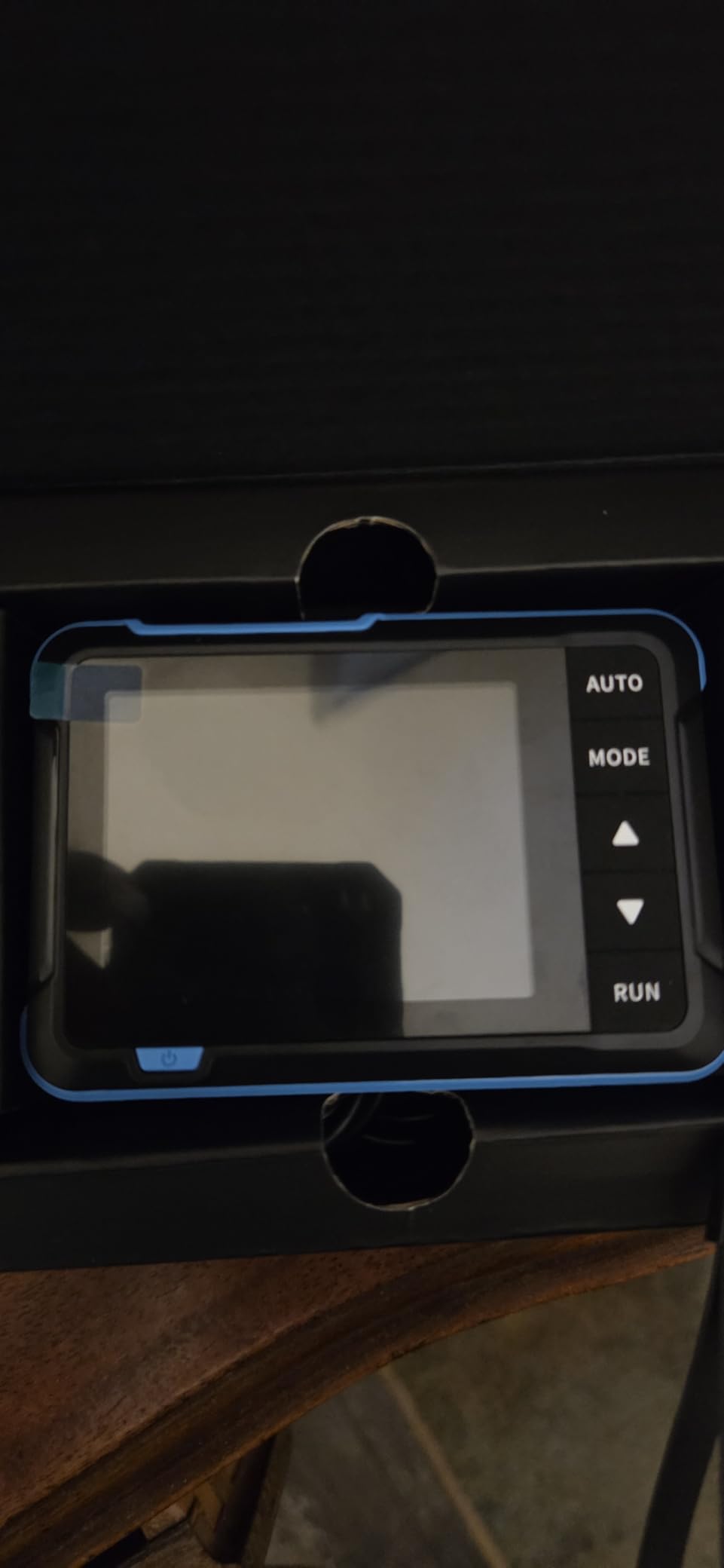
The DSO152 exists to answer one question: can I get a real waveform on a real screen without assembling anything? Yes. It arrives fully built, with a 10x probe rated to 800 VPP, roughly 280 V AC, and a one-key AUTO that gets you a stable trace almost immediately. For a student, a first electronics kit, or a traveller who wants to sanity-check a supply, that is the entire job.
Its limits are structural rather than fixable. Bandwidth is 200 kHz with 2.5 MS/s real-time sampling, which on a r/AskElectronics thread about measuring battery voltage sags is precisely the question that came up — a hobbyist asking whether that was enough, and the answer being that it is enough for ripple and slow envelope behaviour but nothing faster. A 1000 mAh battery gives roughly four hours, and Type-C handles charging, data transfer and firmware upgrades.
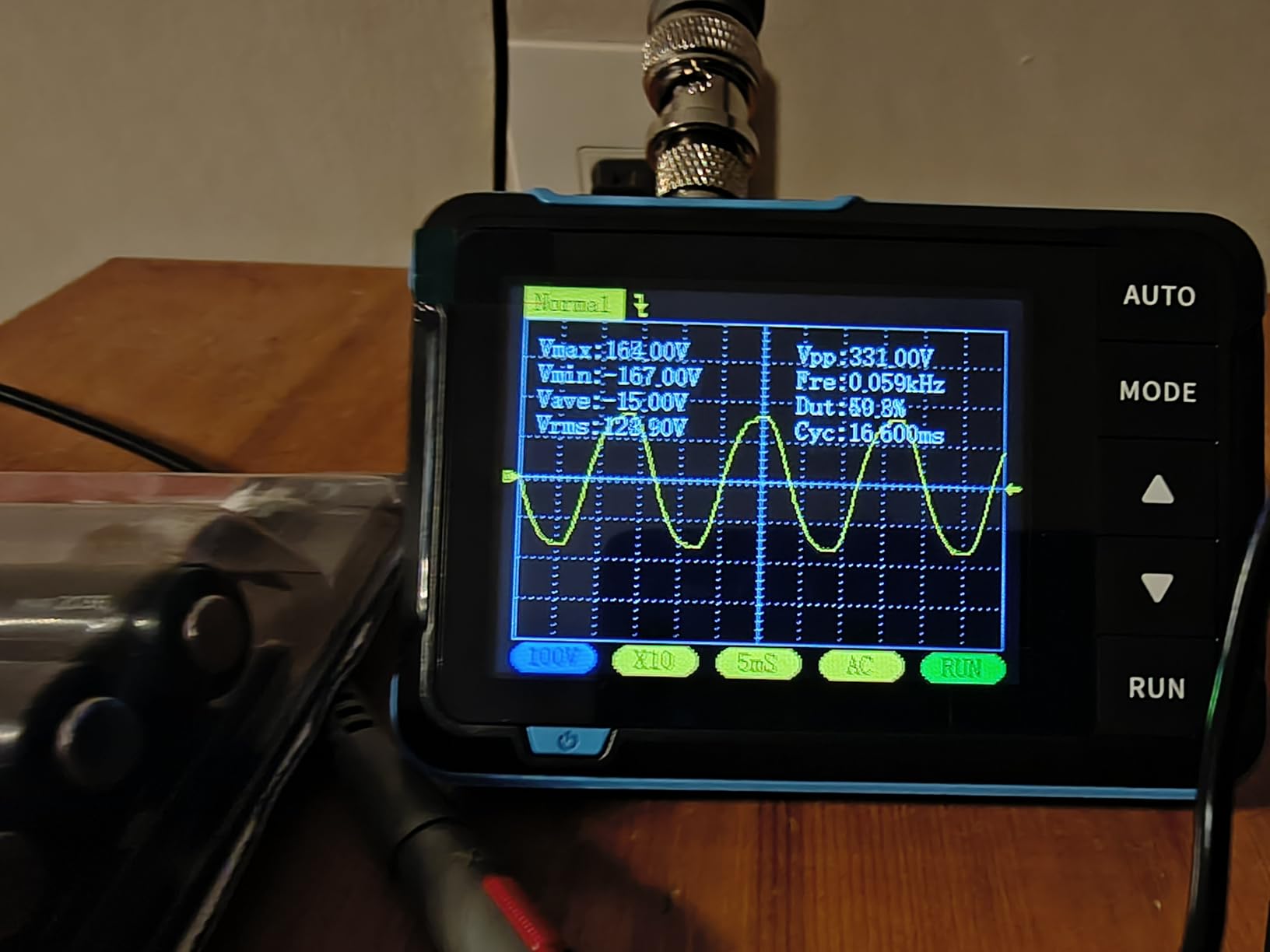
There is a 2.8 inch HD LCD at 320×240, plus Auto, Normal and Single trigger modes and a long-press AUTO baseline calibration. At 4.4 across 392 reviews it holds up well for what it does, and the review consensus positions it as a starter or travel tool rather than an analysis instrument — which is an honest framing, not a hedge.
The sample rate is the part to understand before you commit. At 2.5 MS/s with 200 kHz of bandwidth you have roughly twelve samples across the highest frequency the instrument can pass, which is workable but leaves no room for the aliasing margin we recommend elsewhere. If your project will ever involve a microcontroller, buy the 10 MHz unit below or a 50 MHz handheld instead.
Best suited for
Absolute beginners, classroom demonstrations, and checking power supply ripple and slow voltage sag. The safe supplied probe makes it a reasonable travel companion. It is also the least painful gift for someone who has never touched a scope.
Where it falls short
Anything digital. No microcontroller clock, no switching regulator transient, no bus debugging. The 320×240 screen is also too coarse to read fine timing detail, and there is no record length to speak of at these speeds.
7. FNIRSI DSO-510 10 MHz — the Car Audio and Travel Favorite
FNIRSI DSO-510 2-in-1 10MHz Handheld Oscilloscope DDS Signal Generator
- Ten MHz scope plus a usable 50 kHz DDS generator
- Afterglow and level display reveal transients and bursts
- Bright readable screen for its size
- Popular for car audio tuning
- Generator frequency accuracy degrades at mid-range setpoints
- Generator reverts toward 1 kHz on return to scope mode
- Trigger and generator controls are fiddly
- Only one probe with no multiplier choice
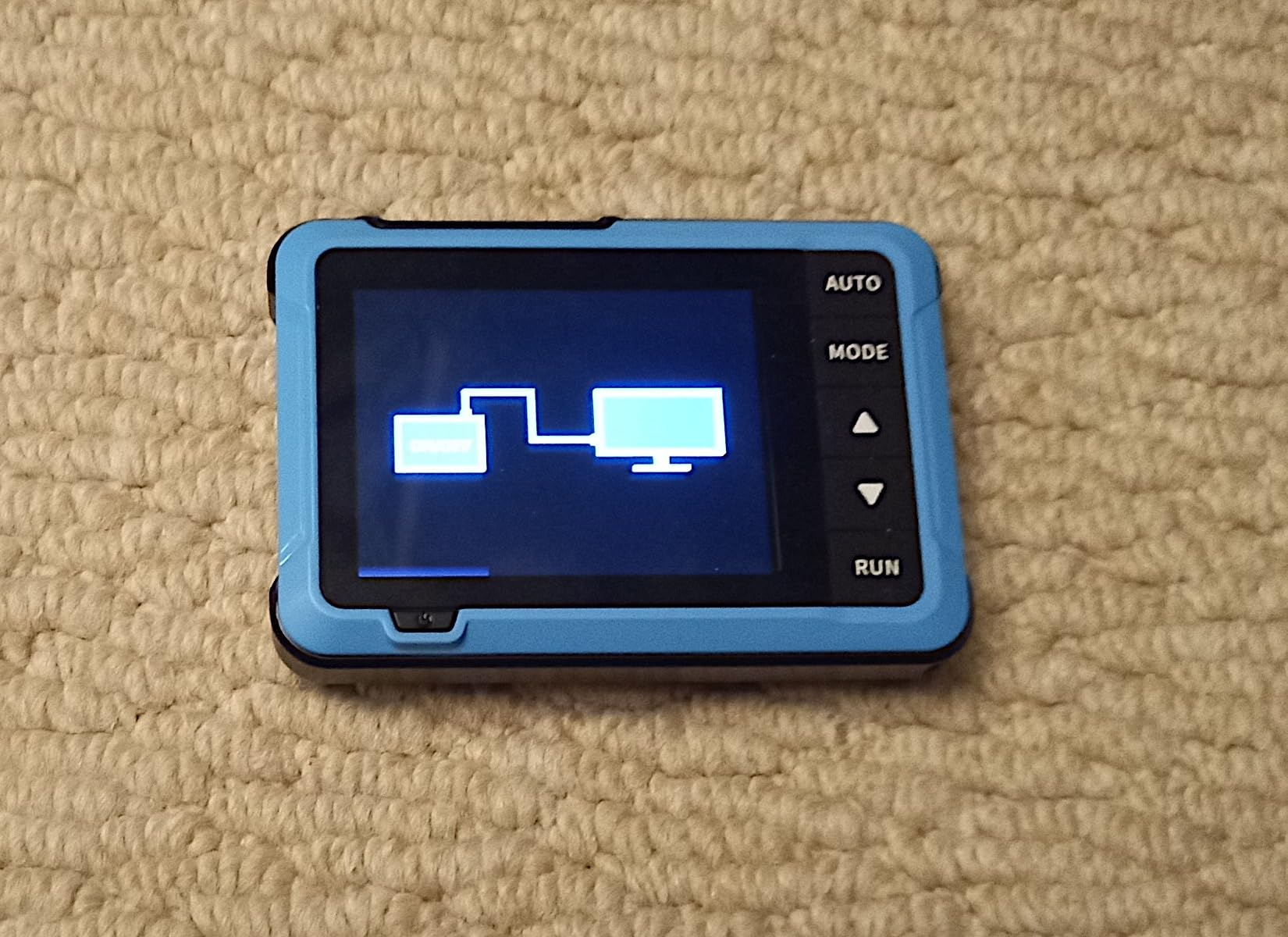
The DSO-510 pairs a 10 MHz scope with a 48 MS/s sampling rate, a 50 ns to 20 s time base, and a DDS signal generator offering 13 waveform types up to 50 kHz. It drives a single probe, which is the practical limit on how you can use it. That generator is why this unit keeps appearing in car audio forums: you can tone an amplifier and watch the clipping as you go.
Infinite afterglow and level display are the features I would miss most if I went back to a plain meter. Afterglow accumulates every trace so a brief event builds a visible band, and the level display ranks hit frequency so a repeating pattern becomes obvious. Waveform scaling, suspension, movement, image save and export are all present, and one-key AUTO handles the setup.
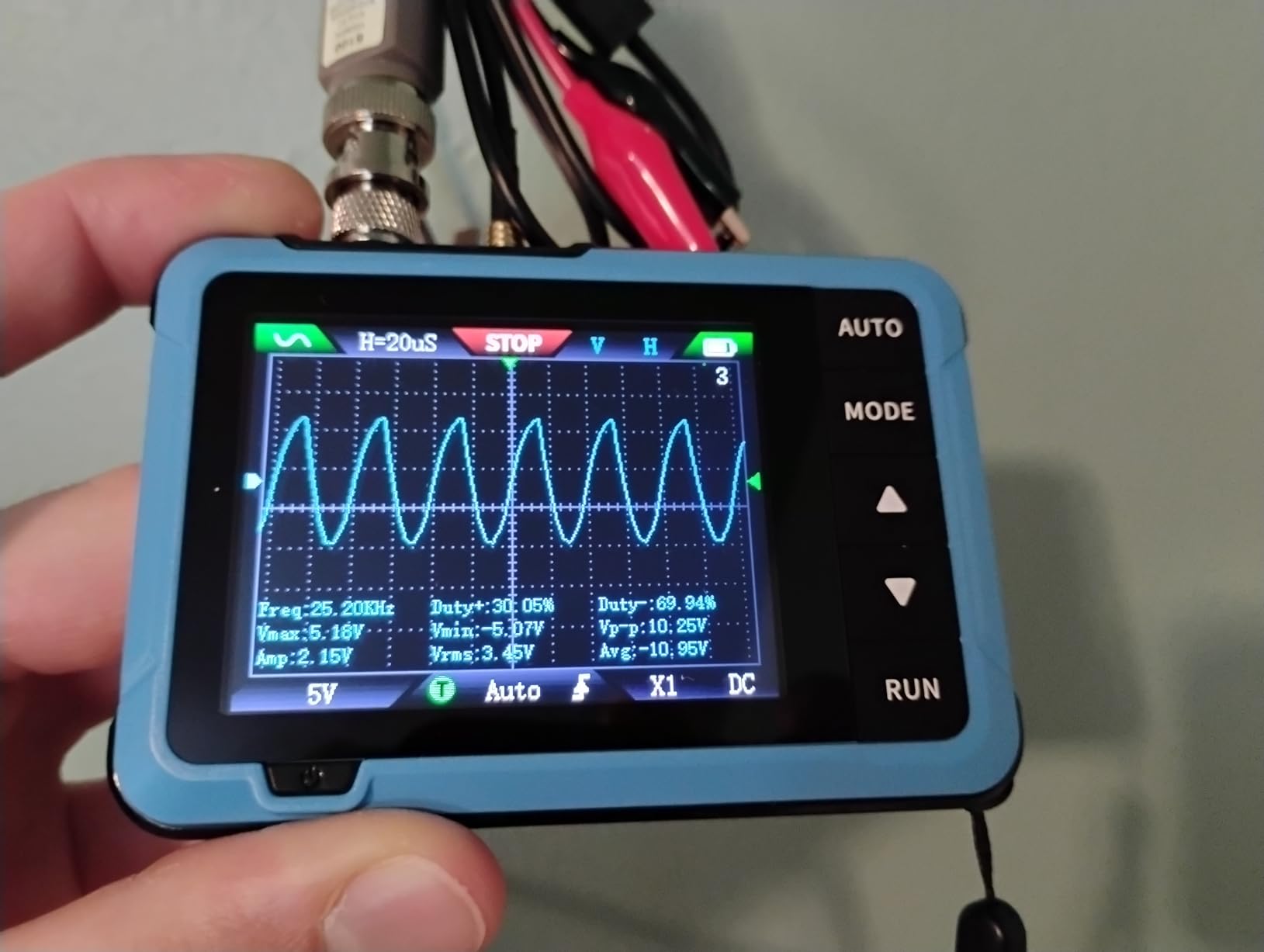
It weighs 14.1 ounces, measures 3.8 by 2.68 by 0.75 inches and runs on a 1000 mAh battery, with voltages up to 400 V measurable through the supplied probe. The 2.8 inch 320×240 LCD is brighter and more readable than the size suggests. At 4.3 across 358 reviews, owners are enthusiastic but consistently tell newcomers to read the manual first.
The generator has real accuracy caveats that reviewers call out directly: frequency accuracy degrades at mid-range setpoints, amplitude is approximate, and the output reverts toward 1 kHz when you switch back to scope mode. Treat the generator as a convenience signal source, not a calibrated instrument. Only one probe is supported, with no user-selectable voltage multiplier.
Best suited for
Car audio and amplifier work, quick fault finding in a cramped space, and learning what a healthy signal should look like before committing to a bigger instrument. It also does a respectable job on audio-frequency circuits.
Where it falls short
Microcontroller work, entirely. At 10 MHz there is no meaningful view of an ESP32 or Arduino signal, and the trigger controls plus generator switching are fiddly for a first-time user. If your projects involve silicon that clocks, this is not the one.
8. Hantek 1008C 8-Channel — the Automotive Diagnostic Scope
Hantek 1008C PC USB 8CH Automotive Diagnostic Digital Oscilloscope/DAQ/Programmable Generator
- Eight channels plus 80+ built-in automotive tests
- Software presets set volts per div and trigger for you
- Reports and screenshots export for customers
- Also works as a DAQ and generator
- USB sessions drop on some Windows versions
- Supplied leads and alligator cables are low quality
- No AC coupling and slow update on fast CAN
- Driver and software setup is frustrating
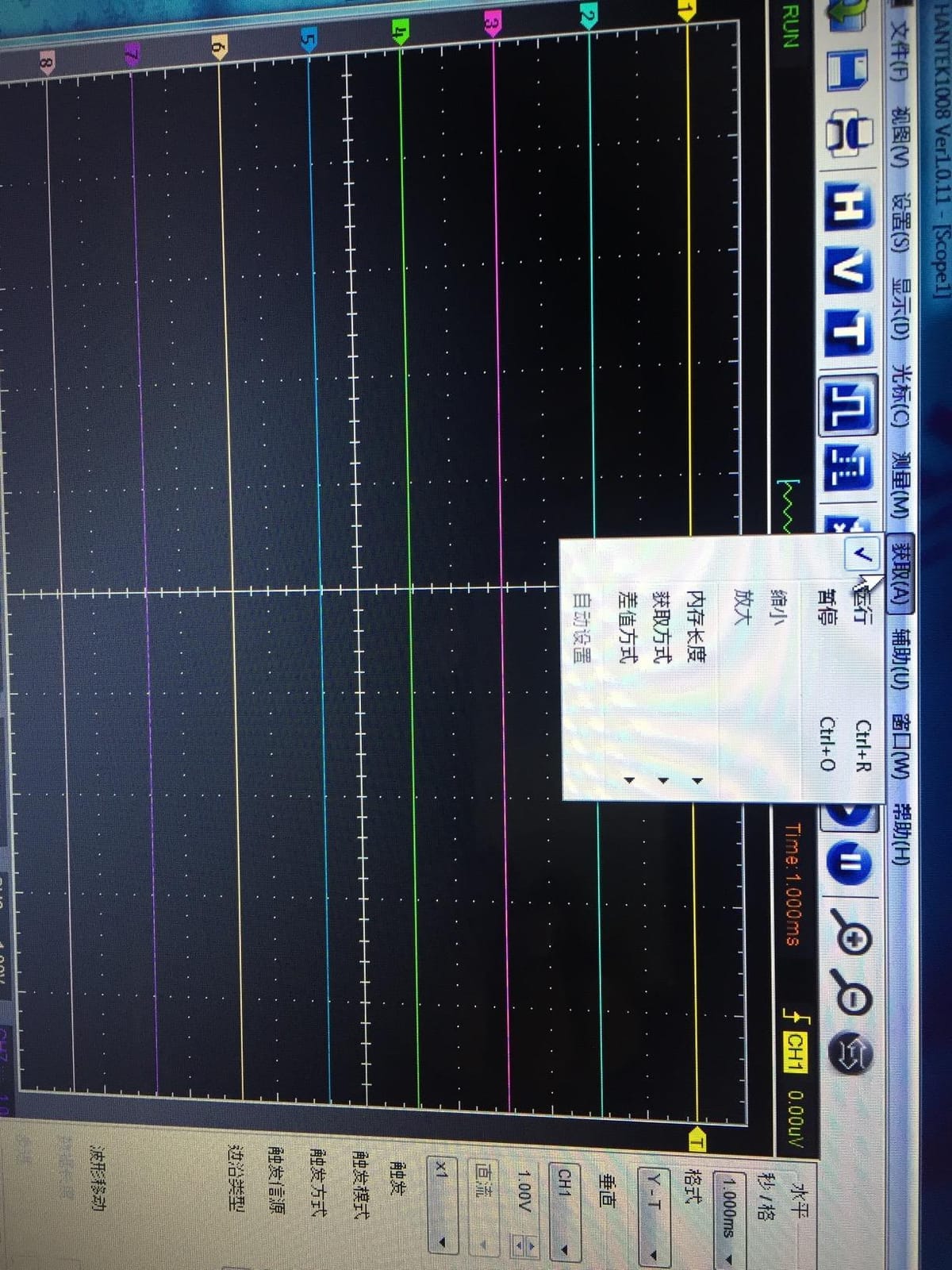
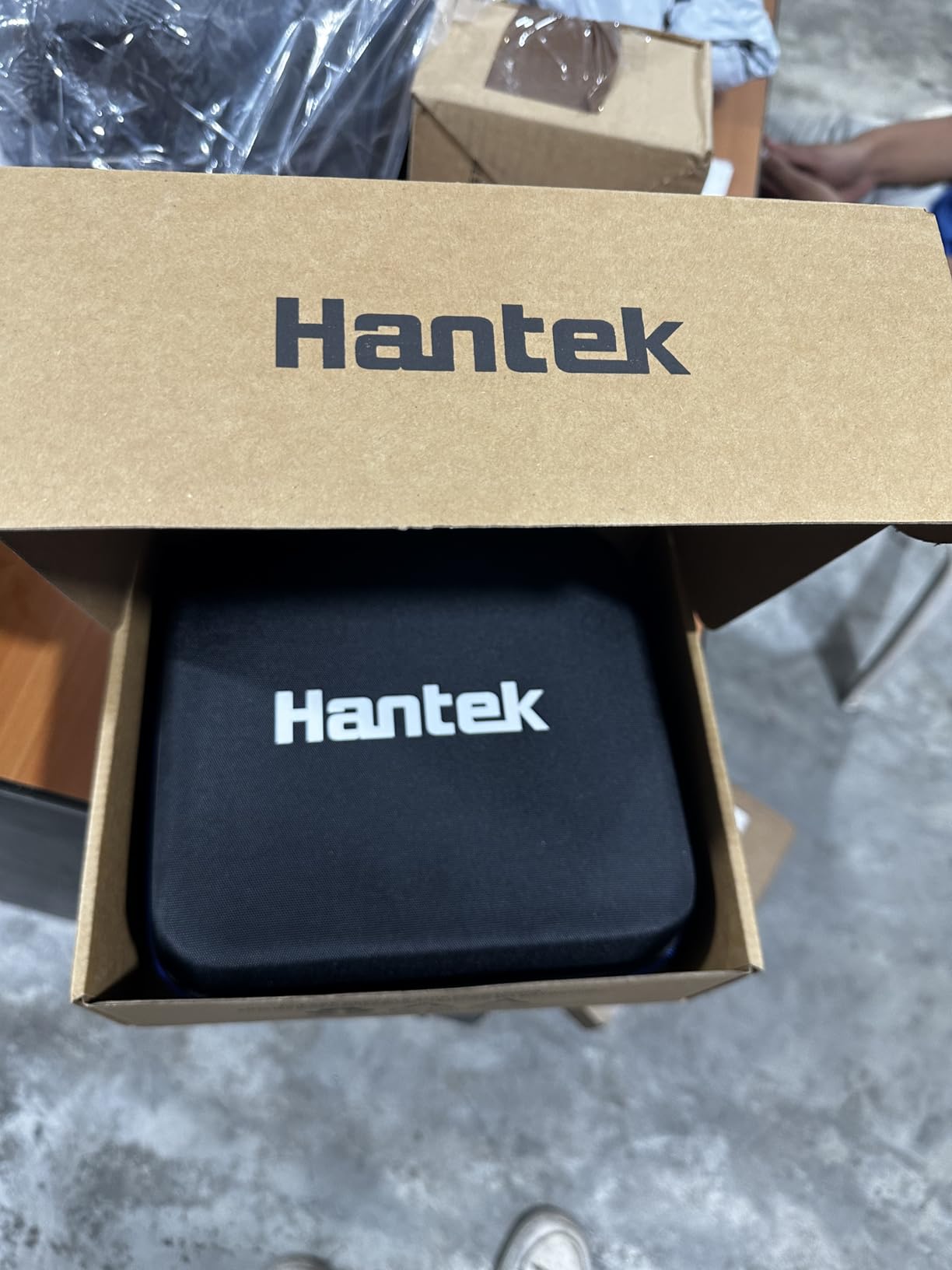
The 1008C is not really a general-purpose oscilloscope, and treating it as one is a mistake. It is a PC-based USB diagnostic instrument with eight channels and more than 80 built-in automotive test functions covering ignition, sensors, bus detection and starter and charging circuits, aimed squarely at home mechanics.
What it does well is remove the guesswork. The software presets auto-configure volts per division, time per division and trigger for each test, so you are not building a measurement from scratch. Diagnostic reports can be printed or captured with one-key screenshots, and there is a video help function with online walkthroughs for each procedure. It also doubles as a DAQ and a programmable generator, which is a genuine bonus if you write scripts against it.
Buyers with a home budget consistently call it an excellent starter automotive scope, and at 4.4 across 314 reviews the sentiment is steady. It is 0.5 kg, corded, and includes the unit, an auto probe, four alligator-to-coax cables and four coaxial connectors, with a 90-day warranty.
The critical mass of complaints is software, not hardware. USB connection drops intermittently on some Windows versions, with Windows 11 incompatibility reported by owners, the documentation and initial driver setup frustrates people, and there is no AC coupling option while the update rate is slow on fast CAN signals. Bundled leads are cheap. This is the model on the list most exposed to software support changes.
Best suited for
Diagnosing ignition, charging, sensor and CAN bus problems on a car, and anyone who wants eight input channels in a single box. The DAQ and generator functions extend its reach into light bench automation.
Where it falls short
General electronics work. It depends on a PC being present and a Windows stack that still cooperates, the interface lists an XP-era software baseline, and the slow update rate means fast bus events can be missed. Treat the software as part of the product when you buy it.
9. HANMATEK DOS1102 110 MHz — the Big-Screen Step-Up
- 110 MHz and 500 MSa/s per channel on a large screen
- Record depth of 10K points plus 16-group storage
- 30 automatic measurements with customizable menu
- SCPI and LABVIEW support for automation
- 20 mV per div minimum vertical scale limits sensitivity
- Long feature list carries a learning curve
- Only two channels for multi-bus work
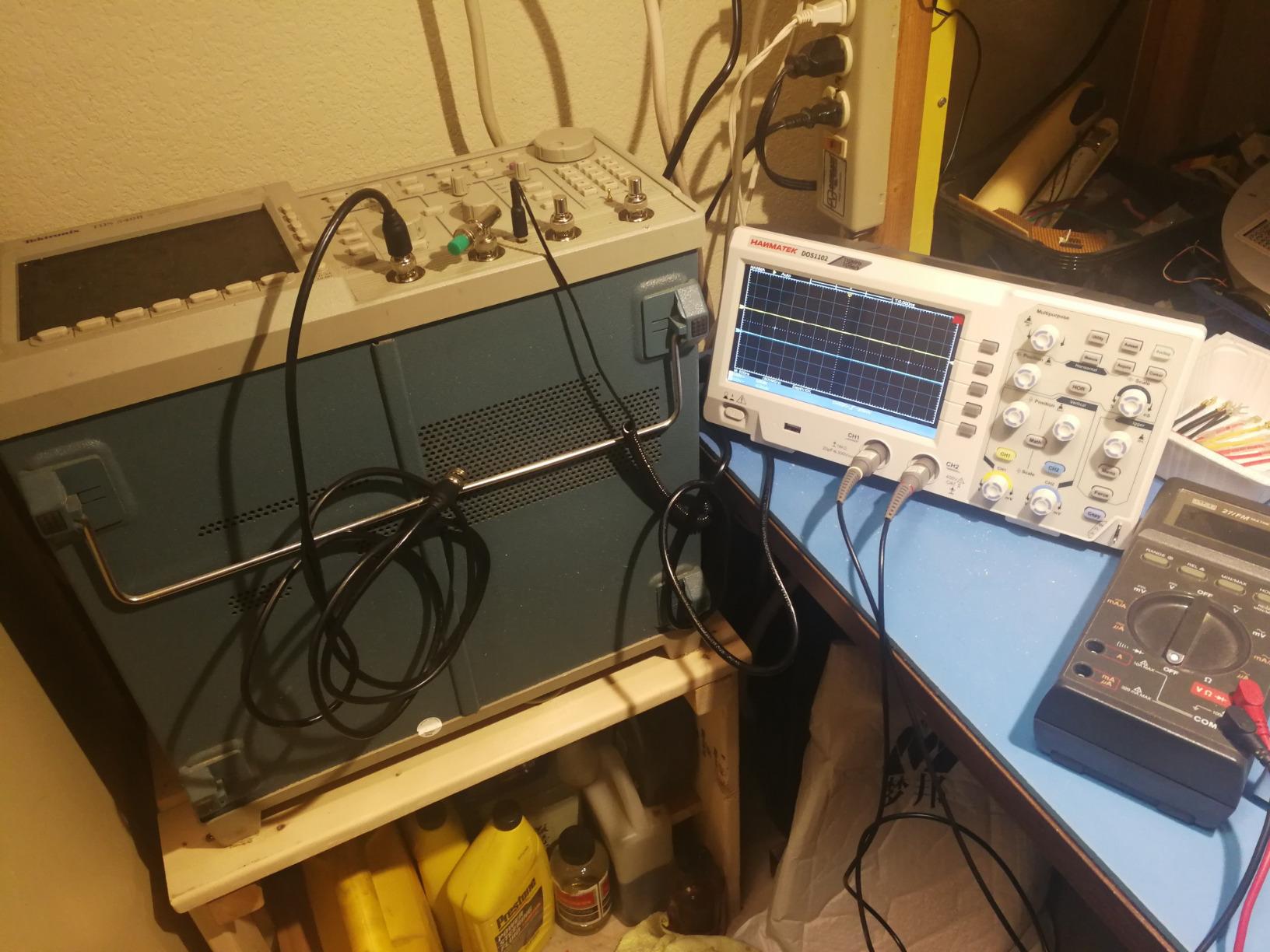
The DOS1102 is the odd one out on this list, and that is its appeal. It is a portable bench scope with a 7 inch true-color TFT at 800×480 and 65535 colors, 110 MHz bandwidth and 500 MSa/s per channel, weighing 2.4 pounds and drawing 18 watts. Most bench scopes this size are chained to a desk; this one is not.
Thirty automatic measurement functions with a customizable menu is a lot of front panel, and I appreciate that the measurements you actually use can be moved to the front rather than buried. Cursor measurement supports voltage difference, time difference and combined modes, and the built-in 6-digit hardware frequency meter covers 2 Hz to 20 MHz, with current measurement alongside it.
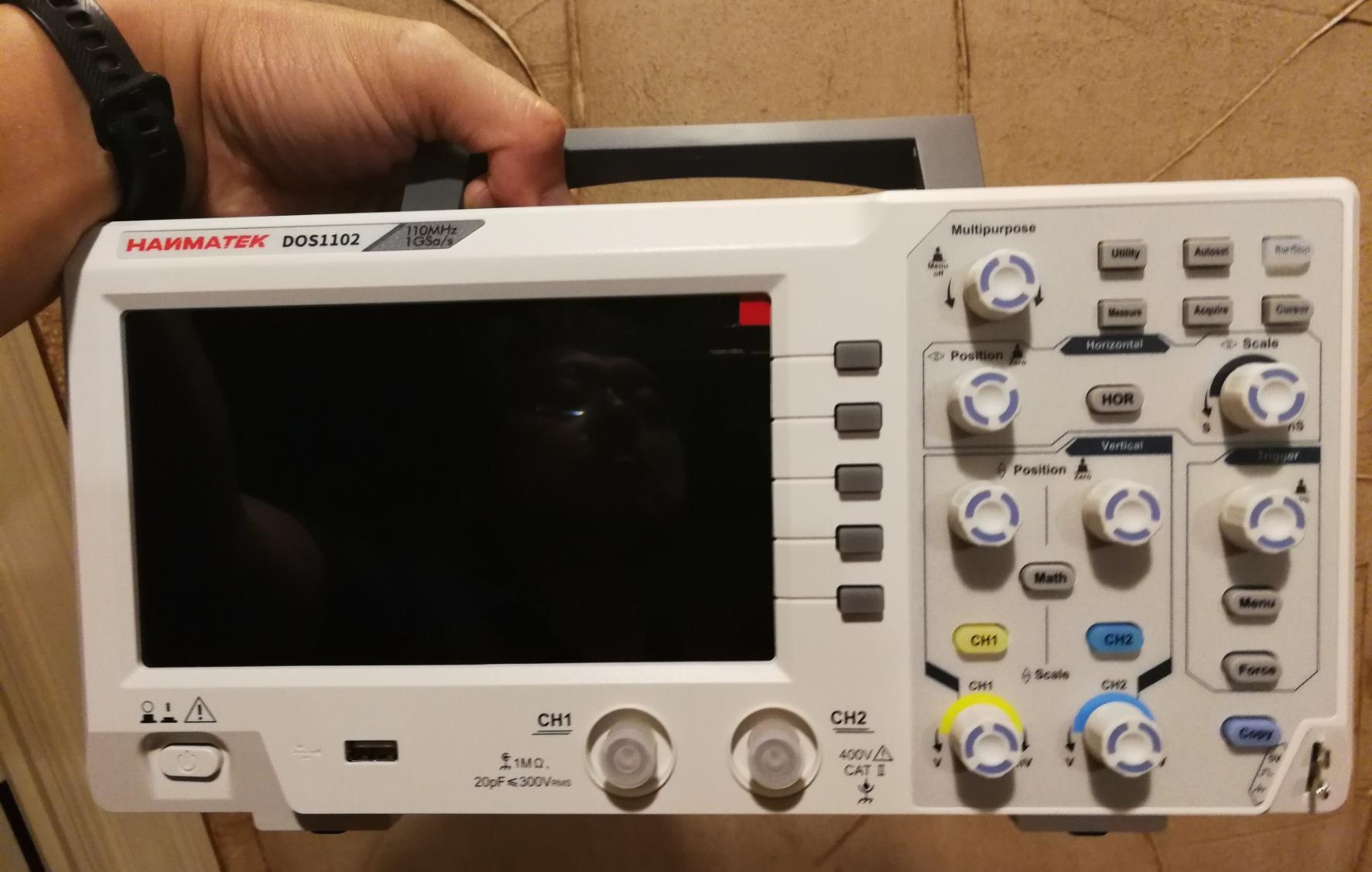
Record depth is at least 10K points per acquisition with at least 16 waveform groups stored, and there is U disk storage plus USB device and host ports. SCPI compliance with LABVIEW communication support means it can be driven from a test script, which is unusual at this level and genuinely useful if you are automating measurements.
It weighs 2.4 pounds and measures 2.76 by 11.85 by 5.98 inches. The specifications list a 20 mV per division minimum vertical scale, which is a real constraint: on small signals you will be riding at a few divisions and working to read them. Two channels also means multi-bus comparison needs another instrument.
Best suited for
A bench where space is tight, a classroom with a big display, and mixed digital and analog debugging on two signals. The large screen makes reading timing relationships far easier than on a pocket unit, and the SCPI support suits scripted measurements.
Where it falls short
Small-signal work, because of that 20 mV per division floor, and any project needing three or four simultaneous views. Owners also consistently note the long feature list needs real time before it stops feeling like a chore.
10. Rigol DS1202Z-E 200 MHz 2-Channel — the Deep-Memory Value Pick
RIGOL DS1202Z-E Digital Oscilloscope, 200MHz, 2 Channel, 1GSa/s Sampling
- 200 MHz with 24 Mpts and 60000-frame playback
- Intensity graded display makes jitter visible
- RS232 UART I2C and SPI decode included
- External trigger input and good bundled probes
- 3-year warranty on the main unit
- Multifunction knob overshoots when pressed
- USB 2 only so large transfers are slow
- Soft-key legends occupy both sides of the display
- Firmware and manual are a learning curve
The DS1202Z-E is the model I would buy if the SDS1202X-E were not already on my bench, and the reason is memory. Up to 1 GSa/s real-time sampling with 24 Mpts of memory, 12 Mpts in dual-channel mode, gives you a much longer window on a transient than most scopes in its class.
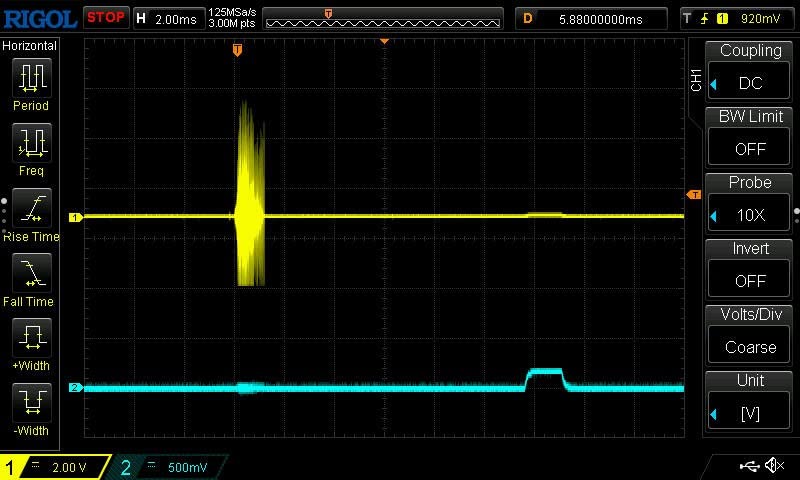
Waveform capture runs up to 30,000 per second on an intensity graded colour display, and hardware record and playback stores up to 60,000 frames. For catching an intermittent that appears once in a few hundred acquisitions, that combination is the whole game. Serial bus trigger and decode for RS232/UART, I2C and SPI come standard, and there is an external trigger input, which the cheaper four-channel Rigol lacks.
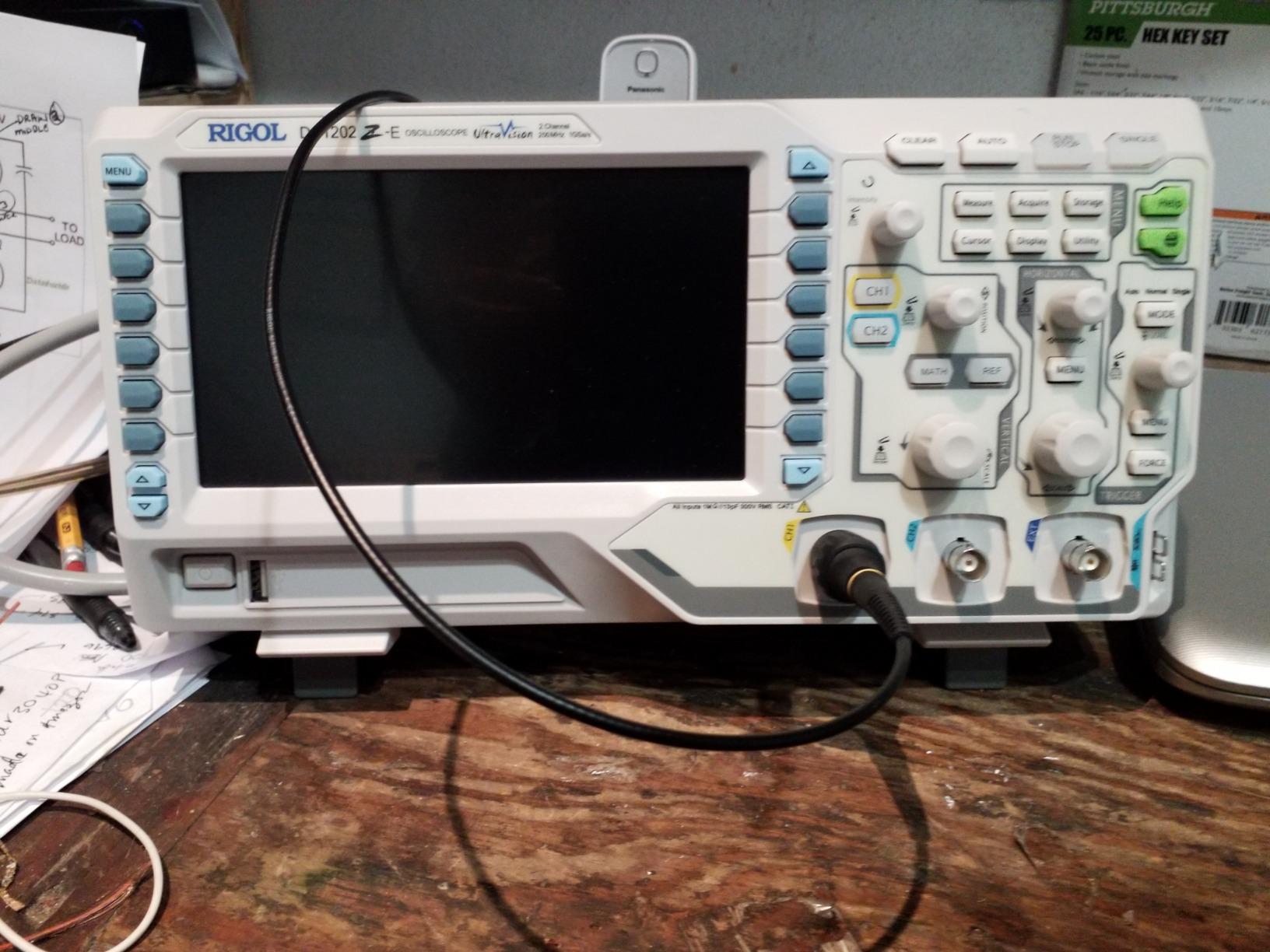
Build and probes stand out. Owners describe a solid chassis, well-placed knobs and genuinely good bundled probes — which, per the probe bandwidth rule, matters as much as the front end. The 7 inch WVGA 800×480 TFT is bright, the USB host, USB device, LAN (LXI) and AUX output cover bench integration, and there is a 3-year warranty on the main unit.
Criticisms cluster on interface polish. The multifunction knob overshoots into adjacent selections when pressed, soft-key legends permanently occupy both sides of the display, only USB 2 is provided so moving 24 Mpoint records takes a while, and the firmware plus downloadable manual are a genuine learning curve for a first-time buyer. There is also no Bode plot in the harmonic analysis suite.
Best suited for
Intermittent fault hunting, switching regulator analysis, and anyone who needs 200 MHz headroom plus a long capture window. The external trigger input makes it a better fit for a repeatable test setup than the DS1054Z.
Where it falls short
Multi-channel work — two analog channels is the limit — and any workflow that depends on quick USB transfer of large records. If you will be moving captures to a laptop constantly, budget for the time USB 2 will cost you.
How to Choose an Oscilloscope for a Hobby Bench?
What bandwidth do I actually need?
Buy 3 to 5 times the highest clock frequency you expect to probe. An Arduino at 16 MHz wants roughly 50 to 100 MHz of scope bandwidth, an ESP32 at 240 MHz wants 200 MHz or more, and audio work is comfortable at 20 to 50 MHz. Bandwidth is the point where a sinusoidal input is attenuated to about 70.7% of its amplitude, and digital edges carry significant energy well above the nominal clock because rise times, not periods, set the spectrum.
What sample rate is recommended?
At least 2x the highest frequency you want to capture, but treat 2x as a floor rather than a target. As one r/AskElectronics commenter put it, sampling frequency has to be at least twice the monitored signal frequency — true, and incomplete. At 4x to 5x you have enough samples across an edge to see its actual shape, and below roughly 2x you will see aliasing that looks like a real signal but is not one.
How many channels do I need?
Two channels cover most hobby work and should be your default. Move to four the moment you are debugging a digital bus, because SPI debugging means clock, data and chip select ideally side by side, and I2C debugging usually means SCL, SDA and an interrupt or reset line. One commenter framed the whole problem as “nobody is talking about the probe and scope impedance” — the same logic applies to channel count: you cannot see a relationship you are not measuring.
Why does record length matter more than sample rate?
Because time captured equals record length divided by sample rate. A scope holding 14 Mpts at 1 GSa/s shows you 14 milliseconds of signal; the same scope at 100 MSa/s shows you 140 milliseconds. That extra window is where intermittent glitches live. Sample rate determines how cleanly you resolve a single edge; record length determines whether the fault is on screen at all. For catching rare events, memory wins.
Does ADC bit depth matter for a hobby bench?
It matters most for small signals sitting on large ones — power supply ripple on a 5V rail, a millivolt-level sensor output on a noisy reference. A 12-bit converter gives roughly four times the usable vertical detail of an 8-bit one, so ripple that is nearly invisible on an 8-bit scope becomes measurable. For digital logic work it makes almost no difference, which is why none of the picks here chase it.
Which triggers and protocol decoding earn their price?
Edge trigger is the baseline. Pulse width, runt and setup/hold triggers are what separate a scope that finds faults from one that does not, because they let you freeze on the specific anomaly rather than waiting for a clean edge that never comes. Protocol decode for I2C, SPI, UART, CAN and LIN is the other one — it turns a wall of bits into readable bytes, and it is the single feature that most changes debugging speed.
Which specs can you safely ignore?
A lot of them. Rise time as a separately quoted number, headline sample rates far above bandwidth, exotic modulation analysis types, waveform update rates above roughly 20,000 per second, and LXI compliance are all near-irrelevant for a hobby bench. Also ignore trigger types you will never program and any listing where bandwidth is quoted without a matching sample rate, because the two are quoted independently and only one is being marketed.
Scope, logic analyzer or multimeter — which do I need?
All three, but for different questions. A multimeter answers “what is the DC voltage,” which is enough for steady voltage sag: as one r/AskElectronics commenter noted, voltage sag can generally be measured by a multimeter, unless 10-nanosecond transients are the cause, in which case you need something that can quantify pulses that short. A logic analyzer answers “what are the bits” across dozens of lines at once, which no affordable scope channel count can match. A scope answers “what does the edge look like.” If you cannot name which of those three questions you are asking, you probably do not need a new instrument yet.
Why does probe bandwidth cap everything?
Because the probe is the last component the signal passes through. A standard passive probe presents roughly 1 MΩ and 10 to 20 pF to your circuit, and that capacitance turns a fast edge into a rounded one before it ever reaches the front end. A 100 MHz scope measured with a 50 MHz probe is a 50 MHz measurement, and the difference is invisible on a datasheet but obvious on screen.
Is it safe to probe mains with a hobby oscilloscope?
Not without understanding what you are doing, and usually not at all. Every BNC input on these instruments is referenced to mains earth through the chassis, and the ground clip is the most dangerous part of the tool. Clipping it to a live node shorts that node to earth, which can destroy the scope, start a fire, or kill you. A commenter on r/AskElectronics summarised the standard advice as choosing a well-made instrument and not buying the crappiest scope you can find; the same applies to probing safety, so use an isolation transformer and a properly rated differential probe if mains work is genuinely unavoidable.
Is a used analog scope worth buying?
Frequently, yes, and almost no roundup covers it. A used Tektronix 465 or similar vintage analog scope, for a modest outlay, will teach you more about real signal behaviour than any modern unit, and forum regulars describe classics like the Tektronix 2000 and 7000 series as a joy to work with. The trade-offs are honest ones: no decoding, no record and playback, no export, a smaller screen, and calibration that depends on the unit’s age. Buy analog for understanding signals; buy digital for the work.
Frequently Asked Questions
What is a good oscilloscope for a hobbyist?
A good hobbyist oscilloscope is a standalone bench unit with 50 to 200 MHz of bandwidth, two or four analog channels, at least 10 Mpts of record length, and I2C and SPI decode included without a license. Buy 3 to 5 times the clock speed of anything you plan to probe. A 100 MHz four-channel scope handles Arduino and ESP32 work, power supply ripple and bus debugging for years.
What is a good, cheap oscilloscope for hobbyists?
For the cheapest useful entry, a fully assembled handheld with 10 MHz of bandwidth and a signal generator covers car audio, audio circuits and power supply ripple, and a 200 kHz unit is enough for ripple and slow voltage sag only. Below that you are not measuring much. The most common beginner mistake is buying the smallest device and regretting it within a year rather than buying too much.
What is the recommended bandwidth for an oscilloscope?
Buy three to five times the highest clock frequency you expect to probe, because digital edges carry frequency content far above the nominal clock rate. A 16 MHz Arduino points to a 50 to 100 MHz scope, a 240 MHz ESP32 points to 200 MHz or more, and audio work is comfortable between 20 and 50 MHz. Below 50 MHz, most microcontroller debugging will show you bandwidth roll-off rather than the true signal.
What is the recommended sample rate for an oscilloscope?
At least twice the highest frequency you want to capture, but treat that as a floor rather than a target. At four to five times bandwidth you have enough samples across an edge to see its real shape, and below roughly two times you get aliasing that resembles a real signal but is not one. Remember that time captured equals record length divided by sample rate, so a high sample rate on a shallow memory buffer shows you a very short window.
Is Siglent a good oscilloscope brand, and how does it compare to Rigol?
Both are strong choices for a hobby bench, and the difference is channel count against bandwidth in most buying decisions. Siglent leans toward higher bandwidth on two channels, deeper memory in the SDS1202X-E, and serial decoding that is unlocked at purchase. Rigol leans toward four channels at 50 to 200 MHz with hardware record and playback, an intensity graded display and an Ethernet port. Hantek sits between them, with portable bench designs.
Do I need an oscilloscope or is a multimeter enough?
A multimeter is enough for steady DC questions: supply voltages, resistance, continuity and slow voltage sag. An oscilloscope earns its place when the fault lives in shape or timing, such as ringing on a power rail, a missing clock edge, or a transient lasting microseconds. As one forum regular noted, voltage sag can generally be measured by a multimeter unless 10-nanosecond transients are involved, in which case you need something that can quantify them.
Conclusion: Which Oscilloscope Should You Buy?
Start with your highest clock frequency and multiply by three to five. Under 16 MHz of signal, the 50 MHz handhelds here — the FNIRSI 2C53T or the HANMATEK HO52 — will serve you well at a modest outlay. Around a 16 MHz Arduino, step up to 50 MHz four-channel hardware and the Rigol DS1054Z becomes the obvious value. For ESP32 work or anything with fast edges, the 200 MHz class is where you belong, and our editor’s choice, the Siglent SDS1202X-E, pairs 14 Mpts of memory with 1 GSa/s sampling and unlocked serial decode.
If you are chasing a signal across a whole system rather than one rail, the Siglent SDS1104X-E gives you four channels and the highest rating in this roundup, 4.8 across 966 reviews. If you want to learn rather than measure, a used analog scope teaches you more per outlay than anything new. And if you cannot yet say what shape of question you are asking, a multimeter and a cheap USB logic analyzer will answer more of them than a scope will.
Whatever you choose, verify the probe is up to the job before you blame the instrument. The measurement chain ends at the tip of the probe, not at the front panel, and that is where most disappointing scopes stop being the scope’s fault.