
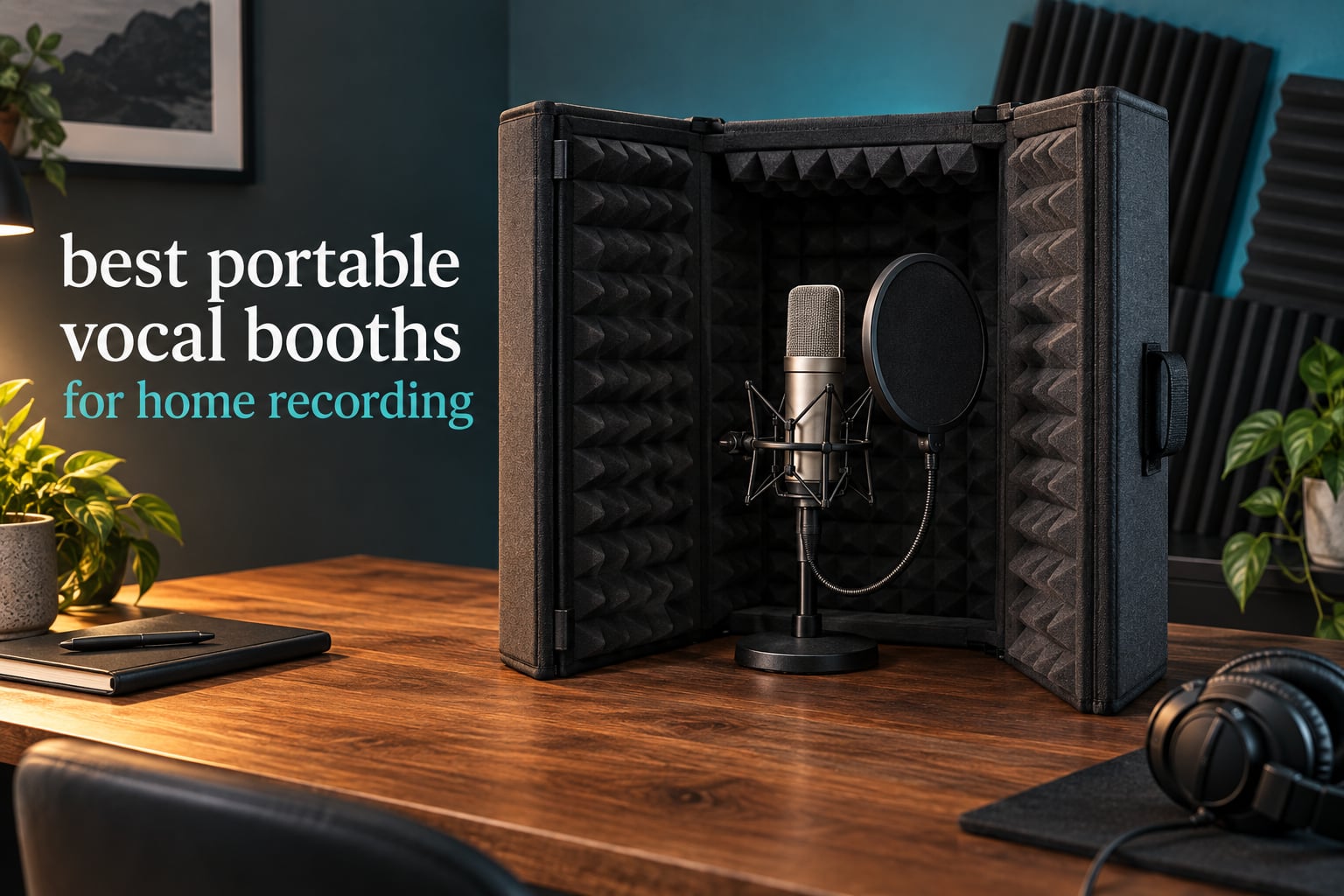
Most people buy a portable vocal booth expecting it to soundproof a room. It will not. A portable vocal booth is a soft-sided enclosure that wraps around your microphone and absorbs the reflections coming off your walls, ceiling and desk, so your voice records close and dry instead of echoing. The noise from the street, the air conditioner and the washing machine keeps arriving exactly as before.
That distinction matters more than anything else in this guide, because it decides which product you should actually buy. If your problem is a hard, bright room that adds reverb to every take, any of the ten booths below will improve your recordings. If your problem is a neighbour, traffic or an open window, none of them will, and a directional dynamic microphone plus a quiet recording window will do more for you than any enclosure on this list.
We spent weeks reading the review history on all ten products below, comparing weights, dimensions, foam thickness and mounting hardware, and looking hard at where owners say their setups still fall short. What follows is the best portable vocal booth for home recording in 2026, whether you sing, voice over, podcast from a spare room, or stream from a desk in an apartment. If you are still building the room around the microphone, start with our audio interface picks first, then come back.
Table of Contents
Top 3 Picks for Best Portable Vocal Booths (September 2026)

Aokeo Isolation Shield Kit
- Shield with pop filter and tray
- 400 g steel frame
- Adjustable to 175cm

Snap Studio Portable Vocal Booth
- Fits a standing performer up to 6 ft 8 in
- Pro Sound Blankets on every wall
- Packs into a duffel bag
AURAY ISO-Armor-2 Chamber
- Only 600 g
- Built-in sliding pop filter
- Integrated suspension mount
Portable Vocal Booths in 2026: Quick Comparison
What a Portable Vocal Booth Does and Does Not Do
A portable vocal booth reduces reflections. That is the whole job, and it is a job worth doing. In a typical bedroom or spare room, your voice bounces off hard surfaces before it reaches the microphone, and the microphone records that bounce as reverb and slapback. Wrap the mic in a foam-lined enclosure and those early reflections are absorbed before they arrive, so the mic hears mostly your voice.
It does not block outside noise. No product in this roundup stops traffic, a washing machine, an air conditioner or a barking dog. The booth sits between the mic and the room, not between the room and the world. If outside noise is your main problem, a directional dynamic microphone, a longer distance from the wall that faces the street, and recording during quiet hours are what actually help.
The honest community consensus is the same. On r/WeAreTheMusicMakers, users describe a booth as providing a worthwhile reduction in unwanted reflections in a bad acoustic environment, which is the realistic expectation. On homerecording.com, the top argument is blunt: a boom mic stand with a duvet draped over it is perfectly usable, because these enclosures are essentially large, sturdier pop filters you can stand inside. Both of those are fair points, and we use them below.
Thin foam cannot fix low frequencies either. Foam panels of an inch or two are excellent at taming midrange reflections, which is where voice clarity lives. Bass, rumble and structure-borne sound from a floor or a desk pass straight through, and only mass and air gaps slow them down. That is why the sE Electronics RF-X with its four layers and the Snap Studio booth with heavy Pro Sound Blankets sit at the top of the tonal quality range, and why a 600 g foam chamber is a starting point rather than an endpoint.
1. Aokeo Studio Recording Microphone Isolation Shield Kit – Best Overall
- One box
- no stand or pop filter to buy separately
- 4.6 stars from 1432 reviews
- Steel construction built for daily use
- Pop filter handles sibilance and plosives
- Microphone not included
- 3.5mm jack connector may limit XLR setups
- One year manufacturer warranty
The Aokeo kit is the one I recommend first, and the reason is completeness. Most competitors on this list are a single object you then have to pair with a stand. This one arrives with the isolation shield, two metal thread adapters, a pop filter, a small storage desk and an adjustable stand, so the only thing left to buy is a microphone. For a first home vocal setup that is the difference between a working rig in an afternoon and a shopping list.
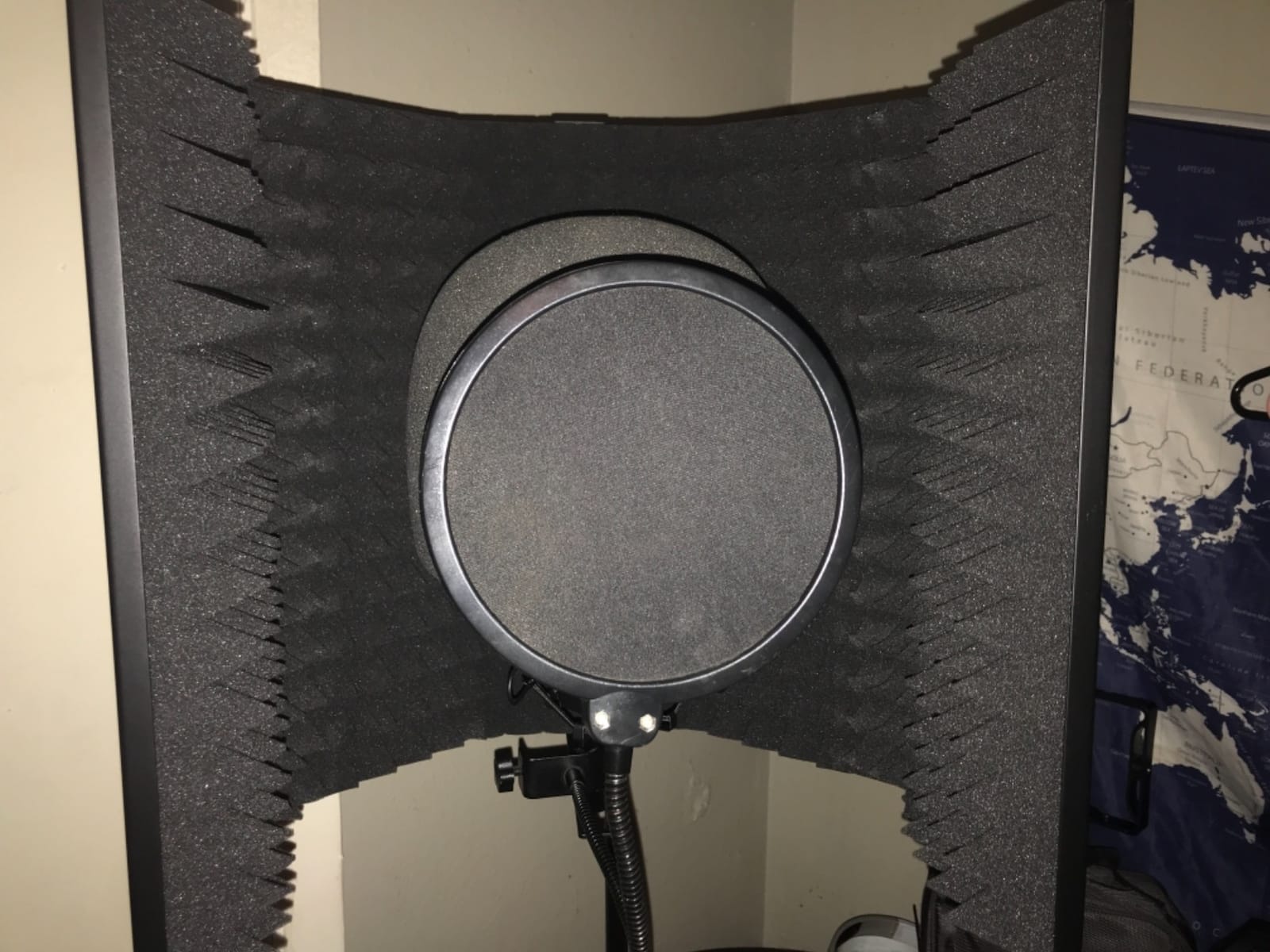
Build quality is where it separates from the cheap folding panels. The front is acoustic foam and the back is a vented metal plate, which lets air move so the capsule does not see a pressurised box. The stand is steel, clips into the back of the shield, and adjusts up to 175cm, so a seated podcast and a standing stream both work without a different stand. At 400 g it is also one of the lighter options here.
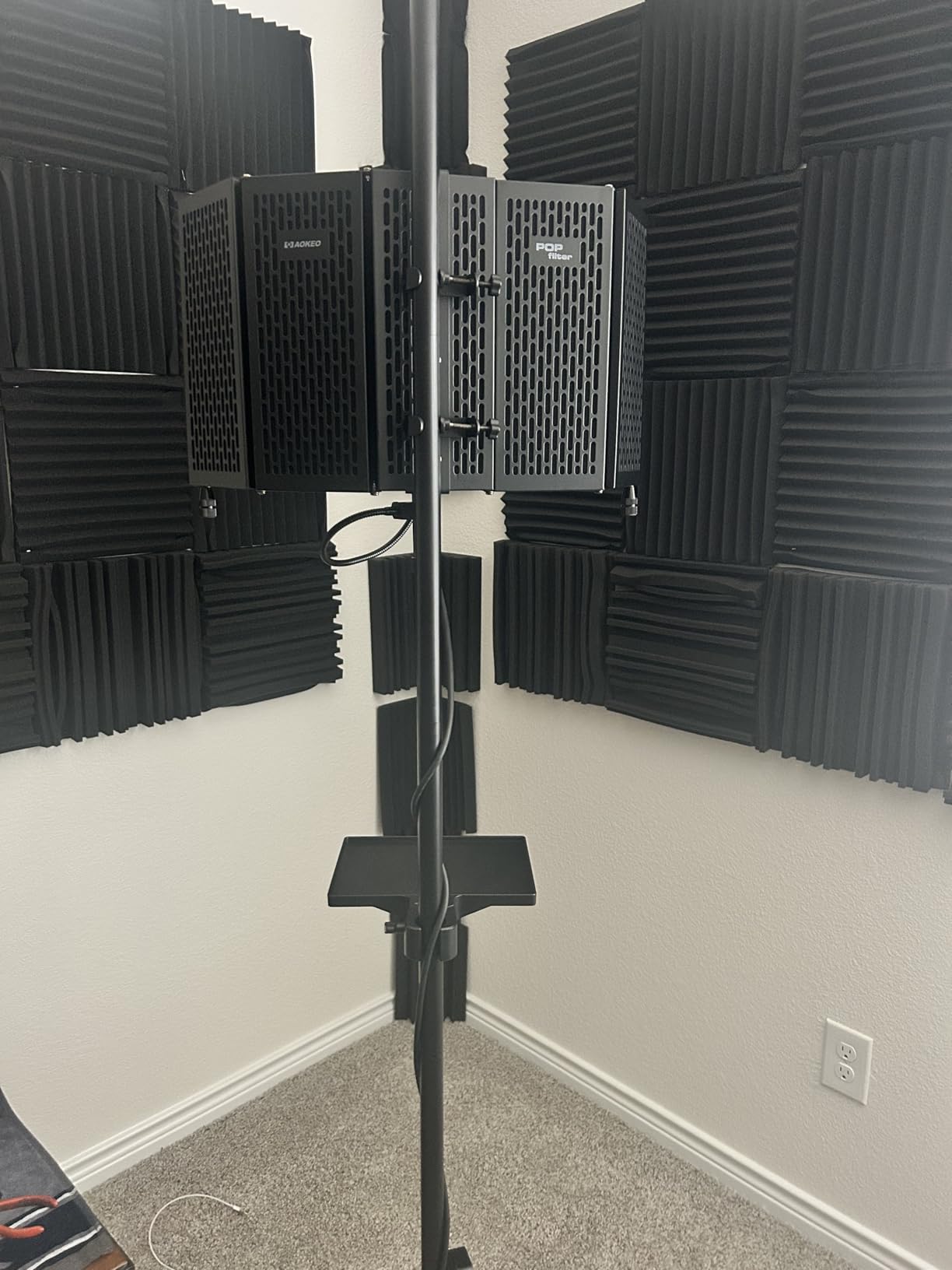
The pop filter is a genuine bonus. It mounts directly to the shield and takes the edge off S sounds and B and P plosives before they reach the foam, which is exactly the frequency range a shield cannot fix on its own. Many owners buy a separate filter for this, so the saving is real even if you never use the tray.
Reviewers are consistent about the foam doing what it claims. Users point to the high-density absorbent interior maintaining clarity while removing interference, and the storage desk being genuinely useful for holding a script during a long read. The 4.6 rating across 1432 reviews is the strongest signal in this roundup by a wide margin.
Who this booth suits
It suits a first-time home recordist who wants one purchase that solves the stand problem, the pop filter problem and the reflection problem at once. It suits streamers and podcasters working seated at a desk, and it works well for voice over and audiobooks.
It also suits anyone recording in a room that is hard but not loud, where the goal is a drier, closer vocal rather than noise reduction. You keep sight of the room around you, so it does not create the enclosed feeling some singers find claustrophobic.
Where it falls short
The microphone is not included, so this is a shield and not a complete vocal chain. The kit ships with a 3.5mm jack connector, which suits USB and condenser mics more directly than a straight XLR setup, so check what your microphone outputs before you commit.
The warranty is one year from the manufacturer, which is the shortest in this roundup. The sE Electronics RF-X carries two years, or three if you register online, and that difference matters if you plan to keep the shield for years.
2. Snap Studio Portable Vocal Booth – Best for Singing
Snap Studio Portable Vocal Booth, Original & Best for Home Studio Recording
- The only pick here a standing performer fits inside
- Pro Sound Blankets line every wall
- Sets up in minutes and folds for storage
- LED lights
- device mount and mic adapter included
- Not soundproof
- works best in an already quiet room
- Heavy at 46.2 lb
Every other product in this guide goes around the microphone. The Snap Studio booth goes around the performer, and that difference makes it the pick for anyone recording vocals rather than speech. With 5.5 square feet of interior space and a ceiling height of 82.68 inches, a singer up to 6 feet 8 inches can stand inside with the microphone in front of them. Nothing else in this roundup can do that.
The walls are heavy-duty Pro Sound Blankets rather than thin decorative foam, which is the right material for a human voice source. Owners describe effective sound absorption, easy setup and a complete kit that feels professional for a home room, and the 4.4 rating from 386 reviews reflects a product people keep once they understand what it is for.
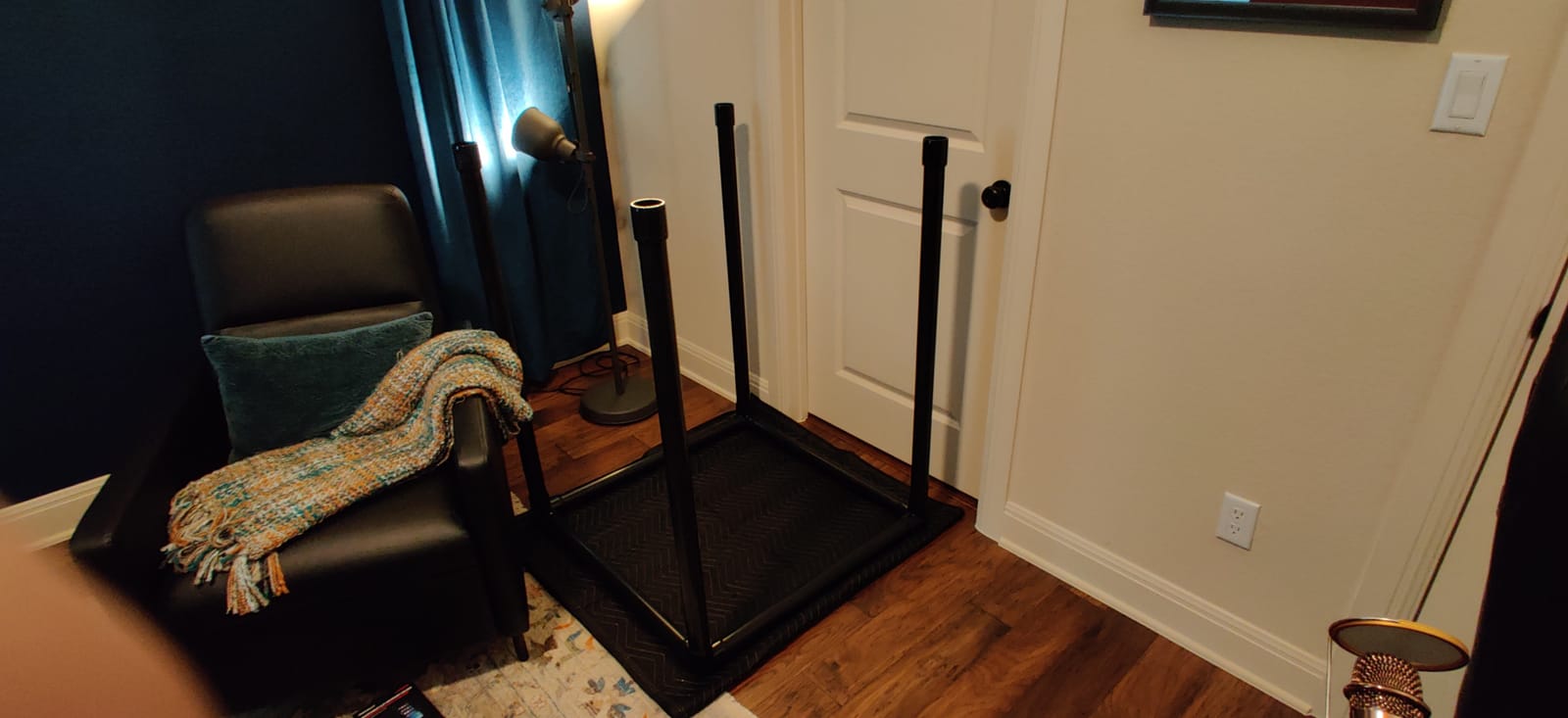
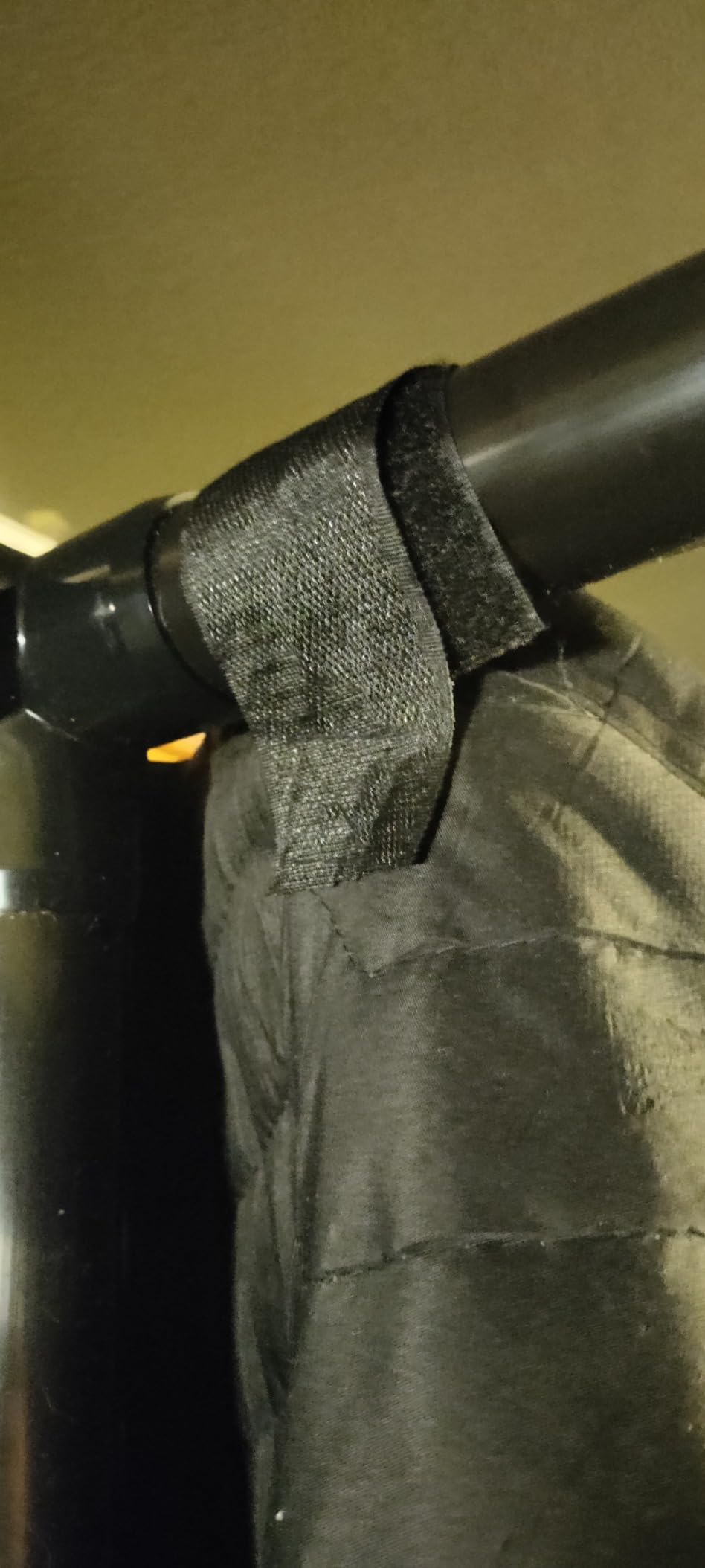
The extras are aimed squarely at singers and video creators. You get wireless multicolour LED lights, a smartphone or tablet mount for framing a performance, a microphone adapter and a duffel bag, so the whole thing moves between rooms or between a rehearsal space and a streaming corner without a second purchase.
Setup is the strongest part of the package. It goes together in minutes, which matters when the booth lives in a corner of a room that is also a bedroom or an office. Buyers who expected a soundproof room come away understanding that it is a reflection chamber, and that is the fair expectation for anything this portable.
Who this booth suits
It suits singers, songwriters and anyone who records themselves standing up, because the interior volume is built around a person rather than a mic capsule. It also suits creators filming themselves, since the device mount holds a phone or tablet inside the booth.
It suits a household where the recording happens in a shared room and needs to fold away at the end of a session. The duffel bag and the fold-flat frame make that realistic, as long as you are willing to lift 46.2 lb.
Where it falls short
It is the heaviest item here by a distance, at 46.2 lb, and it occupies a 32.76 by 32.76 inch footprint when open. In a small flat that is a permanent piece of furniture, not a portable tool, and it is awkward to move between rooms more than once.
It does not soundproof. Owners note that it performs best in an already quiet space, and singing at full effort inside a fabric booth will still leak. If your problem is traffic or neighbours, this is the wrong tool even though it is the most capable reflector here.
3. Aston Microphones Halo Portable Reflection Filter – Best for Studio Microphones
Aston Microphones Halo Portable Microphone Reflection Filter, Black
- Double-curved form wraps the mic vertically as well as sideways
- About 40 percent more surface area than the main rival filter
- More linear absorption than a flat panel
- 264 reviews at 4.6 stars
- Most expensive pick in this roundup
- Shotgun form factor may not suit every microphone
- Open front still lets some direct reflections in
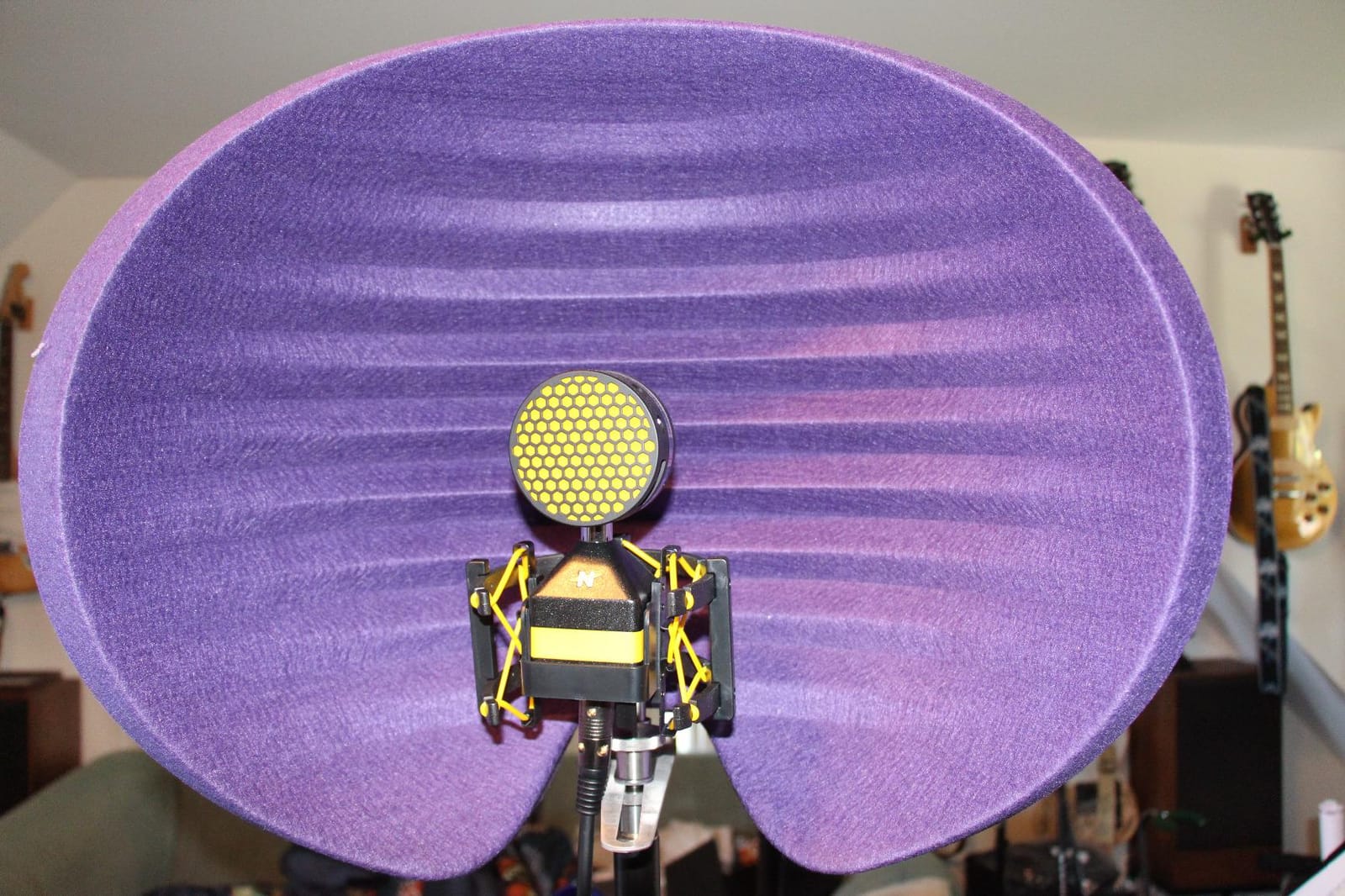
The Halo is the most substantial reflection filter in this roundup, and the reason is geometry. Instead of a flat panel that wraps the microphone on three sides, it uses a double-curved form that covers 360 degrees, including vertically. That vertical coverage is what stops a reflection coming off the desk edge or bouncing up from the floor in front of you, which is a common failure with flat filters.
Aston states the surface area is roughly 40 percent larger than the main competing filter, and users consistently single out the more linear absorption as the audible difference. A 4.6 rating from 264 reviews is a strong signal for a product at this end of the market, and the lightweight 9 lb shell makes repositioning between a close vocal position and an instrument position painless.
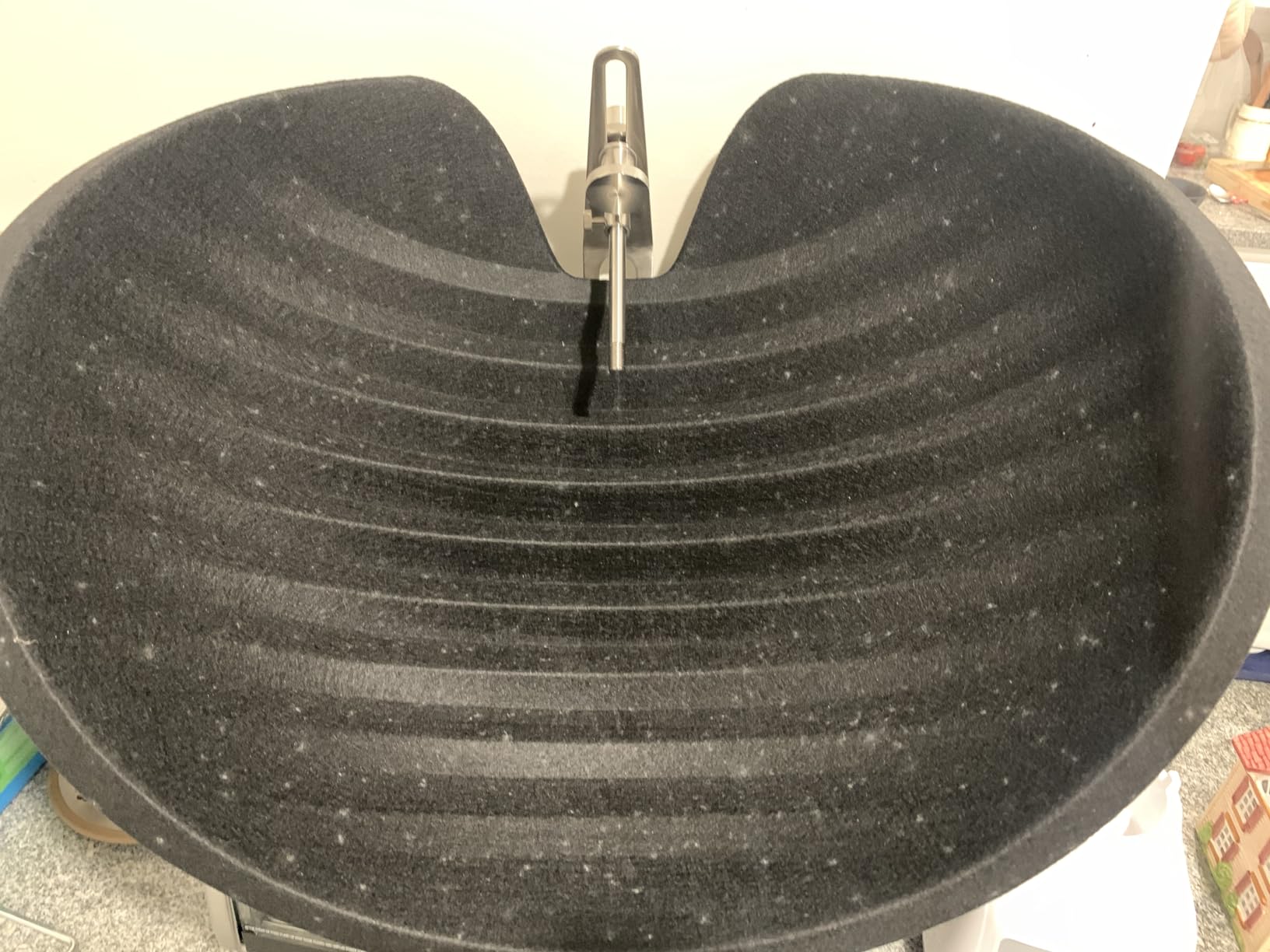
The build is PET-felt over a shaped frame, with a listed unidirectional pickup pattern and a 75 dB signal-to-noise figure, so the filter is treated as part of the recording path rather than an accessory. At 23 by 13 by 20 inches it is one of the larger desktop filters here and it needs a stand with real reach, not a small desk base.
Owners describe radically improved isolation, better coverage than flat alternatives and a construction that feels premium in the hand. It is also the priciest item in this guide, which is worth weighing against the fact that the material difference is audible rather than cosmetic.
Who this filter suits
It suits someone who already owns a decent studio microphone and a proper stand and wants the last layer of reflection control. If you are recording with a large-diaphragm condenser in a hard room, the extra coverage is where the tonal gain shows up.
It also suits anyone who moves between two recording positions, since 9 lb is light enough to swing around a boom arm without rearranging the desk. A Bluetooth speaker player or a singer with an acoustic guitar benefits from the vertical coverage too.
Where it falls short
It is the most expensive product here, and that cost buys filter area rather than noise blocking. If your budget is tight and your problem is a bright reflective room, a folding five-panel shield will get you most of the way for a fraction of the spend.
The listed shotgun form factor is aimed at directional mics, so a ribbon or an unusual studio microphone may not sit inside it comfortably. And like every filter in this roundup, the front is open, so you still need a pop filter for plosives and a quiet room for noise.
4. AURAY ISO-Armor-2 Microphone Isolation Chamber – Best Value
- 789 reviews at 4.5 stars for the lowest weight in the guide
- Only 600 g
- fits in a laptop bag
- Integrated suspension mount decouples the mic from vibration
- Two-layer nylon pop filter slides up and down
- Fits microphone bodies up to 2.3 inch across
- Mini chamber will not take large-diaphragm condensers
- Fixed chamber limits how you can angle the mic
- Aluminum shell adds cost over plain foam
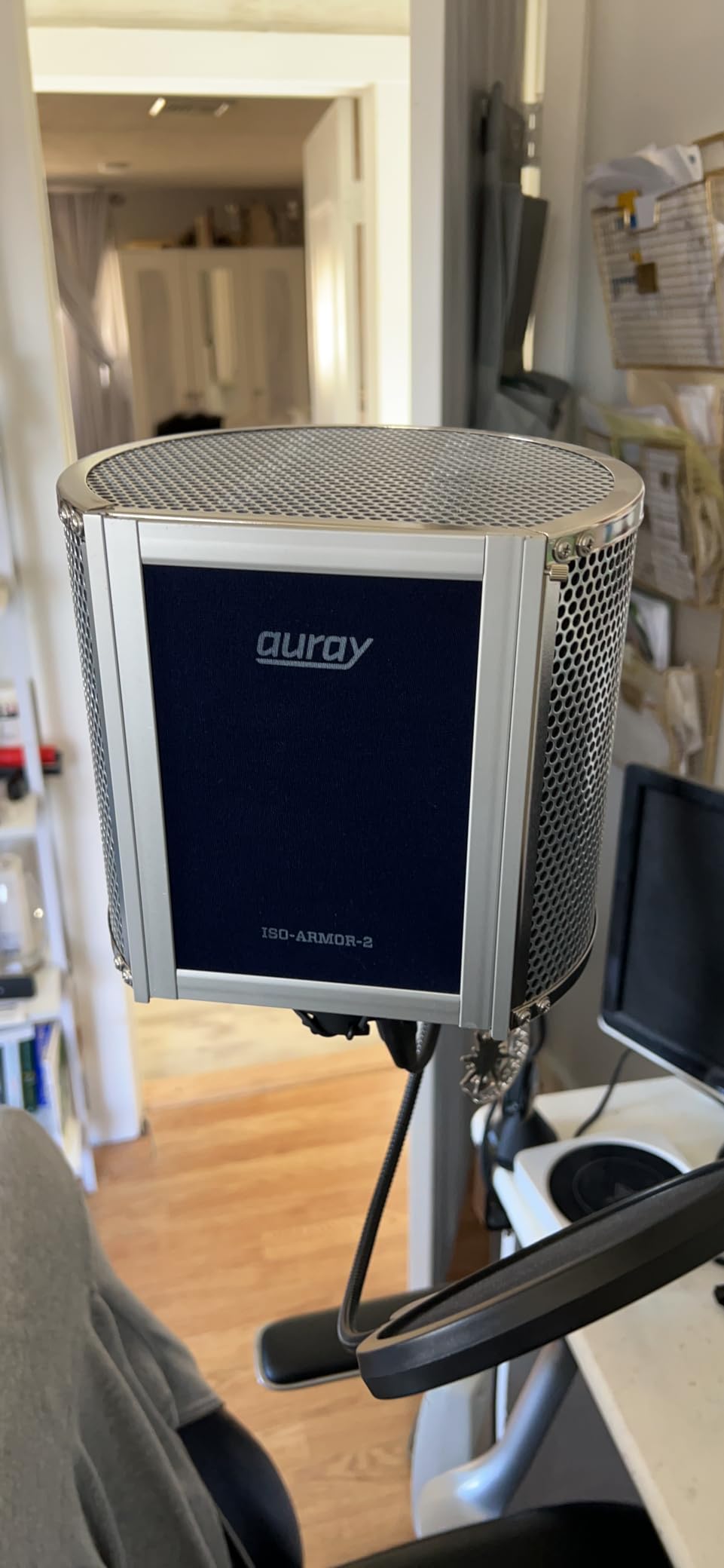
This is the chamber I recommend if you want the biggest improvement per pound spent. At 600 g and 7.24 by 7.99 by 7.01 inches, it is the smallest and lightest product in the roundup, and it still holds a 4.5 rating across 789 reviews. The perforated aluminum shell over high-density open-cell acoustic foam gives it a durability edge over cardboard and plastic builds, which is the usual weak point in this price range.
Two details make it feel more considered than the price suggests. The integrated suspension mount decouples the microphone from desk and stand vibration, which kills a low rumble that a foam box alone would pass straight through. The built-in nylon pop filter slides up and out of the way, so the same object handles plosives and reflections.
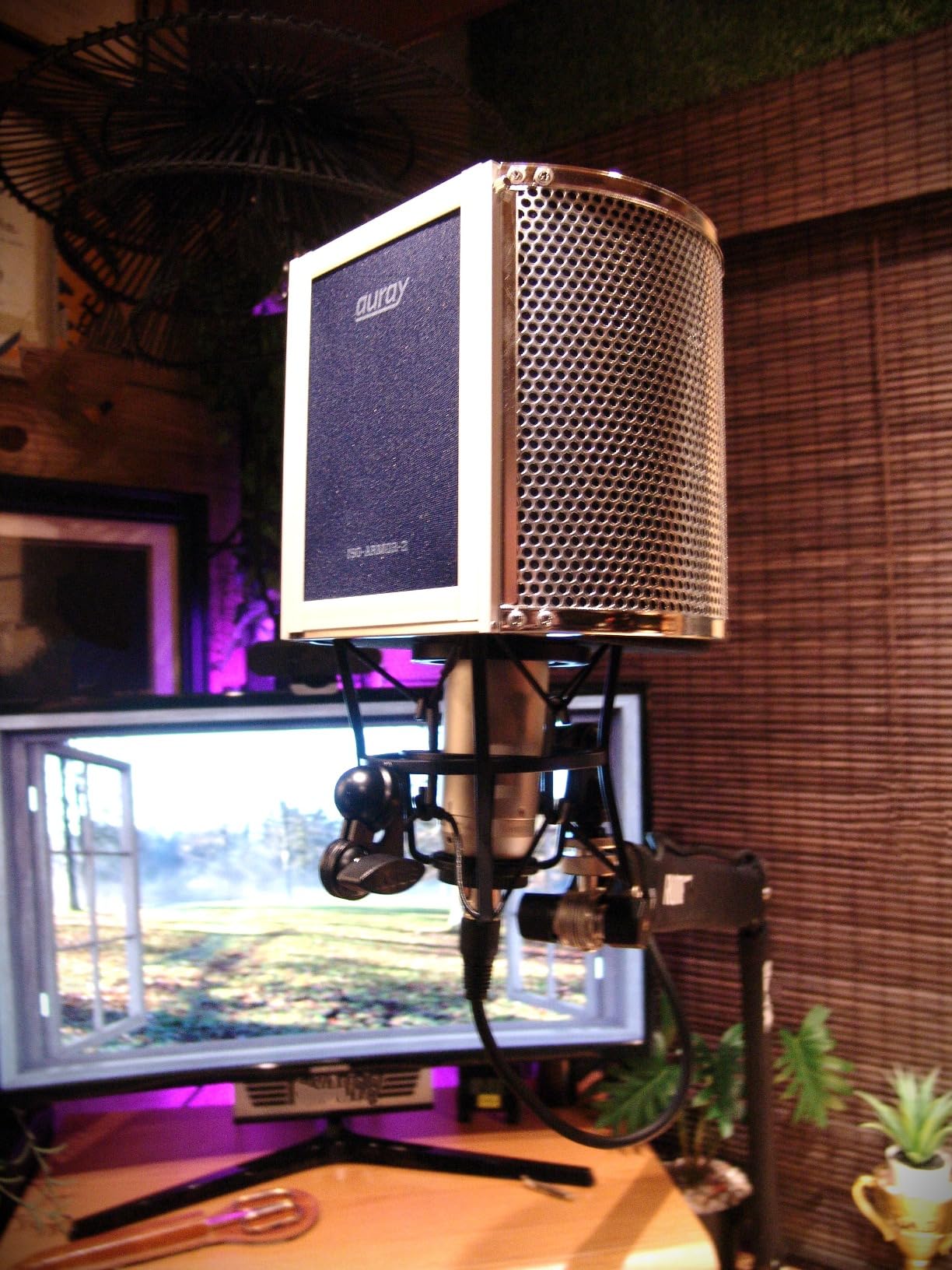
Owners point to a dry, direct sound and a compact design that travels anywhere, and the chamber suits a smartphone, laptop, tablet or camera workflow as much as a studio microphone. It is essentially a permanently mounted, always-correct pop filter and reflector that never needs repositioning between takes.
The listed signal-to-noise figure of 76 dB and a unidirectional pattern describe the chamber as a controlled micro-environment around the capsule. In practice the win is consistency, because the microphone sits at a fixed distance from the foam on every take, which is something a handheld free-standing filter cannot promise.
Who this chamber suits
It suits a home recordist with a compact dynamic or small-diaphragm condenser who wants a permanent, always-on improvement at a desk. It is also the easiest option to justify on a shared desk because it takes up almost no room and never needs setting up.
It suits anyone who records in different places. A 600 g object that fits in a bag means the same controlled vocal environment exists in a bedroom, a home office and a hotel room without any setup time between them.
Where it falls short
It is a mini chamber, so a large-diaphragm condenser will simply not fit inside. Owners note the mini form factor as the main limitation, and that is a real constraint if you own or plan to buy a full-size studio mic.
The chamber is fixed, which limits how you can angle the mic for an off-axis or stereo technique. And while the foam is effective for midrange reflections, it will not touch bass or outside noise. Treat it as the first step, not the last one.
5. TONOR Microphone Isolation Shield with Tripod Stand – Best for Creator Setups

TONOR Microphone Isolation Shield for Studio with Tripod Stand, Vocal Booth
- Height range covers seated and standing recording
- Mic pole doubles as a tablet or phone tray
- Manufacturer states 96 percent indoor reverb reduction
- Hardened plastic frame on a thick steel tripod
- 157 reviews at 4.5 stars
- Heaviest desktop shield here at 10.14 lb
- Microphone weight capped at 4.4 lb
- Newer listing with a shorter review history
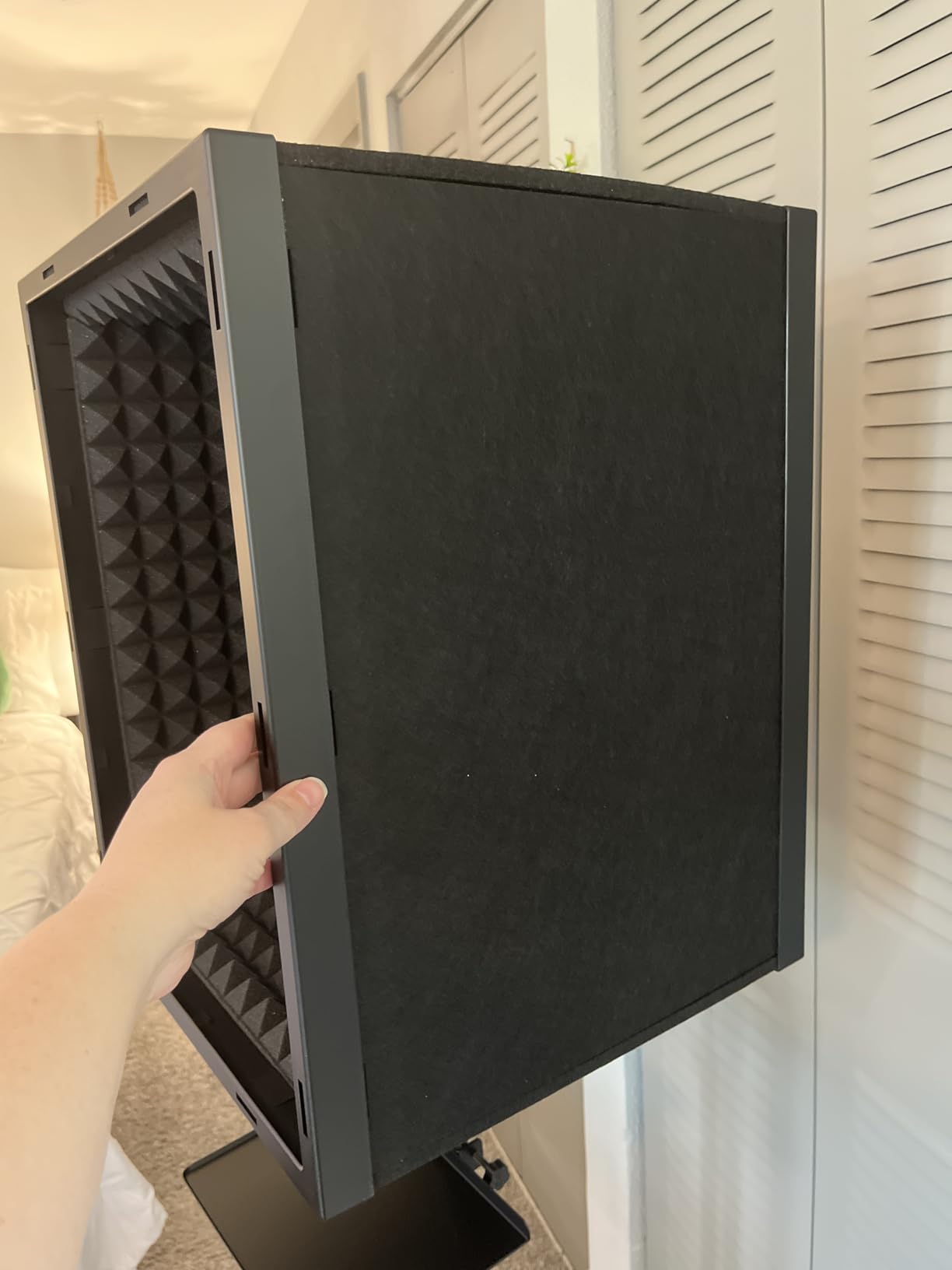
This is the only product in the roundup that treats standing and sitting as the same problem. The telescopic pole runs from 51.2 to 74.8 inches, so a seated podcast and a standing livestream both work with the same tripod, and the interior of 12 by 13.6 by 16.7 inches is roomy enough for a range of microphone sizes including a large-diaphragm condenser.
The stand is the headline feature rather than the shield itself. It is thick steel with hardened plastic frames at the panel edges, which removes the wobble and tipping complaint that usually comes with a boxed shield on a single pole, and a 3/8 to 5/8 inch adapter keeps compatibility broad. The fixing pole also doubles as a tray for a tablet or phone, which is what turns it into a creator rig rather than just an acoustic accessory.
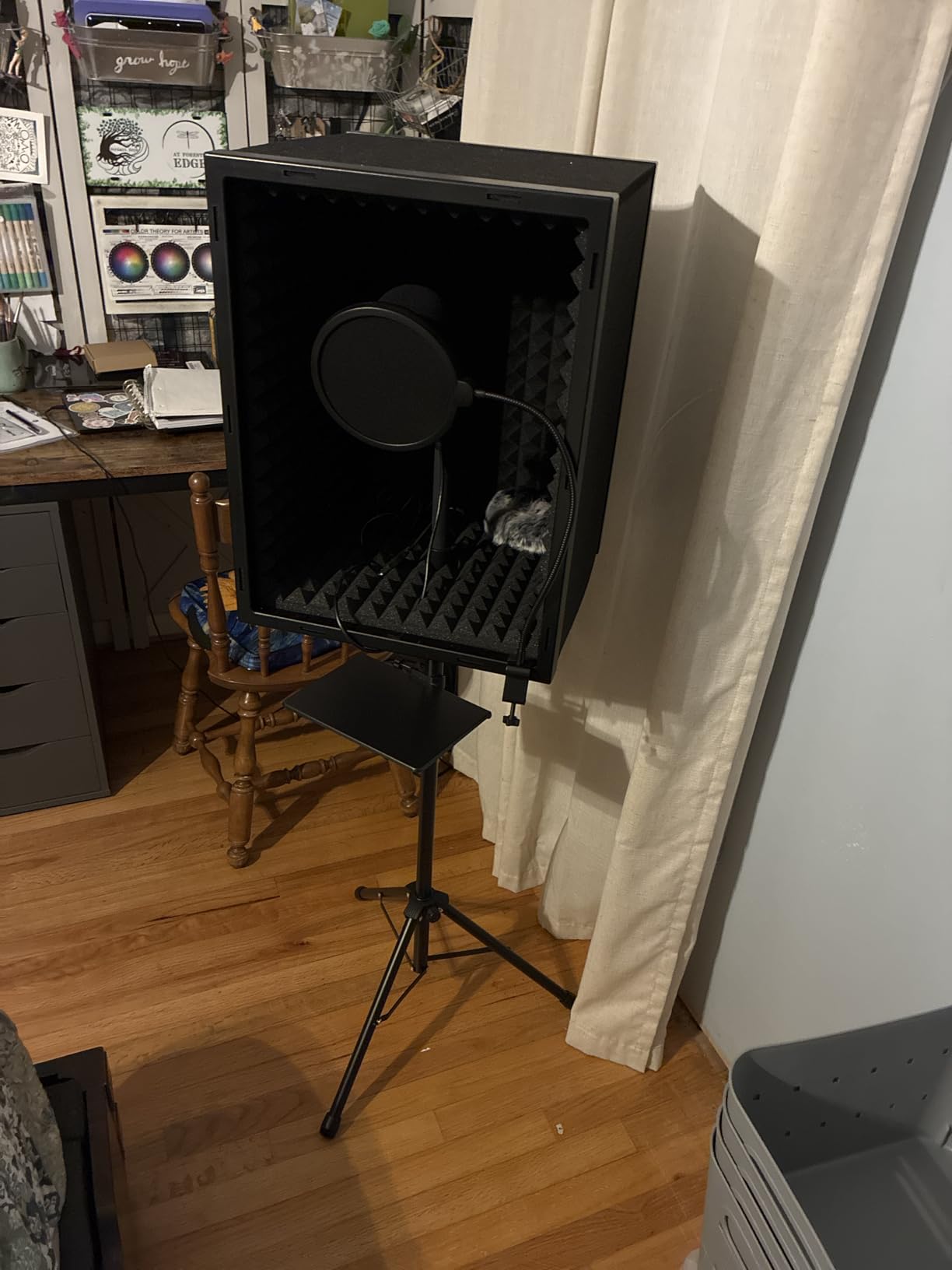
The manufacturer states that the five high-density foam panels eliminate 96 percent of indoor reverb. Treat that figure as a controlled comparison against an untreated room rather than a guarantee, but owner reviews repeat the same theme: strong reverb reduction, stable construction and an adjustable height that removes the usual desk-versus-stand compromise.
It lists at 10.14 lb, which is the heaviest desktop shield here and worth knowing before you commit to a corner of the floor. The microphone weight limit of 4.4 lb covers every common studio microphone, so it is not a practical constraint for most people.
Who this shield suits
It suits streamers, video podcasters and anyone who records at two different heights in the same space, because one tripod covers a seated and a standing position. It also suits creators who want their notes or script device mounted at the same time as the microphone.
It suits a home studio where the floor is the only stable place for a stand. The steel tripod and non-slip feet mean the shield stays put while you talk, which matters more than it sounds when you are three feet away from a camera.
Where it falls short
At 10.14 lb it is not the grab-and-go option, and the tripod footprint is wider than a flat desk shield. If your recording spot is a shared kitchen table rather than a dedicated corner, that is a real cost in convenience.
The 4.4 lb microphone limit rules out the heaviest boutique condensers, and the box design is bulkier than a flat panel if desk space is your binding constraint. With 157 reviews it also has the shortest history in this guide, so long-term durability is less well documented than elsewhere.
6. PyleUsa Mini Portable Vocal Recording Booth – Most Versatile

- Curved metal plates deflect sound before the foam absorbs it
- Microphone depth slides from 1 inch to 5 inch
- Universal 5/8 inch threading
- Reinforced steel and foam construction
- 159 reviews
- Lowest rated pick here at 4.0 stars
- Reinforced steel adds weight for a desktop box
- Mini format excludes larger microphones
The Pyle uses a two-stage approach that most foam-only shields skip. Curved metal plates sit at the front and around the sides to deflect incoming sound, and high-density foam tiles of roughly 2.0 inch thickness line the interior to absorb what reflects. Deflection and absorption together handle a wider band than absorption alone, and it is the reason this budget box performs better than its rating suggests.
The most useful feature for a beginner is the adjustable microphone depth. The mic position slides from 1 inch to 5 inch on universal 5/8 inch threading, which lets you pull the capsule back toward the opening if the sound turns boxy. That single adjustment solves the most common complaint people have with enclosed booths.
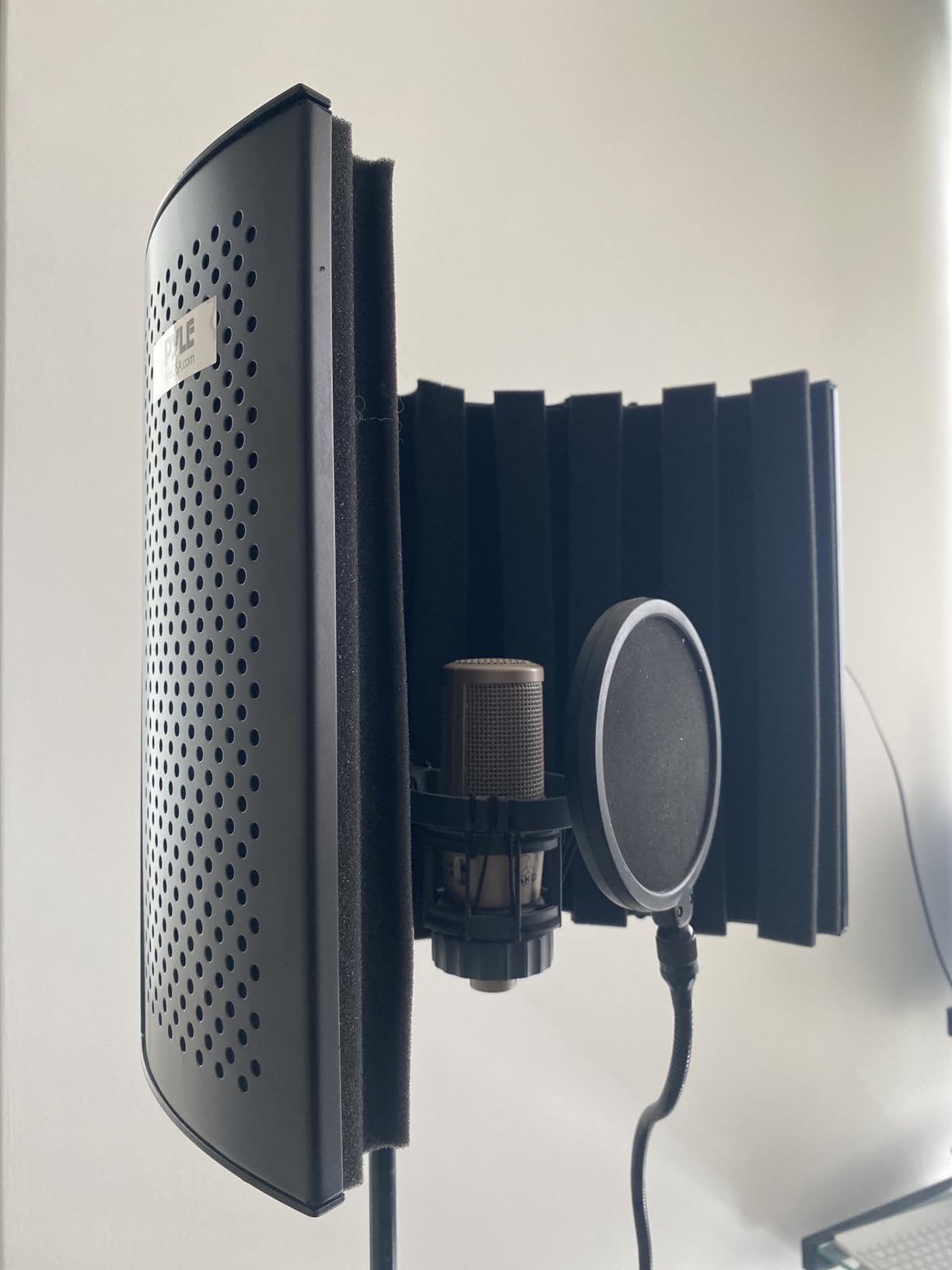
Owners report a closer, drier and more controlled recording than an open desk microphone, and the 2.0 inch foam is thicker than the material on most shields in this price band. The dual folding design also means it stands without hardware, so there is no assembly to get wrong.
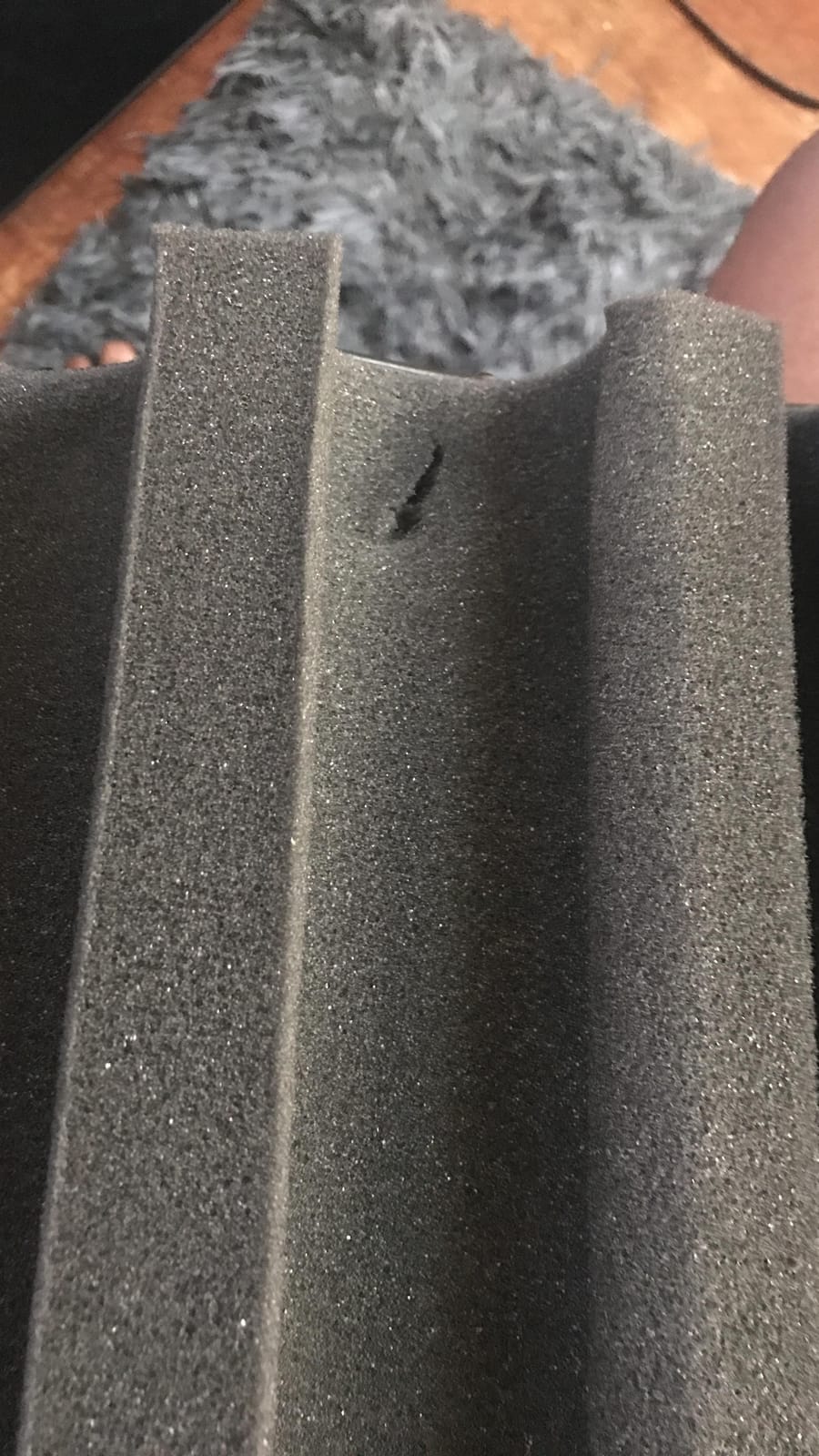
The 4.0 rating from 159 reviews is the lowest in this roundup, and the review summary points to durability concerns as the reason. At 5.1 lb the reinforced steel is heavy for something that lives on a desk, and the 11.82 by 19.69 by 12.21 inch footprint is not tiny.
Who this booth suits
It suits a first-time recorder working at a desk who wants thicker foam than the cheapest folding panels without spending serious money. The adjustable depth makes it forgiving if you are still learning where the microphone should sit.
It suits anyone who moves their recording setup between rooms on a regular basis. The dual folding frame collapses flat, and 5.1 lb is manageable for one person to carry.
Where it falls short
It has the lowest rating of anything we reviewed, at 4.0 stars, and durability is the recurring theme in the reviews. If you plan to record daily for years, a shell with more structural rigidity is the better spend.
The mini format will not accept a large-diaphragm condenser, and the steel construction undercuts the portability advantage. Buying this to pair with a big studio microphone means it will sit on your shelf rather than on your desk.
7. XTUGA MIS02 Five Panel Isolation Shield – Best for Travel
XTUGA MIS02 Recording Microphone Isolation Shield, 5 Panels Soundproof Foam
- 1112 reviews at 4.3 stars
- Folds flat and disassembles for different rooms
- Installs on a desktop or a mic stand
- Adjustable arch sets the front opening
- Plastic hinges reported breaking with repeated folding
- Nuts sit in tight crevices and slow assembly
- Rear-cable microphones do not fit the mount
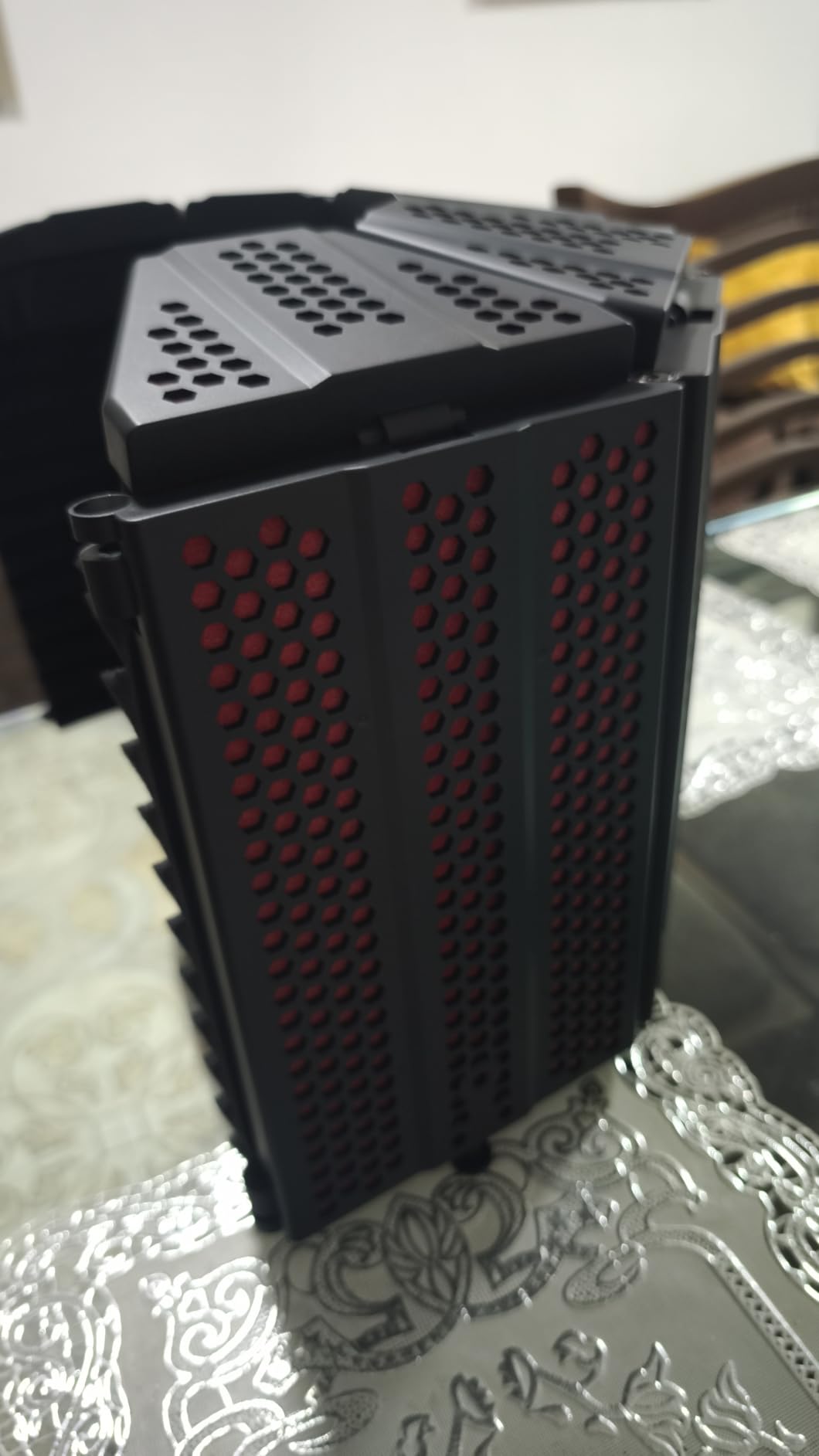
The XTUGA is the one I would pack. At 3.98 lb and 15.75 by 7.87 by 7.09 inches, it is one of the few products here that genuinely disappears into a suitcase, and the foldable end panels let you configure it as either a three-panel or five-panel shield depending on how much of a barrier you need in the room you are in.
The construction is a three-layer arrangement with triangular high-density thickened sponge and multiple reflectors, and the adjustable arch sets how open the front sits. That matters more than it sounds, because a fully open front lets the room in front of the mic stay untreated, and narrowing it focuses the absorption where your voice is.
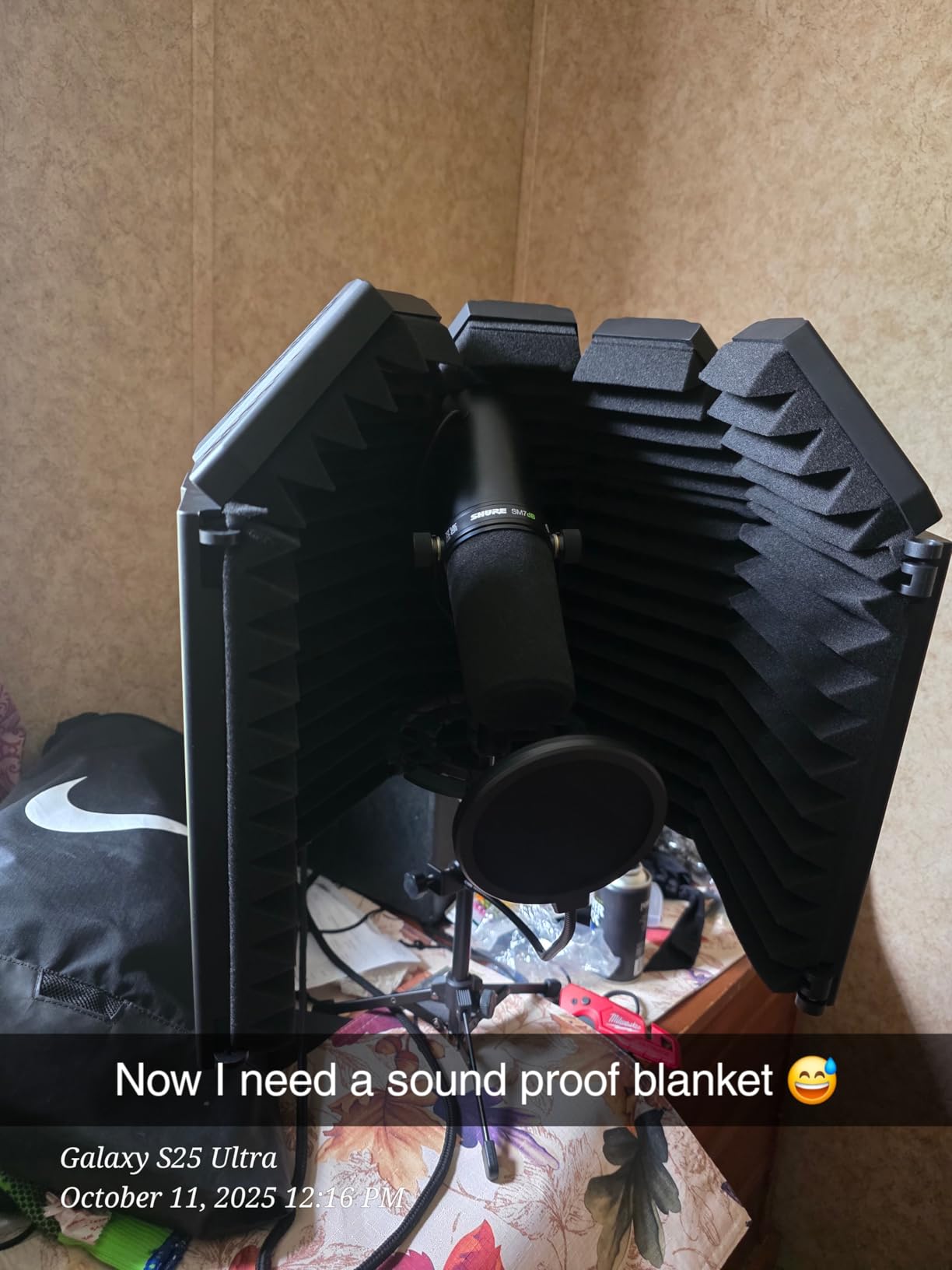
With 1112 reviews at 4.3 stars, this product has a deep enough owner history to buy with confidence. It disassembles into separate pieces for different environments and mounts on a desktop or a microphone stand, so the same object covers a home office and a borrowed studio.
The foldable top adds another layer of absorption over the open front, which is a small feature that measurably changes how enclosed the mic feels. Reviewers report effective reflection blocking across desktop and stand mounting, which is exactly the use case the product is built for.
Who this shield suits
It suits a recordist who works in more than one place, or who travels for sessions. Nothing else in this guide is easier to move, and the ability to switch between a three-panel and five-panel setup means one object can be subtle in a treated corner and substantial in a hard room.
It suits anyone who has already dealt with assembly problems on cheaper panels and wants a flat-pack setup that folds rather than screws together. The height adjustment also means one shield can sit on a desk or on a stand.
Where it falls short
The plastic hinges are the weak point and the most common complaint. Owners report them breaking with repeated folding, which matters directly for a product whose main selling point is portability, so treat it as a travel accessory you unfold carefully rather than something to fold daily.
Assembly involves nuts in small crevices and is described as time-consuming, and the mount does not suit rear-cable microphones such as the Samson Q9U. At 3.98 lb it also sits at the upper edge of comfortable for a desktop, so a real stand is advisable.
8. TroyStudio Portable Vocal Booth – Best for Small Desks

- Most reviewed booth box here at 1958 reviews
- 2 inch dense egg-crate foam on every inner face
- Folds to 6 inch tall for storage or travel
- Manufacturer states 92.7 percent reverb reduction
- Elastic bands keep the foam seated
- Cardboard and fabric shell can bow over time
- Some users report it coming apart at the joints
- Open face needs extra treatment for front reflections
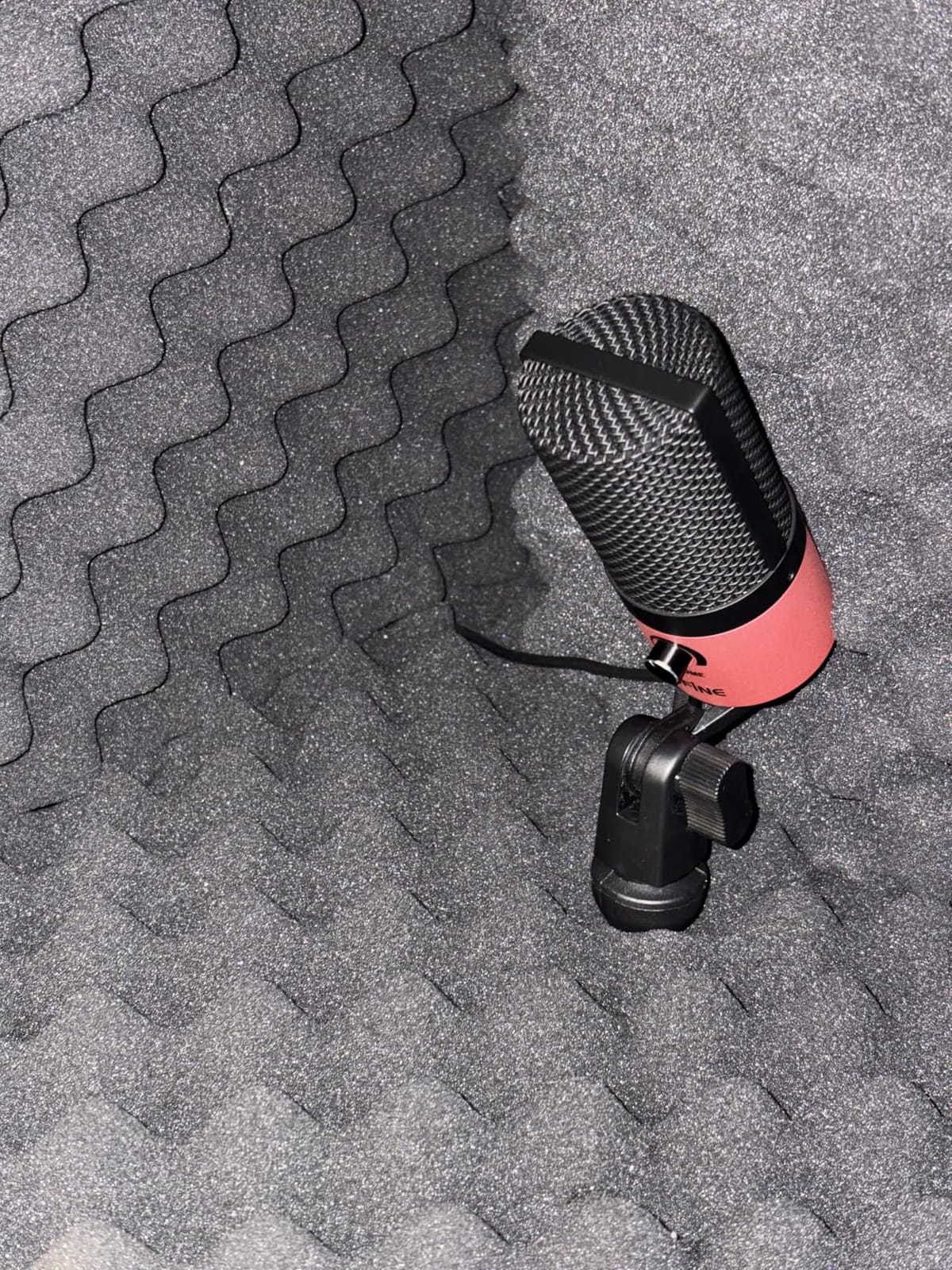
The TroyStudio is a genuine box rather than a folding screen, and that changes the acoustics. With 2 inch dense egg-crate foam on all inside surfaces and an interior of 8 by 10 by 12 inches, the microphone sits in a small defined volume instead of an open arc, which is the acoustically protected pocket that makes a booth different from a shield. At 2.02 lb it is also the second lightest product here.
Pack-down is unusually good for a box. It folds to 12 by 12 by 6 inches, which fits a suitcase, and the elastic bands included keep the foam panels seated against the felt shield case during transport. Setup takes about a minute and disassembly about twenty seconds, so the friction of using it daily is close to zero.
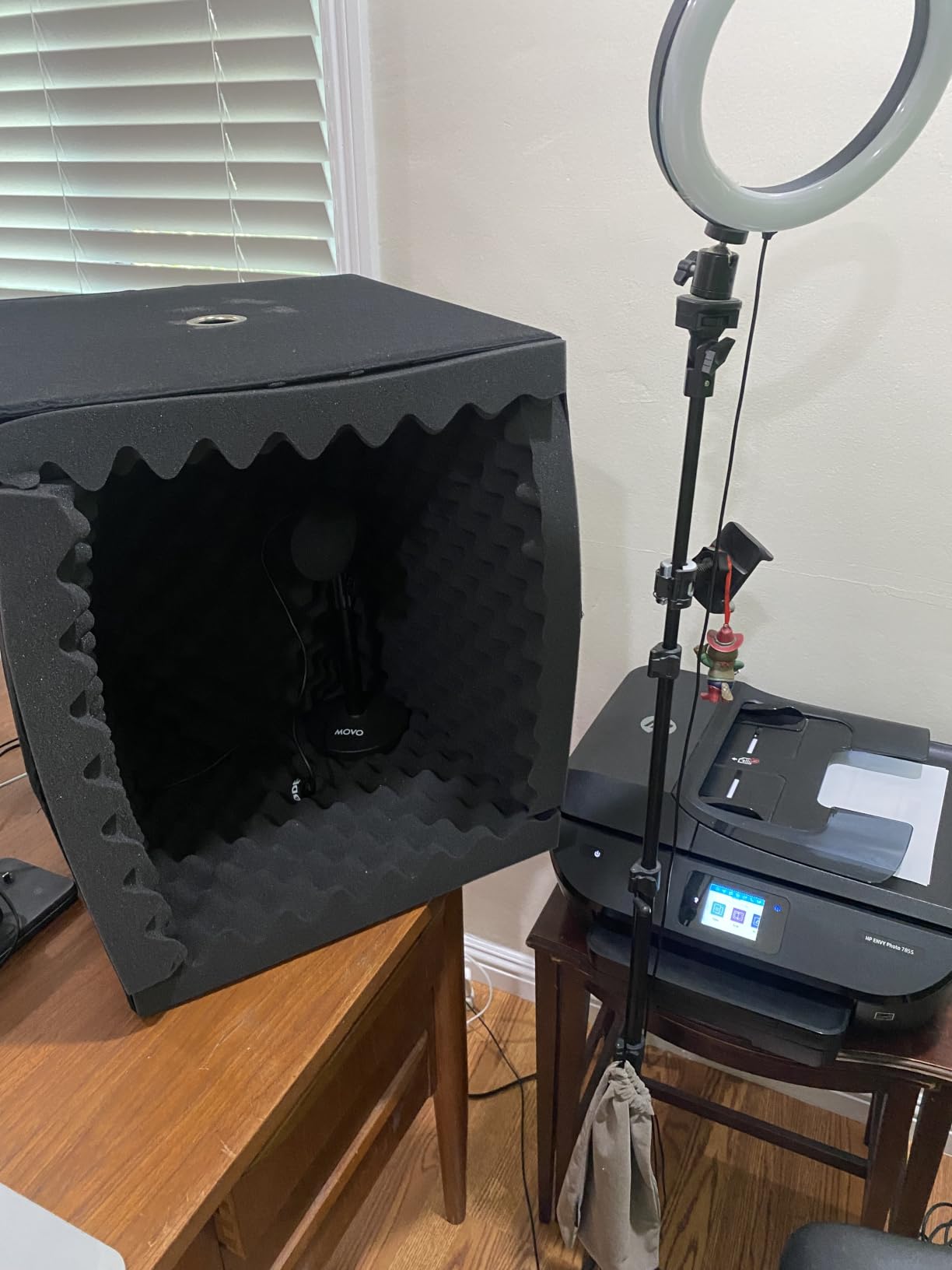
It mounts on a stand or sits on a table, works with all microphone types, and takes stands up to 0.86 inch in diameter. The 1958 reviews at 4.3 stars make it the most reviewed booth box in this guide, so the long-term behaviour of the product is unusually well documented for the category.
The material is the compromise. The shell is cardboard wrapped in fabric rather than metal or plastic, and reviewers report that the structure can bow over time and that the box does not always stay assembled at the joints. Many owners add their own modification to improve stability, which tells you exactly where the product stops and the workaround begins.
Who this booth suits
It suits a home recordist with a small desk who wants a real enclosed booth rather than an open shield, and who will pack it away between sessions. The folded depth of 6 inches is small enough for a closet or a drawer.
It suits voice over, audiobooks and instrument recording in a hard room, since the all-round foam and enclosed volume handle a wider mix of sources than a single flat panel. The stand mount means it can move from desk to boom without modification.
Where it falls short
Durability is the real limitation. The cardboard and fabric construction can bow, and the horizontal joint is connected by fabric, so a user who wants a structure that survives years of daily folding should look at the aluminum AURAY chamber or the framed Snap Studio booth instead.
The open face means front reflections still reach the microphone, and the same review summary notes that extra treatment is often needed. The 2 inch foam also does nothing for bass, so do not expect it to help with rumble or outside noise.
9. Moukey 5-Side Microphone Sound Shield – Best for Large Diaphragm Microphones

Moukey Microphone Insulation Sound Insulation Sound Shield Isolation, 5 Sides Microphone Sound-Absorbing Foam Reflector for Recording Studio, Podcasts, Vocals and Broadcasting
- Most reviewed product in the guide at 2419 reviews
- Large L panel gives big condenser mics real room
- Three layer build: reflective
- filter and absorbing
- ABS back panel with non-slip support points
- Metal 3/8 to 5/8 conversion nuts included
- Open front will not block front reflections
- Foam panels are thinner than the premium filters
- Plastic frame rather than metal
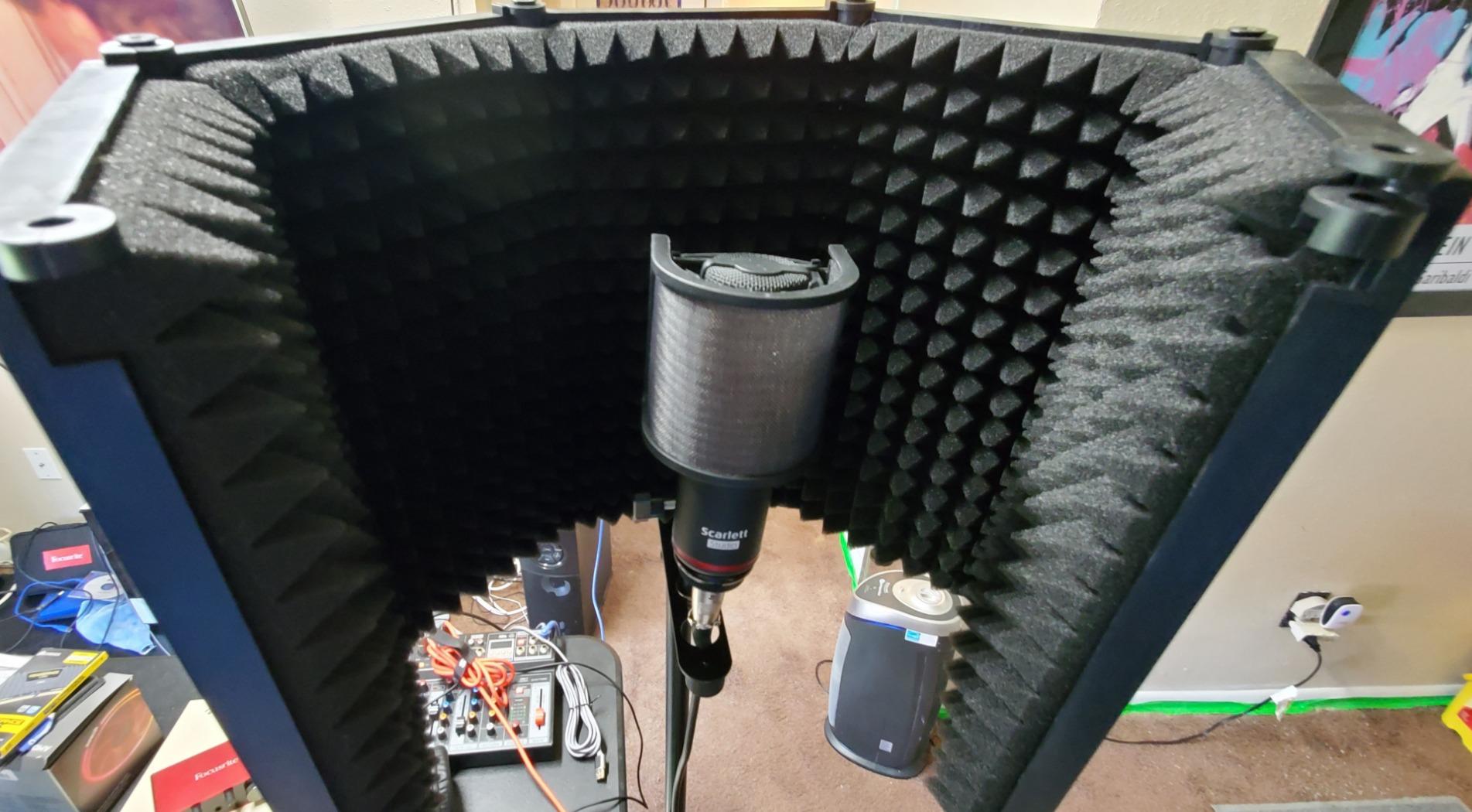
Size is the deciding factor here, and the Moukey has it. The L version measures 29.9 by 12.8 inches, which is enough surface to actually wrap a large-diaphragm condenser without the panels crowding the capsule, and a medium 17.8 by 12.8 inch version is available for smaller microphones. At 3.26 lb it is light enough to reposition with one hand, and it is the most reviewed product in this entire roundup at 2419 reviews.
The build is three layers rather than one: a reflective outer layer, a filter layer and an absorbing inner layer of high-density acoustic foam. Reviewers credit that combination with stopping the wave bounces and interference that a single foam panel leaves behind, and the 4.4 rating across 2419 reviews is the highest review volume here by a wide margin.
It folds for storage and carries in one hand, mounts on a desktop or a microphone stand, and includes metal 3/8 to 5/8 conversion nuts so it fits most stands and shock mounts. The adjustable arch sets the opening, and the ABS back panel with non-slip support points keeps it from tipping forward when you adjust the mic.
The honest limitation is the open front, which reviewers flag as needing additional treatment for complete isolation. The foam is also thinner than the material on the premium filters, so it does the midrange job well and stops there. For a big condenser in a bright room it is a genuinely effective first layer.
Who this shield suits
It suits a home recordist with a large-diaphragm condenser who found mini chambers too small and folding panels too short. The L panel is the cheapest way in this guide to give a full-size studio microphone a proper amount of absorbing surface around it.
It suits anyone who records more than one kind of source in the same room, since the large panel works for vocals, acoustic guitar and voice over without being reconfigured. The foldable design also means it can be stored away when the room is in use.
Where it falls short
The open front will not block direct reflections arriving from in front of the microphone, so it needs a pop filter and some discipline on mic placement to sound its best. It is not an enclosed booth and should not be compared to one on volume.
The frame is plastic and the foam is thinner than the premium options, so it will not outlast the aluminum AURAY chamber or the layered sE Electronics filter in a hard-use studio. What it does offer is the widest coverage and the deepest review history at the lowest end of the market.
10. sE Electronics RF-X Reflexion Filter – Most Compact

- Four layer build attenuates evenly across the spectrum
- Vented and light
- easy to reposition
- Height and distance adjustable bracket included
- Hand built in the sE factory
- Two year warranty
- three if registered online
- Half-filter size is smaller than buyers expect
- Needs a solid mic stand
- Instructions are an online PDF only
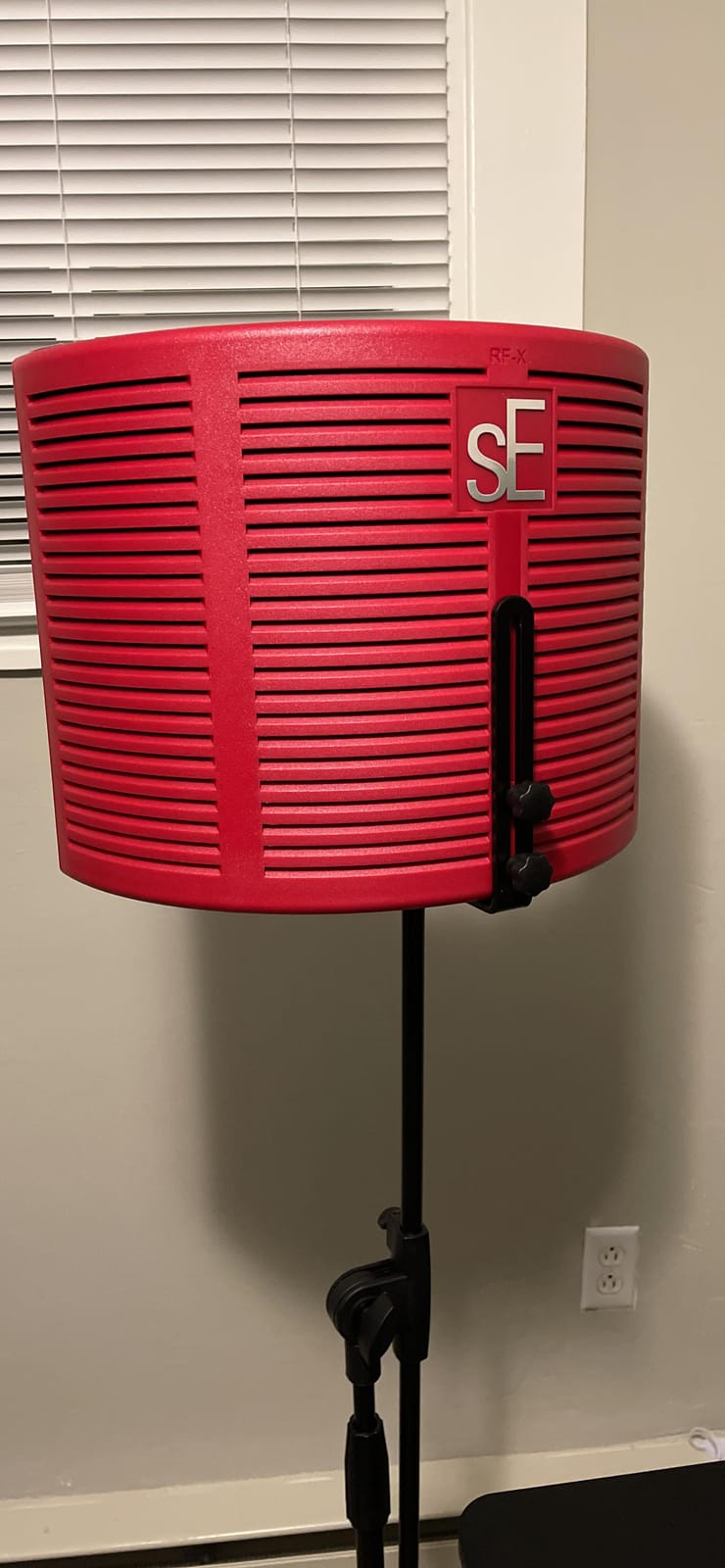
The RF-X is the most considered object in this roundup and the only one built as four distinct layers. A vented composite panel sits at the back, then wool fabric, then an air gap, then acoustic foam facing the microphone. Each layer handles a different part of the reflection problem, and owners specifically report that attenuation is even across the spectrum rather than colouring the voice the way a single foam wall can.
It is also the best made. sE Electronics handcrafts it in their own factory using the same design technology as their industry-standard models, and it carries a two year warranty that extends to three years when you register online. At 5.7 lb and with a ventilated design, it is lighter and easier to reposition than earlier versions.
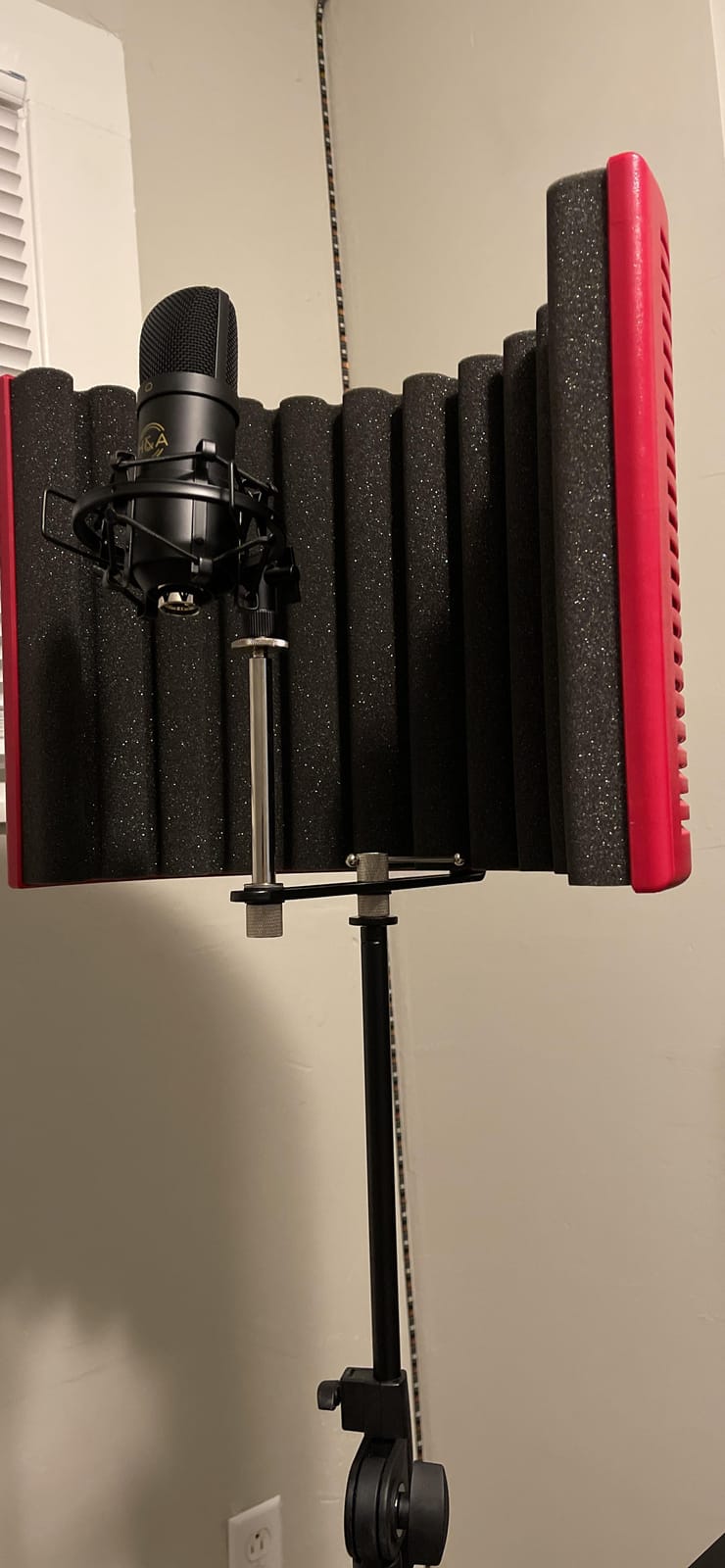
Owners confirm it effectively reduces flutter echoes and room reflections in untreated spaces, and that the flexible mounting hardware, a height and distance adjustable bracket plus a mic stand thread adapter, makes it far more adaptable than a fixed box. The 4.6 rating from 316 reviews reflects a pro audio brand delivering on a pro audio promise.
It is 16 inches across and just under 12 inches high, and that is where expectations and reality diverge. Owners note it is smaller than expected because it is a half-filter design, so check the dimensions against your desk and your microphone before you commit, and pair it with a pop filter to finish the job.
Who this filter suits
It suits a home studio owner who already has a serious microphone and a proper stand and wants the highest quality reflection control available without building a room. It is the natural upgrade path once a cheap shield has run out of usefulness.
It suits singers and players as much as speakers, because the even attenuation preserves the character of an acoustic instrument while removing the room. The three year warranty also makes it the safest long-term purchase here.
Where it falls short
It is a half-filter, so it does not enclose the microphone the way a booth does and it will not create the acoustically protected pocket a full box gives you. The L-shaped arm can also put stress on a shock mount if it is left extended too far.
It needs a decent mic stand, and cheap lightweight stands are not stable enough for it. The instructions are an online PDF only, and no product makes an untreated room sound like a treated studio on its own.
How to Choose the Right Portable Vocal Booth?
Start with the problem, not the product. Write down what is actually wrong with your recording in one sentence. If it sounds like your voice is in a bathroom, you need reflection control and every booth on this list will help. If you can hear traffic, a washing machine or a conversation through the wall, you need a directional dynamic microphone, more distance from the problem wall, and a quieter hour of the day, and no booth will fix it.
Second, pick the form factor that matches how you record. A desktop box or chamber gives the most controlled result per unit of desk space and is the right choice for voice over and podcasting. A folding shield gives you the most flexibility and travels best. A floor-stand tent with a tripod suits anyone who alternates between sitting and standing. And a full enclosure that a performer stands inside is the only option for singing, which is why the Snap Studio booth is in this guide at all.
Third, look at the interior volume against your microphone. Mini chambers such as the AURAY ISO-Armor-2 are excellent value but will not accept a large-diaphragm condenser, and the owners who report disappointment usually bought one for a mic that would not fit. If you have a full-size studio microphone, choose a large panel such as the Moukey L or a stand-mounted box.
Fourth, count the layers and check the material. Two inch foam on a rigid shell handles midrange reflections well. Foam over a metal deflection plate, or a four-layer design with an air gap and wool, handles a wider band and lasts longer. Cardboard and fabric shells are the least durable, and the TroyStudio reviews make that trade-off explicit.
Fifth, be honest about the DIY alternative, because it is a real option. A boom stand with a duvet or a heavy blanket draped over it does a surprising amount of the same job, and members of r/WeAreTheMusicMakers report building a fort out of packing blankets and being satisfied with the result. If your only problem is a bright reflection off a desk and a nearby wall, spend the money on a better microphone instead.
Finally, think about the rest of your chain. A booth helps most when the microphone is a good match for the room, so pair your decision with our audio interface recommendations and a microphone chosen for a dynamic close-mic technique. Treatment and signal chain work together, and neither rescues a badly chosen microphone.
How to Set Up Your Booth and Place the Mic
Set the microphone up before the booth, not after. The most common mistake in this category is placing the microphone too deep inside an enclosure, where the foam sits close to the capsule and takes the natural high end of the voice with it. Pull the mic back toward the opening so the space between your mouth and the nearest panel is a hand width or more, and record ten seconds to check.
A/B test your own room before and after. Record ten seconds of speech with the mic in the open room, then ten seconds inside the booth, without changing anything else. Listen on good headphones rather than speakers. If the second take has less reverb and a closer vocal, the booth is working, and if it sounds thin or boxy, move the mic forward and try again before blaming the product.
Watch the height and distance rather than the frame. On filters with an adjustable bracket, set the microphone at the correct height and the correct distance from the panel before you lock anything down, since the Halo and the RF-X both treat placement as the main tuning control. Keep the back of the microphone away from a bare wall if you can, and leave the stand clear so nothing touches the panels.
Finally, manage expectations on the first week. Add a pop filter if the booth does not include one, because foam does not stop plosives, and record at a consistent distance every take. The gain from a portable vocal booth shows up in consistency more than in any single take, which is why a quick before-and-after test is the honest way to judge whether it earned its place.
Frequently Asked Questions
Does a portable vocal booth actually soundproof a room?
No. A portable vocal booth reduces reflections inside the room by absorbing echoes coming off your walls, ceiling and desk, so your vocal records dry and close. It does not block outside noise such as traffic, air conditioning, washing machines or a neighbour talking. For outside noise, use a directional dynamic microphone, add distance from the noisy wall, and record during quiet hours.
What is the best portable vocal booth for home recording?
The Aokeo Studio Recording Microphone Isolation Shield Kit is the best all-round choice, because it ships with the shield, pop filter, adjustable stand and a device tray in one box, holds a 4.6 rating from 1432 reviews, and weighs only 400 g. For singing, the Snap Studio Portable Vocal Booth is the only option here a standing performer fits inside.
Are portable vocal booths better than a DIY blanket on a mic stand?
For a bright, reflective room, a proper booth is better, mainly because the foam is thick, the frame holds its shape and the geometry is repeatable. But a boom stand with a duvet or heavy blanket draped over it does a surprising amount of the same job, and r/WeAreTheMusicMakers users report being happy with that approach. If your room is quiet but bright, try the free version before buying anything.
Why does my vocal sound boxy inside a vocal booth?
Boxiness almost always means the microphone is too deep inside the enclosure. Foam placed close to the capsule absorbs part of the natural high end of the voice, so the recording sounds dull and confined. Pull the microphone back toward the opening until roughly a hand width separates it from the nearest panel, add a pop filter for plosives, and record ten seconds to compare.
What is the best setup for home vocal recording?
A workable home vocal setup has five parts: a microphone matched to your room, a pop filter, a portable vocal booth or reflection filter, a shock mount or stable stand, and an audio interface with clean preamps. A directional dynamic microphone handles a loud untreated room better than a sensitive condenser, and a room treatment or thick blanket on the wall behind the mic helps more than most buyers expect.
Which Portable Vocal Booth Should You Buy
The Aokeo Studio Recording Microphone Isolation Shield Kit is the portable vocal booth to buy first. It arrives complete, it is the lightest serious option in the guide, and 1432 reviews at 4.6 stars give you more evidence than any other product here. If you sing rather than speak, the Snap Studio Portable Vocal Booth is the only one on this list you can stand inside, and if your microphone is a large-diaphragm condenser, the Aston Halo or the sE Electronics RF-X will treat it properly.
Whichever you choose, remember what the thing does. It absorbs reflections so your voice records close and dry. For outside noise, a directional dynamic microphone and a quiet recording window do more than any enclosure in 2026.