
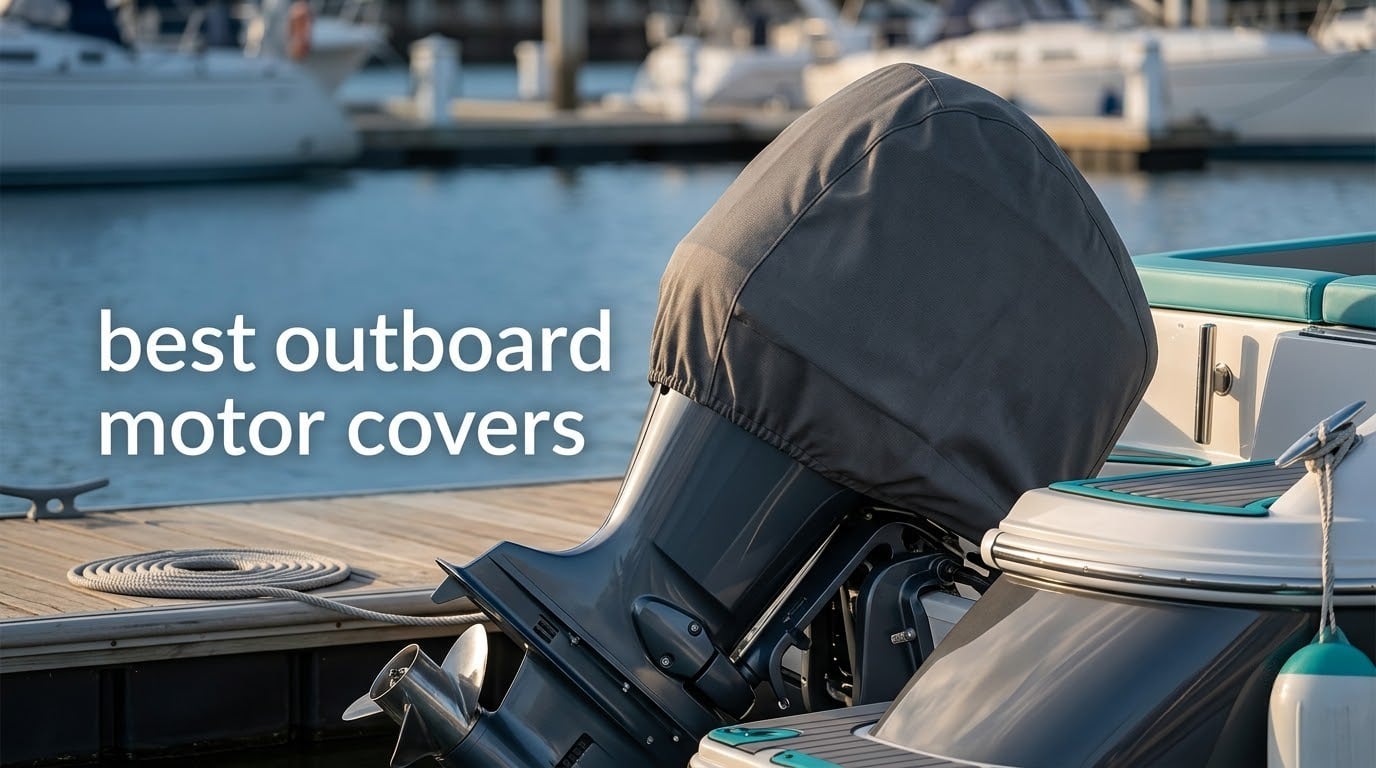
An outboard motor cowling is the most exposed part of your boat. It sits above the waterline taking sun all day, salt spray off the bow, dust off the trailer, and road grime at highway speed. The plastic it is made from fades, chalks and cracks under ultraviolet light, and the connectors and harnesses underneath corrode when moisture sits against them. A fitted cover fixes most of that for the cost of one part.
This guide covers the ten best outboard motor covers we could find across custom-pattern and universal designs, from 2.5 HP outboards to 350 HP V6 engines. We look at fabric weight, seam construction, venting, how the cover stays attached in wind, and whether it can realistically be left on a warm engine. If you are still choosing the motor itself, start with our outboard motor roundup first, then come back here.
One thing worth saying up front: a cover is not a licence to run the engine with the cover fitted. A hot cowling under a sealed fabric traps heat against the plastic, and most manufacturers of fitted covers state storage use only. We flag this clearly on every product below, and the outboard motor stand guide covers what to do with the motor when the boat is not in the water.
Table of Contents
Top 3 Best Outboard Motor Covers in 2026

Quick Overview: All 10 Covers Side by Side in 2026
The table below lists every cover in this roundup with the details that separate them. Three ideas run through it: fabric weight, whether the seams are sealed, and what actually holds the cover down when the wind gets up.
| Product | Specifications | Action |
|---|---|---|
| Explore Land 600D Universal Cover 115-225 HP |
|
Check Latest Price |
 Zettum 600D Oxford Cover 115-225 HP Zettum 600D Oxford Cover 115-225 HP |
|
Check Latest Price |
 FLYMEI Outboard Motor Cover 100-140 HP FLYMEI Outboard Motor Cover 100-140 HP |
|
Check Latest Price |
 Oceansouth Custom Fit Cowling Cover Yamaha V6 Oceansouth Custom Fit Cowling Cover Yamaha V6 |
|
Check Latest Price |
 Softclub Cover 250-350 HP Softclub Cover 250-350 HP |
|
Check Latest Price |
 VINPATIO Cover 50-115 HP VINPATIO Cover 50-115 HP |
|
Check Latest Price |
 zenicham Trailerable Cover 8-15 HP zenicham Trailerable Cover 8-15 HP |
|
Check Latest Price |
 iCOVER Cover 250-300 HP iCOVER Cover 250-300 HP |
|
Check Latest Price |
 STEECA Waterproof Cover 115-225 HP STEECA Waterproof Cover 115-225 HP |
|
Check Latest Price |
 iCOVER Small Engine Cover 2.5-25 HP iCOVER Small Engine Cover 2.5-25 HP |
|
Check Latest Price |
Why You Need an Outboard Motor Cover
Three separate problems show up on an uncovered engine, and they need different parts of the cover to solve.
Ultraviolet damage and photo-oxidation
Modern cowlings are polypropylene-based composites. UV light breaks down the polymer chains in that plastic through a process called photo-oxidation, and the visible signs are a dull surface, a colour shift from white to cream, and hairline stress cracks around mounting points. Once cracking starts, the plastic holds water and the corrosion follows. Florida and Gulf Coast owners see the damage in a couple of seasons, which matches owner reports of OEM covers and cowlings giving out around the eighteen-month mark in that sun.
Salt, moisture and condensation
Salt spray reaches connectors, the throttle position sensor area and the fuel injection system even on a freshwater boat running near brackish water. If a cover is non-breathable and sealed flat against the cowling, overnight temperature swings pull condensation out of the air and trap it. That is why a vented construction matters: airflow under the cover lets that moisture escape instead of sitting on the plastic. A rear air vent, louvered panel or breathable weave all solve the same problem.
Road debris and loose-fit chafing
On the highway, stone chips thrown by the trailer and the car in front land on the cowling at speed. A cover takes that hit instead. The reverse problem is a cover that is too loose: reviewers repeatedly describe universal covers chafing the cowling when they flap, which is a fair argument for measuring carefully and for covers with a cord lock or anchor strap rather than a plain hem. Fit and security are the same issue.
None of this is exotic. If you want a broader picture of the hardware your motor needs, our motor starter roundup covers the electrical side, and portable outboard guides go into the small-engine end of the market where covers matter most.
1. Explore Land 600D Universal Cover – Best Overall
- Largest review base in the group
- Sealed seams and laminated undercoating
- Rear air vent reduces trapped moisture
- Elastic cord plus rear straps keep it snug
- Runs slightly large on some engines
- Colour can fade in intense sun
This is the cover we keep coming back to. It has more owner reviews than anything else in the roundup by a wide margin, and once you read a few hundred of them the pattern is consistent: people like the way it slips on, the way the elastic and rear straps pull it tight, and the fact that the seams are sealed with tape rather than just stitched. The fabric is 600D marine-grade polyester with a waterproof laminated undercoating, which is the right weight for a cover that will live on a transom in weather rather than in a garage.
Size is 31 inch long by 23 inch wide by 29 inch high, and the maker lists it for most 115-225 HP engines across Honda, Tohatsu, Yamaha, Suzuki, Mercury and Evinrude. That range is the reason it sells so well, and it is also the reason some owners complain. A 115 HP Yamaha and a 225 HP four-stroke are very different shapes, so on the smaller end the cover is roomy. Our advice is to measure your cowl and pick the tightest bucket that clears it rather than assuming the top of the range is the safe choice.
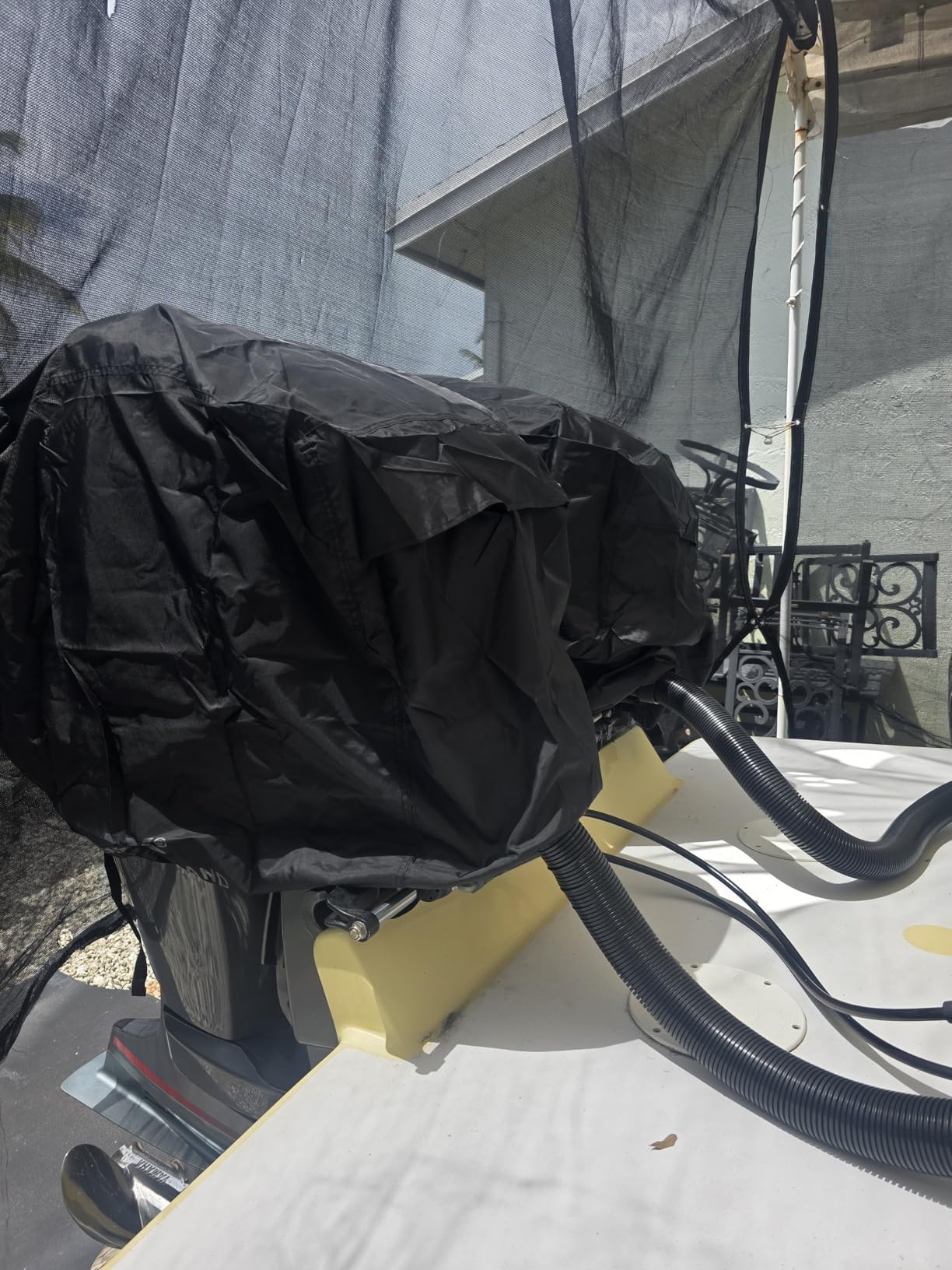
The hardware is what separates it from a plain bucket cover. There is heavy-duty elastic cord around the lower edge, two click-close straps at the back corners, quick-release buckles at the front, and a rear air vent that lets warm air out. The buckle and strap combination is the part that matters on the road, because it is a positive attachment rather than a hem that relies on friction. Owners trailering long distances report the cover staying where they put it.
Sun exposure is the main durability question here, and there is a real pattern in the reviews about grey fading within months in Florida or Tampa sunlight. If you are in intense sun year-round, the Zettum below is worth a look for its stated UV ageing rating. For everywhere else, and for anyone who wants the most proven cover at this size, this remains our pick.
What to check before ordering
Measure the cowling at its widest point and from the top of the transom to the highest point of the cowl. The cover should be a little looser at the front than the sides, otherwise it will not clear the steering handle. Check where the strap buckles land on your stern rail or transom, because the rear corner straps need a solid edge to hook to.
Where it falls short
If your motor is under 115 HP, or above 225 HP, this cover is the wrong size and no amount of adjustment fixes that. The roomy fit that makes it so versatile is also the source of the chafing complaints, so it suits a boat that lives on a lift more than a boat that sits exposed at a dock. And the fade issue is not subtle in hard sun, so expect a replacement on a two-season cycle down south.
2. Zettum 600D Oxford Cover – Best Fade Resistance
- Softer and more tear resistant than PVC covers
- Fade-resistant finish rated to 3 years of UV ageing
- Three clips plus drawstring cinch it on
- Rinses clean and dries fast
- Roomy on smaller engines
- Not a shaped fitted cover
- Black shows dirt and absorbs heat
Zettum makes a point of the difference between PU coating and PVC coating, and on a cover that lives outdoors that difference is not marketing. PU-coated 600D oxford stays softer, handles repeated folding without cracking, and does not turn brittle the way a vinyl finish can. The same fabric is described as more breathable than a PVC cover, which helps when the cover goes on and off daily.
The sizing is 31 by 23 by 29 inches for most 115-225 HP outboards, and it is a straight bucket rather than a shaped pattern. The manufacturer suggests letting the motor cool for ten to fifteen minutes before pulling the cover over it, which is a sensible habit with any fabric cover and worth building into your routine. Three clips and a drawstring hold the lower edge in place once it is on.
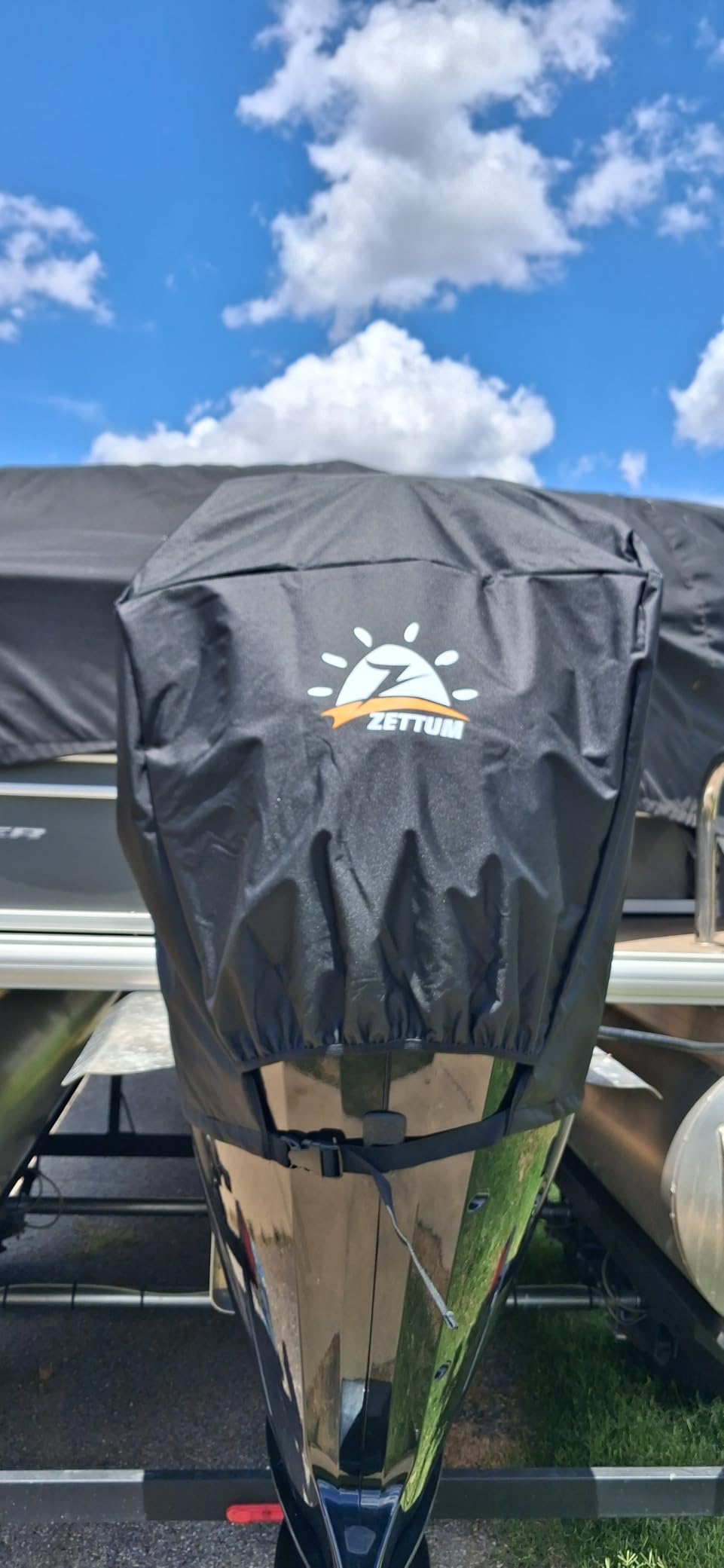
The claim that separates this from the other universal covers is the UV ageing test. The fabric is rated to withstand at least three years of sun, rain and dew, and owners in bright climates back that up more than the marketing would suggest. If your previous cover faded into a grey rag after one season, that is the problem this one is built to fix. The quick-drying surface also means a cover that gets rained on at the dock is not sitting wet the next morning.
The honest drawback is the same one shared by most 115-225 HP covers: the size is generous. Reviewers with 115 HP motors repeatedly note that a smaller bucket is a better fit and that this one looks a little baggy. Black is also not a neutral choice in direct sun, since it absorbs heat and shows salt and mud streaks. Neither issue affects function, but if you care about how the boat looks at the dock, both are fair things to weigh.
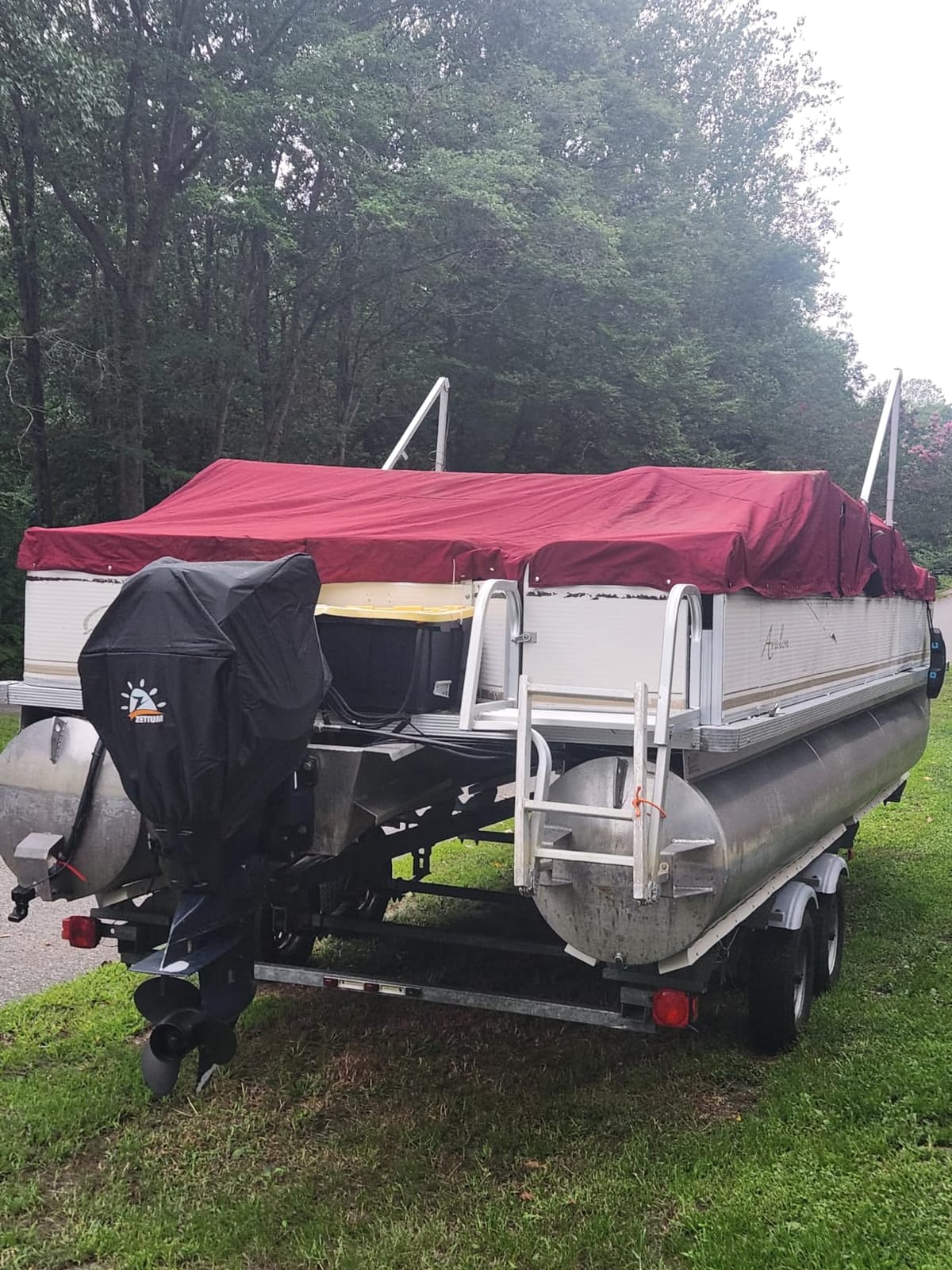
Best used for daily dock and lift storage
This is the one to pick if your boat comes out of the water for a night at a time and the cover goes on and off constantly. The fabric is soft enough to handle without creasing the cowling, the fit is quick, and the surface wipes down and air dries rather than holding water against the plastic. Coastal and Florida owners get the benefit of the stated three-year UV rating.
What to know before you buy
This is not a shaped cover. On a cowling with a pronounced nose or a wide midsection it will not hug the lines, and a loose cover in wind is how chafing starts. Measure first, and if you need a cover that fits a specific Yamaha V6 or a large V6 four-stroke closely, the custom-pattern option further down the list is the better answer.
3. FLYMEI 100-140 HP Cover – Most Versatile
- One of the lowest costs with a 2000+ review base
- Long zipper makes fitting tool-free
- Double-line stitching and bound seams
- Drawstring keeps it snug in wind
- Universal sizing runs loose on smaller engines
- Outer coating can crack or fade faster
- Less established brand name
FLYMEI sits at the cheap end of this group and it is not close to the worst. It covers 100-140 HP engines, which sits right in the middle of what most family boats run, and it has more than two thousand owner reviews behind it. For a lot of people buying a first cover for an older motor, that combination of cost and volume is the whole argument.
The construction is 600D oxford cloth with a PU coating, double-line stitching and high-density bound seams. The fitting method is the part we like most. A long zipper runs down the side so you can open the cover flat, drop it over the cowling, and pull the drawstring at the hem to cinch the bottom. No tools, no wrestling fabric over a hot engine while trying to find the drawstring at the same time.
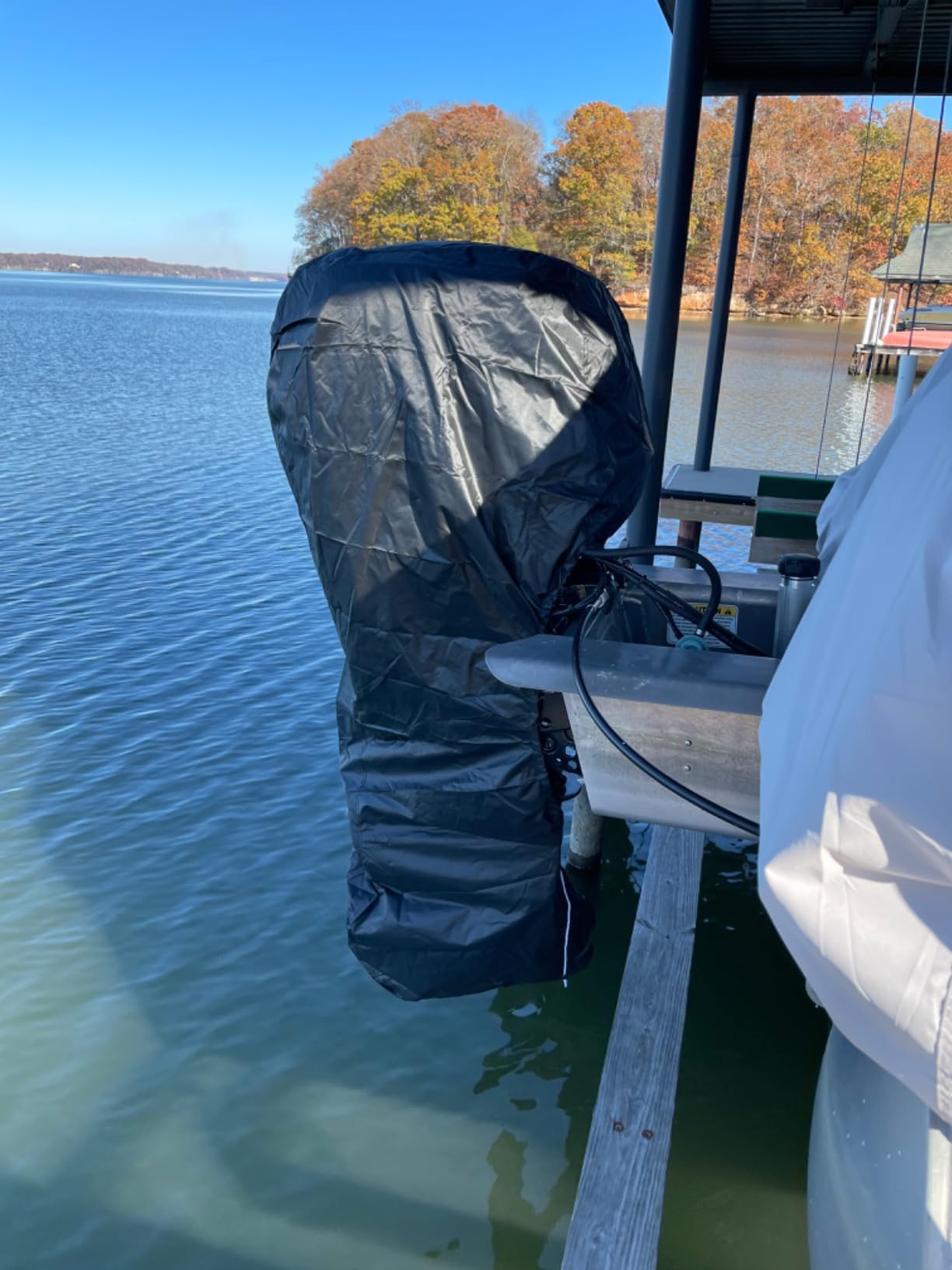
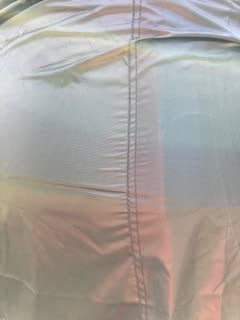
Reviews tend to land in three groups: people praising value, people praising how quick the zip-on installation is, and people noting the fit is generous. The stretchy hem does a good job of stopping the cover lifting once it is cinched, which matters on an exposed mooring. A storage bag is included, so it is easy to keep the cover in the boat rather than losing it in the garage.
The durability feedback is the reason this sits third rather than higher. A number of owners report the outer coating cracking or fading sooner than expected, and the same review base notes the fit can be loose on the smaller end of the range. Neither complaint is unusual for a cover at this price, but if your motor is a glossy cowling that you want to protect for a decade, spend up rather than sideways.
Where this cover earns its place
It suits an older 100-140 HP outboard on a boat that lives at a freshwater slip or on a lift, where the job is rain, dust, bird droppings and sun rather than salt and constant handling. The drawstring and bound seams handle wind well for the money, and the material handles snow if the boat sees a northern winter.
Where it will not be enough
If you are storing through a hurricane season, this is not the cover. A loose universal bucket in a storm is a sail, and the material will not hold long. For storm prep, a cover with a positive anchor point and a tight shaped hem is what you want. This one is also worth sizing down on if you are near 100 HP, since the 100-140 HP bucket is noticeably baggier at the bottom.
4. Oceansouth Custom Fit Cover – Best for Yamaha V6
- True custom pattern fit for specific cowlings
- Coated canvas in a 10.3 oz/yd2 weight
- Coated fabric balances water resistance and breathability
- Storage use only
- not for a running engine
- Fits one engine family only
- Confirm your exact model year before ordering
This is the only genuinely custom-pattern cover in the roundup, and it shows in the rating. At 4.7 across 559 reviews it is the highest-scoring product here, with the bulk of responses in the five-star band. The pattern is cut for Yamaha F250, F300 for 2023, and the F350 V6 4.3 litre for 2024, and a shaped cover is the answer when a baggy one will not do.
The fabric is 10.3 oz per square yard polyester canvas with an advanced coating for water resistance, UV protection and breathability. That is a heavier cloth than any of the universal covers in this list, which is what gives a custom pattern its shape and its resistance to abrasion on a glossy cowl. The lower edge has an elasticized hem and a twin rope cleat for tightening.
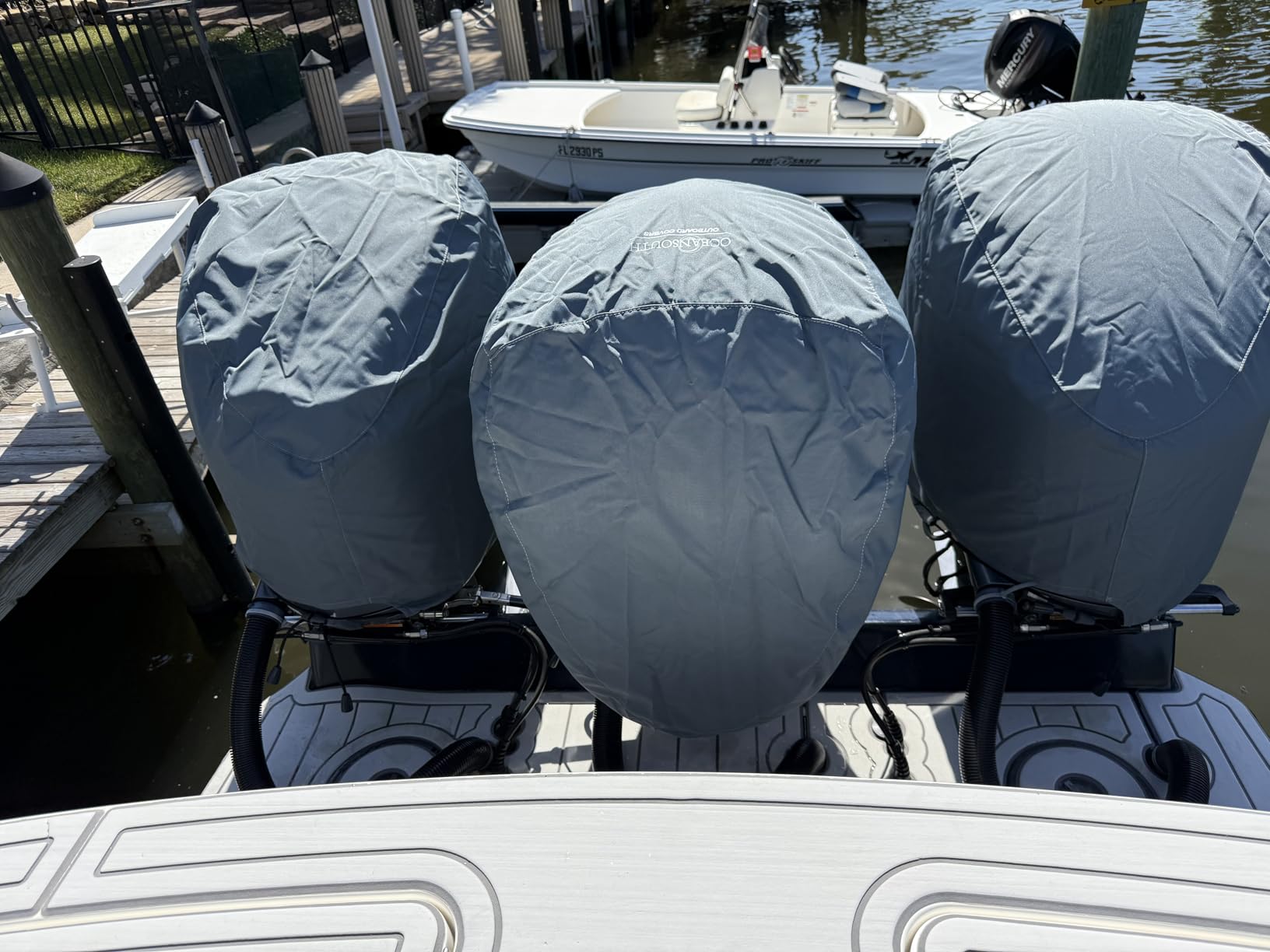
Why we still do not give it the top badge is simple. It covers one engine family, it is priced above the universal options, and it is a storage-only cover with the manufacturer saying so plainly on the listing. If you own one of those Yamaha V6 engines and keep it on a lift, this is the best cover you can fit to it. If you own anything else, the universal options cover more ground.
It is also the one to think about if you trailer a lot on rough roads. A shaped pattern cannot flap, and heavy canvas resists stone chips better than the lighter 600D fabrics. Just confirm the model year before you order, because a custom pattern for a different year of the same engine family will not sit correctly on the cowling.
How to confirm it fits your engine
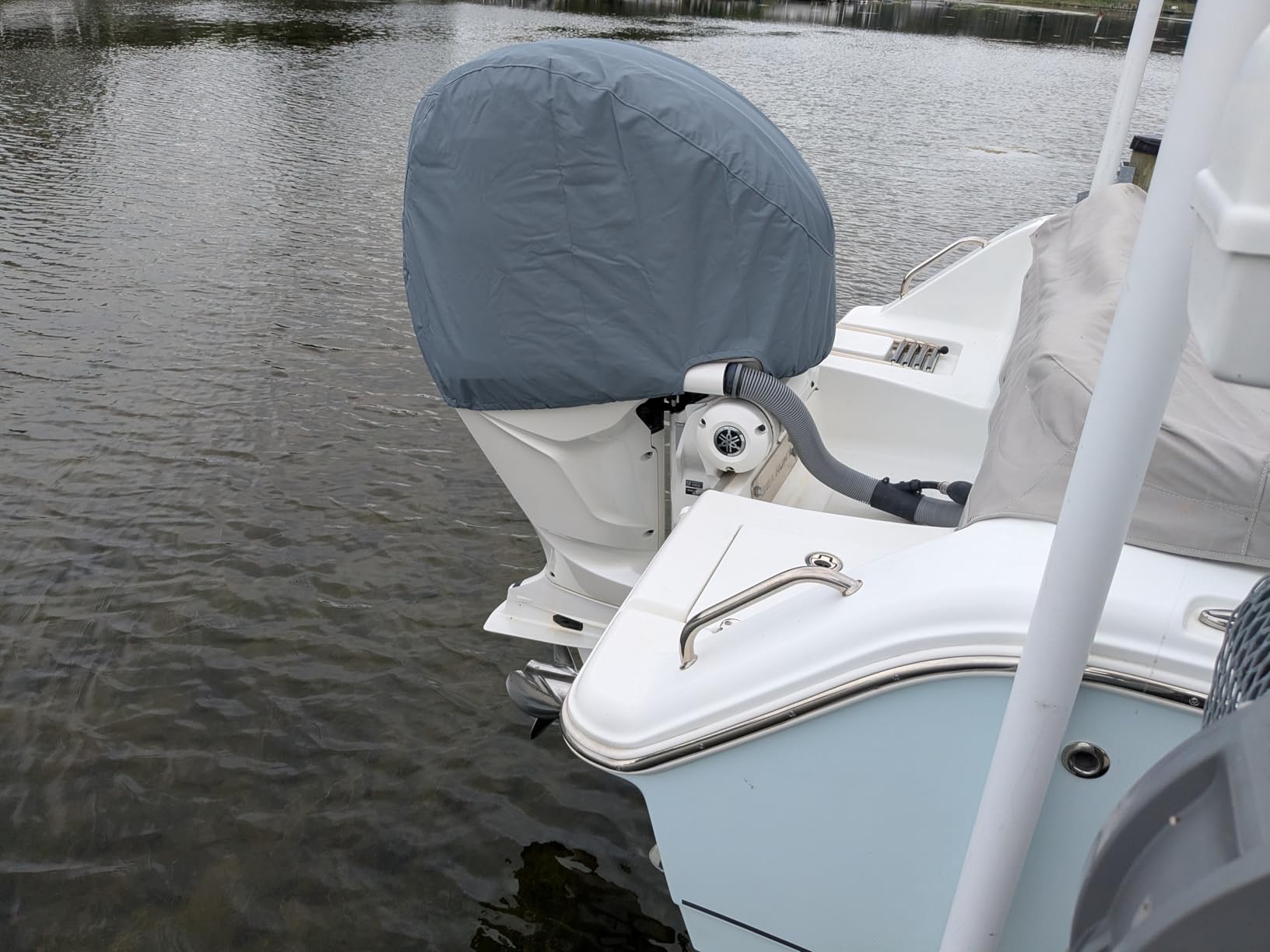
Check the model and year plate on the engine itself, not the boat. The pattern number is Y05A-S, and the listing names F250, the 2023 F300 and the 2024 F350 V6 4.3 litre. If your engine is outside that list, do not force it, and look at the universal covers sized for your horsepower instead.
Why custom fit is worth it here
Custom patterns do three things a universal cover cannot. They stop the chafing that comes from loose fabric moving in wind, they keep the water off a specific cowling shape that a bucket leaves partly exposed at the nose, and they look correct on a boat you care about. On a V6 with a large, expensive cowling, that is worth the extra cost and the narrower fit.
5. Softclub Cover 250-350 HP – Best for Big Engines
Softclub Boat Motor Covers 250-350 HP, Full Outboard Motor Cover, Black
- Covers 250-350 HP
- a size most universal covers skip
- Drawstring hem plus zipper holds tight in wind
- Waterproof seam strips block water
- Blocks dust
- sap and bird droppings
- Zipper is the first thing to fail
- Fit varies with cowl shape
- No soft interior lining
Big V6 and V8 engines break most universal covers simply because nobody makes a bucket big enough. This one runs 34 inches wide, 24 inches deep and 87 inches tall, which puts it in the 250-350 HP range, and several owners mention it finally fitting a Yamaha SHO 250 that other covers could not cover properly. That alone makes it the pick for the engines other guides leave out.
Material is 600D marine-grade oxford with reinforced seams and waterproof seam strips, plus an extra UV-resistant coating to slow fading. The fit is handled by a drawstring hem with zipper access, so you can open the side, drop the cover down over the cowl, then cinch the base. A polyester storage bag is included.
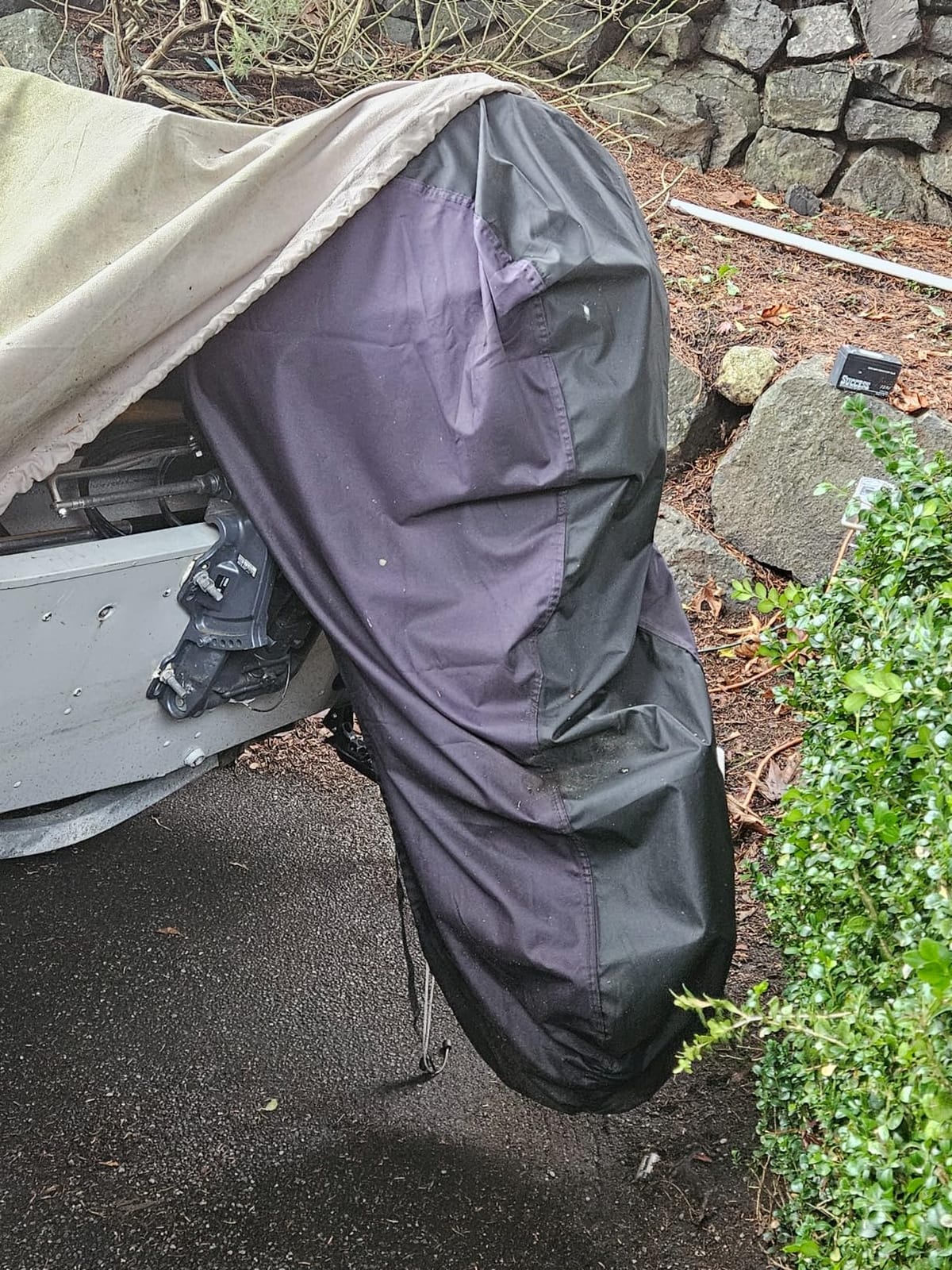
Coverage is genuinely thorough. Owners talk about it blocking dust, tree sap and bird droppings effectively, and the drawstring keeps the base tight in wind and rain, which addresses the chafing problem that flimsier covers create. The fabric is soft and workable, so it goes on and off without feeling like a stiff shell.
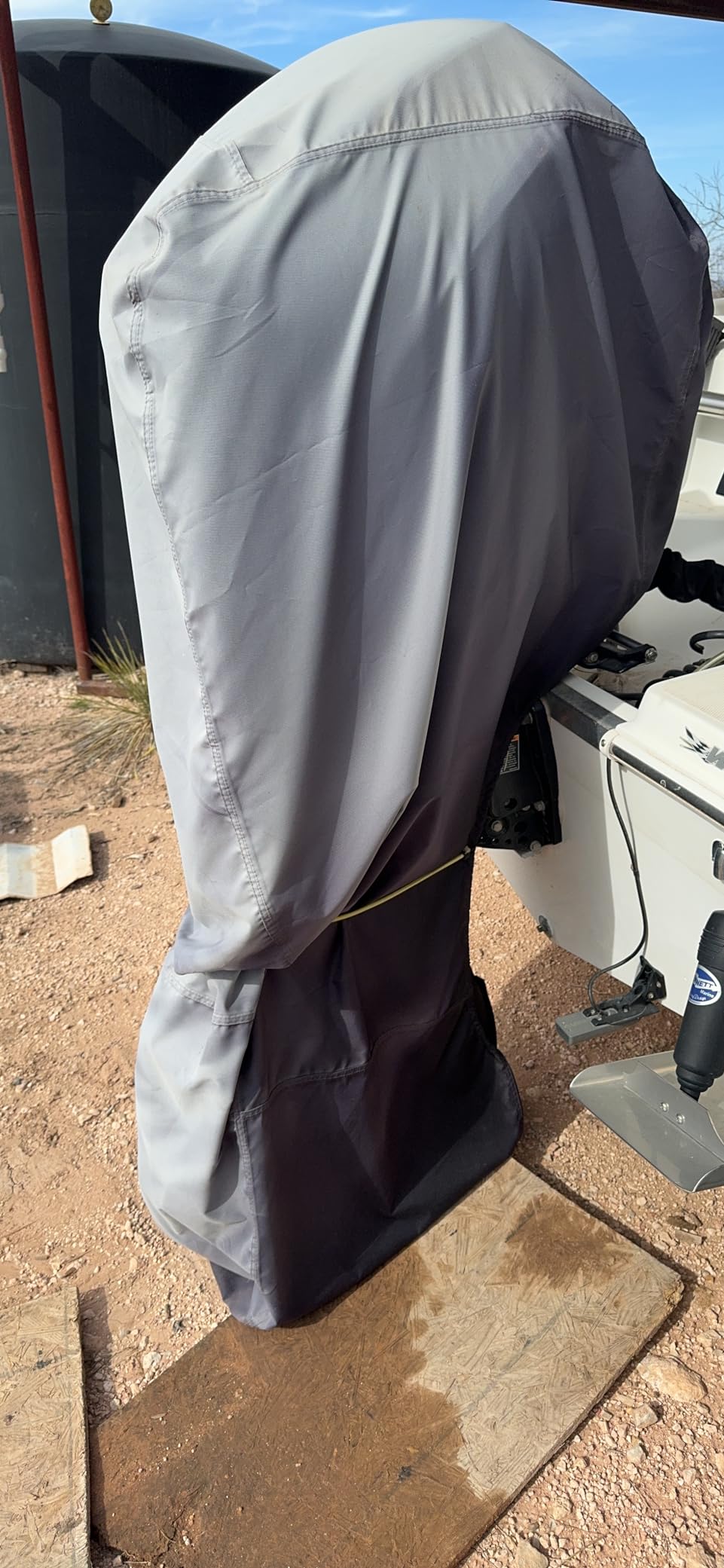
Two recurring complaints are worth weighing. The zipper is the weak point and some owners report it failing early, which matters because the zipper is how you open the cover for access. And the interior is not soft-lined, so on a glossy cowling left covered for months, contact areas can scuff. It is also not a cover to fit while the engine is running, and the tall shape catches more wind than a small cover would.
Why the size matters more than the brand
On a 300 HP engine the cowling is a different object from a 150 HP cowling, and the reason big-engine covers are hard to find is that the pattern and the volume both have to be right. A cover that is technically the right height but too narrow at the base leaves the transom face open to road spray. Measure width, depth and the full height from the transom to the top of the cowl before you settle on this size.
Long-term use notes
For a big engine stored on a lift or indoors, this works well and the taped seams keep water out. Treat the zipper gently, open it from the bottom rather than levering the top of the cowl against it, and consider a soft liner if your cowling is high-gloss and the boat sits outside year round.
6. VINPATIO 50-115 HP Cover – Best for Cold Storage
VINPATIO 600D Outboard Motor Cover Fit Boat Engine 50-115 HP, Waterproof Heavy Duty Solution-Dyed Fabric for All-Weather Protection
- Solution-dyed fabric holds colour through the fibre
- Cold rated to -68F for winter storage
- Elastic hem cord gives a 360-degree fit
- Bound seams and double stitching
- Sold in horsepower buckets
- not shapes
- One year warranty is the shortest here
- No vent or drain feature
The distinction that matters here is solution-dyed fabric. In a solution-dyed textile the colour is in the fibre itself rather than printed on the surface, so it cannot rub off, peel or wash out. For a cover that lives outdoors through seasons, that is a genuine step up from a surface-printed or coated fabric, and it is why this one holds its colour longer than most in the group.
Size is 29.5 by 17 by 24.5 inches for most 50-115 HP outboards from Honda, Tohatsu, Yamaha, Suzuki, Mercury, Evinrude and Hangkai. The 600D polyester carries a waterproof PU coating and an anti-UV treatment, with double-line stitching and high-density bound seams. An elastic cord around the bottom hem gives a 360-degree fit that does not rely on a single hem line.
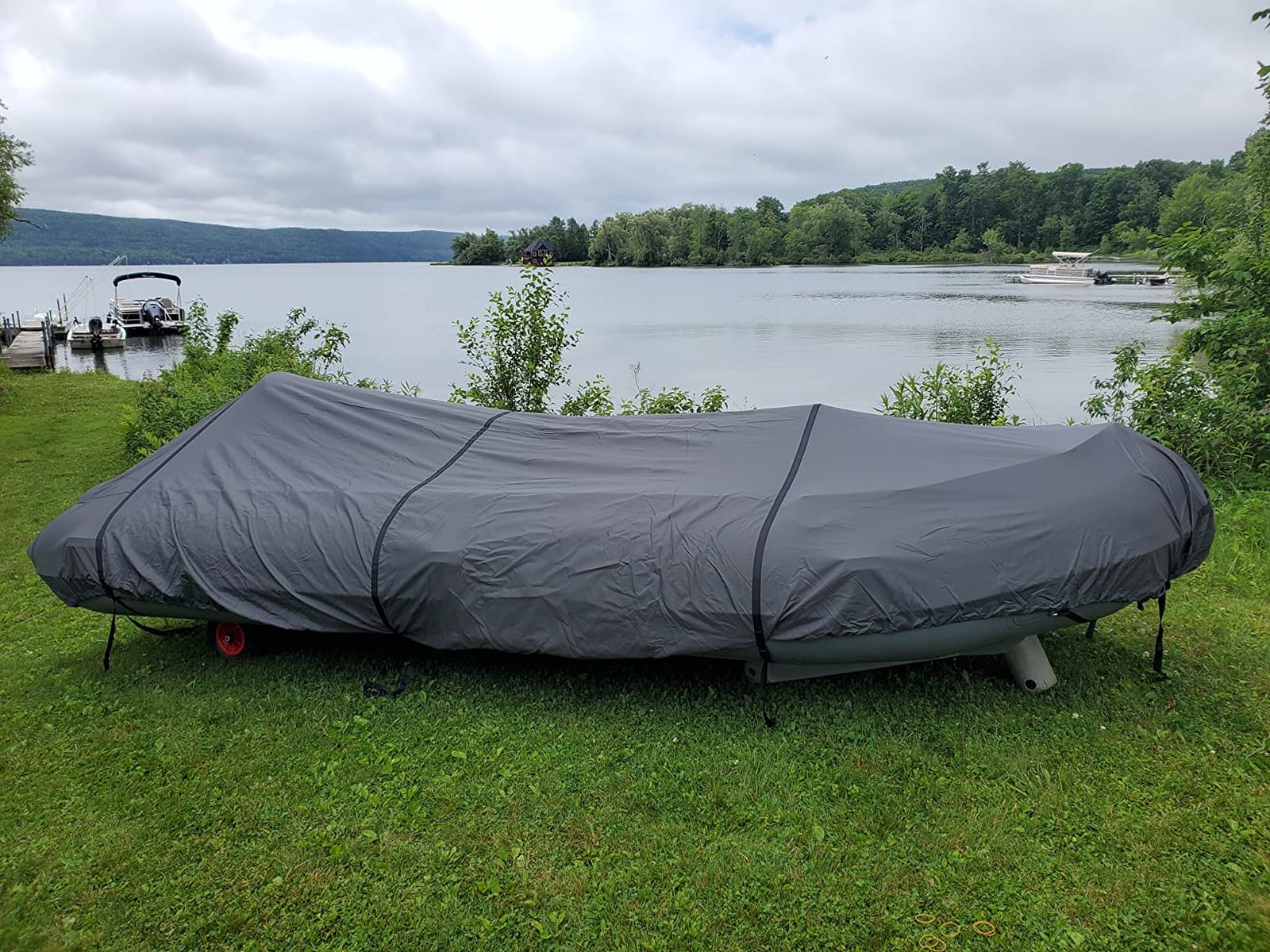
The headline number is the cold rating to -68F, which is a stated specification rather than marketing language and makes this the natural choice for off-season storage in a northern garage, shed or unheated boathouse. It is one of the few covers in this roundup where fabric behaviour in freezing conditions is addressed at all, and cold brittleness is exactly what degrades PU coatings and stitching in a hard winter.
Reviewers are consistent that the fit is close once you measure, and that stitching quality is good for the money. The recurring note is that horsepower buckets are only a guide, so measure the motor. The one-year manufacturer warranty is the shortest of the ten, and there is no vent mentioned for damp long-term storage, so in a humid location it is worth checking under the cover periodically.
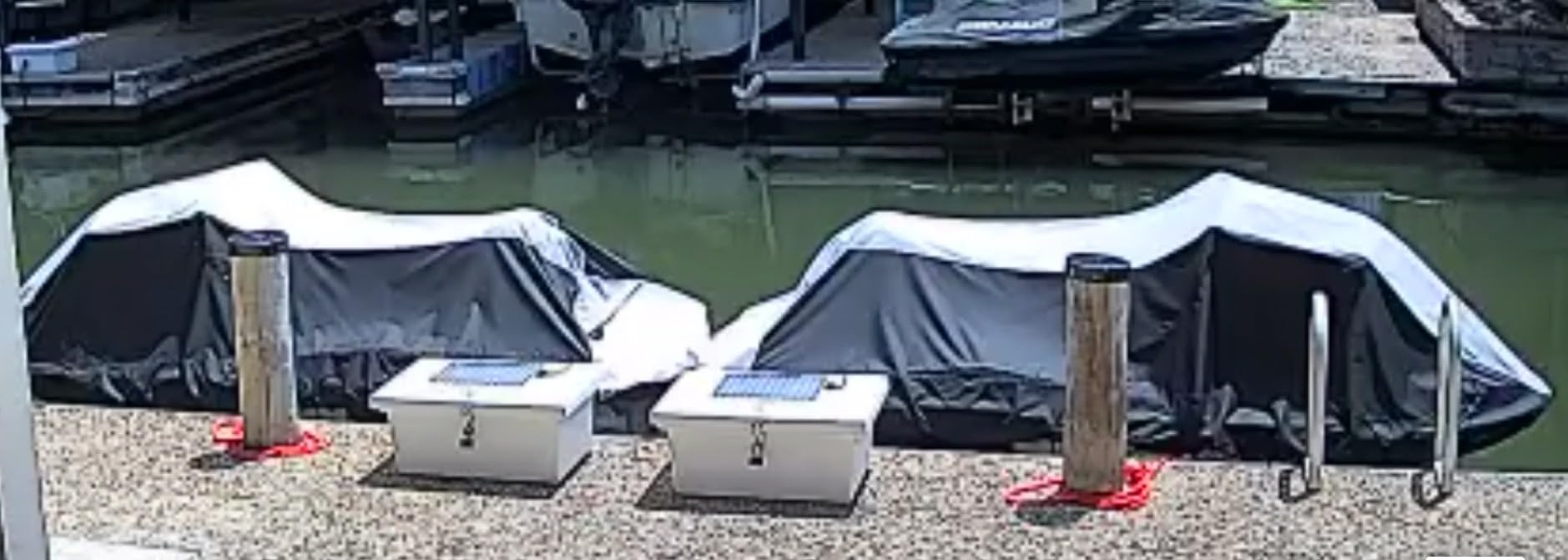
Best for winter lay-up and cold climates
If the boat goes down in October and comes back in April, this is the cover. The cold rating, the solution-dyed colour and the bound seams together make it a better fit for freeze-thaw cycles than a vinyl-coated cover that stiffens. The elastic hem also holds better than a plain drawcord when the fabric is cold and less pliable.
Where to look elsewhere
If your boat lives in a warm, humid climate and the cover stays on for months, a model with a stated vent is a better choice, and a universal cover that is guaranteed for a year is thin comfort for long unattended storage. For smaller engines the size here is generous, so measure before ordering.
7. zenicham Trailerable Cover – Best for Night Trailering
zenicham 600D Fade Trailerable Outboard Motor Cover Navy(Fits 8-15 HP)
- Reflective strips add real visibility at night
- Zipper
- drawcord and quick-release buckles resist wind
- Solution-dyed fabric resists fading and cracking
- Seven sizes and a storage bag
- Size by height not horsepower
- which causes returns
- Long transoms may need the next size up
Reflective strips are the reason this cover is different. On a motor cover that is on the back of a trailer, being visible at night is a real safety point, and almost nothing else in the affordable category has it. The strips run across the cover so headlights catch them, which matters most on unlit roads and when you pull into a launch ramp after dark.
Construction is 600D marine-grade solution-dyed polyester, double-stitched, described as resistant to fading and cracking. Attachment is a heavy-duty zipper plus a durable drawcord, adjustable straps and quick-release buckles at the base, which is a genuinely wind-resistant combination rather than a single drawstring. Installation is tool-free and a polyester storage bag is included.
The sizing system is the one thing to understand before you order. Sizes run from 8-15 HP up to 225-250 HP, but the guidance is to size by motor height rather than horsepower, and to go up one size for a long transom. Reviews show that choosing by horsepower alone is the main source of returns, so measure the height from the transom to the top of the cowl and check the transom length too.
With seven size options and a hardware set built for trailer use, this is a sensible pick for anyone running to and from the ramp regularly. It is a storage and trailering cover rather than a running cover, and the fabric weight is lighter than the custom-pattern canvas at the top of this list, so it is a matter of a season or two in hard sun.
When to choose this one
Night trailering, mixed drive-on and lift storage, and any situation where you want the cover to stay put in a crosswind. The quick-release buckles mean you can attach it fast at the ramp in the dark, and reflective strips handle the rest.
What to measure first
Cowl height from transom to top of cowl, and the cowl’s widest point. If you are between sizes, size up only if your transom is long. Over-sizing on a short transom is what produces the billowy shape that flaps and chafes.
8. iCOVER 250-300 HP Cover – Best Full Enclosure
iCOVER Outboard Motor Covers, Trailerable Full Boat Engine Cover Waterproof Heavy Duty Oxford Fabric with Zipper, Fits 250-300HP Motors, Black
- Full enclosure leaves no cowl edge exposed
- Drawstring and zipper keep it secure in wind
- Eight sizes across the horsepower range
- Handles snow
- hail
- rain and wind
- PVC coating is less breathable than PU
- Universal sizing can look billowy
- PVC stiffens and cracks over time
Most universal covers are a bag that drapes over the cowling and leaves the sides partly open. This one is built as a full 360-degree enclosure, which means every edge of the cowling is inside the cover. For a big engine where a lot of surface area is exposed, that is a real difference in how much of the motor is actually protected from road spray and stone chips.
Material is heavy-duty oxford polyester with a waterproof PVC coating, and the size range covers eight buckets from 6-15 HP through to 250-300 HP across Mercury, Yamaha, Honda, Suzuki and Nissan. Retention is by adjustable drawstring plus a zipper closure, double-line stitching and high-density bound seams, with UV-resistant vinyl on the coating.
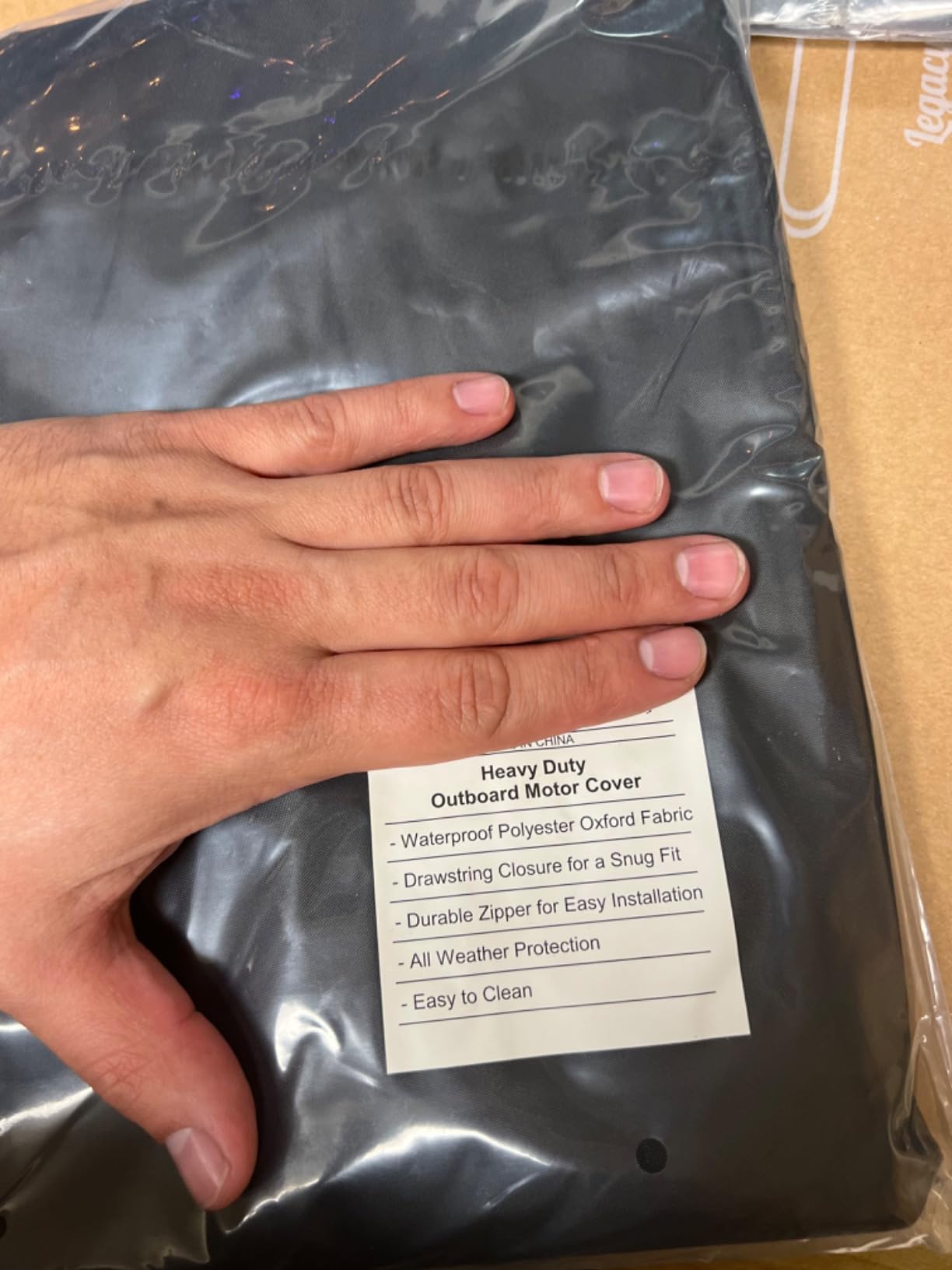
Owners consistently mention two things: the coverage, and the fact that the drawstring and zipper together stop it lifting. On a boat that is parked outdoors in wind, having a positive closure as well as a drawstring is what stops the cover ending up in a car park somewhere down the road. The size range also means one brand can cover a small tender motor and a 300 HP V6 if you own both.
The tradeoff is the coating. PVC is the least breathable of the coatings in this roundup, which matters for a boat stored in a humid climate under a cover for weeks, and owners note the finish stiffens and cracks with age compared with PU-coated covers. If condensation under the cover is your concern, choose one of the PU-coated options instead. For an exposed trailer or a boat that lives outdoors in a dry climate, the full enclosure is worth the trade.
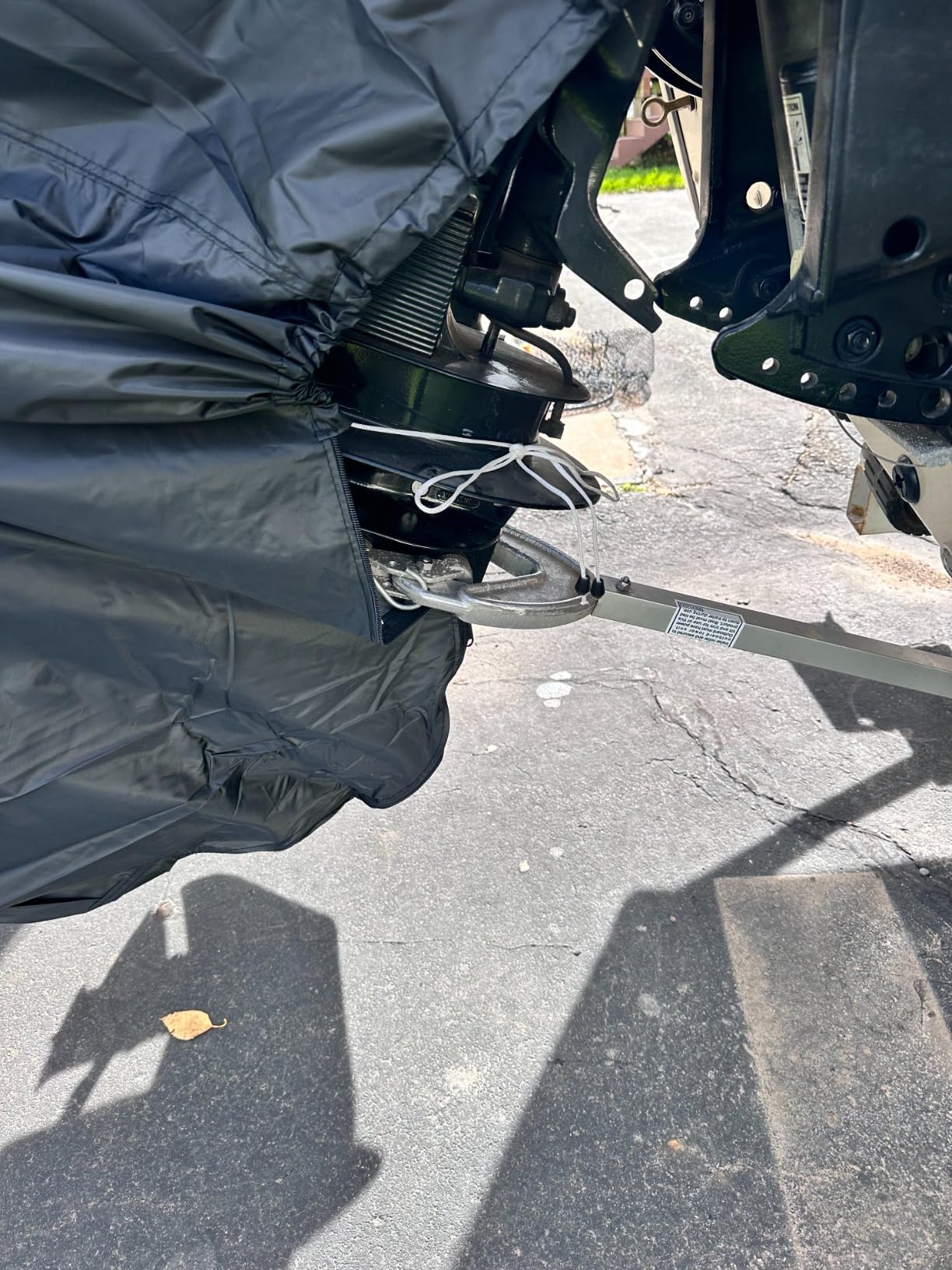
Best for trailering and exposed storage
This is the cover to pick if the motor spends its life on a trailer, on a dry-storage rack, or in a coastal yard where salt settles on everything. The full envelope plus zipper-and-drawstring closure is the most secure attachment combination in this list, and the eight size options cover almost any motor you are likely to own.
Where the material choice matters
Coating technology decides the character of the cover. PU-coated 600D is softer, more breathable and better in heat and cold. PVC-coated oxford is tougher against abrasion and road debris but less breathable and slower to recover once stiff. Match the coating to where the boat lives, not to how tough it looks in a photo.
9. STEECA Waterproof Cover – Best Stern Rail Anchoring
STEECA Waterproof Outboard Motor Cover Fits 115-225 HP, Grey
- Shaped hem follows the motor-to-transom curve
- Strap anchors to the stern rail so it will not lift
- PU-coated 600D with taped seams
- Fits most 115-225 HP outboards
- Horsepower labels are approximate
- Covers the cowling only
- no leg protection
- Shows salt and mud in grey
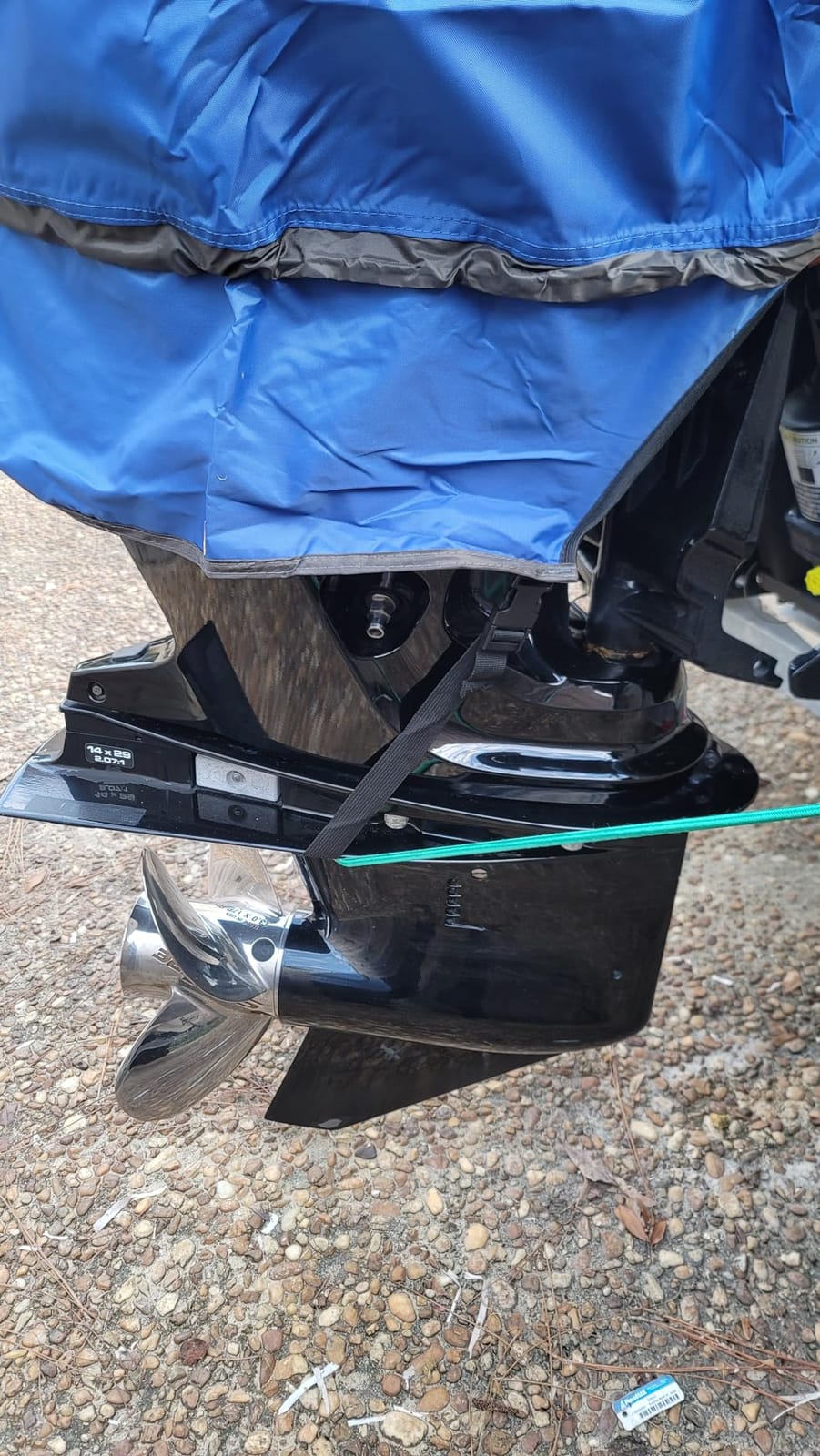
The design detail that sets this apart is the arc-shaped elastic hem with a cord lock. Instead of a straight band around the bottom, it follows the curve where the motor meets the transom, which is the point where a baggy cover gaps open and lets spray in. Combined with the extended adjustable buckle strap that anchors to the stern rail, it is the most securely attached universal cover in this roundup.
Size is 30 inches deep by 26 inches wide by 30 or 38 inches high for 115-225 HP engines, and the fabric is 600D marine-grade polyester with a waterproof PU coating, double stitching and seam sealing tape. That coating and those taped seams are what owners say keep water and road spray out, which matters more than it sounds for a product that sits in sun and salt.
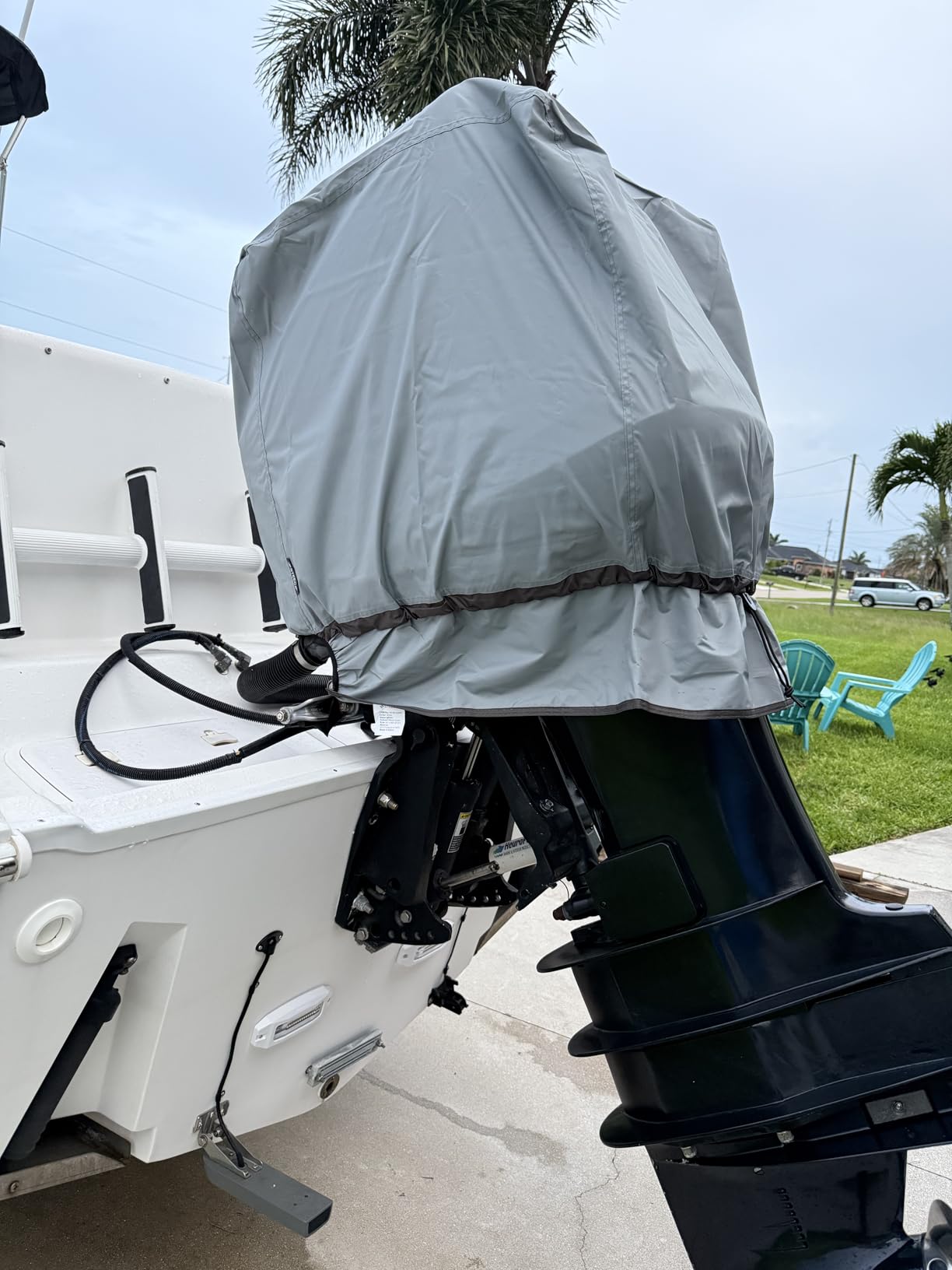
Reviews focus on the two attachment features rather than the fabric, which tells you what buyers actually notice. The hem and the stern rail strap are the features they say keep the cover planted, and the PU coating with taped seams is what they say keeps water and road spray out. The consistent advice across reviews is to measure the cowl, because the horsepower labels are approximate.
Two limits. It covers the cowling only, so the lower unit leg gets no protection from a cover that does not reach down, and the grey colour picks up salt and mud quickly on a boat that is in the water. Neither affects protection of the plastic, and for a stern rail that gives you a solid anchor point, the strap is the best retention system here.
Best for boats that get towed at speed
Highway trailering is where cover retention is tested hardest. A buckle strap tied to the stern rail is a mechanical attachment that does not depend on elastic tension, so it survives sustained road speed and crosswinds in a way a plain hem does not. If your trailer has a solid stern rail, this is the one to fit.
What it does not cover
Keep expectations straight about scope. This is a cowling cover, not a full engine cover, and the lower unit, prop and cavitation plate stay exposed. It also does not address the vent question, so for long-term damp storage check underneath periodically rather than assuming the cover is doing all the work.
10. iCOVER Small Engine Cover – Best for 2.5-25 HP Motors
iCOVER Outboard Motor Cover Heavy Duty 600D Waterproof Engine Hood Covers, 23″ DX13.5 WX16.5 H
- Accurate sizing for small outboards and tenders
- Drawcord cinches tight in wind and travel
- Hoses clean easily
- Fabric is lighter than the heavy duty label suggests
- Drawstring can break or dry rot
- Listed dimensions do not always match the actual cover
Small outboards get ignored because they cost little to replace, and then the cowling fades anyway. This cover is sized at 23 by 13.5 by 16.5 inches for 4-stroke engines from 2.5 to 10 HP and 2-strokes up to 25 HP, which is the range that covers most dinghies, jon boats, tenders and portable motors. If you are shopping for one of those, the electric outboard guide covers the other power option for small craft.
The fabric is 600D oxford polyester with a water-resistant PVC coating, double-line stitching, high-density bound seams and an elastic polyester drawcord hem with a smooth bound edge. It fits Mercury, Yamaha, Honda, Suzuki and Nissan, and it hoses clean, which matters on a motor that lives in a dinghy in salt water.
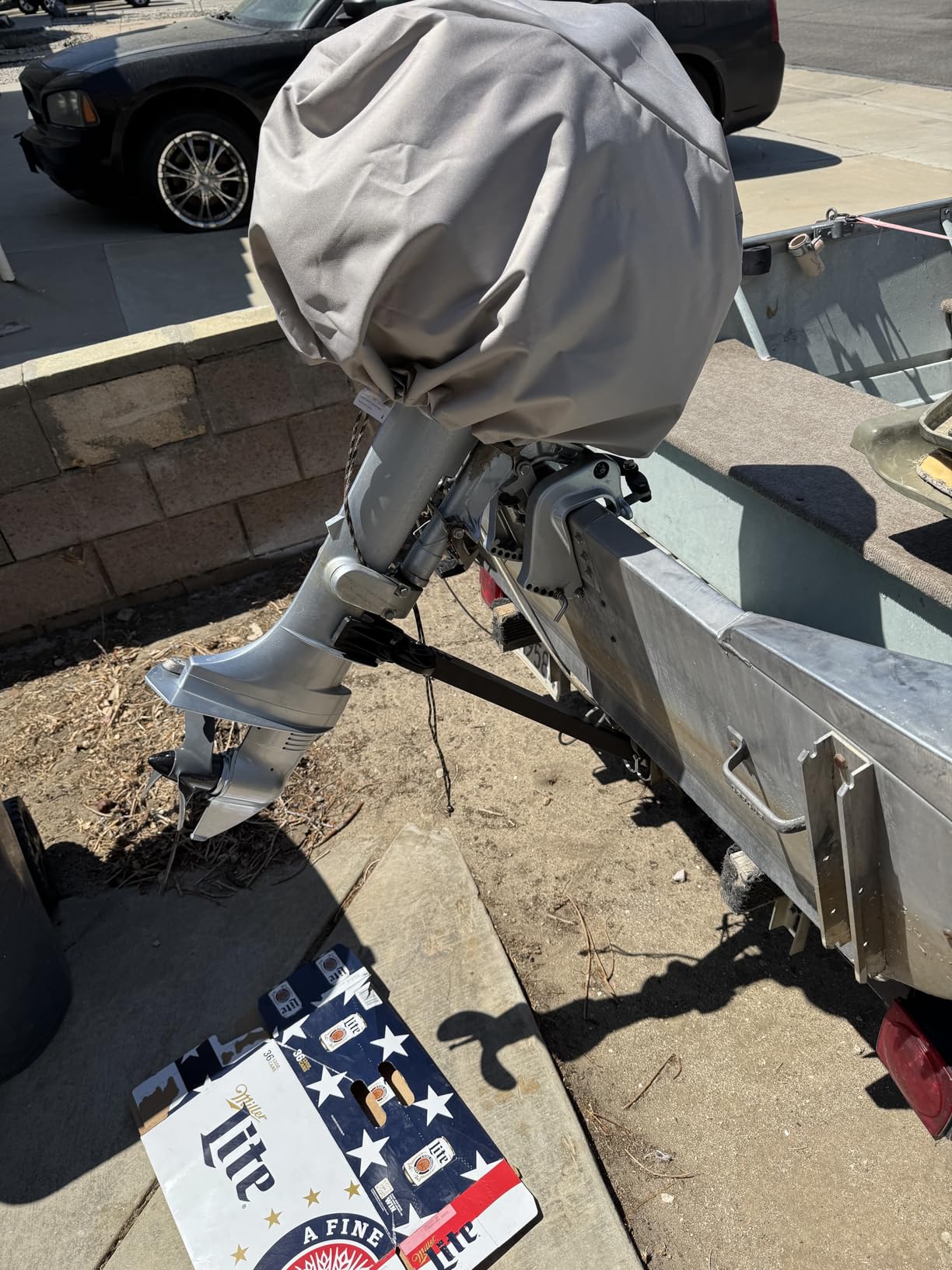
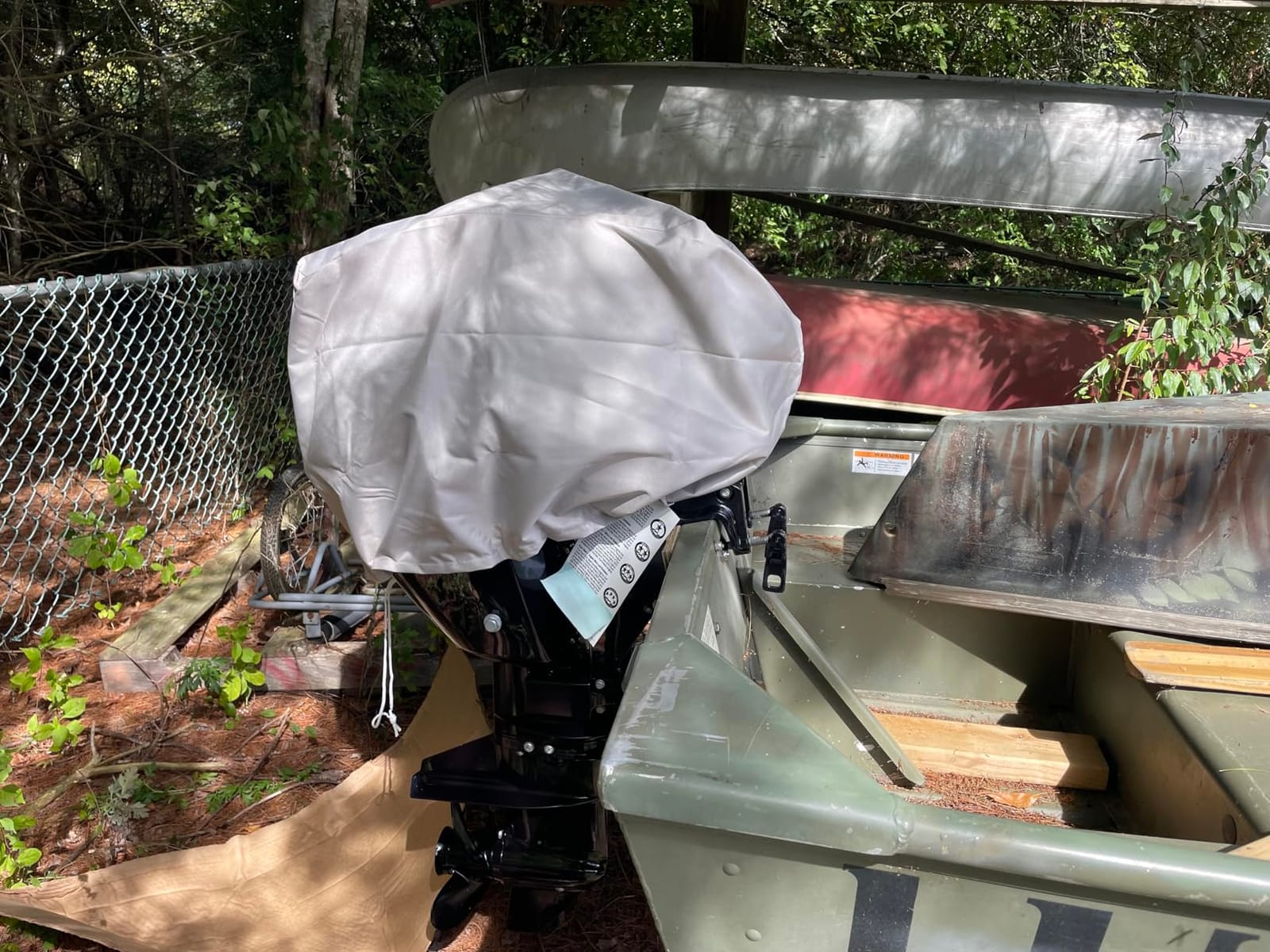
Owners rate it as good value and single out the drawcord, which cinches down tightly and survives wind and travel. It is also used beyond boats, on tillers and small equipment, which says something about how simple the fit is. The rating is the lowest of the ten and the reason is consistent across reviews: the fabric is thinner than the heavy duty label implies.
Two more gripes appear repeatedly. Owners report the drawstring breaking or dry roting, sometimes replacing it with paracord, and the listed dimensions do not always match the physical cover, so measure rather than trusting the number. It is a simple, cheap, functional cover, and for a small motor that is the right level of protection.
Best for tenders, dinghies and small motors
For a motor that is fitted and removed frequently, the simplicity wins. No zippers to snag, no buckles to line up, just a bag and a drawcord you can pull one-handed. It stores small enough to live in the boat, which is where a cover for a portable motor actually needs to be.
What to watch with this one
Replace the drawcord with a fresh length before the first long trip, and check it every season in salt air, since dry rot in the cord is the failure mode owners actually report. If your small motor is a high-gloss cowling you want to keep showroom fresh, expect the unfabric-lined interior to scuff slightly over time.
How to Choose the Right Outboard Motor Cover?
Start with three questions: is the engine coming out of the water, is it being towed, and is it running while the cover is on it. Almost every wrong purchase comes from answering those in the wrong order.
1. Match the engine, not the horsepower
Horsepower buckets exist because they are easy to sort, not because a 115 HP engine and a 225 HP engine share a shape. Measure three things: the widest point of the cowling, its depth front to back, and the height from the transom to the top of the cowl. If the cover is generous on all three, it will flap, and a flapping cover chafes the very plastic you are trying to protect. If it is tight, it may not go on over the steering handle.
2. Decide whether the cover ever comes off while the engine is hot
For almost every cover in this roundup, the answer is no. A running engine puts a great deal of heat into the cowling, and a sealed cover over it traps that heat against UV-sensitive plastic. The exceptions are covers specifically designed and sold for running and trolling, which are shaped with airflow in mind and are not the products reviewed here. If you troll for hours under a cover, take the cover off or use a running-rated product.
3. Choose the coating for the climate
PU-coated 600D polyesters and oxford cloths are softer, more breathable and better across temperature extremes. PVC-coated covers are tougher against abrasion and road debris but are less breathable and stiffen with age. Solution-dyed fabric holds colour longest. In cold climates the cold rating matters more than anything; in humid climates venting matters more than anything.
4. Look at retention, not just fabric
A drawstring hem is the minimum. A buckle strap to the stern rail, quick-release clips, or a zipper paired with a drawstring are meaningfully better on a boat that is exposed to wind or towed at speed. The difference shows up as a cover that is still where you left it in March.
5. Check the warranty and the care instructions
Warranties on these covers vary from as little as a year on some models, so the length is a reasonable proxy for how the manufacturer expects the cover to be treated. Wash the cover with mild detergent and fresh water, let it dry fully before folding it, and never fold a damp cover into its bag. Salt crystallises in the fibres and then cuts them, and mildew in a folded bundle does the same thing.
6. Buy for the whole boat, not just this motor
Owners with a dinghy, a tender and a main boat often end up buying the same brand across sizes so the covers match and the hardware is familiar. That is a small convenience, but the more useful habit is to check the cover fits before you leave the dock, and to never cover a hot engine on the spur of the moment because you forgot to remove it at the ramp.
Frequently Asked Questions
Should you cover your outboard motor?
Yes, if the boat is out of the water for more than a few hours. An outboard cowling is UV-sensitive plastic, and covering it slows photo-oxidation, keeps salt spray and road debris off the connectors, and stops bird droppings and tree sap staining the finish. Let the engine cool first, and check underneath periodically during long-term storage, since a cover can trap moisture against the cowling if the fabric is not breathable.
What is the top cover of an outboard motor called?
It is called an outboard motor cover, and you will also see it described as a cowling cover or a boat motor cover. The cowling is the plastic outer shell over the engine, and the cover is the fitted or universal fabric shell that goes over it. Many manufacturers also call the storage version a cowling storage cover to distinguish it from a full engine hood that extends down over the lower unit.
What material is best for an outboard motor cover?
Marine-grade 600D polyester or oxford cloth with a PU coating is the best all-round choice, because it is waterproof, tear resistant, softer than PVC and more tolerant of temperature extremes. Solution-dyed polyester holds colour longest since the dye is in the fibre rather than on the surface. PVC-coated oxford is tougher against abrasion but is less breathable and stiffens with age. Acrylic canvas is the premium option and outlasts all of them when the budget allows.
Can you run an outboard motor with the cover on?
Only with a cover that is specifically designed and rated for running, which is not most of them. A running engine puts substantial heat into the cowling, and a sealed fabric cover over it traps that heat against plastic that is already degrading under UV exposure. Most storage covers state storage use only. If you need cover while trolling, either remove the cover before you start the engine or buy a running-rated vented cover made for that purpose.
Do outboard motor covers prevent corrosion?
They reduce it rather than prevent it. A cover keeps salt spray, rain and UV light off the cowling, connectors and harnesses, and a breathable or vented construction lets condensation escape instead of sitting on the metal. It does not stop corrosion that starts from water already inside the engine or from a damaged paint coating underneath, so flushing the engine with fresh water after every saltwater trip still matters as much as the cover.
Final Verdict
The best outboard motor cover depends almost entirely on whether you need storage, trailering or running protection, and on the shape of your cowling. For most people, the Explore Land 600D universal cover is the right answer: sealed seams, a rear air vent, positive rear straps and the largest owner base in the group to prove it works.
If you live in hard sun, the Zettum’s stated three-year UV ageing rating is the feature that matters. If you want to spend as little as possible on a mid-size motor, the FLYMEI does the job with a zip-on fit and a drawstring hem. Yamaha V6 owners should look at the Oceansouth custom pattern, large V6 and V8 owners at the Softclub 250-350 HP cover, and northern boaters at the VINPATIO for its cold rating.
Whatever you choose, measure the cowling rather than trusting the horsepower label, let the engine cool before covering it, and wash it with fresh water at the end of every season. That habit alone extends cover life more than any fabric upgrade.