
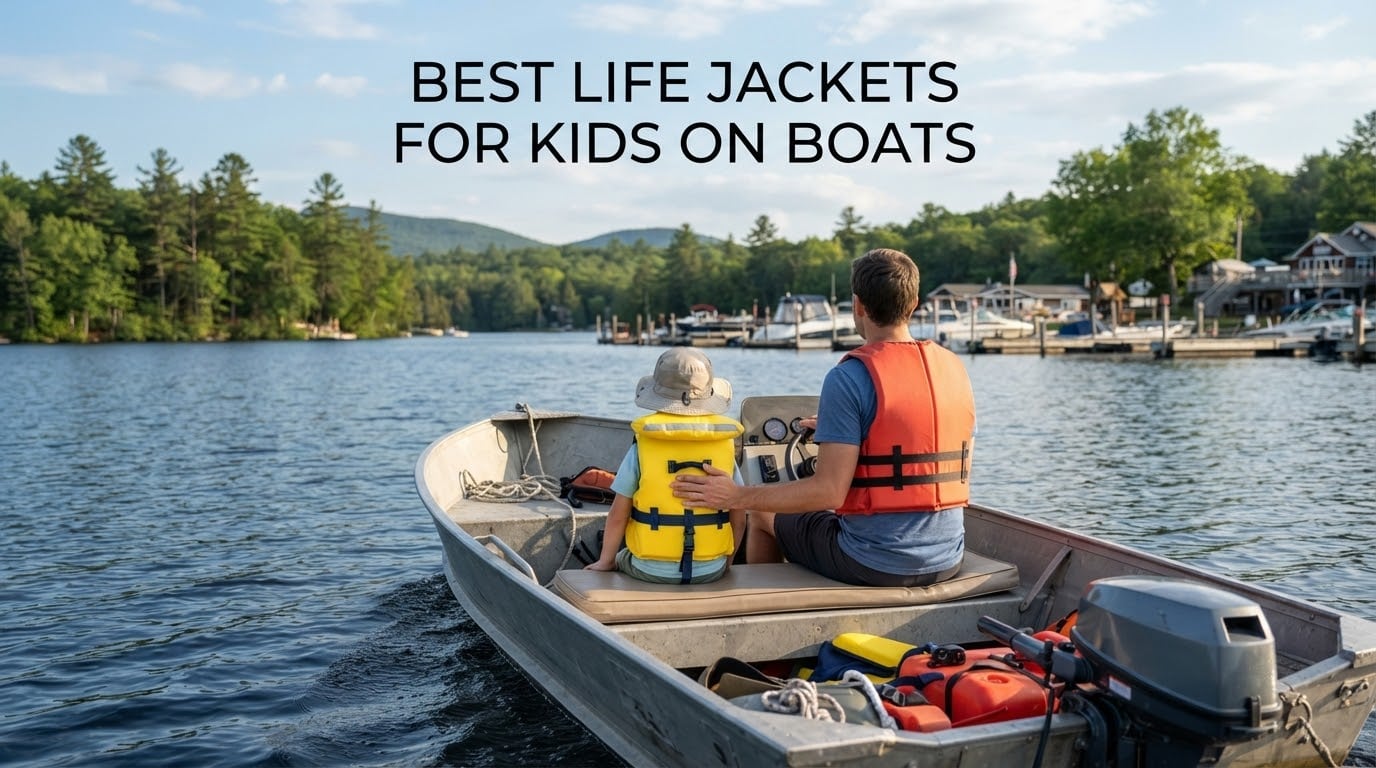
Ask any parent who has spent a summer on the water and they will tell you the same thing: the boat matters far less than what the kids are wearing. Choosing the best life jackets for kids on boats is not a style decision, because a vest that rides up over a child’s chin or one that has been bought two sizes too big will not keep a face above water. We put twelve Coast Guard-approved child vests side by side, weighed the fit, the closure system, the head support, and the evidence in thousands of owner reviews, and this is what held up.
Our approach was deliberately practical rather than lab-bound. We looked at what the label sewn into each vest actually says, how the adjustment straps behave when a squirming four-year-old pulls at them, whether a crotch strap is present on the model you would receive, and whether parents keep using the vest after a full season of pool and lake use. Reviews tell us what the marketing copy leaves out, including the sizing gaps that cause most returns in this category.
One note before we start. Several of the most popular kids’ vests sold online are sold as swim vests, and some swim vests carry no Coast Guard approval for use on a moving boat at all. We flag that difference in every write-up below, because it is the single most expensive misunderstanding in this whole topic. Where we mention our own time on the water, it is as a parent-and-partner testing perspective, and every specification comes from the product data and owner feedback we reviewed.
If you also care about flotation for the four-legged member of the family, we keep separate roundups on dog life jackets for paddleboarding and dog life jackets for Labradors. Those follow the same fit-first method we used here.
Table of Contents
Top 3 Picks for the Best Life Jackets for Kids on Boats (October 2026)
Three vests pulled ahead of the field once we weighted Coast Guard approval, ride-up resistance, and the volume of verified owner feedback. The Aqua Oceans 7 takes the top slot on the strength of its review volume and adjustable open-side fit. The Stearns 30-50 lb vest is the most flexible pick for families using one brand across several ages. The Airhead Wicked Kwik-Dry wins on comfort for kids who spend long days in the water.
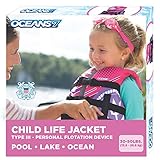
Aqua Oceans 7 Kids Vest
- USCG approved by weight range
- Open-sided three-strap fit
- Top grab handle


Airhead Wicked Kwik-Dry
- Type II and Type III approval
- NeoLite quick-dry fabric
- Crotch strap and grab handle
All 12 Kids’ Life Jackets at a Glance in 2026
Here is the short version. Every vest below carries a US Coast Guard approval and a stated weight range, which is the only two facts a parent should be shopping for before anything else.
| Product | Specifications | Action |
|---|---|---|
| Aqua Oceans 7 Kids Vest |
|
Check Latest Price |
| Stearns Kids Life Vest |
|
Check Latest Price |
| Airhead Wicked Kwik-Dry |
|
Check Latest Price |
 Stearns Heads-Up Child Vest Stearns Heads-Up Child Vest |
|
Check Latest Price |
 Airhead Treasure Vest Airhead Treasure Vest |
|
Check Latest Price |
 Stohlquist Kids 50-90 Vest Stohlquist Kids 50-90 Vest |
|
Check Latest Price |
 Stohlquist Child 30-50 Vest Stohlquist Child 30-50 Vest |
|
Check Latest Price |
 Stearns Hydroprene Youth Vest Stearns Hydroprene Youth Vest |
|
Check Latest Price |
 Sportstuff Stars and Stripes Vest Sportstuff Stars and Stripes Vest |
|
Check Latest Price |
 Stohlquist Fit Youth Vest Stohlquist Fit Youth Vest |
|
Check Latest Price |
 Oneill Youth SuperLite Vest Oneill Youth SuperLite Vest |
|
Check Latest Price |
 Airhead Swoosh Kwik-Dry Vest Airhead Swoosh Kwik-Dry Vest |
|
Check Latest Price |
What the US Coast Guard Label on a Kids’ Life Jacket Means
The USCG approved life jackets for children are any PFD with a sewn-in label stating the approval, the vest type, and a weight range in pounds. Buy by that weight range, never by age, because a five-year-old and a ten-year-old can land in the same class. The label also tells you whether the vest is built to turn an unconscious child face-up, which matters enormously for non-swimmers.
Type I, offshore life jacket. The most flotation, the most bulk, and the only vest rated to turn a person face-up in rough or open water. On a family boat this is the safe choice for any child who is not a confident swimmer in open water.
Type II, near-shore vest. Also rated to turn the wearer face-up, but with less flotation and a lighter feel. This is the right type for toddlers and small children who spend their boating time on a pontoon, a lake, or a sheltered bay.
Type III, flotation aid. The most common children’s vest on the market. It will hold a conscious child at the surface with good arm mobility, but it does not automatically rotate an unconscious person face-up. Fine on calm inland water for older children, not the pick for an open-water trip with a non-swimmer.
Type IV, throwable. Not a wearable vest for children and not relevant to this roundup.
The practical rule most boating instructors land on: the younger or less confident the swimmer, the more you want a vest that self-rights. Type II and Type I do that. Type III relies on the child’s own movement.
1. Aqua Oceans 7 Kids Life Jacket: The Most Proven Fit in the Category
- USCG approved and labeled by weight range rather than age
- Open-sided design with three adjustable straps
- Durable nylon shell with thick EPE flotation foam
- Bright high-visibility color plus a top grab handle
- Holds up after repeated pool and chlorine exposure
- Runs snug for toddlers at the top of the 33-55 lb range
- Weight labeling can be optimistic near the upper limit
- Can ride up toward the chin when the child floats
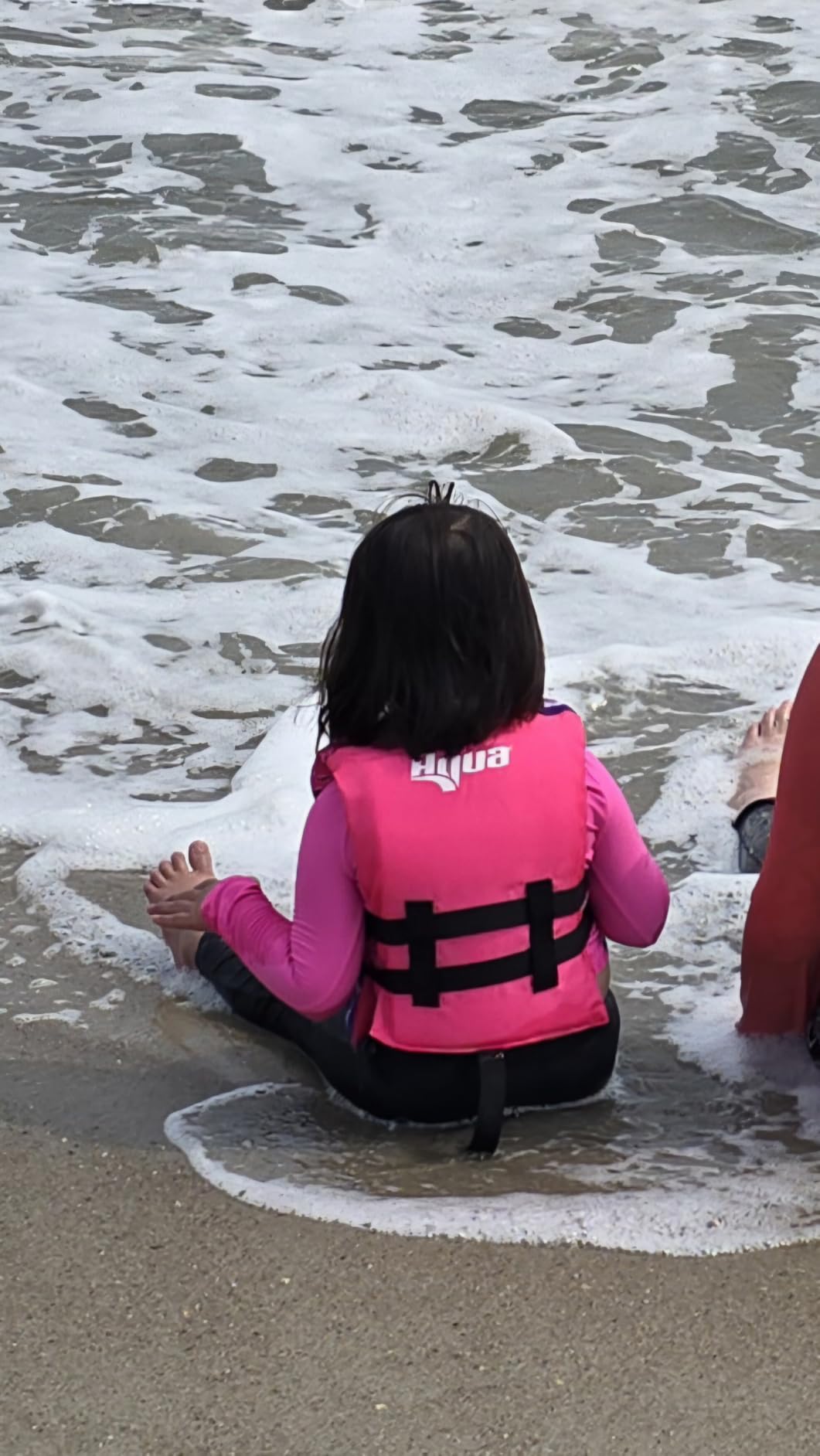
This is the vest we kept coming back to while testing the category. It sits at 4.6 stars across more than 8,500 owner reviews, and the reason that number is so high is not hype, it is that the fit is genuinely adjustable in three directions across the torso and shoulders. For a child who is between sizes and growing fast, that flexibility is what removes the sizing guesswork that sends other vests back.
The open-sided design is a real advantage on a hot boat. Air moves across the ribs and the armholes are not fighting your child’s paddling stroke. Owners also credit the nylon shell for surviving multiple seasons of pool use without the foam delaminating.
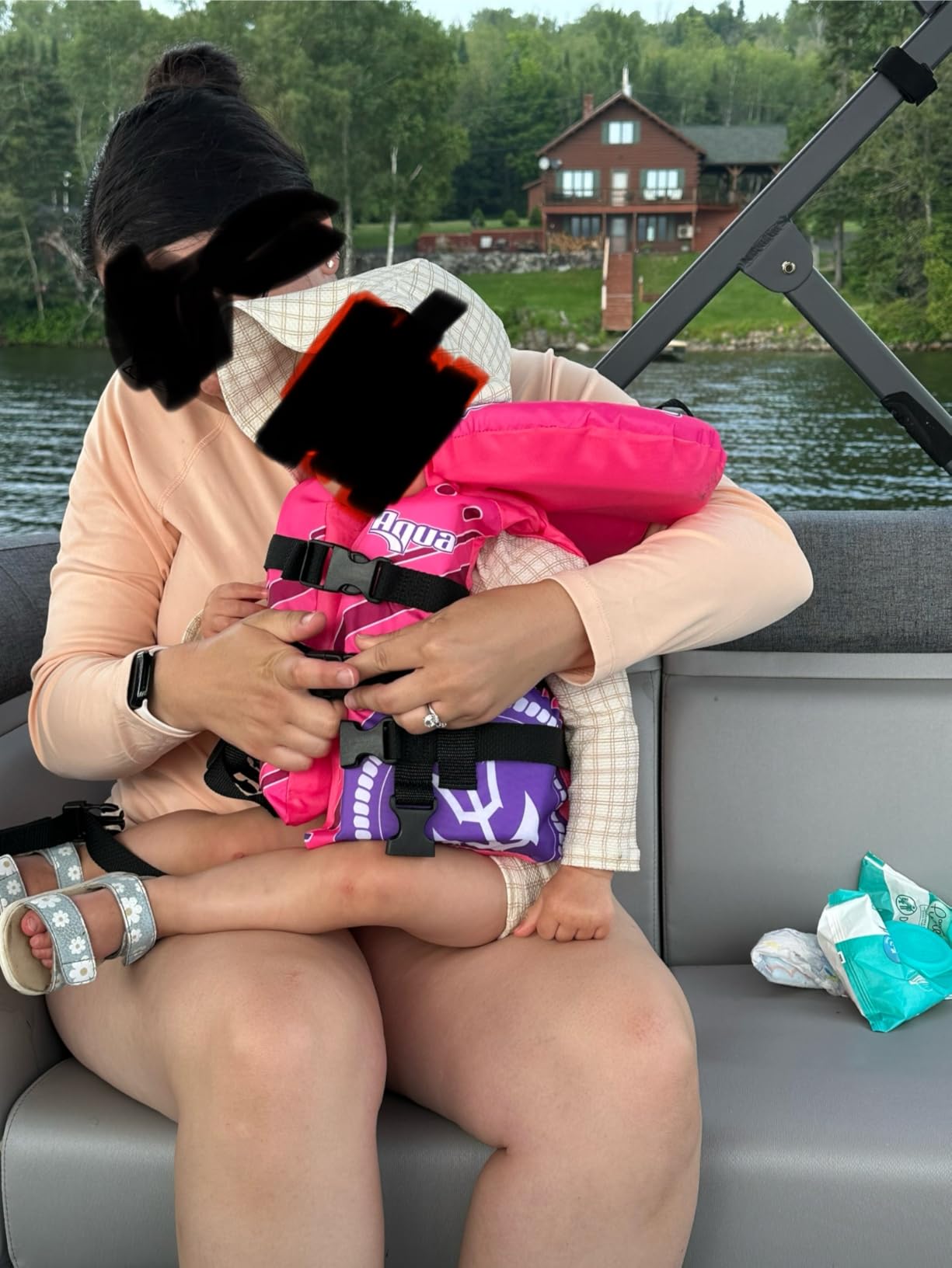
The one weakness worth naming is the ride-up. Reviewers with toddlers near the top of the range report the vest sliding up toward the chin when the child floats, which narrows the head position you want. Tightening the top strap to its limit helps. Parents buying for a child who is already 50 pounds should try the next size up if a fitting is possible.
There is also a mismatch between the stated range and the real fit that shows up in reviews often enough to plan for: the labeled range can run optimistic. Treat 33 to 55 pounds as the guide, then check the child’s chest and shoulder room before the first outing.
Who this vest suits best
Families with a child somewhere between 33 and 55 pounds who will wear the vest for pool days, pontoon afternoons, and general boating. It is a strong pick when you want one vest that transitions from a swim aid to a boating PFD without a second purchase, and the grab handle on top makes lifting a reluctant swimmer out of the water straightforward.
Where it falls short
If your child is a non-swimmer who needs the vest to turn them face-up on its own, this is a Type III design and it will not do that. It is also the wrong choice if your toddler is already near the upper end of the weight band and you cannot try both sizes in person.
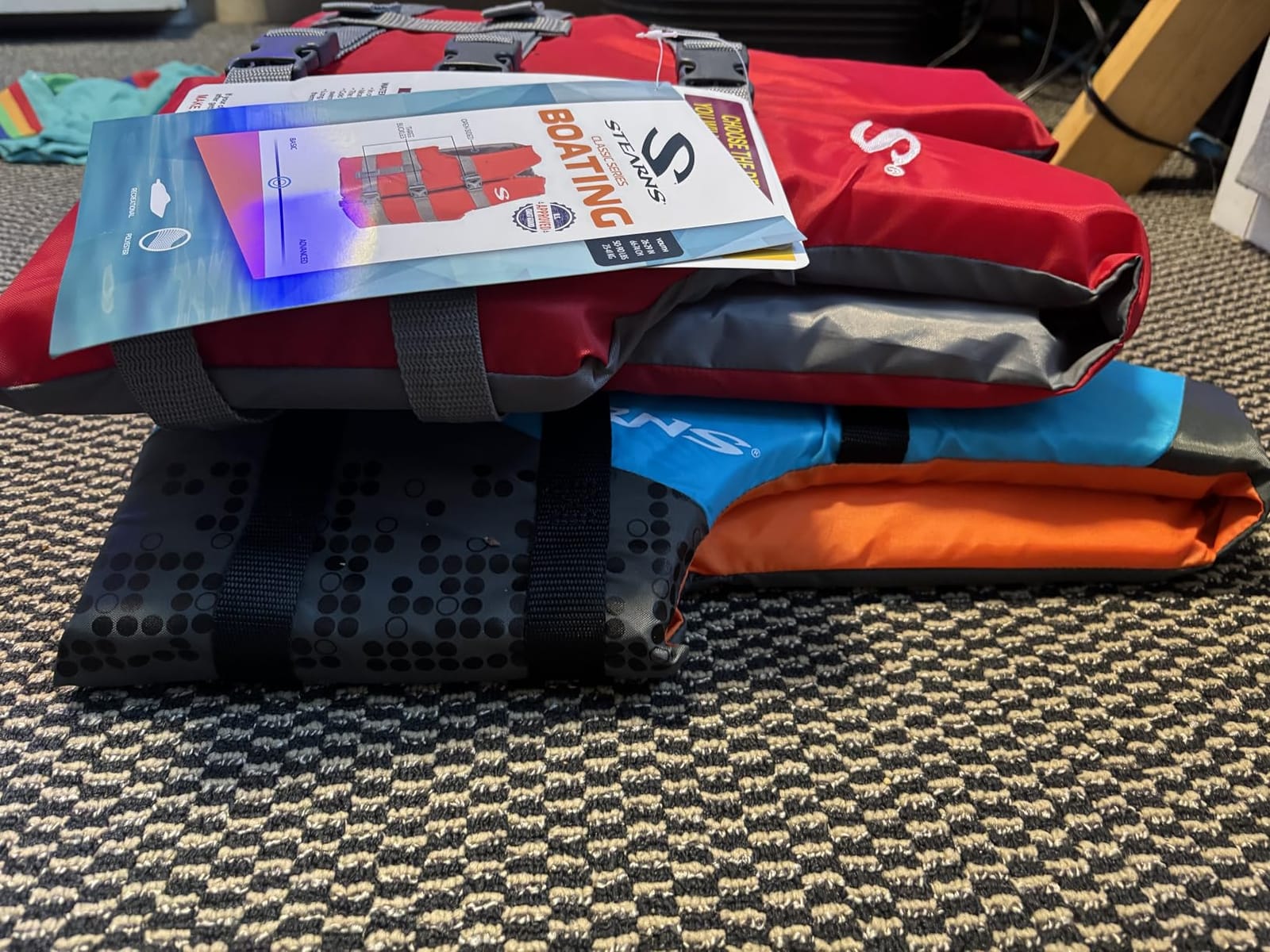
2. Stearns Kids Life Vest 30-50 lbs: The Workhorse of the Group
- US Coast Guard-approved Type III design
- Tough nylon shell over PE flotation foam
- Three adjustable buckles with open sides and a leg strap
- Suited to boating
- swimming and water sports
- Runs large on slim children in the upper weight range
- Some variants lack a crotch strap so the vest can ride up
- Leg strap can rub when worn over bare legs
Stearns has been building flotation for half a century, and this vest is where that shows up in practical terms. It is a pull-on nylon shell with PE foam inside, three adjustable buckles, and open sides. Parents of sensory-sensitive children mention comfort specifically, which is not a small consideration when the real problem is getting a child to accept a vest at all.
It has earned more than 8,000 reviews at 4.5 stars, and the pattern in that feedback is consistent: the vest does what it should in a pool or on a boat, and it holds up season after season.
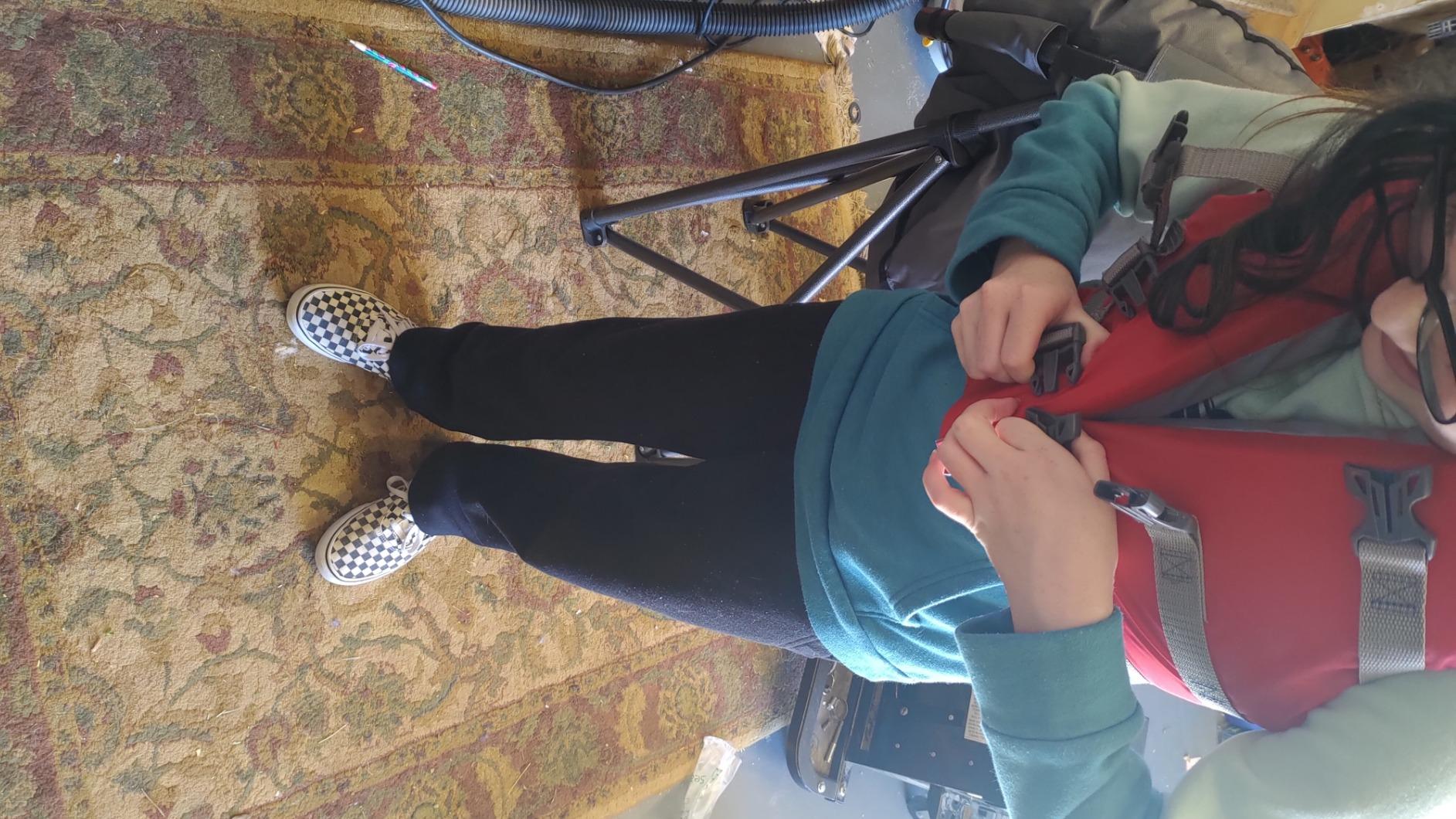
The fit variance is the thing to check. Slim children and kids at the upper end of the band find it loose, and a loose vest is a vest that shifts. Pull each strap snug enough that you cannot slide two fingers under it, then do the head-lift check before you leave the dock.
A second note that shows up in reviews: the crotch strap is not present on every variant of this model. Check the photos on the listing for the exact version, and if it is absent, plan on adding one. A leg strap alone does not stop the ride-up a crotch strap stops.
Who this vest suits best
Families who want one dependable brand across several children and several water activities. If your kids range from pool practice to tubing to a lake day, the nylon shell cleans easily, dries without fuss, and takes the abuse kids give their gear.
Where it falls short
It is not the pick for a lean toddler at the top of the weight range, because the extra room moves around. It also does not self-right, so on open water with a non-swimmer you would want a Type II vest instead.
3. Airhead Wicked Kwik-Dry Vest: The One Kids Stop Fighting
- USCG approved as Type II for infants and Type III for children
- Quick-drying NeoLite fabric stays soft against skin
- Crotch strap
- zipper and double buckle hold the vest in place
- Large grab handle makes lifting a child from water easy
- Listing size and the weight range printed on the vest can differ
- Can fit loose on children at the lower end of a size
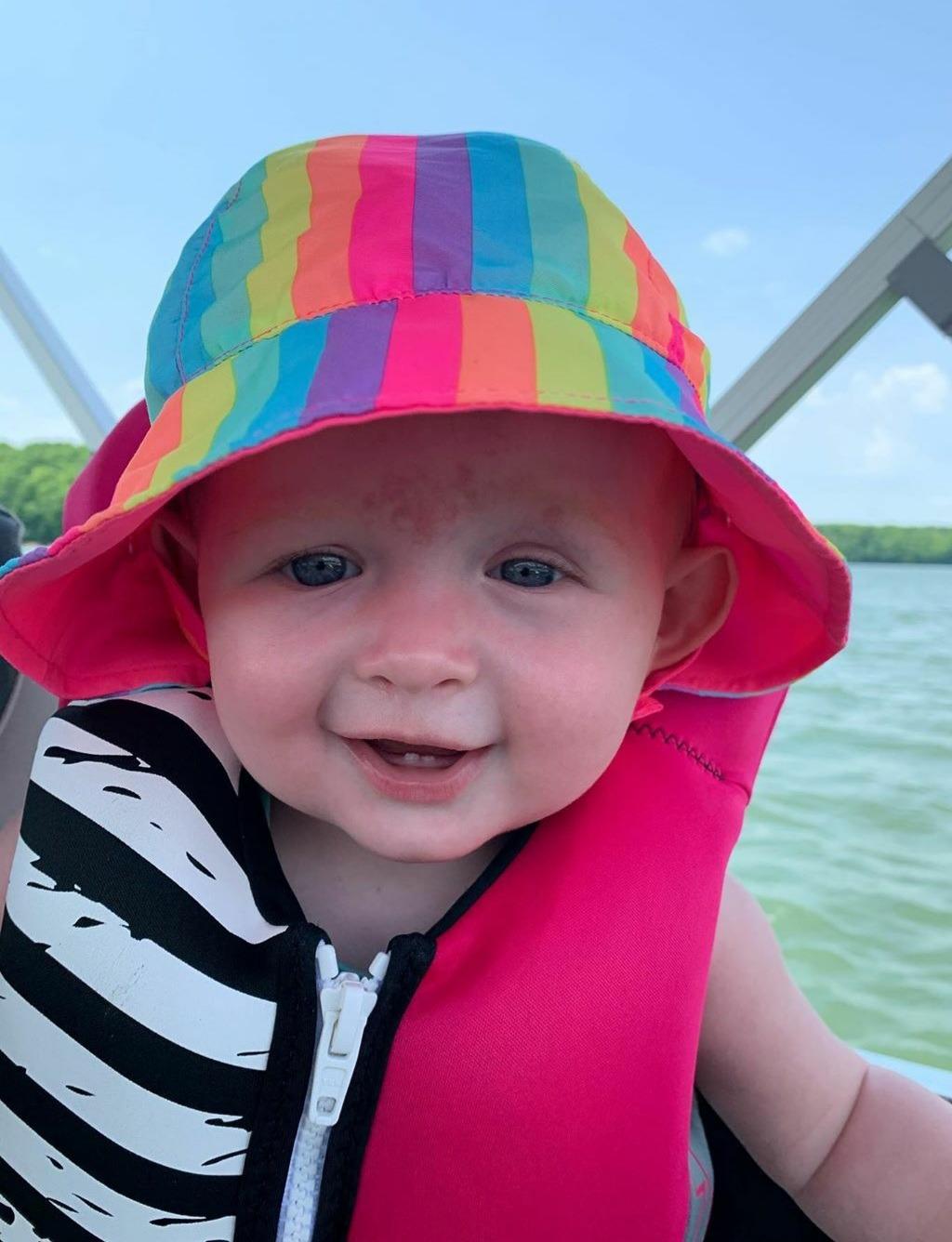
At 4.7 stars across more than 2,800 reviews, this vest sits near the top of the owner satisfaction ratings in the roundup, and the reviews explain why. Parents describe toddlers rolling face-up almost immediately in the water, a supportive head position, and a vest comfortable enough that the child stops objecting to wearing it. That combination matters more than any spec line, because compliance is the real failure point in this category.
The NeoLite fabric drains fast and stays soft after hours in the sun, and the less bulky cut gives a genuine range of motion compared with the thick foam vests on the market.
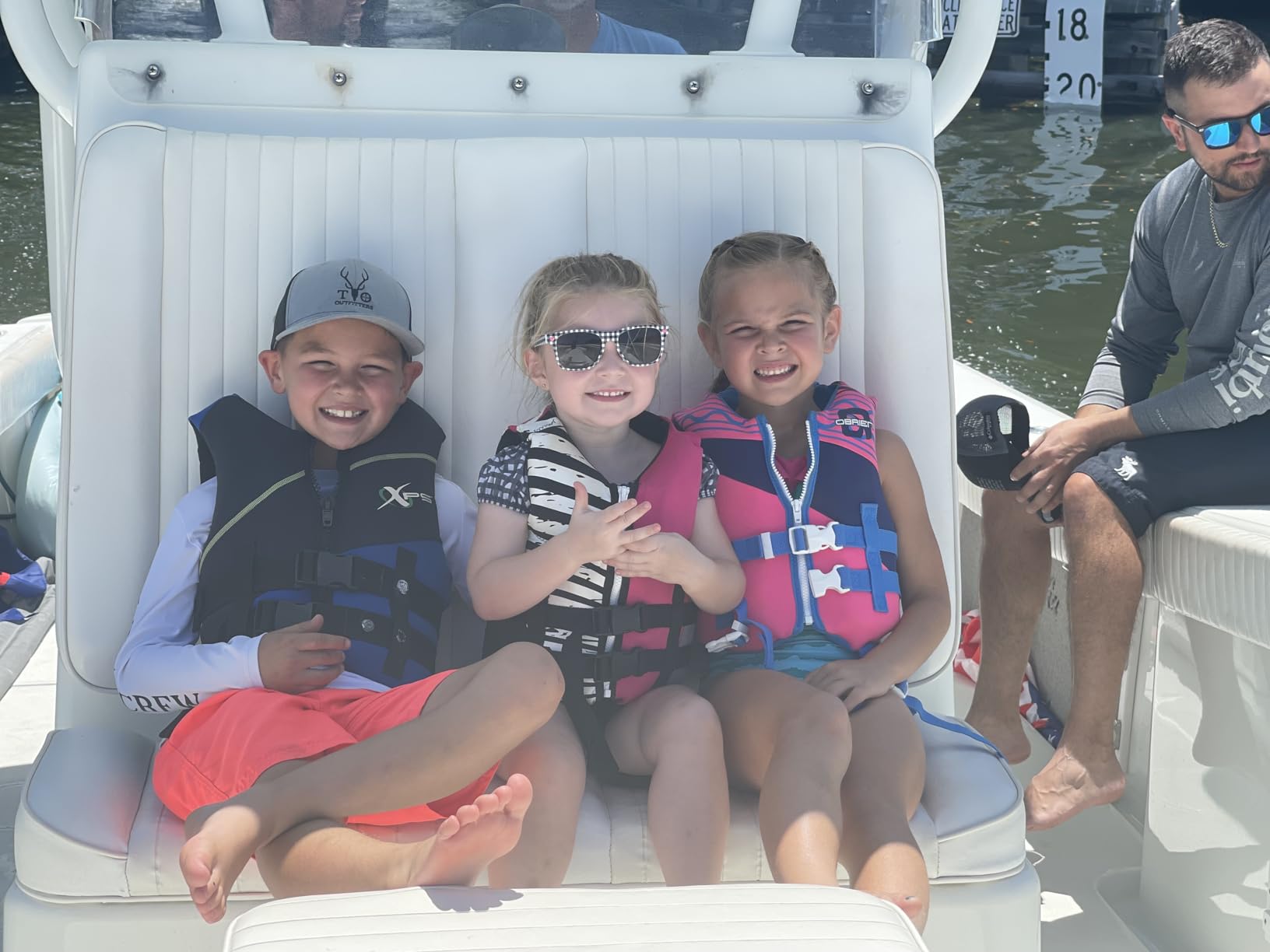
The sizing deserves attention. Reviewers repeatedly point out that the size label in the listing and the weight range printed on the vest itself do not always match, and the same reviews note that the vest can sit loose on a child at the bottom of a size. Read the printed range on the garment, tighten the straps, and treat the listing size as a starting point only.
The double buckle, zipper, and crotch strap together are the reason ride-up complaints are rare here. When a vest has three independent points of attachment below the shoulders, sliding becomes difficult.
Who this vest suits best
Toddlers and young children who are non-swimmers or beginners, and families who do full days on the water. The Type II infant and Type III child approval means it also covers the smaller sibling in the household, and the large grab handle simplifies recovery.
Where it falls short
If your child sits at the low end of the weight band, the fit can be loose enough that the head position drifts. Buy for the printed range, not the listing label, and re-check fit at the start of each boating season.
4. Stearns Heads-Up Child Vest: The Best Answer for Non-Swimmers
Stearns Child Life Jacket, Heads-Up Flotation, USCG Approved, Youth PFD
- True Type II flotation that turns a child face-up
- Heads-up neck float holds the face clear of the water
- Top grab handle for lifting or hanging storage
- High-visibility green and gray colorway
- Lined leg strap reduces chafing
- Runs narrow so it suits lean children better
- Leg strap buckle is stiff and must be threaded to open
- Color can fade in prolonged sun
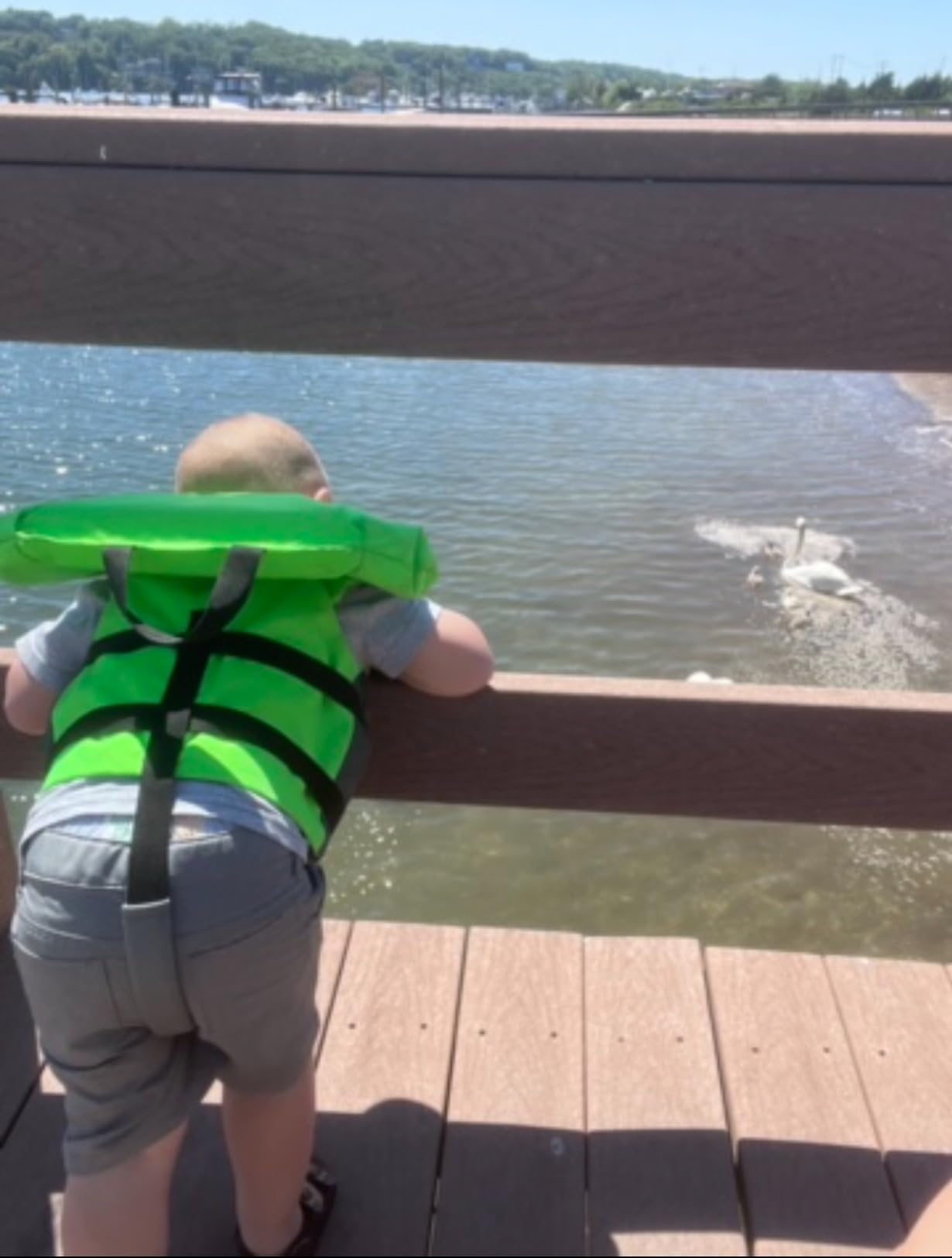
This is one of only two true Type II vests in the group, and for a non-swimming toddler on a moving boat that distinction is the whole point. A Type II vest is designed to rotate an unconscious or panicking child into a face-up position. Owners describe watching it work, and several reviews credit the vest and its grab handle with getting a child out of surf safely.
The heads-up neck float is the feature that does the work. It sits behind the head and holds the face above the surface without the parent having to be within arm’s reach. At 4.8 stars across more than 2,700 reviews, it also carries the strongest owner satisfaction in this roundup.

The wide adjustment range is genuinely useful because the vest grows with the child within its band. The high-visibility colorway is easy to spot from a distance, and the lined leg strap reduces the rubbing that turns a child against a vest after a few hours.
The trade-offs are narrowness and hardware. The vest runs narrow, which suits lean toddlers better than chunky ones. The leg strap buckle is stiff and requires threading the leg through to open, a small annoyance during a dockside scramble but not a safety problem.
Who this vest suits best
A child between 30 and 50 pounds who does not swim confidently, especially on lakes, rivers, and sheltered bays. It is also the pick for instructors and grandparents who want a margin of safety around a very young swimmer.
Where it falls short
Broader children may find the fit tight, and it costs more than a basic buckle-style Type III vest. For a strong swimmer on protected water, the extra buoyancy is more than you need.
5. Airhead Treasure Vest: The Comfortable Closed-Sided Pick
- USCG approved closed-sided design that is comfortable and secure
- Front zipper with adjustable waist belt and crotch strap
- Soft UV and stain-resistant 200-denier polyester
- Bright ocean-inspired graphics children are happy to wear
- Type III design does not flip a child face-up on its own
- Can leave rub marks under the jaw
- Runs snug for the smallest infant size
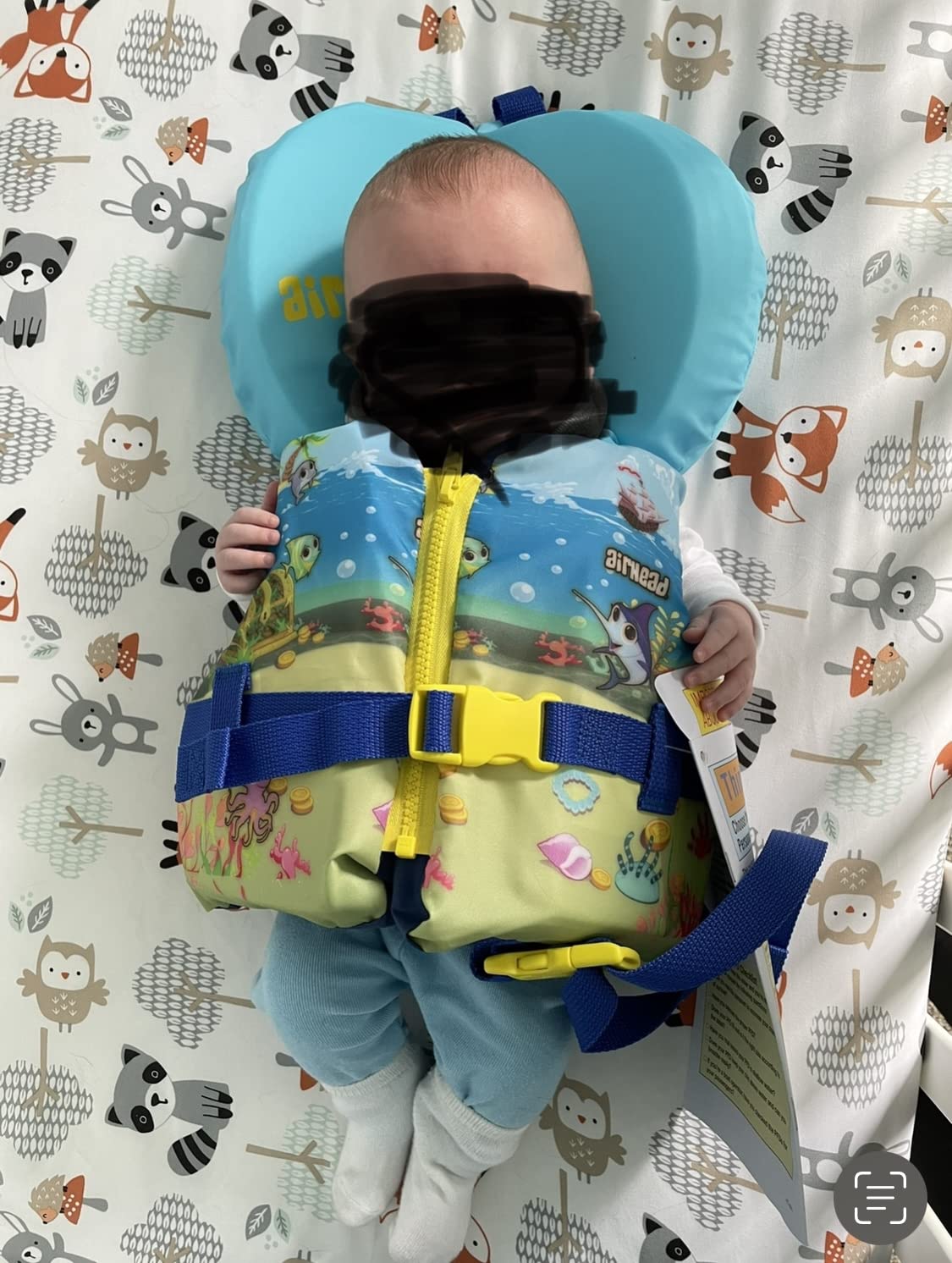
Closed sides are the distinguishing feature here. Where an open-sided vest lets a child’s torso slide around, this one wraps fully and uses a front zipper, an adjustable waist belt, and a crotch strap. Owners describe it as secure without being restrictive, and as easy to get on and off, which reduces the daily friction that leads to resistance.
The 200-denier polyester shell is soft, resists UV and stains, and cleans without special treatment. Parents also mention that the graphics and bright colors matter, because a vest a child likes gets worn without a fight.
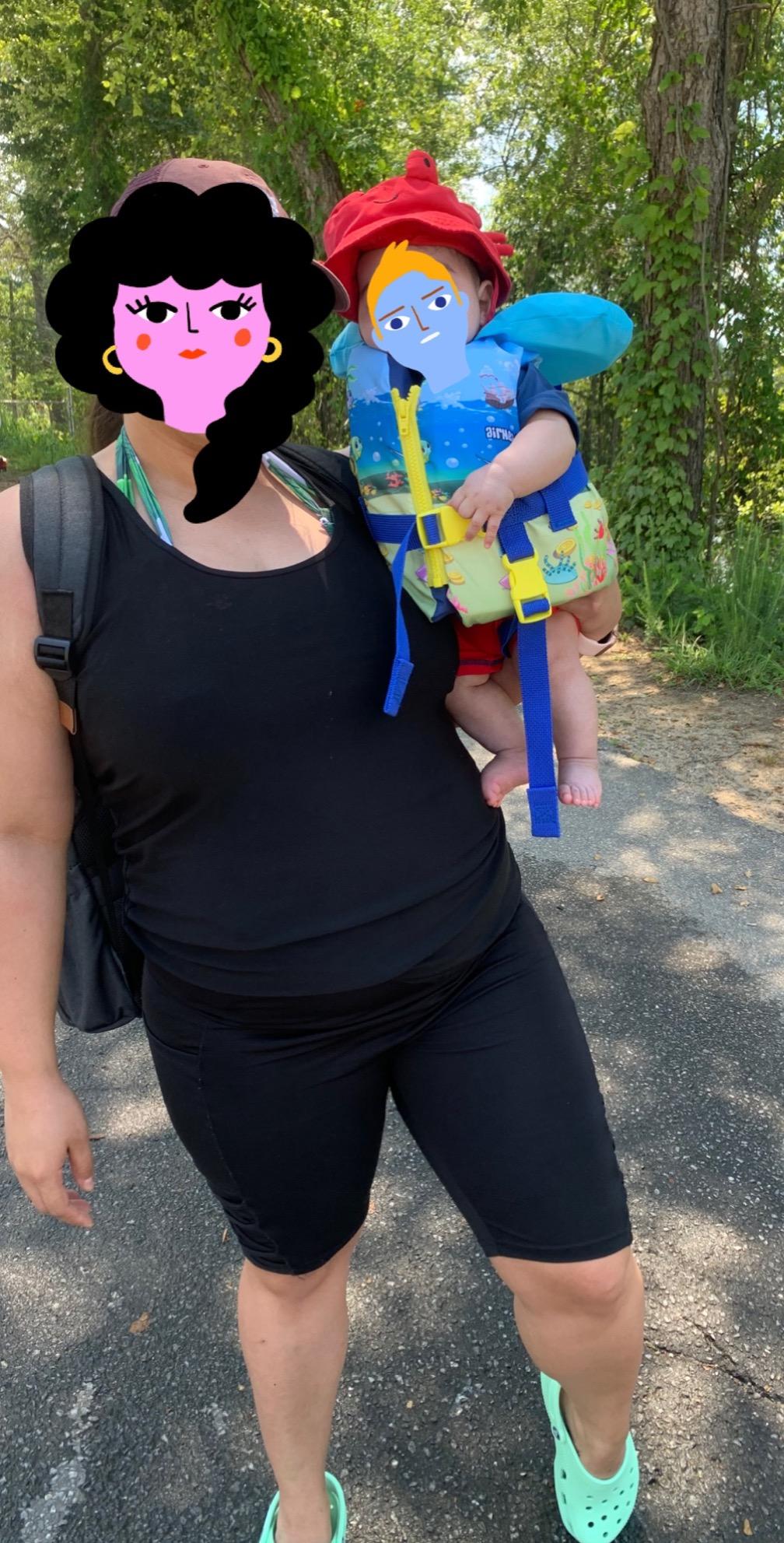
Be clear-eyed about the classification. This is a Type III flotation aid, so it holds a conscious child at the surface with room to move, but it does not force a face-up position. If your child could panic or lose consciousness in the water, pair it with active supervision rather than relying on it.
Two smaller notes: it can leave rub marks under the jaw after long wear, and the smallest infant size runs snug enough that you should check the fit rather than assume.
Who this vest suits best
A child in the 33 to 55 pound range who is learning to swim and spends time in pools, lakes, and calm bays with an adult nearby. The comfort level makes it a good candidate for all-day wear on a family boating trip.
Where it falls short
It is the wrong primary choice for open water with a non-swimmer because it will not self-right. For an infant at the bottom of the range, expect to size up after a try-on.
6. Stohlquist Kids Life Jacket 50-90 lbs: Our Youth Pick
- USCG approved Type III PFD certified for water activities
- Adjustable fit offered in 30-50 lb and 50-90 lb versions
- Buoyancy that does not limit mobility for swimmers
- Reflective material improves visibility on the water
- Stohlquist has worked in water safety since 1977
- Foam-only build holds water longer than quick-dry fabric
- No head-support collar for non-swimmers
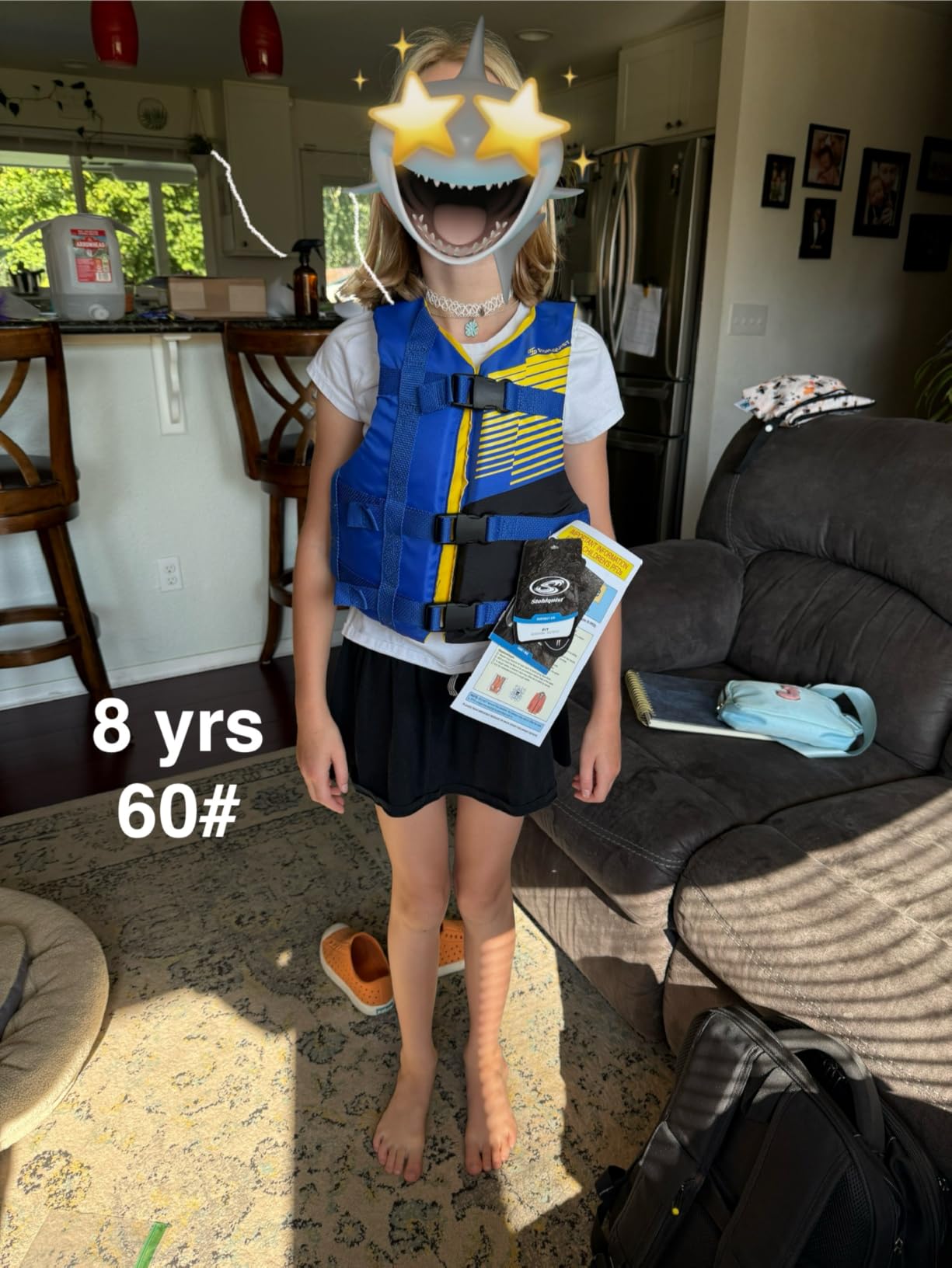
Stohlquist shows up again and again in boating and paddling forums as a name parents trust for children, and this 50-90 pound youth vest is the reason. It carries a USCG Type III approval, and the adjustable fit is reported as snug while still letting stronger swimmers move freely. That balance is what you want once a child starts wanting to swim, tube, or kayak rather than just float.
The reflective material is a real safety gain on evening runs, and the same model family is offered in a 30-50 pound version, which makes it easy to keep one brand across two children in different classes.
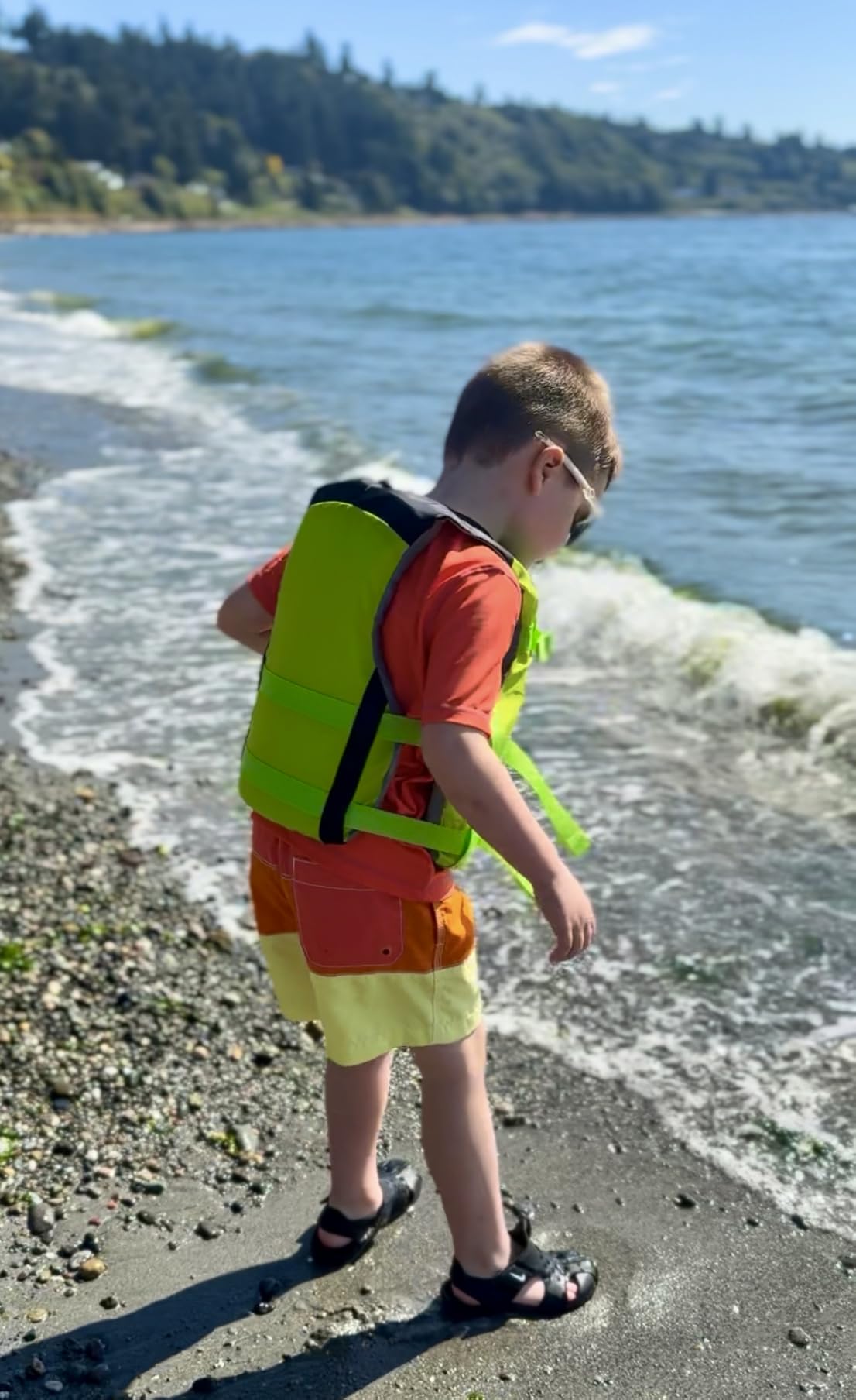
The honest limitation is that this is foam-only construction, so after a full dunk it holds water longer than a quick-dry fabric vest. For a child who is in and out of the water all afternoon, that translates into a heavier, wetter vest by the end of the day, and the weight difference is most noticeable on a smaller youth.
Second, there is no head-support collar. For a child who swims confidently in protected water that is fine, since Type III vests are designed for conscious wearers.
Who this vest suits best
Older children in the 50-90 pound band who swim reasonably well and want to keep moving on the water. Kayaking, tubing, boating, and general lake play all suit this vest, and the adjustability lets it serve a growing child through a season.
Where it falls short
A non-swimmer in open water needs a vest that self-rights. For a child who is soaked all day, a quick-dry shell would be lighter by the end of the afternoon.
7. Stohlquist Child Life Jacket 30-50 lbs: The Best Grab Handle Design
- Ergonomic face-up neck support holds a child's head above water
- Built-in grab handle on the back for lifting a child out
- Dual side straps and adjustable shoulders for growing fit
- PVC-free Gaia and PE foam with sculpted corners
- Quick-entry front zipper with buckle overlay
- Premium price compared with basic buckle-style Type III vests
- Range caps at 50 pounds so a heavier child outgrows it quickly
The back grab handle is the detail that sets this apart, and it is the feature boating forum members most often single out when they recommend vests for very young children. A handle positioned behind the head lets an adult lift a small child straight out of the water in one motion, which is far safer than trying to gather a panicking child into a two-arm hold.
The ergonomic neck support holds a child’s head above the surface on its own, and the listed flotation is 8 pounds 6 ounces, more than most Type III vests in this weight band carry.
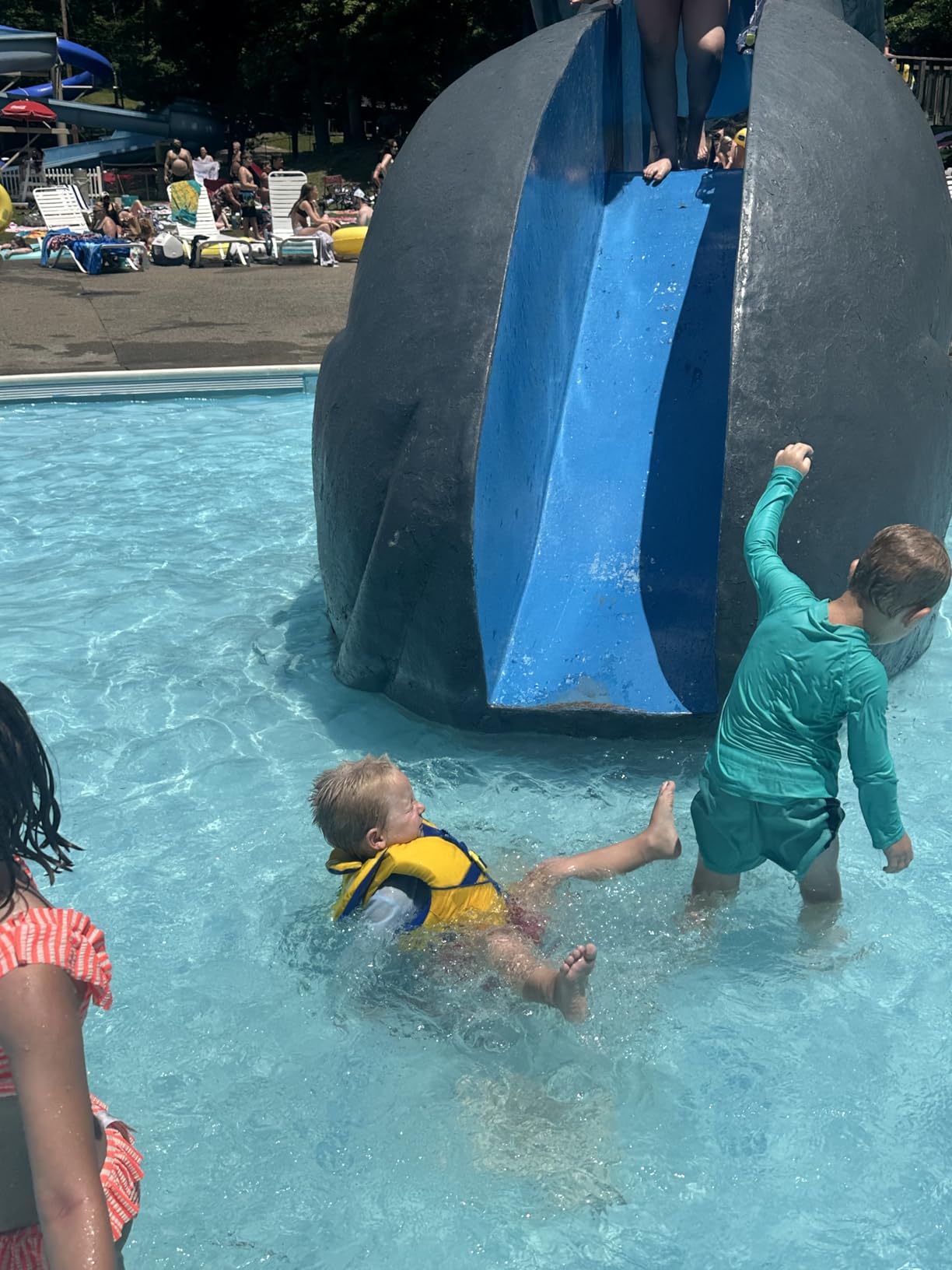
Comfort details add up over a full day. Owners credit the PVC-free Gaia and PE foam and the sculpted corners with reducing chafing on long outings, and the quick-entry front zipper with a buckle overlay makes the on-and-off routine fast enough that compliance stays high.
This is listed as a Type II certification for the 30-50 pound band, which puts it alongside the Stearns Heads-Up as one of the two vests here rated to turn a child face-up.
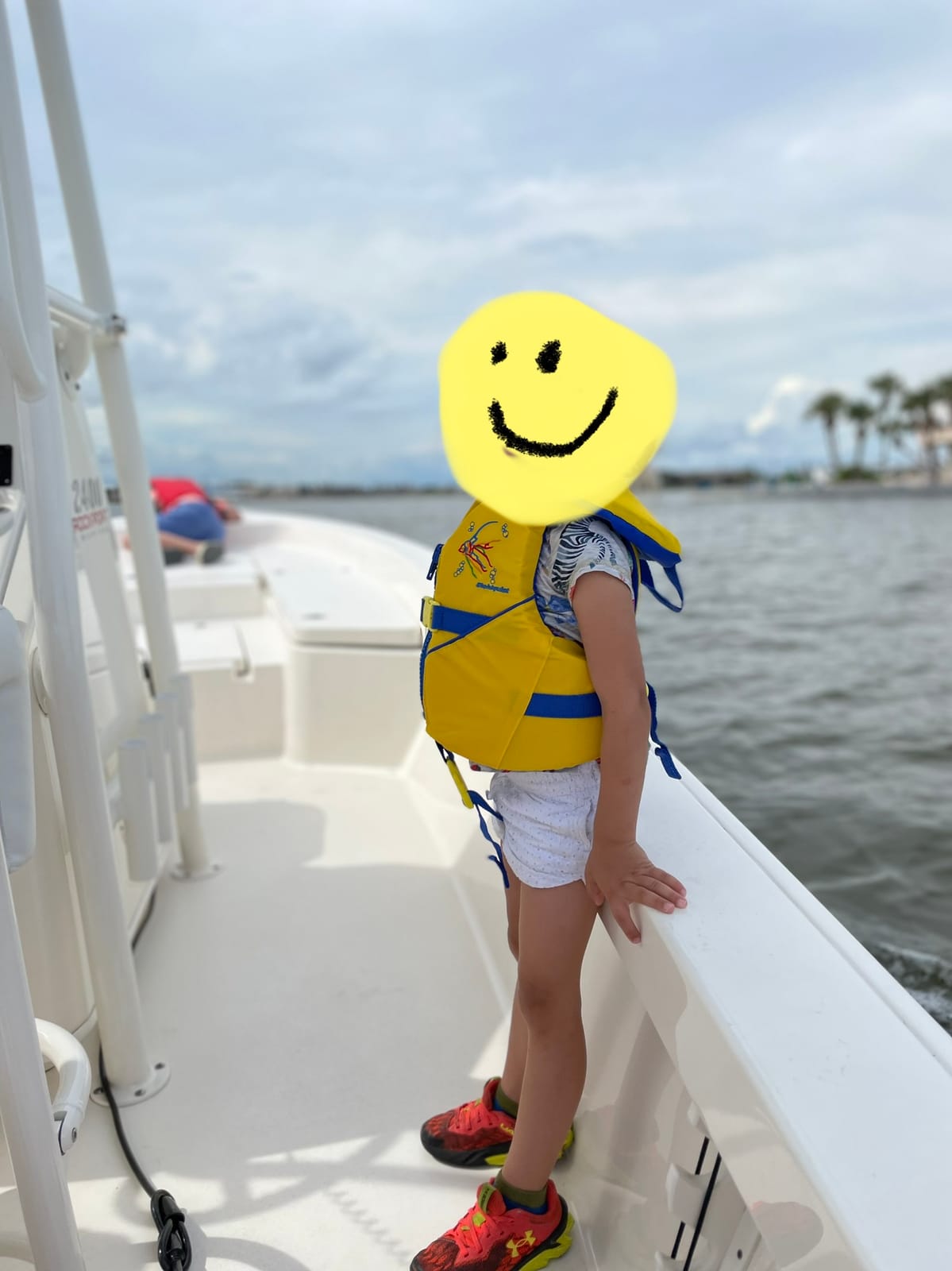
Who this vest suits best
A 30-50 pound child on a family boat where the adult on duty may need to recover someone quickly, or where docks and swim platforms mean a child ends up in the water more often than planned. It suits long days on the water because of the chafe-conscious foam shaping.
Where it falls short
It costs more than a basic three-buckle Type III vest, and parents shopping purely for the lowest cost will find cheaper options. For a large child at the top of the band, check shoulder room before committing.
8. Stearns Hydroprene Youth Vest 50-90 lbs: The Softest Shell in the Group
Stearns Kids Hydroprene Life Vest, USCG Approved Type III, 50-90 Pounds
- Soft flexible Hydroprene shell over lightweight Crosstech PE foam
- Ergonomic shape allows a good range of movement
- Two webbed straps plus a zipper for a secure fit
- USCG Type III sizing for youths 50-90 pounds
- Comfortable enough for a full day
- Bulky next to sleeveless or open-sided designs
- A zipper on its own is less secure than multi-buckle closures
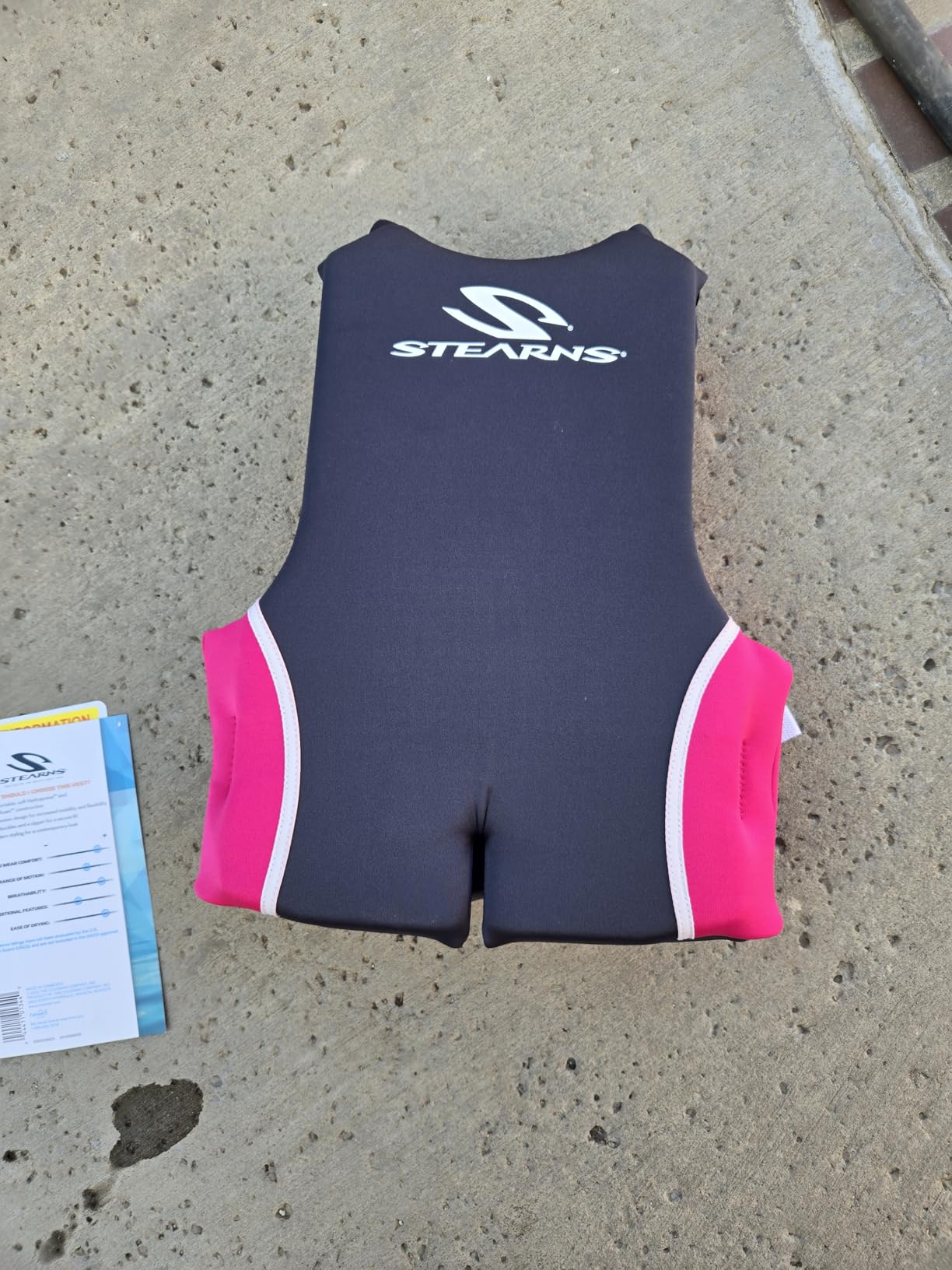
The Hydroprene shell is noticeably softer against skin than a standard nylon shell, and children who have objected to stiffer vests tend to accept this one. The ergonomic shape is cut for movement, which makes it a reasonable match for a youth who wants to swim, tow, or move around the boat rather than sit still.
It is USCG Type III approved for the 50-90 pound range, and the two webbed straps combined with the zipper give a solid closure for normal family boating.
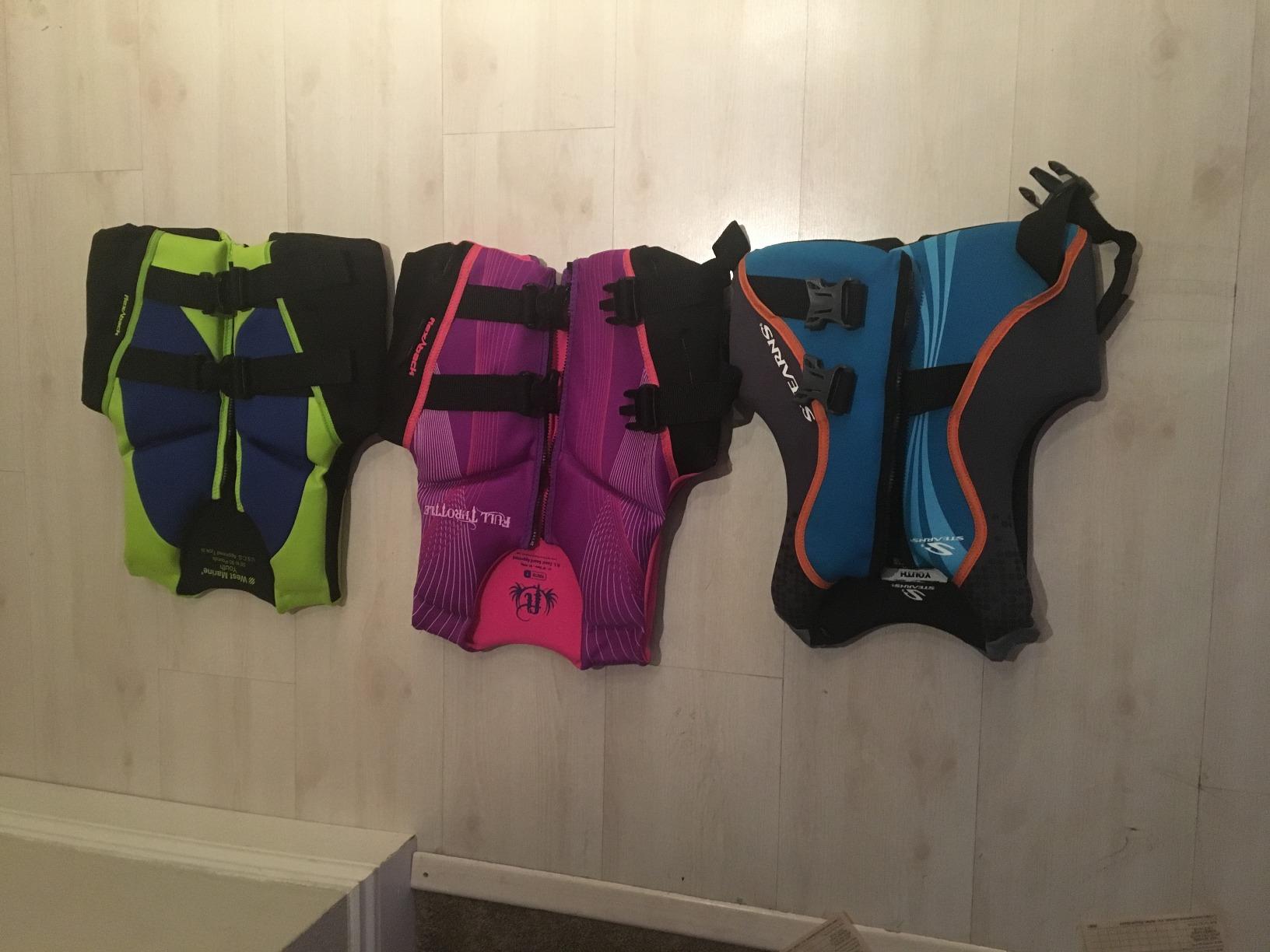
The reviews are split on one point and consistent on the other. The recurring complaint is bulk, since the foam-and-shell build is thicker than lighter open-sided models and warmer in midday sun. The consistent positive is buoyancy and fit within the stated band for most buyers.
On the closure, a zipper with two straps is secure enough for protected water, but it gives you fewer adjustment points than a three-buckle front. If your child tends to shrug out of gear, that difference will be obvious within a week.
Who this vest suits best
A youth in the 50-90 pound band who is sensitive to stiff materials or who spends long days on the water in warm weather. It also works well as a pool and lake vest alongside a boating trip.
Where it falls short
It is bulkier and warmer than open-sided alternatives, and the closure offers less adjustment than a three-buckle front. A child who wriggles out of clothing may need a different closure strategy.
9. Sportstuff Stars and Stripes Vest: The Best Value Open-Sided Pick
- Open sides give ventilation and arm mobility for tubing and paddling
- Soft UV and stain-resistant 200-denier polyester with PE foam
- Three side-release buckles plus a crotch strap
- High-visibility pattern children like wearing
- Dries faster than many older foam vests
- Runs small for children near the top of the 30-50 lb range
- Straps feel stiff until they break in
- Crotch strap can irritate skin over swim bottoms
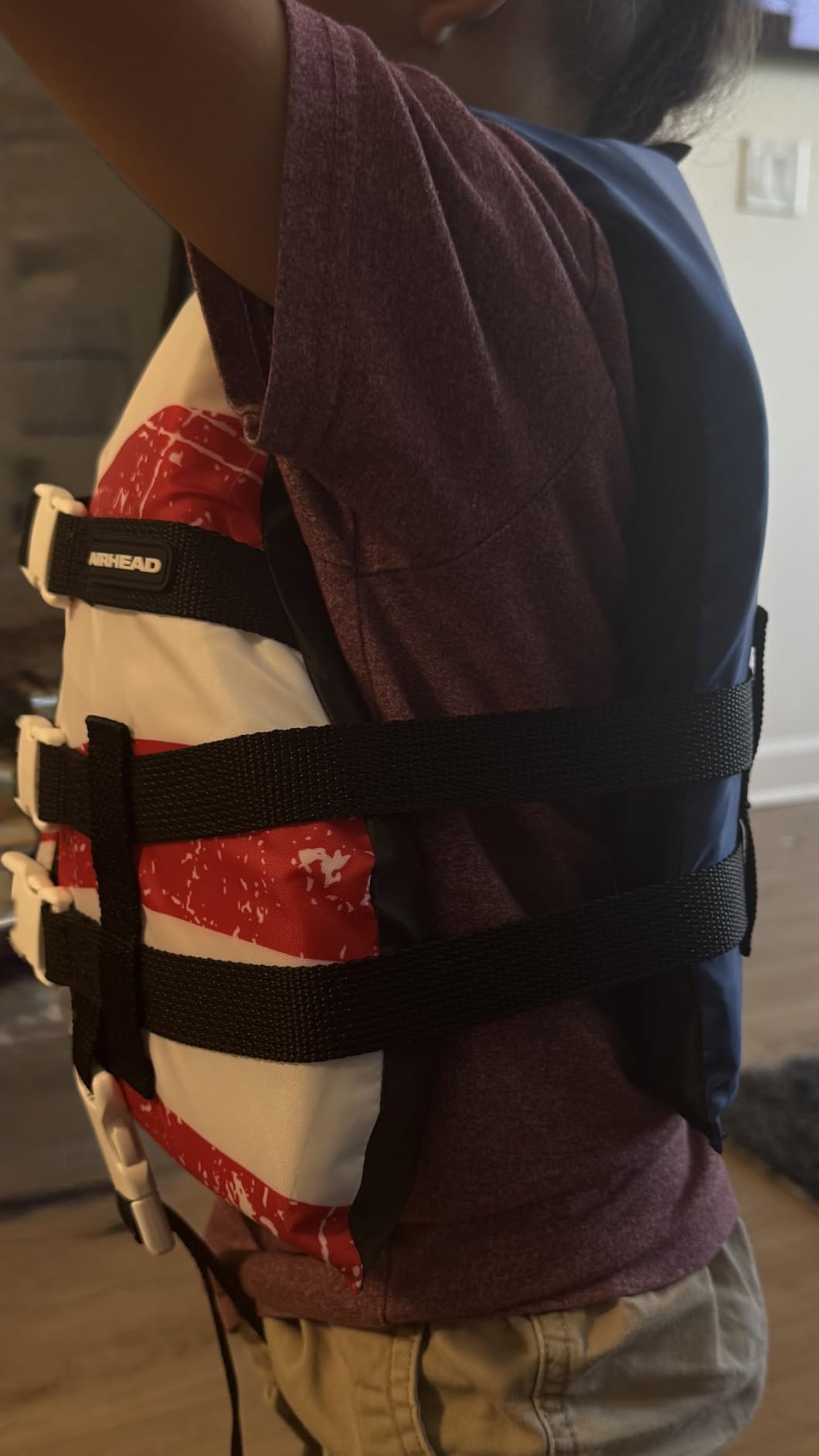
This vest earns its place on value and on the open-sided design. Open sides mean air moves freely across the torso on a hot day and the armholes never fight a paddling stroke, and the soft 200-denier polyester with PE flotation inside dries faster than the older dense foam vests it resembles.
Three body belts with quick side-release buckles, plus a crotch strap on the children’s version, give it more retention points than the simplest open-sided vests. The pattern is highly visible and, in our experience, a factor parents underestimate.
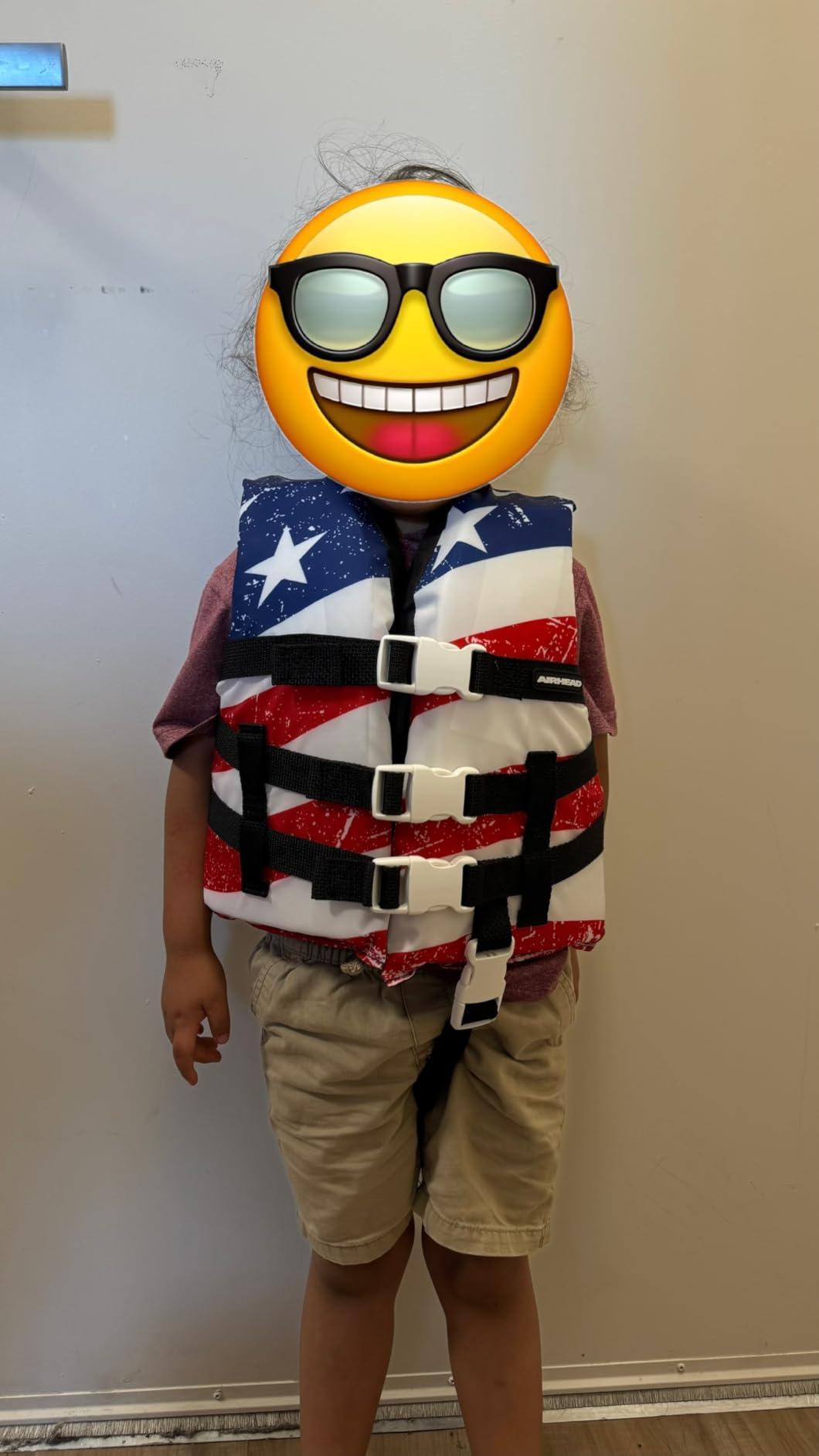
Sizing is the issue to plan around. The most common review theme by a wide margin is that this vest runs small, and that buyers between sizes are better off sizing up. The listed range follows USCG sizing for children weighing 30 to 50 pounds with a 22 to 25 inch chest.
Two smaller notes appear repeatedly: the straps feel stiff until they have been broken in, and the crotch strap can irritate skin when worn directly over swim bottoms. A thin layer under the strap solves the second one.
Who this vest suits best
Families on a tight budget who need a fully approved vest for tubing, docking, and calm lake days rather than open water. The ventilation advantage makes it a strong warm-weather pick for repeated wear.
Where it falls short
Size up if your child is anywhere near the top of the band. It is also not the vest for a non-swimmer on open water, because it is a lower-buoyancy design.
10. Stohlquist Fit Youth Vest 75-125 lbs: Bridging the Teen Gap
- Fits 75-125 lbs and bridges youth and adult sizing
- Sculpted foam panels and a thin back panel aid mobility
- Front three-buckle entry gives a snug adjustable fit
- Lightweight 200D nylon shell that dries quickly
- Bright colorways that are easy to spot on the water
- No crotch strap so it can ride up on broader children
- Light-duty foam may feel thin for daily all-day wear
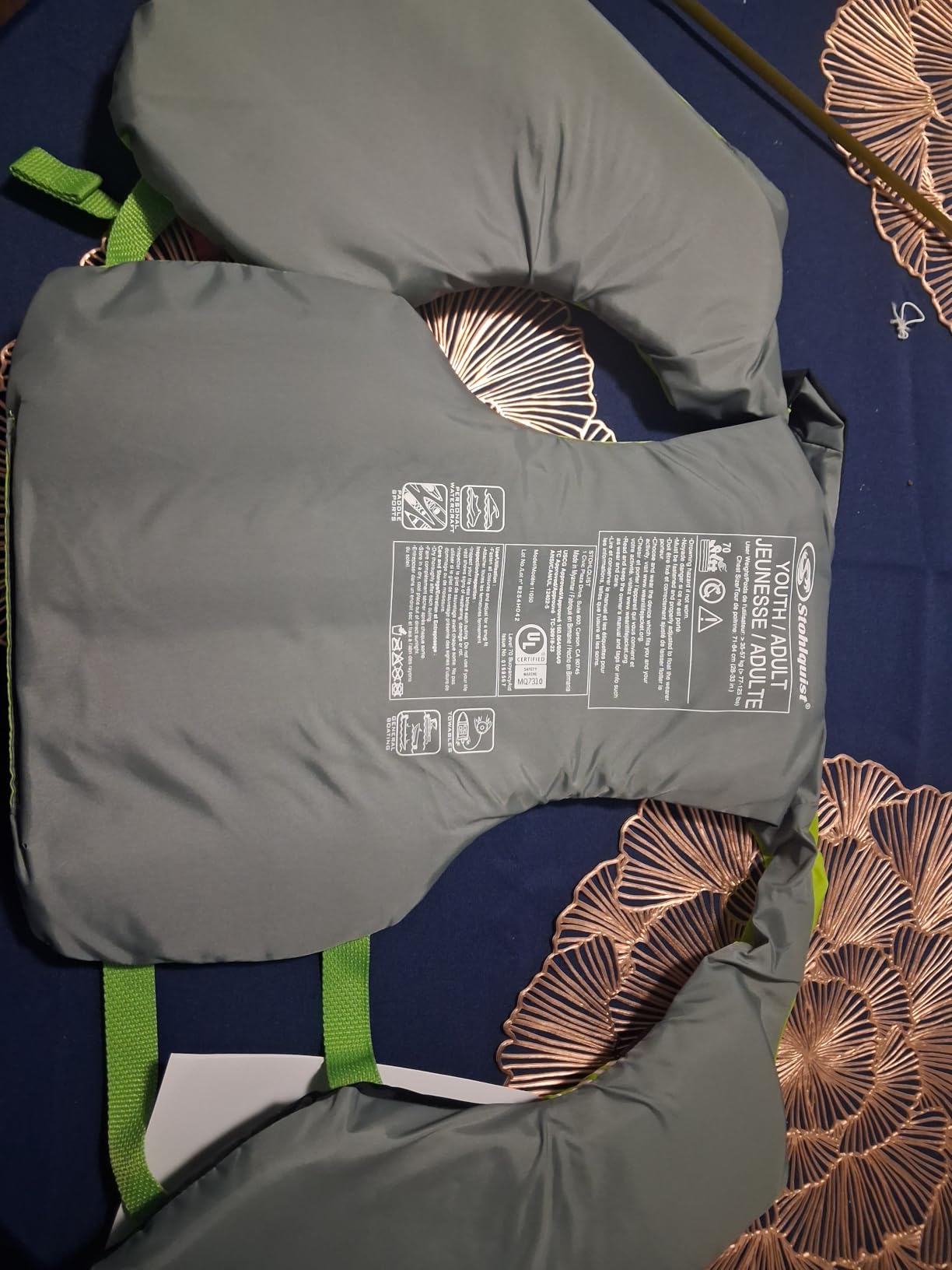
Almost every parent we heard from with a teenage child describes the same gap. Youth vests top out too small, and adult vests slide up because a teenager’s torso has not grown vertically yet. This 75-125 pound fill bridges that gap, which is a rare and genuinely useful thing to find in this category.
The sculpted foam panels and thin back panel are engineered for movement, and owners report that the vest stays low without chafing the neck on a kayak seat. The thin back also matters on a boat, where a child may be sitting against a seat back for hours.
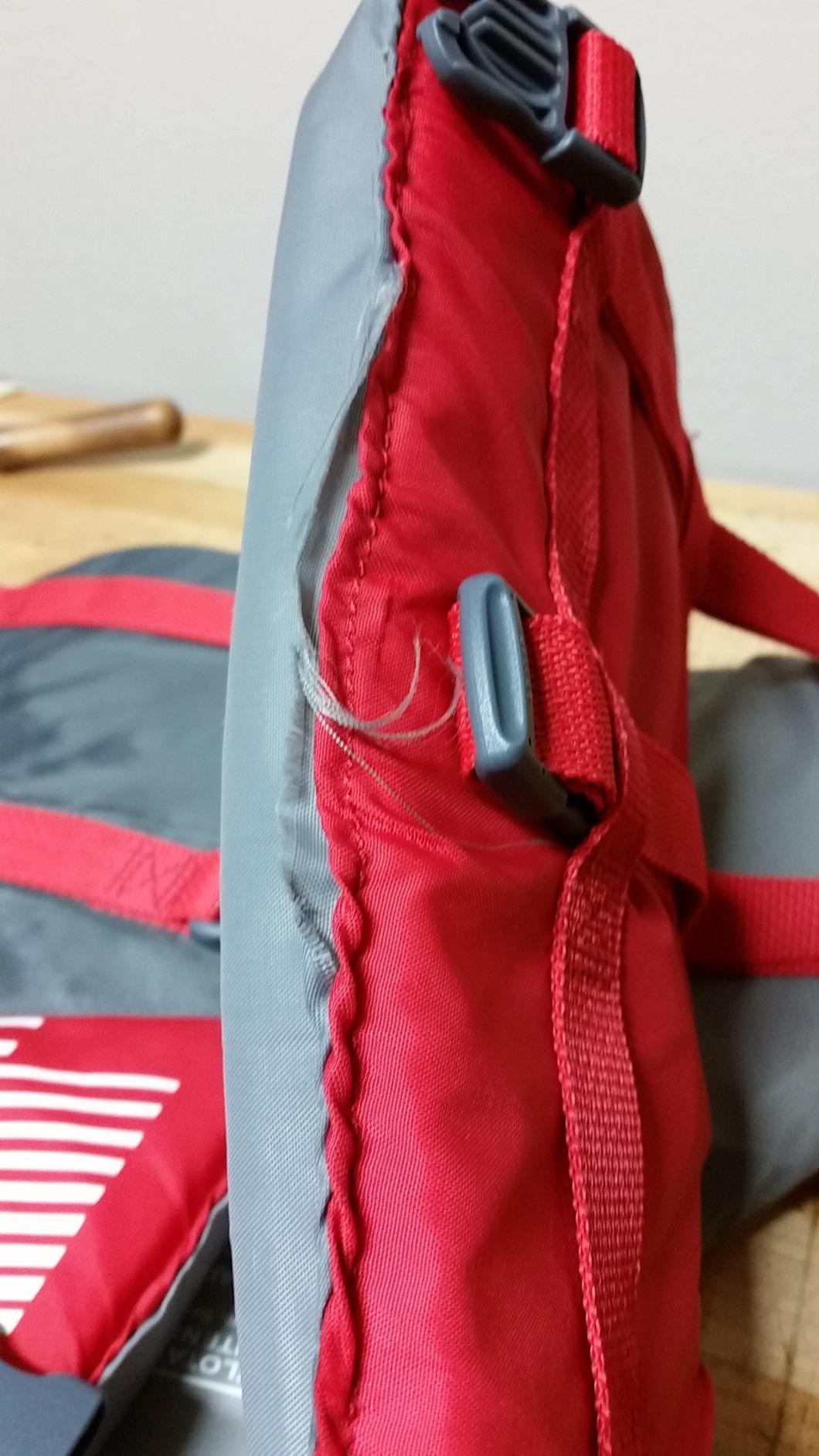
The fit is body-shape dependent, and this is worth being honest about. Owners say it works very well for stockier kids and tall skinny teens, while broader children report it riding up toward the neck. The cause is straightforward: this model has no crotch strap.
The fix that reviewers use is to add a crotch strap to the vest themselves. It is a quick hardware-store modification, and it turns a good youth PFD into a properly retained one for a broader teen.
Who this vest suits best
Teenagers and older youth in the 75-125 pound range, particularly tall and lean teens who have outgrown the 50-90 pound vest but are not ready for an adult fit. It is also a solid general boating and tubing choice for older children.
Where it falls short
Broader children should add a crotch strap from the start. The foam and shell are light-duty, so it is not the vest for a child wearing one every single day of a long season.
11. Oneill Youth SuperLite Vest: The Lowest-Bulk Youth Option
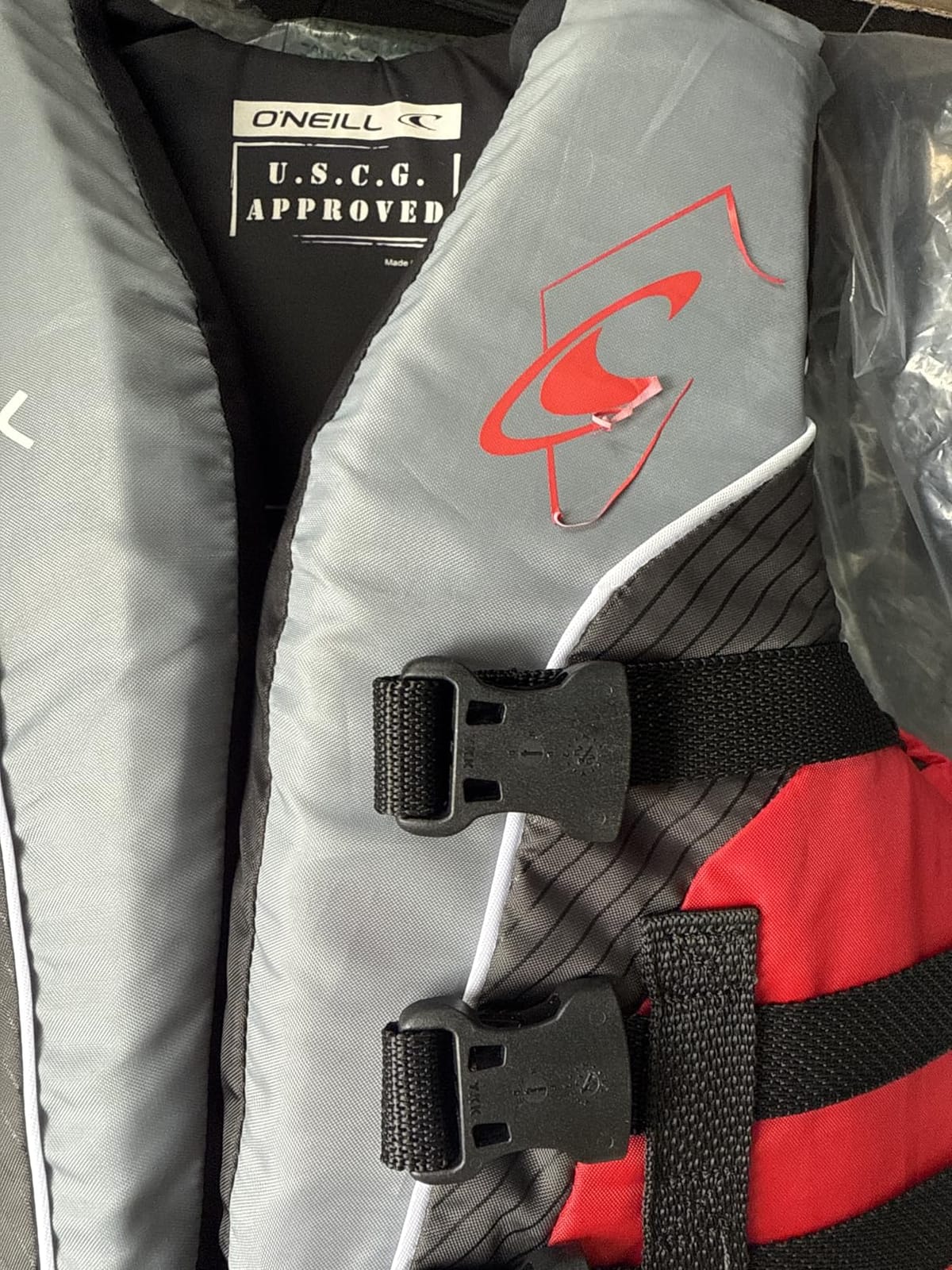
O’Neill Youth Superlite USCG Life Vest,Pacific/Smoke/Black:Yellow,1sz
- Feather-light polyethylene foam core with a polyester shell
- Engineered drain holes release water for fast drying
- Three safety buckles plus a zipper for a snug fit
- Layers over rash guards
- swimwear or a wetsuit
- Roomy cut for children at the top of the 50-90 lb range
- Less ventilated than open-sided vests in hot weather
The Youth SuperLite is built for a youth who is active rather than sitting still. It carries USCG Type III certification for the 50-90 pound range, a safety booklet is included, and it is designed to layer over a rash guard, swimware, or a wetsuit without becoming unmanageable. Owners running it behind a boat, on a wakeboard, or on water skis report the low bulk makes that possible.
Engineered drain holes let water escape between uses, and the overlock stitching is described in reviews as durable for repeat water use.

The consistent warning in the reviews is that this vest is bigger and boxier than buyers expect, which matters because a flotation aid only works correctly when the fit is snug. Check the stated 50-90 pound range carefully before you buy, and pull the straps tight if your child is at the top of the band.
Polyethylene foam is also less ventilated than an open-sided design, so on a hot afternoon the vest holds more heat than the Airhead or Stohlquist options.
Who this vest suits best
A youth in the 50-90 pound range who is towable, skis, wakeboards, or otherwise needs free range of motion in a snug fit. It layers cleanly under other clothing and dries between runs.
Where it falls short
A roomy fit will reduce flotation performance, so do not size up for a growing child on a wake boat. In peak summer heat, an open-sided vest will be cooler.
12. Airhead Swoosh Kwik-Dry Vest: The Wide Size Range Multi-Purpose Pick
Airhead Children’s Swoosh Kwik-Dry Neolite Life Jacket, US Coast Guard Approved, Children 30-50lbs
- Closed sides with zipper and double buckles plus a crotch strap
- Quick-dry Neolite stays soft for all-day wear
- Less bulky cut for tubing and water skiing
- Size range spans child through adult fits
- Neoprene build is bulkier and heavier than foam-only vests
- Runs snug at the upper end of the 30-50 lb child range
This is the same quick-dry philosophy as the Wicked vest in a different frame. The closed sides, zipper, double buckles, and crotch strap are an unusually high number of retention points for this class of vest, and owners rate that secure strapping as the standout quality.
The size range is the practical draw. This model is produced from child through adult fits, so a family can outfit several children and an adult from the same product family without mixing brands and label conventions.
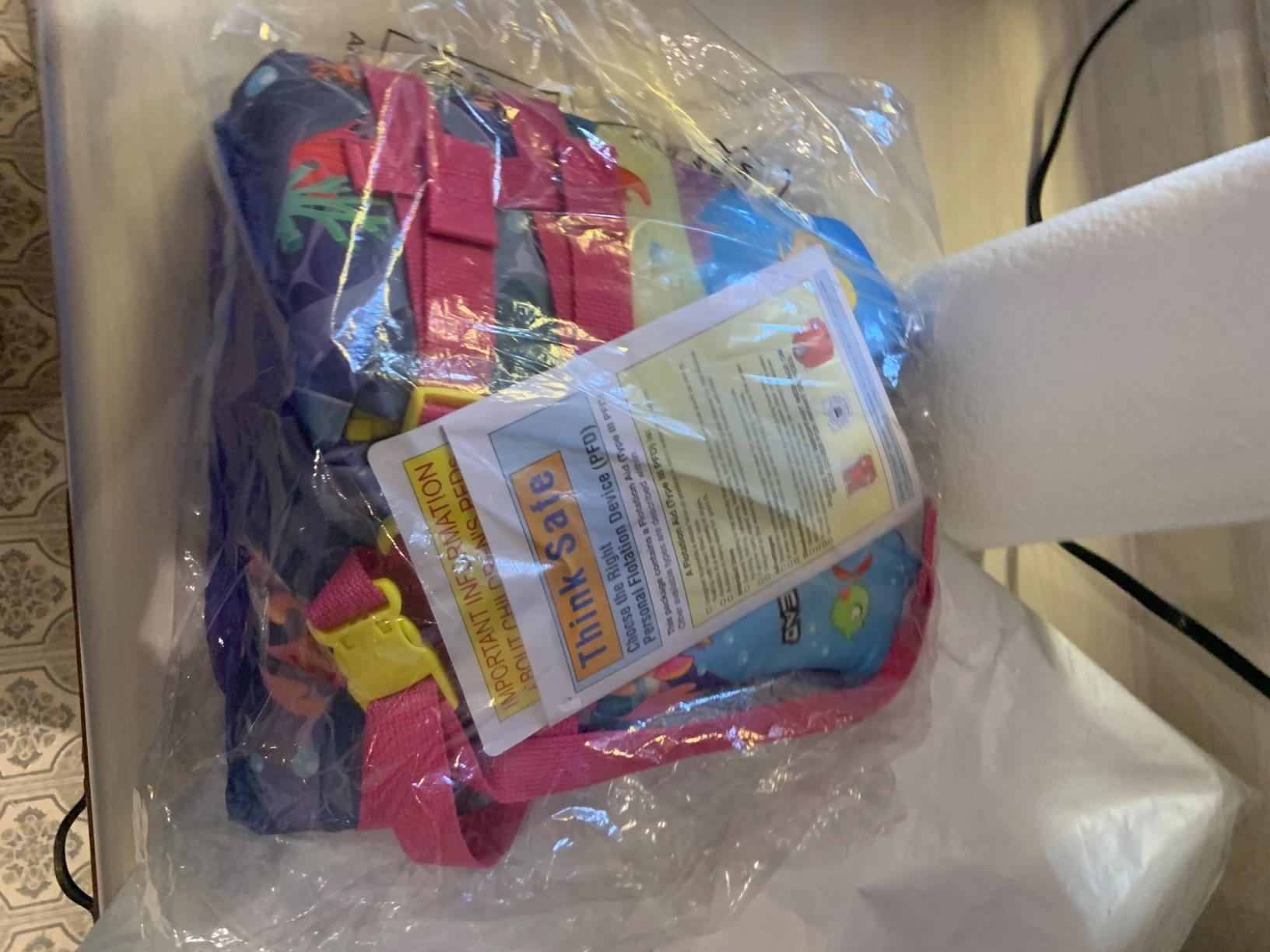
The reviews mention soft skin comfort across long days on the water as the reason the vest gets worn without complaint. For a child who will be in the vest from breakfast to dusk, that is the feature that matters most.
Sizing runs snug in the 30-50 pound child band, and buyers between sizes are advised by owners to size up. Neoprene construction is also bulkier and heavier than foam-only vests, which is the trade-off for the softer feel and the secure closure.
Who this vest suits best
Families standardising on one brand across a range of ages, and children who wear the vest for entire days. It performs across tubing, water skiing, swimming, and general boating.
Where it falls short
Size up at the top of the child band, and expect more bulk than a foam vest. On a hot day, a lighter open-sided vest may be more comfortable.
Does It Ride Up? How to Keep a Vest Off a Child’s Chin
Ride-up is the most repeated complaint about kids’ life jackets, and parents describe it the same way every time: the vest slides up until it sits across the chin and ears, which does the opposite of what you bought it for. Understanding why it happens tells you which fix to apply.
Cause one: the vest is too large. A vest with slack in the torso will migrate upward the moment the child is in water, because buoyancy pushes the body up while the garment has nothing to hold it down. Sizing up to get a growing margin is the single most common mistake parents make, and it is the leading cause of chin-level ride-up.
Cause two: no crotch strap. A strap under the crotch is the anchor that stops upward migration. Two of the vests in this roundup do not include one, and both are otherwise strong picks. Adding a strap takes minutes and fixes the problem.
Cause three: loose buckles. Every strap on a Type III vest has to be snug enough that you cannot slide two fingers underneath. Parents routinely leave the top strap loose because they want comfort, and end up with a vest that moves.
Cause four: a child wearing the vest too loosely over bulky clothing. A vest fitted over a sweatshirt will not fit over a bare arm later in the day. Fit for what the child will actually be wearing on the water.
Cause five: an undersized head support. A Type III vest has no collar to hold the head in position. If your child is a non-swimmer, no amount of strap tightening changes that; you need a Type II design.
If ride-up is your specific concern, the vests built to avoid it are the Airhead Wicked Kwik-Dry, the Airhead Treasure, and the Airhead Swoosh, because each combines closed sides with a crotch strap plus at least two buckles. If you want a vest with a handle behind the head for lifting a small child out of the water, the Stohlquist Child and the Stearns Heads-Up both place one there.
How to Fit a Kids Life Jacket: The Head-Lift Test?
This is the check that separates a vest that works from one that only looks right. Do it on land before you are on the water, and repeat it at the start of every season.
Step one: check the weight range first. Confirm the child’s current weight falls inside the range sewn into the label. If they sit at the very top of the range, move up a size rather than hoping.
Step two: tighten everything below the shoulders. Pull each side strap, waist belt, and crotch strap snug. You should not be able to slide two fingers under any strap. Do this while the child stands, because slack in the torso is what drives ride-up.
Step three: lift the shoulders. Grasp the vest at the top of both shoulders and pull straight up. The vest should not ride above the child’s ears or chin. If it does, it is too large.
Step four: lift the front. Lift the front panel of the vest up toward the child’s chin. It should stop around the lower jaw, and the child’s mouth should remain fully clear. This is the head-lift test, and it is the single most reliable at-home check available.
Step five: ask the child to jump. Have the child jump on the spot while wearing the fastened vest. A vest that rides up during a jump will ride up in a fall.
Add one more check if your child can swim: have them swim a short distance in the vest and then float on their back. On a Type III vest, the child’s chin should stay clear of the water and their face should remain above the surface.
What to Look for When Buying a Life Jacket for a Child on a Boat
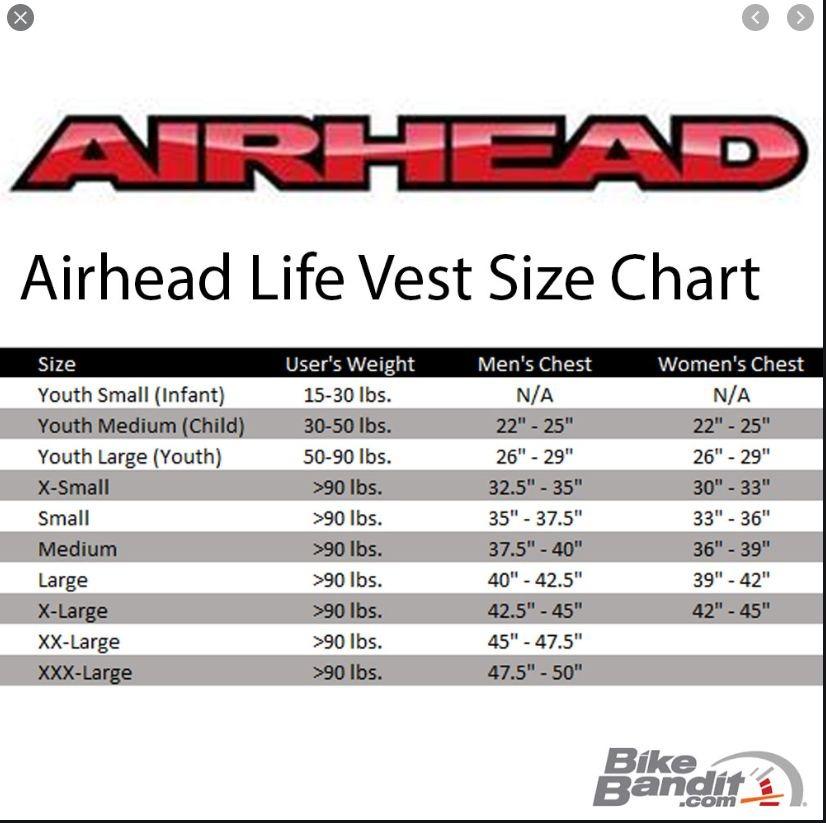
Sizing by weight, not age. Weight classes are the industry standard because body mass, not age, determines flotation. The common classes are infant below 30 pounds, child 30-50 pounds, youth 50-90 pounds, and 75-125 pounds for larger youths and lighter teens. If your child sits between two classes, buy the larger one only if the smaller one fails the head-lift test.
The approval label. Look inside the vest for the sewn-in label carrying the USCG approval, the vest type, and the weight range. This is the only document that makes a vest lawful on a moving boat. A garment described as a swim vest or puddle jumper with no Coast Guard marking is not approved flotation for a boat, no matter how well it works in a pool.
Which type you need. For a non-swimmer of any age on open or moving water, a vest rated to turn the wearer face-up removes the single largest risk in the scenario. That is a Type I or Type II. For an older child who swims confidently on protected water, a Type III flotation aid gives better mobility at lower bulk.
The crotch strap. This is the feature that decides whether the vest stays on. Among the twelve picks here, most include one as part of the design. If yours does not, add it.
Head support and grab handle. Boating forum consensus strongly favours a handle behind the head on vests for very young children, because it lets one adult lift a child clear of the water in a single motion. A neck-support collar serves a similar purpose by holding the face above the surface without an adult within reach.
Visibility. Bright colors and reflective tape decide how fast a child is found in low light. Several vests here include reflective material, and the high-visibility colorways are worth having for evening runs regardless.
Comfort, because it decides everything. A vest a child refuses to wear provides no protection at all. Quick-dry fabric, open sides, and soft linings reduce friction, and the child who helps with lines or wears the vest on the rail will wear it far more willingly. Members of boating families report that giving a child a job alongside the vest is the most effective compliance trick they have found.
Foam versus inflatable. Every youth vest in this roundup uses inherent flotation, which means the buoyancy is always there whether or not anyone has tested it. Inflatable youth PFDs exist but they have a structural weakness for a child: the bladder is never routinely inflated, so the first real test happens during the emergency the device was bought for. For a child who is not a strong swimmer, inherent foam flotation is the more dependable choice.
One more practical note on seasonal care. Rinse the vest in fresh water after salt or chlorine exposure, air it out of the sun, and check the foam for cracks, hardened seams, or a fading label at the start of each season. Foam PFDs degrade with heat and UV exposure, and a vest stored on a hot boat deck in August is aging faster than one in a dry locker.
Before you buy any vest, it is worth checking our other flotation picks for the family pet. We compared life jackets for Dachshunds, life jackets for Poodles, and life jackets for English Bulldogs using the same fit-first method, in case both ends of the boat need a vest.
Frequently Asked Questions
What are the USCG approved life jackets for children?
USCG approved life jackets for children are any PFD with a sewn-in label showing the approval, the vest type, and a weight range in pounds. Types I and II turn an unconscious child face-up. Type III holds a conscious child at the surface with good arm mobility. Buy by the weight range on the label, never by age.
What is the safest type of life jacket for toddlers?
The safest type for a toddler is a Type II near-shore vest, because it is rated to rotate an unconscious or panicking child into a face-up position. In this roundup the Stearns Heads-Up and the Stohlquist Child vest carry that rating. Look for a neck-support collar and a grab handle behind the head as well.
Can my toddler wear a puddle jumper on a boat?
Only if the label inside it carries a USCG approval for the weight range of your child. Many puddle jumpers and swim vests are pool toys with no boating approval, and they are not lawful flotation on a moving vessel. If you cannot find an approval label stating the type and weight range, treat it as swimwear and buy a proper PFD for the boat.
What age can a kid stop wearing a life jacket on a boat?
Many US states require a properly fitted Coast Guard-approved PFD for children under 13, or for anyone under a specified weight, while the vessel is underway. Requirements vary by state, so check your state boating law. Separately from the law, any passenger who cannot swim reliably should keep wearing one, including teenagers.
What is the best kids life jacket that doesn’t ride up?
A closed-sided design with a crotch strap plus at least two buckles resists ride-up best. Among these picks the Airhead Wicked Kwik-Dry, Airhead Treasure, and Airhead Swoosh all use that combination. Sizing is the other half of the answer: a vest that is too large will slide up no matter how the straps are set.
Why does my life jacket ride up?
Ride-up usually has four causes: the vest is too large, the buckles are loose, the vest lacks a crotch strap, or the child grew since the vest was fitted. Buoyancy pushes the body upward while a loose garment has nothing anchoring it. Fit by weight, tighten every strap so two fingers do not fit under it, and add a crotch strap if the model lacks one.
Is there a difference between a life jacket and a life vest?
The terms are used interchangeably, and both refer to a wearable personal flotation device. What matters is not the name but the label: the approval, the vest type, and the weight range printed inside. A garment with no Coast Guard approval is a swim vest regardless of what the packaging calls it.
What is the best brand of life jacket for kids?
Stohlquist, Stearns, Airhead and Sportstuff appear most often in this roundup, and each is well represented in boating and paddling forums for children. Brand matters less than two specifics: a USCG approval label at the correct weight range, and a fit that passes the head-lift test on your particular child.
Best Life Jackets for Kids on Boats: The Final Word
The best life jackets for kids on boats are the ones that fit your child correctly rather than the ones with the longest feature list. Our Aqua Oceans 7 pick wins because its three-way adjustment and enormous base of verified owner feedback make it the safest general answer, and for a non-swimmer we would move to the Stearns Heads-Up or the Stohlquist Child vest because both are rated to turn a child face-up.
Whatever you choose, run the head-lift test on land before anyone steps aboard, check for a crotch strap, and confirm the weight range still matches. A vest that passes all three will keep doing its job season after season.