
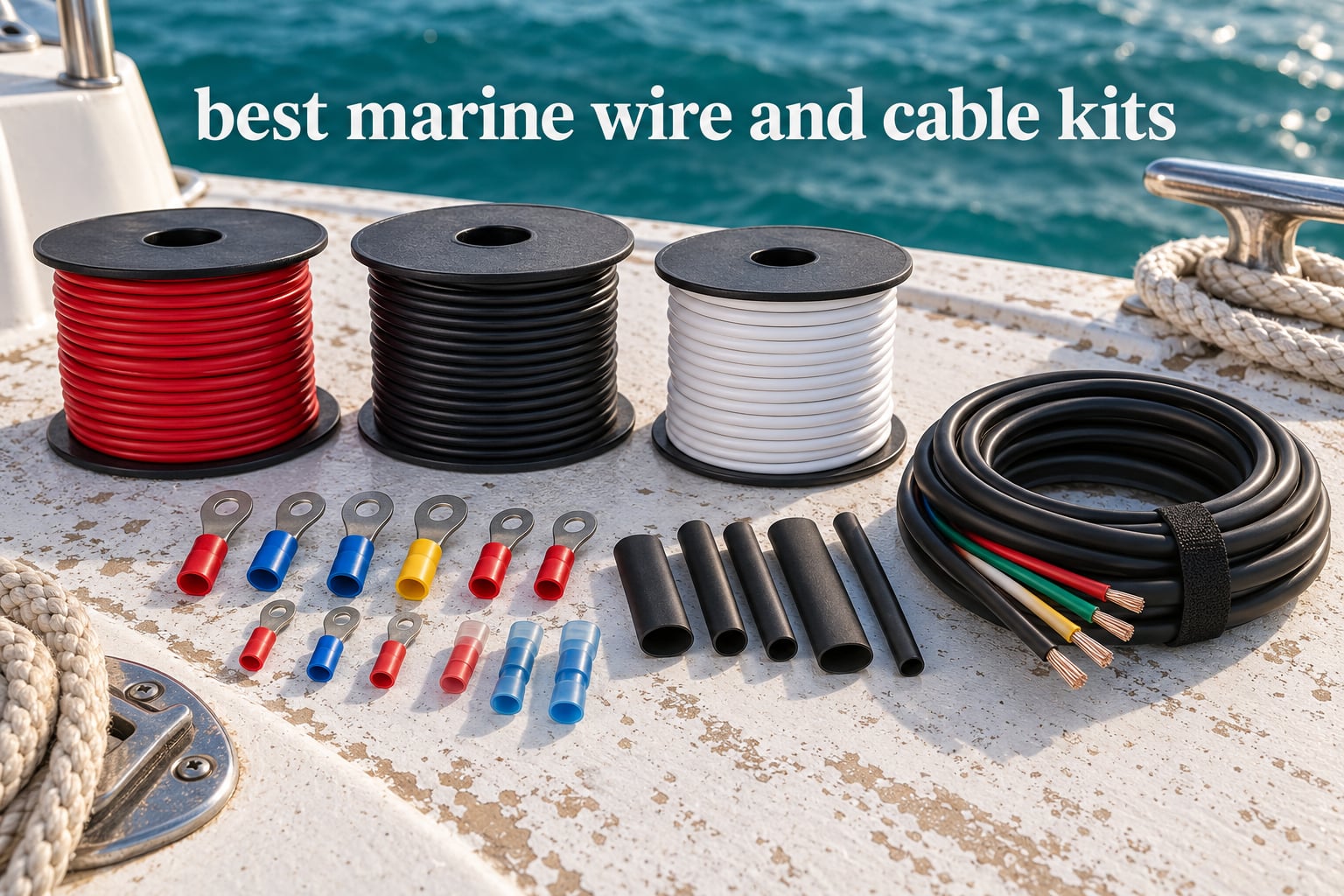
A marine wire and cable kit bundles tinned copper wire, connectors, lugs and heat shrink tubing into one box so you can wire or repair a boat’s DC system without a dozen separate trips to the marine supply counter. The reason it matters is simple: a boat is a wet, vibrating, salty box, and a corroded connection under the helm is a fire waiting for the right weekend. Most people shopping for a marine wire and cable kit are really asking one question, which is whether the kit contains enough wire, in the right gauges, with the right connectors, to finish the job they actually have in front of them. That is the question we answered by reading the specs, the fine print and the owner reports on twelve of them.
We spent weeks pulling apart listings for wire spools, trolling motor extensions, amplifier power kits, hook-up assortments and trailer harnesses, because the word kit covers a 16 AWG six-colour hobby box and a 20-foot 8 AWG harness with an integrated breaker, and those two things are not remotely comparable. If you want a broader look at how wire and cable products get evaluated, our wire wrapping kit roundup takes a different route through the same category, and our marine aquarium starter kit guide covers the other kind of water problem.
Here is the short version before the details. If you want one kit that covers the most ground, start with the GEARit 14 AWG tinned copper duplex spool. If you are running a trolling motor forward for balance, you want a length-and-breaker package, not a spool. And if the word marine appears anywhere in your build, copper-clad aluminium conductors are the one thing to walk away from.
Table of Contents
What Is a Marine Wire and Cable Kit?
Yes, there is a real difference between marine wire and regular wire. Marine-grade wire is stranded copper with every strand coated in tin, which corrodes sacrificially before the copper underneath, wrapped in a GPT or PVC jacket rated for saltwater, UV, oil and abrasion. Automotive wire is untinned and single-insulation. Romex is a residential building wire with no stranding or tinning at all, and it is not legal below deck on most boats. Machine-tool THHN wire is a legitimate budget option for dry, stationary runs inside the cabin, but it is neither tinned nor fine-stranded, so it will not flex well and will not like a wet bilge.
That difference shows up in the three places that actually fail: the conductor, the insulation, and the termination. If you are curious about the other kind of rigging and tension work, we covered wire rope hoists separately.
Top 3 Marine Wire and Cable Kits in 2026
These are the three that cover the most ground for the money and have the deepest owner feedback behind them.

GEARit 14 AWG Marine Wire 100ft
- 14 AWG tinned copper duplex
- 100 ft spool
- 600V rated
- 105C dry / 75C wet

NOVINO 10 AWG Marine Wire 30ft Duplex
- True 10 AWG stranded tinned copper
- UL 1426 / SAE / ABYC compliant
- 30 ft length

Seamaka 50ft 4-Way Trailer Harness
- 50 ft total length
- 18 AWG colour-coded conductors
- 4-way flat plug with ground
Every Kit at a Glance in 2026
All twelve, side by side, with the specs that decide whether a kit fits your project.
| Product | Specifications | Action |
|---|---|---|
| GEARit 14 AWG Marine Wire 100ft |
|
Check Latest Price |
| Seamaka 50ft 4-Way Trailer Wiring Harness |
|
Check Latest Price |
| NOVINO 10 AWG Marine Wire 30ft |
|
Check Latest Price |
 NOVINO 10ft 8 AWG Trolling Motor Extension NOVINO 10ft 8 AWG Trolling Motor Extension |
|
Check Latest Price |
 Rockville RMWK4 V2 4 AWG Marine Amp Kit Rockville RMWK4 V2 4 AWG Marine Amp Kit |
|
Check Latest Price |
 GaiRen 10ft 8 AWG Trolling Motor Extension GaiRen 10ft 8 AWG Trolling Motor Extension |
|
Check Latest Price |
 Kicker 47KMPK4 Marine 4 AWG Amp Power Kit Kicker 47KMPK4 Marine 4 AWG Amp Power Kit |
|
Check Latest Price |
 TUOFENG 16 AWG Solid Tinned Copper 6-Colour Kit TUOFENG 16 AWG Solid Tinned Copper 6-Colour Kit |
|
Check Latest Price |
 Samramra 50ft 7-Conductor 14 Gauge Trailer Cable Samramra 50ft 7-Conductor 14 Gauge Trailer Cable |
|
Check Latest Price |
 Remington 14 AWG GPT Hook-Up Wire 10-Colour Kit Remington 14 AWG GPT Hook-Up Wire 10-Colour Kit |
|
Check Latest Price |
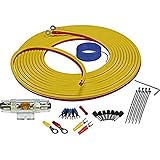 Stinger 23ft Marine 8 GA Amplifier Kit Stinger 23ft Marine 8 GA Amplifier Kit |
|
Check Latest Price |
 Pro Controll 20ft 8 AWG Quick Connect Harness Pro Controll 20ft 8 AWG Quick Connect Harness |
|
Check Latest Price |
1. GEARit 14 AWG Marine Wire 100ft Tinned Copper Duplex
GEARit 14 Gauge Marine Wire, 14/2 AWG Tinned Copper Electrical Wire, 100ft
- Tinned copper conductors with corrosion-resistant PVC jacket
- 259-strand construction keeps resistance low for high-current runs
- Printed footage markers on the jacket simplify cutting
- Stays flexible in cold-weather installs
- Footage markers are small and hard to spot
- Marketed as speaker wire so gauge limits can bite on DC lighting loads
This is the spool I keep coming back to, because it is the one I could hand to almost any boater and have them get a usable result. GEARit builds 14 AWG 2-conductor cable with tinned copper strands, a PVC jacket rated to 600V, and a temperature window of 105 C dry and 75 C wet. That wet rating is the number to actually look at, because the bilge is where your boat lives most of its life and it is warm and wet in there, not dry.
The build quality is what shows up first on the bench. The insulation peels cleanly without nicking strands, and the cable stays flexible in cold conditions down to -40 F, which matters if you are working on the boat in February. The conductor is a 259-strand construction, so resistance stays low even on longer accessory runs where a cheaper single-bunch conductor would start to sag.
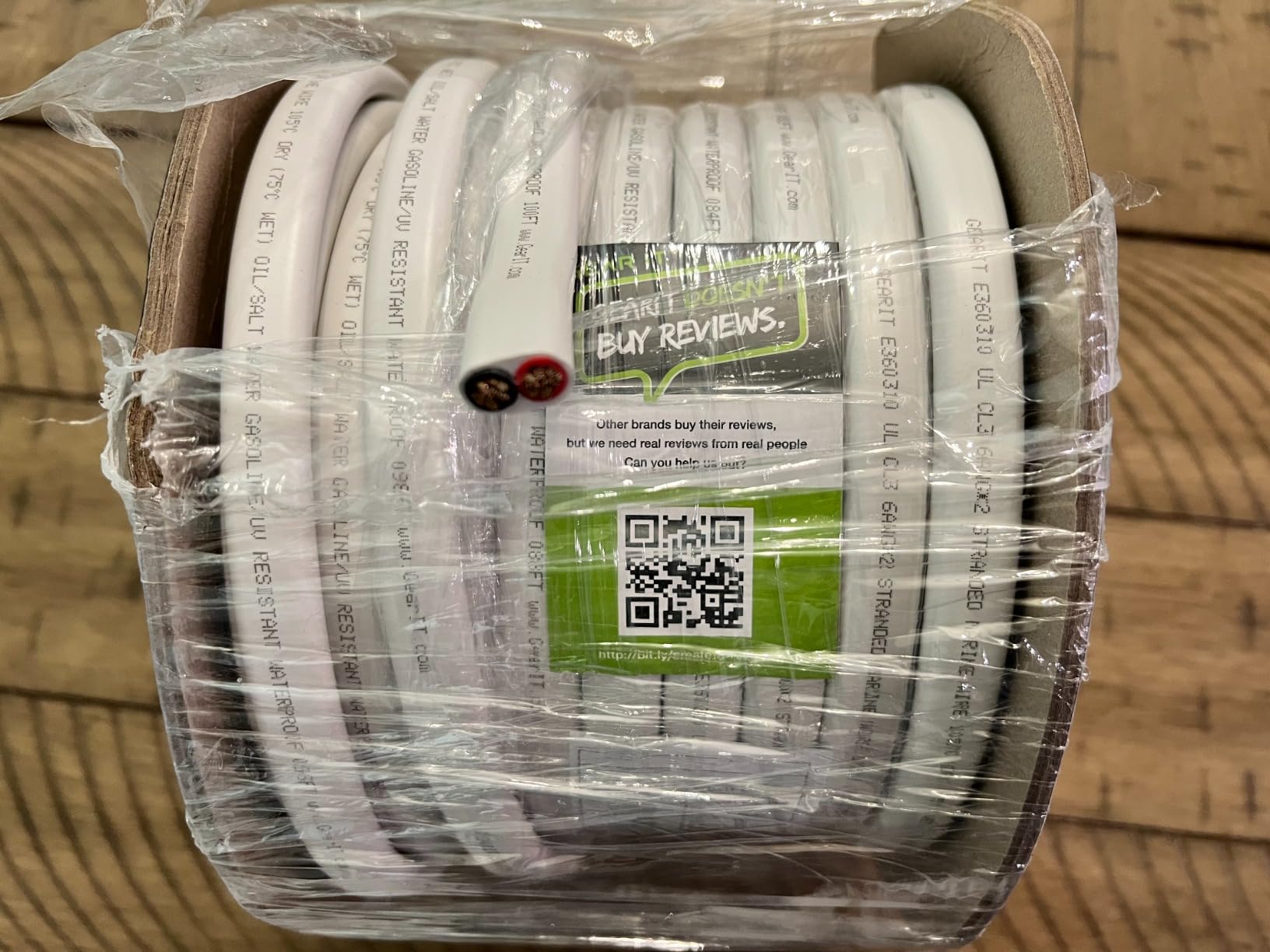
Owner feedback on this one is unusually consistent, and it comes from people who used it in saltwater hulls, on sailboats and in RV accessory circuits. The rating breakdown runs 88 percent five-star and 9 percent four-star, which is a stable shape rather than a spike. The most common complaint by far is cosmetic: the printed footage markers on the jacket are small enough that you squint at them when cutting a long run.
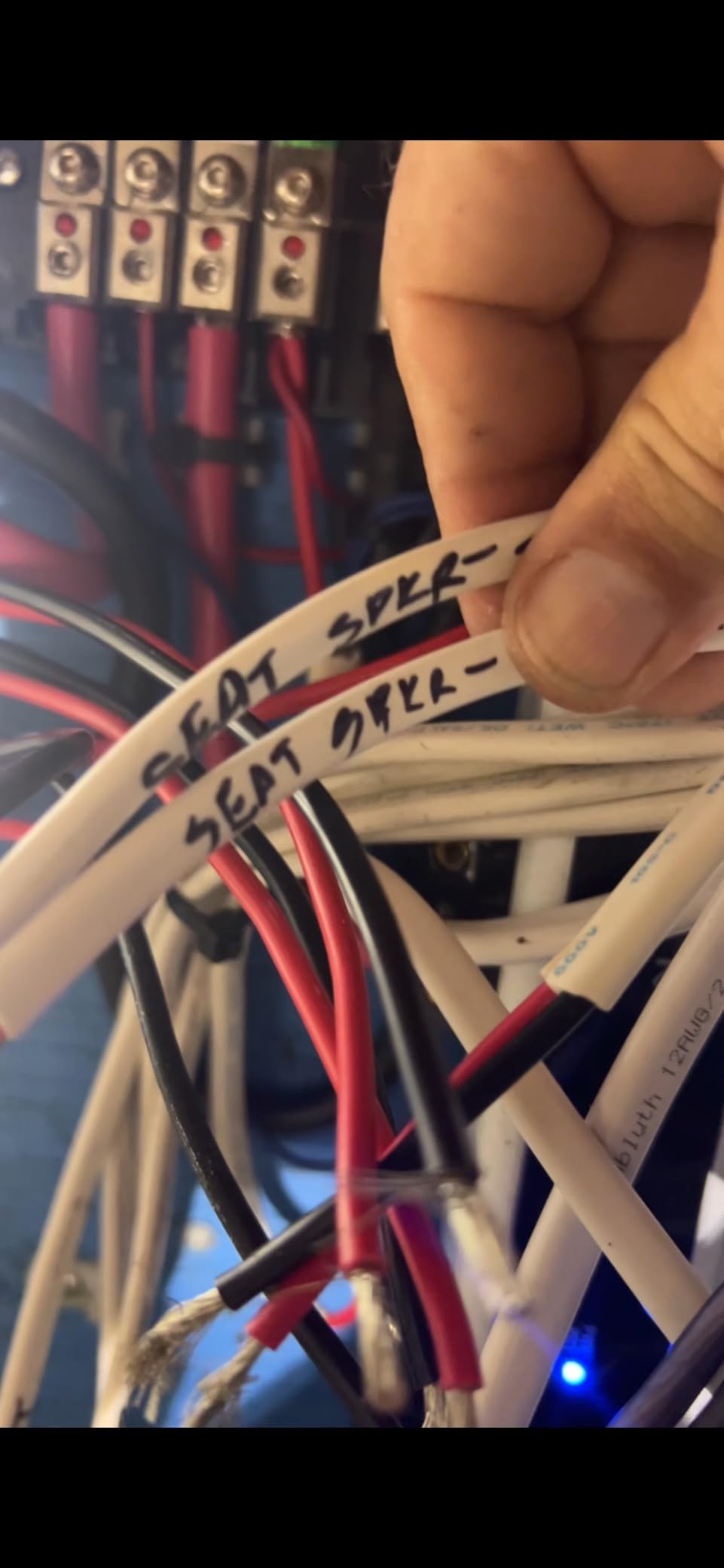
The limitation worth knowing is the marketing label. It is sold as marine speaker wire, and for audio or accessory circuits that is exactly right. But if you plan to hang deck and nav lights off this and add more loads later, 14 AWG is the ceiling, not the starting point, and you would be redoing that run in 12 or 10 AWG. For anything above roughly 15 amps for a long distance, step up a gauge.
Buy this one if your project is a rebuild of small accessory, lighting and signal circuits across a boat of any size. Skip it if your job needs 8 AWG or heavier, because this spool is 14 AWG only and there is no gauge ladder inside the box.
Is the footage enough for a whole boat?
One hundred feet of duplex cable gives you roughly 200 feet of individual conductor, which covers lighting, accessory and signal circuits across a boat of most sizes. Before you order, add up your planned runs end to end and add 15 percent for slack.
What it is wrong for
It is 14 AWG only, so it cannot carry a trolling motor, a start circuit or a high-output amp. If your job needs 8 AWG or heavier, there is no gauge ladder inside this box.
2. Seamaka 50ft 4-Way Trailer Wiring Harness for Boats and Trailers
- 50 ft total run means a trailer can be rewired without splicing
- Colour-coded wishbone conductors make each circuit obvious
- Outer covering simplifies routing and securing the harness
- 4-way plug removes tail light jumper work
- Includes a male plug which will not fit setups needing a female socket
- 18 AWG is thin relative to heavier-gauge trailer cable
This is not a wire spool, and if you read the category as spools only, you will miss it. It is a 50-foot pre-wired 4-way harness with a male flat trailer connector, built for trailer and boat trailer lighting, and it covers the single most common electrical job on an older trailer in about twenty minutes of unhooking.
The breakdown matters for planning. You get roughly 42 feet of male lead, an 8-foot trunk connector section, and around 4 feet of trailer-side ground wire, with 18 AWG colour-coded wishbone conductors and a dedicated white ground. That layout means the male plug goes to the tow vehicle, the short trunk runs under the trailer tongue, and the colour-coded bundle feeds tail lights, turn signals, brake lights and ground without any jumper wiring.
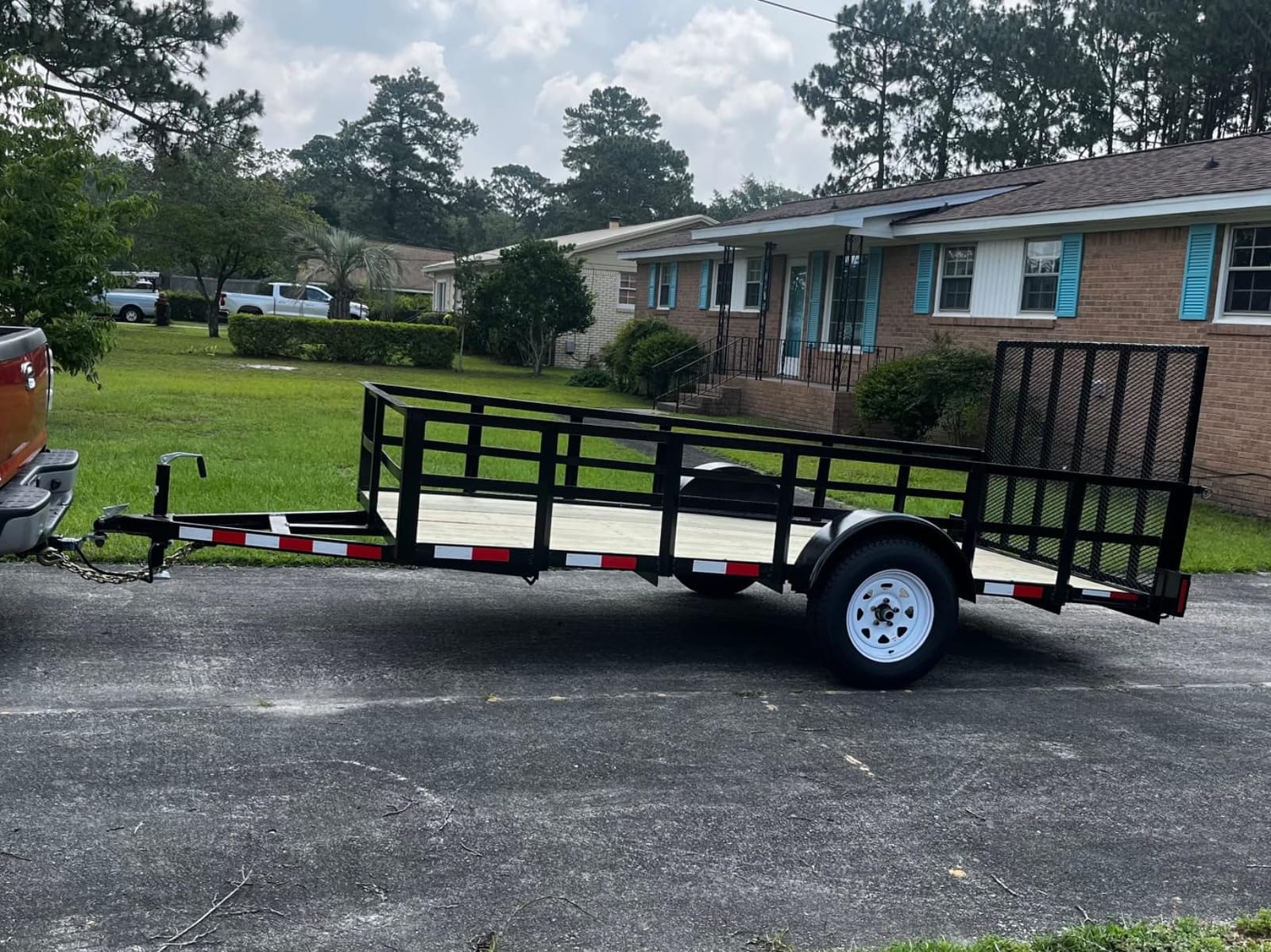
Owners consistently report finishing a full trailer rewire without a single splice, and they mention how quickly the protective outer covering routes around a frame rail. The distribution is 83 percent five-star and 11 percent four-star, with a 3 percent one-star share that mostly reflects connector gender rather than quality.
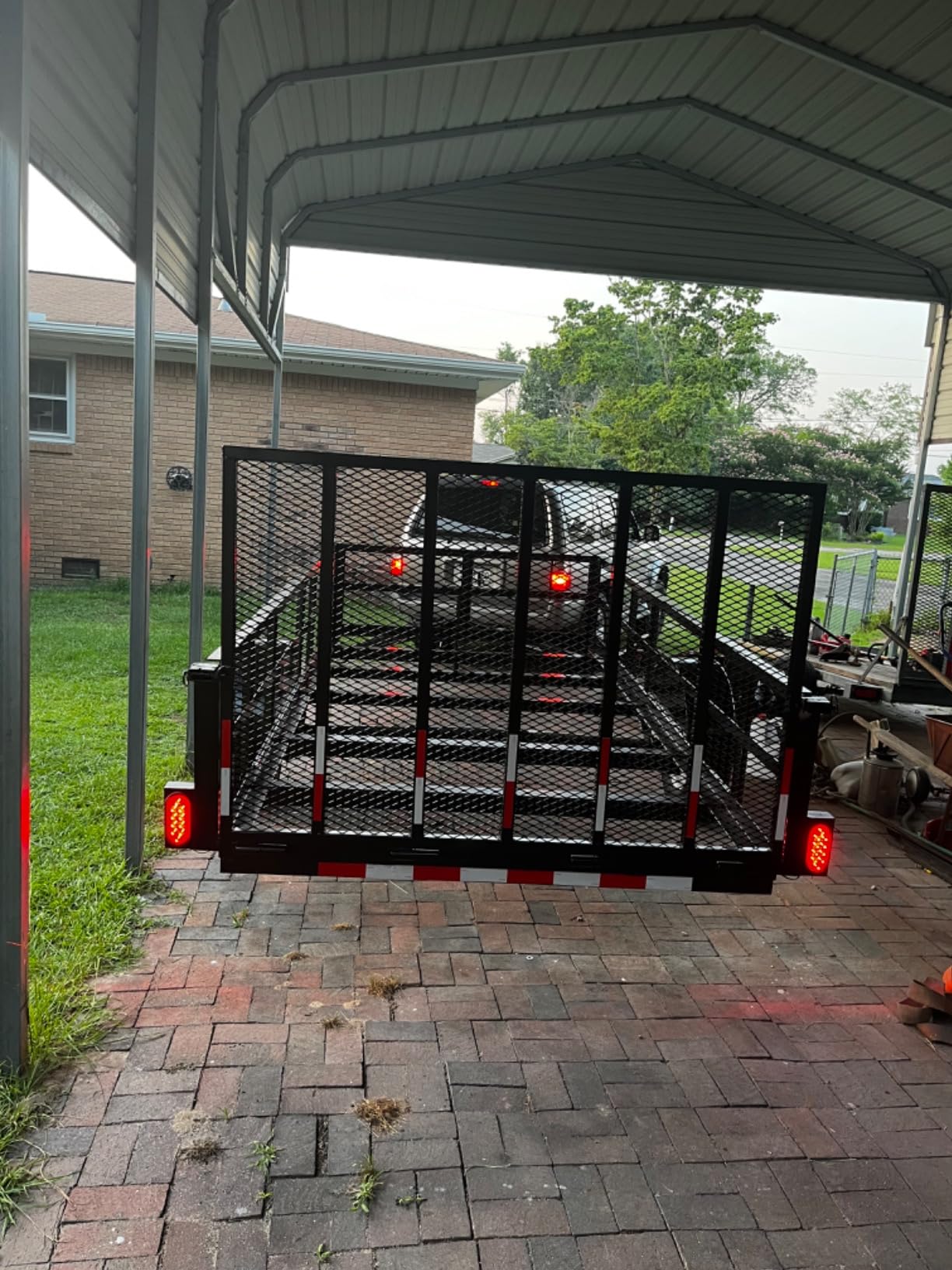
Here is the single thing you must verify before you commit: it includes a male 4-way plug. If your tow vehicle side has a female socket, or if your setup needs the opposite gender, this harness will not mate without an adapter. That is the most repeated caution in the reviews and it costs nothing to check in advance.
The second limitation is gauge. Eighteen AWG is perfectly adequate for lighting circuits on a trailer, and it is thinner than the 14 AWG cable in some heavier harnesses, so it is not the cable you would want for a trailer aux circuit or a battery feed. Check both points, then this harness will do exactly what it says for a lighting rewire.
Will the connector mate with your tow vehicle?
The harness has a male 4-way flat plug at the tow vehicle end, so it needs a female socket on the vehicle. Check that before you buy, and budget for an adapter if the genders do not line up.
What it is wrong for
Eighteen AWG conductors are thin next to a 14 AWG cable, so this is a lighting harness, not a battery feed or aux circuit carrier. It also handles four circuits, so a seven-pin trailer needs the 7-conductor cable instead.
3. NOVINO 10 AWG Marine Grade Duplex Wire 30ft
10 Gauge Marine Wire,10 AWG 30ft Duplex Marine Grade Wire,10/2 Gauge Cable
- True-to-spec 10 AWG with a strand count that delivers real conductivity
- Thick outer jacket resists abrasion heat shock and flame
- Explicit UL 1426 SAE and ABYC compliance stated
- Holds the number one rank in Boat Electric Wire
- White outer jacket shows dirt and scuffs in a working bilge or engine bay
- Duplex format means two conductors per run so single conductor needs are awkward
When a forum thread asks whether an unbranded marine wire is actually marine, the honest test is not the marketing copy but the compliance line. NOVINO states UL 1426, SAE and ABYC compliance directly on the listing for this spool, and pairs it with a true 10 AWG stranded tinned copper conductor in a 30-foot duplex run. That combination is why this is our premium pick.
The insulation rating is 600V with a 105 C dry and 75 C wet window, which matches the practical limits of a real DC system rather than a hobby rating. The outer jacket is thick, and owners who have used it on pontoons and bass boats report it holding up to abrasion, heat shock and even open flame without the jacket letting go.
The range is the quiet strength here. NOVINO makes this conductor from 2 AWG to 20 AWG and 5 ft to 200 ft, which means if this spool is right for your first run, the next heavier run does not mean a new brand. Repeat buyers on this listing are running lighting, bilge, shore power and battery bank work, and the 88 percent five-star share suggests the true-gauge claim holds up in the hand.
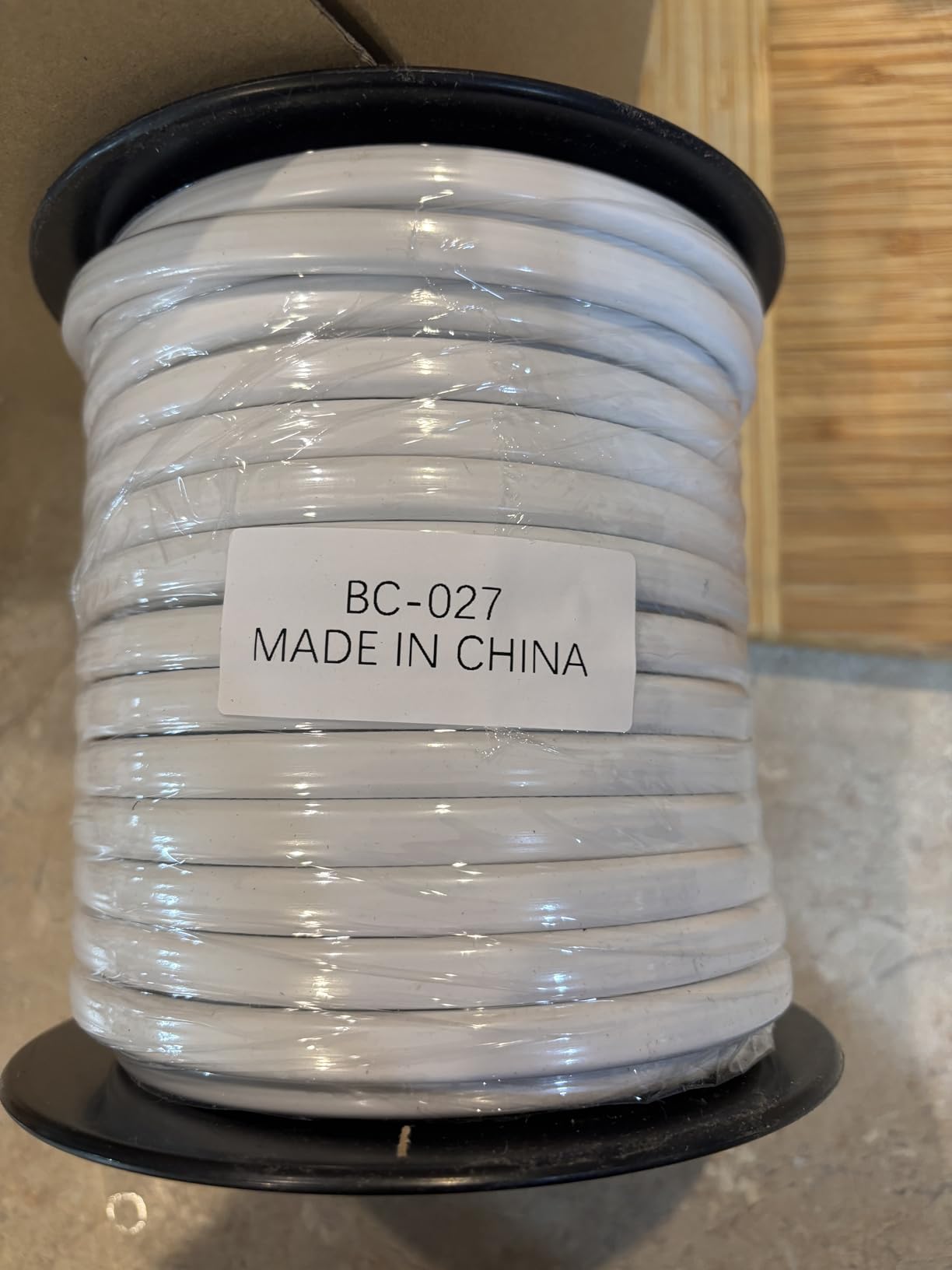
Two honest caveats. First, the white outer jacket is a visibility problem in a working bilge or engine bay, where everything ends up grey within a season. Second, this is duplex cable, so you get two insulated conductors in a shared jacket, which is ideal for a run and out but slightly awkward when you need a single conductor pulled through a tight chase.
Pick this spool when you want a documented standard, a true gauge and a length you can defend to an inspector. Leave it on the shelf if you are wiring one light in the cockpit and the full footprint of 30 feet is dead weight behind your panel.
How much wire does 30 feet actually give you?
Duplex cable carries two insulated conductors in one jacket, so 30 feet gives you 30 feet of paired run, which is roughly 60 feet of individual conductor. Measure your circuit, add 15 percent slack and check it closes before ordering.
What it is wrong for
The white outer jacket shows scuffs in a working bilge or engine bay, and the duplex format is awkward when you need to pull a single conductor through a tight chase. For a single-conductor run, choose a single-core spool.
4. NOVINO 10ft 8 AWG Trolling Motor Battery Extension Kit
NOVINO Trolling Motor Battery Cable Extension Wire Kit-10 Feet 8 Gauge Wire
- Lets you move the trolling motor forward for better trim and balance
- 8 AWG keeps power delivery strong over the longer run
- Connecting hardware and electrical tape included in the box
- Two-year warranty
- Listed 12V maximum rules out 24V and 36V trolling systems
- Proprietary 3-pin housing will not mate with other plugs
The reason anyone buys an extension is not more current, it is better balance. This NOVINO kit gives you 10 feet of 8 AWG red and black cable between the battery and the motor, which on most small boats is exactly the length needed to push the battery forward under the bow and get the boat to sit level. Boats with all the weight aft handle noticeably better once you do.
The electrical spec is 55 amps maximum at 12 volts, and at 8 AWG the resistance over 10 feet is low enough that you will not hear the motor slow down. That is the practical test that matters, because a longer run in thinner wire is exactly how trolling motors get accused of losing power when really the cable is fighting you.
Everything needed to land the connection is in the box: the connector housing, the 10-foot red and black cable, connecting hardware and electrical tape. There is a two-year warranty on the kit, which is longer than most in this category offer.
Now the limits, which matter more than anything else here. The listed maximum is 12 volts, so a 24V or 36V trolling motor system is out. And the 3-pin male-to-female housing is proprietary, so it will not plug into a motor or battery lead fitted with a different connector without an adapter you have to source separately.
This is the right kit for a 12V single-bank setup on a boat that needs its weight shifted forward. It is the wrong kit for a multi-bank saltwater system, where voltage range and connector standard decide compatibility before anything else does.
Will it reach the battery and the motor?
Ten feet of 8 AWG is the useful part here, and it is enough on most boats to move the battery forward under the bow. Measure your actual run before you commit, because the extension only helps if it clears the transom, the deck edge and the mounting hardware.
What it is wrong for
The listed 12-volt maximum rules out 24V and 36V trolling motor systems, and the proprietary 3-pin housing will not mate with a motor fitted with a different connector. Both limits are dealbreakers on a multi-bank saltwater setup.
5. Rockville RMWK4 V2 4 AWG Marine Amplifier Installation Kit
Rockville RMWK4 V2 4 AWG Gauge Waterproof Marine Amplifier Installation Kit
- Everything for one amp install in a single labelled box
- 18 ft of 4 AWG tinned OFC suits centre console and pontoon layouts
- Flexible cable routes easily through interiors and bulkheads
- Pre-installed terminals remove most of the termination work
- Included speaker wire reported to corrode and crumble in a saltwater boat
- Ground wire and lugs reported to oxidise within about a year
This is the most complete single-box amp install on the list, and also the one with the loudest durability complaints, so it deserves a straight verdict. What you get is 18 feet of 4 AWG tinned oxygen-free copper for power, a matching 18-foot ground run, 20 feet of RCA, 25 feet of speaker wire, 25 feet of remote wire, and a fuse holder with terminals. Every run is pre-crimped and labelled.
For a first marine amp on a centre console or pontoon, that inventory is genuinely attractive. Power and ground are the two runs that are painful to extend, 4 AWG is the right gauge for a serious marine amp, and flexible cable routing through bulkheads is a real time saver when you are doing this in a cramped helm.
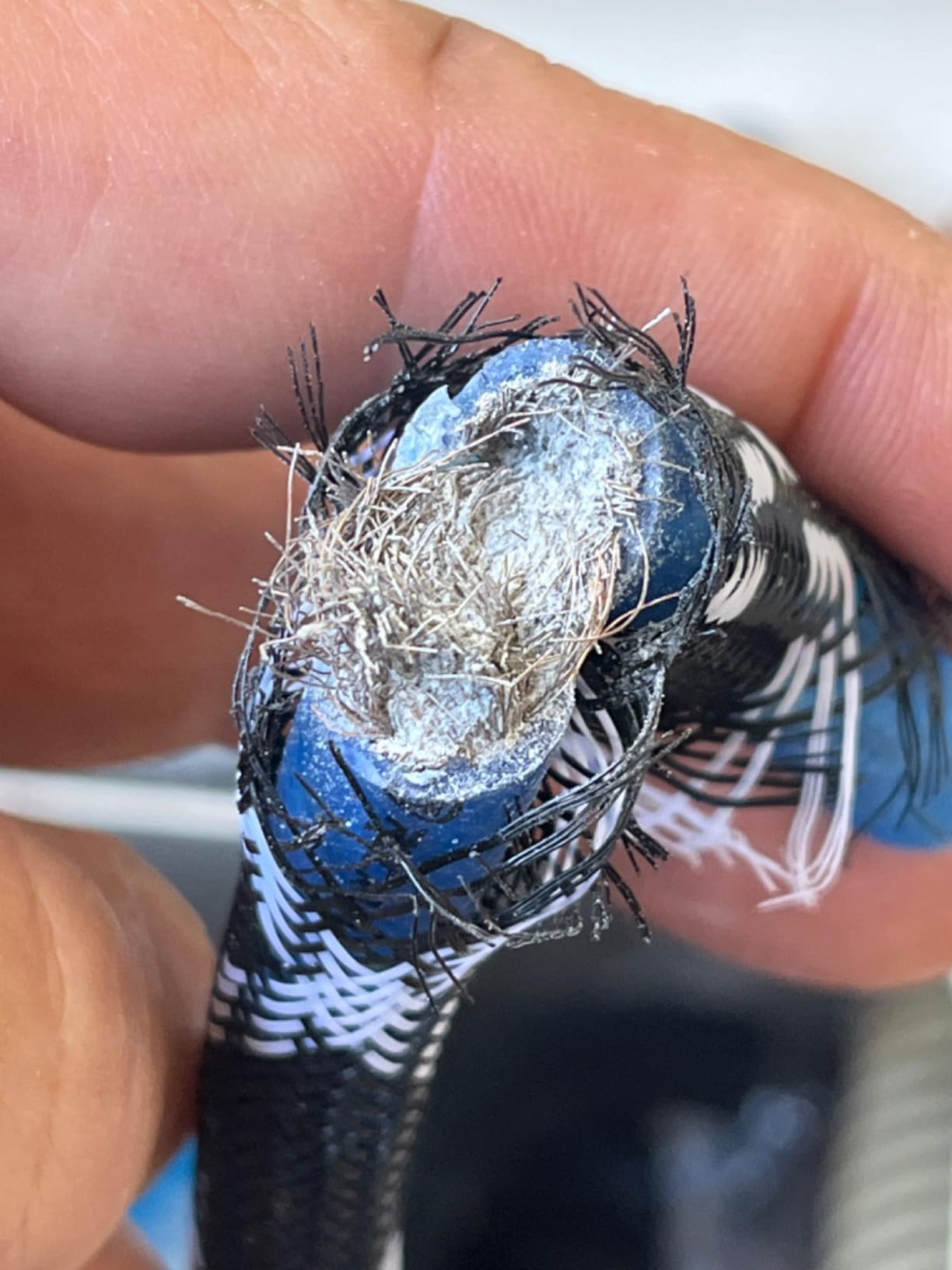
Here is why the rating sits at 4.3 when most of this category runs higher. Several owners who installed high-power marine amps report that the included speaker wire corroded and crumbled inside a saltwater boat within about a year, and that the ground wire and lugs oxidised and disintegrated over a similar period, forcing a rewire with tinned marine-grade wire bought separately. That is the failure mode experienced forum owners warn about, and it lands exactly on the two runs most likely to sit in a wet compartment.
That does not make the kit useless. It makes it a kit with two consumable parts, which is a very different proposition from a kit that is finished when the box is empty. My advice would be to plan on replacing the speaker and ground runs with true tinned marine wire and adhesive-lined heat shrink regardless of what is in the box, and treat the RCA, remote and fuse holder as the parts you actually save money on.
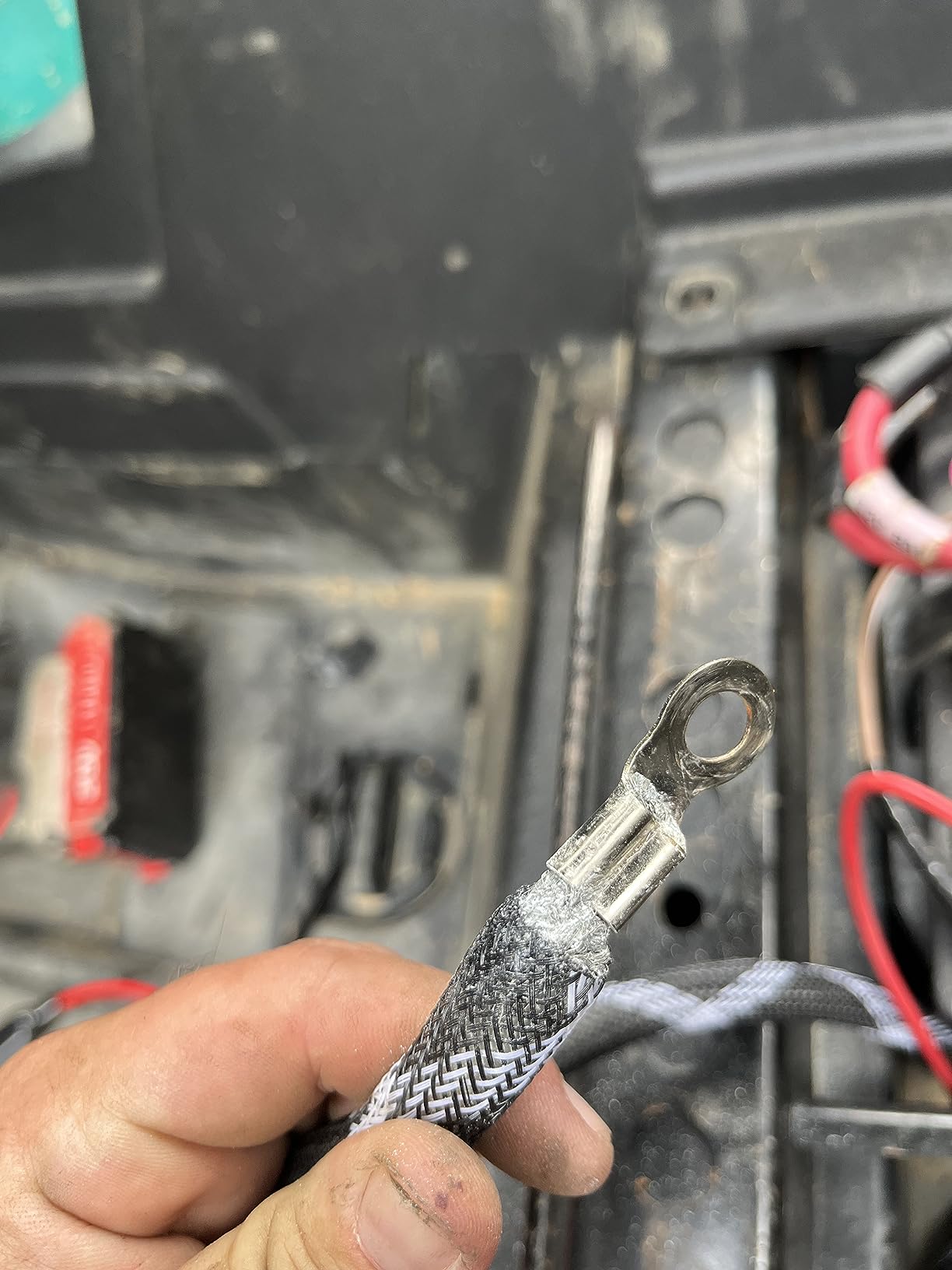
Buy it if you are fitting one amp on a freshwater boat or a salt boat where the ground run will stay inside a sealed compartment. Skip it for a saltwater install where the factory ground and speaker wire will live in a console cavity, because you will end up buying marine wire anyway.
Do the included speaker and ground wires survive saltwater?
Several long-term owners say no, reporting that both runs corroded and crumbled inside a saltwater boat within about a year. On a saltwater boat, plan to replace those two runs with true tinned marine wire and adhesive-lined heat shrink.
What it is wrong for
It is wrong for a saltwater install where the factory ground and speaker wire live in a wet console cavity, because you will buy marine wire anyway. The RCA, remote and fuse holder are the parts that genuinely save you work.
6. GaiRen 10ft 8 AWG Trolling Motor Battery Extension 50Amp
GaiRen Trolling Motor Battery Cable Extension Kit 10 Feet 8AWG Cable Extension 50Amp with Terminals for Fishing Boat Trolling Motor Solar Panel Automotive(Red & Black)
- Long enough to move the motor to the bow on a 14 ft aluminium boat
- 8 AWG delivers power with no noticeable loss
- Every piece of connection hardware is in the box
- Owners report improved balance and handling in canoes and kayaks
- Connections need careful sealing by the installer to stay corrosion free
- No manufacturer warranty offered
The use case that shows up again and again in the reviews is unusually specific, and it is genuinely useful to know: relocating a trolling motor battery forward to the bow so the boat sits level. On kayaks, canoes and small aluminium boats, that single change fixes handling more than any other mod. This 10-foot 8 AWG extension is what makes it possible.
Electrically it is a 10-foot red and black run in 8 AWG rated to 50 amps maximum operating current, with a rugged PVC jacket that resists abrasion. Unlike some competing extensions, it is listed for 12V, 24V, 36V and 48V systems, which widens the range of motors you can put on it.
The hardware situation is where this kit beats the competition. Ring terminals are pre-crimped, and the box includes copper screws and nuts, electrical tape and two pieces of heat shrink tubing. That means the entire connection is landable with basic tools and no trip back to the supply counter for a terminal you did not know you needed.
Two downsides, both real. The pre-crimped terminals still need careful sealing by you if the connection lives in a wet compartment, and there is no manufacturer warranty behind any of it, which is a thinner safety net than the two-year cover on the NOVINO extension above.
Choose this for a small aluminium, canoe or kayak setup where balance is the problem and you want every fastener in the box. For a boat where the joint sits in salt spray and you want recourse if something fails, the warranty-free version is a gamble you may not want to take.
How far can you move the battery forward?
Ten feet covers the relocation from a stern or middle-mounted battery to a bow position on a 14 ft aluminium boat, and the same run works in a canoe or kayak. If your battery is already forward, this is wasted length.
What it is wrong for
There is no manufacturer warranty, and the pre-crimped terminals still need careful sealing by you to stay corrosion free. In salt spray, that is a thinner safety net than a warranted kit with a documented rating.
7. Kicker 47KMPK4 Marine 4 AWG Amplifier Power Kit
- Nickel-tinned OFC cable is built specifically for corrosion resistance
- Includes a marine-rated battery fuse holder and matching marine fuse
- Complete power delivery package for a single amp upgrade
- Only 35 ratings
- so long-term durability data is thin
- Cost per foot runs well above generic marine wire kits
Kicker is one of the names that keeps surfacing in the shopping results for marine amp power, and this kit is why. The cable is full-spec oxygen-free copper with a tinned nickel anti-corrosive coating, which is a different corrosion strategy from the plain tin dip on most marine wire. Nickel resists the salt and fog exposure that eats bare copper faster than it eats tin.
What makes it a kit rather than a spool is the protection hardware. You get the KMFMF marine-rated battery fuse holder and a matching MRBF marine fuse, plus ring terminals, so the overcurrent protection is part of the marine system instead of something you staple on afterwards. For a saltwater boat running a serious amp, that is the piece you do not want to improvise.
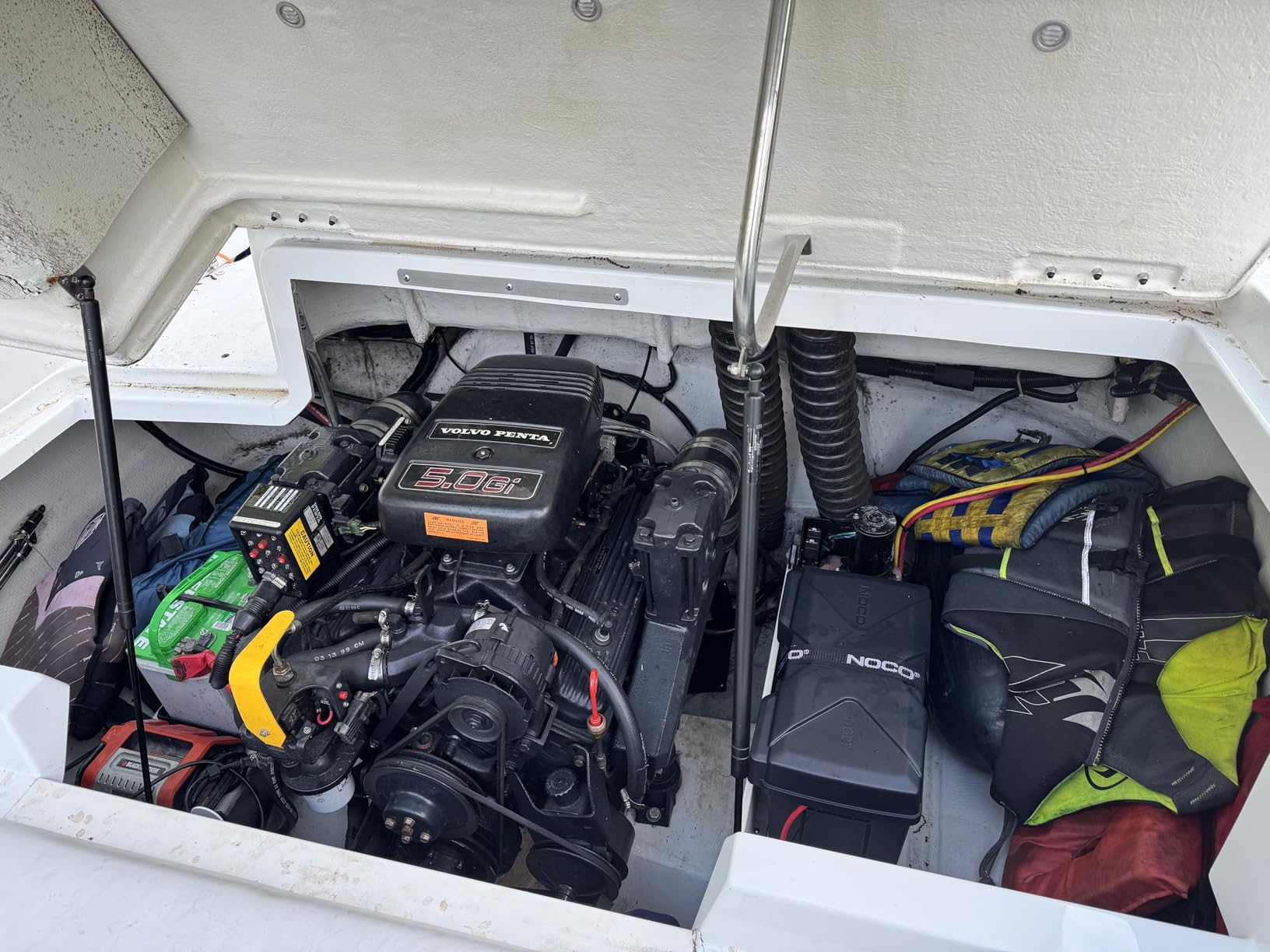
The rating is excellent, but the sample is small, and those two facts belong in the same sentence. Across 35 ratings the distribution is 87 percent five-star and 13 percent four-star with nothing at three stars or below, and owners single out the tinned OFC construction and the completeness of the single-box install. The flip side is that durability praise is mostly manufacturer-sourced rather than verified by long-term owners, which is a distinction experienced boaters would insist on.
The other consideration is cost per foot. On a cost-per-foot basis, this sits well above a generic marine wire spool, and if you already own good 4 AWG and only need the fuse holder, buying the whole kit is paying for wire twice.
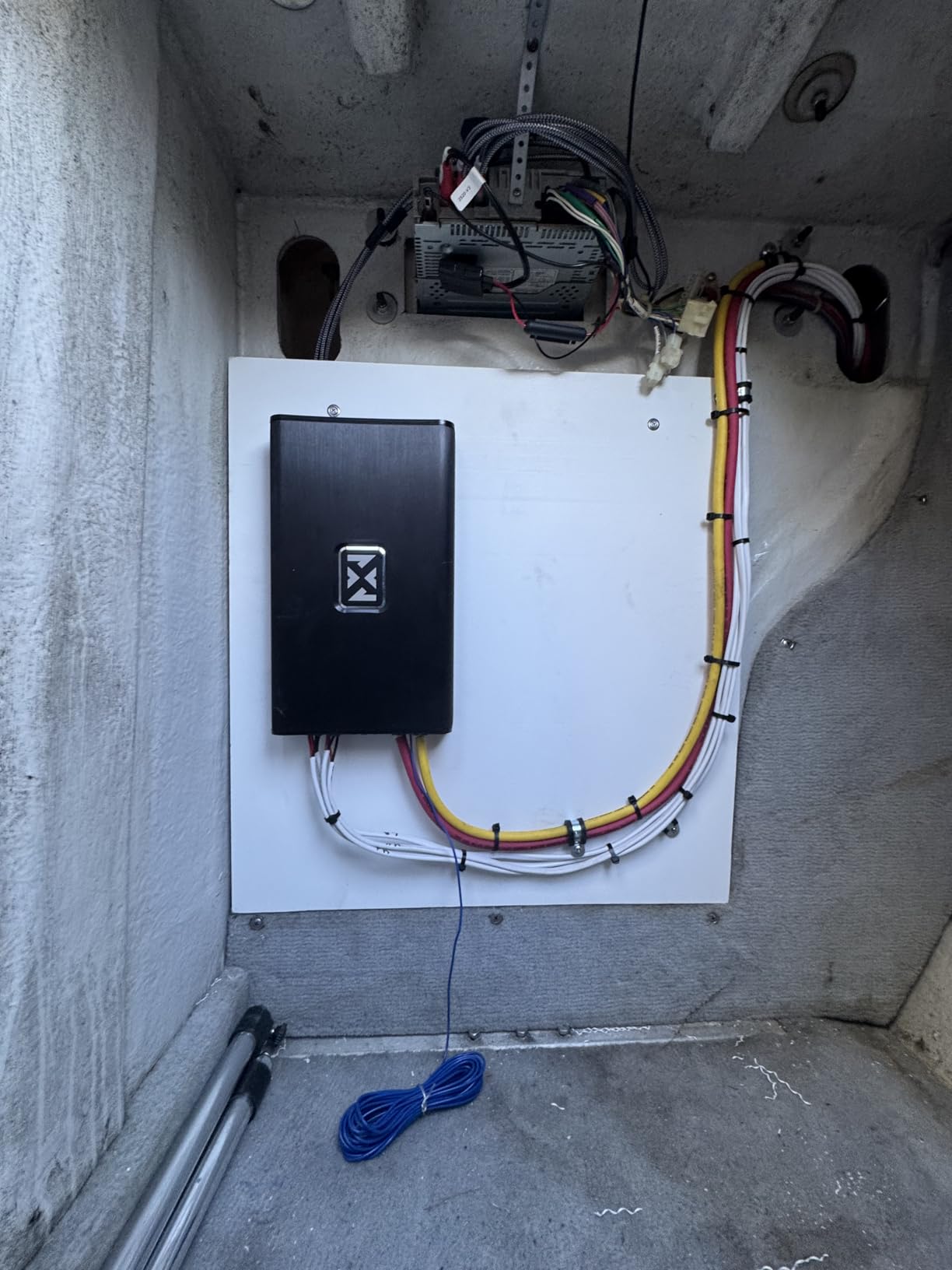
Best for a saltwater audio build where corrosion resistance on the power run is the deciding factor and you want the fuse holder to match. Not the value play, and not the kit for a first install on a freshwater boat where a simpler package will do the same job.
Does the protection match a saltwater audio system?
Yes, and that is the reason to pay for it. The nickel-tinned oxygen-free cable plus the KMFMF marine fuse holder and MRBF marine fuse mean the overcurrent protection is a marine part from the start, not something improvised later.
What it is wrong for
With only 35 ratings, long-term durability feedback is thin, and the cost per foot runs well above a generic marine wire spool. If you already own good 4 AWG and only need a fuse holder, you are paying for wire twice.
8. TUOFENG 16 AWG Solid Tinned Copper Hook-Up Wire Kit 6 Colours
TUOFENG 16 AWG Solid Tinned Copper Wire Kit, 6 Colors, 13.2 ft Each
- Six clearly differentiated colours make circuit identification and troubleshooting fast
- Solid core holds formed bends for stationary control and relay wiring
- Insulation is stiff enough to strip and terminate cleanly
- Box doubles as an organised dispenser with one opening per colour
- Solid core is inflexible and unsuited to moving or repeatedly bent runs
- 300V rating and 80C ceiling sit below marine power cable specs
This is the least marine-looking product here and the one most often bought by people who ignore that, so it needs a clear rule. It is six spools of 16 AWG solid core tinned copper, 13.2 feet each, in red, black, green, yellow, blue and white, packed in a dispenser box with one opening per colour. The tinning is genuine and stripping is clean.
Where it earns its place is control and relay wiring, panel wiring and anything fixed. Solid core holds a formed bend once you make it, which is exactly what you want on a relay circuit or a switch panel that will never be flexed again. Six distinct colours also make circuit identification almost instant, both at install time and eighteen months later during a fault.
Electronics builders use it heavily for low-voltage control, LED work and power supply builds, and the reported resistance measurements for the copper are accurate to spec. Owner ratings sit at 85 percent five-star, and the feedback is warm and specific rather than vague.
Two warnings are non-negotiable. Solid core will not flex, so it is wrong for anything that moves, vibrates or gets bent repeatedly, and a boat is a vibrating environment. And 300V at an 80 C ceiling is below the 600V and 105 C class that marine power cable is rated to, so it has no business on a main feed or a circuit near an engine bay.
Use it for stationary low-voltage control circuits on a boat and you will be fine. Use it as your marine wire and cable kit and you have bought the wrong product for a wet, moving, hot environment.
Can solid core wire go in a boat at all?
Only on circuits that never move. Solid core holds a formed bend, so it works for relay circuits, switch panel wiring and fixed control runs, and it should stay away from anything that vibrates or gets flexed.
What it is wrong for
It is wrong for a main feed or any circuit near an engine bay, because 300V and an 80 C ceiling sit far below the 600V and 105 C class of marine power cable. It is a control wire kit, not a feeder kit.
9. Samramra 50ft 7-Conductor 14 Gauge Trailer Cable
7 Way Trailer Wire Harness Kit, 50 Feet Heavy Duty 14 Gauge 7 Wire Trailer Cable with Color-Coded PVC Jacket, 7 Pin Wiring Conductor for RV, Camper, Utility Trailers, Boat, Truck
- Single 7-conductor cable keeps a rewire cleaner than seven separate wires
- Colour-coded conductors speed up connecting and troubleshooting
- Heavy jacket routes easily around frame corners through tight bends
- Owners report use on boat horse utility and sand buggy trailers
- Copper-clad aluminium carries less current than solid copper of the same gauge
- All-weather splices should be soldered and heat-shrunk rather than twisted
Who makes the best wiring harness for a trailer depends entirely on whether you are running seven circuits or four. For a seven-pin setup this cable is the cleaner answer than seven loose wires, because everything lives inside one 14-gauge jacket that you can route in a single pass and clip down along the frame.
The build detail that separates it from cheap harnesses is the cloth protective layer between the outer jacket and the inner insulation. Without it, stripping the jacket tends to chew the insulation of the conductors inside and powder the surface, which is a nuisance on every repair. With it, stripping is clean.
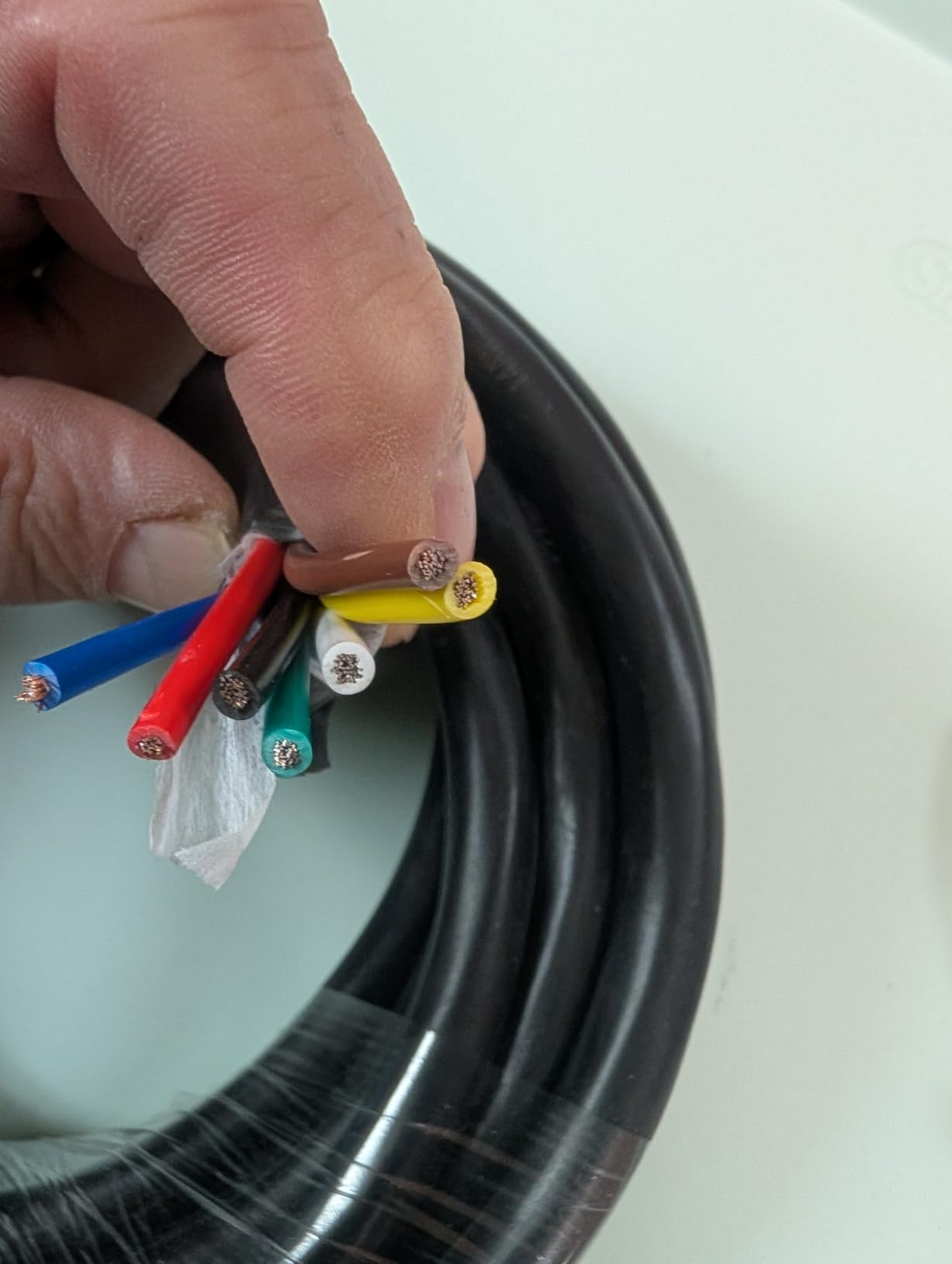
Owner feedback is strongly positive, with a 91 percent five-star share, and reviewers point to heavy-duty construction, generous length, clean routing and the time saved by colour-coded conductors on a full rewire. Length options run to 25, 50 and 100 feet, so the same cable fits a small utility trailer or a long boat trailer.
Now the part that decides it for a saltwater boat: the conductors are copper-clad aluminium, not copper. That is stated plainly on the listing, which is more than most sellers manage, and it means lower current capacity than true copper at the same gauge. It is not a problem for lighting circuits, which is what 7-pin is mostly carrying, but it is not what you want for an aux or battery feed.
The second caution is about splices. Reviewers who use this outdoors recommend soldered, heat-shrunk connections rather than twisted ones, which is good practice regardless of the conductor material.
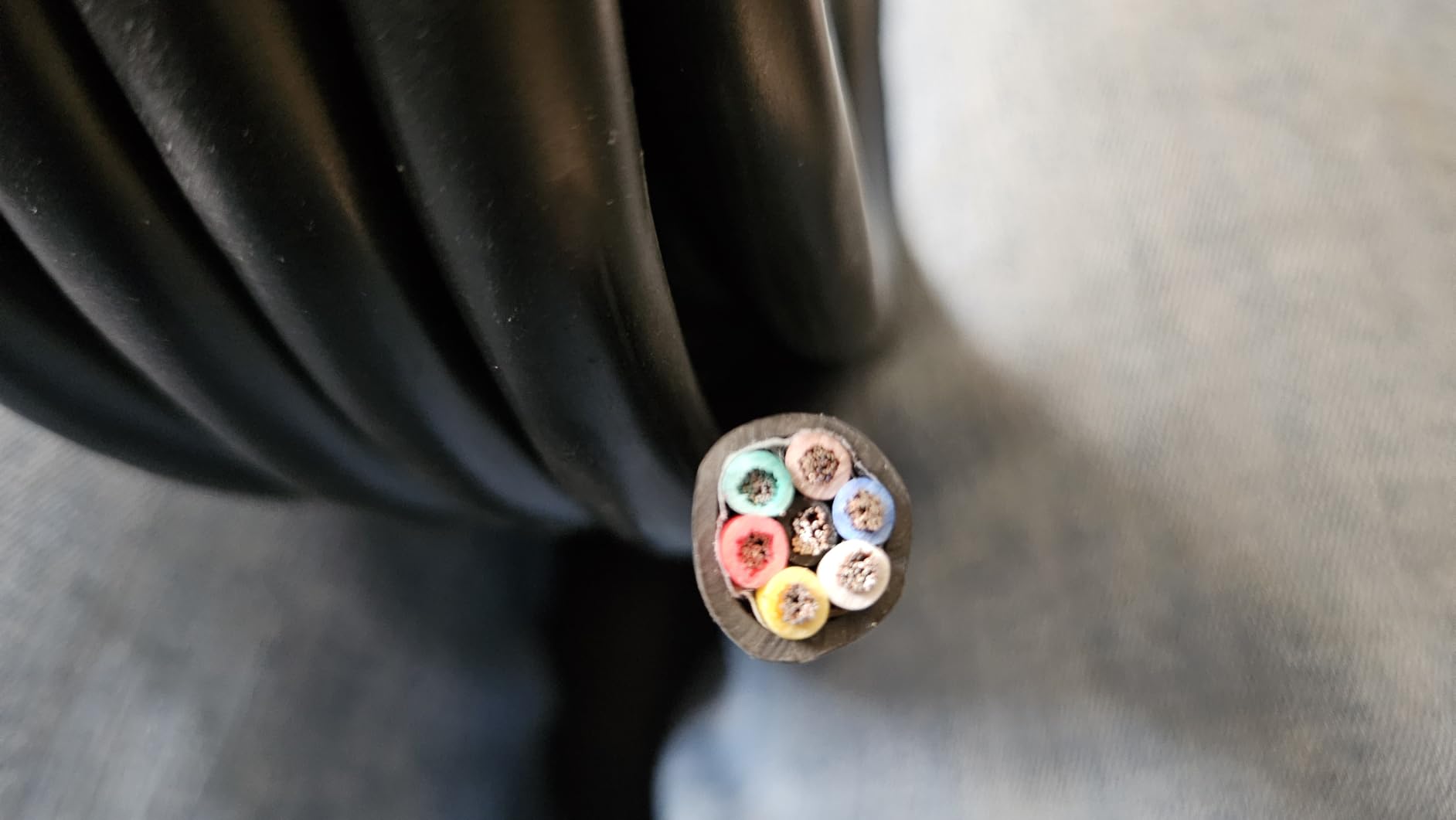
Pick this for a seven-pin lighting rewire on a boat trailer or any utility trailer. Step away from it if your trailer needs to push real current through an auxiliary circuit, because there is a better conductor for that job.
Can copper-clad aluminium carry your trailer circuits?
For lighting circuits, which is most of what a 7-pin connector does, yes. The conductor carries less current than solid copper at the same gauge, so it is a problem only if you plan an aux or battery feed through the same cable.
What it is wrong for
It is the wrong cable for any circuit that pushes real current, and splices on it should be soldered and heat-shrunk rather than twisted for all-weather use. For a heavy aux run, buy copper.
10. Remington Industries 14 AWG GPT Marine Hook-Up Wire 10-Colour Kit
14 AWG Gauge GPT Marine Stranded Hook Up Wire 10-Color Kit, 25 ft Length Each, 0.0641″ Diameter, UL1426, 60 Volts
- Ten distinct colours cover almost any circuit identification scheme
- True UL1426 PVC stranded tinned copper construction
- 25 ft per colour is enough for most panel and harness runs
- 60V wet rating is low next to 600V-class marine power cable
- Only 32 ratings limits long-term durability feedback
When a boat owner asks what the best brand of wire connectors and signal wire to buy for a switch panel, the honest answer is usually a multi-colour assortment rather than a single spool, because you will not remember in two years that circuit was the one you ran in blue. This Remington kit gives you 14 AWG stranded tinned copper in ten colours with 25 feet of each.
The specification is the part worth reading closely. This is GPT marine wire listed to UL1426, with 19/27 strand construction and a 0.1170 inch overall diameter. Stranded tinned copper at a named standard is the baseline of credibility for this audience, and unnamed marine grade is not.
Feedback is generally positive on build quality and the convenience of ten colours at 25 feet each, which is enough for most panel and harness runs without a second purchase. The rating share is 70 percent five-star, and buyers typically deploy it on low-voltage accessory, control and signal circuits rather than main power feeds.
The reservation that comes up repeatedly is the 60V wet rating. That is perfectly adequate for signal, control and accessory circuits, which is what this kit is for, and it is well below the 600V class that marine power cable carries. Match it to the circuit and it is fine; put it on a main feed and it is the wrong wire.
The 32-rating sample is the other limitation, thin enough that long-term durability feedback is limited. Buy it as panel and signal wire and it earns its place. Buy it expecting it to be your primary feeder and it will not.
Is 25 feet per colour enough for a switch panel?
For most panel and harness runs, yes. Ten colours means you can follow a consistent identification scheme across accessory, control and signal circuits instead of guessing which conductor you ran two years ago.
What it is wrong for
The 60V wet rating is a signal and control rating, not a power rating, so this is not the wire for a main feed. The 32-rating sample is also too thin to judge long-term durability.
11. Stinger 23ft Marine 8 GA Amplifier Installation Wiring Kit
Stinger 23-ft Marine & Powersports 8GA Amplifier Installation Wiring Kit
- Siamese dual power and ground design removes a separate ground run
- Type III jacket exceeds UL1426 for salt fog oil and water exposure
- Water-resistant MIDI fuse holder gives integrated overcurrent protection
- Ferrules and all mounting hardware are in the box
- Only 34 ratings
- so long-term owner data is limited
- Dual siamese layout is less flexible than separate conductors
The layout is the idea here. Instead of a separate positive and negative conductor, you get 23 feet of dual siamese 8-gauge oxygen-free copper, meaning power and ground share one jacket for the whole run. On a boat install that saves a routing decision, removes a chafe-prone second loose cable, and cuts install time noticeably.
The jacket specification is unusually well stated. It is Type III BC5W2 compliant PVC that exceeds UL1426, rated 105 C dry and 75 C wet, with resistance to salt, fog, oil and water. The conductors are high strand count hyper-twist tinned, which is the construction that stays supple through a tight bulkhead instead of kinking.
Protection and hardware are handled. The kit includes a water-resistant 40A mini-ANL, or MIDI, fuse holder along with wire ferrules and all the mounting hardware you need to land it, plus a one-year manufacturer warranty. Owners installing high-output marine and powersports amplifiers rate it at 89 percent five-star and 7 percent four-star, and the praise centres on the pre-terminated siamese layout cutting install time.
The honest limitation is the sample size. Thirty-four ratings is a small base, and the dual siamese format is genuinely less flexible than separate conductors if you need to route around an awkward obstacle or split a run in two directions from one feed point.
Pick this if you are running a big amp along a single defined path and want the ground and negative handled as one protected run. Choose separate conductors instead if your routing branches or if 8-gauge is not the gauge your amp actually needs.
Why does a siamese layout matter on a boat?
Power and ground share one jacket for the whole run, so there is no second loose cable to chafe against hardware and only one routing decision to make. Owners report that it visibly cuts install time on a big amp.
What it is wrong for
A dual siamese cable is less flexible if your routing branches or you need to feed two directions from one point. And with only 34 ratings, the long-term owner data on this jacket specification is limited.
12. Pro Controll 20ft 8 AWG Quick Connect Trolling Motor Harness with 60A Breaker
Pro Controll Quick Connect Trolling Motor Battery Harness Kit – 20′ 8 AWG Marine-Grade Wire, 60 AMP Breaker, Wire Loom – For 12V, 24V, 36V Systems
- Tool-free quick connect makes the motor easy to remove for charging or storage
- Built-in resettable 60A breaker protects motor and battery from overcurrent
- 20 ft of 8 AWG is enough for a clean run along the deck
- Works across 12V 24V and 36V systems
- No inline fuse at the battery so some installs still need a battery-side fuse
- Cost runs high against plain extension cable of the same gauge and length
This is the trolling motor wiring kit to buy if your motor spends half its life on the transom and the other half on the charger. The quick connect and disconnect is tool-free, so pulling the motor off takes seconds rather than a wiring exercise, and the harness is designed around that repeated connect and disconnect cycle.
The electrical package is 20 feet of 8 AWG marine-grade tin-plated copper wire inside a protective wire loom, with a 60 amp circuit breaker built in and a manual reset. Twenty feet is enough to route a clean run along the deck to a bow-mounted motor, and the loom is what keeps it from chafing against hardware along the way.
Compatibility is broad, working across 12V, 24V and 36V trolling motors on bass, jon, pontoon and kayak setups, and the manufacturer lists it for saltwater use. Owners value the quick connect and the integrated breaker, which removes the need to assemble a separate breaker and harness, with the tin-plated wire and loom reported to route cleanly on deck runs in salt water applications. Ratings split 81 percent five-star, 12 percent four-star and 4 percent one-star.
Two things to weigh. There is no inline fuse at the battery, so a battery-side fuse is still worth adding on a professional-grade install. And compared with plain 8 AWG extension cable of the same gauge and length, the cost is high, which is a fair thing to know if the only thing you are buying is length.
Choose this when tool-free disconnection and an integrated breaker are the features you actually want on a multi-voltage system. Buy a plain extension instead if you already have a breaker and only need ten feet of cable.
Do you need a breaker and a quick disconnect together?
If yes, this is the only kit here that gives you both in one harness: a 60 amp resettable breaker with a manual reset and a tool-free plug that lets you pull the motor off for charging in seconds.
What it is wrong for
There is no inline fuse at the battery, so a battery-side fuse is still worth adding, and the cost runs high against plain 8 AWG extension cable of the same gauge. If you already have a breaker, buy the extension instead.
How to Choose a Marine Wire and Cable Kit?
Here is the shortlist of questions that decide a purchase, in the order that actually matters.
Does it name a standard?
Look for UL1426, SAE J378 or ABYC on the listing, and treat their absence as a warning rather than a neutral. Forum consensus on this topic is blunt: unnamed marine grade is unverified marketing, and manufacturers have been called out for cutting corners on tinned cable. A spool that states a standard gives you something to argue with a retailer later, and a spool that does not gives you nothing.
The distinction is real. UL1426 covers the wire itself, SAE J378 covers the battery and cable standards, and ABYC is the installation standard that ties them together. The best wire in the world does not help if it was never rated for a wet environment in the first place.
Is the conductor tinned, and how finely stranded?
Tinned copper is the saltwater baseline because the tin corrodes sacrificially, protecting the copper underneath. On non-ABYC brands including Cobra, Kimbluth and Novino, the variable to check is whether the tin is actually on the strands rather than described as tinned in the title. Fine stranding, often 19 or 26 strands, is what lets the cable flex at a bulkhead instead of kinking and breaking strands where you cannot see them.
For freshwater boats, tinned wire in dry interior locations is a nice-to-have rather than a requirement, which is why experienced owners are comfortable with untinned cable in a sealed cabin. Once the run enters the bilge, the engine bay or any salt-spray exposure, tinned stops being optional.
What gauge do you actually need?
How many amps 12 gauge marine wire can handle depends on length and insulation temperature, but as a working rule, 16 AWG suits accessory and lighting circuits, 14 AWG handles light to moderate loads, 12 AWG covers interior circuits, 10 AWG is a solid general-purpose feeder, 8 AWG is the usual trolling motor and start circuit gauge, and 4 AWG or heavier is for high-output amplifiers, thrusters and windlasses. Stay inside a 3 percent voltage drop target on any run feeding electronics, because below that threshold the equipment behaves as designed.
Avoided pitfalls matter as much as gauge. Do not use Romex in a boat, do not use solid core on a moving or vibrating run, and do not use a thin cable because the distance seemed short on the drawing. Measure the actual run, add the routing detours, and then size.
Is the footage enough?
This is the most common real-world disappointment with these kits, and the fix is arithmetic rather than brand loyalty. Measure every planned run end to end, including the routing detours around thimbles, consoles and engine boxes, then add 15 percent for slack at both ends and for the service loop that lets you re-terminate a connection later.
Total spool length is the limiting factor far more often than gauge. A kit can carry exactly the right gauge in a length that stops 12 feet short of where your panel ends up, and no amount of brand quality fixes that. Our GEARit spool at 100 feet, the NOVINO duplex at 30 feet and the Stinger siamese at 23 feet all need to be checked against your measured route before you commit.
What connectors come with it?
The best brand of wire connectors is one you can crimp properly, and the honest answer from experienced owners is that crimp quality matters more than wire brand. Look for adhesive-lined heat shrink, heat-sealed butt connectors and marine-grade terminals, and never use push-on connectors in a damp location. If you do not own a ratcheting crimper, budget for one or use a marine retailer crimp service for the heavy battery cables.
Adhesive-lined heat shrink is worth the small step up from standard tubing because the adhesive flows into the joint as it shrinks, sealing the wire inside the connector rather than just wrapping the outside of it. That is the difference between a connection that survives a wet off-season and one that turns green.
Is the Ancor premium worth it?
The question that comes up constantly on sailing forums is that Ancor wire is the standard, but it usually costs around 30 percent more than the alternatives, with Cobra offered as the value pick. The practical answer is that the premium buys you certainty about strand count, tin coverage and jacket rating, and certainty is worth paying for on high-current or hard-to-reach runs where a failure means pulling the console apart again. On short, low-current accessory runs in a freshwater boat, it is a genuine luxury rather than a necessity, and a compliant spool from another maker does the same job.
Kimbluth sheathed duplex tinned copper is the most frequently recommended pick for electronics runs specifically, valued for being available across many gauges and lengths and for the sheathing protection on the cable itself. That is worth knowing before you order, because electronics runs have different requirements from power runs.
Frequently Asked Questions
What is the best marine wire?
Stranded tinned copper GPT wire listed to UL1426 is the best all-round marine wire for most boat circuits, because the tin corrodes sacrificially before the copper underneath and the fine stranding survives flexing at bulkheads. Use it on every run in a wet compartment. Undersized or untinned wire is the leading cause of marine electrical fires.
Is there a difference between marine wire and regular wire?
Yes. Marine-grade wire is fine-stranded copper with each strand tinned and a GPT or PVC jacket rated for saltwater, UV, oil and abrasion. Automotive wire is untinned with thinner insulation, Romex is an unstranded residential building wire not approved below deck, and machine-tool THHN is a legitimate budget option only for dry, stationary interior runs.
Can you use Romex in a boat?
No. Romex is a residential building wire with no stranding and no tinning, so it cannot flex without breaking strands that you cannot see, and it is not approved for below-deck use. Use stranded tinned marine-grade wire listed to UL1426 for every DC circuit on a boat, and reserve Romex for land-based shore wiring only.
How many amps can 12 gauge marine wire handle?
The answer depends on run length and insulation rating rather than a single number. As a working rule, 12 AWG suits interior accessory and lighting circuits, 10 AWG is a general-purpose feeder, and 8 AWG is the usual gauge for a trolling motor or start circuit. Keep voltage drop under 3 percent on any run feeding electronics.
What is the best wire to use for a trolling motor?
Eight gauge stranded tinned copper is the standard choice for a trolling motor run, with a breaker installed at the battery and a gauge step-down for longer distances. Kits like the NOVINO and Pro Controll options in this roundup use 8 AWG with quick-connect plugs, and both are rated for common 12V and multi-voltage systems.
Is Novino marine wire good?
Yes, on the evidence available. NOVINO lists UL1426, SAE and ABYC compliance on its marine-grade spools, uses true-to-gauge stranded tinned copper, and holds a number one rank in Boat Electric Wire with strong owner ratings. As with any non-ABYC brand, verify the stated standard on the specific spool you buy rather than trusting the product family name.
The Verdict for 2026
If you want one marine wire and cable kit and nothing else, buy the GEARit 14 AWG 100-foot tinned copper duplex spool. It has the deepest owner feedback of anything we reviewed, a 600V jacket rating with a real wet rating of 75 C, and enough length to cover lighting, accessory and signal circuits across a boat without a second trip.
For heavier work, the NOVINO 10 AWG duplex is the pick with a named standard on the listing. For a trolling motor forward of the batteries, the Pro Controll harness gives you 20 feet of 8 AWG with a 60 amp breaker and a tool-free disconnect. For saltwater audio, the Kicker 47KMPK4 pairs nickel-tinned oxygen-free copper with a proper marine fuse holder.
Measure your runs, add 15 percent slack, and check the connector gender before you order. Those three steps prevent more botched projects than any brand choice will.