
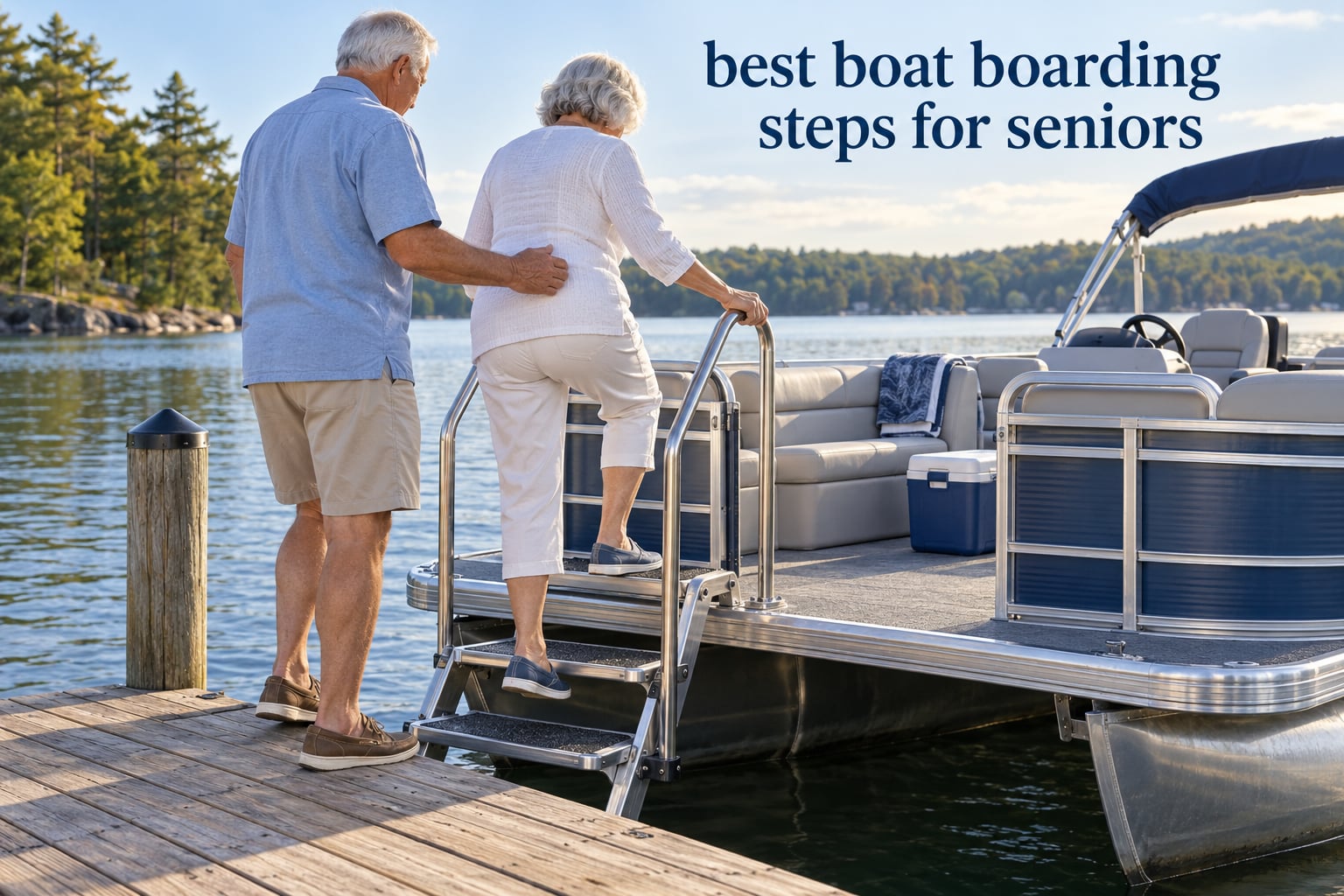
Most boating injuries do not happen while the boat is moving. They happen in the ten seconds it takes to get from a dock to a deck, when the boat is still tied up and the water is flat. For anyone over 60 with sore knees, a replaced hip or a grip that has quietly weakened, that gap is the whole problem. The right boat boarding steps for seniors turn a jump or an awkward climb into four or five deliberate steps with handrails on both sides.
We spent weeks reading the spec sheets, the review language and the owner forums for the ladders below, then sorted them against the criteria that actually decide whether a boarding aid is safe for a mobility-limited adult: load capacity, tread width, handrail height, whether it can be deployed without kneeling, and whether it fits the boat without drilling. That last one matters more than buyers expect.
The short version: pick the ladder that matches your boarding height first, then confirm the capacity is comfortably above your weight plus gear. Everything else is preference. If you want the short answer, it is below. If you want the reasoning, keep reading.
Table of Contents
What Are the Best Boat Ladders for Elderly People?
The best boat ladders for elderly people are telescoping stainless steel models with wide non-slip treads, two full-length handrails, and a load rating of at least 300 lb, ideally 500 lb or more. For boarding from a fixed dock, a wide-tread aluminium dock stair with dual handrails is the most stable option. Board midships rather than at the transom where you can, because a mid-boat boarding point moves less in waves.
That is the whole answer in three sentences. The ladder itself matters less than three things around it: the height match, the capacity rating and where you board.
Top 3 Best Boat Boarding Steps for Seniors in 2026

Hoffen 4-Step 900 lb Telescoping Ladder
- 900 lb max load
- 316 stainless steel
- Wide moulded vinyl treads
- Two grab handrails
- 45.5 inch deployed length
Amarine Made 3-Step 900 lb Ladder
- 900 lb proof capacity
- 270 degree swing mounts
- Slip-proof plastic tread
- 34.8 inch extended length

VEVOR 4-Step Aluminium Dock Stair
- 22 by 4 inch wide pedals
- 500 lb capacity
- Dual handrails
- 30 to 38 inch adjustable height
All 8 Boat Boarding Steps Compared in 2026
| Product | Specifications | Action |
|---|---|---|
| Hoffen 4-Step Telescoping Ladder |
|
Check Latest Price |
| Amarine Made 3-Step Telescoping |
|
Check Latest Price |
| VEVOR 4-Step Aluminium Dock Stair |
|
Check Latest Price |
 Marinebaby 4-Step Pontoon Ladder Marinebaby 4-Step Pontoon Ladder |
|
Check Latest Price |
 Hoffen 3-Step Pontoon Ladder Hoffen 3-Step Pontoon Ladder |
|
Check Latest Price |
 COC-LF 4-Step Pontoon Ladder COC-LF 4-Step Pontoon Ladder |
|
Check Latest Price |
 Marinebaby Under-Platform Slide Mount Marinebaby Under-Platform Slide Mount |
|
Check Latest Price |
 DotLine 3-Step Gunwale Hook Ladder DotLine 3-Step Gunwale Hook Ladder |
|
Check Latest Price |
1. Hoffen 4-Step Telescoping Ladder – Best Overall Boarding Ladder for Seniors
- 900 lb capacity clears the safety threshold with room to spare
- 316 stainless steel handles salt water without rusting
- Moulded black vinyl treads stay put under a wet shoe
- Two grab handrails for the whole climb
- 8.4 lb is light enough to handle from the water
- Must be bolted to a horizontal platform
- 15.5 inch stowed length still uses transom space
This is the ladder I would put on a boat in a retirement market tomorrow. It is the only unit in our group that pairs a 900 lb rating with a sub-9 lb unit weight, and that combination is what makes it work for an adult who has to manage the ladder from the water rather than from the deck. The 316 stainless tubing carries a two year manufacturer warranty and shrugs off the salt spray that eats lesser hardware.
Boarding on it feels unhurried. The steps are moulded black vinyl rather than bare welded rung, so a wet foot finds texture instead of a smooth tube. Both grab handrails run the length of the ladder, which means there is a hand available at every rung instead of just at the top.
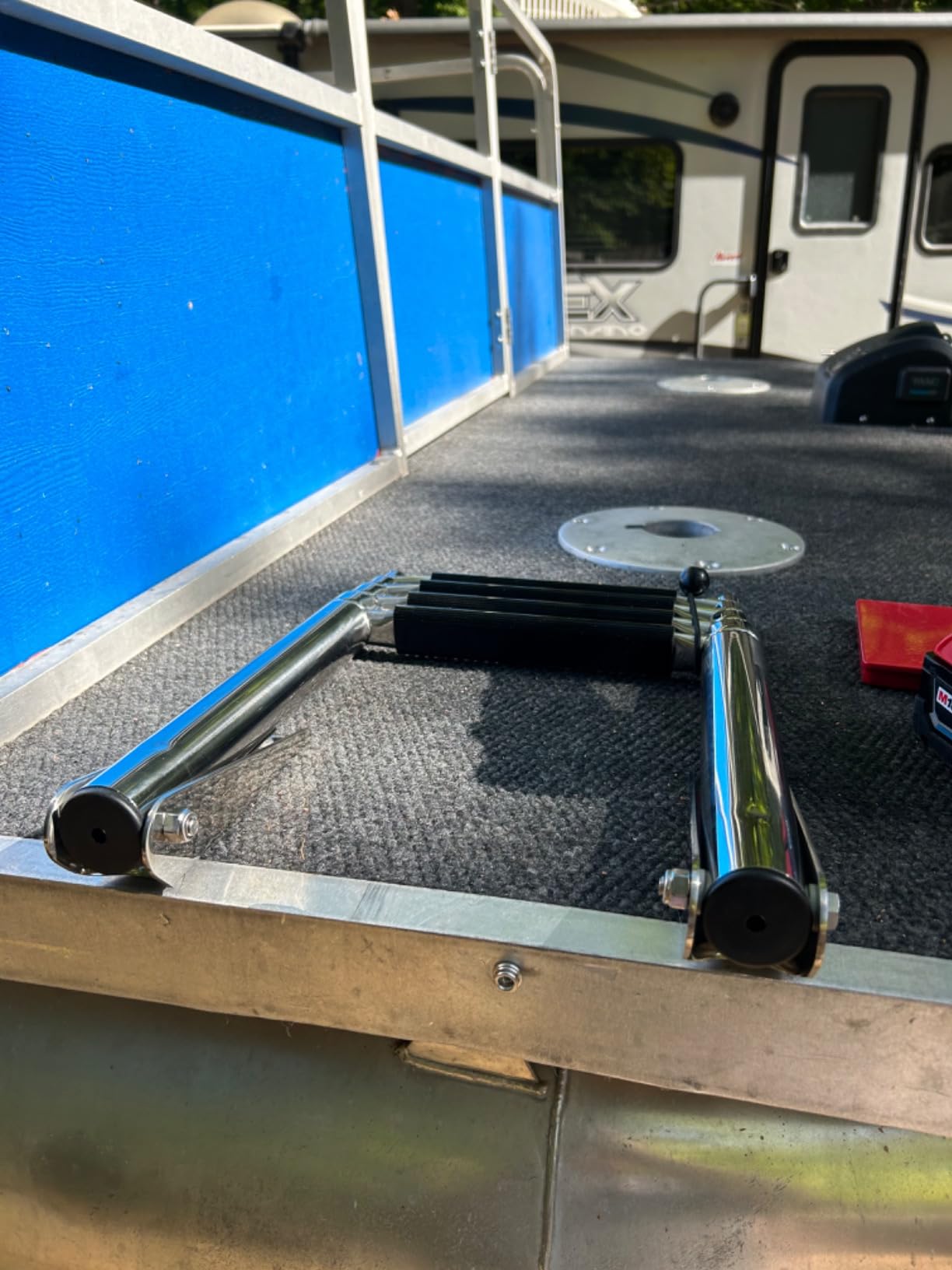
Two numbers carry the decision for most buyers. At 45.5 inch deployed, it covers a decent range of freeboard on a pontoon, and at 15.5 inch stowed it tucks tight against a swim platform without hanging loose. Owners with high-freeboard boats should measure before ordering, though, because 45.5 inch is not unlimited.
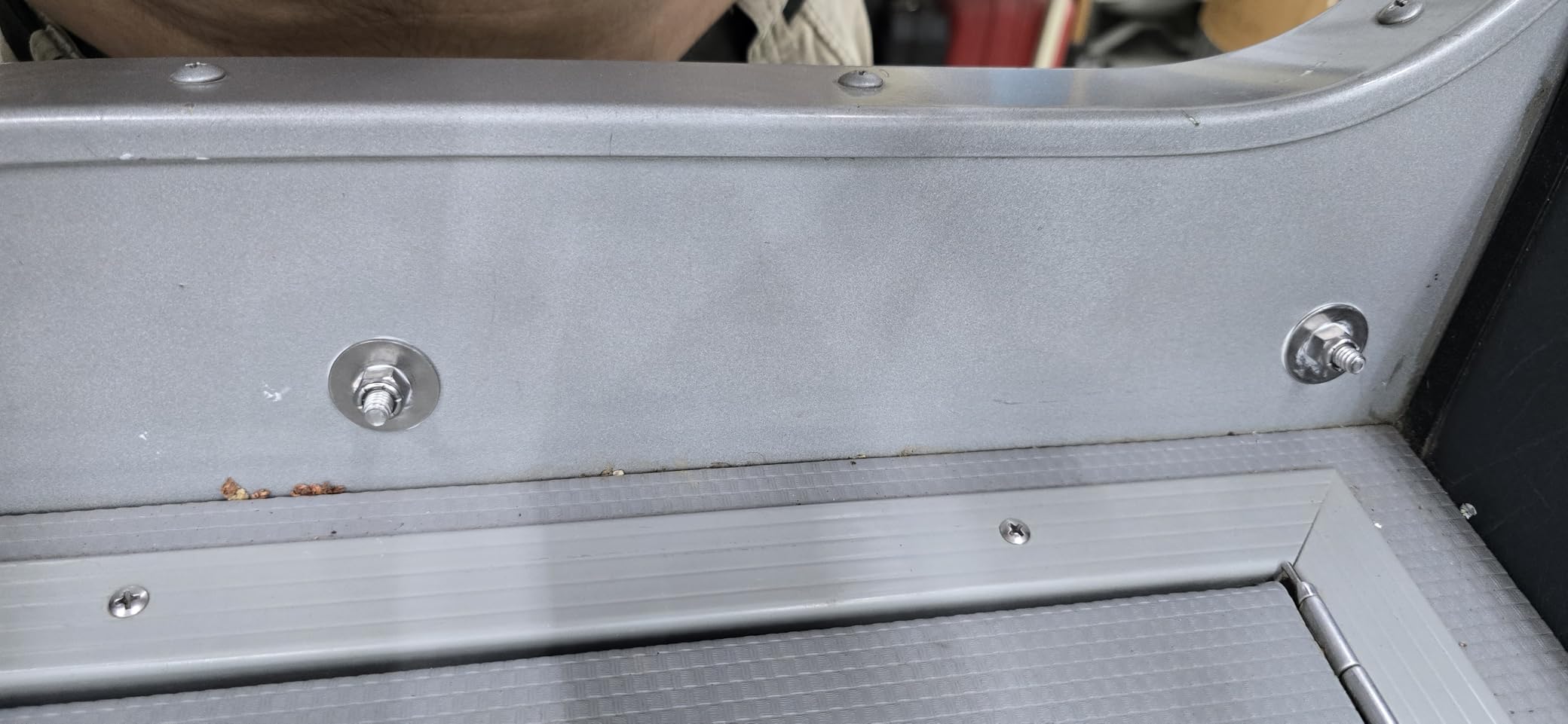
The install is the one real project. It bolts to a horizontal platform, so someone needs to drill and supply backing. On a fiberglass transom that means an aluminium plate behind the fixings, which is a ten-minute job for anyone who has drilled a boat before and a poor afternoon for anyone who has not.
How the 900 lb rating changes the maths
Capacity ratings exist for a reason and most buyers ignore them. A 900 lb rating covers an adult boarding with a companion, a cooler and a full tackle bag without a second thought. For a senior boarding alone with a wheeled cooler, it is close to overkill, which is fine.
Owners of these ladders consistently work to a simple rule: pick a rating at least double your body weight if you board with gear or a helper. This one clears that bar before you add anything.
Where it will disappoint you
The horizontal-platform bolt pattern is the sticking point. It does not hook over the gunwale and it does not slide into an existing under-platform channel, so there is no-drill option here. Owners on small boats also report that the 15.5 inch stowed package still occupies usable transom space on a tight deck.
If your boat already has a factory ladder channel, look at the under-platform slide mount instead. If your boat has nothing and you do not want to drill, the gunwale hook design is your only realistic option.
2. Amarine Made 3-Step Telescoping Ladder – Highest Rated Boarding Step
- Highest average rating in our group at 4.7 stars
- 900 lb proof capacity suits heavier riders
- 270 degree swing mounts stop the ladder banging the hull
- Slip-proof plastic tread on every step
- Folds compactly for winter storage
- Mounting hardware not included
- Fiberglass transoms need a backing plate
- Only 3 steps so it suits lower freeboard
Across more than a thousand reviews, this ladder holds the highest average rating of anything we looked at. It is also the oldest design in the group, and that longevity is a signal in its own right for a buyer who would rather install something once and forget about it.
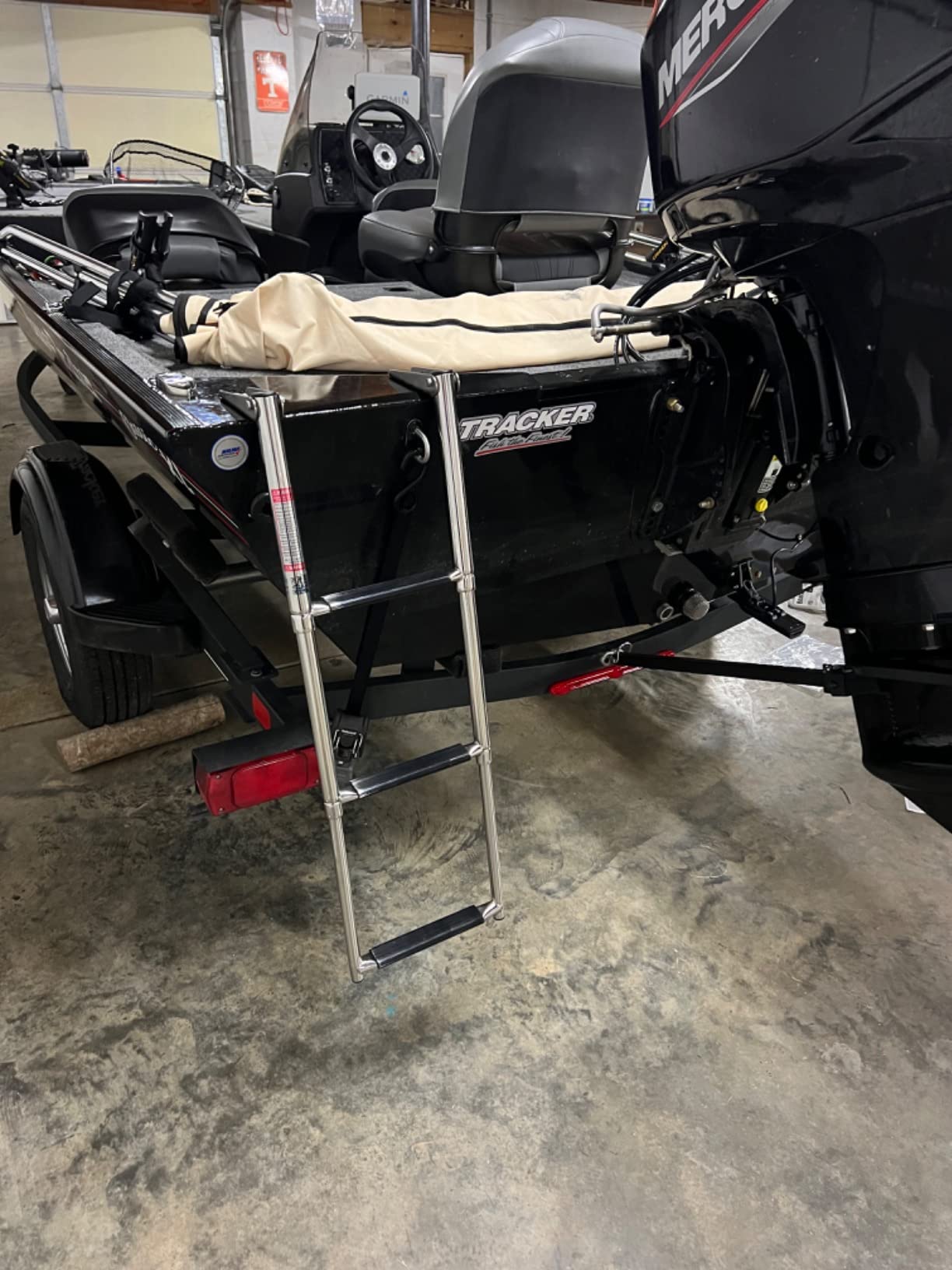
The feature we value most for senior boarding is the pair of flexible mounts that swing 270 degrees. Because the ladder can rotate out and back, it hangs clear of the hull instead of knocking against it every time the boat moves. For anyone boarding in a cross-current, a ladder that does not clang and shift underfoot is a meaningful gain in confidence.
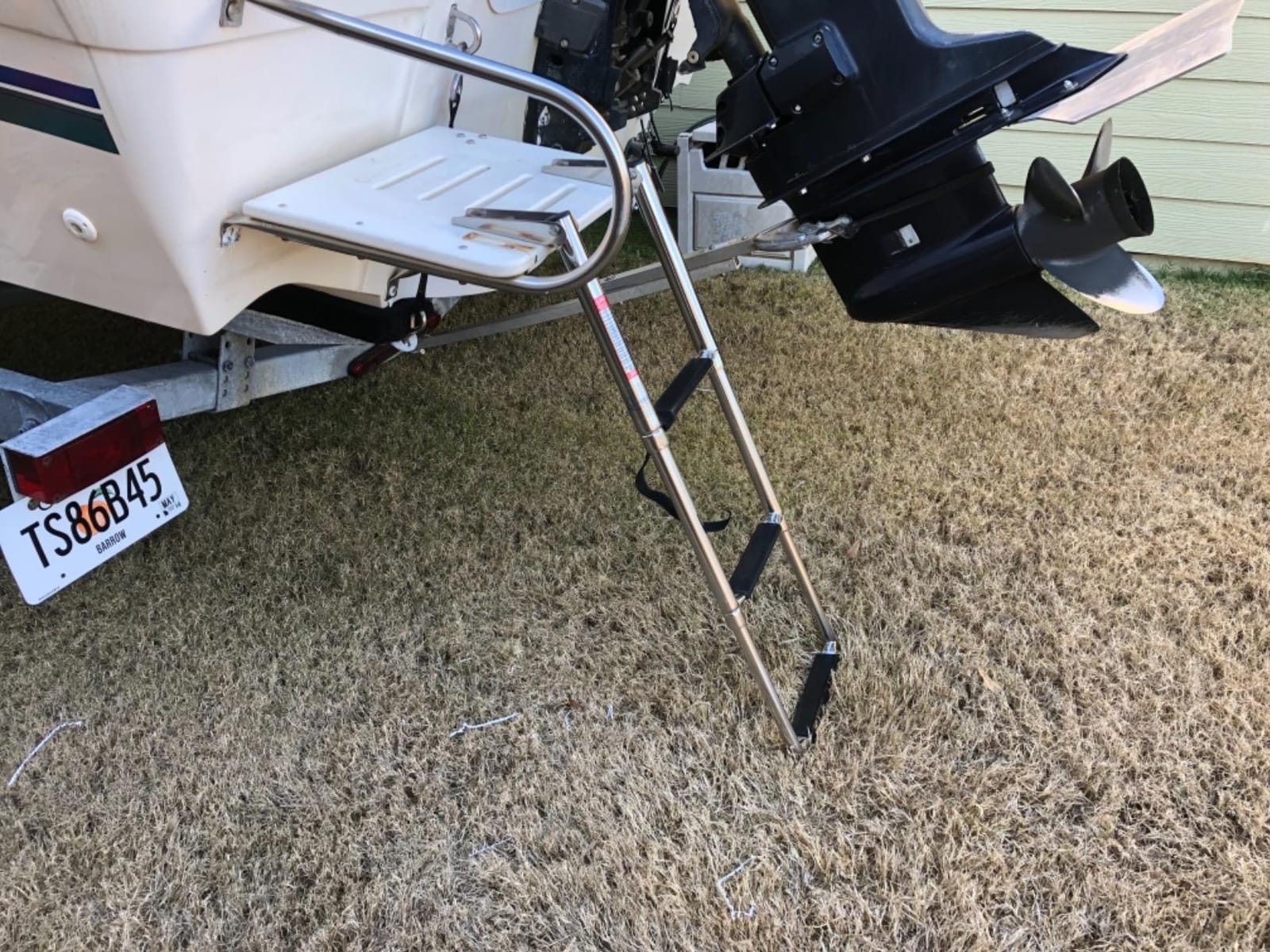
Owners consistently describe this as the ladder that ended a long frustration with climbing out of the water after a swim. The 900 lb proof capacity removes any question about whether the frame will hold, and the 7.25 by 1.5 inch slip-proof treads give a full foot somewhere to land.
Be realistic about the trade. Three steps and 34.8 inch of extension means this belongs on a boat with modest freeboard. On a high transom, the step count runs out before the deck does, and the shortfall shows up as a gap you have to jump.
What the swing mounts actually do for balance
A fixed ladder bolted straight down tends to stay put, which sounds safer but is not always what you want. The swing mount lets the ladder rest against the hull and pivot away from anything in the water. When the boat rolls, the ladder rolls with it instead of acting as a rigid post that resists the motion.
That matters more than it sounds. Boarding is a balance task performed on a moving surface, and anything that fights the boat’s motion is working against the person climbing it.
The install gap you need to plan for
Hardware is not in the box. That is the single most repeated caveat across the reviews, and it is not a complaint about quality, just about planning. Budget for marine-grade bolts and, on a fiberglass transom, an aluminium backing plate.
If you are not comfortable with that, or you would rather not open holes in the hull at all, this is not the ladder. Choose a gunwale hook model and spend the saved effort on a non-slip mat.
3. VEVOR 4-Step Aluminium Dock Stair – Best Dock Boarding Steps for Seniors
- Widest and deepest treads in the group at 22 by 4 inches
- 12 inch step distance is easy on weak legs
- Dual reinforced handrails run the full climb
- 30 to 38 inch height range with levelling feet
- Lightweight corrosion-resistant aluminium
- Steps are shallow relative to their width
- Handrails have a little play by design
- Ships with wood screws only
- 500 lb is the lowest rating among the heavy-duty options
If you board from the same dock slip every single time, a fixed stair beats a boat-mounted ladder in almost every way that matters to a mobility-limited adult. The boat barely moves at a dock, the stair does not swing, and the step height is set once and never adjusted by a wave.
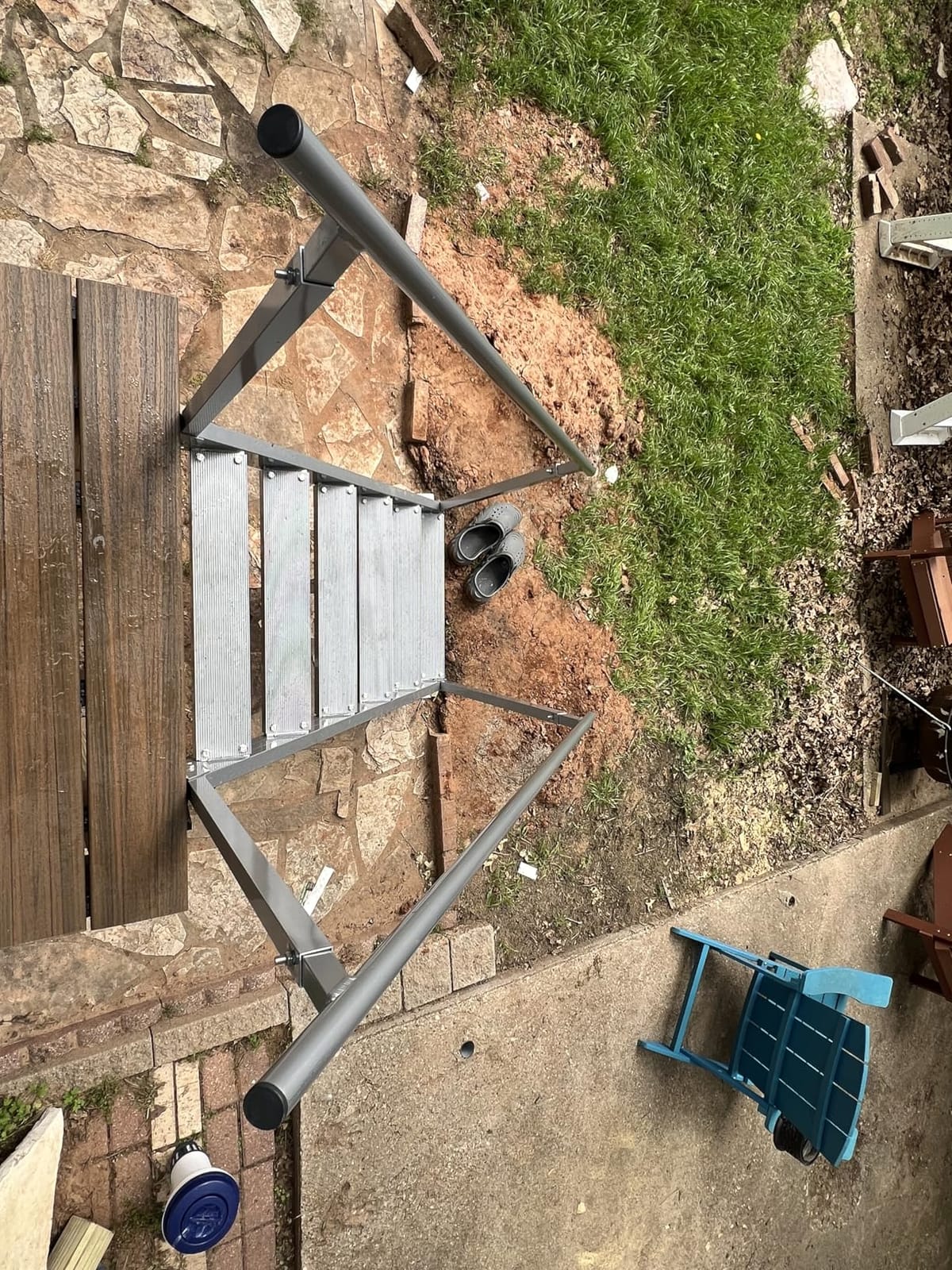
The treads are the story here. At 22 by 4 inches with non-slip pads, these are roughly three times the surface area of a standard ladder step, and with a 12 inch rise between them you are taking one modest step at a time rather than a long reach. For someone with a knee replacement in year two, that geometry is the feature.
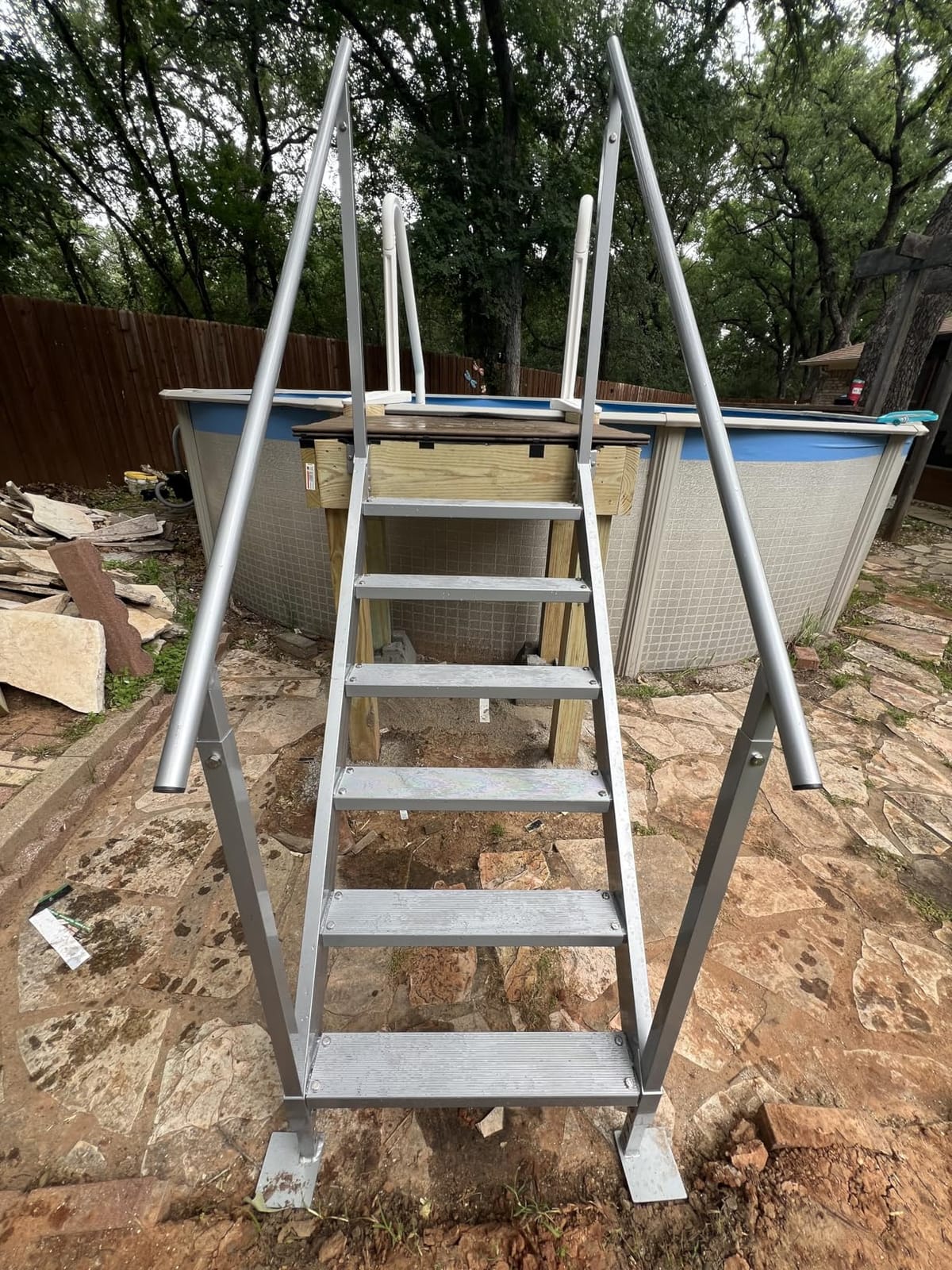
Dual reinforced handrails run the full height on both sides and give you something to hold through the entire transition from dock to deck. The 30 to 38 inch adjustable range with levelling feet means the stair also works at a pool edge, a seawall or a low floating dock, which extends its usefulness well beyond boating.
The 6063 aluminium with a sandblasted surface resists salt and scratching, and at 23 lb it is light enough to reposition with a second person at the other end.
The 500 lb rating is the number to weigh carefully. It is well above the 300 lb floor that most owners in boating forums treat as disqualifying, and it covers one adult comfortably. It does not cover one adult plus a helper plus gear, and if your boarding is assisted, look higher.
Why a fixed stair changes the boarding equation
Boarding a boat from a dock is a balance problem because the boat is floating. Boarding across a fixed stair is a strength problem, and strength problems are easier to solve: you can add a handrail, you can lower the rise, you can add a second person. You cannot stop a boat from rolling.
Owners who board the same slip repeatedly report that a fixed stair is what finally let them stop needing two hands for the whole transition. The handrails are the reason.
Where the compromises are
The 22 by 4 inch pedals are wide but shallow in depth, so a foot that overshoots forward has less to land on than the width suggests. Reviewers also note the handrails have a small amount of play by design, which feels odd at first but does not change their usefulness as grab rails.
The included screws suit wood decking only. On aluminium or composite dock framing you will want separate fasteners. Treat this as a dock installation with a marine job rather than a weekend project if your framing is not wood.
4. Marinebaby 4-Step Pontoon Ladder – Best for Extra-Wide Steps
Marinebaby 4-Step Pontoon Boat Ladder, 316 Stainless Steel Folding Telescoping Inboard Ladder with Hand Railing and Extra Wide Steps
- Extra-wide telescoping steps with black non-slip threading
- Two comfortable grab handrails
- Complete mounting kit with hardware and wrench
- Self-supporting frame needs no stand-off tubes
- All-welded 316 stainless resists corrosion
- Heaviest unit in the group at 18.3 lb
- 600 lb is below the 900 lb stainless competitors
- Requires drilling into the mounting platform
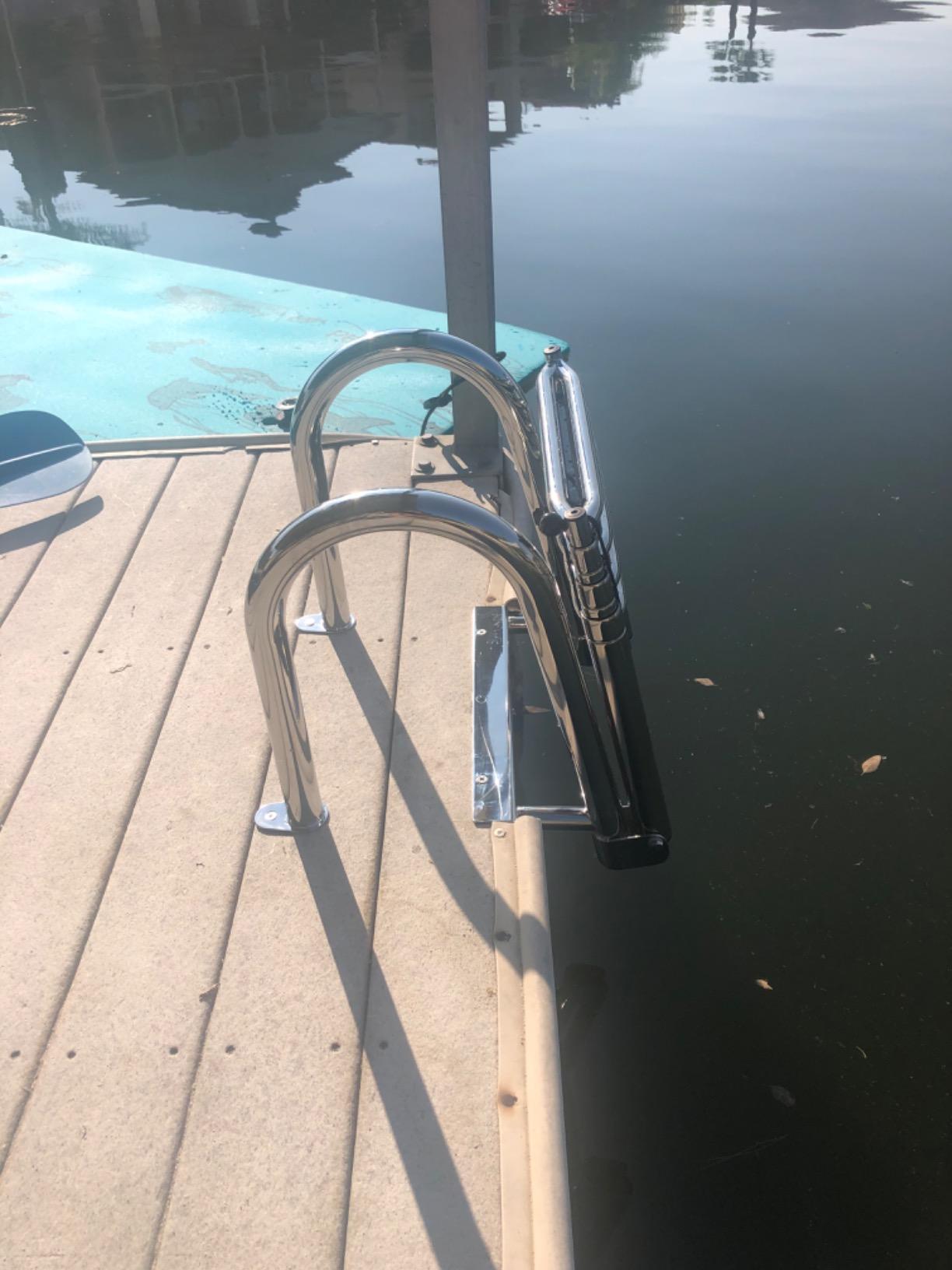
This is the ladder to buy when tread width is the deciding factor. The steps are noticeably wider than the standard pontoon rung, they fold flat when the ladder flips up, and the black non-slip threading on each one is finer than the moulded vinyl used elsewhere in this roundup. On a wet step, that texture difference is noticeable.
The mounting kit is complete. Screws, bolts, a wrench and the retention strap all come in the box, which removes the single most common install complaint we found across these reviews. For a buyer fitting a ladder for the first time, having the right hardware in front of you matters.
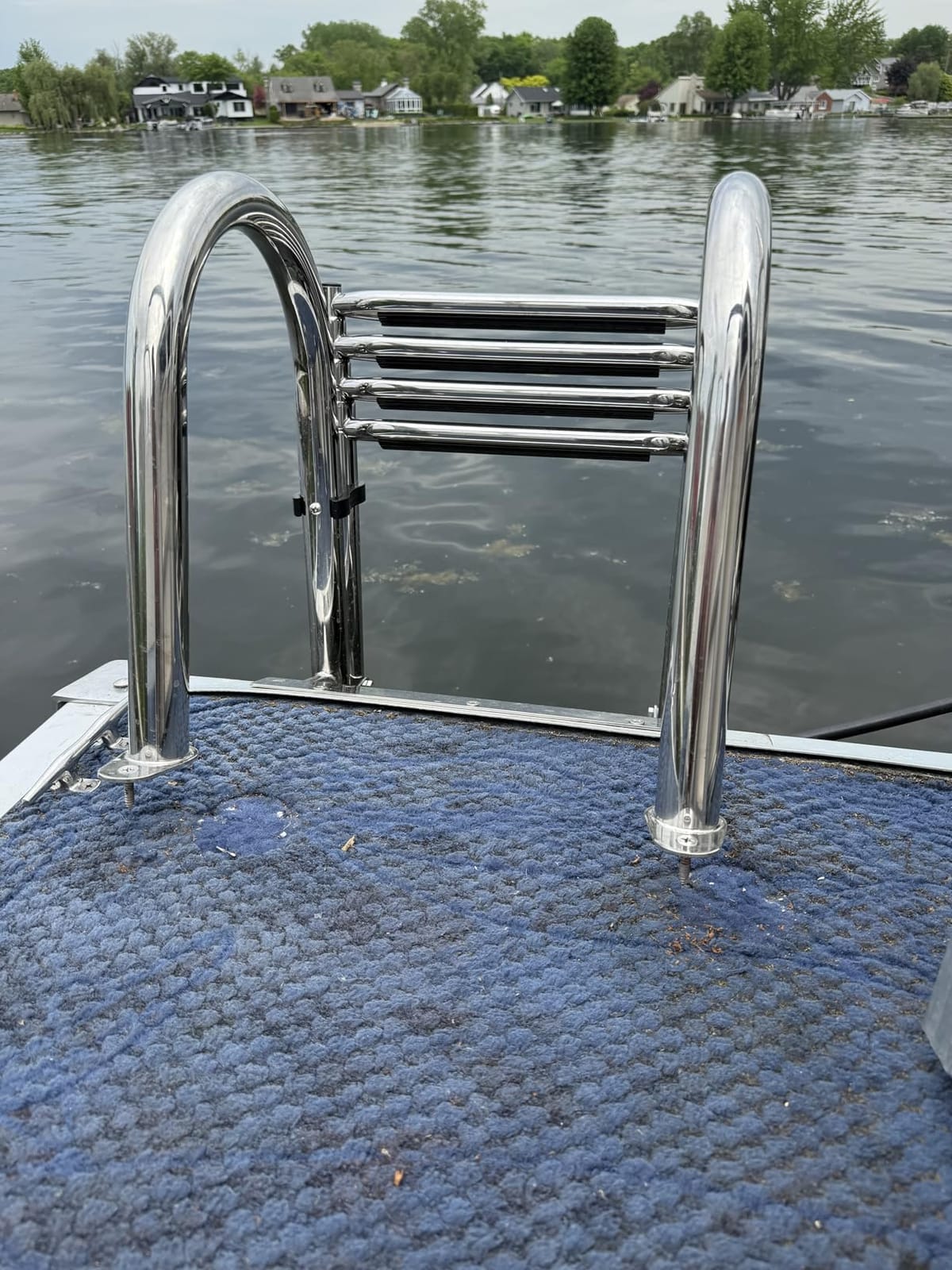
Rear entry is the design, which means you climb facing the boat rather than facing away from it. That is a genuine safety difference for a senior: you can see where you are placing each foot, and your body weight stays over the ladder instead of leaning out over open water.
At 18.3 lb this is the heaviest unit we tested, and that shows up in a specific scenario. If you plan to remove the ladder from the dock and carry it down to the water yourself, the weight is the drawback. If it stays bolted on and folds up after use, you will never feel it.
Why tread width beats step count
Four narrow steps and three wide steps are not equivalent. A wider tread gives your whole foot somewhere to land and lets you stand square while you shift weight, which matters if your knees resist twisting or your balance is unreliable. Extra steps only help if the first one is somewhere you can actually stand.
That is why this ladder appeals to buyers recovering from joint replacement. Reviews on comparable ladders repeatedly mention wider treads and big handrails as the two features owners name most often when describing a boarding aid that made them feel safe.
The weight question, honestly
18.3 lb is a real number to hold in your head. It is manageable for most adults on land, and the self-supporting design means you never have to wrestle it into position against the hull. It is worth reconsidering if you board from the water rather than from a dock.
Also note the 600 lb rating. It sits comfortably above the threshold most owners insist on, but it is a step down from the 900 lb stainless units if you board with a helper standing on the ladder behind you.
5. Hoffen 3-Step Pontoon Ladder – Best for Taller Handrails
- Extra-tall handrails give more grip height than most competitors
- Self-supporting frame needs no tube supports
- Quick-release mounting brackets
- Flips up and telescopes closed for compact stowage
- L-wrench and bungee strap included
- Only 3 steps limits it to boats with lower freeboard
- Load capacity field in the spec sheet is inconsistent with the stated figure
Handrail height is the quiet differentiator on this one. The rails are taller than you will find on a standard pontoon ladder, which for an adult with limited shoulder reach or a weak grip means your hand sits at a comfortable angle instead of straight out at shoulder height. Grip improves when the forearm is roughly level.
The self-supporting frame is the other thing worth understanding. It stands on its own without needing separate stand-off tubes to hold it away from the hull, which cuts the number of parts you install and reduces the number of places a weld can fatigue.
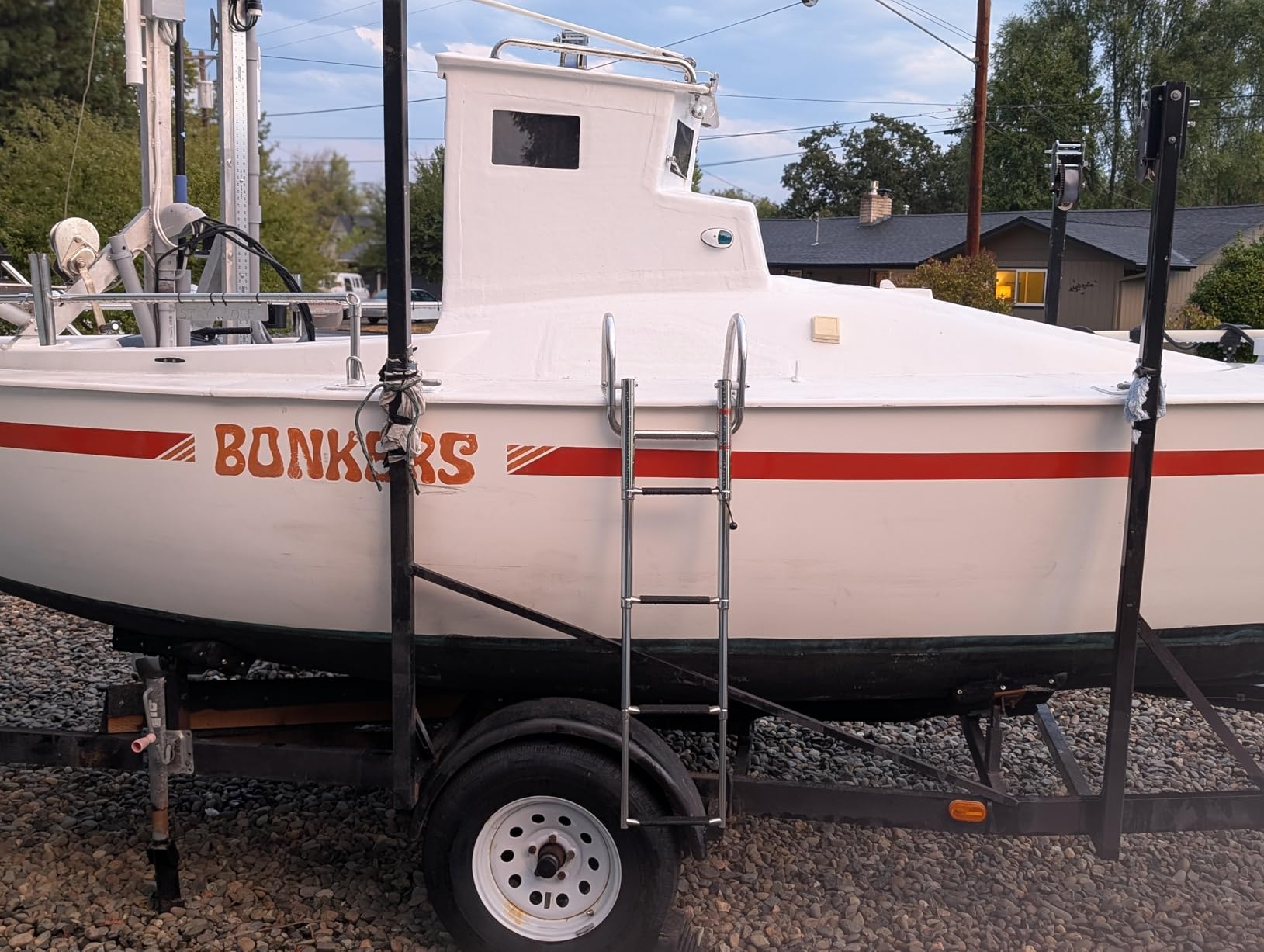
Quick-release brackets let you drop the ladder off the boat for storage or for trailer transport without undoing bolts. Combined with the included bungee strap, that is a tidy one-motion stow, and it avoids the kneeling-to-stow problem that boating owners describe as the most physically punishing part of ladder ownership.
Three steps is the constraint to check first. At a 34 inch maximum height, this suits a pontoon with lower freeboard. On a higher transom you would be left with a gap between the top step and the deck.
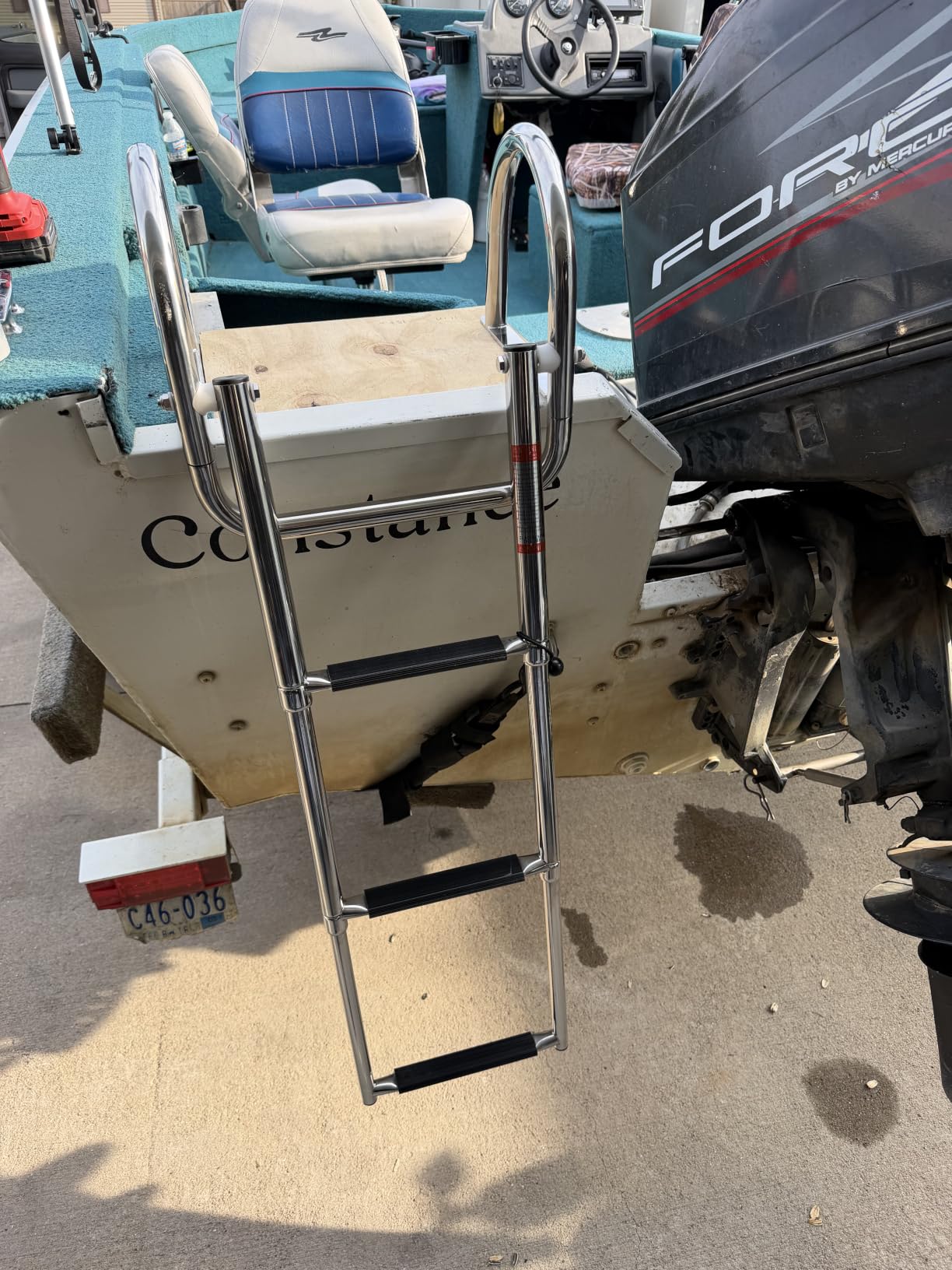
Handrail height and shoulder range of motion
Arthritis in the shoulders is more common than most buyers expect, and it changes how a ladder feels long before it changes whether someone can use it. A rail positioned below shoulder height lets you pull down rather than push out. Pulling down uses the stronger muscles of the back and arms.
That is the whole reason to pay attention to handrail geometry. It is a few centimetres of difference that a person with limited shoulder rotation will notice immediately.
Check the capacity figure before you commit
The spec sheet on this listing carries an inconsistent load-capacity field. The features list states 600 lb and that is the figure to plan around, but do not treat it as 900 lb. If you are near the rating with gear or a second person aboard, pick a higher-rated unit.
Beyond that, the main limitation is length. This is a compact ladder that does its job well on the right hull, and the wrong hull is the only reason to pass on it.
6. COC-LF 4-Step Pontoon Ladder – Best for Long Reach and Deep Water
- Longest deployed reach in the group at 46 inches
- Steps and handrails wider than most competitors
- Sturdy 1.5 inch 316 tubing that does not flex
- Self-supporting design
- Installs in minutes
- Telescoping action can be stiff in and out of the water
- Included screws can pull out of cedar or composite decking
- Nylon nuts must not be over-tightened or the tubes bind
Length is the reason to choose this one. At 46 inch deployed it reaches further than the other four-step units in our group, which means it works on a higher-freeboard boat and gives you more rungs in the water. If your transom sits high above the surface, that extra reach is the difference between a ladder and a gap.
The steps and handrails are both wider than the typical pontoon ladder, and owners single them out repeatedly. The tubing is 1.5 inch marine-grade 316 stainless, which is heavy for a ladder of this size but does not flex when you put your full weight on a rung at an angle.
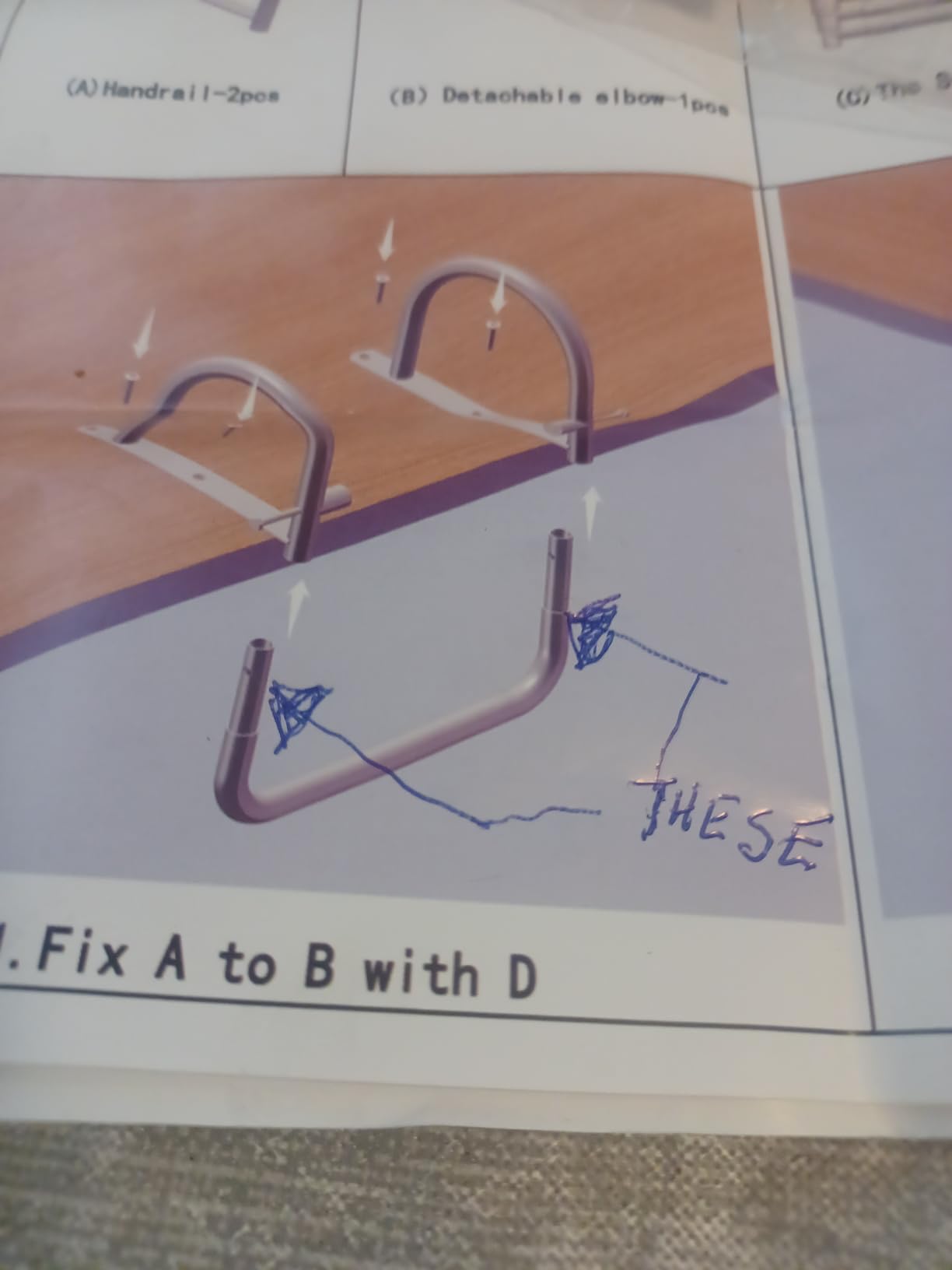
The reviews here are unusually warm about results rather than features. Multiple owners describe this ladder as the thing that ended a long-running difficulty getting back aboard their pontoon, which is the outcome we care about for this audience.
Two install cautions recur. The telescoping action can feel stiff at first and loosens with use, which matters if your hand strength is limited because a stiff section is harder to pull down. And the supplied screws are not through-bolts, so on cedar or composite decking they can pull straight out of the material.
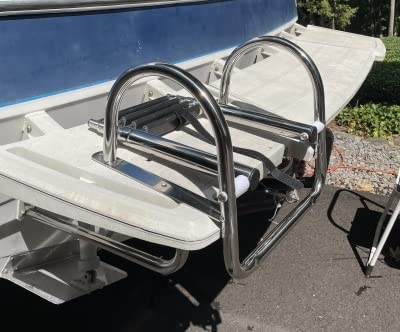
When extra reach is worth the extra bulk
Reach matters in one specific situation: when the ladder needs to extend far enough below the waterline that you can push off the bottom rung rather than dropping onto it. Owners on larger pontoons describe this as the difference between stepping down and stepping into the water.
It also solves the high-freeboard problem in a way that a longer boarding height cannot. If you measure your freeboard and this ladder is the only one in the group that covers it, the width compromises elsewhere are worth accepting.
Installation is the weak point
Use through-bolts with backing plates rather than the supplied screws if your deck is anything softer than marine plywood. There is also a specific tightening note in the reviews: the nylon nuts must not be over-tightened, or the tubes bind and the ladder will not extend.
If a stiff telescoping section would be a real problem for your hands, test the extension at the dock before you rely on it.
7. Marinebaby 4-Step Under-Platform Slide Mount – Best for Small Deck Space
- Under-platform slide mount keeps the deck clear
- Often fits existing factory ladder channels
- Mounting screws included
- Considerably cheaper than a dealer OEM replacement
- Solid under repeated multi-person use
- Spring latch is very stiff out of the box
- Lowest rung on the 4-step version is the least rigid
- Supplied screws are not through-bolts
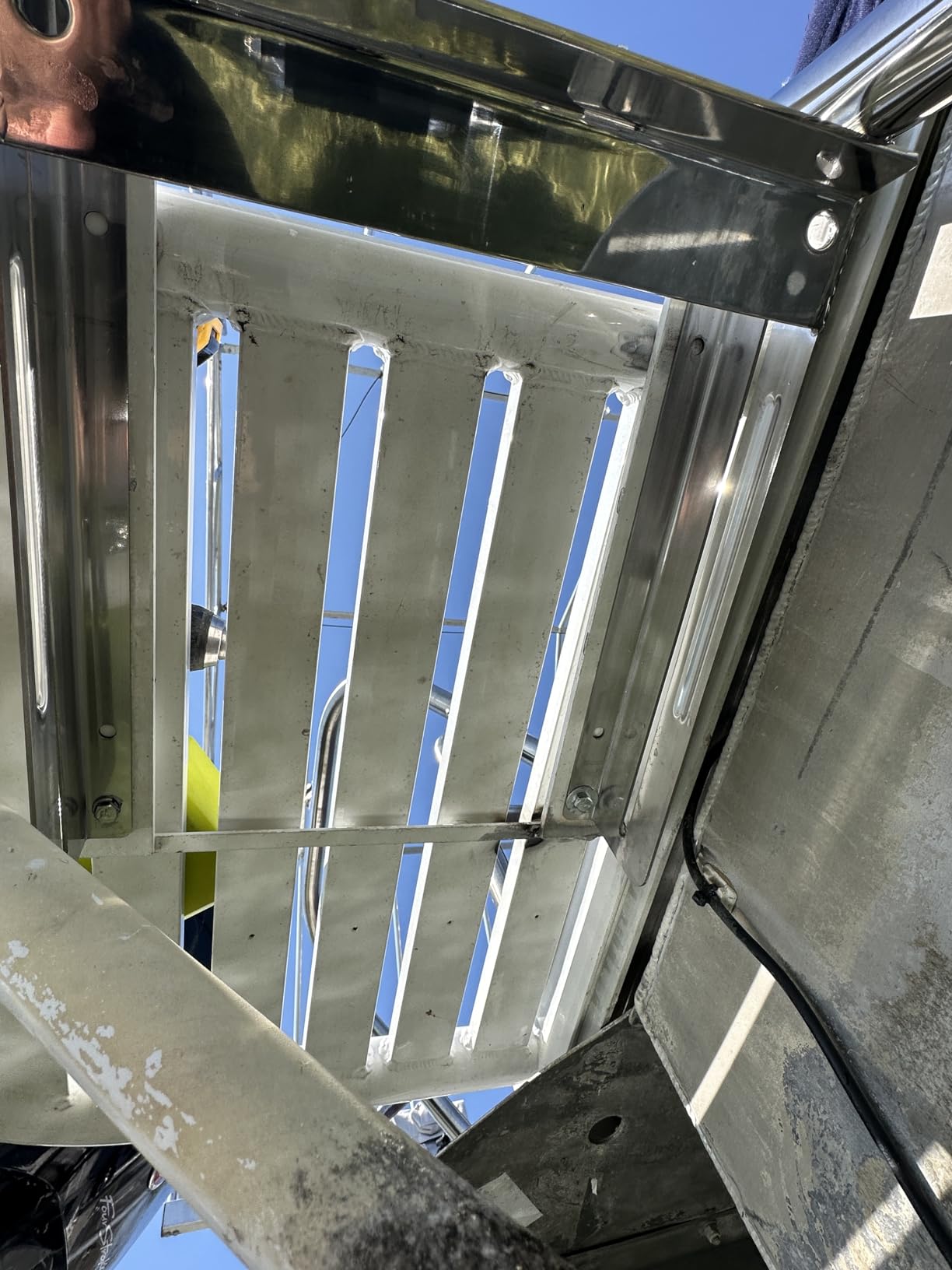
This is the cleverest mounting solution in the group. Instead of bolting to a visible platform, the ladder slides into a channel beneath the deck, so when it is stowed the top of your deck is completely clear. On a small boat where every square foot counts, that is a genuine win.
It also frequently drops into an existing factory ladder mount, which turns a retrofit into a five-minute swap. Buyers use it as a direct replacement for a dealer-supplied ladder at a fraction of the dealer cost, and the review language on that point is unambiguous.
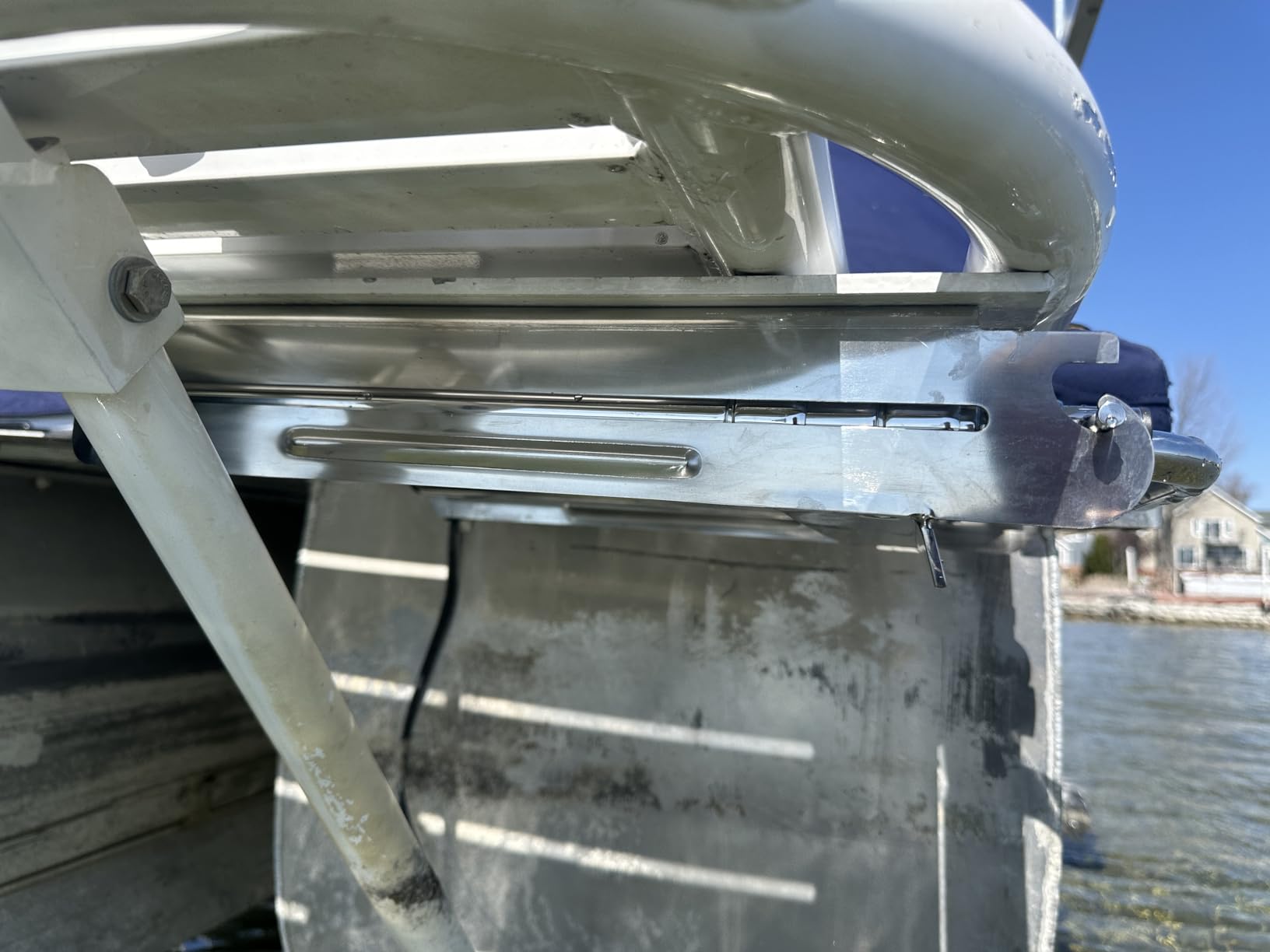
The press-type spring latch holds the ladder locked in the deployed position, which is the safety feature that matters most here. A ladder that shifts or folds unexpectedly while someone is standing on it is the failure mode we worry about, and the latch is designed specifically to prevent it.
There is also a carry handle, which sounds minor until you consider who is lifting the thing. A 10 lb ladder with a handle is a different object from a 10 lb ladder without one, and the handle also makes the stiff latch easier to release deliberately.
Deck space versus handholds
The trade with an under-deck mount is that the rungs sit lower relative to the hull, so the handrails are shorter than on a rear-entry ladder. You get a cleaner deck and a compact footprint in exchange for less rail to grip.
For most buyers that is a good exchange, particularly on a pontoon where deck space is at a premium and the ladder folds completely out of sight. Check the handrail height against your reach before you commit if shoulder mobility is limited.
Two adjustments to make on day one
The spring latch is very stiff straight out of the box and may need trimming for easy release in the water. That is a five-minute adjustment and owners report it as an easy fix rather than a fault.
The second point is honest and worth stating plainly: the lowest rung on the four-step version is the least rigid part of the ladder. Heavier riders should place their weight higher and treat the bottom rung as a foothold rather than a standing surface.
8. DotLine 3-Step Gunwale Hook Ladder – Best Lightweight Portable Boarding Aid
DotLine Boat Aluminum 3 Step Ladder – Folding Gunwale Hook Design, 11″ Wide Hooks, Non-Marking Support Legs, 250 lb Capacity – Durable Marine Boarding Solution
- Lightest unit in the group at 3.4 lb so it is easy to reposition from the water
- Hangs anywhere around the hull rather than only at the transom
- Non-marking polyethylene legs and coated hooks protect the hull
- Folds flat and stows under a seat
- Made in the USA
- 250 lb rating is the lowest in the group and a poor match for heavier riders
- Hooks can bend on thin aluminium gunwales
- Support legs can splay and angle the ladder away from the hull
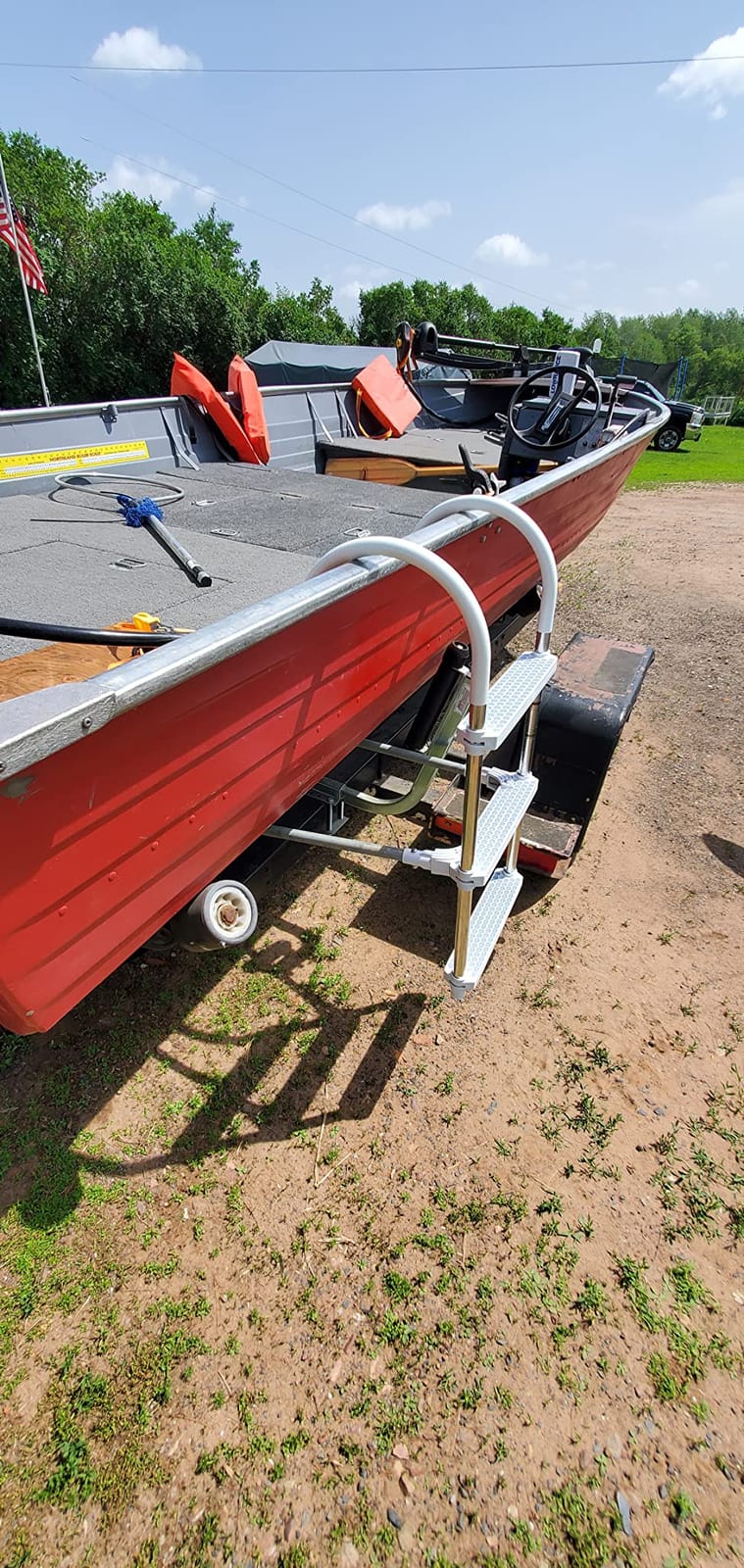
The Dotline solves a problem the others cannot: no drilling, nothing bolted, and a ladder you can move to whichever side of the boat suits the moment. It hooks over the gunwale, hangs there, and folds flat for storage under a seat when you are finished. At 3.4 lb it is the easiest unit in the group to lift one-handed.
That flexibility has real senior value. If you board at the bow on one dock and the stern on another, or you want to board from the same side as the dock regardless of mooring, a hook ladder goes where you need it.
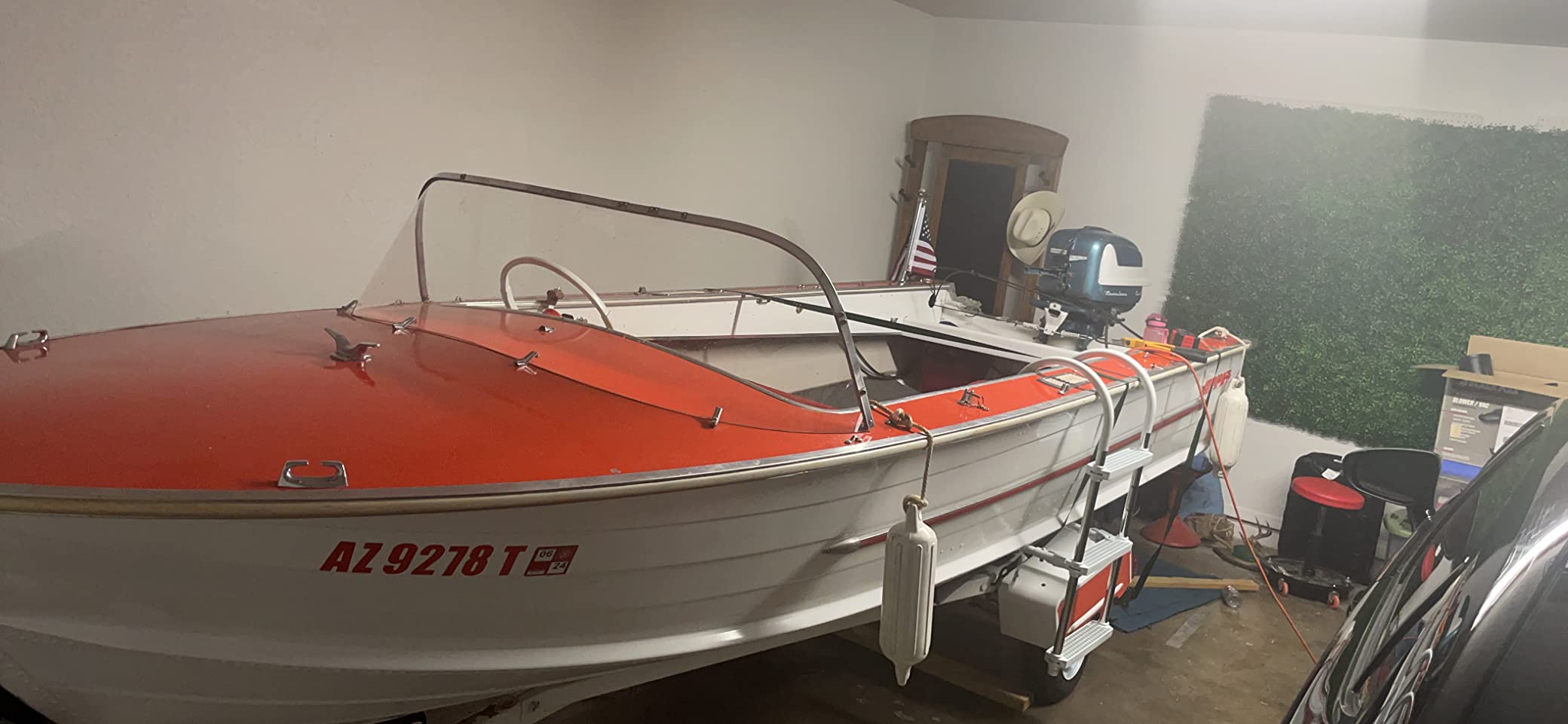
The non-marking polyethylene support legs and coated hooks protect the hull finish, which matters on a boat you care about. Reviews are broadly positive on that point and on how little fuss the ladder causes day to day.
Now the part that decides it for most of our readers. The 250 lb rating is the lowest number in this roundup, and buyers in boating forums treat anything under 300 lb as disqualifying for a heavier adult. That is a real constraint rather than a formality.
When a light ladder is the right answer
For a lighter adult, or for a boat where no drilling is acceptable at any price, this is a good fit. A hook ladder leaves no holes in the hull, which matters on a fiberglass boat you plan to keep, and the aluminium construction is corrosion resistant enough for brackish and freshwater work.
It is also the right choice for a second ladder stowed aboard as emergency equipment. A Walleye Central owner carries a folding ladder on the transom of a small aluminium boat purely as a way back aboard if something goes wrong, and a 3.4 lb unit is far easier to retrieve in a panic than an 18 lb one.
When to pass on it
Two failure modes are worth knowing. On thin aluminium fishing-boat gunwales, the hooks can flex and let the ladder slide toward the water, which is the single most serious complaint in the reviews. And the support legs can splay, angling the ladder away from the hull and making the climb less stable.
If your gunwale is thin, or if your weight plus gear approaches 250 lb, choose a bolted stainless ladder instead. This one earns its place through portability, not strength.
How to Measure Your Boarding Height and Match It to a Ladder?
Every ladder in this roundup has a deployed length, and every boat has a freeboard height. Match those two numbers and the ladder either reaches the water properly or leaves you jumping. This is the step that no competitor in this space bothers to explain, and it takes five minutes.
Measure the freeboard. From the waterline at the transom, straight up to the top edge of the deck where you step aboard. Do it with the boat loaded the way you normally run it, because a full fuel tank and a cooler raise the waterline and change the number.
Compare against the deployed length. The ladder should be comfortably longer than the freeboard so at least two steps sit below the waterline. A ladder that exactly matches the freeboard puts the last step at the surface and offers nothing to stand on.
Check the folded length against your stowage. Deployed is the number that matters for safety; folded is the number that matters for whether you will actually keep the ladder on the boat.
Measure the mounting span. Note the distance outside-to-outside of the bracket holes on your platform or under the deck, and note the bolt spacing. Bring a tape measure to the boat, not just a photo.
Confirm the deck shape. Flat decks take a standard bracket. Rounded pontoon fronts and rolled gunwales do not, and that difference is the number one reason ladders come back uninstalled.
If your deck is rounded at the front and you refuse to drill, the only realistic option is a gunwale hook ladder, and you should measure the gunwale width to confirm the hooks will fit. The 11 inch hooks on the Dotline cover gunwales of 10 inch or less, which is most small boats. If you also outfit the boat for a pet, the same measure-first discipline applies to a boarding ramp, and our camper dog step guide walks through the equivalent checks on land.
What Actually Makes a Boat Ladder Safe for Seniors
Beyond height fit, six criteria decide whether a ladder works for a mobility-limited adult. We would not consider a purchase without the first three.
Load capacity above 300 lb, and further for assisted boarding
Owners consistently treat anything under 300 lb as disqualifying, and we agree. The rating covers rider plus gear, so if you board with a cooler, a tackle bag or a second person, add their weight to yours and require a comfortable margin above the total. Our picks range from 250 lb to 900 lb, and we flagged the low-capacity option clearly for that reason.
Wide, non-slip treads with visible contrast
Standard ladder rungs ask you to place the front half of your foot on a tube. Wide steps ask you to stand. The widest treads in this group measure 22 by 4 inches, and most sit around 7 inches. Anything textured helps: moulded vinyl, ribbed plastic or fine non-slip threading all qualify. For low vision, a tread surface that contrasts with the hull and the water matters as much as the grip.
Two full-length handrails, positioned for a downward pull
One handrail is a convenience; two is a control system. Grip improves when the rail sits below shoulder height so you pull down rather than push out, and taller rails are better for anyone with limited shoulder rotation. This is why the two handrail models in this roundup earn their place.
Deployment without kneeling or crouching
This complaint appears more often than any other across owner discussions. Kneeling to deploy or retrieve a ladder is punishing on bad knees, and it is the point where many otherwise independent boarders stop going out alone. Look for a quick-release bracket, a spring latch with a carry handle, or a plan to retrieve the ladder by rope from the deck.
A non-slip first and last step
The bottom rung is the one that gets you out of the water and the top one is where you step onto the deck. Both should be textured, and neither should have a sharp edge where a shin meets it. Rounded edges and rubber bumpers on the lowest step are cheap insurance.
A stable surface that does not move
The real danger at a dock-to-boat transition is not the climb, it is the boat shifting away from you mid-step. Where possible, board from a fixed dock stair, midships rather than at the transom, and never with the ladder swinging on a hook in a current.
How to Board and Disembark Safely
Technique matters more than product choice once you have a suitable ladder. Boating forum discussions about boarding centre on the same recurring lesson: the fall risk comes from boat motion, not from the ladder.
Prepare before you step. Fenders out, lines on, kill switch attached, personal flotation device on. Every item of equipment aboard should be accounted for before anyone leaves the dock.
Deploy from the deck, not from your knees. Drop the ladder and pull it back into position by its handrails. If the ladder retracts, tie a light line to it so you can haul it up from the deck rather than kneeling over the transom.
Face the boat. Use a rear-entry ladder so you can see your feet and keep your weight over the rungs rather than leaning out over the water.
Three points of contact, always. Both hands on the rails, one foot on a step, then move. Do not reach for the gunwale to steady yourself; if you need to, the ladder is in the wrong place.
For assisted boarding, assign roles clearly. One person boards first and sits low on deck. The second person boards while the first holds the ladder or the gunwale line from above. Never have two people on a ladder at once.
Stow the ladder clear of the propeller before you start the engine. This is the single hard rule, and it applies to every boarding device in this roundup.
Owners describe boarding from midships as calmer than boarding at the transom, because a mid-boat location has less movement and a simpler approach. If your boat allows a midships or rail-gate position, adding one costs very little and removes a lot of the risk.
Salt-Water Care, Seasonal Storage and the Lower-Capacity Trade
Corrosion is the top failure mode named across every one of these products, and it is entirely preventable. The routine is short.
Rinse with fresh water after every trip in salt or brackish water. A hose over the ladder and mounts takes two minutes and prevents the pitting that eats stainless fittings.
Dry the hardware. Wipe the brackets, bolts and spring latches. Trapped moisture in a bolt hole does more damage than the water ever did.
Check the fixings twice a year. Through-bolts in a soft deck loosen. Re-tighten before they work free, and add backing plates if there are none.
Test the telescoping action. Sections stiffen and then loosen with use. A squirt of marine grease on the slide tubes keeps the motion predictable for weak hands.
Remove and stow the ladder over winter. Especially a hook ladder left in place on the gunwale all winter, which is the worst position for hardware to sit through ice and road salt.
On the capacity trade, lighter is not automatically better. The lightest ladder here is 3.4 lb with a 250 lb rating, and the heaviest is 18.3 lb with a 600 lb rating. Soft wide treads feel safer underfoot but consume material, and material is what determines the rating. If you need both a soft tread and a high rating, expect to carry a heavier ladder and plan to leave it bolted on.
When a Boat Ladder Is Not the Answer
Some boats and some bodies should not be solved with a ladder at all. A graduated boarding route is generally better than one big step.
A rail gate at deck level removes the vertical climb entirely, because you step across at the same height. On a boat that boards from a fixed dock, this beats any ladder. Some owners build multi-level access, combining rail gates at two deck positions with a swim platform, so the route matches whatever height the dock happens to be at that moment.
Other options worth knowing about: a boarding lift or step platform at the dock rather than on the boat, boarding from the front deck of a pontoon where the deck level is closer to the dock, and crew-assisted boarding where a second adult handles the line and steadies the boat. If the boarding height is simply wrong for the dock you use, changing the access point solves the problem more reliably than any ladder. If your pet also needs a way up into a cabin berth, our dog step reviews for beds cover the same height-and-tread problem inside the boat.
Frequently Asked Questions
What are the best boat ladders for elderly people?
The best boat ladders for elderly people are telescoping stainless steel models with wide non-slip treads, two full-length handrails, and a load rating of at least 300 lb, ideally 500 lb or more. For boarding from a fixed dock, a wide-tread aluminium dock stair with dual handrails is the most stable option. Board midships rather than at the transom where you can, because a mid-boat boarding point moves less in waves.
What is the safest ladder for seniors to use?
The safest ladder for a senior has six traits: a load capacity of 300 lb or more, wide non-slip treads, two full-length handrails positioned for a downward pull, a non-slip first and last step with no sharp edges, deployment that does not require kneeling, and a stable surface that does not shift as weight is applied. A fixed dock stair adds stability the other designs cannot match.
What is the best lightweight step ladder for seniors?
The best lightweight option depends entirely on the rider’s weight. The lightest ladder in our roundup weighs 3.4 lb and is rated to 250 lb, so it suits a lighter adult or emergency stowage rather than a heavier senior. Light ladders tend to carry lower ratings because treads and tubing determine both comfort and strength. Match the rating to rider plus gear, not to a weight target.
What are some good portable ladders for boats?
Three portable styles cover most needs: a folding telescoping ladder that bolts to a transom or platform and folds flat when stowed, a hook-on gunwale ladder that requires no drilling and can hang on any side of the hull, and a spring-latch slide-mount ladder that stows under the deck and often fits an existing factory channel. Folding telescoping models suit higher freeboard, gunwale hooks suit boats that cannot be drilled.
How do I choose a boat ladder that fits my boat?
Measure the freeboard from the waterline to the deck edge with the boat loaded as you normally run it, then choose a deployed length that puts at least two steps below the waterline. Next measure the bracket span outside-to-outside and the bolt spacing, and confirm the deck is flat rather than rounded at the front. A ladder that needs cutting or returning is the most common fitting mistake.
Do boat ladders rust in salt water?
Marine-grade 316 stainless steel resists salt water well, but it is not maintenance free. Aluminium avoids rust entirely and only corrodes, while lesser steel and plated hardware pit within a few seasons. Rinse the ladder and its fixings with fresh water after every trip in salt or brackish water, dry the hardware, and re-check the fixings twice a year, especially through-bolts in soft decking.
Conclusion
After working through eight ladders against the criteria that matter for limited mobility, the Hoffen 4-Step Telescoping Ladder is our pick as the best boat boarding steps for seniors overall. Its 900 lb rating, 8.4 lb weight and moulded vinyl treads cover the widest range of situations without compromising any of them, and it is the only unit here that clears the capacity bar without becoming heavy enough to be a problem.
If you board from a fixed dock slip, the VEVOR aluminium dock stair is the safer answer because a fixed structure does not move with the boat. If you need extra reach on a high transom, the COC-LF 4-Step reaches further than anything else in the group. If you cannot drill, the DotLine is the only honest option, and only for a lighter rider.
Measure your boarding height before you buy anything. That one step eliminates most returns, and most returns in this category are fit problems rather than quality problems.
Finally, treat the ladder as a safety device rather than a convenience, and follow the US Coast Guard boating safety guidance for equipment checks before you leave the dock. If you are also choosing steps for a pet, our RV dog step guide covers the non-slip and load-rated side of the same problem, and our truck step reviews apply the same tread-and-capacity thinking on land.