
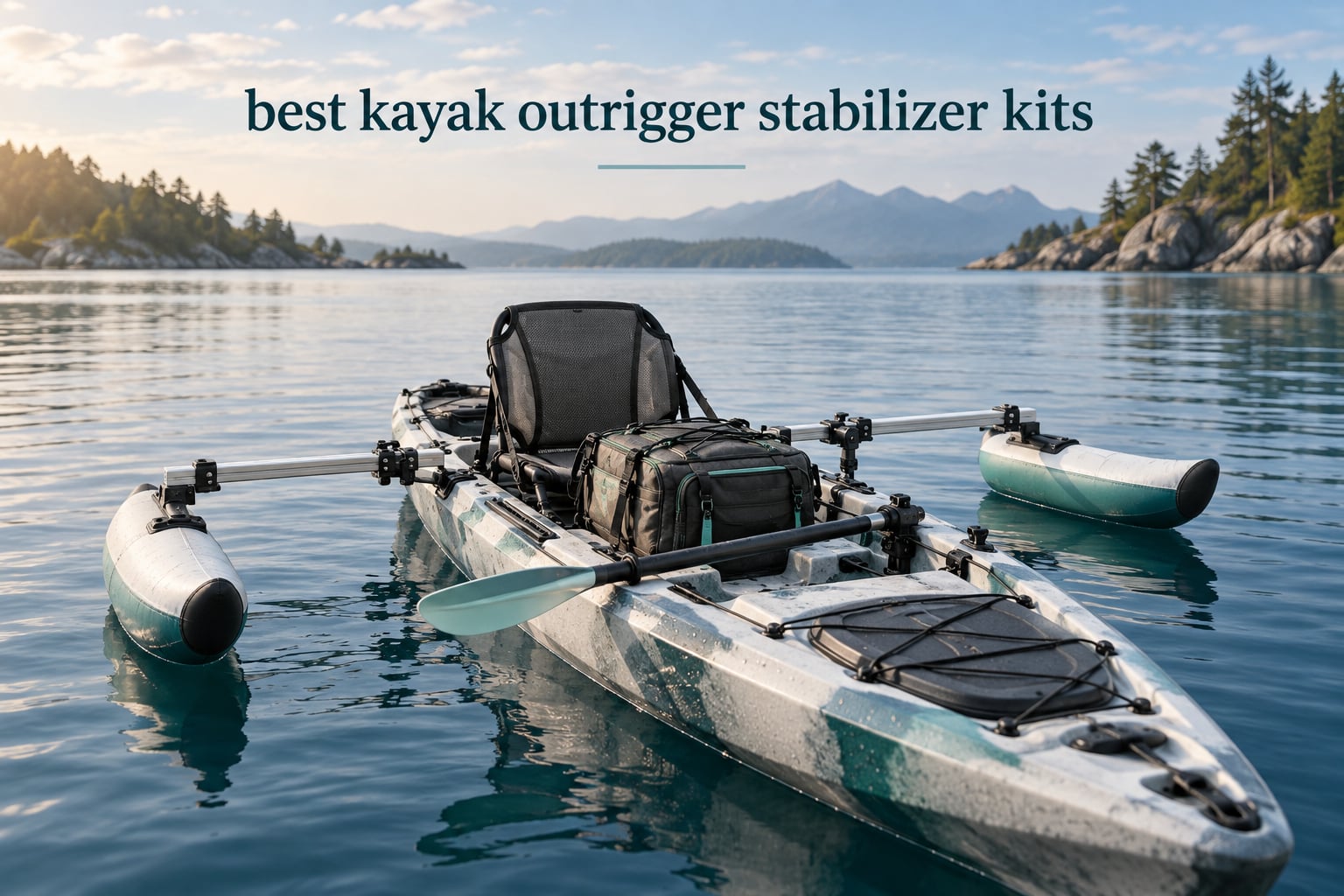
A kayak outrigger stabilizer kit is a pair of flotation pontoons, also called amas or floats, clamped to adjustable arms on either side of your hull so it stops rocking and capsizing. If you plan to stand up to cast, paddle choppy open water, are a tall or heavy paddler, or want a canoe to behave like a fishing platform, one of these kits is the biggest upgrade you can make to a narrow boat. We compared 10 leading kits on float type, arm length, buoyancy, kit weight, mounting method and owner feedback for 2026.
The category splits two ways. Rigid systems use moulded pontoons on aluminium arms and feel planted but never fold away. Inflatable systems use PVC bladders with sealed seams, pack down small and install in minutes, which matters if you carry your boat solo.
Each kit below gets a real verdict rather than a name in a table, and we flag the compatibility traps that stop a kit fitting a specific hull. If you also run a motor for the long stretches, our picks for kayak trolling motors pair well with a stabilised hull.
Table of Contents
What Is a Kayak Outrigger Stabilizer Kit?
There is no technical difference between an outrigger and a stabilizer. Sellers use both words for the same product: a pair of side-mounted floats on rigid or adjustable arms that add lateral buoyancy to a kayak, canoe or small boat. The word outrigger comes from Polynesian ama design, where the float sits well outboard of the main hull to stop it heeling over.
Kayaks are narrow and top-heavy, so they have plenty of primary stability, the resistance to leaning, and very little secondary stability, the ability to stay upright once past the point of leaning. Outriggers are effectively a small second hull, which is what lets an angler stand and cast.
A complete kit has four parts. The floats supply buoyancy, quoted in pounds of lift. The arms set the distance from the hull. The mounts decide how it attaches, through existing tracks, a RAILBLAZA Starport rail, pre-drilled deck holes or a universal receiver. The last piece is hardware, and this is where many kits fall short, because screws, nuts and well-nuts are frequently sold separately.
Top 3 Best Kayak Outrigger Stabilizer Kits for 2026
YakGear Standncast Outriggers Gen II
- Adjustable 30 inch arms
- RAILBLAZA StarPort HD included
- Rated to 350 lbs total weight
- 3 year warranty

VEVOR Inflatable Kayak Stabilizer Kit
- Dual-valve inflatable PVC floats
- Width adjustable 81.5 to 94 inches
- Packs down into a carry bag
METER STAR Kayak Floats
- Only 2.6 lbs for both floats
- Twist-and-click height adjustment
- 4 repair patches included
The YakGear Standncast is the one we would fit to our own boat first, because it is the most reviewed kit here at 662 ratings and the only one with a stated three-year warranty. The VEVOR pair carries the highest average rating at 4.4 stars and packs flat. The METER STAR floats weigh 2.6 lbs for both.
All 10 Kayak Outrigger Kits at a Glance in 2026
| Product | Specifications | Action |
|---|---|---|
| YakGear Standncast Outriggers Gen II |
|
Check Latest Price |
| VEVOR Inflatable Kayak Stabilizer Kit |
|
Check Latest Price |
| METER STAR Kayak Floats |
|
Check Latest Price |
 Brocraft Outrigger System Gen 2 Brocraft Outrigger System Gen 2 |
|
Check Latest Price |
 Scotty Kayak Stabilizer System 0302 Scotty Kayak Stabilizer System 0302 |
|
Check Latest Price |
 DAUERHAFT Inflatable Outrigger DAUERHAFT Inflatable Outrigger |
|
Check Latest Price |
 KUNPENG 2-Piece Stabilizer System KUNPENG 2-Piece Stabilizer System |
|
Check Latest Price |
 LYNICESHOP Inflatable Pontoon Kit LYNICESHOP Inflatable Pontoon Kit |
|
Check Latest Price |
 EIMSOAH Inflatable Outrigger Kit EIMSOAH Inflatable Outrigger Kit |
|
Check Latest Price |
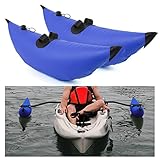 Lixada PVC Inflatable Canoe Stabilizer Lixada PVC Inflatable Canoe Stabilizer |
|
Check Latest Price |
1. YakGear Standncast Outriggers Gen II – Best Overall Kit
- Most reviewed kit in the category at 662 ratings
- RAILBLAZA StarPort HD mount included in the box
- Adjustable 30 inch arms on aluminium and plastic
- Rated for total weights up to 350 lbs
- 3 year warranty and made in the USA
- Needs existing mounting points on the hull
- Canoe conversions need a separately sold Hardie board
- 6.8 lb adds weight to a solo carry
Of the 10 kits we examined, the YakGear Standncast has the deepest owner record, with 662 ratings and roughly two thirds at five stars. It is the kit we would put on our own fishing kayak without hesitating, because the arms adjust through 30 inches and the RAILBLAZA StarPort HD mount is actually in the box rather than sold as an add-on.
You get a complete pair, one outrigger per side, rated for total weights up to 350 lbs. A 95 kg paddler with tackle and a cooler sits well under that cap. That reference load is how we checked every kit here: a full day of gear plus a standing angler, measured against the stated rating.
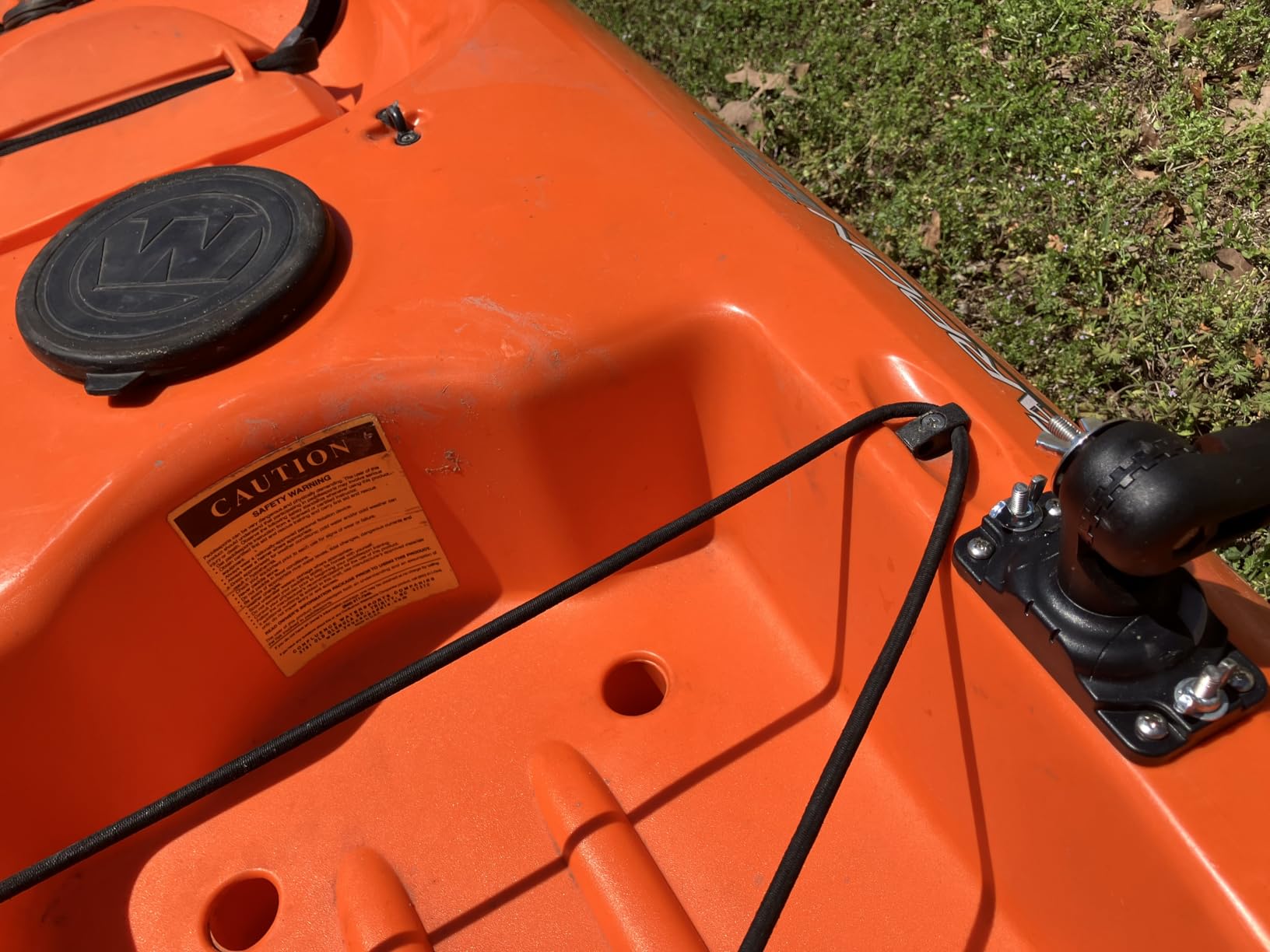
The build is aluminium and plastic at 6.8 lbs for the pair. Owners report rock-solid stability when standing and easy arm adjustment to match trim, and the aluminium with plastic components handles saltwater without the corrosion drama that cheap steel hardware brings.
Two limits are worth stating plainly. The mounts are designed for hulls that already have attachment points, so a bare hull needs drilling or an adapter. Canoe owners are told to add mounting bases to a Hardie board, and that board is not included.
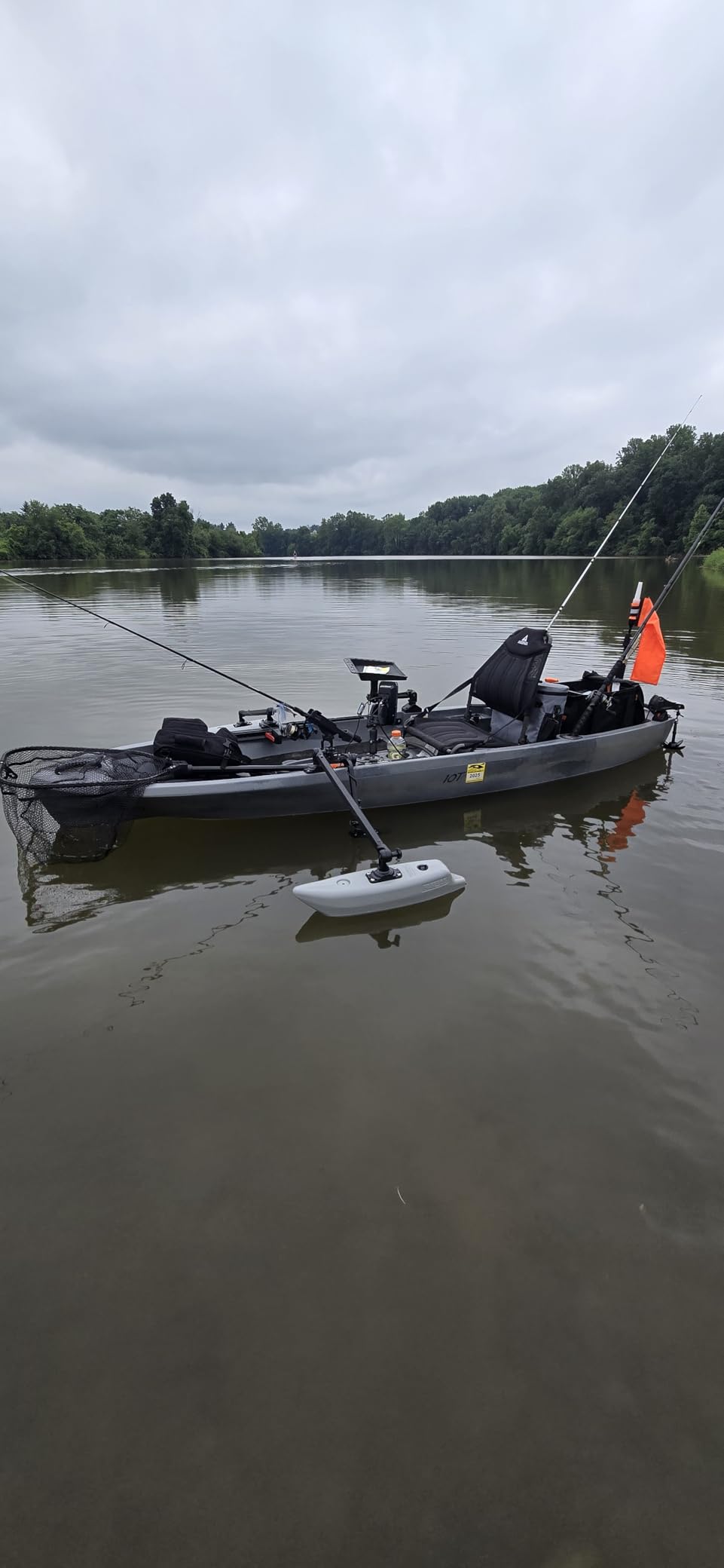
Will the YakGear mounts fit your hull?
The included RAILBLAZA StarPort HD is the deciding detail. If your kayak already carries a Starport rail or a track system the mount slides onto, installation is setting the arm angle and tightening a cam. Owners with no hardware at all report having to drill, which is where many buyers stop.
Is 6.8 lbs a problem for solo paddling?
For most people, no. You only carry the kit from car to launch, and splitting 6.8 lbs into two sides makes the walk manageable. If you portage long distances alone, an inflatable kit further down the list weighs less in your hands.
2. VEVOR Inflatable Kayak Stabilizer Kit – Highest Rated at 4.4 Stars
- Highest average rating in the set at 4.4 stars
- Inflates and deflates in seconds with the dual valve system
- Total width adjustable from 81.5 to 94 inches
- Packs into a bag for car transport
- Thick vinyl pontoons on aluminium brackets
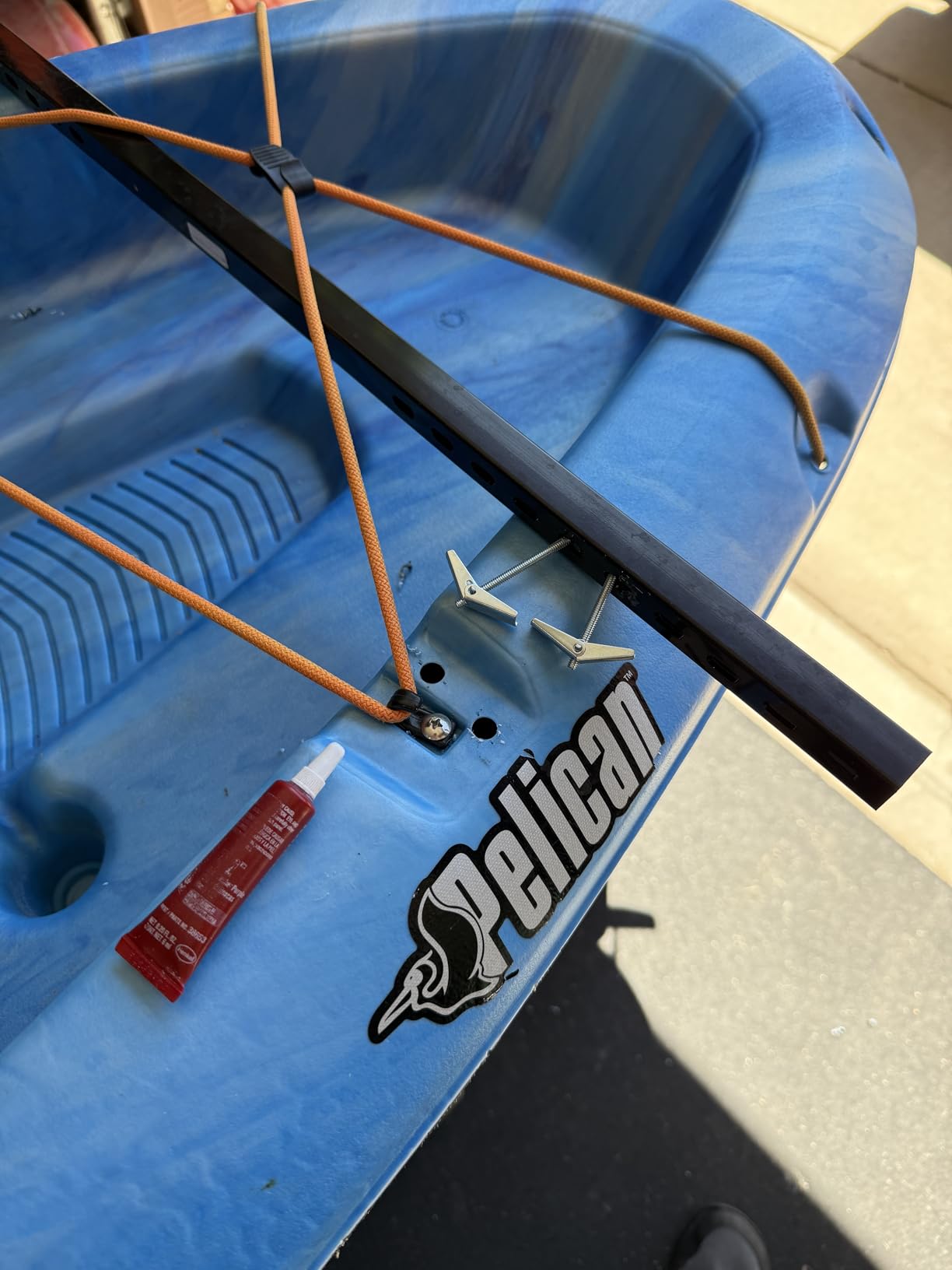
- Included screws for the middle section are often unusable
- Instructions are confusing and thin on detail
- Short pontoons sit deep and create noticeable drag
The VEVOR kit holds the highest average rating of anything we compared, at 4.4 stars across 409 ratings with roughly 72 percent at five stars. It is also the one we would pick for a solo paddler carrying the boat on a roof rack, because the whole system folds into a bag small enough to live in the front of a hull.
The pre-drilled connecting rod lets total width expand from 81.5 to 94 inches, a range that covers a wide sit-on-top and a narrow fishing kayak without swapping hardware. Owners report standing and casting from the boat without fear of tipping, and the pontoons measure 35.4 by 14.2 by 10.2 inches at 6.6 lbs for the pair.
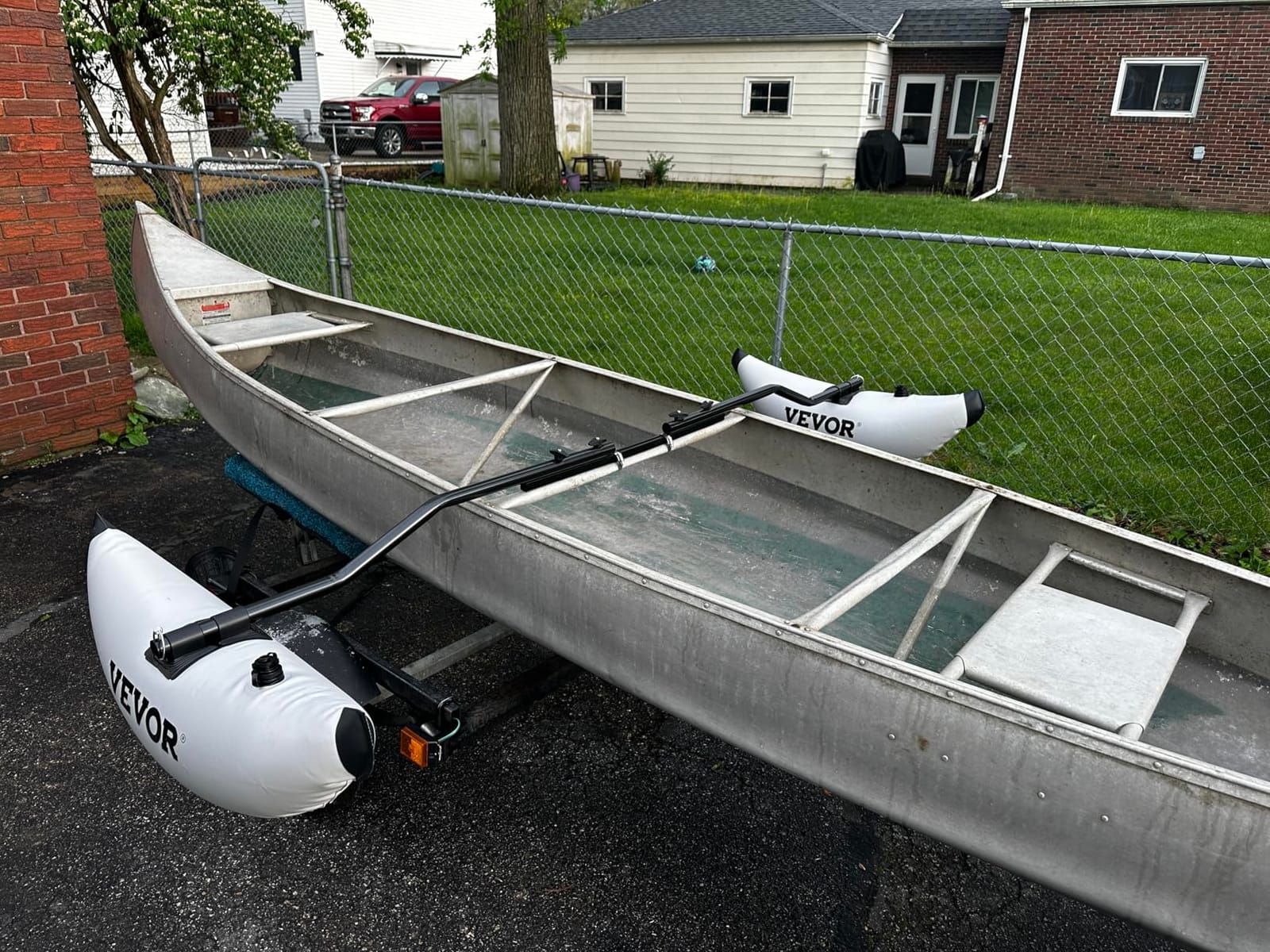
The recurring complaint is the hardware and paperwork, not the floats. Buyers report the included screws for the middle section frequently not working, substituting hose clamps or their own bolts, and describe the instructions as confusing. Budget twenty minutes and bring your own fasteners. A second, smaller gripe is drag: these pontoons sit deeper in the water, so you feel the kit more in open water than a shallower rigid float would.
Can the VEVOR kit be removed for transport?
Yes, and that is its strongest argument. Everything deflates, folds and goes into a bag, so a solo paddler can carry a stabilised boat without a roof rack. The lock on each ferrule joint makes reinstallation a connect-and-tighten job at the launch. Folded flat, this is a bundle you tuck in a hatch or a deck bag, where a rigid kit stays exactly as heavy as it was.
How much speed do you lose to inflatable outriggers?
Nobody publishes a figure, so treat any number with caution. The penalty comes from the pontoon riding deeper in the water and adding wetted surface. Expect a real but modest loss on flat water, more noticeable in wind and current, and largely irrelevant on a lake.
3. METER STAR Kayak Floats – Lightest Complete Inflatable Pair
- Lightest complete kit here at 2.6 lbs for both floats
- Twist and click adjustable float height
- 4 repair patches included in the box
- Universal fit across kayak and canoe use
- Easy to carry and stow
- 4 PSI max pressure limits buoyancy against rigid systems
- 9 percent of reviews are 1 star
- Float size is modest at about 35 by 11 inches
At 2.6 lbs for both floats, the METER STAR pair is among the lightest complete systems here and the one we recommend to anyone carrying gear a long way from the car. It has 172 ratings at 4.3 stars with around 68 percent at five stars, a solid record for a kit this simple.
Installation is a twist-and-click height adjustment rather than a cam lever or a bolted joint, so you can set float height standing in shallow water. That design is why the kit weighs so little. Four repair patches come in the box, which quietly solves the most common failure mode of inflatable amas in rocky or debris-filled water.
Each float measures about 90 by 28 cm and the stated maximum load is 12 kg across the pair. On a fishing kayak carrying an angler and a crate of tackle, that sits at the practical edge, so read the 12 kg figure as a guide for a lighter paddler rather than a full fishing load.
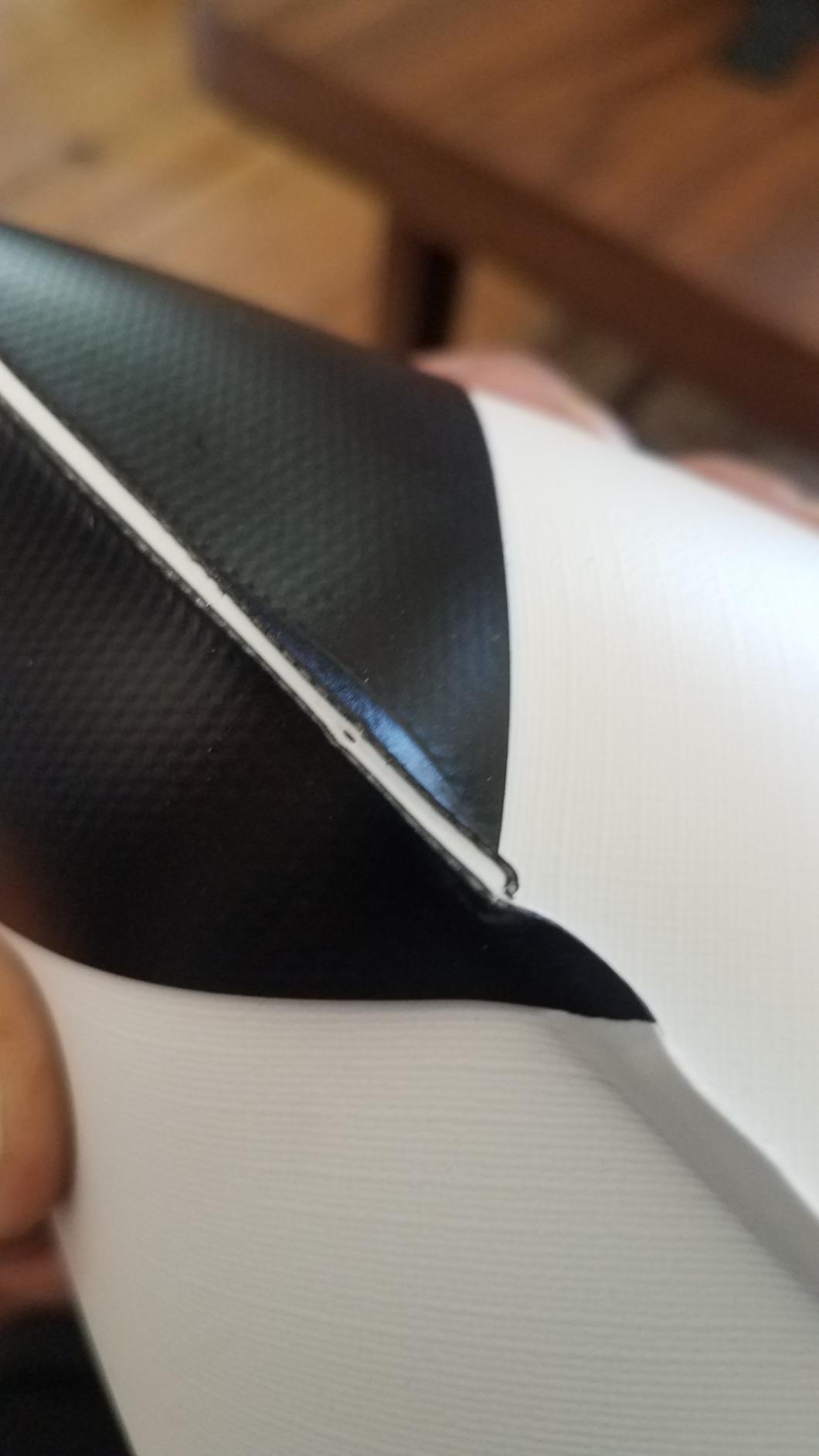
The constraint that defines this kit is the 4 PSI maximum, shared with several budget amas here. Lower pressure means less buoyancy than a rigid system, which is why this float feels softer in chop. It also carries a noticeable share of one-star reviews, mostly from long-term durability doubts.
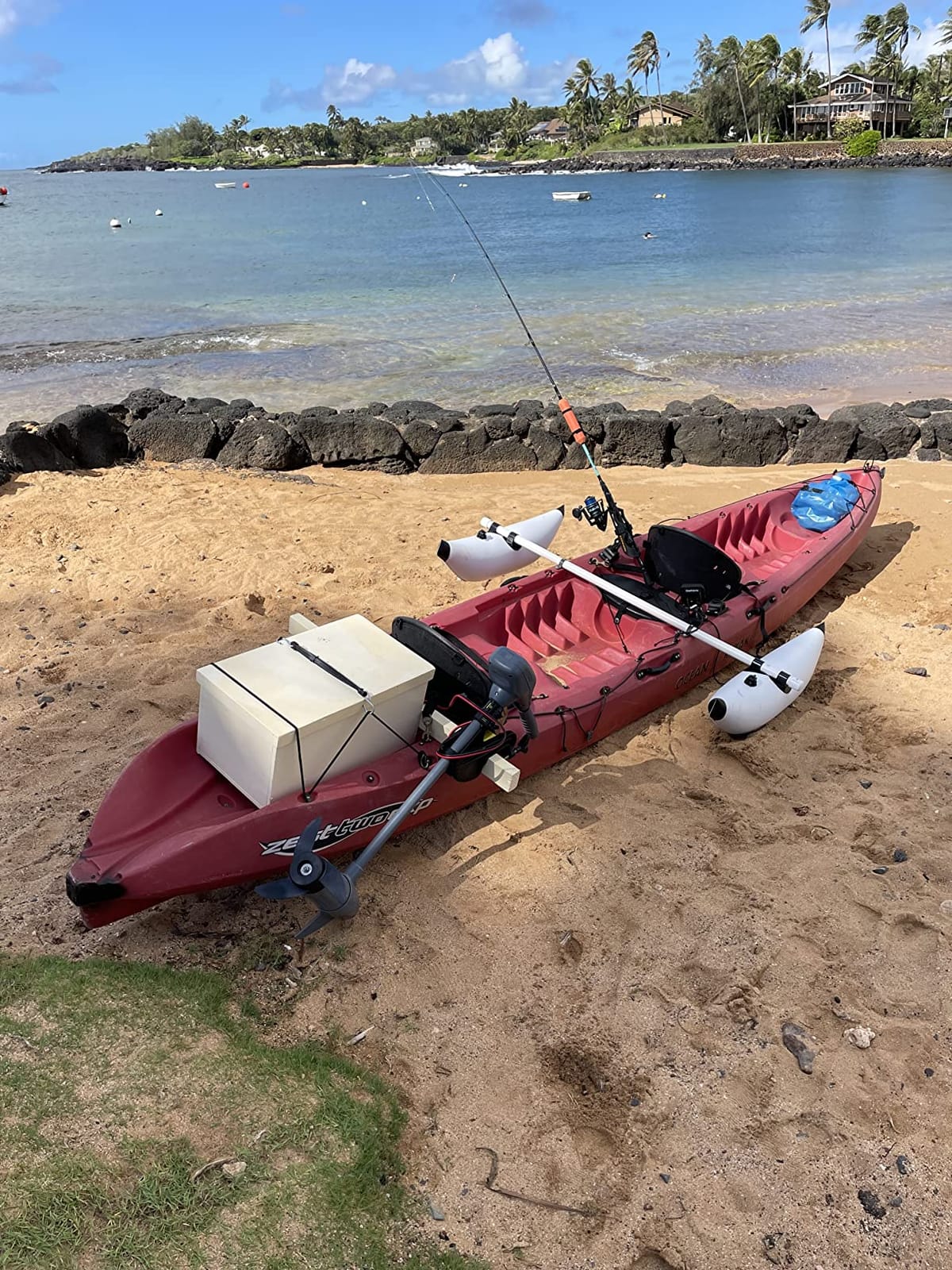
Is 4 PSI enough buoyancy to stand and cast?
For a paddler under about 75 kg on calm to moderate water, yes. The difference between a firm and a soft float is obvious within the first ten minutes of being on the water. For a heavier paddler or exposed water, look at the rigid systems instead, because buoyancy headroom is the one thing a budget inflatable cannot buy back.
Will the patches actually fix a puncture?
A patch handles the common case: a small pinhole or a nick from a submerged branch. Clean, dry, apply and re-inflate. It will not rescue a seam failure, which is the failure mode owners report after a season of storage in a hot car. Store the floats deflated and out of direct sun between trips.
4. Brocraft Generation 2 Outrigger System – Rigid Pontoons That Cannot Be Punctured
- Rigid pontoons cannot pop or be punctured
- High strength aluminium arms with corrosion resistant parts
- Larger pontoon volume than most kits in this class
- Works with existing kayak track systems or direct hull mounting
- Owners describe the build as very robust
- One of the heaviest options here at 10 lb
- Mounting point reported as weak under heavy leverage
- Fixed pontoon volume can be small for rough water setups
- Not compatible with every hull
The Brocraft is the heaviest and most rigidly built system here, and that is the argument for it. Generation 2 uses moulded pontoons on high-strength aluminium arms with corrosion-resistant components, so there is no pressure to lose and no bladder to replace. On rock-strewn rivers and in saltwater, that reliability is worth real money over a few seasons.
With 134 ratings at 4.3 stars and about 69 percent at five, angler feedback is enthusiastic about standing. Owners describe the platform as planted enough to cast from, and the pontoon volume is larger than most competing kits in the same class.
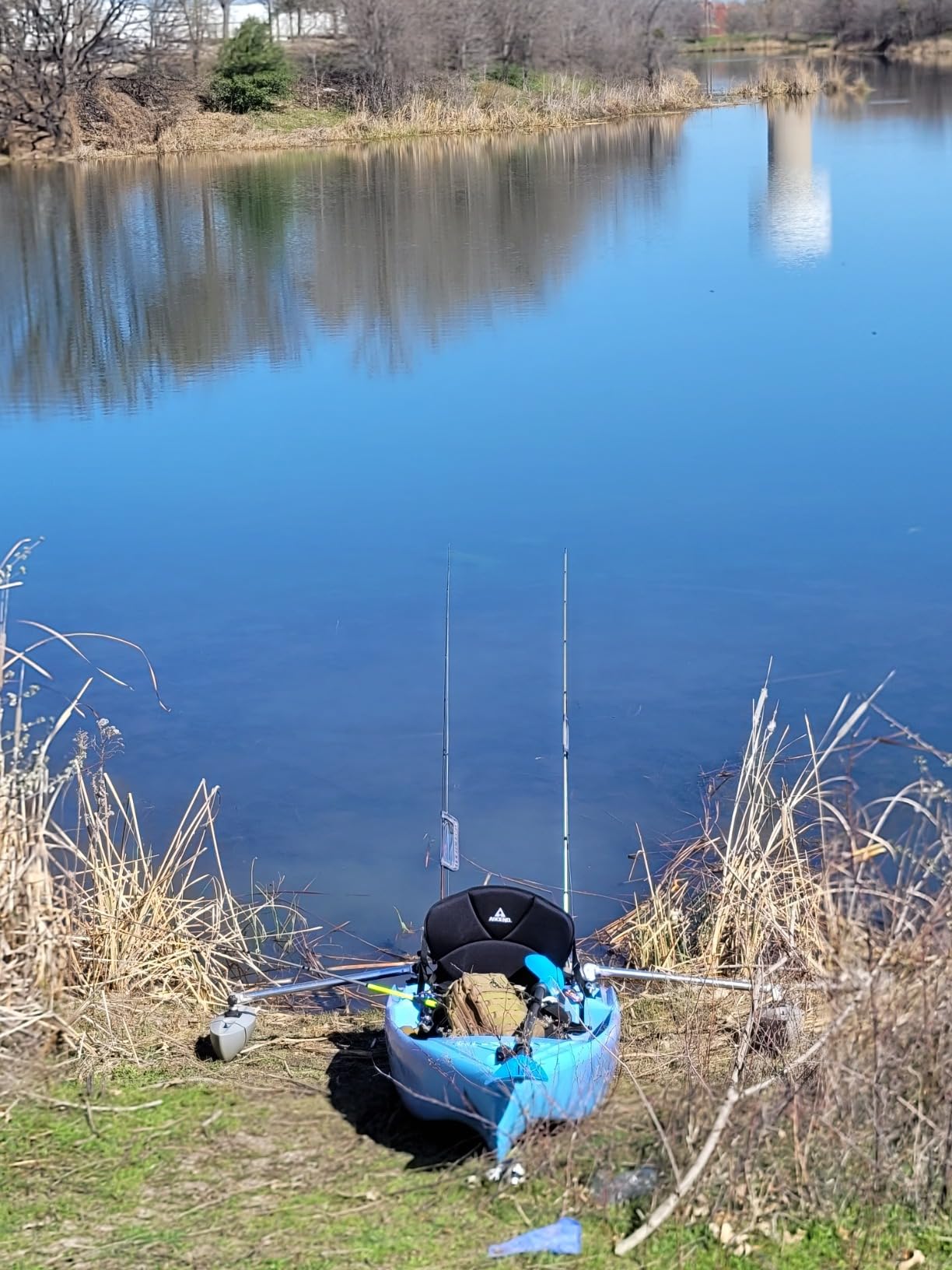
Mounting is the flexible part. The system works with existing kayak track systems or mounts directly to the deck if your hull has none, and package dimensions of 28.9 by 11.5 by 7.6 inches confirm a two-pontoon rigid system rather than a flat-packed inflatable.
The trade is weight, at 4.54 kg. Some owners describe assembly and disassembly as a two-person job. A minority of reviews flag the mounting point as too weak under heavy leverage without a reinforcing crossbar, and a few note the fixed pontoon volume is small for large motorised setups in rough water.
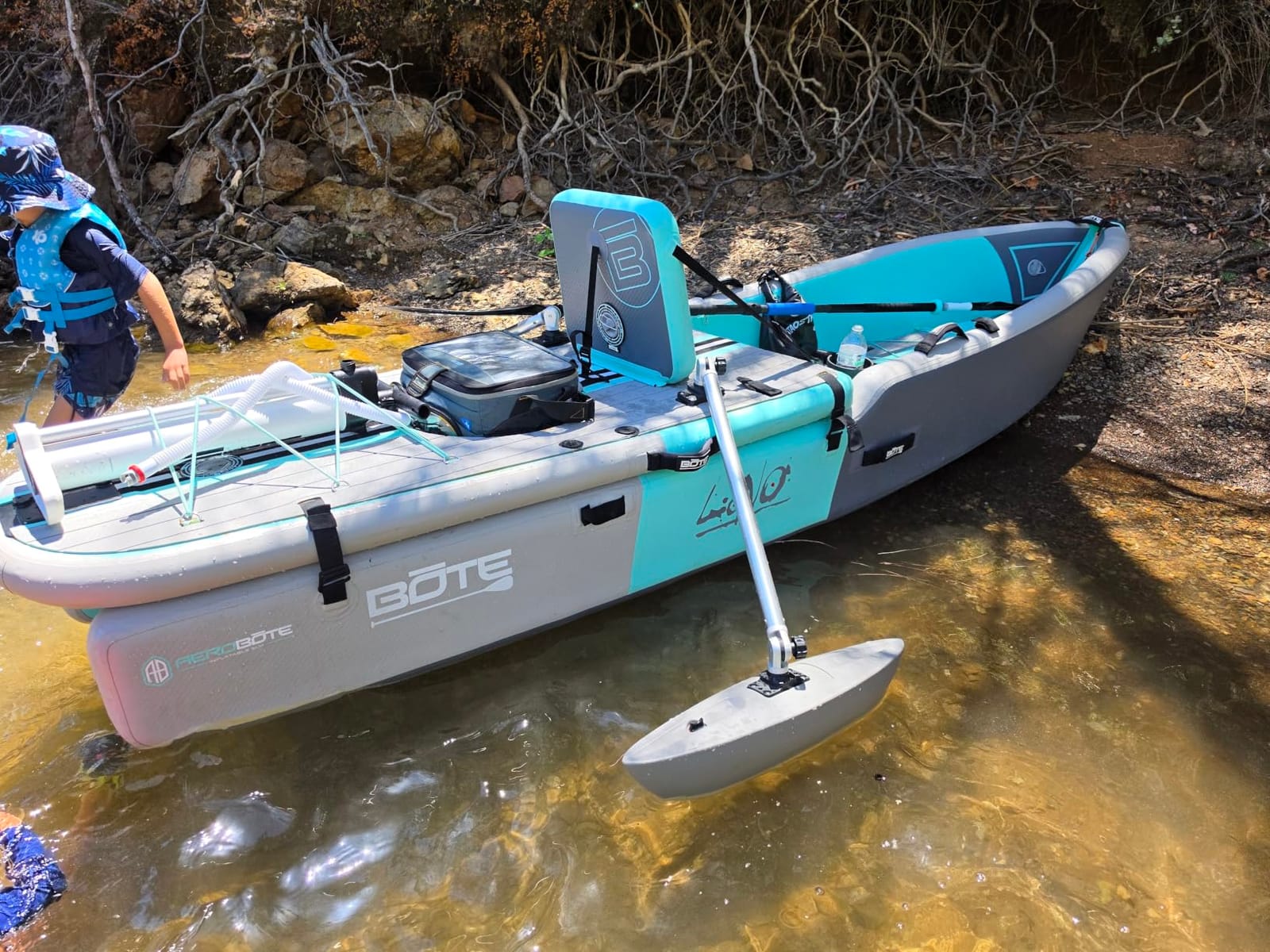
Do rigid pontoons work in saltwater?
Better than inflatables, and the reason is material. Aluminium with corrosion-resistant components and a moulded plastic pontoon has no rubber bladder to degrade. The real saltwater risk is the hardware around the mount, not the float: stainless fittings kept clean of mud outlast cheap plated steel by years.
Is 10 lb too heavy to carry solo?
For a beach launch, no, and the arms and pontoons are separate pieces you can carry in two loads. For a long portage or a solo roof rack, yes. You are committing to permanent weight on the hull that you lift at every launch.
5. Scotty Kayak Stabilizer System 0302 – Best Kit With Rod Holders
- Inflatable inner bladders add over 30 lbs of buoyancy
- 2 Scotty baitcaster rod holders included
- Locking combination side and deck mounts for fast removal
- Long standing design that fits many Scotty mount patterns
- Heavy PVC coated shell over a durable inner bladder
- 10 lb makes it one of the heaviest kits here
- Mounting hardware such as screws and well nuts not included
- Inner bladders need high pressure inflation and no pump is supplied
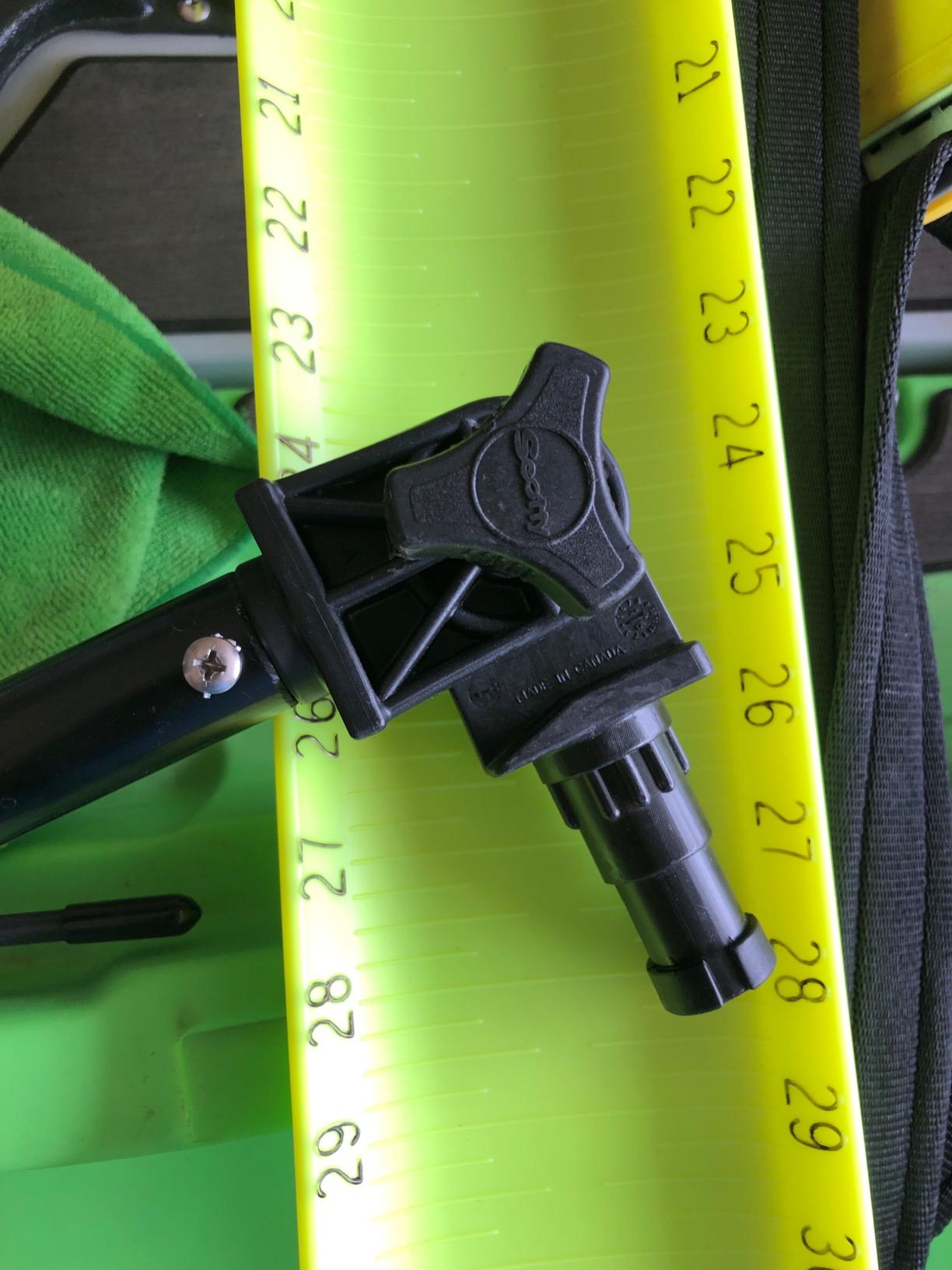
- Mount sprockets adjust in coarse 5 to 6 inch steps
A few kits here ship with rod holders, and the Scotty 0302 is the one built around them. The package contains two inflatable pontoons, two 28 inch anodized arms, four #241L locking combination side and deck mounts and two #280 baitcaster rod holders. For an angler, that is a complete platform in one box rather than a stabiliser plus a second purchase.
Each pontoon is 30 inches long with an 8 inch diameter and an inner bladder adding over 30 lbs of buoyancy, protected by a heavy PVC-coated outer shell. Owners who install it report a dramatic improvement in the ability to stand and work the boat.
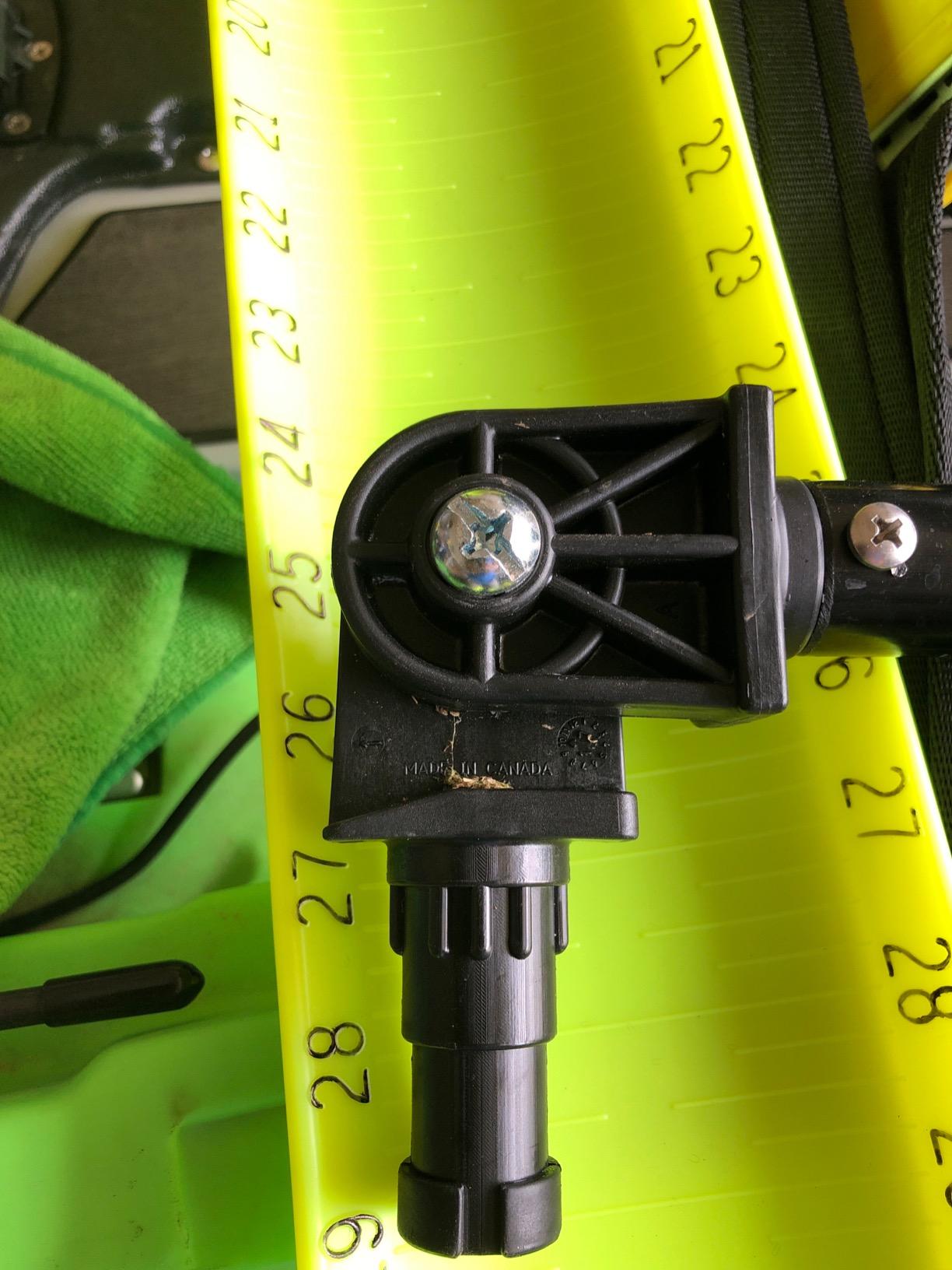
Kit dimensions are listed at 34 by 11 by 11 inches and the weight is 10 lbs. Installation uses the locking combination mounts, which owners praise for making removal fast, and the design fits many existing Scotty mount patterns. The trade-off is that pontoons can only be repositioned in 5 to 6 inch increments, so fine trim tuning is limited.
Two warnings from owners. Mounting hardware is not included, so you need screws, nuts and well-nuts for the job, which is the most common complaint on this system. Second, the inner bladders need high-pressure inflation, the supplied valves are stiff, and no pump is included, so allow time at the car park.
Are the included rod holders worth it?
They are the reason to pick this kit over an otherwise similar system. They are baitcaster holders, which suits most freshwater and light inshore fishing, and two is a working setup rather than a token, so you can keep a rod ready while you paddle. If you already own Scotty accessories, this kit blends in.
Why do the pontoons need such high inflation pressure?
Because the buoyancy comes from a tight inner bladder inside a rigid outer shell, and a slack bladder loses lift quickly. Owners who inflate properly get the advertised stability; those who skip the pump and settle for a soft feel report a disappointing result. Buy a small manual pump and treat the first inflation as part of the install.
6. DAUERHAFT Inflatable Outrigger – Best for Family Paddling
- Lightweight inflatable design that installs and removes quickly
- Available in three colour choices
- Enough stability to stand to cast
- Works for paddling with a child seated in the boat
- Easy to inflate and easy to store
- Only 60 ratings so long term durability is thin on record
- Listing gives few concrete measurements
- 4.2 average sits below the top rated kits
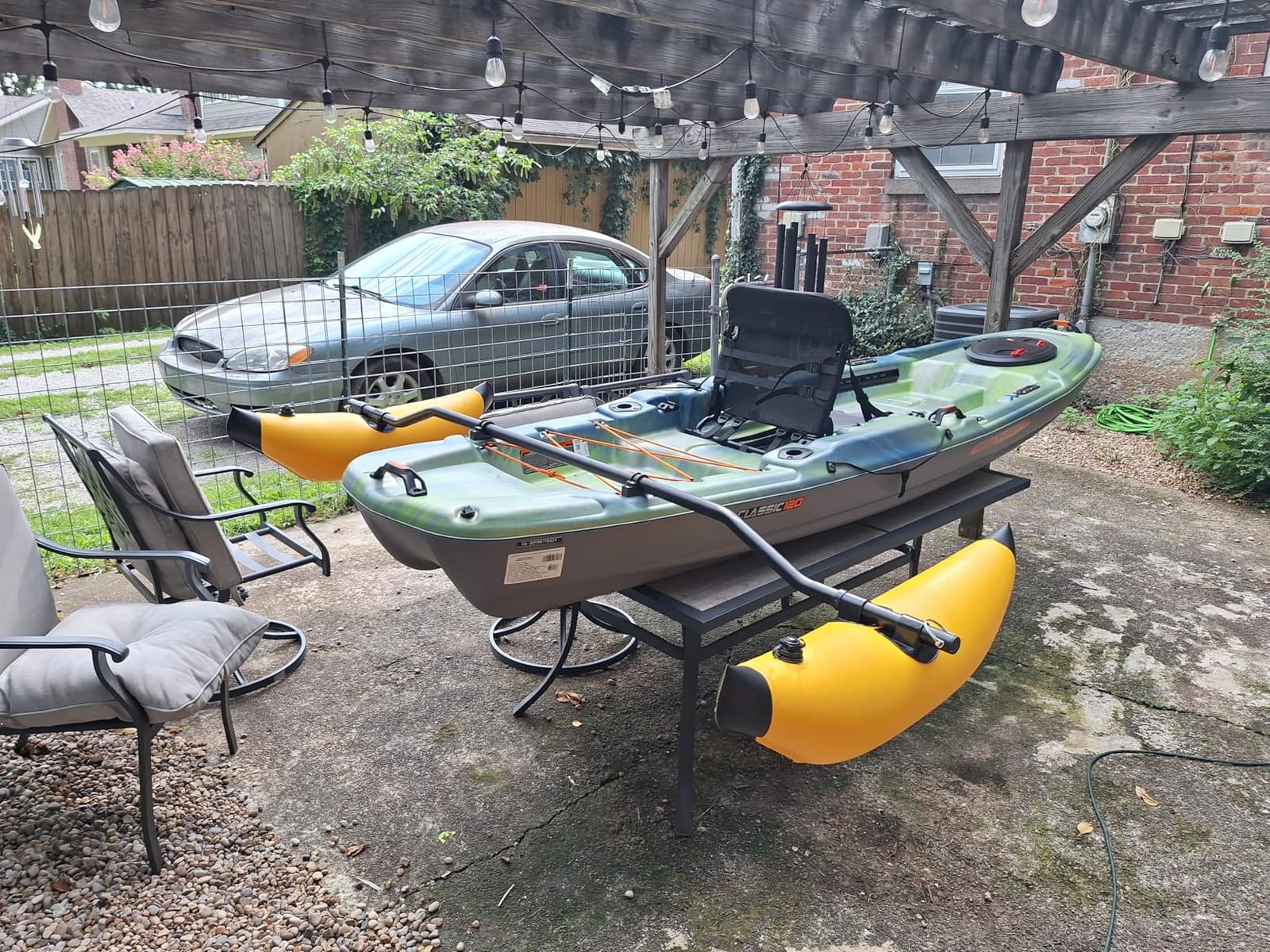
The family use case is where a lightweight inflatable earns its place, and the DAUERHAFT is among the simplest here. Owners report it installs and removes quickly, stores in a car boot without thinking about it, and gives enough stability to stand to cast or to paddle with a child seated in the middle of the boat.
With 60 ratings at 4.2 stars, it sits in the middle of the pack, and the specification detail is where it loses ground to the VEVOR or Lixada. The listing gives few concrete measurements, so you are fitting it more by eye than by numbers.
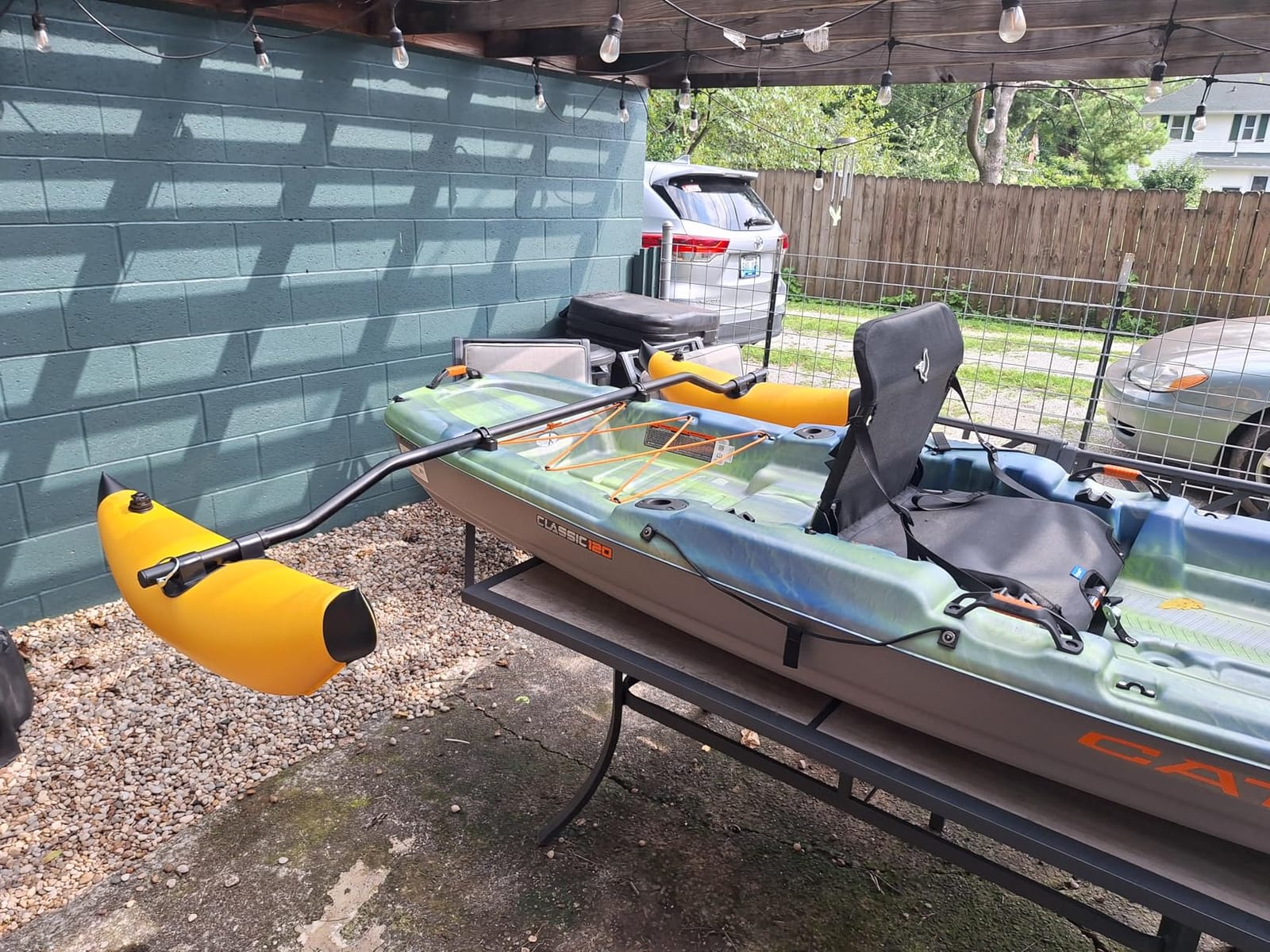
What you do get is a straightforward PVC inflatable with easy inflation, aimed at general use across canoeing, kayaking, rowing and fishing. It is beginner-friendly because there is almost nothing to adjust and nothing to get wrong. The honest caveat is the thin review base: 60 ratings is not much evidence about how a float holds up after three seasons.
Is it stable enough for a child in the boat?
Yes, on calm and moderate water, and this is the configuration owners describe it for. A child in the middle of a kayak moves the centre of gravity in a way a solo paddler never does, and the side float keeps the boat level while you paddle. On exposed water, add a life jacket and keep the trip short.
How does it compare with the VEVOR inflatable?
The VEVOR adds measured specifications, a pre-drilled width adjustment and a much larger review record. The DAUERHAFT is simpler and available in three colours. If you like knowing exactly what you are fitting, choose the better-documented kit.
7. KUNPENG 2-Piece Stabilizer System – Budget Buoyancy Floats
- Very light at 2.6 lbs per pontoon
- Puncture resistant PVC that resists UV and saltwater
- Tool-free installation with a 1.26 in fixing seat
- 4 reinforced PVC repair patches included
- Each pontoon measures 35.4 by 11 inches
- Floats only so many owners fabricated their own arms
- Reported as small and not very rigid in use
- Can develop seam pinholes that need periodic top-ups
- White PVC stains easily
Be clear about what the KUNPENG system is: two inflatable pontoons and a universal fixing seat, with the arms often not included. That makes it a parts purchase as much as a kit, and it is the single most important thing to check before ordering.
With 55 ratings at 4.3 stars, the owners who pair these floats with their own arms report good stability for carrying a dog or for standing briefly. Each pontoon is 2.6 lbs and measures 35.4 by 11 inches, and the PVC is described as puncture-resistant against UV, salt water and abrasion.
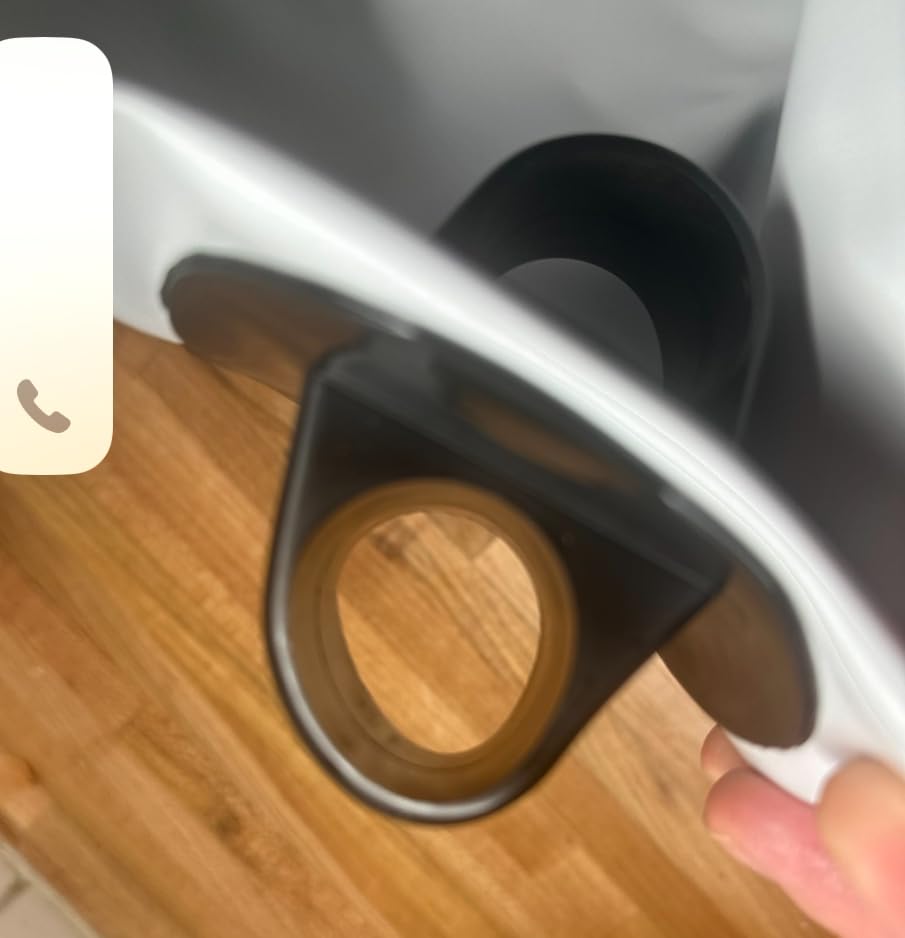
The 1.26 inch diameter fixing seat is designed for tool-free installation across hull types, and four reinforced PVC patch pieces come in the box, which again points to a DIY attitude to ownership.
Reported drawbacks are consistent. Owners call the floats small and not very rigid, some develop seam pinholes and need periodic top-ups of air, and the white PVC stains easily in a wet storage box. The rigidity complaint matters most in current, where a soft float moves more under the hull than a hard one.
Do I need to build the arms myself?
Most owners do. The fixing seat gives a connection point, but the arm is a separate job involving PVC plumbing pipe, clamps and drilling, and you own the structural strength of what you make. If you already have hardware, this is a good way to get a custom arm length.
How long do seam pinholes take to appear?
It varies with storage and water, but owners report the first top-up within a season or two of regular use, especially if the floats are folded away damp. Rinse, dry fully and store inflated at low pressure, and the seams last considerably longer. A failing full-circumference seam is not a patch job.
8. LYNICESHOP Inflatable Pontoon Kit – Built for Canoe Owners
- Complete package with sidekick rods
- connecting rod and hardware
- Stainless steel hardware and aluminium alloy rods resist corrosion
- Twist and click adjustable float height
- Light at 2.6 lbs for both pontoons
- 2 year warranty
- 4.1 stars sits near the bottom of the ratings here
- 4 PSI max pressure limits buoyancy
- Only 45 ratings and thin written feedback
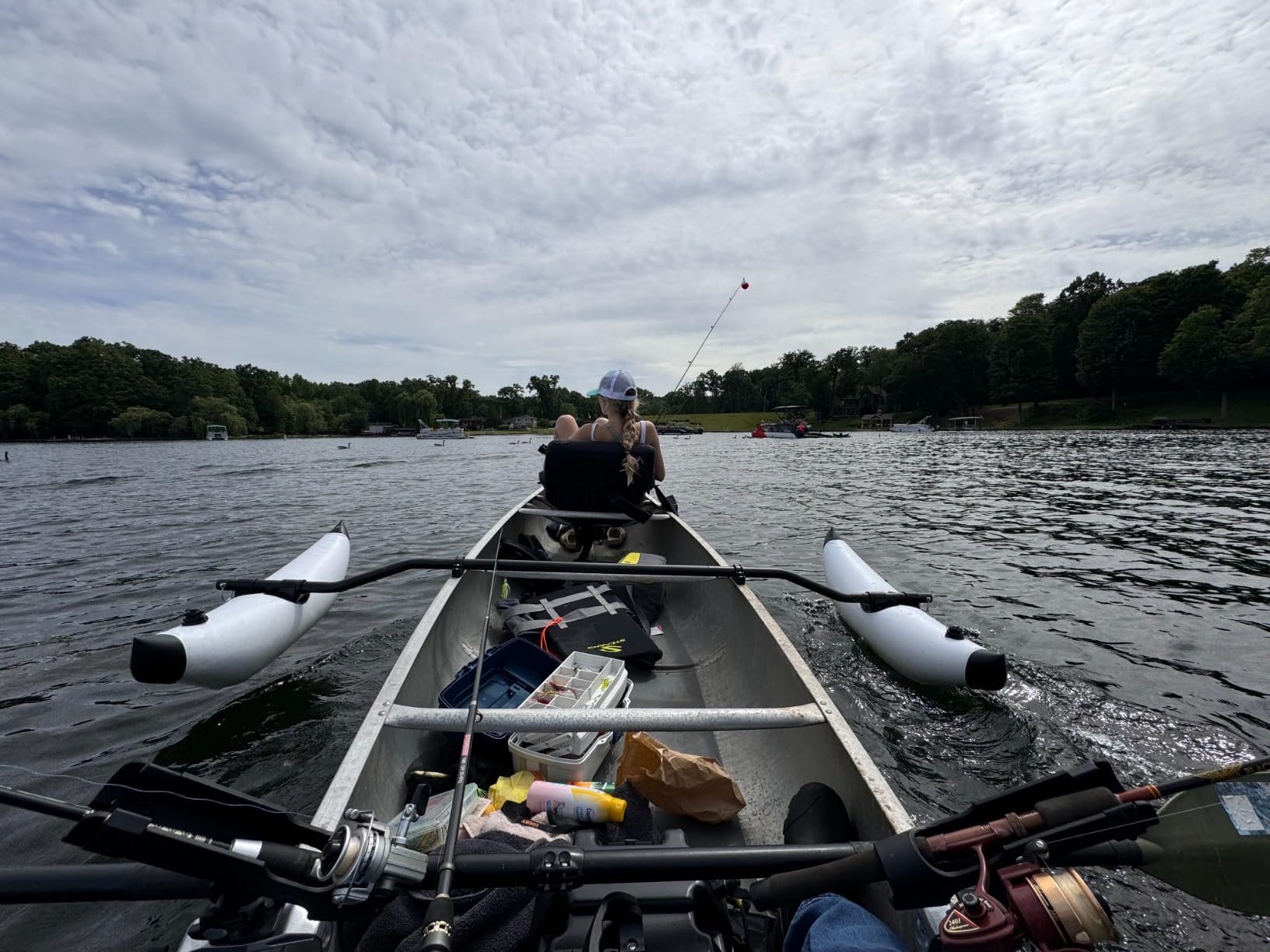
Canoes are wider and higher in the water than kayaks, which means more rotational inertia and more tendency to tip when you stand near one gunwale. A canoe conversion arguably needs outriggers more than a kayak does, and the LYNICESHOP is one of the few kits here sold with a full hardware set.
You get sidekick rods, a connecting rod, a set of hardware and two inflatable outriggers, at a combined 2.6 lbs with each float roughly 90 by 28 cm. The stainless steel hardware and aluminium alloy rods locked by a ferrule are the right call for anyone on mineral-rich lake water or on the coast.
What holds it back is the rating, at 4.1 stars from 45 ratings. Owners like the completeness of the box and the adjustable float height, but the written feedback is thin enough that you are relying on the hardware description rather than on experience. A 2 year warranty is a positive signal, and the 4 PSI ceiling is the familiar constraint on buoyancy.
Will outriggers make a canoe sit too high?
Empty, yes, and this is the most common complaint in older canoe-outrigger threads. With no paddler aboard the hull sits noticeably higher on the float side. Paddling or trolling under power, the geometry settles and owners report the position works fine.
What hardware do I need to add?
Less than with most kits here, because the rods and hardware are included. You still need deck fixings, and you should confirm the sidekick rods match your gunwale width before ordering, since the mount bar length is fixed within each kit.
9. EIMSOAH Inflatable Outrigger Kit – Simple Pick for Beginners
- Lightweight and portable with hassle-free installation
- Simple inflation procedure
- Suitable for canoeing and kayaking on flat water
- Aimed at beginner paddlers who want a stable platform
- 4.0 stars is tied for the lowest average here
- Thin review base with 20 ratings
- Listing gives few hard dimensions or material specifics
- Weak long term evidence at this rating level
The EIMSOAH is the most basic kit here, and for a first season on a wide or tippy boat that is exactly what you want. Installation is described as hassle-free, the inflation procedure is straightforward, and the whole package measures 29 by 7.4 by 4.6 inches at a package weight of 2.9 kg.
It is aimed at beginner paddlers and covers canoeing, kayaking, rowing and fishing without fuss. Owners who installed it report it does the job of keeping the vessel secure on the water.
The evidence is where it runs out. Twenty ratings at 4.0 stars, with only 44 percent at five, is a thin record, and the listing gives few hard dimensions or material specifics for the floats. You are buying on a general description rather than on numbers. We would recommend it only if you want the simplest possible introduction to outriggers.
Is this kit good enough for a first season?
For learning to balance on a wide sit-on-top in flat water, yes. A simple inflatable pair removes the variables that make more complex kits fiddly, and new paddlers gain stability without learning a cam lever first.
Why so few ratings?
Because the listing is thin on measurable detail, buyers cannot tell whether the float suits their hull. Ask for the float diameter and length before you commit. If a seller cannot tell you, that is your answer.
10. Lixada PVC Inflatable Canoe Stabilizer – 37 Inch Floats With a Full Kit
- Larger float dimensions than most budget kits here
- Sealed PVC seams for an airtight float that folds flat
- Dual valve system inflates and deflates in seconds
- Full kit with sidekick arms and mount bar included
- Sidekick arms at 39.4 in give a long lever for stability
- 4.0 stars with 11 percent of reviews at one star
- Smallest review base with 18 ratings
- Single mount bar gives less flexible width positioning
The Lixada is the one to look at if you want a complete inflatable kit where nothing is sold separately. The package list is a pair of floats, a pair of sidekicks, one mount bar and one set of hardware, with a locking ferrule to hold the geometry. That completeness is what separates it from the budget floats-and-a-seat products in this list.
Float size is the real differentiator. Each float measures 37.4 by 13.2 inches, larger than most of the budget kits here, and the sidekick arms are 39.4 inches with a 27.5 inch mount bar. Sealed PVC seams keep the float airtight, and the dual valve system inflates and deflates in seconds, so it folds flat for transport.
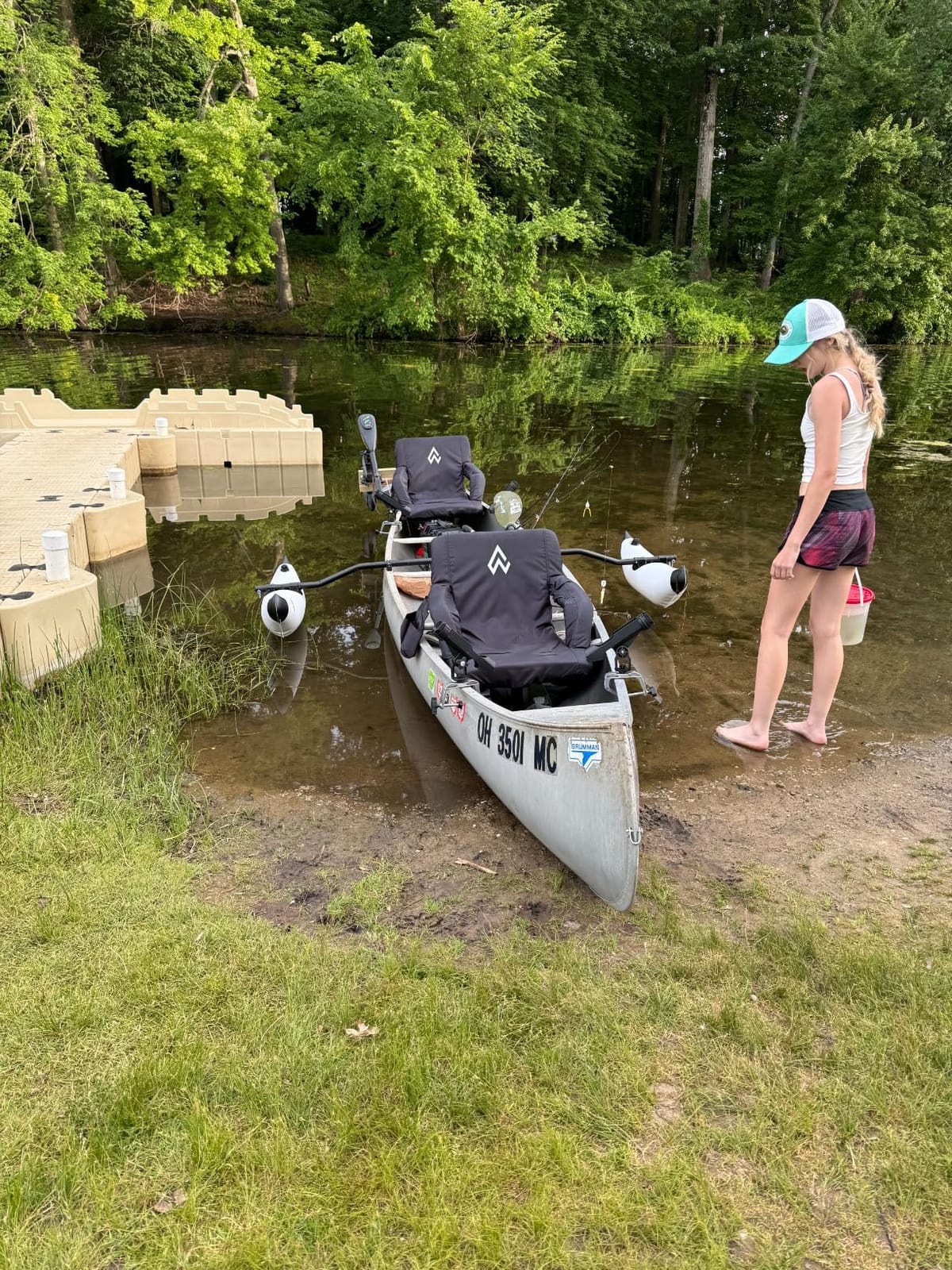
With 18 ratings at 4.0 stars, including 11 percent at one star, this is the weakest review record in the set. Buyers like the airtight foldable design and the fact that everything is included, but there is not enough owner feedback to draw strong conclusions. The other reported drawback is the single mount bar, which makes width positioning less flexible than a twin-arm kit such as the VEVOR.
Why do bigger floats matter?
Buoyancy scales with volume, and volume is what lets you stand. A 37.4 inch float displaces noticeably more water than a 35 inch one at the same pressure, which means more reserve when you shift your weight to one gunwale to cast. The 39.4 inch arms widen the platform further, and wider is more stable and more draggy, so it is a choice rather than a free improvement.
Can one mount bar adjust the width?
Only within the range the bar allows, which is the limitation owners mention. A single bar sets float spacing once the sidekicks are in place, so you choose your width at installation rather than sliding it later. Measure your hull before fitting.
Buying Guide: Inflatable vs Rigid PVC Floats
Choose rigid pontoons if your paddling is local, your water includes rocks, weeds or coral, or you never want to think about pressure again. Nothing pops and nothing needs a pump. You accept the permanent weight and permanent width, and you can rig it once and forget it for years.
Choose inflatable if you carry your boat solo, store it in a small space, move between lakes, or want the option to remove the kit for a narrow creek. Sealed PVC with dual valves folds flat and inflates in seconds. The cost is that you manage pressure, you may patch a pinhole, and a soft float has less buoyancy headroom.
On materials, anodized aluminium arms and stainless steel hardware suit saltwater or brackish water, and that is what the YakGear, Scotty, Brocraft and LYNICESHOP kits use. Rinse hardware with fresh water after every session, because galvanic contact between aluminium and steel in a wet hull ends in seized fittings. If the boat lives on a trailer between trips, our kayak trailer picks cover the transport side of that setup.
Buying Guide: Arm Length, Float Height and Mounting Compatibility
Arm length is the number people get wrong, and the rule is simple: 30 to 36 inches from the centre of the hull to the centre of the float. Shorter gives less leverage and less stability. Longer adds stability but increases drag and total beam. Set the geometry while the boat is level on land, then check it at the water.
Height and angle matter as much as length. The floats should sit on the waterline at roughly a 90 degree angle to the hull. Too high and you add drag without adding righting moment; too low and the float is doing nothing.
Compatibility is where kits fail. Track-equipped kayaks accept almost anything, since a track is a rail. Rail systems such as RAILBLAZA Starport accept a clip-on mount, which is why the YakGear includes one. A plain deck needs drilling or a universal receiver seat, and that is the hard case. Universal receiver mounts fit the most hulls and require no drilling, at the cost of a weaker interface under heavy leverage. Check what your boat already has before you pick a kit.
Buying Guide: The Trade-Offs Nobody Mentions
Outriggers slow the boat down. The float adds wetted surface and, with the arms extended, the hull pushes more water sideways. The penalty is modest on flat water and more noticeable in wind and current. The only way to reduce it is narrower, shallower floats.
They also make the boat wider and harder to handle in tight water. Creeks, dock approaches and launching from a slip where you need to pivot all get harder. If your paddling is on open water, this costs you nothing.
They do not increase your kayak’s weight capacity. What they increase is usable stability, so you can carry more and still feel safe. Ratings such as 350 lbs total on the YakGear and 12 kg on the METER STAR pair describe the stability envelope of the stabilised boat rather than a load rating for the hull. Outriggers also add weight to portage and roof-carrying, and an empty boat sits higher on the float side, which changes how it racks and trailers.
Finally, the DIY option. Owners on the forums regularly build outriggers from PVC plumbing pipe, U-bolts and deck clamps, and it works well if you already have hardware. The trade is that you own the design decisions, including the strength of the arm. If you already run a trolling motor or carry the boat on a kayak trailer, a home-built arm matched to that frame is a natural extension of the same hardware.
Frequently Asked Questions
What are the best kayak outriggers?
The best kayak outriggers for most paddlers are the YakGear Standncast Outriggers Gen II, which carry the most owner ratings in the category and include a RAILBLAZA StarPort HD mount in the box. The VEVOR inflatable kit is the strongest pick if you carry your boat solo, and the Brocraft Generation 2 is the most durable rigid option for rock-strewn or saltwater water.
What is the difference between a stabilizer and an outrigger?
There is no difference at all. Outrigger and stabilizer are two names for the same product: a pair of floats on arms that add lateral buoyancy to a kayak or canoe so it resists rocking and capsizing. Sellers use both words interchangeably, so treat them as one category when you shop.
Are kayak outriggers worth it?
They are worth it if you plan to stand to cast, paddle choppy or open water, are a tall or heavy paddler, or want a canoe to work as a fishing platform. They are not worth it if you paddle narrow sheltered creeks and carry your boat a long way, because the added width, drag and weight will work against you.
How long should kayak outrigger arms be?
Aim for 30 to 36 inches from the centre of the hull to the centre of the float. Shorter arms give less leverage and less stability, while longer arms add stability at the cost of more drag and a wider boat. Most kits in this roundup ship with arms in the 30 inch range, and the adjustable ones let you dial in the rest.
What angle should kayak outrigger floats sit at?
The floats should touch the water at roughly a 90 degree angle to the hull, sitting on the waterline rather than above or below it. Set the geometry while the boat is level on land, then fine-tune in shallow water until the float just kisses the surface as you sit in your normal paddling position.
Do outriggers increase kayak weight capacity?
No, outriggers do not raise the weight capacity of the hull itself. They increase usable stability, which lets you carry more gear and still feel secure. Figures such as 350 lbs total on the YakGear kit describe the stability envelope of the stabilised boat rather than a new load rating for the kayak.
Our Top Pick for 2026
After working through all 10 kits, the YakGear Standncast Outriggers Gen II is the kayak outrigger stabilizer kit we would buy first. It has the deepest owner record in the category at 662 ratings, adjustable 30 inch arms, a 350 lb total weight rating and a 3 year warranty, and it is the only kit here that includes the RAILBLAZA StarPort HD mount rather than leaving it to you.
Buy the VEVOR inflatable instead if you carry your kayak alone, and the Brocraft if you want rigid pontoons that never need inflating. Either way, measure what your hull already carries before you order, because a mount you cannot attach is the only failure that matters. If you plan to rig a sail alongside the stabiliser, our kayak sail picks cover the other half of the setup.