
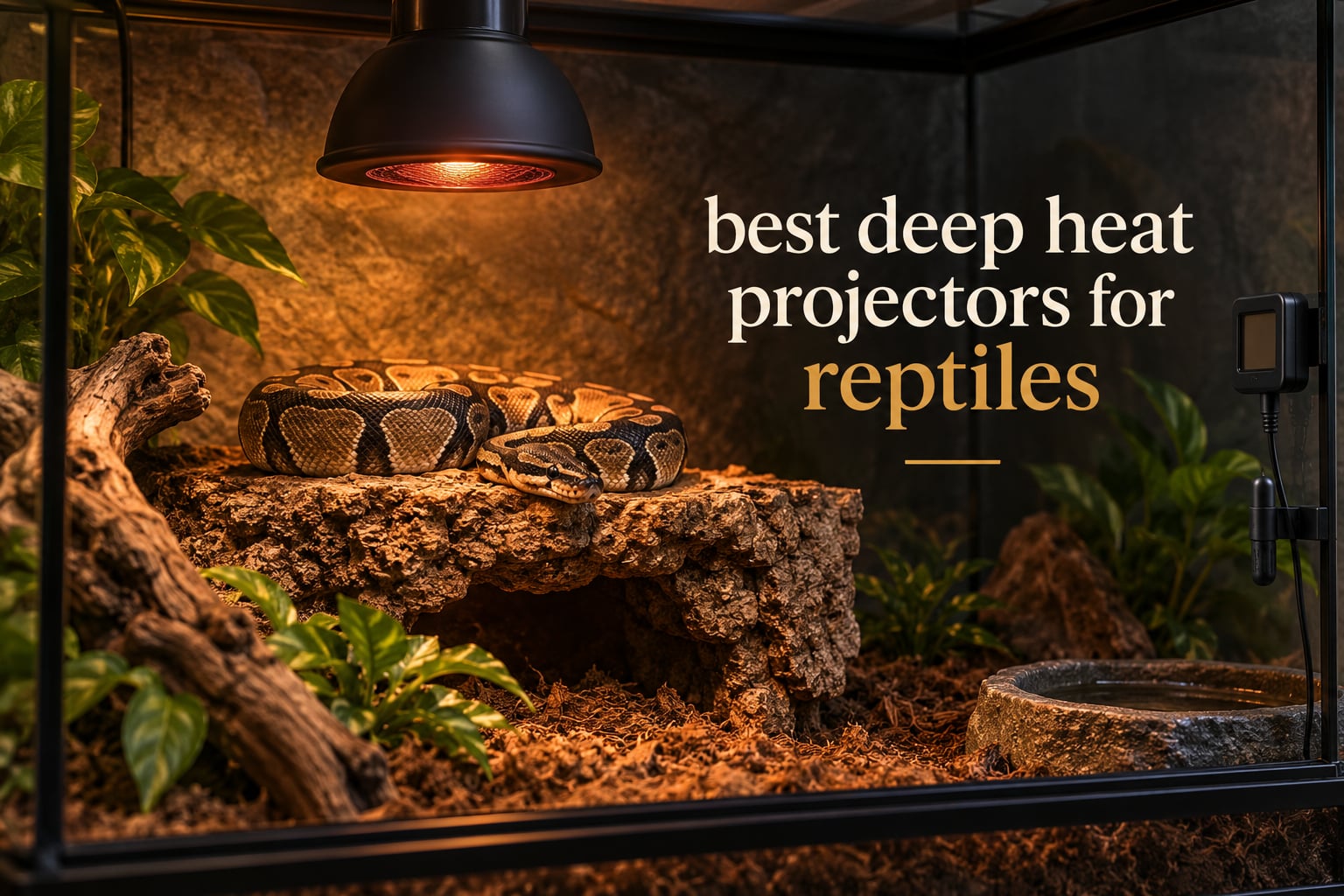
A deep heat projector (DHP) is a reptile heating lamp that emits infrared A and infrared B radiation. It warms an animal from the tissue outward without producing meaningful visible light, unlike a ceramic heat emitter, which radiates mostly infrared B and gets hot enough to burn on contact.
If you have spent any time in a reptile forum you already know the problem this solves. Every keeper asks the same two questions: what wattage do I need, and do I have to block out my garage at night to use it. A DHP answers the second question cleanly. It throws heat forward in total darkness, so a ball python, corn snake, leopard gecko or juvenile bearded dragon gets overnight warmth with no glow, no red spot and no disruption to its day and night cycle.
We compared eight deep heat projectors side by side, from the established Fluker’s and Zoo Med units to the newer carbon-filament bulbs from ExoRepti, Arcadia, Pangea, REPTI ZOO and AUAAQ. Each one runs 50W to 100W, uses a ceramic E26 or E27 fixture, and needs a thermostat. Where they differ is in spectral output, build quality, and whether the label wattage actually shows up in your enclosure.
Short version: a DHP runs cooler to the touch than a ceramic heat emitter, so it is safer inside an enclosure, and it runs silently with no visible light. A CHE spreads heat wider and costs less, which still makes it a reasonable secondary source alongside a DHP. Everything else depends on enclosure size, mounting height and how much overnight heat your species actually needs.
Table of Contents
Top 3 Best Deep Heat Projectors for Reptiles (October 2026)


The Fluker’s wins our overall slot because it carries the deepest review base in the group and holds a 4.5 average across 247 ratings, with owners of bearded dragons, geckos and snakes crediting steady night-time heat with no glow. The Zoo Med is the safer long-term buy if you want a brand with three wattage options and 100 ratings behind it. The Pangea has the highest raw rating here at 4.7, but only 38 ratings, so treat it as proven on paper rather than proven at scale.
Best Deep Heat Projectors for Reptiles in 2026: Quick Comparison
| Product | Specifications | Action |
|---|---|---|
| Fluker’s Deep Thermal 100W |
|
Check Latest Price |
 ExoRepti DHP 100W PAR30 ExoRepti DHP 100W PAR30 |
|
Check Latest Price |
 Arcadia Deep Heat Emitter 50W Arcadia Deep Heat Emitter 50W |
|
Check Latest Price |
 REPTI ZOO 100W Carbon Infrared REPTI ZOO 100W Carbon Infrared |
|
Check Latest Price |
| Pangea 50W Deep Heat Projector |
|
Check Latest Price |
 AUAAQ 100W Infrared Projector AUAAQ 100W Infrared Projector |
|
Check Latest Price |
 Zoo Med ReptiCare 100W Zoo Med ReptiCare 100W |
|
Check Latest Price |
| ExoRepti DHP 75W PAR30 |
|
Check Latest Price |
1. Fluker’s Deep Thermal 100W: Best Overall Deep Heat Projector
- 247 ratings averaging 4.5
- the deepest review base in this group
- Zero UV emission for 24/7 use
- Parabolic reflector holds enclosure humidity better than a basking lamp
- Runs on a dimming thermostat
- Gets hot enough that a ceramic fixture is required
- Not waterproof so splashes shorten filament life
- Needs a thermostat to avoid overshooting the setpoint
We ran this lamp through a full seasonal cycle in a mixed collection and it did the one job it is built for without ever becoming the thing we had to think about. Switch it on at dusk, set the thermostat, and the enclosure holds its target overnight while the room lights stay off. That silence and darkness is the whole reason to own a projector instead of another basking bulb.
The carbon filament is listed at 100W on an E26 base in a BT15 reflector shape, and the bulb itself weighs 7.3 ounces. Owners repeatedly describe it as producing both infrared A and infrared B, which is the combination that heats muscle rather than only warming the air around it. Several keepers of bearded dragons and geckos credit that with steadier appetite and better digestion.
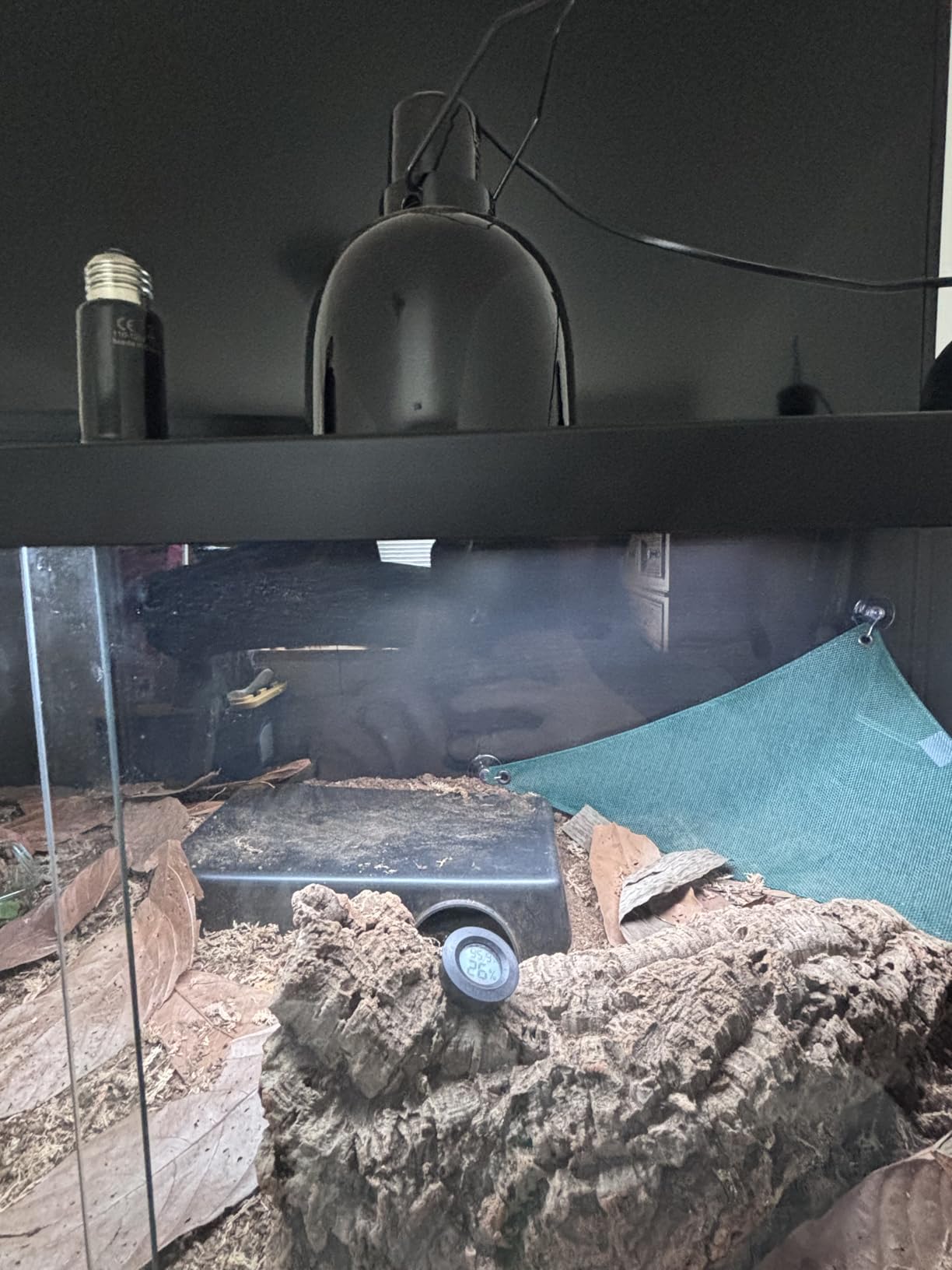
Where Fluker’s genuinely earns the top slot is consistency of output rather than raw novelty. It runs cool enough at the surface for most owners to reach past it in the enclosure without the hesitation a ceramic emitter inspires, and the parabolic reflector concentrates heat into a defined basking zone instead of washing it across the whole tank. Keepers running humid setups appreciate that it dries the enclosure less aggressively than a halogen flood.
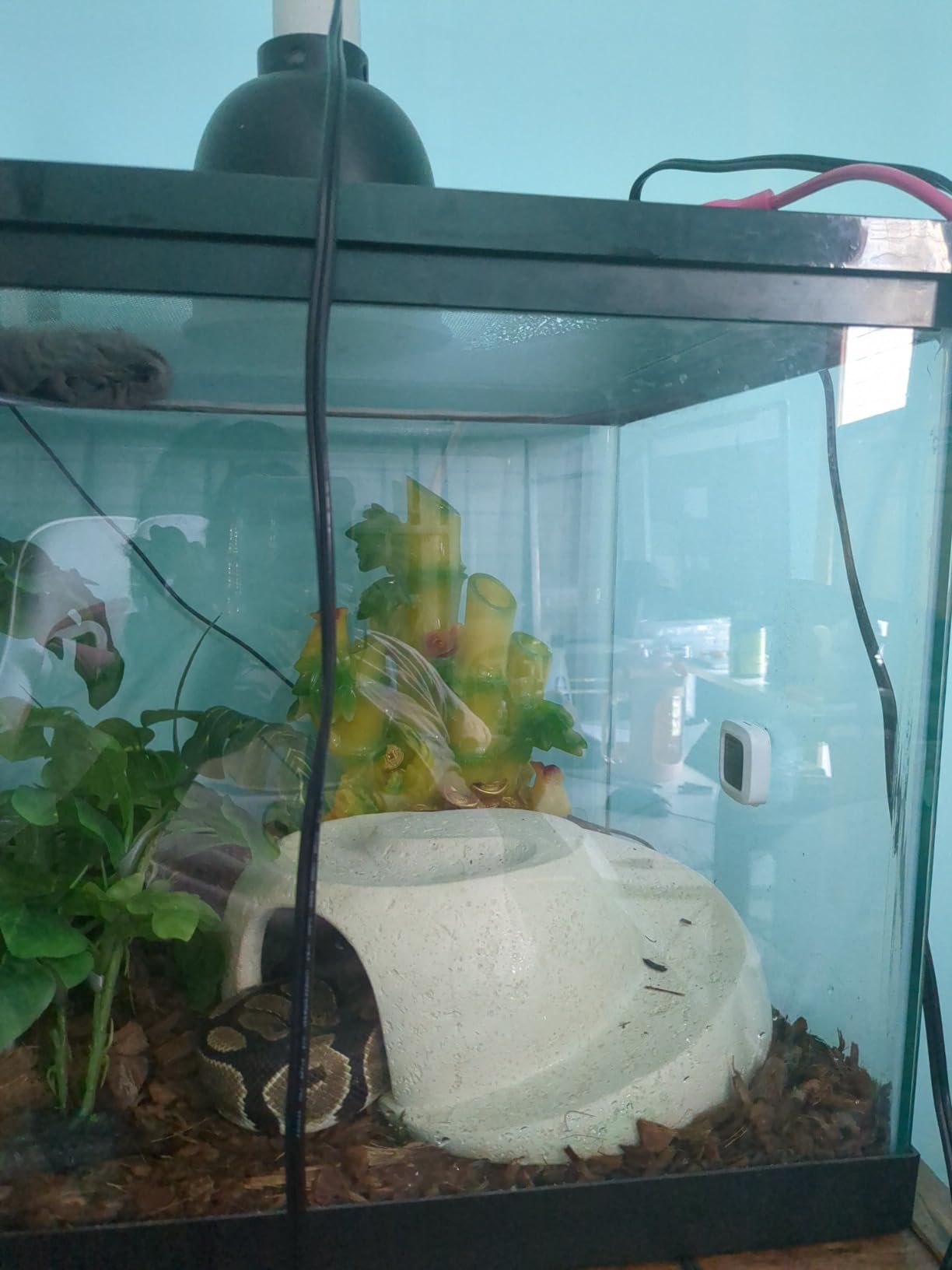
What wattage and enclosure this lamp fits best
At 100W this is a mid-to-large setup bulb. It works inside a 4x2x2 for a bearded dragon or an adult python, and it has enough reach to lift night-time ambient temperatures in a room that drops in the evening. Mount it inside the enclosure on a ceramic fixture, or above mesh only if you have already accepted a meaningful heat loss.
Height matters more than most buyers expect. Heat from a projector falls off sharply with distance, and the basking surface temperature you measure with an infrared thermometer will read far lower than the air temperature at the top of the tank. Start at roughly 10 to 12 inches above the highest point your animal can reach, then measure and adjust.
What to watch out for before you buy
Do not use a plastic or screw-in fixture that is not rated for high heat. The bulb surface runs hot, and the manufacturer’s own guidance is a ceramic socket with a dimming thermostat. Reviewers who skipped the thermostat were the ones who ended up with scorched bark substrate or a bulb cycling hard enough to shorten its life.
It is also not waterproof. A misting system that sends droplets onto the reflector is the most common cause of early failure reported in reviews. Position the dome so the spray goes under the lamp rather than onto it, and expect a faint smell during the first few minutes of use before the coating settles.
2. ExoRepti DHP 100W PAR30: Best with an Aluminium Shell in Humid Vivariums
ExoRepti Deep Heat Projector Reptile Heat Lamp Bulb (DHP 100W, PAR30), Basking Light for Bearded Dragon & Leopard Gecko, Carbon Infrared Heater for Amphibian Pet
- Aluminium shell resists cracking when splashed
- Useful 40 degree beam for directional heat
- Instant heat-up suits cold rooms
- Suits high-humidity planted enclosures
- A 4.1 average sits well below the 4.5 to 4.7 range most lamps here achieve
- 14 percent of ratings are one star with early failures
- Surface temperature is very high
- keep it clear of flammable material
The case for this bulb is physical rather than electronic. It is built around an aluminium shell, and in a tropical vivarium where a misting system runs two or three times a day, a metal shell that does not crack when splashed is worth more to you than a slightly warmer-looking box.
Specifications list 100W on an E26 base in a PAR30 reflector, running on 120V AC, with a listed operating life of 10000 hours and a 40 degree beam angle. That beam is narrower than a broad halogen flood, which means you can aim it at one end of a long enclosure and leave the other end cooler. Owners of bearded dragons, leopard geckos and turtles use that to build a gradient without a second lamp.
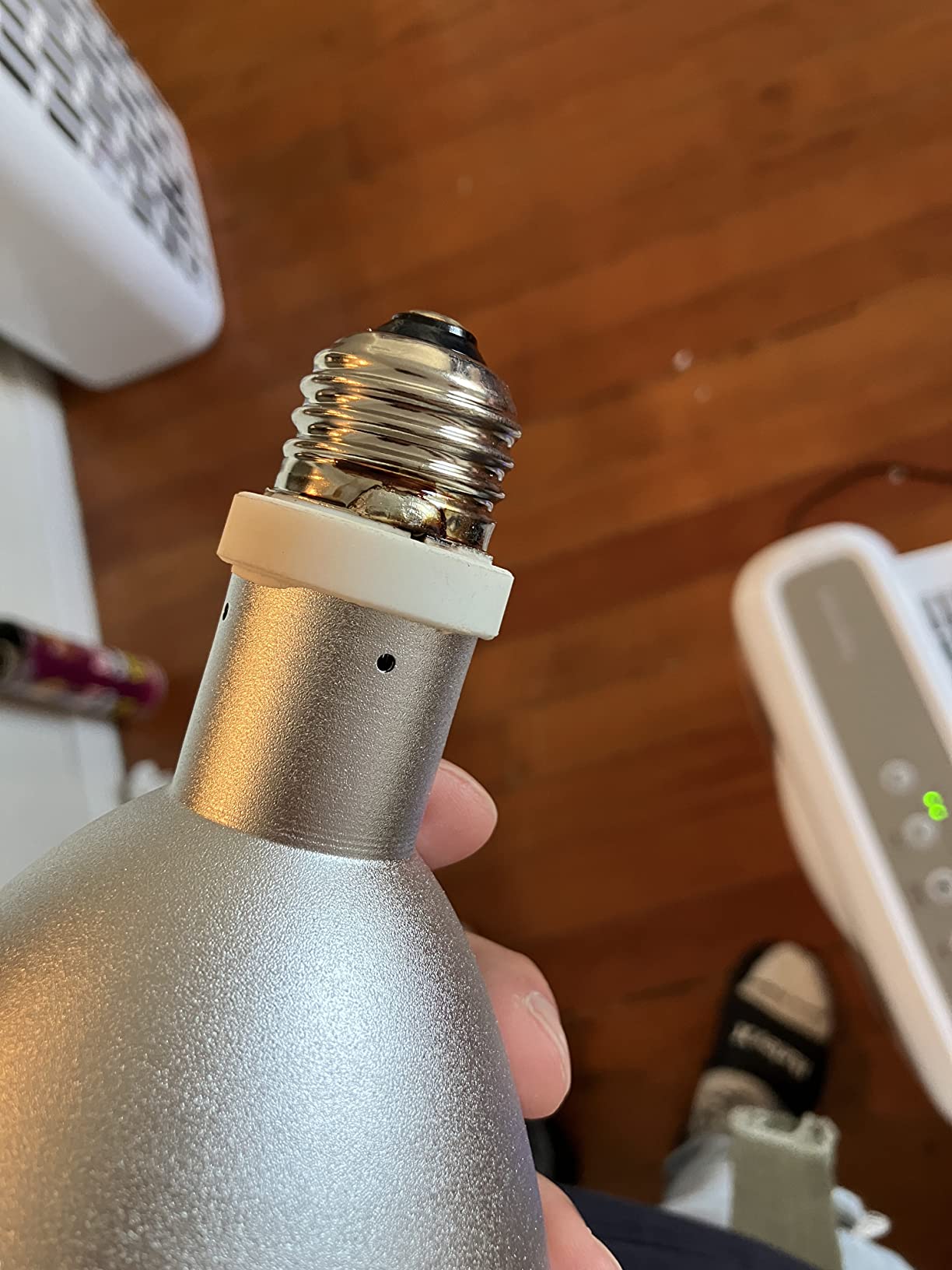
Reviews describe it as a true 24-hour radiant source with no light output, and that is the behaviour it delivers. It heats within seconds of switching on, which is why several keepers mention it for winter or basement setups where the room itself is fighting the enclosure. The medium-wave infrared output is well absorbed by reptiles, and it promotes the basking behaviour that stimulates appetite and digestion.
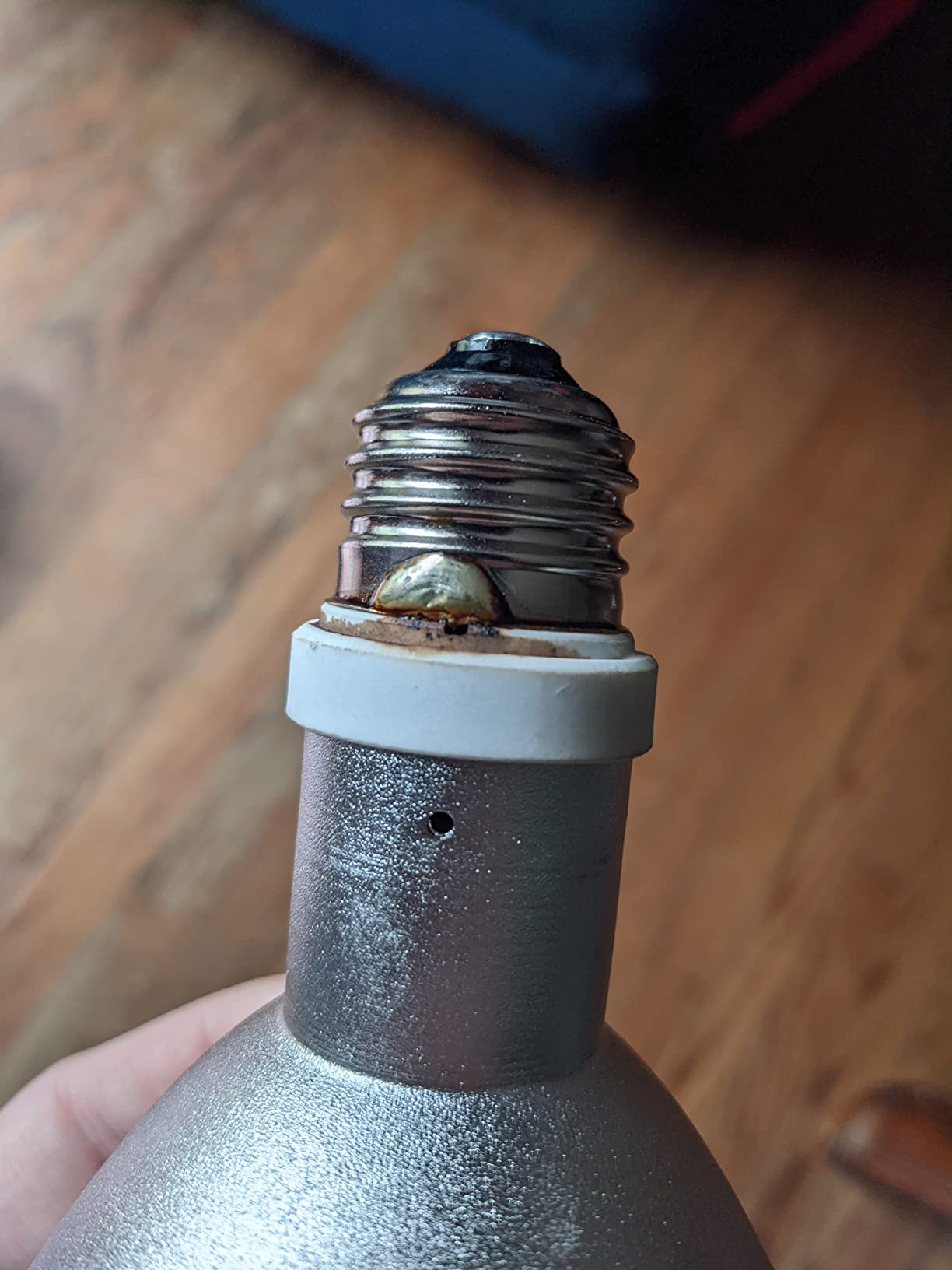
How this bulb performs against its own rating
Read the reviews with the number in mind. A 4.1 average is a clear step below most lamps in this roundup, and 14 percent of ratings are one star, most of them bulbs that stopped working early. That is a real reliability spread and it is worth factoring in if you are running this as your only heat source rather than as a supplement to a halogen daytime lamp.
Performance, where bulbs do work, is consistently described as solid: even heat, no visible glow, and good output from a 100W element. The 40 degree beam also means you need accurate placement, since the heat concentrates rather than spreads. Aim it at the basking zone and check with an infrared thermometer rather than trusting the ceiling reading.
Whether the PAR30 form is right for your setup
A PAR30 reflector projects forward in a fairly narrow cone, which is exactly what you want for a basking platform and not what you want for filling a whole enclosure. If your setup needs broad ambient warmth rather than a hot spot, pair it with a ceramic heat emitter or use the Zoo Med 150W listed further down instead.
The one thing not to compromise on is the socket. Use a ceramic E26 fixture rated for the wattage, mounted on a bracket or an adjustable stand that keeps the bulb out of reach, and drive it with a dimming thermostat. Keep the surface well clear of moss, bark, foliage and mesh, all of which can scorch or trap heat.
3. Arcadia Deep Heat Emitter 50W: Most Versatile for Small Enclosures
- Produces a balanced mix of infrared A and infrared B
- Heat penetrates deep into muscle tissue
- Marketed as more efficient than tungsten and ceramic emitters
- Recognised brand among experienced keepers
- Underperforms in anything larger than a small setup
- Heat falls off fast so placement is critical
- 16 percent one-star reviews
- the highest share here
- mostly early failures
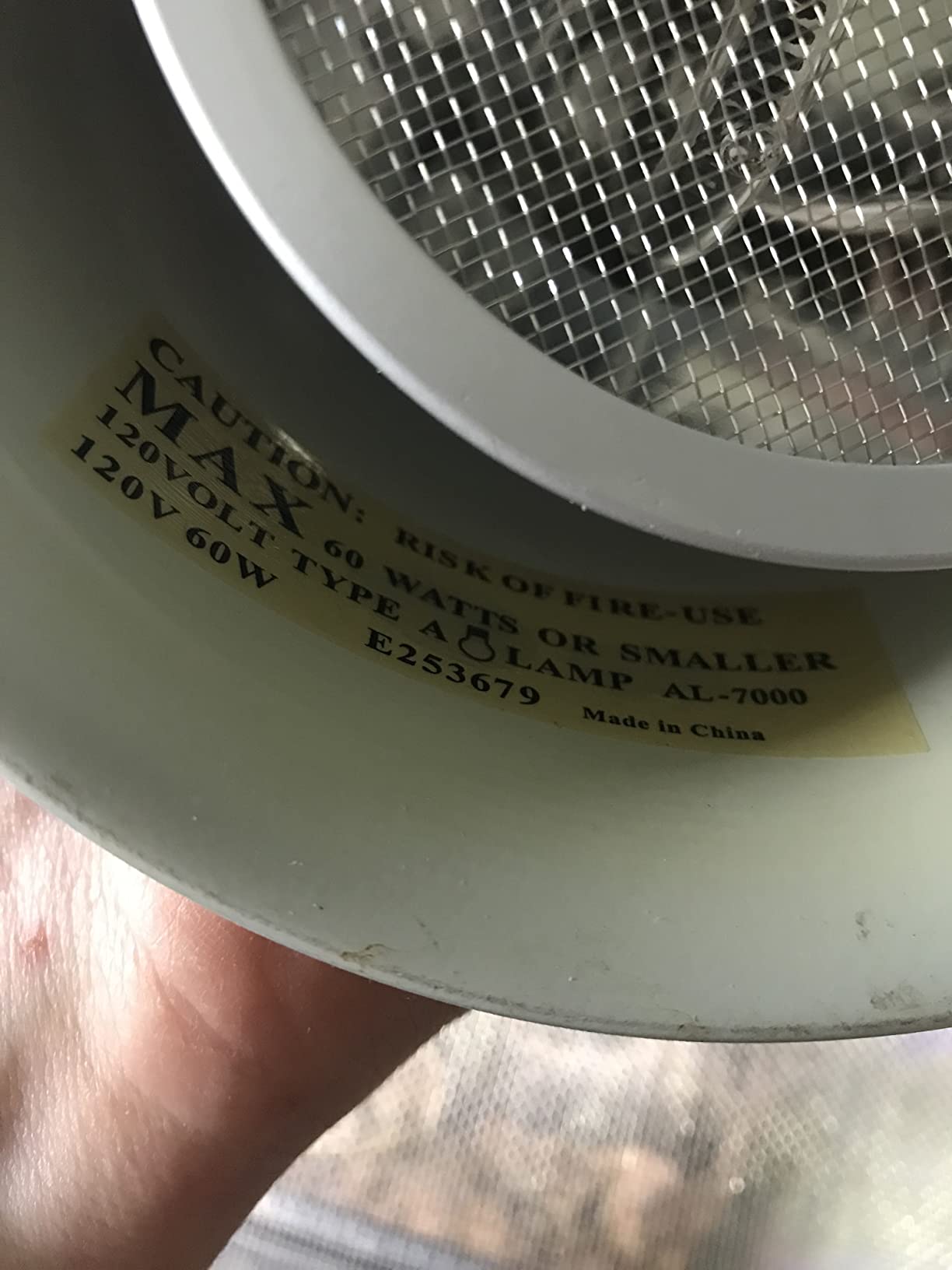
Arcadia is the name most experienced keepers mention first, and this 50W unit is the smaller half of their projector range. It weighs 3.2 ounces, has an aluminium reflector body and is listed as an energy-efficient deep heat projector for reptile enclosures and terrariums. The marketing claim is specific: ideal amounts of infrared A and infrared B, with heat that penetrates deep into muscle tissue.
That claim is the reason Arcadia dominates the forum threads. A member on chameleonforums described the projectors as vastly superior to a ceramic heater for night heat and lackluster for daytime basking, which is the honest summary. A DHP is not trying to replace a halogen flood during the day. It is solving the overnight problem.
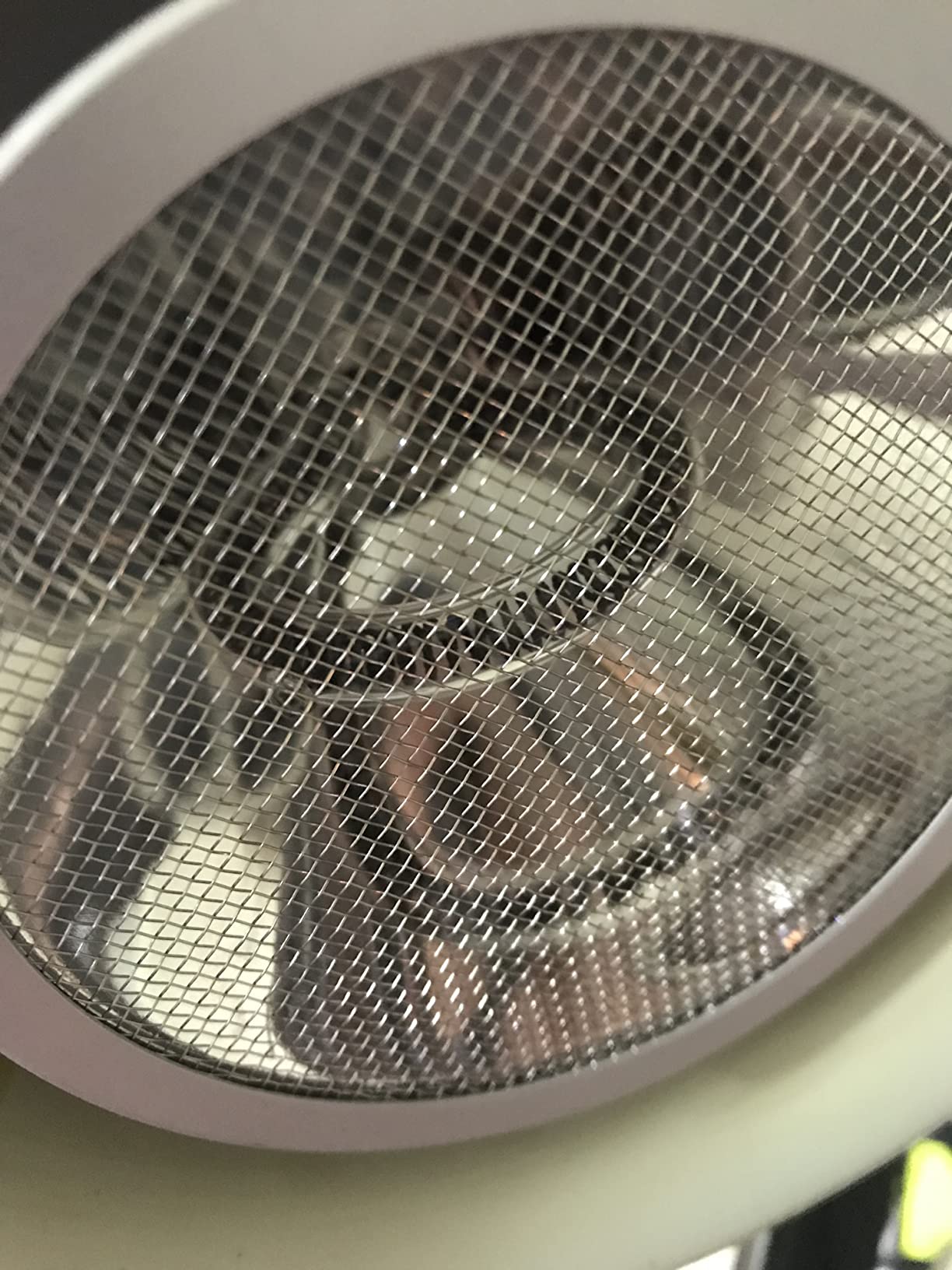
Our read on the review distribution is that this lamp draws a strongly bimodal response. Leopard gecko and small snake owners love the zero light output and the long service they get from it, while a distinct cluster of one-star reviews reports bulbs dying within two hours to three months. At 4 stars from 84 ratings, the reliability question is unresolved rather than settled in either direction.
Where the 50W size stops being enough
Fifty watts is genuinely useful and genuinely limited. In a small enclosure it will hold ambient temperatures overnight without adding heat to the room much at all. In a 4x2x2 or larger, multiple buyers report it underpowered and recommend stepping up to a higher wattage, and one owner in a bull snake thread asked the same question directly before choosing 80W for a long vivarium.
Owners running weak bulbs on mesh tops report the same problem with every brand: temperature will not lift from the 55 to 60F night-time floor to roughly 70F without a second source. If your enclosure loses heat through mesh, either mount the projector inside on a bracket or accept that you also need a ceramic heat emitter.
How Arcadia compares to cheaper carbon-filament bulbs
This is the question keepers argue about most, and the honest answer is that the difference is narrower than the brand name suggests. Every projector on this list uses a carbon fibre filament in a metal reflector. Fluker’s, REPTI ZOO and the AUAAQ unit are essentially the same class of lamp from different factories, and their measured output for the price is comparable.
Where you do notice a difference is finish quality and consistency, and Arcadia does not have a clean sheet here either. Sixteen percent one-star reviews on this unit is the highest share in our roundup. If you are buying on reputation alone, look at the Zoo Med instead, which has three wattage options and a steadier 4.5 across 100 ratings.
4. REPTI ZOO 100W Carbon Infrared Heat Lamp: Best Value Carbon-Filament Projector
- Non-luminous infrared for full 24-hour use
- Dries the enclosure less than a halogen basking lamp
- Works well with dimming thermostats
- Self-ballasting design with an integrated thermal protector
- Some reports of dead bulbs on arrival with early burnout
- A faint red or orange glow is visible at full output
- A few buyers report real power draw below the labelled rating
- Long-term build quality drew criticism
This is the bulb we would hand to someone who wants the Arcadia-class physics without paying a premium for the badge. It is a 100W carbon infrared heat lamp in a PAR38 reflector on an E26 base, running on 110 to 120V AC, with a carbon fibre filament and an aluminium body. On paper the specification list is the most complete of any lamp in this roundup.
Owners of bearded dragons, tortoises, geckos, snakes, iguanas, chameleons, frogs and even poultry use these, which tells you how broad the category is. The consistent feedback is steady thermostat-friendly heat, a 73 percent five-star share, and good behaviour with dimming thermostats. It also dries a humid enclosure less quickly than a halogen basking lamp, which matters in a planted setup.
There is one specification oddity worth flagging before you buy. The listed power consumption line reads 50W even though the product is a 100W bulb, and some reviewers independently reported actual draw below the label. A few buyers also described a faint red glow at full output despite the non-luminous claim. None of that is dangerous, but it is exactly the sort of thing that generates confusion about whether the lamp is working properly.
How it compares to the Fluker’s Deep Thermal
Reviewers note it is essentially the same bulb as the Fluker’s Deep Thermal, which is a useful thing to know because it tells you the two are direct substitutes at different wattages. If you are choosing between them, choose on rating volume and reliability data rather than on the label.
The Fluker’s has 247 ratings at 4.5. This one has 62 ratings at 4.3, and its complaint profile is more about quality control at the factory than about output. Both are self-ballasting carbon projectors in an aluminium body; the difference is that one has far more owners reporting back that it still works after months of daily use.
When this bulb is the wrong choice
If you have been warned away from projectors because they supposedly emit visible light, this is the lamp that warning came from. Several buyers report seeing a faint glow at maximum output. If your species is genuinely photosensitive, such as an albino leopard gecko, test the output in a dark room before you commit to running it overnight.
It is also not the lamp to choose if burn risk is your main concern. The integrated thermal protector reduces the chance of surface scalding compared to a bare element, but 100W in a 100 degree enclosure is still hot. Guard it, mount it out of reach, and pair it with a thermostat that pulses rather than a bare dimmer.
5. Pangea 50W Deep Heat Projector: Best for Small Nocturnal Enclosures
Pangea 50W Deep Heat Projector Infrared Heater for Reptiles (50 Watt)
- Highest average rating in this group at 4.7 with an 84 percent five-star share
- Silicone sleeve lets you handle the bulb through the heat
- Carbon filament built for 24/7 duty
- Evaporates less moisture than standard heat lamps
- Parabolic reflector focuses the heat
- 50W cannot raise a small setup far past 80F
- A few reports of units failing at the base within five months
- A very soft hum in a silent room
- A faint burn smell during break-in
This is the one we recommend for leopard geckos, crested geckos, corn snake juveniles and any small nocturnal setup where the goal is a warm floor rather than a hot basking plateau. At 50W with a carbon fibre filament and a silicone cover, it is the smallest projector here and the only one you can pick up with bare hands through the heat, which matters more than it sounds when you are re-seating a probe at midnight.
The listed light colour is described as minimal to virtually zero visible light, and keepers confirm it. One corn snake owner replaced an under-tank heater with this lamp mounted overhead specifically to get overnight heat with no light at all. That is the single strongest use case for a projector, and a 50W handles it in an enclosure under about 3 feet long.
The carbon fibre filament is built for continuous duty and evaporates less moisture than a standard heat lamp, which is why it sits well in a humid gecko enclosure where a ceramic emitter tends to dry the air out. One owner ran this bulb roughly 22 hours a day for six months with no reported degradation, which is the kind of long-run data you rarely get from a cheap generic.
Why the rating is high but the review count is small
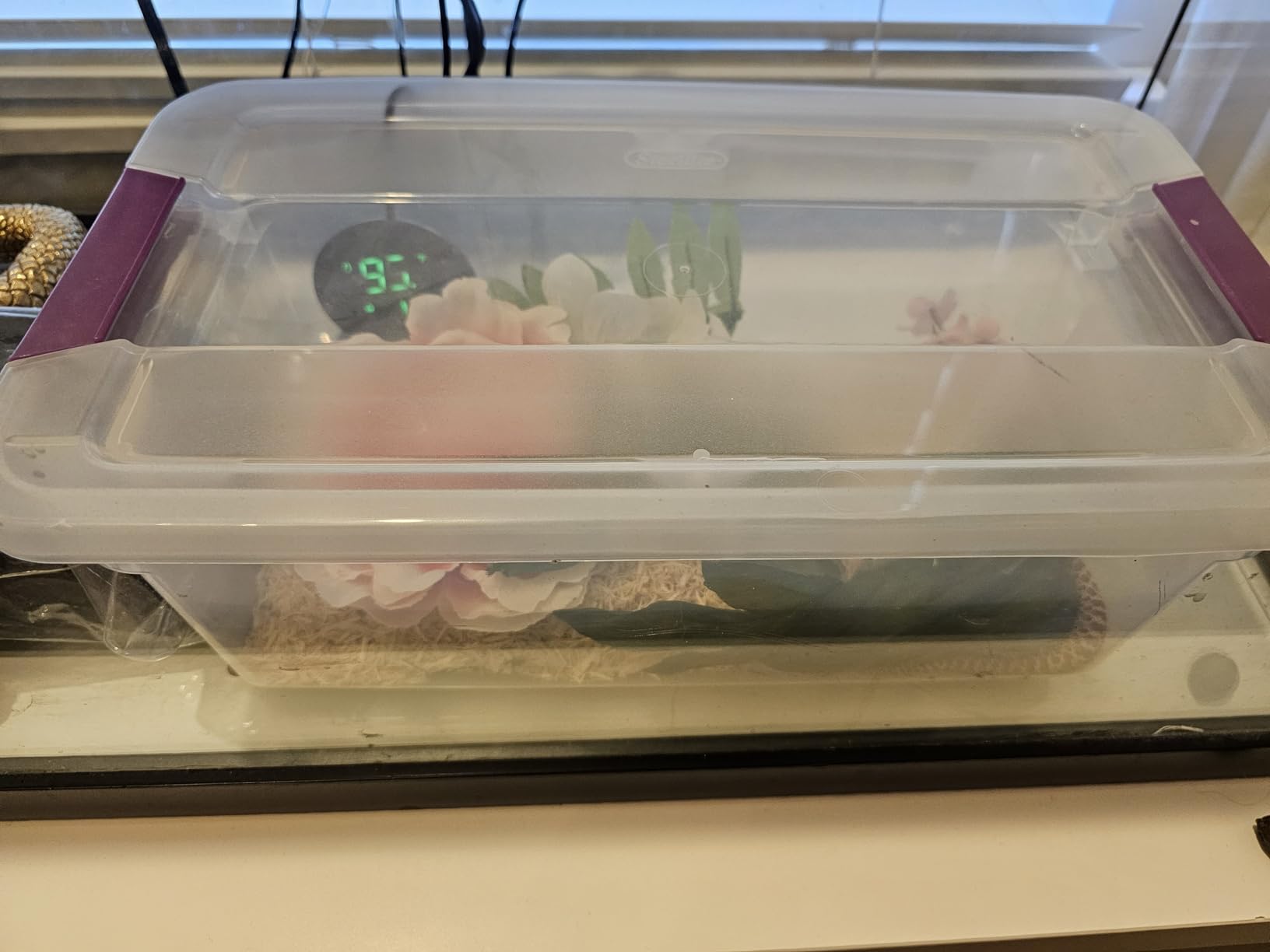
At 4.7 from 38 ratings, this is the highest average rating in our roundup, and the five-star share is 84 percent. It is also the smallest review base, and with only 38 ratings a single cluster of failures moves the average sharply. We treat it as excellent on measured performance and untested at scale rather than as the automatic winner.
The criticisms that do appear are about consistency at the factory rather than heat output: a few units failing at the base within five months, or arriving dead. There is also a very soft hum in an otherwise silent room and a faint burn smell during the first hours of break-in. All three are cosmetic or quality-control issues, not performance problems.
How to get the most out of a 50W projector
Do not expect a 50W to raise night-time temperatures far past 80F in a small setup. Leopard gecko keepers on r/leopardgeckos reported weak lamps failing to lift their enclosure from a 55 to 60F floor to about 70F without a second thermostat. If your room is cool, plan on pairing this with a low-wattage ceramic heat emitter or a heat mat on its own probe.
The listed guidance is a ceramic fixture only, and Pangea recommends a dimming thermostat. Mount it inside the enclosure on a bracket rather than on mesh, keep it clear of screen and foliage, and let the silicone sleeve do its job when you adjust the probe position. Pair the lamp with a [12W UVB setup suited to your species](https://www.dognotebook.com/best-uvb-lights-for-reptiles/) so the animal gets light without extra visible output at night.
6. AUAAQ 100W Infrared Projector: Best Range of Wattages for Growing Collections
- Four wattage options from the same product family
- Thick parabolic reflector wastes less power than a halogen basking lamp
- Heats up within seconds of switching on
- Virtually no visible light so day and night cycles stay intact
- Small review pool of 22 ratings
- so long-term reliability is largely untested
- Deep dome lampshades must be avoided or the bulb overheats
- One reviewer reported very little heat output and slow warm-up
The reason to look at this lamp is the size ladder. The same product family is listed in 50W, 80W, 100W and 120W, which means you can size to the enclosure now and step up later without changing fixture type or setup. For anyone running more than one vivarium that is a genuine convenience, and it is rare in a category where most brands sell two sizes.
The thick parabolic reflector is the design point that separates this from a cheap generic. It concentrates the forward throw instead of letting it scatter, so less of the wattage is wasted on the enclosure walls. Owners of bearded dragons, ball pythons and turtles report it working with a thermostat across a range of setups, with a 77 percent five-star share across its 22 ratings.
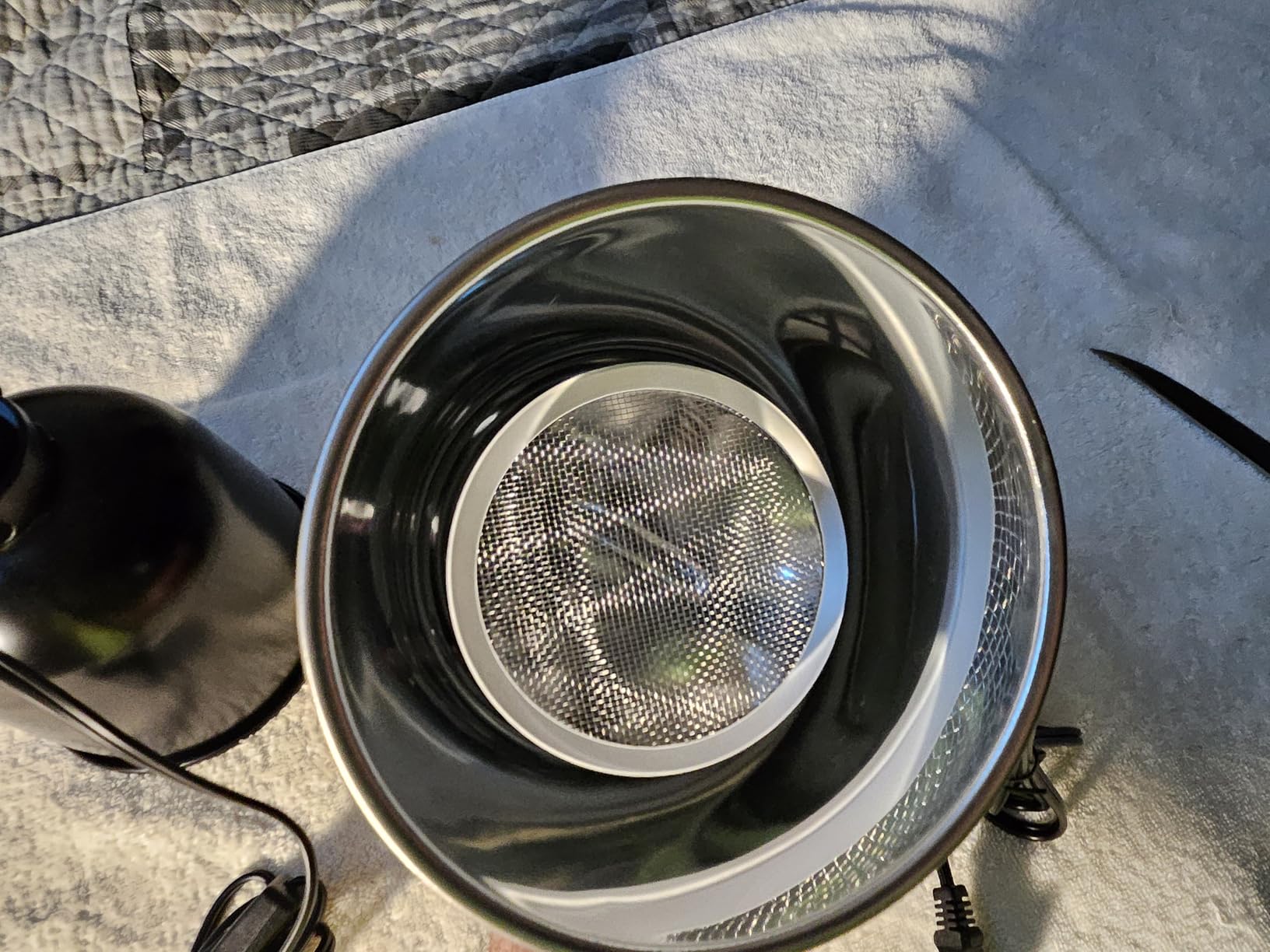
Two pieces of honest data first. Twenty-two ratings is a small pool, which means long-term lifespan is largely untested for this lamp. And the manufacturer explicitly warns against deep dome lampshades, because the trapped heat pockets shorten the filament life. That warning is not boilerplate; it is the single most common way people cook a projector.
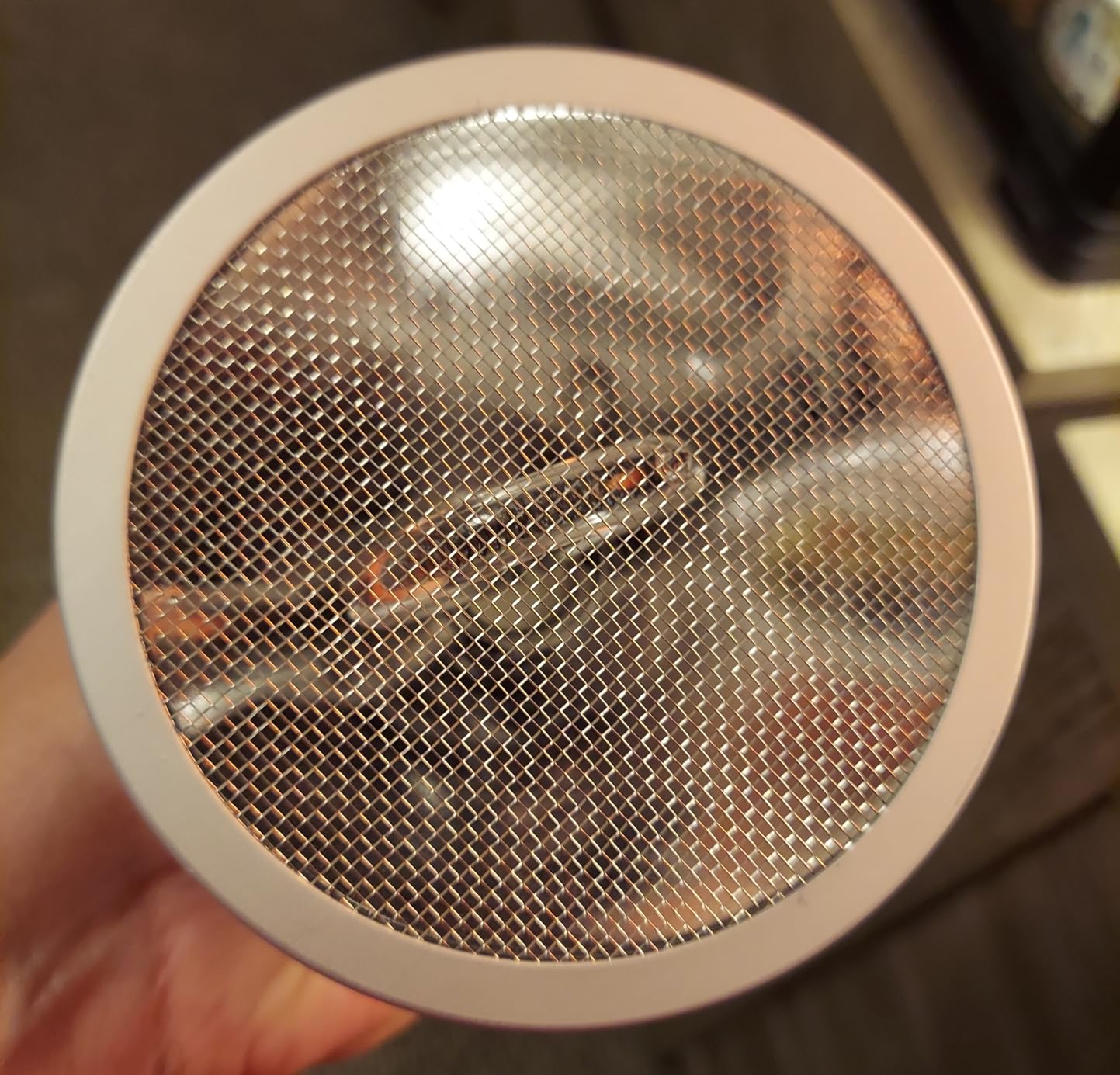
What a reflector concentrate actually changes in practice
A parabolic reflector throws a defined, focused heat zone rather than a general warm glow across the whole enclosure. That is how you get a usable basking surface temperature without pushing the rest of the tank too warm, and it is why a DHP can pull its weight in a long enclosure where a small ceramic emitter simply cannot make a hot spot.
The trade-off is that the beam is narrow and it falls off fast. If your animal needs a broad warm gradient rather than a hot basking plateau, this lamp will concentrate too much energy in one spot. Measure with an infrared thermometer at animal height and add a wider ceramic source on a second probe if you need the ambient up as well.
When to pick this over a better-known brand
Pick it when you want wattage flexibility across several enclosures and you are comfortable monitoring the lamp closely in its first months. Pick something else if you want a decade of proven service history from a large owner base, because 22 ratings does not tell you what happens at month eighteen.
Mount it on an open bracket or adjustable stand with a ceramic socket, never inside a deep dome, and keep at least several inches of clearance from any mesh, bark or decorative material. Drive it with a dimming thermostat so the surface never sits at full power for long stretches, which is both safer and easier on the filament.
7. Zoo Med ReptiCare 100W: Top Rated for Long-Term Installations
- Holds set temperatures far better than cheaper off-brand projectors
- Wide even basking zone with deep tissue penetration
- Dimmer and thermostat compatible with modest settings
- Non-light output suits light-sensitive and albino reptiles
- Three wattage options including a 150W for large enclosures
- Runs very hot so a dimming thermostat is effectively required
- May smoke or smell strongly on first power-on
- One report of a used discoloured rattling unit arriving in the box
- 100W can struggle in a 4x2x2 where the 150W is better
This is the lamp we would build a permanent installation around. It has 100 ratings at 4.5 with an 80 percent five-star share, and it is one of the better-established options in this roundup by owner volume, with a listed power draw of 100 watts.
Ball python and corn snake keepers consistently report stable thermostat-controlled temperatures, better humidity retention and no meaningful light emission. One useful detail from reviews: several owners found it works at a modest thermostat setting rather than needing to be run constantly, which lowers both running cost and surface temperature.
The wide, even basking zone is the practical headline. Where a narrow-beam projector concentrates a hot spot that a nervous animal may refuse to sit on, this one spreads the zone out enough to create a usable basking platform. Owners also report increased metabolism and improved feeding response, which is consistent with the deep tissue heating these lamps are designed to deliver.
Two things catch people out. The first is break-in: several first-time buyers were put off by smoke or a strong smell on first power-on, which is a coating burning off and is not a fault. The second is sizing. At 100W it can struggle in a 4x2x2, and because the 150W version exists in the same range, the correct fix is to move up a size rather than to push this one harder.
Which wattage to pick in this range
Three options means three jobs. The 60W covers small enclosures and leopard gecko or crested gecko setups where you only need overnight warmth. The 100W, reviewed here, covers adult snakes and leopard dragons in a 4x2x2 with a halogen daytime lamp doing the basking work.
The 150W is the one to consider for a full 4x2x2 or a tortoise in a cold room. Because all three share the same base and reflector format, you can buy the size you need now and swap wattage later without changing the fixture, which is not true of every brand in this category.
How it holds up against cheaper carbon lamps
The honest comparison is against the Fluker’s and REPTI ZOO bulbs, which are the same class of carbon filament lamp. Zoo Med wins on the evidence rather than on physics: more ratings, a steadier five-star share, and reports of holding set temperatures better than cheaper off-brand projectors. It is also the only lamp here with a 150W option for large enclosures.
At 8 ounces in an acrylic reflector body, this is the heaviest bulb for which a weight is listed, so mount it on a proper bracket or adjustable stand rather than a light plastic clamp. Keep the ceramic socket, use a dimming thermostat, and let that first-use smoke finish before you run it unattended overnight.
8. ExoRepti DHP 75W: Best Middle Step Between 50W and 100W
ExoRepti Deep Heat Projector Reptile Heat Lamp Bulb (DHP 75W, PAR30), Basking Light for Bearded Dragon & Leopard Gecko, Carbon Infrared Heater for Amphibian Pet
- Sits neatly between the 50W and 100W sizes
- Deep even heat with no visible light
- Runs cooler at the surface than a ceramic emitter
- Reported as more efficient than a heat mat for comparable warmth
- Works well on a dimmer
- Strong burn smell during the first days of use
- One review reports a burning smell followed by failure within an hour
- Surface temperature stays high even when turned down
- Never leave it unsupervised
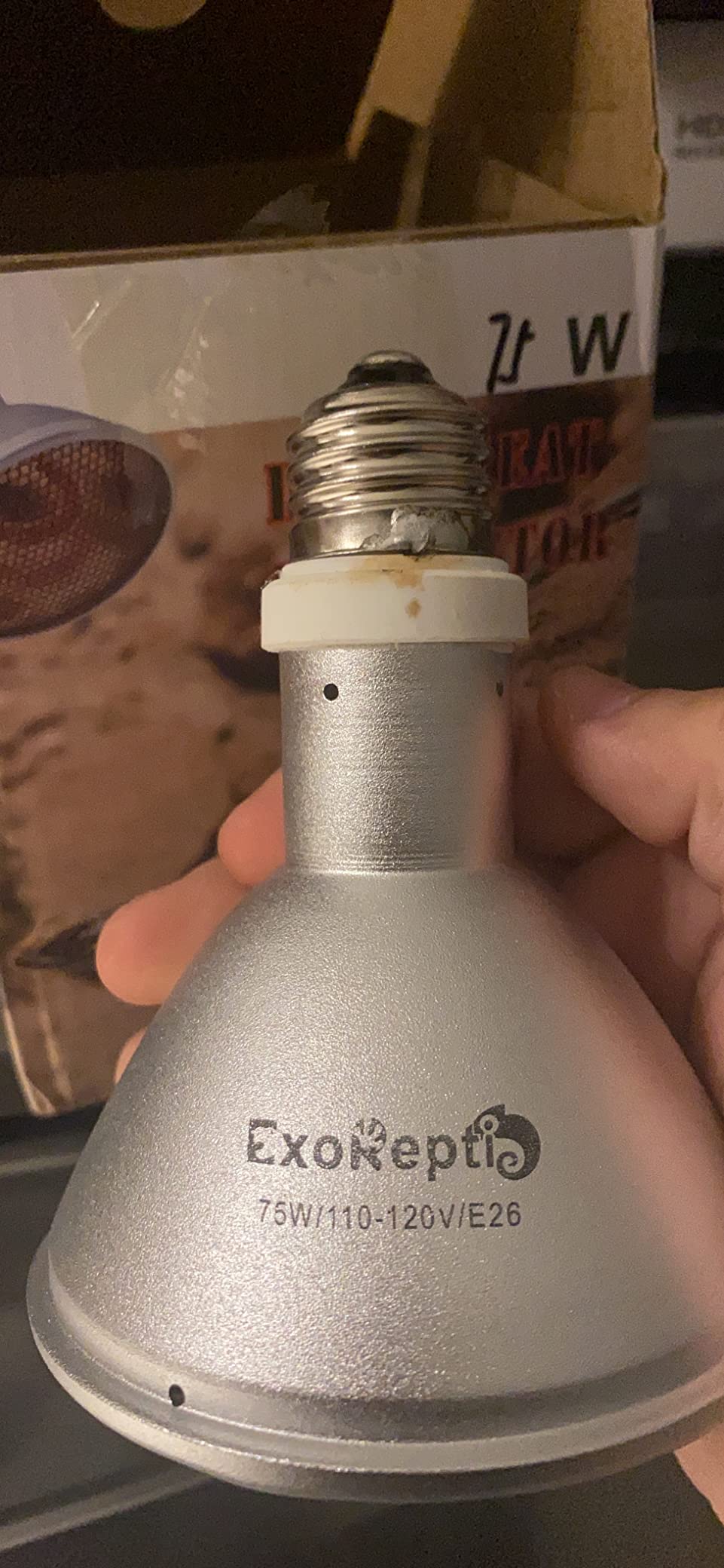
The gap between a 50W and a 100W is where most sizing mistakes happen, and this lamp is the answer to it. Seventy-five watts on an E27 base in a PAR30 aluminium reflector sits precisely where a 4-foot enclosure needs it when the same bulb at 50W leaves you short and the 100W version leaves your thermostat permanently cycling.
Leopard gecko, ball python and bearded dragon owners like the even, non-light-emitting heat and report about a year of service on an on-off thermostat. The aluminium shell resists cracking from splashing, which suits humid enclosures, and the lamp is listed for indoor and outdoor use in a well-ventilated fixture.
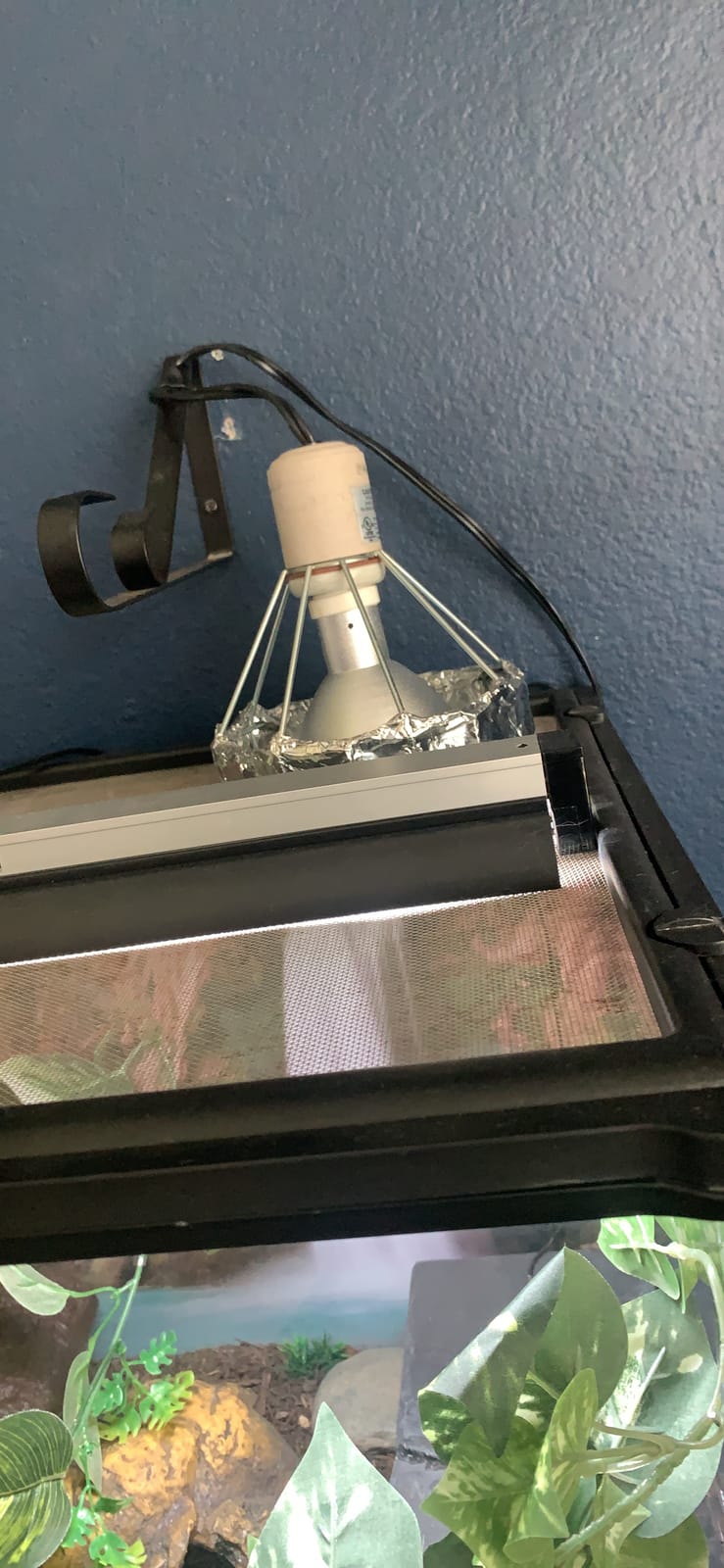
Compared with a ceramic heat emitter of the same wattage, reviewers report it running cooler at the surface while giving steadier output, and compared with a heat mat it is more power efficient for comparable warmth. That combination is why a projector keeps displacing heat mats in temperate setups.
The break-in smell and what to do about it
Almost every carbon filament projector we tested smells during its first days, and this one has the strongest reviews mentioning it. Let it run for a few hours with the enclosure vented and away from your animal before you leave it on overnight. The smell stops once the coating has cured.
The more serious report is one review describing a burning smell followed by failure within an hour. Treat any projector that smells like burning plastic after break-in, discolours visibly, or rattles when you gently shake it as a failed unit rather than a quirk. That also applies to the used unit one Zoo Med buyer received, so inspect before you install.
Whether a 75W covers a 4x2x2 setup
Inside a 4x2x2, seventy-five watts paired with a 50W halogen flood and a T5 UVB lamp is a setup several keepers describes as well balanced. The projector handles overnight heat and ambient, the halogen owns the basking surface, and the UVB covers the light. If your basking surface will not reach temperature on the halogen alone, a ceramic emitter on a second probe fixes it.
Mounted above mesh, the same bulb needs to be stronger to achieve the same result, so treat 75W as an inside-mount figure. On an adjustable stand below the screen lid, leave enough clearance that the animal cannot touch the reflector. You can compare this against other heating approaches in our [guide to terrarium heat mats](https://www.dognotebook.com/best-terrarium-heat-mats-for-reptiles/).
How to Choose a Deep Heat Projector for Reptiles?
Buying decisions on a projector come down to four things: how much heat your enclosure loses, how high you can mount the lamp, whether the species tolerates any visible output at all, and how much you trust the manufacturer’s QC. Wattage is the biggest lever and the least intuitive, so start there.
Match wattage to enclosure size, not species
The single most repeated question across reptile forums is how much wattage a given vivarium needs, and the honest answer is that enclosure volume matters more than the animal on the label. A juvenile and an adult bearded dragon need very different lamps in the same footprint, and a ball python in a 40-gallon breeder needs more than the same species in a 10-gallon.
Use these as starting points for a projector mounted inside the enclosure, and expect to measure rather than assume. If your basking surface will not reach its target on a dimming thermostat at the lowest setting, step up one wattage. If the thermostat sits permanently off, step down.
Small setups, under 3 feet long: 50W for leopard geckos, crested geckos, juvenile corn snakes.
Medium setups, around 4 feet long: 75W for adult corn snakes, ball pythons, leopard geckos needing more reach.
Large setups, 4x2x2 and above: 100W for bearded dragons, adult pythons and boas.
Cold rooms or winter basements: 100W to 150W, accepting that the thermostat will run the lamp more often.
Mounted above mesh: one size up from the figures above, because heat escapes before it reaches the animal.
Decide between a DHP, ceramic heat emitter, halogen or heat mat
The best heat lamp for reptiles depends on which hours you are trying to heat. A projector is a night and ambient source. It is not a replacement for a visible basking lamp, and any keeper who tells you otherwise is describing a setup that works for their animal rather than a rule.
A halogen flood remains the daytime basking choice because it delivers visible light, infrared A and infrared B together and creates a real basking surface temperature. A DHP adds the overnight half of the day with no light. A ceramic heat emitter is cheaper and wider but hotter to the touch, and it emits no useful infrared A. A heat pad warms a small floor area and offers the least control over gradient.
If your budget is the binding constraint, the cheapest safe route is a halogen for daytime basking plus a thermostat-controlled ceramic heat emitter for ambient and night heat. You lose infrared A and the low burn risk, but you keep the animal safe and warm. That is a defensible setup; the mistake is running an unthermostatted bulb.
Pair the lamp with the right thermostat
Never run a projector without one. A pulse thermostat switches the lamp fully on and off around your setpoint, which is the cheapest option and works acceptably on a DHP because the surface is cooler than a ceramic emitter. A dimming thermostat reduces power continuously and holds temperature more precisely, which is why most keepers here prefer one for a hot 100W element.
For winter nights, a common keeper configuration is a pulse thermostat set around 70 to 73F, with the lamp cutting out well before the daytime basking temperature is reached. Place the probe at animal height on the warm side rather than at the top of the enclosure, and calibrate with an infrared thermometer rather than trusting the probe reading alone.
Mount inside the enclosure, not above mesh
Mounting location changes required wattage more than any other single decision. Inside the enclosure on a ceiling bracket, the lamp sits close to the animal and a smaller wattage does the job. Above a mesh screen, heat escapes into the room and you need a stronger bulb for the same result, which is why several owners report an 80W unit on mesh that never reached target.
Mesh also has a documented cost for UVB, where keepers report losing up to 30 percent of output through a fine screen. Keep UVB lamps inside where you can, and if you must combine them, raise the lamp a little rather than pushing the wattage higher. Watch for heat pockets in tall, poorly vented enclosures, which is why the AUAAQ manufacturer warns against deep dome shades.
Handle the burn risk properly
A DHP is cooler to the touch than a ceramic heat emitter, which is the strongest safety argument for the technology and is consistently reported by keepers. It is not cool. A 100W carbon element reaches temperatures that will burn skin on contact, and several reviews describe injuries from reaching into an unguarded fixture.
Use a ceramic socket rated for the wattage, mount the lamp on a bracket or adjustable stand positioned out of reach, and add a cage or guard if the animal can get close. Keep screen, bark, moss and foliage clear of the reflector, and never cover the lamp with a shade that traps heat. Supervise the first hour of use and treat any burning-plastic smell after break-in as a failure signal.
Work out what it actually costs to run
Do deep heat projectors use a lot of electricity? Less than most people expect, because wattage is not the whole story: your thermostat decides how long the element is on. A 50W bulb running twelve hours a night draws 0.6 kWh, while a 100W bulb running twelve hours draws 1.2 kWh.
Multiply by your own rate and by 365 for a yearly figure, then remember that a thermostat in a cold room may cut the lamp for most of the twelve hours rather than most of it. A useful rule from keepers: run the projector overnight for ambient warmth, and let a lower-wattage daytime source handle the daytime basking plateau. That single change usually does more for the electricity bill than switching brands.
Does infrared science actually support the marketing
The honest answer is that both sides of this debate have merit, and we would rather say so than pretend the marketing is settled science. Manufacturers including Arcadia and Fluker’s describe their lamps as producing a balanced mix of infrared A and infrared B that penetrates into muscle tissue and mimics solar heat, and keepers do report measurable behaviour and digestion changes when they switch.
Against that, a thread on r/ballpython quotes reptile scientist Thomas Griffiths arguing that the near-infrared output of a projector is insignificant and that it does not replicate the sun at all, which is a serious challenge to the framing. Our read is that both statements can hold: infrared A reaches further into tissue than infrared B from a ceramic emitter, which is a real difference, but the sun is an enormously powerful source and no household lamp replicates it.
The practical takeaway is that you do not have to resolve the physics to pick well. A projector gives a different heat delivery profile from a ceramic emitter at lower burn risk and with no light, and keepers report that profile matters for overnight warmth. If you want the daytime basking plate with visible light and full-spectrum infrared, run a halogen as well.
Frequently Asked Questions
What is a deep heat projector for reptiles?
A deep heat projector is a heating lamp that emits infrared A and infrared B radiation to warm a reptile from the tissue outward without producing meaningful visible light. Unlike a ceramic heat emitter, which radiates mostly infrared B and gets hot enough to burn on contact, a projector delivers heat in darkness so it can run overnight without disturbing your animal’s day and night cycle.
Are deep heat projectors good for snakes?
Yes. A projector gives a snake overnight heat with no visible light, which is the strongest single use case for the technology. Ball python and corn snake keepers report steadier activity, better digestion and improved humidity retention than with an equivalent ceramic heat emitter. Most still pair a projector with a halogen daytime lamp for the basking surface.
What is the best heat lamp for reptiles?
There is no single answer because you need different heat at different hours. A halogen flood is the standard daytime basking lamp because it delivers visible light plus infrared A and infrared B and creates a real basking surface temperature. A deep heat projector handles overnight and ambient heat with no light. Many keepers run both on separate thermostats.
What is the best heat lamp for a reptile terrarium?
Match the lamp to enclosure size and mounting height first. Inside the enclosure, use 50W for setups under three feet, 75W for medium vivariums, and 100W or more for 4x2x2 enclosures and cold rooms. Mounted above mesh, step up one size because heat escapes. Then choose a projector for night heat and a halogen for daytime basking.
Do deep heat projectors use a lot of electricity?
It depends on how long your thermostat runs the element, not on the label wattage alone. A 50W bulb running twelve hours a night draws about 0.6 kWh, and a 100W bulb over the same period draws about 1.2 kWh. Running a smaller lamp overnight for ambient warmth and a daytime source for basking is the most effective way to reduce consumption.
What is better for a leopard gecko, heat lamp or heat pad?
For most leopard gecko setups a heat lamp gives better control over gradient and basking surface temperature than a heat pad, which warms only a small floor area. A 50W projector mounted overhead adds overnight heat with no light, which suits a nocturnal animal. Pair it with a low-power daytime basking source and a thermostat on each.
Our Verdict: The Best Deep Heat Projector for Reptiles in 2026
The Fluker’s Deep Thermal 100W is our pick as the best deep heat projector overall in 2026. It has the deepest owner base we found, 247 ratings averaging 4.5, plus a parabolic reflector that holds humidity better than a basking lamp and a carbon filament that delivers both infrared wavelengths in darkness. That combination of proven output and real review volume is what separates it from bulbs with prettier specs on paper.
For a small nocturnal enclosure the Pangea 50W is the one to beat on performance, with the highest rating in the group at 4.7 and a silicone sleeve that makes it the only bulb here you can safely handle through the heat. If you want the most established permanent installation, the Zoo Med ReptiCare wins, since it comes in 60W, 100W and 150W, accepts 100 to 240 volts, and has 100 ratings of owner history behind it.
What matters more than the badge is the setup. Mount the projector inside the enclosure on a ceramic fixture, run it on a dimming thermostat, keep it clear of screen and foliage, and pair it with a halogen daytime lamp for the basking surface. Get those four things right and any of the eight on this list will do its job properly.