
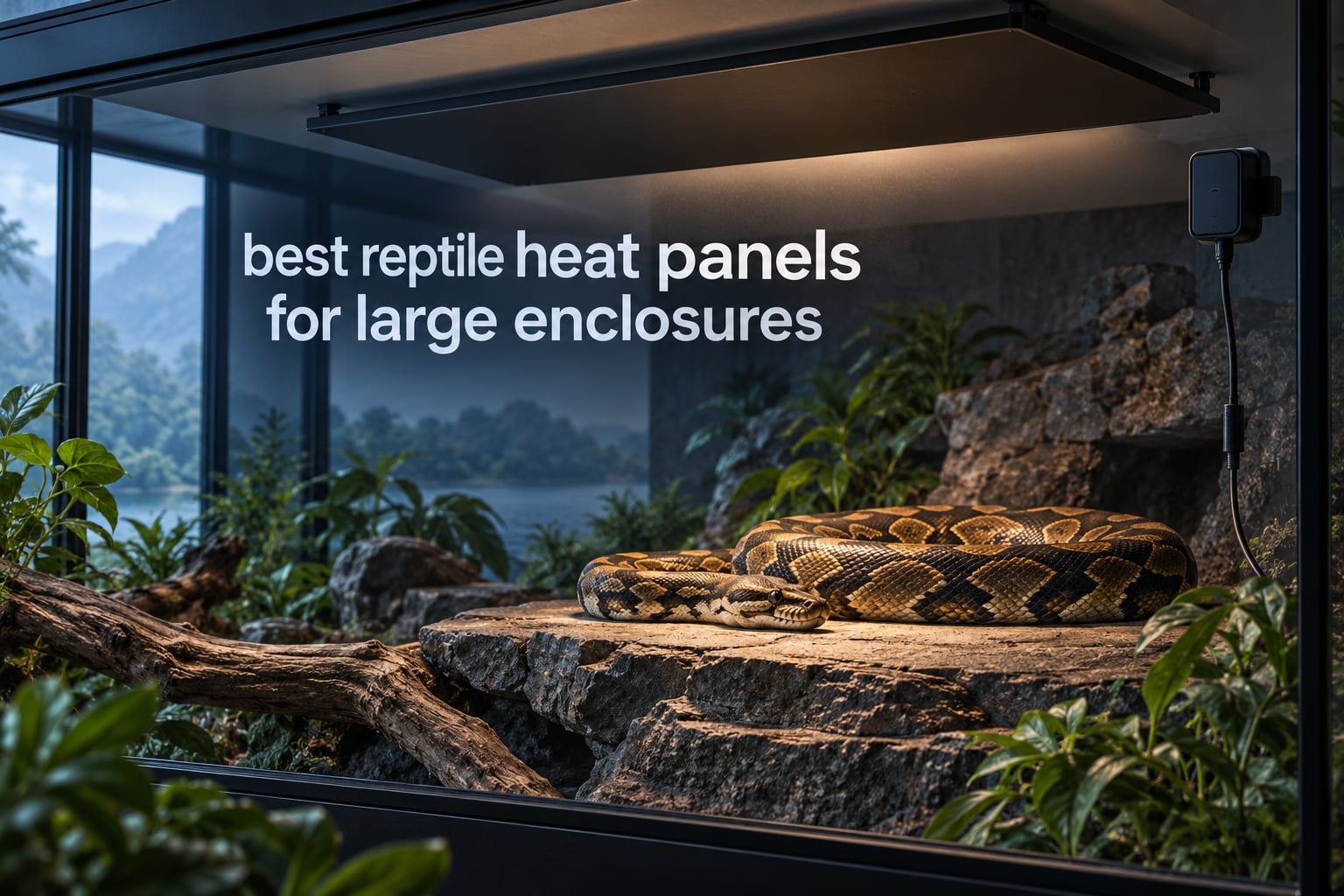
Short answer: for a 4x2x2 enclosure, a 60W to 80W radiant heat panel is the right starting point; a 6ft vivarium needs 80W to 125W, and anything 8ft or a 400 gallon build needs 125W or two panels on separate zones. Most panels sold for reptiles top out well below that, which is why so many keepers end up with a warm spot and a cold enclosure.
That is the core problem this roundup solves. Search results for the best reptile heat panels for large enclosures are full of guides that cap their recommendations at 100W and never map wattage to enclosure dimensions, so a keeper with a 4x2x2 PVC snake enclosure and a keeper with a 1700 litre paludarium get handed the same answer. They do not need the same answer.
I went through six radiant heat panels and infrared heater units that are actually sold for reptile enclosures, checked the wattage, physical size, mounting method and safety certification of each, and read the customer reviews closely. What follows is the sizing math first, then the burn-risk verdict, then a review of every panel in the roundup with the enclosure size each one genuinely suits.
A note on what you will not find here: prices. Panel pricing moves constantly and the button on each card takes you to the live listing. I would rather give you accurate wattage and honest limits than a number that is wrong by tomorrow.
If you have not sized your enclosure yet, start with our large reptile terrarium picks so you know the volume you are heating. If your reptile is a bearded dragon rather than a snake, the daytime lighting plan changes completely, and our bearded dragon enclosure guide covers that side of the build.
Table of Contents
Top 3 Picks for Best Large Reptile Enclosures in 2026

REPTI ZOO Under-Lid Heat Panel
- Engineered for enclosures up to 48 x 24 x 24 inch
- Zero-light infrared heating
- Under-lid screw mounting with a built-in fan

Vivarium Electronics 80W Panel
- 80W radiant output
- Glass-reinforced Noryl housing
- Thermal fuse overheat cut-off
- Designed for 2 by 6 foot setups

REPTIRAD 80W ETL Panel
- 80W radiant output
- 18.5mm slim galvanised steel body
- IP64 splash and dust protection
- ETL Listed
The REPTI ZOO panel takes the top slot because it is the only unit in this roundup with a manufacturer-stated maximum enclosure size, and that number is a 48 by 24 by 24 inch enclosure, which is exactly the 4x2x2 and 4x2x3 territory most keepers are trying to heat. It also carries by far the largest review base here at 179 ratings, which is the only way to get an honest read on how a fan-assisted panel behaves after a year of nightly cycling.
The Vivarium Electronics 80W is the value pick. It is the panel in this set that is explicitly designed around a 2 by 6 foot setup, which makes it the sensible choice for a long 6ft enclosure where a single short panel would leave one end cold. The REPTIRAD unit wins on build quality and safety certification, and it is the one to choose if your enclosure is humid or bioactive.
All Six Panels Side by Side in 2026
| Product | Specifications | Action |
|---|---|---|
| REPTI ZOO Under-Lid Heat Panel |
|
Check Latest Price |
| Vivarium Electronics 80W Radiant Panel |
|
Check Latest Price |
| REPTIRAD 80W ETL Certified Panel |
|
Check Latest Price |
 Oiibo 60W Fan-Assisted Panel Oiibo 60W Fan-Assisted Panel |
|
Check Latest Price |
 Reptile Systems 100W Infrared Unit Reptile Systems 100W Infrared Unit |
|
Check Latest Price |
 Oiibo 30W Infrared Panel Oiibo 30W Infrared Panel |
|
Check Latest Price |
Read the table as a sizing map rather than a ranking. The 30W and 60W panels are not failures, they are simply built for enclosures with a much smaller volume, and pairing either of them with a 4x2x2 will leave you disappointed. The 100W infrared unit is an interesting middle ground because its dome reflector throws heat further than its wattage alone would suggest.
What Wattage Does a Large Reptile Enclosure Actually Need?
Here is the sizing ladder that none of the ranking guides I found publish. It maps enclosure dimensions to panel wattage, and it assumes a solid-sided enclosure mounted overhead in a normally heated room.
4x2x2 (a standard adult ball python or boa enclosure, 16 cubic feet): 60W to 80W. This is the number most keepers land on, and the number most manufacturers bury.
4x2x3 and 4x2x4: 80W to 125W. The extra height matters more than the extra length, because a ceiling-mounted panel loses effectiveness with distance.
6ft vivariums (4x2x3 as a long single unit, 24 cubic feet): 80W to 125W, and check the physical length of the panel against the enclosure. A short panel centred on a 6ft run leaves both ends cold.
8ft vivariums and 200 gallon class builds: 125W, or two smaller panels on separate thermostats, one per half.
400 gallon and 1700 litre paludarium builds: two panels minimum, each on its own thermostat zone. No single panel in this roundup covers that volume.
Three factors move that ladder. The first is mounting height, because radiant heat falls off sharply with distance; one of the panels in this roundup states outright that it is most effective within 16 inches below the panel face, which is exactly why a tall 4ft enclosure needs more wattage than a long shallow one of the same floor area.
The second is the lid. Screen and mesh tops bleed heat continuously, and keepers report warm spots and cold spots from the same panel depending on the day. A solid PVC or wood lid holds heat far better, and a screen top means you should step up one wattage tier or add insulation to the lid frame.
The third is the room itself. A reptile room sitting cool in winter changes the calculation more than any enclosure dimension. Large enclosures lose heat quickly, and a panel fighting a cold room is running near continuously, which is where the running cost and the panel’s service life both come into play.
If you want a starting number before you browse, use enclosure volume in cubic feet as the baseline: roughly 5W per cubic foot for a solid-sided enclosure with a normal room, and 7W to 8W per cubic foot for a screen-topped or cold-room setup. Then round up to the next available panel size rather than down, because an oversized panel on a proportional thermostat is controllable and an undersized one is not.
Can a Radiant Heat Panel Burn a Snake?
Yes, a radiant heat panel can burn an animal, and the reason is not exotic. The panel face gets hot enough to cause contact burns, and a snake that can reach the panel will lean against it because it is the warmest surface in the enclosure.
The consensus among experienced keepers is consistent, and it is worth following: mount overhead, never on the side wall where the animal can drape itself across the heated surface. Side mounting produces a closer radiant spot, which sounds useful until you realise the surface itself becomes the burn point. An overhead panel at a sensible height gives you a heat zone that the animal can approach and leave at will.
Four habits reduce the risk further. Mount the panel so there is air between the element and the animal at all times, add a guard or a stainless mesh shelf where contact is possible, run the panel through a proportional thermostat so the surface temperature has a ceiling, and check the surface with an infrared temperature gun rather than trusting the air reading.
One warning from this roundup deserves its own line. Two of the panels here ship with an explicit manufacturer instruction that they must never be connected to a thermostat or a timer. That instruction exists because the panel is controlled by a knob rather than by feedback, so there is nothing stopping a probe fault from turning into a cooking surface. Treat any panel with a knob as a fixed-output device you size carefully, not one you modulate.
1. REPTI ZOO Under-Lid Heat Panel – Best Fit for 4x2x2 and Larger
- Documented for enclosures up to 48 x 24 x 24 inch
- Mounting screws included
- Zero light output for nocturnal species
- Built-in fan reduces hotspots
- Works on a thermostat for stable night temps
- Modest heat output
- often only a few degrees above room temperature
- Strong chemical smell in the first minutes of operation
- Fan noise and replacement parts are hard to source
This is the panel most keepers in this roundup have actually run for a year, with 179 ratings behind it, and that is why it leads. The spec sheet states a maximum recommended enclosure of 48 inches long by 24 inches wide by 24 inches high, which lands squarely on a 4x2x2 and stretches to a 4x2x3. Two sizes are offered, a 6 by 9 inch and a 6 by 18 inch version, and the mounting kit with screws is included.
The 3.5 star average is misleading on its own, because the reviews split hard in both directions. About 49 percent of buyers gave five stars and 23 percent gave one star, and that split tells you exactly what the panel is good at and what it is not. People running it in 10 gallon to 4x2x4 enclosures for overnight stability are delighted. People expecting a daytime basking hotspot are disappointed.
That distinction matters for large builds. This is a night and cold-weather temperature stabiliser, not a daytime heat source, and pairing it with a halogen basking lamp for daytime is the arrangement most experienced keepers describe. Mounted under the lid with screws, it directs heat downward and the integrated fan spreads it across the panel face to reduce hotspots.
The one-star reviews cluster around three things. A strong chemical smell in the first few minutes of operation is the most common, and it fades. Weak heat throw is the second, which is a sizing problem rather than a fault. Dead on arrival units show up repeatedly too, so inspect the panel the moment it arrives and test it before you build the rest of the install around it.
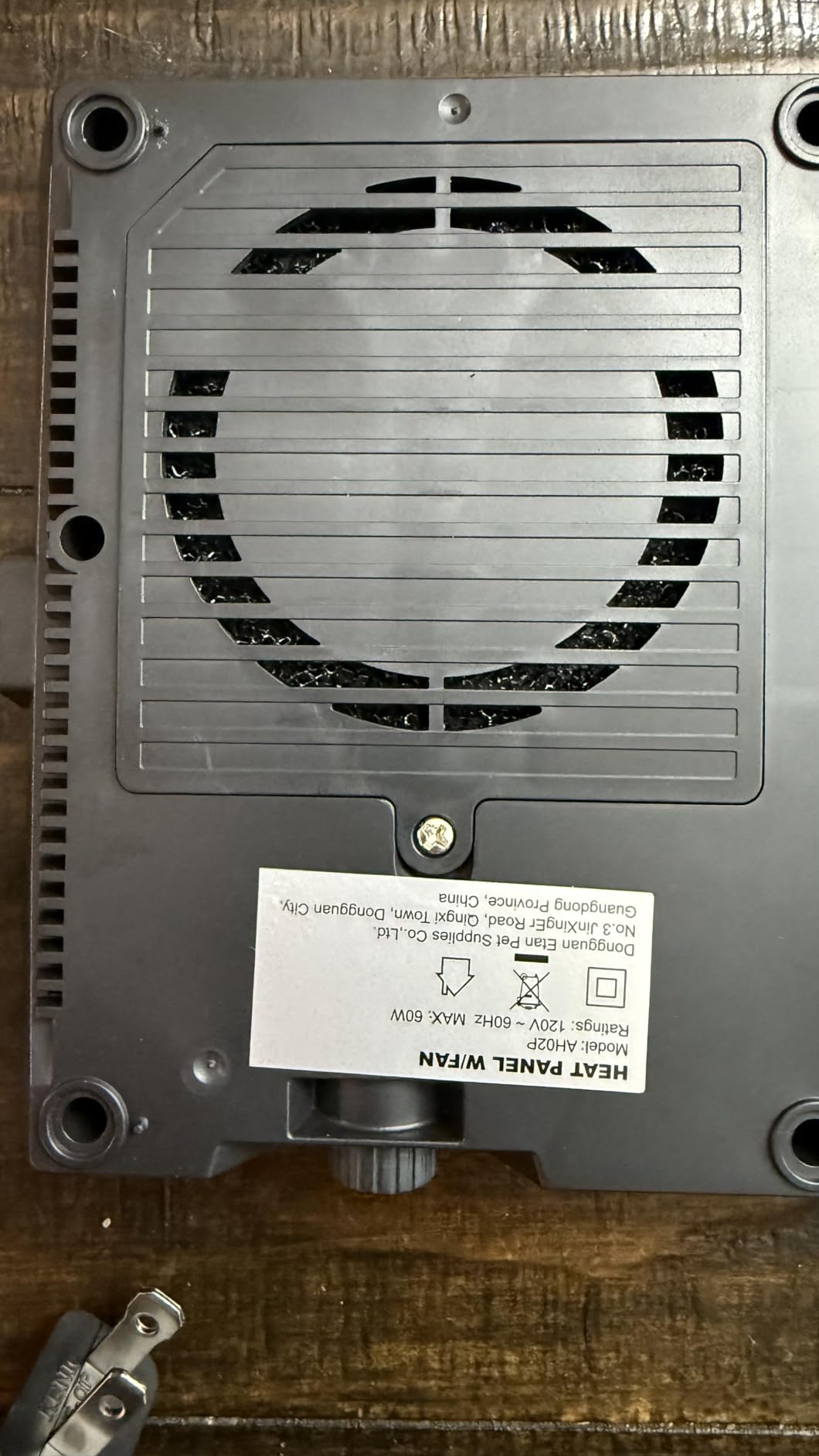
One practical note for a 6ft enclosure. The manufacturer size limit is 48 inches of length, so a 6ft run technically exceeds the documented envelope. In practice keepers mount a 6 by 18 inch unit at one end or centre it and accept a slightly cooler far end, then confirm the gradient with an infrared gun before adding any second heat source.
Because the panel has a fan rather than a thermostat of its own, it is genuinely usable on a proportional thermostat, and several owners specifically report steady night temperatures when it is. That single fact is what separates it from the other fan-assisted panels in this roundup, all of which tell you not to connect them to one.
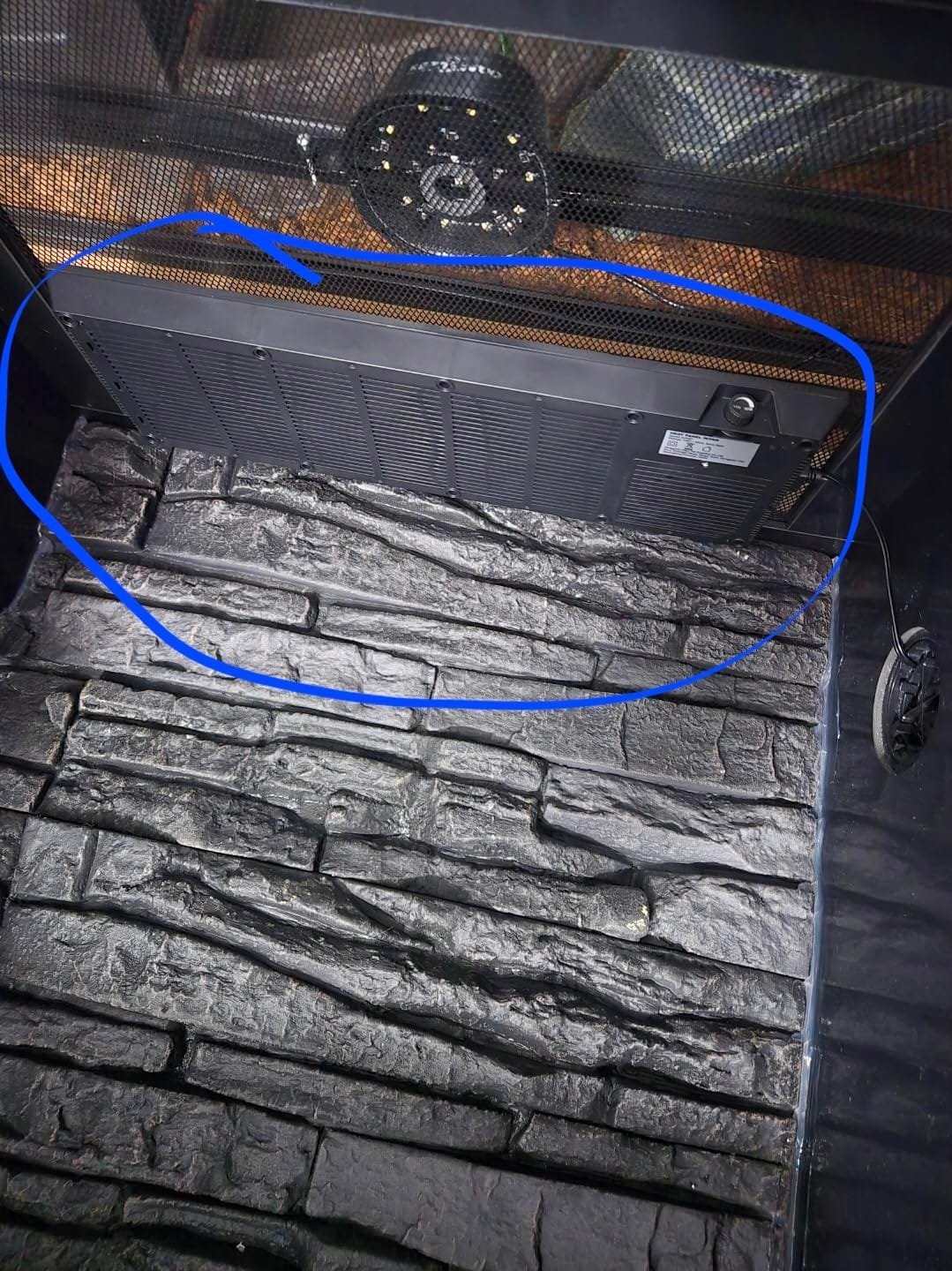
What a REPTI ZOO panel is genuinely good for
It is good for overnight temperature stability in a 4x2x2 or 4x2x3 enclosure, particularly for nocturnal species that need heat without any light. Zero light output means the animal’s day and night cycle stays intact, which matters for anything sensitive to a lit basking spot at night.
It is also good for anyone who wants a documented enclosure size rather than a guess. Nobody has to email the manufacturer to find out whether a 4x2x2 is supported, and the physical size is modest enough that it does not dominate the enclosure profile.
Where it falls short
The heat output is modest, and owners frequently describe it as only a few degrees above room temperature, which means it will not carry a large enclosure on its own. Pair it with a daytime basking lamp or a second panel if your species needs a real warm side during daylight hours.
It is also not designed for continuous all-day operation, and the replacement parts for the fan are hard to source if it fails. Neither issue is disqualifying for a night-time role, but both are reasons to treat it as a supporting heat source rather than the only one.
2. Vivarium Electronics 80W Radiant Panel – Best Value 80W for Long Enclosures
- 80W output designed with 2 by 6 foot setups in mind
- Glass-reinforced Noryl resists breakage
- Detachable 6 foot power cord
- Mounting screws included
- Under 2 inch low profile saves enclosure space
- Only raises basking-zone temperatures rather than heating the whole enclosure
- Needs a proportional thermostat for stable control
- Effectiveness drops beyond roughly 16 inches below the panel
This is the panel in the roundup that most directly answers the large-enclosure question, because its own documentation points at setups of 2 feet by 6 feet rather than at small tanks. At 80W it is squarely in the range that keepers report working in a 4x2x2, and the physical dimensions of 22.5 by 12.5 by 1.75 inches are large enough to spread heat over a meaningful section of a long enclosure.
The construction is the selling point for anyone building in PVC or wood. A glass-reinforced Noryl housing is far more resistant to the cracking and warping that kills plastic-bodied panels, the sealed surface wipes down without a fight, and the detachable 6 foot cord means a damaged cable is a two-minute fix rather than a replacement.
It also carries a built-in thermal fuse for overheat cut-off, which is a genuine safety feature that most panels at this output level omit. That is separate from your thermostat, and the distinction matters: the thermal fuse protects against a catastrophic failure while the thermostat controls normal operation.
At 4.3 stars from 22 ratings, it holds the highest average of any panel with a meaningful review base in this roundup, with a 60 percent five-star share. Keepers consistently describe it as a basking-zone heat source that works best within about 16 inches of the panel face, which is exactly the honest framing you need when sizing a tall enclosure.
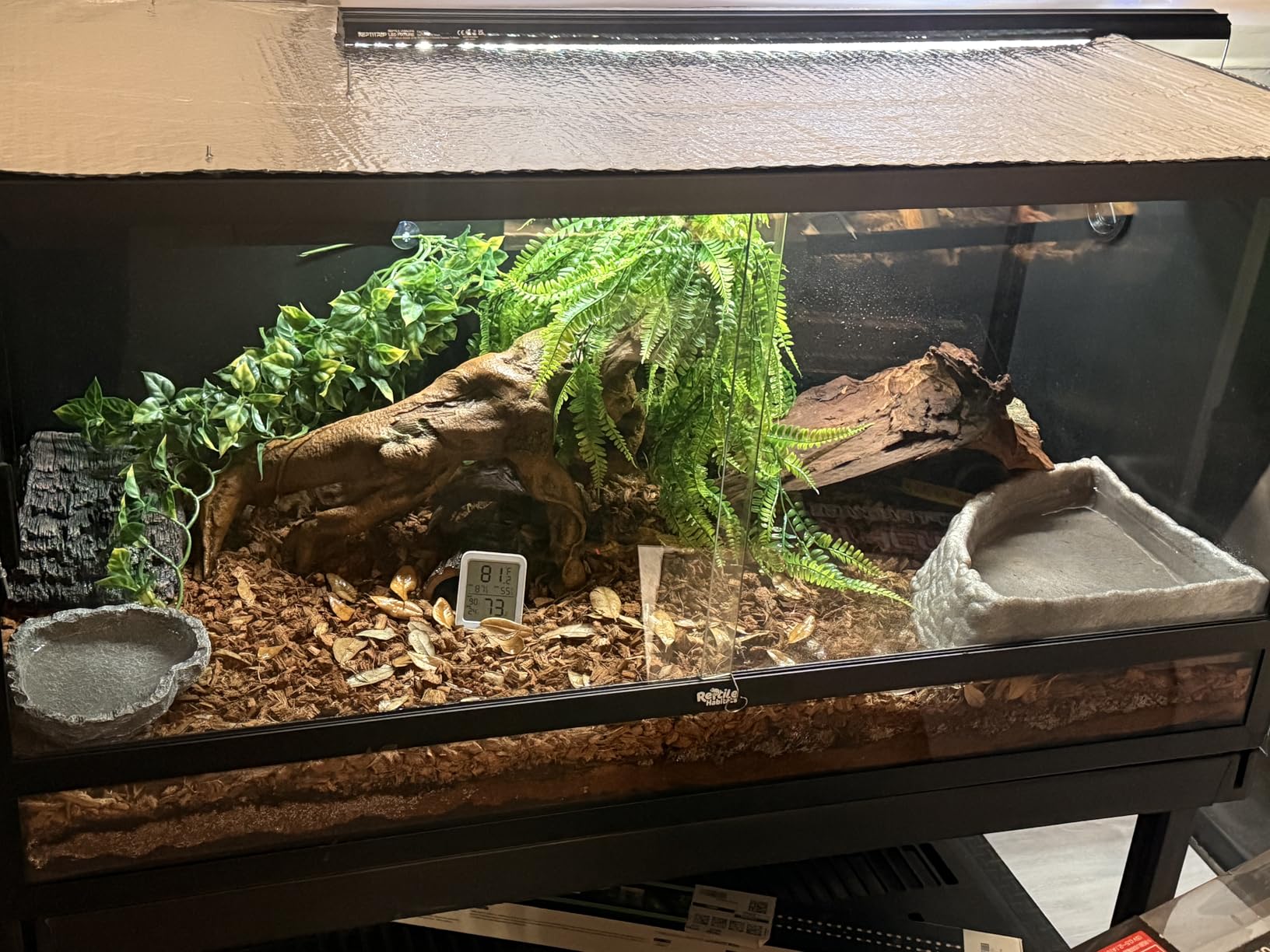
The 16 inch figure is the number to design around. If your animal perches 24 inches below the panel, you are outside the useful range and you should move up in wattage or lower the mount point rather than expecting a hotter surface.
It is a fixed 80W output, so it needs an external proportional thermostat, and several variants exist at 28W, 40W and 80W. That ladder is useful: the smaller versions cover a 4x2x2 comfortably, and the 80W covers a 6ft run. Note that a panel physically takes up real estate, so check the length against your enclosure before committing.
One thing to plan for is rear heat loss. A radiant panel mounted flush against an insulated wall dumps a meaningful share of its output backwards. Mounting it on standoffs so air can circulate behind it, or adding a reflective backing, recovers a surprising amount of usable heat for very little work.
What the Vivarium Electronics panel is good for
It is good for anyone with a 4x2x2 or 6ft enclosure who wants real radiant output rather than a fan-assisted approximation, and it is the pick here if your build is PVC and you care about impact resistance.
It is also good for keepers who want a documented low-voltage-style safety net, because the thermal fuse is uncommon at this output. The detachable cord and included screws make the install a ten-minute job on wood or PVC.
Where it falls short
It does not heat an entire enclosure. Owners are clear that it lifts basking-zone temperatures and leaves the rest of the volume cooler, which is the point of a gradient but a problem if your species needs a uniformly warm air temperature.
Beyond roughly 16 inches of drop the output falls away, and it has no built-in thermostat, so a proportional controller is not optional. If you need the whole 8ft warmed, you are looking at two units rather than one.
3. REPTIRAD 80W ETL Certified Panel – Best for Humid and Bioactive Enclosures
- Even radiant heat with no hotspots across the panel face
- 18.5mm profile preserves enclosure space
- Galvanised steel outlasts plastic-bodied panels
- IP64 rated for humid and bioactive setups
- ETL Listed for North America and Canada
- Very limited review history with a single recorded rating
- Largest available variant is 125W so 8ft builds need two units
On paper this is the best-built panel in the roundup, and for a humid bioactive enclosure it is the one I would choose despite the thin review history. The body is galvanised steel rather than plastic, the core is dual-insulated aluminium for even radiant output across the whole face, and the panel is only 18.5mm thick, which matters in a tight ceiling cavity.
Two certifications carry most of the weight here. It is ETL Listed for North America and Canada, which is the electrical safety standard experienced keepers look for before anything else, and it carries an IP64 rating for dust and water ingress, which is exactly the protection a bioactive setup with drainage and misting needs.
Even heat distribution is the feature experienced keepers care about most and the one hardest to fake. A panel with a hot centre and cool edges creates a moving target for the animal and makes your gradient hard to map with an infrared gun, and a dual-insulated core is the design answer to that problem.
The 5 star rating comes from a single review, and I want to be straight about that rather than presenting it as proven. One rating is not a track record, and this panel only became available recently. What I can say is that the specifications are verifiable and they line up with what large builds actually need.
Variants run at 40W, 80W and 125W. The 125W is the largest, and that tells you something important: no single panel from this brand covers an 8ft vivarium or a 400 gallon build on its own. For those, the answer is two panels on separate thermostat zones, and the galvanised steel construction is a good reason to consider this brand for both halves.
What the REPTIRAD panel is good for
It is good for bioactive and humid enclosures where moisture resistance is non-negotiable, and for anyone who wants a listed, certified panel rather than an uncertified marketplace unit. The steel body also tolerates the knocks that come with large outdoor-style or custom builds.
The 18.5mm profile is the quiet hero for tall enclosures, because a slim panel frees up vertical space you would otherwise lose to a deep housing. Where vertical mounting distance is tight, that is worth more than the extra wattage.
Where it falls short
There is one review, and the lack of long-term data is a genuine risk on a component you might run nightly for a decade. Buyers who want a proven longevity record should look at a panel with a deep review history instead.
It tops out at 125W, so an 8ft vivarium or a 400 gallon paludarium needs two units and two thermostats. Budget for that when you plan the electrical layout, because two zones means two probes and two controlled circuits.
4. Oiibo 60W Fan-Assisted Panel – Best Value Pick for Enclosures Under 4 Feet
- Zero light emission leaves the day and night cycle undisturbed
- Built-in fan spreads heat and reduces hotspot risk
- Adjustable knob for variable output
- Under-lid screw mounting
- Lightweight ABS housing is quick to install
- Manufacturer states it must never be used with a thermostat or timer
- Fan produces audible noise during operation
- Noticeable share of buyers report weak output at distance
The 60W Oiibo sits in the middle of this roundup at 3.4 stars from 25 ratings, and the 18 percent one-star share is the tell. Those negative reviews are not about quality control, they are about reach, and they cluster around a single complaint: the panel does not throw heat far enough to matter at a distance.
That is a sizing story, not a defect. At 17.7 inches wide and 1.2 inches tall mounted under the lid, it is a close-range heat source. In a small enclosure where the animal can move within a foot of the panel, that is genuinely useful. In a 4x2x2 with a 24 inch drop, it is the wrong tool.
What it does well is night heating without light. There is no visible emission, so a nocturnal species stays in true darkness, and the adjustable knob lets you tune the output manually between seasons. The built-in fan circulates warm air to prevent hotspots, which is a reasonable answer to the biggest complaint about flat panels.
The line that stops me recommending it for a large build is the manufacturer warning. Oiibo explicitly states this panel must never be connected to a thermostat or a timer, which means you have no feedback control, no probe-based ceiling on surface temperature, and no way to compensate for a cold room in winter.
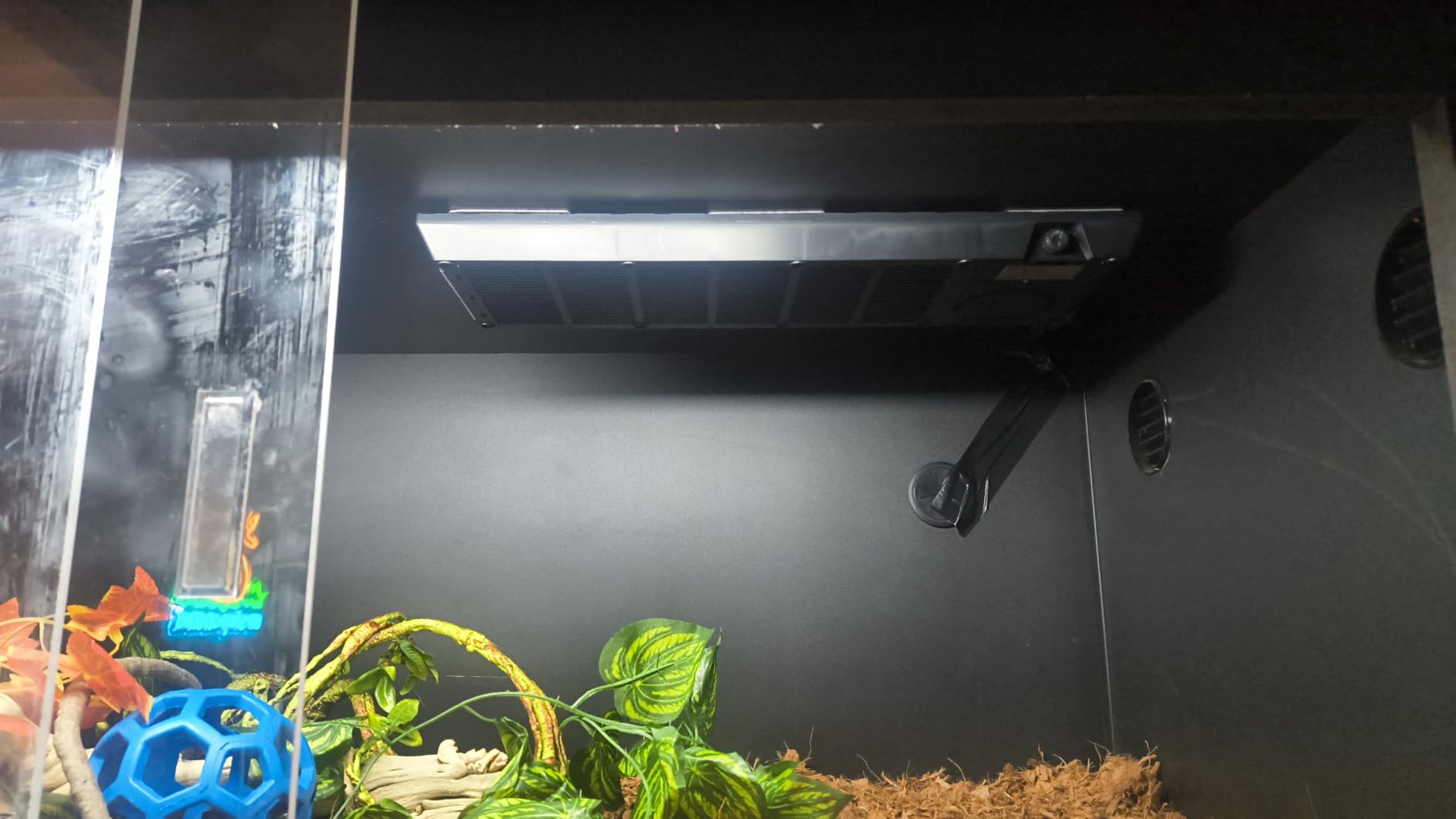
Mounting is straightforward. It screws under the terrarium lid, which directs heat downward and wastes less output than a side or rear mount, and the ABS housing is light enough that the fixings matter more than the weight.
The fan does produce audible noise during operation, which is a real consideration for species that are sensitive to sound, and it adds a failure mode that a solid panel does not have. Budget for the possibility of a fan-led replacement rather than assuming the panel outlives the enclosure.
If you want a night-only heat source in a compact enclosure and you are comfortable managing output by hand, this works. If your enclosure is 4x2x2 or larger, choose a panel with real radiant output instead.
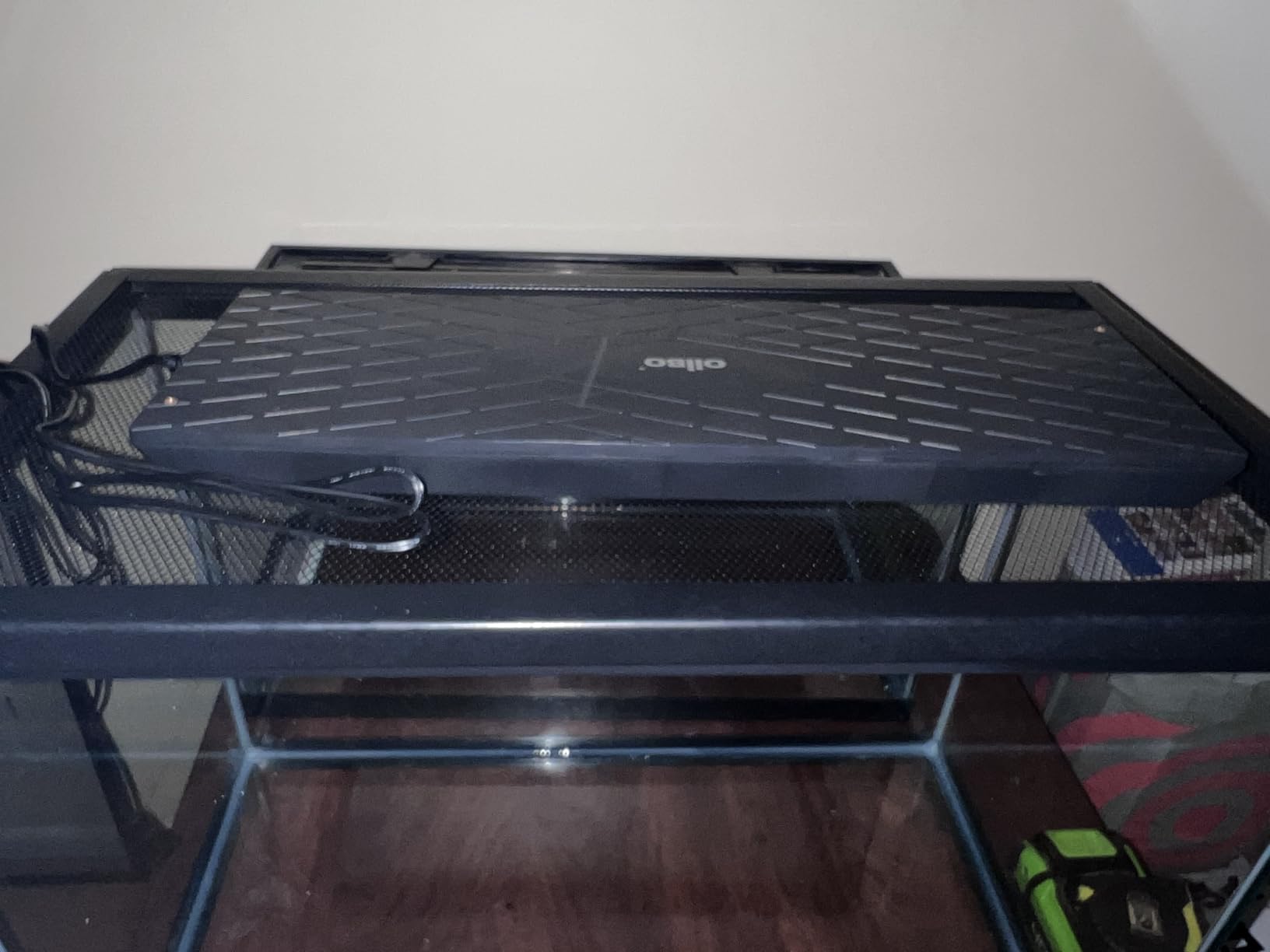
What the Oiibo 60W panel is good for
It is good for small to medium enclosures where the animal stays close to the panel, and for keepers who need 24 hour heat with no light at all. The knob adjustment is genuinely useful for a seasonal room.
The fan-assisted design is a sensible attempt at even heat across a small enclosure, and the under-lid screw mounting makes the install clean. It is also the lightest option here, which matters if you are retrofitting into an existing lid.
Where it falls short
The manufacturer instruction not to use a thermostat is the dealbreaker for large builds. Without proportional control you cannot safely push the output higher to compensate for a cold room, and you have no ceiling on surface temperature if something goes wrong.
Heat throw is the other limit. Buyers consistently report output dropping off with distance, and the fan noise is audible in a quiet room. For a 4x2x2 or above, both of those are disqualifying.
5. Reptile Systems 100W Infrared Unit – Best for Vertical or Directional Mounting
Reptile Systems Gold Infrared Units IRA & IRB – Dual Infrared 100w Output for Effective Thermal Gradients – for Terrariums, Vivariums & Exotic Habitats – Easy to Mount
- Dual IRA and IRB infrared output creates layered warmth zones
- Complete fixture with housing
- ceramic socket and mount
- Aluminum dome directs and spreads heat
- Clamp and hook allow horizontal or vertical mounting
- Only a single customer rating is available
- IR fixture form factor uses more vertical space than a slim flat panel
- Three star rating reflects average heat delivery for the cost
This is the only infrared fixture rather than a flat panel in the roundup, and that changes both its strengths and its constraints. Instead of a broad, even radiant field, you get a directional 100W output with an aluminium dome that focuses and spreads heat along a chosen axis. Dual IRA and IRB output gives you layered warmth zones, which is useful for an animal that wants a distinct warm and cooler band.
The mounting flexibility is the standout feature. A clamp and hook support horizontal or vertical mounting, so the same unit can sit overhead in a tall enclosure or on the back wall of a wide one, and the complete fixture includes the housing, ceramic socket and mount, so you are not hunting for a separate socket assembly.
Its weakness is form factor. An IR fixture occupies considerably more vertical space than a slim flat panel, and in a tight ceiling cavity that can be the difference between a panel that fits overhead and one that does not.
The 3 star rating comes from a single customer review, and I would treat the entire rating as unproven. There is no real owner history here, and the honest position is that the fixture design is credible while the field performance is not yet demonstrated by anyone but the manufacturer.
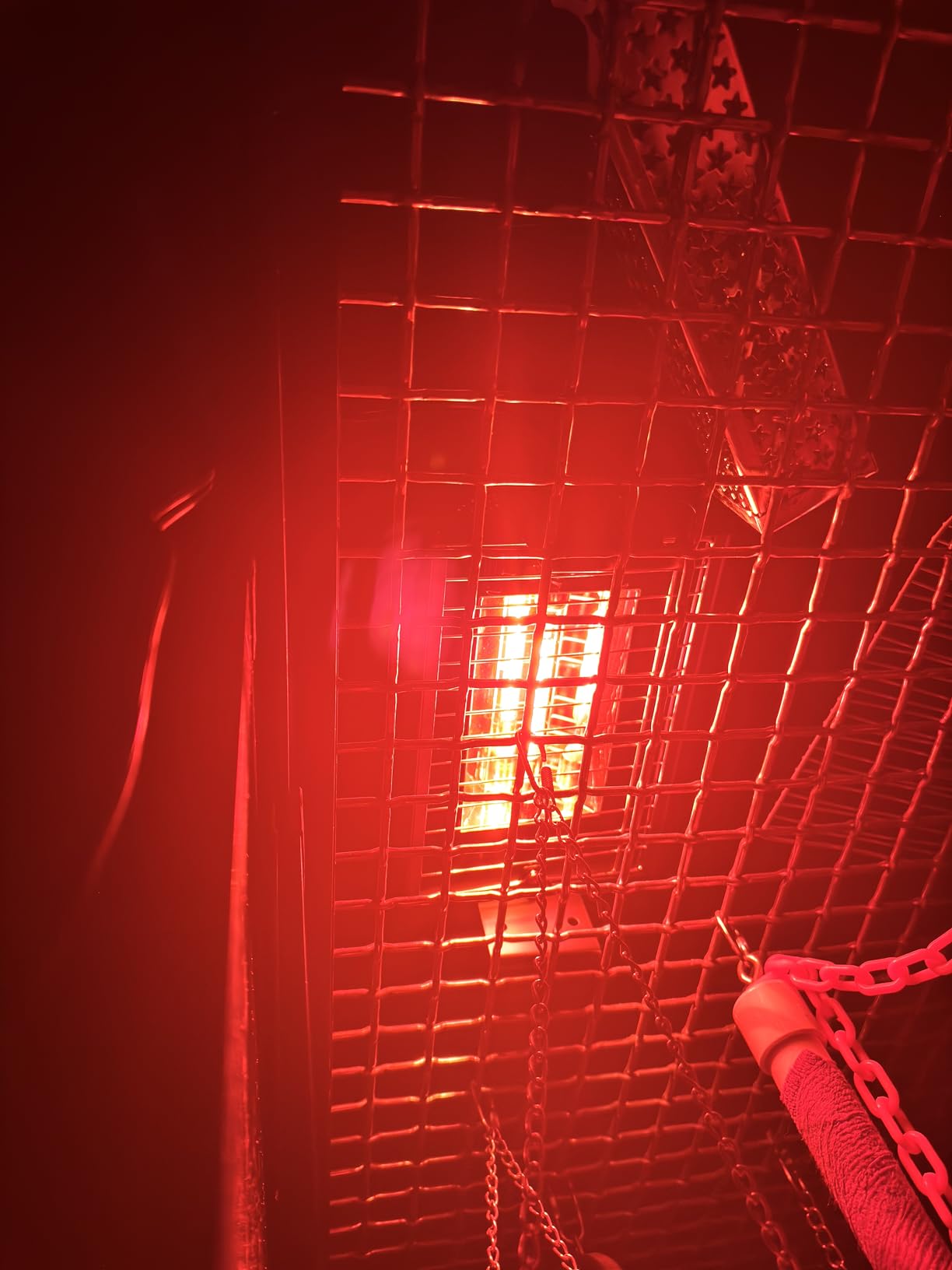
One more thing worth planning for. An infrared fixture with a ceramic socket should sit on a guarded, rated socket, and many keepers running high-wattage ceramic fixtures in humid rooms fit a thermostat-controlled ceramic socket holder as standard practice. That adds a component to your install that a flat panel with a moulded cord does not need.
It runs on 110V for indoor use and weighs just under 1kg, so it is easy to reposition while you are dialling in the gradient. Directional heat means you can aim the dome along a 6ft enclosure rather than at the centre, which partially offsets the narrower coverage.
If your build is tall and narrow, or if you want a distinct warm band along one wall, this is the only unit in the roundup that gives you that control. If you want even overhead ambient warmth across a wide enclosure, a flat panel is the better shape for the job.
What the Reptile Systems unit is good for
It is good for directional heat along one wall or one end of an enclosure, and for tall builds where a side or back wall is more practical than a ceiling mount. The clamp and hook system makes that repositioning easy.
It is also good for keepers who want layered zones rather than one uniform field, since the dual infrared output is designed for exactly that. The complete fixture package removes the guesswork from parts.
Where it falls short
The single-rating review base is the biggest risk, and the 3 star result is not a signal you can lean on. There is no long-term data on this fixture, and for a component meant to run nightly that matters.
It also uses more vertical space than a slim panel, and a dome-based fixture concentrates rather than spreads heat evenly. For uniform ambient warmth across a wide enclosure, the shape works against you.
6. Oiibo 30W Infrared Panel – Budget Pick for Compact Setups
- Non-light infrared heating keeps the day and night cycle intact
- Built-in fan spreads warmth and lowers burn risk
- Adjustable knob for heat output regulation
- High efficiency at 30W draw
- Backed by a one year manufacturer warranty
- Must not be used with a thermostat or timer per the manufacturer
- Small physical size suits smaller enclosures
- Some buyers report temperature dropping below target at distance
At 30W and 5.98 inches wide, this panel is not a large-enclosure heater and I want to frame it correctly: it is the cheapest way to add silent, light-free background warmth to a small or medium setup, and it is a useful second zone in a two-panel build. With 70 ratings at 3.8 stars it has the second-largest review base in this roundup, which makes its behaviour easy to characterise.
What works is the basics. There is no light emission at all, so it can run 24 hours without touching a nocturnal animal’s rest cycle, and the built-in fan distributes heat over a larger area than a bare element would, which lowers the risk of a localised hot spot in a small enclosure.
The one year manufacturer warranty is unusual at this end of the market and worth noting, because most panels in the entry category carry no stated warranty at all. It is a modest commitment, but it is a commitment.
What does not work is reach. Owners report temperature falling below target at distance, and at 5.98 inches wide the panel simply cannot cover a 4x2x2 footprint. The same manufacturer warning applies: this panel must not be connected to a thermostat or a timer.
Used as intended, it is a sensible small-enclosure solution or a supplementary heat source in a dual-zone build. Used as the sole heat source for a large enclosure, it will fall short and the reviews make that clear.
What the Oiibo 30W panel is good for
It is good for compact enclosures and for adding a quiet, light-free second zone to a setup that already has a main heat source. The knob adjustment makes seasonal tuning easy when you are managing output by hand.
The warranty and the efficiency rating set it slightly ahead of other entry panels, and the fan reduces the burn risk relative to a bare ceramic element in a small space.
Where it falls short
It cannot heat a large enclosure, full stop, and the 5.98 inch width makes that obvious once you hold it against your enclosure. Reports of temperature dropping below target at distance are the most common complaint in the reviews.
The no-thermostat manufacturer instruction removes any feedback control, so you cannot safely compensate for a cold room. For a 4x2x2 or above, you need a higher-wattage panel with proportional control.
Thermostats: Why Proportional Control Is Non-Negotiable Above 60W
Any panel in this roundup that reaches 60W or more should be run through an external thermostat with a temperature probe. That is not a recommendation, it is the minimum safe configuration, and it is the first thing experienced keepers check before anything else on a panel.
There are three control types worth understanding, and one that is not a real control at all. A dimming thermostat reduces power to the panel continuously to hold the target temperature, which gives very smooth, very stable results and is the preferred choice for high-wattage panels. A pulse-proportional thermostat delivers full power in timed bursts, which cycles the panel rather than easing it, and it works well but produces a slightly more pulsed surface temperature. A rheostat is simply a manual dimmer dial, which is a control you adjust and then forget, and it is not appropriate for a panel in a closed enclosure.
A built-in adjustment knob on the panel itself is none of those things. It is an output setting, not a thermostat, and two of the panels in this roundup say so explicitly in their own instructions. The panel cannot tell what the temperature is, so nothing corrects for a probe fault, a sudden drop in room temperature, or a lid being left open.
Probe placement is where most installations go wrong. The probe should sit in the warm zone you are actually trying to hold, roughly where the animal rests, not directly under the panel where it will read hotter than the rest of the enclosure. If you are running two zones, each zone needs its own probe placed in its own region, and the two thermostats should be set to different targets rather than mirrored settings.
Verify your work with an infrared temperature gun rather than a thermometer alone. Air temperature and surface temperature diverge sharply in a gradient enclosure, and the surface reading is what determines whether the animal can safely rest against a warm surface.
Panel Types and Where You Can Mount Them
Radiant heat panels are not the only option, and for large enclosures they are rarely the only one you want. A quick comparison of what is available:
Radiant heat panel: broad, even infrared heat with no light, ideal for ambient warmth and overnight heating. Weakness is that it creates a hot surface rather than raising whole-enclosure air temperature quickly.
Deep heat projector: raises ambient air temperature more efficiently and reaches further into a large enclosure. Weakness is narrower spread and a smaller effective zone than a panel.
Halogen basking lamp: a visible daytime heat and light source that produces a tight basking spot. Weakness is that it emits light, so it cannot run overnight without disrupting a nocturnal animal.
Infrared fixture like the Reptile Systems unit: directional heat along a wall or an axis. Weakness is vertical bulk and a narrower field than a flat panel.
Under-tank heat mat: cheap and simple for small enclosures. Weakness is that it heats the substrate rather than the air or the animal, it does not scale, and it is a poor fit for anything above 20 gallons.
Ceramic heat emitter: radiant and light-free, but small, extremely hot at the surface, and demanding on a guarded socket. Useful as a targeted basking heat source, not as enclosure-wide warmth.
The arrangement experienced keepers converge on for a large build is a hybrid. A halogen or overhead light provides a daytime basking spot with a real light cycle, and a radiant panel or deep heat projector handles overnight heat and raises the ambient floor. That gives you a proper day and night rhythm without a single device trying to do both jobs badly.
On mounting surfaces, PVC and wood are the straightforward cases. Screw fixings into the top rail of a PVC enclosure are the standard install, and the screws matter because adhesive pads are a known weak point in humid bioactive setups, where they have been reported failing after roughly six months. Route the cord through a proper gland or strain relief so the cable cannot be pulled or chewed.
Screen and mesh tops work, and keepers confirm panels perform on them, provided the screen is not flimsy. The tradeoff is heat loss, so step up one wattage tier or insulate the lid frame. On glass, mount to a top rail rather than to the glass itself, and for a very large enclosure, mount a shelf or guard so the animal cannot make contact with the element.
If you are still working out the enclosure, our general reptile enclosure picks and our reptile heat lamp guide cover the daytime lighting side of a build that these panels only handle the night side of.
Frequently Asked Questions
What wattage heat panel do I need for my enclosure?
For a 4x2x2 enclosure, plan on 60W to 80W. A 4x2x3 or 4x2x4 needs 80W to 125W, a 6ft vivarium needs 80W to 125W with a panel long enough to cover the run, and an 8ft or 400 gallon build needs 125W or two panels on separate thermostat zones. Add roughly 2W per cubic foot if you have a screen top or a cold room.
Can a radiant heat panel burn a snake?
Yes, if the animal can reach the heated surface. Mount the panel overhead rather than on a side wall, leave air between the element and the animal, add a guard or mesh shelf where contact is possible, and always run a panel of 60W or more through a proportional thermostat. Check the surface with an infrared temperature gun rather than trusting an air reading.
Are radiant heat panels worth it for large enclosures?
For large enclosures they are worth it as the overnight and ambient layer, provided you size up and control them proportionally. They heat surfaces rather than air, so most experienced keepers pair a panel with a halogen basking lamp for daytime. The exception is very tall or very wide builds, where a deep heat projector or a second panel on its own zone raises ambient temperature more efficiently.
Which radiant heat panel is the best for reptiles?
For enclosures up to 48 by 24 by 24 inches, the REPTI ZOO under-lid panel is the most documented choice, with a stated enclosure limit and the largest review base. For 80W radiant output in a long 6ft setup, the Vivarium Electronics panel is built for that footprint. For humid or bioactive enclosures, the REPTIRAD panel is the one with an ETL listing and an IP64 rating.
What is the best heat source for reptiles?
It depends on the enclosure and the time of day. A halogen basking lamp is the best daytime source because it provides light and a tight basking spot. A radiant heat panel is the best overnight source because it emits no light. A deep heat projector raises whole-enclosure air temperature most efficiently. Under-tank heat mats are only appropriate for small enclosures below about 20 gallons.
Can you use a radiant heat panel without a thermostat?
Only if it is a small panel, the room is warm and stable, and the output is fixed by a knob rather than a probe. Two panels in this roundup are explicitly labelled by their manufacturer as never to be connected to a thermostat or timer. Any panel of 60W or more should run through a proportional thermostat so surface temperature has a ceiling.
The Bottom Line on Heating Large Reptile Enclosures in 2026
For most keepers working with a 4x2x2 or larger enclosure, the REPTI ZOO under-lid panel is the safest starting point in this roundup, because it is the only one with a documented enclosure size and a deep review history, and it runs happily through a proportional thermostat. If your build is a long 6ft setup, go to the Vivarium Electronics 80W for real radiant output, and if your enclosure is humid or bioactive, the REPTIRAD panel is the one with the certification and IP64 rating to back it up.
Whatever you choose, the rules do not change: size up rather than down, mount overhead, and run anything at 60W or more through a proportional thermostat. For an 8ft vivarium or a 400 gallon paludarium, plan on two panels on separate zones from the start rather than trying to find one big enough unit. Getting the best reptile heat panels for large enclosures is mostly a matter of matching output to volume, then refusing to compromise on the controller.