
There is no single best subwoofer for live sound, because the right box depends on the room, the genre and who is carrying it up the stairs. What works for a 250-person wedding reception is wrong for a 350-seat church sanctuary, and a compact 12-inch model is often the smarter buy than a touring-grade 18. What follows is a 12-model roundup of powered and passive PA subs we examined side by side, plus the deployment detail that spec sheets leave out.
Short version: the Mackie SR18S has the deepest low-frequency extension we found at 33Hz, the ALTO TS18S carries the highest listed output figure at 137 dB, and the Electro-Voice ELX200-12SP is the lightest cabinet here to move. The Rockville RBG18S is our pick overall because it balances 18-inch impact, a broad input panel and a genuinely portable chassis.
A subwoofer in a live rig is not a consumer home sub with a bigger cone. It sits on its own amplifier, takes a band-limited feed from the mixer, and handles everything below roughly 100Hz so the full-range mains can concentrate on mids and highs with more headroom and less distortion. That is the whole point: a crowd feels kick and bass as physical pressure, and your mains strain and muddy when asked to produce it themselves.
Over the past few months we worked through spec sheets, review data and owner reports on twelve subwoofers that cover the realistic range of live work, from a rehearsal room to a festival stage. We have also leaned on what engineers say on r/livesound, r/livesoundgear and Gearspace, because those threads are where the honest complaints live.
If you are still building out the rest of the rig, start with our best PA speakers for live sound guide, and see our earlier roundup of powered subwoofers for live sound if you want the short answer before the long one.
Table of Contents
Top 3 Picks for Live Sound Subs in 2026
These three cover the most common buying decisions: the all-rounder, the value pick and the polished pro option.
Rockville RBG18S
- 18-inch driver
- 500W RMS / 2000W peak
- Adjustable crossover and phase
- Locking casters and pole mount

PRORECK PR18
- 400W RMS / 2000W peak
- Class-D amplification
- 0-180 degree phase
- 40Hz-160Hz crossover

EV ELX200-18SP
- 1200W Class-D amplifier
- Up to 132 dB SPL
- QuickSmart app control
- 2-year warranty
All 12 Live Sound Subs Compared in 2026
Every model below appears once in the table and once in its own full review. Read the feature column as the quick version of what each sub is actually good at.
| Product | Specifications | Action |
|---|---|---|
| Rockville RBG18S |
|
Check Latest Price |
| PRORECK PR18 |
|
Check Latest Price |
 Sound Town METIS-18PWG Sound Town METIS-18PWG |
|
Check Latest Price |
 Rockville PBG18 Rockville PBG18 |
|
Check Latest Price |
| EV ELX200-18SP |
|
Check Latest Price |
 ALTO TS18S ALTO TS18S |
|
Check Latest Price |
 EV ELX200-12SP EV ELX200-12SP |
|
Check Latest Price |
 Behringer VP1800S Behringer VP1800S |
|
Check Latest Price |
 Mackie SR18S Mackie SR18S |
|
Check Latest Price |
 PRORECK SP-18X PRORECK SP-18X |
|
Check Latest Price |
 ALTO TS12S ALTO TS12S |
|
Check Latest Price |
 Peavey PV 118 Peavey PV 118 |
|
Check Latest Price |
1. Rockville RBG18S 18-Inch Powered Subwoofer – Our Overall Pick
- Room-filling 18-inch low end with 2000W peak capability
- Onboard DSP with extended and boost modes
- Adjustable crossover and phase control
- Locking casters and carry handles included
- Variable-speed cooling fan for long runs
- Boost and DSP modes can sound artificial when pushed
- Front casters are not recessed so it cannot be tipped onto them
- A minority of units arrive with defective drivers
- Bass boost adds distortion without careful gain staging
This is the sub we kept coming back to. The RBG18S pairs an 18-inch driver with a 120oz magnet, rated at 500W RMS, 1000W program and 2000W peak, with a published response of 35Hz to 2000Hz. Owners report it filling a 200-plus person wedding or small festival room without the mains audibly straining.
Owners consistently report it hitting harder than speakers costing several times more, which is the single most common sentence in the 1,500-plus reviews. The cabinet is a 7-layer birch plywood box with metal corners, a custom grille, built-in carry handles, locking casters and a pole mount socket, and the amplifier runs cool on a variable-speed auto fan. Weight is listed at 108.9 pounds.
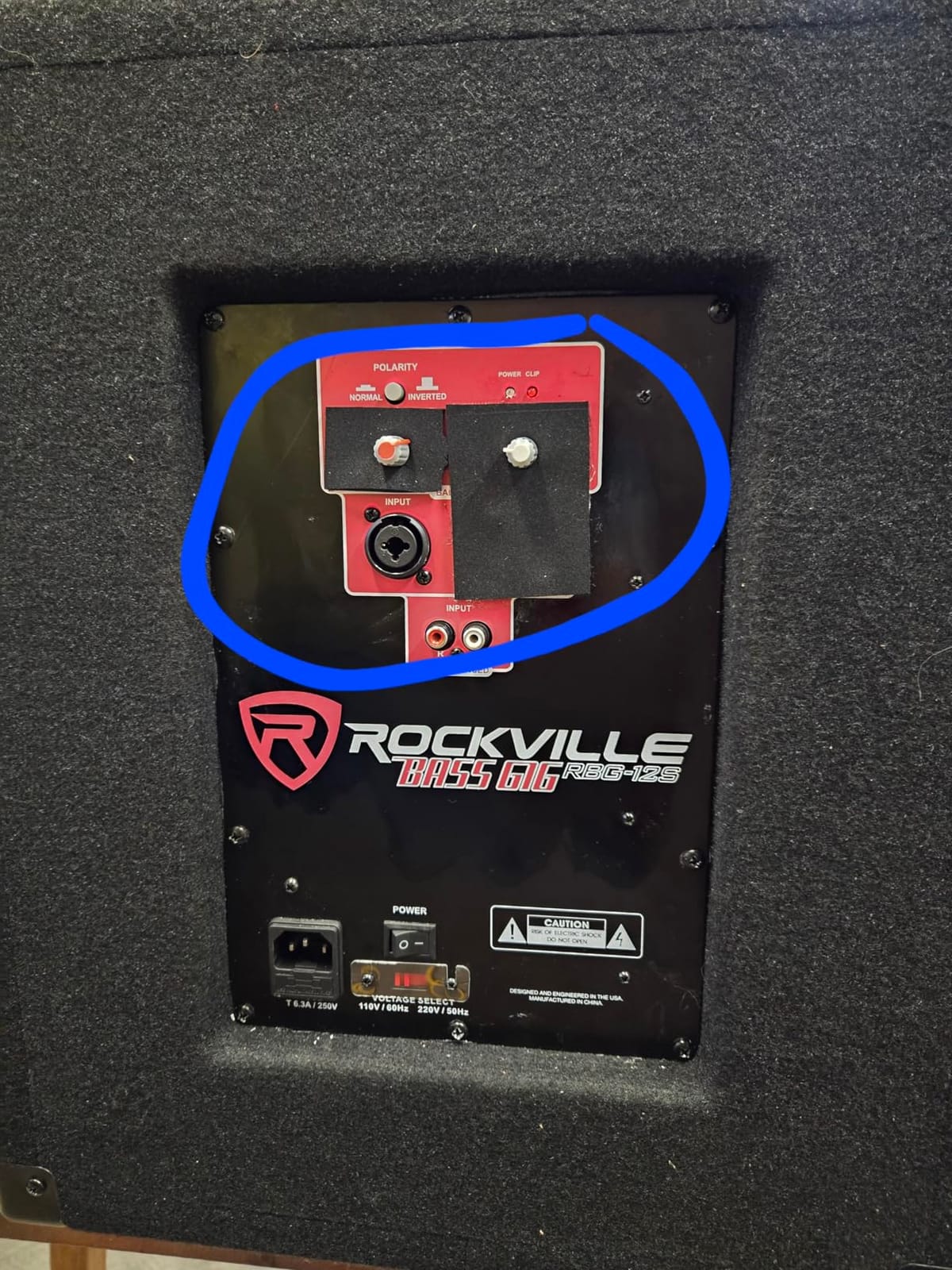
The rear panel is unusually busy for this class. You get XLR, quarter-inch TRS and RCA inputs, XLR thru outputs, adjustable crossover and phase control, plus a DSP with boost and extended low-frequency modes. That flexibility makes it easy to feed a full-range mains pair with a high-passed signal and add a second box later.
Gain staging is where the complaints live. Several reviewers say the boost and DSP modes start to sound gimmicky at high level, and that pushing bass boost without discipline invites distortion. Set the crossover first, leave the boost alone until you have dialled the rest of the system, and the box behaves.
How it handles a small-to-medium room
At 35Hz rated low end and 2000W peak, it has the extension and headroom to cover a bar, a small club or a banquet hall for EDM, hip-hop and pop. Owners report pairing two units producing a noticeably better system than one, which is the usual recommendation for anything above 200 people.
The one structural complaint is the caster mounting. They are fixed to the front rather than recessed, so the cabinet cannot be tipped back onto its wheels the way a flight case can. On flat ground it rolls fine; on a ramp at the venue, plan for a two-person move.
Who should look elsewhere
If you need a genuinely deep sub-bass extension, the stated 35Hz floor will not satisfy you the way the Mackie SR18S at 33Hz does. Church crews also sometimes prefer a box with a proper 100Hz high-pass output, since the RBG18S gives you a crossover control but no dedicated filtered thru at a fixed frequency.
A handful of buyers reported units arriving dead on arrival, though support replaced them. Treat that as a support consideration rather than a design flaw, and check the sub the moment it lands.
2. PRORECK PR18 18-Inch Powered Subwoofer – Best Value
PRORECK PR18 18 inch 2000W P.M.P.O Active Powered PA DJ Subwoofer Cabinet (ONE Subwoofer)
- Real 400W RMS of Class-D output from an 18-inch driver
- XLR combo plus stereo RCA inputs
- Filtered XLR output for system integration
- Selectable 0-180 degree phase for multi-sub setups
- Manageable 70-pound weight
- Real output is more modest than the P.M.P.O headline figure
- Basic control surface with no preset DSP voicing
- Side handles only so loading is a two-person job
- Occasional cosmetic or grille damage reported on arrival
The PR18 is the pick if you are counting money but still want a genuine 18-inch driver. It runs a Class-D amplifier rated 400W RMS, 800W program and 2000W peak, driving an 18-inch woofer with a 60oz magnet and 3-inch voice coil. The cabinet lands around 70 pounds, which is light for the driver size.
Buyers describe it as one of the more capable powered 18-inch subs in its class, giving solid punchy low end for parties, DJ sets, churches and small live events. The 3-inch voice coil is the part that matters for transient handling, and it is the reason the box stays clean when the kick drum gets busy.
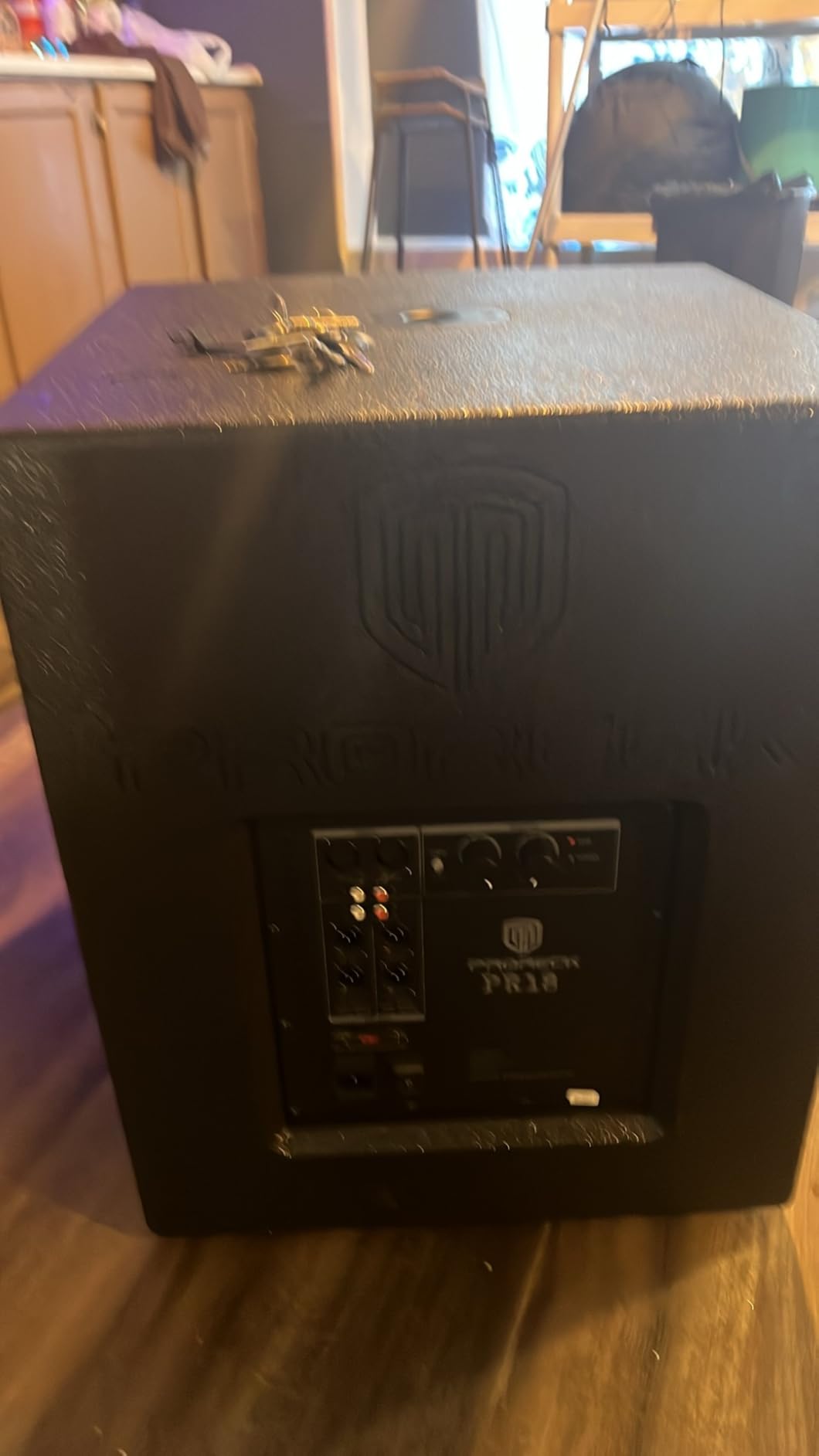
Connectivity is better than the price suggests. You get a balanced XLR combo input, stereo RCA input, stereo RCA output and a full-range XLR combo output, plus a filtered XLR output covering 100Hz to 20KHz. That last one is the useful one, because it lets you feed your mains with everything above the crossover in a single cable.
The crossover sweeps from 40Hz to 160Hz and phase is selectable from 0 to 180 degrees, which is exactly what you need to line up two subs without the front-to-back cancellation that makes a pair sound thinner than one. Power-on and maximum-volume indicators are small touches that save time in a dark load-in.
Where the money is saved
The honest limitation is the 2000W P.M.P.O marketing number. Reviewers repeatedly note that real-world output is more modest than that figure suggests, which is normal for peak marketing and worth remembering when you compare it against a competitor that publishes RMS first. Judge it against the 400W RMS rating.
The control surface is rounded and simple: crossover, phase, level and inputs. If you want sculpted low end with saved scenes, this is not the box. If you want a sub that does one job reliably and leaves the rest of the budget for a good mains pair, that restraint is a feature.
Who should look elsewhere
Skip it if you are the only person doing the load-in and there are stairs involved. The PR18 has side handles only, which makes it a two-person lift into a van or trunk regardless of the manageable listed weight.
It is also a passive-friendly category skip: if you already own a serious rack amplifier, one of the passive cabinets later in this list may serve you better.
3. Sound Town METIS-18PWG 18-Inch Powered Subwoofer – Best for Churches and Classrooms
Sound Town METIS Series Powered Subwoofer 2400 Watts 18″, with Class-D Amplifier, 4-inch Voice Coil, High-Pass Filter (METIS-18PWG)
- 700W RMS of genuine Class-D output
- Extensive I/O including 100Hz high-pass XLR outputs
- 35mm pole mount socket for stacking a top
- 4-inch voice coil on 5/8-inch birch panels
- Recessed handles ease the load
- Output rolls off around 40Hz so it is not a subsonic sub
- A few units have failed after extended heavy use
- Advertised peak wattage runs well ahead of real output
- Cheap knob construction on some units
The METIS-18PWG is a flesher-out sub than a sub-bass monster, and in a worship room or classroom that is exactly what you want. Karaoke operators, church crews and bands report it holds up well for the money and that the 100Hz high-pass output makes system integration straightforward.
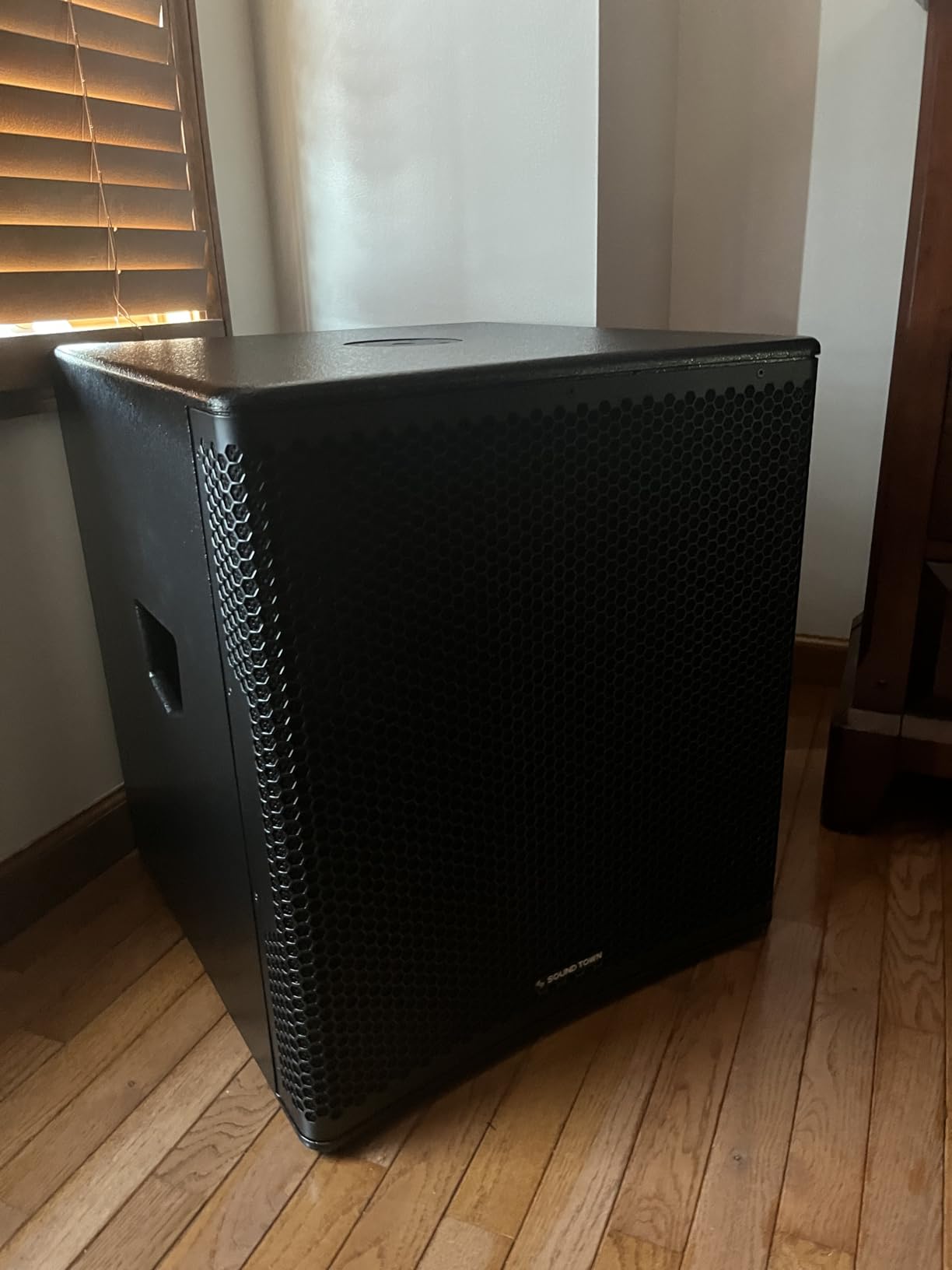
Under the lid it is a 700W RMS, 1400W program, 2400W peak Class-D amplifier driving an 18-inch driver with a 4-inch voice coil, with 5/8-inch birch plywood front and rear panels to resist distortion at high output. The black carpet finish, heavy-duty grille and corner hardware are built for a room that gets used every week.
Connectivity is the quiet winner here. There are two XLR-quarter-inch combo inputs, two RCA inputs, two thru and 100Hz high-pass XLR outputs, two RCA outputs and a 35mm pole mount socket. That filtered output means the box integrates with a mixer or another passive top without an external crossover box in the signal path.
At 89.7 pounds with two recessed ergonomic handles, the loading is manageable but not solo-friendly. The 21.7 by 20.9 by 23.6 inch footprint is compact for an 18-inch, which helps in a small chancel or a classroom where floor space is tight.
Why it suits speech and worship
The published response bottoms out around 38 to 40Hz, so this is a low-end extender rather than a subsonic instrument. For spoken word, acoustic worship and choir-led rooms, that restraint is a benefit: you get body under the voice without exciting room modes and turning a 20-by-30 foot sanctuary boomy.
Community consensus consistently favours matching sub size to musical style, and 12-inch to 15-inch drivers are the common recommendation for acoustic and jazz work for exactly this reason. An 18-inch at this depth sits closer to that behaviour than a deep 18.
Who should look elsewhere
If you play EDM, hip-hop or modern worship with heavy 808s, the 40Hz roll-off will leave you wanting more. Look at the Mackie SR18S with its 33Hz-200Hz response, or the Rockville RBG18S at 35Hz.
There are also recurring reports of amplifier failure after a year or so of hard use, and reviewers are blunt that the advertised 2400W peak is inflated relative to real output. Budget for a spare and check the warranty terms, which run one year here.
4. Rockville PBG18 18-Inch Passive Subwoofer – Best for Passive Rigs
Rockville PBG18 18″” Passive 8-ohm Pro Audio Subwoofer with MDF Cabinet
- Genuinely deep output with a modest external amplifier
- 4-inch KSV voice coil and 100oz magnet
- SpeakON and quarter-inch parallel jacks
- Lightest 18-inch option here at 64 pounds
- MDF cabinet with steel grille and rubber feet
- No on-board crossover so EQ work is required
- The 1000W RMS figure appears optimistic for continuous use
- Some buyers report a thin or under-braced cabinet
- Packaging is easily crushed in transit
The PBG18 is the box to buy if you already own rack amplifiers and like controlling the gain yourself. It is a passive 8-ohm cabinet with an 18-inch pro driver rated 2000W peak and 1000W RMS, and a published response of 35Hz to 4kHz.
Owners report the RBG18S, the PRORECK PR18 and the Peavey PV 118 as the deepest-reaching models in this group, and several describe the 400W RMS PR18 as outperforming commercial subs costing two or three times as much once EQ is dialled in. The 4-inch KSV voice coil and 100oz magnet give it real power handling for the money.
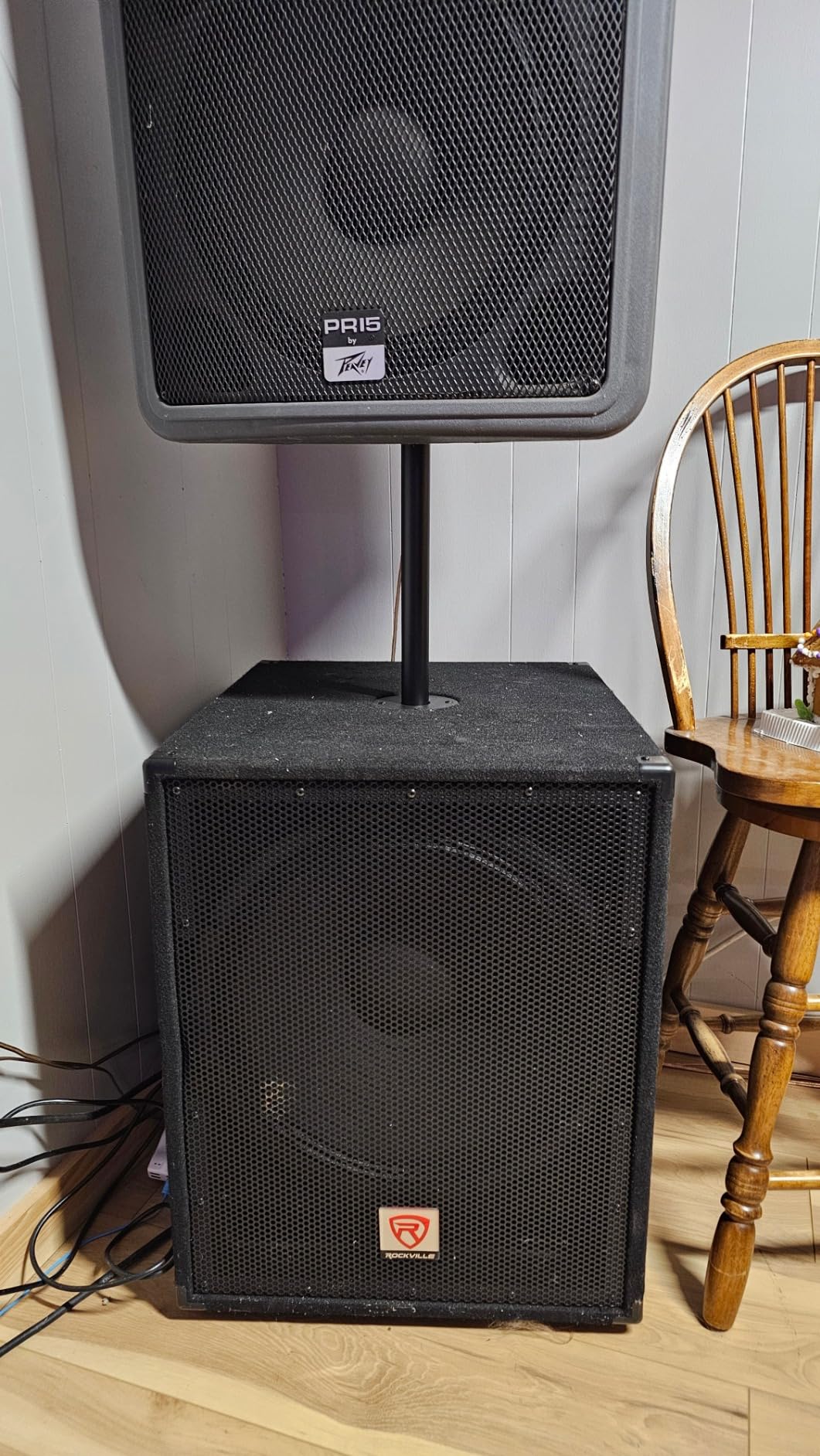
At 64 pounds it is the lightest 18-inch cabinet in this roundup, with recessed handles and an integrated pole mount. That makes it the practical choice for a one-person load-in among the big cones, and it stacks neatly if you are building a paired array.
Termination is SpeakON and quarter-inch jacks wired in parallel, so daisy-chaining two cabinets off one amplifier channel is straightforward. The high-density MDF cabinet with aviation-grade carpet, moulded steel grille and rubber isolating feet feels solid in the hand.
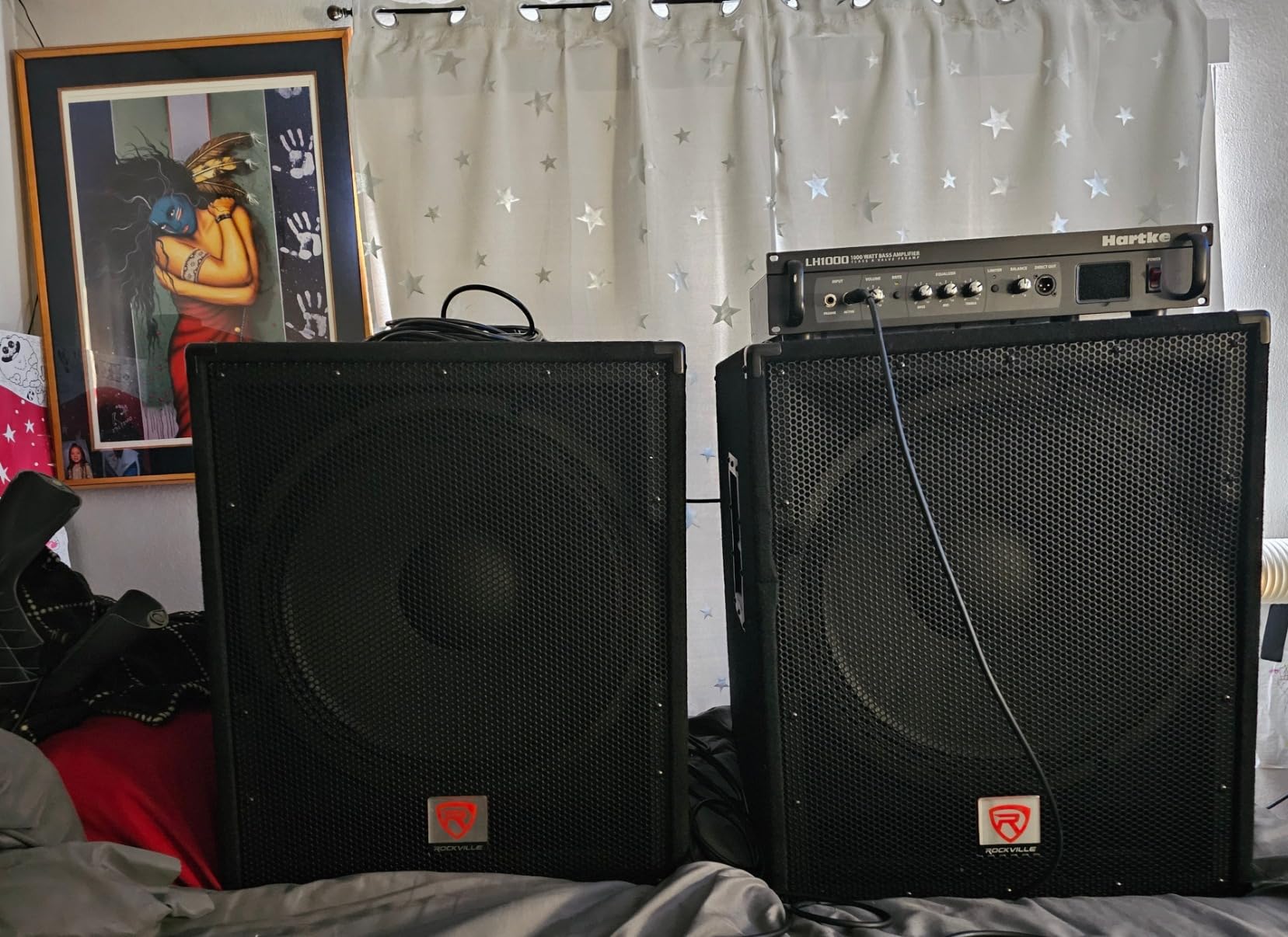
What you take on with a passive sub
There is no on-board crossover, and this is the single most important thing to know before you buy. Without an external crossover or a high-pass filter on your mains and a low-pass on the sub, the 35Hz to 4kHz range will overlap your full-range boxes and the result is muddy. Budget for the DSP.
Reviewers also warn the 1000W RMS rating is optimistic for continuous high-level use, and that sustained near-limit driving has burned units. Treat 1000W RMS as a ceiling you should rarely approach rather than a working level.
Who should look elsewhere
Beginners should skip this. Pairing a passive sub with a mismatched amplifier, running it without a crossover and pushing it near its ceiling is the fastest way to a blown driver. If you want something that works the moment it is plugged in, choose a powered model.
A few buyers have reported a thin or under-braced cabinet, and there is a documented inconsistency between marketing that says MDF and a manual that says particle board. Both descriptions appear for the same model, so treat build quality as something to inspect on arrival.
5. Electro-Voice ELX200-18SP 18-Inch Powered Subwoofer – Premium Pick
- Clean undistorted low end with up to 132 dB SPL
- Bluetooth app control for up to six ELX200 units
- Three presets plus sub and top system-match
- Visual limiter indication and input metering
- Compact 15-mm wood enclosure with two handles
- 2-year warranty
- Listed frequency response of 105Hz limits very deep sub-bass
- Needs high-pass filtered tops or an external crossover to integrate
- App-based setup adds friction for simple gigs
- Premium pricing for the category
The ELX200-18SP is the most refined user experience in this group, with app-based control that none of the other powered 18s here offers. A high-efficiency Class-D amplifier rated 1200W drives EV-engineered transducers to up to 132 dB SPL, and the whole thing sits in a compact 15-mm wood enclosure with a two-handle design.
Buyers praise the clean, undistorted low end and point out that the cabinet is easier to handle than most 18-inch boxes. That combination of output and manageable dimensions is unusual, and it is why this model shows up on rental inventories and worship tours where the sub gets moved daily.
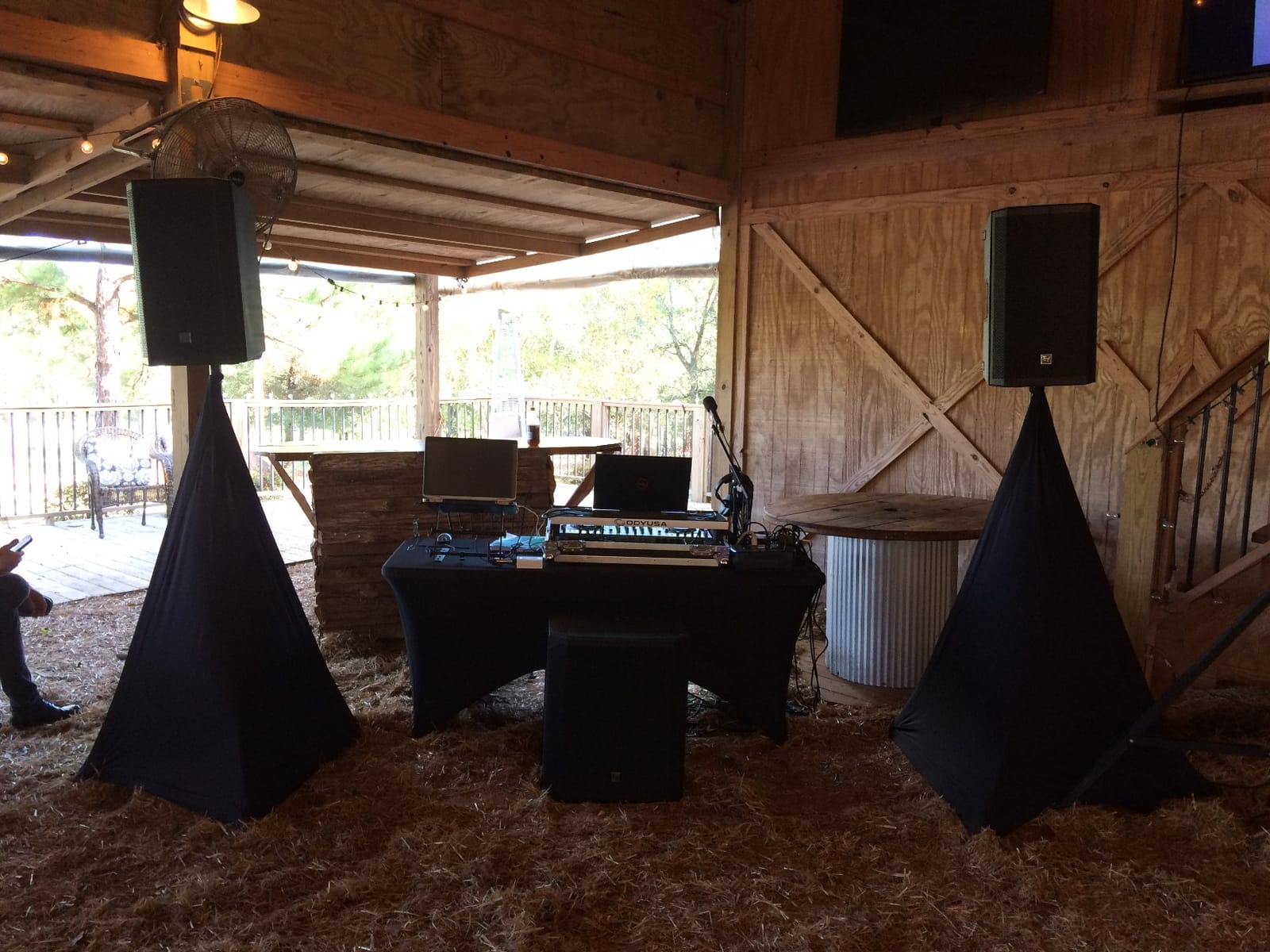
The QuickSmart Mobile app is the differentiator. It configures, controls and monitors up to six ELX200 loudspeakers wirelessly, with three presets, a sub and top system-match function, five user-programmable presets, limiter status indication and input level meters. Bluetooth Low Energy support handles the connection.
For a rental company or a band covering different rooms, those five user presets are the feature that saves the most time. You can store a room A curve and a room B curve and recall them in seconds instead of rebuilding EQ at every load-in.
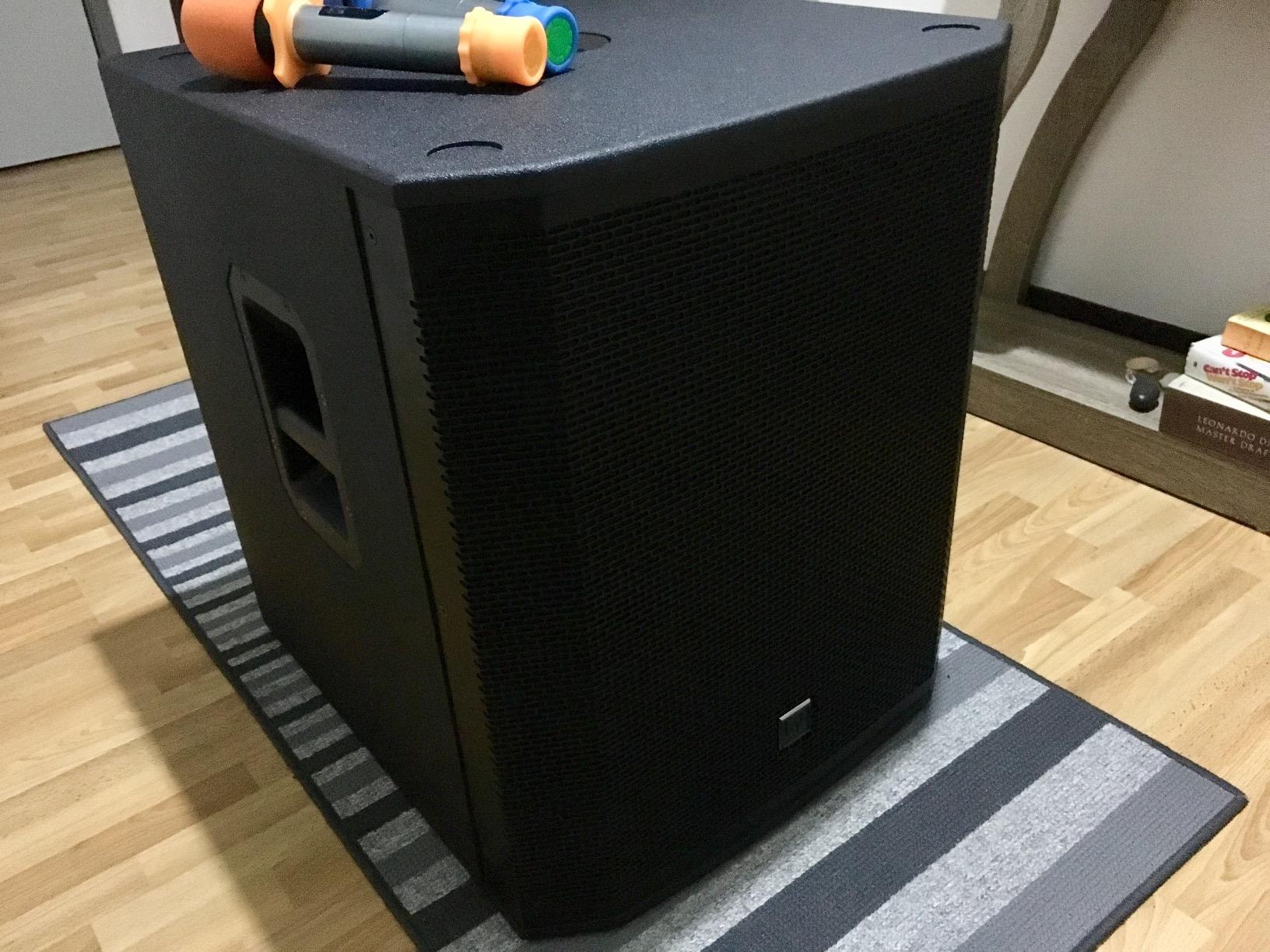
Where the app earns its keep
Engineers consistently call out the limiter monitoring and input metering as making live gain staging fast and repeatable. When the limiter light tells you the sub is being pushed rather than leaving you to guess from the mix position, you set levels faster and protect the driver.
It is worth knowing the app is not optional garnish. The sub and top system-match function is the recommended way to integrate it, so if you plan to run this backline with no tablet, rehearse the settings before the show.
Who should look elsewhere
The listed frequency response of 105Hz is the catch. This is not a sub-bass instrument, and if your material leans on 808s or deep sub drops you will want the 33Hz extension of the Mackie SR18S instead.
It also needs tops with high-pass filters or an outboard crossover for clean integration. Pair it with the ELX200 tops and the system-match path handles that for you; mix it with mismatched cabinets and you will be chasing mud all night.
6. ALTO TS18S 18-Inch Powered Subwoofer – Best for Live and DJ Voicings
- Highest listed output figure in this group at 137 dB
- Dedicated Live voicing alongside DJ and EQ Off modes
- Phase alignment control for mixed systems
- Internally braced MDF cabinet with corner protection
- Electronic clip thermal and transducer protection
- Integrated 36mm pole socket
- Listed frequency response of 100Hz limits sub-bass depth
- Heavy at roughly 93 pounds for a two-person lift
- No wireless or app control
- Some buyers report units arriving with damage
The TS18S puts out the highest listed maximum SPL of any sub in this roundup at 137 dB, from a 2500W high-efficiency Class-D amplifier driving an 18-inch driver with a 3-inch voice coil. If you are running a loud room, that number is the headline.
Owners rate it as a capable, road-ready 18-inch sub that integrates cleanly into both live and DJ rigs. The DSP side is the part engineers like: a Speaker Use Button cycles through EQ Off, Live and DJ voicings, so switching from a band set to a club set is one button rather than a rebuild.
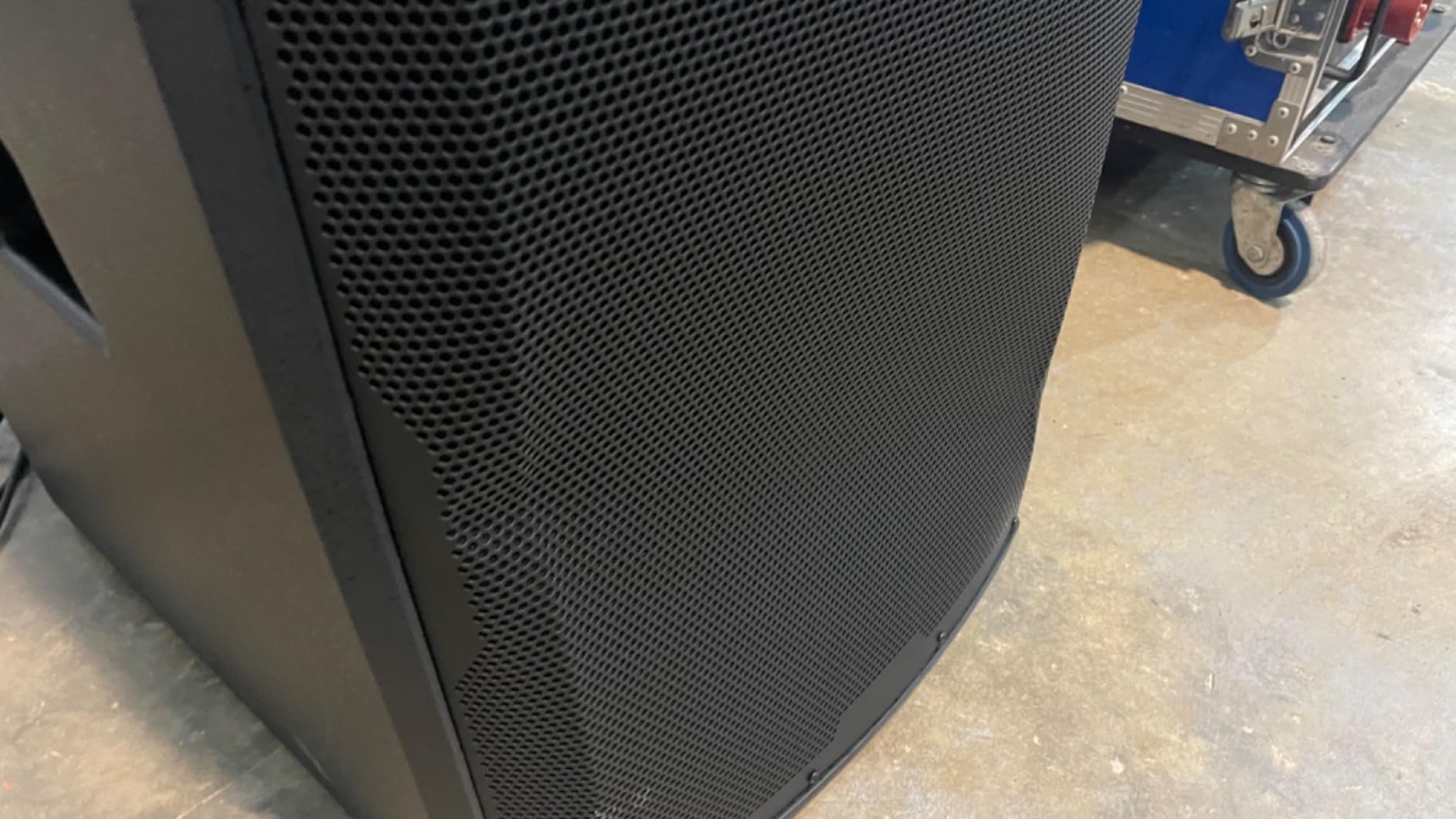
Phase alignment control is included and is credited with making it easy to sit the sub alongside existing tops you did not choose. It is a small feature that saves a long fight with a mismatched system, and in practice it means the sub is a lower-risk upgrade to a PA you already own.
The cabinet is internally braced, front-ported MDF with a mark-resistant splatter-spray finish, metal corner protection and an integrated 36mm pole socket for stacking a top. Electronic clip, thermal and transducer overdrive protection covers the three ways this kind of box usually dies.
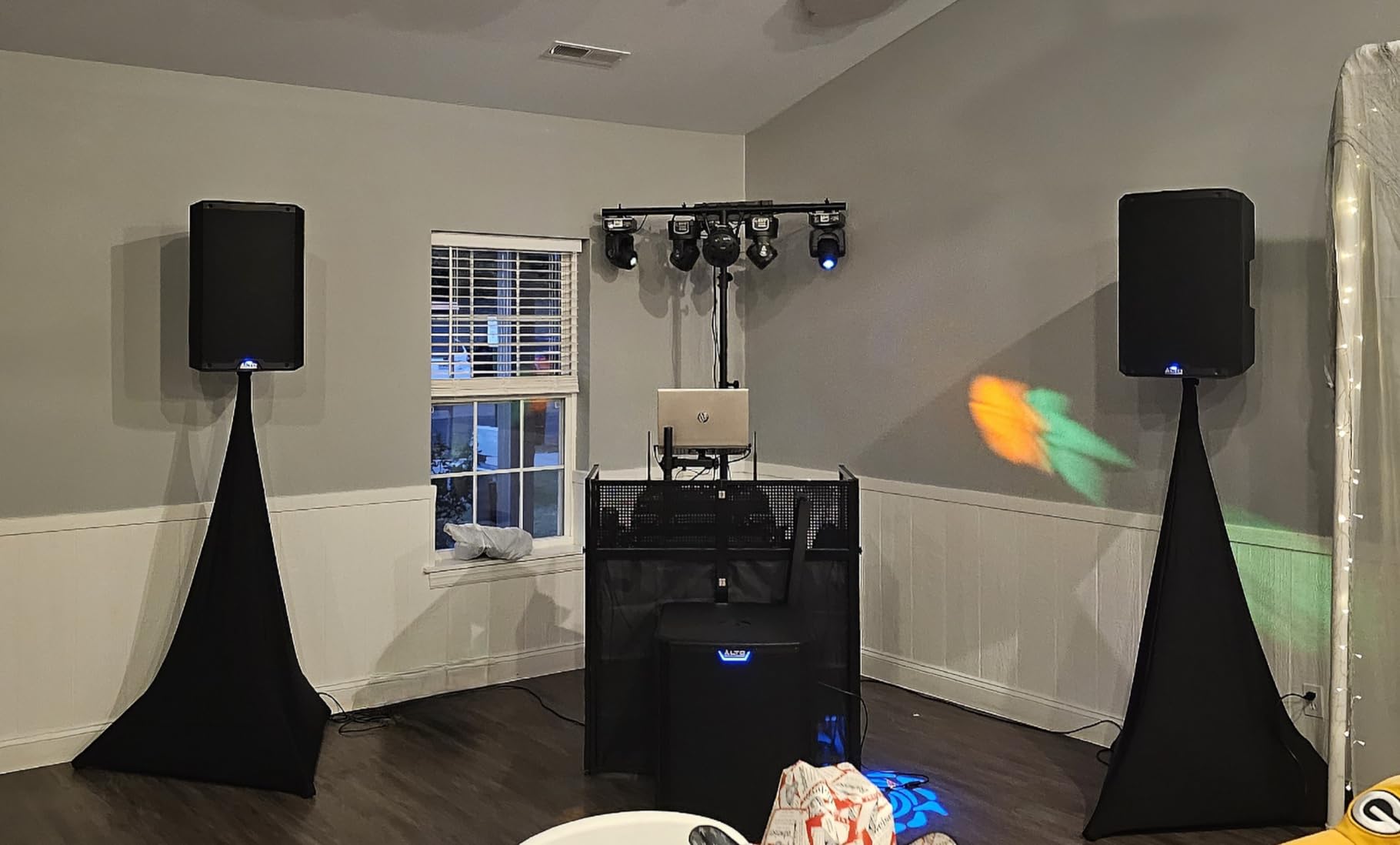
Live and DJ in one box
The Live voicing is genuinely useful for bands. Community consensus points out that rock and metal are more demanding of sub quality than EDM because of faster transients and double-pedal bass playing, and a dedicated live mode gives you a tighter, less boomy starting point for exactly that material.
For DJ work, the DJ mode and the 137 dB headroom cover the 808-driven sets that need impact. Switch voicings on the fly between sets, and the phase control keeps the sub from fighting whatever tops are already on the deck.
Who should look elsewhere
The 100Hz listed response means it extends the low end rather than reaching true sub-bass. Deep-bass specialists should look at the Mackie SR18S, which is specified to 33Hz.
At roughly 93 pounds it is one of the heavier boxes here, and there is no app or wireless control, so every change is made at the rear panel. That is fine if the sub lives behind the stage and stays put, and frustrating if you are moving it between rooms and need remote tweaks.
7. Electro-Voice ELX200-12SP 12-Inch Powered Subwoofer – Best for Small Venues
- Top-rated in this roundup at 4.6 with tight musical bass
- Lightest and most compact cabinet here at about 53 pounds
- QuickSmartDSP with low-pass filtering over the app
- Visual limiter monitoring and input metering
- 3-year limited warranty
- No built-in crossover
- only a low-pass filter
- So a 12-inch driver will not deliver very deep sub-bass
- Bluetooth app dependency adds friction for quick setups
The ELX200-12SP earns the highest average rating in this roundup, and owners are unusually specific about why. Several report A/B testing it against a far more expensive sub and finding more even response, faster transient punch and comparable or better usable level.
Under the cabinet is a 1200W high-efficiency Class-D amplifier with integrated QuickSmartDSP driving the EVS-12L 12-inch woofer to up to 129 dB SPL. The response is tight and musical down to roughly 50Hz with usable output below that, which is exactly what a 12-inch can do well.
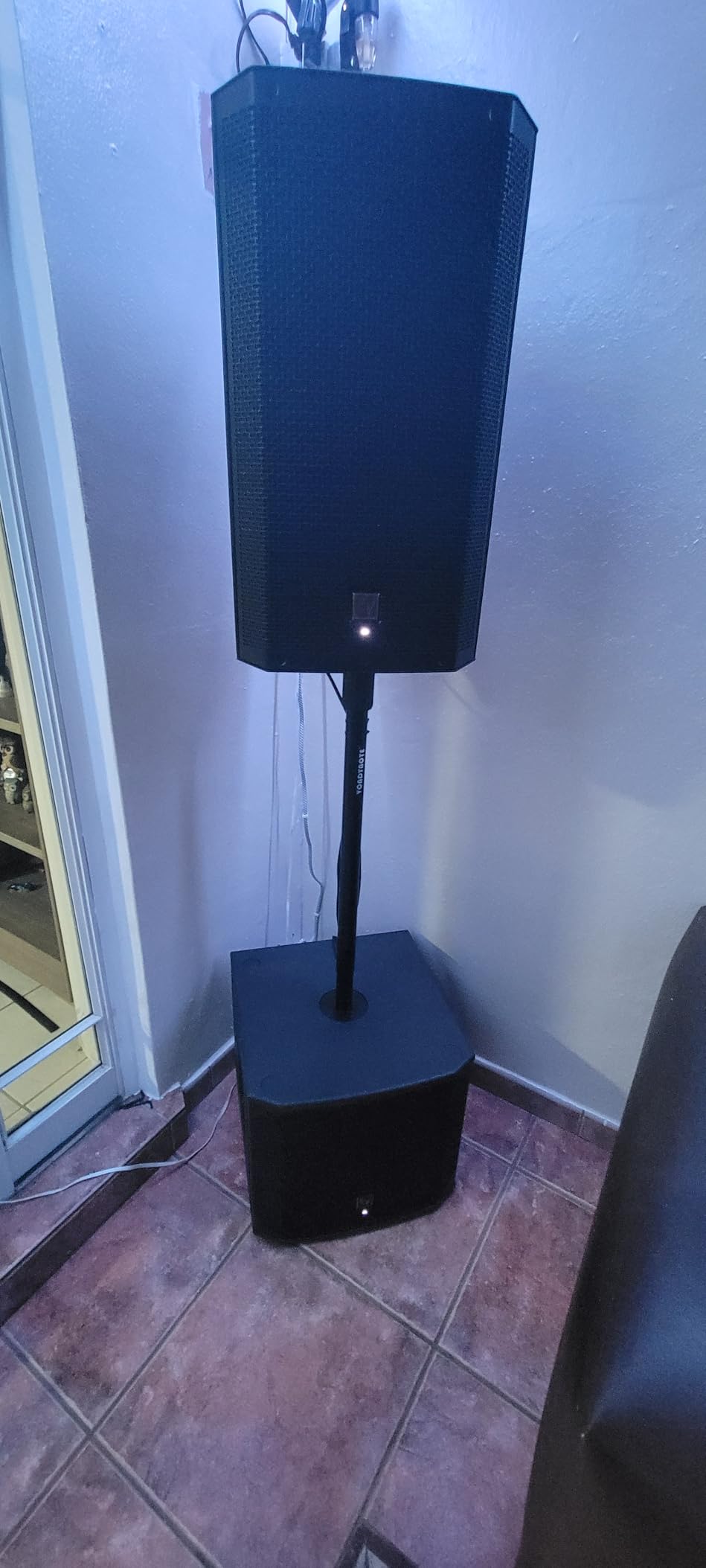
At 53 pounds with an integrated M20 threaded pole mount plate and a two-handle design, this is the easiest sub in the list to move. It is the one to buy if you load in alone, if your venue has stairs, or if you are setting up in a bar where the load-in window is ten minutes.
QuickSmart brings the same three presets, sub and top system-match, five user-programmable presets, visual limiter monitoring, input level control and master volume that the 18-inch model has, plus selectable low-pass filtering over Bluetooth Low Energy.
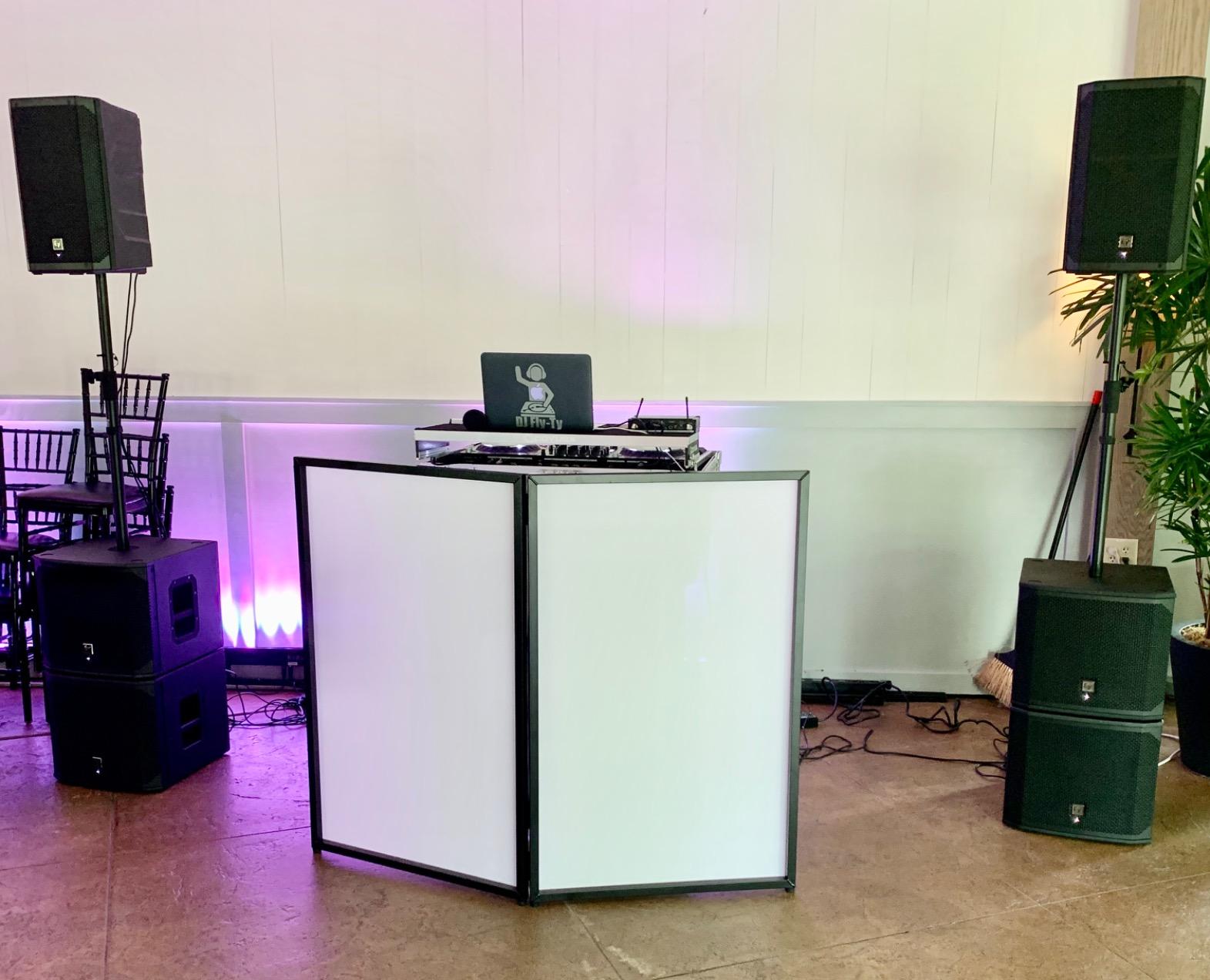
Why 12 inches suits a small room
Engineers warn that large 18-inch subs excite room modes and can make small venues boomy, which is why compact subs are often preferred for jazz, acoustic and folk work. A 12-inch in a small room is faster, cleaner and easier to place, and it will not overpower a quiet acoustic set.
The other argument is budget. A single strong sub often eats an entire equipment budget, and buying two mediocre subs is a common regret on forum threads. A well-reviewed compact model plus money left for good mains is a better system than two compromised subs.
Who should look elsewhere
If you need genuine sub-bass for EDM or hip-hop, a 12-inch driver will not get you there, however good the cabinet is. Its usable low end sits in the low 50Hz range, so treat it as a low-end extender for a small room rather than a sub-bass instrument.
It also ships with a low-pass filter only. Your tops need high-pass filtering, or you need an outboard crossover, or the two will overlap. And the app dependency is real friction if your load-in window is short and you would rather press one button.
8. Behringer EUROLIVE VP1800S 18-Inch Passive Subwoofer – Best for School Gyms and Large Halls
Behringer EUROLIVE VP1800S Professional 1600 Watt 18″ PA Subwoofer
- Deep low end that fills medium venues and large school gyms
- Long throw felt at the back of a 350-person room
- Durable enough to survive a drop onto concrete
- Passive only so a substantial external amplifier is required
- SpeakON and quarter-inch inputs only with no line-level input
- Thin awkward handles can mark the palm
- Light-duty carton regularly results in transit damage
- Box joints can loosen and produce a resonant whine
The VP1800S is a long-serving design that still holds up well in a fixed installation. It is a passive 8-ohm cabinet rated 1600W peak and 400W continuous, with a pole socket, metal grille and ergonomically shaped handles.
Owners report it filling 350-plus-person venues successfully, and multiple long-term users describe it delivering impressive bass output for a fraction of the price of commercial 18-inch subs. Long throw is the recurring word, and several mention feeling it at the back of a large room.
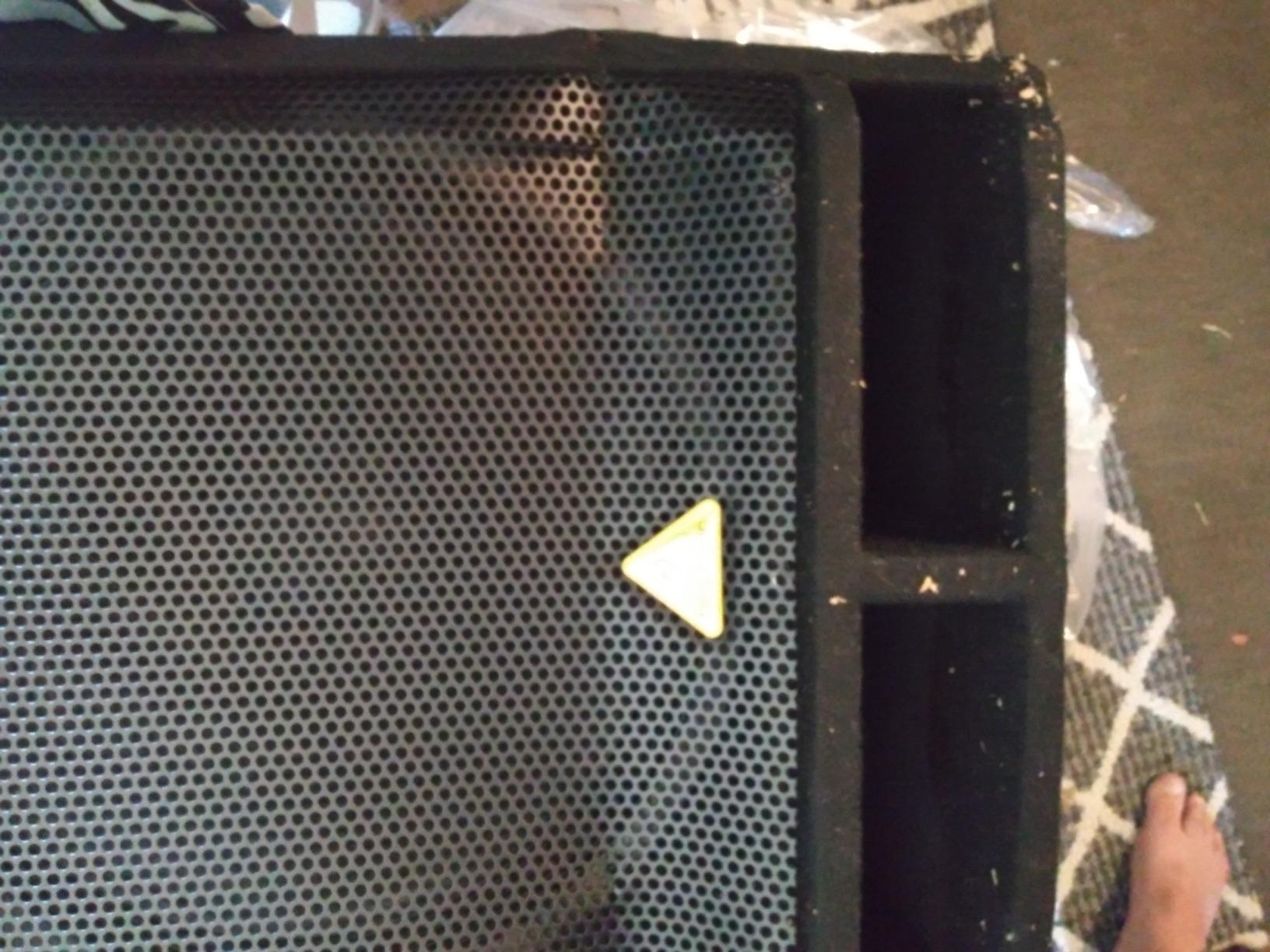
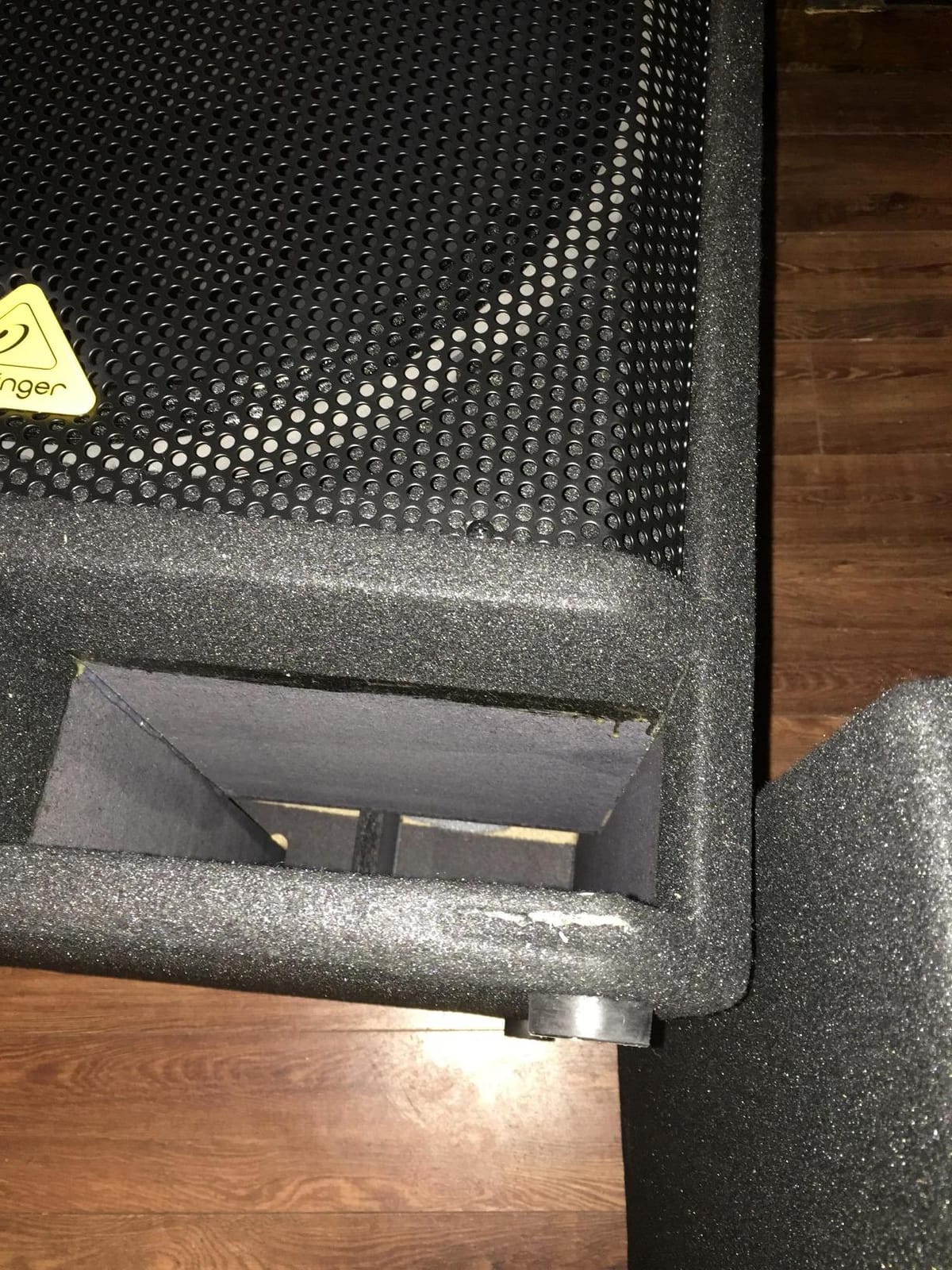
As a passive design it slots into any rack with a clean 8-ohm channel, which is why it shows up in schools, churches and halls where a technician owns the amplifier and the speakers are just boxes. The cabinet is reported to survive a drop onto concrete without damage.
At 99.2 pounds it is one of the heavier options, and the handles are thin enough that owners report them marking the palm during transport. Budget for a two-person lift and a decent hand cart if there are steps.
What continuous power really means
The 1600W peak figure is not a working level. Continuous handling is closer to 400W, and reviewers are clear that over-driving risks damage. For a school assembly or a speech-led event that runs at moderate levels, that is plenty. For a loud band, you need amplifier headroom above the continuous rating.
This is also the point forum engineers make repeatedly: powered subs get criticised for lacking headroom compared with dual-18 passive cabinets driven by separate bridged amplifiers. A passive box like this, paired with a good amp, gives you that control if you have the rack space.
Who should look elsewhere
Skip it if you want something you can carry yourself, or if you do not own an amplifier. There is no line-level input, only SpeakON and quarter-inch speaker-level jacks, so a mixer output cannot go straight into it.
Be aware of the two most repeated complaints: light-duty packaging that regularly produces grille or cabinet damage in transit, and box joints loosening after a couple of years to produce a resonant whine at high level. Inspect the cabinet on arrival and tighten the hardware periodically.
9. Mackie SR18S 18-Inch Powered Subwoofer – Deepest Low-Frequency Extension
Mackie SR18S, 18-Inch 1600W Professional Powered Subwoofer
- Deepest listed low-frequency extension here at 33Hz
- 133 dB max SPL that stays clear at high level
- Flat Deep and Punch voicing presets
- Manageable 87.7-pound cabinet with 1600W Class-D
- 3-year electronics warranty
- Cabinet finish chips and nicks easily in transport
- Two-person lift at about 88 pounds
- No app or wireless control despite the modern feature set
- Heavier and costlier than the budget 18-inch options
The SR18S is the one to buy when the brief is depth. Its published frequency response runs 33Hz to 200Hz, the deepest low end of any sub in this roundup, with a maximum SPL of 133 dB from a 1600W Class-D amplifier. That combination is what makes an 808 or a sub-bass drop felt rather than merely heard.
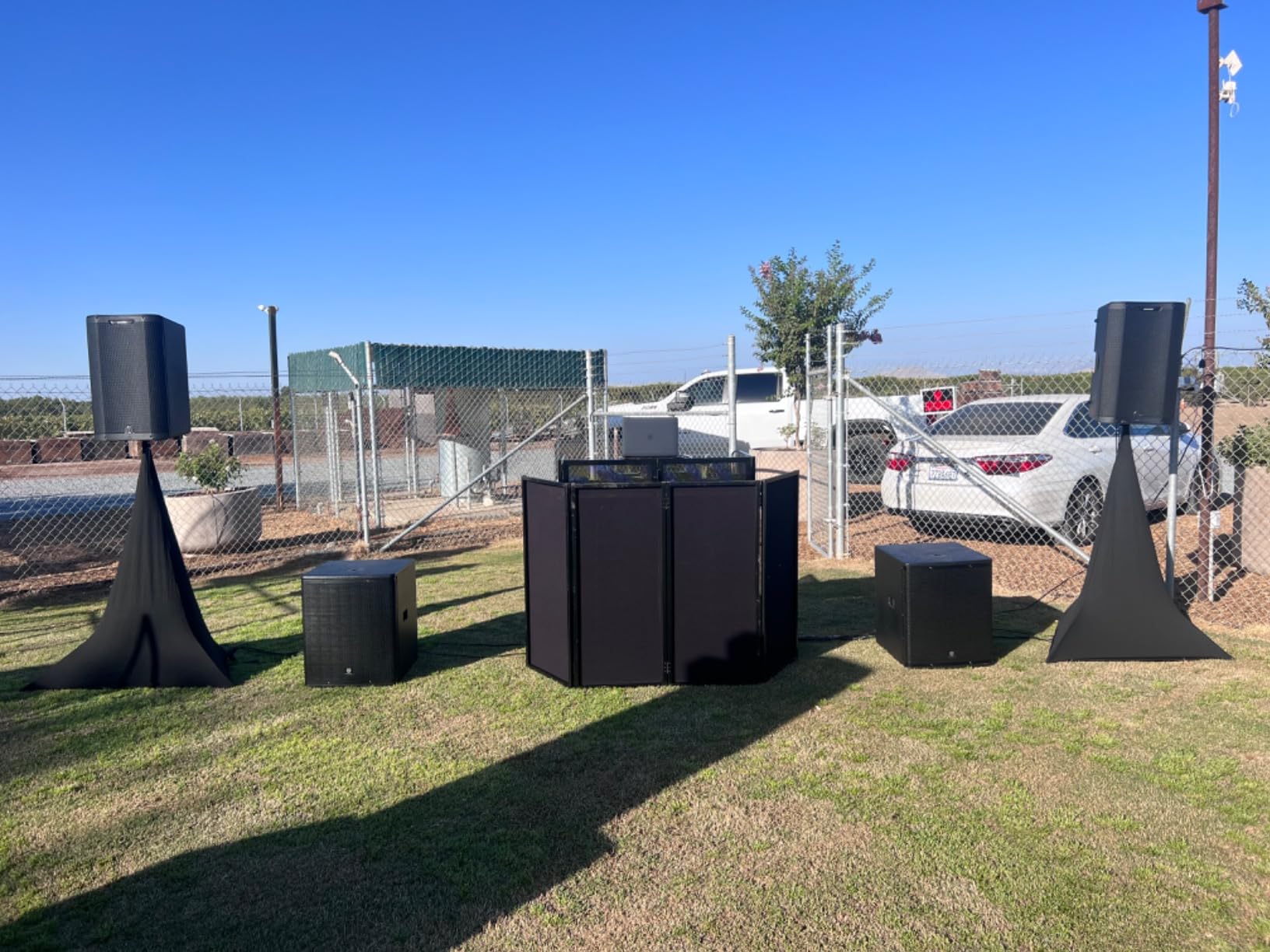
Owners describe it as exceptionally loud while staying clear at high levels, and long-term band and DJ owners report buying multiples for outdoor events. The Deep voicing preset is the one that gets singled out for sounding noticeably deeper than cheaper 18-inch subs.
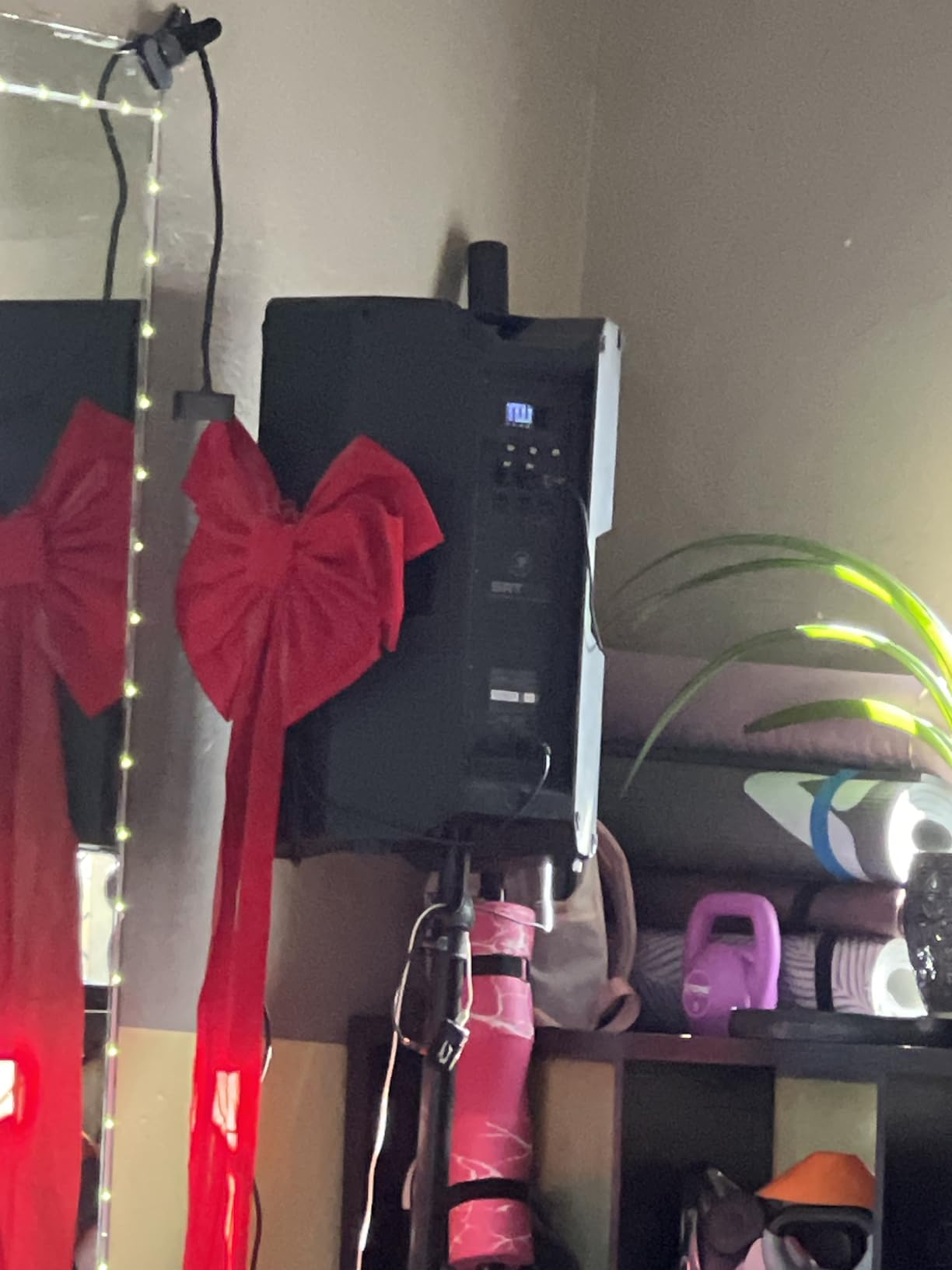
There are three custom voicing presets: Flat, Deep and Punch. Flat for a clean starting point, Deep for sub-bass-heavy material, and Punch for a tighter, more aggressive low end on rock and metal. That is quick, meaningful tonal control without a laptop.
Variable crossover and XLR connectivity suit both live and mobile rigs, and the warranty runs three years on electronics with two years on drivers, which is longer than most of the field. At 87.7 pounds it is mid-weight for an 18-inch powered box.
Best for EDM, hip-hop and bass-driven modern music
Community advice is consistent on genre matching: 18-inch drivers for 808s, hip-hop and EDM drop impact, 12-inch for acoustic, jazz and folk warmth. This is the pick on that side of the divide, and the 33Hz figure is why.
For rock and metal it is equally strong, because faster transients and double-pedal bass playing reward the headroom that 1600W of Class-D provides. Punch voicing is the preset engineers reach for in that case.
Who should look elsewhere
Do not buy it for a small room. A sub that extends to 33Hz excites room modes hard, and in a bar or a small club you will spend the night fighting boom. The ALTO TS12S or the ELX200-12SP are more appropriate there.
The most repeated complaint is cosmetic: the cabinet coating chips and nicks easily during normal transport. If your sub lives in a van, put it in a cover. And with no app or wireless control, every adjustment happens at the rear panel.
10. PRORECK SP-18X 18-Inch Powered Subwoofer – Best for Weddings and Part Bands
- 800W RMS output that punches well above the price
- Monitor DJ and Live DSP presets
- Electronic crossover plus a 120Hz high-pass XLR output
- Plywood cabinet reduces resonance
- Reported to carry a 250-person room at about 30% volume
- Response concentrates in the high 30s to mid-40s Hz
- Heavy at 86.5 pounds with no casters
- Non-locking XLR inputs are a risk in mobile use
- Limit indicator monitors input only with no output protection
The SP-18X is a strong middle ground: an 800W RMS, 3000W peak powered 18-inch with an 80oz magnet and 3-inch voice coil, running a built-in Class-D amplifier. Performers who work regular gigs and parties rate it as one of the best value powered 18s available.
The standout owner report is specific and useful: one performer carried a 250-person reception with a single unit at around 30% volume. That is the kind of headroom you want at a wedding, where the band plays at half volume for dinner service and full volume for the first dance.
Three DSP presets cover Monitor, DJ and Live, and the electronic crossover sweeps 35Hz to 120Hz with a dedicated XLR high-pass output from 120Hz up to 20KHz. That filtered output is the practical feature: one cable to your mains, no external crossover box.
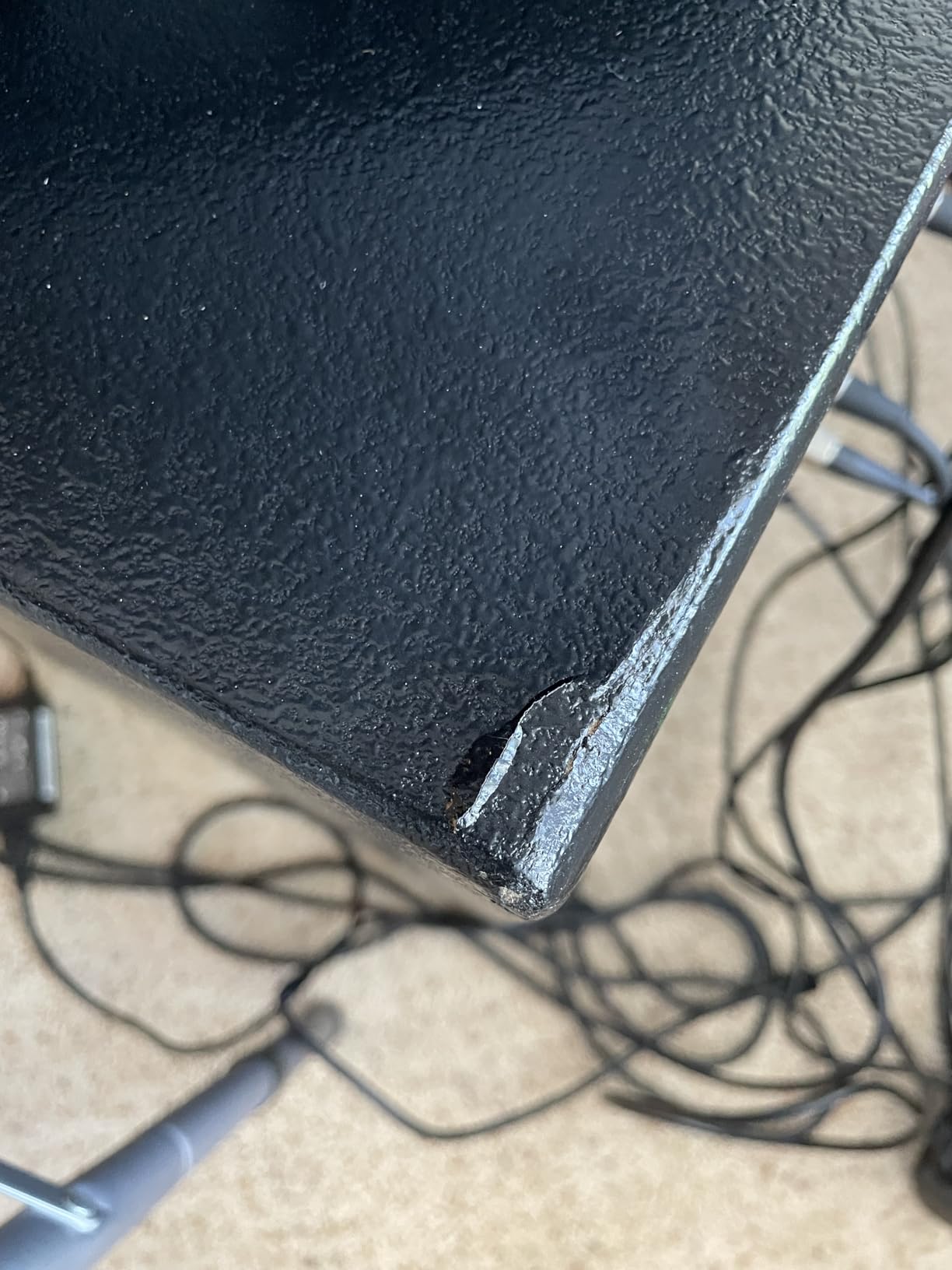
The plywood housing is specified to reduce resonance compared with plastic cabinets, which helps on a transient-heavy set. Two side handles are provided, and the listed item weight is 86.5 pounds.
Why part bands and wedding DJs like it
The Monitor preset exists for exactly this use case, letting a player hear low end without it dominating the stage. For a drummer or bassist sharing a sub on a small stage, the preset plus the electronic crossover gives you a workable starting point in seconds.
The 120Hz high-pass XLR output also solves the common small-mixer problem in a way most budget subs do not, because you can feed mains from the sub directly.
Who should look elsewhere
Response concentrates in the high 30s to mid-40s Hz and does not reach subsonic range, so deep 808 material will not have the same weight as on the Mackie SR18S. If sub-bass depth is the priority, spend the difference there.
At 86.5 pounds with no casters, you need a hand cart for steps. The non-locking XLR inputs are a real risk in mobile use, since a cable can work loose mid-set, and the limit indicator watches input level only rather than output protection. There are also occasional reports of units arriving distorted or low-powered, so check it early.
11. ALTO TS12S 12-Inch Powered Subwoofer – Best for One-Person Load-Ins
- 130 dB output from a 2500W Class-D amplifier
- Lightweight 57.1 pound cabinet with a compact footprint
- Three DSP EQ modes including a Live setting
- Phase alignment control
- Internally braced front-ported MDF cabinet
- Electronic clip thermal and transducer protection
- Listed frequency response of 95Hz makes it a low-end extender
- A 12-inch driver cannot match 18-inch low-frequency extension
- No app or wireless control
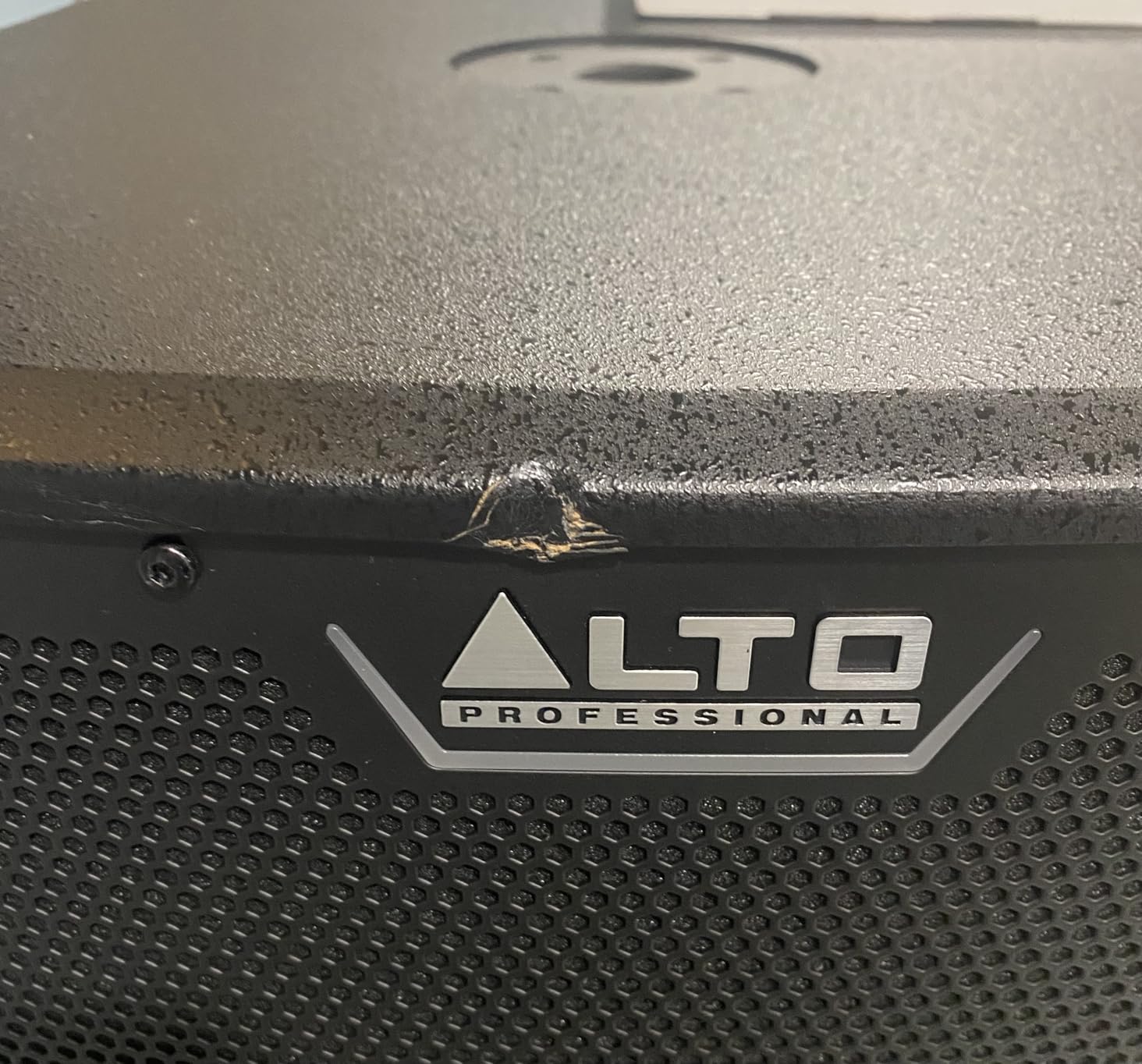
- Reports of units arriving with damage
Weight is the number one practical complaint about 18-inch subs, and this is the answer to it. The TS12S puts out 130 dB from a 2500W high-efficiency Class-D amplifier driving a 12-inch driver with a 3-inch voice coil, and the cabinet weighs 57.1 pounds.
Owners pick it out as one of the easiest subs in the set to transport, with the weight and small footprint being the deciding factor for anyone moving a PA frequently. Sound quality is described as clean and well balanced for a 12-inch driver, which is the harder thing to achieve.
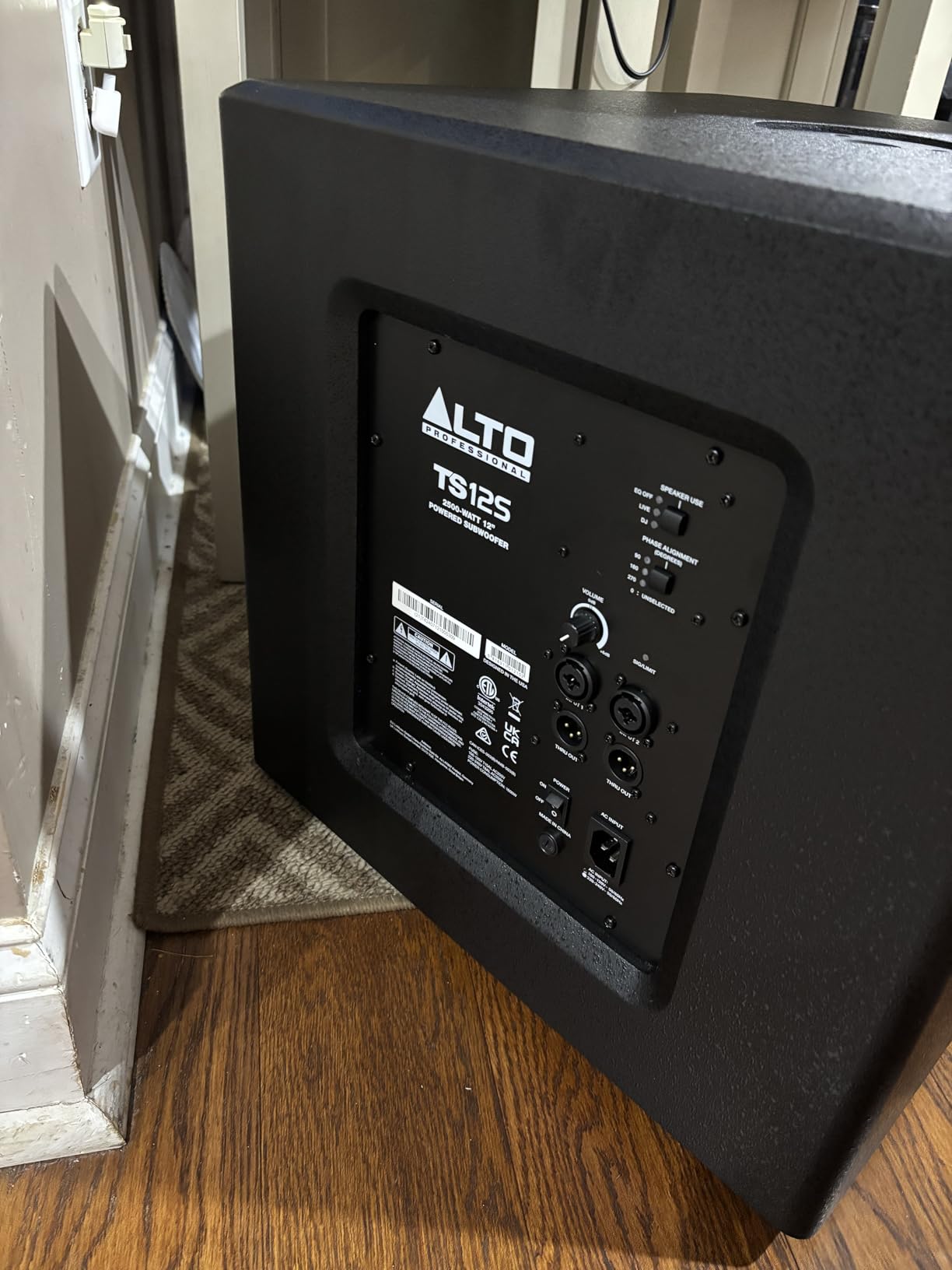
The DSP matches the bigger TS18S: a Speaker Use Button cycles EQ Off, Live and DJ, with phase alignment control to compensate for low-frequency cancellation in a mixed system. The Live mode is credited with making it easy to add low end to an existing live rig without a long EQ session.
Cabinet construction is good for the weight: internally braced, front-ported MDF with a mark-resistant splatter-spray finish, an integrated 36mm pole socket and electronic clip, thermal and transducer overdrive protection. Two XLR plus quarter-inch inputs and two XLR outputs give you real routing options.
How a 12-inch behaves in a small room
A 12-inch driver moves less air per excursion, so in a room with a ceiling height under about 12 feet it will sound tighter and faster than an 18. For a bar, a small church hall, a rehearsal room or a wedding dinner service, that is usually the better result, not the compromise.
Paired with the phase alignment control, it also works well as an addition to an existing system where you do not want to re-tune the whole rig. It will not overpower a quiet acoustic set, which matters more than raw output for a lot of gigs.
Who should look elsewhere
The listed response of 95Hz makes this a low-end extender rather than a sub-bass subwoofer, and a 12-inch driver cannot match the low-frequency extension of any 18-inch here. Club music, modern R&B and bass-heavy electronic sets will outrun it.
There is also no app or wireless control, so changes are made at the rear panel, and there are reports of units arriving with transit damage. Inspect the cabinet and grille before the first show.
12. Peavey PV 118 18-Inch Passive Subwoofer – Best for Rental Fleets
- Deep low-frequency extension deeper than many rivals
- Rugged build with corner protectors and a metal grille
- Reported to survive a two-foot drop onto concrete
- Compact 18-inch format eases transport
- Long-term owners report years of reliable service
- 5-year limited warranty
- Passive and rated at only 400 watts so it needs a capable amplifier
- Some units have a pole mount made of cardboard
- Thin internal wiring and minimal polyfill
- Onboard crossover sounds worse than outboard DSP
The PV 118 is the durability pick. Long-term Peavey users treat it as a dependable workhorse rather than an enthusiast sub, reporting years of reliable service across weddings, church services and band rehearsals. The 5-year limited warranty is the longest in this roundup.
It is an 18-inch passive cabinet rated at 400 watts, and owners note that a pair lets the main PA run at a lower apparent level while still filling the room. Bass extension is consistently described as deeper than other 18-inch cabinets at a similar price point.
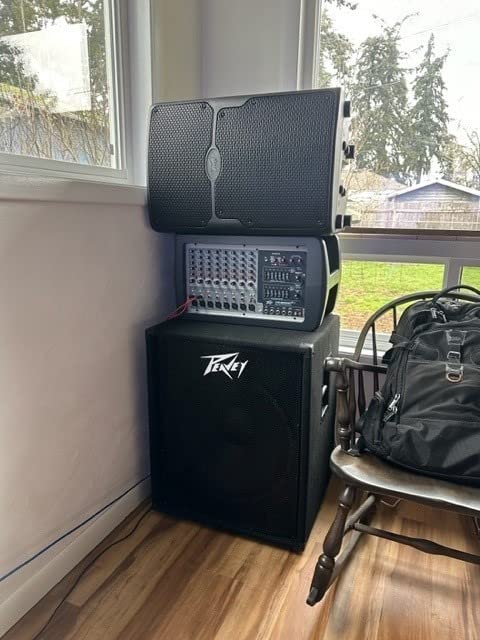
Build quality is where it earns its keep. It is reported to survive a two-foot drop onto concrete without cabinet damage, and the compact 18-inch format at 70.9 pounds is easier to move than most full-size 18s. Solid corner protectors and a sturdy metal grille take the punishment of a rental truck.
A rear-panel crossover is present on early production units, and a pole mount is included for stacking a top. Note the teardown findings, though: some units have a pole mount made of cardboard rather than a solid cap, internal wiring is thin 18AWG, and polyfill is minimal.
Why fleets buy this one
Reliability over time is the number one trust signal engineers cite, and this box has it. A cabinet that survives being dropped, loaded repeatedly and driven hard by different operators is worth more to a rental company than one with better specs and a coating that chips.
The 400-watt rating means it wants a good external amplifier with headroom. Feed it a capable channel and it will hold level in a medium room; feed it too little amplifier and you will be asking for more than it gives.
Who should look elsewhere
It will not deliver the volume of a modern powered 18-inch sub, so it is the wrong choice for a loud club night or a festival stage. If you need raw output without an amplifier, choose a powered model.
Teardown reviewers also consider the onboard crossover inferior to an outboard digital crossover and EQ, so budget for external processing if you care about the low end. For a straight stereo or mono PA in a hall or a church, it is fine as is.
How to Choose a Subwoofer for Live Sound?
The nine criteria that actually matter
Start with these nine, in this order, and ignore everything else on the box until they are answered.
1. Frequency response. Look for a published low-end figure. 33Hz to 40Hz covers real sub-bass. Above 100Hz and you are buying an extender, which is fine for speech and worship but not for a dance floor.
2. Max SPL. Compare figures only when the measurement method is the same. The industry standard is 1W/1m half-space sensitivity; some brands publish corner-loaded or 1/8th-space peak figures that inflate the number by roughly 12 dB.
3. Power rating. RMS matters more than peak. A 400W RMS amplifier with headroom beats a 2000W peak number every time, and commenters on live sound forums are blunt that wattage claims are usually marketing.
4. Driver size. 12 inches for compact rooms and acoustic material, 15 for a middle ground, 18 for output and sub-bass depth. This single choice affects weight, portability and tonal character more than any other.
5. Crossover flexibility. A variable crossover plus a high-pass filtered output saves you an external processor and a cable run. Check whether the filtered output exists and at what frequency.
6. Connectivity. XLR combo inputs and thru outputs are the standard. RCA is convenient but not ideal for long runs or a noisy stage. Non-locking XLR is a mobile-use risk.
7. Polarity and phase control. A 0 to 180 degree phase switch and delay let you time-align subs to mains, which is what makes a sub disappear into the mix instead of sitting in front of it.
8. Enclosure and grille. Braced plywood or MDF with corner protection survives a rental truck. A thin plastic shell saves weight and loses the argument with a loading bay floor.
9. Weight and transport. Listed weights in this category run from about 53 pounds to nearly 109 pounds, and the heavy end is where people give up on subs entirely. Check whether casters are included, whether they are recessed, and decide honestly whether you are loading in alone.
12-inch vs 15-inch vs 18-inch: which size for which venue
Pick 12 inches for rooms up to about 150 people, bars, small clubs, rehearsal spaces and any acoustic or jazz set. The ALTO TS12S at 57.1 pounds and the ELX200-12SP at 53 pounds are both genuinely solo-loadable.
Pick 15 inches for the middle: a mid-size room where you want more output than a 12 but not the weight and room-mode problems of an 18. No 15-inch models appeared in our test group, which is itself informative about where the value sits in 2026.
Pick 18 inches for anything above 200 people, and for EDM, hip-hop, modern R&B and metal. The trade is weight: every powered 18 in this group weighs between about 64 and 109 pounds, and large 18s excite room modes in small spaces. The Mackie SR18S is the deepest option at 33Hz; the ALTO TS18S is the loudest at 137 dB.
Powered vs passive subwoofers for live sound
A powered sub has an amplifier inside, takes a line-level feed from the mixer, and works the moment it is plugged in. That is the right choice for almost every band, DJ and worship team, and nine of the twelve models here are powered.
A passive sub is a driver in a box waiting for an amplifier. It is the right choice if you already own rack amps, if you want to run several cabinets off bridged channels, and if your technician owns the whole signal chain.
Engineers on r/livesoundgear note that powered subs are often criticised for a lack of headroom compared with dual-18 passive cabinets driven by separate bridged amplifiers. That is a real argument, but it only applies if you already know what you are doing with a rack.
Crossover frequency and the 80-120Hz starting point
Start at 100Hz and adjust. That is the most common crossover point for a live PA because it sits below the fundamental range of most vocals and guitars while staying above the room’s problem frequencies.
Move down to 80Hz if you have headroom and want more weight on the kick. Move up to 120Hz if your mains are full-range boxes with weak low end and you need the sub to take over a wider band. Always high-pass your mains at the same frequency, and sweep slowly with the programme playing rather than pink noise.
Watch for cancellation. If the sub sits behind the mains and is not time-aligned, output at the crossover point drops and the whole system sounds thin. Delay, phase inversion or physical placement solves it, and that is why phase and alignment controls matter.
Max SPL, half-space sensitivity and reading a spec sheet
Max SPL is the loudest a box will go, and it is the most abused number in the category. Two things inflate it: publishing a peak or 1/8th-space figure instead of a half-space figure, which can add around 12 dB, and quoting an instantaneous peak rather than a sustained level.
To compare two subs fairly, take the rated power in watts, add 3dB for the doubling if one is double the other, and assume a typical half-space sensitivity for a pro driver of that size. Two subs of equal power give about 3dB more than one, not double the volume.
Ignore the P.M.P.O and peak wattage numbers for buying decisions. Read RMS, read the low-end frequency figure, and read the warranty. If a brand publishes only peak power and a corner-loaded SPL, treat all of its numbers as marketing.
Cardioid and end-fire sub arrays
Cardioid is the most useful array technique for live work, and almost no competitor roundup covers it. By delaying a rear-facing sub, you cancel the output behind the stage and keep the low end in front of the audience, which reduces stage bleed that confuses drummers and bassists and causes feedback.
To set one up: place two subs side by side facing the audience, add a third behind, and set its delay to roughly 2.9 milliseconds per meter of extra distance. Most DSPs and several of the subs in this roundup have a phase switch, which is a coarse version of the same trick, and the ALTO models add explicit phase alignment control.
An end-fire array lines all cabinets in a row facing forward, which concentrates output into a narrow horizontal slice for long-throw applications. It needs much finer delay steps than a cardioid pair, so treat it as a job for a digital processor rather than a rear-panel knob.
Sub-mix routing when your mixer has no sub out
Many small and mid-format mixers have no dedicated sub output. The workaround that appears in forum replies is to take a main or monitor output, run it through an external EQ, and feed the sub from there.
On a digital mixer, the cleaner route is a group or bus: put the kick and bass channels into a group, apply a low-pass filter at 100Hz on that group only, and send the group to the sub output. Then high-pass the same channels at 100Hz on the main mix. This is called a sub-mix, and it stops guitars and cymbals from wasting sub headroom.
If you can only send a full-range mix to the sub, set the sub’s own crossover to 100Hz and raise its level only after the mains are dialled. Feeding an unfiltered mix into a sub is the most common cause of a muddy, uncontrollable low end in small venues.
Weight, casters and the one-person load-in reality
Weight is the practical complaint that stops people buying subs at all. Under 60 pounds you can carry it yourself. Between 70 and 90 pounds you are planning a two-person load. Above 90 pounds you need a ramp, a hand cart or a second person, every time.
Check the spec sheet for casters before you commit, because most cabinets in this group list handles only. The Rockville RBG18S is the one model here specified with locking wheel casters, though they are front-mounted rather than recessed, so it cannot be tipped onto them. The PRORECK SP-18X at 86.5 pounds is explicitly reported as having no casters. Recessed casters let a cabinet roll up a ramp without a second person steadying it.
If you are a solo operator, weight should outrank output in your decision. A sub you can get into the venue is worth more than a sub that stays in the garage. Our mixing console buying guide covers the routing side.
Indoor versus outdoor, and five spec-sheet red flags
Outdoors, low frequencies behave differently. There is no ceiling or wall reinforcement, wind moves the air in front of the port and can change how the sub sounds at a distance, and you need power. A sub that comfortably covers 200 people indoors will disappoint you at 200 people outdoors.
Plan for weather too. A carpeted birch or MDF cabinet is not a rain surface, and gear on casters should be on a covered stage or under a canopy. Check whether the amplifier is convection or fan cooled, and whether there is a power distribution point near the sub rather than a long cable run.
Five red flags to check before you buy:
1. Only peak power is published. No RMS figure means you cannot compare it to anything.
2. Max SPL measured at 1/8th space. Ask which method was used. A corner-loaded figure can read 12dB high.
3. A frequency response that starts above 60Hz. It is an extender and will disappoint on bass-heavy material.
4. No high-pass filtered output. You will need an external crossover to feed your mains cleanly.
5. No visible driver protection or metering. A limiter light that only watches input level tells you little about whether the amp is healthy.
Frequently Asked Questions
What is the best subwoofer for live sound?
The best subwoofer for live sound depends on room size and genre. For general-purpose use the Rockville RBG18S balances 18-inch output, a broad input panel and locking casters. For the deepest extension to 33Hz, the Mackie SR18S. For the highest listed output at 137 dB, the ALTO TS18S. For solo load-ins, the 53-pound EV ELX200-12SP.
What is the best powered subwoofer for a PA system?
The best powered subwoofer for a PA system is the one matching your room and mains. Powered models are the right default because they take a line-level feed and need no external amplifier. Look for a variable crossover, a high-pass filtered XLR output for your mains, and an RMS power figure rather than a peak wattage claim.
What is the recommended crossover frequency for a PA subwoofer?
Start at 100Hz for most live PA work, then adjust with the programme playing. Move to 80Hz if you have headroom and want more kick weight, or up to 120Hz if your mains are full-range boxes with weak low end. Always high-pass your mains at the same frequency to prevent overlap.
What hits harder, a ported or a sealed subwoofer?
A ported cabinet hits harder and reaches lower, which is why every large live PA sub in this roundup uses front porting. A sealed design trades output for tighter, more accurate transient response and is easier to EQ. For live reinforcement where impact matters, ported is the standard choice.
What are the subs with the deepest bass?
Among these twelve, the Mackie SR18S has the deepest listed extension at 33Hz, followed by the Rockville RBG18S at 35Hz and the Rockville PBG18 at 35Hz. Several of the more compact models list a low-end figure well above 95Hz, which makes them low-end extenders rather than sub-bass instruments.
Why do my subwoofers not hit as hard as they should?
The usual causes are feeding a full-range mix into the sub, overlapping mains that are not high-passed, and too little amplifier headroom. Also check that the sub is not phase-cancelling against the mains, which happens when it sits behind them without delay. Set a 100Hz crossover, sub-mix only kick and bass, and re-test.
Final Verdict
After working through all twelve, the Rockville RBG18S is our pick for the best subwoofers for live sound in 2026 because it combines genuine 18-inch impact, a wide input panel with XLR, TRS and RCA, DSP voicing and locking casters at 108.9 pounds. It is the box we would put on a truck for a mid-size room without thinking twice.
Take the Mackie SR18S instead if sub-bass depth is the priority, the ALTO TS18S if raw output and Live and DJ voicings matter, and the PRORECK PR18 if the budget is the constraint. For a solo load-in or a small room, the ALTO TS12S and the Electro-Voice ELX200-12SP solve a problem the big 18s create.
Whichever you pick, set the crossover before you set the level, high-pass the mains to match, and sub-mix only the kick and bass. If you want a second opinion on the rest of the rig, our home subwoofer guide covers the consumer side for comparison.