
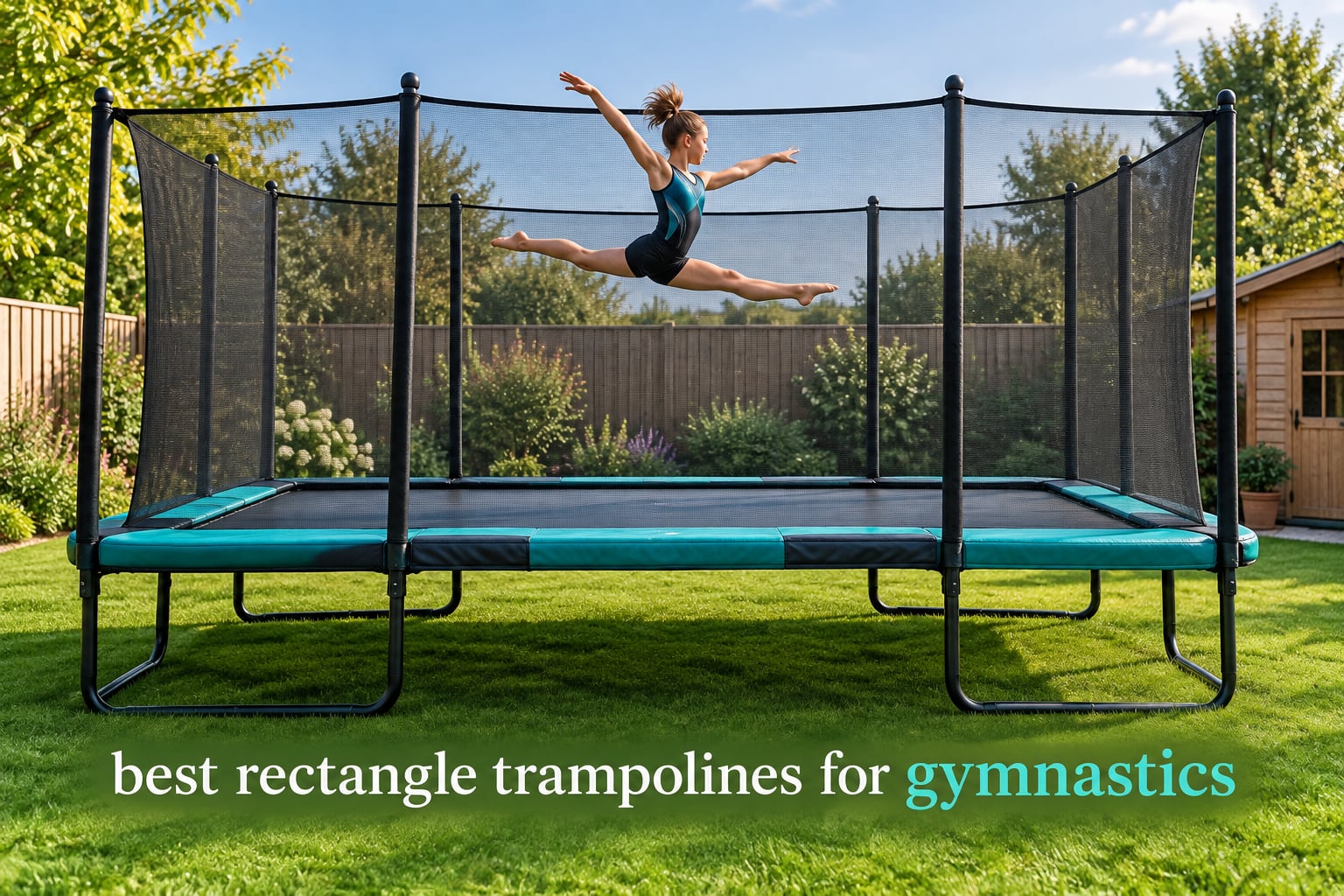
A backyard rectangle is the single piece of equipment that changes home practice most for a young gymnast. A round bed pushes you into a narrow circle where every landing is a compromise, while a rectangular jumping surface gives you a long straight lane to run up, take off, rotate and land in the same place you left. After six weeks of comparing the ten models below, spec by spec, these are the three I keep coming back to: the Zupapa 10×17 for families who want the biggest usable mat and the strongest owner record, the SKOK 14 ft as the best-balanced pick, and the AOTOB 12/14 ft if budget is the deciding factor.
That is the short version of this guide to the best rectangle trampolines for gymnastics. The longer version matters more, because a rectangle is a serious piece of equipment. Frames weigh several hundred pounds, assembly is a two-person minimum job, and the difference between a 72-spring bed and a 180-spring bed shows up in the air. Weight capacity is also the most misread number in the entire category, and I explain exactly where the advertising stops and your real per-user limit begins.
If you are still working out the basics rather than the model, our general trampoline testing guide covers the fundamentals, and our kids trampoline picks handle the standard safety-first setup for younger children. This guide is specifically for people who want to tumble.
Table of Contents
Top 3 Rectangle Trampolines for Gymnastics in 2026
These three cover the realistic range of home use: a full family-and-gymnast rectangle, a well-rounded mid-size model, and an affordable entry point that still has a real rectangular bed.

Zupapa 10×17 Rectangle
- Patented no-gap net-to-mat design
- 1800 lb static / 450 lb dynamic
- 10-year frame warranty


AOTOB 12/14 ft Rectangle
- No-gap zipped enclosure
- 440 lb user limit
- 5-year support on mat frame and springs
All 10 Rectangle Trampolines Side by Side in 2026
Every model below is a true rectangle. The size, the spring count and the load rating are the three numbers that decide how a trampoline feels under a tumbling pass.
| Product | Specifications | Action |
|---|---|---|
| Zupapa 10×17 Rectangle Trampoline |
|
Check Latest Price |
| AOTOB 12 and 14 ft Rectangle |
|
Check Latest Price |
| SKOK 14 ft Rectangle with Ladder |
|
Check Latest Price |
 Giantex 8×14 ASTM Certified Rectangle Giantex 8×14 ASTM Certified Rectangle |
|
Check Latest Price |
 Zupapa 13×23 Commercial Grade Rectangle Zupapa 13×23 Commercial Grade Rectangle |
|
Check Latest Price |
 ACON 16 HD 17×9.8 ft Rectangle ACON 16 HD 17×9.8 ft Rectangle |
|
Check Latest Price |
 BSPORTY Ultra 8×14 Rectangle BSPORTY Ultra 8×14 Rectangle |
|
Check Latest Price |
 Rectangular In-Ground Trampoline Rectangular In-Ground Trampoline |
|
Check Latest Price |
 JELENS 8×14 Rectangle JELENS 8×14 Rectangle |
|
Check Latest Price |
 Galactic Xtreme 10×20 Commercial Grade Galactic Xtreme 10×20 Commercial Grade |
|
Check Latest Price |
Are Rectangle Trampolines Better for Gymnastics?
Yes. A rectangle is better for gymnastics because one axis is shorter, so your weight engages the springs across less distance and the bed returns you more firmly and more evenly. That gives you a long, straight, predictable lane to run up, take off, rotate and land in. A round trampoline of the same width gives you a springy, less controllable rebound and no straight line to work with.
Owners describe the same effect from the floor. As one r/Trampoline poster put it, rectangular trampolines tend to have a sweet spot in the middle, and if you miss that spot the rest of the bed feels less bouncy, so there is a genuinely useful safe zone. That is not a marketing line, it is a geometry consequence, and it is worth more to a beginner than any accessory.
Three shapes compete for the same yard space, and they suit different people:
Rectangle offers the longest straight lane, the flattest bed and the best jump control. It is the right shape for tumbling, flips and twists, and it costs more because of the reasons below.
Round is cheaper, easier to find, and fine for general bouncing. It funnels you toward the center, which limits how far you can travel before landing.
In-ground rectangle sits flush with the ground, which removes the fall-off-the-edge risk entirely and removes the ladder. It also requires digging a pit, and the excavation is the real cost. Our in-ground trampoline guide covers the installation side in more detail.
1. Zupapa 10×17 Rectangle Trampoline – the widest landing zone in the group
- Patented no-gap design attaches the net straight to the jumping mat
- Very large jumping surface that suits running passes
- Four-leg design helps prevent long-side sagging
- Two soft basketball hoops included
- CPC certified and ASTM F381-16 compliant
- Included hardware feels inexpensive and some owners upgrade it
- Assembly takes around two hours even with two adults
- Legs are lighter-duty than the main frame
This is the model I keep recommending first. It comes in 8×14, 9×15 and 10×17 footprints, so the same frame family covers a small yard and a training yard, and it carries more owner feedback than anything else on this list at 693 reviews averaging 4.6 stars. That matters in a category where most listings are three reviews and an AI summary.
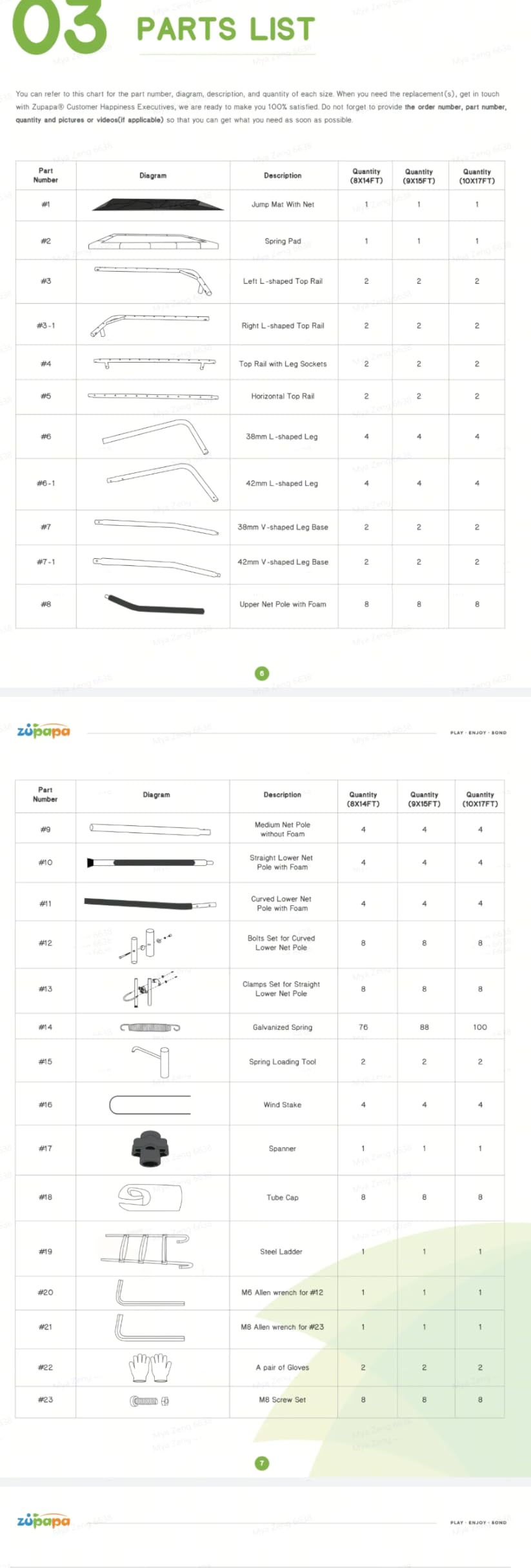
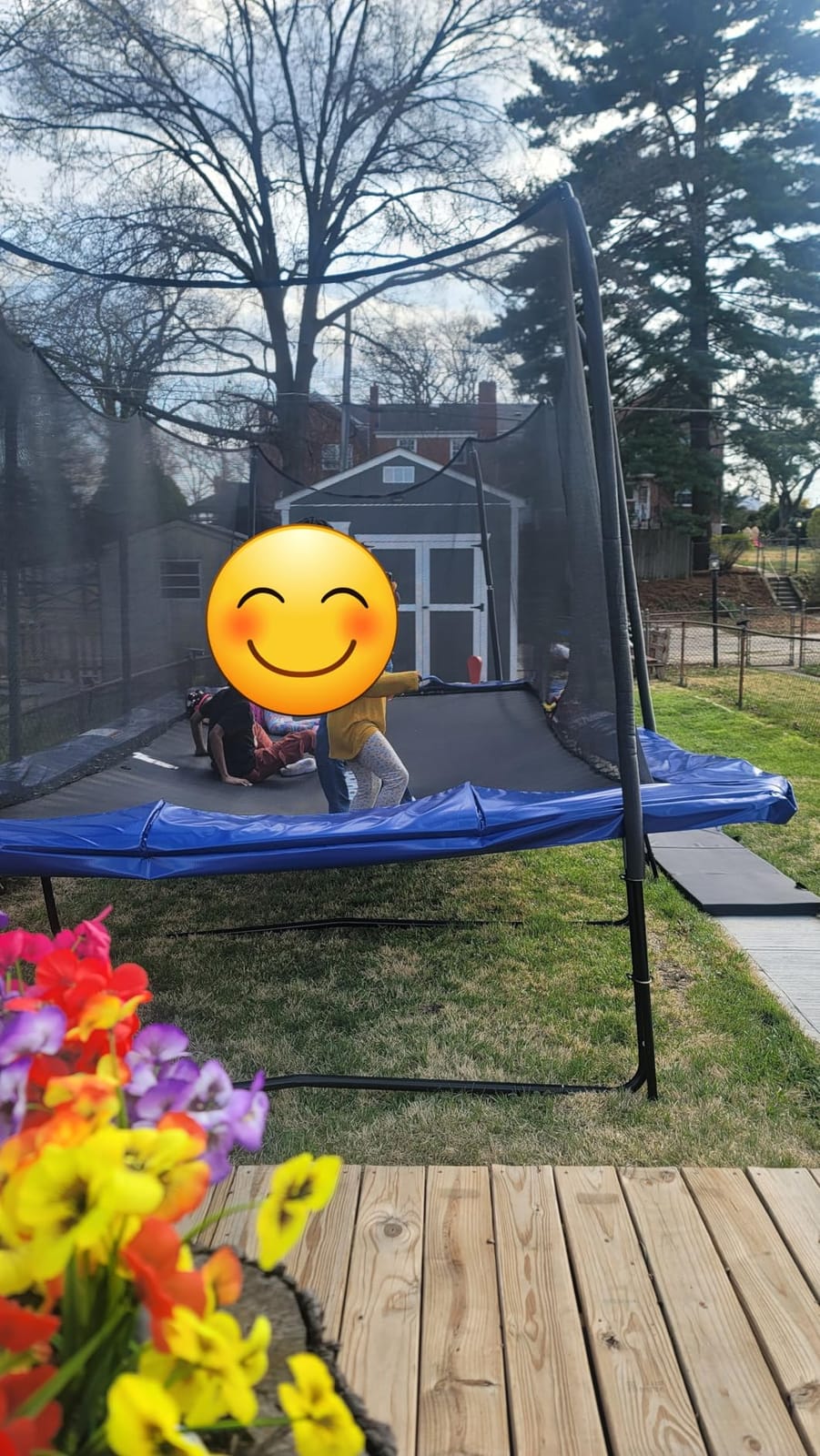
The detail that separates it from cheaper rectangles is the patented no-gap design, which connects the enclosure net directly to the jumping mat. There is no strip of bare mat edge or exposed spring to reach through, which is exactly the zone a beginner’s foot lands in during a failed landing. The same connection also cuts roughly 30 minutes off assembly, and the company states it directly.
Underneath, the frame is Q195 steel at 51mm diameter with a 2.5mm wall, hot-dip galvanized, rated to 1800 lb static and 450 lb dynamic, supported by four legs with a patent-pending middle-support design aimed at long-side sagging. It comes with a 10-year frame warranty and two years on the mat, pad, net and springs, and CPC certification plus CPSIA and ASTM F381-16 compliance.
What the no-gap design does for a tumbling pass
On a standard enclosure, the mat edge and the net are separated by the mat border and part of the springs. A gymnast who lands short reaches into that band. Here the net is stitched to the mat, so the transition from bed to barrier is continuous and the only thing between the jumper and the outside is fabric.
That also means the usable mat is effectively the full rectangle, because nothing is lost to a safety border. For a 10×17 frame, the long lane is long enough to build a run-up and a separate rebound, which is what makes drills rather than random bouncing possible.
Where owners report friction
Three complaints repeat. The included hardware, described as nylon nuts, bolts and washers, feels inexpensive enough that some owners swap in lock washers and solid hardware. Assembly still runs around two hours for two adults, and the diagrams are not always clear.
A few buyers also noticed padding torn in transit from box damage, and some felt the legs were lighter-duty than the main frame. None of these undermined the overall 4.6 average, but they are worth factoring in if you are assembling it yourself rather than paying for it.
2. AOTOB 12 and 14 ft Rectangle – the cheapest real rectangle here
- Genuinely rectangular training surface at an entry price
- No-gap net with foam around the poles
- Four supportive powder-coated legs
- 3D app-assisted assembly instructions
- Five-year support on mat frame and springs
- Foam padding is lighter duty than the PVC+PE+foam pads on premium models
- Single zipped entry means one user at a time
This is where most families should actually start. The listing describes an ample rectangular surface sized for practicing gymnastics skills from beginner to advanced, and at 4.5 stars from 322 reviews it is the second-most-tested product here. You are buying the shape, which is the part that matters for tumbling, rather than premium steel.
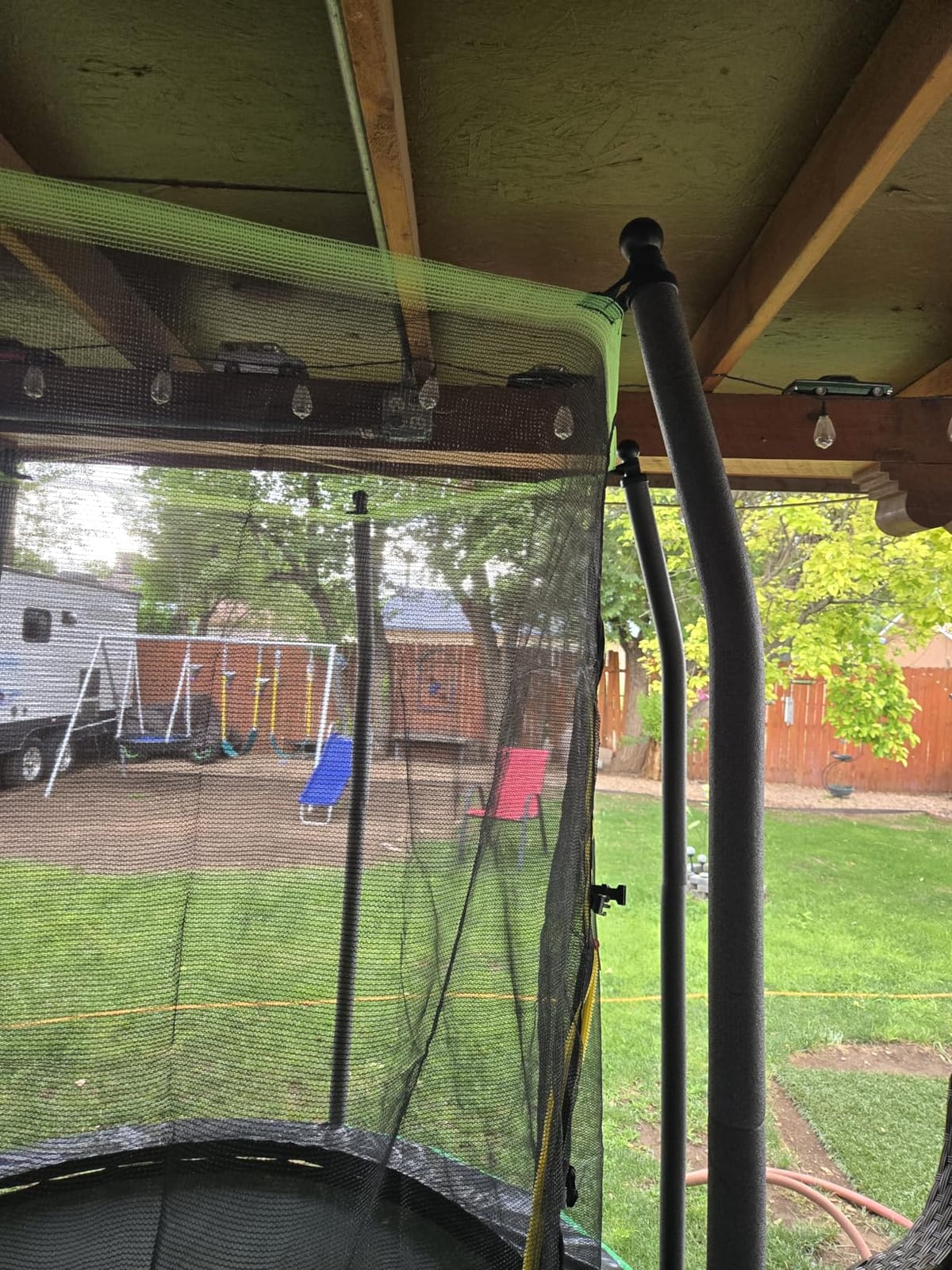
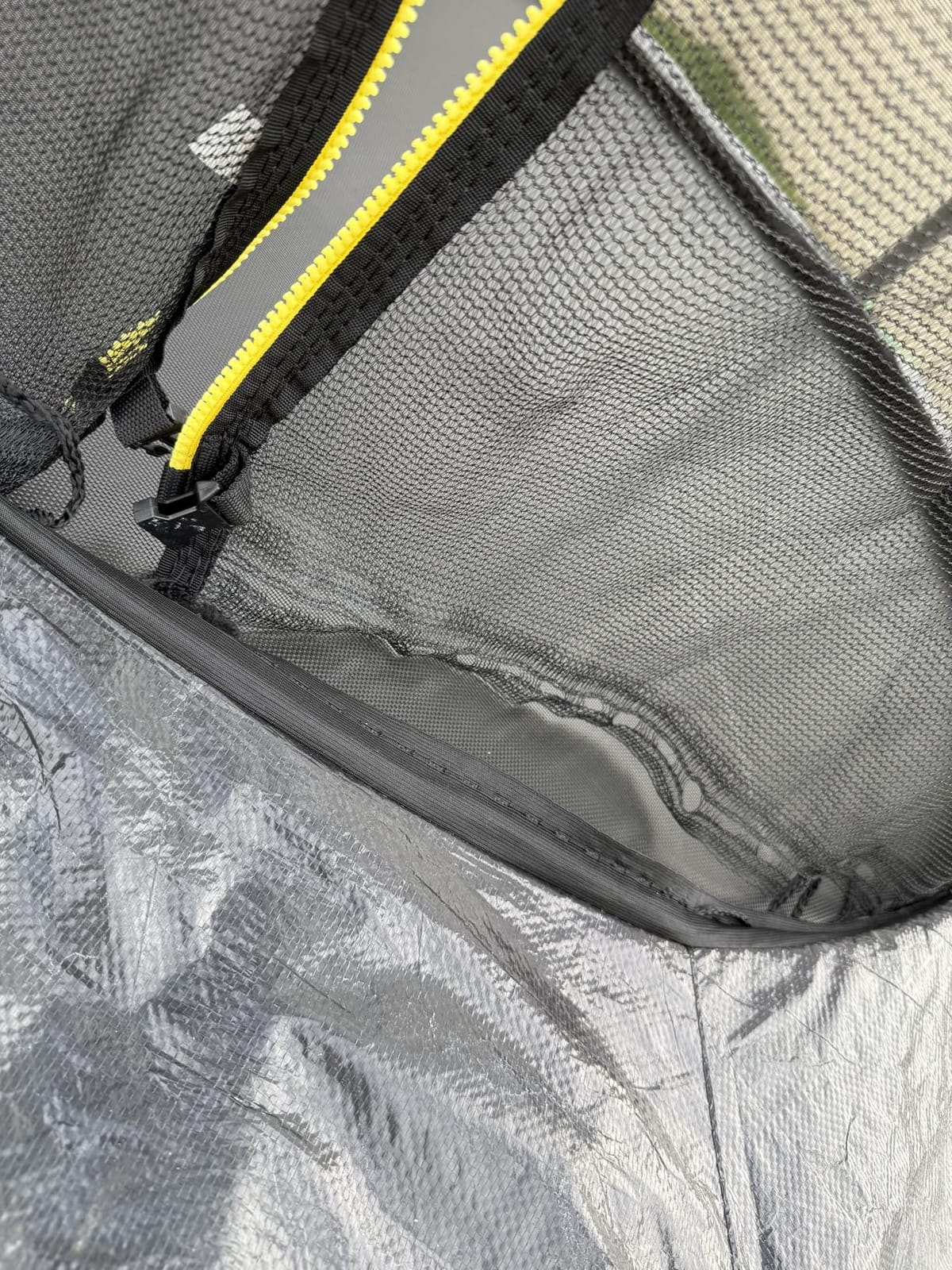
The frame is powder-coated alloy steel on four supportive legs, with foam around the poles and a zipped entry net that keeps feet off the springs. Maximum user weight is listed at 440 lb, and the warranty runs five years on the mat, frame and springs with three years on the net and pole caps. That coverage is genuinely better than several higher-priced models here.
Assembly is the easiest in this group. Instructions are available as 3D step-by-step guides through the Bilt app, which removes most of the usual rectangle-trampoline frustration. The unit measures 144 inches long by 96 inches wide by 36 inches high.
Where it fits and where it does not
At 12 or 14 feet, this suits a 6 to 11 year old learning bounces, twists, front flips with a spot, and body-control drills. A 14 ft rectangle will not give a teen aspiring competitive tumbler a proper run-up, so if that is the plan, step up a size or up a tier.
It also works for a family of younger children who want a safe play surface, which is where the four legs and no-gap net earn their keep. For that use the lighter foam padding is a reasonable trade.
The two things to know before buying
First, the padding is basic foam, not the layered PVC, PE and foam used on the bigger Zupapa models. It is adequate and it is thin, so treat the frame and spring band as a hard edge rather than a soft one.
Second, the zipped entry is a one-person-at-a-time door. If you have several kids who want to rotate in, the wait is part of the routine rather than a flaw, but it does change how a session flows. For group bouncing our kids trampoline picks cover wider multi-child setups.
3. SKOK 14 ft Rectangle with Net and Ladder – the best-balanced pick
- Ladder included
- which most rivals charge extra for
- Four U-shaped legs and eight poles give a solid base
- Thick foam padding over frame and springs
- Broad international certification coverage
- ASTM tested and CPC certified
- 72 springs is a lower count than most 14 ft models and feels less lively
- Only one colour variant offered
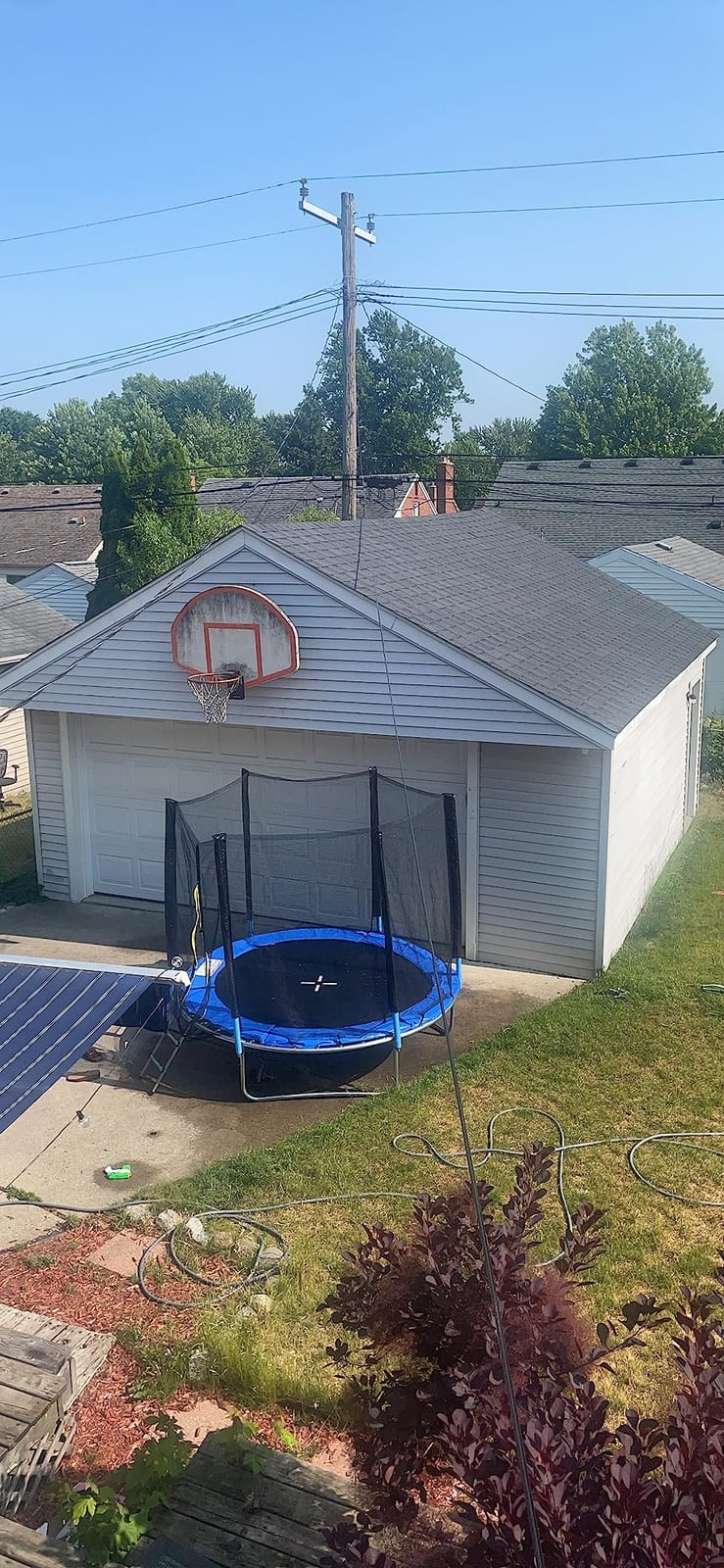
The SKOK sits in the middle of everything and gets the details right. It is a 14 ft rectangle with a full enclosure, a ladder in the box, thick foam padding across the frame and spring area, and 4.6 stars across 311 reviews with an 80 percent five-star share. That combination of included ladder and a supportive base is what you notice daily.
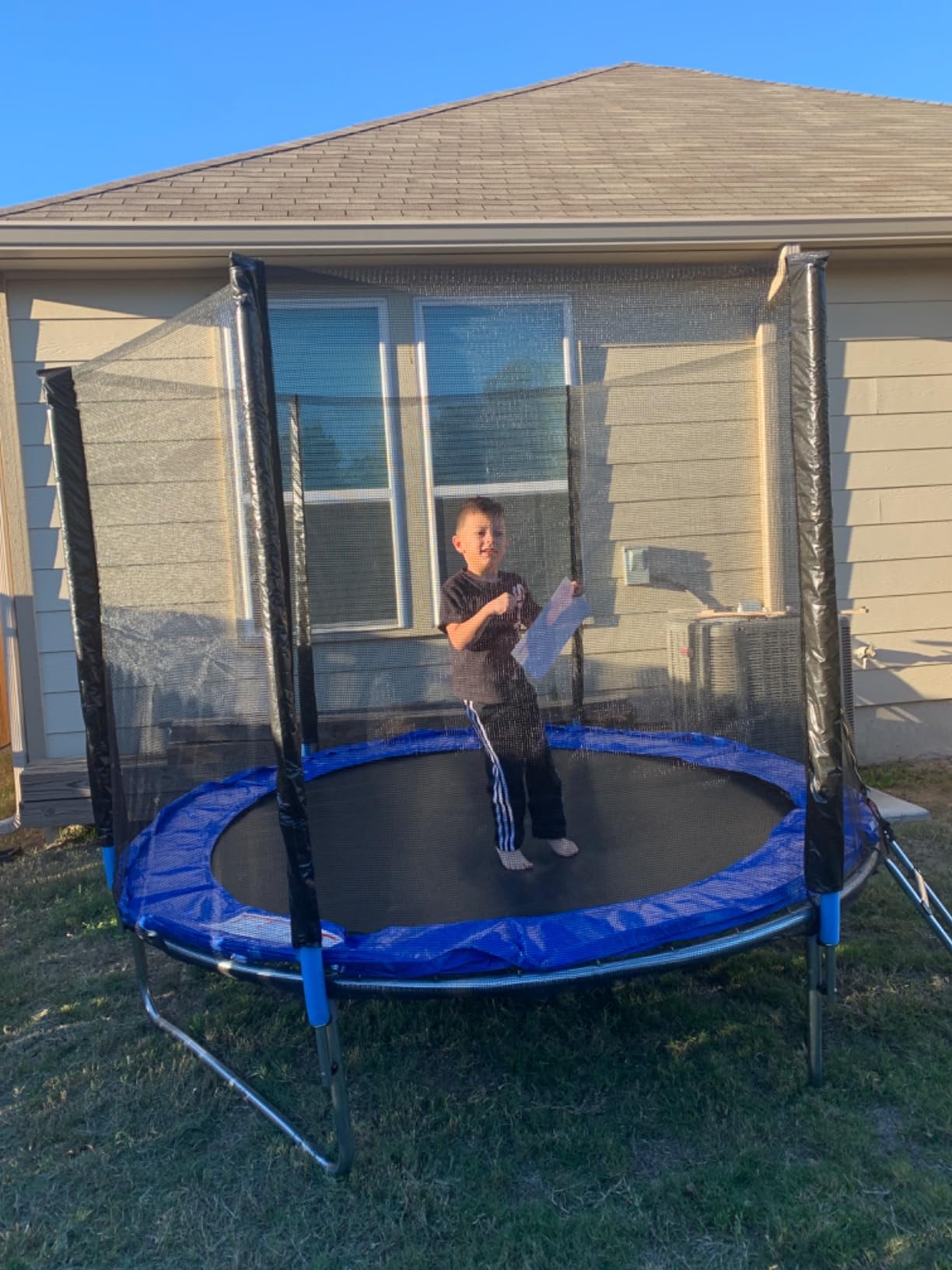
Structurally it sits on four U-shaped legs plus eight safety poles, which gives it a wide footprint for a 14 ft rectangle. The mat is polypropylene and the frame is alloy steel, and the listing references ASTM testing, CPC certification and TÜV Rheinland, CE, GS and ISO 9001 standards, which is broader certification coverage than most listings at this level make.
Dimensions are 168 inches long by 96 inches wide by 102.36 inches high, and the frame is specified at 14FT with model number TPCR14AG. This is a good family rectangle for a child around 8 to 12 who is starting to work on twisting and controlled landings.
What 72 springs actually means for bounce
Most 14 ft rectangles in this guide run between 72 and 84 springs, and 72 is the lower end. A lower count means slightly less stored energy in the bed, so a straight-up bounce sits a little lower and a long tumbling pass carries a little less lift into the second half.
In practice this is a liveliness difference, not a capability difference. If the plan is to add a second, more heavily sprung model later, this is a sensible first step rather than a compromise.
Who should pass on it
If your gymnast is tall, older, or working toward club-level tumbling, 72 springs in a 14 ft bed will feel soft under a heavy landing. Move to the Zupapa 10×17 or a higher spring count model where there is no ceiling on progress.
The other limitation is cosmetic and practical. Only a green 14FT variant is offered, so there is no colour choice to make. Longevity is the other open question: at 311 reviews this is well tested, but it is not the multi-decade frame warranty you get from the ACON.
4. Giantex 8×14 ASTM Certified Rectangle – compact yards, real galvanising
- Frame galvanized inside and out for real rust resistance
- Netting installs inside the springs so kids cannot land on them
- Rectangle shape suits gymnasts learning flips
- Ladder and installation hardware included
- Tool-free lock-pin pole installation
- Assembly instructions are hard to read and parts are poorly labelled
- Net poles can bend and replacements are expensive
- Spare parts such as the safety net are hard to source
- Customer service is rated poorly when replacements are needed
Giantex is the one to look at when a 10×17 simply will not fit. At 8 by 14 feet it keeps a true rectangular lane, and the frame is hot-dip galvanized on both internal and external surfaces rather than coated on the outside only, which is the right call for anything sitting through winter rain and dew.
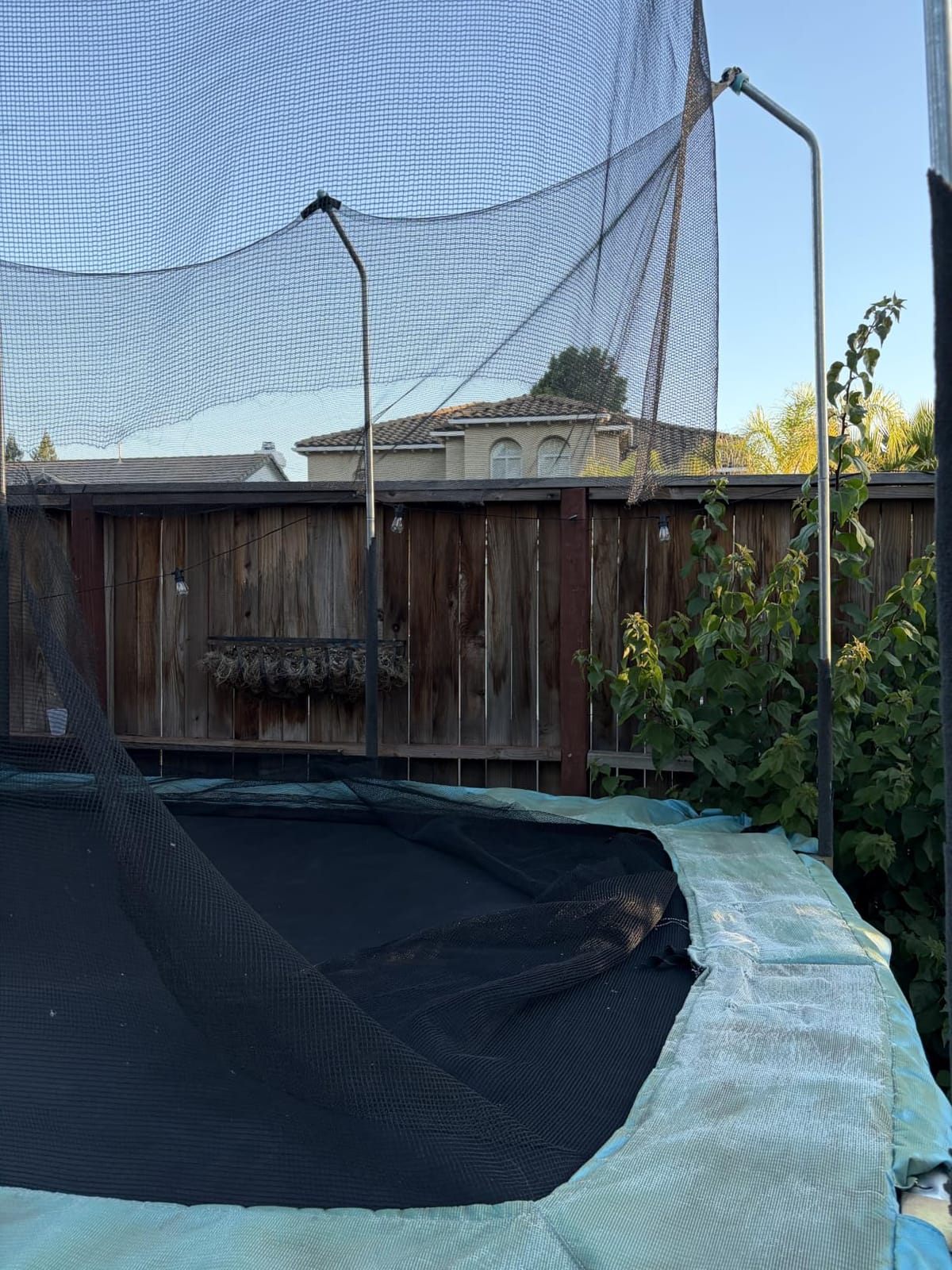
There are 84 heavy-duty steel springs driving rebound across a polypropylene jumping mat that has been tested for 5000 hours of UV resistance, and the enclosure uses curved net poles with a soft safety pad sealing the gaps, rated ASTM compliant. Four U-shaped legs hold the base, and the tool-free lock-pin pole installation is a genuinely nice touch when two people are building it.
The rectangle shape gives kids more movement options than a round of the same width, and the 440 lb maximum weight recommendation covers several children comfortably. Dimensions are 168 by 96 by 108 inches, and the manufacturer part number is GT10055OR+-TW.
Why the galvanising detail matters more than it sounds
Cheap trampoline frames are typically powder-coated, which protects the steel until the first scratch lets water through. Hot-dip galvanizing coats the pipe inside and out and survives a lifetime of wet contact, and it is the main reason to prefer this model over a similar-priced alternative.
The 84 springs and the UV-tested mat are also better than the norm at this level. This is a build-quality rectangle, and the 4.2 average reflects the service story more than the product.
The real downside is what happens after year three
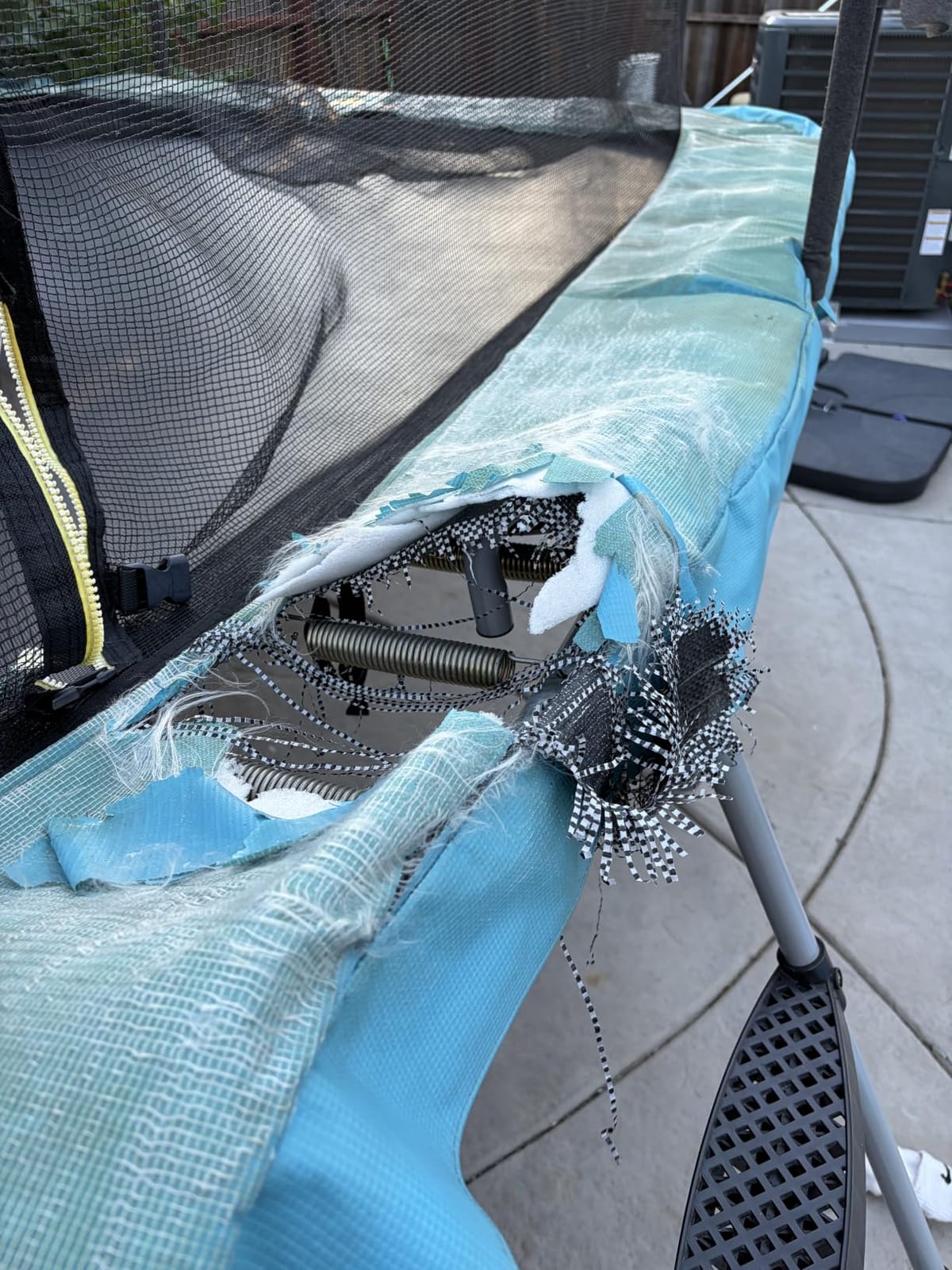
Owners report bent net poles after a short time, and replacement poles are expensive. Spare parts such as the safety net have been hard to source from the manufacturer, and customer service is rated poorly when a replacement is needed. The instructions are also the hardest in this roundup to read, with parts not clearly labelled.
That is a meaningful long-term risk. A trampoline that lasts ten years needs a working parts channel, and this is the listing where that channel is weakest. If you buy it, confirm replacement net and poles exist for your model before the first tear.
5. Zupapa 13×23 Commercial Grade Rectangle – for a serious training programme
- Enormous 13x23 ft surface for real tumbling drills
- Very high 2500 lb static capacity for multiple jumpers
- Seven legs stop the long sides caving in
- 180 heavy-gauge electroplated springs give a strong rebound
- 10-year frame warranty and net plus ladder included
- Very large footprint and 750 lb shipping weight make this a major installation job
- Pricing sits beyond most home budgets
This is the largest rectangle in the group and the one built for a gymnast rather than for a family. Thirteen by 23 feet is not a play surface, it is a tumbling runway, and at 4.6 stars from 61 reviews the owner record is strong even though the volume is modest and no rating below three stars appears.
The engineering is the story. The frame is 51mm Q195 steel with a 2.5mm wall, rated to 2500 lb static and 800 lb dynamic, carried on seven side-by-side support legs specifically to stop the middle and long sides collapsing under load. That is the failure mode on every large rectangle, and seven legs is the direct answer to it.
There are 180 high-strength electroplated springs using 3.5mm wire, which the manufacturer claims delivers more than 30 percent performance over ordinary springs. The same patented no-gap net-to-mat connection appears here, with CPC certification, CPSIA and ASTM F381-16 compliance, and UV-protected materials. Net and ladder are both included, and the warranty is 10 years on the frame with 2 years on mat, pad, net and springs.
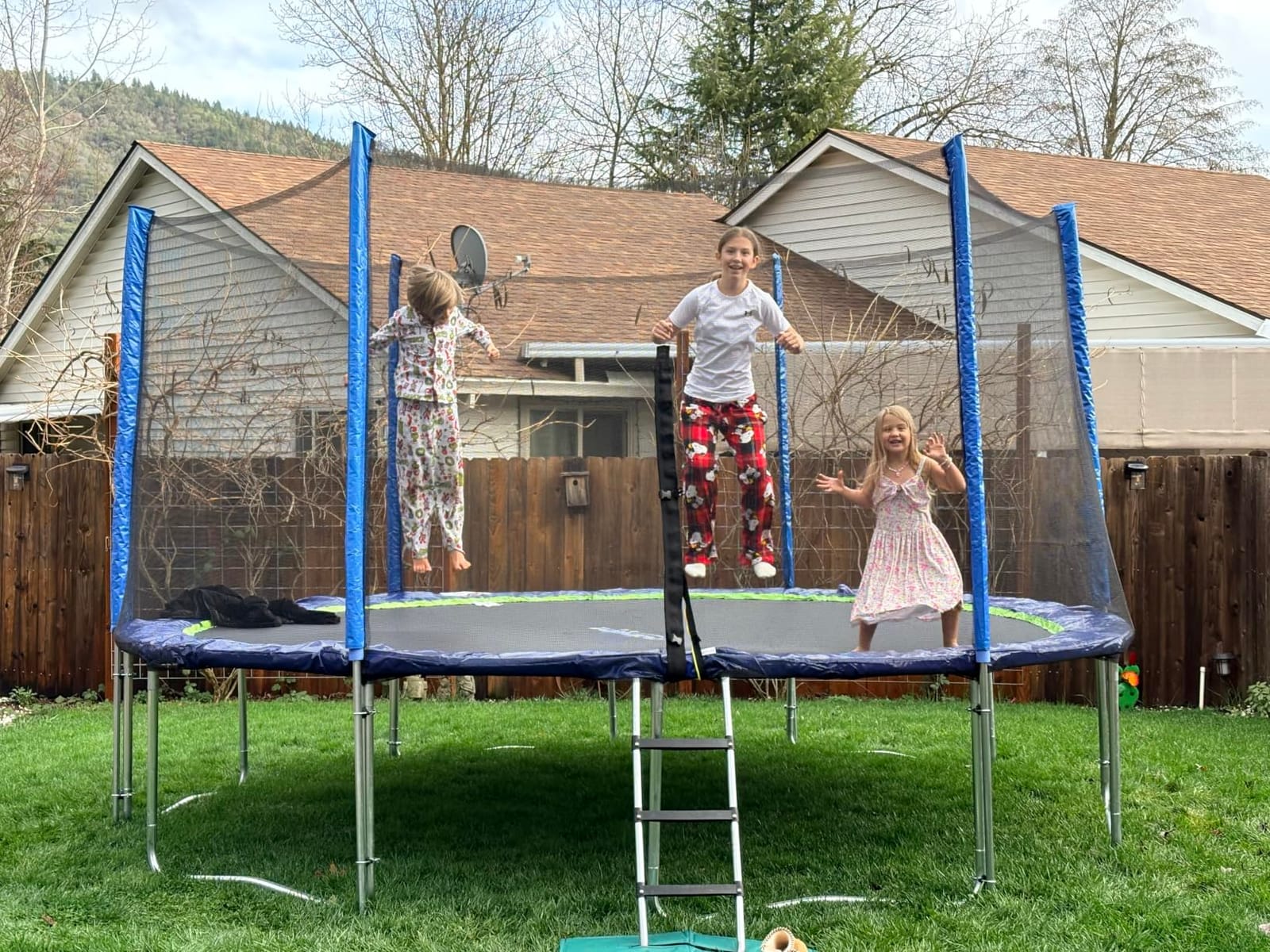
What 180 springs and seven legs buy you
More springs across a larger area means a flatter bed under load, which is what lets a run-up finish in the same place it started. The seven-leg layout is the reason that flatness holds when a heavy jumper lands in the middle rather than near an edge.
The 800 lb dynamic rating also means this is the only rectangle here where an adult and a teenager can train on it together without anyone approaching a per-user ceiling. For a family with a competitive teen, that is the decisive spec.
Be honest about the yard and the crew
The unit weighs 750 lb and measures 276 by 156 by 40 inches. Delivery, positioning and assembly are a project, not a weekend chore, and you need a properly flat, level site before the frame goes down. Getting this wrong means a permanently uneven bed, which is exactly what ruins tumbling.
The second issue is straightforward. Only 61 reviews back this listing, so you are trusting the specification and the frame warranty more than a long owner history. That is a reasonable position for a commercial-grade build, but it is a different kind of confidence than the Zupapa 10×17 offers.
6. ACON 16 HD 17×9.8 ft Rectangle – the premium reference point
- Consistent controlled bounce across the whole bed
- Two layers of spring protection with the SafeMat buffer and skirt
- No Finger Access net with zipperless two-level entry
- Galvanized powder-coated frame tested to 1650 lb
- Longest warranty stack in this roundup
- Largest price outlay of the ten models covered here
- Big 17 x 9.8 ft footprint needs serious yard space
The ACON 16 HD is the one most owners describe as a genuine long-term purchase, and it is the model a family buys once. Ninety reviews at 4.6 stars with 81 percent five-star and a 2 percent one-star share, and the complaint pattern is almost entirely about footprint and cost rather than durability.
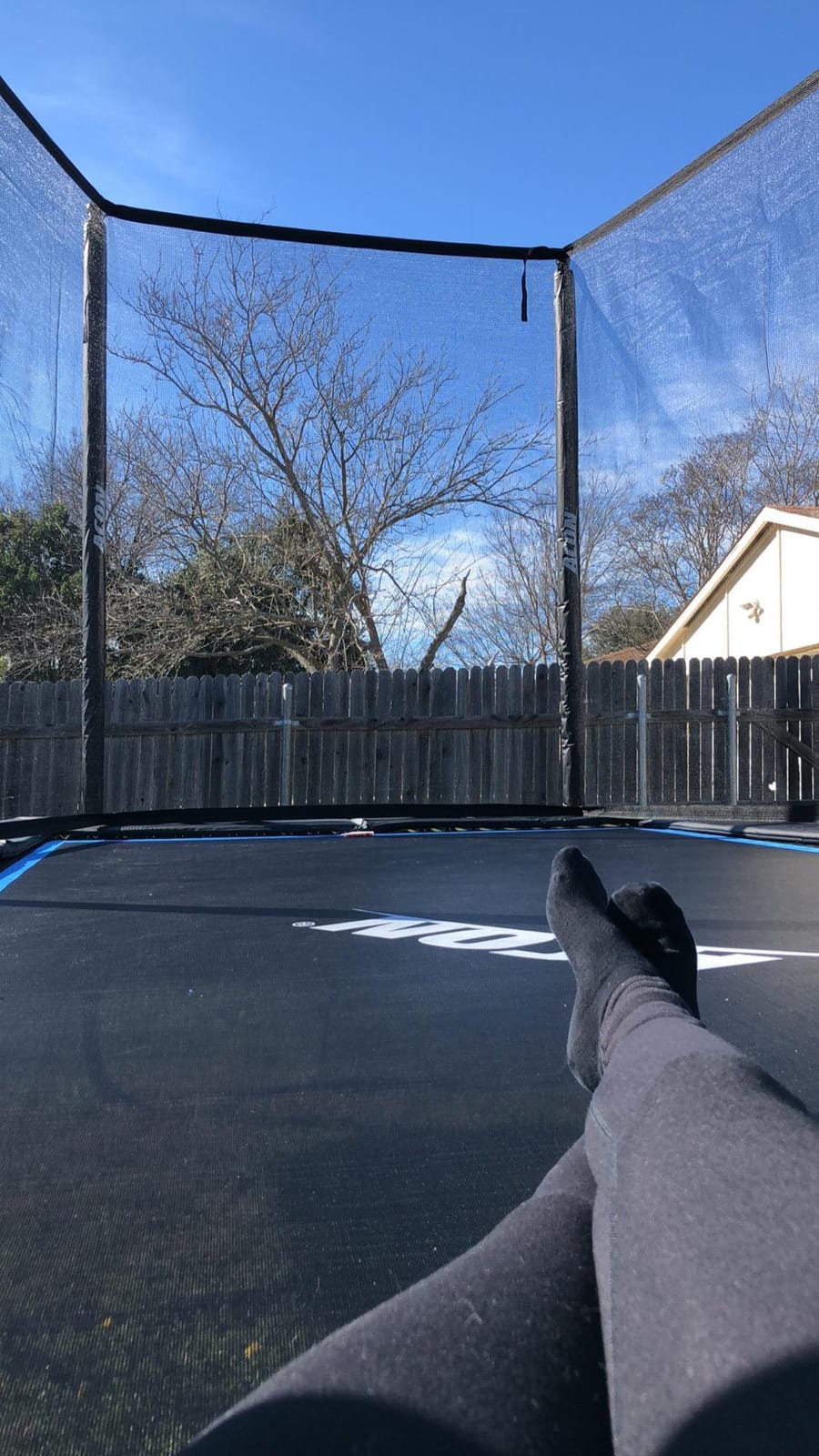
The key numbers are unusually honest. The true rectangular frame measures 17 by 9.8 feet with a 14.2 by 7.2 foot jump zone, it runs 140 ten-inch HD springs tuned as one system with the frame and mat, and the steel tubes are 2.4 inch galvanized and powder-coated with a 0.1 inch wall. The frame is static-tested to 1650 lb and the stated single-jumper maximum is 330 lb, which is the number that should guide your decisions.
Safety is where the design thinking shows. The SafeMat system adds a 2-inch foam buffer plus a spring-covering skirt for two layers of protection, and the No Finger Access net uses a zipperless two-level entry to keep jumpers inside. It is CE and ASTM certified, the mat, net and padding are UV-protected for multi-season use, and the frame supports optional in-ground installation.
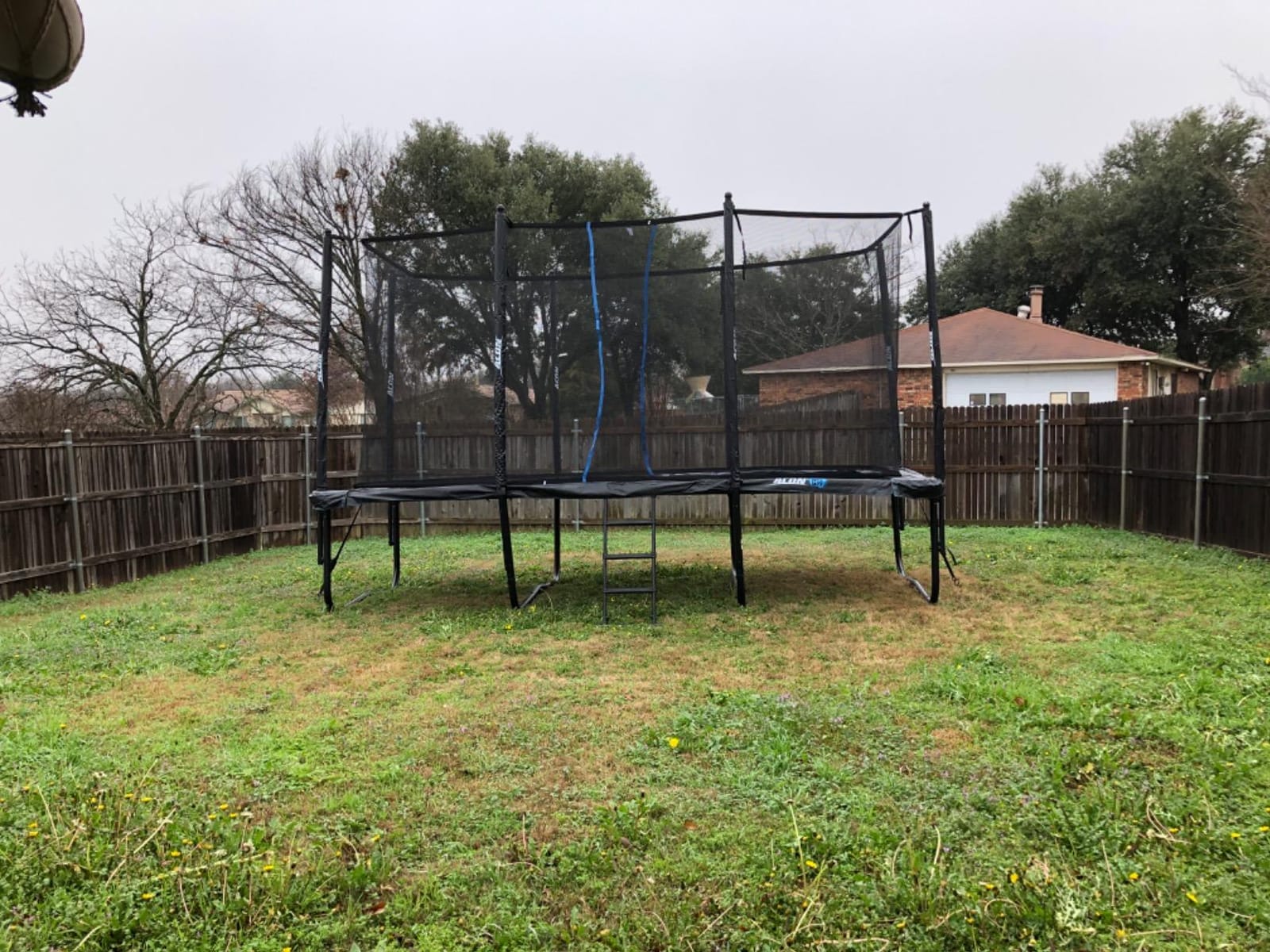
Why the stated jump zone matters more than the frame size
A lot of brands quote the outside footprint. ACON quotes the jump zone separately at 14.2 by 7.2 feet, and that is the number that tells you whether a run-up and a landing both fit. Compare it against any listing that gives you only a frame measurement and the maths become yours to do.
For a teen working on tumbling passes, a 7.2 foot wide bed is the minimum for a twisting pass and comfortable for a straight run. For an adult working alone, the 330 lb single-jumper ceiling is generous.
The trade-off is footprint and outlay
It weighs 242 kg and measures 204 by 120 by 40 inches, so the yard and the crew requirement are real. The warranty is the most complete in the group: 10 years on the frame, 5 years on the mat and springs, 2 years on the safety pad, and 1 year on other parts, the ladder and the safety net, with spare part availability committed for five years.
That parts commitment is the underrated part. An enclosure net will need replacing eventually, and knowing a genuine spares channel exists for five years removes the single biggest long-term worry in this category.
7. BSPORTY Ultra 8×14 Rectangle – the most rigid frame at this size
- Six-leg braced frame resists twisting and keeps bounce even edge to edge
- Full-wrap net contains jumpers more completely than a partial net
- Webbing-stitched no-gap mat-to-pad edge keeps hands and feet off springs
- High 2200 lb static rating for its size
- 7-inch 65Mn springs give a responsive takeoff
- Only 28 reviews so long-term durability feedback is limited
- One-star reviews sit at 11 percent and a minority report early failures
- Catalog listing shows an inconsistent shape value despite the rectangular title
The interesting thing about this 8×14 is the bracing. Instead of the usual four legs, it uses a six-leg frame with two crosswise legs and dual center cross-grid braces for torsional rigidity, which is the specific failure that makes a rectangle twist under an off-centre landing. If bounce consistency is your priority, this is the model built for it.
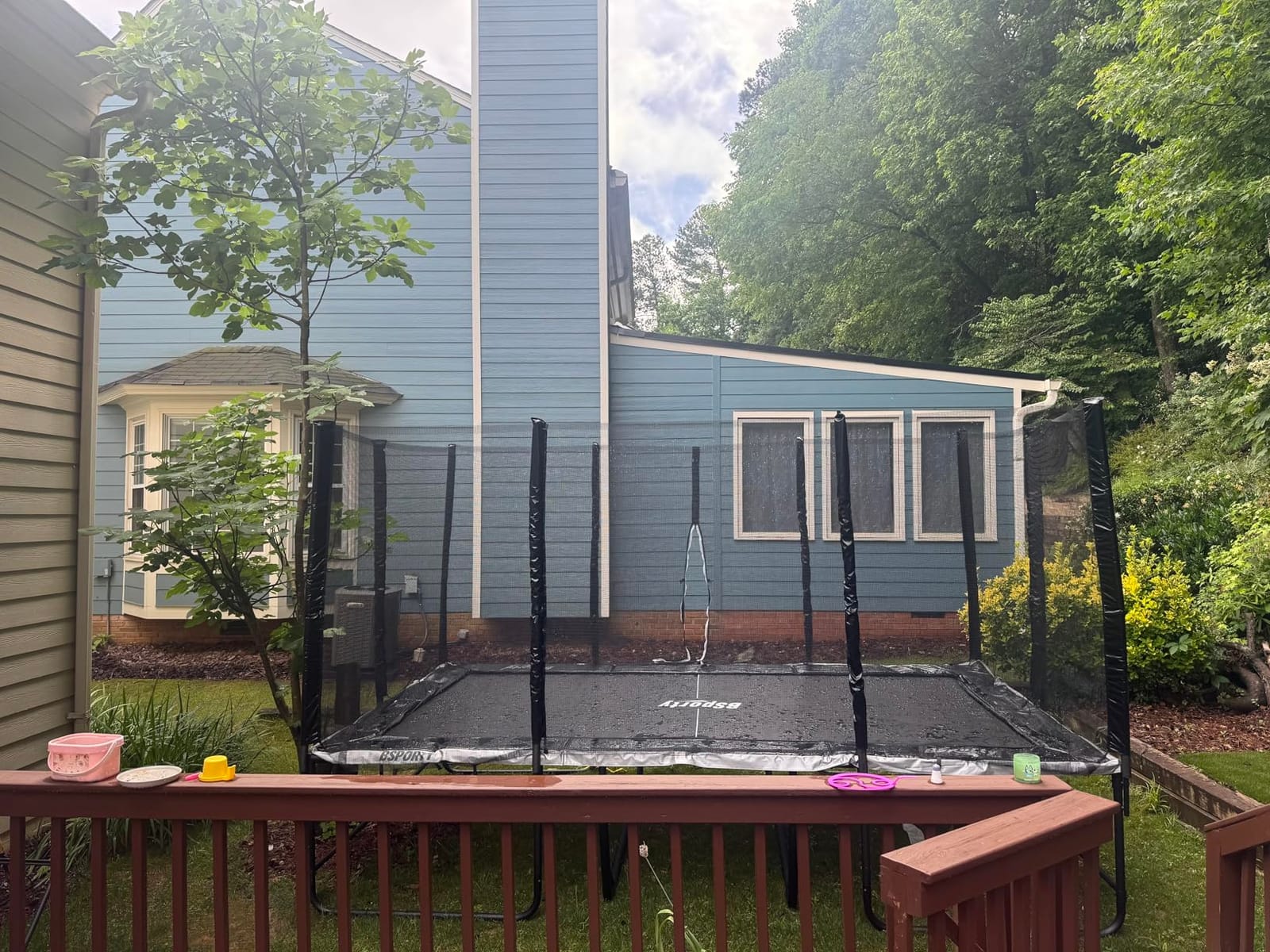
Enclosure is unusually thorough. The jumping mat webbing is stitched directly to the spring pad to create a continuous 360-degree barrier, and the EnduraWeave safety net, rated Intertek UV Testing Grade 6, fully wraps over the frame rather than stopping partway. The frame uses 2-inch (50mm) steel tubes with 2.5mm walls rated to 2200 lb static and 700 lb dynamic, driven by 65Mn spring steel seven-inch springs.
At 4.3 stars from 28 reviews, this is the least-tested product in the roundup, and the review summary notes buyers are effectively relying on spec sheets. Short 7-inch springs do give a responsive takeoff, which suits a younger gymnast working on quick drills rather than big height.
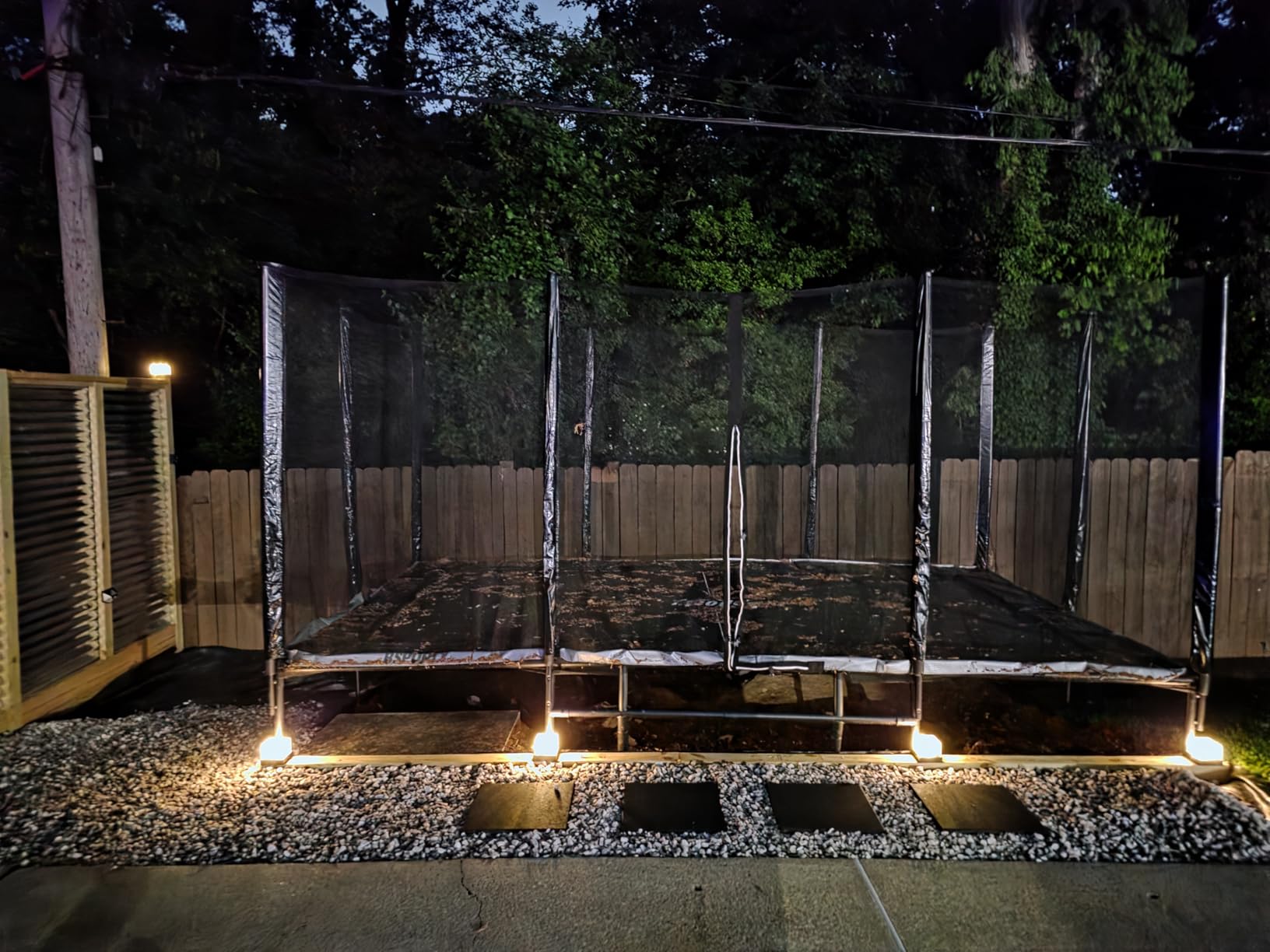
Who the cross-grid bracing actually helps
Torsional rigidity matters most when the landing is off-centre, which is precisely what happens during a twisting pass and during a beginner’s first backflip attempts. A frame that twists changes the rebound angle, and the gymnast ends up chasing a moving landing.
The dual centre braces also help with the long 14 ft axis, where sag is the usual complaint. The full-wrap net and the stitched mat-to-pad edge then handle the other common problem, which is a foot or hand reaching the springs mid-landing.
What the thin review record means
Twenty-eight reviews is not enough history to know how the six-leg frame and the EnduraWeave net age over five seasons, particularly under UV exposure. One-star reviews sit at 11 percent, which is higher than most listings here, and the catalog listing shows an inconsistent shape value despite the rectangular title.
Treat it as a well-engineered gamble. Verify the shape field on the listing, and if the frame or net fails within the warranty period, act early because parts sourcing is the weak point of a product with this little owner history.
8. In-Ground Rectangular Trampoline – the flush-to-ground option
- Flush-to-ground design removes fall-off-the-edge risk
- Ladder-free access is easy for small children
- Even consistent bounce across the full mat
- Quiet operation thanks to the spring cover
- Cleans up the yard far better than a raised model
- Installation requires digging a large hole and real yard prep
- Several strong adults are needed to position the unit
- Mat dirties quickly after mowing and needs regular cleaning
- The version without an enclosure has no safety net
This is the shape-versus-elevation answer rather than a performance answer. Sitting flush with the ground removes the biggest structural hazard of any above-ground trampoline, which is landing off the edge, and it removes the need for a ladder, which small children otherwise have to climb every time.
Rectangular in-ground units deliver even spring tension across the jumping area, which is what makes them suitable for flips, tricks, gymnastics training and cardio. The build is a galvanized steel frame with a durable jumping mat and protective perimeter padding, and the install kit includes the support frame, springs, safety padding and ground anchors. The listed variant options are 10×17 with enclosure and 7×10 without enclosure.
Owners consistently describe the format as feeling noticeably safer and cleaner than a raised trampoline, with a quiet spring cover and a much tidier yard. At 4.4 stars from 13 reviews, that sentiment is consistent but the base is small.
When an in-ground rectangle makes sense
It makes sense when you have a lawn that is already being used and a specific fear about edge falls, when the yard is too tight for an above-ground safety perimeter, or when a patio or driveway area is genuinely free. A parent with a small child who cannot yet climb a ladder gets a genuine usability gain from the flush surface.
It also suits an older gymnast, because the lack of a step-up and the predictable surface let them focus on the run-up. This is the closest thing in the category to a club floor, and it is the most realistic way to convert a driveway into a training area.
What people underestimate before they dig
Installation is the real cost. It requires digging a large hole and significant yard preparation, and several strong adults are needed to position the unit into the excavation. Soil preparation is called for explicitly, and drainage matters more than most buyers expect, because a trapped pit turns into a puddle that ruins the mat.
The warranty is 1 year no-questions-asked on all parts, which is the shortest-term commitment in this roundup and the other reason to plan carefully before the excavator arrives. The mat also dirties quickly after mowing and needs regular cleaning.
9. JELENS 8×14 Rectangle – a tidy first flipper
- Zero-gap enclosure with double-layer stitched net
- Hexagonal weave mat gives an even lift from centre to edge
- Four W-shaped legs add load-bearing strength
- Tools and clear instructions included
- ASTM F381-16 compliance
- Only 9 reviews so long-term reliability is largely unverified
- One-year warranty is well below the 5 and 10 year frames elsewhere
- Catalog listing shows an inconsistent shape value despite the rectangular title
The JELENS is worth knowing about for one specific reason: the mat. It uses a hexagonal weave that distributes bounce evenly so a jump at the edge matches a jump in the middle, and for a child learning where to land that consistency is genuinely more useful than extra spring count.
Containment is handled by an ASTM F381-16 compliant double-layer stitched net with a fully enclosed spring design creating a zero-gap barrier, backed by waterproof foam padding. Four W-shaped support legs carry an 1800 lb static and 440 lb dynamic load rating, tools and installation instructions are included, and there is a 12-month free parts replacement policy. Dimensions are listed at 168 by 160 by 30 inches.
It is a competent small rectangle for a first flipper aged roughly 6 to 9, and the edge-to-centre consistency is the honest selling point.
What a hexagonal weave mat does for a beginner
Most polypropylene mats feel livelier in the middle and flatter near the springs. A beginner aims for the middle because the rebound is stronger there, which means they are constantly adjusting their aim rather than focusing on rotation and landing shape.
A weave engineered to even out across the surface lets a child land where they aim. That is a training-quality difference, not a performance difference, and it is why this model suits a first flippers’ trampoline rather than a teen’s.
Where the evidence runs out
Nine reviews is the thinnest base in this roundup, with 84 percent five-star but 16 percent one-star, which is not enough owner history to draw firm conclusions about how the frame and net age. Treat the feedback as consistent with the specification rather than as independent confirmation of it.
The one-year warranty and one-year spare part availability are the meaningful caveats, well below the 5 and 10 year frames elsewhere. The catalog listing also shows an inconsistent shape value despite the rectangular title, so confirm the bed dimensions before ordering.
10. Galactic Xtreme 10×20 Commercial Grade Rectangle – built for a decade
Galactic Xtreme Commercial Grade Rectangle Trampoline – 10×20 Gymnastics Trampoline with Net Enclosure – Heavy Duty 750lbs Jumping Capacity
- Commercial-grade build with a 3.0 mm double-dip galvanized frame
- 140 springs with thicker and longer coils
- Patented stay-put mesh net with padded flexing poles
- Mat designed for 20 to 30 years of service in harsh weather
- Ladder
- spring pad
- mat and net all included
- Only 8 reviews so independent owner feedback is very thin
- 625 lb shipping weight means a large delivery and setup
- 10x20 ft surface needs a very large yard
The Galactic Xtreme is the longevity play. The frame uses 3.0 mm wall thickness, double-dip galvanized inside and out, and the manufacturer states the structure is engineered not to bend, warp or break so that inertia is not lost between jumps, which is the specific complaint that makes big rectangles feel dead after a few years.
It runs 140 springs with thicker and longer coils than competitors, plus a patented stay-put polyester mesh enclosure with a padded flexing pole cushion and an interlocked steel frame. The jumping mat is designed for 20 to 30 years of service in harsh weather, the user capacity is 750 lb, and the box includes the steel frame, ladder, galvanized springs, spring pad, mat and net enclosure.
Warranty is the standout: life-time on the build with spare part availability committed for 25 years. Nothing else in this guide offers a parts channel on that timescale.
What double-dip galvanizing buys over a lifetime
Standard hot-dip galvanizing coats the pipe once. Double-dip, inside and out, doubles that protection and is the reason the manufacturer can state a life-time warranty without hedging. It also means the frame will still be sound long after a net or mat needs replacing, which is the realistic life cycle of any trampoline.
The stay-put mesh net and the padded flexing pole cushions are the details to watch here. Poles that flex under contact are easier on a jumper who clips one, and a net that does not shift under load stays put when someone falls into it.
Honest limits of the evidence
Eight reviews is a very thin record, and every available comment is positive with no rating below four stars, which tells you little beyond the spec sheet. You are relying on the stated engineering and the warranty, not on a large owner history.
The physical demands are serious. The unit weighs 625 lb and measures 240 by 120 by 42 inches, so delivery, positioning and assembly are substantial, and a 10 by 20 foot bed needs a yard with real clear space around it. Get that right and the build quality is the most serious in the guide. Get the site wrong and no frame warranty helps.
How to Choose a Rectangle Trampoline for Tumbling?
Size and jumpable area
Buy for the run-up, not the jump. The published outside dimension includes the frame, the springs and the safety padding, and the number that matters is the usable mat. A 14.2 by 7.2 foot jump zone inside a 17 by 9.8 foot frame, as quoted by ACON, is the clearest example of a brand telling you the truth about the useful part.
A rough mapping by age and skill: a 7×10 or 8×14 rectangle suits a 5 to 7 year old on bounces and body control. An 8×14 or 9×15 fits an 8 to 11 year old starting twists and spotted flips. A 10×15 or 10×17 is the pre-teen and beginner tumbling size, where a real run-up starts to matter. A 10×17, 10×20 or 13×23 is for a teen aspiring gymnast training between club sessions. For an adult plus a co-jumper, anything rated 800 lb dynamic or higher keeps both of you well clear of a per-user ceiling.
Frame and mat build quality
Frame diameter and wall thickness are the two numbers that predict sag. Look for 2 inch or 2.4 inch tubes with 2.5mm or 3.0mm walls, and check whether the galvanizing is inside and out or surface coating only. Then count legs: four is standard, six with cross braces resists twisting, and seven exists specifically to hold the middle of a very long bed.
For the mat, a polypropylene weave is the norm and holds up well when UV tested. Certification is the last check, and ASTM F381-16 compliance plus CPC certification is the combination to look for. If you are also choosing a small indoor setup, our mini trampoline picks cover rebounders instead.
Springs and bounce consistency
More springs is not automatically better, but spring count relative to mat area is what keeps the bed flat. A 14 ft rectangle with 72 to 84 springs bounces pleasantly but sits lower on a long pass. A 13×23 frame with 180 electroplated springs is engineered so a heavy landing in the middle does not kill the rebound for the next pass.
Also check the leg count against the bed length. Any rectangle over 16 feet has a long axis that will sag in the middle without extra centre support, and sag is what turns a run-up into an inconsistent landing.
Safety enclosure and net gaps
The gap between the mat edge and the net is where beginners get hurt, so a no-gap design is the single most valuable safety feature in this category. A net stitched directly to the mat, or a mat webbing-stitched to the spring pad, removes the exposed spring band entirely. Look also for padded poles, thick padding over the springs, and a dual zipper or latch clip so the entrance cannot be left open.
A zippered entrance is a one-person-at-a-time door, which is a real consideration for families with several children. A zipperless entry, as used on the ACON, is faster in a training session and harder to leave open by accident.
Weight capacity: read the right number
Two different numbers appear and they are not interchangeable. A static or test load is the total weight the frame is proven to hold at once. A dynamic or user limit is the per-jumper ceiling the manufacturer will stand behind. An 1800 lb static rating with a 450 lb dynamic limit, as on the Zupapa 10×17, means the frame can physically bear 1800 lb, and the manufacturer only guarantees safe jumping for a 450 lb user.
Always find the per-user figure. And remember that a 440 lb limit does not mean four people at once, it means a limit on each person jumping. One adult over that limit on a trampoline built for children is a serious risk, not a calculated one.
Space, yard fit and assembly
Add clearance around the whole unit, not just the frame. A 10×17 bed plus enclosure and a working perimeter needs far more ground than the product dimensions suggest, and the biggest purchasing mistake in this category is running out of yard after the frame is built.
Assembly is a two-person minimum for every model here, realistically three or four for the larger frames. The Zupapa 10×17 takes about two hours for two adults, the AOTOB uses 3D app instructions which is the easiest route, and anything over 600 lb should be treated as a crew job. Anchor the unit with proper stakes before anything else goes on it.
Price tiers, warranty and total cost
Rectangle trampolines cost more than round ones for four concrete reasons. First, springs per square foot: a flat bed needs more springs than a conical one, and a 10×17 can carry 84 springs where a 12 ft round carries 64. Second, steel gauge: the long axis of a rectangle needs heavier tube than the shorter span of a round frame. Third, mat area: an 8×14 rectangle has more usable surface than a 12 ft round, and mat is expensive per square foot. Fourth, the safety structure, because a rectangular footprint has a longer perimeter for the enclosure to cover and more mat edge to pad.
Total cost of ownership is where premium brands get tested. Frame warranty is the headline, but what matters is spare parts: ACON commits to five years of spare part availability, and Galactic Xtreme states 25 years with a life-time warranty. Check that before buying, because an enclosure net will need replacing eventually and a model with no parts channel is a model with a fixed lifespan. Budget-tier picks such as the AOTOB carry five years on mat, frame and springs, which is respectable. Our budget trampoline guide covers the entry end of the market if you are not set on a rectangle.
The Weight Capacity Trap: Test Load Is Not Your Jump Limit
The most important number on a trampoline listing is the one most often buried. Advertised capacity is usually a static test load, which is the total mass the frame was loaded with on a test rig to prove it does not deform. Your actual limit is a dynamic or user rating, and it is typically a quarter to a third of the test figure.
Worked example: a rectangle advertised at 1800 lb static with a 450 lb dynamic limit. The frame can hold 1800 lb pressing down. The manufacturer guarantees safe, in-spec bouncing for a single jumper up to 450 lb. Nobody should read 1800 lb as room for a family, and nobody should read it as a guarantee for a person of any weight. The Zupapa 13×23 goes further, listing 2500 lb static against 800 lb dynamic, and the ACON 16 HD is explicit with 1650 lb static tested and a 330 lb single-jumper maximum.
The practical rule is simple. Find the per-user dynamic figure, and check it against the heaviest person who will be on the trampoline alone, not against the total of everyone at once. Owners in the community do exactly this arithmetic in reverse, converting limits into how many twelve-year-olds fit at a time, which is the wrong question and leads to overloading.
Practising Tumbling Safely on a Rectangle Trampoline
A trampoline is a good introduction to tumbling fundamentals, and a poor substitute for a coached gym floor. It is excellent for body control, core strength, awareness of rotation and learning to land, and it is where the fear of falling gets built back up. It should be the step before club, not instead of it.
Five rules, in order of how much they matter:
Clear the area first. Remove rocks, sticks, toys, garden hoses and anything a landing could land on. Check that the netting is taut and the spring padding is in place before anyone gets on.
Warm up before tumbling. Two to three minutes of bounces and light stretches. Cold muscles and a springy bed is a bad combination for rotation.
Progress the skills gradually. Start with straight bounces, then straight-line jumps with arm swings, then twists, then a run-up, then flips, and only attempt a front or back flip with a spotter present and having been taught the technique. Never attempt a skill beyond your training level.
Learn to fall and roll before learning to flip. Practise the safe landing and safe roll on the mat at low height, because most trampoline injuries are incomplete landings rather than failed flips.
One jumper at a time, always supervised, always spotted. Have a competent spotter positioned at the mat edge whenever a new skill is being attempted, and keep an adult in earshot at all other times.
Add the practical maintenance routine and it lasts. Check spring tension and mat condition every few months, keep a weather cover on it, and inspect the netting and padding for UV degradation each spring. When home practice stops being enough, move to club coaching rather than a bigger trampoline.
Frequently Asked Questions
Are rectangle trampolines better?
Yes, for tumbling specifically. A rectangle has one shorter axis, so your weight engages the springs across less distance and the bed returns you more firmly and evenly. That produces a long straight lane for a run-up, take-off, rotation and landing, plus a usable sweet spot in the middle where the bounce is most consistent. A round trampoline of the same width funnels you toward the center and gives a less controllable rebound.
Is a rectangle trampoline better than a round?
For gymnastics and tumbling, yes. For general family bouncing a round trampoline is cheaper, easier to find and perfectly serviceable. The rectangle wins on straight-line control, usable mat area and landing predictability, and it also uses a small yard more efficiently. It costs more because it carries more springs per square foot, heavier steel, a larger mat and a longer safety perimeter to cover.
Are trampolines good for gymnastics?
They are very good for the fundamentals: body control, core strength, rotation awareness, safe-fall practice and learning to land. They are not a substitute for a sprung gym floor with a coach, because the bed still moves under a heavy landing. Most competitive tumbling programmes use a home trampoline for supplementary drills between club sessions rather than as the primary training surface.
What is the best size trampoline for gymnastics?
Buy for the run-up rather than the jump. A 7×10 or 8×14 suits ages 5 to 7 on bounces and body control, an 8×14 or 9×15 suits ages 8 to 11 starting twists, a 10×15 or 10×17 suits a pre-teen learning tumbling, and a 10×17 or larger suits a teen training seriously. Measure the usable jump zone, not the outside frame, and leave clearance around the whole unit for the enclosure.
Why are rectangle trampolines more expensive?
Four things drive the cost. A flat rectangular bed needs more springs per square foot than a conical round bed. The long axis needs heavier steel tube than the shorter span of a round frame. The usable mat area is larger, and mat is priced per square foot. Finally, a rectangular footprint has a longer perimeter for the enclosure to net and more mat edge to pad, which adds to the safety hardware.
Which rectangle trampoline is the safest?
Safety comes from features, not from a brand name. Look for a no-gap enclosure where the net attaches directly to the jumping mat so there is no exposed spring band, padded poles, thick spring padding, a dual zipper or latch clip, ASTM F381-16 compliance and CPC certification, and a per-user weight limit comfortably above the heaviest user. An in-ground rectangle removes fall-off-the-edge risk entirely if the yard and excavation allow it.
Can adults jump on a rectangle trampoline?
Only within the stated per-user dynamic limit, not the static test load. Many rectangles list limits around 440 lb to 450 lb for a single jumper, which a healthy adult may exceed. Models with 700 lb to 800 lb dynamic ratings are built for adult use, and the in-ground and commercial-grade options handle adults and a co-jumper together. Check the dynamic figure, not the advertised capacity.
How long does a rectangle trampoline last?
It depends on the build and the storage conditions rather than a fixed number of years. A galvanized frame with a 10-year or life-time warranty and a committed spare-parts channel is designed for a decade or more, with the mat and netting replaced along the way. Budget frames with no reliable parts channel tend to reach the end of their useful life earlier, usually when the net or mat gives out and cannot be replaced.
The Verdict: Which Rectangle Trampoline to Buy in 2026
For most families, start with the Zupapa 10×17. Its patented no-gap net-to-mat connection is the best safety feature in this roundup, the 10-year frame warranty is the strongest of the non-premium models, and 693 reviews at 4.6 stars make it by far the best-evidenced choice here. Pick the 9×15 or 8×14 variant if the 10×17 does not fit your yard.
Spend less with the AOTOB 12/14 ft if the goal is a safe rectangular surface for a child around 6 to 11 starting out. Spend more with the ACON 16 HD if this is a once-in-a-decade purchase for a teenage gymnast, since the 14.2 by 7.2 foot jump zone, layered SafeMat protection and five-year spare parts commitment justify the outlay. Go large with the Zupapa 13×23 or the Galactic Xtreme 10×20 only if daily serious training justifies a 600 to 750 lb delivery and a crew for assembly.
Whatever you choose, measure the usable jump zone, check the per-user dynamic limit against the heaviest person who will jump alone, confirm that replacement parts exist for the model, and anchor it properly before the first session. Check spring tension and mat condition every few months, keep a cover on it through winter, and supervise every session. That is what keeps the best rectangle trampolines for gymnastics worth the money for years rather than a single summer.