
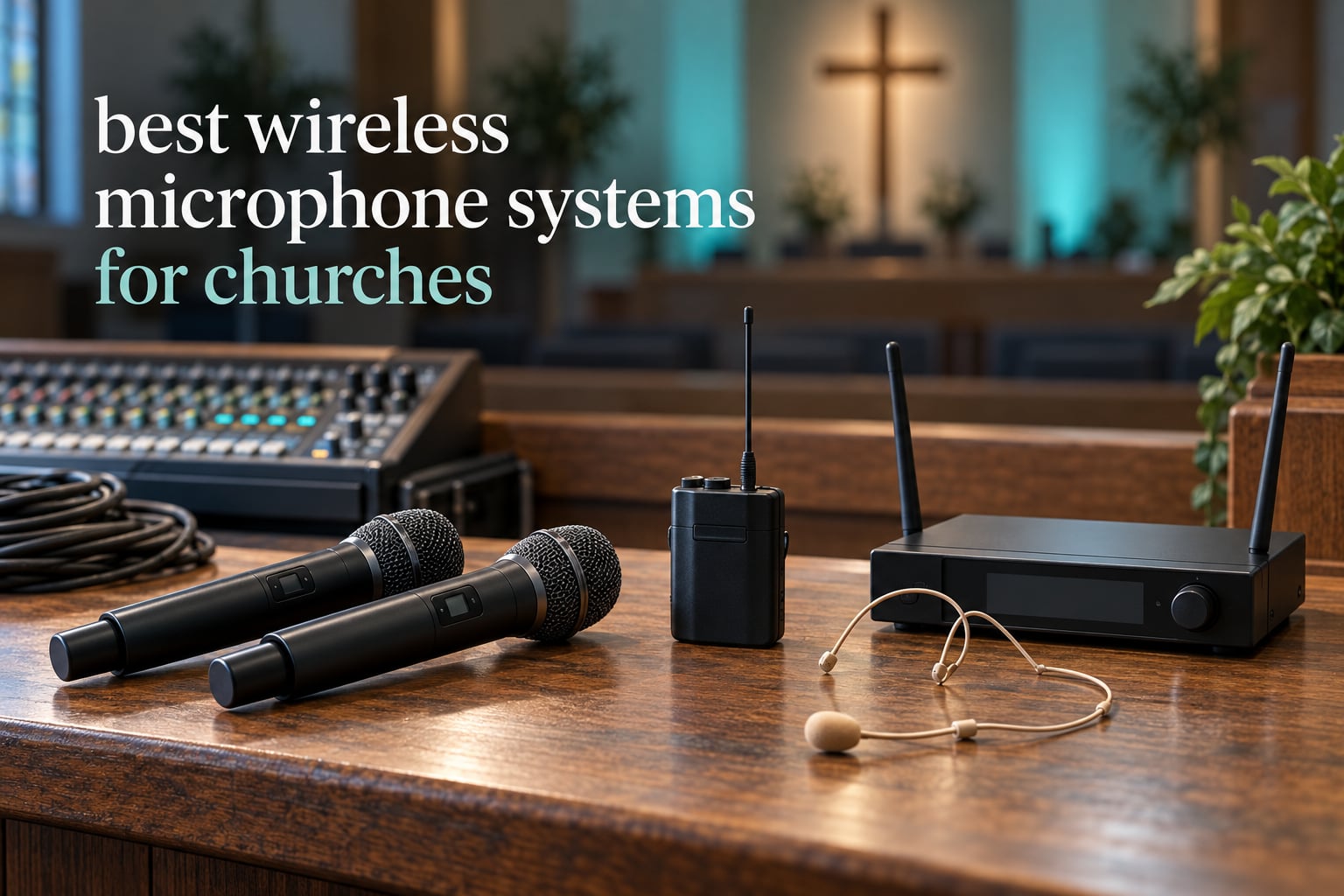
Ask a worship volunteer what keeps them up at night and it is rarely the mixing console. It is the pastor who steps off the platform during a baptism, the reader who cannot find a cable, the guest speaker nobody can hear from the third row back. Fixing that means choosing from the best wireless microphone systems for churches, and the honest answer is that most of the loud listings in this category are aimed at karaoke, not a room where one person is preaching to eight hundred people every week.
We spent weeks reading manufacturer documentation, published specifications and thousands of owner reviews to put this list together. To be straight with you: we did not bench test these systems in a sanctuary ourselves, and we think you should treat any roundup that claims otherwise with suspicion. Everything here is grounded in what the manufacturer states on paper and what long-term owners report back after real services.
What that research produced is a set of recommendations organised the way church audio actually gets planned: by room size and channel count, not by an abstract quality score. If you want a starting point before the full list, here is the short version.
- Best overall for mid-size churches: the Phenyx Pro PTU-5000-4H, a four-channel metal UHF system with individual volume controls, four XLR outputs and per-mic battery monitoring on the receiver display. It handles a preaching channel plus worship vocals in one box.
- Best budget start for a small church: the JBL Wireless Two Microphone System. It is the simplest pairing process of anything we looked at, and the most owner reviews in this group, but it is built for speech rather than singing.
- Best for hands-free preaching: the TONOR TW844 four-bodypack kit, which includes both a headset and a lavalier with every pack and runs 900-930 MHz transmission that sidesteps the crowded 500 MHz band.
- Best for a preacher who wants a lavalier: the Shure BLX14/CVL, the only single-brand professional system in the list, with a 14-hour bodypack runtime and roughly 300 ft of line-of-sight range.
- Best four-channel value for large halls: the innopow WM-400, four metal handhelds on one rack-mountable receiver with a supercardioid pattern for feedback rejection.
If your church already has instruments and is deciding where the money goes next, our guide on choosing digital pianos for church spaces covers the same room-acoustics questions from the music side.
Table of Contents
Top 3 Picks for Church Wireless Microphone Systems in 2026

Phenyx Pro PTU-5000-4H
- 4-channel UHF
- Metal handheld mics
- XLR and 1/4 inch outputs
- 260 ft range
JBL Wireless Two Mic System
- Dual-channel UHF
- Instant auto-pairing
- AA battery powered
- USB-C receiver

TONOR TW844 Bodypack System
- 4 bodypacks included
- Headset and lavalier each
- 900-930 MHz
- 40 selectable channels
Quick Overview: All 10 Church Wireless Mic Systems in 2026
Most of the systems below sit in the 500 MHz UHF band, the part of the spectrum most church audio teams are authorised to use in the United States under FCC Part 74, and the exceptions are flagged in their own section. Read the feature column first: channel count, output type and frequency agility decide whether a system survives contact with a real service.
| Product | Specifications | Action |
|---|---|---|
| Phenyx Pro PTU-5000-4H 4-Channel UHF |
|
Check Latest Price |
| JBL Wireless Two Microphone System |
|
Check Latest Price |
| TONOR TW844 4-Bodypack UHF System |
|
Check Latest Price |
 Phenyx Pro PTU-71-2H Auto Scan Phenyx Pro PTU-71-2H Auto Scan |
|
Check Latest Price |
 Phenyx Pro PTU-52-2H Tunable Phenyx Pro PTU-52-2H Tunable |
|
Check Latest Price |
 innopow WM333 Dual UHF innopow WM333 Dual UHF |
|
Check Latest Price |
 TONOR TW360 Handheld and Bodypack Set TONOR TW360 Handheld and Bodypack Set |
|
Check Latest Price |
 innopow WM-400 4-Channel Set innopow WM-400 4-Channel Set |
|
Check Latest Price |
 Shure BLX14/CVL Lavalier System Shure BLX14/CVL Lavalier System |
|
Check Latest Price |
 MicrocKing MK240-1 4-Channel UHF MicrocKing MK240-1 4-Channel UHF |
|
Check Latest Price |
1. Phenyx Pro PTU-5000-4H – Best Overall 4-Channel UHF System
Phenyx Pro 4-Ch UHF Fixed Frequency Wireless Microphone System PTU-5000-4H
- All-metal build rated for drops and road abuse
- Four XLR outputs plus a mixed quarter inch output
- Rack-mountable 19 inch receiver with LCD showing frequency and battery state
- Stable fixed frequencies with no feedback when all four run together
- Long AA battery life
- Capsules are relatively insensitive and need close-miking
- Fixed frequencies cannot be retuned or expanded
- XLR cables are not included
- Heavier than most budget handheld rigs
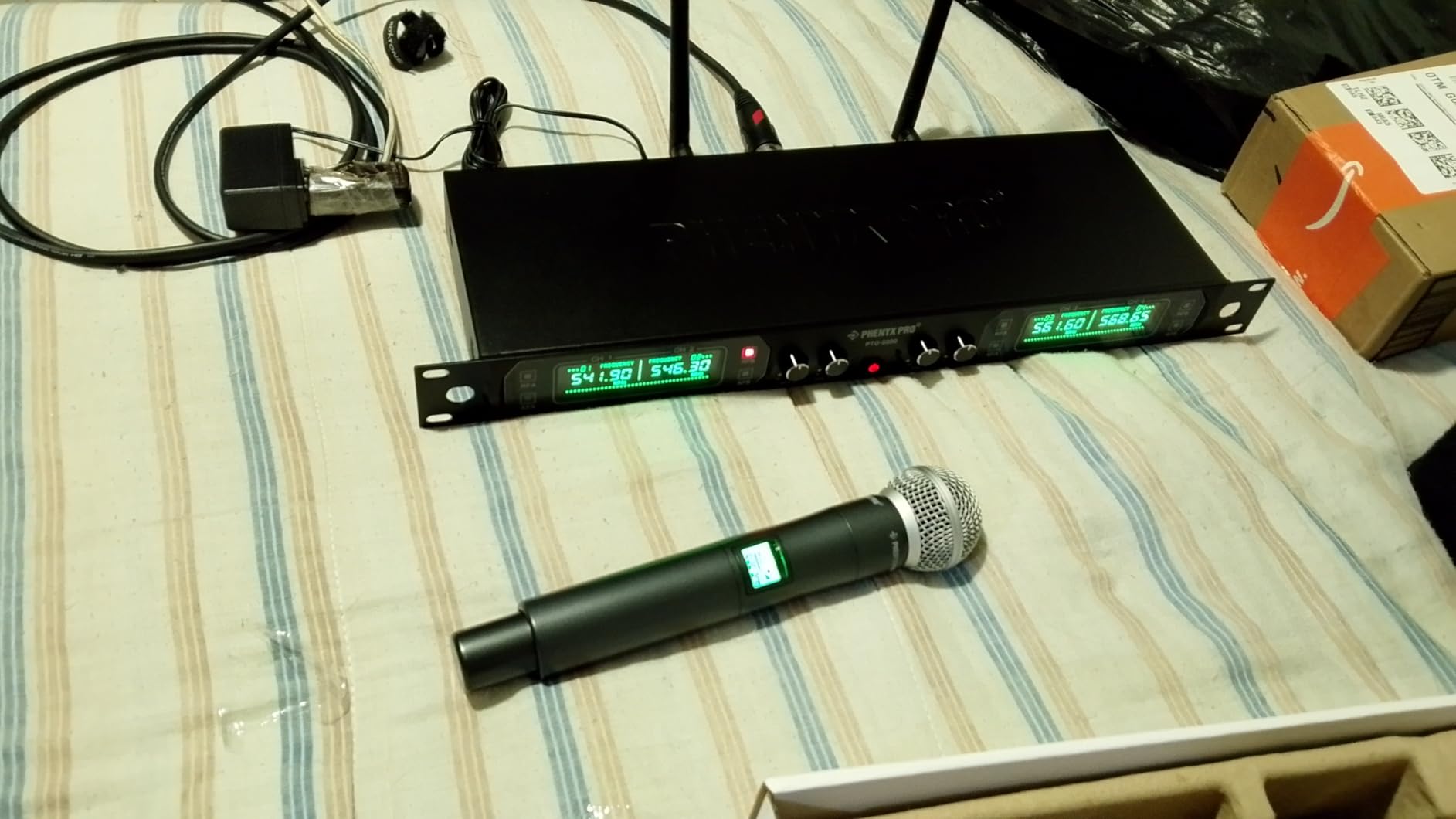
The first thing that stands out is that this is a four-channel system, not a pair of handhelds pretending to be a system. Four discrete channels, four individual volume controls and four XLR outputs mean your mixing desk sees four separate inputs rather than one stereo pair you have to fight with in a mix. For a mid-size church running a preaching channel, a worship leader and two backups, that is the whole job in one box.
Owners consistently report that the metal construction is the standout. These are heavy handhelds and a metal receiver chassis, and the reported experience in church, karaoke and mobile PA settings is that they survive being dropped, misted and carted around in a van. The receiver is rack-mountable in a standard 19 inch space, which matters more than it sounds when your current setup is a shelf under the desk with gaffer tape.
The sound is repeatedly compared to Shure and Sennheiser systems by people who own them, which is about as strong a compliment as this category gets. Signal-to-noise ratio is quoted at 105 dB with a cardioid capsule tuned to keep feedback down, and the manufacturer claims a range of up to 260 ft.
Two operational details matter more than anything else in a church setting. First, the receiver LCD shows both frequency and battery state, so a volunteer can check four mics at once instead of discovering a dead cell mid-sermon. Second, there is a memory switch that retains your settings, so the system comes back exactly as you left it after a power outage.
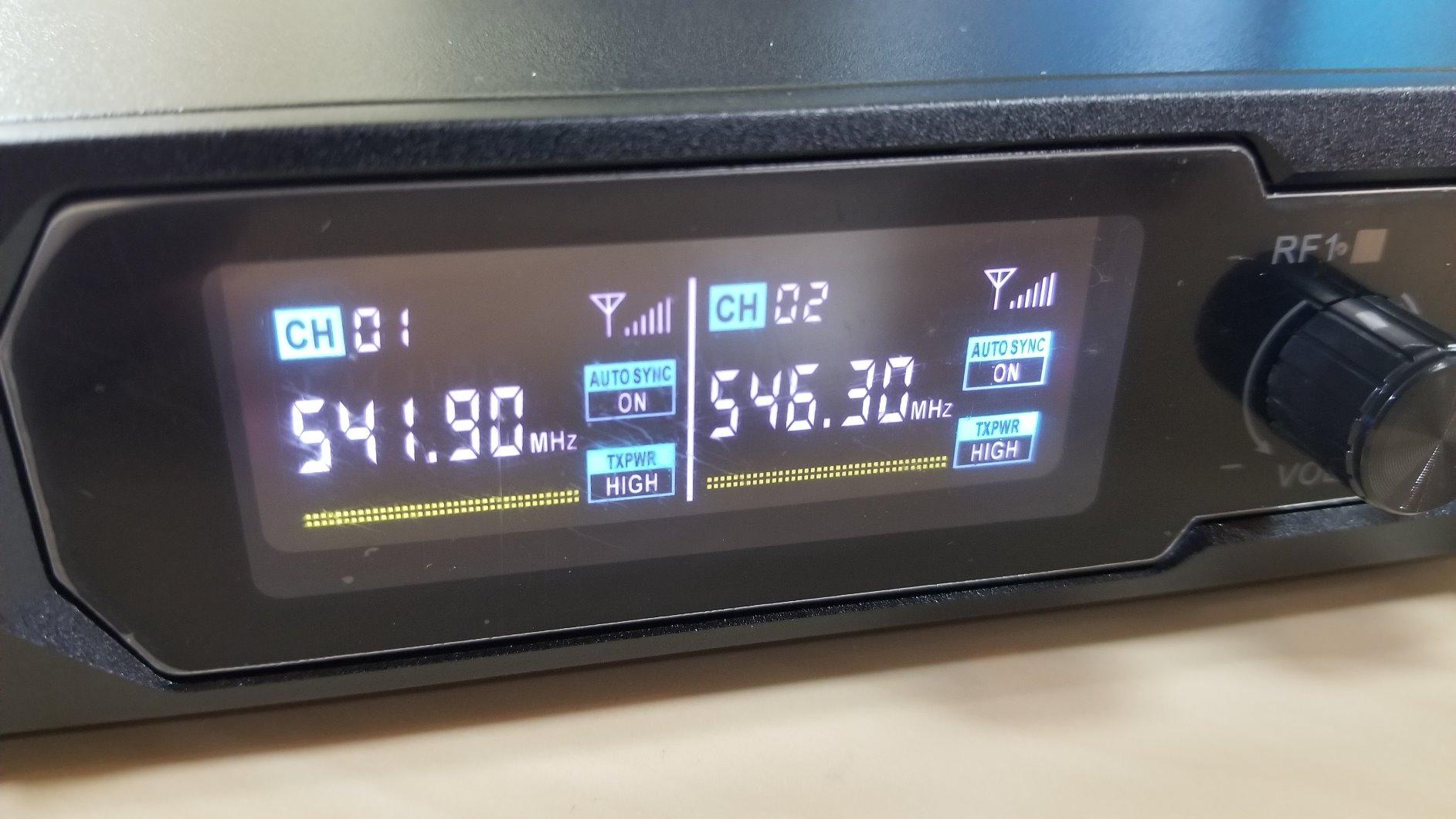
The honest limitation is the fixed-frequency design. These transmitters transmit on fixed frequencies at 541.9, 546.3, 561.6 and 568.65 MHz and cannot be retuned, which means you cannot add a fifth bodypack later on the same platform, and you cannot run this alongside another system occupying the same frequencies. Plan for four channels or buy a platform that scales.
The capsules are also on the quiet side, and owners report needing to hold the mic within a few inches of the mouth for a strong signal. For preaching that is natural. For a worship vocalist used to singing a foot away from a wired mic, it takes adjustment, and it is the single most common complaint in reviews of this unit.
Who this system suits
This suits churches between roughly 200 and 800 seats that want a preaching channel plus worship vocals without buying a second receiver. The four XLR outputs drop straight into a small-format mixer or a digital snake, and the rack-mount chassis keeps the audio rack tidy rather than adding another box to the shelf.
It also suits volunteer-run teams. Individual volume controls mean you can hand a guest speaker a handheld and let them set their own level at the mic, which removes one of the most common Sunday-morning support calls.
Who should skip it
Skip it if you know you will be past four channels within a couple of years, because the fixed frequencies make expansion a repurchase rather than an addition. Also skip it if worship vocals are the priority and you have singers who work handheld at a distance; the sensitivity is not the friendliest to that style.
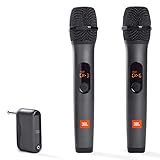
2. JBL Wireless Two Microphone System – Best Budget Dual-Channel Kit
- Plug and play setup with instant connection
- Clear vocal clarity with JBL Original Pro sound
- Two mics mix through one speaker for up to 6 hours
- Lightweight and comfortable for extended handheld use
- Power switch sits under the grip and is easy to hit
- Plosive-prone and needs a foam windscreen
- Receiver cannot be used while charging
- Occasional unit-to-unit static or crackle
This is the system we would hand a 60-seat chapel that needs one preaching mic and one roaming handheld for announcements. You turn on the receiver, you turn on the mics, and they connect. There is no frequency find, no pairing button, no menu, and for a volunteer team that has never coordinated spectrum in its life, that simplicity is the feature.
It also has the largest owner review base of anything in this guide by a wide margin, which means the long-term failure patterns are well documented rather than unknown. The pattern that emerges is reassuring: the electronics are consistent, and the complaints are almost entirely physical, ergonomic things rather than signal failures.
For speech, the sound is genuinely clear. The capsule is unidirectional, the quoted sensitivity is 100 dB and the signal-to-noise ratio is 60 dB, and the manufacturer claims no delay or distortion. That is a working preaching microphone, which is exactly what this class of product is for.
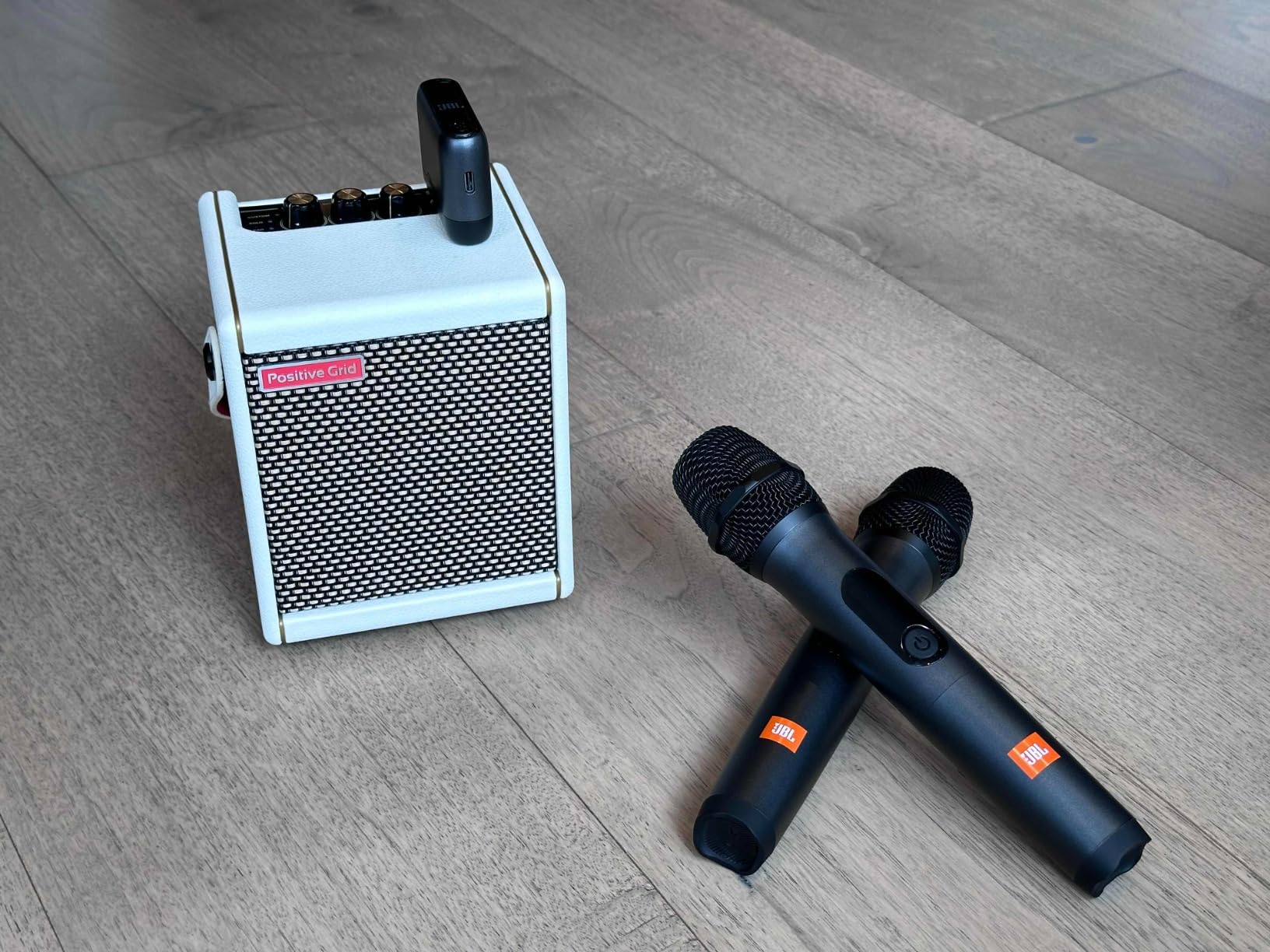
Two specifics matter for a church. The microphones use easy-to-replace AA batteries, so a volunteer can swap cells in seconds rather than hunting for a charger dock, and there is a battery indicator light on each mic so you know the state before the service rather than during it.
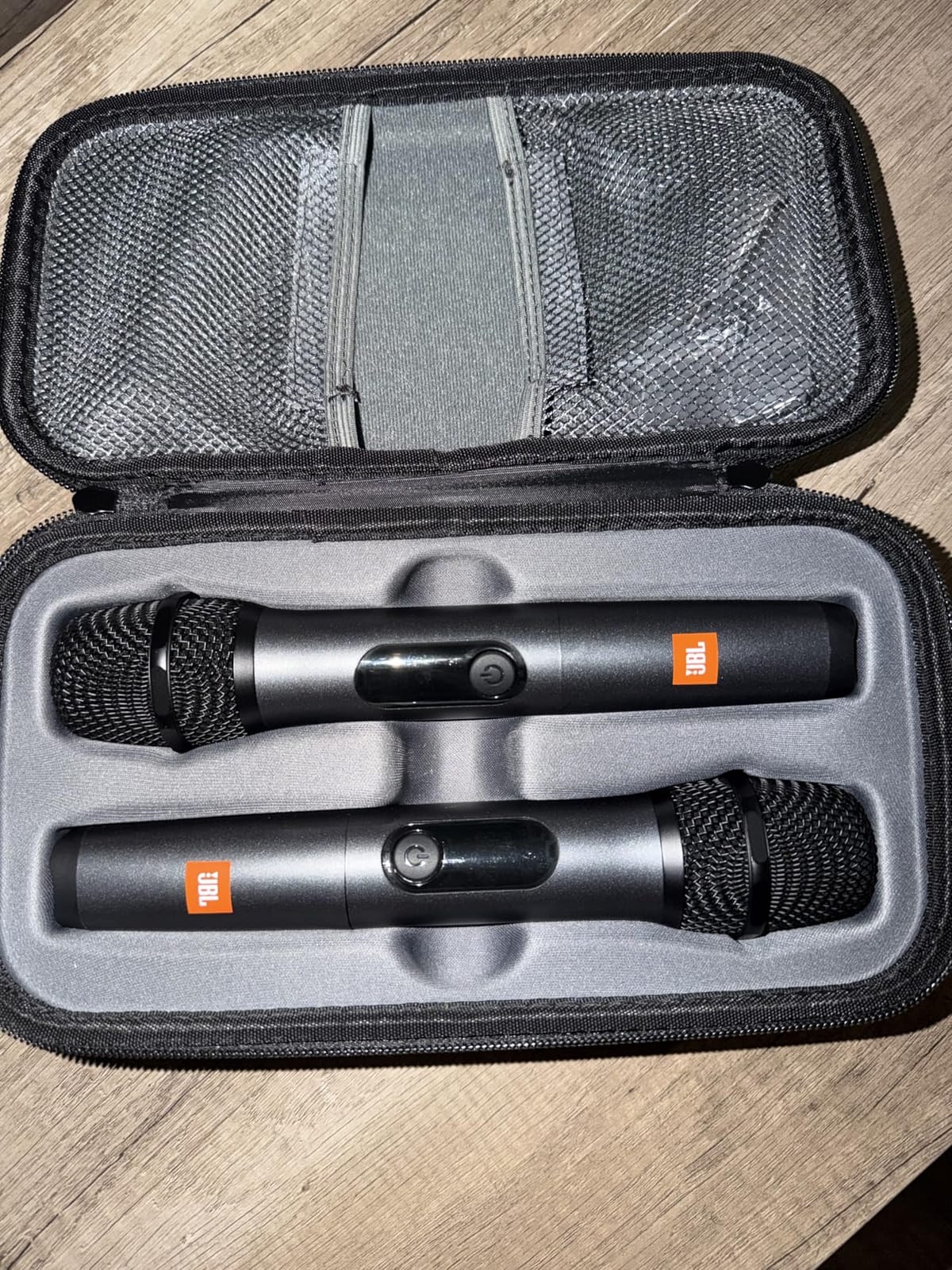
The receiver runs over USB and works with a wide range of powered speakers and amplifiers, and the manufacturer claims the two wireless mics can be mixed through one speaker for up to 6 hours of playback. The included box contents are a USB-C cable, the wireless receiver, two wireless microphones, a quick start guide, a safety sheet and a warranty card.
One structural limitation is worth knowing: the receiver cannot be used while charging. If your sound rack is powered from a single source and the receiver is the only thing keeping audio alive, plan for that.
Who this system suits
This suits small churches, chapels under 50 seats, fellowship halls and any room where two channels is genuinely enough. It also suits a youth group room or a food pantry that needs a microphone for announcements but does not need a platform.
It is the least intimidating purchase in this guide. If nobody on your team has ever set a frequency, start here and move up later.
Who should skip it
Skip it for worship vocals. It is plosive-prone out of the box and needs a foam windscreen, and a small plastic enclosure does not survive being thrown into a backpack between services. It is also the wrong choice for anyone who needs more than two channels later, since there is no path to add one.
3. TONOR TW844 4-Bodypack UHF System – Best for Hands-Free Preaching
- Every bodypack includes both a headset and a lavalier
- 40 selectable channels across four bodypacks
- Four-antenna receiver design holds a stable signal past sanctuary distances
- Bodypack MUTE button prevents open-mic moments
- Battery-level indicator on each bodypack
- Limited documentation for locking frequencies across two receivers
- Lapel capsules have modest sensitivity and need extra gain
- Bodypack antennas are not user-replaceable
- Some units report noisy channels
This is one of two systems in the guide where the preacher never has to hold anything. Four bodypack transmitters, and every single one comes with both a headset microphone and a lavalier, so a pastor who wants to be hands-free for a sermon and hands-in-pocket for announcements uses the same pack. Churches describe this as the best value in bodypack systems they have tried, and the package logic is genuinely hard to argue with.
The band choice is the quiet strength here. Rather than sitting in the congested 500 MHz range where every other system on this list competes, it transmits at 900 to 930 MHz, which is far less crowded in most towns. With a four-antenna receiver design and a claimed 295 ft operating range, the reported experience is a stable signal in most sanctuary and hall sizes.
There are 40 adjustable channels, 10 frequency options per bodypack, and the transmitters auto-pair on power-up. Auto-pairing matters more than it sounds: a volunteer who cannot pair a transmitter will abandon the whole system and go back to the wired mic they hated.
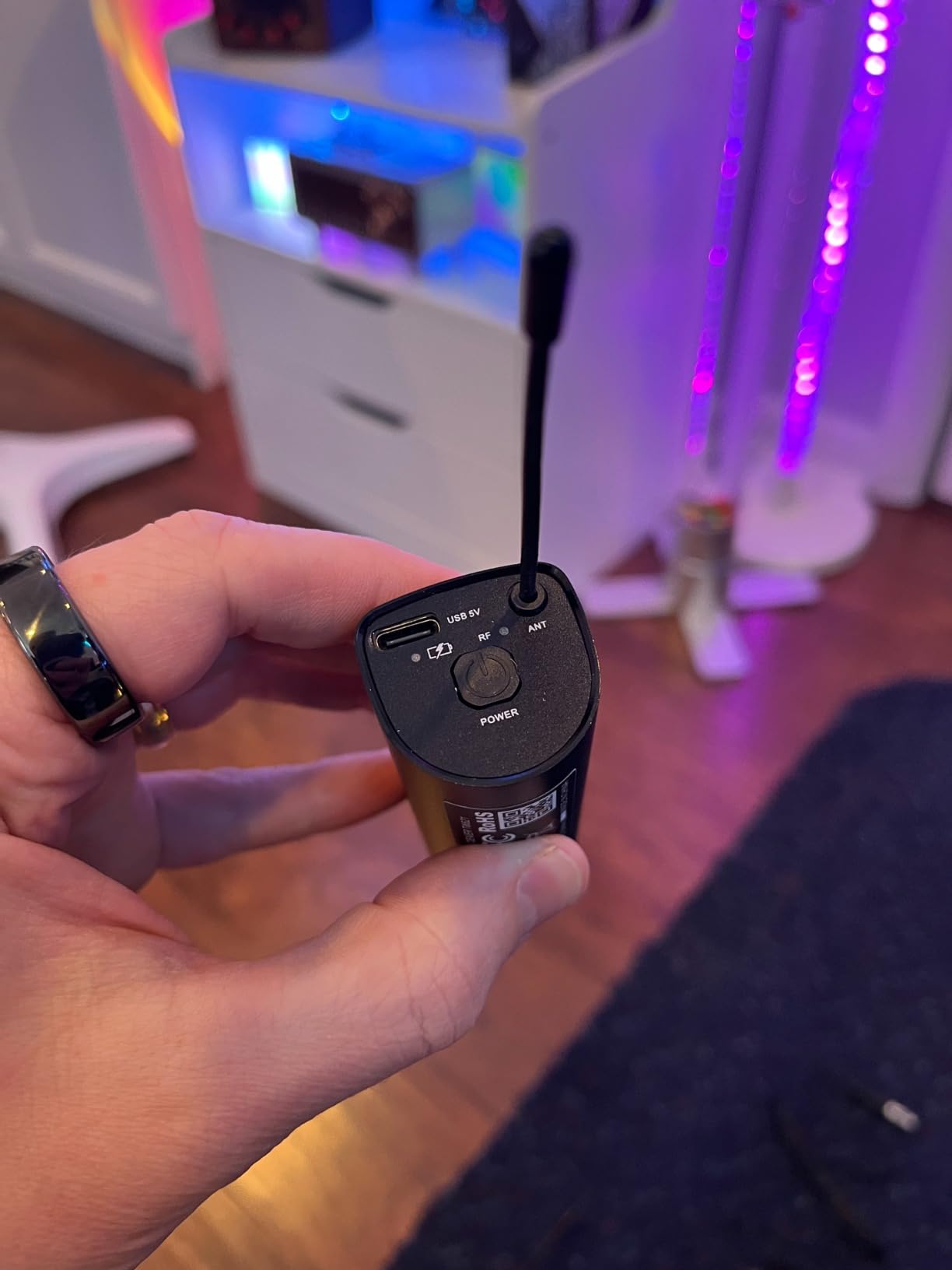
The bodypack hardware is better thought out than most at this level. There is a MUTE button, which is one of the most-requested features on cheap bodypacks because an open microphone during a service is an event everybody notices. There is a battery-level indicator so a depleted pack is discovered before the platform rather than during it.
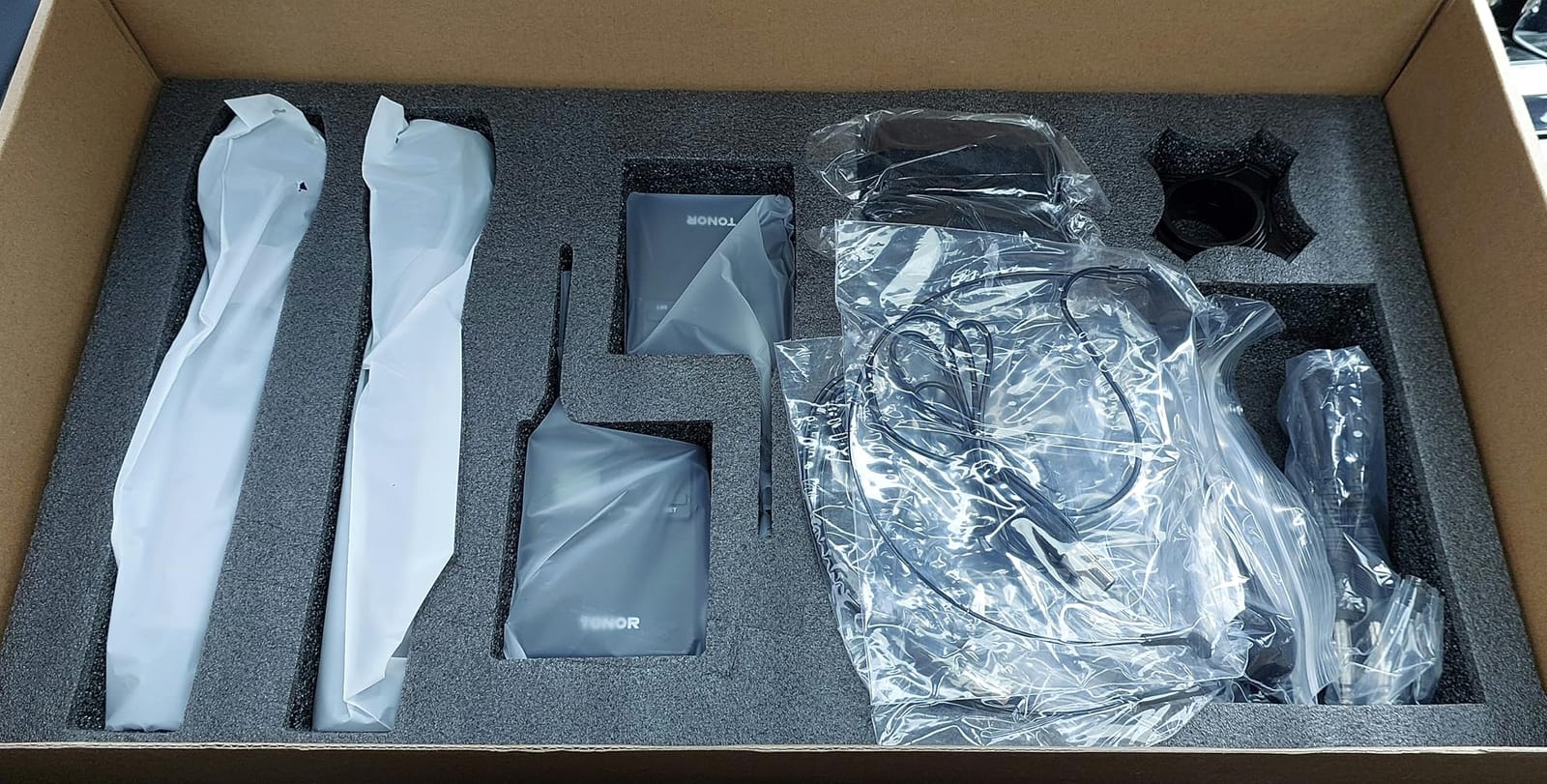
The capsules are cardioid pattern, quoted at 120 dB sensitivity with a 70 dB signal-to-noise ratio, and they connect to mixers, speakers, karaoke machines and amplifiers. The included kit is four bodypacks, four headsets, four lavaliers, the receiver, a 6.35 mm audio cable, a power adapter and a manual.
The weakest point is documentation. Setting up two receivers in one building on locked frequencies requires trial and error, because the manual is thin. Budget an evening with a spectrum-scanning app on your phone before the first service rather than the morning of.
Who this system suits
This suits any church whose main speaker moves, sings, or baptises, and it is our pick for a volunteer team that wants headsets and lavaliers in the same purchase without a second order. The 900 MHz band also makes it a sensible choice in dense urban areas where the usual 500 MHz white space is genuinely crowded.
It works well for a hospitality team, a roving Christmas caroller, or a communion distribution where someone needs to move through the room.
Who should skip it
Skip it if your church runs a worship band that moves around the stage, because the lapel capsules are on the quiet side and will need extra amplifier gain. Also skip it if a single volunteer is handling the whole rig alone; undocumented frequency locking across receivers is a poor experience for a first-timer.
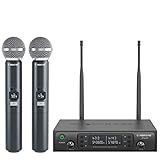
4. Phenyx Pro PTU-71-2H – Best for Auto Scan Frequency Finding
Phenyx Pro Dual UHF Auto Scan Handheld Wireless Microphone System PTU-71-2H
- Auto Scan finds a clean frequency in seconds
- Two bands of 100 frequencies each
- All-metal construction with replaceable mic heads
- Dual XLR plus combined quarter inch output
- Long AA battery life
- Mics are hot and need gain reduction
- Power indicators extinguish after a few seconds
- Receiver is not rack-mountable without a workaround
- Mics are heavy over a long set
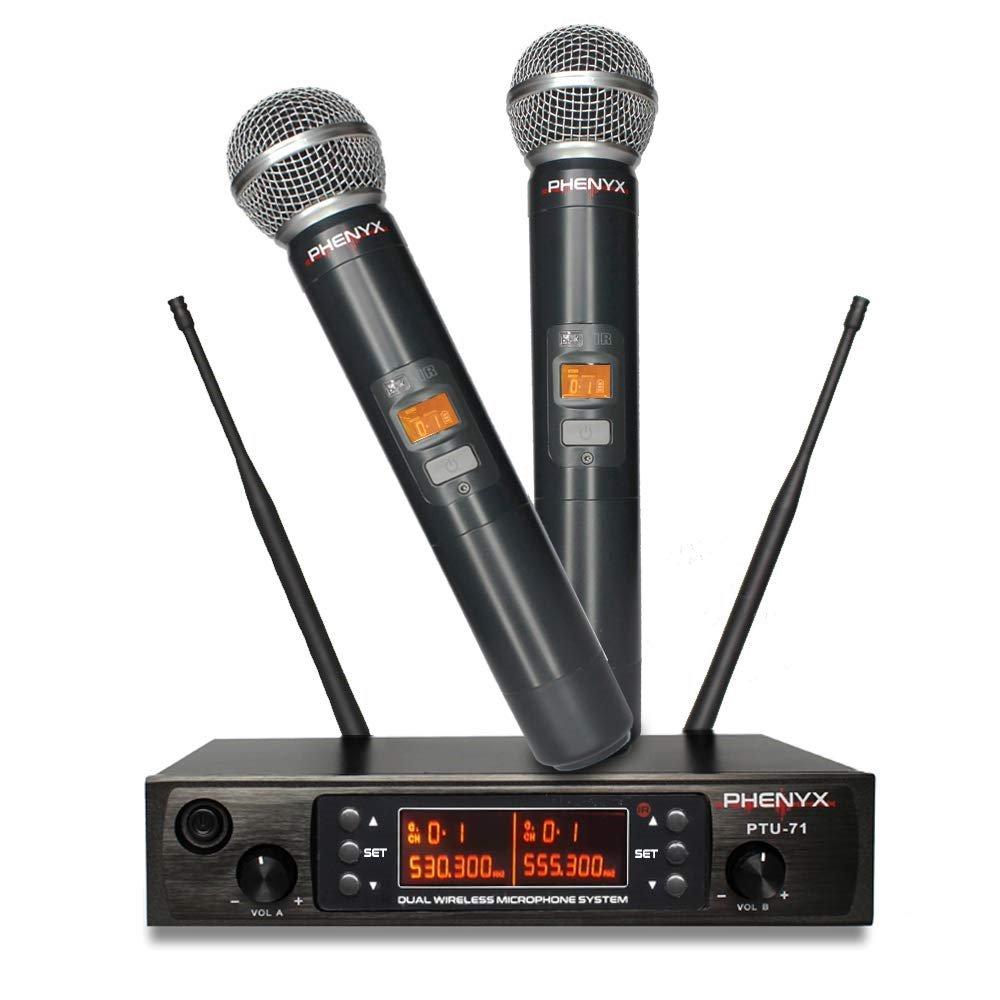
Auto Scan is the feature that sets this apart from every other two-channel system here. You press one button, the receiver sweeps both bands, finds the cleanest frequency and locks it. Reviewers report this as the difference between a system that works on a Sunday and a system that gets troubleshot during one.
Underneath that are two bands of 100 selectable frequencies each, 200 in total across 536.57 to 587.12 MHz using PLL synthesis with infrared sync, and the manufacturer states up to 16 simultaneous transmitters. In practice that headroom is what lets a church in a town with other venues on the same band avoid interference without a spectrum analyser.
The build is all metal with removable, replaceable mic heads. That replaceable-head design is quietly valuable: when a grille takes a hit from being set down on a steel stage, you replace the head rather than the transmitter, and owners confirm the capsules can be swapped in seconds.
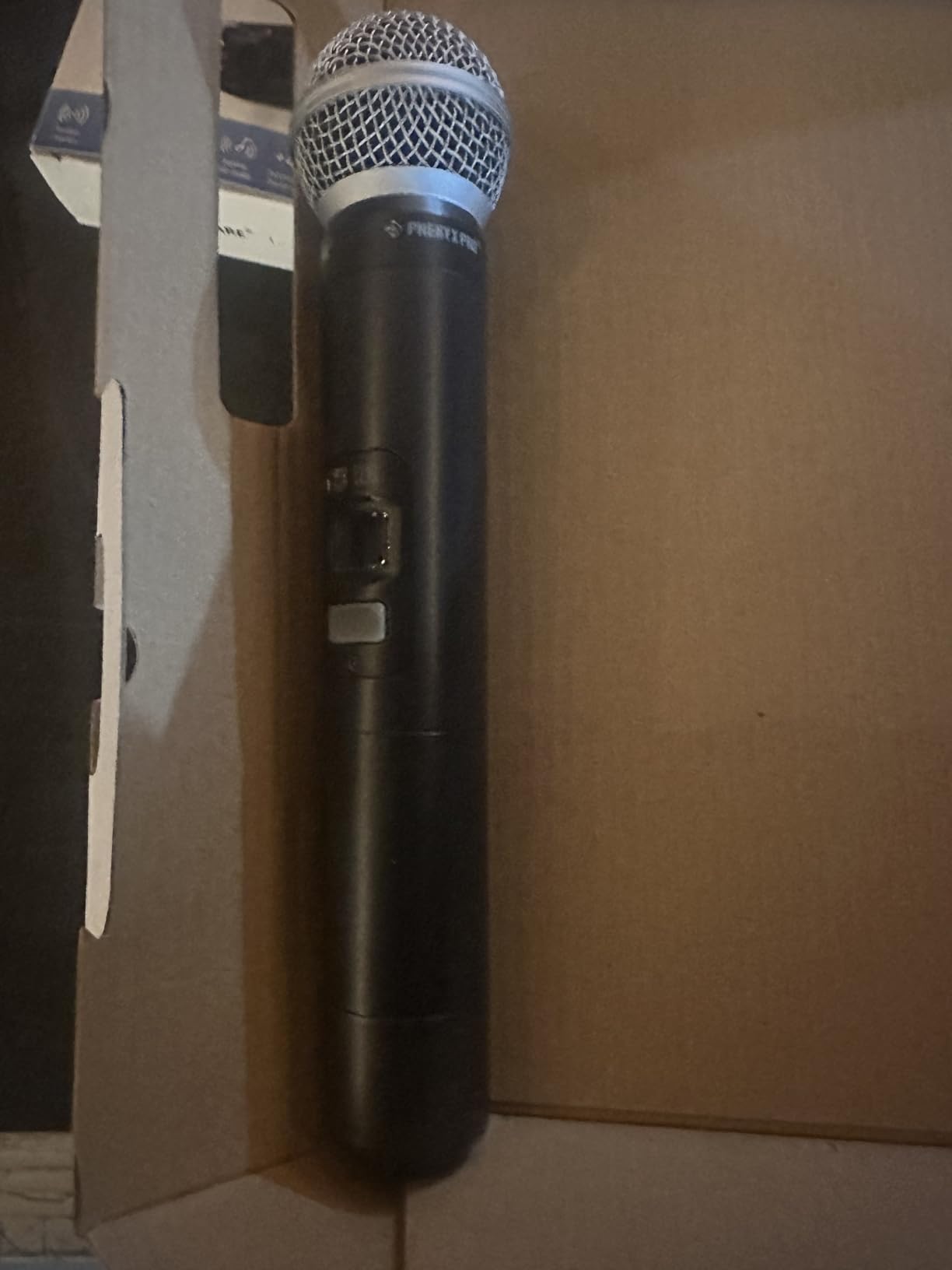
Long-term users in church, karaoke and mobile PA settings describe setup as roughly three minutes and report the signal holding at 100 ft and beyond, with sound frequently compared favourably to a Shure SM48. The included box covers a dual-channel metal receiver, two UHF handheld mics, a quarter inch cable, a 6.5 mm to 3.5 mm adapter, power adapter, two antennas, two anti-rolling rings and four AA batteries.
Two ergonomic complaints come up repeatedly. The power button sits exactly where your hand wraps the mic body, so it is genuinely easy to press it off mid-sentence. And the on/off indicator extinguishes after a few seconds, which leaves volunteers unsure whether the mic is live. A strip of tape with a dot on it solves both in about ten seconds.
Because the capsules run hot, gain and channel faders usually need pulling down relative to a wired microphone. This is a five-minute fix in the console, but budget time for it before the first rehearsal.
Who this system suits
This suits a church in a busy RF area where you cannot guarantee clean spectrum, because Auto Scan removes the need for a frequency chart and a phone with a spectrum app. It also suits rooms that host multiple events, where a second system might be brought in occasionally.
The replaceable mic head makes it a good long-term purchase for a group that treats equipment hard.
Who should skip it
Skip it if you already know your frequencies and want to lock everything down permanently, because the extra convenience is not worth anything once a channel is fixed. It is also too heavy for a volunteer who holds a mic for an entire 90-minute service and complains about hand fatigue.
5. Phenyx Pro PTU-52-2H – Best All-Metal Two-Channel Rig
Phenyx Pro Dual UHF Tunable Frequency Wireless Microphone System PTU-52-2H
- All-metal receiver and handheld microphones
- 30 tunable frequency groups supporting up to 3 systems
- Frequency-hopping auto-pairing within seconds
- Two XLR outputs plus a mixed quarter inch output
- Complete box contents with batteries and windscreens
- Range tops out around 200 ft in the open
- Only 30 frequency groups per mic
- Frequency selection is manual rather than auto-scanning
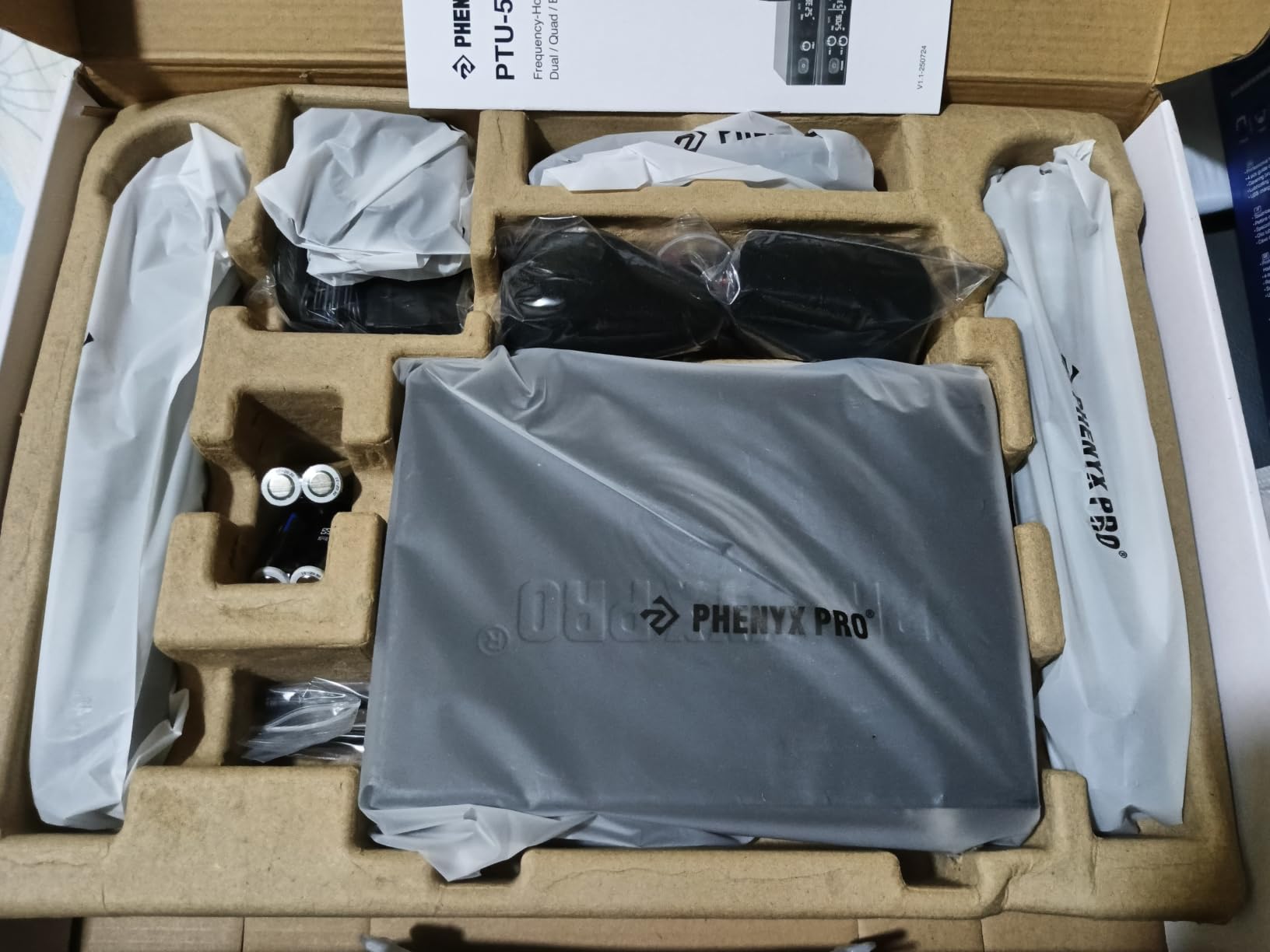
This is the version of the two-channel idea for people who care about build quality. Metal receiver, metal handheld bodies, 2.5 pounds of kit, and buyers consistently point to sturdy construction as the reason it delivers a professional result for church services, karaoke and public speaking without feeling like a toy.
Frequency handling is a 30-group pool in the 500 MHz band, which supports up to three concurrent systems. That is less headroom than the PTU-71 above, but it is enough for a church that is running one system while a neighbouring room occasionally runs another. Selection is manual rather than auto-scanning, with a memory switch to hold your choice.
Pairing is frequency-hopping auto-pair, and reports describe the transmitter and receiver linking within seconds. Two XLR outputs plus a mixed quarter inch output give you both per-channel mixer control and a fast path into a powered speaker.
The reported signal is clean, with owners specifically noting the absence of hiss, dropouts and feedback for church and speaking work. The included kit is generous for the class: receiver, two mics, power adapter, quarter inch cable, 6.35 mm to 3.5 mm adapter, four AA batteries, two anti-rolling colour rings, two windscreens, antennas and rubber feet.
The cardioid capsule and enhanced circuitry are tuned for smooth transmission, and the unit carries a mute function and volume control. It is a one-year warranty, shorter than the two years a Shure bodypack carries, so factor replacement into a long-horizon budget.
The main constraint is range. Reports put usable distance at around 200 ft in open line-of-sight, which covers most sanctuaries but is short if your platform is at one end of a very long room or if the transmitter is going off-site.
Who this system suits
This suits a small-to-mid church that wants two metal handhelds, keeps its equipment in a van or an unheated storage closet, and does not need to retune frequently. The colour rings are a small touch that matters when four people share two mics and you need to know which is which.
It also works well as a secondary stage box for a fellowship hall that is set up rarely.
Who should skip it
Skip it in dense urban areas where the 500 MHz band is crowded, since 30 groups is thin and there is no auto-scan to rescue you. Also skip it if you plan to add a third or fourth transmitter, because the channel pool is the limit.
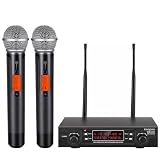
6. innopow WM333 – Best for Battery Life Between Services
- 100 selectable frequencies on each of two separate bands
- Auto-scan plus manual channel pairing
- All-metal handhelds with cardioid capsules
- 14 to 17 hour battery life
- Reliable infrared frequency pairing over multi-year use
- Gripping the base of the mic blocks the internal antenna
- Bundled foam screen is not enough on its own
- Receivers do not power on automatically
- Not rack-mountable without a shelf
Battery logistics is a real cost in a church, not a minor spec. A volunteer changing cells before every service is a recurring commitment, and this system is quoted at 14 to 17 hours of run time, which in practice means a set of cells that can cover several long services before anyone thinks about it.
Sound engineers and church volunteers with two to twenty years of experience describe this as the best value in metal-bodied UHF handhelds, citing a tight cardioid pattern and excellent rear rejection. Rear rejection is what stops a floor wedge or a monitor speaker from bleeding into the mic, and for a room with a decent band that is a meaningful advantage.
Frequency-wise it is well covered: 100 selectable frequencies on each of two bands, mic A at 536.57 to 561.32 MHz and mic B at 562.37 to 587.12 MHz, with auto-scan plus manual channel pairing for multi-system setups. Infrared sync is fast, and owners with multi-year usage report it has never failed to pair.
Two operating habits make a bigger difference here than on any other system in the guide. First, do not hold the bottom of the mic: the internal antenna lives there, and covering it causes static at very short range. Second, add an external wind filter, because the bundled foam screen is not enough to control plosives on close-miked speech.
Both tips appear repeatedly in long-term owner reviews, and both are free. The reported learning curve around the auto-scan routine is also worth the evening it takes, because owners note that running the scan resolves most problems people attribute to the hardware.
One logistics point to plan around: the receivers do not power on automatically with the rack, so each one has to be switched on manually as part of the power-up sequence. Write it into the checklist rather than into memory.
Who this system suits
This suits a church that runs two or three services a week and does not want a charging dock to manage. It also suits bands with loud vocal sources where rear rejection prevents feedback, and churches with metal racks and busy power supplies nearby who want tight cardioid pickup as insurance.
It suits a small fellowship hall or a community room that only needs audio a few times a month.
Who should skip it
Skip it if you need receivers to come up automatically with the console, since there is no auto-power. It is also a poor fit for anyone who wants the mics to sit in a pocket or be carried by a small child, given the internal antenna arrangement.
7. TONOR TW360 – Best Starter Package for Small Churches
TONOR Wireless Microphone System, Handheld Mic Set with Headset/Lapel Mics
- Most flexible package here with handhelds and bodypacks together
- Auto-pairs on power-up
- Cardioid dynamic capsule clear for services and meetings
- 20 channels across four transmitters
- Bodypack MUTE button for shared rooms
- Range is 200 ft
- shorter than most four-channel alternatives
- Batteries are not included
- Bodypack audio uses a single combined quarter inch connection
- Signal-to-noise ratio of 60 dB is low
- Plastic bodypack housings
Most small churches need two handhelds for readers and guests and one or two bodypacks for preaching, and this is the only package here that bundles all four with both a headset and a lavalier on each bodypack. For a first wireless purchase that covers every role a small church has, the value is difficult to argue with.
It auto-pairs on power-up, so the setup is genuinely plug in and go. The capsule is a cardioid dynamic described as clear and feedback-resistant for church, weddings, meetings and karaoke, and the bodypack MUTE button handles the open-microphone problem during transitions.
Frequency-wise there are 20 channels across the four transmitters, 10 per mic and bodypack, which supports several simultaneous sets in one room without much fuss.
Where it falls short is measurable. The quoted range is 200 ft, which is shorter than most four-channel alternatives here and tight for a long sanctuary. The bodypack housings are plastic, the signal-to-noise ratio is 60 dB, and the bodypack audio exits through a single combined quarter inch connection rather than per-channel XLR.
AA batteries are not included, and each mic and bodypack needs two cells. That is a small upfront chore rather than a problem, but it catches people out the first Sunday.
The included box is comprehensive: two handheld microphones, two bodypacks, two headset microphones, two lavalier microphones, the receiver, two mic covers, two anti-slip rings, a 6.35 mm audio cable, a power adapter and a manual.
Who this system suits
This suits a small church, a chapel, or a church plant running one service in one room, where the pastor preaches hands-free and a reader or two need a handheld. The all-in-one nature means one order replaces what would otherwise be two.
It also suits a church hall that needs both speech and a bit of singing without a full upgrade.
Who should skip it
Skip it for a large sanctuary, where 200 ft is not enough reach and a 60 dB signal-to-noise ratio will show on a good system. Skip it if you plan to grow into eight channels, because the platform does not scale to per-channel XLR routing.
8. innopow WM-400 – Best 4-Channel Set on a Single Receiver
- Four independent channels with per-mic volume knobs
- All-metal handheld bodies with internal antennas
- Plug and play with no syncing required
- Supercardioid pattern rejects room noise and feedback
- Receiver is rack-mountable
- Fixed frequencies cannot be retuned or run with other systems
- Mic bodies are too thick for standard mic stands
- Only one quarter inch cable included
- XLR cables must be bought separately
Four channels, one receiver, and no pairing ritual. Church, choir and karaoke-jockey owners rate this as a strong four-channel value, and the specific thing they praise most is the loud, clear vocal pickup that does not require holding the mic close to the mouth.
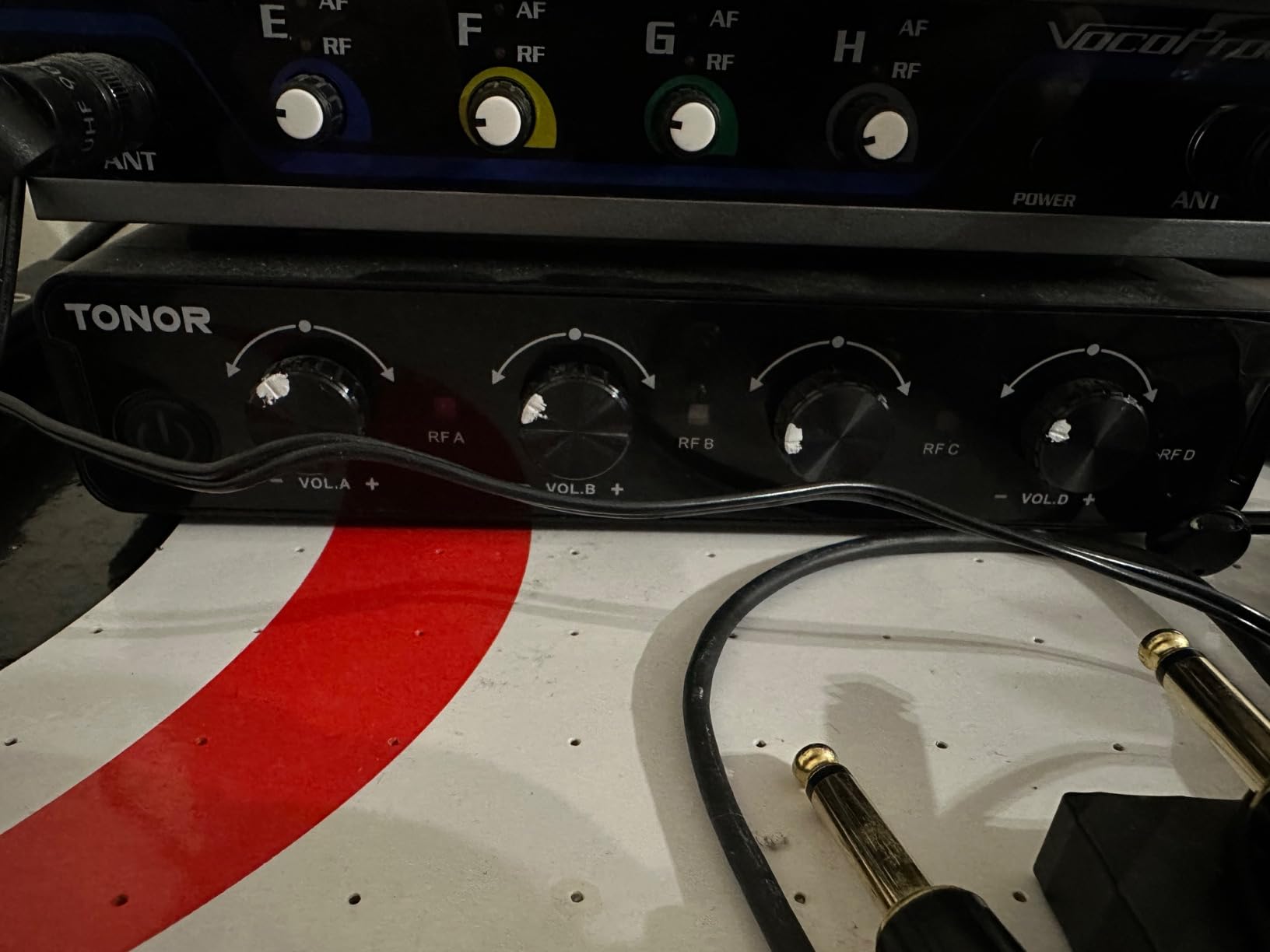
The receiver is rack-mountable, which puts it alongside the Phenyx four-channel unit and above the shelf-mounted two-channel kits here. Each channel has its own volume knob, so you can balance a quiet reader against a loud guest without opening a mixing desk.
The capsule is a unidirectional neodymium dynamic cartridge described as supercardioid, with true sound, feedback rejection and low handling noise. That pattern is the reason it holds up in a room with a live band, because it points at the singer and away from the monitors.
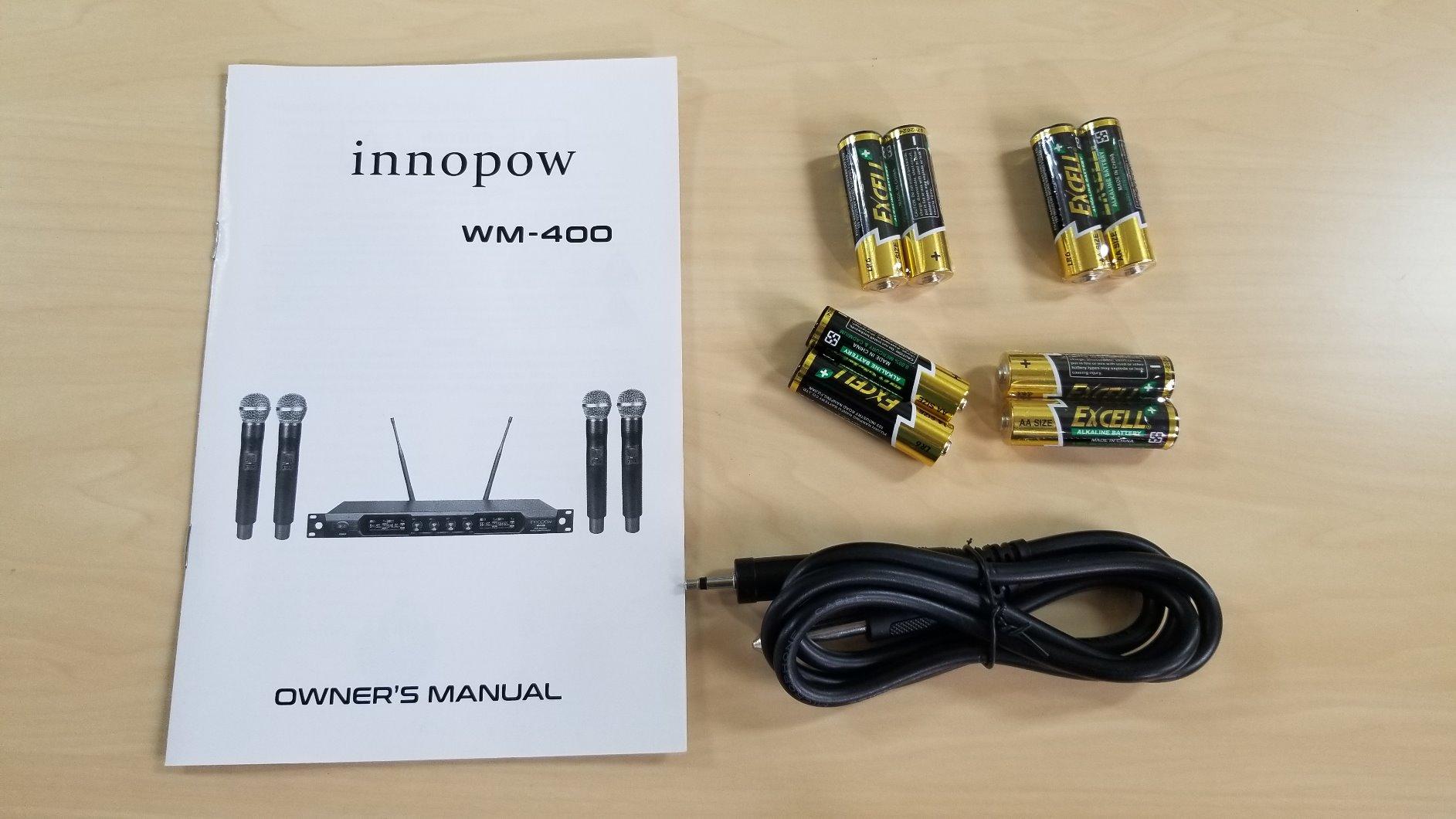
Battery life is quoted at 14 to 17 hours and working range at 150 to 200 ft in open areas. Four AA batteries are included, and the design uses internal antennas, so there is nothing to snap off and nothing to lose in transport.
Two practical gotchas are worth planning for. The mic bodies are too thick to fit a standard mic stand and no holders are included, so anyone who sets a mic down mid-service needs a clamp or a shelf. And only one quarter inch cable comes in the box, so per-channel mixer use means buying XLR cables separately.
The fixed-frequency design is the deeper limitation. It cannot be retuned and cannot run alongside other systems on the same band, which makes it a closed system rather than a platform.
Who this system suits
This suits a church that runs a worship band, a choir, or a large choir-and-ensemble event where several people need to be heard at once and nobody is available to ride a mixing desk. The rack-mountable receiver makes it a clean fit in a small audio rack.
The internal antennas also make it a good travelling system, since there is no loose antenna to lose between venues.
Who should skip it
Skip it if you might ever add a second system in the same room, because the fixed frequencies close that door. Skip it if your singers need to go hands-free, since every transmitter here is a handheld and no bodypack is offered for this platform.
9. Shure BLX14/CVL – Best Lavalier System for Preaching
Shure BLX14/CVL Wireless Lavalier Microphone System – H10 Band
- Clean
- interference-free audio with essentially no feedback
- About 300 ft line-of-sight transmission
- Up to 14 hours on two AA batteries
- CVL cardioid lavalier focused on speech
- Two-year limited warranty
- No mute button so the transmitter must be power-cycled
- Small delicate on/off switch on the bodypack
- Highly directional pickup drops out when the speaker turns their head
- Bundles are band-specific
The Shure name matters here in a way it does not for the other nine. Church and presentation users point to the Shure badge for dependable, feedback-free clarity, and the audio is described as clean and interference-free across the board. It is the only established pro audio brand in this guide, and it is the one most tech teams are already trained to service. It is also the only one with a two-year limited warranty.
The capsule is a CVL cardioid lavalier, which means it is designed for speech rather than singing. Placed discreetly with a clip and windscreen, it stays out of sight on a pulpit and out of frame on a livestream camera, which addresses one of the most common complaints from congregations watching a stream.
The BLX1 bodypack runs up to 14 hours on two AA batteries, and some owners report closer to 20. Range is quoted at approximately 300 ft or 100 m line-of-sight, which suits a sanctuary with a long nave and a platform at one end.
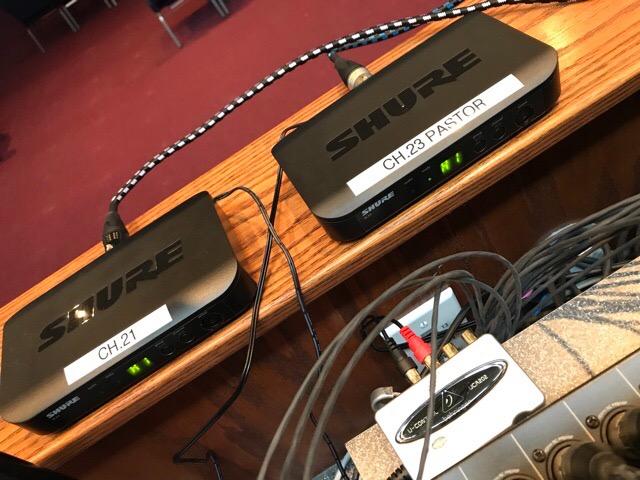
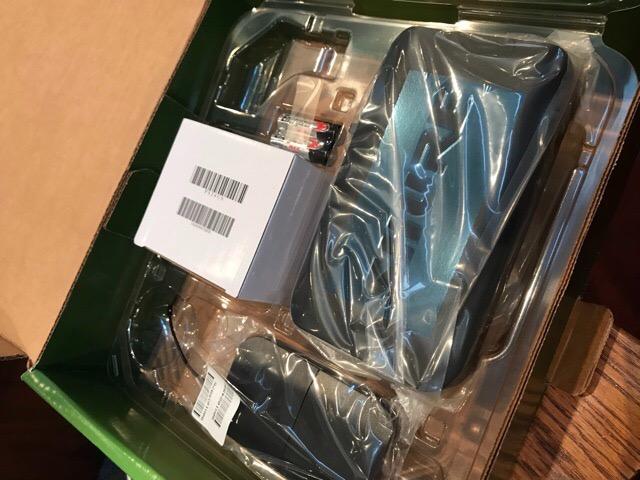
The complete package is a BLX4 single-channel receiver, a BLX1 bodypack, the CVL cardioid lavalier with clip and windscreen, a power supply, two AA batteries and a user guide. Shure supports up to 12 compatible systems per band, with quick receiver frequency matching to get them paired.
The most common complaint by a distance is the absence of a mute switch. Turning the mic off means switching it fully off and back on, which introduces a delay you can feel on stage. The on/off switch on top of the bodypack is also small and delicate, and a number of owners report it eventually breaking.
Because the pickup is highly directional, a speaker who turns their head away becomes hard to hear. That is a rehearsal habit rather than a defect, but it needs to be coached, especially for a guest speaker who has never worn a lavalier.
Who this system suits
This suits a church whose primary requirement is a discreet, reliable preaching microphone, particularly one that livestreams. The Shure warranty is a two-year limited, and the support ecosystem means a spare part is always findable.
It also suits churches that already own BLX equipment and want the same band, since Shure supports up to 12 compatible systems per band.
Who should skip it
Skip it if you need more than one channel out of the box, because this is a single-channel receiver, and adding a second means buying a second system rather than expanding. Skip it if your speakers move constantly and wear their head near the body, since the directional pickup is unforgiving of that.
Be careful with bands. These bundles are band-specific, and mixing H10 and H9 units produces incompatible systems.
10. MicrocKing MK240-1 – Best for Large Halls and Multi-Mic Sundays
- One receiver box drives all four mics
- Individual volume knobs for balancing quiet and loud users
- Range performs as advertised in large halls
- Mics pair automatically on power-up
- Metal mic bottoms and mesh heads resist impact and corrosion
- AA batteries fit very tightly and are hard to install
- No low-battery warning so failures look like dropouts
- Batteries are not included
- Sound quality is adequate rather than refined
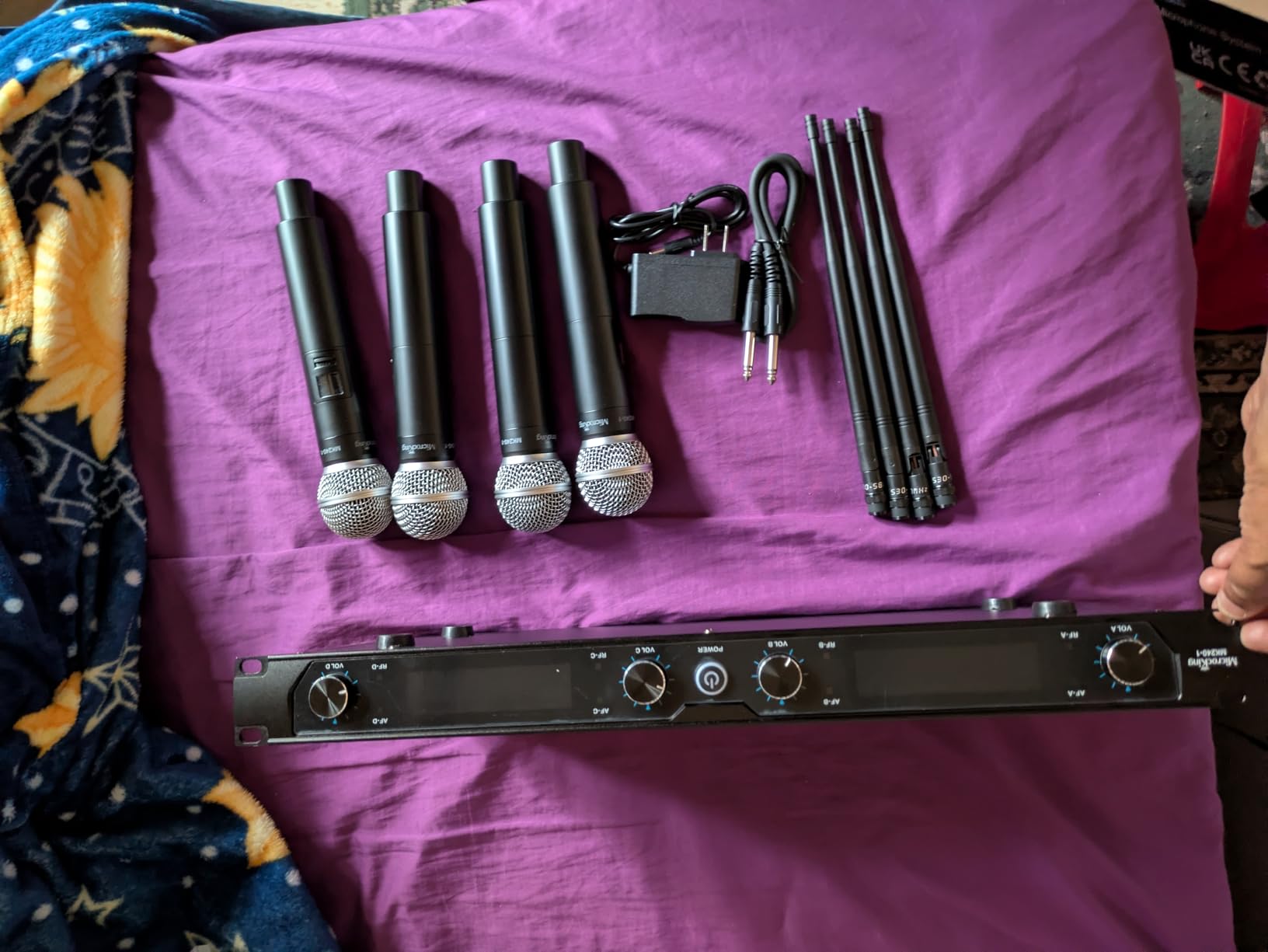
The case for this system is a single receiver driving four mics with four XLR outputs, or a single quarter inch mixed output with on-board level controls. For a large hall running a single mixed feed into a powered speaker, that is genuinely all the routing you need, and the individual volume knobs let you balance without a mixer at all.
Owners report range performing as advertised in large halls, with one operator describing clear vocals across a 200 ft hall. The mics pair automatically on power-up, and 40 available channels across up to 10 simultaneous systems gives broad headroom for a four-channel kit like this one.
The capsule is a cardioid moving-coil pickup head with an internal chip, described as clear and smooth with reduced feedback. The metal mic bottoms screw on securely and the mesh heads resist impact and corrosion, which suits equipment that lives in a closet between services.
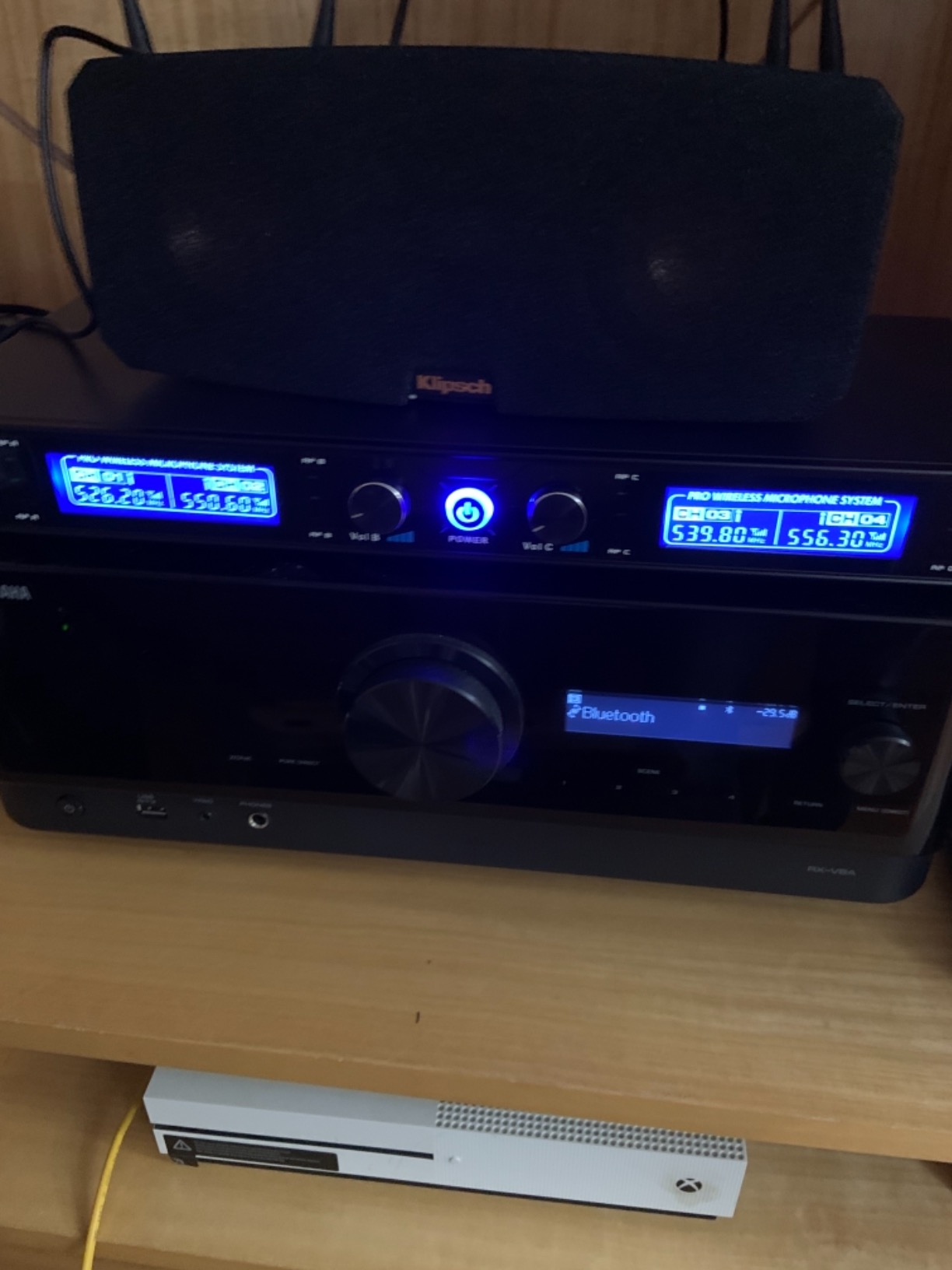
There is a meaningful operational flaw to know about: there is no low-battery warning, and the display stays lit while the cells are already too weak to transmit. A dead mic then looks exactly like a signal dropout, which sends volunteers hunting for RF problems that do not exist.
The AA batteries also fit very tightly and are difficult to install and remove, which is genuinely awkward when a children’s ministry volunteer is trying to change a cell before class. Batteries are not included with the system, and eight are needed for four mics.
On sound quality, owners are honest that it is adequate rather than refined, with a brighter, less natural top end than higher-tier sets. A few owners also report a channel or the receiver failing within the first year of moderate use, so the warranty conversation matters.
Who this system suits
This suits a large hall, an auditorium-style church, or a multipurpose space that runs a mixed feed rather than per-channel audio. The 400 ft claimed range and automatic pairing make it forgiving in a room where volunteers are not confident with technology.
It suits a church that wants four handhelds for readers, guest speakers and a roaming host without buying a rack-mount receiver.
Who should skip it
Skip it for a worship band, because the top end is bright and the capsule is not built for sustained vocal work. Skip it if you have young volunteers changing batteries, because the tight compartment and the missing low-battery warning will cost you more time than the purchase saves.
How Many Wireless Mics Does Your Church Actually Need?
Two channels cover most small churches, three to four channels cover most mid-size churches, and six or more is a multi-site or large-sanctuary conversation. The mistake we see constantly is buying four channels for a room that only ever has two people talking, because channel count is the single biggest driver of what the system costs and how much battery and coordination work it creates.
Two channels. One for the preaching position and one roaming handheld for readers, elders, guest speakers and children’s ministry. This is the sweet spot for a chapel under 50 seats or a small church up to about 200 seats. A dual-channel handheld kit covers it, and a lavalier plus handheld covers it better if the pastor moves.
Three to four channels. Add worship vocals. Two channels is almost always too few once a band plays, because the pastor, a worship leader, a reader and a guest speaker are four distinct people in a typical Sunday. Four channels with individual volume control is where this roundup’s top pick sits, and it is the most common purchase in the category for good reason.
Six channels and up. You now need real RF coordination. Above four concurrent transmitters, antenna placement, intermodulation checking and antenna distribution stop being optional, and this is the topic church sound forums raise most often. The subject of splitting one antenna pair across many receivers comes up repeatedly in professional live sound discussion, and the short answer is that a proper distribution system is not optional at that scale.
The running-cost side of the equation matters more than most buyers expect. A church that runs three channels on alkaline cells replaces batteries on a schedule that never quite ends, and volunteers are the ones paying that cost in time. Above roughly three channels, rechargeable packs or a system with long published runtime start to pay for themselves quickly, which is why the innopow WM333 and WM-400 both claim 14 to 17 hours and the Shure bodypack claims 14.
Budget for the accessories the box does not include. Several systems here do not include XLR cables, and the four-channel units that only offer a mixed quarter inch output will need either a cable purchase or a spare mixer channel to carry the whole mix.
UHF vs 2.4 GHz: Which Band Survives Your Sanctuary
UHF is the safer default for most churches, and 2.4 GHz is the right answer in specific circumstances rather than as a general upgrade. UHF systems in this guide transmit in the 500 to 590 MHz range under FCC Part 74 authorisation, they penetrate concrete and steel far better, and they do not compete with your church Wi-Fi. The cost is coordination: when several systems share a band, you need to check for intermodulation products, not just find a quiet frequency.
2.4 GHz systems skip coordination almost entirely because they are in an unlicensed ISM band, which is a real advantage in a small building with two channels. The problem is coexistence. Uncontrolled church Wi-Fi and access points sitting near the platform are the most commonly reported cause of dropouts on 2.4 GHz systems, and the fix is on the network side: fixed access point channels, and no router on the platform.
Dual-band designs that transmit on both 2.4 and 5.8 GHz are the compromise answer for a church in a dense urban area where the usable UHF white space is genuinely full. They give up some of the UHF wall penetration in exchange for not having to coordinate anything.
The TONOR TW844 in this guide takes a different route entirely, transmitting at 900 to 930 MHz. That band is far less crowded than 500 MHz in most towns, which is why owners in busy areas report stable links on all four bodypacks without any frequency planning.
On the digital versus analog question: digital wireless is not automatically better. Digital systems give predictable audio regardless of signal strength and typically eliminate the noise floor that analog raises as the signal degrades, but they do not fix bad antenna placement or a crowded band. In a room where UHF white space is scarce, a well-coordinated analog system beats an unconfigured digital one every week.
Microphone Type by Role: Headset, Lavalier, or Handheld
Match the form factor to what the person does on stage, not to what looks tidy. A headset suits a preacher who moves, sings, and baptises. A lavalier suits a preacher who mostly stays in one place and is being filmed. A handheld suits anyone who roams, hands out a mic to a guest, or sings. And a gooseneck podium mic is the answer when the pulpit moves, which is a real problem raised repeatedly in church audio forums, where a portable pulpit gets moved out of the chancel and stored elsewhere.
Headset. Best gain before feedback of any option, because the capsule sits at the corner of the mouth. It also frees both hands, which is why preaching and baptising work well with one. The cost is visibility: on a livestream, a headset is visible in a way a lavalier is not, which some congregations and some pastors mind a great deal.
Lavalier. Discreet on camera and comfortable for four hours, which is exactly what a long service needs. The trade-offs are lower gain before feedback and more sensitivity to clothing noise and to the speaker turning away. The common complaint that lavaliers sound muffled is usually placement, not the capsule: worn too low, under a collar, or against a tie, the capsule picks up fabric instead of voice.
Handheld. The most forgiving in every practical sense. Nothing to hide, nothing to place, works for a four-year-old on a microphone and a guest speaker alike. The limits are gain before feedback against a loud band, and the fact that a handheld caps how close the speaker can get to the mouth.
Gooseneck podium. If the pulpit moves or is shared between rooms, a wired gooseneck with an integrated preamp is a strong option, and owners in church audio forums describe running one into a wireless bodypack to gain mobility. Confirm that the preamp output matches what the bodypack expects before committing to that route.
The 3 to 1 rule is a mixing guideline rather than a purchasing one, but it shapes what you buy. With three or more open microphones, gain structure gets tight and every open capsule adds feedback risk. Buying fewer, better-matched microphones and closing the others frequently solves more problems than buying more channels.
On capsule choice specifically, the useful habit is to think in terms of what the voice is doing. A dynamic cardioid capsule such as the one in the Phenyx and innopow units is a sensible general-purpose starting point. Moving up to a tighter supercardioid pattern, as in the innopow WM-400, buys feedback rejection at the cost of requiring a closer working distance. Change capsule before you change system, because capsules cost a fraction of a transmitter.
Batteries, RF Coordination, and the Five-Year Cost Question
Battery chemistry is the quietest running-cost decision in this whole category. Alkaline cells remove the charging logistics entirely and fail predictably, which makes them the right choice for a mission-critical preaching channel where a dead mic mid-sermon is unacceptable. Rechargeable packs are the better answer above roughly three channels, where the number of cells in circulation each Sunday starts to matter.
Label transmitters with the cell type they take, and keep a spare set of cells in a labelled box. More churches lose a service to a flat battery than to interference, and the fix is a spare set of cells plus ten minutes of setup.
RF coordination is the part most small churches skip and most regret. The runbook is short: scan the band in the room you are actually going to use, choose frequencies that are not merely quiet but that do not produce intermodulation products landing on each other, place the antennas with clear line of sight and away from metal racks and power supplies, label every transmitter and receiver pair, then run a full-load test with every channel live before the service.
Antenna distribution is the piece that appears in almost no beginner buying guide and in almost every professional one. Past about four channels, running many receivers from a single antenna pair is asking for trouble, and equipment such as wideband UHF antenna splitters and distribution amplifiers exists specifically to give each receiver a matched, isolated signal path.
For six or more channels, treat antenna distribution and coordinated frequency planning as part of the purchase rather than an upgrade for later. Churches that skip it end up with intermittent dropouts that look like equipment failure and get misdiagnosed repeatedly, and that is one of the most common threads in professional live sound discussion.
Wired versus wireless is worth a moment too. A wired microphone at the pulpit needs no batteries and cannot drop out mid-sentence. Wireless wins when the speaker moves. For a fixed pulpit in a small room with a reliable mixer, a good wired microphone is a defensible choice, and no roundup should pretend otherwise.
Before You Buy: Used Gear, Karaoke Kits, and Bluetooth Mics
Used and donated wireless gear is the most expensive mistake a church can make. Frequency bands have been reallocated in the United States, including portions of the 617 to 652 MHz, 663 to 698 MHz and 700 MHz ranges, so a donated receiver tuned to a band that is no longer available for wireless microphone use is scrap, however clean it sounds. Check the band label before accepting the gift, and ask the donor for the model number first.
Read the band letter on the receiver, such as H9, J11 or G20, and confirm that the same band is available and authorised in your area. A system that is legal in one state can be illegal in another, and a system that is legal today can be reallocated in a few years, which is the argument for buying current-band gear rather than inheriting it.
Cheap karaoke bundles are a different trap. Dual-handheld and four-mic bundles built for parties are designed for a room with no band coordination, no congregation and no live band. In a weekly service they show up as hot capsules, limited channel headroom and no per-channel control, and the replacement means another afternoon of setup work on top of the original spend.
Bluetooth and consumer headset microphones are not wireless microphone systems. They are built for phone calls, they compress aggressively, they drop whenever the paired device moves out of range, and their latency shows up plainly on a livestream. Owner reviews of these products in a church context are uniformly negative, and that pattern is consistent across brands.
On safety and installation, we are not professionals and this is not professional advice. Have a qualified installer sign off on any system that goes into a distributed campus or a sanctuary with a distributed antenna system, and confirm the current FCC position for your band and area before a purchase rather than after. Churches that are also covering the sanctuary and entry points for security are usually running separate, non-interfering equipment, and our guide to wireless security camera systems covers that side of the install.
Frequently Asked Questions
What is the best wireless mic system for churches?
The best wireless microphone systems for churches are usually the four-channel UHF sets that cover a preaching position plus worship vocals in one receiver. In this roundup the Phenyx Pro PTU-5000-4H leads because it offers four discrete channels, four individual volume controls, four XLR outputs and a rack-mountable metal receiver. Small churches often need only two channels, so a dual-channel handheld kit is a perfectly good answer at a lower tier.
How many wireless microphones does a church need?
Most churches need two channels, which covers a preaching microphone and one roaming handheld for readers and guest speakers. Mid-size churches running a worship band usually need three to four. Six or more channels is a large-sanctuary or multi-site scenario where RF coordination and antenna distribution become necessary. Buying more channels than you will ever use adds battery logistics and coordination work for no benefit.
What type of microphone is best for church?
It depends entirely on the role. A headset microphone suits a preacher who moves, sings and baptises, and offers the best gain before feedback. A lavalier suits a stationary speaker who is being filmed, since it is discreet on a livestream. A handheld suits roaming speakers, guests and singers. A gooseneck podium mic suits a pulpit that moves or is shared between rooms.
Which is better, UHF or 2.4 GHz wireless for a church?
UHF is the safer default for churches because it penetrates concrete and steel better and does not compete with church Wi-Fi, though it needs frequency coordination. A 2.4 GHz system needs no coordination at all, which suits a small room with two channels, but it can drop out when access points sit near the platform. Fixing Wi-Fi access point channels and keeping routers off the platform resolves most 2.4 GHz problems.
Is digital wireless always better than analog?
No. Digital systems give predictable audio regardless of signal strength and usually remove the noise floor that analog raises as the signal degrades, but neither fixes bad antenna placement or a crowded frequency band. In a room where UHF white space is scarce, a well-coordinated analog system is more reliable week to week than an unconfigured digital one.
Can you use donated or second-hand wireless microphones in a church?
Only after checking the frequency band. Parts of the 617 to 652 MHz, 663 to 698 MHz and 700 MHz ranges have been reallocated in the United States, so a donated receiver tuned to a reallocated band cannot legally be used for wireless microphones. Read the band label on the receiver, such as H9, J11 or G20, and confirm it is still authorised in your area before accepting the equipment.
Our Verdict for Churches Buying Wireless Mics in 2026
After weighing channel count, build, frequency agility and battery logistics rather than sticker price, the Phenyx Pro PTU-5000-4H is our pick among the best wireless microphone systems for churches. Four metal channels, four XLR outputs, a rack-mountable receiver and a display that shows frequency and battery state cover the preaching plus worship vocals case that most mid-size churches actually have.
Under about 200 seats, the JBL two-channel system is the honest starting point, because the easiest setup in this guide is worth more than features you will not use. If your preacher never holds a microphone, the TONOR TW844 bodypack kit is the right shape of purchase. If you are filming, the Shure BLX14/CVL lavalier is the one here with a two-year warranty and a bodypack rated for up to 14 hours on two AA cells.
Whichever you choose, buy the channel count you will genuinely use, write the battery change into the checklist, and expect a different tool entirely past four channels. If you are coordinating a distributed campus, our guide to wireless intercom systems covers the same multi-room infrastructure questions.