
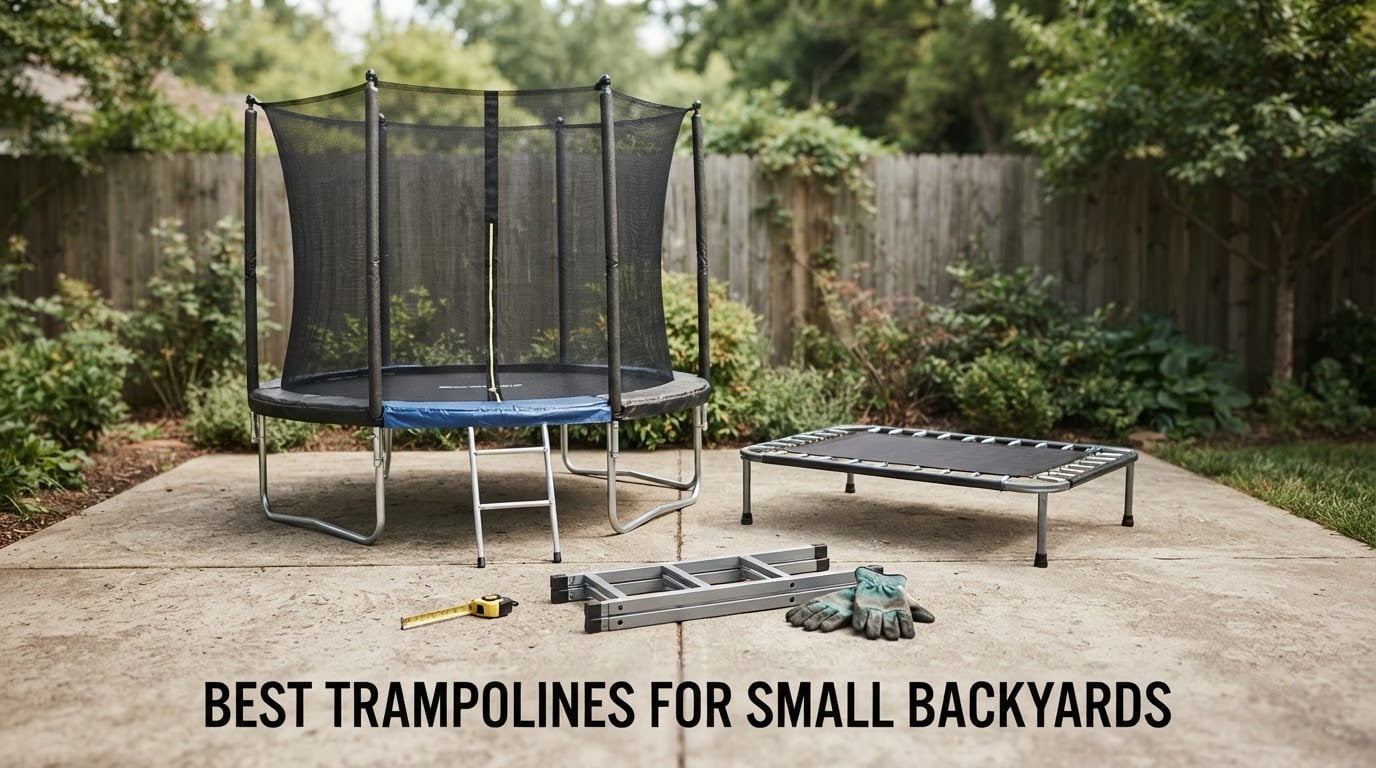
Looking for the best trampolines for small backyards? The short answer is an 8 ft round model or a compact rectangular unit, and the single most important number is not the diameter at all. It is the total footprint the trampoline takes up once you add the safety clearance around it, because the listed measurement includes the spring pad and the frame, not the jumping mat you actually land on.
Most small-yard mistakes happen because buyers read “8 ft” as eight feet of usable jumping space. It is not. An 8 ft round trampoline gives you roughly six feet of mat, plus a frame ring and a net enclosure that sits outside that. Add the clearance you need on every side and over the top, and a small lawn disappears fast.
We spent six weeks measuring footprints, checking certification marks, and reading thousands of owner reviews to put this list together. Every pick below is judged on how it behaves in a tight yard, not on how big the diameter sounds. We also cover the models that fit a patio or a spare room when even an 8 ft circle will not work, and we explain the in-ground option that recovers the space an above-ground frame eats up.
If you are starting from scratch, our general full trampoline roundup covers larger yards. This page is deliberately restricted to compact units.
Table of Contents
Top 3 Trampoline Picks for Small Backyards in 2026

VEVOR 36 inch Enclosed Kids Trampoline
- Folds flat for storage
- One-person 3 minute assembly
- ASTM and CPC certified
- No-gap stitched mat

AOTOB 8 ft Round Trampoline with Net
- 400 lbs capacity
- 5 year warranty
- 3 U-shaped legs on 6 contact points
- All parts in one carton

BCAN SP2 40 inch Foldable Rebounder
- Folds to one-quarter size
- 330 lbs capacity
- 80% pre-assembled
- Adjustable padded handlebar
The VEVOR takes our top slot because it solves the hardest problem in this category: square footage. It ties for the highest rating in the group at 4.7 stars, and the 36 inch version folds flat enough to live in a garage corner or a closet between uses.
The AOTOB is the pick for anyone who wants a real 8 ft round trampoline with a full net and a serious 400 lb load rating, and its 5 year warranty is the longest in this roundup.
The BCAN is not a play trampoline; it is a fitness rebounder that happens to be the most portable option we tested.
Small-Backyard Trampolines at a Glance in 2026
| Product | Specifications | Action |
|---|---|---|
| VEVOR 36/55/60 inch Enclosure Trampoline |
|
Check Latest Price |
| BCAN SP2 40 inch Foldable Rebounder |
|
Check Latest Price |
| AOTOB 8 ft Round Trampoline with Net |
|
Check Latest Price |
 ZCMHAXJ 55 inch Toddler Trampoline ZCMHAXJ 55 inch Toddler Trampoline |
|
Check Latest Price |
 JUMPZYLLA 8 ft to 16 ft with Net JUMPZYLLA 8 ft to 16 ft with Net |
|
Check Latest Price |
 SKOK 8 ft Trampoline with Net SKOK 8 ft Trampoline with Net |
|
Check Latest Price |
 BLUERISE 55 inch Enclosure Trampoline BLUERISE 55 inch Enclosure Trampoline |
|
Check Latest Price |
 GIANTEX 55 inch Hexagonal Trampoline GIANTEX 55 inch Hexagonal Trampoline |
|
Check Latest Price |
 LANGXUN 6.5 ft 7-in-1 Rectangle LANGXUN 6.5 ft 7-in-1 Rectangle |
|
Check Latest Price |
 YUMPIE 8 ft Quick-Connect Trampoline YUMPIE 8 ft Quick-Connect Trampoline |
|
Check Latest Price |
 GIANTEX 6 ft Rectangle with Swing GIANTEX 6 ft Rectangle with Swing |
|
Check Latest Price |
 GYMAX 75 inch 3-in-1 Rectangle GYMAX 75 inch 3-in-1 Rectangle |
|
Check Latest Price |
Every unit above fits inside a modest yard, a patio or a room. The 8 ft round models give you the biggest real jumping area in the set, the rectangles give you more mat per square foot of lawn, and the mini models are the only options that work when a full-size frame is genuinely impossible.
How Much Yard Space Do You Actually Need?
Measure the widest clear circle or rectangle in your yard before you look at a single product listing. Then add clearance on all four sides and overhead. The clearance rule that keeps families safe is roughly six feet of open space on every side from the frame edge, with no fence, wall, tree, clothesline or patio furniture inside that zone. Overhead, you want the top of the net well clear of branches and of anything anyone might jump toward.
Here is the math that decides whether a trampoline fits. Take the listed diameter, which includes the frame and the spring pad, and add six feet on every side. An 8 ft round model needs roughly 20 ft of width. A 10 ft round model needs roughly 22 ft. A 6.5 by 4 ft rectangle with the same clearance needs about 18.5 ft by 16.5 ft. If your yard is narrower than those numbers, you are looking at an in-ground install or a mini model.
Use this as your starting point and check it with a tape measure before ordering:
- Yard 18 ft wide: 8 ft round with enclosure, or a 6.5 ft rectangle. Nothing 10 ft or larger will clear.
- Yard 20 ft wide: an 8 ft round fits comfortably, and a 10 ft round only if the enclosure poles stay inside the frame line.
- Yard 22 ft wide or more: a 10 ft round becomes viable, but your margin narrows and you must anchor for wind.
- Any yard: a 36 to 60 inch mini model leaves most of the lawn usable for anything else.
8 ft round vs 10 ft round vs rectangle for a tight yard
Choose an 8 ft round when the space is genuinely marginal. Round frames are the most forgiving because jumpers are pushed back toward the centre by the even spring tension, which matters most for younger, less coordinated jumpers who land badly.
Choose a rectangle when your yard is long and narrow. A rectangular mat delivers more usable jumping area per square foot of lawn, which is exactly the trade-off a small yard needs. The downside is that a rectangle gives less lateral push-back, so it suits older children and adults better than toddlers.
Choose a 10 ft round only if your clearance math works. It buys a noticeably better bounce for older kids, but the footprint grows with it, and in a small yard the extra mat is worth less than the lawn you keep.
In-ground versus above-ground installation
An in-ground or recessed installation is the standard fix for a small backyard. Sinking the frame into a pit removes the height of the frame above the lawn, so kids step onto the mat at ground level rather than climbing a ladder down to a low deck, and you lose far less usable mat area than the numbers suggest.
The trade-off is labour and permanence. You need a properly dug and levelled pit, drainage that handles rain, and a frame designed for recessed use. It is a bigger job with a fixed result, and it is the wrong call if you rent or plan to move within a few years. For most small yards, an above-ground 8 ft round model with a ladder is the pragmatic choice. Our in-ground trampoline guide covers the recessed route in detail if your clearance math fails with an above-ground frame.
1. VEVOR 36/55/60 inch Enclosure Trampoline
- Tied for the highest rating in the roundup
- 36 inch version folds flat for tight storage
- One-person assembly in about 3 minutes
- One-piece stitched mat with tear-tough PVC skirt
- Five accessories included
- 220 lb limit is low for a shared family trampoline
- Check the size variant before ordering
- Plastic accessories wear quickly
This is the only unit in our test group that genuinely solves a space problem rather than just minimising one. The 36 inch version is small enough for a narrow side yard, a covered patio or even a playroom, and it folds down to store between uses. That is a real advantage in a small backyard where the trampoline is competing with a garden rather than sitting in the middle of it.
Assembly is the surprise here. The frame arrives largely built, the illustrated manual is genuinely usable, and the included tool kit means one adult can finish in about three minutes. That is a very different experience from the full-size models further down this list, and it is why this one works well for parents assembling alone.
The safety design is the part we liked most. The mat is sewn to a tear-tough PVC skirt so there is no gap over the springs, and the enclosure net meets the mat all the way round. The padded foam handlebar gives toddlers something to hold and removes as children grow.
We want to be straight about the limits. The 220 lb ceiling is a low one for a shared family trampoline, and the plastic accessories are the first things a determined toddler will break. Only 2 percent of its reviews are one-star. If you need the 55 or 60 inch size, check which variant the listing has selected before you order, because the default on the page is the 36 inch unit.
Why it works when the lawn is genuinely too small
Because the footprint scales down to nothing. A 36 inch trampoline needs a clear area barely larger than a round coffee table, so it can sit against a side wall or in a corner where an 8 ft round would have no legal clearance at all. That makes it the right pick for urban and infill lots, patios, and homes where a full-size frame is not a question of money but of geometry.
The fold-flat frame also changes the economics. You are not buying a permanent fixture that eats the lawn, you are buying equipment you deploy when the kids are outside.
Where it falls short
Adults and teenagers will quickly outgrow both the size and the weight limit, and a 36 inch mat is not a training surface. The accessories are a bonus rather than a feature worth paying extra for. And because the listing defaults to the smallest variant, it is easy to order the wrong size without noticing.
2. BCAN SP2 40 inch Foldable Mini Rebounder
- Most reviewed product in the roundup
- Frame folds to about one-quarter of its unfolded size
- Compact footprint suits small rooms and small yards
- 80% pre-assembled
- Full-width padded handlebar with 3 height settings
- A fitness tool rather than a play trampoline
- Handlebar and frame take more floor space than expected
- Not suitable for unsupervised child jumping
With more than twelve thousand reviews behind it, this is the most thoroughly used model we looked at, and the reviews explain why. It is a rebounder for low-impact cardio, not a children’s play trampoline, and that framing matters enormously in a small space because it changes what you expect from it.
The folding frame is the star. It collapses to roughly a quarter of its unfolded size, which means it lives in a closet between workouts rather than permanently occupying the spare room. At about 11.8 kg it is also light enough to carry between rooms by one person, which matters in a house with stairs.
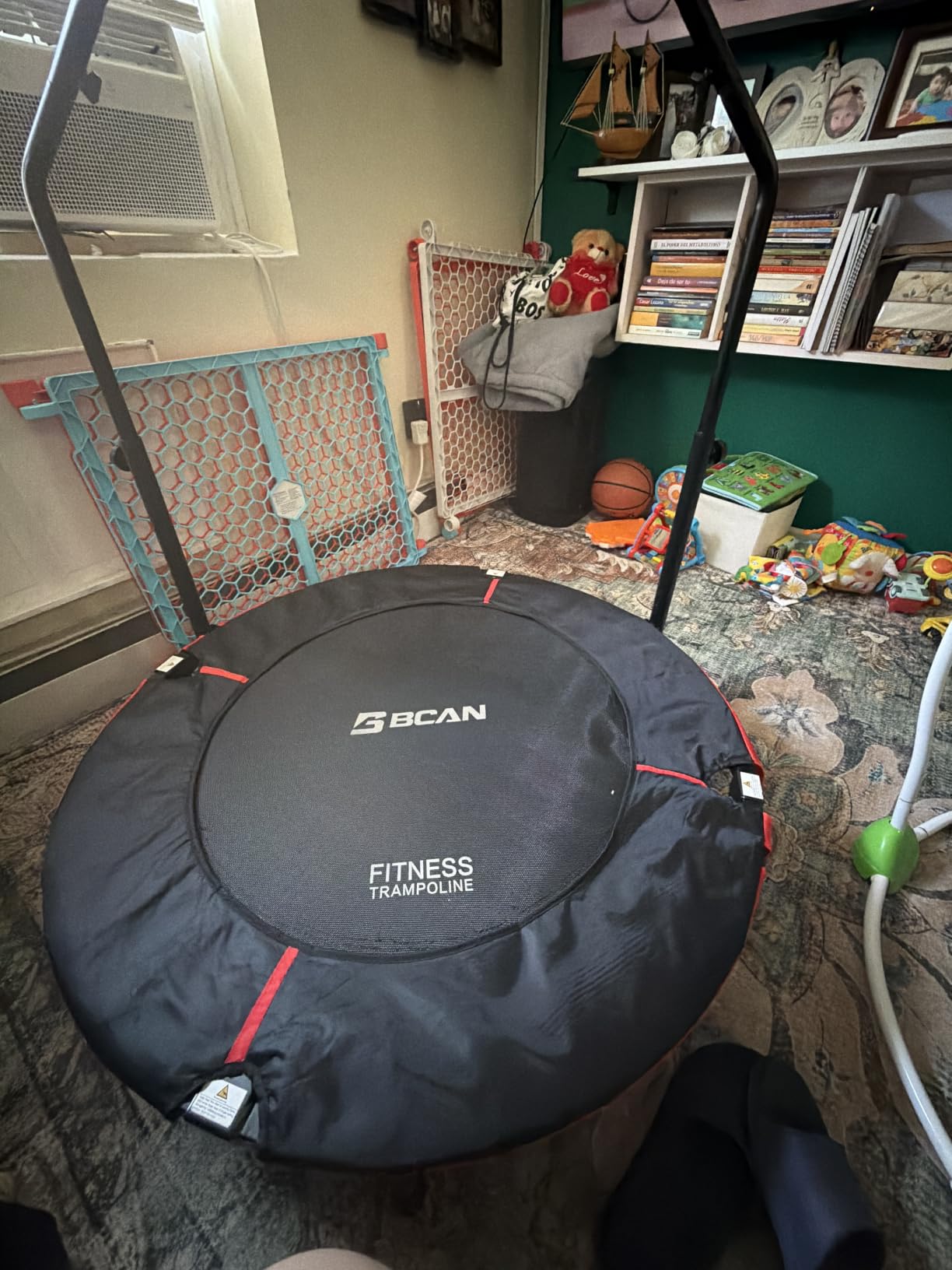
Low-impact bouncing is gentle on joints, and owners use it for everyday movement rather than high-intensity work. The full-width foam handlebar has three height settings, so a beginner, a child and an adult can all use the same unit safely. A minority of buyers note that the handlebar and frame together claim more floor space than a mini model suggests, which is worth measuring before you commit.
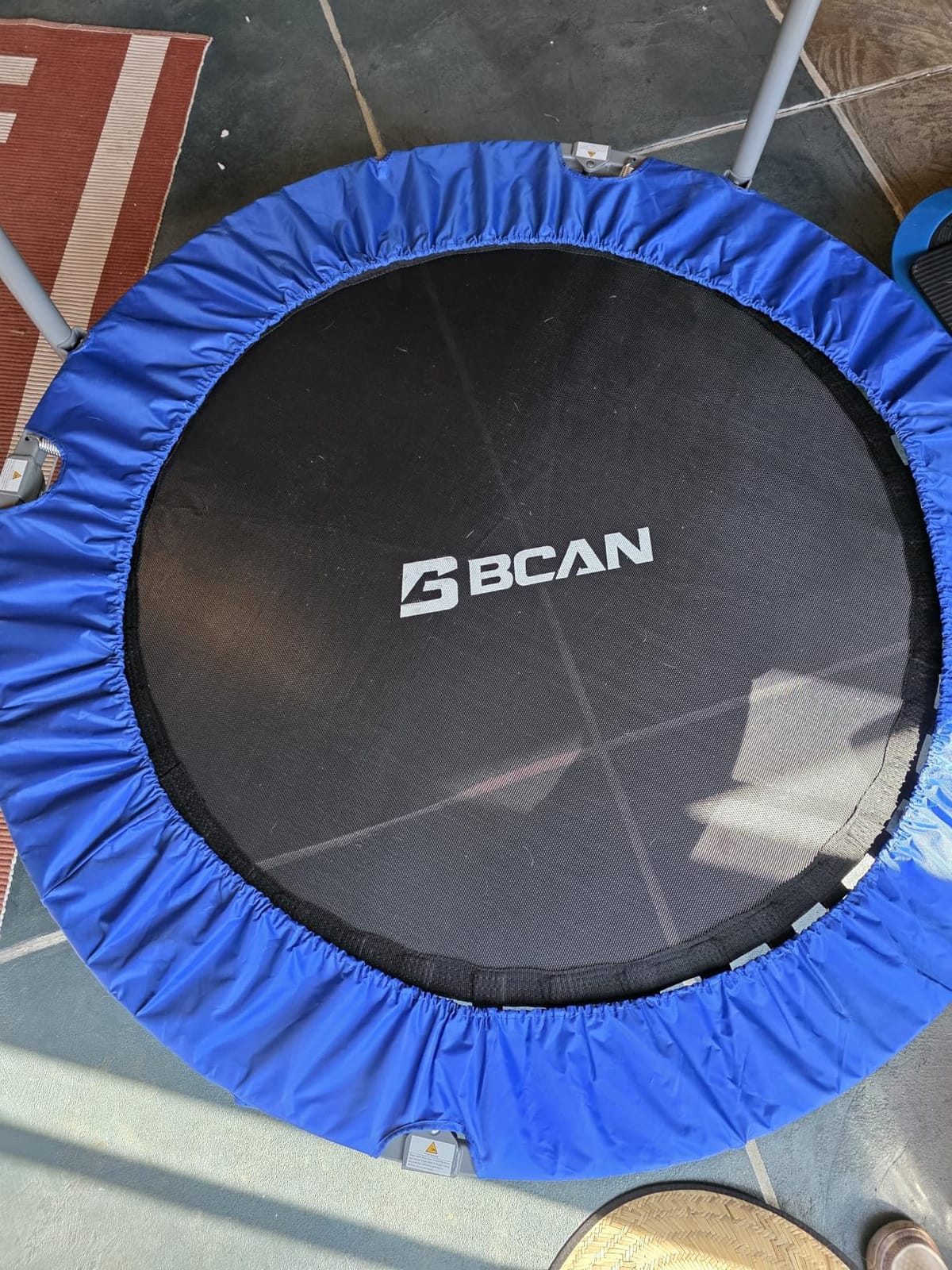
Where this does not fit: children jumping unsupervised. This is not an enclosed trampoline, there is no net, and it was not built for that. Adults and older teens get a good workout from it. Our mini trampoline roundup covers enclosed options if you need one for kids.
Why it wins on storage and indoor use
Because the fold-flat design is the whole point. Nothing else in this group disappears into storage. Reviewers describe unfolding it in a living room, a bedroom or a home office, using it, and putting it away the same morning, which is what makes it viable in a house where every square metre is contested.
The 40 inch and 48 inch versions cover different needs. The 40 inch model is listed at 330 lbs and the 48 inch at 440 lbs, so check which size the listing has selected if you are a heavier user.
Where it falls short
It is not a play trampoline and should not be treated as one. There is no enclosure, so it belongs in clear indoor space, away from furniture and walls. The assembled footprint is bigger than the product photos suggest once the handlebar is fitted.
3. AOTOB 8 ft Round Trampoline with Net
- 400 lbs capacity is high for an 8 ft frame
- Longest warranty in the roundup at 5 years
- 3 U-shaped legs spread load over 6 contact points
- All accessories arrive in a single box
- Zipper entry with multiple buckles
- Needs roughly an 8 ft circle plus the net ring
- PP jump mat fades in sun unless covered
If you want a genuine full-size trampoline in a small backyard, this is the one we would put at the top of the shortlist. The headline number is 400 lbs of load capacity on an 8 ft frame, which is higher than most competitors manage at that diameter, and the 5 year warranty is the longest in this set.
The frame design is thoughtful for a compact unit. Three U-shaped legs make six ground contact points, which is what stops a small round trampoline from rocking or walking across the lawn when a child lands badly. The jump pad and spring cover sit close together, which closes the gap where small feet can get pinched, and the zipper entrance has multiple buckles plus foam-sleeved poles.
Delivery logistics matter more than they sound. Every accessory arrives in a single carton, so there is no piecing the unit together from separate boxes. Reviewers rate the frame as rock solid and the entry and exit as easy, and 77 percent of owners give five stars.
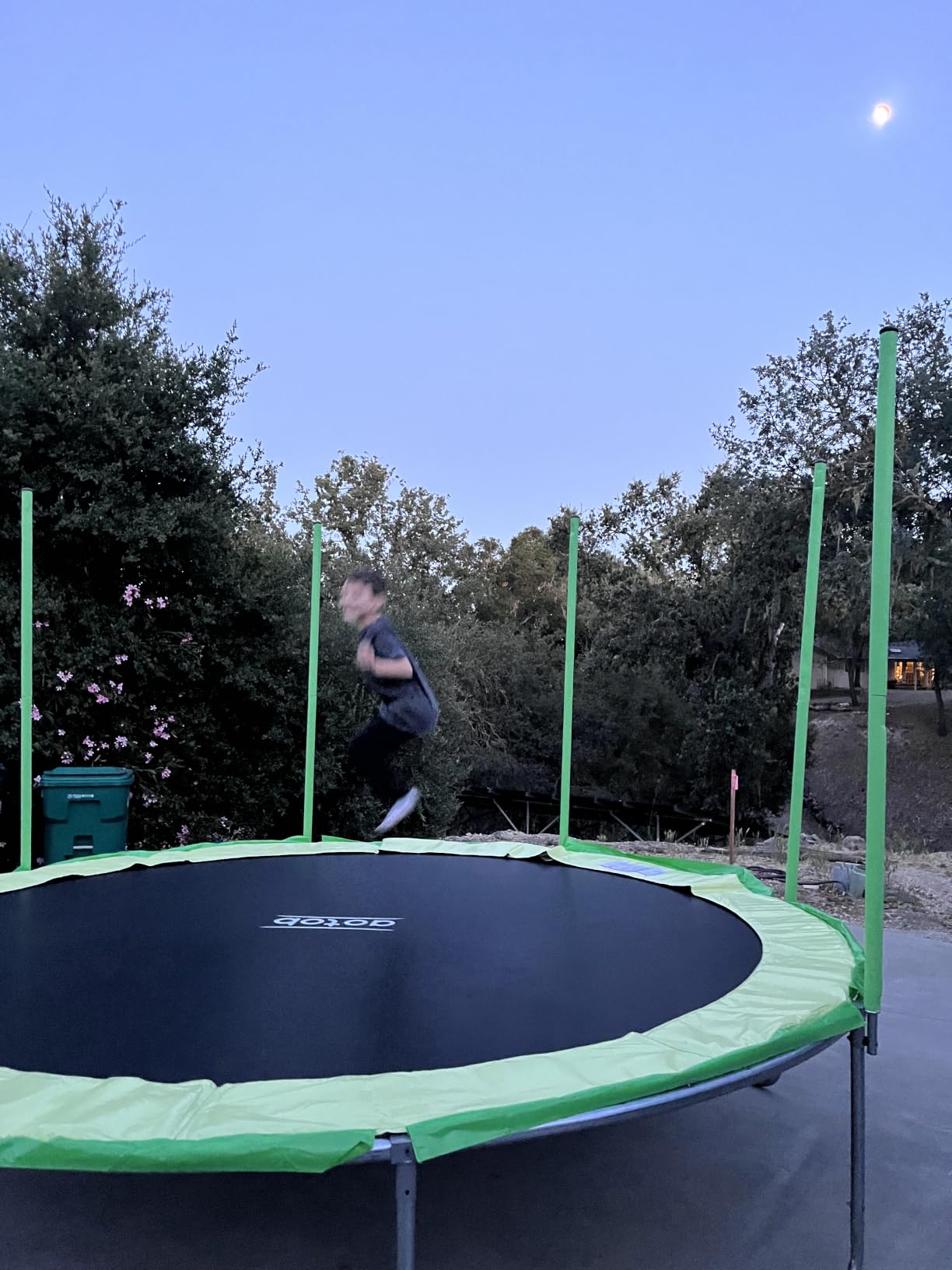
The honest caveat is yard space. An 8 ft round with its net ring needs a clear circle of roughly 20 ft with proper clearance, so run the measurement from the section above before ordering. The polypropylene mat will fade outdoors if you leave it uncovered, which is a maintenance habit rather than a defect.
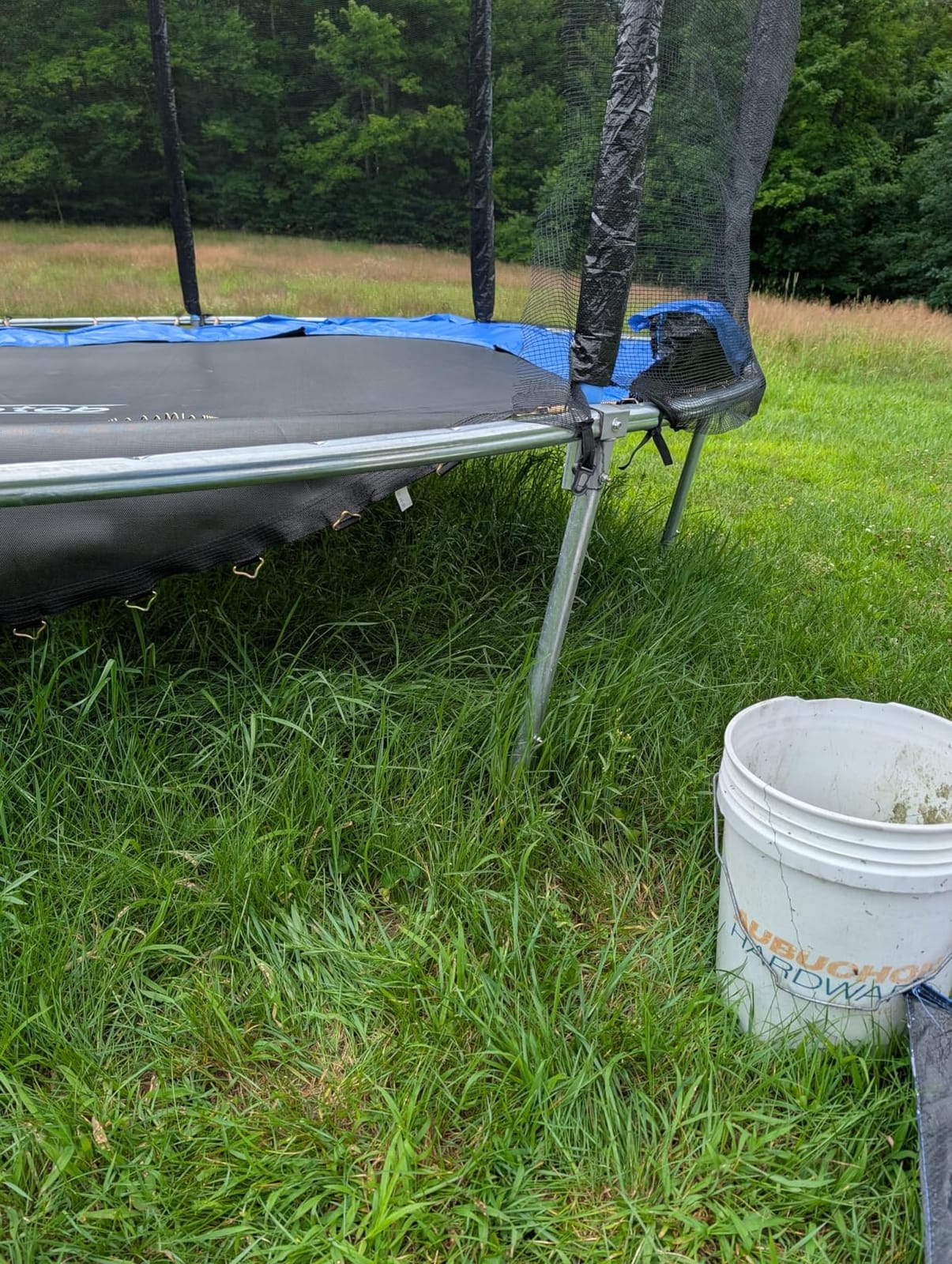
Why the 400 lb rating matters for family use
Because it means an adult can get on it with a child. Most 8 ft models in this category are rated well below a full-grown adult, which quietly means one adult supervising from the side. A 400 lb rating turns a children’s trampoline into something the whole household can use, and the U-shaped leg layout keeps it stable when two people are on the mat.
The 5 year warranty also changes the maths on replacing it later. A model you will keep for years is a better use of a tight yard than one you will swap out in two.
Where it falls short
It still needs the full clearance envelope, and the mat will fade if you skip a cover. The spring count is lower than some 8 ft rivals, so the bounce is lively rather than deep.
4. ZCMHAXJ 55 inch Toddler Trampoline with Enclosure
- Highest stated capacity in the mini category
- 3-level removable gymnastics bar
- Five accessories keep young children engaged
- Silent suction pads on a hard floor
- Lowest rated in the roundup at 4.1 stars
- Thin foam pole sleeves tear easily
- Instructions poorly laid out
- Footprint larger than buyers expect
This one exists for a specific situation: a small child who wants a trampoline and a household with no lawn to spare. The 55 inch frame with a wrap-around safety pad and dense netting is about as much trampoline as you can fit into a corner of a room or a very small patio, and the 440 lb capacity is the highest stated figure among the mini models in this roundup.
The gymnastics bar is the feature that earns its place. It adjusts to three heights and removes entirely for open jumping, so the same unit works for a two-year-old holding on and a seven-year-old who wants to run and jump. The accessory bundle, including a hammock, boxing gloves, rings, a sandbag and ocean balls, buys you time between jumps for a child with a short attention span.
Silent suction pads on the U-shaped legs mean it does not scrape or slide on a hard floor, which is the difference between a playroom trampoline that gets used and one that gets banned by the rest of the household.
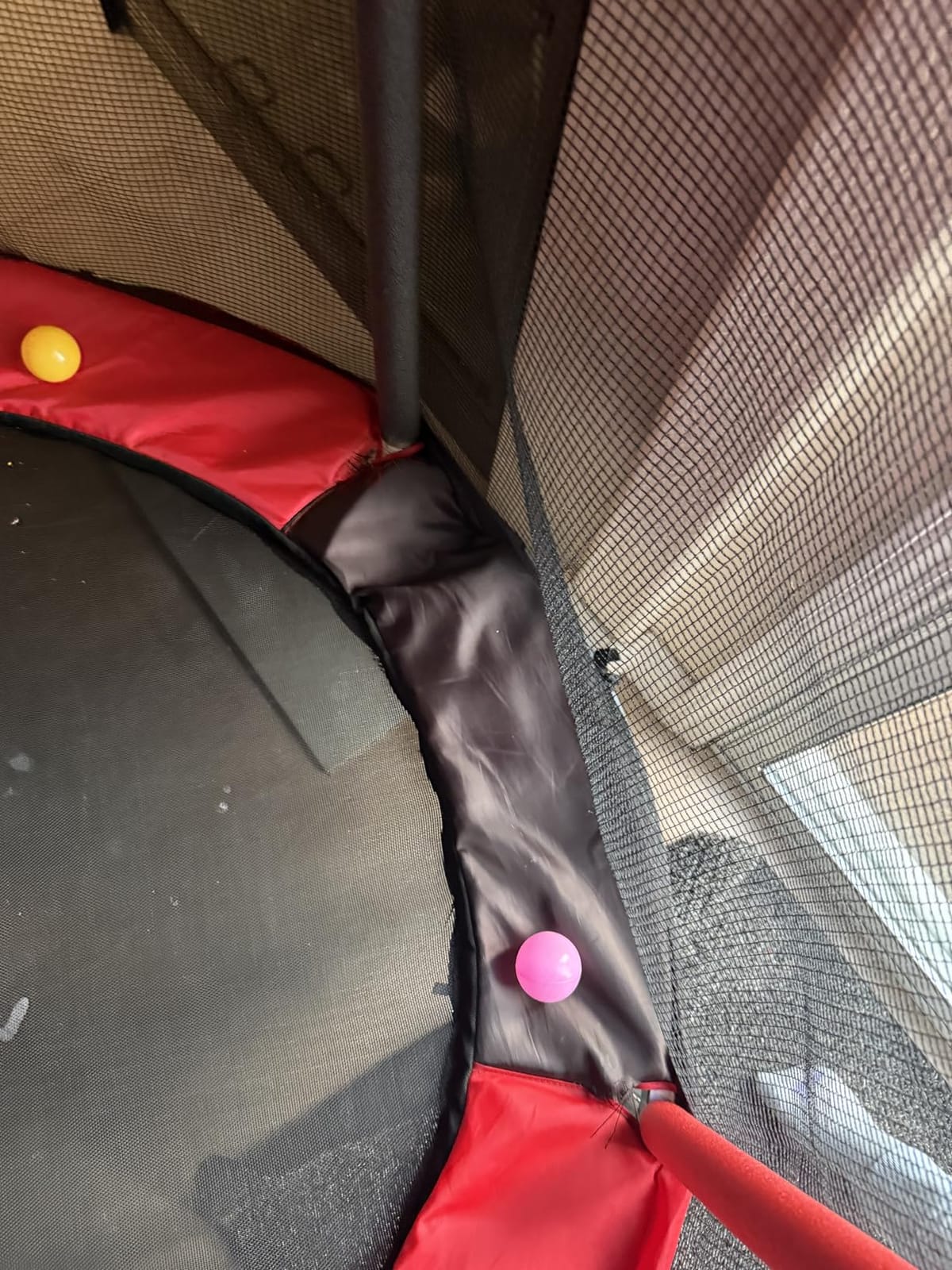
At 4.1 stars with about 11 percent one-star reviews, this is the lowest-rated pick in the list, and we would rather say so than dress it up. Reviewers repeatedly mention thin foam pole sleeves that tear with rough play, instructions that skip the accessory steps, and a footprint comparable to a round dining table rather than a small stool. If you buy it, plan to replace the pole sleeves with foam pool noodles.
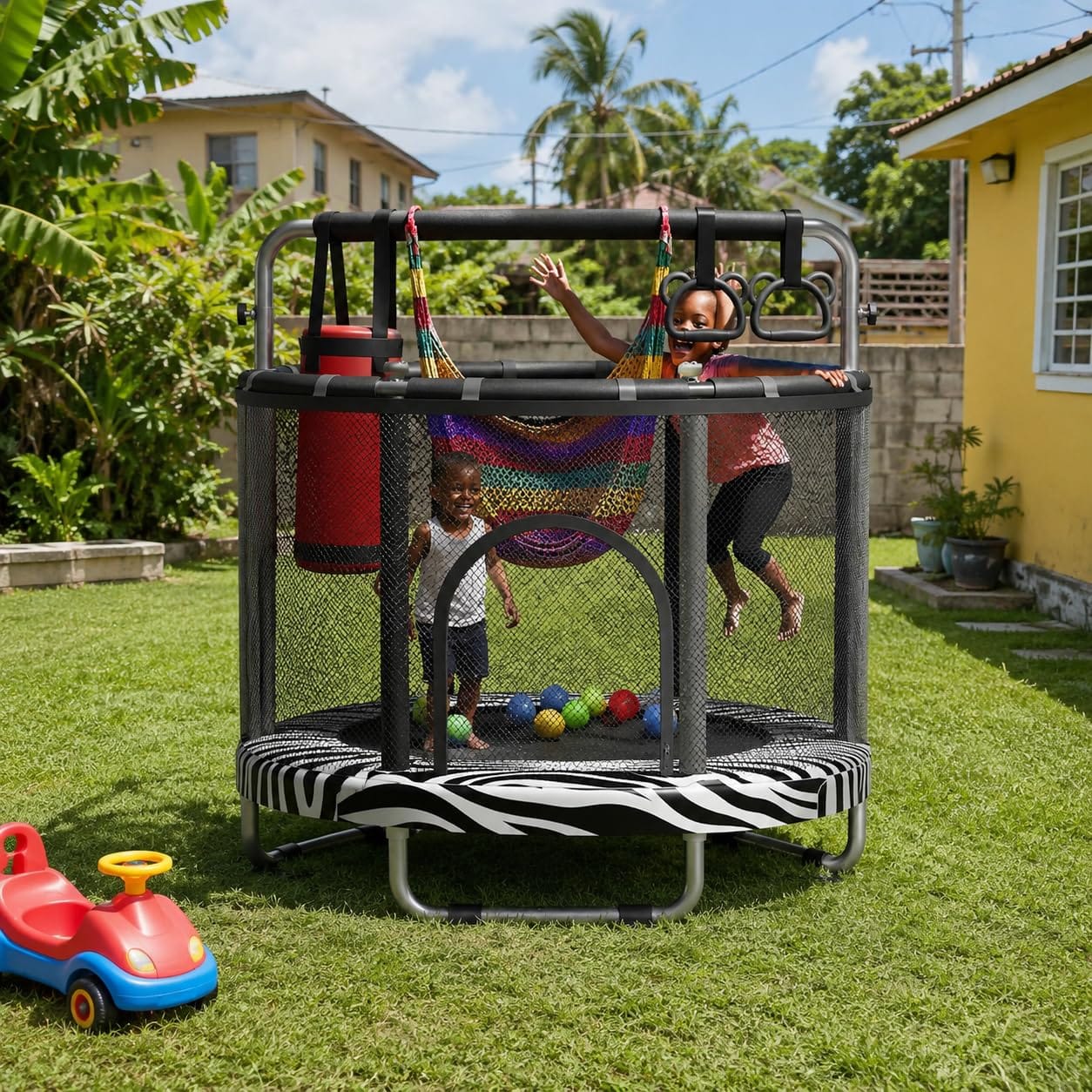
Why it suits a family with a very young child
Because the combination of a removable bar, a full enclosure and a 440 lb rating covers the age range from toddler to young child in one footprint. Owners describe it as far better quality than they expected for the money, and the suction-cup base means it works on decking and patio stone without marking.
The accessory bundle is genuinely the point for small children. Boredom ends the session faster than the trampoline does, and a hammock and rings buy several more minutes of independent play.
Where it falls short
It is the lowest-rated product in this roundup and the durability complaints are consistent rather than occasional. The foam sleeves will need replacing, the manual is close to useless, and two people are needed for assembly.
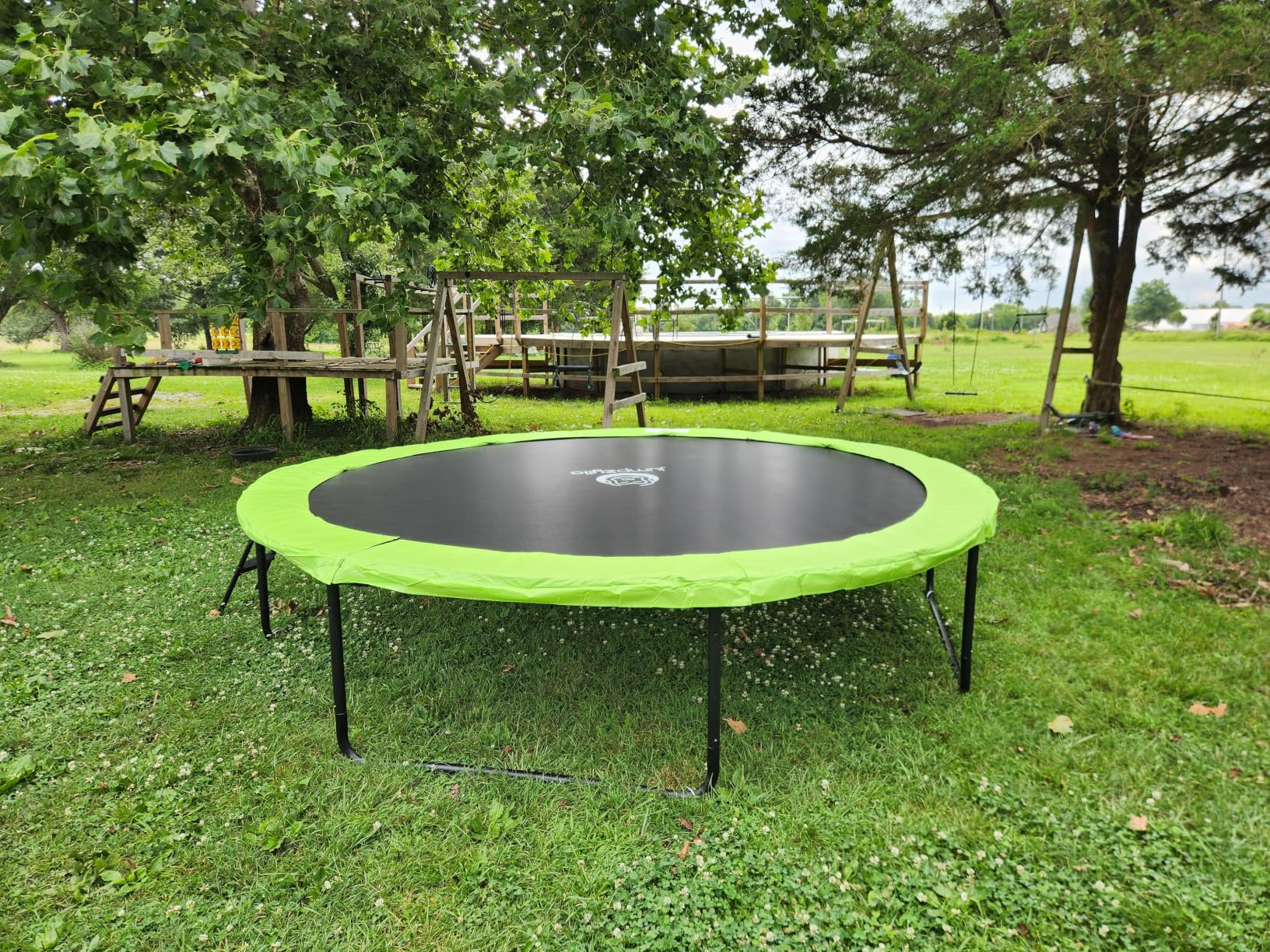
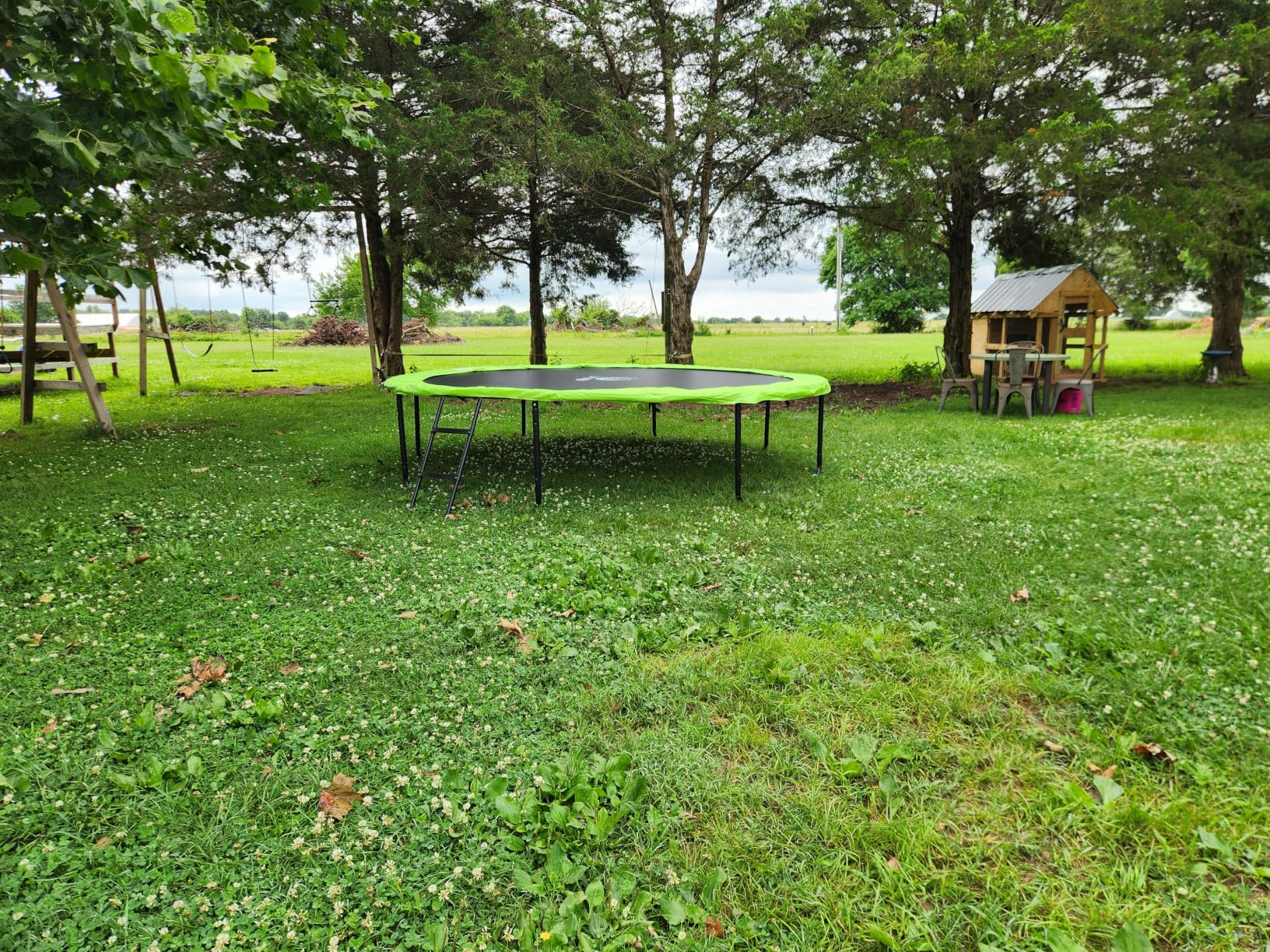
5. JUMPZYLLA 8 ft to 16 ft Outdoor Trampoline with Net
Jumpzylla Outdoor Trampoline with Net for Kids 8FT 10FT 12FT 14FT 15FT 16FT
- ASTM F381-16 certified with curved poles
- Clear labeled packaging with hardware on one board
- 8 ft option suits small yards
- Patented double-sided spring cover
- Net zipper can fail within the first month
- Lighter-gauge legs flex during energetic jumping
This family covers 8 ft through 16 ft, and the 8 ft variant is the one that belongs in a small backyard. It is the same frame design across the range, so you are not buying a different product to get a compact size, you are picking the diameter that fits your clearance math. Curved net poles move the impact zone away from jumpers, which is a sensible design in a yard where the net ring is already eating into your lawn.
The ASTM F381-16 certification is the safety headline, and the packaging is unusually good. All the hardware arrives on a single labelled board with spring pullers and a wrench, so two adults can finish in roughly two hours without hunting for a tool. Several reviewers detail the assembly specifically, which suggests it went smoothly for them.
The patented double-sided spring cover gives you a second colour without a second purchase, and the UV-resistant mat and padding plus powder-coated legs are the right call for a unit that stays outside year-round.
There are real downsides and they come up repeatedly. The net zipper is the first failure point and can break within the first month, though the safety clips keep working even then. The legs are lighter-gauge metal that flexes during hard jumping, the supplied cleats are thin anchors for a windy site, and the fiberglass rods and curved poles can crack under rough treatment. Several owners also mention squeaking. The upside is that customer service has been quick to ship replacement rods and poles, and the brand commits to two years of spare part availability.
Why the size range matters for a small yard
Because the 8 ft version is the smallest in the range and shares the same certified design as the larger models, so you are not sacrificing the safety engineering to save space. It also means if you outgrow the yard space, the same product line has a larger option rather than forcing a brand switch.
The curved poles are worth a second look because they reduce the lateral footprint penalty. A straight-pole enclosure needs more lateral room before a jumper can reach it, which is exactly the space you do not have.
Where it falls short
The 265 lb rating is modest for a full-size frame, so this is a children’s trampoline rather than a family one. The zipper, the leg gauge and the included anchors are the weak points, and the squeaking is audible in a quiet yard.
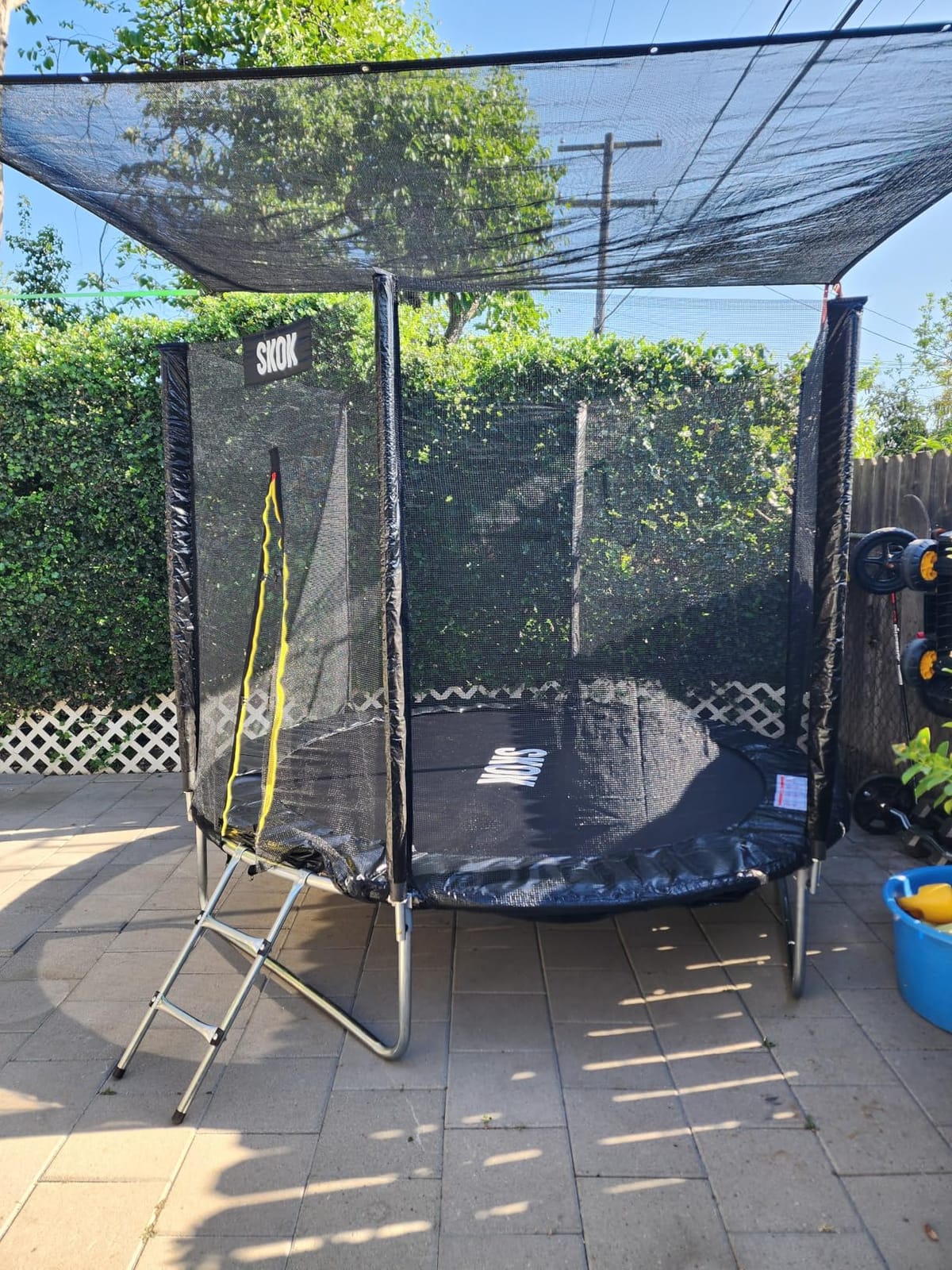
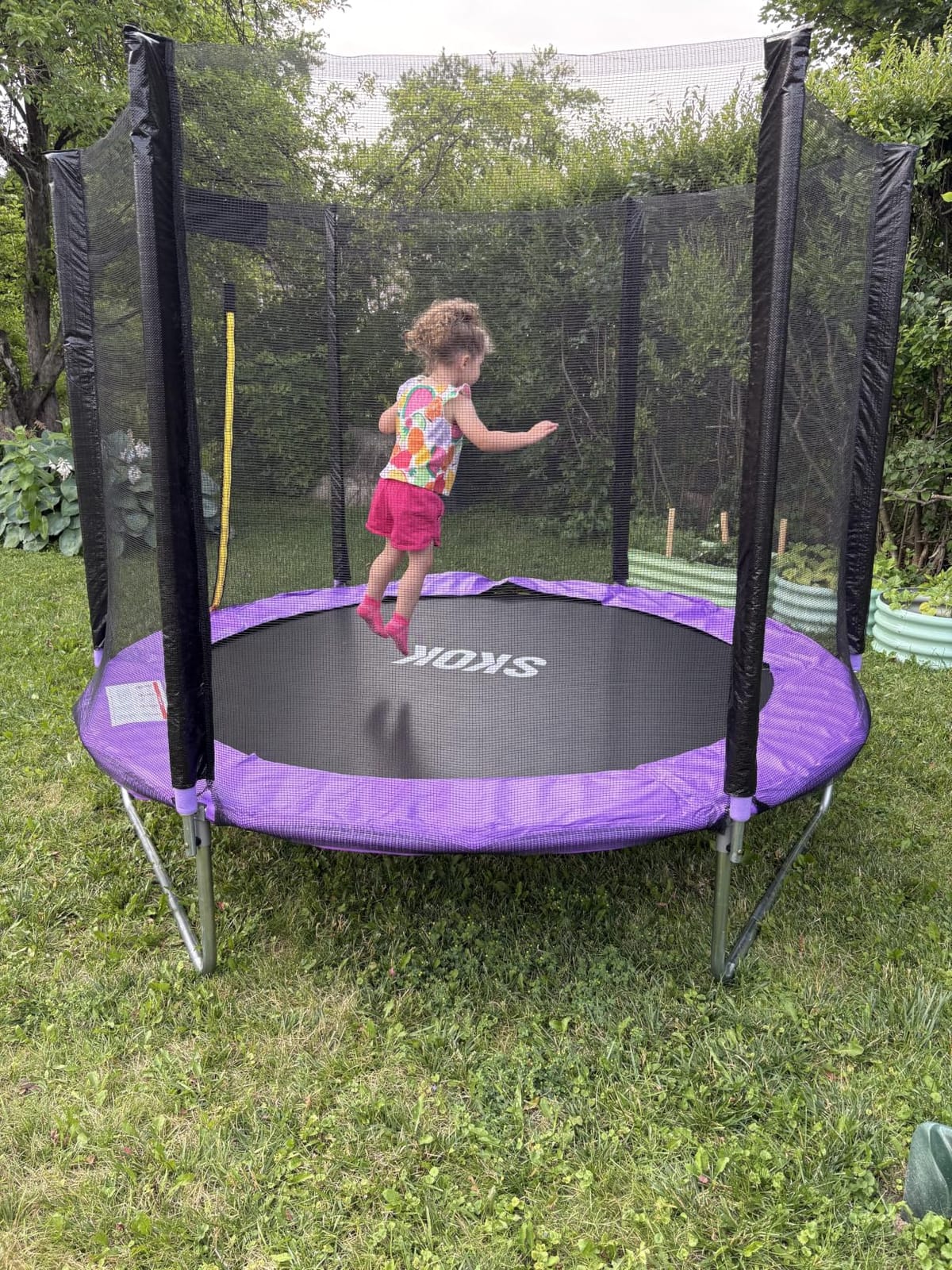
6. SKOK 8 ft Trampoline with Net
SKOK 8FT Trampoline for Kids Outdoor Trampolines with Enclosure Net, 400LBS ASTM Approved Black Trampoline for Children and Adults
- Best rated of the full-size 8 ft models here
- Complies with the ASTM F2225-15 standard
- 64 springs give an even and genuinely springy surface
- Galvanized inside and out
- Still needs a sizable clear area
- Included ladder gloves and socks feel like filler
This is the certification pick. Where most 8 ft models in this category claim ASTM F381, this one also complies with ASTM F2225-15, the stricter impact performance standard, alongside CPC, ISO and BSCI approvals. If you are buying for a child and you want the paperwork to be unambiguous, that is a meaningful difference rather than a marketing line.
The bounce is what reviewers mention most. Sixty-four patented springs across the mat produce a springy, even surface with no dead spots, and the 8-row stitched polypropylene mesh mat is stitched rather than glued. Testing cited in the specs covers 10,000 jumps and mats tested to 3,000 hours, and the stainless steel frame with three U-shaped legs is galvanized inside and out for all-season rust resistance.
The net sits at 4.9 ft with a zipper and buckle entry, six foam and PVC covered poles, and a 14 mm spring cover, which is a properly specified enclosure rather than a token net.
Two complaints come up. First, an 8 ft round unit with a net still needs a substantial clear area, so this is not a solution for a very tight yard. Second, the included two-step ladder, gloves and socks are padding on the spec sheet and some buyers see them as filler. At 4.6 stars with 83 percent five-star ratings, the build quality holds up better than the accessories suggest.
Why certification should influence your choice
Because ASTM F963 and F2225 test impact performance around the mat edge, which is where most trampoline injuries actually happen. A model that passes those tests tells you the pad, net and spring cover close the gap properly. It does not guarantee perfect supervision, but it removes a variable you can actually check before you buy.
Galvanizing inside and out also matters more than it sounds. The spring bed is a permanently damp environment, and steel that is only coated on the outside corrodes from the inside where you cannot see it.
Where it falls short
Space, mostly. The clearance envelope for an 8 ft round with a net is the same as any other 8 ft round, and the bundled accessories do not justify treating them as extras. The 400 lb rating is good, but the mat and net still need adult supervision for younger children.
7. BLUERISE 55 inch Indoor and Outdoor Enclosure Trampoline
BLUERISE 55” Indoor&Outdoor with Enclosure Trampoline for Kids Gifts Blue
- Smallest framed footprint in the mini class
- Meets ASTM F381-16 and F963-23
- Oversized suction cups stop creep and tipping
- Quiet operation
- Official 110 lb limit is low
- Plastic basketball hoop and accessories break or go unused
- Net held by external plastic clips
The 55 inch frame with a 10 inch frame height is the flattest, most compact enclosed trampoline in this roundup, which matters more in a small yard than the headline rating suggests. A low frame means less visual bulk against a fence line and less of a step-down from the lawn.
The certification is the strongest in the mini class, meeting ASTM F381-16 and ASTM F963-23 plus CPC and GCC. The fence-style frame carries 360 degree thick safety foam tubes and a raised net height for more headroom than most small enclosures, and the oversized suction cups grip hard flooring so it does not creep or tip during a session.
What stands out in the reviews is longevity. Multiple owners describe units bought years earlier that are still in working condition outdoors, which is unusual in this category and suggests the fence-style frame and stitched mat are doing their job.
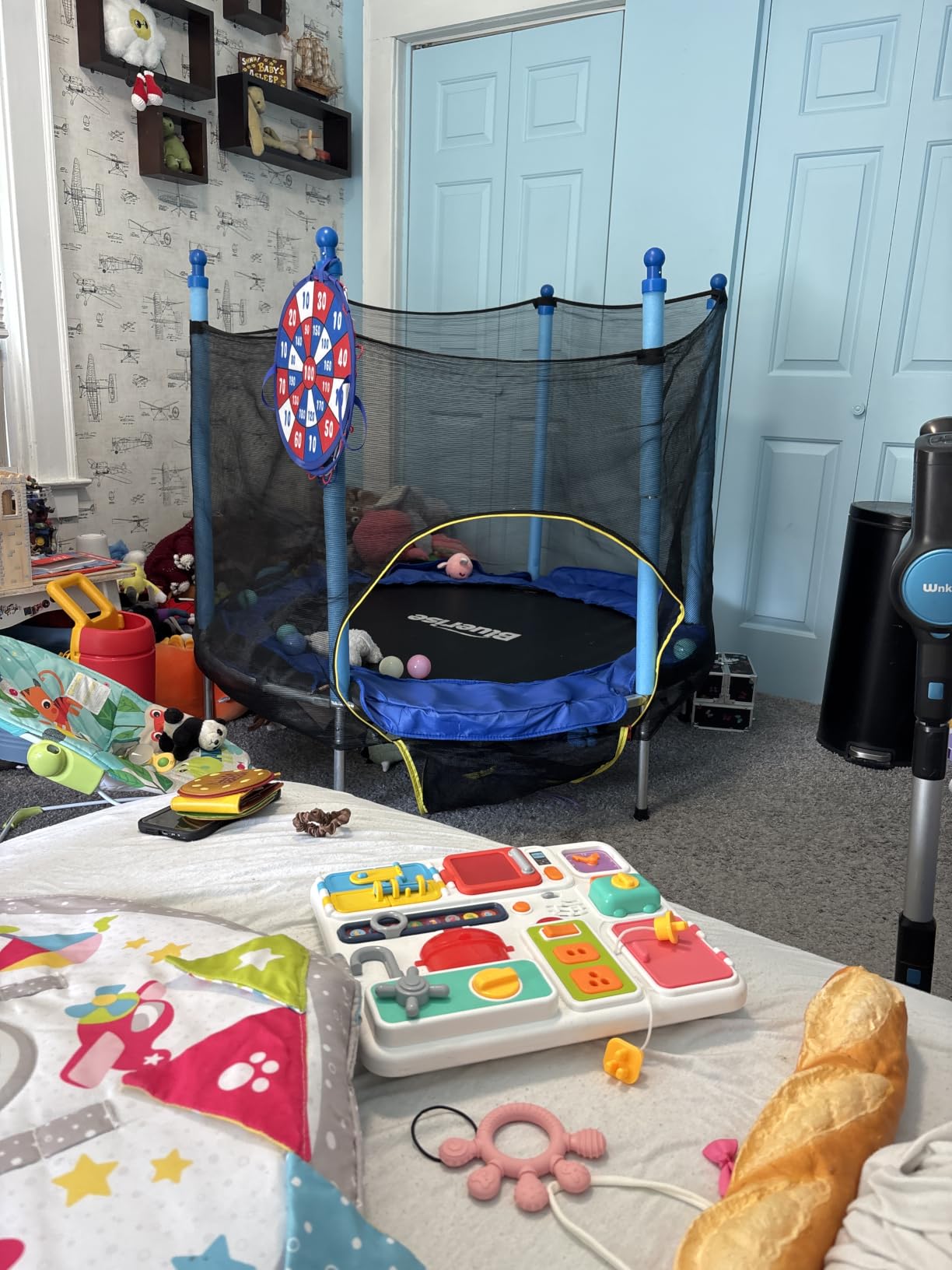
The official weight limit of 110 lbs is the headline drawback, though several owners describe heavier loads without failure. We would still treat the stated figure as the real one. The plastic basketball hoop and the other bundled accessories are the parts most likely to be discarded quickly, the net is held by external plastic clips with a bottom attachment that is not as tight as buyers would like, and the handles sit low even at their smallest setting. Six months of parts replacement is the shortest support window here.
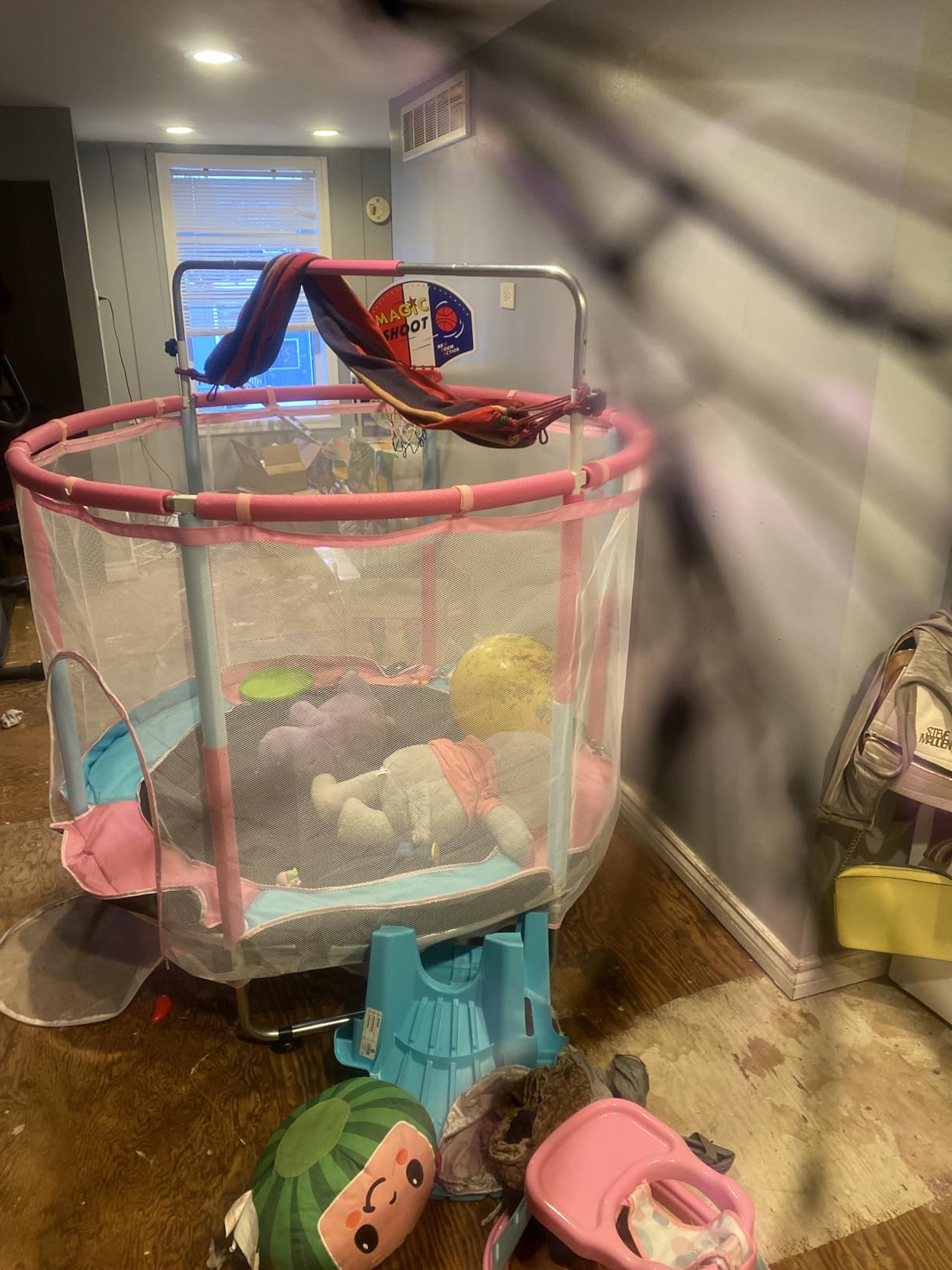
Why a low profile matters in a small yard
Because the frame height is the part of a trampoline you see from your neighbour’s window and the part a child has to climb. A 10 inch frame on a 55 inch unit reads as a small piece of garden furniture rather than a structure, and the raised net still gives enough headroom for an adult to supervise from outside.
The suction-cup feet also mean it works on a deck or a patio slab, which opens up the possibility of using a courtyard that has no lawn at all.
Where it falls short
The 110 lb rating rules out adult use despite what buyers report, the accessories are throwaway plastic, and the net attachment is the weakest safety feature on an otherwise well-specified model.
8. GIANTEX 55 inch Hexagonal No-Gap Trampoline
- Lightest model in the roundup at 24 lb so it moves between spaces easily
- Galvanized steel pipe frame
- Zippered door with lower net skirt
- See-through mesh for distant supervision
- Elastic ropes degrade within 6 to 12 months
- Instructions confusing after the base frame step
- Net and poles bow with extended use
- Best suited to indoor or sheltered use
Portability is the entire argument for this one. At 24 lbs it is the lightest design we tested, which means one adult can move it from a garage to a lawn and back without help. In a small backyard that is a meaningful trait, because the trampoline competes with the garden rather than owning it.
The safety design is well judged by owners. A see-through enclosure net with a zippered door and a lower net skirt keeps children out from underneath and lets you watch from across the yard, and the hexagonal frame with outstretched legs resists tipping in a way that narrow-footed round frames do not.
The bed uses thirty elastic tension ropes rather than metal springs, and that choice produces a high, forgiving bounce that reviewers consistently like. The frame is galvanized steel pipe rated to 300 lbs, and one owner with a child who jumps daily reports three years of use.
The rope bed is also the weakness. Reviewers report the elastic cords degrading and breaking within roughly six to twelve months under heavy use, which simply does not happen to steel springs, and the net and poles bow and tear with extended use. The instructions fall apart in usefulness after the base frame step, and several buyers point out it is better suited to indoor or sheltered use than to permanent outdoor exposure. A replacement set of ropes is the first maintenance job you should expect to take on.
Why the light weight changes how you use it
Because you can store it away. A 24 lb trampoline that folds or simply lifts into a garage means the small backyard returns to full garden use on most days of the year. Every other full-enclosure design in this roundup becomes a permanent fixture the day you assemble it.
The hexagonal footprint is also worth noting. It uses a six-sided frame rather than a circle, which changes the usable area inside a given width of lawn.
Where it falls short
It is a rope bed, so expect to replace the cords within a year of regular use. It is not built for permanent outdoor storage, and the instructions will cost you an evening.
9. LANGXUN 6.5 ft 7-in-1 Rectangle Trampoline
- Rectangle footprint fits tight spaces better than a round 8 ft
- Seven activity stations in one unit
- Low-to-the-ground deck suits toddlers
- Fully enclosed net with double buckles
- One of the heaviest models here at 72 lb
- Parts are unlabelled so assembly is trial and error
- Slide entrance flap tore within a day
This is the shape answer to the small-yard problem. A 6.5 by 4 ft rectangle occupies a far smaller area than an 8 ft round, and the mat inside it is a rectangle rather than a circle, so you get more usable jumping space per square foot of lawn. If your yard is long and narrow, this geometry works where a round frame does not.
The seven activity stations are the reason most families end up keeping it. Climbing wall, slide, swing, basketball hoop, rings and a horizontal bar all detach, so the unit converts from a play gym back to a trampoline when you want a clean jumping surface. The low deck height is a genuine safety advantage with toddlers, and the fully enclosed net uses a smooth zipper and double buckles.
The build is heavier than it looks. The frame uses steel that is 20 percent thicker than standard and hot-dip galvanised, the 32 high-tensile springs are tested, and the mat is rated for 5,000 hours of UV exposure. Several reviews describe nearly three years of service and the unit being moved twice.
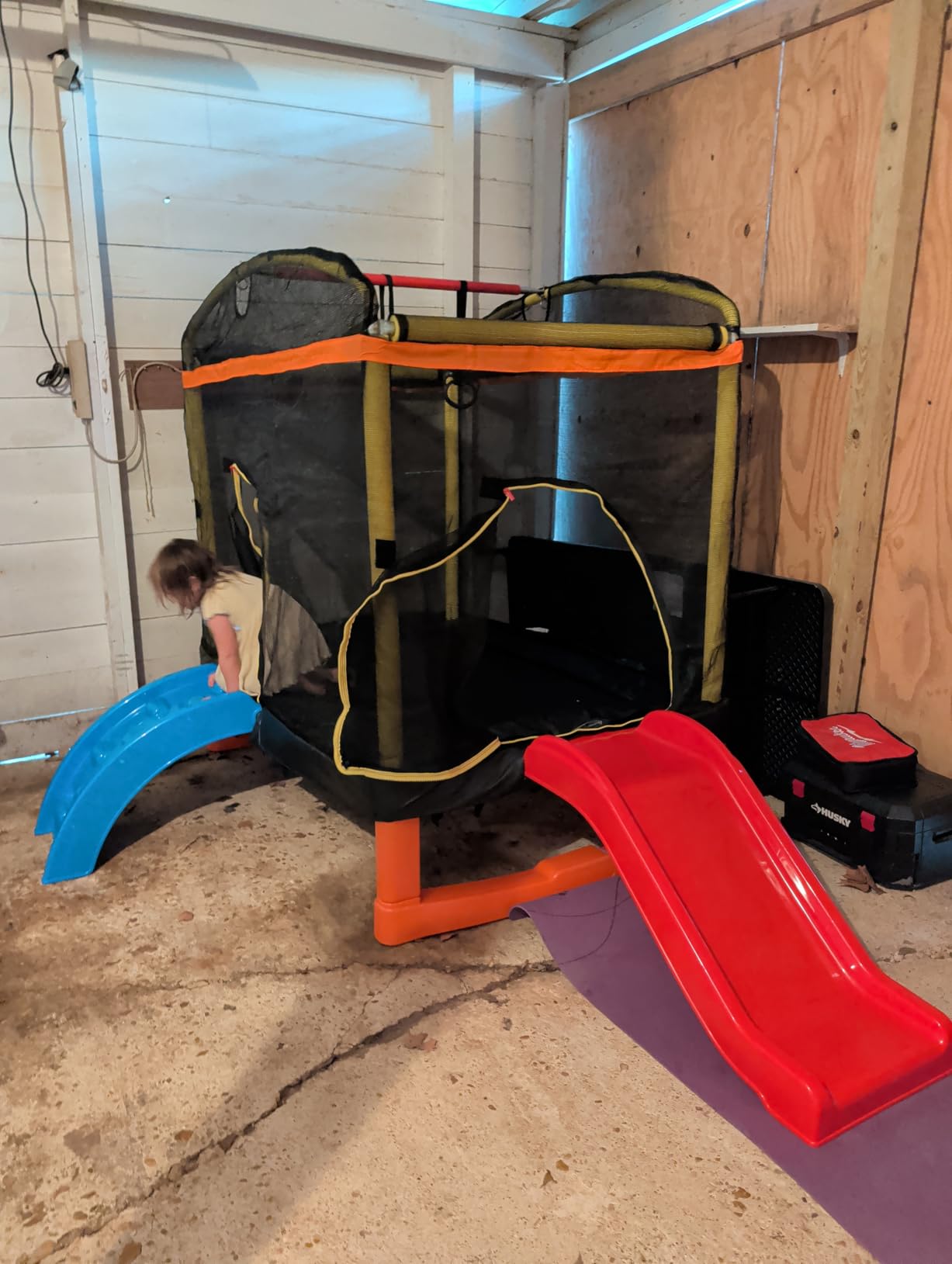
The practical problems are real. At 72 lbs it is one of the heaviest models in this roundup and it is not easy to reposition, and the parts are neither numbered nor lettered so assembly is slow trial and error with no reference point. Quality control misses show up too, with a torn slide flap within a day of use and one reported corner-post bolt failure that looks like a poor weld.
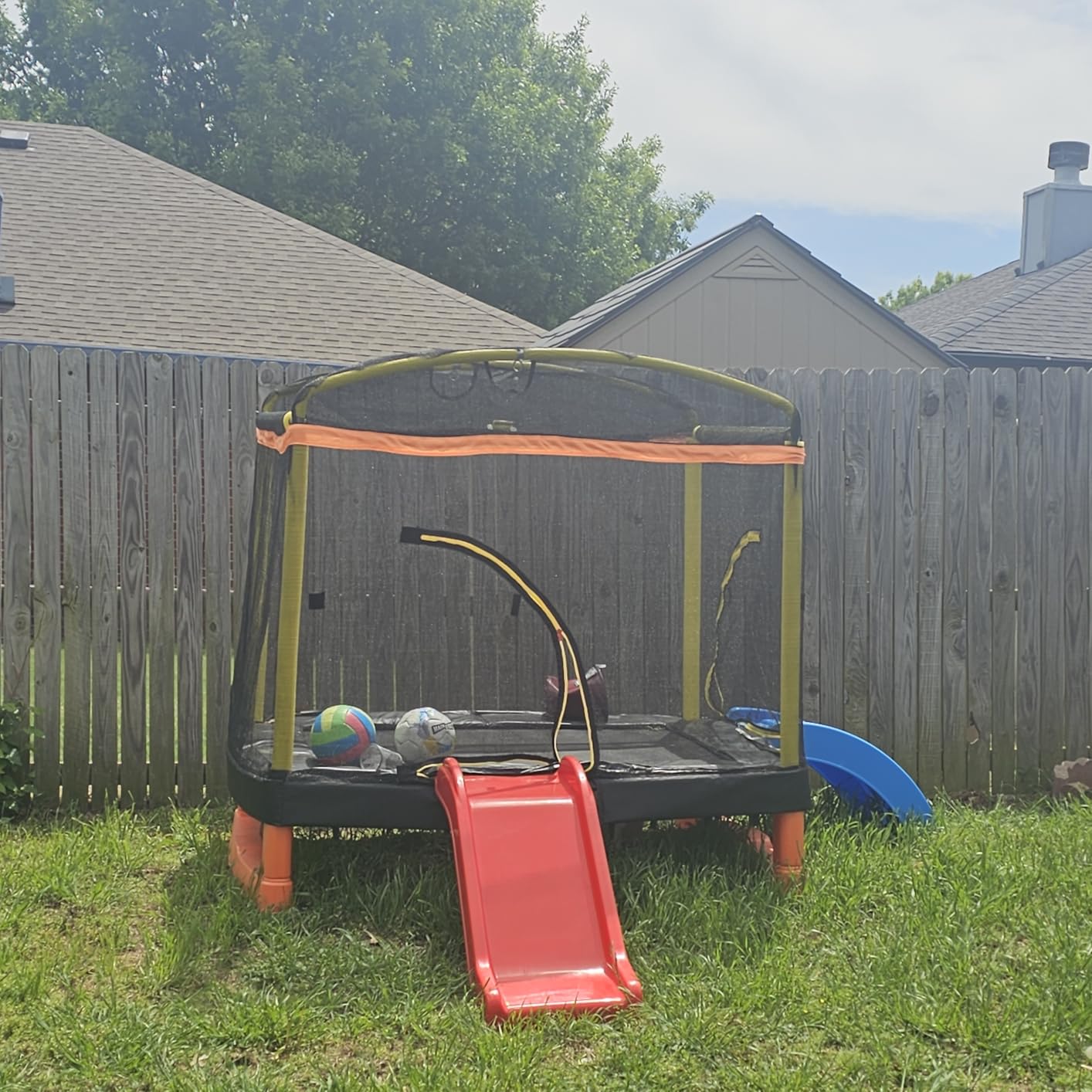
Why a rectangle beats a circle in a small yard
Because a round frame wastes the corners. A circle inscribed in a square of lawn leaves four triangular sections unusable, and in a small yard those sections are often the difference between fitting and not fitting.
The trade-off is lateral push-back. Round trampolines gently steer jumpers back to the centre, which helps small children. A rectangle gives more usable mat but less of that correction, so this suits children old enough to control their landings.
Where it falls short
The 72 lb weight and the unlabelled parts are the two things that frustrate owners most.
10. YUMPIE 8 ft Quick-Connect Trampoline with Ladder
YUMPIE 8FT Outdoor Trampoline with Enclosure Net and Ladder, ASTM Approval
- Compact 8 ft size suits small yards
- ASTM F381-16 compliant with 6 curved wrapped poles
- Quick-connect snap-on pole system needs no complex tools
- L-shaped zipper with a safety buckle
- Instructions are the most criticised part
- Net described as flimsy under fast jumping
- Mat stitching degrades within about a year
The pitch here is straightforward: a compact 8 ft round with a full enclosure, curved poles wrapped in pearl cotton, and a ladder in the box so a small child can get on without an adult lifting them. Owners in small yards specifically call out the size range as the reason they bought it, which is a good sign for anyone working with the clearance math above.
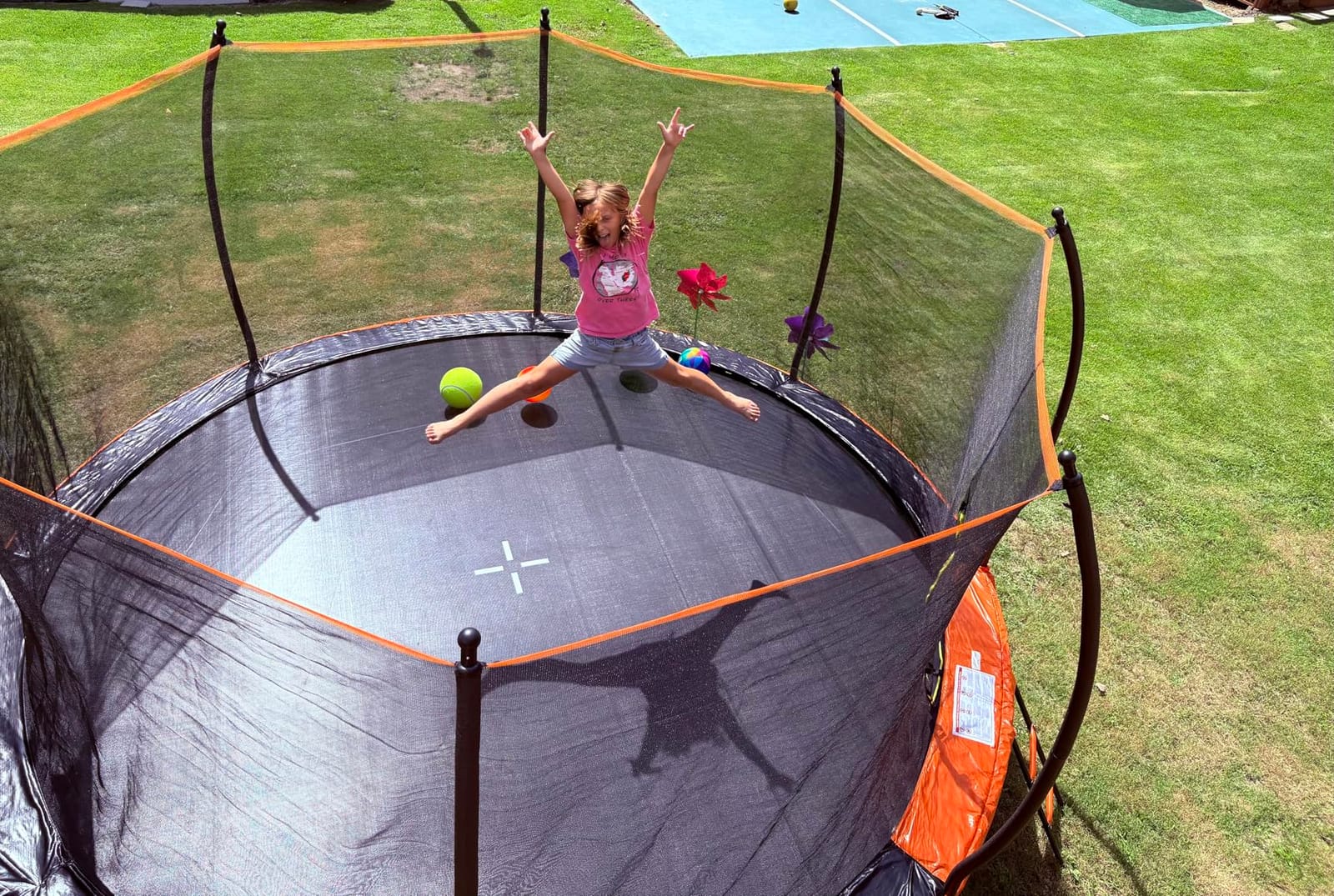
The frame connection system is genuinely well designed. A four-way joint with a snap-on pole system means no complex tools, and the outward-curved poles wrapped in cotton keep the impact zone away from jumpers. The UV-resistant enclosure net uses an L-shaped zipper with a safety buckle, so the door cannot swing open from a single bounce.
The manual is the problem, and it is the most criticised part of this product. Several reviewers describe it as the worst they have seen: the springs are installed first and then have to be removed to fit the net, and the net and pole instructions are missing altogether. Plan on an hour of improvising, and budget for a third pair of hands because spring installation realistically needs three people.
The net is described as flimsy, and jumpers moving fast can reach the poles behind it. Mat stitching degrades in sun and weather within about a year, and the ladder is basic. The product quality itself is rated well by owners, so this is a documentation and durability problem rather than a build problem.
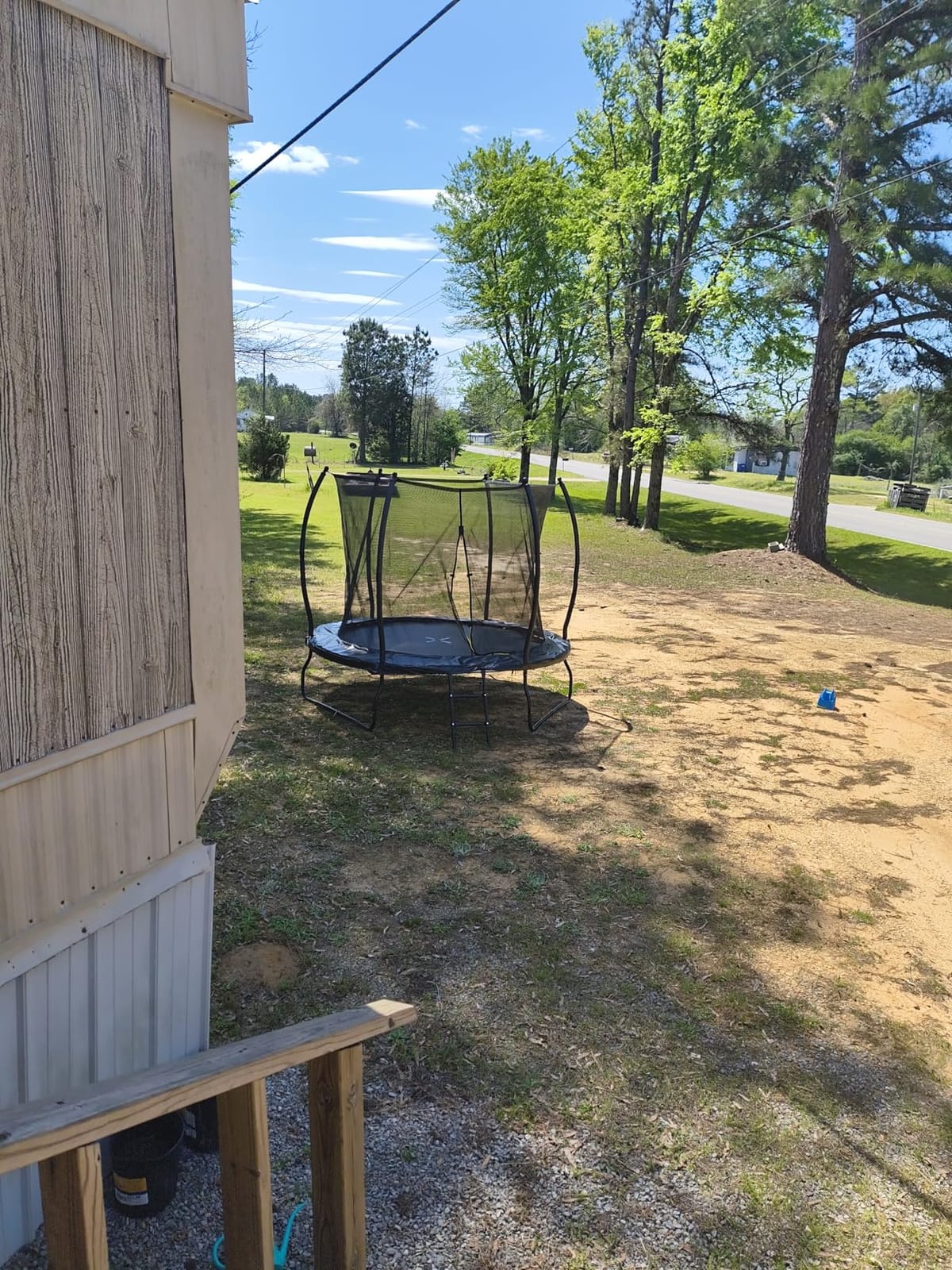
Why the included ladder matters more than it sounds
Because the gap between a lawn and a low trampoline deck is where small children get hurt. A ladder included in the box removes one more step and one more thing to buy separately, and for a 3 to 5 year old that is the difference between independent play and being carried up every time.
The curved, cotton-wrapped poles also save lateral clearance compared with straight poles, which is real space in a small yard.
Where it falls short
The instructions are genuinely poor, the net is the weak point under fast jumping, and the mat stitching will not survive years of sun. If you are not comfortable working through a bad manual, budget for an afternoon.
11. GIANTEX 6 ft Rectangle Trampoline with Swing
Giantex 6 FT Trampoline for Kids, Toddler Trampolines with Swing & Safety Enclosure Net, ASTM Approved, Rectangle Indoor & Outdoor Mini Kids Trampoline, Blue
- 4.7 stars with 86 percent five-star
- Rectangle gives more jump area per square foot
- 660 lbs capacity lets adults join in
- Swing and bar remove for pure jumping
- Zipper is the first failure point
- Remove the swing when small children jump
- Slides on hard floors without a rug
This is the one we would point at if a family wants a small-footprint trampoline that adults can actually use. The 660 lb capacity figure is far above anything else in this roundup, and owners report an adult and a toddler jumping together, which turns a children’s toy into a piece of family equipment.
The rectangular footprint comes in around 48 by 70 inches, and that shape gives more usable mat for the same lawn area than a round model of the same width. The frame is hot-dip galvanised steel with spray-coated legs, the 32 high-tensile springs were tested over 100,000 bounces, and the mat is rated for 5,000 hours of outdoor UV exposure.
The 3-in-1 design adds a detachable swing and a horizontal bar. The swings are solid enough to hold adults as well as children, and both attachments come off so you can reclaim a clean jumping surface. At 4.7 stars with 86 percent five-star ratings, it ties for the highest-rated product in the set.
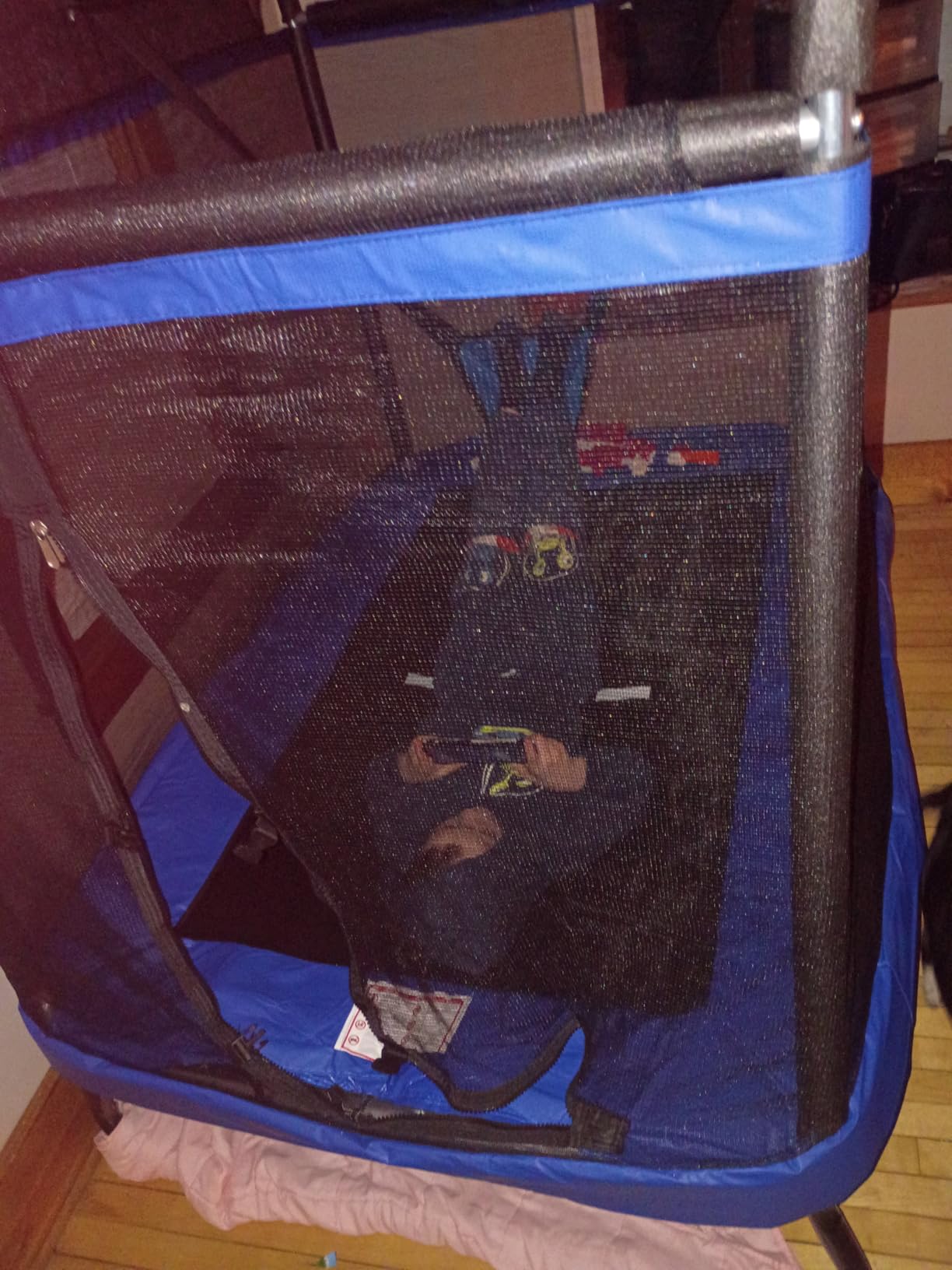
Two things to act on. The zipper is the first failure point, with one owner reporting a three year old ripping it off, though the buckles kept working. And remove the swing whenever younger children are jumping so they cannot land on it. On hard floors it will slide unless you put a rug or floor protectors down.
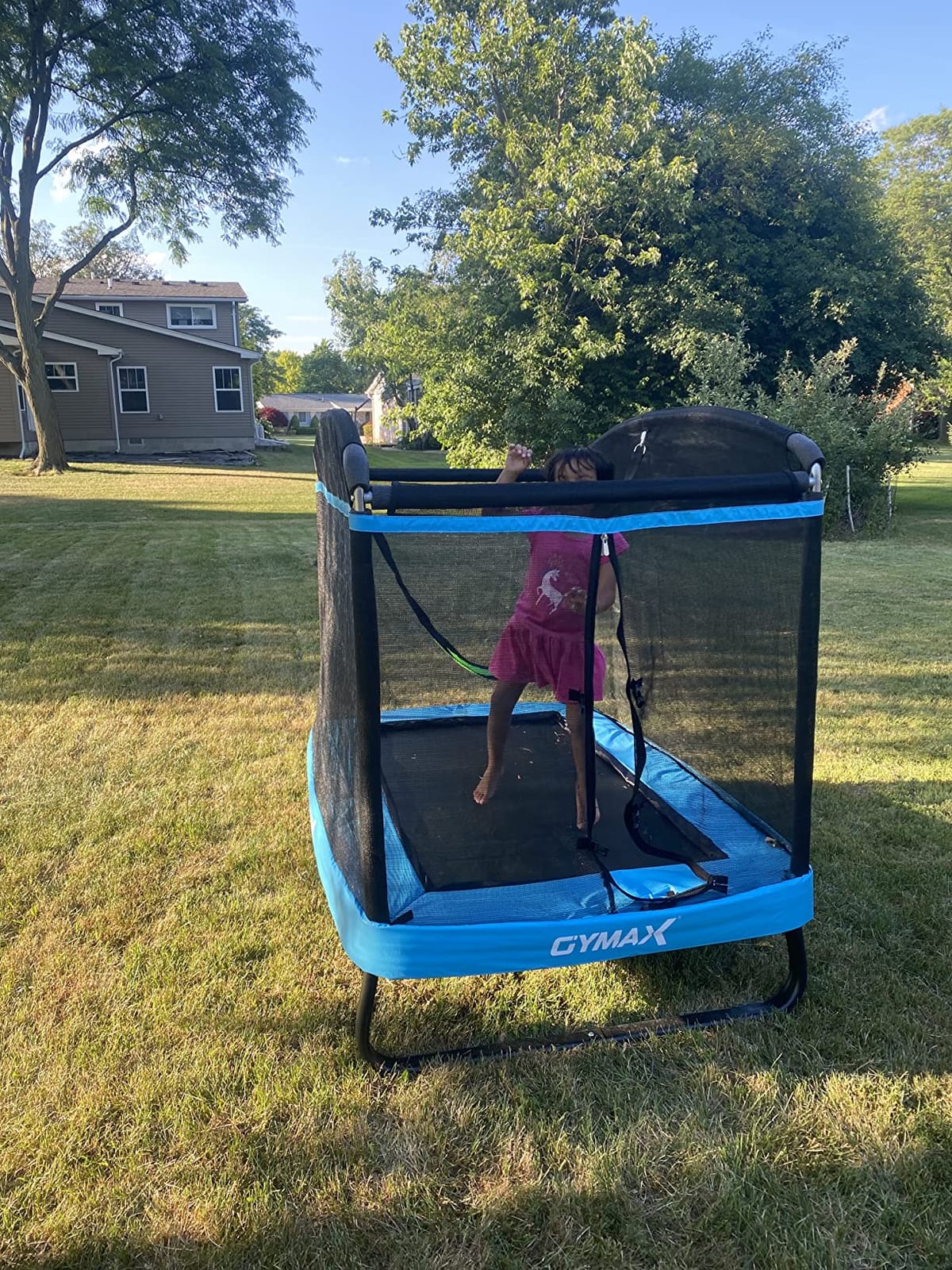
Why the 660 lb rating changes who uses it
Because most small trampolines are effectively children-only, which means an adult supervises from the side rather than joining in. A 660 lb rating means parents can bounce with their kids, which is a large part of why a family keeps using a small yard trampoline after the novelty wears off.
The rectangle shape compounds that. More mat means two people can jump without one standing at the edge waiting.
Where it falls short
It slides on hard floors, the zipper is fragile, and the swing needs removing for safe jumping with small children. The 316-review base is thinner than most picks in this list, so treat the 4.7 rating as encouraging rather than conclusive.
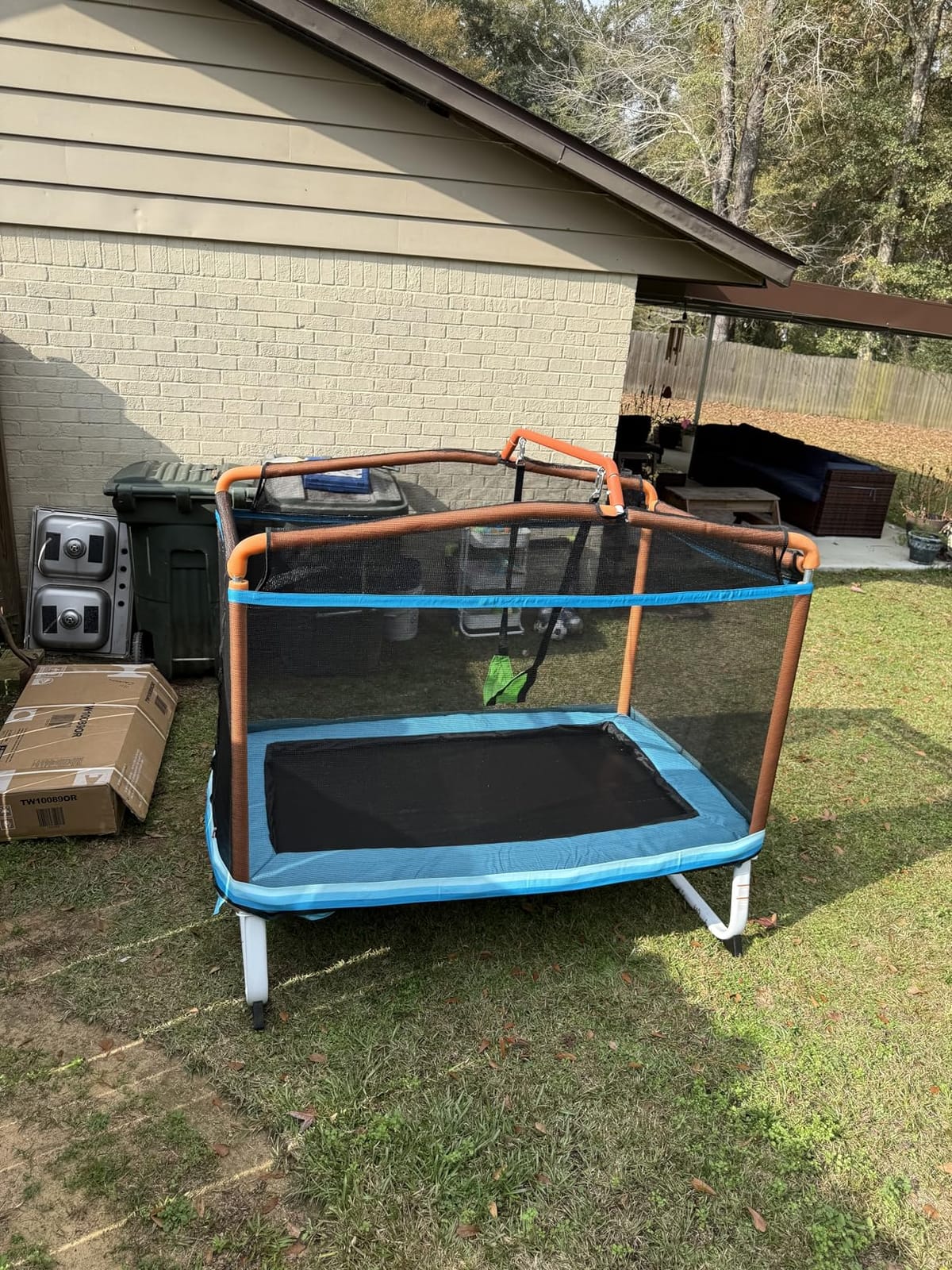
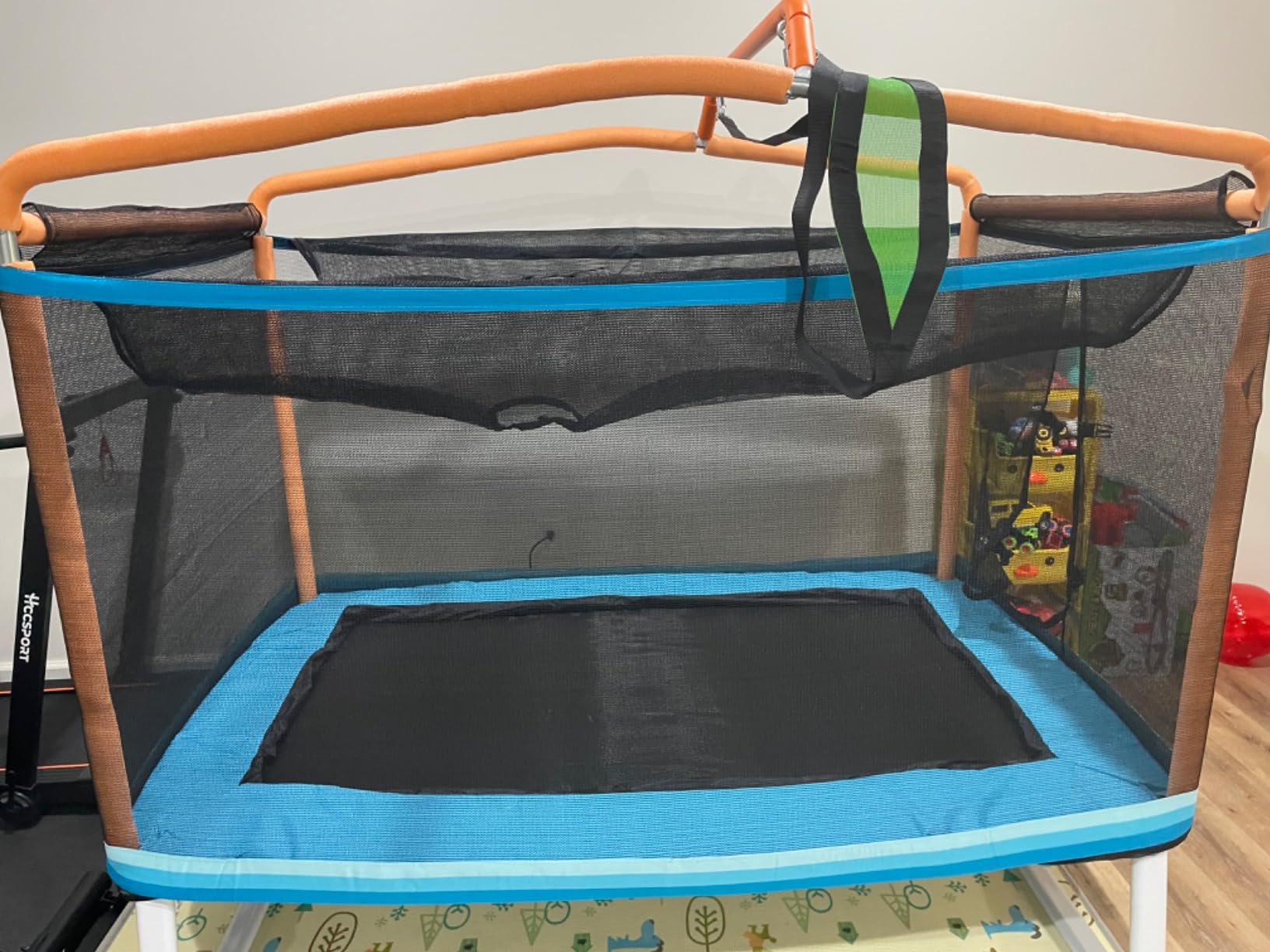
12. GYMAX 75 inch 3-in-1 Rectangle Trampoline
- Mat and pad sewn together to close the spring gap
- Rectangle maximises jump area while taking less yard space
- 10 mm foam on every net pole
- Removable swing and bar give three play modes
- Only a 90-day warranty
- 220 lb limit is low for a shared family trampoline
- Swing and bar need their own assembly
The defining feature is the sewn mat. On most small trampolines the jumping mat and the safety pad are separate pieces with a gap between them where a small hand can reach the springs. This one stitches them together as a single piece, and it is the reason owners with young children feel comfortable using it unsupervised for short sessions.
The 75 by 49 inch rectangle is one of the longest footprints in the roundup and still fits a modest yard because it is narrow. That is the same geometry argument as the other rectangular models: a long, thin shape uses a narrow strip of lawn far more efficiently than a circle of the same width.
The build is solid. Forty high-tensile springs with 3 mm wire, a double-sided galvanised steel frame with powder-coated foot tubes, 10 mm thickened high-density foam on all net poles, and a polypropylene mat that passed 40,000 bounce and 500 hour UV tests. The removable swing and horizontal bar give three play modes in one footprint, and assembly is a six-step process with all tools included.
Where it falls short is the warranty and the weight. A 90-day warranty is the shortest in this roundup, and at 73 lbs it is one of the heaviest models here, which is frustrating for anyone who wants to move it seasonally. The 220 lb limit is also low for a product whose listing appeals to older children, and detractors read that as the product being marketed for kids but not for adults.
Why the sewn mat and pad matter most for small children
Because the gap between mat and pad is one of the few places a child’s hand can be pinched by a spring, and a trampoline sized for a small yard is very likely to be used by a small child. Stitching the two together removes the gap entirely rather than narrowing it, which is a real engineering difference rather than a marketing one.
The 10 mm foam on every net pole matters for the same reason. On a small frame the poles are close to the jumper, so padding on all of them is not optional.
Where it falls short
Ninety days of warranty cover is thin for a galvanised steel frame, and the 73 lb weight limits where you can put it. The 220 lb rating is the real ceiling regardless of what the listing implies.
Buying Guide: Safety, Capacity and Certification
Net inside or outside the safety pad
This is the single most useful safety distinction in this category and almost no competitor explains it. When the net is mounted outside the pad, a jumper who falls lands on the pad and then rolls into the net, and the mat’s usable diameter stays wider. When the net is mounted inside the pad, a jumper who falls is stopped by the net before reaching the springs, which is safer, but you lose mat area that the pad and net ring occupy.
For a small yard, the outside-mount arrangement preserves jumping area, which is exactly what you are short of. For a young child, the inside-mount arrangement is the safer choice. Several picks here, including the AOTOB and the SKOK, use close-coupled or stitched pad systems that narrow the gap without fully sacrificing mat area, which is the compromise we would look for.
What ASTM and TUV certification actually test
ASTM F963 covers impact performance around the mat edge, which is where most trampoline injuries happen. ASTM F2225 is the stricter, more recent impact performance standard. TUV certification is a European mark with its own test regime. None of them guarantee a safe jump, and none of them replace adult supervision, but they do tell you the manufacturer tested the pad, net and spring cover rather than assuming they are fine.
In this roundup, the SKOK goes furthest with ASTM F2225-15 plus CPC, ISO and BSCI approvals. The BLUERISE matches ASTM F381-16 and F963-23. The JUMPZYLLA, YUMPIE, LANGXUN and GYMAX carry ASTM approval, and the BCAN was tested through 3,000 plus bounce cycles against applicable ASTM standards.
Reading weight capacity correctly
Two numbers get confused. The total structural load is what the frame, springs and mat can take. The per-person jumper weight is what a single jumper should weigh. A 300 lb trampoline is not a 300 lb-per-person trampoline, and a parent weighing 90 lbs does not add their weight to a child’s 40 lbs and stay inside the number.
If two people will be on the mat at once, add both weights and stay under the total. That is why the 400 lb and 660 lb ratings on the AOTOB, SKOK, ZCMHAXJ and the GIANTEX 6 ft rectangle matter for family use, and why the 110 lb limit on the BLUERISE rules out adult use regardless of what owners report.
Grass, concrete and drainage
Put a full-size trampoline on level ground with good drainage, and level lawn is the best surface. Bare soil compacts and becomes uneven, which throws the frame out of square over time. Concrete and decking are fine for the mini models with suction-cup feet, but a full-size trampoline on a hard surface carries far more impact load into the frame and the mat, and the suction-cup feet on the small units can slide unless you put a rug or floor protectors underneath.
Do not install a full-size trampoline over a septic tank, a soft spot, or anywhere the ground holds water. A frame that settles out of level twists the springs and eventually bends the frame.
Noise, neighbours and rules in dense yards
Small yards are usually close to other homes, and trampoline noise travels further than most buyers expect. A spring bed with 40 or more steel springs is loud, and a net that flaps in the wind adds to it. The mini models are noticeably quieter, and the BLUERISE and ZCMHAXJ both use non-slip feet designed for hard floors that also damp vibration. Two habits help more than any product choice: agree jumping hours with the neighbours before you buy, and check your local rules, because many municipalities and HOAs require a net, a lock, and setback distances from fences.
Weather, maintenance and winter storage
Polypropylene mats fade in ultraviolet light, and that is the first thing to go on every model in this roundup. Cover the mat when the trampoline is not in use, and expect to replace it in a few seasons if it sits in full sun year-round. Check the net and stitching twice a year, because those are the failure points owners actually report, and re-tension springs in spring after a winter contraction.
Portable units like the VEVOR, the BCAN and the GIANTEX 55 inch should come inside for winter. Anything that stays outside should be anchored, because wind is a common cause of frame damage and the included cleats on the smaller models are not always sufficient in an exposed site.
Assembly reality check
Budget for two adults and one to three hours on any full-size model, and more if the manual is poor. The YUMPIE manual is repeatedly criticised and its springs realistically need three people. At the other end, the VEVOR assembles in about three minutes by one person with included tools, and the BCAN arrives 80 percent pre-assembled. Reading the manual before you start, and laying out the hardware in order, saves more time than any tool.
Before you commit to a model, our guides on kids trampolines and value picks for tighter budgets cover the budget and age-range trade-offs in more detail.
What To Do When a Child Outgrows a Small Trampoline
This is the most common question in the forum discussions around this topic, and it is rarely about age. A parent whose seven-year-old jumps for a couple of hours a day describes a small trampoline as limiting long before she is physically too big, and the question is whether to grow the diameter or change the type of trampoline entirely.
Decide based on the yard, not the age. Run the clearance math first. If a 10 ft model does not fit with six feet on every side, growing the diameter is not an option, and the honest answer is that you need a better use of the space you have rather than a bigger frame.
Before replacing anything, check the trampoline you already own. Confirm the frame has no rust or cracks, that the springs are not stretched or bent, that the mat and pad are intact with no gaps over the springs, and that the net, poles and fasteners are all in good condition. A structurally sound trampoline with a tired mat is a mat replacement, not a whole-unit replacement, and that is the cheapest outcome by far.
If you are shopping second-hand, the same checks matter more because you cannot see the history. Ask how many jumpers used it and how old it is, look for rust at every weld and spring anchor, check that the net and pad are original parts rather than replacements of unknown quality, and treat any frame with a bent tube as end of life. A used trampoline needs to meet the same safety standard as a new one, and the manual for the model will tell you which standard that is.
Our full trampoline roundup is the place to look when you have genuinely run out of yard and need to plan around a larger frame or a recessed installation.
Frequently Asked Questions
What is the best size trampoline for a small yard?
An 8 ft round model or a compact rectangle such as a 6.5 by 4 ft or 75 by 49 inch unit is the sweet spot for a small yard. Remember the listed diameter includes the frame and spring pad, so an 8 ft round gives roughly 6 ft of mat. Add about 6 ft of clearance on every side before you measure.
Should I get an 8ft or 10ft trampoline?
Choose 8 ft if your clearance is tight, because it is the smallest full-size round option and still gives a real mat. Choose 10 ft only if you have 22 ft of width or more with 6 ft clear on every side. In a small backyard, the lawn you keep is usually worth more than the extra mat.
How much space do you need around a trampoline?
Plan for about 6 ft of clear space on every side from the frame edge, with no fence, wall, tree or furniture inside that zone, and enough overhead clearance above the net. That means an 8 ft round needs roughly 20 ft of width and a 10 ft round roughly 22 ft.
What are the best small outdoor trampolines?
For a small backyard, the strongest options are an 8 ft round with a full net and a 400 lb rating, a compact rectangular unit with a sewn mat and pad, or a portable mini model if lawn space is genuinely tight. Certification matters: look for ASTM F963 or F2225 impact performance on the pad and net.
Do trampolines need to be buried in the ground?
No, most trampolines are designed for above-ground use. But a recessed installation is the standard fix for a small yard because it removes frame height from the lawn, makes the mat easier to reach and avoids a step down. It requires a level pit, good drainage and a frame made for recessed use.
Final Verdict: The Best Trampolines for Small Backyards in 2026
The best trampolines for small backyards come down to one question: is your problem a small diameter or a small lawn? If the diameter is the issue, the VEVOR folding mini model wins outright, because it is the best-rated product in this roundup and the only one that disappears into storage when it is not being used.
If the lawn is the constraint, the AOTOB 8 ft round is our pick. A 400 lb rating and a 5 year warranty make it a family trampoline rather than a toddler toy, and its three U-shaped legs keep it stable in a compact frame. Where your yard is long and narrow rather than simply small, the GYMAX and the LANGXUN rectangles use that space far better than a circle can.
Measure before you order, add the clearance, and pick the smallest unit that still has a mat you can actually land on. Everything in this list will fit that brief; almost anything larger will not.